White Supremacy And Mass Incarceration
This article by Wende Marshall is re-posted from ZNet.
In a 2011 opinion piece in the Washington Post, Newt Gingrich said, “There is an urgent need to address the astronomical growth in the prison population, with its huge costs in dollars and lost human potential…The criminal justice system is broken, and conservatives must lead the way in fixing it.” An advocacy group called Right on Crime is spearheading Republican efforts to “demand more cost effective approaches that enhance public safety.” Signatories to its statement of principles include, in addition to Gingrich, other notable Republicans like Jeb Bush and Grover Norquist. A recent Washington Monthly article celebrated the right’s new focus on crime claiming it would “put the nation on a path to a more rational and humane correctional system.”
But by focusing on achieving “a cost effective middle ground,” Republican reform strategies end up eschewing the relevance of social justice and largely ignoring racial disparities and the disruptive social costs created by mass incarceration.
Justice and white supremacy
The travesty of mass incarceration and its devastating social effects and of the malfeasance of American jurisprudence cannot be measured purely in terms of economic rationality. It is an issue deeply entwined with long histories of racial oppression and white supremacy. True reform will require grappling with this larger problem.
A 1987 Supreme Court case illustrates what I mean when I say that the justice system is saturated with racism. In McCleskey v. Kemp, the Court declined to define the death penalty as racially discriminatory. The case involved the appeal of the death sentence for Warren McCleskey, a Georgia man convicted of armed robbery and the murder of a white policeman. In his appeal McCleskey cited research analysing 2000 Georgia homicides over an eight year period beginning in 1972 that found black defendants were nearly twice as likely to be sentenced to death as white defendants.
The research, described as the “most sophisticated study of the criminal justice system in the 20th century,” also found that the death sentence was applied 4.3 times more often when the murder victim was white. McCleskey’s appeal (based upon the 14th Amendment guarantee of equal protection and the 8th Amendment prohibition against cruel and unusual punishment), argued that the death sentence was racially biased. Justice Powell, in the majority opinion, accepted the general validity of the data and the likelihood that race was a factor in death penalty cases, but wrote that in the specific case of Warren McCleskey there was no proof of “the existence of purposeful discrimination.”
In the analysis of Bryan Stevenson, Executive Director of the Equal Justice Initiative (EJI), the Supreme Court’s decision in McCleskey upholds the constitutionality of the Georgia death penalty, even while it validates the data showing clear racial bias. Stevenson summed up the case by arguing that in McCleskey v. Kemp the Supreme Court viewed the problem of racial bias as “too big” to confront.
Indeed, in the majority opinion Justice Powell wrote that “if we accepted McCleskey’s claim that racial bias has impermissibly tainted the capital sentencing decision, we could soon be faced with similar claims as to other types of penalty… [S]ince McCleskey’s claim relates to the race of his victim, other claims could apply with equally logical force to statistical disparities that correlate with the race or sex of other actors in the criminal justice system, such as defence attorneys or judges.”
In effect, the Court declined to recognise that racism and white supremacy were factors in the administration of justice. “The Court,” Stevenson argued, “said if we recognise disparities based on race in the administration of the death penalty it’s going to be just a matter of time before lawyers begin complaining about race disparities for other kinds of criminal offences…”
McCleskey v. Kemp powerfully reinforced white supremacy in the administration of justice by obscuring a long American history of systematic racial violence and oppression, and normalising racial bias and racial disparities in sentencing. Although the decision was a specific deliberation on racial bias and the death penalty, its logic clearly ramifies throughout the entire criminal justice system.
Race, class and incarceration
The US incarceration rate began increasing in the mid-1970s, but exploded dramatically after passage of the 1986 Anti-Drug Abuse Act. Between 1970 and 2005 the prison population rose 700 per cent. The US comprises only 5per cent of the world’s population, but contains 25per cent of the world’s incarcerated people. Over seven million Americans are entangled with the criminal justice system through parole, probation or other forms of correctional supervision, while 2.3 million are behind bars. At 730 per 100,000 the US prison rate is 4-7 times higher than other western nations and up to 32 times higher than countries with the lowest rates like Nepal, Nigeria and India.
Racial disparities among the incarcerated are glaring: one in every 36 Latino man and one in every 15 black man is a prisoner compared with one in every 106 white man. Four percent of Native American adults are under correctional control. Data comparing apartheid era black incarceration rates in South African with current black male incarceration rates in the US provides a jarring perspective. According to the Prison Policy Institute, in 1993, during the apartheid era in South Africa, black men were incarcerated at a rate of 853 per 100,000 total black male population. In 2010, under the Obama administration, US black men were incarcerated at a rate of 3,074 per 100,000. As the law of the land, McCleskey v. Kemp became an alibi for the racialised logic of mass incarceration, obstructing recognition and elimination of blatant racism in the criminal justice system.
Featured in the December issue of the Smithsonian Magazine, Stevenson was described as “the most important advocate for death row inmates in the US,” having successfully argued cases before the Supreme Court that banned mandatory life sentences without parole for minors. Stevenson is an eloquent, soulful man who sees the world through the eyes of imprisoned children and equates the incarceration of African Americans in the post-Civil Rights era with the enslavement of Africans in the US.
Mass incarceration, he argues, has radically changed society. He speaks of urban communities, like Philadelphia, Los Angeles and Washington, where 50 percent of young black men are in prison, on parole or probation and where the disenfranchisement of convicted felons “has horrific implications for the political aspirations of people of colour.” In Alabama, Stevenson said, 34 per cent of black men have permanently lost the right to vote and within the next 10 years the level of disenfranchisement will be higher than it has been since passage of the Voting Rights Act in 1965.
Stevenson points to the consequences of the 1996 Welfare Reform Law which denied drug offenders eligibility for public housing, food stamps and other benefits, and that has had a disastrous impact on black women and children. Black women comprise half of the female prison population, although they are only 12 percent of the total population. Between 1986 and 1991the number of black women incarcerated for drug offences soared by 828 percent.
It’s not just racism in Stevenson’s analysis that drives the shame of mass incarceration. A class system defined by gross wealth and income inequality and entrenched poverty also subverts the achievement of justice. “We have a system of justice in this country,” he said, “that treats you much better if you’re rich and guilty than if you’re poor and innocent.” A racially biased war on drugs, poverty and political disenfranchisement combine, Stevenson argues, to create “a new class of untouchables, 1 million strong,” who cannot be reached by the public health or welfare systems and are “marginalised in ways from which there is no recovery.”
Using the institution of slavery as a lens through which to analyse the hugely disproportionate incarceration of African Americans men, women and children, Stevenson challenges us to question the logic of a justice system based on the rule of McCleskey v. Kemp. Why are blacks more likely to receive mandatory minimum sentences than whites? Why are two-thirds of those sentenced to life African Americans? Why, according to the US Bureau of Justice Statistics, does a black boy have a 32 per cent chance of going to gaol, compared with a 6 per cent chance for a white boy?
Mass incarceration is a legacy of slavery
Stevenson and the EJI are prompting a discussion on justice, on American racial history, and on slavery and the racism as foundational to the criminal justice system. “America,” Stevenson argued, “… became a society where slavery was a proxy for caste, and value, and worth. So when you ended slavery, you didn’t end the presumptions about black inferiority. All those things carried on… Until we have a conversation about that, we are going to continue to replicate those dynamics.” For Stevenson, it is clear that the justice system is based upon both the myth of black inferiority and on the delusion of white supremacy.
In a recent interview Stevenson described white supremacy as a tragedy because “… generations of people … were raised and taught … that they were better than other people because of the colour of their skin… There is nothing more abusive that you can do to a child or to a community than to persuade them that their worldview should be shaped by a lie, and that they should … interpret everything through that lie. And because we haven’t talked about that lie, a lot of what we say and what we do reflects an identity that is complicated and compromised by this history.”
It is crucial for us to reflect on Stevenson’s analysis that slavery and mass incarceration are part of a continuum, part of a history of racial oppression and white supremacy that remain entrenched in the legal system. This analysis is especially critical at a time when Republicans are attempting to redefine our carceral state without considering the role of race and racism in criminal justice and American history. This nation’s inability to face a past that includes slavery and the lie of white supremacy severely constricts the possibility of justice in the present and the future.
This Day in Resistance History: Hope College graduate A.J. Muste and the 1919 Lawrence textile workers strike
On February 3, 1919, an estimated 32,000 workers went on strike in Lawrence, Massachusetts to protest labor conditions and fight for the 8-hour work day.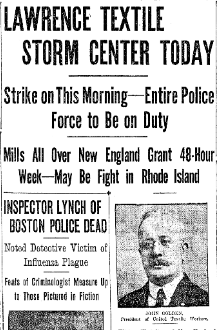
Several labor unions were involved in the 1919 strike, including the IWW, but the primary union involved with this strike was the Amalgamated Textile Workers Union, also known as the ATWU.
Despite the battle to win an 8-hour work day for several decades, not all workers enjoyed this right, which resulted in ongoing labor resistance across the country. The ATWU was fighting for shorter days, but they were also fighting for better working conditions.
The textile workers were making a measly 20 cents an hour and were often not paid for time that they worked. The workers were made up of people from at least 20 different countries, which always made it harder to organize such a diverse workforce. That the union could unify people across so many linguistic and cultural lines is a testament to their creativity.
The strike lasted 16 weeks and it was met with a tremendous amount of force by the company, which not only utilized the local police force, but the national guard, which at one point was guarding the textile mill with machine guns.
It was in this context that Hope College graduate and radical A.J. Muste came to Lawrence to stand in solidarity with the striking workers.
Muste was an ordained minister and harsh critic of the US involvement in WWI. Muste came to Lawrence just days after the strike began and joined the men and women on the picket line. Since many of the strikers had no or limited English speaking skills, Muste became a spokesperson for many of the workers, especially after he won their confidence when he was pulled off the picket line, beaten and hauled away by the local police.
Upon release from jail Muste came back and joined the picket line again and continued to be a spokesperson for the striking workers.
When the National Guard had been brought in, they set up machine guns to protect the textile mill. It is believed that the company sent in agent provocateurs to convince the workers to engage in violence, thus justifying the use of machine guns. However, Muste, who was a pacifist, counseled the workers to not use violence. Muste is believed to have said to the workers, “Let the mill owners try to weave cloth with machine guns.”
Whatever one thinks about the use of violence, in this instance the decision to not engage in violence worked and the strikers eventually won shorter work weeks, a 12% increase in pay and recognition of shop grievance committees in all departments.
We celebrate this day in solidarity with workers today who face unjust and brutal working conditions and are willing to fight back. We also remember and honor the person of A.J. Muste, not just because he is from West Michigan, but because he used his abilities to stand in solidarity with those who fought oppression.

This article by Steve Horn is re-posted from CounterPunch.
The American Legislative Exchange Council (ALEC) – known by its critics as a “corporate bill mill” – has hit the ground running in 2013, pushing “models bills” mandating the teaching of climate change denial in public school systems.
January hasn’t even ended, yet ALEC has already planted its ”Environmental Literacy Improvement Act“ – which mandates a “balanced” teaching of climate science in K-12 classrooms – in the state legislatures of Oklahoma, Colorado, and Arizona so far this year.
In the past five years since 2008, among the hottest years in U.S. history, ALEC has introduced its “Environmental Literacy Improvement Act“ in 11 states, or over one-fifth of the statehouses nationwide. The bill has passed in four states, an undeniable form of “big government” this “free market” organization decries in its own literature.
ALEC’s ”model bills” are written by and for corporate lobbyists alongside conservative legislators at its annual meetings. ALEC raises much of its corporate funding from the fossil fuel industry, which in turn utilizes ALEC as a key – though far from the only – vehicle to ram through its legislative agenda through in the states.
A Frankenstein Co-Created with Heartland Institute
A DeSmogBlog investigation last year found that the Environmental Literacy Improvement Act’s orgins date back to 2000.
The Act’s creation is directly connected to the ongoing efforts of another corporate-funded group, the Heartland Institute – of “Heartland Institute Exposed” fame – a group well plugged into the climate change denial machine.
ALEC’s Natural Resources Task Force, now known as its Energy, Environment and Agriculture Task Force, adopted this model at a time when the Task Force was headed by Sandy Liddy Bourne. Bourne, who served in this capacity from 1999-2004, would eventually ascend to the role of Director of Legislation and Policy for ALEC in 2004.
Upon leaving ALEC in 2006, Bourne become Heartland’s Vice President for Policy Strategy. Today she serves as Exectutive Director of the American Energy Freedom Center, an outfit she co-heads with Arthur G. Randol. Randol is a longtime lobbyist and PR flack for ExxonMobil, a corporation which endowed the climate change denial machine for years.
Heartland’s website still lists Bourne as one of its “experts,” stating that ”Under her leadership, 20 percent of ALEC model bills were enacted by one state or more, up from 11 percent.”
Importantly, Heartland is still a member of ALEC’s Energy, Environment and Agriculture Task Force that originally passed the Environmental Literacy Improvement Act.
According to internal documents leaked to and published by DeSmogBlog in Feb. 2012, Heartland obtained funding for a “Global Warming Curriculum for K-12 Classrooms” project beginning in 2012. This cirruculum aims to teach that there “is a major controversy over whether or not humans are changing the weather.”
If this sounds similar to ALEC’s model bill, it should, given the fact that the two outfits share funding from the same honey pot. In fact, Heartland actively promotes the ALEC model on its website.
Model Bill Introduced in OK, CO, and AZ
Oklahoma and Colorado came first and within just over a week, Arizona followed suit in proposing the ALEC climate science “mis-education” bill.
Oklahoma: Sooner Rather than Later
On Jan. 18, the Sooner State’s legislature took the lead for 2013 in pushing the ALEC climate change education model in the form of HB 1674, the “Scientific Education and Academic Freedom Act.”
HB 1674 calls for the teaching of “scientific strengths and scientific weaknesses of existing scientific theories,” including of global warming, saying it’s a theory steeped in “controversy” – not that the actual scientific record thinks so.
This is necessary, the bill states, “to help students develop critical thinking skills they need in order to become intelligent, productive, and scientifically informed citizens,” going on to explain that it’s important to explore “differences of opinion on scientific issues.”
The ALEC model similarly calls for the teaching of “critical thinking so that students will be able to fairly and objectively evaluate scientific…controversies.” The model also mandates creation of “an atmosphere of respect for different opinions and open-mindedness to new ideas” in the scientific sphere.
The OK bill is sponsored by Rep. Gus Blackwell (R-61), unsurprisngly a dues-paying member of ALEC. According to a Dec. 2012 report published by the Center for Media and Democracy (CMD) titled, “Buying Influence,” Blackwell has paid for his attendance at least one ALEC meeting with taxpayer money.
National Institute on Money in State Politics‘ data demonstrates that Blackwell’s largest pool of campaign funding for his 2012 electoral victory came from the oil and gas industry, which gave him $28,800. This includes taking $7,500 from shale gas industry giant Chesapeake Energy, $2,350 from ConocoPhillips, and $1,000 each from Koch Industries and coal industry giant Duke Energy, among others. All of these corporations also fund ALEC.
Colorado’s Same Day Affair
One sure sign of a coordinated, ALEC-lead effort is the fact that Colorado’s state legislature introduced the ALEC model on the same day as did Oklahoma’s. The two states, it’s worth noting, share a border on Oklahoma’s panhandle.
On Jan. 18, 2013, eight representatives and four senators introduced HB 13-1089, coining the bills the “Academic Freedom Acts.”
Paralleling the language in the ALEC model and the Oklahoma bill, the HB 13-1089 aims to ”Inform students about scientific evidence and to help students develop critical thinking skills,” also recognizing that the teaching of the concept global warming “can cause controversy.”
One of the senators co-sponsoring the bill, Rep. Scott Renfroe (R-13) is an ALEC dues-paying member. He’s also attended at least one ALEC meeting paid for by Colorado taxpayers, according to the CMD’s “Buying Influence” report.
Of the $91,000 dollars he raised for the 2012 election, over $5,000 of it came from the oil, gas and electric utilities industry, according to the National Institute on Money in State Politics. This includes taking money from Chesapeake Energy, Anadarko Petroleum, Williams Companies, and the Colorado Oil and Gas Association.
The Arizona (Sun) Devils are in the Details 
Eight days later, ALEC’s model bill made its way to Arizona, a state sharing a “corner border” with Colorado.
Arizona’s SB 1213 was introduced on Jan. 26, 2013 by six senators that, as it turns out, are all dues-paying ALEC members. Five of the six have attended conferences totally on the taxpayer dime, according to CMD’s report.
SB 1213 incorporates the “critical thinking skills” operative language, the “scientific controversies” operative language and the ”teaching…global warming” can “cause controversy” operative language.
In short, SB 1213 is the same exact copycat ALEC model bill that’s been proposed in both Oklahoma and Colorado.
ALEC Celebrates Groundhog Day 2013
Groundhog Day is on Feb. 2 and fittingly, ALEC and its corporate patrons continue to sing the same tune, simultaneously promoting fracking, blockading a transition to renewable energy and pushing bills mandating teaching climate change denial on par with actual science.
“It’s the same old schtick every year, the guy comes out with a big old stick, raps on the door,” actor Bill Murray said in the classic film “Groundhog Day.” “They pull the little rat out, they talk to him, the rat talks back, then they tell us what’s gonna happen.”
Replace “guy” with “corporate lobbyist” and “legislators” with “rats” and that’s ALEC in a nutshell, serving as a mere microcosm of the current American political system at-large.
This article by Karen Charman is re-posted from WhoWhatWhy.
While New Yorkers anxiously await Governor Andrew Cuomo’s decision on whether to lift the state’s de facto moratorium on high-volume slick-water horizontal hydraulic fracturing, or “fracking,” Woodstock, the iconic counter-culture capital of the world, has become the first municipality to call for legislation to make fracking a Class C felony.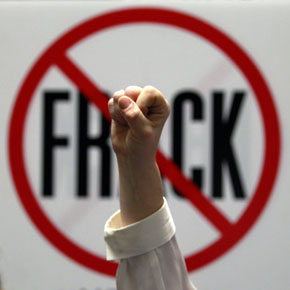
Woodstock’s action is just one small town’s response to a rapidly escalating global war over fracking. To both sides in this war—environmentalists and citizens who oppose fracking on the one side and the gas industry and its supporters on the other—the upcoming ruling to allow or ban fracking in New York is being viewed as (you should pardon the expression) a watershed event.
Decisions made in Albany and in towns like Woodstock will likely determine whether fracking goes full steam ahead everywhere, or whether its momentum can be slowed or even stopped. New York, after all, has a rich history of environmental activism and democratic movements, and anti-fracking activism has spread like wildfire over the last couple of years. New York is also home to abundant supplies of clean freshwater, an essential resource that is in crisis globally and that could be endangered by the practice.
Fracking? Please Explain
On January 15, the Woodstock Town Board unanimously passed a resolution to petition New York State to introduce New York Public Law #1—which would impose stiff penalties for fracking and related activities. Before taking this step, the Woodstock Town Board took two others: banning fracking within its borders and outlawing the use of frackwaste fluid, some of which is known as “brine” (because of its heavy salt content), on its roads. This material is used as a de-icing agent in the winter and for dust control on dirt roads in the summer. Despite the fact that brine from oil and gas wells (whether fracked or not) is laden with heavy metals, toxic chemicals, and radioactivity, since 2008 the Department of Environmental Conservation has granted approval for it to be spread on roads in the western part of the state.
New York Public Law #1 was conceived and drafted in May 2011 by the Sovereign People’s Action Network (SPAN) and FrackBusters NY—two citizen anti-fracking groups spearheaded by the late Richard Grossman, a legal historian, democracy activist, and founder of a movement to ban corporate personhood and strip corporations of their special legal privileges.
Fracking is used to extract “unconventional” sources of natural gas or oil, like those found in shale formations. Unlike the large pools of gas that make up “conventional” sources, the gas in shale is typically found in separate tiny bubbles throughout the rock formation. In order to get it, drillers create a “permeable reservoir” by shattering the rock formation that contains the gas.
This involves drilling a deep well straight down into the shale, then turning the well at roughly 90 degrees so that it runs horizontally another 10,000 feet or so. The well is fracked when a mixture of water, chemicals, and sand is pumped in at explosive pressure to force open cracks in the rock, enabling the gas to flow back up to the wellhead.
Since these wells travel under aquifers, lakes, rivers, and streams, much concern has been raised about the potential to contaminate groundwater and other freshwater supplies. Fracking also requires a massive industrial operation, which creates significant air pollution, noise, and truck traffic. Large amounts of various toxic compounds, plus nitrous oxide, a key component of ozone, spew from diesel generators, drill rigs, trucks, condensate tanks, and other equipment, as well as the flaring of wells.
In communities across the country where fracking has been underway for more than a decade, the process has left a trail of poisoned people, serious water pollution, including radioactive contamination of drinking water supplies, and potential threats to the value of people’s homes and land in drilling areas. The gas industry has denied that its actions are responsible for these problems.
Meanwhile, serious questions have been raised about the integrity and economic viability of the entire enterprise. Officials within the United States Energy Information Administration, a division of the Energy Department, have suggested that estimates of gas reserves may have been purposely inflated, a concern graphically illustrated in hundreds of industry emails and internal documents—some of them dripping with contempt.
According to one industry insider, “The word in the world of independents is that the shale plays are just giant Ponzi schemes and the economics just do not work.” Another equated the hype around shale gas as a “charade” and said companies involved were “having an Enron moment,” adding that “they want to bend light to hide the truth.”
On another environmental front, evidence is mounting that a vast expansion of shale gas extraction will dramatically increase global warming. That’s because the emissions of methane—a much more potent greenhouse gas than carbon dioxide—leaking out of the ground in drilling fields are much greater than previously known. Considering that fracking is becoming a global phenomenon, the methane leakage could be a significant new source of greenhouse gas emissions.
SPAN, FrackBusters NY, and the Woodstock officials who passed the resolution calling for criminalizing the activity believe that existing law and regulation won’t protect New Yorkers from the irreversible damage fracking would inevitably cause. On its website, SPAN says: “The traditional way to prevent irreparable harm is by enacting laws criminalizing such behavior and by imposing deterrent-level penalties.”
A Law with Real Teeth
As such, the law is comprehensive in scope and mandates prison sentences of between five and 20 years along with minimum fines of $1 million per violation. Activities deemed felonies under the law include:
– extracting oil and/or gas by fracking in New York State; - mapping, exploring and locating oil and/or gas deposits with the intent to frack; - importing frack-related materials into the state, including fracking wastewater and drill cuttings; - withdrawing any water in the state for the purpose of fracking anywhere; and - owning, possessing or transporting fracking paraphernalia anywhere in the state.
The law also goes after corporations—and their boards and top management—found to violate it. New York corporations would have their corporate charter revoked, while those chartered elsewhere would have their authority to do business in the state rescinded. Such corporations could also have any assets they had in New York seized to be sold at auction, with the proceeds going to the state treasury.
Nor does Public Law #1 exclude government personnel. It would also make any person working for any level of government in New York, whether as an employee or as an elected or appointed official, liable not only for compensatory and punitive damages, but also legal expenses if that person was found in violation.
“The oil and gas mining laws of New York, as presently written, disempower citizens and communities while treating corporate fracking and fracking-related activities as legal, despite the extreme and irreversible harm this industrial process causes,” FrackBusters NY said in a statement from November 2011, when the group first unveiled the draft law.
The law is intended to move the debate over fracking out of the regulatory arena, whose often glacially paced and always expensive procedures are designed only to mitigate rather than prevent harm. Instead, the law would require officials to stop the damage before it occurs.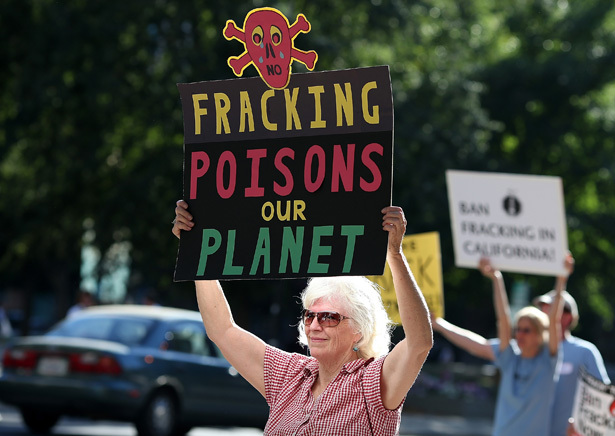
In October 2011, a month before he died, Grossman gave an interview to Russell Mokhiber, editor of the Corporate Crime Reporter, in which he said that he and his co-activists had no illusions about the New York State Legislature: “But theoretically at least, that is where laws are made. And that’s where sovereign people go to instruct our representatives. Our approach to our legislators is: we wrote this law—now you pass it.”
Grossman also said that anti-fracking activists understood that this wouldn’t happen “until we build a formidable statewide movement that is not only talking about fracking as a destructive technology, but also about illegitimate rule by a very small corporate class.”
Jobs vs. Environment: A Familiar “Choice”
Anti-drilling sentiment is rising in New York. Currently, 43 municipalities have enacted bans, 110 have passed moratoriums, and there are movements for either outright bans or moratoria in another 91 municipalities.
Not everyone is opposed to fracking, however. Like many areas in the country, the upstate economy is struggling with high rates of poverty and unemployment, issues that loom large for many people living in areas above the shale. Forty-four municipalities have passed resolutions supporting fracking, though opponents in some of those communities are trying to repeal pro-fracking resolutions and enact either a ban or moratorium.
The public’s concern about shale gas extraction is much more nuanced than the common but crude “jobs versus environment” framing. According to a survey of 600 residents in upstate New York by Cornell University’s Survey Research Unit in January 2011, 46 percent said the need for jobs and economic issues was the most important concern facing their community. And 70 percent of those living in counties with urban area populations of between 10,000 and 50,000 (“micropolitan” counties) said creating local jobs was the most important goal of their local government, while 59 percent of respondents in more sparsely populated areas agreed.
At the same time, environmental preservation also scored high among upstaters. In response to the question, “Given the current economic challenges facing New York State, do you believe state and local governments should be committed to protecting long-term environmental values?”, 90 percent said yes. When specifically asked about natural gas drilling and whether the risks to water quality outweighed the benefits of the revenues, or vice versa, 65 percent said the risks outweigh the benefits, 24 percent said the revenues were more important, and 11 percent said they didn’t’ know enough about gas drilling to answer.
Regulatory Business-as-Usual—But with a Twist
Anti-fracking groups delivered 204,000 letters on the New York Department of Environmental Conservation’s proposed regulations on January 11, 2013, the last day of a 30-day public comment period that included the Christmas holidays.
The DEC took most of 2012 to read the 66,000 comments generated during an earlier public comment period. Yet the agency appears to be pushing hard to meet a February 27, 2013 deadline to approve the proposed regulations that would pave the way for the issuing of drilling permits. If the fracking regulations are not finalized by that date, the proposed ruleswould lapse, in which case the entire process would start from scratch, probably delaying any decision to allow fracking in the state for years.
Governor Cuomo and the DEC have come under intense criticism for rushing the process. The most recent comment period under the state’s environmental review—quite possibly the last—asked for public input on regulations the agency put out before its environmental review was finished.
There has been no comprehensive study of fracking’s health impacts by independent experts, a glaring omission in the state’s environmental review, which citizens and environmentalists have repeatedly called on the governor and DEC to remedy. Instead, the Cuomo administration decided to have the state Department of Health conduct a health review that veteran Albany Times Union columnist Fred LeBrun describes as “opaque.”
“To this day,” LeBrun continues, “the public has not a clue as to what the health department is actually looking at, what’s being reviewed, whether any recommendations for change will be made. That’s all being kept secret by the administration. And apart from the names of the three respected public health experts from outside the state vetting the health department’s work, we know nothing of what they are being asked to vet, whether they, too, can make any recommendations, [or] what the limits of their oversight might be.”
The rule-making on fracking “has been from hell, an abomination,” LeBrun said. “The public has been deceived, misdirected and kept utterly in the dark over where the state was heading concerning the most important environmental issue of this generation.”
Frackbusters NY says New York’s oil and gas mining laws, as currently written, “disempower citizens and communities while treating corporate fracking and fracking-related activities as legal, despite the extreme and irreversible harm this industrial process causes.” It further charges that the New York DEC “functions as a pro-corporate agency, enabling hazardous extraction processes that benefit the few against the interests of local communities and the vast majority of citizens.”
The DEC’s behavior in its environmental review of fracking seems to bear out the group’s allegation. Under existing state law, DEC must publish its environmental review, a document known as the Supplemental Generic Environmental Impact Statement, or SGEIS, at least ten days before it releases its final decision. The SGEIS will contain the reasoning behind the DEC’s decisions on fracking as well as whether or not it will be permitted in New York.
If the state is to meet its February 27 deadline to finalize its regulations and lift the de facto moratorium on fracking, the SGEIS would have to be published by February 13.
But whether Cuomo approves fracking or not, this high-stakes fight will undoubtedly continue.
To the deep-pocketed and politically powerful fossil fuel industry—which has run out of large, easily exploited reservoirs of fossil fuels—fracking is the only way to get at much of the vast supplies of what is left. Global warming or not, the fossil fuel sector is aggressively securing as much of those sources as they can throughout the world.
To those concerned about the immediate harm to their health, the environment, and their communities, as well as the continued existence of our species and other life forms we share the planet with, stopping fracking is a question of life and death.
If Cuomo does approve fracking in New York, thousands have pledged to continue the resistance with acts of civil disobedience. Can ordinary citizens prevail, Occupy Style, when the money piles are high, and the stakes even higher? Stay tuned.
Victory for Undocumented Immigrant Youth: Secretary of State Decides to Grant DACA recipients Driver Licenses
Yesterday, Secretary of State Ruth Johnson reversed her discriminatory policy that denied Deferred Action for Childhood Arrivals (DACA) recipients their right to a driver license. This is a tremendous victory for our community and our allies.
In her announcement, Johnson tried to misconstrue the January 18 announcement United States Citizenship and Immigration Services (USCIS) as a “reversal” in policy, but it was always her mistake. Over 30 states have confirmed that they will issue licenses to DACA holders; Johnson was one of a select few that needed a lawsuit to change her mind.
On October 18, 2012, Secretary of State spokesman Fred Woodhams said “the Secretary of State is taking direction from the federal government as to who is and is not legally in the country,” according to MLive. “Because the Deferred Action on Childhood Arrivals program doesn’t confer legal presence on its participants, we are not able to issue licenses or ID cards to DACA participants,” he continued. “As its name implies, the program merely defers action on the individual and doesn’t make the individual legally present in the United States.’”
The USCIS announcement clearly states that “An individual who has received deferred action is authorized by the Department of Homeland Security (DHS) to be present in the United States, and is therefore considered by DHS to be lawfully present during the period deferred action is in effect.” Furthermore, it asserts that “The relief an individual receives pursuant to the deferred action for childhood arrivals process is identical for immigration purposes to the relief obtained by any person who receives deferred action as an act of prosecutorial discretion.”
Secretary of State Ruth Johnson states, “The feds now say they consider these young people to be lawfully present while they participate in the DACA program, so we are required to issue driver’s licenses and identification cards. I will continue to follow the law.”
One Michigan led a call-in campaign that generated over 1,000 calls to the Secretary of State office. Also, One Michigan was a plaintiff in a lawsuit against Johnson.
“This reversal will give immigrant youth the opportunity to contribute more fully to society by giving them a chance to work, go to school, and lead productive, fulfilling lives.” states Evelin Calderon, One Michigan member and DACA recipient.
This victory should be seen as the direct result of all the grassroots work to pressure the government, like phone calls, demonstrations and direct action that has been organized across the state for the past several months.
This article by Sadhbh Walshe is re-posted from The Guardian. Editor’s Note: The Michigan Department of Civil Rights
published a report on the working and living conditions of migrant workers in Michigan. The report acknowledges that working conditions are as bad and in some cases worse now than they were for migrant workers in the early 1960s.
This week, a bipartisan group of senators and the president unveiled their respective plans for much needed and long overdue immigration reform. For the 11 million or so undocumented immigrants who have settled in this country, the path to citizenship being paved for them looks like it will be more tough than fair.
While we don’t yet know how this will all play out, at least there will be a path. For one group of immigrants, however – the farm workers who sustain our food supply – there is reason to fear that what awaits them is not a path to citizenship, but their cemented status as indentured servants.
Most farm work in America is performed by immigrants, most of whom are undocumented and therefore exploitable. The big agribusinesses that hire these immigrants will tell you that they need an unfettered supply of cheap foreign labor, because they cannot find Americans willing to do these jobs.
When you consider what these jobs entail – hours of backbreaking work in terrible and often dangerous conditions, subsistence wages with little or no time off, and none of the protections or perks that most of us enjoy (like paid sick days, for instance) – it’s hard to see why anyone with other options would subject themselves to a life that is barely a step above slavery.
In the 1980s, President Ronald Reagan signed a bill into law which introduced some protections for these imported serfs, under what has become known as the guest-worker program. These protections include a minimum wage guarantee, housing that meets an acceptable standard for the duration of the contract, and a guarantee that the worker be paid three-quarters of their full pay should should a season end early.
Most employers would be delighted to get away with all this: being able to hire low-wage workers at will, without the hassle of paying disability insurance or other niceties. But agribusinesses find the guest-worker program’s pitiful protections such a burden that they have mounted a relentless campaign to undermine them, and for the most part, work around them anyway; they hire undocumented workers instead.
According to a report compiled by Eric Ruark (pdf), the director of research at the Federation for American Immigration Reform (Fair), as of 2006, only 27% of workers hired by agribusinesses are American citizens, 21% are green card holders, around 1% are part of the guest worker program … and a whopping 51% are unauthorized immigrants.
It’s agriculture‘s worst kept secret that farm owners routinely break the law by hiring undocumented workers, but the crime receives tacit approval from lawmakers sympathetic to the plight of major agribusinesses, which seem to consider cheap labor their right. In South Carolina, for instance, lawmakers passed their version of Arizona’s draconian bill, and have mandated that employers use an e-verify system to check the immigration status of employees. Farm workers, however, were exempted from verification.
The agribusiness sector has gotten away with exploitative and illegal practices because of ridiculous threats, like the suggestion that should the supply of cheap labor dry up in the US, they will outsource our food production to China. This idle threat is based on the absurd notion that if they have to pay workers higher wages, somehow there will be fewer people willing to do the jobs. The other scare tactic is spreading talk that if they have to increase their expenditure on labor, those costs will have to be passed on to the American consumer.
Several studies have been conducted, however, that expose these hollow threats for the nonsense that they are. A report by the Congressional Research Service (pdf) found no evidence of a labor shortage in the agricultural sector. On the contrary, it found that between 1994 and 2008, the unemployment rate for farm workers was consistently higher than for all other occupations. In other words, agriculture has had a surplus of available workers for decades.
During this period, the agricultural industry has recorded a nearly 80% average annual increase in profits – more than all other major industries. No doubt, these record profits have something to do with the fact that real wages for farm workers have remained stagnant throughout this time. Finally, a 2011 report by the Economic Policy Institute found that an increase in farm workers’ wages of 40% would result in an annual rise in household spending by the American consumer of just $16.
Clearly, the economic argument for allowing one industry a workforce of virtually indentured labor does not hold water. But there is a humanitarian argument to be made, as well, that should be enough to put an end to this exploitative practice immediately. In 2009, the New York Times’ Bob Herbert wrote an article about the horrible treatment of farm workers in upstate New York – in this case, hired to feed and care for ducks farmed to be slaughtered for foie gras.
“The routine is brutal and not very sanitary. Each feeding takes about four hours and once the birds are assigned a feeder, no one else can be substituted during the 22 day force feeding period that leads up to the slaughter … Not only do the feeders get no days off during that long stretch, and no overtime for any of the long hours, but they get very little time even to sleep each day. The feeding schedule for the ducks must be rigidly observed.
“When I asked one of the owners, Izzy Yanay, about the lack of a day of rest, he said of the workers: ‘This notion that they need to rest is completely futile. They don’t like to rest. They want to work seven days.'”
Herbert went on to make the point that we are much more likely to hear complaints about cruelty to ducks by force-feeding than we are about the cruelty to the people hired to feed them. Consumers have long since showed a willingness to pay more for organic meat or chicken because they don’t like the idea of animal cruelty.
Are we really not willing to pay a few cents more for farm produce so that human beings are not treated like animals?
It remains to be seen what the bipartisan “gang of eight” senators have in mind specifically for farm workers in any future immigration bill. But one can only hope that they will not give in to bullying by the spoiled agricultural industry, which continues to deny these workers the same rights and protections every other worker in America enjoys.
Keystone XL Blockader Disrupts TransCanada Meeting
This article and video is re-posted from Common Dreams.
Ramsay Sprague, a spokesperson for Tar Sands Blockade, was arrested Thursday after disrupting a planned speech by TransCanada executive Tom Hamilton by chaining himself to the room’s audio equipment and telling security officials attempting to remove him: “I don’t have key.”
Sprague’s protest comes less than a week after 19 activists and environmental organizations agreed to a repressive settlement preventing them from trespassing on Keystone XL property to protest Tar Sands pipeline owned by Hamilton’s company.
Hamilton was scheduled to speak before a crowd of 300 pipeline construction executives about safety and regulations on the KXL pipeline. But approximately 10 minutes into Hamilton’s speech, Sprague interrupted by chaining himself to the equipment and telling attendees that the “slow industrial genocide” caused by the pipeline must end.
“Toxic Tar Sands extraction should not be allowed to continue,” Sprague said. “We’ve been inside the pipe, light shining through at morning, with photographic and video evidence that the their wells are inadequate. That pipe went into the ground less than an hour later.”
“TransCanada’s safety record is beyond deplorable,” he continued. “Their wanton disregard for the health of our communities is demonstrated by their countless toxic tar sands spills. I’m compelled to take action today and shed light on the dangerous material this multinational corporation is pumping through our homes.”
Along with Sprague, three other activists were detained but released and escorted from the conference, the group said in a release.
Sprague is among 19 individual activists, along with Tar Sands Blockade, Rising Tide North America and Rising Tide North Texas, who on January 25 agreed, under threat of a $5 million lawsuit, not to trespass on Keystone XL property.
As part of the settlement, the activists agreed to no longer trespass or cause damage to Keystone XL property throughout the pipeline’s entire southern leg, including any demonstrations “aimed at interfering with pipeline construction,” the Toronto Star reports.
But Sprague vowed at the time to continue protesting the dangerous pipeline.
“TransCanada is dead wrong if they think a civil lawsuit against a handful of Texans is going to stop a grassroots civil disobedience movement,” he said in a statement. “This is nothing more than another example of TransCanada repressing dissent and bullying Texans who are defending their homes and futures from toxic tar sands.”
This article by Sundiata Acoli is re-posted from Black Agenda Report.
This article previously appeared on the website dedicated to political prisoner/prisoner of war Sundiata Acoli. It was written to accompany Dan Berger, author, anarchist and college professor on his January, 2013 book tour thru Germany. Dan is author of “Outlaws in America: The Weather Underground Organization” and is the editor of “The Hidden ’70s.”
America has millions of prisoners locked away in its dungeons, many for 20, 30 and 40 years or more – yet astonishingly, it claims there are no Political Prisoners or Political Prisoners of War (PP/POWs) in its prisons – and that it has no PPs.
That makes the u.s. the only country in the world that has MASS INCARCERATION, has more prisoners, period, than any other country – and has prisoners locked in secret CIA prisons around the world, but no PPs.
Since it has no PPs, it obviously has no masses of poor, hungry, homeless or unemployed people, nor does it have hordes of oppressed nationalities and lower classes herded into reservations, barrios, ghettoes, ‘hoods, trailer parks and housing projects who are daily subjected to various forms of discrimination, racial profiling and police brutality, murder and mass imprisonment.
If the u.s. has no PPs, then apparently there’s no MASS INJUSTICE in america because that’s where MASS INCARCERATION and PPs come from. MASS INCARCERATION is the barometer, the main indicator of MASS INJUSTICE in society.
PPs are those in every land and throughout every era, who are imprisoned for fighting INJUSTICE in their societies and the same holds true today for the relationship between MASS INJUSTICE, MASS INCARCERATION and PPs in u.s. society – and who must be freed! Not only PPs – but ALL those imprisoned by unjust policies.
The latest 30-year prison-building/mass-incarceration spree has left the land dotted with thousands of new prisons overfilled with millions of prisoners – all of which has convinced state legislators that they cannot incarcerate their way out of the defects in this political system and that the current budget-busting levels of incarceration are too costly to sustain any longer.
So at this moment it seems very possible for social movements to succeed in reducing prison populations. But any reductions under the present policy would only postpone the next INCARCERATION binge to some more cost-efficient time in the future although MASS INCARCERATION itself is the problem! Not crime, not drugs nor violent offenders per se, but MASS INCARCERATION itself is the problem. Crime rates, for serious crime, were as low in 2011 as they were in 1964. Rates for violent and nonviolent crimes have been declining for at least five years but the national prison population is functionally the same size. So it’s clear that incarceration rates are “policy” driven, not “crime” driven. And history shows that america’s incarceration is driven primarily by “unjust racial/class” policies.
The 1st instance of america’s unjust racial policy occurred at inception with its incipient genocide against Indigenous american, theft of their land and Chattel Slavery – unjust on its face – became racially so when it switched to enslaving Blacks ONLY. Confinement of Indigenous americans on reservations, their captured Chiefs and Braves in military prisons and the enslaved Afrikans on plantations for 300 years was the first MASS INCARCERATION committed by the colonial nation. Every slave confined on a plantation or runaway detained in jail was a POW. So was every Indigenous american forced onto reservations or detained in military prisons – as was any other person detained for resisting american genocide, enslavement, rape and robbery of their lands and nations.
The 2nd instance, which began at the end of the Civil War and continued until the 1970s, was the use of Black Codes and Jim Crow segregation laws to re-enslave the newly freed Blacks and people of color in general through mass imprisonment in the penal system. At the time Whites were the overwhelming majority of the nation’s prison population when the percentage of Blacks in the southern prisons jumped from near zero to 33% within 5 years. Others imprisoned during the ensuing 100 year struggle against Jim Crow segregation and other racial/class oppressions were the increasing number of poor immigrants and other such agricultural and industrial workers, union organizers, war resisters, ghetto heroin addicts and the rising number of Civil Rights workers and revolutionaries of all stripes: Black Panther Party, Puerto Rican Young Lords, Anti-imperialist Weather Underground Organization, Chicano Brown Berets, American Indian Movement, the Asian I WOR KUEN and numerous others which resulted in the defeat of Jim Crow (de jure) segregation during the mid-’60s. By 1975, Black and other people of color made up nearly half of the 250,000 prison population. The period between 1865 and 1975 produced a great number of PP/POWs, including Big Bill Haywood, Sacco and Vanzetti, Sitting Bull, Marcus Garvey, and Pedro Albizo Campus; George Jackson, Angela Davis, Marilyn Buck, Huey P. Newton, Assata Shakur and many others.
And the 3rd instance of unjust racial/class policies began around 1975, a decade after the defeat of Jim Crow (legal, not actual) segregation. In that intervening period and beyond, numerous revolutionary organizations who were fighting injustice – the Black Liberation Army, FALN of Puerto Rico, American Indian Movement, Weather Underground Organization, the United Freedom Front, MOVE and others – were attacked by the police who killed or imprisoned several of their members. Those imprisoned joined the ranks of other unrecognized PP/POWs already in prison. Ronald Reagan set widespread injustice in motion by flooding South Central L.A. with “crack” cocaine to secretly finance the Nicaraguan Contra War in the early 1980s, and incarceration rates skyrocketed. “Crack” spread quickly, devastated ghettoes nationwide and escalated the racist, hypocritical War on Drugs and racial profiling schemes that mainly targeted people of color, White hippies and the poor as crime suspects and targeted communities of color for saturation with Street Crime Units to terrorize, mass imprison and paint its inhabitants with felony convictions later used to deny their right to vote, deny their right to work jobs/trades requiring certain licenses and certificates, deny the right to live in public housing, deny food stamps, deny student loans for college/trade course etc., all of which relegated felons to a permanent 2nd-class status, exploded the prison population from 250,000 in the mid-’70s to 2.3 million today and so aptly verified noted author Michelle Alexander’s statement that: “MASS INCARCERATION is the New Jim Crow.” This era produced PP/POWs Oscar Lopez Rivera, Kuwasi Balagoon, Mumia Abu Jamal, David Gilbert, Leonard Peltier, Move 9, Susan Rosenberg, Carlos Alberto Torres, Tom Manning, Jaan Laaman and numerous Muslim, Earth Liberation Front, Animal Liberation Front, Environmentalist and Occupy Wall Street PPs, plus Sekou Odinga and the liberation of Assata Shakur followed by her political asylum in Cuba. Blacks had become the absolute majority of the prison population at about 55% but the number is even higher since approximately 5 to 10% of the Black population is hidden in under the “Hispanic” ethnic category in the census, which often omit racial designations so that the “official” percentage of Black prisoners is listed at about 45% followed by a fast growing number of Browns: Latino/as, Hispanics, Indigenous americans and Asians, with Whites declining to less than 20%.
Since america’s MASS INCARCERATION is driven by unjust racial/class policies then the real solution to MASS INCARCERATION is MASS “DECARCERATION.” In other words, drastic cuts to ALL prisoner’s TIME, since TIME is the currency, the legal tender, the great equalizer and righter of wrongs in prison.
Many prison and human rights activists are in agreement with a position forwarded by Michelle Alexander, which calls for incarceration rates to be reset to 1980 levels, or even to the post-Jim Crow level of the 1970s, which are levels before Ronald Reagan flooded South Central and set off the “Crack” epidemic in america. Decarceration opens the door to struggle over the life and scope of the system more generally; it can be shrunk well beyond its earlier levels! To “DECARCERATE,” many activists advocate some form of time-served plus prisoner-age combination that automatically put a prisoner out the door when the combination adds up to a certain number. The main proposal for this strategy, advocated by POWs like Russell Maroon Shoatz, calls for 25/50 and out: that is, if a prisoner is over 50 and has served 25 years or more, than s s/he is “automatically out the door” or discharged immediately. This strategy will free those imprisoned by, or long held for, biased and unjust policies – including many PPs as well.
Thank you for your attention – and i hope we can find ways to work together in support of PPs, prison struggles and progressive movements in both our countries. Our main PP organization is The Jericho Movement at nycjericho@gmail.com. Feel free to contact them on any issue regarding solidarity work for PPs in the u.s.
i also bring you solidarity greetings from those who have been on a rolling on hunger strike in the California state prisons. They’re joined in a fierce struggle to end solitary confinement, some of whom have been held in solitary 20 years or more; 20 years in conditions described by their outside representative thusly:
“The long-term (indeed life long) indefinite isolated solitary confinement in 7′ 7″ x 11′ 7″ concrete boxes for 22 1/2 hours per day in California’s Pelican Bay and Corcoran Secure Housing Units (SHUS) is torture. It is cruel. Without phone calls, without human touch, degrading and humiliating routines, bad food, insufficient clothing, no fresh air and they NEVER see natural sunlight, terrible mattresses… without hope of ever escaping, all this most often for reasons that have nothing to do with behavior, or even disciplinary matters. This is unprecedented in the history of the United States. Isolated for life for alleged associations, for what books you read, what art you draw or for what you believe in…. this is commonplace in the California system – a system which takes up more than half of California’s budget.”
They’re also struggling against an insidious gang debriefing program that requires them to “give up” or “make up” info (i.e., “snitch”) on another prisoner as their only ticket out of solitary. As expected, or designed, the program creates or greatly aggravates hostility between prison gang members and ethnic groups. In return the Hunger Strike leaders have initiated a Truce Movement among the various gangs and ethnic groups that’s well worth your support and worth emulation by other states. To find out how you can support the California Prisons’ Hunger Striker contact their outside representatives at:
Anne Weills and Carole Travis Siegel and Yee 499 14th St. Suite 300 Oakland, CA 94612 and/or contact any of the following prisoner Hunger Strike leaders:
Todd Ashker, C58191, D1-119
Arturo Castellanos, C17275, D1-121
Sitawa Nantambu Jamaa (Dewberry) C35761, D1-117
Antonio Guillen, P81948, D2-106
Paul Redd, B72683, D2-117
Pelican Bay mail to prisoners is addressed to: P.O. Box 7500 Cresent City, CA 95532
Thank you.
In Struggle, Sund
This article by Brian Tashman is re-posted from Right Wing Watch.
Tony Perkins of the Family Research Council has joined American Family Association’s Buster Wilson in linking the repeal of Don’t Ask Don’t Tell to the military’s suicide rate. Discussing the Pentagon’s new policy on allowing women to serve in combat units yesterday on his radio program, Perkins said that the Obama administration’s work in “driving Christianity out [and] putting homosexuality in” are “adding additional stress” that leads to a higher rate of suicide.
Perkins cited no evidence to back up his claim, but as with his ominous and incorrect predictions regarding the consequences of DADT’s repeal, he apparently doesn’t see a need to substantiate his outrageous allegations.

Perkins: The volume of these decisions coming out of this administration is unbelievable, unbelievable. The stress in our military, when you look how they have used the military for their social experimentation: driving Christianity out, putting homosexuality in, suicide rate going through the ceiling. I think it was last year if I recall the numbers there were 349 suicides in 2012 and I believe that’s more than were killed in combat, that’s the highest number since the Pentagon began tracking suicides back in 2001. And what are they doing? Adding additional stress by this social engineering. Unbelievable.
Enbridge Resisting Final Clean-Up of Its Michigan Oil Spill
This article by Lisa Song is re-posted by InsideClimate News.
Two and a half years after the costliest oil pipeline spill in U.S. history, the company responsible for the disaster is balking at digging up oil that still remains in Michigan’s Kalamazoo River.
The cleanup has been long and difficult because the ruptured pipeline was carrying bitumen, a heavy oil from Canada’s tar sands region. Bitumen is so thick that it can’t flow through pipelines until it’s mixed with liquid chemicals to form diluted bitumen, or dilbit. When more than one million gallons of dilbit poured out of the broken pipeline in July 2010, the chemicals evaporated and the bitumen began sinking to the riverbed.
Today, regulators and oil spill experts are still struggling to deal with the accident, which was the first major spill of dilbit into a U.S. waterway. The cleanup tools and techniques developed for conventional oil spills—which mostly float on water—are ineffective for submerged bitumen, so experts have had to come up with new methods.
In October, the U.S. Environmental Protection Agency asked Enbridge Inc., the pipeline’s Canadian owner, to clean up several miles of the river where submerged oil is still accumulating. The proposed order told Enbridge to dredge 80 to 100 acres of the riverbed. The request was based on the results of a yearlong study the EPA conducted with oil cleanup experts, Michigan state regulators and a committee of about 15 scientists.
The dredging is needed, the agency said, because the oil could spread into uncontaminated areas of the river if it isn’t removed.
Steve Hamilton, a Michigan State University professor and a scientist on the committee, said the number of acres could change as the EPA continues to study the situation. “No specifics have been decided…Further recovery actions in the most contaminated sediments—potentially including dredging—are being contemplated.”
Enbridge responded to the request by asking the EPA to delay issuing its final order until the agency completes some ongoing scientific studies. In a Nov. 2 letter obtained by InsideClimate News, the company questioned the EPA’s assertion that the submerged oil is “mobile” and could contaminate sections of the river that are already clean.
“Studies and activities are currently ongoing to better understand the extent, if any, of submerged oil transport, containment of oil and recovery of oil-containing sediment related to the Line 6B release,” Enbridge wrote.
The EPA is drafting its response to the letter and declined to comment about its discussions with Enbridge.
Nick Schroeck, executive director of the Great Lakes Environmental Law Center, said the Clean Water Act gives the EPA authority to order whatever cleanup it determines is needed. But in these types of cases, the agency likes to work with the responsible parties, he said, and make its orders as “least burdensome as possible” to avoid court challenges.
Enbridge, Canada’s largest transporter of crude oil, was fined a record $3.7 million for the 2010 spill by the U.S. Department of Transportation. The National Transportation Safety Board blasted the company for a “complete breakdown of safety.” The EPA is conducting a separate investigation of the accident.
The slow pace of the cleanup has angered Deb Miller, whose home is about 300 feet from Ceresco Dam, one of the locations targeted for dredging. When an area near the dam was dredged in 2010, Miller and her husband, Ken, lived for months with the noise of helicopters and machinery. So much heavy equipment blocked the roads by their nearby carpet and flooring store that their customers couldn’t reach them.
Still, Miller wants Enbridge to abide by the EPA’s order and dredge again near her home.
“It just really frustrates me, that our federal government allows a company to put a product through [a pipeline] where they don’t know the effects and don’t know how to clean it up,” Miller said in an interview last week.
In 2010, Miller testified before Congress about the spill and she has joined the New Voices Project, an outreach group created by the nonprofit Pipeline Safety Trust, which advocates for improved pipeline regulations and practices.
Last fall, Miller took a garden rake and stirred up the bottom of the river. She said the oil “just came up black.” Now that the river has frozen over, there’s no visible contamination, yet Miller remains worried.
“There’s no way I will ever let my 14-year old grandson step foot in the river,” she said. “Us property owners [are] sitting with a river that’s absolutely contaminated and changed forever. We were promised this would be made whole, that the river would be made better than it was before…In my mind, it comes down to a bottom line. They don’t want to put the money into dredging.”
Hamilton, the Michigan State professor, said the EPA committee is conducting a number of research projects, including examining the submerged oil’s effects on aquatic life, refining a hydrodynamic model to track the oil’s movement and analyzing the environmental impacts of dredging and the effectiveness of less intrusive methods of oil removal. He spoke with InsideClimate News as an individual scientist, not as a representative of the EPA.
“My personal interest is to be more ready for the next spill,” said Hamilton, who has spent years studying the Kalamazoo’s hydrology and water quality.
U.S. imports of dilbit are projected to quadruple in the next decade, and dilbit would be carried on the proposed Keystone XL pipeline, which crosses the critically important Ogallala aquifer. Earlier this month, the Nebraska Department of Environmental Quality concluded that a dilbit spill in the Ogallala would be less serious than a spill into surface water, because groundwater moves slowly within the aquifer. But the agency did not model the impact of a dilbit spill on Nebraska’s rivers or lakes.
Spill Forced EPA to Improvise Cleanup Techniques
The debate over the Kalamazoo cleanup underscores how little is known about dilbit and how to remove it from waterways.
To gauge the extent of damage after the spill, the EPA developed a method it calls “poling” to map the amount and location of the oil. Using hand-held poles, workers agitated the sediment in the riverbed to see if oil floated to the surface. They found that the current was sweeping clumps of oil downstream, allowing them to collect in low-lying areas, where they were sometimes buried in up to six inches of sediment.
Results from the latest survey show that oil is pooling near Ceresco Dam, Mill Ponds and Morrow Lake Delta. Oil is also showing up in places that were once oil-free, and the EPA is concerned it could move further downstream during floods.
Enbridge disputes these conclusions.
“Poling is a rough, subjective method to determine the general location of submerged oil without accounting for volume, source of oil or potential for migration,” the company said in its letter.
Hamilton acknowledged that the technique is flawed, but says it’s the best method they have given the unique challenges of this spill. “Poling remains to this day the only practical method of going out in the field and trying to find submerged oil,” he said.
Enbridge also argues that the dredging would do more harm than good.
Last year an InsideClimate News investigation of the spill showed that regulators and scientists have constantly struggled to balance oil cleanup with protecting the ecosystem. The EPA’s proposed order acknowledges that dredging is too destructive for some parts of the river. But it also says that after consulting its scientific committee and other experts, it determined that the benefits outweigh the potential damage in the three areas tagged for cleanup.
“The decision has been made, by EPA at least, that we should go after [the oil] while we can,” Hamilton said. “Once it gets spread all around it’s harder to [clean up].”
Enbridge has used less intrusive methods in many parts of the river, including agitating sediment and collecting any oil that floats to the surface. In its letter objecting to the EPA’s plan, it said it prefers to continue with those techniques.
The EPA is studying whether these methods are effective, Hamilton said. But so far, no one has “properly measured what fraction of the oil is collected that way.”
Jay Wesley, a fisheries expert with Michigan’s Department of Natural Resources, said the three areas targeted by the EPA already have been heavily disturbed by cleanup activities over the past two years, “so some additional dredging…probably won’t affect the ecosystem too badly.”
Under orders from the EPA, Enbridge used an even more intrusive method in 2011 to clean up Talmadge Creek, a Kalamazoo tributary that received the brunt of the damage from the ruptured pipeline. The creek was so badly contaminated that Enbridge had to essentially rebuild two miles of it.
“They dug out the whole stream and its valley, carted it [away] in trucks and brought in clean materials…It’s 100 percent new,” Hamilton said.
The dredging the EPA is proposing now would be much less intrusive than that, but the process could still take months and substantially increase the cost of the cleanup, which already totals more than $809 million.
Before any work can begin, Enbridge will have to apply for permits from Michigan’s Department of Environmental Quality.
Michelle DeLong, who leads a response team the MDEQ formed to deal with the Kalamazoo spill, said the permitting process would take at least a month.
If Enbridge ends up dredging 100 acres, it would be “a pretty large scale operation,” she said. A staging ground would be needed for the heavy equipment, and Enbridge would have to submit a detailed work plan to the MDEQ. Impacted property owners would have an opportunity to comment on the plan and could request a public hearing. If that happened, DeLong said the permitting process could extend to two months.
Hamilton said the EPA will conduct another survey of the submerged oil in the spring, which could alter the dredging plan. But he doesn’t expect the oil to move much over the winter because the river is running low after a severe summer drought and there’s been little rain over the past few months.
Long-Term Effects Unknown
As the EPA struggles with the cleanup, Michigan authorities continue to assess the spill’s impacts on human and environmental health.
Wesley, the fisheries expert, said little is known about how bitumen will affect the aquatic ecosystem. Most of the impact would be on mussels, insects and other macroinvertebrates, he said, and any problems they experience would in turn affect the rest of the food chain.
“This was a really heavy crude, and huge volumes were put into the river,” Wesley said. It’s “very unusual.”
Michigan’s Department of Community Health determined last year that contact with submerged oil could cause skin irritation but no long-term health effects. The agency is still studying the health risks posed by the chemicals that evaporated into the air after the spill, as well as the risks of eating fish from the river.
Deb Miller, the Ceresco resident, said concerns about the spill’s long-term effects forced her and her husband to close their carpet store on Nov. 30 and accept Enbridge’s offer to buy selected properties along the river.
“I sold the property back to Enbridge, at a loss, because I don’t know what the future holds,” Deb Miller said. “At 60 years old, I can’t take the chance at staying at a property that may be contaminated…I pray no other community has to go through what we did.”
 Grand Rapids Institute for Information Democracy
