Yesterday I was Told I Was Not Welcomed at a Right Wing Think Tank Conference in Grand Rapids
Have you ever heard of an organization called The State Policy Network? My suspicion is that you probably haven’t and that is not any fault of your own. The State Policy Network is just good at operating outside of the public eye.
Beginning yesterday, September 29, the State Policy Network was holding its annual meeting right here in Grand Rapids at the Amway Grand. Hundreds of people and dozens of organizations will be meeting through Friday to discuss strategies and tactics that will push their agenda through at the state level.
What is their agenda you ask? Well, first it’s important to know that the State policy Network (SPN) is a national organization that brings together state-based right wing think tanks and advocacy groups to influence policy at the state level. The State Policy Network is one of the biggest allies in doing the work of the American Legislative Exchange Council (ALEC), the Koch brothers funded entity that is seeking to privatize the country, amongst other things.
- So, the agenda of the SPN and its member groups is to do some of the following:
- Get States to pass Right to Work Legislation
- Get States to adopt austerity measures that will hurt workers, the public sector and public services
- Attack Public Education by redirecting more public funds to Charter Schools and other “Schools of Choice.”
- Privatize Higher Education

- Promote more Ag-Gag laws, which attack community based efforts around food production and silences animal rights groups challenging the industrial animal industry.
- Attacks on Green Energy Legislation

Those of us who reside in Michigan know what this look and feels like, as the state has adopted greater austerity measures in recent years, passed Right to Work legislation and has been exploring Ag-gag laws and cutting more funding from public education. Some of the State Policy Network partners from Michigan are, The Mackinac Center for Public Policy and the Acton Institute.
You can see some of the sessions that that are taking place over the next few days, by going to the SPN Annual meeting Agenda. For a more detailed examination of the work of the State Policy Network, I highly recommend a report from the Center for Media & Democracy, entitled, Exposed: The State Policy Network. Below is a screen shot of several of the major sponsors of the State Policy Network Conference being held in Grand Rapids.

I was told I was not welcomed at the SPN Conference
A few weeks ago I was contacted by folks from Political Research Associates, a group which monitors to activity of the religious and political right in the US. They asked if I would be willing to attend the State Policy Network Conference in Grand Rapids and write some articles for them on the current and future agenda of the State Policy Agenda and its members groups across the country. They offered to pay the conference fee and since I hate to miss any opportunity to see what the Political and Religious Right are up to, I said yes.
Yesterday, I went to register for the conference at the Amway Grand Plaza Hotel. Since I was not pre-register, I was directed to a separate table in the registration area. The person who greeted me asked if I was with any particular group. I replied that I was not a member of any of the SPN’s affiliates, just someone from Grand Rapids who was interested in state policy issues.
Then I was asked if I had a business card, to which I responded, “No, I was not a business person or professional, just someone interested in state policy issues.” This person said they would be right back and 2 minutes later they returned with a very large man who said he was the head of security for this event. I said I didn’t understand why security was called. I just wanted to register for the conference. The security guy asked to see some ID, so I gave him my drivers license.
He left and walk across the display tables area to talk with two other people, who were no doubt conference organizers. They looked at my ID, then both proceeded to get on their mobile phones and do what appeared to be some searching. After 5 minutes the security guard returned and said that he was told that, “I was not welcomed, especially after looking at my website.” I said, which website? This only seemed to aggravate the security guy. I then said, pointing to the conference brochure, (which says Experience Freedom) why I was not allowed to participate in a conference that purported to promote freedom? He was not amused and said that I needed to leave.
In some ways I was not surprised that I was asked to leave, but it certainly underscores the secrecy and exclusivity of the political and religious groups, like the State Policy Network.
What do you do when your government is corrupt? It’s an important question, and depending on who you ask, you’ll get very different answers.
Over the past month, civil society in Guatemala has done what many people in the US can hardly imagine. The popular movements of Guatemala have forced the President of Guatemala from office, resulting in his arrest and imprisonment.
Guatemalan President Otto Pérez Molina was forced from office a month ago by a massive uprising of civil society that is tired of corruption and impunity. Molina and some of his cabinet members had pillage an estimated $100 million dollars from the government treasury to finance their lavish lifestyles. Guatemala civil society had known about this corruption for some time and did what they have done so many times in the past, they took to the streets.
Thousands of Guatemalans are protesting government corruption and they have not stopped protesting, despite Molina being behind bars. New elections have been held, but Guatemalan civil society is not putting their hopes in the electoral process, since the leading political parties are run by the wealthy sectors of the country, along with former military personnel. Guatemalans are well aware of the fact that there needs to be systemic change, especially for the majority indigenous population.
A great deal can be said about the ongoing efforts to create justice in Guatemala, but that is not the point of this article. For those who want more details on the uprising in Guatemala, I recommend the following online resources: Guatemalan Human Rights Commission, Upsidedown World, Washington Office on Latin America and the Latin America Working Group.
Having participated in international solidarity work in Guatemala on numerous occasions since the late 1980s, it is always inspiring to me to see how courageous and powerful the popular movements are in that tiny Central American nation. What I want to do in this article is to talk about why those of us who live in Grand Rapids should care about what is happening in Guatemala and what it is that we can learn from the grassroots organizing being done there.
What is the Grand Rapids connection to Guatemala?
Grand Rapids is currently home to an estimated 4,000 Guatemalans. Most of the Guatemalan diaspora that calls West Michigan home, are of Mayan decent and speak Mam, Quiche or Qanjobal. Many of them are migrant workers, work in one of the service industries or own small businesses. There are even Guatemalan soccer teams that exist in Guatemala. But what brought these people to Grand Rapids?
Guatemala has been dealing with colonialism, racism and war ever since Europeans first invaded the Mayan world in the early part of the 16th century. The United States government has had a particular interest in Guatemala since the late 19th century, mostly for economic reasons, with US-based multinationals like Chiquita owning a tremendous amount of land.
Guatemalans overthrew the US-backed dictatorship in 1944 and began an experiment with participatory democracy that was too much for Washington and the capitalist class to the north. The CIA orchestrated a coup in 1954 and put in place another military dictatorship to support the wealthy elites, which are the true ruling power in Guatemala. After decades of a brutal counterinsurgency war that was funded by the US, Guatemala was able to have a ceasefire in 1996. However, the social inequities and systems of oppression that caused many to take up arms remained, despite the legal end to the war.
During the counterinsurgency war, many Guatemalans fled to Mexico. Many stayed there, while others continued north and entered the US, often as undocumented political refugees. Some of the first Guatemalans to come to Grand Rapids, were part of the Central American Sanctuary Movement. As the repression continued, others came north and the Guatemalan community created informal networks to house new refugees and find work for each other.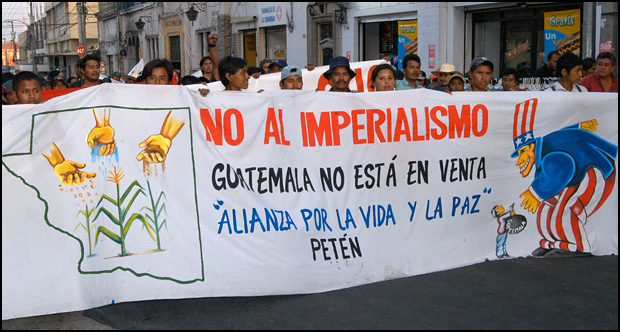
Even after the 1996 Peace Accords were signed in Guatemala, thousands were fleeing the country annually, since the Guatemalan economy was devastated from decades of repression, racism and ongoing exploitation. In 2005, the Guatemalan government, along with other Central American nations, signed a trade agreement with the US, known as CAFTA. Modeled after the North American Free Trade Agreement (NAFTA), CAFTA created new opportunities for foreign investors to exploit the resource rich nation. The gap between the wealthy and the poor grew and out of desperation, many Guatemalans continued to come to the US to find work, often where other Guatemalans resided.
Therefore, it is important that we recognize that the Guatemalans that reside in Grand Rapids are here because of the direct result of US military and economic policies. In fact, not only should we welcome these political and economic refugees, we should support the popular movements in Guatemala, which seeks to dismantle the systems of oppression that would prevent more forced migration to cities in the US like Grand Rapids.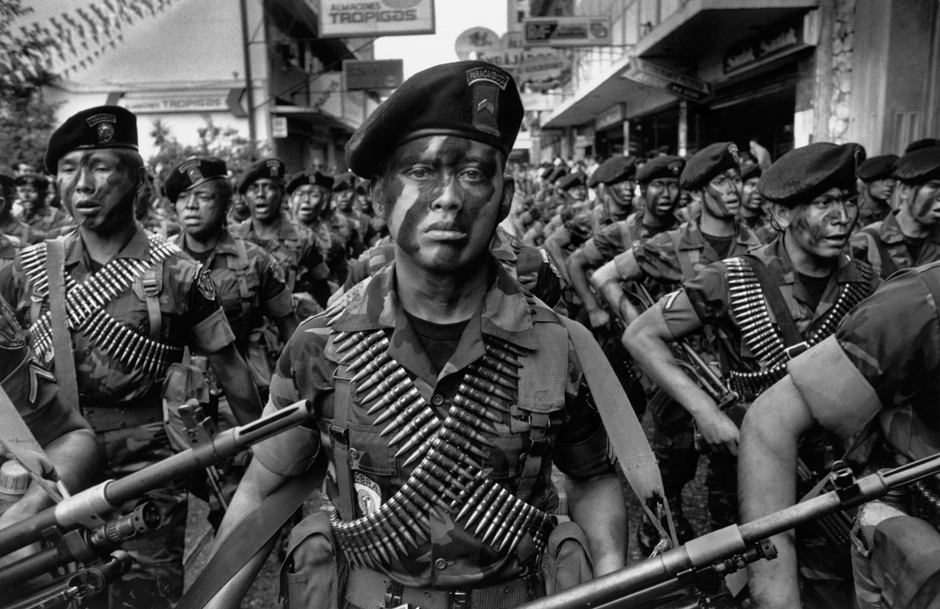
Another connection between Grand Rapids and Guatemala is rooted in longstanding US policy. One of the demands of the current uprising in Guatemala is that the US government also be held accountable for its role in the military repression and economic exploitation of their country. For example, the ousted President Molina was a military leader in the 1980s, during the most violent years of the US-backed counterinsurgency campaign. Guatemalans want US heads of state to be held accountable for their role in the murder, torture and disappearance of hundreds of thousands of their family members, neighbors, co-workers and friends.
Participating in solidarity with Guatemalans does not just mean we morally support their struggle, it means providing the kind of support they are asking of us, which is to demand accountability for past crimes and to work towards ending military and economic policies that continue to do harm.
What We Can Learn from Guatemala
Once we have owned the role the US government has played in creating violence, exploitation and forced displacement in Guatemala, we need to pay attention to how Guatemalans organize themselves. Here are a few things we can learn from Guatemalans that might actually create the change we want to see here in Grand Rapids.
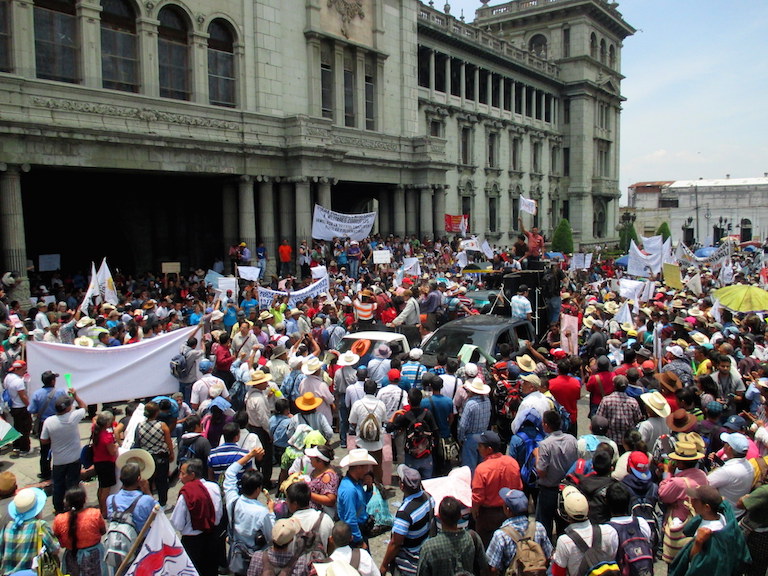 Call for Systemic Change – The popular movement in Guatemala isn’t calling for some quaint reforms of the existing system, they are calling for systemic change. Guatemalans aren’t calling for a renegotiation of CAFTA, they are calling for an end to CAFTA. The popular movement in Guatemala wants political and economic autonomy, something the Mayan people haven’t enjoyed since the European Conquest. People in Grand Rapids talk about buying local, which is often just another repackaging of capitalism, plus it doesn’t examine how local companies exploit the resources and labor of Guatemala. Sure, I can feel better about getting coffee from Kava House than Starbucks, but the coffee is still being grown in countries like Guatemala and Guatemalans are experiencing massive rates of hunger and poverty, because so much of the agriculture is devoted to exports.
Take it to the Streets – With growing corruption at the highest levels of the Guatemalan government, people did not circulate more online petitions, they took to the streets. And taking to the streets in Guatemala does not mean getting a permit to march, it means taking over the streets and shutting down business as usual. Systems of power will not be negatively impacted unless there is a cost. Also, taking to the streets is not just the choice of young anarchists, rather it is what all sectors participate in – unions, students, feminist groups, indigenous organizations, farmers, teachers, etc. Guatemalans understand that direct action is what is necessary to create real change, change that benefits the most marginalized, not those with privilege.

Elections are just a tactic – The popular movements in Guatemala have attempted to create and support more independent political parties, but they only see elections as one possible tactic for change. In the US, we are constantly being told that if we don’t drop everything and vote for this candidate or that political party. In Guatemala, they understand that the forces in power have always corrupted the political process, just like what happens here in the US. The Guatemalan popular movements many participate in elections, but they also never stop directly resisting the forces of exploitation and oppression in their communities, plus they are always working on creating new forms of community that compliment the resistance efforts. For example, while fighting the current exploitation of US and Canadian mining companies, communities are creating worker run co-ops or occupying land to create more autonomy.
In my book, Sembramos, Comemos, Sembramos: Learning Solidarity on Mayan Time, I shared a story about what a group of Guatemalan women had told us one night, while we were providing international accompaniment for their organization, which was being targeted by the military. These women told us that they were grateful for our solidarity work and providing them some space to do the work they needed to do. However, as the night wore on, they told us that the most important thing we Americans could do, was to go back to our country and change the system their, because US policy had such a negative impact on their country. They told us that they would take care of Guatemala, but that we needed to fight for liberation in our country. In other words, their liberation was directly connected to ours and our liberation was directly connected to their.
La Lucha Sigue en Guatemala and Grand Rapids!
Year Seven of the Monied Spectacle: An Indy Media Guide to ArtPrize

Year seven is upon us. Whether you like it or not, for the next month or so, the spectacle that is ArtPrize, is pretty much all you will hear about. Forget about Donald Trump, Iran or climate change, thousands of people invading downtown Grand Rapids is all that matters.
This is year seven and for seven years we have been writing about ArtPrize. Therefore, it seems fit that for year seven, we provide you with an Indy Media Guide to ArtPrize. However, before we begin, it is worth noting that our ongoing critique of this monied spectacle does acknowledge that there is pleasure, entertainment and benefits to ArtPrize. We do not see the world in some overly simplified binary world of good and bad, but we do want to see a world where those with obscene wealth and power are challenged or at the very least made to feel a bit exposed.
- Back in the summer of 2009, as ArtPrize was first being announced, we were one of the first media sources to raise questions about the intent of this so-called art extravaganza. The main issue we raised was around the larger PR function such an event would provide for the DeVos family. We asked, what impact will such an event have on any insurgent movement to challenge organized money? Like most billionaire families, the DeVos family cares deeply about its public image and ArtPrize seemed like the perfect opportunity to bring more converts to the, “where would Grand Rapids be without them,” crowd.

- By year two, it became clear that the local news media had become unpaid cheerleaders for ArtPrize. Even during the inaugural year, ArtPrize had already garnered the allegiance of local media, as we noted in our story entitled, Reporting on and Promoting ArtPrize. In that article, we quoted local property owner and managing partner of CWD Real Estate Sam Cummings. Cummings said, “Our long-term goal is really to import capital – intellectual capital, and ultimately real capital. And this (ArtPrize) is certainly an extraordinary tool.” Such a comment confirmed for us the overriding role that the annual event would play in Grand Rapids. Later that year we published the finds of a news study to make the point about how ArtPrize had become the media darling. ArtPrize trumps democracy: What the Press coverage tells us about the Press reveals that even during a gubernatorial election year, ArtPrize had nearly twice as many stories in the Grand Rapids Press as all election related stories, 153 ArtPrize articles to 87 election articles.
- In year two, we were also fortunate to have artist Richard Kooyman allow us to re-post his thoughtful piece on the danger that DeVos money and ArtPrize would pose to art and culture in general, in his piece What is ArtPrize?
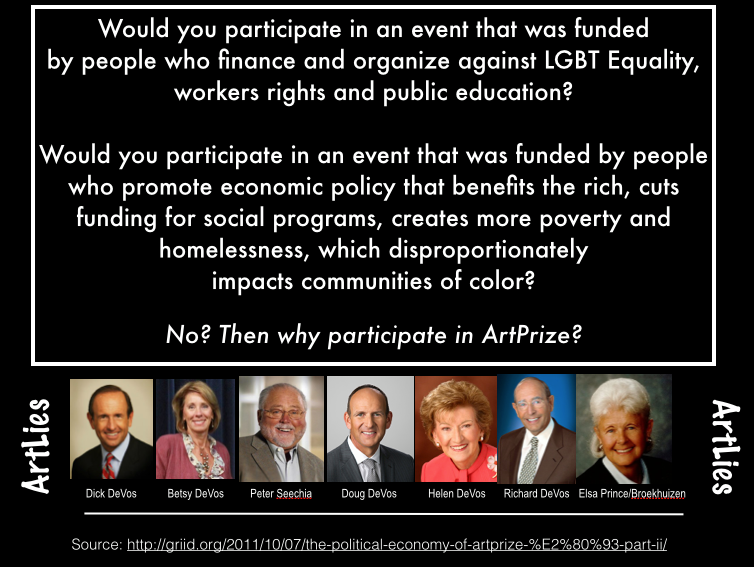
- In year three, we began to look more closely at the financial aspects of ArtPrize. The mainstream news media has always run stories about how much money is “brought in by ArtPrize,” but they have never really explored who are the big financial winners, as we did we our story, When elites give money to each other: ArtPrize financials for 2010. We have also made it clear, based upon 990 documents, that Rick DeVos has been bankrolled by his parents, Dick & Betsy, to put on the annual monied spectacle. It became clear from the 990 documents that a great deal of the money was simply being passed around from one DeVos entity to another, although this was never a theme of any media reporting.
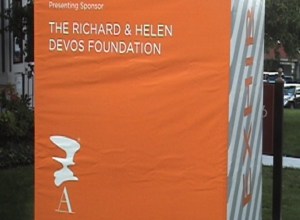
- In 2012, a GQ article about the DeVos family and ArtPrize generated some interesting conversation, but not by local news media, as we pointed out in MLive article misses the point of the GQ article on ArtPrize. The GQ article was one of the first outside media sources to discuss the political dynamics of ArtPrize, something that Rick DeVos constantly wants to distance himself from. Rick DeVos’ desire to distance himself from the family politics was reflected in this comment in the GQ story where he says, “I don’t even want to weigh in on any of the political stuff. I just prefer to stay away from that.”
- In 2012, we continued to explore the money and politics of ArtPrize, we our 2 part piece entitled, The Political Economy of ArtPrize. In Part I, we explored the more general impact that such an event has on art and culture and in Part II we explore in more detail the relationship between those who finance ArtPrize to what else the monied elites finance at the local, state and federal level.
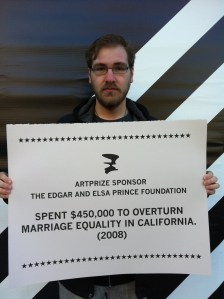
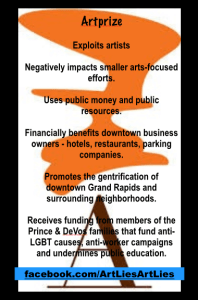
- 2012 was also the year that local activists engaged in a photo bomb campaign (called ArtLies) to visually make a point about the money and politics of ArtPrize donors, sponsors and the DeVos family.
- In 2014, artist Steve Lambert generated lots of attention and discussion around the politics of ArtPrize, with both his installation piece and his announcement that if he won the prize money from ArtPrize he would donate it to a local LGBT effort, since the DeVos family has historically funded anti-gay campaigns. What Lambert was able to do was to force both ArtPrize and the larger community to ask more fundamental questions about the political economy of this annual monied spectacle.

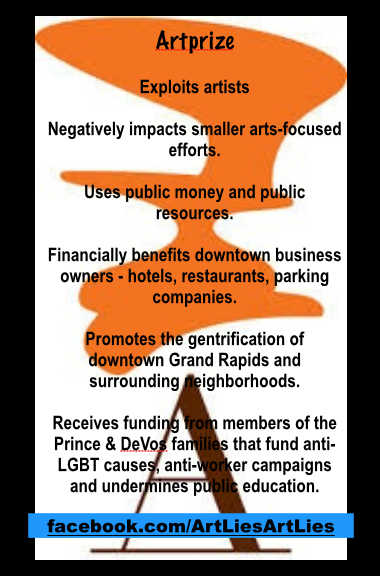
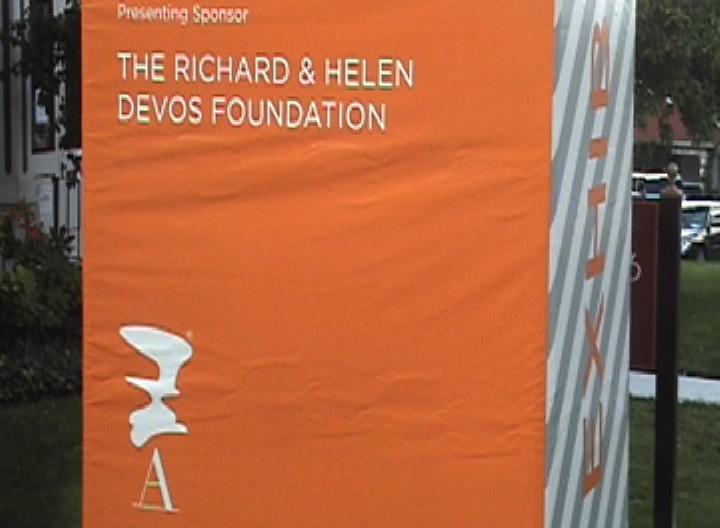
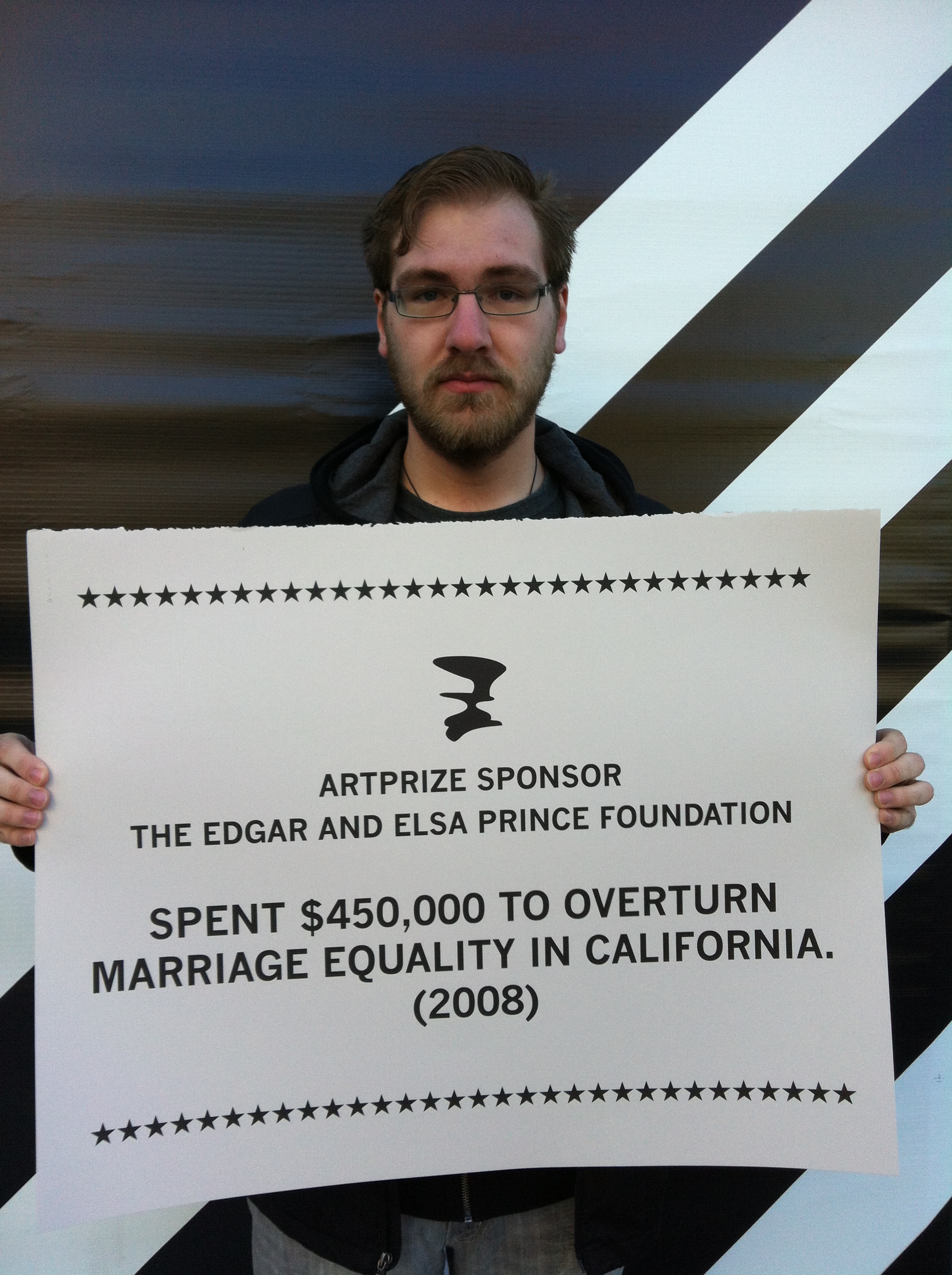
Ultimately, we believe that you cannot separate the funding sources of events like ArtPrize, from the political desires of the capitalist class. The DeVos funding of ArtPrize is a way to distract us and make us feel good for a few weeks out of the year, while the politics they fund bludgeon us all year round.
The Grand Rapids Local Food Discussion through a Food Justice Lens
I was delighted to see some of the responses to Levi Gardner’s article a few weeks back, which raised important questions about the Downtown Market and arguably the local food system.
However, a large part of the problem when discussing the local food system is our inability to recognize the fallacies of a market driven approach to food. What we need is an imaginative view of the local food system through a food justice lens.
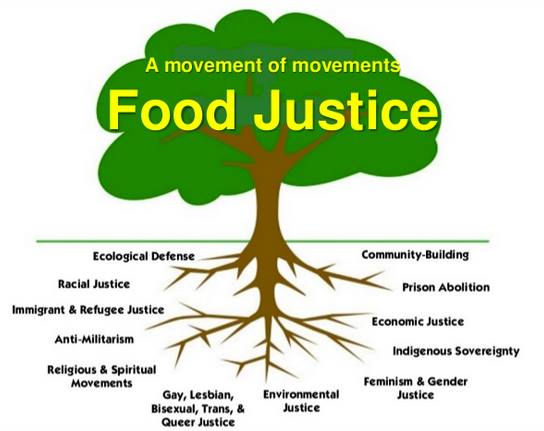
I don’t want to provide a lengthy articulation of what Food Justice is, which one can explore in a series of handouts I created for Our Kitchen Table. There are two points about Food Justice that I would like to emphasize. First, Food Justice is an outgrowth of the environmental justice movement, a movement where communities of color confronted not only environmental injustice, but the often narrow focus of White dominated environmental NGOs.
The second point about Food Justice, which is essential to any local food conversation is the needs to see that food insecurity is the result of multiple systems of oppression, such as White Supremacy, Capitalism, Patriarchy and Speciesism. This means that if we are to honestly address the causes of food insecurity and food disparities, we need to address more than just the food system.
Now that we have a Food Justice framework, lets look at what is happening with food in West Michigan in recent years. There has been a growing interest in people growing more of their own food and purchasing locally grown food in a variety of ways. There are lots of new restaurants and foodie projects, like Community Supported Agriculture (CSAs), urban food growing projects and plenty of farm to table discussion. However, the problem with much of the food discussion and food-driven projects is that it primarily benefits those with economic and racial privilege. This is in part due to our collective inability to think outside of a market approach to food and the lack of a food justice lens. Don’t get me wrong, I know lots of farmers and urban growers and they work hard, but in order to survive they have to operate within the current economic system, which means that much of their produce ends up in the stomachs of people with lots of privilege. Lets face it, those who are most food insecure in this community cannot afford to eat at the local restaurants that serve locally grown food. This is not the fault of the growers, rather that of the food system.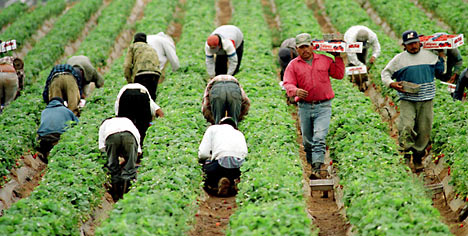
So what do we do? As with all major social problems, there are no easy answers. However, I would like to offer up some ideas and proposals for how to move forward in a way that promotes Food Justice.
First, the local foodie trend has almost completely ignored one of the prime factors in food production, food workers. West Michigan is home to one of the largest migrant worker populations in the country, which means that we are all dependent upon a workforce that is highly exploited. A 2010 Michigan Civil Rights Commission report stated that migrant worker conditions are as bad as they were in the 1960s. If we care about the local food system then we need to support efforts for migrant worker justice. This is also a racial justice issue, since most of the people who pick our food are Latino/a or indigenous. This food worker justice focus must also extend to those who work in kitchens, bus tables and wait on us when we go to restaurants. These food workers are also highly exploited and rarely are brought into the local food discussion. A local food movement that does not address food worker issues will only perpetuate exploitation and White Supremacy.
Second, we need to confront the current food system, while attempting to create a new food system. For example, one of the major reasons why local farmers cannot compete with agribusiness is because agribusiness is highly subsidized by public tax dollars. The so-called Farm Bill means that the unhealthy and ecologically destructive food system gets billions of dollars in public money, while small, ecologically sound growers get no public assistance. (See who gets food subsidies in Michigan.) The reason why the shitty food that fills some much of supermarkets is cheap is because it is highly subsidized.
What I would propose is that local farmers, both urban and rural, who want to support food justice, should get public funds to offset costs to allow them to make their food affordable to those who are experiencing poverty. Hell, if we can provide millions of dollars of public money to places like the downtown market and Monsanto, why can’t we fund local growers to practice food justice? If Beer City can provide tax break incentives for more bars and distilleries, then why can’t we provide similar financial support to people who want to grow food locally, especially food that serves the nutritional needs of the large number of individuals and families experiencing poverty?
Third, one issue that makes urban food growing difficult for people experiencing poverty is the lack of access to land. I propose that the City of Grand Rapids not only allows people to grow on the vacant lots they current own, but they should wave the fee for people to use those lots and they should provide financial support, along with practical assistance to people who want to grow more of their own food. This would certainly be a way for the city to put into practice their claim to being a Green City. This proposal might be difficult since the City has been in discussion for some time now (with little transparency) with the Kent County Land Bank to transfer those lots out of the public sector into a public/private structure. The Land Bank states that they have already been overwhelmed with requests in the vacant lots. What we need is a process that provides greater access or first priority access to people who are more vulnerable to food insecurity. People with lots of race and class privilege should not be the primary beneficiaries of such land acquisitions.
Fourth, another major issue that people experiencing poverty face and is ignored by the foodie trend, is the hard reality that people who work long hours and often two or three jobs face, is having the time to prepare healthy food. Even if we can get food subsidies to local farmers to truly make food affordable, people still need time to prepare and preserve healthy food. This underscores the fact that we can’t have food justice without confronting poverty and its root causes. Look at the growth of groups like Kids Food Basket. While it is encouraging that this group continues to provide free meals to children experiencing poverty, it is not addressing why those kinds are experiencing poverty.
Just last week Feeding America published a story in The Rapidian with tips on fighting hunger. However, Feeding America is also a food charity agency that does not address root causes of hunger. Instead, they want people to donate to their organization or wear a t-shirt to fight hunger. Why don’t we just make it a goal to NOT have the need for food charity, because we have policies and practices that support food justice. If people made a livable wage like $15 – $20 an hour, then more people could work less hours and have time to practice good nutrition that those of us with privilege take for granted.
Lastly, I come from a tradition where community building means practicing collective liberation. With food this could look like setting up community kitchens all across the city, whether they are in people’s homes or in churches. Community kitchens would be spaces that people can come to collectively make food, eat together, share recipes and then take home lots of prepared food that would save them time and energy during the week. Some of us have practiced this on a small scale. We call it potlucks. The beauty of potlucks and a community kitchen model is that it allows us to think about food and community outside of a market-based model. Indeed, in this sense eating well is simply a basic right, and that, I believe, is what needs to be cultivated in our efforts to build a local food movement.
Jeff Smith has been growing food for 35 years in Grand Rapids, has taught food justice classes and been part of numerous local food efforts over the years.
This 8 – week class is designed to do the following:
- Investigate the history of policing in the US
- Investigate the function of the Grand Rapids Police Department (GRPD)
- Explore and discuss ways to counter the repressive tactics of the GRPD
- Imagine and explore ways to create community safety that doesn’t involve cops
As a primary text, we will us Kristian Williams book, Our Enemies in Blue: Police and Power in America. You can order the book directly from AK Press or inquire with us about other options.
The 8 – week class with take place on Mondays, from 7 – 9pm, beginning Monday, September 28. Location is still to be determined. Contact us at jsmith@griid.org if you are interested in signing up. We are asking $20 for the class, but will not turn people away who are unable to contribute financially. Capacity for this class is 15 people.
Henry Kissinger is Wanted for War Crimes
The Bloom Collective has sent out the following image to several media outlets in Grand Rapids, and the poster has been appearing around the city itself.

It is probably no coincidence that Kissinger will be speaking at the econ club in Grand Rapids the same day as the event listed on the flier above. While the speech at the Devos owned JW Mariott downtown is strictly “members only”, those interested in learning more about Kissinger’s war crimes (and can’t afford $190 “Standard Membership” to the econ club, though they probably won’t be touching on Cambodia there anyhow) can attend the Bloom’s showing of The Trials of Henry Kissinger this upcoming Tuesday at 6pm.
All Bloom events operate on a “suggested donation” model, so no one turned away for lack of US currency. Any and all questions should be forwarded to bloomcollective@gmail.com.
GRIID is taking a break
For a variety of reasons GRIID will be taking a break from our work. We hope that in the meantime others will step in and take on more Indy media work in West Michigan. Thanks to everyone for their ongoing support.
Foundation Profile: Jerry & Marcia Tubergen Foundation
This foundation profile is part of a series of West Michigan foundation profiles, which is included in our Grand Rapids Non-Profit Industrial Complex Project.
Jerry Tubergen is part of the DeVos Family inner circle. He sits on the boards of some of the DeVos Family foundations and works for the DeVos-owned RDV Corp.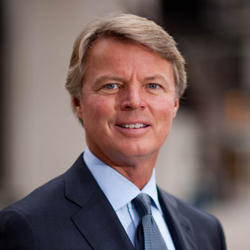
Jerry and his wife Marcia have their own foundation, that also serves as a mechanism for funding the kinds of projects that reflect his conservative, pro-capitalist, Christian worldview.
In looking at the foundation’s 990s for 2009 – 2011, we found that a great deal of their contributions went to conservative or reactionary Christian groups. Most of their money went to West Michigan organizations, but there were some from out of state that have received large sums. For instance, the Magdi Yacoub Foundation, which does medical work with children, received roughly $2,000,000 from their foundation, based on the most recent financial reports. The Jerry & Marcia Tubergen Foundation have also contributed substantially to the Cure International, Inc, which also provides medical treatment for children, but with an exclusively conservative Christian focus.
Closer to home, their foundation has contributed roughly $100,000 to Mel Trotter Ministries in Grand Rapids and other church ministries projects. The foundation has also funded anti-abortion groups like Michigan Right to Life ($5,000) and The Pregnancy Resource Center ($30,750).
We also notice a $50,000 contribution to Donors Trust, which has recently been receiving some attention because of their clandestine methods of funding everything from Right to Work campaigns to climate denial. When the Center for Public Integrity uncovered much of the information on the role of Donors Trust, we discovered that one of the main contributors to that group was Richard DeVos. This is not surprising, considering that Tubergen is a loyal employee of the DeVos family, but it further demonstrates the inter-locking systems of power and influence in West Michigan.
Video deconstructs Global Wealth Inequality
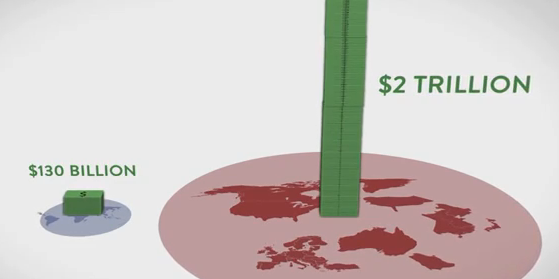
This video is produced by and re-posted from The Rules. Editor’s Note: While we find the video informative and useful for framing the global wealth gap, the group that put this video together does not offer ways to challenge global capitalism beyond reformism.
The richest 300 people on earth have the same wealth as the poorest 3 billion. This is no accident – those in power write the rules. Together, we have the power to change those rules.
Can Civilization Survive Really Existing Capitalism?
This video is re-posted from ZNet.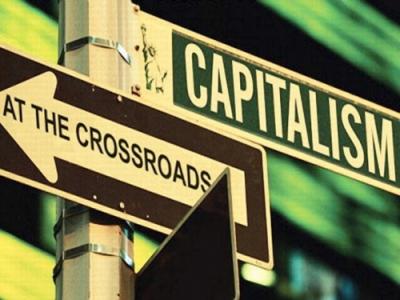
One of the world’s leading intellectuals and political activists, Professor Noam Chomsky has been awarded the UCD Ulysses Medal, the highest honor that University College Dublin can bestow.
Professor Chomsky was presented with the UCD Ulysses Medal by the President of UCD, Dr Hugh Brady, following a public lecture hosted by the UCD Philosophy Society and the UCD School of Philosophy at University College Dublin on Tuesday 02 April 2013.

