On May 11th, MLive posted an article entitled, DeVos Institute program helps 14 Grand Rapids nonprofits build capacity.

The MLive article uncritically centers the work of the DeVos Institute of Arts and Non-Profit Management. The article goes on to say:
Fourteen Grand Rapids area nonprofits are participating in the DeVos institute’s two-year program, Capacity Building: Grand Rapids. It provides participants with personalized consultations, group training sessions, and help with strategic planning and building effective boards, according to a release.
The DeVos Institute website provides us with a framework for what they will be doing with the fourteen Grand Rapids nonprofits that they will be working with:
Our approach is grounded in The Cycle, a practical management framework designed to optimize organizational performance in five essential areas: market position, programming, marketing, governance, and revenue development.
I don’t know about you, but based on what the DeVos Institute says it does, it seems to me that they focus on money, maximizing wealth and expanding wealth. The fourteen groups in Grand Rapids that will be working with the DeVos Institute are non-profit groups and arts-centered organizations. The MLive article lists the following groups:
- Artists Creating Together
- ArtPrize
- Broadway Grand Rapids
- Children’s Healing Center
- Festival of the Arts
- Girls Choral Academy Grand Rapids Art Museum
- Grand Rapids Ballet
- Grand Rapids Children’s Museum
- Grand Rapids Civic Theatre
- Grand Rapids Symphony
- Lowell Arts
- Opera Grand Rapids
- West Michigan Trails
- West Michigan Youth Ballet
Ways in which the DeVos family has undermined local art in Grand Rapids
Being an artist in a Capitalist world is difficult and deeply problematic. When art is seen as a commodity, it loses meaning and it takes from us our ability to see beauty, to imagine, and it diminishes our ability for critical reflection.
When ArtPrize was created by the DeVos family, their goal was never about elevating art, it was about selling the City of Grand Rapids and expanding their wealth. This view of ArtPrize was affirmed by Sam Cummings, CEO of CWD Real Estate Investment, when he said, “Our long-term goal is really to import capital – intellectual capital, and ultimately real capital. And this (ArtPrize) is certainly an extraordinary tool.”

A major outcome of ArtPrize is that it undermined local art and local artists. ArtPrize didn’t pay artists to submit their work for the 2-week spectacle, in fact, they made them pay to submit their work. Many local artists and art venues were negatively impacted, not just during ArtPrize, but for weeks and months leading up to it, since so much capital and so much PR was centered on the spectacle of ArtPrize that artists had to adjust to that world. In addition, local arts councils disbanded and funding sources for art dried up. Hell, even Festival of the Arts was thrown on the scrap heap of the art as a commodity, since it no longer fit the tourist-driven destination that the Grand Rapids Power Structure wants to see.
A second major way that the DeVos family has undermined local art is through their involvement in shaping public policy to promote business interests over the public good. What we have been seeing in Grand Rapids and the US as a whole over the past 40 – 50 years is a push to have local and state governments adopt neoliberal economic austerity policies, which include the following:
- THE RULE OF THE MARKET
- CUTTING PUBLIC EXPENDITURE FOR SOCIAL SERVICES
- DEREGULATION
- PRIVATIZATION
- ELIMINATING THE CONCEPT OF “THE PUBLIC GOOD”
The DeVos family has been part of promoting these kinds of economic austerity measures in three main ways. First, they have provided millions of dollars to political candidates who embrace economic austerity policies. Second, the DeVos family gives millions of dollars to organizations which promote economic austerity, like the American Enterprise Institute, the Mackinac Center for Public Policy, the Acton Institute, and the Heritage Foundation. The DeVos family funds these organizations through their foundations, thus allowing them to use non-taxed funds to promote economic austerity policies. The third way the DeVos family promotes economic austerity policies is by being part of groups like the West Michigan Policy Forum, Grand Action 2.0, The Right Place Inc. and the Grand Rapids Chamber of Commerce, all of which embrace the same economic policies of wealth expansion for the few and economic despair for everyone else.
The irony of all of this is that while the DeVos family has spent decades undermining local artists and the arts community, they are now swooping in to offer their services to assist art groups in order to make them more marketable and profitable. Just one more example of how sinister the DeVos family is and how they want to control so much of what happens in West Michigan.
Palestine Solidarity Information, Analysis, Local Actions and Events for the week of May 18th
It has been more than 19 months since the Israeli government began their most recent assault on Gaza and the West Bank. The retaliation for the October 7, 2023 Hamas attack in Israel, has escalated to what the international community has called genocide, therefore, GRIID will be providing weekly links to information and analysis that we think can better inform us of what is happening, along with the role that the US government is playing. We will also provide information on local events and actions that people can get involved in. All of this information is to provide people with the capacity of what Noam Chomsky refers to as, intellectual self-defense.

Information
The Price of Silence: Gaza’s Famine and the Erosion of Our Humanity – Politics For The People
EXPLOSIVE MATERIALS BOUND FOR ISRAEL ARE FLYING OUT OF JFK AIRPORT
Hamas and U.S. reach deal. “I think we’ll have to detox from US security assistance,” says Netanyahu
GOOGLE WORRIED IT COULDN’T CONTROL HOW ISRAEL USES PROJECT NIMBUS, FILES REVEAL
“People Are Starving to Death”: Oxfam Warns Israel’s Blockade on Gaza Is Catastrophic
Israeli Forces Bombed Two Gaza Hospitals in One Day
Surveillance Humanitarianism”: As Gaza Starves, U.S.-Israeli Plan Would Further Weaponize Food
One Side Routinely Uses Human Shields in Gaza—But Not the Side That’s Usually Blamed
Analysis & History
New Podcast Series: Histories of the Palestinian Left
Image used in this post is from https://visualizingpalestine.org/visual/gaza-stripped/
GRIID weekly audio digest – #5
 In the fifth installment of the GRIID audio digest, we bring you the following six stories from this week:
- Marching for workers and immigrant justice, the Cosecha May Day action was met with constant GRPD threats to arrest people
- During the Cosecha cultural event, SECOM announces it will also be a Sanctuary space for undocumented immigrants
- Day 3 of Cosecha action: Salsa shutdown at Walmart demonstrates that interrupting capitalism will bring out the cops
- Responses to the mistrial of ex-cop Schurr who killed Patrick Lyoya – Part I
- Responses to the mistrial of ex-cop Schurr in the death of Patrick Lyoya – Part II
- Responses to the mistrial of ex-cop Schurr in the death of Patrick Lyoya – Part III
GRIID invites our readers to share this audio digest and suggest platforms that we can share these weekly audio versions of our posts.
Chief Winstrom is now saying that Patrick Lyoya was killed because the GRPD was understaffed
It has been a week since the Judge announced a mistrial in the legal proceedings against the former GRPD cop who killed Patrick Lyoya. On Wednesday there were two different gatherings to talk about next steps in finding justice for the Lyoya family.
During Tuesday night’s Grand Rapids City Commission meeting, there were dozens of people who spoke during public comment denouncing the recent behavior of the GRPD, especially during the Schurr trial and their actions during the Cosecha May Day march and the march after a mistrial was announced.
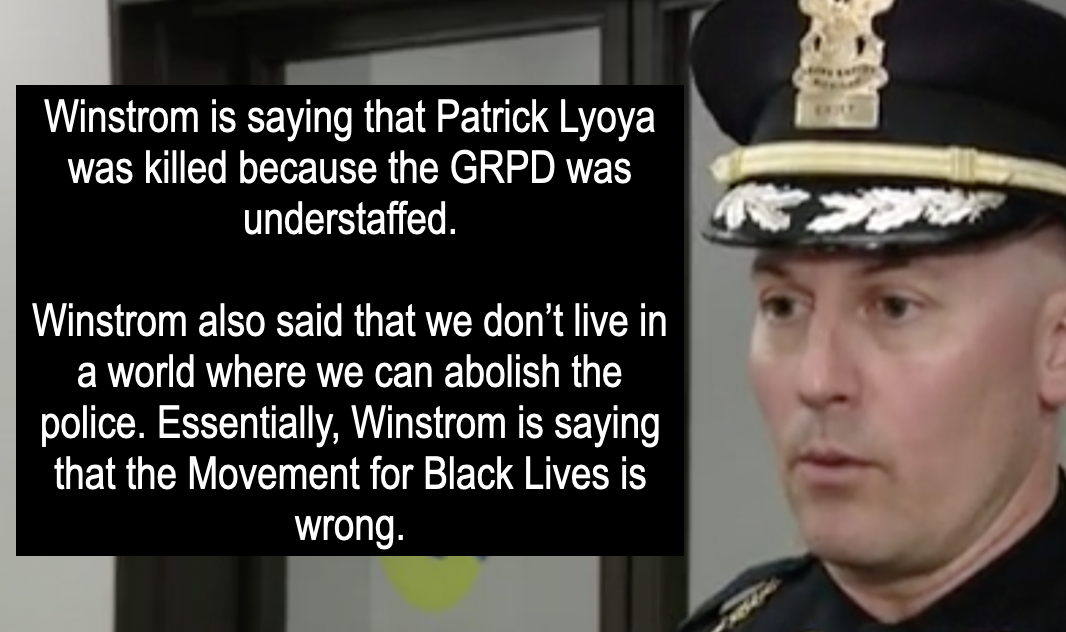
Just minutes before the 7pm Grand Rapids City Commission meeting, WOODTV8 ran a story that was crafted by GRPD Chief Eric Winstrom, a story that was a calculated PR stunt. Winstrom has been working overtime to control the narrative around the GRPD, claiming that he has regained the trust of the community when it comes to the GRPD.
This story that aired on WOODTV8 was simply another pre-emptive attempt to win over public support for the GRPD, with Chief Winstrom playing his role as the snake oil salesman. Winstrom had the audacity in this channel 8n story to make the claim that had their been more cops in the police force, Christopher Schurr would not have had to shoot Patrick Lyoya.
On top of that, the WOODTV8 story used commentary from Christopher Schurr’s trial, where Schurr is talking about hoping for backup on the day he shot Patrick Lyoya. By crafting this story, on could say that Chief Winstrom is brilliant, but I would also call him diabolical. Diabolical in the sense that he willingly knows that this claim is meant as a justification for why Schurr shot Patrick Lyoya in the back of the head. Chief Winstrom never comes out and says it, but it is clear that this is what he is implying.
Here are 5 reasons why Winstron’s claim that Schurr would not have killed Patrick Lyoya if there were more cops available that fateful day is just plain ridiculous.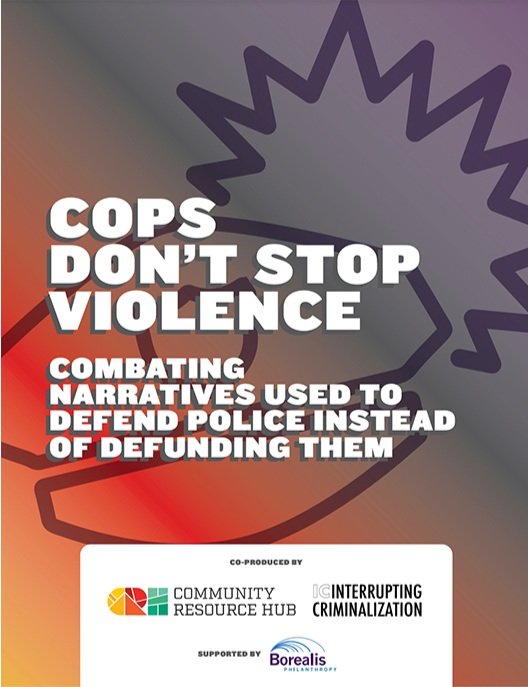
- An expert that Kent County Prosecutor used during the Schurr trial made it clear that there were multiple things that Schurr could have done after pulling over Lyoya. This expert testified that Schurr did not have to chase after Lyoya when he fled initially. Lyoya was stopped because his car registration had expired.
- Schurr could have waited for back up, that would have allowed for the possibility that Lyoya would be willing to cooperate.
- Schurr could have gone to Lyoya’s home later that day to speak with him and find out why he was driving with an expired car registration.
- Schurr did not use de-escalation tactics. In fact, Schurr escalated the situation.
- The GRPD have been facing a crisis of legitimacy in recent years, thus offering justifications for what they do, even shooting unarmed civilian, is an opportunity to argue why we need cops and more of them. The excellent report by Interrupting Criminalization provides important data and an analysis that dismantles Chief Winstrom’s claim. In fact, this report makes it clear that cops rarely prevent violence.
In my own research looking at local news coverage around crime and public safety, I found that the GRPD rarely prevent crime. In the 673 stories that centered around crime, there were only 11 stories about the GRPD actually preventing crime, which means in most of the stories the GRPD showed up after a crime had been committed.
A couple of other things that Chief Winstrom said in this story was, first, “We’ve turned around the culture around where elected officials aren’t afraid to compliment us anymore.” I read this as elected officials don’t want to be critical of cops anymore for fear of smear campaigns and character assassination from pro-cop organizations and cop unions. In Grand Rapids, the GRPD union has provided campaign funding for people like City Commissioner Robbins, who received $10,000.
The second this that Winstrom said was They (City Commission) did a fantastic job recognizing we need the police department,” he added. “We’re not in a position where we can abolish the police, get rid of the police, that world doesn’t exist.” Of course Winstrom is an apologist for policing, but he also demonstrates that he does not practice radical imagination, like imagining a world where people are shot by cops during a traffic stop. By making the point about the world of abolishing the police doesn’t exist, means that he is telling the Movement for Black Lives, Angela Davis, Miriam Kaba, Robin D.G. Kelley, and countless community based groups that they are wrong, or more accurately, Winstrom is telling them to fuck off.
 On May 16, Movimiento Cosecha Michigan and GR Rapid Response to ICE will be hosting a meeting to talk about upcoming actions and campaigns to further the struggle for immigrant justice.
Even if you didn’t participate in the recent May Day march, the Cosecha cultural event or the Salsa Shutdown, you are more than welcomed to attend the People’s Assembly.
I asked Cosecha organizer Gema Lowe about the importance of the People’s Assembly, and she said:
“Movimiento Cosecha Michigan in collaboration with GR RR to ICE are organizing the People’s Assembly where we will discuss the next steps on the immigrant resistance.
Our Immigrant communities are getting organized across the country when our love ones are getting kidnapped by ICE. The greater GR area won’t be the exception and we will continue fighting for immigrant rights.
We say:
YES to Papers for All
YES to driver’s licenses in Michigan
YES to Sanctuary
and
NO to REGISTRATION
NO to DEPORTATIONS
NO to ICE and DETENTION CENTERS”
The People’s Assembly will begin at 5pm in the Linc Up Gallery, which is right next to the Linc Up office, located at 341 Hall St. SE in Grand Rapids.

Editors Note: The fact that Episode #6 aired on Tuesday night, while people were at the Grand Rapids City Commission meeting to verbalize their disgust of the GRPD and the GRPD’s repression of people pushing back against the system, is worth noting. You can also see my deconstructions of the previous 5 episodes at this link.
Episode six begins with audio from a 911 call, where someone has just heard gunshot. According to the All Access PD: Grand Rapids series, they only investigate gun violence, which is a very small part of what the GRPD actually does.
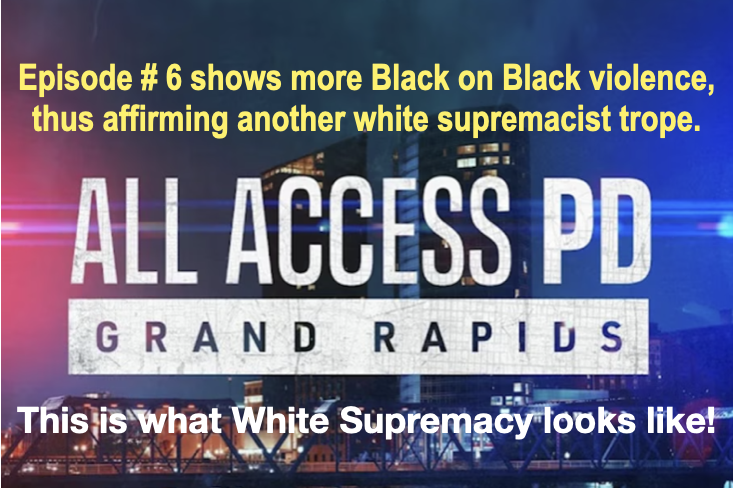
The episode quickly resorts to body cam footage of a young African American who was just shot, while her sister is heard screaming and being restrained by the GRPD from getting to her sister’s body. This was nothing but trauma porn, and a disgusting display of what the GRPD and the producers of the show wanted to communicate.
The scene cuts to Chief Winstrom talking to the camera saying he is shocked that it is a 15 year old girl and that he is, “emotionally invested in this case.” Always the PR guy. Winstrom again shows up and says his primary concern is to be there for the family.
The GRPD get the video footage from the scene and the person who was the shooter is a young African American male.
For the next few minutes the GRPD is then seen talking with the parents of the victim. Why would they use these grief stricken parents at this moment?
GRPD cops then pontificate and shake their heads over why people would not want to talk to them. This is all happening while Chief Winstrom does the voice over in the introduction of this TV series, where he says he is building community trust. Please.
Then scene cuts to another shooting in the southeast part of GR, where you see lots of cops with weapons drawn and they bring out several young Black people, whom they are treating as suspects. At one point, a Black cop is reading the rights to a young Black suspect.
The GRPD then seeks out Jemar Sterling, who does violence prevention work with urban youth, who says that people in his family aren’t happy that he is talking to the cops.
The next scene uses GRPD body cam footage of cops charing a young Black man, which just happened to be the primary suspect in the shooting that this episode is centered around.
The GRPD then hosts a Press Conference, which leads to a call identifying someone who was a witness. The cops then interviews the witness, who identifies a suspect, which leads to the GRPD gearing up to go after the suspect. The cops surround a home and the suspect finally comes out with his hands up. The suspect is a young Black male.
The next scene is two white cops interrogating a young Black male, with one of the white detectives providing commentary for the viewers. The Black suspect is then charged with second degree murder, while the detective is seen calling the victims mother, saying, “this was a good day.”
The episode ends with members of the victim’s family holding a celebration for the girl who was killed, which included releasing balloons.
With this week’s episode, it communicates that the only shooters and victims are BIPOC,, plus some of the video footage used communicates the message that there are Black gangs roaming the streets of Grand Rapids. This show will definitely contribute to fostering and maintaining stereotypes about Black people, since the audience will no doubt be predominantly white. Once again, I’m still waiting for the episode showing how the GRPD monitors community organizers and organizations to suppress any form of dissent against those challenging systems of power and oppression.
Another long line of people formed for the public comment period at the Grand Rapids City Commission. People talked about how the GRPD harassed and abused people during the Schurr trial and after the judge called for a mistrial.
You can watch of the public comments at this link, with the public comment period beginning at 31:50 into the meeting. More importantly was the responses from Grand Rapids City officials, which begins at 1:44:00 into the meeting, beginning with Commissioner Ysasi.
Commissioner Ysasi – spoke for 12 minutes, but didn’t really say much. However, she did want to promote the idea of the civilianization of the GRPD. What is that you say? It means that some jobs that were previously done by cops are now being done by civilians. This is really a misdirection by Commissioner Ysasi, since it not only fails to acknowledge that the GRPD has been adding new officers over the past 2 years, but more importantly, it diverts public outrage over the way that the GRPD has been criminalizing and repressing those who dissent.
Commissioner Perdue – spoke for 2 minutes and 15 seconds. Wants to expand the OPA, even review of use of force incidents.
Commissioner Belcak – spoke for 3 minutes and 30 seconds. Also talked in circles a bit, but spent the most time promoting the 175th anniversary of the City of Grand Rapids.
Commissioner Robbins – spoke for 45 seconds with words like both sides, respect and forgiveness. Robbins received $10,000 from the GRPD union in 2022 and he was implicated in the smear campaign against his opponent in 2022, along with the campaign against another candidate in 2024.
Commissioner Knight – spoke for 4 minutes and 30 seconds. Gave props to Chief Winstrom for having a conversation with her and reveal that she has a son who is a cop.
City Manager Washington – spoke for 3 minutes and primarily highlighted the upcoming Public Safety Committee meeting, where Chief Winstrom and the OPA can tells us about the exciting things they are doing.
Mayor LaGrand – spoke for just under 2 minutes. LaGrand says he spent most of his adult life making the justice system better, but provides no evidence of how he has done that. He also said as a community we can always do justice better, we can always improve our culture and our community. The Mayor’s words were another misdirection, thus avoiding talking about the City’s responsibility and the policing, both systems of power and oppression.
In Part I, I revealed the statements that came from police unions, police apologist organizations and Grand Rapids City officials. Today, I want to look at some of the response to the mistrial of Schurr from those who are supportive of/sympathetic to the Lyoya family.
In Part II, I included statements of solidarity, sympathy and collective grief with the Lyoya family. Today, I want to talk about an abolitionist response to policing, and what Alec Karakatsanis, the author of the new book Copaganda: How Police and the Media Manipulate Our News, calls the, “Punishment Bureaucracy.”
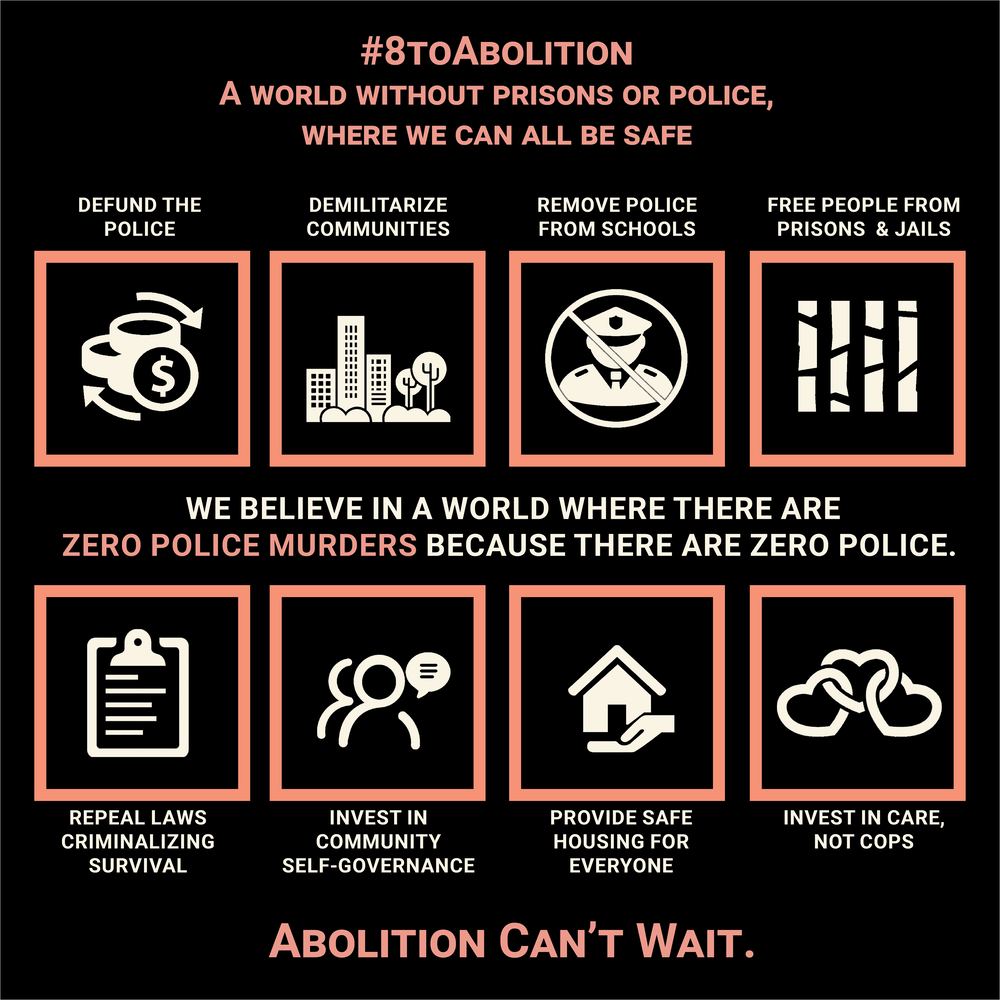
However, before talking about abolition the police, also known as state violence workers, it is important to talk about a recent Executive Order from the Trump Administration that has to do with policing. It is called, Strengthening and Unleashing America’s Law Enforcement to Pursue Criminals and Protect Innocent Citizens. This Executive Order will provide even more freedom for cops to intimidate, harass, jail people in the US, along with providing additional protections for them.
A recent article from the Intercepted states:
The executive order calls for “military and national security assets” to assist in local policing, directs federal resources and protections for state and local law enforcement, and enhances police protections, among other proclamations. But it reflects a deeper ambition.
“He wants more federal militarized law enforcement under his thumb instead of under the thumb of governors or mayors,” says Balko. “He wants to use them to help with immigration deportations. He wants help with cracking down on protest.” And the concern and fear, says Balko, is that Trump will also “use law enforcement to go after his critics and people he perceives to be his enemies.”
I wanted to include this information to say that the standard reformist approaches to policing will not only be completely inadequate, and reforms will only solidify and further legitimize state violence.
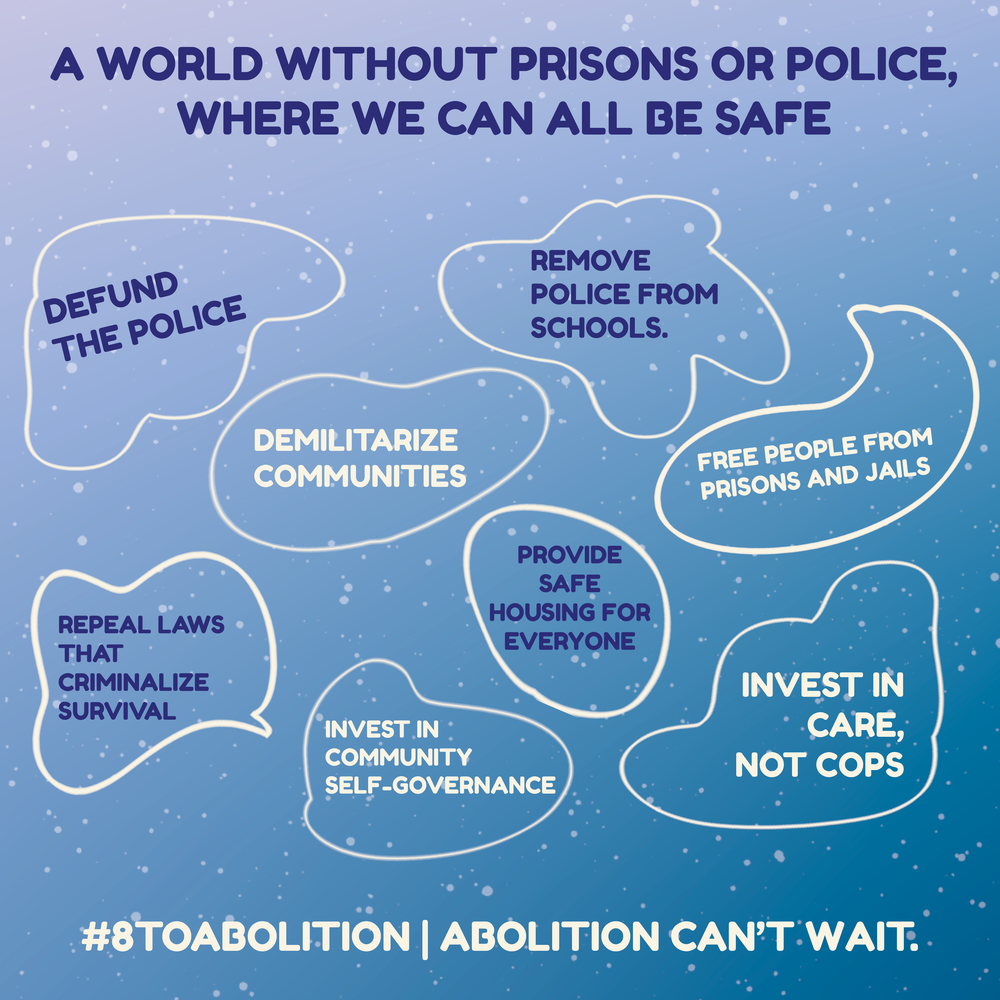
This is exactly why the Movement for Black Lives was calling for the Defunding of the Police after the George Floyd protests all across the US. To be clear, defunding the police is the first step to the abolition of policing as we know it.
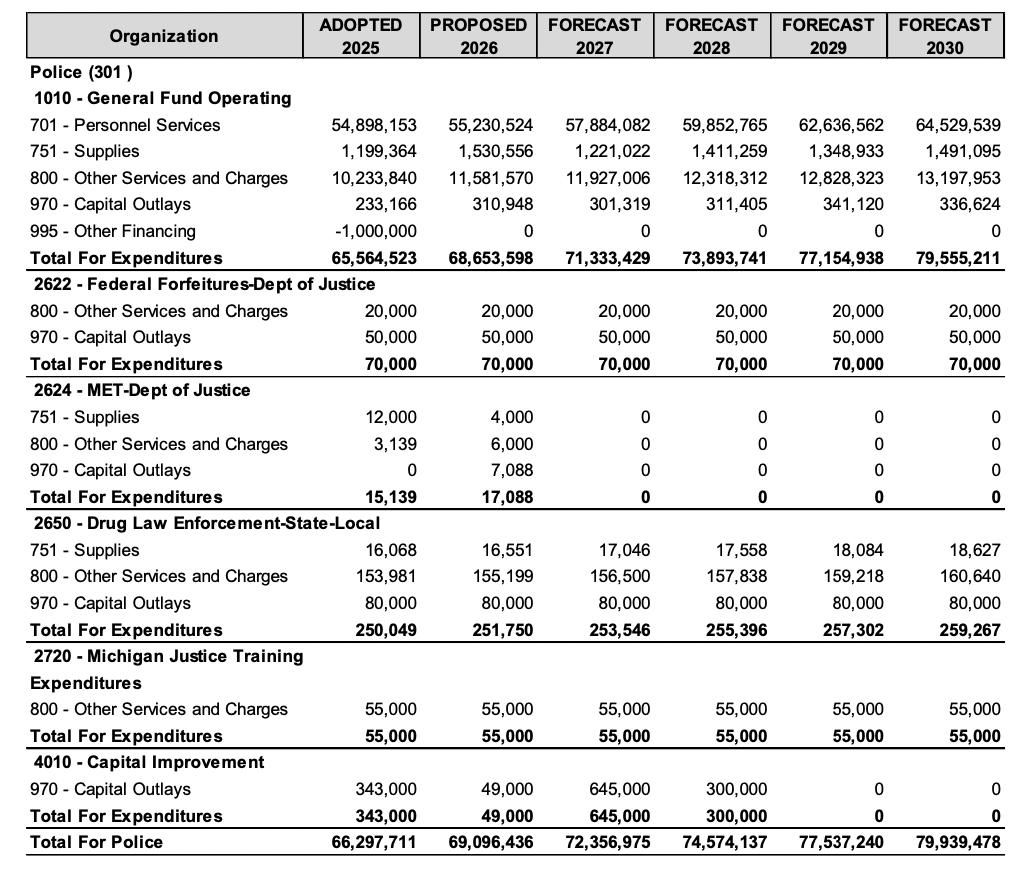
The City of Grand Rapids has submitted their 2026 Budget proposal, which includes $69,096,436.00 for the GRPD. You can see (above) how the amount for the GRPD will continue to grow and by 2030, they will receive nearly $80 million in public money to manage and control this community.
Using Radical Imagination for the Abolition of the GRPD
Now, no one is expecting that the GRPD will go away tomorrow or anytime soon. However, if we want to see the GRPD, a known institution of oppression, to be dismantled, then we need some kind of a proposal/plan to make that become a reality. What I am proposing is just an idea, it is not the only idea and it may not even be the right idea. However, we have to begin with an idea to start down the path of actually working towards the abolition of the GRPD.
Imagine what kind of an impact that $370 Million would have over the next 4 years if the GRPD was defunded and we used that money to invest in community. Considering these numbers, think about how $370 Million over a four year period could contribute to things such as:
- Housing costs – both home ownership and rent
- Health care costs, including preventive care
- Educational scholarships
- Food security
- Transportation costs
- Environmental Justice projects
These are just some of the ways that divesting from the GRPD and investing in the Black community could radically alter the lived experience of the very community that has disproportionately been affected by policing in Grand Rapids.
Lastly, the $69,096,436.00 that currently goes to the GRPD is annually. Imagine how that kind of funding could be used to invest in community, or that money could be directed towards BIPOC communities in general, as a form of reparations for the historical exploitation, police abuse, drug war, land theft, etc. that BIPOC communities have experienced since the founding of Grand Rapids. We all can radically imagine how things would be different if such a plan were enacted, so why limit ourselves to the unimaginative notion of simply reforming the cops? Lets work to actually abolish the police and practice the principle that we take care of us!
I am excited to share with people who follow this blog, that I will be coming out with another book in the fall, one that is based on my experiencing of doing solidarity and accompaniment work in Latin America and here in West Michigan. Below is the introduction for the forthcoming book.
“Fray Diego de Landa throws into the flames, one after the other, the books of the Mayas. The Inquisitor curses Satan, and the fire crackles and devours. Around the incinerator, heretics howl with their heads down. Hung by the feet, flayed with whips, Indians are doused with boiling wax as the fire flares up and the books snap, as if complaining. Tonight, eight centuries of Mayan literature turn to ashes.”
Memory of Fire: Volume 1 – Genesis, Eduardo Galeano
In January of 1992, just days before the ceasefire in El Salvador, I was sitting in the Central Plaza watching the crowds of people with my traveling partners. We noticed a large crowd in the center listening to a man speaking in English who was accompanied by a translator. I decided to walk over to investigate what was going on when I realized that the man speaking was a preacher from the US. As soon as I realized this, I turned around and rejoined my friends shaking my head in disgust.
When the crowd finally dispersed, I noticed that the street preacher was headed in our direction. Right away he began to speak to us in English and inquired about our being in El Salvador. We told him we were tourists because one never knows when there are people listening in (orejas) on your conversations. Before we could say any more, this guy began asking us if we had “come to know the Lord.” We all said “no,” much to his disappointment, but we were curious enough to ask him what he was doing in El Salvador. He said, “To spread the Gospel and to win souls for Christ.” We asked him if he was doing anything for these people in the way of food, housing, jobs, or opposing US military aid. He told us “no” and that those things were not relevant as long as people saved their souls. At that point, I remember telling him that he was no different than the long line of Christians who had come here to impose their will on these people. I told him that if he wanted to preach religion, maybe he might want to follow the model of the late Archbishop Oscar Romero.(1) Looking at me with a confused expression, our missionary friend simply said, “Who was he?”
This encounter reflects for me a fundamental tenet of the relationship that Euro- Americans have had and continue to have with people throughout Latin America. Over the past 500 years, Mayans and many other people have had various forms of intervention in their communities by people claiming to know what is best for them. Whether they have been missionaries, statesmen, Peace Corp workers, anthropologists, relief agencies, or even solidarity organizations – all of them, in some form or another, have gone to these countries with the position that they were going to “help these people,” “show them how it is done,” make their lives better or simply to “save” them from themselves.
The corporate-owned media in this country has contributed to this view since it rarely puts into context why there are rampant societal problems such as poverty, street children sniffing glue, political violence, government corruption, and ecological devastation. The cumulative effect of watching news stories about Latin America that are mostly disaster related is that viewers are left with the sense that “these people” cannot take care of themselves. Whether it is on the nightly news or a CARE ad showing malnourished children, the North American public is fed images of dependency and backwardness. From my studies of the local TV news coverage of Latin America, it is rare that we are given the opinions and perspectives of Latin Americans on what is happening there and a virtually nonexistent view from Latin Americans who hold no positions of power.
More and more people are beginning to question this notion of superiority and imperial mentality that permeates all social institutions in this country. Beginning with the observations that took place surrounding the 500 years of resistance by Indigenous peoples throughout the Western hemisphere, some people in the US are confronting their own relationships with the First Nations of North, Central and South America. This is due in part to an increase in solidarity groups sending people to various countries by way of invitation to stand with people in their struggles for justice.

Attitudes are also changing because people are becoming more familiar with the rich literary and cultural traditions that give a radically different view of the past 500 years. This transition has not been without resistance, some of it which wants to aggressively cling to the history of the victors, while others are scrambling to find “examples” of well intentioned people that they can hold up so as to not feel completely guilty about being in positions of privilege.
What I want to do in this book is to reflect on the fact that it has been I who have been “saved,” because of the people I have worked with in Guatemala, El Salvador and Chiapas, along with those in Grand Rapids who are from Mexico and Central America. In many ways it is I who have been transformed by these people and the experiences I had with them. I do not want to give the impression that I have some romanticized notion of who the people I met, rather I am saying that it is I who really gained from these encounters. It is sort of a reversal of the missionary position, where instead of going to change others I became changed. Who I am today, and what I do, is in large part because of my encounters with the people of Mexico and Central America.
What I hope to communicate in these pages is that solidarity was not just something I participated in on my journeys to Guatemala, El Salvador and Chiapas, it was something I learned and continue to learn from because of the struggles they have allowed me to participate in. They have taught me profound lessons on community, organizing, and the importance of having a vision. I learned that for them to obtain real freedom I had to learn to listen to what it was that they wanted. I was taught solidarity by not wanting to impose my will, my desires on them. In religious terms, it is as if I was being proselytize by them and sent back to the US to make converts here. I could not simply come back from my trips and claim that I had done “my time.” No, this is not solidarity. Solidarity requires an ongoing relationship and doing whatever it takes to improve, to build upon that relationship.
The kind of solidarity that the Guatemalans/Salvadorans and Mexicans have taught me is learned solidarity. This type of solidarity requires that after standing with those communities, I have to also work here in the US to change the policies that make it nearly impossible to achieve lasting change in their country’s of origin. The main difference between dogmatic religion or political ideologies and learned solidarity for me is that learned solidarity is based on real principles of democracy, equality and mutual respect, not just paying lip service to it. Learned solidarity is the desire and the experience of standing with people, of having a presence with them, regardless of differences or world-views.
Learned solidarity is not following an ideological blueprint or something you read in a book. Learned solidarity is a process and a commitment to practicing what I learned from the Zapatistas and the values they embrace. One Zapatista value comes from the phrase, “we build the road by walking together.”
One experience I had of learned solidarity came during my first stint in Guatemala while working with Peace Brigades International. I was working with a newly formed group of Guatemalan widows called CONAVIGUA. They were meeting in a church courtyard in Chichicastenango one afternoon when a group of soldiers entered and made threats. The women definitely stood their ground and the soldiers left. That night one of the women said to me that they were grateful for our presence that day, but then she went on to tell me something that I can never forget nor ignore. She said, “It is important that you are here, but more important that you return to your country to tell the people what is going on here. The way you live determines how we live.”

This book is the product of learned solidarity. It is divided into three sections, each reflecting on the various ways that this learned solidarity has impacted me. Part I of the book is entitled Q’anjobal Mayans Invade Amway Territory. I share thoughts on being bit by the Central America bug, part of the Sanctuary movement in the 80’s and how I negotiated cultural solidarity in an area permeated with Christian conservatism.
Part II is called Sembramos, Comemos, Sembramos – We Plant, in order to Eat, in order to Plant. This is a saying I learned from a Mayan farmer that reflects the simplicity and consistency in the lives of the Mayans I met in Guatemala, El Salvador and Chiapas. Here I gleaned sections from my journal entries from various trips between 1988 to 2006, where I have had numerous opportunities to accompany and observe the relentless persistence of the Guatemalan and Salvadoran popular movements and the participatory democracy of the Zapatista communities.
Part III, The Way You Live, Determines How We Live, is a collection of articles that I have written over the years on various aspects of how US foreign policy impacts Central America and Mexico, and what we might do to change those policies. As Noam Chomsky has always pointed out, the responsibility of the citizens of countries that dictate global policies are key in determining the outcome of many liberation struggles around the world.
I am forever indebted to the people I have met and learned from in these pages. My encounters with them have transformed my life forever. It is because of them that I am the person I am today. It is for them that I dedicate this book.
Photos:
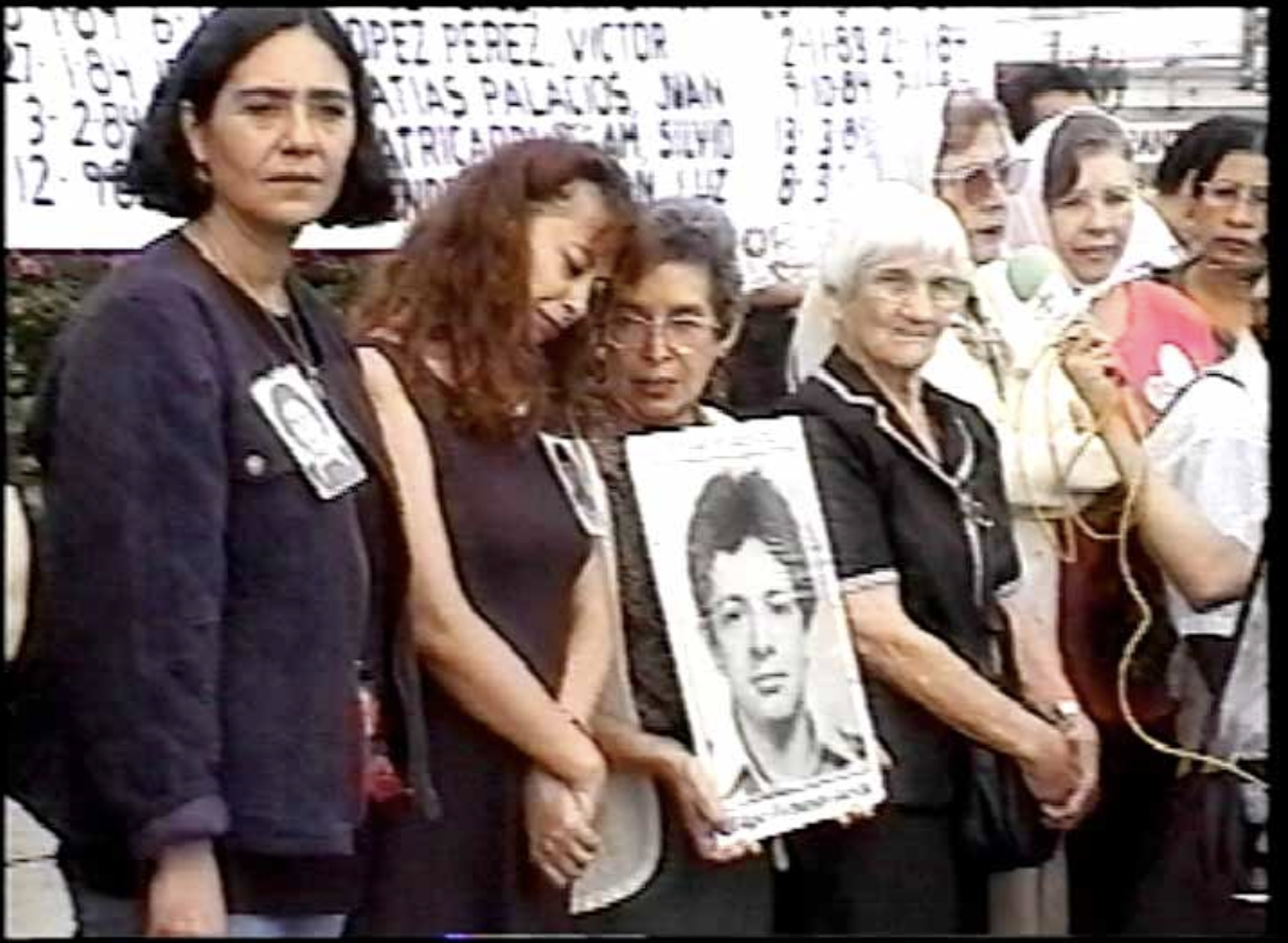
Top picture is from Guatemala, with the Mothers of the Disappeared group
2nd picture is from Chiapas, Mexico, where Zapatistas converge on a Mexican military base to shut it down.
3rd picture is from Guatemala, during International Women’s Day.
 In Part I, I revealed the statements that came from police unions, police apologist organizations and Grand Rapids City officials. Today, I want to look at some of the response to the mistrial of Schurr from those who are supportive of/sympathetic to the Lyoya family.
There was an outpouring of support and solidarity on May 8th, from a number of organizations offering sympathy to the Lyoya family. The Grand Rapids Pride Center wrote in part, “We mourn, we stand, we fight. The Grand Rapids Pride Center joins the collective grief and outrage surrounding the injustice faced by Patrick Lyoya and his family. We send our deepest love, strength, and solidarity to the Lyoya family during this painful time.”
The Latino Community Coalition said, “We recognize how significant this moment is in the history of Grand Rapids and in the life of our community. As Latine people, we know we have a responsibility to stand with our Black community. Our lives are deeply connected. We are grieving alongside our neighbors, and we call on all of us to use our voices, leverage our collective power, and continue building community. We must keep showing up and demanding justice; not just today, but always.”
The YWCA posted on their social media, this brief statement: “The news of a mistrial in the case of Patrick Lyoya’s murder is deeply painful for many in our community, especially for those who have long borne the weight of injustice. While the courtroom process has reached a standstill, the pursuit of justice must continue. As an organization committed to eliminating racism, we stand with those calling for accountability, transparency, and transformation—not only in our justice system but across all systems that affect safety, opportunity, and equity for all.”
The ACLU of Michigan responded with the following comments: “Despite devoting considerable time and energy to the effort to reach a verdict in the killing of Patrick Lyoya by former Grand Rapids police officer Christopher Schurr, the jury was unable to do so. The mistrial leaves continued pain and uncertainty in our community. But what the mistrial does not change is the fact that the death of Mr. Lyoya, a beloved son, brother and father of two, who came to this country in search of a better life, was both preventable and predictable. True accountability means a commitment by the City of Grand Rapids and its police department to real and lasting policing reform – a commitment evidenced by no more lives lost.”
The Grand Rapid Urban League also weighed in and wrote in part: “This is a grave injustice the Lyoya family must now bear—not only today, but for the rest of their lives. It is a wound that also marks the conscience of every Grand Rapidian who believes in the promise of justice. Until every system—education, health, housing, economic, and criminal justice—works for all, our community cannot and will not thrive. The Urban League of West Michigan calls on the Kent County Prosecutor to swiftly retry the murder case against former officer Christopher Schurr without delay. Additionally, we invite the City of Grand Rapids Office of Oversight and Public Accountability (OPA) to an immediate and transparent dialogue with us and the broader community. This conversation should focus on a thorough examination of the training, policies, practices, and procedures currently in place within the Grand Rapids Police Department – particularly in instances were these actions result in a loss of life. Our city’s future depends on the courage to confront hard truths and the will to make meaningful changes. Justice delayed is justice denied—not just for one family, but for all of us.”
Finally, here is an excerpt from a statement from the Concerned Clergy of Grand Rapids : “As clergy representing diverse faith communities in Grand Rapids, we stand united in our commitment to truth, justice, and human dignity. The killing of Patrick Lyoya placed our city at a painful crossroads – a moment that demands moral clarity, communal resolve and transformative action. Patrick Lyoya was a son, a brother, a neighbor—and a child of God. His life was taken by an act of violence at the hands of law enforcement, and the pain of his death reverberates still, especially among our Black and immigrant communities. We acknowledge that the deeper crisis is not solely about one case—but about a system that continues to fail the very people it claims to protect.”
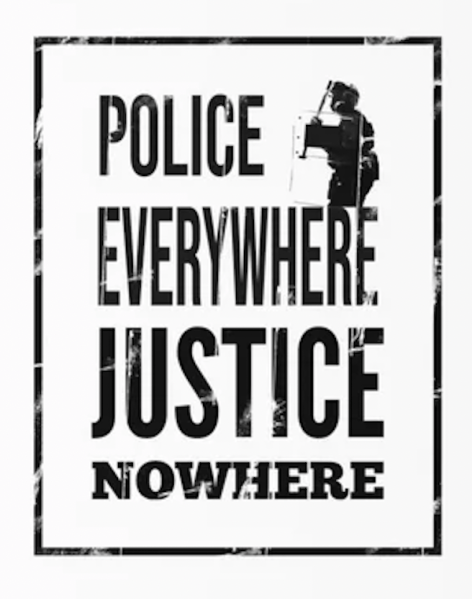 All of these responses center the Lyoya family and the collective grief that many are feeling since the mistrial of the ex-cop who killed Patrick Lyoya. These statements are important, not only because they are embracing the Lyoya family, but because they honor the need for collective grief, loss and mourning.
Several of these groups also included some comments about the need for change, specifically the ACLU of Michigan and the Grand Rapids Urban League. However, the Concerned Clergy of Grand Rapids was the only statement I have seen which communicates a list of demands. They write:
- “We are not only calling for justice in this case—we are demanding structural transformation. This includes:
- Immediate and transparent review of police training and testing practices, especially those related to de-escalation, racial bias, and use of force
- Changes in recruitment and hiring that reflect the racial, cultural, and linguistic diversity of our community
- Thoughtful and community-informed officer placement to foster trust rather than fear
- Greater investment in non-policing solutions to public safety, including mental health responders and violence interrupters
- The establishment of ongoing, accountable partnerships between police leadership and trusted community representatives
- As faith leaders, we want to collaborate with the Office of Oversight and Public Accountability to establish a plan of shared action that addresses these systemic issues, supports community healing, and ensures ongoing institutional accountability—regardless of the outcome of this trial.”
The calls for accountability and reform, while understandable, are unlikely to achieve what is necessary to actually prevent the systemic harm and function of policing. Alex Vitale, in his groundbreaking book, The End of Policing, provides an important critique of police reforms, stating:
“For liberals, police reform is always a question of taking steps to restore the legitimacy of policing…………They want the police to be better trained, more accountable, and less brutal and racist – laudable goals, but they leave intact the basic institutional functions of the police, which have never really been about public safety and crime control………..The reality is that police exist primarily as a system for managing and even producing inequality by suppressing social movements and highly managing the behaviors of poor and nonwhite people; those on the losing end of economic and political arrangements.”
In Part III, I want to explore what an abolitionist response to the GRPD would be and how it might be achieved.
 Grand Rapids Institute for Information Democracy