Year Seven of the Monied Spectacle: An Indy Media Guide to ArtPrize

Year seven is upon us. Whether you like it or not, for the next month or so, the spectacle that is ArtPrize, is pretty much all you will hear about. Forget about Donald Trump, Iran or climate change, thousands of people invading downtown Grand Rapids is all that matters.
This is year seven and for seven years we have been writing about ArtPrize. Therefore, it seems fit that for year seven, we provide you with an Indy Media Guide to ArtPrize. However, before we begin, it is worth noting that our ongoing critique of this monied spectacle does acknowledge that there is pleasure, entertainment and benefits to ArtPrize. We do not see the world in some overly simplified binary world of good and bad, but we do want to see a world where those with obscene wealth and power are challenged or at the very least made to feel a bit exposed.
- Back in the summer of 2009, as ArtPrize was first being announced, we were one of the first media sources to raise questions about the intent of this so-called art extravaganza. The main issue we raised was around the larger PR function such an event would provide for the DeVos family. We asked, what impact will such an event have on any insurgent movement to challenge organized money? Like most billionaire families, the DeVos family cares deeply about its public image and ArtPrize seemed like the perfect opportunity to bring more converts to the, “where would Grand Rapids be without them,” crowd.

- By year two, it became clear that the local news media had become unpaid cheerleaders for ArtPrize. Even during the inaugural year, ArtPrize had already garnered the allegiance of local media, as we noted in our story entitled, Reporting on and Promoting ArtPrize. In that article, we quoted local property owner and managing partner of CWD Real Estate Sam Cummings. Cummings said, “Our long-term goal is really to import capital – intellectual capital, and ultimately real capital. And this (ArtPrize) is certainly an extraordinary tool.” Such a comment confirmed for us the overriding role that the annual event would play in Grand Rapids. Later that year we published the finds of a news study to make the point about how ArtPrize had become the media darling. ArtPrize trumps democracy: What the Press coverage tells us about the Press reveals that even during a gubernatorial election year, ArtPrize had nearly twice as many stories in the Grand Rapids Press as all election related stories, 153 ArtPrize articles to 87 election articles.
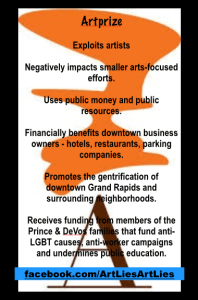
- In year two, we were also fortunate to have artist Richard Kooyman allow us to re-post his thoughtful piece on the danger that DeVos money and ArtPrize would pose to art and culture in general, in his piece What is ArtPrize?
- In year three, we began to look more closely at the financial aspects of ArtPrize. The mainstream news media has always run stories about how much money is “brought in by ArtPrize,” but they have never really explored who are the big financial winners, as we did we our story, When elites give money to each other: ArtPrize financials for 2010. We have also made it clear, based upon 990 documents, that Rick DeVos has been bankrolled by his parents, Dick & Betsy, to put on the annual monied spectacle. It became clear from the 990 documents that a great deal of the money was simply being passed around from one DeVos entity to another, although this was never a theme of any media reporting.
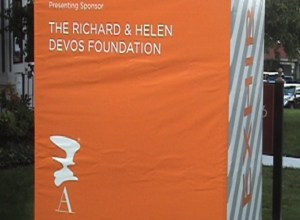
- In 2012, a GQ article about the DeVos family and ArtPrize generated some interesting conversation, but not by local news media, as we pointed out in MLive article misses the point of the GQ article on ArtPrize. The GQ article was one of the first outside media sources to discuss the political dynamics of ArtPrize, something that Rick DeVos constantly wants to distance himself from. Rick DeVos’ desire to distance himself from the family politics was reflected in this comment in the GQ story where he says, “I don’t even want to weigh in on any of the political stuff. I just prefer to stay away from that.”
- In 2012, we continued to explore the money and politics of ArtPrize, we our 2 part piece entitled, The Political Economy of ArtPrize. In Part I, we explored the more general impact that such an event has on art and culture and in Part II we explore in more detail the relationship between those who finance ArtPrize to what else the monied elites finance at the local, state and federal level.
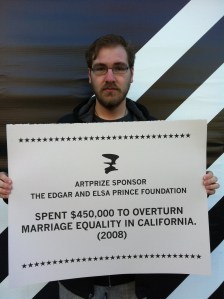
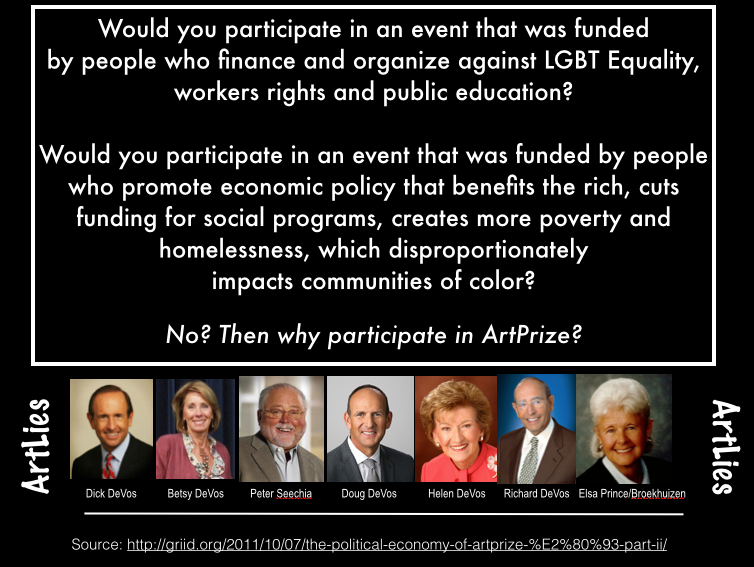
- 2012 was also the year that local activists engaged in a photo bomb campaign (called ArtLies) to visually make a point about the money and politics of ArtPrize donors, sponsors and the DeVos family.
- In 2014, artist Steve Lambert generated lots of attention and discussion around the politics of ArtPrize, with both his installation piece and his announcement that if he won the prize money from ArtPrize he would donate it to a local LGBT effort, since the DeVos family has historically funded anti-gay campaigns. What Lambert was able to do was to force both ArtPrize and the larger community to ask more fundamental questions about the political economy of this annual monied spectacle.

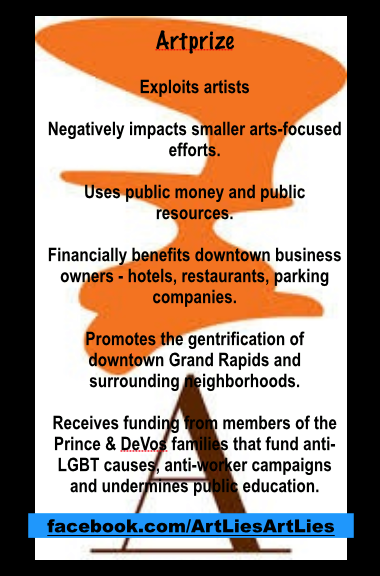
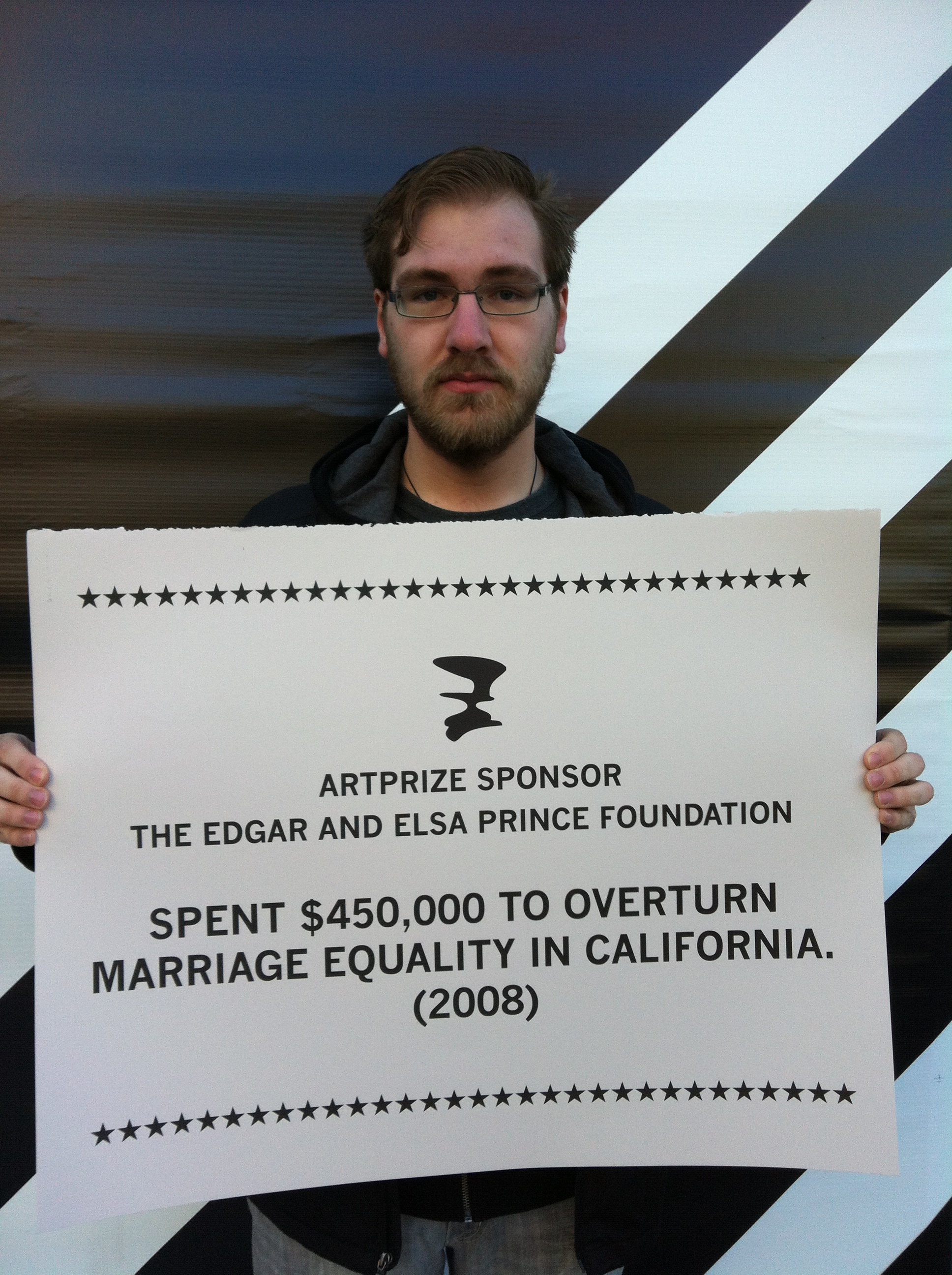
Ultimately, we believe that you cannot separate the funding sources of events like ArtPrize, from the political desires of the capitalist class. The DeVos funding of ArtPrize is a way to distract us and make us feel good for a few weeks out of the year, while the politics they fund bludgeon us all year round.
The Grand Rapids Local Food Discussion through a Food Justice Lens
I was delighted to see some of the responses to Levi Gardner’s article a few weeks back, which raised important questions about the Downtown Market and arguably the local food system.
However, a large part of the problem when discussing the local food system is our inability to recognize the fallacies of a market driven approach to food. What we need is an imaginative view of the local food system through a food justice lens.
I don’t want to provide a lengthy articulation of what Food Justice is, which one can explore in a series of handouts I created for Our Kitchen Table. There are two points about Food Justice that I would like to emphasize. First, Food Justice is an outgrowth of the environmental justice movement, a movement where communities of color confronted not only environmental injustice, but the often narrow focus of White dominated environmental NGOs.
The second point about Food Justice, which is essential to any local food conversation is the needs to see that food insecurity is the result of multiple systems of oppression, such as White Supremacy, Capitalism, Patriarchy and Speciesism. This means that if we are to honestly address the causes of food insecurity and food disparities, we need to address more than just the food system.
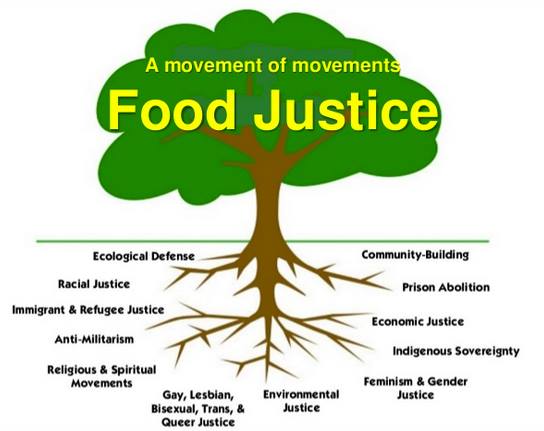
Now that we have a Food Justice framework, lets look at what is happening with food in West Michigan in recent years. There has been a growing interest in people growing more of their own food and purchasing locally grown food in a variety of ways. There are lots of new restaurants and foodie projects, like Community Supported Agriculture (CSAs), urban food growing projects and plenty of farm to table discussion. However, the problem with much of the food discussion and food-driven projects is that it primarily benefits those with economic and racial privilege. This is in part due to our collective inability to think outside of a market approach to food and the lack of a food justice lens. Don’t get me wrong, I know lots of farmers and urban growers and they work hard, but in order to survive they have to operate within the current economic system, which means that much of their produce ends up in the stomachs of people with lots of privilege. Lets face it, those who are most food insecure in this community cannot afford to eat at the local restaurants that serve locally grown food. This is not the fault of the growers, rather that of the food system.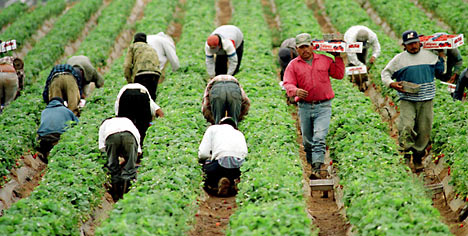
So what do we do? As with all major social problems, there are no easy answers. However, I would like to offer up some ideas and proposals for how to move forward in a way that promotes Food Justice.
First, the local foodie trend has almost completely ignored one of the prime factors in food production, food workers. West Michigan is home to one of the largest migrant worker populations in the country, which means that we are all dependent upon a workforce that is highly exploited. A 2010 Michigan Civil Rights Commission report stated that migrant worker conditions are as bad as they were in the 1960s. If we care about the local food system then we need to support efforts for migrant worker justice. This is also a racial justice issue, since most of the people who pick our food are Latino/a or indigenous. This food worker justice focus must also extend to those who work in kitchens, bus tables and wait on us when we go to restaurants. These food workers are also highly exploited and rarely are brought into the local food discussion. A local food movement that does not address food worker issues will only perpetuate exploitation and White Supremacy.
Second, we need to confront the current food system, while attempting to create a new food system. For example, one of the major reasons why local farmers cannot compete with agribusiness is because agribusiness is highly subsidized by public tax dollars. The so-called Farm Bill means that the unhealthy and ecologically destructive food system gets billions of dollars in public money, while small, ecologically sound growers get no public assistance. (See who gets food subsidies in Michigan.) The reason why the shitty food that fills some much of supermarkets is cheap is because it is highly subsidized.
What I would propose is that local farmers, both urban and rural, who want to support food justice, should get public funds to offset costs to allow them to make their food affordable to those who are experiencing poverty. Hell, if we can provide millions of dollars of public money to places like the downtown market and Monsanto, why can’t we fund local growers to practice food justice? If Beer City can provide tax break incentives for more bars and distilleries, then why can’t we provide similar financial support to people who want to grow food locally, especially food that serves the nutritional needs of the large number of individuals and families experiencing poverty?
Third, one issue that makes urban food growing difficult for people experiencing poverty is the lack of access to land. I propose that the City of Grand Rapids not only allows people to grow on the vacant lots they current own, but they should wave the fee for people to use those lots and they should provide financial support, along with practical assistance to people who want to grow more of their own food. This would certainly be a way for the city to put into practice their claim to being a Green City. This proposal might be difficult since the City has been in discussion for some time now (with little transparency) with the Kent County Land Bank to transfer those lots out of the public sector into a public/private structure. The Land Bank states that they have already been overwhelmed with requests in the vacant lots. What we need is a process that provides greater access or first priority access to people who are more vulnerable to food insecurity. People with lots of race and class privilege should not be the primary beneficiaries of such land acquisitions.
Fourth, another major issue that people experiencing poverty face and is ignored by the foodie trend, is the hard reality that people who work long hours and often two or three jobs face, is having the time to prepare healthy food. Even if we can get food subsidies to local farmers to truly make food affordable, people still need time to prepare and preserve healthy food. This underscores the fact that we can’t have food justice without confronting poverty and its root causes. Look at the growth of groups like Kids Food Basket. While it is encouraging that this group continues to provide free meals to children experiencing poverty, it is not addressing why those kinds are experiencing poverty.
Just last week Feeding America published a story in The Rapidian with tips on fighting hunger. However, Feeding America is also a food charity agency that does not address root causes of hunger. Instead, they want people to donate to their organization or wear a t-shirt to fight hunger. Why don’t we just make it a goal to NOT have the need for food charity, because we have policies and practices that support food justice. If people made a livable wage like $15 – $20 an hour, then more people could work less hours and have time to practice good nutrition that those of us with privilege take for granted.
Lastly, I come from a tradition where community building means practicing collective liberation. With food this could look like setting up community kitchens all across the city, whether they are in people’s homes or in churches. Community kitchens would be spaces that people can come to collectively make food, eat together, share recipes and then take home lots of prepared food that would save them time and energy during the week. Some of us have practiced this on a small scale. We call it potlucks. The beauty of potlucks and a community kitchen model is that it allows us to think about food and community outside of a market-based model. Indeed, in this sense eating well is simply a basic right, and that, I believe, is what needs to be cultivated in our efforts to build a local food movement.
Jeff Smith has been growing food for 35 years in Grand Rapids, has taught food justice classes and been part of numerous local food efforts over the years.
This 8 – week class is designed to do the following:
- Investigate the history of policing in the US
- Investigate the function of the Grand Rapids Police Department (GRPD)
- Explore and discuss ways to counter the repressive tactics of the GRPD
- Imagine and explore ways to create community safety that doesn’t involve cops
As a primary text, we will us Kristian Williams book, Our Enemies in Blue: Police and Power in America. You can order the book directly from AK Press or inquire with us about other options.
The 8 – week class with take place on Mondays, from 7 – 9pm, beginning Monday, September 28. Location is still to be determined. Contact us at jsmith@griid.org if you are interested in signing up. We are asking $20 for the class, but will not turn people away who are unable to contribute financially. Capacity for this class is 15 people.
Henry Kissinger is Wanted for War Crimes
The Bloom Collective has sent out the following image to several media outlets in Grand Rapids, and the poster has been appearing around the city itself.

It is probably no coincidence that Kissinger will be speaking at the econ club in Grand Rapids the same day as the event listed on the flier above. While the speech at the Devos owned JW Mariott downtown is strictly “members only”, those interested in learning more about Kissinger’s war crimes (and can’t afford $190 “Standard Membership” to the econ club, though they probably won’t be touching on Cambodia there anyhow) can attend the Bloom’s showing of The Trials of Henry Kissinger this upcoming Tuesday at 6pm.
All Bloom events operate on a “suggested donation” model, so no one turned away for lack of US currency. Any and all questions should be forwarded to bloomcollective@gmail.com.
GRIID is taking a break
For a variety of reasons GRIID will be taking a break from our work. We hope that in the meantime others will step in and take on more Indy media work in West Michigan. Thanks to everyone for their ongoing support.
Foundation Profile: Jerry & Marcia Tubergen Foundation
This foundation profile is part of a series of West Michigan foundation profiles, which is included in our Grand Rapids Non-Profit Industrial Complex Project.
Jerry Tubergen is part of the DeVos Family inner circle. He sits on the boards of some of the DeVos Family foundations and works for the DeVos-owned RDV Corp.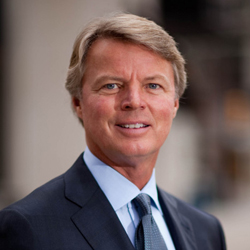
Jerry and his wife Marcia have their own foundation, that also serves as a mechanism for funding the kinds of projects that reflect his conservative, pro-capitalist, Christian worldview.
In looking at the foundation’s 990s for 2009 – 2011, we found that a great deal of their contributions went to conservative or reactionary Christian groups. Most of their money went to West Michigan organizations, but there were some from out of state that have received large sums. For instance, the Magdi Yacoub Foundation, which does medical work with children, received roughly $2,000,000 from their foundation, based on the most recent financial reports. The Jerry & Marcia Tubergen Foundation have also contributed substantially to the Cure International, Inc, which also provides medical treatment for children, but with an exclusively conservative Christian focus.
Closer to home, their foundation has contributed roughly $100,000 to Mel Trotter Ministries in Grand Rapids and other church ministries projects. The foundation has also funded anti-abortion groups like Michigan Right to Life ($5,000) and The Pregnancy Resource Center ($30,750).
We also notice a $50,000 contribution to Donors Trust, which has recently been receiving some attention because of their clandestine methods of funding everything from Right to Work campaigns to climate denial. When the Center for Public Integrity uncovered much of the information on the role of Donors Trust, we discovered that one of the main contributors to that group was Richard DeVos. This is not surprising, considering that Tubergen is a loyal employee of the DeVos family, but it further demonstrates the inter-locking systems of power and influence in West Michigan.
Video deconstructs Global Wealth Inequality
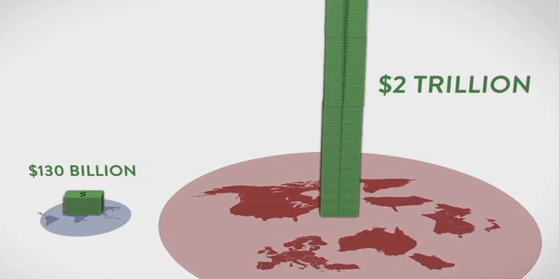
This video is produced by and re-posted from The Rules. Editor’s Note: While we find the video informative and useful for framing the global wealth gap, the group that put this video together does not offer ways to challenge global capitalism beyond reformism.
The richest 300 people on earth have the same wealth as the poorest 3 billion. This is no accident – those in power write the rules. Together, we have the power to change those rules.
Can Civilization Survive Really Existing Capitalism?
This video is re-posted from ZNet.
One of the world’s leading intellectuals and political activists, Professor Noam Chomsky has been awarded the UCD Ulysses Medal, the highest honor that University College Dublin can bestow.
Professor Chomsky was presented with the UCD Ulysses Medal by the President of UCD, Dr Hugh Brady, following a public lecture hosted by the UCD Philosophy Society and the UCD School of Philosophy at University College Dublin on Tuesday 02 April 2013.
Healing Children of Conflict to host 2 fundraising events this month for Iraqi boy who lost leg in US missile strike

Nearly two years ago we reported on the efforts of the local group Healing Children of Conflict, which brought an Iraqi boy and his father to Grand Rapids.
Then, 8-year old Hamzah, was being fitted for a prosthetic leg, a leg which he lost from a US missile strike outside of his home in Baghdad.
Hamzah and his father are returning to Grand Rapids this week so that the now 10-year old Iraqi boy can be re-fitted for a new prosthetic leg.
To welcome back Hamzah and his father Imad, Healing Children of Conflict will be hosting two fundraising events in April. Hamzah and his father will be at both events to share their stories and talk about life in Iraq in 2013.
Healing Children of Conflict is hoping that both events will help cover the costs of the medical services needed and to provide an opportunity to educate the West Michigan community on the ongoing legacy of US foreign policy in Iraq.
Healing Children of Conflict April Fundraising Events
Wednesday, April 17 at 7:00PM (doors open at 6:30)
Notos Old World Italian Dining
6600 28th St, Grand Rapids
Friday, April 26 at 6:30PM
Plymouth United Church of Christ
4100 Kalamazoo SE, Grand Rapids
Both events are fundraisers and people can purchase tickets ahead of time by contact Nidal Kanaan at nidal_kanaan@hotmail.com 616-262-4525 or Christine Yard cayared@comcast.net or 363-9041.
Mainstream Green Is Still Too White
This article by Brentin Mock is re-posted from Colorlines.
Last year was the hottest on record for the continental United States, and it wasn’t an outlier. The last 12 years have been the warmest years since 1880, the year the National Oceanic and Atmospheric Administration began tracking this information. And climate scientists predict that the devastating blizzards, droughts, hurricanes and wildfires we’ve been experiencing lately will worsen due to climate change.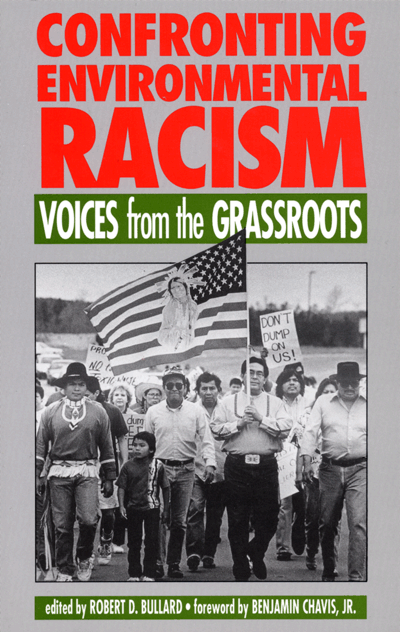
In many ways these punishing weather events feel like Mother Nature seeking revenge for our failure to reduce greenhouse gas emissions, the primary cause of global warming. Despite abundant evidence, the U.S. government has yet to pass a law that would force a reduction in these emissions.
During his first term, President Obama did make climate change a priority, both in his campaign and in office. The American Clean Energy and Security Act that Congress produced passed through the House in June 2009 by a narrow margin. Yet the bill never reached a vote in the Senate, and it died quietly.
Environmentalists have been flummoxed ever since. One prominent cause-of-death theory says that large mainstream (and predominantly white) environmental groups failed to mobilize grassroots support and ignored those who bear a disproportionate burden of climate change, namely poor people of color.
With Obama in for a second term and reaffirmed in his environmental commitments, climate legislation has another chance at life. Now, observers are wondering if mainstream environmentalists learned the right lessons from the first climate bill failure and how they’ll work with people of color this time around.
Anatomy of a Conflict
To hear some environmental leaders tell it, their defeat wasn’t due to a lack of investment in black and brown people living in poor and working class communities, but to an over-investment in Obama. For example, Dan Lashof, climate and clean air director for Natural Resources Defense Council (NRDC), has blamed the president for having the audacity to push health-care reform and he’s pointed the finger at green groups for being too patient with Obama.
Asked what environmental advocates who led the first climate bill effort could have done differently in 2009, Bill McKibben, founder of the online grassroots organizing campaign 350.org, says their game plan was too insular. “There was no chance last time because all the action was in the closed rooms, not in the streets,” he tells Colorlines.com.
Yet that “action” took place behind closed doors for a reason: Major mainstream green groups including the Environmental Defense Fund and The Nature Conservancy teamed up with oil companies and some of the biggest polluters and emitters in the nation to form the United States Climate Action Partnership (USCAP). This ad hoc alliance was the driving force behind the failed 2009 bill and there were no environmental justice, civil rights or people-of-color groups at the USCAP table.
Obama can’t be blamed for the blindspots of major groups. As recent Washington Post and Politico articles have pointed out, their leadership and membership simply don’t reflect the race or socieconomic class of people most vulnerable to climate change’s wrath.
Sarah Hansen, former executive director of the Environmental Grantmakers Association, argued recently that the mainstream has been stingy with funding and resources and inept at engaging environmental justice communities. In a National Committee for Responsive Philanthropy (NCRP) study, “Cultivating the Grassroots: A Winning Approach for Environmental and Climate Funders,” Hansen reported that philanthropies awarded most of their environmental dollars to large, predominantly white groups but received little return in terms of law and policy. Meanwhile, wrote Hansen, too few dollars have been invested in community- and environmental justice-based organizations.
According to the NCRP report, environmental organizations with $5 million-plus budgets made up only 2 percent of green groups in general but in 2009 received half of all grants in the field. The NCRP also found that 15 percent of all green dollars benefitted marginalized populations between 2007 and 2009. Only 11 percent went to social justice causes.
In January, Harvard professor Theda Skocpol released a study of the first climate bill campaign’s failure and faulted green groups involved for choosing direct congressional lobbying over grassroots organizing. Some of the major organizations did spend money on field organizers, wrote Skocpol, but only to push public messaging like billboards and advertisements.
“The messaging campaigns would not make it their business to actually shape legislation — or even talk about details with ordinary citizens or grassroots groups,” Skocpol wrote in the report. The public “is seen as a kind of background chorus that, hopefully, will sing on key.”
Take One for the Team?
That the environmental movement thought billboards and ads could replace educating and organizing actual people was their biggest flaw, a position shared by Hansen and Skocpol. In comparison, health reform advocates took a lobbying and grassroots approach while the climate-change bill made the rounds and got a law passed.
“If you want to gain the trust of the emerging non-white majority, it’s not just a messaging thing,” explains Ryan Young, legal counsel for the California-based Greenlining Institute, a policy research non-profit focused on economic, environmental and racial justice. “It’s a values thing. You must understand the values of these communities and craft policy around that.”
Why does this matter?
Consider how the website of the National Wildlife Federation (NWF) recently featured an article on city bird sanctuaries from the group’s print magazine titled “Urban Renewal.”
Having people of color on staff might have helped NWF understand that for some, “urban renewal” signifies a historical legacy of black and Latino neighborhoods being effectively erased by development projects such as sports stadiums. Cultural snafus like this have led to white environmental groups being clowned in influential outlets including The Daily Show.
In an interview about the unintended message of “Urban Renewal,” Jim Lyon, NWF’s vice president for conservation policy, told Colorlines.com that the group doesn’t “always get everything right” and that “he’d take it back to his staff.” (Ironically, one of the harshest critiques of urban renewal came from Jane Jacobs, a white conservationist.) On the topic of staff diversity, Lyon said the organization isn’t where they want it to be, but that they’ve made “good progress.” He would not release staff demographics, but said NWF achieves diversity through partnerships with other groups and programs like Eco-Schools USA, which he says “engages more than one million children of color” daily.
Beverly Wright, who heads the New Orleans-based Deep South Center for Environmental Justice, says racial oversights of traditionally white groups are the main reason black and Latino environmentalists have formed their own organizations. The culturally divided camps sometimes use the same words, but they’re often speaking different languages.
Take “cap and trade,” a scheme that would commodify greenhouse gas emissions for market-trading as a way to reduce those emissions. The first climate bill centered on cap and trade because most major environmental groups supported it. But cap and trade was anathema to environmental justice because it did nothing to curb local co-pollutants such as smog and soot, direct threats to communities of color. That’s not to mention that cap and trade was the brainchild of C. Boyden Gray, a conservative member of the Federalist Society and leader of FreedomWorks, today a major Tea Party funder.
Wright says major green groups tried to coax EJ organizations into supporting cap and trade by claiming it was for the “greater good.”
“But that meant white people get all the greater goods and we get the rest,” says Wright. “Until they want to have real discussions around racism, they won’t have our support. That’s what happened last time with the climate bill. It did not move, because they did not have diversity in their voices.”
“Diversity” doesn’t just mean hiring more people of color. As the 30-year-old Center for Health, Environment and Justice stated earlier this month, the diversity conversation “really needs to be about resources and assistance to the front line communities rather than head counting.”
What’s Next?
So in the new round of climate bill talks, will large environmental groups meaningfully engage community-based EJ groups?
The prognosis is mixed. Look at MomentUs, a mammoth collaborative started in January to ramp up support for new climate legislation. While MomentUs claims to be a game-changer, the strategy behind it seems very similar to that of USCAP’s—the one that failed to deliver a climate-change law the first time around. On its website, MomentUs describes its board of directors as “cultural, environmental, business, and marketing leaders who offer the diversity of viewpoints and keen insight vital to advancing MomentUs’s mission.” At press time, all of the directors are white. So is the staff, except for one office administrator.
Looking at MomentUs partners, it appears that the same traditionally white environmental organizations who teamed up for USCAP are now working with corporations including ALEC funder Duke Energy, predatory subprime mortgage king Wells Fargo, perennial labor union target Sodexho, and Disney. At press time there are no environmental justice or civil rights groups involved.
On the other side of the spectrum, The Sierra Club—one of the nation’s largest and whitest green groups—has had an expansive role in environmental justice and advocacy, particularly in the Gulf Coast. In January it joined the NAACP and labor unions in launching the Democracy Initiative, which will tackle voting rights, environmental justice and other civil rights concerns.
To be sure, it’s way too early to make a conclusion about MomentUs or the Democracy Initiative, but the latter appears to be a step in the right direction in terms of highlighting the intersection between poor environmental outcomes and racism.
McKibben, the 350.org founder, has helped cultivate a multicultural fight against the Keystone XL pipeline project, but he admits that the overall environmental movement has “tons of work to do” on racial equity and inclusion.
“The sooner [mainstream environmentalists] absorb the message and are led by members of the environmental justice movement, the better,” he says.
In that case, the question is a matter of timing and power, of who decides when and which EJ activists get to lead.
Stay tuned.
 Grand Rapids Institute for Information Democracy