GRIID Winter 2016 Class: Investigating the Religious and Political Right in West Michigan
Our Winter 2016 class will focus on the Religious and Political Right of West Michigan. Most people know that West Michigan is a highly conservative place, but the details and the depth of the connection between the religious and political right may not be as well know.
This class will use Russ Bellant’s book, The Religious Right in Michigan Politics. The book is 20 years old, but it provides solid background on the current religious and political right. We’ll be using a PDF of the book, so no one will have to purchase the book.
In addition to Bellant’s book, we will be using numerous reports produced from a variety of sources and we will be doing lots of our own investigation and monitoring of individuals, families and organizations that make up the political and religious right of West Michigan.
This investigation will include, but not be limited to people and entities that promote patriarchy, homophobia and heterosexism, white supremacy, capitalism, Zionism and the attack on public institutions like public education, public policy and public funding.
This class will be held on Mondays from 7 – 9pm, beginning on Monday, February 1. The classes will be held at the offices of the Institute for Global Education, located at 1118 Wealthy in Grand Rapids. The cost for the class is $25, but we will not turn anyone away based on their ability to pay. To sign up, contact GRIID at jsmith@griid.org.
MLive’s Managed Reporting on DeVos Family “Giving”
Yesterday, MLive published a series of articles that claimed to illuminate the philanthropic donations made by the DeVos Family.
There were a total of three articles from January 4 and a slide show with highlights of recipients of DeVos Family donations. One article focused on how much money the DeVos Family has contributed to GVSU, a second article provided a brief overview of how MLive conducted their research, with the third article entitled How and why Amway’s DeVos family gives away billions.
The articles are pretty straight forward and mostly data driven, yet the headline (How and why Amway’s DeVos family gives away billions) of the featured article suggests that there is some big reveal.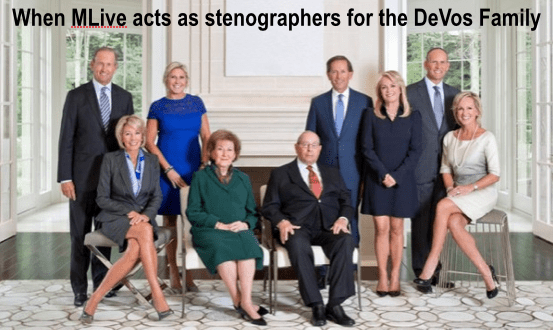
The featured story does what has come to be expected from commercial media. The story reads as a form of stenography, where the reporter reprints what people in power have to say without verifying or questioning said comments. Several sources are cited in the article:
- DeVos Family spokesperson John Truscott
- R.J. Shook, founder of the Philanthropic Research Institute
- Communications Director for Grand Rapids Public Schools, John Helmholdt
- Doug DeVos
- Marge Palmerlee, Degage’s Executive Director
- Dennis VanKampen, CEO of Mel Trotter Ministries
- Michael Kaiser, former Kennedy Center President
- Mike Guswiler, President, West Michigan Sports Commission
- Kyle Caldwell, Executive Director of GVSU’s Johnson Center for Philanthropy
- Tom Haas, GVSU President
- Jim Brooks, philanthropist and founder of the now-defunct West Michigan Strategic Alliance
- Steve Ford, son of the late President Gerald R. Ford
All of the sources speak glowingly of the DeVos family, which should raise red flags for any discerning reader. How is it that an article can be written about the most powerful family in West Michigan and not include some critical commentary or analysis?
Giving strategies
The “big reveal” from the MLive article is as follows:
The family has in the past instructed philanthropic organizations not to discuss the gifts. That restriction was lifted for this series, and three hallmarks emerged for the DeVos family foundations’ giving strategies:
- leveraging additional donations through peer pressure or organized giving among the family foundations.
- providing strategic advice to institutions receiving money.
- extending influence through board service and other connections.
The three strategies are interesting, but hardly a big reveal. People who have followed the DeVos Family over the years would have been aware of these “three hallmarks” for giving. However, even though the rest of the MLive article is an elaboration on the three strategies, there is really no new information provided about the real effects of the DeVos Family contributions. Sure, there is some commentary about how it has impacted various local and national organizations, but the commentary is superficial and highly managed.

For instance, GVSU President Tom Haas is quoted as saying, “We wouldn’t be the university we are today without his and the family’s support.” While such a statement is true, it fails to convey how DeVos money has impacted Grand Valley State University. One example is based upon our own research with the Grand Rapids LGBT People’s History Project, where the DeVos Family made it clear to GVSU in the mid 90s that, if the university were to allow domestic partner benefits, they would withhold funding for the new health sciences building on Michigan Avenue in Grand Rapids.
This kind of influence is exactly what the DeVos Family means by strategy number two – providing strategic advice to institutions receiving money. This is probably the most important strategy, since this is often the primary reason that wealthy families contribute to institutions and organizations…….to influence what those entities do.
This influence can take on various forms. First, the influence can be straight forward, where the funding is to simply affirm the ideological mission of the institution receiving the money. For instance, one of the entities mentioned in the MLive article is the Mackinac Center for Public Policy, which is referred to in the article as a conservative think tank. However, to not explore how DeVos money assists groups like the Mackinac Center is another way of not serving the public interest. For instance, in 2012 we wrote about how DeVos money supported the efforts of the Mackinac Center to get Right to Work Legislation passed in Michigan. 
It is this kind of journalism that is needed, where reporters take the information provided about those in power and then flesh out the details of how this impacts the public. This could have been done with any number of the organizations and institutions that received DeVos Family money that appear in the donation recipient slideshow on MLive. One of the recipients listed in the slideshow is the Grand Rapids Public School system, which has received a total of $2.6 million from the DeVos Family. The featured story also mentions that GRPS has been a recipient of DeVos money, where “funding paid for leadership development, teacher evaluation and teacher training,” along with funding for the Believe 2 Become project. The Believe 2 Become project is really a wedding of faith-based entities with the public schools system, something that again the DeVos Family ideologically supports.
The DeVos Family funding of the Grand Rapids Public Schools should also raise interesting questions for competent journalists. Why would a family that has been a national leader in private education, faith based education and the school voucher movement be contributing to public education? Unfortunately, these are not the kinds of questions or angles that are pursued in the MLive story.
A second major reason that families like the DeVos’s contribute money to institutions and organizations is to redirect or manage populations that have the potential to be involved in revolutionary and insurgent politics. For instance, as the MLive recipient slide show reveals, one of the local organizations that benefits from DeVos Family money is LINC Community Revitalization. The slide show information says the Doug and Maria DeVos Foundation contributed $905,000 to LINC in 2013. DeVos money does not mean that LINC doesn’t do good work in the community, rather the point is that instead of organizing people to engage in radical grassroots organizing for systemic change, LINC puts most of its energy into directing people into participating in acceptable political tactics that do not question systems of power, along with an emphasis on developing entrepreneurs.

A third reason for foundation and philanthropic contributions, in addition to ideological support of social management, is to buy silence and complicity. This consequence of funding from the wealthiest sectors of society is the least evident, but it is as equally impactful as the other reasons. The DeVos Family knows that if they give money to an organization or an institution that those groups receiving the money will not take a public stance that is either critical of the DeVos Family practices or critical of issues that the DeVos Family is attempting to influence.
For instance, in the summer of 2015, DeVos Family political contributions helped the Michigan legislature pass HB 4052, which allows organizations to discriminate against families wanting to adopt on religious grounds. This connection is made clear when one considers that the largest adoption agency in the state, Bethany Christian Services, is also a major recipient of DeVos Family money. This is not to suggest that Bethany would challenge DeVos’s political influence, but it does have a silencing effect on staff who may not agree with such discriminatory policies.

The last major issue that the MLive articles on the DeVos Family giving fail to address is what connections their major political contributions have with their philanthropic giving? This seems like an important question that journalism that serves the public interest would want to explore. We already raised the question about the DeVos Family funding of the Grand Rapids Public Schools, while at the same time being involved in funding and politically leading national groups that promote redirecting public funds away from public schools and into the hands of private and charter schools.
A larger and maybe more obvious question is how does their political funding for economic policies that benefit the rich then connect to their charitable funding for urban-based social services agencies? For instance, the state policies that the DeVos-influenced West Michigan Policy Forum have worked on in recent years – ending state business taxes, Right to Work and other anti-union/anti-worker policies – such policies contribute to creating poverty and widening the gap between the rich and the working class poor. So, the DeVos Family funds public policy that makes them and their friends richer by stealing public money, then they turn around and fund projects that provide some assistance to those experiencing poverty, but such programs redirect working class anger into pull-yourself-up-by-your-bootstraps practices. Sounds like a wonderful way to get richer while simultaneously convincing the public you are generous beyond compare. Seems to work.
Public Money Supports Israeli Military Contractor in West Michigan

A week and a half ago, MLive ran a story which announced that MDOT would be contributing nearly half a million dollars for road improvements because of two expanding companies in Kent and Ottawa county.
It is curious that state funding for road improvements would be used to reward businesses, but not surprising. The two companies which have the favor of the state department of transportation are Agape Plastics Inc. and Plasan North America.
Agape Plastics makes custom injection moldings and Plasan North America, “is a Tier One supplier to defense contractors and a leader in composite material technology in the design and development of a variety of military ground vehicles.”
Plasan is not just any military contractor, they are an Israeli-owned military contractor with facilities in the US, France and Israel. Plasan not only makes weapons, but provides “security resources and solutions” that focus on Border Protection, Special Forces Operations, Intelligence Missions, Disaster Management, and Convoy & VIP Protection. Here is a sample of “services” they offer with the products, which is taken from their own promotional material.

Plasan has a facility in Walker, Michigan and was recruited recently by The Right Place Inc. to set up shop in West Michigan. This fits within the larger role of The Right Place, which is to attract businesses to West Michigan, but it is also a reflection of the business agency’s growing relationship with the State of Israel.

This relationship between The Right Place and Israel is directly through the Michigan Israel Business Bridge (MIBB), a Bloomfield Hills-based entity which promotes business relationships between Michigan and Israeli businesses, including the promotion of Israeli products. The Right Place CEO Birgit Klohs is part of the Advisory Council for the MIBB.
It is bad enough that public funds are being used to directly support the private sector, but it is another thing to provide public funds to a company that plays a significant role in the illegal Israeli occupation of Palestine. Plasan military equipment and “security solutions” profits from the brutal Israeli repression of Palestinians and supports what is essentially a racist apartheid system.
Considering that there is a growing interest in the Palestinian-led Boycott, Divestment and Sanctions (BDS) movement around the world and in West Michigan, Plasan and supporters like The Right Place Inc, would be worthy targets of anti-apartheid organizing.
The Not So Glamorous Organizing Efforts of Grand Rapids Bus Drivers
Over the past couple of months, we have written a couple of articles about the Grand Rapids Bus Drivers Union, the ATUGR. One article was written for the national left publication, In These Times, and another piece was more recently published on this blog. 
As of this writing the ITP has refused to negotiate a contract with the bus drivers union, making the stalemate more than 6 months. Instead, the management of the ITP, along with the Board of Directors has decided to engaged in tactics that are antagonistic towards bus drivers who continue to fight for a just labor contract.
Earlier in the year there was lots of organizing around this campaign, with a fair amount of media attention, even from the commercial press. However, in recent weeks the attention has dissipated and participation from rank and file members has dwindled.
This is not to say that there isn’t any organizing going on. In fact, there have been a constant stream of actions and efforts in the struggle to get a just labor contract. In the past week, I attended to activities, where ATUGR members were engaged in the more mundane, yet equally important work of organizing.
A few weeks ago while ITP CEO Peter Varga was in DC, ATU members hand him a flyer while the song from The Grinch Who Stole Christmas played in the background. In addition, Grand Rapids Mayor George Heartwell was greeting by ATU members while attending the Paris Climate Summit. The ATU members wanted him to know that nearly 30% of the GR population lives in poverty and that the Rapid just raised bus fares by 16%.
On Wednesday, December 16, some members of the union attended the monthly board meeting for the Rapid. Two of the members spoke during public comment about the threats to their pension, while another member filmed some of the proceedings.
The Rapid board meeting was brief, but instructive. Rapid CEO Peter Varga spoke briefly at the front end of the meeting about “how he came up through the ranks,” even reflecting on his time as a bus driver in Grand Rapids. Varga also passed around a picture of when he was a bus driver, apparently attempting to present himself in a positive light as a man of the people.
One aspect of the ITP board meeting that was revealing was in the form of document they handed out to all those in attendance, a document that refers to Rules of Public Comment at Meetings. The document is clearly designed to censor people from challenging or confronting board members, since they “reserve the right to remove anyone who violates the rules.”
In addition, if you want to submit documents to the ITP board members there are also clear instructions. One of the guidelines states; “Position papers pr lengthy documents must be submitted to the office of the CEO for vetting.”
The board meeting lasted only about 30 minutes and then they went into a closed Executive Session. It made little sense to this writer why there would be part of the meeting held in private, especially when this is a public entity that relies on public tax dollars for operation. Transparency did not seem to be a priority.
Yesterday morning, the Rapid held a job fair at the central station in the same room that the ITP board meeting was held. Jay DeShane with the ATUGR was present to greet people who were there to apply for a job and hand out some information on their campaign to negotiate a contract. This is often the nuts and bolts of any organizing effort, talking to people face to face about your campaign.
I was impressed with Jay’s ability to connect with people and have an honest dialogue about the current political battle they were in with the ITP. When people were not coming in to fill out job applications, Jay would engage me in conversation around labor politics and history. It was a refreshing way to spend the morning and it was even somewhat inspirational to know there are people who are willing to do the not so glamorous work of organizing that rarely sees the light of day.
In the midst of all the chatter about the 2016 President race, it was comforting to know that people are not just putting blind faith in politicians. Instead, it seems that some of the members of the ATUGR are engaged in a process that will have a direct impact on their lives. In fact, the Bus Drivers Union is doing what labor organizers have done since the later part of the 19th century. These labor organizers are taking matters into their own hands, using their own power and not abdicating it to politicians or political parties which rarely act on behalf of working class people.
DeVos, Gilbert and friends are still buying elections
We are less than a year away from the next Presidential Election and already it is clear that the super rich are buying the election.
This should in no way be surprising to those who have seriously looked at how elections function in the US, but it is always useful to follow the money.
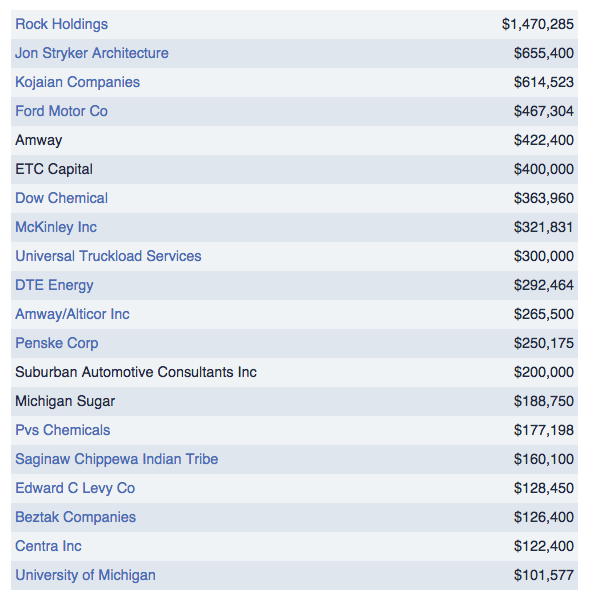
Below is a listing of the top corporate political contributions as of November 16, 2015, according to the Center for Responsive Politics.
The top contributor so far is Rock Holdings, which is a subsidiary of Dan Gilbert’s company Quicken Loans. Gilbert has been buying up property all over Detroit in recent years and is a major player in the gentrification on the east side of the state. Gilbert’s election contributions in Michigan are to the Republican Party and candidates.
Number two on the list is Jon Stryker Architecture, which is part of the Stryker Corporation and Stryker family wealth. The Stryker family has a long history of contributing to the Democratic Party and its candidates, which they continue to do in this cycle. Their support for the Democrats, makes it clear in Michigan, like in any other state that the rich buy elections regardless of party affiliation.
Third on this list corporate purchasing of elections is the Kojaian Companies. The Kojaian Management Corporation owns and operates industrial real estate properties around the state, including near the Grand Rapids airport, Byron Center, Walker, Holland and Zeeland. Their contributions go primarily to the GOP.
The DeVos Family, through the Amway and Alticor business entities are 5th and 11th on the list so far in political contributions for the 2016 cycle. The DeVos family has consistently contributed millions of dollars to the Republican Party and its candidates and is known for influencing public policy, with a few pieces of legislation in Michigan being the most recent examples. It should also be noted that the amount of money the DeVos family contributes personally is much larger than that which is contributed through the corporation they own.
Some of the other companies listed also have a long track record of buying influence, either through elections or lobbying around state policy. In a recent report from the Michigan Campaign Finance Network, companies that are listed below, such as Dow, DTE, Ford and Quicken Loans (of which Rock Holdings is a part) have all contributed significantly to political action committees in the current election cycle.
Again, this is not new information, but should be a reminder of how elections really function. More importantly, the fact that DeVos, Gilbert and other members of the elite are constantly engaged in a class war and will use whatever means necessary to impose their will on the rest of society.
Grand Rapids participates in National Day of Action to Stand with Immigrant Families
Yesterday, several dozen people gathered outside the offices of Justice for Our Neighbors to participate in a National Day of Action to Stand with Immigrant Families as the Supreme Court takes up the issue of deportation relief.
Alexandra Gillett, with Justice for Our Neighbors, welcomed those who showed up to take a stand on immigration justice. Alexandra stated, “Today we’re here to urge the Supreme Court to hear the case on Administrative Relief, it’s called Texas v. United States. You’re going to hear from individuals from across WM: they are faith leaders, business owners, leaders in the Hispanic community; and immigrant advocates. They will share their experiences and stories to illustrate how important it is for the Supreme Court to hear the case on DAPA and expanded DACA.”
DAPA stands for Deferred Action for Parental Accountability and DACA is Deferred Action for Childhood Arrivals.
The representative with Justice for Our Neighbors made it clear what has happened with DAPA and DACA so far.
1. DAPA would provide certain parents of US citizen or legal permanent resident children with a work permit that is good for 2 years. This does not provide a path to a green card or citizenship, but it does allow immigrants to work legally and remain with their families. I want to be clear: it DOES NOT GRANT AMNESTY to anyone.
2. Expanded DACA is similar to the DACA program currently in place, but it expands the program to help more people and it allows for a 3 year work permit instead of 2 years. This would allow more undocumented people who were brought to the US as children to receive work permits. Again DACA does not provide a path to a green card or citizenship, but it does allow immigrants to work legally.
Gillett was followed by several other speakers, each of which made points about the importance of this moment in history and why immigrants, both documented and undocumented, deserve justice.
Adam Lipscomb, a Pastor at City Life Church, spoke about his congregations work with immigrants. More importantly, he shared a story about the deadly consequences that those who are deported could face.
Sergio Reyes, Co-founder of Cultivate Holland, spoke about the importance of recognizing this historical moment and made the connection between previous movements for social justice and what those struggles were able to accomplish.
However, maybe the most important voice heard at the rally was Vanessa Gutierrez, a DACA recipient and immigrant advocate. Vanessa talked about her own experience of how the broken immigration system made life for her and her family a constant struggle. Vanessa also told those in attendance that her fight has paid off, but that we all need to be involved in the ongoing efforts to stop deportations and treat immigrants with the respect and dignity that all humans deserve.
Other speakers were Roberto Torres, Executive Director at the Hispanic Center and the Rev. Kate Kooyman, with the Christian Reformed Church Office of Social Justice. The rally in Grand Rapids was co-organized by Michigan United.
Graphic from http://dignidadrebelde.com/
Your Wealth is Causing My Poverty: Grand Rapids Poverty numbers up, but we still love all the shiny new development
On Friday, MLive posted a story based on new data from the U.S. Census Bureau.
The article states early on, “Statewide, more than one out of every six people are living in poverty, a 17 percent increase from the previous 5-year period.” In Grand Rapids, the data shows that 26.7% of the population is experiencing poverty according to the 2014 data, which is up from 21.9% from 2009.
The article also states that medium income levels in Grand Rapids fell by 8 percent over the last 5 years.
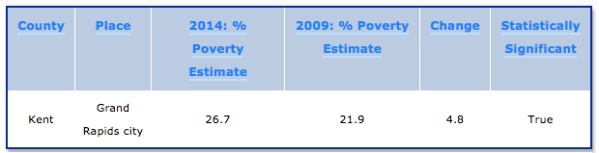
How is this so? I mean, don’t we always hear about how Grand Rapids is the best place to raise a family and how the economy here is doing so great? There is not a week that goes by where there is a new story about a new “development project” and that there a housing boom in Grand Rapids. Even the headline from the MLive article says, Michigan’s poverty rate soars as income drops even in economic rebound, census shows.
Even in the economic rebound. However, the question we must always ask ourselves when such seemly contradictory claims are made is, WHO is benefiting from the economic rebound and WHO are the growing number of people experiencing poverty?
These are questions that the MLive story do not ask. In fact, the people they do cite in the story are from the Chamber of Commerce, a state demographer and someone from the Michigan League for Public Policy. Each of the three people who were cited do not shed light on why poverty is increasing across the state, nor who it is disproportionately impacting.
More Than Statistics
The MLive story does link to federal standards for income levels that categorize who lives in poverty. These numbers are inadequate however, since poverty is about so much more than income.
For those who experience poverty, income is just one indicator for quality of life. But lets be real, the income levels for poverty are also pretty ridiculous and it is clear that those who determine such numbers have never experienced poverty themselves. Does anyone really believe that if you earn just over $11,770 a year you can survive? Rental costs keep going up, as do food costs, transportation and health care. Increasingly, people have to make choices between eating and heating, or eating and transportation. In other words, for those who live in poverty, it is a constant battle with limited options one has.
Then there is the experience of those in poverty with the charity services sector. People are often scrutinized by the social service system and made to feel shame about experiencing poverty. This speaks to the emotional and psychological toll of living in poverty, which underscores the point that it is so much more than just income levels.
Poverty and Race
Another failure of the MLive article is the lack of investigation into whom this increase of poverty in the state and in Grand Rapids is affecting. Statistically we know that communities of color, immigrants, refugees, people with disabilities and LGBTQ youth experience higher levels of poverty than do those who hold all kinds of social and economic privilege.
Some of the most recent data from Kids Count, shows that the percentage of children in Michigan experiencing poverty in 2014 was 23% for the entire population. For White children the percentage experiencing poverty is 16%, while African American children experiencing poverty is 47% and 32% for Latino/a children. The astronomically higher numbers of poverty for communities should be a clear indicator that poverty is disproportionately a result of institutionalized racism and White Supremacy.
Wealth and Comfort for some means poverty for others
Back to the question of how can poverty be increasing during an “economic rebound.” First, it is important to point out that phrases like economic rebound or economic growth are misleading. Such terms distract us from the harsh reality of economic systems, particularly the current system of Neoliberal Capitalism.
NeoLiberal Capitalism is based on the notion that some will benefit at the expense of others. In September, the latest Forbes Richest people for 2015 has the Meijer brothers list at 58th richest in the world at $7.9 Billion and Richard DeVos at 84th on the list with $5.7 Billion. The combined wealth of these two families and that of a few others in West Michigan is greater than the combined wealth of everyone else living in this area.
However, those who have accumulated tremendous wealth aren’t the only ones contributing to the increase of those living in poverty in Grand Rapids. There is another class of people who are aspiring to accumulate more wealth, those who have six-figure salaries or more who also contribute to poverty creation. This is a professional and entrepreneurial class of people who embrace the system of Neoliberal Capitalism. We hear about these people all the time as well, since they are the ones starting new businesses, sitting on local boards or participating in some new philanthropic venture. These are the 40 Under 40 crowd who not only are benefiting from the poverty of others, but act as a buffer for the super wealthy, since they perpetuate the notion that we just need to come up with creative ways to help those in poverty. This class of people are the executive directors of agencies that convince those in poverty that they just need more opportunities to achieve success. Don’t question the economic system or the structural causes of poverty, just get people to pull themselves up by their bootstraps or get your friends to spend more of their money that will benefit the creative class, who will donate a portion of their business earnings to charitable programs that helps us all feel good and divert us from having to think about the systemic causes of poverty.
This is a follow up article to the one I wrote for In These Times in late October, Michigan Transit Workers Fight To Prevent City Bus System From Eliminating Their Pensions.
It was a cold afternoon in downtown Grand Rapids and members of the Amalgamated Transit Union (ATUGR) Local 836 and a few supporters were standing outside of The Rapid facility.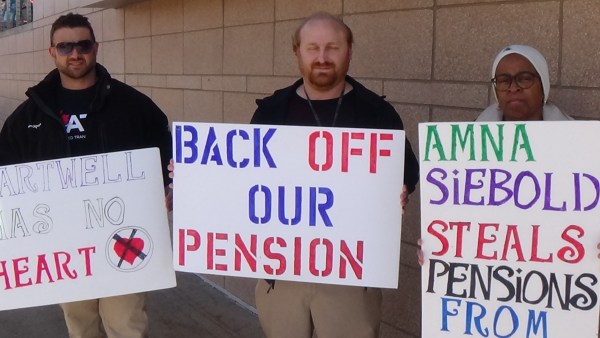
The conversation was lively, with union members discussing tactics and strategies on how to deal with the ongoing threats to their pensions from The Rapid board members. Around 2pm, the ATUGR was in a meeting with people from The Rapid. Here is what rank and file member of Local 836m Louis DeShane, had to say about what happened.
“We were in negotiations today and the ATU wanted to give The Rapid a proposal. They (The Rapid) did not want to listen to it and they just walked out of the negotiations.” When I asked Louis why he thought that The Rapid chose to walk out of the negotiations today, he replied, “They keep saying they want to negotiate, but every time we propose something, they want nothing to do with it.”
This has been a pattern for months now, where the ATUGR has attempted to negotiate in good faith, but The Rapid leadership has refused to meet with the union or compromise on their proposal to alter the bus driver’s pension plan, which the ATUGR says would negatively impact workers, some of whom have been driving for the Grand Rapids transit system for over 20 years.
As we continue to talk outside the north end of The Rapid facility, bus drivers come and go during shift changes and stop by to shake hands and offer up encouraging words to the union members standing outside.
Inside, other members of the ATUGR were meeting to discuss other strategies, which included a response to The Rapid walk out during the meeting on Monday.
Some allies also joined the small rally outside The Rapid facility. There was a member of the Grand Rapids Federation of Musicians, which is also faced with a standstill in contract negotiations with the Grand Rapids Symphony.
Along with the local musicians union, a member of the GVSU United Students Against Sweatshops (USAS) also came to show solidarity with the Grand Rapids bus drivers union. The GVSU chapter of USAS has been the most consistent in their support of the ATUGR and had recently participated in an action during a Grand Rapids City Commission meeting to confront that elected body on their unwillingness to truly negotiate.
In addition to The Rapid’s failure to negotiate, they continue to intimidate workers who are pressing the issue. As we reported for the In These Times article, workers who were leafletting at the bus station on their own time were threatened with arrest by The Rapid. Now The Rapid is trying to limit what workers can say while on the job, especially when communicating with fellow workers about their campaign.
According to a message from Todd Brogan, with the national Amalgamated Transit Union, The Rapid issued a new Social Media policy that workers say is meant to silence dissent online and violates their Constitutional rights.
Some excerpts from The Rapid Social Media policy are as follows:
1. “Before creating content, consider some of the risks and rewards that are involved. Keep in mind that any of your conduct that adversely affects…people who work on behalf of The Rapid or The Rapid’s legitimate business interests may result in disciplinary action up to and including termination.”
2. “Employees are prohibited from using social media to distribute…false or misleading statements about The Rapid or its personnel…”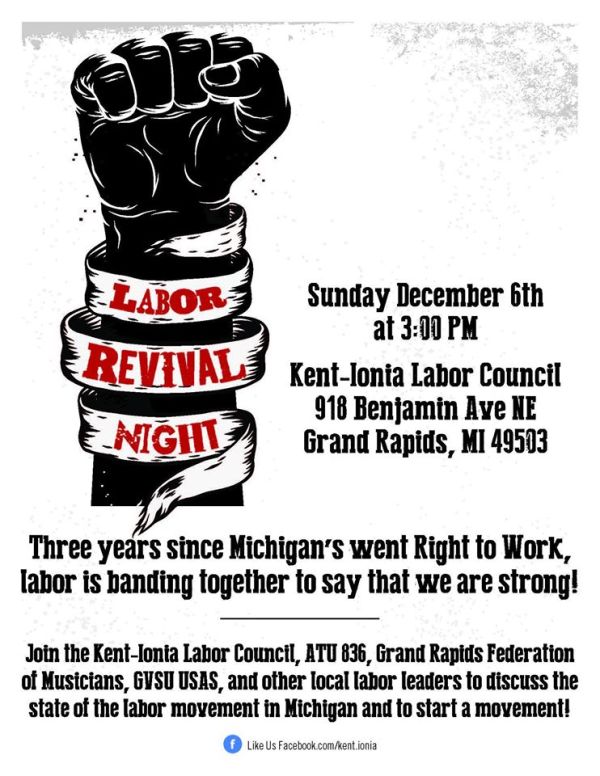
ATU Local 836 President RiChard Jackson responded to this latest attempt to silence workers by stating, “Given their recent history, the obvious intention is to scare employees into silence, because there is no way to know what is safe to say.”
Despite these anti-worker tactics by The Rapid, the momentum is building for union members and allies. In fact, there is an event this coming Sunday (Dec. 6) where union members and allies will gather to show solidarity, to share information, news ideas for the campaign and to enjoy live music and food at what the promotional material is calling a Labor Revival Night.
“When we’re united, working families have more power than they realize. This Sunday, December 6 at 3pm, at the Kent-Ionia Labor Center, we’ll be holding an old fashioned Labor Revival.”
Sounds like a perfect opportunity for people to support the ATUGR campaign and even be part of building a larger worker movement in West Michigan.
Listening to Native Voices: Fighting Against White Settler Colonialism
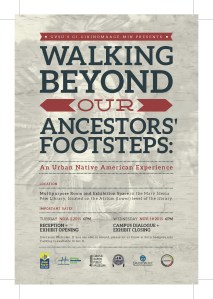
Last week I attended an event that was centered around the urban experience of Indigenous people living in the greater Grand Rapids area.
The event was beautiful and moving. A drumming circle began the evening, followed by a welcoming and explanation of the significance of the drumming circle and the sage ceremony that followed.
However, the rest of the evening was filled with local members of the Native American community speaking about their lived experience of growing up under settler colonialism. Several of those that spoke addressed the issue of identity and self-esteem. One of the Native speakers addressed being sent off to a boarding school at an early age, where he was not only separated from his family, but was not allowed to speak his own language. This practiced of forceable removing Native children from their communities to be place in state-run or religious schools has impacted thousands of indigenous children within the US, a topic that is addressed in the book Kill the Indian, Save the Man: The Genocidal Impact of American Indian Residential Schools.
The Native speakers talked about the trauma of being in a boarding school, as well as the trauma of growing up in a society that did not value them or saw them in some strange, media created stereotype. Those that spoke made it clear that much of their adult life has been dedicated to reclaiming their indigenous heritage and identity.
Another issue that was raised dealt with the lack of resources available to the Native community in West Michigan. The number of native people experiencing poverty is high and the lack of resources for education and autonomy are staggering. One example of this was when people talked about Lexington school being closed in the 1990s. The closing of that school was devastating, since Lexington school provided a space and resources for people to build community, to meet some material needs and for elders to share their language with members of the community who grew up not knowing their own language.
Towards the end of the community dialogue, the question was posed by a White audience member. This question always seems to come up for White people no matter what. This person asked, “How can I support you and your community?”
Several from the Native community responded to this question. One response had to do with how Native people have always dealt with Euro-Americans who wanted to be in support of Indigenous struggles. The response was, if you truly want to support us and fight with us, then we consider you part of the community.
Other responses were:
- Learn about Native history and struggles, particularly that of Native people from the Great Lakes region
- Listen to Native voices
- Be a part of Native struggles, but on their terms
- Fight against White Settler Colonialism
Learn Native History and History from an Indigenous Perspective
Some suggested sources on this topic are:
An Indigenous Peoples’ History of the United States, by Roxanne Dunbar-Ortiz
All Our Relations: Native Struggles for Land and Life, by Winona LaDuke
Behind the Trail of Broken Treaties: An Indian Declaration of Independence, by Vine Deloria Jr.
A Little Matter of Genocide: Holocaust and Denial in the Americas 1492 to the Present, by Ward Churchill
Unsettling Ourselves: Reflections and Resources for Deconstructing Colonial Mentality https://unsettlingminnesota.files.wordpress.com/2009/11/um_sourcebook_jan10_revision.pdf
Walleye Warriors: An Effective Alliance Against Racism and for the Earth, by Rick Whaley and Walter Bresette
The Canary Effect (film) – https://www.youtube.com/watch?v=lD7x6jryoSA
Listening to Native Voices
This means that those of us who are Native should shut up and listen to Native voices, especially when we are at events or meetings. It also means that we should never speak on behalf of Native people.
Be a part of Native struggles, but on their terms
There is no shortage of current Indigenous struggles. A few of them worth mentioning here are the Idol No More Movement, which has a Michigan chapter. There are also the Indigenous Environmental Network , Indigenous Action Media and Unsettling America: Decolonization in Theory and Practice.
Being part of these struggles is vital, but it is equally important that we engage in solidarity as determined by Indigenous people. Here are some good guidelines, as presented by Waziyatawin:
- The movement for Indigenous liberation is a radical political struggle
- Being an ally does not mean signing up for Indigenous spirituality
- We need strong, solid individuals who are not floundering with their own spiritual struggles
- This is not a struggle for those people who believe it’s trendy to support Indigenous causes—we are in it for the long haul
- You can find Indigenous individuals who will support any position you want them to support—that is a direct result of the colonial experience

- Those indigenous individuals who encourage non-Indigenous participation in ceremonies are often (not always) those who are attempting to curry favor with white women, or white people for their own purposes
- Because this is a political struggle, it is essential to work in solidarity with critically minded and politically engaged Indigenous individuals
- Remember that decolonization is a process for both the colonizer and the colonized
Fight Against White Settler Colonialism
For those of us who want to engage in solidarity with Indigenous struggles, we have to make our work about fighting against and dismantling the structures that make up White Settler Colonialism. A good resource on what it means to do anti-colonial work, we suggest you check out Everyone Calls Themselves An Ally Until It Is Time To Do Some Real Ally Shit.

MLive provides a plug for the Acton Institute…..again
Last week, MLive ran a story about the local pro-Capitalist think tank, the Acton institute. The story is about an award the Grand Rapids based organization won for a documentary that purports to offer a solution to poverty. 
The award was presented by the Templeton Foundation at the annual Atlas Network’s Liberty Forum & Freedom Dinner. The MLive writer cites the Atlas Network’s CEO and Acton’s Executive Director, Kris Mauren. Interestingly, if you look at the Acton blog post for November 13, one would think that the MLive reporter just used the Acton content instead of writing their own story.
However, even more egregious than simply plagiarizing the Acton blog, the MLive reporter doesn’t even bother to provide any information on the Templeton Foundation or the Atlas Network, let alone an opposing point of view to the claim made by the Acton film.
The Atlas Network states that their vision, “is of a free, prosperous and peaceful world where limited governments defend the rule of law, private property and free markets.” Their President is Alejandron Chaufen, who also happens to be on the board of the Acton Institute. The list of partners for the Atlas Network are hundreds of neoliberal, pro-capitalist think tanks and foundations, such as the Mackinac Center for Public Policy, the American Legislative Exchange Council (ALEC), the American Enterprise Institute and the State Policy Network, which just held its national convention in Grand Rapids in late September.
Each of these entities promotes policies that redirects more money to the top, promotes the privatization of public services, the deregulation of industry, denies Climate Change and attacks unions and workers.
The PovertyCure project, which the Acton film is based on, is a project of the Acton Institute. The PovertyCure project promotes a Christian ethic, coupled with the belief that free market capitalism is the only thing that will bring people out of poverty. One of the core values of the PovertyCure project is that, “Humans flourish most in environments where private property, free association and the free exchange of ideas and goods are sponsored by a culture of trust and protected by the rule of law.” This value is quite similar to the vision of the Atlas Network.
The documentary, Poverty Inc., does take a critical look at the global charity approach to poverty alleviation, but offers up free market capitalism as a cure to poverty. The film has an edgy feeling to it that is deceptive, so much so that filmmaker Michael Moore even praises the film, by saying, “You’ll never look at poverty and the third world the same again.” Moore screened the neoliberal capitalist film at his annual film festival in Traverse City this past August.
The PovertyCure project has several hundred global partners, all of which are religious based organizations that embrace the free market. It seems pretty clear that there is a network of religious groups that promote the supremacy of the free market and are now giving each other awards for promoting what they all agree upon. This should come as no surprise for the Acton Institute, since they have a long history of being funded by the likes of the DeVos and Prince families, which are the poster families for the merging of religion and capitalism. Unfortunately for MLive readers, they would not get any of the backstory to this network, but they do give an endorsement of the Grand Rapids-based right wing think tank.

 Grand Rapids Institute for Information Democracy