New GRIID Study looks at Gender Representation in 2015 Films

In 2012, we conducted a study looking at gender representation in Hollywood films. In that study we determined that the overwhelming majority of movies reflected a male-dominant cultural narrative, based, in part, on the actual numbers of leader characters and the content analysis.
Our most recent film study, Normalizing Male Dominance, did not reflect that Hollywood was improving much when it comes to gender representation. To read the entire study, click here.
What follows are some conclusions from the study.
- Statistically, there was some minor improvement in the number of lead female characters in the 2015 film study compared to the 2012 film study.
- Despite the increased female lead representation in the 2015 study, there are several films with lead female characters that do not challenge the dominant gender narratives – Sisters, Hot Pursuit, Cinderella, Fifty Shades of Grey, The War Room and The Age of Adaline.
- There were several films with lead female characters that challenged the male-dominant narrative, such as Star Wars: The Force Awakens, The Hunger Games: Mockingjay – Part 2, The Divergent Series: Insurgent, Avengers: Age of Ultron and Sicario. However, even in many of these films, which are disproportionately action oriented or fantasy based, the female lead characters are juxtaposed with dominant male lead characters.
- There were several films where women’s bodies are hyper-sexualized and objectified, such as Get Hard, Fifty Shades of Grey, The Boy Next Door, Straight Outta Compton, The Wedding Ringer, Hot Pursuit, Vacation, Ted 2 and Sisters.
- Films with male lead characters rarely challenge the male dominant narrative and present a cookie cutter version of masculinity, such as Avengers: Age of Ultron, Creed, San Andreas, Black Mass, Pixels, Sniper, Bridge of Spies, Sicario, The Night Before, Jurassic World, The Kingsman, Taken 3, The Gift, Ted 2, The Maze Runner, Southpaw, The Man from U.N.C.L.E., Spectre, Mission Impossible 6, The Gift, Max, Furious 7, The Night Before and the Wedding Ringer.
- There were films where men are presented as caring, sensitive and empathetic towards others, such as in Selma, The Imitation Game, The Martian, The Intern, McFarland USA and Star Wars: The Force Awakens.
- As was the case in the previous film study, children’s films and animated films do challenge some gender norms provide more space to explore human in a less stereotypical fashion, with films such as Inside Out and Home.

Showing up after the Standing Rock Action in Grand Rapids: WZZM 13 misses half the story

(Updated version)
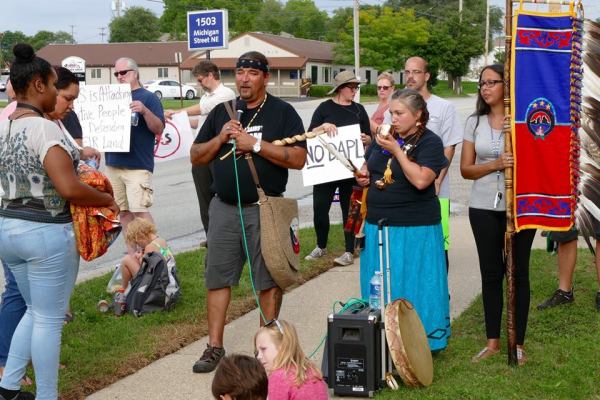
What happens when a local TV station shows up late to a protest in solidarity with the Standing Rock encampment in North Dakota? Essentially they butchered the story.
About 60 people showed up in solidarity with the Standing Rock encampment on Michigan Street, in front of the offices of G4S, a British company that is provide security for the pipeline project and has been beating native protestors and using dogs to maul them. This was the main reason for the organized protest and why that location was chosen. G4S also has a long history of supporting the Israeli occupation of Palestine and profiting from the US prison industrial complex.
However, channel 13 completely omitted this fact in their story, as if people were randomly standing on Michigan Street in an area that wasn’t exactly the most visible.
WZZM 13 showed up as people were leaving after the 2 hour demonstration and was able to talk with someone from the local native american community. They missed the ceremony, the prayers, the drumming and the singing which centered the demonstration in solidarity with Standing Rock. On top of that, they used photos taken by demonstration participants without sourcing the photos or asking permission to use some of them. One participant from the demonstration did send them a few pictures to use.
This is what Gentrification Looks like in Grand Rapids
It has begun. The decimation of the first block of homes, right now, today, in the process of gentrifying the Belknap neighborhood by Grand Valley State University and other private developers that are taking advantage of the re-development of the area.
This posting is not designed to provided detailed analysis of the GVSU-led gentrification of the Belknap neighborhood, rather we want to present a series of pictures, accompanied by brief commentary on the harsh realities of what gentrification looks like in this community.
GVSU owns virtually all of the land shown here in this map, which was included in the Memorandum of Understanding.

Working class families used to live in these houses that are now being bulldozed in the name of progress.

Families have been displaced, uprooted from friends, their children’s school, memories…..

Even if any concession were made, do we have any idea what it must be like to be forced from where you live?

This is just the beginning, just the first block to be leveled. These houses, which do not need to be destroyed, are now fenced off and waiting to be torn down.

These machines are owned by companies making a profit from the decimation of this neighborhood and it’s memories.


But wait, there is new housing being built just around the corner………oh, we’re sorry, it’s not for those working class families who were told to leave.

Housing Development Projects are an assault on working class families
One of the strongest indicators of how working class individuals and families are under attack in this community is the recent housing development trend.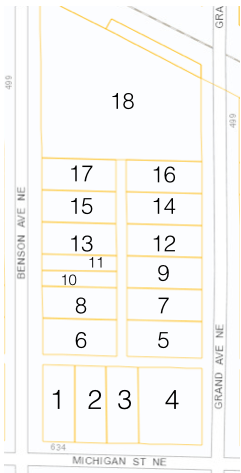
According to a recent report from the Economic Policy Institute, Grand Rapids has the highest wealth gap of any community in Michigan, with over one quarter of the community experiencing poverty (27%).
However, such statistics do not tell the whole story. Indeed, statistics are not enough to tell us that what we are seeing in an all out class war being waged against working families.
In April it was reported that Rise Real Estate received approval for a $53 million dollar housing development project on Grand Ave NE, between Michigan and the 196 highway.
This project, which will provide 287 Market-rate apartments, means that they will be unaffordable to working class individuals and families. In addition, the project will include a 4 story, 334 car parking garage.
This entire project received substantial tax breaks, to the tune of $8.9 million dollars.
This project has already resulted in the destruction of over a dozen homes (see above graphic of what used to exist before the current project) and the displacement of over a dozen families. What do you say to these families? Families who may fall deeper into poverty by being displaced. Families who may have lost jobs because of the displacement and have had to pull their kids out of the schools that they attended. Do we have any idea of the harm that is caused by such a project?

Those defending such a project will no doubt say that 287 housing units far outweighs the number of homes bulldozed in the process. What they are really saying is that those who can afford market rate housing are more important than working class individuals and families.
Such project ultimately promote contempt for working class people and are part of a class war, whether we recognize it or not.
Rapid Board members ignore GR Bus Drivers Union comments, give administrative staff a raise
On Wednesday, August 31st, about 20 members of the Grand Rapids bus driver’s union, the ATUGR, along with supporters, spoke during the monthly board meeting of the Rapid in downtown Grand Rapids.
Before the meeting took place, about 15 people gathered in front of the Rapid facility at 300 Ellsworth Ave SW, holding signs, talking to bus riders and confronting members of the Rapid board and staff as they entered for the monthly meeting.
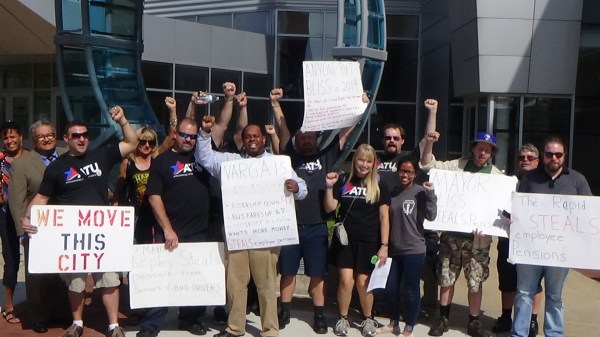
We had a chance to talk briefly with the Vice President of the Amalgamated Transit Union International Javier Perez Jr, who was in town to support the Grand Rapids bus driver’s struggle.
By the time the Rapid board meeting began, the Grand Rapids Police Department decided to deploy four officers to sit in the meeting, clearly meant as an intimidation tactic and to make sure that union members or their supporters were not disruptive.
The Rapid board meetings provide an opportunity for people to address the board in public comments, before the main agenda items are presented. I counted 14 people who addressed the issue of the Rapid board’s failure to negotiate a contract with the ATU GR. What follows are some of the comments from those who spoke in support of the union.
The first person to speak was a bus driver named Donald. He states that the Rapid won’t get a millage, because the drivers won’t support any new millage, unlike what they have in the past. “There has been no raise in 2 years and no increase in pensions in the past 10 years. They just don’t want to negotiate a new contract.”
Then a woman who is an employee with the Grand Rapids Public Schools spoke. She trains students on how to ride the buses. “The bus drivers are outstanding to our students, but I don’t see any of you riding the buses. The mode now is to simply screw the workers.”
ATU member Louis DeShane, a bus driver, spoke about how the lack of negotiations has impacted him personally. He said it makes him not want to negotiate with the riders, some of which don’t want to pay the full amount for the fair and this puts his safety at risk. He also implores the Rapid board to leave the pension and health care benefits alone and to negotiate in good faith.
A woman named Dione, who is a Rapid rider, believes that if the contract isn’t settled that more drivers are likely to leave. “It would be a huge loss for the community if the Rapid cuts back on route/times. I am really torn apart by what is going on and I want you to make sure the riders and the drivers are taken care of.”
Another bus rider, Heidi, spoke next. She uses the Go Bus, which is critical to her ability to be mobile in the community. Heidi said, “Lots of Go Bus drivers are leaving to find better paying jobs, like truck driving.” She also stated, “What I think is happening is that it is not about the riders, but it is about keeping the Rapid Board members happy. Lifestyles will be impacted, if the contract is not negotiated.”
Justin, a driver and member of the ATU GR, also spoke. He believes that this is an attack on the middle class. “The middle class is the backbone of society. I love coming downtown and I love GR, even though I don’t live in GR. I support the bus and have friends who supported previous millages. I don’t appreciate the attacks and the failure to negotiate. So, I ask you, who do you stand with?”
The secretary for the ATU local said that last year the union gave the Rapid a savings of $1 million by going to Blue Cross/Blue Shield and that there are no longer awards given to drivers, like their used to be. “All of the apartments down here are too expensive, I could not afford to live down here on the salary that I make.” She also stated that it costs ATU members with a family, $887 a month in health care premiums per month.
There were several students from GVSU who spoke. The GVSU United Students Against Sweatshops has been a huge supporter of the ATU GR struggle. Lindsey said that despite cops being sent to their homes earlier this year, because of the student’s support for the bus drivers, “we will continue to stand with drivers/workers. I grew up working class and my dad went through something similar to what the Rapid drivers are experiencing now. We dealt with not knowing where we would eat and not being able to go to the doctors.”
Jen, also with GVSU USAS, said that two detectives showed up at her house for participating in the labor action earlier this year. “Take the time you spend sending cops to intimidate to actually listen to the workers.”
Abby, who works as an organizer with the ATU International office, also spoke. “I have been working with this local for over a year. What is happening here with the health insurance is horrible. Imagine growing up in a family that has to ask if they can afford to eat or go to the doctor. The drivers are the folks who move this city. They deserve good lives and a good retirement and health insurance. They deserve that.”
Peter, an ATU GR member and driver, said that this didn’t make any sense to him and he believes that the Rapid would ultimately save money if they negotiated. “Their goal is clear, that they want to do away with the pension. You are going to risk the new millage over the pension costs. These people will tell their friends and family to not vote for the next transit millage.”
Lastly, John, who is a Rapid maintenance worker, said he raised his family on the wages of the Rapid. However, he is not able to put retirement money away with the current salary. He stated that he needs the current pension and wants a fair contract.
Several other people spoke, but it didn’t seem to phase the Rapid board members, who remained silent on the matter. How effective was it for the ATU GR members to address the Rapid board once again? It’s hard to say, but their members and supporters made it clear they are not going away and will continue to apply pressure to achieve justice in this labor dispute. However, in a demonstration of how much contempt the Rapid boards members have towards the union, they voted to give the administrative staff a 2% raise. Clearly, this was a big “Fuck You” to the union and its supporters.
Is it a Dialogue when the speakers are Pro-Israel?: GVSU forum not an opportunity for learning on the Israeli/Palestine issue
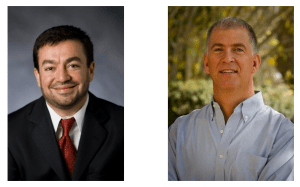
The Hauenstein Center and the Kaufman Interfaith Institute at GVSU are co-hosting a forum on September 8 entitled Can We Find Common Ground Between Israel and Palestine?
The speakers invited are Abdullah Antepli and Donniel Hartman. Antepli teaches at Duke University, is an Imam and is co-director of the Muslim Leadership Initiative. Hartman is President of the Shalom Hartman Institute in Jerusalem and an Orthodox rabbi. While it is beneficial at some level to have a dialogue on critical topics such as Israel and Palestine, these two speakers are likely to both present Israel in a favorable light.
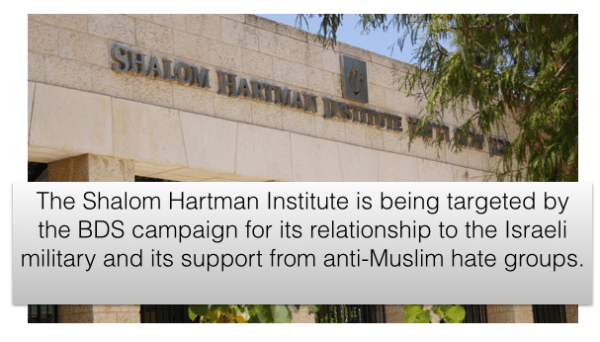
The Hartman Institute is a recipient of funding from the Russell Bernie Foundation, which is listed as one of the top anti-Muslim hate groups in the US, according to the study by the 2011 study from the Center for American Progress entitled, Fear, Inc.: The Roots of the Islamophobia Network in America. 
In addition, the Hartman Institute is on the list of centers of learning in Israel that are being boycotted in the Palestinian Boycott, Divestment & Sanctions campaign (BDS), because of their relationship with the Israeli military, according to an article by Ali Abunimah, founder of the blog, The Electronic Intifada.
During the last major Israeli military assault on Gaza in July of 2014, Donniel Hartman called the Israeli military campaign, known as Operation Protective Edge, a “just war.” In fact, Hartman wrote a whole article in defense of the Israeli assault on Gaza in 2014, where he lauds the Israeli military are refers to Palestinians as nothing more than terrorists.
Then there is the question of where Hartman stands on the BDS Campaign. Hartman has written, “BDS is repulsive to me and alien to my Jewish consciousness.” In an article he wrote in December of last year, Hartman denounces BDS and frames it as another form of anti-Semitism. In another piece written in response to the growing BDS campaign, Hartman refers to the BDS campaign as the “new danger” for Israel on campuses across the work and particularly in North America.
Entering into this dialogue with Hartman is Abdullah Antepli. Antepli major contribution in the area of interfaith dialogue has been his involvement with the Muslim Leadership Initiative (MLI). That organization’s website says, the program specifically targets “emerging North American Muslim leaders to develop a deeper understanding of Judaism, the Jewish people and Israel” in order to “change attitudes in the North American Muslim community and in Muslim-Jewish discourse in communities and on campuses across North America.” So how is it that the MLI wants to change participant’s perspective?
The Muslim Leadership Initiative has increasingly come under fire from the BDS campaign, especially since the Israeli assault on Gaza in 2014. One analogy that was written by a mentor of Antepli, Omid Safi, states:
“Imagine an MLI-type program that was designed to address racial tensions and understanding of police violence in the United States,” it said. “MLI is akin to going to Ferguson, but not meeting with Michael Brown’s family, and instead devoting oneself to ‘engaging’ the supporters of Officer Darren Wilson.”
The overt support of the Muslim Leadership Initiative for Israel has led several chapters of Students for Justice in Palestine to call for a boycott of any campus that brings MLI participants, according to a recent article in the Chronicle of Higher Education.
The Hauenstein Center and the Kaufman Interfaith Institute either did not do their homework on these two speakers, they are either denying the positions of these two speakers or they are complicit in hosting a forum that is clearly biased in favor of Israel.
GRIID Class for Fall 2016: Fighting Racism, Dismantling White Supremacy – The Responsibility of White People
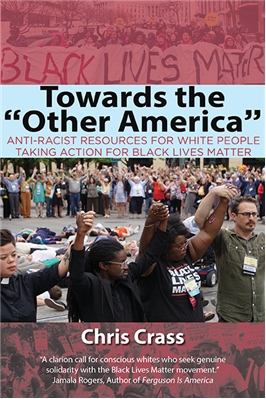
Beginning on September 26, GRIID will be offering another 8 week class for people who are serious about fighting racism and White Supremacy. The Title of the Class is Fighting Racism, Dismantling White Supremacy: The Responsibility of White People.
The class will be structured in 3 parts. During the first session we will discuss White Privilege, Institutionalized Racism and White Supremacy in a workshop format. In the second part of the class (weeks 2 – 5), we will be reading and discussing the book Towards the Other America: Anti-Racist Resources for White People Taking Action for Black Lives Matter, by Chris Crass. Everyone taking the class is responsible for purchasing their own copy.
Here is what Alicia Garza, one of the founders of the Black Lives Matter movement says about Towards the Other America:
“Towards the ‘Other America’ is an important primer for new and seasoned white anti-racist organizers and activists in the era of #BlackLivesMatter. Today, the Right attacks and attempts to de-legitimize the movement for Black lives by using the age-old wedge of white supremacy and hetero-patriarchy. But tomorrow—the one we must work together to build—will have millions of anti-racist whites who say ‘Not in our name.’ This collection of essays and interviews, grounded in practical lessons, will help us get one step closer to that tomorrow.”
In the final part of the class (weeks 6 – 8), we will be using The Movement for Black Lives policy document and discussing ways to work on these issues in West Michigan.
This is a class only for White people who want to seriously work to confront racism and White Supremacy.
Class begins on Monday, September 26, from 6:30 – 8:30pm and will be every Monday until November 14. (8 weeks)
We are asking for a $25 contribution for the class, but no one will be turned away because of money. Class is limited to 15 people and will be held at St. Andrew’s Episcopal Church, located at 1025 3 Mile Rd NE, Grand Rapids, MI 49505. Send an e-mail to jsmith@griid.org if you are interested in signing up for this class.
Also of interest, there is an good interview with Chris Crass and Dara Silverman on the Laura Flanders show, talking about White anti-racism organizing in the US.
Last week we reported on how much money the DeVos Family spent just 2 months before the August 2nd Primary election. The West Michigan family spent $1.5 million during the 56 day period just prior to the August Primary, which means they spent $26,785 a day to buy candidates and political influence at the state level.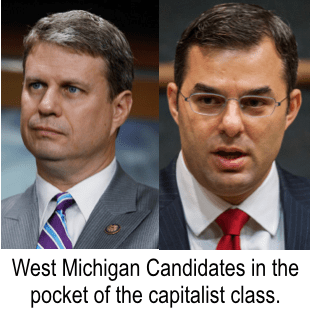
Now we turn to the two congressional districts that make up Grand Rapids and Holland, the 2nd and 3rd Congressional Districts.
These two congressional races have been dominated by Republicans for decades and that trend is not going to change in the near future. According to OpenSecrets.org, the Republican candidates (both incumbents) have a huge advantage in funding compared to their Democratic challengers.
In the 2nd Congressional race, Bill Huizenga has raised $1,047,454, compared to $11,235 raised by the challenger, Dennis Murphy. The disparity in campaign funding is roughly the same in the 3rd Congressional race, with Justin Amash raising $561,183, compared to a mere $8,157, raised by Douglas Smith. What is more interesting than the amounts that have been raised in both Congressional Districts is the sources of those campaign contributions.
Again, according to OpenSecrets, Bill Huizenga has raised money from some of the wealthiest entities in the state.
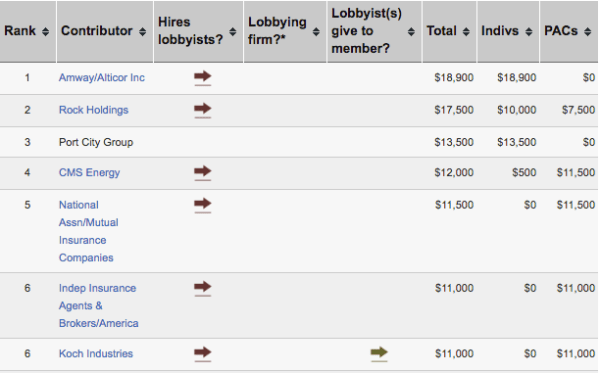
One can see from the graph above that the top contributor so far to Huizenga’s campaign is the DeVos/Van Andel run Amway/Alticor Inc. at $18,000. This contribution from Amway is more than the total amount raised by the Democratic challenger. The second largest donor to Huizenga’s campaign is Rock Holdings, which is the parent company of Quicken Loans, owned by billionaire Dan Gilbert.
Huizenga has also received money from Port City Group, CMS Energy, insurance companies and Koch Industries. Koch Industries is none other than the company owned and run by the Koch Brothers, who are in many ways the national version of what the DeVos family is to Michigan.
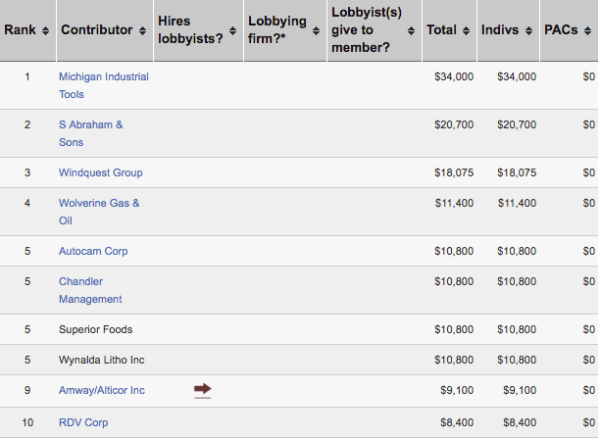
In the 3rd Congressional race, Justin Amash dominates in fund raising. One can see from the graph above that the largest contributor so far has been Michigan Industrial Tools, which is a company founded by the father of Justin Amash. The second largest contributor is S Abraham & Sons, owned and operated by a wealthy Arab-American family in West Michigan.
The third largest contributor to the Amash campaign is the Windquest Group, which is part of the DeVos family empire. In addition to the Windquest Group, Amway, RDV Corp and DP Fox ventures have also contributed to the Amash campaign and all of them are part of the DeVos family empire.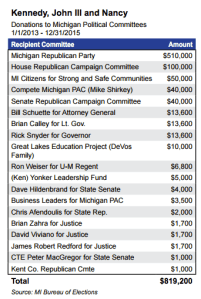
Other major contributors to the Amash campaign are Wolverine Gas & OIl and Autocam Corp. These two companies are run by some of the richest men in West Michigan, Sydney Jansma (Wolverine Gas & Oil) and John Kennedy (Autocam Corp). Jansma is a former board member of the Acton Institute and has been a major player fracking throughout Michigan in recent years.
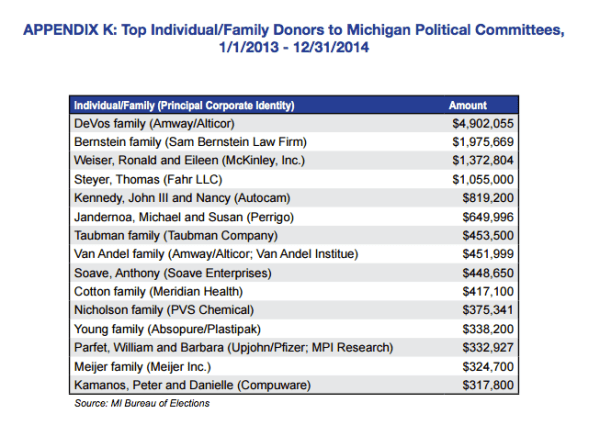
Kennedy is a major player in West Michigan politics and throughout the state. One can see from the chart on the right that both Kennedy and his wife have contributed to hundreds of thousands to candidates across the state and the fifth largest donor to Michigan Political Committees from 2013 – 2014, according to a report from the Michigan Campaign Finance Network. (see chart below) The Autocam Corp CEO sits on the board of the West Michigan Policy Forum and the Acton Institute.
More clear evidence that money from the capitalist class is what determines the electoral process in this country.
The DeVos Family, MLive and the Buying of Elections
Last Friday, MLive posted some information on which candidates in West Michigan are receiving money from the DeVos family. I say posted some information, because what information was given, was the absolute minimum and required virtually no work on the part of MLive staff.
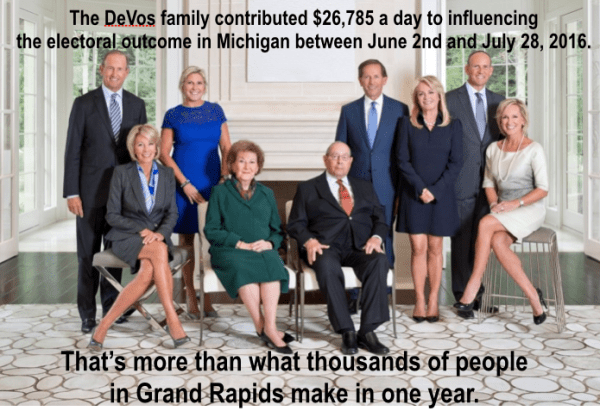
The MLive posting essentially consisted of slides with a picture of the DeVos family and the candidates they have contributed to just before the August 2nd primary. Each slide has a little bit of text, but the posting provides no analysis, not how many other candidates of political action committees the DeVos family has contributed to in the most recent campaign finance disclosure cycle.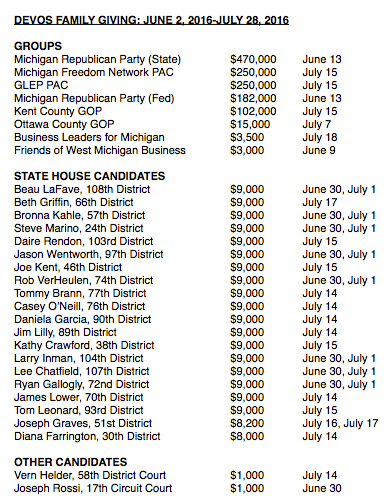
MLive once again demonstrates that they will not challenge or investigate the political and economic influence of the most powerful family in West Michigan.
At a closer and more honest look at the recent campaign donations from the DeVos family reveals that their influence is much greater than what MLive suggests.
First, here is a complete listing of the DeVos family contributions between June 2nd and July 28 of 2016. One can see that there are many more candidates that the family has contributed to beyond West Michigan. It is also evident that the organizations and political action committees they have contributed to have been the real beneficiaries of the DeVos money.
Second, the total amount the DeVos family contributed to influence electoral outcomes in just 56 days is roughly $1.5 million. This means that the family contributed $26,785 per day during this 56-day period. In other words, the DeVos family contributed the same amount of money in one day ($26,785) that thousands of people in Grand Rapids make in one year.
Third, the MLive posting provides no analysis or information on what the DeVos money buys in terms of policy. This is the most relevant question for journalists to ask, since rich people don’t give money just for the hell of it, but to determine policy outcomes. For example, State Representative Daniela Garcia received $9,000 from the DeVos family on July 14th. One can easily check what the representative from the 90th District is voting for and which bill she is introducing by going to this link. Not surprising, Rep. Garcia has voted to support policies that benefit businesses, policies that negatively impact unions and policies that benefit the push to privatize public education. Any of the candidates, that are incumbents, in which the DeVos family has given money to recently, could easily have been looked at the determine how they vote. This is what real journalism would do.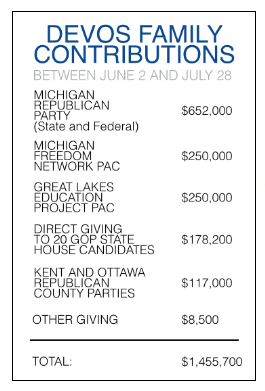
Fourth, MLive completely ignored the fact that the political action committees and organizations which received the bulk of the DeVos family money in the past two months is a larger issue than what individual candidates receive. It would come as no surprise that the bulk of the DeVos funds during the past two months went to the Republican Party, both at the state and federal level, to spent how they please.
Then there are the funds the DeVos family has contributed to the Great Lakes Education Project and the Michigan Freedom Network, both political action committees that are run by either a member of the DeVos family or a DeVos family operative. Both entities received $250,000 from the DeVos family on July 15.
Betsy DeVos is one of the four board members of the Great Lakes Education Project (GLEP). The GLEP is part of a larger national network of organizations that are working to undermine public education. The GLEP is the primary entity work on undermining public education in Michigan and has most recently played a critical role in state policy decisions on the future of Detroit schools.
The Michigan Freedom Network is the political action committee of the organization of the Michigan Freedom Fund. It’s director is Greg McNeilly, a long time DeVos political operative. McNeilly was the campaign manager for the failed gubernatorial campaign of Dick DeVos in 2006. McNeilly is also a board member of GLEP and is the Chief Operating Officer of the DeVos run Windquest Group. McNeilly was quoted in an MLive article from last year, boasting how political donations are the most protected form of speech:
“Political speech is the most protected form of speech, and we need more people participating at higher levels. We should applaud anyone who is leading on that dimension and try to encourage greater participation in our great American experiment.”
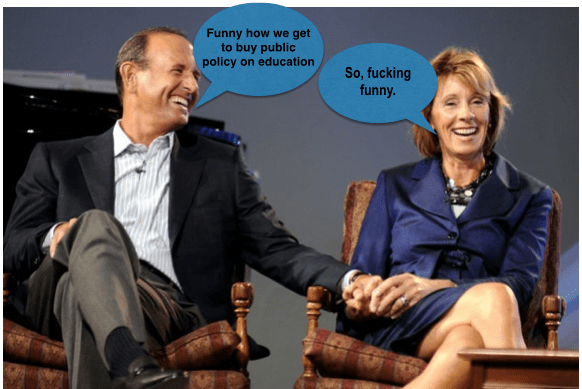
MLive completely fails to truly inform the public about the power and influence of the DeVos family. Therefore, we should never rely on it as a source to inform us about how power functions. Instead, we need to create our own mechanisms to inform and mobilize the public to challenge power, whether it is private or government power.
What happens when you have a chief of police on a TV program to discuss policing in Grand Rapids? It turns into a show, where not only did the Chief of Police act as an apologist for police behavior, it makes it difficult to have a real conversation about police accountability or community solutions that are independent of the police.
How we frame issues, especially an issue such as police brutality and the institution of policing, is critically important if we are ever going to go down the path to ending state violence. If we understand that the function of policing is fundamentally the armed protection of state interests. Rachel Herzing, the co-founder of Critical Resistance, names policing as follows:
“A set of practices sanctioned by the state to enforce law and maintain social control and cultural hegemony through the use of force.”
For many people and organizations within communities of color, the question is “not how to improve policing, but how to reduce its role in our lives.”
WGVU TV’s Mutual Inclusive showed aired on Monday night with the topic focused on policing. The program invited the Grand Rapids Chief of Police, Briana Urena-Ravelo (Black Lives Matter Grand Rapids) and Darrel Ross (Linc up). The show began with some text on the screen, providing data on how many black people have been killed by police officers across the country, this year alone. This was followed by a video clip of a African American mother talking about how her son was wrongfully accused and then beaten by the GRPD. The mother’s story was powerful.
The TV show’s host then began by asking Briana a question, but before she could respond, the Chief of Police interrupted. Not only did he interrupt, he then wanted to reframe the issue and defend the actions of officers in his department. However, not once did he apologize for the beating this young black kid experienced at the hands of the GRPD.
The video of the mother was countered by a 5 minute video on a variety of programs that the Grand Rapids Police Department uses to engage the community, particularly youth. There were several youth singing the praises of the police department because the cops play baseball with them and take them to Tiger games in Detroit. Several police officers also spoke in the video, but one was particularly revealing. Lt. Patrick Merill addressed the issue of bias training, by saying, “if this training comforts the public, we’ll do it.”
Chief Rahinsky spoke more than the other panelists, using his comments to either defend or deflect questions from the host or those in the audience.
Darrel Ross from Linc Up did offer some poignant comments that challenged what Chief Rahinsky was saying, particularly around the idea that while talking about police behavior it often causes us to discuss specific cases, instead of discussing the institution of policing. Ross also commented that he felt that the result of our collective failure to talk about the institution of policing, perpetuates racialized outcomes.
Briana Urena-Ravelo also challenge comments or responses from Chief Rahinsky. In response to the issue of people living in fear, the Chief equated the fear that the public experiences what the police officers experience. Urena-Ravelo named this as a false binary, since “fear is not equitable.” The police are not as afraid as the public, particularly with communities of color that fear for their lives every day based on what the police do and might do, since these communities are more heavily policed than other communities.
Briana also challenged the very nature and function of the police on numerous occasions. When talking about funding, she stated that the police have recently spent more money on new rifles than they have on bias training. In fact, she said that more money should go back to the community, since they could do more with those funds to transform their communities instead of those funds ending up in the hands of the police.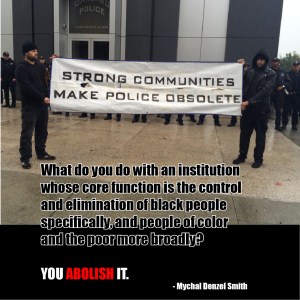
Urena-Ravelo also stated at one point that the police are not being held accountable. “They use excessive force. I haven’t seen transparency, plus we don’t name the racism and white supremacy perpetrated against the black community.”
What was important about what Briana was saying, was to reframe questions and to do what no one else was doing……which was to try to shift the conversation on the necessity of the police. As was stated at the beginning of this post, there are a growing number of people who think it does no good to attempt to reform the police. Again, to quote Rachel Herzing, the function of policing is the armed protection of state interests.
Just a few weeks ago, the Black Lives Matter Grand Rapids chapter, wrote a powerful statement in response to the Am I Next gathering, which had invited the police. Part of that statement read, “We do not think those who police, intimidate and enact violence on communities are healthy, functioning parts of those communities and regard with suspicion those who believe that moral appeals will save Black people from public execution.”
The whole time I watched this program on policing, I kept thinking, what kind of discussion could have happened if the police chief was not invited. Indeed, what kind of creative and transformative solutions could people come up with that doesn’t rely the cops.
 Grand Rapids Institute for Information Democracy