Gauntlet of Shame greeted Acton Institute event attendees and Betsy DeVos supporters in Grand Rapids last night
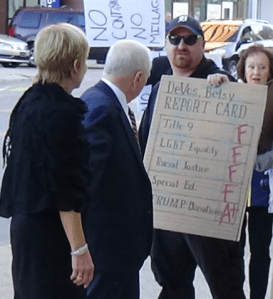 As we reported on last month, Betsy DeVos was the keynote speaker at the Acton Institute’s 27th annual gala event, held at the DeVos Convention last night.
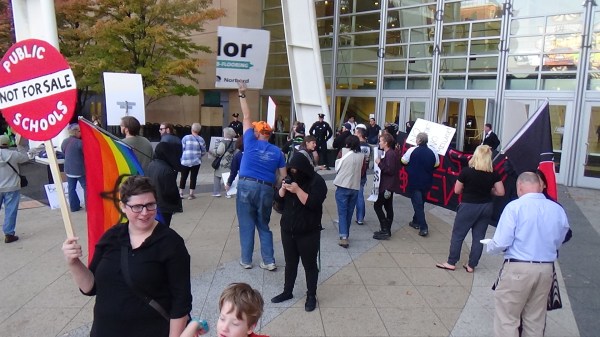
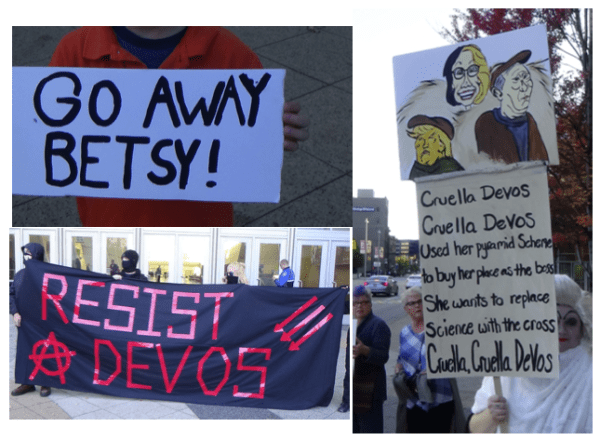
The protest outside was designed to make it uncomfortable for those attending the event, which were largely members of the capitalist class. The Acton Institute set up valet parking right along Monroe St. in front of the Convention Center, but some people chose to park in the ramp across the street under the city/county building. Either way, people who were attending the Acton Institute event had to pass through a gauntlet of protestors who greeted them with whistles, signs and chants of “Shame” as they entered the building.
The idea behind the Gauntlet of Shame was to communicate clearly to the Capitalist Class that what they do and what they support causes actual harm to people, especially to those most marginalized. We know that what the Acton Institute stands for, which is primarily about the neoliberal capitalism – profits over people, the privatization of public services, attacks against public education, dismantling unions – that these policies cause tremendous harm to working class people and especially to communities of color.
 Another aspect about last night’s protest was that people were not there to engage in a dialogue. The Capitalist Class isn’t going to change, because they benefit from the systems that are in place. We were there to make people feel uncomfortable, because of all the harm they cause in the world. Here is the text of a handout that someone made, which sums up well the reasons why people were confronting those attending the Acton Institute Gala event.
Cops and War Criminals
The police presence was minimal when the demonstration began last night, with some cops in cars and others on bikes to keep an eye on those protesting. However, once it became clear that the protest was not the usual sign holding affair and that people were being made to feel uncomfortable, the police numbers grew.
The protest was concentrated at the main convention center entrance off of Monroe, so the police presence was heavy there, with 6 cops standing in front of the doors (along with  convention center security) and then several other cops around the perimeter of that entrance, since people were coming from the north and south side of Monroe to enter the building. The police were even escorting members of the Capitalist Class from the valet area to the building.
At one point, just before he entered the building, people recognized the brother of Betsy DeVos, Erik Prince, who was attending the Acton Institute event. Immediately, people began shouting War Criminal at Prince and walking towards him. The police stood in front of those attempting to get closer to Prince, and just before he entered the building he blew a kiss to those protesting. This gesture was nothing more than a big “Fuck You” to everyone outside. Erik Prince can arrogantly make these gestures because he knows that the current political and economic system will protect people like him, despite the fact that the mercenary corporation he used to own, Blackwater, was responsible for the murder of innocent Iraqi civilians. Prince himself lived in the United Arab Emirates for several years to avoid extradition for his role in those murders. The Capitalist Class gets to live in this world, causing tremendous harm, and then they do not have to suffer the consequences of their actions.
The protest against the Acton Institute and Betsy DeVos began at 5:30pm and ended just after 7pm, since the dinner/keynote address was scheduled for 7pm. People left feeling energized, especially since this was an action that was focused on directly confronting those who attended the Acton Institute and those who support the current Secretary of Education, Betsy DeVos.
Socialism in One Restaurant
(Editor’s note: For transparency sake, I was a part of the Grand Rapids Chapter of the IWW when Bartertown was part of the IWW. We had meetings there and I was part of many conversations both during and after Bartertown’s involvement with the IWW. I also tend to agree with Cole Dorsey’s comments in this article. This article was written and submitted by David Zeglen, who is a professor at George Mason University.)

by David Zeglen
Last November, “Bartertown”, a small vegan restaurant in Grand Rapids, Michigan, closed its doors forever. Despite the restaurant’s relative obscurity, the closing nonetheless made headlines in the mainstream media: Fox News issued the story “Marxist Vegan Restaurant Closes After Customers No Long Willing to Wait 40 Minutes for a Sandwich”; Fortune reported “A Michigan Marxist Restaurant Closes After Failed Group Decisions and Long Sandwich Waits”; and Vice Media ran a short article entitled “Marxist Vegan Restaurant in Michigan Closes for Predictably Marxist Reasons.”
This hyperbole, schadenfreude, and invocation of familiar red-baiting tropes was symptomatic of a deeper anxiety about restaurant capitalism in one of the most exploitative sectors of the American economy. Bartertown represented the possibility of an alternative organizational model for the workplace. Although Bartertown’s co-founders never assumed that their restaurant would remain open for very long in a place as politically conservative as Grand Rapids, they were committed to cultivating a class consciousness via workplace democracy that would remain with Bartertown’s workers long after the restaurant closed. While Bartertown’s labor experiment was unable to move toward enacting broader structural changes, it nonetheless challenged the capitalist restaurant model and provided valuable lessons for future workplace organizing.
A Post-Recession Outpost
After years of working in various restaurants, Bartertown’s brainchild, Ryan Cappelletti, had seen first-hand how the industry relied on the basic principle of keeping wages low to keep food costs down and increase profit margins. Given the post-recession economy of Michigan in 2011, Cappelletti wanted to build a restaurant that saw its customers as struggling laborers in need of fair prices, and its workers as deserving of fair wages. Thus, Cappelletti and his fellow co-founders began to design a model that could meet these principles.
For Cappelletti, this was a chance to challenge some dominant ideologies about the food industry. To reduce food costs, the restaurant would be a true farm-to-table by using locally sourced vegan food from within Michigan. But Cappelletti didn’t use this farm-to-table ethos as a brand gimmick to justify charging higher prices like other local vegan restaurants. Instead, this model would ensure that customers could get a locally sourced plate of food for as low as $5.00. Although it is often assumed that locally sourced, seasonal food is more expensive for the customer, Cappelletti argued that restaurants opted for less nutritious frozen goods from regional suppliers more out of convenience than cost.
Capelletti also wanted the restaurant to have a barter system wherein Grand Rapids’ homeless, unemployed, and underemployed could come in and wash dishes for an hour in exchange for a meal. Additionally, as local mushroom forager Glenn Freeman recounts, the restaurant also accepted local food ingredients as currency that could be credited in exchange for a meal.
This “Bartertown” also remained inviting to the working class by foregoing the pretentious décor and fancy menus characteristic of farm-to-table restaurants. While other places used overblown language like “artisanal” and “handcrafted” to deliberately ostracize certain demographics, Bartertown’s menus, with items such as “two-buck tacos,” “chickpea dip,” or “tofu Reuben” were simple and direct with basic descriptions. When rhetorical flourish was invoked, it was never to dress up the items as evidenced by the “bowl of food,” and “raw trash salad” options.
Rather than purchasing brand new lights, chairs, and tables, Cappelletti also hired a local builder who agreed to forage for materials and upcycle them into furnishings for the restaurant. As a result, Bartertown’s décor consisted of refurbished old doors for tables, mix-matched utensils, mugs, and plates, and used kitchen equipment, including a beat-up oven salvaged from an old church.
Let Them Eat Che
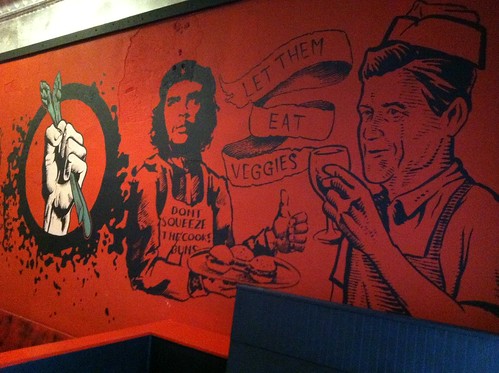
The DIY aesthetic was also applied to Bartertown’s art: on the main wall inside the restaurant was a giant red and black propaganda-style mural of Che Guevara dressed as a hamburger cook holding a plate of veggie burgers, with Ronald Reagan working beside him as a dishwasher. Although Bartertown sought to evoke a commentary on the linkage between political leadership, mass murder and faux-revolutionary status, the so-called “Che mural” offended many residents, including a local Cuban émigré who took to Facebook to complain about the restaurant’s alleged endorsement of a mass murderer. The Facebook comment was subsequently linked to a blog post critiquing the mural on a local website, wherein Grand Rapid’s bourgeois vegans became righteously indigent towards Bartertown’s aesthetic, despite the restaurant’s unprecedented commitment to worker’s rights.

Indeed, although Bartertown was conscientious about making its food accessible to everyone, there was also an underlying “fuck you” attitude towards customers who had internalized the absolutist mentality of always being right. Bartertown helped cultivate this attitude by hiring people who had little restaurant experience and therefore hadn’t been indoctrinated with the industry’s hierarchical value system, making it easier to train them in workers’ rights from the bottom up. During training, Cappelletti often encouraged the staff to be nice to the people who were nice to them back, and to not take any shit from people who were rude or offensive.
Bartertown also had a list of by-laws posted on the wall indicating that any sort of oppressive behavior, derogatory language, or general cause of discomfort or stress including mental or physical abuse from the customer would not be tolerated. As Bear, a former worker at Bartertown recalls, “we aimed to give excellent food and great service all the time because we loved to work there and keep it alive, but we just weren’t going to take any shit. If you didn’t like that, we would say ‘get the fuck out of here, we don’t need your money.’”
To help cultivate the workers’ sense of autonomy, Cappelletti contacted the Industrial Workers of the World (IWW) for help. Cole Dorsey, one of the founders of the Grand Rapids IWW branch, met with Cappelletti and agreed to help organize Bartertown into a closed-shop union based on the IWW’s core principles of horizontalism, direct democracy, accountability, and transparency.
With the IWW’s help, worker meetings were held every week and all decisions about delegating responsibility for specific tasks were made according to a simple majority rule with every worker having an equal vote from dishwasher to cook to server. Everyone agreed to being paid the same hourly minimum wage and dividing all tips fairly, and all the financial records were open. More important decisions about profits and finances were also collectively decided, usually through consensus, and everyone agreed that the priority would be paying back their investors, which they did within the first year. According to Onya Jackson, one of Bartertown’s co-founders, implementing IWW principles opened her eyes to how unfairly restaurants were usually run in the industry.
Trappings of Success
As Cappelletti admits, the IWW’s support before and during the restaurant’s first year was critical to Bartertown’s initial success. In addition to helping organize Bartertown’s workers, the IWW financially helped the restaurant by running donation drives, investing in Bartertown’s Kickstarter, and organizing punk concert fundraisers in Bartertown’s basement. When Bartertown first opened, the IWW also offered free labor from branch member volunteers to fill in when the restaurant was short-staffed, and offered advice on how to handle negative media attention while providing positive media coverage.
But the restaurant’s popularity also made it increasingly difficult for the busy staff to maintain the IWW’s requirements for a union shop, such as holding regular IWW meetings, recording meeting minutes for transparency, and writing up by-laws for the restaurant. By the time Bartertown had been open for a year, the relationship with the IWW had largely ended. Dorsey speculates that Bartertown might still be around today had they continued to work with the union and incorporate the restaurant into a larger network of IWW-supported businesses in the city. For Cappelletti, the dissipation of the relationship was regrettable, as the restaurant would soon need the kind of advice and support that only the IWW could provide.
For instance, in the spring of 2013, nearly 15 months after the restaurant had first opened, Cappelletti relinquished ownership and gave the restaurant to Bartertown’s five co-founding workers, including Jackson. After Cappelletti left, Bartertown’s confrontational attitude and equitable working conditions started to erode. According to Kate Vlaming, one of the co-owners of the restaurant at the time, workers grew increasingly passive-aggressive towards each other since nobody wanted to upset or offend anyone else by voicing their opinion about increasingly unfair divisions of labor.
As the owner, Cappelletti functioned as a symbolic totem that enabled workers to confront each other’s ideas indirectly, thus helping facilitate a workplace democracy. As a result, after nine months as a worker-owned and operated restaurant, in early 2014, Cappelletti agreed to take back ownership of Bartertown while continuing to run it as a worker-operated, if not worker-owned, restaurant.
However, Bartertown encountered a further problem that the IWW could have also helped to mitigate. In December 2014, Bartertown’s rental lot was sold to Rockford Construction, a local land development company with a reputation for gentrifying neighborhoods in Grand Rapids. Rockford immediately doubled the rent on the lot, making it increasingly difficult for Bartertown to maintain its fair wages and low prices, even though the restaurant was doing their best business yet – a common problem in the American restaurant industry.
Soon after the Rockford takeover, Thad Cummings, a local entrepreneur, approached Cappelletti about becoming a partner in Bartertown. Although Cappelletti initially turned him down, Cummings continued to visit, investing money into the business and providing financial advice. According to Cummings, there was no way of saving Bartertown without its debt being bought out. In February 2016, Cappelletti relented, and finally sold Bartertown to Cummings.
Don’t Eat the Rich
After taking ownership of Bartertown, it became immediately apparent that Cummings’ approach to organizing the restaurant’s work relations was clashing with the workers who remained after Cappelletti sold the restaurant.
Cummings tried to continue the monthly staff meetings with equal votes for decision-making. But according to Cummings, some of his workers saw the job as just that (a likely result of different hiring practices from Cappelletti’s) and didn’t want to participate in meetings, while those who did participate would gridlock Cummings over basic business decisions. Cummings ended up making several unilateral decisions about the restaurant, which consequently provoked a backlash from several workers that the restaurant was only nominally worker-operated.
Furthermore, Cummings’ business partner, Crystal LeCoy, constantly micro-managed the workers and refused to hear input from other staff on how to run the restaurant. When some workers challenged LeCoy’s ideas, she responded by threatening to fire them. As Bear put it, “we weren’t the kind of people to take that without fighting back. We gave her [LeCoy] a lot of attitude for trying to control everything.”
Cummings and LeCoy also turned Bartertown into a no-tip restaurant. Instead of tipping, customers could pay two dollars for a meal card that would go on a board near the front of the entrance, which anyone from the community could take down and use. Workers recalled that while several homeless people did come in and use the board, many of the cards stayed unused, which made them suspect that Cummings was pocketing the “tips” and hacking wages.
When Cummings explained to his workers that their wage was more than what they were previously making with tips, they responded that the issue was less about money and more about having some control in the decision-making process. As Cummings said, “it’s bizarre when employees tell you how they are going to run the company.” Cummings also felt that making Bartertown a no-tip restaurant took away the incentive to work hard, and attributed this factor to the decline in customer service among his workers, rather than dissatisfaction with the social organization of management. However, he also admitted that he implemented his idea for the meal board with little input from the staff.
By the fall of 2016, Bartertown had become a series of constant battles between the restaurant’s old workers and its new owners. From Cummings’ perspective, he was continually frustrated by the fact that the workers couldn’t understand the financial complexity of the restaurant, which meant that workplace democracy could never work in the restaurant industry.
But for the staff, it was Cummings who didn’t understand that they were more interested in having a workplace democracy that wouldn’t last forever rather than having a deadening job that would. It wasn’t that Bartertown’s workers didn’t understand the nuances of business economics, it was that they weren’t willing to sacrifice their temporary autonomy for the drudgery of long-term wage slavery.
Although Cummings made a last-ditch effort to re-brand the restaurant and start anew, by November the writing was on the wall, and the restaurant closed for good.
No Recipes for the Kitchens of the Future
Instead of gleaning insights from an experiment with workrplace democracy, once Bartertown had closed, the media and the public responded by mocking a restaurant that had tried to provided workers with labor rights and a community with affordable food in a post-recession economy.
Cappelletti also distinctly recalls that several locals in the community blasted Bartertown’s for being thoroughly depraved and anti-American. But Bartertown’s politics embodied a particular valence of the American Dream that resonated with a different kind of world where people regulated production and could decide to do one thing today and another thing tomorrow. As Cappelletti countered, “we weren’t anti-American; just the opposite. We made Bartertown happen because we believed we could make it happen, and because we believed we could do whatever we wanted. We were just really hard working, and did everything we could to try and make the experiment last.”
Whatever mode of production follows capitalism won’t emerge as an entire system, but will involve small-scale experiments like Bartertown. Although many will fail, the lessons of those failures will enable other experiments to succeed and help shift this emergent system into the dominant one and change the overall logic of our contemporary social relations.
“Blues Lives Matter” Legislation continues to be pushed in Lansing
 It is no surprise that legislators in Michigan, like all across the US, have been pushing legislation that is in response to the Black Lives Matter movement, copying the same language, naming it as Blue Lives Matter. The Black Lives Matter movement has made the issue of police brutality and the role policing in the black community a larger part of our political discourse, especially since the murder of Michael Brown in Ferguson, Missouri in 2015. Blue Lives Matter is not a movement, but a racist campaign by the state to present Blacks Lives Matter members as “a threat” to social order.
2015 was the first time that Michigan Legislators attempted to get a bill passed that would make it a more severe crime for people to target law enforcement officers. The proposed legislation was HB 4585, but it never was adopted.
In May of 2017, a revised bill was introduced, HB 4590, legislation that was introduced by Rep. Klinto Kesto. Kesto, who represents the 39th House District, is a former prosecuting attorney and has received significant amounts of campaign contributions from the Meijer and DeVos families.
HB 4591 was introduced at the same time as HB 4590, a piece of legislation that was introduced by Rep. Brandt Iden, who represents the 61st House District. Iden is a former Kalamazoo County Commissioner and a Real Estate business owner. Iden has also received a significant amount of campaign contributions from the DeVos Family. HB 4591 provides more clarity on the ways in which crimes against cops, firefighters, EMP workers and correctional workers would be punished.
Last week, the legislation was being discussed and you can read the submitted Legislative Analysis as provided by House Fiscal Agency. This analysis notes that there were 16 police departments or police associations in Michigan who gave testimony in support of the proposed legislation. The only opposed statements were submitted by the ACLU of Michigan and Black Lives Matter of Lansing.
Here is an excerpt from the BLM Lansing statement:
Michigan should not fall in line with the states attempting to pass “Blue Lives Matter” laws with the misrepresentation that first-responders are not already protected. Attacks on first responders already carry enhanced penalties and are prosecuted to the fullest extent of the law. Under this bill, Michigan police officers would be considered a protected class alongside vulnerable groups who face discrimination based on race, gender, religion, or sexual orientation. There is no evidence that this legislation is necessary or will make first responders safer. There is ample evidence that police have the procedures and trainings to de-escalate encounters at a much higher rate when the civilian is not visibly identifiable as a person of color. The only people killed by police at higher rates than Black people are Native Americans.
Blue Lives Matter bills serve one purpose only and that is to silence criticism and peaceful protest which is a 1st Amendment right afforded to all Americans. Law enforcement is already one of the most powerful and protected organizations in the nation and to attempt to pass legislation that suggests otherwise is deceitful and disrespectful to the families of the innocent people, including children and unarmed civilians, who have been killed by law enforcement officers as if their lives didn’t matter and therefore are not worthy of peaceful protest. The best way for police to build trust with the community is to stop killing unarmed civilians and to take responsibility when it happens.
In Michigan and across the country, Democratic lawmakers have rarely spoken out against the Blue Lives Matter legislative campaigns, primarily because they do not want to be seen as “weak on crime” and because of their relationship to Police Unions.
The lack of any real commitment to defending black people by politicians is also a recognition that the Movement for Black Lives has a very clear a powerful platform. The Movement for Black Lives makes it clear that what they are calling for is an end to the War on Black People. This platform should be required reading for those who think that body cams will be sufficient in dealing with the War on Black People.
Betsy DeVos Watch: Protests continue to follow the Secretary of Education across the country
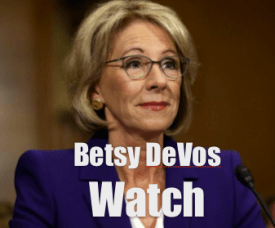 On Friday, Secretary of Education Betsy DeVos spoke in Seattle, Washington at a forum hosted by the Washington Policy Center.
Her speech was not unlike many of the other speeches she has given since becoming Secretary of Education, especially at forums hosted by organizations that have similar a ideological framework as DeVos.
There were a couple of things during her speech that are worth noting. First, DeVos once again used the mantra of states rights to push her education agenda, commenting that states, “are best equipped to solve the unique problems they face.” Second, DeVos argues that public money is really the taxpayers money and therefore, shouldn’t parents be able to spend that money how they want in terms of education? I wonder if Betsy feels the same way about tax dollars that subsidize large corporations, like Amway. Does she think the public should be able to decide if Amway or any other corporations should receive public money? How about the public tax dollars that go to the US military? Should the public be allowed to have a say in how that money gets used and whether or not they want it to go to the largest military in the world? Betsy DeVos, like all neoliberal capitalist only believe in government intervention when it serves their interest.
Third, DeVos makes a comparison between food and education choice. She states:
Near the Department of Education, there aren’t many restaurants. But you know what? Food trucks started lining the streets to provide options. Some are better than others; and some are even local restaurants that have added trucks to their businesses to better meet customer’s needs.
Now, if you visit one of those food trucks instead of a restaurant, do you hate restaurants? Or are you trying to put grocery stores out of business?
No. You are simply making the right choice for you based on your individual needs at that time.
This argument is essentially a free market argument, where she believes that education, like food or anything else, is nothing more than a commodity.
Fourth, early on in her speech, DeVos says:
State-based centers like yours are important in shaping policy because you have great ideas and you fight for them. Your fellow member in the State Policy Network, the Mackinac Center for Public Policy, has advanced major initiatives in my home state of Michigan.
It is important to understand that the Washington Policy Center, just like the Mackinac Center for Public Policy and the Acton Institute are all think tanks that are members of the State Policy Network.
According to Source Watch:
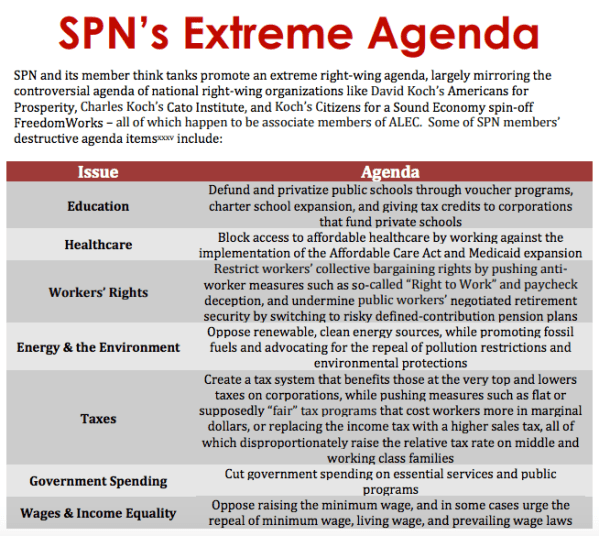
The State Policy Network (SPN) is a web of right-wing “think tanks” and tax-exempt organizations in 49 states, Puerto Rico, Washington, D.C., Canada, and the United Kingdom. As of July 2017, SPN’s membership totals 153. Today’s SPN is the tip of the spear of far-right, nationally funded policy agenda in the states that undergirds extremists in the Republican Party.
The Center for Media & Democracy published an excellent report entitled, Exposed: The State Policy Network, which we highly recommend. Here is just one of the section from the report that provides a snapshot of what the State Policy Network advocates all across the country.
Protests Follow Betsy DeVos wherever she goes
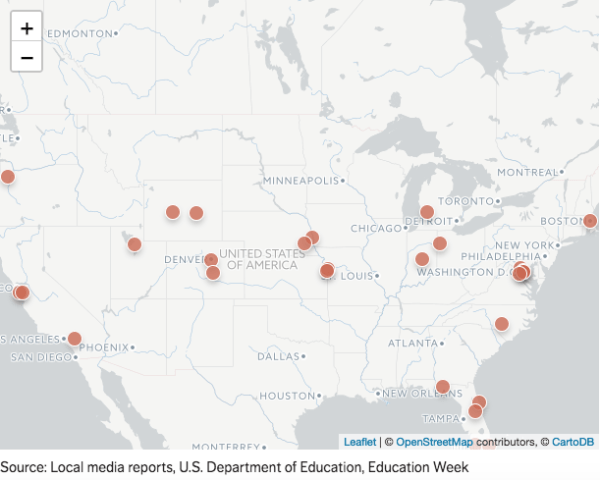
Lastly, it is important to point out that during the 8 months that Betsy DeVos has been the Secretary of Education, protests occur no matter where she travels to. While she was in Seattle last Friday, she was greeted by over 1,000 people, possibly the largest demonstration she has been confronted by since taking office.
This video gives you a sense of how large the protest was.
People in Grand Rapids have certainly protested Betsy DeVos while she has visited Grand Rapids, both on in early August while she was at GRCC and more recently while speaking at the opening of the new MSU building in downtown Grand Rapids.
In the Seattle Times story last Friday, they provide an interactive map of where the Secretary of Education has visited and how many times she was met by protestors. Go to this link and scroll down halfway through the article until you see this map.
This Wednesday, we have a chance to add to the number of protests against Betsy DeVos since she became Secretary of Education. The Acton Institute is holding its annual meeting at the DeVos Convention Center and Betsy DeVos is the keynote speaker. For details on the protest, go here.
Grand Rapids Bus Driver’s Union and Equity PAC trade words over November Transit Millage
On November 7, voters in the Greater Grand Rapids area can vote on whether or not to renew an operational millage for The Rapid bus system.
The issue has been a contentious one for more than a year, mostly because The Rapid board has failed to reach a negotiation with the Amalgamated Transit Union (ATU) Local 836. 
In recent months the issue has become more intense, with the ATU engaging in actions around the millage, most recently their confronting of Grand Rapids Mayor Bliss on Labor Day.
Since then, the Kent County Democrats have sided with the ATU to not support the millage, unless there is a contract agreement reached before the November 7 Millage vote. Some political candidates have also sided with the ATU in not endorsing the Millage, such as Robert Van Kirk who is running for the 77th State House seat and Rachel Hood who is running for the 76th House seat, although both want to see both of these things happen and are urging The Rapid and the ATUGR to find a just solution.
On October 9, Equity PAC formally endorsed the Transit Millage, with their entire statement at this link. Equity PAC does acknowledge that The Rapid and the union need to agree on a contract, but then it takes an ugly turn.
Equity PAC also strongly feels that it is important for The Rapid and the Amalgamated Transit Union (ATU) to come together in agreement on a contract. The assurance of seniority and proper compensation is vitally important for those employed by The Rapid. However, it is more important above everything else that we support the interests of low income people, seniors and people with disabilities, and others in the need for this service.
“For too long we have allowed people to prosper, benefit and make money off the backs of minorities – and people in poverty in general. The latest move by the transit union, and its supporters to use the endorsement of the upcoming millage hostage until the ATU contract is negotiated is consistent with that unfortunate history. What is inconsistent is the amount of ‘allies’ who sit silent or agree to the tactic,” says Darel Ross, Equity PAC board member.
This statement from Equity PAC board member Darel Ross certainly got the attention of RiChard Jackson, who is the President of the ATUGR. Jackson released a statement today, which we reprint below.
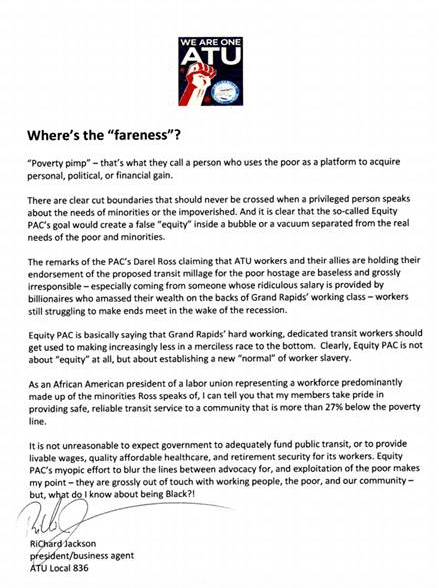
There is less than a month before the November 7 vote. We will update readers on any new information in regards to a potential contract agreement and other positions on the Transit Millage.
The Acton Institute conference on Education & Freedom: School Privatization, School Choice and the Benefits of Free Market Capitalism
Last month, we reported that Betsy DeVos will be the keynote speaker at the Acton Institute’s 27th Annual Dinner. The $175 a plate Acton event will be held at the DeVos Hall in downtown Grand Rapids on October 18.
The very next day, on October 19, the Acton Institute will host an event entitled, Education and Freedom. This event, which is being held at the Acton Institute headquarters on the corner of E. Fulton and Sheldon, makes this claim:
Everyone in the United States knows education is badly in need of reform. While K-12 and higher education costs have outpaced inflation, we have yet to see commensurate returns. And parents who opt out of such a system pay twice for their children’s education–taxes and tuition.
Choice, flexibility and innovation are needed.
The lack of freedom for parents, teachers, students, and state and local governments is distorting the purpose and function of education across the country.
It is clear that the Acton Institute is not hiding their ideological bias on the issue of education. They embrace the same fundamental framework as the current Secretary of Education, Betsy DeVos. The Acton Institute sees the existence of Charter Schools, Private Schools and School Vouchers as synonymous with FREEDOM. So do the people they have invited to their one-day conference.
Brian Britton – He is the current CEO of National Heritage Academies (NHA), which is based in Grand Rapids. The NHA was founded by J.C. Huizenga, who is a current board member at the Acton Institute. Huizenga is part of the West Michigan power structure, because of his wealth and the organizations that Huizenga is part of. Over the past 10 years, the National Heritage Academies has spent $810,000 lobbying Congress on education legislation.

Joe Cohn – Joe Cohn works for the Foundation for Individual Rights in Education (FIRE). FIRE is a major proponent of the intellectual diversity movement, which aims to dismantle the so-called liberal bias in higher academia. Cohn writes about numerous issues related to higher education, but has spent a great deal of time writing about and supporting Betsy DeVos’s revision around Title IX. Like DeVos, Cohn believes that those accused of sexual assault are not treated fairly.
Ben DeGrow – Ben is the director of education policy at the Mackinac Center for Public Policy. DeGrow writes regularly about the importance of school choice and Charter Schools for the Mackinac Center. DeGrow’s work and that of the Mackinac Center around education policy, “is devoted to privatizing state institutions and to deregulating public education.” Over the past decade, the Mackinac Center has received $325,000 from the Dick and Betsy DeVos Foundation and $210,000 from the DeVos Urban Leadership Initiative. 
Timothy Hall – Hall works as the Director of Operations and Academics at Thales Academy in North Carolina. Thales Academy was founded by Bob Luddy, a businessman who supports GOP candidates and created Thales Academy because he wanted to offer parents private school options. Luddy was the top contributor to the anti-diversity-policy electoral effort in 2009 in North Carolina and is accused by the NAACP of desegregating school districts.
Tom Lindsay – Lindsay is the Director of the Center for Higher Education at the Texas Public Policy Foundation. The Texas Public Policy Foundation (TPPF) is a conservative think tank founded in 1989 by James R. Leininger. It is a member of the right-wing State Policy Network (SPN) and is based in Austin, Texas. It has ties to Texas Governor and former presidential candidate Rick Perry, Ted Cruz, and many other powerful politicians. The TPPF has been a champion of many of the ALEC bills used in states across the country and has a history of supports legislation that supports school privatization, virtual schools, attacking public education teachers and eliminating pensions for public school teachers.
Catherine Pakaluk – Pakaluk is a faculty member at the Busch School of Business and Economics in Washington, DC. The Busch School is a Catholic School, and like the Acton Institute, believes that Catholicism and Capitalism are perfect bedfellows.
Greg Reed – Greg Reed is an attorney with the Institute for Justice. The Institute for Justice (IJ) is a libertarian public interest law firm registered as a 501(c)(3) non-profit and founded in 1991. The IJ names its four major issues as “private property, economic liberty, free speech and school choice.”
Mitchell Rocklin – Mitchell Rocklin is a Resident Research Fellow at The Tikvah Fund, a Jewish educational think tank and philanthropic organization in New York. The Tikvah Fund is a private philanthropic foundation that works closely with neoconservative think tanks and media outlets as well as an array of academic institutions to promote conservative ideologies. The foundation seeks to influence both academic discourse and the media on issues impacting economics, politics, culture, and religion, with a particular emphasis on the role of Judaism in society. The Tikyah Fund is politically Zionist in its orientation.
Jeff Sandefer – Jeff Sandefer has been the President of Sandefer Capital Partners. Sandefer Capital Partners is a U.S. based investment company. In February 2004 they announced that they would takeover Southern Pacific Petroleum (SPP), an ailing company that had been attempting to develop oil shale deposits in North Queensland. The project had been opposed by Greenpeace and other environmental groups due to its greenhouse gas emissions and the company’s refusal to relinquish leases over shale deposits that extended to within the Great Barrier Reef Marine Park. Sandefer considers himself an entrepreneur educator.
Richard Vedder – Richard Vedder is a Distinguished Professor of Economics at Ohio University in Athens, Ohio. Vedder is also on the Board of Scholars and the Mackinac Center for Public Policy.
So, it seems pretty clear that the notion of Education and Freedom for the Acton Institute invited speakers means school choice, education privatization and education that embraces free market capitalism.
Activists tell the City of Grand Rapids they need a policy that doesn’t make immigrants feel threatened
Last night, during the Grand Rapids City Commission, several activists and organizers with the Micah Center and Movimiento Cosecha GR, spoke passionately during the public comment portion of the meeting about the urgency of having a policy that would not threaten immigrants in this community.

Since December, the City of Grand Rapids has opted to call itself a Welcoming City and not a Sanctuary City, due to the possible loss of federal funding. The Trump administration has sought to withhold federal funds from cities that declare themselves a Sanctuary City. However, a federal judge recently ruled to block the administration from preventing cities that are designated as Sanctuary Cities from receiving federal funds. Last month CNN reported:
“The harm to the city’s relationship with the immigrant community, if it should accede to the conditions, is irreparable,” Judge Leinenweber wrote. “Once such trust is lost, it cannot be repaired through an award of money damages.”
Friday’s decision marked the second time this year a federal judge has blocked the Trump administration’s efforts to force sanctuary cities to cooperate on immigration enforcement. A judge in San Francisco restricted a January executive order from Trump that threatened to block all federal funds to sanctuary cities — a catchall term generally used to describe jurisdictions that have some policy of noncooperation with federal immigration enforcement.
Gema Lowe, with the Workers Center made her statement in Spanish, without an interpreter, thus highlighting the intimidation factor that immigrants face when interacting with the city. She also had a statement on her back saying NO Intimidation, which underscored the urgency for the city to adopt a policy that doesn’t make immigrants feel threatened. Lowe stated that the city needs to adopt a policy to make sure that no city employee, and especially the GRPD, does not ask people what their immigration status is.
Russell Olmsted also spoke about how such a policy was a matter of equity. He also said that the city needed to send a strong message to the immigrant community that they are valued and that they will be protected from intimidation.
LaDonna Norman both spoke about the importance of immigrants feeling welcomed in this city and Martha Cooper said that people who already feel intimidated by the Federal government, should not have to feel intimidated by local government as well.
Jim Howe asked the Mayor of Grand Rapids where she was born. He did so to illustrate how invasive and intimidating it would be for city staff to ask something similar. Howe said that the City needs to adopt a policy where immigrants, regardless of status, should be protected from further harassment and intimidation.
WXMI 17 station parent company about to merge with Trump Administration friendly Sinclair Broadcasting Group
 In May of this year it was announced that the Fox affiliate, WXMI 17 and their parent company the Tribune Media Co., would be bought up by the Sinclair Broadcasting group.
MiBiz recently ran an article about this buyout and does a pretty good job of pointing out that this merger would be in violation of current Federal Communications Commission (FCC) rules.
This is because the Sinclair Broadcasting Group already owns a TV station in the area, WMMT, channel 3, based in Kalamazoo, and according to FCC rules, you can’t own more than one TV station in the same market.
Radio/TV ownership deregulation
The deregulation of radio and TV stations is nothing new. Beginning in the 1980s, there was the first major push to deregulate the broadcast market and allow for greater media ownership consolidation.
The largest shift came in 1996, under the Clinton administration, where radio corporation were allowed to expand the number of stations they owned in one market from 3 to 8. This FCC shift during the Clinton years gave birth to mega-media corporations like Clear Channel, which owns 8 radio stations in the Grand Rapids market.
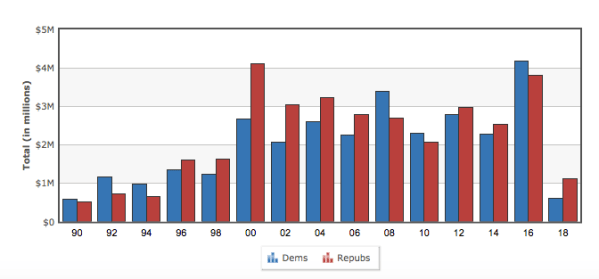
However, the push to further consolidate media ownership didn’t end with the 1996 FCC ruling, especially since the media companies themselves have become monopolies looking out for their own interests. Media companies spend millions annually lobby the federal government to further deregulate the broadcast market. According to data from the Center for Responsive Politics, you can see how much the commercial TV & radio companies have been spending on lobbying and how they give pretty much equally to both parties.
WXMI 17 and media bias
As someone who has been monitoring the local news over the past 30 years, it is clear that WXMI presents news through the lens of the dominant culture. When I say dominant culture, I mean they represent the views of those with economic and political power, along with a bias towards white supremacy.
This bias has nothing to do with them being a FOX affiliate, since they have never been owned by FOX, they just rely on FOX News as a source for national news. We have tracked WXMI 17 around election coverage since 1998, along with war coverage, racial representation and a number of other issues and WXMI 17 is no more biased that WOOD TV8 or WZZM 13.
Sinclair Broadcasting Group and the Trump Administration
While WXMI 17 has not demonstrated any partisan bias, this may change if the station gets bought up by the Sinclair Broadcasting Group.
The partisan bias of the Sinclair Broadcasting Group has been well documented for more than a decade. According to the Center for Media & Democracy (CMD), The company and its executives have consistently funded right-wing political candidates, according to the Center for Responsive Politics.
In April 2004, Sinclair refused to let its stations broadcast a special “Nightline” episode, produced by the ABC television network, that was devoted to reading the names of soldiers who had died in “Operation Iraqi Freedom.” It also directed its stations to air an anti-Kerry program ahead of the 2004 presidential election.
Sinclair stations are forced to make room for “must run” segments produced by the company, such as brashly right-wing video op-eds from Sinclair executive Mark Hyman and the station’s chief political analyst (and senior advisor to Trump’s campaign) Boris Epshteyn, who memorably claimed that President Obama won North Carolina because of voter fraud.
Sinclair stations are also fed scripts to introduce must-runs, leaving local news stations across the country echoing language such as, “Did the FBI have a personal vendetta in pursuing the Russia investigation of President Trump’s former national security adviser Michael Flynn?” as evidence was mounting that Flynn was in serious legal jeopardy for failure to report foreign ties and for withholding information from the Pentagon and the FBI.
According to the national media reform group, the Free Press, the Sinclair media merger would be detrimental to a free flow of information. In a recent post, the Free Press writes:
In addition to violating the agency’s longstanding ownership rules, the merger would give an even bigger megaphone to a company that forces its stations to run right-wing political commentaries every single day. Sinclair routinely overrides the objections of local journalists and fails to provide coverage that serves community needs. At its worst, Sinclair uses its massive network of broadcast stations to fan the flames of racial and religious prejudice and put local communities at risk. “When a broadcaster’s political perspective is so strident that it inhibits local editorial control and subverts localism, the Commission must consider whether that broadcaster is acting in the public interest,” reads the Free Press response.
“Sinclair has long evaded the FCC rules it’s now trying to completely erase with the help of the Trump FCC under Chairman Pai,” said Free Press President and CEO Craig Aaron. “Sinclair forces its local stations to air pro-Trump propaganda and then seeks favors from the Trump administration worth billions. This should be a national scandal. And if it’s allowed to happen, it will unleash a new and unprecedented wave of consolidation in local TV that may boost short-term stock prices but will spell long-term disaster for local communities.”
“For all their bluster, Sinclair and Tribune have once again failed to show how this unprecedented merger could possibly serve the public interest,” said Free Press Policy Analyst Dana Floberg. “Instead they seek to distract the FCC with boasting and technical quibbles in the hopes that Chairman Pai will overlook the transaction’s blatant violations of FCC ownership rules. The reality is that this deal would seriously harm people of color, low-income families and other communities that rely on local television for local news. It would silence independent community voices while giving mega-broadcaster Sinclair even more control over what we see and hear on the news.”
This proposed media merger will benefit the small number of media monopolies that exist, but you won’t hear about it from other broadcasters. The local TV stations certainly are not making this an issues, especially since they are also owned by major media corporations. WOOD TV 8 is owned by Texas-based Nexstar Media Group Inc. and WZZM 13 is owned by Gannett.
It is difficult to fight these corporate conglomerate, but there are groups like the Free Press who do take up that fight. We also recommend that you seek out independent sources of news and information, particularly sources that were created by and led by marginalized communities, like communities of color, immigrants, queer & transgender communities and working class communities. Change the narrative!
A Eulogy for Public Education: Demonstrators march in Grand Rapids and denounce the policies of Betsy DeVos
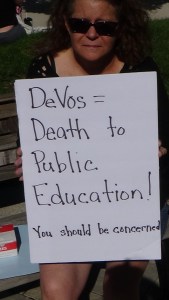 About 60 people gathered in downtown Grand Rapids yesterday, to hold a mock funeral for public education.
Organized by the Michigan Student Power Network, people met at Monument Park, most dressed in black, to eulogize Public Education in the US. Those who organized the action handed out a small document, something you might find at a funeral, which read in part:
It is with great sadness that we announce the impending death of the great institution of Public Education. After years of living on life support, Public Education is now in the terminal stages of its long battle with underfunding, privatization, segregation, and rich political donors, it would seem that the end is drawing near for this vital institution.
Shortly after 2pm, one of the organizers read the entire statement, a statement that was offered up as a eulogy in this video.
After the eulogy, the march/procession began with people carrying signs, banners, flags and coffins, each speaking to the death of public education. The group of 60 marched west on Fulton Street, then around the arena district, to end up back on Fulton Street. Here is a short video of the march/procession.
Along the route, the march/procession made stops at the downtown GVSU campus, the GRCC campus and back to Monument Park. At each stop there were speakers addressing a variety of issues such as the assault on Title IX policies, which will decrease the efforts to support those who have been sexually assaulted on school campuses across the country.
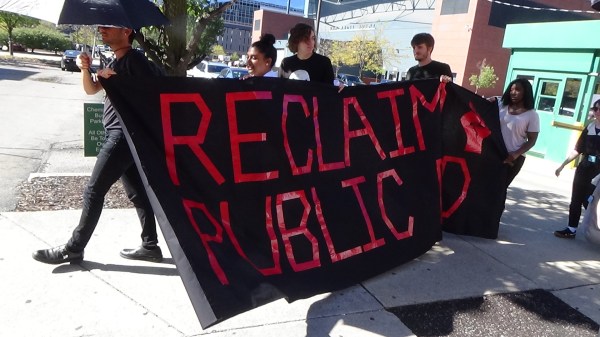
Another speaker addressed the issue of budget cuts for education, especially to programs that are offered to students with disabilities and other marginalized groups.
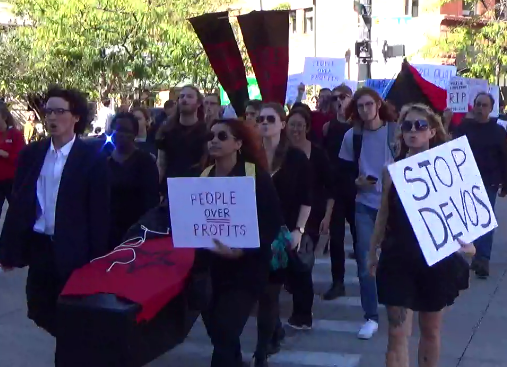
Another speaker addressed how the Secretary of Education and her policies have and will impact the Grand Rapids Public Schools. This speaker also addressed the relationship between Betsy DeVos and the Superintendent of the GRPS.

Along the march/procession route, there were a few detractors, but most people responded positively to what the action was drawing attention to. As expected, the police got involved early on in the march/procession (see photo above) and even threatened people at one point with arrest if they didn’t get out of the street.
You can follow the Michigan Student Power Network on Facebook at https://www.facebook.com/michiganstudentpower/?ref=br_rs.
Updated – Working without a contract, Kendall Faculty Association takes action to challenge Ferris Board of Trustees

(Thanks to Sarah Doherty for the updated information and for sharing the video posted here at the end.)
Earlier today, several dozen members of the Kendall College Faculty Association and 20 additional community supporters held an informational picket today. The action was called by the Kendall Faculty Association, which has been operating without a contract.
In addition, Kendall College faculty are amongst the lowest paid for a four-year public college in Michigan. This of course is all happening while the annual compensation for the four-person administration has a total cost in excess of $600,000.
We interviewed several of the faculty members about their action and what they are asking for. The first interview wis with the president of the faculty union, Adam.
There are more specific issues that the faculty at Kendall are dealing with such as the fact that they do not have a pension plan and they already pay for a portion of their health plan. These kinds of policies have historically been used to try to break unions.
We also interviewed Stefanie, another member of the Kendall faculty.
The third person we spoke with is also with the Kendall faculty and has been teaching at the college for 16 years.
Just before 11:00am, faculty members and community supporters entered the building, since the board of the college was meeting. People went in with signs and stood in the back of the room while the board members began their meeting. Some of the members of the Kendall Faculty Association were planning on addressing the board, but unfortunately, this writer had to leave and was unable to stay for that portion of group’s action.

The video below is Kendall Professor Deb Rockman addressing the administration board. Rockman was speaking on behalf of the Kendall Faculty Association. After her comments the demonstrators left the meeting and reconvened on the sidewalks outside of the KCAD federal building. They chanted under the window of the second floor room where the board was meeting, and continued to hand out fliers to people walking by.