Moral Pronouncements aren’t enough: Artprize, the DeVos Family and Trump’s Executive Orders
Yesterday, Artprize made an announcement on their website that appears to be a response to some of the recent Executive Orders coming from the Trump administration, particularly the anti-immigrant, anti-refugee and anti-Muslim policies.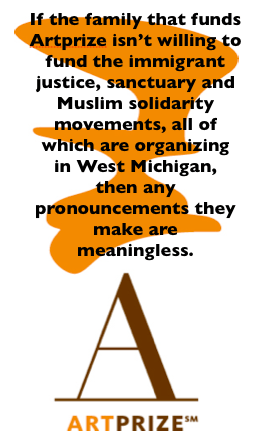
Here is part of what the ArtPrize announcement stated:
ArtPrize operates according to a Mission and a set of Guiding Principles. Recently the ground shifted, and so far the policies and statements of the current administration have made what were once broadly agreeable sentiments into urgent calls to action.The ArtPrize team is committed to these principles so we’re compelled to speak out. ArtPrize opposes any efforts to:
- Discriminate against anyone based on religion, race, gender, sexual identity, physical ability or economic status.
- Detain or persecute refugees and immigrants.
- Limit or undermine a free press or freedom of speech.
- Prevent any child in the United States from accessing a quality education that includes the arts and humanities.
While such a pronouncement is nice and all, it effectively does nothing to address the reality that is faced by immigrants, refugees and Muslims, based on the recent Executive Orders.
No doubt this pronouncement is also influenced by the recent confirmation of Betsy DeVos as Secretary of Education, who is the mother of ArtPrize founder Rick DeVos. This seems evident based on the fourth point in the ArtPrize announcement, which says ; Prevent any child in the United States from accessing a quality education that includes the arts and humanities.
Show us the money!
Here are some reasons why the pronouncement is essentially meaningless.
- The US government’s negative treatment towards immigrants, refugees and Muslims is nothing new. ArtPrize first came on the scene in 2009, after the Obama administration took office. During his administration more undocumented people have been detained and deported than any previous administration. This included an escalation in the detention of families. So why now?
2. This announcement is fundamentally a PR stunt aimed to head off any potential or additional anger that might be directed at ArtPrize because of the growing animosity towards the Betsy DeVos confirmation and the increased exposure to the DeVos family history as a result of the nomination and eventual confirmation.
3. ArtPrize was founded by Rick DeVos, receives a tremendous amount from the Dick & Betsy DeVos Foundation on an annual basis, gets money from other DeVos family members and the circle of friends that they associate with, like the Seechia, Jandernoa, John Kennedy, etc. These people are all part of the West Michigan power structure that continues to support reactionary policies around labor issues, LGBTQ issues, as well as, promoting a Neoliberal Capitalist model. These people also a major contributors to the Republican Party at the state and federal level. In other words, their funding helped bring about the election of Donald trump. Therefore, unless ArtPrize is willing to stop receiving funds from these major contributors to the GOP, the announcement is essentially meaningless.
4. Lastly, the only real action that ArtPrize could take would be to work to fund the immigrant justice, pro-refugee, in Solidarity with the Muslim community and Sanctuary movements that are currently organizing in Grand Rapids. In other words, raise millions of dollars for these movements, money which we know they are capable of raising for an art competition, so that these movements can reduce the harm being done to immigrants, refugees and Muslims throughout West Michigan.
Failure to act on these four points means that the ArtPrize pronouncement is essentially meaningless.

616 Lofts Profile: The Art of Gentrification and Racism
616 Lofts is just one part of 616 Development. Founded in 2009 by Derek Coppess, the 616 Lofts mission offers the following narrative:
We build unique, urban spaces where people can work, play and just … live. 616 Lofts are residential communities built to do better for the city of Grand Rapids and its people. Our properties are in the midst of some of downtown’s most popular locations. Modern apartments (most of them upcycled from old structures) fuse historic and contemporary features, offering some of the most unique interiors in the city.
This seemingly upbeat and attractive take on what 616 Lofts does, fails to mention that the kinds of “urban spaces” they create is not for the thousands of working class families and communities of color who could never afford the monthly cost of rent required by the company.
Can you say Gentrification?
Of the seven locations the company currently has apartments available, they are all listed as “market rate.” However, market rate is essentially a term that is synonymous with unaffordable. Here are the locations and the cost(s) that come with living in 616 Lofts:
- Michigan Lofts: $1,100 – $2,300

- Alabama Lofts: $900 – $1,950
- Monroe Lofts: $925 – $2,400
- Prospect Lofts: $800 – $1,800
- Kendall Lofts: $950 – $1,700
- Ionia Lofts: $1,100 – $2,700
- Pearl St. Lofts: $1,000 – $1,600
Someone making $10 an hour, which is the reality for thousands of people in the Grand Rapids area, equals $22,400 a year. This makes none of the 616 Lofts affordable for this entire population. Even someone making $15 an hour ($31,200 a year) would have a hard time affording most of the 616 Lofts, especially after factoring in utilities, transportation, health care, food, etc.
In addition, many of the 616 Lofts projects contribute to the gentrification of Grand Rapids. This is particularly the case with the 616 Lofts that were created on Michigan, Prospect and on the westside, on Alabama Street. These neighborhoods have historically been working class neighborhoods that have seen drastic changes as a result of the various development projects that have taken over. With each new development project, property values go up, which increases the rent, resulting in working class individuals and families being displaced because those neighborhoods are no longer affordable.
There is a new project by 616 Lofts that will be on Plainfield NE, in the Creston neighborhood. This forthcoming project will also contribute to the ongoing gentrification of that traditionally working class neighborhood, which has seen new breweries, restaurants and an upscaling of a long-standing party store in recent years.
On top of the cost of 616 Lofts and their contribution to gentrification in Grand Rapids, it is worth looking at the kind of culture they promote.
One can get a sense of the kind of culture that are promoting by reading the 616 Lofts blog. The blog postings are about where to find the best breweries, coffee shops, restaurants or where the best boutique stores are. You’ll find articles on exploring the night life and attending yoga class or you might find a piece about celebrating the holidays or where you can volunteer in town. In other words, the 616 Lofts are promoting a more professional, upscale, creative class culture that is highly privileged and disproportionately white.
In looking at the images of people that are used on their site, the mostly present white people. Even in their cute, upbeat video about how the company came to be, everyone is white.
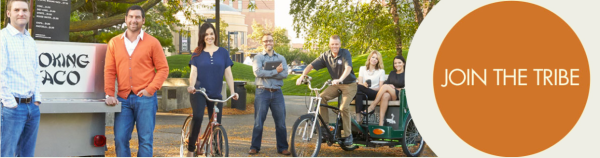
What is also offensive about this culture, is that the staff are referred to as “the tribe.” Ironically, the staff at 616 Lofts is all white. The company is also hiring and they invite people to “Join the tribe.” It is not ok for people or businesses to use this kind of language, language that is racist and appropriates from other cultures.
Grand Rapids is a city that is becoming stratified in terms of class and race. More and more of the development projects are forcing working class people and communities of color out of neighborhoods. We can ill afford to be unaware of these dynamics and need to begin to name the forces responsible for these dynamics. 616 Lofts is not the only business perpetuating gentrification and racism, but they are one of them.
In the next several weeks we will take a look at companies that are in the businesses of creating new housing and what role they play in the gentrification of Grand Rapids.

There is a new zine that people in Michigan have put together and are distributing at protests that have been organized since the election in November.
The zine is entitled, Whatever You Do, Don’t Talk to the Police. Sprout Distro is making the zine available on their site, in PDF form. Here is what Sprout Distro has to say about the zine:
It’s a basic introduction for folks coming into contact with police and other law enforcement officials in the context of political demonstrations. It focuses on the importance of avoiding interactions with the police, looking out for each other, and taking care of each other. The zine explains how police often sew the seeds of division within resistance movements and instead articulates the importance of building a “culture of resistance” wherein folks respect a diversity of approaches by agreeing not to cooperate with the police.
Last year we offered a class on the history of policing in the US, using Kristian Williams book, Our Enemies in Blue: Police and Power in America, for those wanting to dig deeper into the history, function and purpose of policing in the US.
MLive: Reporting on and Taking Money from Betsy DeVos
It would be a bit misleading to promote the notion that journalism in the US was once a noble profession and only in recent decades has it lost credibility.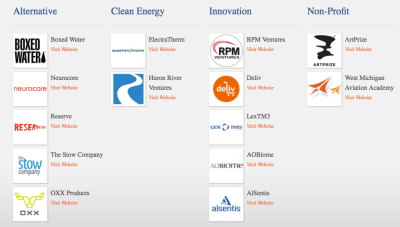
Media scholars like Bob McChesney have made it clear that there was never a heyday of journalism in the US and that news agencies have always been compromised because of the relationships they have with centers of power, because of the increasing consolidation of ownership and because news agencies are also businesses.
The reliance on advertising for most news agencies inherently compromises their ability to practice journalism without financial consequences. I was on a panel years ago with local news managers in the greater Grand Rapids area and one TV executive said,
“My job it to make sure that the shareholders with this company are happy. The only way to keep them happy is to get good ratings and good ratings means more advertising dollars. Anyone who tells you our primary job is to inform the community, doesn’t understand how this all works.”
When news agencies rely on the money from an industry they are also reporting on, do you think it is possible for them to honestly report the truth?
Today, on MLive, it was ironic that there were several articles about the upcoming vote in the Senate on whether or not to confirm Betsy DeVos as Secretary of Education, and right next to those articles appeared ads from the Reserve and Neurocore.
Both Neurocore and the Reserve are part of the Windquest Group, which is owned and managed by Dick and Betsy DeVos.
So how is it that so many people still think that MLive has any integrity when it comes to challenging power in this community? This is not to say that they never do good reporting. However, we have demonstrated for years how the Grand Rapids Press/MLive has never really challenged the power of the DeVos family. There have only been marginally decent articles in the last few months, because MLive has been forced to have to report on the nomination of Betsy DeVos by President Trump.
Now that DeVos has been confirmed as the Secretary of Education we should be extremely skeptical that MLive or any other local corporate news agencies will report honestly and with integrity on the role Betsy DeVos plays as Secretary of Education and the larger role that the DeVos family plays when it comes to influencing policy at the federal, state and local level.
More Right Wing money gets behind Betsy DeVos nomination for Secretary of Education in Ad Campaigns

Yesterday, the watchdog organization, the Center for Public Integrity noted that two conservative non-profit organizations are spending lots of money to run ad campaigns in states with Senators who haven’t as yet completely committed to voting for DeVos.
The two groups are Club for Growth and America Next. Founded in 1999, Club for Growth has focused much of their energy around economic issues, such as taxes and pushing a pro-capitalism agenda. Club for Growth has also aggressively back candidates running for federal office, candidates like West Michigan’s Justin Amash.
According to the Club for Growth website, under the heading, We Are Determined to see Betsy DeVos win confirmation, it states:
The Club for Growth released the following statement from its president, David McIntosh, about its new television ad supporting the nomination of Betsy DeVos as Secretary of Education:
“The Club for Growth enthusiastically endorsed Betsy DeVos when President Trump nominated her in December, and we are determined to see her win confirmation,” said Club for Growth president David McIntosh. “We expected the union-backed liberals to oppose her, but it’s especially troubling to see Senators in conservative states who are wavering on her nomination because of union pressure. We’re running these ads to make sure constituents understand what’s at stake in this nomination battle.”
The Club for Growth is airing TV ads in North Dakota and West Virginia, urging constituents to call their Senator about the DeVos nomination.
Here is an ad that Club for Growth is running.

America Next is an organization much newer to partisan politics. Founded in 2015, America Next was started by long-time Republican Bobby Jindal and seeks to influence the federal policy in four main areas: Education, Defense, Energy and Health Care.
In reading the platform they have for Education Policy, one can see why they are spending money to get Betsy DeVos nominated. The 44 page Education Policy report is a public educator’s worst nightmare.
Here is the ad campaign that America First is running to get Betsy DeVos nominated as Education Secretary.
The Center for Public Integrity article also states:
The Club for Growth and America Next both didn’t respond to a request for comment from the Center for Public Integrity. Club for Growth is also running digital ads on Twitter and on websites such as National Review. The 45Committee, another conservative nonprofit whose sister super PAC supported Trump during the 2016 election, has also released a pro-DeVos web promotion.
We Don’t Need a Permit to Resist: 2nd Week of Protests at the Kent County Airport in Solidarity with Muslims, Immigrants and Refugees

For the second week in a row, a good-sized crowd turned out to say no the President’s Executive Order that would restrict and ban certain refugees, immigrants and Muslims from coming into the US.
An estimated 300 people showed up at the Kent County Airport yesterday to resist the Federal government’s policy. This was about half as many people who came out last Sunday.
 The amount of people wasn’t the only difference at yesterday’s protest. The police presence was significantly larger that what was there last week, especially early on. There were nearly 20 police vehicles patrolling throughout the 2 hours the protest lasted, with law enforcement from the airport security, the Kent County Sheriff’s Department, the Grand Rapids Police Department and the Michigan State Police.
The same designated protest area was created, like last week, but most people refused to go to that space, instead, people initially gathered near the entrance to the airport. After about 30 minutes, the crowd began marching pasted the designated protest area and marched down one road that eventually led to the terminal. The police kept scrambling to keep up, since they were unaware of where the protest was going.
Once people arrived at the airport terminal, it became evident that the airport security and other law enforcement agencies were going to manage those marching, especially if they decided to block all four lanes in front of the terminal, like what had been done the week before. The airport had wooden barricades lined up along the sidewalk, just in case they needed to contain people. The police were also preventing people from blocking all roads in front of the terminal and from entering the terminal itself.
Permits and the Policing of Dissent
Part of the reason why there was such a large police presence at the airport before and during the protest, had to do with the fact that people with the local Democratic Party had once again contacted the airport asking for permission to protest. Those with Michigan’s Third Democratic Congressional District had created their own protest, which they then cancelled, but not before attempting to pressure the autonomous protest organizers to comply with the wishes of the airport authority.
In a message sent to those who organized the autonomous protest, here is what Traci Kornak wrote:
- See the attached permit.

- See the rules and liability for damage or breaking the rules.
- Someone from the group will need to sign.
- We have obtained a permit but will not go forward until the groups that are online who want to interfere and disrupt the airport operations are in agreement. Last weekend there was no damage but the disruption at the terminal delayed flights.
- This is private property and there is no right to assemble anywhere but the easement at the front of the property on Patterson.
- We do not want to distract attention from the cause.
There were other messages sent attempting to pressure people to comply with the permit agreement. In one message, the people associated with the local Democrats said, This permit needs to be signed if the protest is going to go forward.
If people want to get permission to protest, they certainly can do that, but those who chose to should never tell other people that they need permission to resist or dissent.
Muslim, Refugee and Immigrant Voices
One positive thing that this writer witnessed was that there was a larger contingent of those from the refugee, immigrant and Muslim communities present during yesterday’s march. People from Latin America, African and the Middle East were visible and vocal during the protest that began in front of the airport entrance, all the way to the terminal.
This writer spoke with several people who identified as Muslim and who were from countries like Somalia that came out to voice their opposition to the Executive Order that would ban or limit people coming from certain countries. One young woman said to me, “It is important to be here to voice our opposition to this injustice, to this policy. We all need to take a stand. We are grateful that other people are willing to be here and to stand in support of our rights.”

Start Garden adds Ethnic Diversity, but offers same old Capitalist opportunities for the few
Last Thursday, the DeVos-owned project known as Start Garden, headed by Betsy DeVos’ son Rick DeVos, announced they would be hiring two new people in order to promote more minority business opportunities in Grand Rapids.
Start Garden hired Darel Ross, former co-executive director of Linc and Jorge Gonzalez who has been executive director of the West Michigan Hispanic Chamber of Commerce since March 2015.
The Start Garden Press Release, in part stated:
The vitality and future of our entrepreneurial ecosystem, however, requires local leaders in economic development with deep knowledge of the disparities and challenges faced in diverse entrepreneur communities. This helps ensure that the economic benefits of entrepreneurship can be realized by people of all backgrounds and experience.
On Monday, MLive reported on this new announcement from Start Garden, wherein Ross and Gonzalez said, “they are looking forward to having the additional resources to remove barriers to entrepreneurship across the board.”
The MLive article also mentions the 2015 Forbes ranking that put Grand Rapids the worst city in the US in terms of Blacks economic well being. The above comments from Ross and Gonzalez suggest their addition to the Start Garden staff will somehow be able improve minority businesses opportunities in Grand Rapids.
We don’t doubt that Start Garden will be able to increase the number of minority owned businesses in Grand Rapids, but the Forbes article from 2015 wasn’t just talking about minority owned businesses, it was talking about the average income of Black households. The Forbes article stated that Black median household income was only 59% of what White median household income is.
Hiring two economic development leaders from minority communities was certainly a smart move by Start Garden. It adds lots of PR value to the organization. However, Black Capitalism, like White Capitalism, will only benefit a small percentage of people in the black community and will NOT do much of anything to alleviate the deep poverty that thousands of black families find themselves experiencing in Grand Rapids. An important historical analysis of how capitalism will not benefit the mass of black working class families can be found in Manning Marable’s book, How Capitalism Underdeveloped Black America.
Hiring Gonzalez makes sense considering his leadership in the Hispanic Chamber of Commerce, but Ross’s hiring may not seem quite as clear. However, when one considers that the largest funders to Linc have been members of the DeVos family.
According to the most recent 990s from the Doug and Pamela DeVos Foundation, between 2012 and 2014, that foundation provided roughly $3.2 million dollars to Linc. This is because the organization’s primary function is economic development.
Public money for Private gain
The MLive article also states:
The new focus by Start Garden comes as the organization is completing a year-long restructuring to take over managing Grand Rapids SmartZone. Overseeing SmartZone gives Start Garden an opportunity to take advantage of state and federal economic develop dollars to work with more businesses.
As we reported in September https://griid.org/2016/09/20/who-knew-the-city-of-grand-rapids-is-giving-taxpayers-money-to-a-devos-owned-business/, Start Garden (by March of 2017) will receive $725,000 of taxpayer funds from the City of Grand Rapids to run the SmartZones program.

We are beginning to see the repressive policies that the new administration is beginning to implement. From the push to further militarize the US border with Mexico to the ban on Muslims coming from select countries.
In writing about the Kent County Airport Action in support of Immigrants, Refugees and Muslims this past Sunday, I mentioned that someone with the Democratic Party attempted to co-op the action by; 1) meeting with airport authorities to create a protest zone on their own and ; 2) by attempting to police the behavior of those marching in the road. 
This type of cooptation is not new, but it is something that those of us who seek justice should be aware of and work to counter its affects.
Radical and autonomous social movements have always been impacted by elements attempting to coop their agenda and goals. In Lance Selfa’s important book, The Democrats: A Critical History, he devotes a whole chapter (chapter 4) on how the Democratic Party has coopted social movements in the 20th century.
Other writers, such as John Stauber, have focused on partisan front groups like MoveOn, which have played a major role in coopting social movements since early 2003. One example that Stauber has documented was during the US occupation of Iraq and how MoveOn was really not calling for an end of the war/occupation.
One last example worth mentioning is what the Democrats did during the Occupy Wall Street movement, by coopting the language and vision of what that movement was attempting to accomplish in cities all across the country.
Let’s face it, political parties are interested in gaining power through elections. When political parties have power, they want to maintain it, when they don’t have power, they want to regain it.
Co-optation Right Now
A current effort to co-opt the growing forces against the Trump administration policies has shown up in West Michigan in recent weeks. The Facebook group calls themselves Indivisible West Michigan.
Indivisible West Michigan is one of many chapters across the US that is using a guide called, Indivisible: A Practical Guide for Resisting the Trump Agenda. This guide is essentially a mechanism to try to engage elected officials by crafting messages, meeting with members of Congress, co-ordinating phone call campaigns and setting up Town Hall meetings. While these things aren’t necessary bad, what the Invisible guide is suggesting is that we just need to be better organized so we can convince members of Congress to do the right thing. This comes as no surprise, since the entire guide was written by former Congressional staffers.
This is not to say that the tactic of attempting to move elected officials on social policy is completely useless, but if we really want to look at tactics and strategies that will actually resist the policies of the US government, attempting to lobby Congress is an extremely weak tactic.
Looking at the former Congressional staffers who actually put together the Indivisible Guide should also tell us something about what it is they want for the future.
Ezra Levin – Ezra works for the Corporation for Enterprise Development (CFED) as an Associate Director of Government Affairs. The CFED’s mission states in part, “We scale innovative practical solutions that empower low- and moderate-income people to build wealth.” Their Institutional Funders reads like a who’s who of corporate America, with companies like Chase Bank, Cargill, Charles Schwab and Wells Fargo.
Leah Greenberg – Leah is an investments manager with Humanity United. Humanity United’s vision page has lots of nice words and uses images of Dr. Martin Luther King Jr. and Nelson Mandela, but it was founded by one of the wealthiest men on the planet, the founder of ebay, Pierre Omidyar.
Angel Padilla – Angel works with the National Immigration Law Center, specifically as a Health Policy Analyst.
Sarah Dohl – Sarah is currently the Vice President of Communications for Junior Achievement.
Matthew Traldi – Matthew is the Research Team Director for the SEIU – the Service Employees International Union. The SEIU has a long history of allegiance to the Democratic Party.
The profiles of these individuals don’t exactly inspire the kind of movements we need to resist the current government agenda.
The Need for Autonomous and Independent Movements
Throughout US history, grassroots social justice movements that have been effective, have primarily remained autonomous from partisan politics. Think of the Abolitionist movement, the radical labor movement of the late 19th and early 20th century, the Black Freedom movement and movements like the American Indian Movement or the South African Anti-Apartheid movement. These movements were effective, in large part, because of their autonomy from partisan politics and their use of strategies that relied on direct action and pre-figurative politics.
We are in a moment right now that needs independent and autonomous movements, movements that are not swayed by partisan politics or the influences of money. These independent and autonomous movements should be centered around the  struggles of people who are the most vulnerable in this society. We need to look to the Black Lives Matter movement, the Idol No More movement, the immigrant rights movement, the various movements for economic justice and anti-capitalist movements, the BDS movement, the new Sanctuary movement and the climate justice movement.
With these existing movements and whatever new ones will be created we can build power from below that does not rely on existing systems of power and oppression and actually resist the current government agenda.
Standing for Refugees, Immigrants and Muslims: Protest Defies Airport by not complying with designated “Free Speech” area
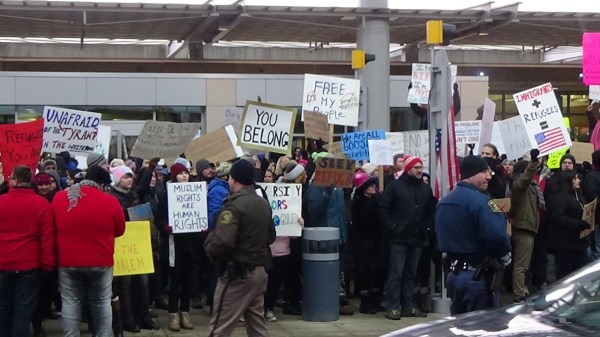
On Sunday, hundreds of people from West Michigan converged on the Gerald R. Ford International Airport to protest the recent Executive Order from the Trump administration which attacks the travel rights of individuals from more than a half-dozen Muslim-majority countries – Iraq, Syria, Iran, Libya, Somalia, Sudan and Yemen.

This latest Executive Order has resulted in protests at airports all across the country and in some cases, shutting down business as usual, in places like JFK and O’Hare.
The call was put out on Facebook on Saturday afternoon and people quickly responded that they would attend. However, there was some push back from a few people around the question of whether or not this would be a permitted action or not. Without checking in with the organizers of the action, someone who has strong ties to the local Democratic Party decided to contact the airport themselves and “work out an agreement about where to protest.”
This person sent the following to the main organizer, who shared it with us:
We will be protesting OUTSIDE on the north east corner of the airport entrance off of Patterson and 44th St. It is the airport exit lane. We can park in the economy lot or in the empty business lots across the street. We will be able to protest in the area as cars are exiting. We will also be able to extend a march from the protest area to the economy lot. This is a pretty good distance. We need to remind people that the focus is bringing attention to the cause, We are not there to disrupt or in impede those traveling in our community who are at the airport for travel. There will be security that will assist us in this process. In addition to that folks should be cautioned that should they try to enter the terminal area it is not only counterproductive but they will be reminded that we agreed upon to these terms. WE WILL NOT BE ENTERING THE TERMINAL BUILDING. Anybody who is doing any action in violation of federal law which includes encounters with TSA check points will be arrested and subject to federal prosecution. This is extremely serious.
You can see from the picture above where this designed protest area was set up, which would have made it difficult for people to interact with those coming and going from the airport. In addition, this designated protest area would have undermined people’s ability to stop business as usual, which is exactly what was happening at airport protests across the country.
Undeterred by the effort to undermine the action, several people began to let folks know that there would be a march, but not in the limited space that the airport authorities were allowing. After most people had arrived for the demonstration, the march began, but then crossed the road and took over one of the entrance lanes into the airport. Most of the several hundred people who came out joined the march and people began to walk and chant towards the airport. There were several attempts by the few police officer that were present, to get people off the road and to turn around. The crowd was not having it.
Then, the same person who on their own contacted the airport to set up the “designated protest area,” took the bullhorn and attempted to tell people to get out of the road, doing the very same thing that the cops had asked the crowd to do. Again, people were not having it.
Eventually the crowd made it to the main terminal and again refused to get out of the road, taking over both lanes, chanting and holding signs.
In addition to the chant from this video, other prominent chants were, No Ban, No Ban, no Ban on Stolen Land; and Fuck White Supremacy.
After about 30 minutes, the crowd then extended the protest the other two lanes, closest to the parking area with the intention of trying to stop business as usual. By this time more cops had showed up and were forming a line to prevent both lanes by the parking ramp from being shut down.
There was also an attempt to enter the terminal itself, but the airport security had locked most of the doors and were only allowing those traveling to come and go.
However, most of the airport workers that this writer talked to were very supportive of the action that was being taken. In fact, there was virtually no opposition from those who were at the airport. The only opposition was from the police, which was outnumbered the entire time the action took place.
What the action signaled in many ways was that enough people were not going to make nice and follow the rules established by those in power. It was very encouraging to see people defy the pleas from cops to stay off the street or away from the terminal. What this kind of defiance can result in, is to give people a sense that they have power by participating in direct action and that in the future they might be willing to take bolder actions against policies that brutalize people, particularly those who are already vulnerable in this society.
Eventually, people marched back to down the road they had taken to the terminal. The protest lasted just shy of three hours.
Grand Rapids Protests Trump’s New Immigration Policy

Yesterday, several hundred people gathered in downtown Grand Rapids to express their opposition to the newly signed Executive Order from President Trump on immigration policy.
The protest in Grand Rapids was one of dozens that have taken place across the country in the last fe days, since President Trump signed the Executive Order.
The executive order would essentially do the following:
- Securing the southern U.S. border “through immediate construction of a physical wall” to stop immigrants that are undocumented, the flow of drugs, human trafficking and acts of terrorism
- Detaining “individuals apprehended on suspicions of” law breaking and expedition of claims of their eligibility to stay in the U.S.
- Swift deportation of “individuals whose legal claims to remain in the United States have been lawfully rejected”
- DHS Secretary John Kelly to “take all appropriate steps to immediately plan, design and construct” the wall
- Projections for “long-term funding requirements,” including the preparation of congressional budget requests for current and future fiscal years
- Completion of a “comprehensive study” of the southern border’s security to completed within the next 180 days
- Construction and operation of detention facilities at or near the border
- Termination of the catch-and-release border policy, a directive to Border Patrol agents not to arrest and deport undocumented immigrants
- Repatriation of immigrants who have been deported
- The hiring of 5,000 Border Patrol officers and the tripling of the number of ICE officers
- A report of “Federal aid or assistance” to the Mexican government over the past five years to be completed within 30 days
- Termination of “the abuse of parole and asylum provisions currently used to prevent the lawful removal of removable aliens”
- A public monthly report “on aliens apprehended at or near the southern border”
- Crackdown on so-called sanctuary cities, locales that don’t prosecute immigrants for living in the country without documentation
- Denial of federal funds to “jurisdictions that fail to comply with” federal law, unless deemed necessary
- “Prompt removal” of immigrants who have been ordered to leave the country
- A DHS office whose aim is to support “victims of crime committed by removable aliens and the family members of such victims”
The protest on the Blue Bridge in downtown Grand Rapids was organized by the Office for Social Justice of the Christian Reformed Church. Organizers welcomed people and made to following statement.
Now more than ever, the Grand Rapids community must demonstrate its support for Muslims, refugees, and immigrants. We must loudly oppose all changes to our refugee resettlement system that ban Syrians, reduce the number of refugees we welcome, halt the resettlement of Muslims, and pause the processing of refugees for any period of time. As we witness the largest displacement of people in modern history, we must continue to extend welcome, not turn our backs. Grand Rapids stands in solidarity with immigrants and refugees, and will not support Donald Trump’s policies to hurt them and divide us.
Several other speakers were given an opportunity to address the crowd. One speaker was a young woman who is a refugee and came to the US thirteen years ago.
Another speaker was Fr. Steve Cron, who is the pastor of St. Joseph the Worker Catholic Church, a congregation made up most of immigrants from Latin America. Fr. Cron spoke just after the crowd engaged in a chant of, Bridges, Not Walls!
Other speakers included someone from the Micah Worker Center, Bethany Christian Services and a representative from Senator Gary Peters office. The Senator has a mixed history when it comes to voting for immigration policies that reflected the sentiment of the crowd on the Blue Bridge, a record you can look up here. There is also no formal statement from Senator Peters on his website about the President Trump’s Executive Order. https://www.peters.senate.gov/newsroom/press-releases
Towards the end of the short protest, people were encouraged to send a text that would allow them to then easily send messages to Senator Peters, Senator Stabenow, Representative Amash and Representative Huizenga. View the voting record on immigration policy these elected officials by clicking on their name.
While holding politicians accountable for their stance on immigration is one tactic, another tactic is for people to defy the current Executive Orders and engage in acts of solidarity with refugees and immigrants. One effort that is underway in West Michigan is a growing coalition of individuals and organizations who would offer sanctuary to those targeted under the new Executive Order.
Grand Rapids has a history with the Sanctuary Movement and there seems to be lots of positive energy around offering sanctuary for those most vulnerable under the current immigration policies.
At the end of the protest, people walked hand in hand across the Blue Bridge in downtown Grand Rapids, chanting and making a statement about how they will stand with refugee and immigrants.

 Grand Rapids Institute for Information Democracy