Making a Pilgrimage for Immigrant Justice and Driver Licenses
 People have been organizing pilgrimages for centuries. For many people, pilgrimages are associated with religious or spiritual journeys. However, organized pilgrimages have also been a significant tactic in the history of social movements.
For the purposes of this article, I was to focus on three historical examples of social movements using pilgrimages as a tactic to gain attention to goals they all sought to achieve.
The first example is from Michigan in the summer of 1988. Hundreds of people began their pilgrimage of peace in the Upper Peninsula of Michigan and ended in Detroit. This pilgrimage was organized by a coalition of peace & justice organizations across the state that were all working for disarmament, particularly the disarmament of nuclear weapons.
The pilgrimage lasted 3 months, with people walking about 12 miles a day. Organizers had found churches, schools and libraries all along the route of the pilgrimage, places that hosted a forum every night, so that people could talk about the importance of nuclear disarmament. In addition, the pilgrimage included stops at factories that had contracts with the Department of Defense to make parts for nuclear weapons. This was an important component of the pilgrimage, since it exposed how much money and how many companies were profiting from the manufacturing of weapons of mass destruction.
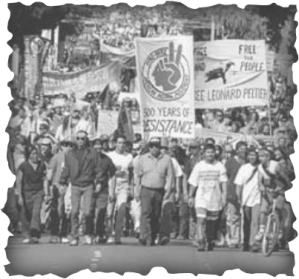 A second example is from 1972, when the American Indian Movement, along with other Indigenous organizations, engaged in what was called the Trail of Broken Treaties. This pilgrimage began on the west coast in October of 1972 and ended in Washington DC the week before the November election.
Indigenous people were given a promise by the Nixon administration that they would meet with representatives at the end of the pilgrimage to discuss Indigenous issues. The American Indian Movement had even created a 20-point position paper to present to the Nixon administration.
All along the route, the Indigenous activists that participated in the Trail of Broken Treaties, met with and stayed at the homes of other First Nations people in order to build support and raise awareness about their campaign.
When the group arrived in Washington, DC, the Nixon administration refused to meet with them, so the Indigenous activists occupied the Department of Interior building, where the Bureau of Indian Affairs (BIA) had offices. During the occupation, Indigenous activists took some of the documents and records from the BIA and burned them in the hallways. After a week, the Nixon administration decided to negotiate an end to the occupation, which led to further treaty negotiations.
The third, and last example of pilgrimages being used by social movements, took place in 1966. The pilgrimage was organize by the United Farm Workers (UFW), a movement made up of migrant workers from the Latino/Chicano community and the Filipino community.
This pilgrimage focused on the working conditions that migrant farm workers faced on a daily basis, both the low wages, horrid living conditions and chemical pesticides that workers were exposed.
Led by Dolores Huerta and Cesar Chavez, the UFW pilgrimage began in Delano and ended up in Sacramento, California, the state capitol.
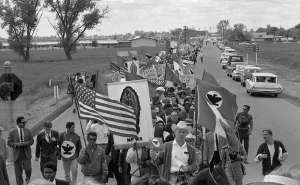
What was unique about this pilgrimage is that it merged the use of the tactics of strikes and boycotts with religious iconography, particularly the Virgin of Guadalupe. Those participating in the pilgrimage sang traditional Mexican protest songs, while some, including Cesar Chavez walked barefoot, which was also a traditional way for Mexicans to participate in pilgrimages.
The UFW pilgrimage did help in building support for the larger farmworker movement, but it took more strikes and nation-wide boycotts to help them achieve their goals.
It is in the same spirit as these historical examples of pilgrimages, that Movimiento Cosecha will be organizing a pilgrimage this fall. The Movimiento Cosecha pilgrimage will begin in Grand Rapids on Friday, October 5th and conclude at the Lansing State Capitol on Tuesday, October 9. The focus of the pilgrimage is a campaign to win drivers licenses for all. Those in the undocumented/under-documented immigrant community cannot currently obtain a drivers license and Movimiento Cosecha wants to change that.
To find out more details about the Drivers Licenses for All campaign or the October pilgrimage, go here https://www.facebook.com/events/261930651314731/

ICE out of Kent County campaign disrupts ArtPrize event
 Last night, about a dozen people who are working in collaboration with Movimiento Cosecha GR and GR Rapid Response to ICE, interrupted the opening ceremony of ArtPrize in Rosa Parks Circle.
Two teams held up banners on either side of the Rosa Parks stage and shouting statements about ICE operating in Kent County and separating families on a weekly basis. The group chose to disrupt ArtPrize in part because the Water Center on Ottawa NW is an ArtPrize venue and in that building there is a office of the Department of Homeland Security, specifically immigration investigations and potential ICE raids of workplaces. Part of the message last night was that ArtPrize is complicit because one of their venues houses a government agency that separates families.
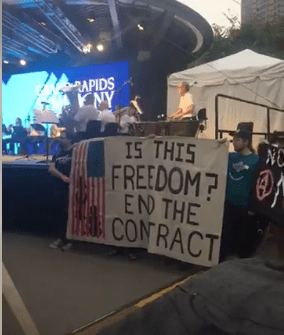 ArtPrize had security people who were attempting to stop those drawing attention to ICE violence, at times pushing people, threatening them and even taking one of the banners. They did this all under the watchful eye of the GRPD, who did nothing to stop the ArtPrize security people from physically intimidating those demonstrating. The only thing the GRPD did was to tell those demonstrating that if they continued to use the bullhorns they would be arrested.
There were several people who came up to demonstrators clearly upset that their evening was disrupted. This was the point. Those demonstrating disrupted the ArtPrize opening ceremony for maybe 20 minutes, but immigrant families are having their lives disrupted by ICE repression, a disruption that can last for days, months, even years, especially of people end up being deported.
ArtPrize released a statement about using the public space in Rosa Parks circle, stating in part, “It’s our hope that we can share this public space with other members of the community in a respectful  manner.” There is a certain irony about this statement, especially since the park is named after a member of the Black Freedom struggle that used a tactic of public disruption on a regular basis.
After the demonstration, people invited the public to come over to the east side of the Rosa Parks stage and symbolically dismantled a cardboard cage that resembling the cages that ICE was using to detain children near the US/Mexican border, something that angered thousands, maybe even millions in the country earlier this summer.
There were also people handing out flyers about what the action was about, along with information about an upcoming action on October 1st, which is a national day of action called No Business With ICE.
The Backlash Against the GR Chamber of Commerce endorsement of Schuette begs the question, Why Now?
In the past 24 hours there has been a tremendous amount of backlash against the Grand Rapids Chamber of Commerce endorsement of Republican candidate for Governor, Bill Schuette.

When the GR Chamber posted the endorsement, hundreds of people responded with anger at the endorsement. In addition, several local businesses have abandoned their membership in the Grand Rapids Chamber of Commerce and now there is a growing list of people who have participated in a variety of Chamber programs that have signed on to a statement calling for the Chamber to renounce their endorsement of Schuette.
“Dear Grand Rapids Area Chamber of Commerce Leadership & Policy Staff:
Your endorsement of Bill Schuette as governor of the State of Michigan is unacceptable.
Bill Schuette actively fights against equal rights and protections for Michigan residents who identify as LGBTQ. He has been complicit in the leadership who brought us the Flint Water Crisis (continuing), helped to underfund public education, continued privatizing of our water and natural resources for pennies to corporations, has fought against the EPA and limits to pollution in a state surrounded by fresh water, and the list goes on.
Moreover, the Chamber’s positioning of itself diversity and inclusion champion through programming such as the Diversity Equity Inclusion Summit and OutPro, among others, stands in stark contrast to the beliefs and policy that align with a Bill Schuette candidacy.
As alumni of Leadership Grand Rapids and many other Chamber-run programs, we the undersigned are compelled to renounce your recent endorsement of Bill Schuette for Governor of Michigan.”
In one sense, it is always encouraging when people speak out against any injustice and this statement identifies several. However, for those who follow state politics and the endorsements of the Grand Rapids Chamber of Commerce, this is not the first time they have endorsed a candidate that promotes policies that do tremendous harm.
Why Now?
The Chamber of Commerce has a long history of endorsing candidates and lobbying for policies that do tremendous harm. SourceWatch has great details on this history, which includes opposing minimum wage increases, maternity leave, union organizing, climate change legislation, privatization of public resources, etc. The Grand Rapids Chamber of Commerce is simply a microcosm of the national entity, which makes its priority the defense and promotion of the interests of capitalism and the capitalist class.
The GR Chamber’s endorsement of Schuette is just one example in recent years, where they have endorsed politicians which promote policies that do tremendous harm. This same Grand Rapids Chamber of Commerce endorsed Governor Rick Snyder. Under Snyder’s leadership Michigan has expanded its number of Emergency Managers, promoted radical neoliberal economic austerity measures (doing away with traditional public sector pensions, privatizing public services and undermining teacher unions), making Michigan a Right to Work State and essentially giving greater control over the State’s economy to corporate interests.
For those who are pissed about Schuette’s stance on LGBTQ issues, the the GR Chamber endorsed candidates who voted for HB 4188. This legislation, often framed as a religious freedom bill, allows adoption agencies in Michigan the ability to deny LGBT couples/partners/families from adopting.
In 2008, the West Michigan Policy Forum (WMPF) was created as an extension of the work of the Grand Rapids Chamber of Commerce. The goal of the WMPF has been to promote and lobby for specific policies at the state level that adopt neoliberal capitalist austerity measures.
Every two years the West Michigan Policy Forum hosts a major summit in Grand Rapids to promote their agenda for the upcoming year. This year’s focus is on education policy and the kind of education policy that the WMPF and the GR Chamber of Commerce are promoting is essentially what Education Secretary Betsy DeVos is trying to force on the American people.
People will point out that the Grand Rapids Chamber of Commerce does Diversity and Inclusion work. However, what they means by Diversity and Inclusion is that people of color and members of the LGBTQ community are welcomed to be part of the Chamber’s work, which is to promote Neoliberal economic policies that will ultimately hurt at a disproportionate level communities of color and people who identify as Lesbian, Gay, Bisexual, Transgender or Queer.
Ultimately, membership in the GR Chamber of Commerce, participation in GR Chamber programs or endorsements from the Chamber should be renounced, since their primary goal is endorsing candidates that benefit the interests of the Capitalist class.
Resisting ICE in Kent County: What we have learned so far
The following is based on my participation with Movimiento Cosecha GR and GR Rapid Response to ICE.
It has been 2 and a half months since we started the campaign to End the Contract that the Kent County Jail has with ICE.
The campaign began with some 200 people coming to a County Commission meeting in late June and taking over the space in front of where the commissioners sit. The Chairperson of the commissioners, Jim Saalfeld, called for an end of the meeting and most of his fellow commissioners walked out. In the process they turned off all recording devices, but those who organized the action brought a bullhorn so people could continue to offer testimony on why the contract with ICE should be terminated. Commissioner Saalfeld also claimed that one member of the action pushed another person who was attempting to speak during public comment, a claim which was false.
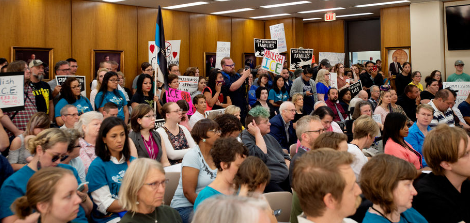
A few days latter, the campaign participated in a fourth of July action using some street theater about the immigrant children in detention near the US/Mexican border, with an emphasis that immigrant families were being separated right here in Kent County.
We then went to the home of Chairperson Saalfeld to protest his role in shutting down the previous meeting, which meant that most of the other commissioners did not get to hear testimony from the immigrant community. We also brought a resolution for him to sign, basically stating that he would commit to working with us to End the Contract with ICE.

At the July County Commission meeting, there were some 20 people who got up during the public comment period to call for an end to the contract. These people included members of the affected community and allies. At one point we sat down an occupied space to protest the county’s unwillingness to sign onto our resolution. By the end of the meeting, just two of the nineteen commissioners agreed to sign.
In early August we met with Kent County Officials to talk about ending the contract with ICE. They had no intention of doing so, so after hearing from several county spokespersons, we got up and walked out of the meeting.
On August 18th, we organized a rally at the Kent County Jail, with some 60 people. There were numerous speakers to addressed a variety of issues, but mostly we heard from members of the immigrant community about their experience dealing with ICE and the constant fear they live in. There were also people from Kalamazoo who spoke, since Kalamazoo had just passed a resolution to end their dealings with ICE in that community.

At the August County Commission meeting, we had one person speak during public comment, asking to be put on the agenda for September and then several members of the campaign turned their backs on the commission, standing in silence. After people walked at of that meeting, Commissioner Antor went on a rant about what we were doing and how misinformed we were. His comments were taped and we responded to them, deconstructing what he had to say.

At the September Commission meeting, we read a brief statement and then told the commissioners that we were holding our own People’s Commission, since they continued to refuse to be part of a collective effort to end the contract.
During these short 10 weeks, we have talked to more immigrants impacted by ICE, as well as the larger community about the County’s contract with ICE and here is what we have learned about the campaign so far.
- Most people were unaware that Kent County even had a contract with ICE (since 2012) before we made it a public issue.
- This issue resonates with lots of people. We have had hundreds of people participate in our actions; over 2,000 sign the petition calling for an end to the contract; some 20 news stories have been done about our campaign, in print, on air and online.
- Movimiento Cosecha GR has been recognized by the Mexican Heritage Association because of this work and their work on the Drivers License for All campaign.
- Since we began 10 weeks ago, there have been numerous communities across the country that have ended their contracts with ICE.
- We have heard from thousands of people in the immigrant community that they fully support our efforts to end Kent County’s contract with ICE.
- Most of the County Commissioners have either been silent on the issue or have taken an oppositional stance towards our efforts.
One commissioner recently stated:
We need to have a civil conversation about these issues. One thing that I’ve observed in my old age is that sitting down to work through problems together usually produces better outcomes than going to battle over them. I know the Sheriff is willing to engage (talk AND listen) with our community. I know that many in our community are also willing to do the same. We need to get that important work started!
When people in power tell us that we need to be civil, it usually means that they feel threatened by what social movements are doing. The fact is, that we have been having conversations with county officials, in groups and individually. The reality is that they continue to refuse to end the contract, so what would be the point of continuing to have a conversation. In addition, the GRPD and the Sheriff’s Department have continued to intimidate and harass those involved in the campaign. We ask, how is that being civil?
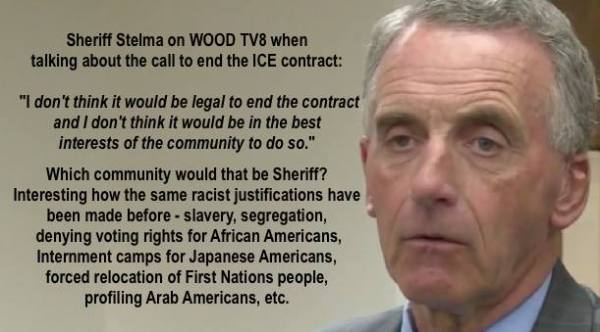
The commissioner quoted above says that the Sheriff is willing to talk and to listen. Not on this issue. Sheriff Stelma has been very clear on this matter and has repeatedly stated in the news media that he will not end the contract with ICE.
Lastly, while some people may object to the tactics of our End the Contract campaign, they failed to understand that the tactics we are using are part of a long history of social movements that have used disruption as a tactic. Whether we are talking about the abolitionist, civil rights, women’s voting rights, anti-war, environmental, LGBTQ or disability rights movements, all of them have used disruption or a no business as usual approach in their struggles.
We will continue to disrupt business as usual, until ICE and any complicity with ICE stops disrupting the lives of immigrant families.
Gateways for Growth or Gateways for Economic and Immigrant Justice: Another look at the new report on the economic contributions of immigrants in Kent County
 Last week, a new report on the economic impact that immigrants have in Kent County was rolled out at two separate events, one at the Goei Center and one at Cesar Chavez School.
One of the main groups behind the report is Samaritas, a refugee resettlement program. In a recent MLive article, a representative of Samaritas as quoted as saying:
“They are contributing to a lot of vital sectors in our community,” said Joel Lautenbach, executive director of development at Samaritas, a Detroit-based social service agency that focuses on refugee resettlement. “They are a very important source of labor in an economy that has long talked about a shortage of labor.”
Gateways for Growth or Gateways for Economic and Immigrant Justice
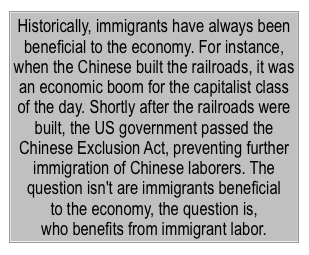
It is important to recognize that in the current economic reality of West Michigan, immigrants do contribute a great deal to the economy. The New Americans in Kent County report emphasizes this economic impact by stating that in 2016, immigrants earned $1.3 billion dollars in Kent County and contributed $219.4 million in federal taxes and $101.5 million in state and local taxes.
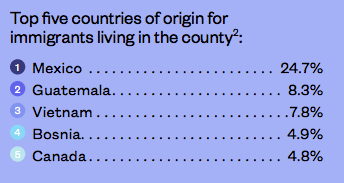 This data flies in the face of the anti-immigrant messaging, which believes that immigrants don’t pay taxes and then use all kinds of social services that the rest of society pays for. The fact is that immigrants, whether they are documented or undocumented, pay taxes. However, just because this report reveals that immigrants pay taxes and contribute to the economy, it should not cause us to simply use the argument that immigrants are good because they bolster the regions economy. It is important that we look deeper into the data and question what it means for immigrant just.
The notion that immigrants are good for the economy should not be our argument for why all immigrants should be allowed to live in our community. In fact, the argument is flawed. The report notes that there are a few sectors where immigrants tend to find work, such as assemblers, fabricators, agricultural, production, cooks and packagers. These are all jobs that do not pay very well and in the case of agricultural work, may not even pay minimum wage.
The reality is that many immigrants who work in construction, assembly, agriculture, the restaurant industry and other service jobs do not make a livable wage. Most of these immigrant workers are exploited, meaning that not only do they make a low wages, they make money for business owners who take advantage of them. Think about all the immigrants who work as farmworkers, how hard they work and how little they get paid. According to the State of Michigan, the food and agricultural sector contributes $101.2 billion to the state’s economy every year. However, the fact is that most of this money stays in the hands of the agribusiness sector as compared to the immigrant population who does the bulk of the agricultural labor.
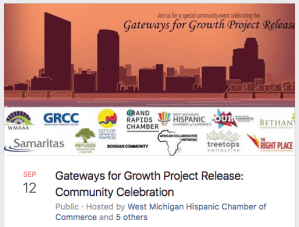 This is exactly why the Grand Rapids Chamber of Commerce and the Right Place Inc. were involved in the promotion of this new report. Both of those entities don’t care about economic justice, they just want to promote economic growth, even if it is at the expense of certain populations, in this case the immigrant population. In addition, the GR Chamber of Commerce is opposed to any kind of organized labor force and works to influence state policy to make sure that wages, benefits and pensions are low or are eliminated. Again, these organizations support increased money coming into the community, they just don’t believe in economic justice.
Another reason why putting an emphasis on what immigrants contribute to the economy is that it means we put economic value above all else. We don’t value immigrants for their culture, for their creativity, for their skills and for their commitment to their respective communities. Why do we always emphasize the economic contribution of immigrants above all else?
The report also does not take into consideration the amount of money that immigrants send back to countries of origin to support other family members, what is called remittance. It would be interesting to see some data on how much remittances are sent to countries of origin from Kent County. Why? First, remittances would underscore the fact that for many immigrants, they rarely get by because they are not only supporting themselves or family members in Kent County, they are supporting family members in their country of origin. Secondly, remittances helps put an emphasis on why people come to the US and why they send so much money home. This would focus our larger collective discussion around the desperation that many immigrants experience, when they flee their own country, come to the US, experience economic exploitation here, along with political repression. As the report notes a high number of immigrants are from Mexico and Guatemala, two countries that US foreign policy has devastated, both economically and militarily. This kind of expanded understanding of why so many immigrants are coming to West Michigan, would force us to see the humanity of people, rather than to fixate on how much money they bring to the area.
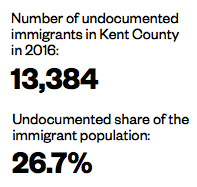 This brings us to one of the most important pieces of data in the report, the number of undocumented people living in Kent County. In 2016, the report states that there were a total of 13,384 undocumented immigrants living in Kent County. In early 2017, the Trump administration made it very clear that if you are an undocumented immigrant, you will be a target. Indeed, as GR Rapid Response to ICE has made known, every week members of the undocumented community are be terrorized by ICE agents, often being arrested, detained and facing possible deportation. If Kent County, the City of Grand Rapids or any other local municipality really values the immigrant community, they would declare themselves a sanctuary city and Kent County would end its contract with ICE. You can’t celebrate immigrants for their economic contributions to the area and then not work to oppose federal policy that seeks to treat them as criminals just because they don’t have the documentation the government requires.
The new report on the economic contributions is a good start in terms of recognizing the value of the immigrant community in Kent County, but until we expand the conversation that includes the following:
- Remittances of immigrants
- Economic exploitation of immigrants
- Reasons why people fled countries of origin
- How US Foreign Policy is a major cause of migration
- How state violence, especially through ICE oppresses the immigrant community
……….. Kent County will never be a welcoming community for immigrants.
10 years of ArtPrize critique and resistance
It has been 10 years since Rick DeVos announced that he and his family’s money (Dick & Betsy DeVos have bankrolled ArtPrize) would be hosting an annual event in downtown Grand Rapids, known as ArtPrize.

We have written about this event from the beginning, offering a critique of the monied spectacle, which uses artist labor and public resources that primarily benefit private wealth.
Early on it became clear that the local news media would not offer any sort of scrutiny of the annual event, instead they became cheerleaders and collaborators. Some years we even tracked election coverage and compared it to ArtPrize coverage. ArtPrize garnered more coverage than representative democracy.
We have also documented to benefits from the annual monied spectacle and we have posted artist responses to ArtPrize.
As the annual event gets ready to kick-off, we simply wanted to provide our readers with several of the articles we have written over the years, to provide some context for why it is important to critique and resist this monied spectacle.
ArtPrize trumps democracy: What the Press coverage tells us about the Press
When elites give money to each other: ArtPrize financials for 2010
MLive article misses the point of the GQ article on ArtPrize
Photo bomb challenges the politics of ArtPrize , with online campaign
The Political Economy of ArtPrize – Part I
The Political Economy of ArtPrize – Part II
Moral Pronouncements aren’t enough: Artprize, the DeVos Family and Trump’s Executive Orders
The funding scheme of ArtPrize
ArtPrize, art and the aesthetic experience: An interview with Richard Kooyman
Grand Rapids, ArtPrize and Whiteness

The People’s Commission and the End the Contract with ICE campaign action expands list of demands from the County
As a matter of transparency, this writer participated in the action yesterday at the Kent County Commission meeting.
Yesterday, some two dozen people attended the Kent County Commission meeting to continued to demand that the county agree to work to end the contract between the county jail and ICE.
People met on Calder Plaza before going up to the County Commission meeting. Waiting for members of the End the Contract campaign were more than a dozen law enforcement officers, some from the GRPD and some from the Sheriff’s Department.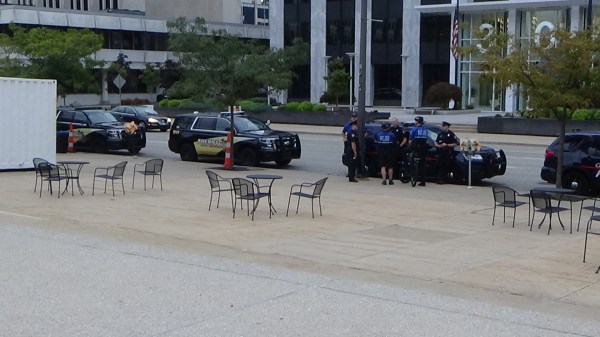
The police told organizers that if they planned on marching in the street there would be arrests. The cops said that since government dignitaries were in town because of the DeVos funeral, that they needed to keep streets open and not allow for any disturbances in the city.
Just moments before people went into the County building, someone from the Sheriff’s Department told them that anyone with a backpack could not come to the commission meeting for “security” reasons. This was just the latest tactic used by the county to try to deter people from participating in county government business.
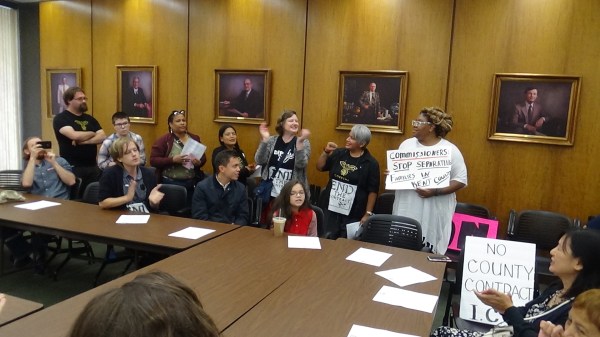
People went inside and up to the third floor where the commission meets and right away notice that there were several people with backpacks and briefcases in the room, clearly demonstrating a double standard. Undeterred, the End the Contract campaign members stuck to their plan. What follows is text for what those who organized the action were calling the People’s Commission.
Speaker during public comment: It’s been over two months since we first asked you to end the contract between ICE and the Kent County Jail – to not accept money to hold our immigrant neighbors for ICE, when often they’ve only been brought in for a traffic violation. There is nothing regarding ending the contract on the agenda. Will you sign this resolution now?
[Holds up resolution document, calls each commissioner who hasn’t signed by name.]
This Kent County Commission has shown it will not listen to the people’s will. Therefore we must call a special commission – a People’s Commission – to model how to listen to the people, how to represent the people, and how to act in a way that responds to their needs. For instance, a People’s Commission would have meetings in the evening so people could attend, not during the work day like this one.
Commissioners Womack and Melton, you signed the resolution, so we invite you to join us, as long as you’re willing to listen to the public and act to end the contract. This is the People’s Commission!
[People’s Commissioners stand up, form semi-circle that mimics Kent County Commission seating arrangement.]
Chair: I now call this meeting of the People’s Commission to order! We are here to listen to the public about the Kent County Jail contract with ICE. We represent the people of Kent County as we actually are! And we want to hear from the public – tell us – is this contract between ICE and the Kent County Jail hurting our community?
Public (together): YES!
Commissioner 1: How is it hurting our community? Help me understand.
[Stories from affected community.]
Commissioner 2: Some say that ICE serves as a positive agency?
Public (together): NO!
Public 1: No. There’s evidence that there have been over 33,000 complaints filed against ICE over the last 7 years, alleging a wide range of abuses in immigration detention. Those included sexual abuse. Complying with a demand could get an immigrant released -but they could be deported to the wrong country if they didn’t. (1) This is who the Kent County Jail is working with. And the Commission has the power to stop it.
Public 2: The ACLU has obtained over 30,000 pages of documented abuses of immigrant children in ICE custody. IvCE officers have:
- Punched a child’s head three times, kicked a child in the ribs
- Used a stun gun on a boy, causing him to fall to the ground, shaking, with h eyes rolling back in his head
- Subjected a 16-year-old girl to a search that ended in a sexual assault which was too graphic to describe here.
- They’ve done many other things – calling children dogs, threatening them with sexual assault by other inmates, running over a teen with a patrol vehicle, refusing to let children stand up for days, and more. (2)
This is who the Kent County Jail is working with. And the Commission has the power to end the contract and stop being complicit in this violence.
Public 1: For that matter, ICE was only created after 9/11. Before that immigration was handled by Immigration and Naturalization Services, which had a greater focus on bringing people into the country. Now immigration is handled by the Department of Homeland Security, which created ICE. Forms of immigration that had been common and accepted before were now made into criminal acts. (3) The Kent County Jail is complicit in criminalizing our neighbors. Yet the increased violence in enforcement by ICE has not stopped migration. There are still currently an estimated 11 million under-documented immigrants in the U.S.
Public 2: Also, this violence by ICE shows us that we don’t need armed officers to fix our problems. Right here in this group we have non-violent crowd safety volunteers, looking out for us and willing to de-escalate problems if they arise.
Commissioner 3: How many people in Kent County does the contract with ICE affect?
Public 3: In 2016, the number of undocumented immigrants in Kent County was over 13,000. The undocumented share of the immigrant population was over 26%. (4)
This means that most immigrant families and many non-immigrant families here have loved ones who are under-documented, and the fear of their detention and deportation affects all areas of their lives. The fear of losing a loved one. Of losing a family member. Of losing the income they need to live. All because the Kent County Jail has sold them to ICE – received payment for holding them for ICE and handing them over.
Public 4: What’s more, nationally, there are over 350,000 people detained each year. The national detention budget for 2017 was $2.6 billion for locking up our neighbors – but immigrants contribute $2.3 trillion of wealth to the U.S . (5)
My point is this problem happens everywhere in the U.S., and that’s why it’s important for local decision-makers like yourselves to fix it at the local level, here in Kent County.
Commissioner 4: How much does Kent County benefit or lose from the contract to hold immigrants for ICE?
Public 3: Kent County only made $18,000 last year from this contract. (6) But it is estimated that immigrants contribute $3.3 billion a year to Kent County’s economy, which benefits the county. (7) So it is much better for Kent County to not lock up our immigrant neighbors or hold them for ICE.
Also, our Kent County residents’ quality of life is decreased and their human rights are being violated by this contract. In a city and county that already has a national spotlight on its issues with racial profiling, this just gives more financial incentive to pull over Black and brown drivers. (8) Criminalizing immigrants should not be a source of income for the government. They should be allowed to live and work and raise their children in peace and without fear. (9)
Commissioner 5: So is there an alternative?
Public (together): YES!
Public 4: Across the nation, cities and counties like us have resolved not to work with ICE.
The mayor of Atlanta just ordered the city to end the relationship with ICE and to remove all those detainees from the city jail. (10) The governments in Austin, TX, in Sacramento County, CA, in Springfield, Oregon, and in Alexandria, Virginia – all of them ended contracts with ICE and will no longer accept a ransom to kidnap their residents. (11) And Kalamazoo County right here in Michigan has also passed a resolution to not work with ICE.
Chair: I appreciate these examples and these points. We know that the commission can use financial and legal means to end this contract. Will ending the contract really stop the harm ICE is doing in Kent County?
Public (together): YES!
Public 2: It will show every immigrant resident that Kent County stands with them.
- Ending the Contract is the right thing to do! And you can do more!
- You can pass a resolution that says the County will not use any of their resources to support ICE.
- You can make the County a Sanctuary for all immigrants, just like Ann Arbor and Detroit have done.
- You can support the work of GR Rapid Response to ICE, who gets calls every week from families – you can help them to interrupt ICE and to support families who have been harmed by ICE.
- You can pass another resolution to support state legislation that would allow drivers licenses for all.
Commissioner 1: I propose that we draft a resolution to end the contract and provide better support to our immigrant neighbors!
Commissioner 2: And I want to thank the public for all this engagement and for this great information. We are listening! With all the public engagement on this issue, I propose that we schedule our meetings during the evening, to allow more people to participate. And we should change the process so that there can be a dialogue between the public and the commissioners during the public comment period.
Public (together): YES!
[New Resolution is provided – Chair reads aloud. Chair calls a vote. Commission Votes and Passes – Commissioners sign.]
Chair: [announces next steps] I call this meeting to a close. Let’s celebrate!
The People’s Commission organizers fully expected to be led out of the commission meeting by law enforcement, which never happened. instead, Kent County Commissioner Saalfeld made the decision to adjourn the meeting, which allowed the People’s Commission to stay and complete their action.
When people returned to Calder Plaza, they found out that the County had moved their meeting to another location, but prevented some members of the public from entering. In various news stories, the commission claimed they were acting within their right to move the meeting and prevent people from entering, but those involved in the action believe this violates the open meetings act.

Once the End the Contract campaign people came back to Calder Plaza, there was a brief celebration, which also consisted of the People’s Commissioners signing the new resolution with added action steps mentioned above.
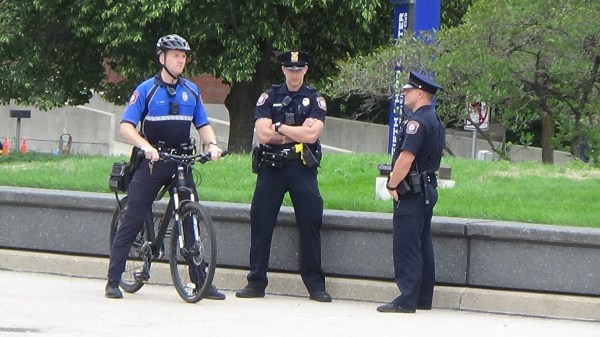
The police presence was still significant at the Calder Plaza, most with cops on bicycle. As people left to go to their cars in the city ramp, the cops on bike followed them, thus continuing to demonstrate a low level of surveillance and harassment that has been consistent with Cosecha GR and GR Rapid Response organizing over the past eighteen months.
What follows are sources cited in the People’s Commission proceedings:
Sources:
theintercept.com/2018/04/11/immigration-detention-sexual-abuse-ice-dhs/
aclu.org/news/aclu-obtains-documents-showing-widespread-abuse-child-immigrants-us-custody
splinternews.com/a-short-brutal-history-of-ice-1822641556
The Gateways for Growth Project: findings presented on September 12 at Cesar Chavez Elementary
detentionwatchnetwork.org/issues/detention-101
https://www.mlive.com/news/grand-rapids/index.ssf/2018/06/ice_protesters_shut_down_kent.html
mlive.com/news/grand-rapids/index.ssf/2017/04/grand_rapids_police_present_re.html
detentionwatchnetwork.org/issues/financial-incentives
nytimes.com/2018/06/28/us/migrant-shelters-ice-contracts-counties.html
GVSU Canonizes Rich DeVos, but some students push back
The Rich DeVos love-fest continues in Grand Rapids, particularly in the news media, where there are daily posting on the “legacy” of the co-founder of Amway.
My favorite headline so far has been, For Rich DeVos, giving away his millions was a full-time job. This headline is not only misleading, it is inaccurate in terms what the organizations who were the recipients of his contributions actually do that is harmful. For an counter-narrative, see A more honest obituary for Richard DeVos Sr. 
The canonization of DeVos has also extended to areas outside of the news media. GVSU has already erected a monument of sorts to DeVos and placed it on the Allendale campus at GVSU. (seen here on the right)
The commemorate piece states:
This Laker Light shines in memory of one of Grand Valley State University’s greatest leaders and most loyal friends, Richard M DeVos Sr. Mr DeVos’ vision for Grand Valley, including the building of the downtown campus, will benefit students and our community for generations to come.
Such a statement is fundamentally based on the amount of money that Rich DeVos contributed over the years to the campus, especially since the school transitioned from Grand Valley State Colleges to Grand Valley State University. This transit was in many ways influenced by DeVos in that it went from a place that was called the “Berkeley of midwest” to a campus that has a significant business emphasis and has become increasingly more conservative.
 Some students are not being quiet about this new monument to DeVos, as they have begun putting up around campus a poster (seen here) that attempts to provide a counter-narrative to benevolence of DeVos. We are grateful that the student who created the flyer added a nod to GRIID, by including a link to our DeVos Family Reader, entitled, We’re Rich and We Do What We Want.
When it comes to Rich DeVos and GVSU, we’d also like to share a few other resources that are important if we are to understand the history and how GVSU has evolved.
First, there is a GR People’s History Project post based on a student newspaper from the late 1970s called The Insider, where students confronted DeVos while he was on the Board of Control. If you go to page 26 of The Insider issues we have posted, you can read the student criticisms of Rich DeVos in 1977.
Another important resource that was created specifically for students and faculty, is What’s in a Name: A Popular Guide to Wealth and Influence at GVSU, which provides a visual depiction and maps to show where there are names of wealthy donors on buildings and what harm they have caused with their money, with DeVos being the primary perpetrator.
Lastly, when we produced A People’s History of the LGBTQ Community in Grand Rapids film, we devoted a whole chapter to GVSU, which talks about how DeVos was a major impediment to LGBTQ justice. You can view the entire film at this link. The section on GVSU begins at 1:06:10.

Betsy DeVos Watch: At the G20 Summit, DeVos shares her Neoliberal Education vision while Argentinians hold a massive strike
In late July, Secretary of Education Betsy DeVos traveled to Argentina to participate in the G20 Summit forum on education.

The G20 meets annually and is made up of the the countries with the 20 largest economies. These gatherings are designed primarily for heads of state from those countries and the leading global financial institutions to figure out how to continue expand neoliberal economic policies that will benefit these 20 countries at the expense of the rest of the world.
These gatherings are always met with significant opposition and this year’s summit was no different. There were major demonstrations with a massive strike organized by labor unions in Argentina, as you can see in the video below.
This is the context for the education forum at the G20 Summit, which included Betsy DeVos and her counterparts from other other countries. A major focus of the education forum was to discuss the link between education and work.
This link was also part of Betsy DeVos’ brief message delivered at the summit, where she said:
This gathering provides an important opportunity to learn from each other, acknowledging the vital link between education and the economy. Here, we can discuss our respective challenges, and, importantly, discuss ways to improve education for all students on their lifelong learning journeys as they prepare for today’s and tomorrow’s careers.
Indeed, education and the economy are indivisible, especially given the interconnectedness of the world today. In the United States, we are focused on expanding pathways to success. We recognize that a dynamic and changing economy requires dynamic and changing approaches to education.
We must first acknowledge that every student is an individual. There is no one-size-fits-all approach that works for every student – and there is no such thing as an “average” student. Each of them come to learn with different experiences, different needs, different learning styles and different dreams. Their education must be equally customized and individualized.
DeVos makes it clear that her vision and that of the US administration is to focus on: 1) what those within the neoliberal education model identify as talent creation, where education is a means to create future workers; and 2) that the best way to create future workers is to change the education system that is more focused on job skills, especially outside of the current public school structure.
In the end, what Betsy DeVos and the other G20 participants were doing was to further a world agenda that the people in Argentina were protesting outside the summit. Betsy DeVos is not only dangerous to the future of education in the US, but the future of education globally.
Michigan Governor’s race ads are being paid for by corporate money, on both sides
 With the primaries behind us in Michigan, campaign money will to more focused up until the November election.
The Michigan Campaign Finance Network (MCFN) recently released data on entities contributing to the Republican Governor’s Association (RGA) and the Democratic Governor’s Association (DGA), in terms of who is financing paid ads for the Governor’s race in Michigan between Bill Schuette and Gretchen Whitmer.
The DGA and the RGA are 527 organizations that disclose their donors on a quarterly basis through the Internal Revenue Service. Both groups raise money from across the country, including from some donors based in Michigan.
MCFN examined the top donors to each group from the start of 2017 through the end of June 2018 to see which donors listing Michigan addresses have given the most. Here’s what we found.
Top Michigan-Based Donors To RGA
1. DeVos family, Amway, $375,000
2. McKinley Associates, Ann Arbor, $200,000
3. Michigan Chamber, $100,000
4. ITC Holdings, $101,800
5. DTE Energy, $100,000
6. Edward Levy, Edward C. Levy Co., $75,000
7. J.C. Huizenga, Huizenga Group, $75,000
Top Michigan-Based Donors To DGA
1. Greenleaf Trust, Kalamazoo, $350,000
2. General Motors, $240,000
3. Fiat, $50,000
4. Dow International Finance, Midland, $45,000 (Dow gave $50,000 to the RGA)
5. Richard Schiffrin, Grant Eisenhofer, Farmington Hills, $25,000
6. Ford, $25,000
7. ITC Holdings, $25,000
For people in Michigan who are familiar with the big campaign donors, it’s no surprise to see names like DeVos, the Chamber of Commerce and JC Huizenga. What people may not be used to seeing are the list of entities contributing to the Democrats in this case, such as GM, Fiat, Dow, Ford, ITC Holdings and the Stryker Corporation connected Greenleaf Trust.
This raises questions, such as why would the major auto manufacturers, DOW and the other corporate entities be backing the Democratic candidate for Governor? What would these same corporations want in return, since no corporation or member of the capitalist class contributes to political campaigns without expecting something in return.
For those who are not blinded by partisanship, they would be aware of the fact that corporate America has been backing both major parties for decades now. If one does any kind of a search on opensecrets.org, one can clearly see that most major industry sectors contribute to both Republicans and Democrats. For example, look at what the Insurance Industry has contributed to both parties in the past year and the past 2 decades. Another example would be the pharmaceutical industry, which also spreads their money to both parties.
The bottom line is that if we are going to be informed about where we put our energies in terms of social change, whether it be movement building or voting, we need to always follow the money before making decisions.

