Last night, some 25 people participated in the national No Business With ICE Action Day, here in Grand Rapids. Cities across the country participated in the action to draw attention to the many corporations and businesses that have contracts with ICE, and to demand that they end their contracts with an agency that does tremendous harm to the immigrant community.
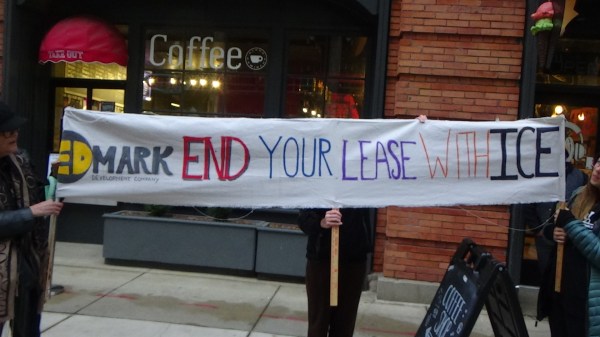
The target in Grand Rapids was the Edmark Development Company. Edmark, which now owns the Waters Center building, leases space to the Department of Homeland Security/ICE at 161 Ottawa NW. However, you wouldn’t know this, since there is no information listed at their online directory or the directory in the building’s lobby.
Movimiento Cosecha GR and the GR Rapid Response to ICE group were handing out flyers with information about Edmark, along with ways for people to contact them to demand that they end their lease with the Department of Homeland Security/ICE. The number to call for Edmark is 616.575.6051. There is also an online petition that people can sign.
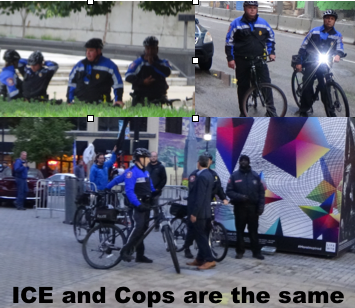 However, before going to the Waters Center, people gathered at Calder Plaza, where they were met by 12 – 15 cops from the GRPD. The cops told the group that if they went into the Waters Center building and disrupted people there for entertainment (the Waters Center is an ArtPrize venue), they would be arrested.
It was a cold and raining night in Grand Rapids, which meant there wasn’t much foot traffic, so the action moved from the Waters Building and decided to go to Rosa Parks Circle to see if there were more people that they could share the flyer with.
Upon arriving at Rosa Parks Circle the group stood in front of the Grand Rapids Art Museum, specifically where channel 8 has their ArtPrize studio, holding up banners and signs and chanting. After about 5 minutes, the GRPD (which followed them down) told people they had to move off the brown colored bricks onto the grey colored bricks or they would be arrested.
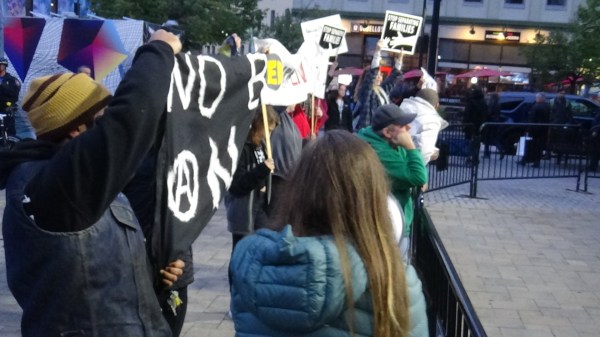
The group then went down to the arena district and continued to hand out flyers and to chant about ICE, Edmark and the cops, since the cops kept following the group the entire way. The action ended at the ArtPrize office on Sheldon & Weston, where flyers were left for ArtPrize staff.
Movimiento Cosecha GR and GR Rapid Response to ICE also wrote up a statement, which was delivered to the Edmark Development Company office. It is a powerful statement, which we will re-post here:
To: Edmark Development Company
161 Ottawa NW, Grand Rapids, MI 49508
From: Movimiento Cosecha GR
GR Rapid Response to ICE
Concerned citizens
Date: October 1, 2018, A National Day of #NoBusinessWithICE
We demand that you cancel your contract with ICE and stop renting office space to the Department of Homeland Security.
Why?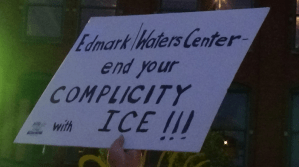
- It’s morally wrong to be complicit with ICE. ICE abuses immigrants and children.
There’s evidence that there have been over 33,000 complaints filed against ICE over the last 7 years, alleging a wide range of abuses in immigration detention. Those included sexual abuse. There are cases in which complying with a demand could get an immigrant released -but they could be deported to the wrong country if they didn’t.
The ACLU has obtained over 30,000 pages of documented abuses of immigrant children in ICE custody. ICE officers have:
- Punched a child’s head three times, kicked a child in the ribs
- Used a stun gun on a boy, causing him to fall to the ground, shaking, with his eyes rolling back in his head
- Subjected a 16-year-old girl to a search that ended in a sexual assault which was too graphic to describe here.
- They’ve done many other things – calling children dogs, threatening them with sexual assault by other inmates, running over a teen with a patrol vehicle, refusing to let children stand up for days, and more.
This is the organization that you are allowing in your building.
- ICE separates families and hurts our community.
In 2016, the number of undocumented immigrants in Kent County was over 13,000. The undocumented share of the immigrant population was over 26%.
This means that most immigrant families and many non-immigrant families here have loved ones who are under-documented, and the fear of their detention and deportation affects all areas of their lives. The fear of losing a loved one. Of losing a family member. Of losing the income they need to live.
Even when they are not abused by ICE like in the examples above, children are traumatized and do poorly in school when a parent is taken. Mental and physical health, productivity, and quality of life all suffer greatly when a family is separated.
Yet it is estimated that immigrants contribute $3.3 billion a year to Kent County’s economy. Immigrants are our valued neighbors, working, living, learning, and playing alongside of us in our day-to-day lives. We must stand with them.
- We must make it so that ICE cannot do their violence in our city.
Businesses all over the country have stopped doing business with ICE. Virgin Airlines won’t use their flights to deport people anymore. Several local municipalities have canceled their contracts with ICE and ordered ICE detainees to be released. By making it difficult for ICE to work in our city, we can help to stop the violence and keep families together.
Stop renting to ICE. Support the immigrant community.
Betsy DeVos Watch: Freedom, Free Speech on Campus and the National Constitution Center
 A few weeks ago, Secretary of Education Betsy DeVos spoke at an event organized by the National Constitution Center for their annual Constitution Day.
The speech that DeVos gave in September, was instructive on many levels. A primary theme of the Secretary of Education’s speech centered around freedom and freedom of speech. In many ways, Secretary DeVos was chastising both students and campus administrators of limiting ideas and information. Such a claim seems rather laughable coming from a person who justifies her family’s contribution of millions of dollars during election cycles as “free speech.”
Another point that DeVos addressed was the issue of civility. Civility is a topic and theme that more and more campuses are pushing, especially since there are more and more students and community members who are challenging what they would identify as hate speech.
A good example of hate speech is the student-led protests that have confronted the white supremacist leader Richard Spencer. More and more student groups or community groups that are marginalized – black, latino, immigrant or queer communities – are protesting, interrupting or even trying to prevent those who promote white supremacy, homophobia, closed borders and privatizing education, as a few examples.
These are examples that are in sharpe contrast to the examples that Betsy DeVos does provide. One example, DeVos gives states:
An official student activities board at the College of William & Mary, a public campus in Virginia, recently hosted a director of the American Civil Liberties Union for a discussion on free speech. Almost as soon as the event got underway, students rushed the stage and began to shout down the ACLU representative, an organization typically allied with many of the same causes shared by those who were shouting. The event never resumed.
What DeVos failed to mention is that those protesting the event were members of a Black Lives Matter chapter that were specifically challenging the ACLU’s defense of people like Richard Spencer and other white supremacists to have a public forum to spew their hate. This protest was held in October of 2017, so the BLM protest was drawing attention to the ACLU’s defense of the white supremacist gathering in Charlottesville, Virginia.
A second example that Betsy DeVos gave in her speech was about U of M students bringing Alveda King to campus and then being charged by the university to provide security. DeVos also mentioned that she was the niece of Dr. Martin Luther King Jr. What DeVos failed to mention in her speech was that Alveda King was invited to campus, since she was an anti-abortion activist and was invited by an anti-abortion student group. When other students found out that King would be speaking about 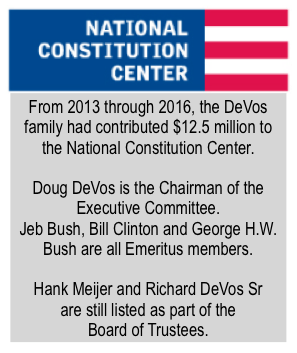 her anti-abortion views, the university decided that security would be needed and then charged the group that brought King to campus.
One last example that DeVos mentions was the joint statement that Princeton’s Robby George and Harvard’s Cornel West issued on freedom of thought. While Cornel West issued such a statement, DeVos again failed to mention that Dr. West was part of the counter-demonstration in Charlottesville attempting to shut down the white supremacy march.
Betsy DeVos also stated that the country has “abandoned truth.” Yes, a person who grew up in a wealthy family that was part of the religious right and married into an even wealthier family that is part of the religious right movement that seeks to impose its values on the rest of society, had the audacity to tell students that people have abandoned truth.
Grand Rapids Police Task Force Recommendations: False solutions and the need for Radical Imagination
 For several years now the City of Grand Rapids and the GRPD have been reviewing their policies and making some adjustments because of public pressure.
Most of the public pressure has been coming from communities most negatively impacted by police presence and police practices, specifically the African American and Latino/Latinx communities.
This pressure coincided with increased police brutality and police killings of black people across the US, especially since Michael Brown was murdered by cops in Missouri a little more than four years ago.
The most recent round of recommendations that have been developed by a Task Force made up of cops and some residents is just the latest list of recommendations that ultimately present a false solution.
There are 38 recommendations put forth dealing with the following areas:
- Staffing and Deployment
- Internal Affairs (Accountability)
- Training
- Youth Policy (this was added at the request of the police chief)
- Community Policing and Crime Reduction
- Recruiting and Hiring
 As you can see from the list, the recommendations are internal to the GRPD and are essentially mild reforms that do not address the fundamental role of cops, which is to protect power and maintain the status quo. To quote Alex Vitale, author of the book, The End of Policing:
The problem is not police training, police diversity, or police methods. The problem is the dramatic and unprecedented expansion and intensity of policing in the last forty years, a fundamental shift in the role of police in society. The problem is policing itself.
Do we really believe that if police officers take cultural competency courses that it will result in a reduction of policing and arrests in black and brown communities? Do we really believe that hiring more minority officers or female officers will fundamentally change the function of policing? Does having more cops in neighborhoods, walking a beat and getting to know the residents mean that crime will be reduced? These are all reformist solutions that are generally presented to communities all across the country, yet the results are still the same.
- The US has the highest incarceration rates in the world and the highest percentage of people who are on parole, on probation, in jail or prison are disproportionately black and brown communities experiencing poverty.
- Police harassment and violence directed at communities of color are on the rise.
- Police departments have become more militarized.
- Police departments are engaging in increasing levels of surveillance.
- Police departments are using massive amounts of city budgets – 1/3 of the Grand Rapids City Budget is devoted to policing.
Take for instance the idea of community policing. In the new recommendations, there are eight community policing recommendations:
Recommendation 5.1: Recognizing that community policing works best when it is supported by elected leaders and is a subset of community-based governance; the Mayor and City Commission should adopt a Resolution that mandates community policing as the operating philosophy of the police department and require all city departments to contribute to enhance public safety through community collaboration.
Recommendation 5.2: GRPD should develop a citywide community policing plan that incorporates crime reduction strategies, community engagement and partnerships, and police department oversight.
Recommendation 5.3: GRPD should include community members in its CompStat process.
Recommendation 5.4: Develop a patrol strategy that allows Beat officers time to engage with the community in non-enforcement activities (e.g., foot and bicycle patrols).
Recommendation 5.5: Require Problem-Oriented Policing (POP) training to all sworn officers. This training teaches officers how to solve community problems in partnership with the community and through a mode that is comprehensive and evidence-based.
Recommendation 5.6: Incorporate the core principles of community policing – engagement, collaboration, problem-solving, and building trust and legitimacy in annual performance evaluations for all officers.
Recommendation 5.7: GRPD Beat officers should be required, and given the time, to initiate and complete at least one POP project on a quarterly basis.
Recommendation 5.8: GRPD should develop a specific POP incentive program(s) that recognizes and highlights GRPD staff – both sworn and civilian – in problem-solving with the community.
These recommendations might sound like a good idea, but that is only because we fail to understand the essential function of police departments as protecting power and maintaining the status quo. Within this framework of understanding, community policing is essentially a form of counterinsurgency, which seeks to win over the populace of any community, to gain access to information about populations they consider dangerous, and to undermine efforts for collective liberation.
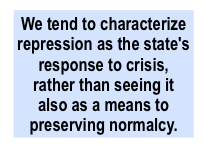 Kristian Williams, in his book, Life During Wartime: Resisting Counterinsurgency, examines the history of community policing and the disastrous impact it has had on communities of color and poor communities.
In Williams’ book, he looks at the research done by the RAND Corporation, which studied community policing. The Rand Corporation says this about community policing as its paradigm for counterinsurgency:
Pacification is best thought of as a massively enhanced version of the ‘community policing’ technique that emerged in the 1970s. Community policing centered on a broad concept of problem solving by law enforcement officers working in an area that is well-defined and limited in scale, with sensitivity to geographic, ethnic, and other boundaries. Patrol officers form a bond of trust with local residents, who get to know them as more than a uniform. The police work with local groups, businesses, churches, and the like to address the concerns and problems of the neighborhood. Pacification is simply the expansion of this concept to include greater development and security assistance.
Does this assessment by the RAND Corporation sound eerily like the recommendations put forth by the GRPD?
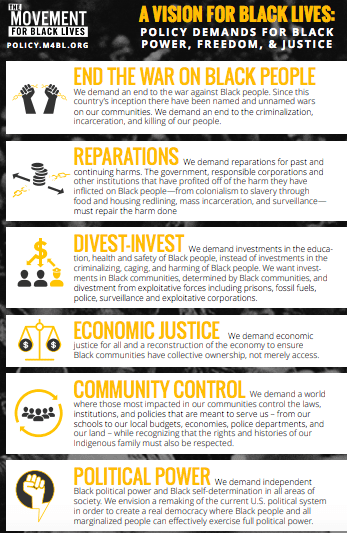 A Community-based vision for Liberation that doesn’t include cops
Part of the work that community-based organizing must do, is to challenge all of us to engage in radical imagination. Radical imagination simply means to envision a world that is outside of the acceptable and existing frameworks. For instance, instead of proposing that those with tremendous wealth donate to projects that provide affordable housing, we could propose that housing is a fundamental right and if everyone had a livable wage they could afford adequate housing.
When we talk about radical imagination and policing, many movements propose that every community should be able to determine how to create safe and secure communities. This is exactly, what many communities of color, specifically black communities have been calling for since Michael Brown was murdered by a cop in Ferguson, Missouri in 2014. This is exactly what the Movement for Black Lives has been calling for in the radically imaginative vision, seen here on the right.
We all most push for a radically new way to create safe and free communities. We all need to radically imagine our communities that no longer includes state violence in the form of police or prisons. Together we can imagine something new.
Don’t be fooled by Wolverine Worldwide’s PR stunt during ArtPrize!
 Corporations go to great lengths these days to present themselves as being environmentally sustainable or practicing social responsibility. Hell, even oil companies have very slick PR campaigns to communicate to the rest of us that they are a “green” company.
Within the capitalist framework, corporations want to tap into public concerns about hunger, homelessness or environmental sustainability. Within this framework, corporations can encourage consumers to buy their product, which will result in the corporations donating a portion of their profits to some non-profit.
These corporate campaigns tap into a very vulnerable aspect of humanity, in that they want people to feel good, while at the same time contribute to the ongoing consumption of the world’s resources.
Manipulating this kind of public sentiment is very dangerous and it has dangerous consequences. One way that the purchase our way to social justice is dangerous is that it tends to redirect our thinking, even our collective imagination away from what the root cause is of any given social problem. For instance, if I purchase Boxed Water, they will donate a portion of their profits to plant trees. Sounds good on the surface, but it distracts use from the ridiculousness of buying water, when water should be a right that we all have access to. Secondly, buying boxed water distracts us from thinking about all the energy and resources it takes to manufacture the boxes and transport them, when people could just be drinking tap water.
Another way that purchasing to achieve social justice is dangerous, it that it means that we believe that simply donating money will solve our social problems. For instance, the current housing crisis that millions face in the US, cannot simply be fixed by monetary donations. The real housing crisis is a crisis that the so-called free market has creates, which results in millions of people not being able to afford to buy a home or rent an apartment. The market dictates the cost of housing and at the same time (we are told), the market determines what kind of wages that businesses can pay. Not so ironically, this same market, which has forced skyrocketing housing costs and stagnate/low wages also directs billions of dollars to the real estate industry and property management companies.
Lastly, the danger of purchasing our way to social justice thinking also tends to reward the same companies that are responsible for the theft of public funds, racism, homophobia or environmental catastrophes and threats to public health. A great example of this is taking place this Friday, September 29th during ArtPrize.
The Why We Walk project is being sponsored by Wolverine Worldwide where participants will turn their ArtPrize experience into a donation for one of three local charities: Habitat for Humanity of Kent County, Family Promise of Grand Rapids or Western Michigan Center for Arts + Technology.
According to the Facebook event page:
Wolverine Worldwide will donate $50,000 but your steps will determine how much money each charity will receive – why we walk. Simply show us why you walk ArtPrize and for every one-mile you walk (or 2,000 steps), you will be given a token to vote for a charity. At the end of the day, the charity with the most votes will receive $25,000; the charity with the 2nd most votes will receive $15,000 and the charity with the 3rd most votes will receive $10,000. While you’re out walking and exploring ArtPrize and the local community use #WhyWeWalk for a chance to win gift baskets filed with Wolverine Worldwide brand product. At 5pm we’ll draw a random winner from all the #WhyWeWalk hashtag users; the more times you use #WhyWeWalk, the better the chances for winning the gift basket. All participants will be given a discount code to use on any Wolverine Worldwide brand product.
Again, this all sounds good and might even give us some warm fuzzies. However, such charity functions should not distract us from what the real function is of this PR stunt by Wolverine Worldwide.
First, this PR stunt is primarily a way to distract us from or minimize the harsh truth that Wolverine Worldwide has been lying the the public for decades about their environmental contamination in Kent County. Wolverine Worldwide’s toxic dumping is resulting in millions of public money being used for cleanup and massive health costs to families that have been and will suffer from the corporation’s contamination. On top of that, Wolverine Worldwide is still denying most of the damage they have done. (Check out the Facebook page of Michigan Demands Action Group for updates and analysis on the Wolverine Worldwide contamination https://www.facebook.com/groups/demandaction/)
Second, Wolverine Worldwide’s $50,000 donation is insulting when one considers the fact that the company has eliminated over 500 jobs in the last decade and their CEO, Blake Krueger, has a total compensation package (salary, stocks options and bonuses) of nearly $8 million in 2016. The company’s charity during ArtPrize will simply hide the gross inequities that they engage in as a matter of practice.

Of course there will be people who will be fooled by these corporate hucksters and then there are those that say Wolverine Worldwide’s donation will benefit needy families, so don’t be so hard on them. I say, no amount of charity can hide an injustice and no amount of charity can reverse the systemic harm being perpetrated on the people of Kent County.
Don’t be fooled by Wolverine Worldwide’s PR stunt during ArtPrize!
Jeb Bush was brought in for the West MI Policy Forum to get them to adopt the same education policy platform that Betsy DeVos is pushing
Despite not being able to report in person on the 2018 West Michigan Policy Forum (WMPF) conference, it is still important to write about some of the things that took place on Monday in Grand Rapids.
Former Governor of Florida, Jeb Bush, was one of the main speakers at the WMPF conference, a conference which made education policy the focus of this year’s gathering.
So far, there has very little reporting done about the conference of business leaders and members of the Grand Rapids Power Structure. The only story from the main news sources in West Michigan was a piece on MLive, a piece which focused on what Jeb Bush had to say.
The MLive article was headlined, Jeb Bush touts education reform to West Michigan business leaders. The headline alone should tell us something about how the MLive article would frame the issue. While one could technically use the phrase “education reform” to describe what the West Michigan Policy Forum wants to do, it does not adequately communicate the reality of what Jeb Bush and those who embrace his views on education truly want to do. A more accurate description would be that the types of education policy that Bush (and the WMPF) want to adopt would undermine public education and impose a neoliberal economic model for how education is done in Michigan. Essentially, this model would seeks to attack teacher unions in public schools, privatize education and education services, promote a curriculum that best benefits businesses and allow public money to be used for private & religious schools.
The MLive article does really question the message that Jeb Bush brought to West Michigan, although they did state:
Bush also supported the expansion of charter schools and the use of public money for private and religious school tuition, the Washington Post reported.
Beyond that statement, the MLive reporter presented a very brief overview of what the former governor of Florida had to say.
Unfortunately, the MLive reporter did not verify the claims made by Bush and did not inform readers that the powerpoint he used was created by the Foundation for Excellence in Education, also known as ExcelinEd
The MLive article also failed to inform readers that Jeb Bush is the Chairman of the Board of the Foundation for Excellence in Education, nor to they report on the mission of the organization.
In fact, the 5 main education policy positions that ExcelinEd promotes are:
• Charter Schools
• Public School Choice
• Education Scholarship Accounts
• Tax Credit Scholarships
• Vouchers

In addition, MLive did not bother to tell their readers that ExcelinEd is a national organization that hosts an annual summit to promote their neoliberal education model. ExcelinEd also is a member of the American Legislative Exchange Council (ALEC) and the State Policy Network, organizations that are deeply committed to promoting a neoliberal model of education.
One final point that MLive omitted from their brief article is that the Foundation for Excellence in Education, which Bush is the Board Chairman of and the organization which provided the former-Governor of Florida with, also is funded by some of the wealthiest families and largest corporations in the US that also believe in the neoliberal education model – families like Bill and Melinda Gates, the Walton family, ExxonMobil, News Corp, the US Chamber of Commerce and the Dick & Betsy DeVos Foundation. Actually, the Dick & Betsy DeVos Foundation ended their funding in 2017, once Betsy became the Secretary of Education. However, Betsy DeVos is still deeply involved in the Foundation for Excellence in Education, as she was the keynote speaker at their national summit in 2017.
Now that we know that the West Michigan Policy Forum is committed to making “education reform” (which is code for a neoliberal education model), the focus of their efforts to lobby state politicians, its seems even more urgent that the public should be made aware of these intentions.
Grand Valley Labor News three-part series on Amway from 1980
It would be utterly impossible for people to not know that Rich DeVos died recently. Not only is the West Michigan the news media still canonizing him, it is very difficult to even find a critical comment about the co-founder of Amway, apart from the more honest obituary that GRIID posted.
In light of that, we thought it would be important to re-post something recently added to the Grand Rapids People’s History Project.
We recently received a three-part series of articles written by Michael Johnston, a Grand Rapids labor historian and former journalist with Grand Valley Labor News (GVLN).
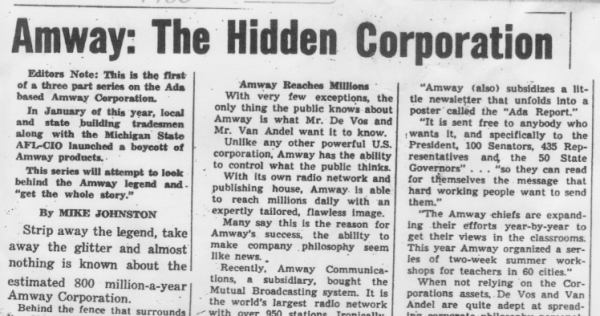
This recently acquired three-part series is important, since Johnston provides important analysis about co-founders Rich DeVos & Jay Van Andel. The GVLN series is also important because it looks at the anti-labor practices of the Ada-based corporation in the late 1960 and early 1970s.
Part I of the series provides more of an overview of the Amway Corporation and its co-founders DeVos and Van Andel. One thing important from Part I in the series is the information about how much media the Amway corporation produces and owns, both in the United States and around the world.
In Part II of the series, entitled, The Right Wing Idol, Johnston takes a look at the ideological worldview of the Amway co-founders and provides details on who these two members of the capitalist class were funding at the time. This investigation into which organizations DeVos and Van Andel were funding is similar to our post from the late 1990s. It is important to have some comparisons in different decades to see how their contributions to Right Wing entities had evolved.
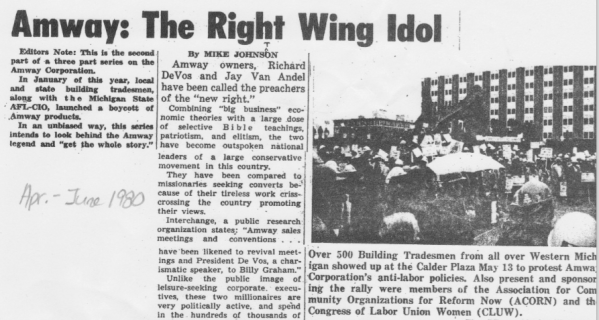
In addition, the picture that accompanies Part II in this series, is from May of 1980, where some 500 people were in Calder Plaza to protest Amway’s anti-labor practices (pictured above). Most of those protesting were from various trade unions, but there were also representatives from ACORN – the Association for Community Organizing for Reform Now.
 In Part III of the series, the writer takes a close look at Amway’s anti-union position, beginning with examples from the 1960s, when the Retail Wholesale and Department Store Union (part of the AFL-CIO) attempted to unionize the Amway plant in Ada.
This story is particularly interesting since it discusses how Rich DeVos began holding mandatory in plant meetings to counter the union efforts. Part III devotes a fair amount of attention to this dynamic, since DeVos has made this practice of regular meetings with employees an important part of his strategy to undermine workers who attempt to create a union within the company founded on a pyramid scheme.
(A big thank you to Michael Johnston for sharing this series and for allowing us to post in on the Grand Rapids People’s History Project site.)
Access Denied: GRIID not allow to attend the 2018 West MI Policy Forum Conference
Ever since their inaugural conference in 2008, I have attended and reported on every West Michigan Policy Forum conference. I had every intention of reporting from the 2018 West Michigan Policy Forum conference, but I was denied access as a media person from attending.

What follows in my e-mail correspondence with people involved in the conference.
As early as July 24, I had sent an e-mail to Omar Cuevas, who works for the Grand Rapids Chamber of Commerce and is the VP of Sales and Marketing. Cuevas was one of the people listed as contacts for the 2018 West Michigan Policy Forum conference.
I asked is the conference was open to news media and if I could get a media pass for the day, as I had done for all their previous conferences held since 2008. The GR Chamber of Commerce contact said, “I’m going to connect you to the PR firm handling this event and have them follow up with you.” The PR firm responsible for all promotions and media was SeyferthPR. SeyferthPR lists among its clients, Amway, RDV Corp., Talent 2015, Rockford Construction, Autocam, Bissell, Perrigo, SIBSCO and Huntington Bank, all of which are part of the Grand Rapids Power Structure.
On July 30th, I asked if Omar was going to give them my contact info or if he could share their contact info with me? He responded by saying, “I forwarded your email to Seyferth PR.”
I did not hear back on this matter, so on August 21st I sent the following e-mail, “I still haven’t heard from the folks at Seyferth PR about media access to the Sept. 24 Policy Forum. Can you give me an e-mail of someone over there I could speak with?” He replied by saying, “I apologize Jeff. I will reach out to them.”
Another three weeks went by, so I sent Omar another e-mail on Wednesday, September 12, stating, “Omar, still haven’t heard anything. Is there someone I can contact directly about obtaining a media pass for the WMPF Summit on the 24th? This time Mr. Cuevas sent me the following reply on Friday, September 14, saying “I’m sorry for the delay. I have passed on all of your messages to Seyferth PR. I am going to find out today.”
That same day, I received the following e-mail from Michael Zalewski who is Senior Counsel for SeyferthPR. He wrote the following:
Jeff, sorry I had not got back to you sooner regarding media pass request. You are certainly welcome to purchase a ticket to WMPF. Also please note, as shared with all other media, by purchasing a ticket to event you are able to attend ECON luncheon, which is part of the conference.
As a point of clarification, I responded by asking, “Michael, are you telling me that this event is not open to the media?” Zalewski’s response was, “Again, you are certainly welcome to purchase a ticket to WMPF. Also please note, as shared with all other media, by purchasing a ticket to event you are able to attend ECON luncheon, which is part of the conference.” I responded to this non-answer with, “I ask this because in past years they were providing passes for reporters. My budget prohibits me from buying a ticket. You are no longer giving media access to this event?”
At this point I also contacted someone I know who writes for MiBiz and asked if they were planning on attending and if they had to purchase tickets to the West Michigan Policy Forum conference. The journalist I know from MiBiz said that he wasn’t sure if he was attending, but someone with MiBiz would be attending and NO, they did not have to purchase a ticket.
Mr. Zalweski did not respond to the previous e-mail I had send, so I sent him another e-mail stating, “I just checked with folks I know over at MiBiz and they are not required to purchase a ticket to come and report on the event. Since that is the case, I will be coming, as I have a right to be there as a reporter.”
Zalweski’s response was prompt this time and he stated, “Well first this is a by invite only event it’s not a public event. However this is being hosted by the Chamber of Commerce so let me get back to them on your request.” First, there was nothing on the WMPF conference registration that suggested this was an invite only event. Second, why had he not said that up front? Third, this has never been an issue in previous conferences held by the WMPF. Lastly, if SeyferthPR was dealing with all media inquiries, why was Mr. Zalweski now checking with the GR Chamber of Commerce about my request?
On Thursday, September 20th the Senior Counsel for SeyferthPR repled:
Based on WMPF criteria for media passes to event, your request for media credentials has been denied . Please note this is a private, by-invitation only event and the West Michigan Policy Forum reserves the right to issue or deny media credentials.
 I replied immediately, stating, “Seems rather arbitrary. So why have i been given a media pass for all of the previous WMPF conferences and not this one?” Mr. Zalweski did not respond to this last e-mail.
In many ways this is completely understandable, since I have been highly critical of the West Michigan Policy Forum conferences and their role in the Grand Rapids Power Structure.
It is also possible that since I had written a critical piece about the Gr Chamber of Commerce on September 19th, the day before Mr. Zalweski’s last e-mail, that that could have played into their decision to deny me a media pass.
However, despite my criticisms of both the West Michigan Policy Forum and the GR Chamber of Commerce, what would they possibly have to fear by denying me a media pass? This blog is not read by tens of thousands of people and is fairly insignificant in the local media landscape of commercial media, which is almost uniformly business-friendly.
It is unfortunate, especially considering that the commercial media outlets will not provide substantial analysis of what takes place at the conference on September 24, a conference which is making a neoliberal education model their platform for state policy changes in Michigan for the rest of this year and 2019.
Making a Pilgrimage for Immigrant Justice and Driver Licenses
 People have been organizing pilgrimages for centuries. For many people, pilgrimages are associated with religious or spiritual journeys. However, organized pilgrimages have also been a significant tactic in the history of social movements.
For the purposes of this article, I was to focus on three historical examples of social movements using pilgrimages as a tactic to gain attention to goals they all sought to achieve.
The first example is from Michigan in the summer of 1988. Hundreds of people began their pilgrimage of peace in the Upper Peninsula of Michigan and ended in Detroit. This pilgrimage was organized by a coalition of peace & justice organizations across the state that were all working for disarmament, particularly the disarmament of nuclear weapons.
The pilgrimage lasted 3 months, with people walking about 12 miles a day. Organizers had found churches, schools and libraries all along the route of the pilgrimage, places that hosted a forum every night, so that people could talk about the importance of nuclear disarmament. In addition, the pilgrimage included stops at factories that had contracts with the Department of Defense to make parts for nuclear weapons. This was an important component of the pilgrimage, since it exposed how much money and how many companies were profiting from the manufacturing of weapons of mass destruction.
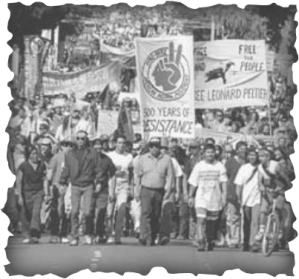 A second example is from 1972, when the American Indian Movement, along with other Indigenous organizations, engaged in what was called the Trail of Broken Treaties. This pilgrimage began on the west coast in October of 1972 and ended in Washington DC the week before the November election.
Indigenous people were given a promise by the Nixon administration that they would meet with representatives at the end of the pilgrimage to discuss Indigenous issues. The American Indian Movement had even created a 20-point position paper to present to the Nixon administration.
All along the route, the Indigenous activists that participated in the Trail of Broken Treaties, met with and stayed at the homes of other First Nations people in order to build support and raise awareness about their campaign.
When the group arrived in Washington, DC, the Nixon administration refused to meet with them, so the Indigenous activists occupied the Department of Interior building, where the Bureau of Indian Affairs (BIA) had offices. During the occupation, Indigenous activists took some of the documents and records from the BIA and burned them in the hallways. After a week, the Nixon administration decided to negotiate an end to the occupation, which led to further treaty negotiations.
The third, and last example of pilgrimages being used by social movements, took place in 1966. The pilgrimage was organize by the United Farm Workers (UFW), a movement made up of migrant workers from the Latino/Chicano community and the Filipino community.
This pilgrimage focused on the working conditions that migrant farm workers faced on a daily basis, both the low wages, horrid living conditions and chemical pesticides that workers were exposed.
Led by Dolores Huerta and Cesar Chavez, the UFW pilgrimage began in Delano and ended up in Sacramento, California, the state capitol.

What was unique about this pilgrimage is that it merged the use of the tactics of strikes and boycotts with religious iconography, particularly the Virgin of Guadalupe. Those participating in the pilgrimage sang traditional Mexican protest songs, while some, including Cesar Chavez walked barefoot, which was also a traditional way for Mexicans to participate in pilgrimages.
The UFW pilgrimage did help in building support for the larger farmworker movement, but it took more strikes and nation-wide boycotts to help them achieve their goals.
It is in the same spirit as these historical examples of pilgrimages, that Movimiento Cosecha will be organizing a pilgrimage this fall. The Movimiento Cosecha pilgrimage will begin in Grand Rapids on Friday, October 5th and conclude at the Lansing State Capitol on Tuesday, October 9. The focus of the pilgrimage is a campaign to win drivers licenses for all. Those in the undocumented/under-documented immigrant community cannot currently obtain a drivers license and Movimiento Cosecha wants to change that.
To find out more details about the Drivers Licenses for All campaign or the October pilgrimage, go here https://www.facebook.com/events/261930651314731/

ICE out of Kent County campaign disrupts ArtPrize event
 Last night, about a dozen people who are working in collaboration with Movimiento Cosecha GR and GR Rapid Response to ICE, interrupted the opening ceremony of ArtPrize in Rosa Parks Circle.
Two teams held up banners on either side of the Rosa Parks stage and shouting statements about ICE operating in Kent County and separating families on a weekly basis. The group chose to disrupt ArtPrize in part because the Water Center on Ottawa NW is an ArtPrize venue and in that building there is a office of the Department of Homeland Security, specifically immigration investigations and potential ICE raids of workplaces. Part of the message last night was that ArtPrize is complicit because one of their venues houses a government agency that separates families.
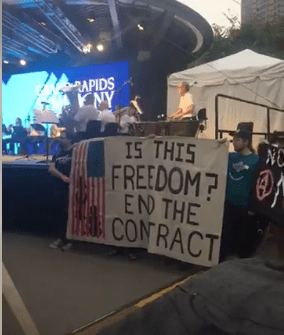 ArtPrize had security people who were attempting to stop those drawing attention to ICE violence, at times pushing people, threatening them and even taking one of the banners. They did this all under the watchful eye of the GRPD, who did nothing to stop the ArtPrize security people from physically intimidating those demonstrating. The only thing the GRPD did was to tell those demonstrating that if they continued to use the bullhorns they would be arrested.
There were several people who came up to demonstrators clearly upset that their evening was disrupted. This was the point. Those demonstrating disrupted the ArtPrize opening ceremony for maybe 20 minutes, but immigrant families are having their lives disrupted by ICE repression, a disruption that can last for days, months, even years, especially of people end up being deported.
ArtPrize released a statement about using the public space in Rosa Parks circle, stating in part, “It’s our hope that we can share this public space with other members of the community in a respectful  manner.” There is a certain irony about this statement, especially since the park is named after a member of the Black Freedom struggle that used a tactic of public disruption on a regular basis.
After the demonstration, people invited the public to come over to the east side of the Rosa Parks stage and symbolically dismantled a cardboard cage that resembling the cages that ICE was using to detain children near the US/Mexican border, something that angered thousands, maybe even millions in the country earlier this summer.
There were also people handing out flyers about what the action was about, along with information about an upcoming action on October 1st, which is a national day of action called No Business With ICE.
The Backlash Against the GR Chamber of Commerce endorsement of Schuette begs the question, Why Now?
In the past 24 hours there has been a tremendous amount of backlash against the Grand Rapids Chamber of Commerce endorsement of Republican candidate for Governor, Bill Schuette.

When the GR Chamber posted the endorsement, hundreds of people responded with anger at the endorsement. In addition, several local businesses have abandoned their membership in the Grand Rapids Chamber of Commerce and now there is a growing list of people who have participated in a variety of Chamber programs that have signed on to a statement calling for the Chamber to renounce their endorsement of Schuette.
“Dear Grand Rapids Area Chamber of Commerce Leadership & Policy Staff:
Your endorsement of Bill Schuette as governor of the State of Michigan is unacceptable.
Bill Schuette actively fights against equal rights and protections for Michigan residents who identify as LGBTQ. He has been complicit in the leadership who brought us the Flint Water Crisis (continuing), helped to underfund public education, continued privatizing of our water and natural resources for pennies to corporations, has fought against the EPA and limits to pollution in a state surrounded by fresh water, and the list goes on.
Moreover, the Chamber’s positioning of itself diversity and inclusion champion through programming such as the Diversity Equity Inclusion Summit and OutPro, among others, stands in stark contrast to the beliefs and policy that align with a Bill Schuette candidacy.
As alumni of Leadership Grand Rapids and many other Chamber-run programs, we the undersigned are compelled to renounce your recent endorsement of Bill Schuette for Governor of Michigan.”
In one sense, it is always encouraging when people speak out against any injustice and this statement identifies several. However, for those who follow state politics and the endorsements of the Grand Rapids Chamber of Commerce, this is not the first time they have endorsed a candidate that promotes policies that do tremendous harm.
Why Now?
The Chamber of Commerce has a long history of endorsing candidates and lobbying for policies that do tremendous harm. SourceWatch has great details on this history, which includes opposing minimum wage increases, maternity leave, union organizing, climate change legislation, privatization of public resources, etc. The Grand Rapids Chamber of Commerce is simply a microcosm of the national entity, which makes its priority the defense and promotion of the interests of capitalism and the capitalist class.
The GR Chamber’s endorsement of Schuette is just one example in recent years, where they have endorsed politicians which promote policies that do tremendous harm. This same Grand Rapids Chamber of Commerce endorsed Governor Rick Snyder. Under Snyder’s leadership Michigan has expanded its number of Emergency Managers, promoted radical neoliberal economic austerity measures (doing away with traditional public sector pensions, privatizing public services and undermining teacher unions), making Michigan a Right to Work State and essentially giving greater control over the State’s economy to corporate interests.
For those who are pissed about Schuette’s stance on LGBTQ issues, the the GR Chamber endorsed candidates who voted for HB 4188. This legislation, often framed as a religious freedom bill, allows adoption agencies in Michigan the ability to deny LGBT couples/partners/families from adopting.
In 2008, the West Michigan Policy Forum (WMPF) was created as an extension of the work of the Grand Rapids Chamber of Commerce. The goal of the WMPF has been to promote and lobby for specific policies at the state level that adopt neoliberal capitalist austerity measures.
Every two years the West Michigan Policy Forum hosts a major summit in Grand Rapids to promote their agenda for the upcoming year. This year’s focus is on education policy and the kind of education policy that the WMPF and the GR Chamber of Commerce are promoting is essentially what Education Secretary Betsy DeVos is trying to force on the American people.
People will point out that the Grand Rapids Chamber of Commerce does Diversity and Inclusion work. However, what they means by Diversity and Inclusion is that people of color and members of the LGBTQ community are welcomed to be part of the Chamber’s work, which is to promote Neoliberal economic policies that will ultimately hurt at a disproportionate level communities of color and people who identify as Lesbian, Gay, Bisexual, Transgender or Queer.
Ultimately, membership in the GR Chamber of Commerce, participation in GR Chamber programs or endorsements from the Chamber should be renounced, since their primary goal is endorsing candidates that benefit the interests of the Capitalist class.

