What We Can Learn from the Zapatista Rebellion on the 25th Anniversary of their uprising
 Twenty Five years ago, the world became aware of a new resistance movement known as the Ejercito Zapatista Liberacion Nacional (EZLN), or simply the Zapatistas.
In the southern most state of Mexico, the world became aware of the Zapatistas, as they interrupted the New Year’s celebration in the city of San Cristobal de las Casa, Chiapas. San Cristobal is a tourist city, but the EZLN came to destroy government records that falsely claimed that non-indigenous people controlled the land in a area that was made up of mostly indigenous people.
On that fateful night, on the eve of the beginning of 1994, the EZLN came out of the shadows to declare that they would not allow the North American Free Trade Agreement (NAFTA) be their death sentence.
Instead, the Zapatistas made their presence known to the Mexican government and to the world, with a bold declaration from the Lacandon jungle that they would fight this idea of globalization.
The EZLN stated early on in their struggle:
“Silence is what the powerful offer our pain in order to make us small. When we are silenced we remain very much alone. Speaking heals the pain. Speaking, we accompany one another.”
I have been grateful to have been part of international solidarity work in Chiapas, specifically in the Zapatista communities on three separate occasions – 1997, 1998 and 2001. In addition, I have read a great deal about their movement and learned from their struggle, as the EZLN has a great deal to teach us about our own struggles for liberation. As they stated during the First Intergalactic Encuentro in Chiapas in 1995, “we need to globalize the resistance” and “you all need to be the Zapatistas in your own community.”
9 things we can learn from the Zapatistas
 While we can be in solidarity with other movements around the world, we need to be the resistance in our own communities. This statement is particularly true in the US, since US imperialism touches virtually every corner of the world. We have to be the resistance in OUR community and make the connections and the links between global oppression and the oppression in our own communities. Resisting oppression in our own community, therefore, requires that we identify and name the systems, organizations and members of the capitalist class, which were perpetrating oppression right here in Grand Rapids.
- Mandar Obedeciendo – Lead by Obeying. The armed insurgency known as the EZLN is not a traditional insurgent movement, where the strategy and tactics are developed by political and military leaders. For the Zapatistas, they take their orders directly from the communities that make up Chiapas. One of the first things they did even before the January 1, 1994 uprising began, was to construct these open air assemblies, where people could meet, discuss and plan. The EZLN would visit these places in every community and ask, “What do you want us to do?” Such a notion of leadership is so foreign to how politics functions in the US. The type of leadership that we practice in the US, especially political leadership is very much top-down, where people are vetted by the political/capitalist class to make sure that their interests are the priority. This type of leadership even permeates movement politics at times, but if we are serious about organizing to confront systemic oppression, then we need to adopt a position of leadership that is to follow the will of those most affect, most marginalized and those who’s voices have been most suppressed.

- We do not seek to take power, but to create spaces for civil society to be empowered. Another powerful lesson from the Zapatistas is the idea that real power doesn’t come from above or from those who run things, rather real power is the belief that we all can have power with each other. The EZLN have never sought to take state power or overthrow the government. Their goal has been to provide political, economic, social and cultural space for civil society to create the kind of power that is contrary to power over others, instead a power that is with others. Taking power, whether that is by force or through elections is still power that is dictated from above. In our work and our movements, we must never seek to take power that is from above, but to create spaces where people can have power with each other, instead of relying on the state to take care of them.
- Comunidades Autonomo o caracoles. The EZLN believes that their communities should be autonomous – politically, economically, social and culturally. Autonomy is what the Zapatistas have fought for from the beginning. Autonomy is not some ideological notion, rather it comes out of the lived experiences of oppression communities and tells them that no one can represent you other than yourselves. This is why the Zapatistas have told the Mexican government and the state of Chiapas that they do not want to be governed, but to govern themselves. The other major benefit of autonomy is that you are not beholden to anyone outside of your communities. This means that you are not beholden to political parties, to nationalism, to the capitalist class, to funders or any other entity which claims to represent you. The Zapatistas call their autonomous communities caracoles, which is Spanish for snails, because their notion of autonomy moves very slowly, but it is consistently faithful to the principles of being autonomous.
 We, the zapatista children, think that our work as children is to play and to learn. During the time that I spent with the Zapatistas, it became very clear that despite the constant harassment from the Mexican military, they wanted their children grow up in a world where children could simply be children. This didn’t mean that children didn’t help with chores – cooking, cleaning, working in the garden or gathering firewood, but they spent most of their days simply being children. This meant that children played a great deal, in the woods, in the streams or anywhere in the communities. The EZLN say: “In our dream children are children and their work is to be children… I do not dream of the agrarian redistribution, of big mobilizations, of the fall of the government and elections and the victory of a left-wing party, or whatever. I dream of the children and I see them being children.”
- We have the right to defend ourselves. Our world is contaminated will too much violence. Everywhere you turn violence is being perpetrated by systems of oppression against those who are the most marginal. White Supremacy does violence against communities of color. Patriarchy does violence against women, children, men and those who are gender non-conforming. Capitalism does violence against the majority of the worlds population and it commits violence against all other living beings and ecosystems. However, just because violence is the dominant social narrative, it doesn’t mean that people don’t have the right to defend themselves. I agree that most of how we organize ourselves should be done in a non-violent manner, but when non-violence becomes dogmatic and rigid, it ends up not only causing harm, but it limits our radical imagination to do things that allows us to defend and protect ourselves. The EZLN has arms, but has rarely used them. They believe in defending their communities, but they do not seek to attack systems of oppression militarily. The Zapatistas have used global awareness, global communication and the invitation to global solidarity as their primary weapons against state repression.
 Use methods of communication as a tactic to create change. One thing the EZLN did in 1994 and ever since, has been to “get the word out” about their revolution. The Zapatistas, through the use of communiques and the internet, have made it a priority to globalize the resistance. Their idea of communicating to the rest of the world was to develop as much solidarity as possible so that the Mexican government could not easily isolate them and marginalize their struggle. The Zapatistas have done this so well that even the prestigious RAND Corporation did a study of how effective the EZLN has been in what they call, The Zapatista Social Netwar. The Zapatistas Social Netwar consists of three main objectives: 1) Make civil society the forefront of the attention; 2) Make information operations a key weapon, by demanding freedom of access and information; and 3) Make swarming a distinct objective. Swarming is where you overwhelm your opponent with information that they (governments and other systems of oppression) cannot keep up with or easily suppress. We have to be as creative with our means of communication and see it as a strategic objective. Too often we put out a lot of information, but with no strategic objective.
 - Preguntando caminamos – Asking we walk. This is one of the most important statements from the Zapatistas. Asking we walk is a statement of solidarity. It is saying that if you want to be with us, walk with us in our struggle, then you need to keep asking us what we need and not what you think we need. This is critical for those of us who carry a great deal of privilege in society, whether is is racial, gender or class privilege. If we are to be part of movements for social change, then we must embrace this idea……asking we walk. This is the real meaning of solidarity and is the opposite of the practice of white saviorism.
- We need to develop movements of resistance that are beautiful and poetic. This may be the hardest for those of us accept or to understand, since we may not make it a priority, but there is a poetic beauty in the way that the Zapatistas communicate and just how they are in the world. Instead of me trying to explain this, let me suggest that you watch this short video that I shot during the 2001 New Year’s eve gathering in the Zapatista community of Oventic. This video was shot on the 7th anniversary of the Zapatista uprising and is from my film, Reversing the Missionary Position: Learning Solidarity on Mayan Time, which you can watch at this link.
GRIID End of the Year Review Part III – Monitoring the Local News
 In our continuing look at the major themes we have reported on for 2018, Part I was about monitoring systems of power and oppression in Grand Rapids and in Part II we chronicled local social movements.
In our third and final post for 2018, we look at our watchdog reporting on how local news media has covered critical issues in this community.
As we mentioned in Part I, we regularly monitor what Secretary of Education Betsy DeVos is doing in her position. While this is not necessarily a function that West Michigan news media are required to fulfill, it is something that they could do as a way of continuously investigating local ties to federal policy.
One of the major themes in our critique of local news media has to do with how they report on local government policy. For instance, in late January of 2018, MLive provided an overview of former City Manager Greg Sundstrom’s 8 years in that position. We pointed out how limiting that story was and provided a different perspective on Sundstrom’s 8 years as City Manager.
There were numerous stories we critiqued that had to do with the GRPD and community relations, beginning with a January 30th GR Press editorial. Here are a few more articles we dissected when it came to the GRPD:
MLive, a pro-policing narrative and the lack of radical imagination
Another theme in our Dissecting Local News Media work involved how the news media dealt with how they covered those with the most power in our community. We already noted in Part I that the coverage of Rich DeVos’s death was nothing short of canonizing the billionaire.
However, we also wrote critiques of MLive’s reporting on Amway and DeVos family philanthropy.
We also dissected how the local news media reported on Jeb Bush’s talk at the 2018 West Michigan Policy Forum conference.
Immigration and immigration policy was certainly a topic that the local news covered and we critiqued how they reported on what Sheriff Stelma had to say, how they reported on rally to End the Contract at the Kent County Jail how a public access TV station presented the ICE contract with Kent County issue a look at how an immigrant-led protest was framed and local coverage of a racist response to migrant workers.
One last area we looked at was how local news media dealt with historical events and people. MLive’s eulogy for Billy Graham was standard reporting on how the white preacher cozied up to power, without any real critique of his role within systems of power and oppression.
We also provided a critique of a Michigan Public Radio series on the 1967 riot in Grand Rapids.
GRIID began as a local media watchdog and we think it is important that part of our work continues to monitor how local news reports on issues of the day or how they fail to report on issues that impact the community.
In Part I of our End of the Year Review, we wrote about our monitoring and analysis about the Grand Rapids Power Structure. In today’s post, we will be providing an overview of the Grand Rapids Social Movement activity of the past year.
2018 was an election year, which means that social movements often take a back seat. Electoral politics often redirects the energy and resources that people invest in social movements and 2018 was no exception to that dynamic.
There was some organizing around housing issues in Grand Rapids, but most of that was done through non-profits and not the people most directly affected by homelessness and gentrification. There was also some organizing around police violence, specifically directed at the black and latino/latinx communities, but it was not sustained, so one would be hard pressed to call it a movement.
Then there was some limited organizing and public debate around gun control, especially after the Parkland shooting. However, besides a few small protests, these efforts, mostly involving students, were quickly redirected to electoral politics instead of movement building.

The reality is, that the only sustain social movement in Grand Rapids was around immigration, mostly led by immigrants, but also involving allies working with the group Movimiento Cosecha GR.
The first major immigration action took place in January, when Congress was debating whether or not to continue the federal policy known as DACA. People from Grand Rapids went to DC to take part in actions and then organized an action on January 19, where protestors shut down traffic at an intersection by the Grand Rapids Federal Building.
At that January 19 action, police officers did not act when motorists forced their way through the protestors on the street. Movimiento Cosecha GR held a press conference in response to this form of state violence in February. The GRPD showed up to intimidate the immigrant-led group and then waited in the parking lot to make sure that they could talk to the news media that came to the press conference.

Then in March, a church which was working with the group GR Rapid Response to ICE, publicly declared themselves a sanctuary for undocumented immigrants.
Beginning in early April, Movimiento Cosecha GR began promoting their upcoming days of action, which would begin at the end of April. These four days of action were part of a larger strategy of getting to a seven day strike, where immigrants and allies would demonstrate the kind of economic power they have to force the country to come to terms with the unjust immigration policies that currently permeate the US.
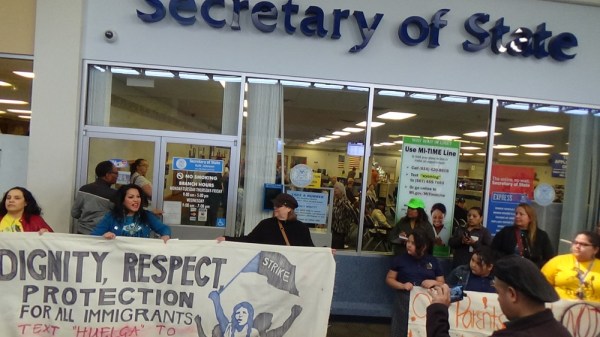
Movimiento Cosecha GR also used these four days of action to kick-off their campaign to get drivers licenses for all in Michigan. On April 30th, the movement participated in an action at the Secretary of State’s office in Wyoming, MI.
On May 1st, an estimated 2,000 people marched in the streets of Grand Rapids to demonstrate the power of immigrants. The GRPD had increased their presence during the march and tried to dictated the route, but movement organizers would not comply, thus demonstrating their commitment to a truly grassroots politics that took its direction from the people most impacted by the unjust immigration policies.
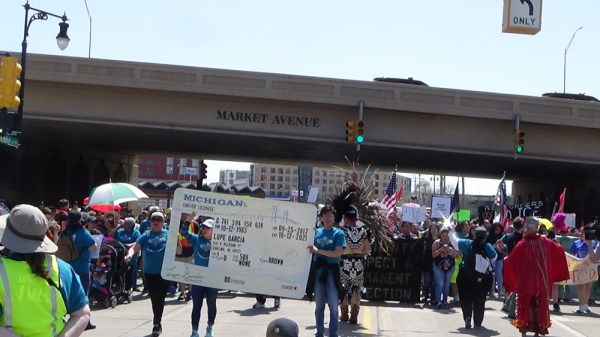
While these actions were being organized, Immigration and Customs Enforcement (ICE) was continuing to terrorize the immigrant community in West Michigan and GRIID consistently wrote about ICE oppression, like in an article we published in early May.
Then the Trump administration decided to further criminalize immigrants and took action against immigrant families at the US/Mexican border in June. Images of children being taken from their families and put in cages soon went viral and Movimiento Cosecha GR and GR Rapid Response to ICE began a campaign to end the contract that ICE had with the Kent County Sheriff’s Department. The first big action took place on June 28th, where several hundred people came to Kent County Commission meeting and ended up taking over the meeting.

Since the End the Contract campaign began in late June, Movimiento Cosecha GR and GR Rapid Response to ICE have participated in over a dozen actions on the contract, plus Movimiento Cosecha GR organized a 5 day pilgrimage to Lansing for their drivers licenses for all campaign. Here is a list of the posts we did to document this powerful movement for justice:
Cosecha GR confronts the contradictions of July 4th in America
End the Contract with ICE campaign visits Commissioner Saalfeld’s house
Some observations on the End the Contract action at the Kent County Commission meeting
End the Contract Rally at the Jail: What you wouldn’t learn from the Fox 17 story
End the Contract campaign returns to the County Commission meeting
ICE out of Kent County campaign disrupts ArtPrize event
Grand Rapids participates in the national No Business With ICE Action Day
We don’t want promises, We want Licenses: Movimiento Cosecha rally inspires!
Documents from FOIA request about Kent County ICE Contract reveal several important points
Diversity of Tactics, Movement Building and the campaign to End the ICE contract with Kent County
Kent County Administrative Staff and Commissioners establish Immigration Focus Group

This is the first in a three part series, where we will review our coverage over the past year. In today’s post we will look at our reporting and analysis of systems of power and oppression in Grand Rapids.
In Part II we will look at local social movements and the work they have been involved in during the past year. And lastly, in Part III, we will look at our media watchdog coverage where we dissect the local commercial news.
We begin with our 10 piece series looking at the Grand Rapids Power Structure. The first article in the series provides a framework for looking at the local power structure and the 10th article has links to all the previous posts in that series. We also created a visual depiction of the Grand Rapids Power Structure, which you can see at this link.

Of course, a big part of the Grand Rapids Power Analysis is an ongoing look at the DeVos family. We wrote 15 stories in 2018 under the heading, Betsy DeVos Watch, focusing on the policies and actions of Secretary of Education Betsy DeVos.
Former teacher Jack Prince, contributed a 4 – part series on Betsy DeVos and the Covert Privatization of the Grand Rapids Public Schools.
 However, one of the biggest news stories was the death of Rich DeVos. We first looked at how the commercial news media reported on his death. We then provided our own honest obituary of the billionaire co-founder of Amway, along with a critique of how GVSU canonized DeVos, since the billionaire was a major funder of the university.
We also provided a collection of articles we have written about ArtPrize, for their 10th anniversary event this past September.
All of the analysis of the DeVos Family can be read in our growing volume entitled, We’re Rich and We Do What We Want: A DeVos Family Reader.
However, the Grand Rapids Power Structure is also comprised of groups like the Right Place Inc, which was a major player in the attempt to bring Amazon to West Michigan.

We also looked at the Grand Rapids Chamber of Commerce and their endorsement of GOP candidate for Governor Bill Schuette, but pointed out that this endorsement was consistent with the Chamber’s endorsement history.
 Another major player in the Grand Rapids Power Structure is the West Michigan Policy Forum and we looked at their ongoing efforts to influence state policy. The West Michigan Policy Forum held their bi-annual conference, which we have reported on every time, but this year they denied us access to the event. However, we did manage to provide analysis of some of the content of the conference speakers, based on media they produced for the conference, with a critique of American Enterprise Institute’s CEO Arthur Brooks and Michael Jandernoa’s interview on the need to dismantle public sector employee pensions.
Of course there was much more reporting and analysis of the Grand Rapids Power Structure, but we wanted to note that this should be a central focus of any independent news source, to challenge systems of power and oppression.
All I got for Christmas from my employer was a card that said bless you: West Michigan Nice and the Non-Profit Industrial Complex
 West Michigan Nice is a phrase that people use all the time to refer to the way in which religion, white supremacy and politics functions in this community.
People say it all the time when they experience some oppressive shit, especially when it comes from white, religious people who think they are morally superior. We really need to develop a more robust definition of West Michigan Nice, especially since it is practiced by virtually every institution in the area and permeates the dominant culture.
In West Michigan, we are conditioned to be grateful for all the “good” that families like DeVos and Meijer do for this community. We are conditioned to accept the notion that Grand Rapids just doesn’t do it that way, which essentially means that if you want to change things you need to move slow, be polite and always work within the system, the very same system that benefits those in power. Here you are told to cooperate with the cops, to collaborate with developers, to not agitate, to be patient and to always ask permission. Well, for a growing number of people, this is not only unacceptable, it is simply bullshit.
Last Friday, when I went to get my mail, I found a Christmas card from the CEO of Hope Network. Since 2014, I have worked at Hope Network as a Direct Care Associate, which means I provide care to people with disabilities.
The Christmas card was signed by the CEO of Hope Network, Phil Weaver, who wrote, “Bless you.” Really. You pay me poverty level wages and all you can say to me is, “Bless You.”
Then on Sunday, I got to work and saw that all the employees had an e-mail message from the CEO. This message was longer than the brief comment on the card. The letter was 3 pages long and had lots of holiday messaging, plus lots of religious lingo, since Hope Network identifies itself as a Christian organization. There was one sentence in particular that stood out to me:
Hope Network is blessed by each of you who everyday serve as Jesus served all of us. You make sure that others have the opportunity to live their dreams and meet their potential.
There are no doubt many that will say this is a very nice sentiment in this statement, but it isn’t genuine. The reason I say that it isn’t genuine is because when you pay people poverty level wages, their “service” is essentially a form of exploitation.
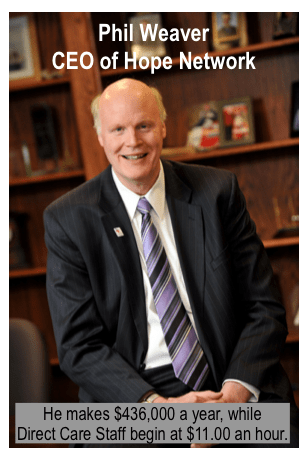 According to GuideStar (2016 documents), the CEO of Hope Network, Phil Weaver, made $436,000 in total compensation. This amount is in sharp contrast to people, like me, a Direct Care worker, who makes $11 to $12 an hour working with and caring for people with serious physical injuries. My job, in many ways, is to provide direct care to people who need assistance with bathing, dressing, using the bathroom and sometimes those who need assistance with eating. Most take medication for a variety of reasons and they are also dealing with the long term effects of serious injury. It is not easy work, it can be physically demanding at times, often thankless work and work that requires one to have sharp empathy skills.
So, no, I don’t feel blessed, not with the wage I make. According to the most recent data from the Economic Policy Institute, the CEOs in the US make 312 times more than the average worker. The gap between CEO and direct care staff at Hope Network isn’t that high, but it is unjust.
I know literally hundreds of people in this community who work for non-profits, who can totally relate to the low wage dynamic and the glaring discrepancy between what Executive Directors make and what those who do the work make. The unjust nature of wages within non-profits is just part of what we call the Non-Profit Industrial Complex, but it is also part of West Michigan Nice.
I share this bit about my own work experience, not to draw attention to myself, but to a systemic problem that exits in this community. I also don’t want to fixate on wages, since there is so much more that is structurally wrong about non-profits operating within the West Michigan Nice framework. I only use my own experience to get more of us to think about how we work collectively to challenge and change these dynamics.
None of us are going to feel blessed or valued until we are compensating fairly. None of us are going to feel included until we are given agency to have a say in how things function. Of course, if we want to change this, it comes down to organizing, action and taking risks. If we want to end West Michigan Nice, then we need a movement for collective liberation. Who is with me?
Grand Rapids Acton Institute praises National Security Advisor John Bolton on African Economic Plan, ignores increased US Military presence
 Last week, US National Security Advisor John Bolton presented the new US strategy for Africa. Bolton’s plan for Africa wasn’t exactly a new strategy, but merely a simple modification of what US policy has been towards Africa for decades.
The Grand Rapids Right Wing Think Tank, known as the Acton Institute, had their own particular take on Bolton’s plan for Africa. Acton, which has been an apologist for neo-liberal capitalism, praised Bolton’s economic plan for Africa. Bolton announced his plan at another far right think tank, the Heritage Foundation.
The Heritage Foundation, which has been one of the leading far right think tanks since the late 1970s, was the perfect place for Bolton to present his plan for Africa.
The Acton Institute put together this short video of Bolton’s plan, so as to take advantage of pushing their own agenda of neo-liberal capitalism.
The edited video of Bolton’s comments, were followed by the comments of Acton supporter Joel Salatin, who was criticizing US aid to Africa, since that aid creates dependency. Salatin, a self-proclaimed climate denier, fails to provide any real historical context for US aid to Africa or how African nations have become dependent on the Western world.
Salatin and the Acton Institute were promoting their “poverty cure” philosophy in this brief video and the post about Bolton’s African plan that was posted on their blog on Tuesday.
The problem with Salatin and Acton’s assessment of US aid creating dependency for African nations is that it completely ignores the history of the European/Euro-American slave trade, European and US colonialism in Africa and the more recent history of US backed dictatorships in various African countries, where US economic interests always took priority over the African people.
 One great source that deals with much of this history is the ground-breaking book written by Pan African scholar Walter Rodney in 1972, How Europe Underdeveloped Africa. Rodney’s analysis makes it clear that after centuries of capitalist plunder from Europe and the US, Africa became dependent because dependency is what both Europe and the US wanted for African.
For Salatin and the Acton Institute to talk about African dependency is disingenuous. African people did not chose dependency, it was imposed on them by the very economic system that the Acton Institute so zealously endorses…….capitalism.
Ignoring US Militarism in Africa
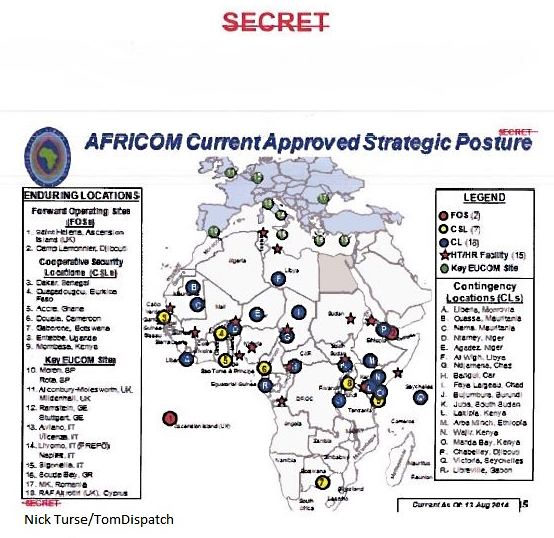
In addition to cheerleading Bolton’s African economic plan, the Acton Institute failed to even mention the massive US military presence on the African continent.
The Black Alliance for Peace had a strong counter analysis to what the Acton Institute had to say. In a statement they released on Tuesday, the Black Alliance for Peace said:
U.S. National Security Advisor John Bolton announcing a “Prosper Africa” initiative was no departure from U.S. foreign policy toward Africa. He simultaneously threatened China and Russia, while heaping scorn upon African nations. Our siblings in African nations struggle to overcome the destruction caused by European colonization, as well as the American interventions exemplified by the destruction of Libya, the destabilization of Somalia, and the fomenting of conflict in the Great Lakes region of Africa.
Bolton’s bluster against Chinese and Russian influence in Africa was borne of panic and was full of bald-faced lies. He made no mention of the U.S. Africa Command (AFRICOM), which has put most African nations under the military control of the United States. But even so, the United States lags behind China, which is investing in African infrastructure and forgiving debt demanded by the International Monetary Fund (IMF). Bolton charged China and Russia have predatory designs in Africa, but it is Europe and the United States that have committed the greatest thefts ever since the 19th-century scramble for the continent kicked off at the Berlin Conference of 1884-85.
Bolton warned African nations to ally themselves to the United States or risk the threat of intervention or the end of foreign aid. He lied about Russia and China, projecting onto them the wrongdoing that the United States has committed across the globe. In calling them “corrupt,” he exposed the United States’ own corrupt intention onto its rivals for economic and military power.
Black Agenda Report has a similar assessment of Bolton’s African plan:
Bolton didn’t mention in his statement that U.S. strategy for Africa which centers military recolonization would be a continuation of the U.S. policies of the last few decades and in particularly during the Obama administration that saw the expansion of the U.S. military presence by 1,900 %.
It is clear that the Trump “strategy” offers nothing substantially different. The policy continues to be more guns, more bases and more subversion.
Both the Black Alliance for Peace and Black Agenda Report make it clear that US policy towards Africa, which has been consistent for decades is a two pronged policy of imposing neo-liberal capitalism on the continent and maintaining massive US military presence. This two-pronged approach is by definition an imperialist policy, a policy that the Acton Institute ultimately promotes.
Migrant Workers and White Supremacy in Comstock Township: How Local TV news reported on last night’s meeting
 One of the main things that TV news does is to focus on conflicts. This is exactly what three of the four West Michigan TV stations did with how they reported on a meeting last night at the Comstock Township Board.
WOOD TV 8, WXMI 17 and WWMT 3 all reported on a meeting that took place last night, a meeting that was prompted by a racist and xenophobic flyer that was distributed saving that people should “Help Stop the migrant bus from becoming the most common sight in our community.”
The local TV news coverage goes to great lengths to inform viewers that many people in Comstock Township (just East of Kalamazoo) did not want migrant workers in their community. The channel 8 online headline reads, “Some upset over greenhouse’s migrant worker housing,” Fox 17’s online headline reads “Community concerned about migrant workers coming legally to work at local greenhouse,” and channel 3’s online headline states, “Comstock residents sound off over migrant worker housing plan.” The content of what aired on TV locally was worse.
WOOD TV 8 framed the issue as “people giving their opinions about migrant workers.” In addition, WOOD TV 8 kept saying that “word got out about migrant workers being housed in Comstock Township, but the reality is that the large turnout was the result of the racist and xenophobic flyer that was circulating in the community.
Viewers heard from several people, but there were essentially two white women who were given a platform to speak. One was the owner of the greenhouse and one was a woman who said that she was concerned about the safety of her children, since a group of migrant men would be now living in her neighborhood.
What WOOD TV 8 essentially did was to provide this white woman a license to express white supremacist views. There is no evidence that the channel 8 reporter questioned her afterwards about these views and channel 8 no doubt felt that they were just providing air time to someone’s point of view.
WOOD TV 8 also did not bother to talk about what the H 2A migrant worker program was and how it worked.
Fox 17 newsreaders framed the issue as “migrant workers coming to the community” at the beginning of their story. The Fox 17 reporter begins by stating that there were no local rental regulations in Comstock Township, but failed to mention that last month the Township Board did pass an ordinance granting the greenhouse company to rent to H 2 A workers.
 The greenhouse owner was also interviewed and she also used language that was questionable in regards to migrant workers. This interview was followed by comments from a local resident who is concerned about their property values. This woman stated that it would be all men coming, no families and then says that there have been families before and “I still had trouble with people,” which is another white supremacist perspective. The same White woman who was given voice on channel 8, was also given air time on WXMI 17 to articulate her racist views. Fox 17 did give a fe seconds to a woman who was calling out this behavior was racist against migrant workers, but then channel 17 sandwiched her comments from the same white woman with white supremacist views who stated:
“I don’t care where these people come from. These people are coming to work, and I understand that there’s a need for workers, but not on my road, not in my community, not where my kids live, not where my kids play.”
Of the three TV stations, WWMT channel 3 did provided better coverage, but the first voice we hear is another white woman stating, “it’s just a nice community to live in and we’d like to keep it that way.”
WWMT 3 did acknowledge that the township had passed an ordinance recently to allow the greenhouse to house migrant workers and followed that up with comments from the greenhouse owner. These comments also brought up the H 2A migrant worker program and this was the first time that it was stated that Mexican workers would be coming.
Eva Alvarez, with the Michigan Immigrant Rights Center, was given some airtime to speak about the H 2A program and she emphasized that this was a government program and that the workers coming would be legal.
Channel 3 also acknowledged the racist flyer and stated that “without evidence, the flyer stated that the camp would become a safety concern.” In addition, channel 3 was the only station to provide evidence that there were several people, including civil rights activists, who came to speak out against the racist flyer.
Unfortunate, the coverage overall was pretty awful, primarily because it provided a platform for white supremacist views. In addition, the coverage did not adequately provide a clear understanding of what the H 2A worker visa program was about, a program that has been in place since 1986. By not providing adequate context for the migrant worker program, the local TV news coverage fed into the current political climate, where immigrants are viewed as violent criminals.
More massive subsidies for Agribusiness: Senator Stabenow announces passage of the 2018 Farm Bill
 Last week, the 2018 Farm Bill finally passed in both the House and the Senate. Senator Debbie Stabenow, the ranking member of the U.S. Senate Committee on Agriculture, Nutrition, and Forestry, announced the passage of the bill as a victory for bipartisanship.
In a released statement, Stabenow said:
“The 2018 Farm Bill is a bipartisan victory that has Michigan on every page. This is a strong bill that will grow Michigan’s diverse agricultural economy and support our farmers, families, and rural communities. I’m pleased the Senate has moved forward with the bill and look forward to the House considering it soon.”
While the 2018 Farm Bill does not include the previously announced cuts to Food Stamps, it maintains an agricultural system that is ecologically unsustainable and benefits the agribusiness sector.
You can check out the Environmental Working Group’s Farm Subsidy Database, to look at the entire country and each state, including Michigan.
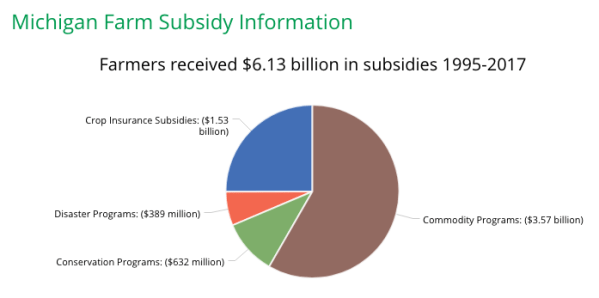
You can see from this graphic below, where the subsidies have gone since 1995, which is primarily to commodity crops (corn, soy, etc), crop insurance, disaster programs and conservation programs. Of the $6.13 billion in farm subsidies since 1995 in Michigan, nearly half has gone to subsidize corn. ($3 billion) Most of the corn grow in Michigan either ends up as feed for farm animals or is used in processed foods. This is what the Farm Bill does, it subsidizes the current food system of agri-business and unhealthy food.
Included in the released statement from Senator Stabenow, are a list of organizations that endorses the 2018 Farm Bill and Senator Stabenow. Those organizations include, the Michigan Agri-Business Association, the Michigan Milk Producers Association, the Michigan Corn Growers Association, the Michigan Sugar Company, Michigan Vegetable Council, the Michigan Forest Products Council, the Cherry Marketing Institute and many others.
This list of entities are not made up of small farms, but the agri-business sector and their specific associations and councils. Most of these groups are part of the Michigan Farm Bureau and make it a point to influence public policy at the state and federal level. The Michigan Farm Bureau was one of the largest donors in many of the political races in Michigan, making sure that their interests are represented in Lansing and in Washington. The Michigan Farm Bureau has created their own Political Action Committee, known as AgriPAC. Here is a sample of the kind of influence that they have from two prominent Michigan Legislators:

The ongoing federal subsidies to agribusiness will mean more taxpayer money goes for corporate welfare and away from sustainable, local small farmers. The 2018 Farm Bill also perpetuates the exploitation of migrant farm labor and it contributes to a food system that contributes to Global Climate Change.
To read the actual 2018 Farm Bill, go to this link to read the 807 page document.
(This post was written by Jack Prince, who wrote the previous articles in this series, Part I, Part II and Part III.)
The opening of the school year here in Grand Rapids was marked by the gala unveiling of the new Grand Rapids public museum building at 54 Jefferson Avenue Southeast. This new building is an expansion of the program started in 2015 which is located at the Van Andel Museum Center overlooking the Grand River.
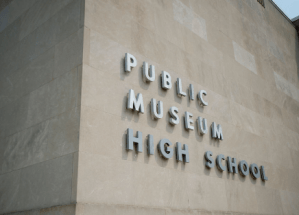 Before continuing in this effort to expose inherent School segregation in the Grand Rapids Public Schools (GRPS), it needs to be stated that the Grand Rapids Public Museum school is a misleading moniker as the museum itself is rented and controlled from the city by a business Consortium designed and pushed by the DeVos power structure.
To imagine it as a haven for public education objectives is whimsical with its private school proclivity. The building at 54 Jefferson has undergone an expensive renovation including money from the public /private Corporation donations and from a GRPS fundraising campaign.
Additionally the district was awarded 10 million dollars from the XQ Institute. Grand Rapids was one of 10 School’s nationally to receive money from the business orientated Institute of which half of the recipients were charter schools.
In 2017, a star-studded one-hour long long national broadcast headed by Justin Timberlake, with a bevy of celebrity cameos, attempted to convince America that the nation’s high schools needed to redesign in line with the business objectives of an Institute formed by Laurene Powell Jobs, the Widow of business magnate Steve Jobs.
To promote their desired changes a $1,000,000 carrot was dangled in the face of cash-strapped US school districts. From EdSurge we read:
If the point of the Extravaganza was to promote change it missed the mark by airing tired arguments that public schools have stayed static through the decades and consequently glossing over the extraordinary hard work of millions of teachers.
The star-studded Primetime event, paid for by the same group that plastered its name all over the doors of the building at 54 Jefferson, had entertainers quip with the show’s premise that high schools are a system that hasn’t changed in 100 years. That maintenance however clashes with education historians mentioned in the EdSurge article.
Education historians interviewed by Chalkbeat, where it was said that while the basic setup of schools has remained largely intact the democratization of access to high school along with the different skills and subject kids learn constitute big shifts. Valerie Stross education writer for the Washington Post bemoaned the use of celebrities to push a faulty narrative.
Clearly what was once a successful education system funded by public tax dollars for public benefit and led by non-corporate professors and universities, has experienced damaging changes with public funding being replaced by private funding. Now instead of a Level Playing Field of opportunity, there is a funding system diametrically opposed to that along with propaganda coming from the corporate world with their attached agenda.
The influence from neighborhoods and parents locally has been eradicated and replaced with more and more corporate oversight including at 54 Jefferson Street. The Jefferson School looks more like a lavish Motel on the ground floor and does not have typical classrooms. The two-story building is very modern with bright flexible spaces designed to encourage collaboration and innovation.
Simultaneously, another building in the district opened on August 27th with no renovation or Fanfare. Westwood Middle School reopened with a physical plant that has seen no renovation or facelift for years. Even more worrisome the middle school which houses more students than the museum school, was teaching as of early October with 30% of its positions manned by full-time Subs. That is not the case at the Grand Rapids public museum school where all classes were filled on the first day with full-time teachers and will remain filled by full-time teachers for the entire year unlike Alger middle, Union High School or Westwood which yearly allows classrooms to be manned by substitutes for the entire school year.
Evidently none of the money used to refurbish the eighty-year-old museum school building could be used to simply hire teachers at livable wages at the Westwood building. The neglect at Westwood may be responsible for the very low academic proficiency registered at Westwood Middle located at 1525 Mount Mercy Drive Northwest Grand Rapids where only 5% of the 358 students are proficient in math and 13% in English.

These dismal numbers are supplied by the nationally respected evaluation service called greatschools.org. Even more worrisome is the warning from Great Schools that this school is falling far behind other students in the state and that this school may consequently have large achievement gaps. Great Schools continues their assessment by stating, “students at The school are making far less academic progress given where they were last year compared to similar students in the state.”
Very little progress with low test scores at Westwood mean students are starting at a low point and are falling even farther behind their peers in other schools. Compare the opening day at the new Museum school where 300 dignitaries including mayor Bliss filled the beautiful lobby at 54 Jefferson with the worn lobby at Westwood where there were no balloons or millionaires patting themselves on the back. A gala scene indicative of the corporate world’s incursion into public education should be alarming particularly when we remember when the primary educational philosophy was to first and foremost address the problems at struggling schools and the students there in. That philosophy has been atrophied today as the germination of educational philosophy does not emanate from the offices of university education departments but rather the boardrooms of corporate headquarters such as QX.
 The renovation at 54 Jefferson Street, which has been primarily a business led endeavor, was also given a magnanimous gift from the city selling the building to GRPS for a single dollar. The city also gratuitously gave $52,000 to renovate a parking lot at the corner of State and Jefferson. In addition the city gave money to restore a small park adjoining the parking lot. The park is called a pocket park. Downtown Grand Rapids inc, contributed $51,573 for improvements. The architect for the park and parking lot project is King Scott with Lott3Metz Architecture along with landscape architect Viridis Design Group, and construction manager, Rockford Construction. With such a phalanx of contributors over such a long period of time for such prestigious and expensive professional design and construction it would seem someone could have donated money to replace the broken furnace at Union High School. The students and faculty have had to endure space heaters for two winters at Union High School while the expensive workmanship was being put on with gold trim At 54 Jefferson.Ironically Union High School is just a stone’s throw or step down from Westwood Middle. This summer City High School, located in the old Creston High School building on Plainfield, has been completely air-conditioned.
Union high School unfortunately after decades of heat fatigue has received no funding for air conditioning. This priority difference is only one of many that exists between the regular public school buildings and the business/district nexus school buildings. The disparity is a prime reason for the academic proficiency weakness in the less preferred schools. A correlation can be quickly drawn between the physical building environment and academic performance. A spending correlation can also be easily derived at with the same results.
Westwood Middle School has opaque plexiglass windows surrounding the school except in the teachers’ lounge or rooms directly surrounding the main school entrance. The plexiglass was not the original school windows. The opaque windows inhibit vision out of the classrooms, and more importantly to GRPS, prohibit vision into the classrooms obscuring a chaotic school. Many of the classrooms are out of control and the emotional fatigue of the teachers both at Westwood and Alger Middle means that each year most of the teaching staff leave only to be replaced with first year teachers and subs.
Compare that reality with the teacher retention rate next spring at the GRPMS. One of those teachers from Alger 5 years ago categorically claimed that the MEAP score for math proficiency registered .000 on test scores with reading nearly as low. Funding, teacher safety and class size with academic proficiency at these struggling schools should be receiving the attention rather than the district’s trophy business backed buildings.
 The disparity of help to these buildings is matched by the initial unfairness of admittance to these cherry picked schools, where GRPS school leaders have said dogmatically that half of the students from within GRPS boundaries were selected for GRPMS by lottery and were currently attending charter or private schools. According to MLive, another 15% of the students at GRPMS came from outside of the district . These students did not come from Union or Ottawa. They instead were derived from charter or private schools alien to the GRPS district. Lottery selection means that the district can pick students from test scores and other demographics by hiding behind a supposed random luck of the draw lottery.
Therefore what exists in GRPS is a non public school procedure for admission in many buildings. There exists an exception to the traditional open door policy previously indigenous to all public schools called test in. This aspect for admissions is symptomatic to the charter/public school nexus, particularly by having to test in. A new word has been coined indicative of this phenomenon called testination.
Enrollment, unequal funding and teacher retention, have had a combined impact on the educational priorities within GRPS. The stark and definable difference of educational atmosphere and opportunity latent within GRPS is easily recognized. The students at GRPS need the advocacy and protection of the district’s leaders and they are not getting it. There are other indicators of priority variances which have resulted in a segregated system at GRPS which will be exposed in continuing articles.
Media Bites: Nestle commercial about donating water to Flint is an insulting example of White Saviorism
We have not produced a Media Bites segment in several years, so it seems appropriate to renew our commitment to providing some deconstructions of media, no matter what form it takes. Today, we take on a fairly new commercial by the global corporation known as Nestle.
This 30 second commercial from Nestle is nothing short of propaganda. The spot starts out with a scene in Flint, Michigan, then cuts to a Nestle truck driving from Stanwood, Michigan.
Then a voice begins to narrate stating early on that, “some people forgot about Flint, but Nestle Waters never did.” The narrator continues by telling people that Nestle has been delivering 100,000 bottles a week to Flint for free.
The spot then ends with the narrator saying, “In Flint, we haven’t given up, because we have friends like Nestle Waters.” The commercial ends with an ariel shot of Flint, with the Nestle logo and the tag line that says, “Water is our life’s work.”
The Youtube version of the commercial has a link for more information, which essentially takes you to a page where Nestle just praises themselves for all their humanitarian efforts, specifically in Flint.
On another page, Nestle makes a statement that I found very interesting and infuriating at the same time:
At Nestlé Waters, we believe that access to safe, clean drinking water is a fundamental human right. Across North America, we care for and protect the water sources on which we rely, as well as the land around them. We are dedicated to making healthy, made-in-Michigan products while supporting our communities and caring for the state’s most precious natural resource for years to come.
The first sentence alone is an outright lie. If Nestle thought that access to safe, clean drinking water was a fundamental human right, then they would not extract it for profit.
We wrote about Nestle in April of 2018, when the State of Michigan essentially gave the global corporation complete access to the extraction of water in Michigan for the purpose of profiting off of something that people should not have to pay for.
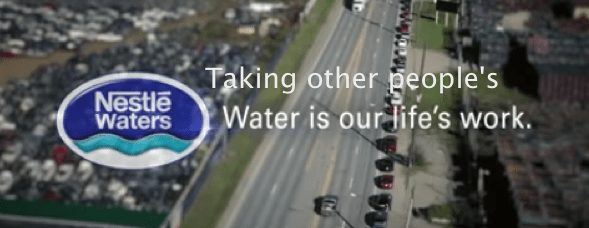
Getting back to the commercial, about Nestle and the residents of Flint, Michigan. This commercial and Nestle’s attempt to win public support for “donating” bottled water to residents in Flint is a concrete example of White Savior Politics. Here is a global corporation that is run by white people, going out of their way to let the public know that their donations to Flint, Michigan is part of their deep commitment to caring for people. The reality is that Nestle, which profits from water extraction on public land, doesn’t give a shit about people’s fundamental human rights. Nestle cares about Nestle and its shareholders……period.

