 There are many things that we are taught to believe about the United States of America. We grew up reciting the Pledge of Allegiance without understanding or critically investigating the words. We are taught to blindly accept that the Founding Fathers were great defenders of liberty, without knowing that many of the signers of the Declaration of Independence were slave owners.
However, we can fight back against the nationalistic tendencies that most of us are raised with and we can begin to seek out deeper truths about the US. The great abolitionist Frederick Douglass said this about the Fourth Of July, in a speech he gave in 1852:
“What, to the American slave, is your 4th of July? I answer; a day that reveals to him, more than all other days in the year, the gross injustice and cruelty to which he is the constant victim. To him, your celebration is a sham; your boasted liberty, an unholy license; your national greatness, swelling vanity; your sounds of rejoicing are empty and heartless; your denunciation of tyrants, brass fronted impudence; your shouts of liberty and equality, hollow mockery; your prayers and hymns, your sermons and thanksgivings, with all your religious parade and solemnity, are, to Him, mere bombast, fraud, deception, impiety, and hypocrisy — a thin veil to cover up crimes which would disgrace a nation of savages.There is not a nation on the earth guilty of practices more shocking and bloody than are the people of the United States, at this very hour.”
The contradiction of the 4th of July is evident to people who dare to look closely at the history of the United States. Indeed, the contradictions are self-evident even today. While many people across the country gathered yesterday for a cook out, witnessed the spectacle of fireworks or attended one of the many parades that took place in West Michigan, there were people who were unwilling to accept the dominant narrative about the 4th of July.
About 50 people participated in an action yesterday organized through Movimiento Cosecha GR. The action took place in East Grand Rapids during the 4th of July parade that made its way on Wealthy Street for just a few blocks in downtown East Grand Rapids.

Movimiento Cosecha GR set up for mock cages of detained children and families, like what we have been seeing near the US/Mexican border in recent weeks. In additions to the mock detention cages, there were several banners that were held on both sides of the street, calling for an end of the contract that the government of Kent County currently has with Immigration and Customs Enforcement (ICE). 
The action yesterday, is a follow up to the larger action that took place last Thursday, where some 200 people came to the Kent County Commission meeting to demand that the county end their contract with ICE.
In addition to the mock cages and banners, people were chanting “End the Contract,” especially when politicians and candidates were walking past the crowd. As is the case for most fourth of July parades, the bulk of those participating in the parade were candidates or people currently holding office. Rep. Justin Amash walked in the parade, as did Winnie Brinks, who is running for a State Senate seat in Michigan. There were also current Kent County Board Commissioners, specifically Phil Skaggs and Robert Womack. Those taking part in the action were sending a loud message to both of these commissioners to End the Contract, as not one single Kent County Commissioner has come out against the contract since the commissioners were confronted at the June 28th meeting.
The only movement on the issue of the county’s contract with ICE, was a Facebook posting proposal from Commissioner Jim Talen on June 28, who stated:
At the end of today’s meeting, my colleague Dave Bulkowski and I both asked Chair Saalfeld to consider appointing a task force to take a look at what can be done to address the concerns that were shared.
Many have responded to this proposal to have a task force with swift criticism that it is only a way to distract or re-direct the people from demanding an end to the contract that Kent County has with ICE.

We know that ICE is arresting and detaining immigrants on a weekly basis in Kent County. ICE is separating families and terrorizing the immigrant community, which is exactly what the County Commissioners were told during the June 28th meeting.
Back to yesterday’s parade.
On a few occasions, those who participated in the action also sang songs. One song, a old labor song, included the lyrics, “which side are you on.” One strategy that Movimiento Cosecha uses is the strategy of polarization. Movimiento Cosecha will take a public stand on immigration, like the County’s contract with ICE, and see how the public responds to the issue. The public will be polarized to either join Movimiento Cosecha in their call for an end to the contract with ICE or they will reject it and side with those who support oppression.
The whole point of the action yesterday, was to polarize people and see which side they are on with this issue. In addition, to the mock cages, the banners, the chanting and songs, there were people conducting interviews with those attending the parade, asking them what they thought about the issue of freedom on the 4th of July, while children and families are being detained by ICE at the border and in Kent County.
Lastly, people were handing out information about upcoming meetings and actions related to the Kent County contract with ICE. Activist were also asking people to sign a petition, demanding that Kent County end their contract with Immigration and Customs Enforcement, which you can sign here.
In addition to signing the petition, Cosecha GR and GR Rapid Response to ICE are inviting people to take part in several upcoming events and actions that challenge the legitimacy of ICE in Kent Count.
Movimiento Cosecha GR has an Ally Training on Monday, July 9th and GR Rapid Response to ICE has their next monthly training on Thursday, July 19th. There is also a Facebook group called, End the Contract, which people are encouraged to join and get regular updates on this campaign.
Grand Rapids Power Structure: Part VIII – Religious Institutions as Buffers against systemic change
Over the past several weeks we have been investigating the Grand Rapids Power Structure, beginning with a discussion about its framework in Part I; the most powerful family in Grand Rapids, the DeVos Family, in Part II and in Part III we looked at other members of the most powerful members of the private sector. In Part IV, we looked at the private sector organizations that have power and which individuals sit on the boards of those organizations.
 Three weeks ago, we looked at the next level of the Grand Rapids Power Structure, the local government, in Part V, and two weeks ago we investigated the role and function of the media, within Grand Rapids and how it serves power in Part VI.
Last week we began to look at how various institutions act as a buffer for systems of power against systemic change, first looking at institutions of higher learning in Part VII. Today, in Part VIII, we will look at how Religious Institutions act as a buffer against systemic change in Grand Rapids.
Historically, the three monotheistic religions of Christianity, Islam and Judaism have caused more harm than good. Christianity, especially since the Roman Empire adopted it in the 4th Century, has been the religion of empires, colonialism and settler colonialism. Sure there have been small enclaves of Christians that have adhered to a radical form of love, justice and mercy, but religious historians often refer to these groups as the faithful remnant. Since Christianity is the dominant religion in Grand Rapids, we will limit our analysis to that religion.
Grand Rapids is built on settler colonialism, with indigenous populations inhabiting this area for centuries, only to be forced or coerced into submission in the early part of the 19th Century. Various Protestant denominations and Catholicism have played a critical role in the formation of Grand Rapids, since those who have made up and continue to make up the local power structure identify as Christians. However, for the purpose of this article is to focus on how religious institutions, specifically Christianity, acts as a buffer against systemic change.
Grand Rapids is sometimes referred to as the City of Churches, with an estimated 800 churches. Hundreds of thousands of people in Grand Rapids belong to churches, yet very few of them take an active role in promoting systemic change. There are the ultra-conservative churches, which embraces and supports the concentrated wealth of a few over the many, but they are not the focus of this article. We want to look at the mainstream churches that ultimately acts as a buffer for the Grand Rapids Power Structure, rarely calling into question the systems of power and oppression that exist in this city.
There are several ways that churches act as a buffer against systemic change in Grand Rapids. One of the most common ways, is to remain passive or distracted from the injustices that occur every day in this city. This is what Karl Marx meant by religion being the opiate of the people. In Grand Rapids, Christianity is certainly a distraction for thousands of Christians, so that they don’t have to even acknowledge the suffering, exploitation and oppression that exist in this community on a daily basis.
A Second way that churches act as a buffer against systemic change, are those churches that engage in various forums of charity. Now, I’m not saying that charity, in and of itself is a bad thing, but charity often doesn’t lead to people questioning the larger, systemic problems that lead to things like homelessness, hunger and poverty. Charity is also a easy way to make yourself feel good without having to take any kind of risk that usually accompanies the dismantling of systems of oppression.
 For instance, there are food drives that happen all year round in this community. Many churches even have their own food pantry. However, there are only a few churches that practice food justice, where the entire food system is called into question and then challenged through a variety of strategies and tactics.
Churches also engage in charitable acts by visiting prisoners, visiting those that are sick, sponsoring a refugee family or serving fair trade coffee on Sunday mornings. These are all nice things to do and they can provide some temporary relief for those who are suffering, but they do not dismantle the root causes of the social injustices they claim to address.
A Third way that churches act as a buffer against systemic change is to take on causes, without ever taking the necessary risks involved to challenge systems of oppression. Churches might be gay-friendly, but they do not challenge hetero-patriarchy that permeates the Grand Rapids Power Structure. Churches might try to practice being good stewards of the earth by recycling, but they rarely confront the fossil fuel industry or the economic system of capitalism, which is incompatible with environmental justice. Churches might promote some vague notion of peace, without ever taking the hard risks necessary to end war or white supremacy. Churches might even say that immigrants are a blessing, but fail to declare themselves a sanctuary and actually practice the idea that all immigrants are truly welcome in their community.
A Fourth way that churches act as buffer against systemic change is to practice White Savior Politics. Churches often have good intentions in wanting to be good allies, but more often than not they still think that they know what’s best for people experiencing poverty, those in the immigrant community or those in the black community. Good intentions are not only not enough and they often lead to “good people” doing real harm to those they seek to “help.” This is often the case with churches that focus on diversity, instead of racial justice. Diversity proponents rarely have a power analysis and believe that if we just treat each other with respect then we can all get along. Those who practice racial justice are those that recognize historical inequities, are willing to look closely at how they contribute to racial oppression and then develop relationships with communities of color to find out how they can best be in solidarity with them.
If churches in Grand Rapids were not acting as a buffer for the local power structure, what might that look like?
- Churches would demand the elimination of the wealth gap and practice economic justice, which cannot exist within capitalism.
- Churches would acknowledge that this community was founded on settler colonialism and ask the Native community what is required of them to undo settler colonialism.
- Churches would acknowledge that this city was built on and continues to practice White Supremacy. The churches would then ask communities of color what they need to do to not participate in White Supremacy, which is related to the wealth inequality and the need to pay reparations.
- Churches would stop practicing and condoning violence against women, violence against the LGBTQ community and practice inclusive and horizontal ways of sharing power.
- Churches would declare themselves a sanctuary and take in members of the immigrant community that are being targeted by ICE.
- Churches would not support the Prison Industrial Complex, would use their wealth to bail people out, would start seeing the police and the courts as instruments of oppression and work to end the criminalization of poverty and the war on drugs.
- Churches would stop defending US Imperialism and militarism, by demanding their members to not work for weapons manufacturers, to fight against the Military Industrial Complex, to not send their young members to war and to denounce nationalism.
These are just a few things that churches could do, which would surely scare the shit out of those who are part of the Grand Rapids Power Structure. Unfortunately, it is not likely that churches would even consider practicing justice to end systems of oppression. It is far easier for churches to act as a buffer in service of the power structure.
The narrative we create about events that happen is important, as narratives can help inform us about what we need to in certain circumstances or how to navigate power dynamics.
Last week Thursday, several hundred people came to the Kent County Commission meeting to demand that they end the contract they have with Immigration and Customs Enforcement (ICE).
After effectively shutting down the commission meeting, we decided to go to the ICE office on Ottawa, just north of the 196 overpass. We remained there for only 15 minutes as ICE had their doors locked. Afterwards, the demonstration moved back down Ottawa towards Michigan Street. It was at this point that seven of us decided to walk out onto the Ottawa/Michigan intersection, at the crosswalk, going east crossing Ottawa.
The seven of us were carrying a banner that read, Kent County Separates Families, End the Contract with ICE. The traffic at that intersection had been shut down by police, but the GRPD officers told us as we began to leave the sidewalk and go east up Michigan in front of Ottawa, that we could not walk that way and if we didn’t leave we would be arrested.
Here is the narrative created by the Grand Rapids Police Department, posted on their Facebook page a few hours after the arrested had taken place on June 28th:
The Grand Rapids Police Department was forced to affect 7 arrests this morning after protesters sat down in the intersection of Michigan St NW and Ottawa Av NW.
This morning at approximately 9:45 a.m. a group of 100 protesters left the County Commission chambers and began to march through the 400-600 blocks of Ottawa Av NW. Patrol officers monitored the crowd and were able to block traffic at intersections to allow for safe passage of the pedestrians.
At 10:00 a.m., the crowd began to gather near and within the intersection of Michigan St NW and Ottawa Av NW. The marchers were advised to move to the sidewalk to allow for the passage of motor vehicles. 7 adult marchers, all holding the groups banner, disregarded the officers repeated commands and proceeded to the middle of the intersection completely blocking traffic. When warned that their actions were putting themselves, motorists, and those seeking medical treatment in harms way and that they would be arrested if they did not move, all of them sat down further failing to comply with instructions. Those 7 individuals were all arrested for “Failing to Comply With a Lawful Order” as well as “Resisting and Obstructing Police”, both city misdemeanors. There was no force used in the arrests, and the remainder of the group complied by remaining on the sidewalk until the march moved back to Calder Plaza at 10:45 a.m.
“The Grand Rapids Police Department has great respect and admiration for the Constitutional expression that is a basis for our American freedoms,” Chief Rahinsky stated. “However, when demonstrators block a road that leads to facilities which provide emergency medical treatment for the City of Grand Rapids residents and West Michigan, they endanger the health, safety, and welfare of the community. At that point we are obligated to act in the community’s best interest.”
Deconstructing the GRPD Narrative
First, the very fact that the statement from the GRPD begins with the notion that those arrested “forced them” to do so is a manipulative way of reversing the power dynamics between police and members of the community. We didn’t force them to do anything. They chose to arrest us.
Second, the GRPD statement in paragraph fails to mention that they had blocked the on ramp for 196 off of Ionia, even though the demonstration never went in that direction. Motorists wanting to get on to 196 at Michigan and Ionia, we unable to because of a decision made by the GRPD.
Third, the cops stated they, “were able to block traffic at intersections to allow for safe passage of the pedestrians.” The demonstration had safety marshals who were directing traffic and keeping people safe. We didn’t need cops to keep us safe as they suggest.
Fourth, the police narrative states, “When warned that their actions were putting themselves, motorists, and those seeking medical treatment in harms way and that they would be arrested if they did not move, all of them sat down further failing to comply with instructions.” The fact is that the police never said anything about putting motorists and those seeking medical treatment in harms way. We were simply told that if we continued to walk across Ottawa that we would be arrested.
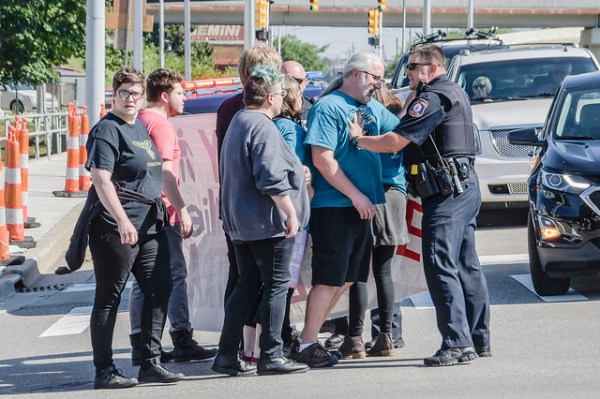
Fifth, the GRPD state, “There was no force used in the arrests.” Again, a slight manipulation in the narrative. You can see in the picture above that the cops was pushing into my chest, which was not painful, but it the cop did use force. Had I put my had on the chest of the cop, I would have been charged with assault. In addition, cops are heavily armed, with tasers, guns, clubs, pepper spray, etc, which naturally determines a power dynamic in their favor.
Sixth, the GRPD narrative ends with a couple of quotes from Chief Rahinsky, both of which also presents a false narrative. The GRPD, like all law enforcement agencies, do not respect freedom of expression. Organizers will tell you that any time there is a demonstration, a march or a type of direct action, the police will try to intimidate you, silence you or tell you what you can and can’t do. If you bring a megaphone they can stop you from using it, citing a noise ordinance. If you try to hold a sign or try to hand out informational flyers (for example) near the entrance of the Ford Museum, the GRPD will tell you that you need to move far from the entrance in order to do so.
The second point that Rahinsky makes is the most offensive.
“However, when demonstrators block a road that leads to facilities which provide emergency medical treatment for the City of Grand Rapids residents and West Michigan, they endanger the health, safety, and welfare of the community. At that point we are obligated to act in the community’s best interest.”
This statement is just another attempt to twist the truth. When Rahinsky says that they have to act in the community’s best interest, we have to ask ourselves, which community is he referring to? People living in poverty, those living on the streets, African Americans, most in the immigrant community are not the people that Rahinsky has in mind when he says he is acting in the “community’s best interest.”
As a member of the GR Rapid Response to ICE group and an active participant in Movimiento Cosecha GR, we come in contact with immigrants every week who are being targeted by ICE agents, who arrest and detain them. We hear stories regularly of local cops stopping people in the immigrant community and arresting them for things like driving without a license, since they cannot obtain a drivers license in Michigan. While Rahinsky likes to say they his department wants to improve trust between the GRPD and the immigrant community, the fact is that he has stated on numerous occasions that if ICE asks his department to get involved with ICE cases, he is obligated to do so.
The way many of us see it, is that local cops are doing harm to the immigrant community on a regular basis, they are not looking out for their safety. Is it in the immigrant community’s best interest to have the GRPD stop them, arrest them and then hand them over to the Kent County Sheriff’s Department, which notifies ICE agents once they are processed in?
Movimiento Cosecha GR has a saying, We will disrupt you as long as you continue to disrupt the lives of our community. The very fact that the police cooperate in the arrest, detainment and eventual deportation of members of the immigrant community causes tremendous interruption of that community and those families. Therefore, when we engage in actions to block traffic for a few minutes, we do so to make the the following point: We are going to inconvenience your life for a short period of time so that we can communicate to you that the police (and your silence) is causing tremendous harm to the lives, to the families and to the immigrant community.
Therefore, which narrative do you think you can trust? The narrative put forth by an institution which is designed to protect power and punish communities of color or the narrative from members of affected communities struggling to survive and to achieve some form of liberation?
Ending the ICE contract with Kent County and yesterday’s action at the Kent County Commission meeting
( As a matter of transparency, I was part of the action at this meeting and one of those arrested yesterday for demanding that Kent County End their contract with ICE.)
For those of you who read this blog, you are well aware of the fact that yesterday, nearly 200 people came to the Kent County Commission meeting to demand that they end the county’s contract with ICE.

Yesterday, MLive ran an article where they interviewed Kent County Commission Chairman Jim Saalfeld. Here is what he said in that article:
“There were comments from the larger group that made me nervous this was going to turn into something more, which is why I suspended the meeting at that point,” chairman Jim Saalfeld said later in the meeting. “That was a discussion I had with the sheriff’s department and the leadership in advance that that is the type of approach we did in order to downplay the risk of violence.”
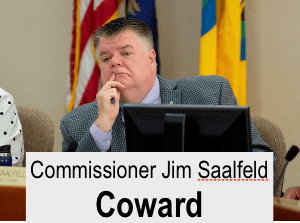 First, it seems that Saalfeld and other commissioners feel nervous when residents of Kent County decide to actively take part in policies that directly impact them and the people they care about. Second, there was never any risk of violence from the people who came to the commission meeting. The only people there who we now of who already engage in acts of violence were the members of the Sheriff’s Department and the Kent County Commissioners themselves. The Sheriff’s Department administers the contract with ICE and the Kent County Commission voted to approve it. This is the real violence and the reason why so many people came to demand that the county end the contract with ICE.
The MLive article also mention that Saalfeld had told the Sheriff’s deputies to remove a member of Movimiento Cosecha GR, Karla Barberi, because she asked someone at the podium to let immigrants speak about an urgent matter. Saalfeld said that Karla pushed the man at the podium,  which was totally false. You can see from the video here that this never happened. What MLive did not report, was that the man who was at the podium, was John Kennedy. John Kennedy (pictured on the right) is the CEO of AutoCam, one of the wealthiest people in Kent County, a member of the Grand Rapids Power Structure and someone who actively supports far right policies, with both his money and his time. John Kennedy is on the board of the West Michigan Policy Forum, is active with the Grand Rapids Chamber of Commerce, sits on the Board of the Acton Institute, the Right Place Inc and is on the Board of Trustees at GVSU. He has publicly opposed the Affordable Health Care Act and always supports policies that hurt working people, especially unions. Kennedy also also contributed millions to federal, state and local Republican candidates in recent years, many of which have introduced legislation that promotes neo-liberal capitalism and the austerity measures that come with it.
One additional observation, since there have been numerous comments about what the Kent County Commissioners did during the meeting yesterday. The majority of commissioners left, which people noted was cowardly. There were some that stayed and others thanked them for staying to hear what people had to say. I understand people wanting to thank them. However, why are we thanking people who were elected to supposedly listen to public concerns in the first place? Why do we feel the need to affirm politicians who are paid through public tax dollars to sit and listen to members of the public? I for one am not going to thank any of them, until they take a public stance against the contract with ICE and then end the contract.
Yesterday, the Detroit Chapter of the NAACP came to Grand Rapids to hold a rally in front of the offices of Bethany Christian Services, because of the current crisis surrounding the separation of immigrant families in detention.
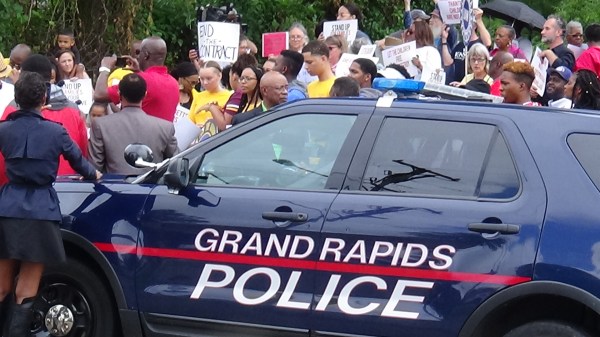
The event also included a spokesperson from the Grand Rapids NAACP, members of the UAW from Detroit, La SED and several pastors who addressed the crowd of roughly 100 who stood across from the offices of Bethany, holding signs.
There was some important points that were made during the rally. First, one of the pastors who spoke made the point that the children who were brought to Bethany and other agencies in the state, were brought in between 11pm and 7am, “during the cover of night. What is it that the government was hiding that caused them to transport these children in the middle of the night?”
The representative from La SED (Latin Americans for Social and Economic Development) made the point that not only is separating children from their parents is an injustice, but keeping them together in detention facilities is also an injustice.
However, beyond these clear and relevant statements, the majority of the commentary used religious language and the quoting of Christian scriptures. None of the speakers offered any clear analysis of the current detention of immigrant families and the separation of children from their parents. There was no mention of the role and function of ICE and there was no critique of the role that Bethany Christian Services was playing in this process. In fact, those who organized the rally stated that they were not interested in “attacking” Bethany. So why hold the rally across from the agency?
While I respect the desire to respond the current immigration crisis, it is not enough to make proclamations without a strategy. There were several issues this writer had with what took place during this rally.
 First, the voices and experiences of immigrants were not centered at this rally. The voices and experiences of immigrants should be central to the struggle to confront this injustice. Someone did reach out to Cosecha GR and asked if they could bring supporters, but when Cosecha GR asked to speak at the rally, they were told that there were already enough speakers.
Second, the signs that most people were holding up were provided by the organizers. One sign read, Stand Up for Families, call your Representative now. While I am not suggesting that people should not call their representatives, such an action will get the results that we want – meaning the  end of immigrant families in detention. Another sign said, America is Better than this, children are not pawns. I agree with the sentiment that children are not pawns, but there is little historical evidence to suggest that America is better than the separation of children from their families. Whether it has been the forced separation of Indigenous children from their families and putting them in boarding schools, theft separation of black children from their parents during slavery and a more contemporary reality of the Prison Industrial Complex and how it separates children from their parents on a massive scale.
 Third, there were several references to letters from Democratic politicians, plus there were numerous democratic politicians and candidates present for this rally. And during the rally, the NAACP Grand Rapids chapter president only offered up the strategy of voting, with no other discussion of how we resist what is happening to immigrant families. There could have been mention of divesting from private prison corporations, which is where a growing number of immigrants are being sent. There was no discussion of municipalities declaring themselves Sanctuary Cities or religious institutions becoming sanctuaries for those fleeing government oppression. It is ironic, that right now in Detroit that is an action outside the ICE headquarters. There was also no mention of the action taking place today in Grand Rapids, where Movimiento Cosecha GR and GR Rapid Response to ICE are demanding an end to contract that ICE has with Kent County.
We all need to engage in expanding our radical imagination about what we can do to achieve collective liberation.
Another attack against those on government assistance in Michigan and the people paying for this new state law
 Yesterday, Michigan Governor Rick Snyder passed legislation known as the Medicaid Workforce Engagement Act.
The title of this legislation was designed to pacify people, since the real focus of this legislation is to make people who receive government assistance with Medicaid be required to work 80 hours a month in order to continue receiving this assistance.
There are several exceptions listed within the newly adopted legislation, but according to an estimate cited in the Detroit News, “540,000 able-bodied adults” would be required to fulfill the work requirements.
Organizations that are part of the Grand Rapids Power Structure, like the GR Chamber of Commerce and the West Michigan Policy Forum, endorsed the legislation. On their facebook page, the WMPF stated:
The West Michigan Policy Forum supports this plan, as it will help employers struggling to find workers fill open jobs, and put people in need of assistance on a path for success and improvement.
The narrative that groups like the WMPF are using is suggests that this state policy will help people find work and take charge of their lives. The reality is that this new state policy punishes those who receive government assistance and is part of a larger decades-long battle to undo any form of government assistance at the state and federal level. This push to undo any government safety net is part of the larger Neo-liberal capitalist plan that has been promoted initially by Republicans, but adopted by the leadership of the Democratic Party, especially since the Clinton administration, when that administration dismantled welfare as we know it.
The newly adopted policy signed by Gov. Snyder was passed by the Senate and the House, pretty much on partisan lines. The legislation was introduced in the state Senate by Mike Shirkey, with the following co-sponsors:
Phillip Pavlov, Dave Hildenbrand, Peter MacGregor, Joe Hune, Judy Emmons, Jack Brandenburg, Patrick Colbeck, John Proos, Wayne Schmidt, David Robertson.
As always, it is important to follow the money when it comes to politicians, with our emphasis on those from West Michigan who have financed those who co-sponsored this new state policy, which punishes those receiving Medicaid.
Sen. Mike Shirkey – $80,000 from John Kennedy and $59,000 from the DeVos Family
Sen. Phil Pavlov – $18,000 from the DeVos Family and $6,500 from Meijer
Sen. Dave Hildenbrand – $21,000 from the DeVos Family and $13,650 from Meijer
Sen. Peter MacGregor – $43,000 from the DeVos Family, $16,000 from Meijer and $12,000 from Michael Jandernoa
Sen. Joe Hune – $9,000 from the DeVos Family
Sen. Jack Brandenburg – $14,000 from the DeVos Family
Sen. Patrick Colbeck – $18,000 from the DeVos Family
Sen. John Proos – $9,000 from the DeVos Family
Sen. Wayne Schmidt – $18,000 from the DeVos Family
Sen. David Robertson – $7,000 from the DeVos Family
Once again, the Grand Rapids Power Structure plays a significant role in determining the outcome of state policy that punishes the most vulnerable residents of Michigan.
White Savior Politics and the current immigration crisis
 The recent news that the US government, through the Department of Homeland Security, has been detaining children of immigrant families. The detention centers are cruel manifestations of the nation’s immigration policies, which are punishing immigrants, particularly undocumented immigrants.
The images that we have all been seeing of immigrant children being separated from their families are awful, traumatic and gruesome. Therefore, it is not surprising that people have been outraged. All one has to do is look at social media and these images of children in detention all everywhere.
In the past few weeks, there has also been a variety of responses to this revelation that families are being separated. People have been calling members of Congress, holding protests and attempting to raise awareness about what is happening at this moment. Wanting to do something is understandable, in fact it seems rather natural for many people, since humans will respond to tragedy.
However, it is crucial that we step back and think critically about what it is we are responding to and how we respond. This is particularly important for white people. Why, you might ask? Well, the reality is that we live in a society that is permeated by white supremacist ideology. Activist and organizer, Elizabeth Martinez, defines white supremacy as:
White Supremacy is an historically based, institutionally perpetuated system of exploitation and oppression of continents, nations, and peoples of color by white peoples and nations of the European continent, for the purpose of maintaining and defending a system of wealth, power, and privilege.
Within this system of white supremacy, white people are taught to take action and to fix things, even if doing so causes more harm or perpetuates inequality. Within white supremacy, this dynamic is called White Savior Politics. White Savior Politics is fundamentally about white people taking action because it makes us feel better, plus it has the benefit of not getting us to think about our privilege.
The current immigration crisis is a good example of how white savior politics can play out, so lets look at what this means in the context of how people are responding to the separation of immigrant families. The following talking points are important for all of us, but especially for white people, when we are moved to do something in the face of injustice.
First, white savior politics means that we do not recognize the agency of those who are being oppressed have. White people often assume that those being oppressed don’t have agency and can’t speak or act for themselves. What this means is that white people erase the voices and agency of people who are being oppressed at that moment, but it also erases a long history of resistance by the very same people who are being oppressed. In the current immigration crisis, white peoples actions often erase the voices & stories of those impacted by having their families torn apart, plus it erases a long history of how immigrant communities have been resisting the same kind of oppressive treatment they have been experiencing for centuries.
Second, white guilt is also part of the white savior dynamic, wherein we take action out of guilt, instead of taking action because those being oppressed have asked us to. White guilt doesn’t serve any purpose, except to limit our ability to engage in radical imagination. We shouldn’t take action because of guilt, but rather out of a sense of compassion and justice.
Third, white savior politics often is a result of our own historical amnesia. It is well documented that during the Obama administration, roughly 3 million people had been deported and ICE agents were arresting and detaining people, thus separating families. Where was the outcry then? People in the immigrant community were experiencing fear and separation at the hands of ICE then, so why is it now an issue? Part of the reason why the issue is front and center now, is because immigrants and immigration activists have made it an issue. However, another reason it is causing such an uproar, is due to the fact that the separation of families is taking place under a Republican administration. MoveOn.org is the primary entity that has been promoting the June 30th rallies across the country, but MoveOn.org was not challenging people at the grassroots level to resist the deportations during the Obama administration, thus demonstrating the absurdity of partisan politics. The separation, detention and deportation of immigrants and their families should always be opposed, not just when it is politically convenient.
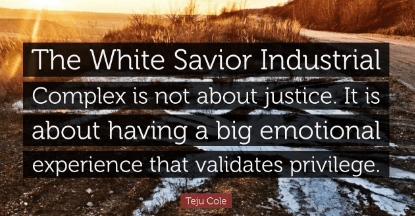
Fourth, in order to counter white savior politics we have to recognize our own privilege, understand history and begin to develop relationships with the immigrant and undocumented community. Countering white savior politics means we must practice relational politics, which in turn should be based on solidarity. Solidarity is not just some lofty idea, but it is a commitment to being in relationship with those who are oppressed, listening to them, asking what they need and then working with them to fight against anti-immigrant policies and practices.
Fifth, we have to come to terms with larger US foreign policy dynamics, which is often the root cause of migration. We have to come to terms with the fact that US foreign policy towards Latin American countries are at the root of the immigration crisis. The US government support for dictatorships, providing military aid & training, drug policies and economic policies (like NAFTA) are the real reasons why so many people are coming to the US from Latin America. Fighting against US imperialism and white supremacy abroad would radically alter the realities of immigration to the US. We have to see the bigger picture in this struggle and cannot afford to simply say we are against the treatment of immigrants without also being against US Imperialism and White Supremacy.
Lastly, the current immigration crisis must always be about the affected communities of immigrants. We cannot make this issue about what white people are doing and how wonderful we think we are. Immigrant lives and voices must be centered in this struggle, not the lives of white people. We need to elevate and amplify the voices of those most impacted by ICE repression, not our own. We need to practice humility and stop trying to pat ourselves on the back doing things that are of no real consequence or cost to ourselves.
I recognize that people want to take action in the face of injustice. I get that. However, unless we begin to deal with our own privilege and recognize how white supremacy is embedded into our privilege, we will continue to practice and perpetuate white savior politics.
Grand Rapids Power Structure: Part VII – Universities and Colleges as Buffers against systemic change
 Over the past few weeks we have been investigating the Grand Rapids Power Structure, beginning with a discussion about its framework in Part I; the most powerful family in Grand Rapids, the DeVos Family, in Part II and in Part III we looked at other members of the most powerful members of the private sector. In Part IV, we looked at the private sector organizations that have power and which individuals sit on the boards of those organizations.
Two weeks ago, we looked at the next level of the Grand Rapids Power Structure, the local government, in Part V, and last week we investigated the role and function of the media, within Grand Rapids and how it serves power in Part VI.
In the next series of posts, we will explore the various institutions that ultimately act as a buffer for the Grand Rapids Power Structure. When we say buffer, we mean that these institutions often redirect people from focusing on systemic problems and instead focusing on uplifting the individual. These institutions do offer some solutions to current social problems, but rarely do they call for systemic change and almost never challenge structures of power.
In addition, these buffer institutions often normalize systems of power by accepting the existing social order as it is, only to call for mild reforms. Buffer institutions also are often ideologically and financially compromised, since they are recipients of funding from the existing power structure.
In Part VII of our analysis of the Grand Rapids Power Structure, we will look at the function of local universities/colleges and their relationship to power.
Institutions of Higher Learning
Amongst the universities and colleges in Grand Rapids, GVSU stands out as the best example of an educational institutions that acts as a buffer for those in power. This hasn’t always been the case, especially in the early years of Grand Valley State College, but once the DeVos Family became involved much of that changed.
Beginning in the mid-1970s, ever since Rich DeVos became a trustee at Grand Valley, the school went from being known as the Berkley of the Midwest to a university that collaborates with the Grand Rapids Power Structure.
Students at Grand Valley State College attempted to challenge the power of Rich DeVos in 1977, but the Amway co-founder offered the college an opportunity to not only become a university, but to shift its focus from a more progressive liberal arts college to a university that zealously embraces a neo-liberal capitalist view of the world.
 One indication of the embrace of neoliberal capitalism by GVSU can be seen in the so-called Wall of Fame, art the downtown campus, in the Eberhard Center. The Wall of Fame is made up of members of the Grand Rapids Power Structure, primarily business people, who have served on the board of trustees and donated large sums of money to expand GVSU’s economic influence.
Much of this influence is documented in our Popular Guide to Wealth and Influence at GVSU, which you can download at this link. One example we provide of how wealth has influenced GVSU politics has to do with what happened in the 1990s, when faculty members, who were part of the LGBT community, were told that they would be getting domestic partner benefits from the University. However, word of this promise became public and Rich DeVos and Peter Cook threatened to take away funding they had promised for the new Michigan St. building. Then GVSU President Lubbers, withdrew his commitment to the LGBT faculty and the new building got the funds it was promised.
A second attempt was made in 2003, to get domestic partner benefits passed at GVSU, but then President Mark Murray blocked the attempt. Murray stated at the time, “As a University that has benefited from very generous support from the private philanthropic community, we must recognize the prevailing views of those who provide such support.”
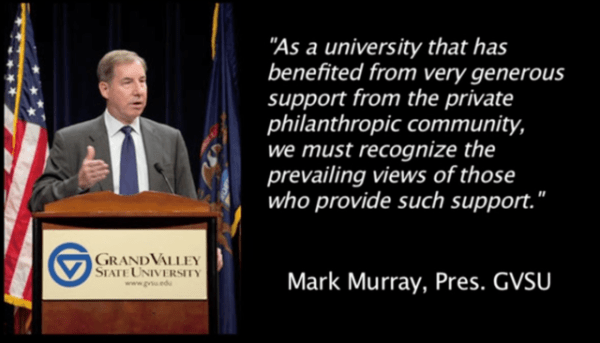
This statement by Murray underscores the power that donors have had on policy at GVSU. This reality is consistent with the kinds of political and economic influence those in the Hall of Fame have had and continue to have in Grand Rapids. Many of those on the Hall of Fame continue to be involved in organizations like Grand Action, The Right Place, the Grand Rapids Chamber of Commerce, the Acton Institute and the West Michigan Policy Forum, all of which we identified on Part IV of our analysis of the Grand Rapids Power Structure. https://griid.org/2018/06/04/grand-rapids-power-structure-part-iv-private-sector-organizations/
Another way that GVSU acts as a buffer zone is the increased focus on being a business school, that promotes neo-liberal economic policies. GVSU has been expanding this focus, with the growth of the Seidman School of Business and the Van Andel Trade Center. These programs are “complimented” by the Johnson Center for Philanthropy and the GVSU School of Social Work. These programs are the real buffer, since they re-direct people’s energy into doing social work through non-profits, which focus on serving people who are marginalized in society, instead of being part of movements calling for systemic change. These career tracks not only don’t advocate for systemic change, they often do not even recognize that what is being taught in the business school actually causes the kind of social problems that the populations non-profits serve are experiencing.
All of these dynamics are supported by those who run the university, such as those who sit on the Board of Trustees. Virtually all of those who sit on the Board of Trustees are either part of the business community or work in local government positions, including some members of the Grand Rapids Power Structure, such as John Kennedy.
Then there is the GVSU Foundation Board, which also is made up of those who are part of the Grand Rapids Power Structure. In fact, most of the people we identified as being part of the GR Power Structure, also sit on the GVSU Foundation board, such as several members of the DeVos Family, Peter Secchia, J.C. Huizenga, Michael Jandernoa, Mike VanGessel, John Kennedy, Sam Cummings, Matthew Hayworth, Scott Wierda and Carol Van Andel.
The GVSU Board of Trustees and the university’s foundation are designed to have members of the Grand Rapids Power Structure as active members, since they determine larger, structural policies and agendas for the school. These structures are designed this way as a means to protect and promote the long-term interests of the local power structure.
Calvin College, Aquinas, GRCC and Davenport are not that different from GVSU, in that they operate in the same fundamental way that most centers of higher learning do, which is primarily to promote and normalize social inequalities and to encourage people who want to try to do some good, to chose the non-profit administrative track.
Lastly, it should be mentioned that most of the private foundations, particularly the DeVos Family foundations, are major contributors to the local colleges and universities, thus providing another mechanism to control the long-term interests of the Grand Rapids Power Structure.
In our next article in this series, we will look at the role of organized religion, its relationship to power and how it often acts as a buffer against systemic change.
 The US House of Representatives passed the 2018 Farm Bill, with a vote of 213 – 211.
The 2018 version of the Farm Bill, will continue to perpetuate an agribusiness-driven food system, by providing massive subsidies. Large, agribusiness growers will continue to benefit from the 2018 Farm Bill, while small farmers and farmers that practice diverse, ecologically sustainable methods will not be recipients of taxpayer support.
Like the 2014 Farm Bill, the 2018 version will include significant cuts to $867 Billion piece of legislation. The House farm bill includes cuts of more than $20 billion in SNAP (Supplemental Nutrition Assistance Program) benefits over 10 years. The legislation also contains provisions that could see more than 2 million low-income Americans lose their benefits or experience declines in financial assistance.
These cuts to food assistance is just one more attack against working class people and those experiencing poverty. However, the House version of the 2018 Farm Bill also adds addition work requirements to people who receive food assistance. These requirements stipulate that able-bodied individuals aged 18-59 to participate in employment training or work a minimum of 20 hours a week. Once again, the Farm Bill provides a massive amount of welfare to corporate agribusiness, but punishes families who need food assistance.
Then there is the issue of how our food assistance relies on low wage migrant workers and unjust immigration policies. For decades US immigration policy has been punishing immigrants, especially from Latin America, yet the current agribusiness system is completely dependent on immigrant farm labor. In a recent online post, the Institute for Agriculture and Trade Policy provides some important analysis of how immigration policies and agriculture are connected:
It’s no secret that US agriculture is suffering from a labor shortage. The American Farm Bureau estimates that $60 billion in agricultural production could be lost just this year if enough workers are not found. This is not new. Farm labor has always been low-wage work, and has depended on migratory workers for its sustenance. When other jobs are in demand, the workforce dries up. Farm labor has also been tied up in the politics of racism since colonial times. From slavery, to the exclusion of the predominantly black agricultural (and domestic) workforce from the National Labor Relations Act in 1935, which allowed private sector workers to unionize, to the Braceros program of the early and mid-20th Century. When that program was being debated, a Chamber of Commerce spokesman testified to Congress, “We, gentlemen, are just as anxious as you are not to build the civilization of California or any other western district upon a Mexican foundation. We take him because there is nothing else available.” Agribusiness and large-scale agriculture has used whatever means necessary to create a brown-skinned underclass that supplies cheap labor. Grounded in that history, the Goodlatte Bill continues to further erode protections for an already weakly-protected workers. It is no surprise, given their record of racism, that the Trump administration is seeking to continue in this vein.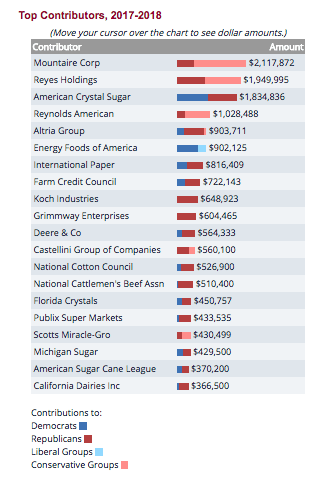
The US Senate will now vote on the 2018 Farm Bill and we will have to wait and see if they adopt the same provisions of the House version. Michigan Senator Debbie Stabenow is the ranking member of the Agriculture, Nutrition and Forestry Committee and has already received high praise from the agribusiness sector for continuing to support massive subsidies to corporate agriculture, such as the Michigan Farm Bureau and other agribusiness associations.
Senator Stabenow, like the other members of the Agriculture Committee, receive lots of pressure and lots of money from the Agribusiness sector to make sure that their interests are being represented. The Agricultural sector has already contributed over $50 million in the current election cycle to buy votes and candidates.
Peters and Stabenow vote with majority of Senate to approve $716 Billion Military Budget
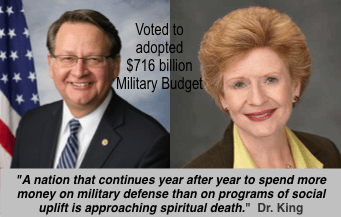 On Monday, the US Senate voted in favor of adopting the National Defense Authorization Act, by a margin of 85 – 10.
The vote adopts a $716 billion defense bill that boosts military spending by over $80 billion and authorizes another $21.6 billion for nuclear weapons programs.
If adopted by the House, the 2019 Budget for US militarism would be an increase of roughly $82 billion from last years defense budget.
Both Michigan Senators voted in favor of the National Defense Authorization Act. As member of the Senate Armed Services Committee, Sen. Gary Peters released a statement on why he voted for the military budget, stating:
“At a time when our nation faces new and wide-ranging security threats, it is critical that our brave men and women in uniform have the support, tools and technologies necessary to complete their mission safely and effectively, Michigan is conducting groundbreaking research that will revolutionize the future of warfare. This legislation will bolster initiatives already underway in our state – from developing the Next Generation Ground Vehicle to assessing military vehicle capabilities under extreme winter weather – while reaffirming the importance of the A-10 and the critical role it continues to play in our national security.”
Fellow Michigan Senator Debbie Stabenow, in a similar statement on the military budget vote, chose to focus on how the military budget will “a big investment in Michigan’s defense industry.”
Both Michigan Senators also added changes which would benefit military contractors in the state and military research being done at universities, mentioning the Michigan Technological University in Houghton.
As with the adoption of any new military budget, the near unanimous vote to approve $716 billion for the military raises important questions about the priorities for a country that has millions living in poverty, wages that millions cannot live off of and a massive affordable housing crisis.
In Dr. Martin Luther King Jr’s famous speech in 1967, entitled, Beyond Vietnam, he calls out the nation and states that, A nation that continues year after year to spend more money on military defense than on programs of social uplift is approaching spiritual death. However, hearing his critique on spending priorities is much more powerful.
Dr. King made these connections clear, which led him to be involved in the Poor People’s Campaign, calling for a revolution of values where the social uplift of people is more important than militarism.
The same principle is part of the current Poor People’s Campaign, which challenges several main themes of injustice and oppression. The Poor People’s Campaign identifies the following overarching themes to be addressed and dismantled:
- Systemic Racism
- Poverty & Inequality
- Ecological Devastation
- War Economy and Militarism
Unfortunately, the US government continues to make militarism a priority over the lives of millions of people living in this country. Therefore, it is necessary for those of us who advocate for radical change to be clear that the US military budget is incompatible with economic, racial and environmental justice.
 Grand Rapids Institute for Information Democracy