 Recently, I read a piece by Joel Belz from the publication World Magazine, which discussed the 1992 Congressional race between then Congressman Paul Henry and challenger Carol Kooistra.
The article by Belz, is entitled Opponents and Friends: An unlikely 1992 political race seems even less plausible in today’s climate. The article shares the story that while Henry and Kooistra were campaigning, it was revealed that Henry was diagnosed with brain cancer just two weeks before the election. Kooistra decided to withdrawl campaign literature that attacked Henry’s voting record and she helped to distribute his campaign literature while she and her team were going door to door with her literature. Henry won the election and died in late July of 1993.
I have my own story about Paul Henry, one that was years earlier, when Henry was still fairly new as a member of Congress.
Paul Henry was elected in 1994 and began his career as a Congressman in 1985. One of the most controversial issues that was taking place while Henry was still a newcomer, an issue that would continue throughout the rest of his life, was US policy towards Central America.
The US was financing two counterinsurgency wars in El Salvador and Guatemala, along with using Honduras as a massive US military base and using Panamanian President Manuel Noriega for CIA activity. However, maybe the most controversial aspect of US policy in Central America at the time, or at least the one that received the most media attention, was the US support for the former Somozan National Gaurdsmen in Nicaragua, known as the Contras.
The specific issue was whether or not the US Congress should provide funding for the Contras, which were attempting to overthrown the Sandinista government in Nicaragua. The Reagan administration wanted to fully fund the Contras, while Democratic members of Congress were not fully supportive of such a plan.
On the matter of the US support for the Contras, Paul Henry consistently voted for military funding that allowed the Contras to attack Nicaragua from both Honduras and Costa Rica, the countries which border that Central American nation. The Reagan administration (and Paul Henry) was claiming that the Contra forces were “freedom fighters,” despite the record of massive human rights violations. The Contras were known for attacking farming cooperatives, literacy workers and other social programs, which were at the forefront of the Sandinista revolution.
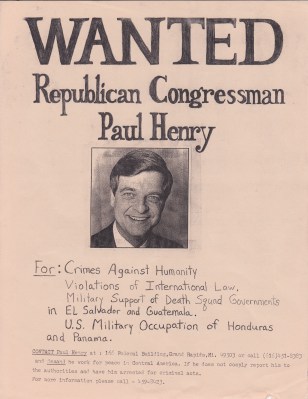 There was a lively campaign in Grand Rapids to challenge Paul Henry’s position on Nicaragua and his support for the Contras beginning in 1984, with the Stop The Invasion Campaign (STIC). There were weekly demonstrations outside his office in the federal building for years and several acts of civil disobedience, where people occupied his office until they were arrested. On one occasion, a group of people put 100 crosses in the lawn of the federal building with the names of Nicaragua civilians that the Contras had killed. Despite these efforts and many more Paul Henry never changed his position on Nicaragua, even after the Iran Contra affair and the allegations that the CIA was working with the Contras to traffic cocaine to buy weapons.
In 1986, the community that I was part of then, the Koinonia House, was in the process of becoming a Sanctuary for Central American refugees. Some of us went to a conference in Washington, DC, to learn more about being a sanctuary and connecting with the larger Central American Solidarity movement. At the conference, several members of Veterans for Peace were in the midst of a 30 day fast to end US support for the Contras. They were encouraging others to do the same, in their own communities.
I decided to do a 30 day fast against US funding of the Contras, in 1986. As part of my fast, I decided that In would write to Congressman Paul Henry every day of the fast to share my thoughts and information about what the consequences of US funding were having on the Nicaraguan people.
On day 26, I received a phone call from Congressman Henry, saying that he had a stack of letters from me on his desk and that he thought he would reach out to me. I said I was grateful for the call and then said that I would like to talk with him in person. I then suggested that I would end my fast early if he would sit down and break bread with me. Congressman Henry declined, so I finished the 30 day fast as planned.
In the 1980s the US was also providing massive amounts of military aid to the country of El Salvador to fight the FMLN guerilla forces. Throughout that period human rights groups and many US-based church groups were claiming that the Salvadoran military and the death squads were responsible for the bulk of the human right abuses, but Congressman Henry (who support military aid to El Salvador) was staunch in his conviction that the human rights abuses were equally committed by the FMLN.
Again, people in Grand Rapids organized to oppose the US support of the Salvadoran military and Paul Henry’s office was the target of people’s rage. The largest action against Henry’s support for the death squad terror in El Salvador was right after several priests, their cook and her daughter were assassinated on November of 1989.
About 100 people blocked traffic on Michigan Avenue in front of the Federal building in Grand Rapids. After the police came, another contingent of people went into Paul Henry’s office and attempted to make a citizen’s arrest against the Congressman and his staff. Eventually, the people who were in Paul Henry’s office were dragged out and the doors to the federal building were locked so no one could get in.
In 1992, there was a ceasefire in El Salvador and a UN Truth Commission was established to investigate the crimes committed in El Salvador between 1980 and 1992. In March of 1993, the UN Truth Commission published their findings, which stated that the Salvadoran military was guilty of 85% of the human rights abuses during that 12-year period and that the FMLN was only responsible for 5%. Congressman Henry never admitted he was wrong or that he was mislead by the Reagan/Bush administrations.
I respected the fact that Paul Henry called me during my fast, a respect that Carol Kooistra seemed to share about the former Congressman. Kooistra’s decision to not distribute literature that would have held Henry accountable for his voting record, particularly on funding human rights abusers in Central America, was laudable. However, I believe that one can be respectful when interacting with those who hold political office AND hold them accountable at the same time. It is sad that anyone would die prematurely because of cancer, but that doesn’t mean we have to ignore their support for policies that resulted in the deaths of hundreds of thousands of people in Central America during time in Congress.
 Last week, several Michigan news sources, including Michigan Advance, reported that at least six Democratic State Representatives signed a letter in opposition to the lawsuit that Michigan Attorney General Dana Nessel has filed to shut down Enbridge’s Line 5.
Michigan Advance reported that six Democratic State Representatives – Brian Elder (D-Bay City), Tenisha Yancey (D-Harper Woods), Sara Cambensy (D-Marquette), Wendell Byrd (D-Detroit), John Chirkun (D-Roseville) and Terry Sabo (D-Muskegon) – signed on to a letter, that was critical of the Attorney General’s desire to shut down the Enbridge run Line 5.
The article also stated:
The Democrats added that Line 5 is critical for transportation fuels, consumer goods and home heating energy, something echoed by Republican senators last month.
Not only are there Democratic lawmakers in Michigan who support Line 5, there are several labor unions that do as well. One of them signed on to a letter written with the Michigan Chamber of Commerce earlier this year, which states:
Dear Governor Whitmer,
We believe in your leadership, your commitment to jobs, doing what’s right for Michiganders and protecting and preserving our magnificent Great Lakes.
So let’s get the job done. The underground tunnel beneath the Straits will be the largest construction project in Michigan since we built the Mackinac Bridge. It will create many good-paying construction jobs, allow the continued supply of essential energy to heat family homes in the Upper Peninsula, fuel businesses and jobs across our entire state, and protect the Great Lakes as Line is removed from the floor of the Straits.
You have worked to build consensus on many issues. On the issue of building an underground tunnel to replace Line 5, business and labor agree. So let private industry, private funding and Michigan workers build the Straits Tunnel.
Securing Michigan’s future is in your hands.
Sincerely,
Michigan Chamber of Commerce
Operating Engineers 324
Here the emphasis in on job creation, specifically jobs for construction workers in Michigan.
Last month, Crain’s Detroit Business reported that at least two Michigan labor unions had been lobbying Gov. Whitmer to support Line 5, again because of the construction jobs.
 The connection between jobs, labor unions and the six Democratic State Representatives becomes even clearer, when you see that these same state representatives have all received substantial campaign funding support from the very unions that would likely benefit from the construction of new energy pipelines.
If you go to the hyperlink for each of the six Democrats that oppose the Attorney General’s lawsuit against Line 5, you can see that each of them have received substantial support from labor unions which would benefit from the construction of Line 5.
One lesson from this is that it is not just corporations or wealthy people whom we should be concerned about in regards to campaign financing, but even labor unions can support politicians, which support policies that are unjust and unsustainable, such as the Line 5 pipeline project operated by Enbridge.
This morning, about 50 people gathered at Calder Plaza for an action organized by members of the local Jewish community, an action that was done in solidarity with the immigrant community that has been living in fear because of ICE violence.

Like the actions that have taken place in New Jersey, Boston and all across the country, this action was a Never Again Is Now action.
The group walked from Calder Plaza to the ICE office located at 517 Ottawa NW in Grand Rapids, just north of the 196 overpass. This is one of many offices that ICE has in Kent County and the one that the action took place today is a local where ICE sometimes brings detainees when they are being transported to and from detention facilities.
The members of the local Jewish community who organized the action, were handing out information, part of which had the following statement, which articled the reasons for taking such an action of solidarity.

Most of the time in front of the ICE office, members of the Jewish community were engaged in prayer and had asked allies that were present to be respectful of what they were doing. Towards the end of the action, while still praying three members of the Jewish community walked out onto Ottawa to block traffic briefly, holding a Never Again Is Now banner, while continuing to pray.

The GRPD that was nearby, chose not to intervene and did not arrest anyone. In fact, the GRPD presence was limited to only two cruisers (that we knew of), which is unusual for actions that are anti-ICE or focused on immigrant justice. Some of those participating were even wondering if the decision of the GRPD was more about the fact that when white people take these kinds of actions, the cops will keep their distance, which is radically different when the actions are led by immigrants.
 The Grand Rapids Police Officers Association, the union that represents those employed by the GRPD, is getting some pushback from a recent statement posted on their website. The statement reads:
The recent and continued violence is the direct result of city officials not properly staffing and supporting the police department. To allow the police department to be constantly scrutinized discourages any type of proactive enforcement necessary to keep Grand Rapids safe. It is evident that stop the violence rallies have no affect on criminal activity. It’s time to let GRPD get back to policing.
The cop union statement is instructive on many levels. First, they blame city officials for not hiring more police and for not supporting what they do. A recent study has determined that the GRPD has enough staff, but that they do not utilize current resources efficiently. Also, to say that City officials do not support them is code for “we don’t like it when you scrutinize how we operate in the community.”
Second, the police union says that the “stop the violence” rallies have no effect, but offer no evidence to refute such a claim. In fact, the police union makes the claim that if they had more cops the “recent and continued violence” would stop or be diminished. Again, the police union offers NO evidence to support their claim.
One of the community members who have been critical of the GRPD’s use of violence against black and brown people is Rev. Jerry Bishop. He responded to the police union statement on Facebook, with his own statement that you can read in response to the GRPD union post on July 7. The Urban Core Collective also responded and challenged the police union on their dismissive comments about the stop the violence rallies.
However, there were numerous other responses, most of which are defending the GRPD and in one case slandering Rev. Bishop, comments you can read on the Grand Rapids Police Officer’s Association FB page from the July 7 post.
There has been a fair amount of local news media reporting on the statement and the reactions from the community. However, most of the local news do not verify of the claims made by the police union, both the claim that the stop the violence rallies don’t work and that more cops would mean less crime. So, what would it look like to further explore these claims?
First, there is little evidence to suggest that increasing the number of cops will actually reduce low level crimes. So-called community policing, as it has been practiced since the 1970s, has not resulted in reduced incidents of low level crimes. In fact, what it has done, particularly in communities of color, is to increase the level of mistrust between communities of color and local law enforcement agencies, according to Alex Vitale, author of the book, The End of Policing.
Second, what communities of color have been calling for in recent decades, is for more systemic change that will benefit their communities, but actually reduce crime. The Movement for Black Lives calls this the Invest/Divest strategy. This strategy takes money going to police department and the prison industrial complex and puts it into community safety programs, education, anti-poverty initiatives, etc. This Invest/Divest strategy is worth looking at, especially if we are not interested in a quick fix.
Third, another important aspect of what is problematic about the Grand Rapids Police Officer’s Association statement, is that it underscores how they see crime. For police departments, crime is something that people commit when they violate existing laws. However, we all know that laws are often designed by those with power and privilege, which means that these laws often only impact people who are part of the working class or communities of color.
People who don’t make a livable wage, people who can’t afford good health care and people who pay too much for rent are often in precarious situations because of limited financial resources. The harm that they experience or the violence that they experience is structural. Structural Violence. One way to define structural violence is this:
“Structural violence is one way of describing social arrangements that put individuals and populations in harm’s way… The arrangements are structural because they are embedded in the political and economic organization of our social world; they are violent because they cause injury to people … neither culture nor pure individual will is at fault; rather, historically given (and often economically driven) processes and forces conspire to constrain individual agency. Structural violence is visited upon all those whose social status denies them access to the fruits of scientific and social progress.”
 Therefore, corporations that pay people poverty wages or don’t provide workers with health care benefits are not technically breaking the law, but they are doing real harm. The CEO of Wolverine Worldwide is complicit in the terrible violence the company has caused by polluting large areas of Kent County, because of toxic chemicals they have been using to manufacture shoes. People have been getting sick from the toxic dumping, have developed cancer and many people may have already died, in part, because of the toxic waste from the Wolverine Worldwide plant. However, when was the last time that the GRPD or any other law enforcement agency has arrested corporate bosses for paying people poverty wages or for polluting local communities?
The reality is that crime is defined by governments and governments use police to enforce laws, which disproportionately impact working class communities and communities of color. AND this is all done by design. When people protest against Immigration and Customs Enforcement, private detention centers or companies profiting from contacts they have with ICE, who are the police there to defend? Not those who are protesting structural violence.
 On Monday, July 1st, former Republican State Legislator and now the policy advisor for the West Michigan Policy Forum (WMPF), was on Michigan Radio talking about, “a way to ensure teachers’ retirement promises are funded; and how securing this repayment could also provide funding for roads.”
Bolger said on Michigan Radio, “The West Michigan Policy Forum proposes borrowing $10 billion through a pension obligation bond and putting that money into the underfunded Michigan Public Schools Employees Retirement System.”
Chase Bolger also begins his comments by talking about the Teacher Pension Fund in Michigan as “unfunded liabilities” of the State of Michigan and that the WMPF believes that teachers deserve that money. This interview on NPR leaves out one major component in the discussion on the Teacher Pension Funds.
First, in 2016, the West Michigan Policy Forum was backing legislation that would remove the decades-long contractual agreement between the State of Michigan and the teacher union to remove the state as the primary source to pay teacher pensions and transfer that responsibility to the market. That legislation was adopted, which means the traditional pensions have been eliminated in terms of how they get paid and are replaced with 401k-type plans leaving the teacher pensions in the hands of the speculative capital market. At the time, the Michigan Education Association stated that, “This is a nation-wide attack, led by Enron billionaire Tom Arnold, whose Arnold Foundation is flooding right wing think tanks across the nation with funding to do this work. The Enron meltdown cost public pension funds $1.5 billion in losses.”
Second, the West Michigan Policy Forum has not been shy about their efforts to undermine unions, such as the 2016 legislation to attack the teacher unions and more recently, their push to undermine public sector unions, by calling health care benefits and pensions of government employees “unfunded mandates” as well.
Therefore, what Chase Bolger and the West Michigan Policy Forum is now proposing, is to take money from the Teacher Pension Fund (money that was previously guaranteed by the State and now is placed in the speculative capital market) and place that in the speculative capital market in order to make money to pay for the roads. Not only does the West Michigan Policy Forum see the speculative capital markets as the financial savior of us all, they are ultimately interested in pushing Neo-Liberal economic austerity measures in order to weaken the public sector.
What do we mean by Neoliberal Economic policies or austerity measures? Here is a solid explanation of these kinds of policies by Elizabeth Martinez and Arnoldo Garcia:
1. THE RULE OF THE MARKET. Liberating “free” enterprise or private enterprise from any bonds imposed by the government (the state) no matter how much social damage this causes. Greater openness to international trade and investment, as in NAFTA. Reduce wages by de-unionizing workers and eliminating workers’ rights that had been won over many years of struggle. No more price controls. All in all, total freedom of movement for capital, goods and services. To convince us this is good for us, they say “an unregulated market is the best way to increase economic growth, which will ultimately benefit everyone.” It’s like Reagan’s “supply-side” and “trickle-down” economics — but somehow the wealth didn’t trickle down very much.
2. CUTTING PUBLIC EXPENDITURE FOR SOCIAL SERVICES like education and health care. REDUCING THE SAFETY-NET FOR THE POOR, and even maintenance of roads, bridges, water supply — again in the name of reducing government’s role. Of course, they don’t oppose government subsidies and tax benefits for business.
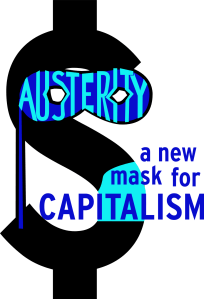 3. DEREGULATION. Reduce government regulation of everything that could diminish profits, including protecting the environment and safety on the job.
4. PRIVATIZATION. Sell state-owned enterprises, goods and services to private investors. This includes banks, key industries, railroads, toll highways, electricity, schools, hospitals and even fresh water. Although usually done in the name of greater efficiency, which is often needed, privatization has mainly had the effect of concentrating wealth even more in a few hands and making the public pay even more for its needs.
5. ELIMINATING THE CONCEPT OF “THE PUBLIC GOOD” or “COMMUNITY” and replacing it with “individual responsibility.” Pressuring the poorest people in a society to find solutions to their lack of health care, education and social security all by themselves — then blaming them, if they fail, as “lazy.”
Lastly, another aspect of Neoliberal economic policies it that they limit our imagination about how to actually deal with economic problems. Neoliberalism says that the market can solve all our problems, when in fact this is a false solution. The reality is that the State of Michigan is not without insufficient funds, rather it is compromised by how to generate and distribute funds.
If the wealthiest sectors and corporations were adequately taxed, that would generate a massive amount of funds for the state. Another issue is how much money leaves the state of Michigan to pay for US militarism. According to the National Priorities Project, in 2018, Michiganders were paying $18.63 billion dollars to support the US military. Imagine if part or all of that money stayed in the state and was used for the roads, education, environmental clean up, clean energy or affordable housing? The National Priorities Project provides clear trade offs for what the tax money from Michigan that goes to the military could be used for. If we practiced radical imagination we wouldn’t be subjected to the awful neoliberal economic policies being proposed by the West Michigan Policy Forum.
Amash and the threat to the Two Party System
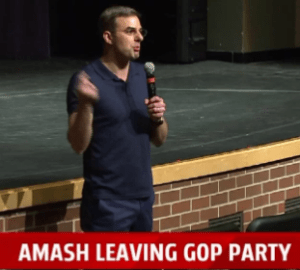 On July 4, 3rd Congressional Representative Justin Amash announced that he was leaving the Republican Party. This announcement has received a great deal of local and national media attention.
Much of the coverage about Amash’s decision to leave the Republican Party refers to his opinion piece from the Washington Post, but most of the coverage is speculative and doesn’t raise larger questions about the two-party political system that dominates US electoral politics.
WZZM 13 ran an interview with Amash on July 5th, an interview that did step outside the normal partisan boundaries, an interview that is worth watching.
In this interview, Amash talks about his decision to leave the Republican Party, his response to the Trump administration and partisan politics. Party politics was one of the questions he responded to, by saying:
What frightens me is people turn into zombies. They go to Washington and they will be telling me stuff privately that is very different from what they say publicly. And I believe you have both parties now falling in line with their respective leadership teams almost 100 percent of the time because they are scared of their leadership teams and they scared of what will happen back home with their primaries and from people at town halls or social media. And that is a very dangerous place for our country to be in. I don’t think we want a system where people just follow one person, follow the leader of their party on everything.
In some ways I agree with this statement from Amash, since the goal of both the Republicans and the Democrats is to have power, not to do what the public really wants them to do.
However, after having written numerous articles about Rep. Amash over the years, I haven’t seen much indication that he operates outside of the systems of power that control electoral politics.
For instance, we all know that from the beginning of when he first ran for the 3rd Congressional seat, Amash has relied a great deal on the financing of the DeVos family and other sectors of financial power, such as Club for Growth. All one has to do is to look at OpenSecrets.org and you can see where his campaign money has come from since 2009.
If one looked at Amash’s voting record, one can see that he doesn’t always vote with the GOP. This is partly because Amash prides himself on being a libertarian and a constitutionalist, but it also has to do with the fact that the 3rd Congressional seat has been a fairly safe seat for Republicans for several decades.
In the interview with Amash, he doesn’t really challenge the two-party system, rather he says that people just need to be more engaged and more educated about the political process. In the end, Amash believes that representative democracy works and that is what he wants to demonstrate as a political independent.
These sentiments by Amash are, in my opinion, naive, since they don’t take into account just how corrupt the political system is. Here is a short assessment of democracy in the US from the late historian Howard Zinn.
This brief assessment from Howard Zinn, is explored in great detail by the political scholar Sheldon Wolin, in his book, Democracy Incorporated: Managed Democracy and the Specter of Inverted Totalitarianism. Wolin states:
The United States has become the showcase of how democracy can be managed without appearing to be suppressed. This has come about, not through a Leader’s imposing his will or the state’s forcibly eliminating opposition, but through certain developments, notably in the economy, that promoted integration, rationalization, concentrated wealth, and a faith that virtually any problem – from health care to political crisis, even faith itself – could be managed, that it, subjected to control, predictability, and cost-effectiveness in the delivery of a product.
Wolin goes on to talk about the function of elections within this managed democracy, saying:
If the main purpose of elections is to serve up pliant legislators for lobbyists to shape, such a system deserves to be called “misrepresentative or clientry government.” It is, at one and the same time, a powerful contributing factor to the depoliticization of the citizenry, as well as reason for characterizing the system as one of antidemocracy.
One addition observation from Wolin, is worth citing.
Unlike the Nazis, who may accurately be described as control freaks obsessed by the need to rule everything, American rulers prefer to manage the population as would a corporate CEO, manipulatively, alternately soothing and dismissive, relying on the powerful resources of mass communications and the techniques of the advertising and public opinion industries.
The last point by Wolin, echoes the analysis of Alex Carey, author of the book, Taking the Risk Out of Democracy: Corporate Propaganda versus Freedom and Liberty. Carey makes the following observation about the 20th Century:
The twentieth century has been characterized by three developments of great political importance: the growth of democracy, the growth of corporate power, and the growth of corporate propaganda as a means of protecting corporate power against democracy.
Carey’s point is spot on, as it relates to the United States, even before Citizens United. It is important to recognize that powerful class interests have always dictated the US political system, whether it was the capitalist class directly running for office or having proxies (candidates) run for office in order to represent their interests.
If Amash thinks that by simply leaving the GOP that he will now have a greater opportunity to change the political system, then he is delusional. Granted, the US political system needs to be radically altered. In fact, one could argue that what needs to change is an entirely new system of governance, one that is based upon self-governance and direct democracy.
As long as we submit to being governed, especially by representatives, the state will shift back and forth as needed between majority rule and tyranny – two expressions of the same basic principle.
We need to develop better forms of governance, forms that are rooted in cooperation, autonomy and radical self-determination. Developing such radical forms of direct democracy are urgently needed. In a globalized world, democracy is simply the operating system of the gated community promising equality and self-determination while legitimizing repression and xenophobia.
 (Graphic used is from artist Melanie Cervantes)
July 4th will be upon us in a few days and people will no doubt be gearing up to have a cook out, bring their families to a parade or watch the fireworks.
As the US gets ready to celebrate Independence Day, with all of its patriotic fervor, we have to come to terms with this country’s history, particularly for communities that have rarely ever been treated as equals.
For me, one of the best critiques that centers around the 4th of July, is a speech that was given by the abolitionist Frederick Douglass in 1852, entitled, What to the Slave is the Fourth of July?
In that speech, Douglass examines and exposes the hypocrisy of American independence, specifically through an abolitionist lens. Douglass identifies crimes and names names in his scathing critique of how the US brutalized black people, while at the same time making massive profits off of them.
Douglass’ most indicting comments during the speech were:
What, to the American slave, is your 4th of July? I answer: a day that reveals to him, more than all other days in the year, the gross injustice and cruelty to which he is the constant victim. To him, your celebration is a sham; your boasted liberty, an unholy license; your national greatness, swelling vanity; your sounds of rejoicing are empty and heartless; your denunciations of tyrants, brass fronted impudence; your shouts of liberty and equality, hollow mockery; your prayers and hymns, your sermons and thanksgivings, with all your religious parade, and solemnity, are, to him, mere bombast, fraud, deception, impiety, and hypocrisy — a thin veil to cover up crimes which would disgrace a nation of savages. There is not a nation on the earth guilty of practices, more shocking and bloody, than are the people of these United States, at this very hour.
If we are to seriously take Douglass’s words to heart, it should not move us to shame, but to action. Let’s make no mistake about it, Douglass’s words are not just about the past, but the present, which is why the current momentum centered around reparations for black people is so vitally important.
However, on top of the horrendous history of how the US has treated black people, today we can see another massive injustice, specifically in how undocumented immigrants are being treated. What we have seen, particularly since September 11, 2001, is a systematic demonization and criminalization of immigrants, particularly immigrants of color.
With the creation of the Department of Homeland Security and its underling, Immigration and Customs Enforcement (ICE), we see a major shit if the treatment of immigrants, particularly undocumented immigrants. The Bush administration deported an estimated 2 million immigrants between 2001 – 2009. The Obama administration then escalated that process and deported roughly 3 million during the 8 years of his administration.
With the Trump administration, the criminalization of immigrants has reach an all time high, both in terms of policy and how this administration has foster a white supremacist, xenophobic climate that has millions of Americans supporting the rounding up, detention and deportation of the 11 million undocumented people living in the US.
So, what is to the undocumented immigrant, the fourth of July?
It means that millions of undocumented immigrants live in constant fear of what might happen to them and their families.
It means that the number of ICE agents has increased during the past two years, in order to target more and more of the 11 million undocumented immigrants.
It means that ICE works closely with local and state law enforcement agencies to terrorize immigrant communities and to justify this treatment on the claim that “they are obligated to cooperate with federal agencies.”
It means that the private prison/detention industry has expanded all across the US, making massive profits from detaining and holding immigrants for ICE.
It means that the conditions of immigrants, both adults and children, who are being held in detention facilities is atrocious.
It means that people picked up by ICE have to come up with a minimum of $5,000 and up to $30,000 to be able to post bond.
It means that those seeking asylum, particularly those that are coming at the US/Mexican border, are abused, tear gassed and detained primarily because they are fleeing political and economic violence.
It means that the system of capitalism is happy, since it generates billions for private corporations to detain, monitor and brutalize immigrants through a wide range of services they provide in cooperation with ICE and Border Patrol.
 It means that the US will not acknowledge how their foreign policy is displacing people throughout the world, particularly in Mexico and Central America. Decades of US military intervention and trade policy is one of the main causes of people fleeing their homelands and coming to the US. Thus, the US causes their flight and then punishes them for trying to make a better living.
It means that the US political establishment only sees value in immigrants because of their labor, but in no way wants to provide them with dignity, respect and permanent protection.
It means that undocumented immigrants cannot rely on political parties to end the terror and harm directed at them.
It means that those of us who have citizenship privilege should not celebrate the 4th of July, not until all people are truly free. It means those of us with privilege must practice radical hospitality and solidarity with the undocumented community. Only then can we celebrate anything that remotely looks like freedom.
Last week, MLive ran a story about recently proposed legislation in both the Michigan House and the Michigan Senate, which has to do with immigration policy and immigration status.
Some of the proposed bills in the Michigan House are HB 4083 and 4090 and in the Michigan Senate SB 382 and 383. “These bills will increase the state’s ability to assist federal officials and penalize those who purposefully prevent law enforcement from doing their jobs,” according to Senator Aric Nesbitt. In another news source, Nesbitt said:
“Local governments with sanctuary policies protect criminal illegal aliens instead of their own residents,” he said. “This dangerous lawlessness must be stopped.”
Nesbitt, represents the 26th Senate District and has relied heavily on corporate donations during his political career. The other sponsor of the Senate bills is Sen. Tom Barrett from the 24th Senate District. Barrett has relied more on the various Republican campaign committee, but he has also been the recipient of a good chunk of DeVos money ($30,000).
The House Bills, HB 4083 and 4090 are similar to what the Senate Republicans are pushing, but these bills would:
create two new acts called, respectively, the Local Government Sanctuary Policy Prohibition Act and the County Sanctuary Policy Prohibition Act. The new acts would prohibit local laws that prevent local officials from cooperating with federal authorities regarding an individual’s immigration status.
These two bills were introduced by Rep. Pamela Hornberger and Rep. Beau Matthew LaFave. Hornberger’s number one campaign funder since she was first elected in 2016, is the DeVos family. LaFave has relied more on Republican campaign committees and PAC money.
Some Democratic State Legislators have also introduced legislation that provides somewhat of a counter to the proposed Republican bills, specifically HB 4724, which was introduced by Rep. Abdullah Hammoud.
The bill package “sets the tone for the kind of state we want to be,” Hammoud said in a statement. “Michigan should be a state that welcomes and promotes our diversity…By establishing a welcoming environment for all, we can attract talent from across the nation and globe to make Michigan their home.”
This is an interesting statement since it does not focus on the safety of the immigrant community, nor does it acknowledge the tremendous harm being done to the undocumented immigrant community by ICE arrests, detention and deportations.
While I find it encouraging that these bills as limiting local law enforcement’s role in cooperating with ICE agents, it is too early to tell what this will actually mean or if it even stands a chance of passing in the Republican controlled legislature.
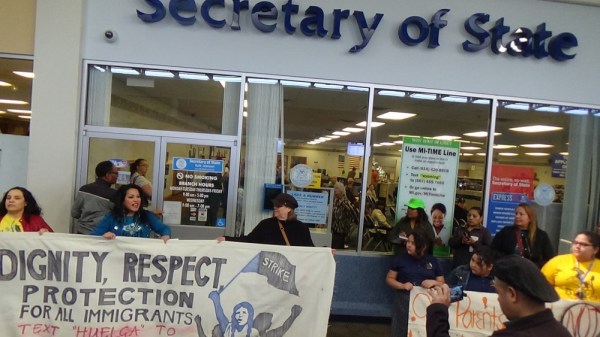
More importantly, what is missing from this MLive article is the fact that communities all across the state are resisting ICE violence. The fact is that this “debate” about current immigration policy has been led by organized immigrant communities throughout the state, along with groups of allies who have partnered with immigrant communities and immigrant-led organizations.
For example, last Friday, Movimiento Cosecha GR and GR Rapid Response to ICE released a statement on the one year anniversary of their End the Contract campaign. This statement includes a summary of all of the Abolish ICE work they have done in the past 12 months. (see below)
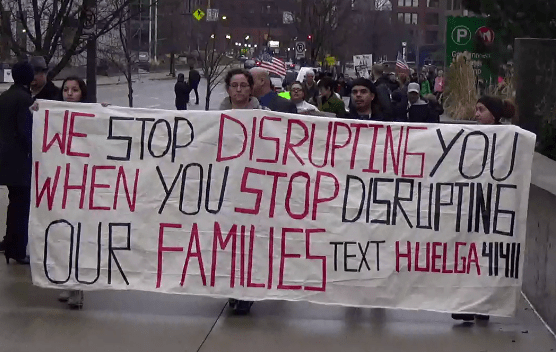
This summary of all the work these two groups have done in Kent County not only makes them the experts on what the immigrant and undocumented communities really want, but it makes it clear that they are not waiting around for politicians to propose legislation, which may or may not keep them safe from state violence. It is instructive that MLive uses a photo of the most recent May 1st march organized by Movimiento Cosecha GR, but then never cites them or the impressive work they have been doing on the ground to oppose ICE violence.
A Year of Resisting ICE in Kent County
June 28th marks the one-year anniversary of the #EndTheContract Campaign, launched by Movimiento Cosecha GR and GR Rapid Response to ICE to end the contract between ICE and the Kent County Sheriff’s Department.
As the country once again erupts in outrage over the inhumane treatment of our immigrant neighbors, at the border and in our local communities, we want to note the successes and achievements of this campaign.
On June 28th, 2018, more than 200 people packed the Kent County Commission meeting and let the community know that ICE had maintained a contract with the Kent County Sheriff’s Department since 2012. Storming the floor of the Commission chambers, the #EndTheContract campaign took over the meeting and turned it into a forum where immigrant voices were centered as they talked about the fear of constantly living with the threat of ICE arrests, detention, and deportation.
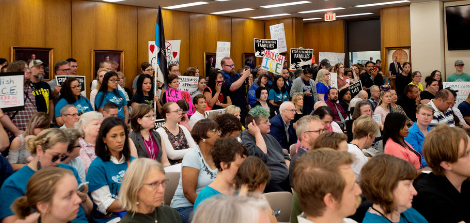
In the past 12 months, our collective efforts have made it possible for tens of thousands to know about the lived experiences of the immigrant and undocumented community as they live under the terror of the ICE within Kent County.
• At 12 different County Commission meetings, we offered numerous testimonies on ICE violence in this community and provided a list of demands, from ending the contract and ending any cooperation with ICE to supporting the Drivers Licenses for All Campaign.
• We collected over 2,000 signatures on our petition to #EndTheContract.
• We held a People’s Commission where the people themselves voted to End the Contract, since the County Commission wouldn’t.
• We rallied at both the Kent County Jail and at the home of a Kent County Commissioner.
• During the course of these actions, we generated dozens of news stories, both local and national, about the campaign to #EndTheContract with ICE.
• We organized several actions that exposed and confronted ICE at numerous office locations in our community.
• We participated in the national #NoBusinessWithICE day in October.
• We worked with the ACLU and MIRC to expose the unjust practices of ICE in Kent County and to let County officials know that they did NOT have to comply with ICE.
• With the ACLU and MIRC, we helped expose the GRPD’s involvement with ICE, which also received national news coverage.
• Due to our constant pressure, in January of 2019 the Kent County Sheriff’s Department changed their policy on ICE Holds.
In addition, since this date last year:
• We attended numerous City Commission meetings with a list of demands and even shut down one meeting because of the blatant collusion between ICE and the GRPD.
• We partnered with two community-based African American organizations to work in solidarity with these groups to expose police violence against Black and brown communities.
• We held a dozen press conferences.
• We did several banner drops.
• Along with other community groups, we were able to pressure the Civilian Appeals Board to reverse the decision by the Grand Rapids Police Department’s investigation of Captain VanderKooi, the ICE liaison who called ICE on a U.S. citizen.
• We provided funding to several families who needed to bond out family members held by ICE.
• We raised over $24,000 to provide support to immigrant families who have been impacted by ICE violence.
• We held numerous GR Rapid Response to ICE trainings in order to build capacity.
Of course, this list does not include all the meetings, support roles, planning, and volunteer organizing hours that many people invested to support this movement in Kent County to #AbolishICE. We are deeply grateful for everyone who contributed to this movement.
Believing that movements like this that center the leadership of the affected community are the most effective way to success, we know that the work and the struggle must continue!
Betsy DeVos encourages Community College graduates to be selfless and then talked a lot about God
 On Tuesday, Secretary of Education Betsy DeVos gave a commencement address for graduates from Tulsa Community College’s Second Chance program. The Second Chance program is a collaboration between Tulsa Community College and several jails/prisons in Oklahoma and was created in 2007.
The Second Chance program has received pell grants from the Department of Education beginning with the Obama administration and now the Trump administration wants to make it permanent.
Betsy DeVos’s comments during the commencement were not particularly enlightening and she said nothing about the fact that the US has more people in jail/prison that any other country on the planet. In fact, DeVos had no critique of the Prison Industrial Complex, instead she chose to focus on what the individual student who participated in the program could achieve. A lack of an systems analysis has been the norm for the current Secretary of Education, since she believes that everyone has the ability to make it on their own.
There were a few comments from DeVos’ commencement address that are worth discussing. First, she says:
And you’ll contribute to an economy—the strongest it’s been in years! There are about 8 million unfilled jobs today. Small businesses are opening at record numbers. Wages are growing and unemployment is shrinking—for everyone. Our economy is expanding faster than anyone predicted.
Remember, these are students who were taking classes in jail/prison, so getting hired is not an easy thing for people with a criminal record. In addition, DeVos does not back up her claims about the economy being strong and wages going up. This is because it just isn’t true. Wages have only grown in a significant way for the 1% and the .01%, according to the site Inequality.org.
Secondly, DeVos talks a great deal about God in the later part of the commencement speech, saying things like people are born in the likeness of God or that whatever talents people have are God given. To make matters worse, she then cites convicted criminal turned evangelical christian, Charles Colson as an example of someone who was “redeemed.”
 Using Charles Colson as an example of redemption is instructive, especially since Colson embraced the same kind of far right christian values that Betsy DeVos has. While alive, Charles Colson spoke out against gay marriage, against women’s reproductive rights, he endorsed US wars abroad and he was a frequent speaker for the pro-patriarchy group, The Promise Keepers. Thus, using Colson as an example of “redemption” was just another way of for DeVos to inject conservative religious values into her speech.
Lastly, near the end of her speech, the Secretary of Education encouraged the students to be “selfless.” Now, where I come from, the idea of being selfless means that you give of yourself for others and don’t do things to put yourself first. How is it that Betsy DeVos, who is from a millionaire family and married into a billionaire family, who owns jets, yachts and numerous homes, how can she encourage selflessness, when clearly she is part of the billionaire class?
The Immigration Crisis, Whiteness and the Power of Direct Action and Movement Building
 “Nobody in the world, nobody in history, has ever gotten their freedom by appealing to the moral sense of the people who were oppressing them.” Assata Shakur
Since President Trump announced that his administration would begin to round up and deport thousands of immigrants, communities all across the US have been taking action in preparation for the newest wave of ICE repression.
There are groups providing lots of Know Your Rights documents to distribute in the community, there are reports of some places announcing that they will offer sanctuary to individuals and families in the immigrant community, and there are numerous groups doing Rapid Response to ICE work letting people know that if they see ICE in their neighborhoods or at their workplace to call designated numbers to mobilize people in response. These are all useful and important tactics for people to engage in.
There has also been a great deal of social media responses that make you want to scratch your head and at times force us to painfully acknowledge that there are lots of white folks who either don’t get it or who are stuck in the same knee-jerk responses that have done very little for the immigrant and undocumented communities in the past.
When I say “social media responses that make you want to scratch your head,” I mean things like people pointing out that the Right to Lifers don’t seem to care about the plight of immigrant children in US detention camps. It is true that most Right to Lifers don’t care about immigrant children, but such a statement does nothing to move us to act in solidarity with immigrant children and families. What such a statement about Right to Life ends up doing, is usually just making us feel superior or staying in the Liberals are good, Conservatives are evil camp.
Another knee-jerk response to the current immigration crisis is to want to find a quick fix solution. These kinds of responses are common place because they are predicated upon the idea that there must be an easy solution that allows me (White people) to not have to risk anything or continue to allow me to engage in White Savior Politics. Is there a petition to sign or is there a group I can send money to so they can make the problem go away and I can feel special because I did something? So, what do these kind responses mean and how can we potentially bring those people into the immigrant justice movement?
First, we have to stop engaging in White Savior Politics and do some serious self-examination around White Privilege and White Supremacy. Second, sending petitions and calling members of Congress will NOT put an end to ICE/border patrol violence against the immigrant and undocumented communities. Those in power do not care, regardless of regardless of party affiliation, plus they are too politically compromised to take action that would have the results that are needed. Immigration and Customs Enforcement (ICE) is part of the Department of Homeland Security, which was created just after 9/11 with near unanimous Congressional support. There is a great deal of money to be made from how the Department of Homeland Security functions and very few politicians who want to take that on.
Third, there is no easy solution and no quick fix to the immigration crisis, which is really a crisis created by the systems of power in the US, both electoral and private. Therefore, we need to build powerful social movements to challenge and dismantle the existing systems of oppression that are being utilized to criminalize immigrants. In fact, there are groups and movements all over the country right now that are focused on immigrant justice. Groups like Mijente and Movimiento Cosecha are both immigrant led movements and those are the kinds of movements that those of us who are not part of the immigrant/undocumented community should look to for leadership. Also, it is important to note that building a powerful movement for immigrant justice will not be created overnight and will need to develop over time if it is to be effective. There may be revolutionary moments or openings that allow us to make major changes in a short period of time, but those moments are rare and the changes that come are often not lasting.

In order to build powerful movements there are numerous things that need to happen and since people like lists, I will provide yet another list of things that people can do in the Grand Rapids area to Abolish ICE and to be part of the immigrant justice movement.
- The immigrant justice movement must be led by those who are most impacted by ICE violence, thus this movement should be immigrant led.
- Educate yourself on the history of US immigration policy. A good place to start is by reading American Intolerance: Our Dark History of Demonizing Immigrants, by Robert Bartholomew and Anja Reumschuessel.
- We need to recognize that quite often US foreign policy is the root cause of so many people fleeing to the US. US military and trade policy has caused tremendous harm around the world and that harm has displaced people. Therefore, if we want to get to the root of the problem, we need radically alter US foreign policy.
- Familiarize yourself with the recent Immigrant Rights Movement in Grand Rapids, which we have been documenting in Part I and Part II.
- Support and get involved in the work of Movimiento Cosecha GR – donate money, attend general meetings, attend a Cosecha Ally Training and follow them on Facebook at www.facebook.com/cosechagr/.
- Get involved in the work of GR Rapid Response to ICE. Attend one of their regular trainings. Donate to the mutual aid fund, which directs money to individuals and families affected by ICE. Join their Abolish ICE campaign. Follow them on Facebook at www.facebook.com/RapidResponseGR/.
- Share the GR Rapid Response to ICE, “If you see ICE in your community or if ICE comes to your home” information. See graphic below.
- Learn about and participate in the Direct Actions in Grand Rapids, actions that are often organized by Movimiento Cosecha GR and GR Rapid Response to ICE. Direct Actions means that we take collective action to change our circumstances, without handing our power to a middle person, like politicians, bosses or cops.
- Bring friends, co-workers, members of your faith community or neighbors to an action organized by Movimiento Cosecha GR and GR Rapid Response to ICE.
- Ask your faith community to be a sanctuary for members of the undocumented immigrant community. Providing sanctuary is a great way to practice solidarity and it is a form of direct action that says that we will not allow ICE to do harm to our fellow community members. Right now we only have 1 declared sanctuary in the greater Grand Rapids area.
- Get trained in crowd safety, so that you can actively support the immigrant community when they engage in public actions. Contact Movimiento Cosecha GR for the dates of the next crowd safety training.
- Get your friends together or ask them online to donate money to Movimiento Cosecha GR and GR Rapid Response to ICE.
- Offer your skills/abilities to the immigrant justice movement – art work, transportation, media skills, translation skills, time, money, food and child care.


