FOIA documents were requested from the GRPD in September: Why is it taking so long?
 On September 16th of this year, I submitted a Freedom of Information Act (FOIA) request to the Grand Rapids Police Department regarding the May 1st, 2019 march that was organized by Movimiento Cosecha GR.
When submitting the request, I was asked by the GRPD if I wanted all GRPD communications or just those from the Command Unit. I chose just the Command Unit, since they are the ones giving the orders and to avoid the often repetitive nature of FOIA requests.
This is how the GRPD responded to my specific request, which clarified the scope of their monitoring and response to Movimiento Cosecha GR’s May 1st march:
All emails, texts, memorandum, reports or other public records including but not limited to communications from/to GRPD Command Staff personnel and other Command Staff GRPD personnel and from/to GRPD Command Staff personnel and other law enforcement agency including ICE, HSD, MSP, KCSD and Wyoming PD from April 15 to May 2 regarding May 1, 2019 Movimiento Cosecha GR March from Garfield Park to Pinery Park.
I was told that I would receive a response by September 30th, with an estimated cost for the FOIA request and the number of pages the GRPD had on the May 1st action.
On September 25th I received an e-mail from the GRPD that stated that the estimated cost for this FOIA request would be $578.64. I then sent another e-mail asking how many pages this included and their response was, “350 pages, plus attachments.”
In addition to the total estimated cost for the FOIA, they sent me a breakdown of the costs for gathering the information by a clerk with the GRPD and then having someone redact (black out) information they consider too sensitive for the public to see. Here is the breakdown of the cost they sent me.

A group of allies in support of Movimiento Cosecha GR raised the money for the FOIA request, so I went down to the police station to paid 50% of the estimated cost on October 15th. The person I gave the money to, then gave me a receipt and a letter stating that I would be able to obtain the documents within an estimated 20 business days from the date of the first payment…..October 15.
I was then told by the GRPD that 20 business days landed on Nov. 13, so I sent another e-mail asking if I could come by on November 14th or 15th with a thumb drive to obtain the FOIA documents and pay the balance. The GRPD’s response was, “No problem. Once I email you the final invoice, you can come in any time after that and pay the remained of the cost. I’ll have the records ready.”
I asked for clarification on November 13th on how long it might take. The GRPD responded on that same day saying, “The records are being reviewed by my Captain so it won’t be much longer.”
I sent two more e-mails asking if the documents were ready and I received no reply. After talking with Movimiento Cosecha GR, we decided that it would appropriate to show up in person asking if the documents were ready and what it was taking so long.
On Wednesday, November 27th, several of us went to the police station in downtown Grand Rapids and walked up to the window where I had paid half of the estimated cost. I showed them the receipt and the letter they gave me stating it would be an estimated 20 business days and said that 20 business days was two weeks ago. We were told in a rather condescending tone that “it was an estimated 20 days” and “we will send you a message when it is ready.”
Ok, so according to the cost document shown above, it took a clerk 1 hour to collect all of the data and an estimated 15 hours for a captain with the GRPD to redact the documents. Again, I ask, why is this taking so long, since as of today, the documents have still not been released, which was two and one-half weeks ago from the estimated time of completion?
Of course, once the documents are obtained, we will provide some analysis of what they contained. In the meantime it is important for people to think about why the GRPD would have 350 pages (plus attachments) about a non-violent march from May 1st of the 2019, a march that was organized by Movimiento Cosecha GR. Hasta La Huelga!!!
MLive just can’t help but act as a stenographer for the DeVos family
 On Monday, MLive posted a story with the following headline, DeVos family earns spot on Forbes’ list for donating $112 million.
The article, like so many we have documented over the years, provides an unquestioning forum for the DeVos family and allows them, once again, to be seen as generous people.
The MLive article is based on a Forbes magazine list of the top 50 people who donate in the US. The DeVos family ranks 26th on the list, along with other members of the capitalist class, including Bill & Melinda Gates, the Walton family, Jeff Bezoz, Mark Zuckerberg, Michael Bloomberg, Warren Buffet, George Soros and Charles Koch.
The problem with such innocuous lists is that they never question:
- How these people became so wealthy
- These lists don’t make comparisons to how much money these people contribute to candidates or political parties
- And they never question what role rich people’s philanthropy plays within a larger political, economic and social framework.
Members of the Capitalist class become disgustingly rich because they exploit other people’s labor. Sure, some of these people were born into wealth, but that hasn’t stopped them from buying politicians that provide massive subsidies for their companies and to get politicians they have bought to pass policies that create tax structures that benefit those with the most wealth.
The only two entities that received funds from the DeVos family foundations, mentioned in the MLive article, were Spectrum Hospital Foundation and Grand Valley State University in 2018. There is no exploration into why the various DeVos foundations contributed the amount of money they did and there is no questioning of what strategic role this money plays for the DeVos family.
If we go back and look at the examples of the Rockefeller family or Andrew Carnegie, when were some of the first foundations were created, we know from that history that their wealth was much more scrutinized, even when it was used for philanthropic purposes. (see Foundations and Public Policy (Joan Roelofs) and The Revolution Will Not Be Funded (edited by INCITE!)
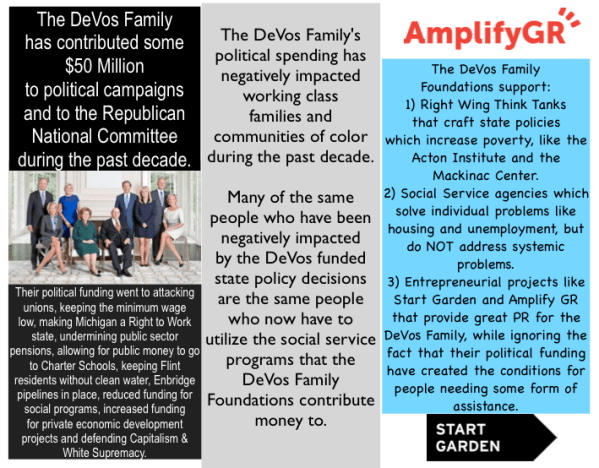
Those who create foundations are not giving money away to be generous, their philanthropy is strategic. Those with wealth use philanthropy to either distract people from asking questions about why those with wealth are so wealthy or to fund projects that fit within their ideological framework. For instance, the DeVos foundation contribute to conservative christian groups that embrace their worldview, to social service agencies that focus on individual solutions to issues like poverty, and to organizations that do public policy work that serves the interests of the DeVos family, like the Acton Institute, the Mackinac Center for Public Policy and the American Enterprise Institute.
Therefore, to report on the DeVos family philanthropy without exploring the deeper implications of why the contribute does a disservice to the public and demonstrates how MLive will not challenge the DeVos family influence in West Michigan.
New Hospitality & Tourism Academy at GRPS fits with the business community’s emphasis on developing workforce talent in West MI
 Below is a video statement from the group Grand Rapids for Education Justice (GREJ) that addresses one of the new GRPS Academies, specifically the Hospitality & Tourism Academy.
By submitting a FOIA, the GREJ was able to obtain an overview of the Hospitality & Tourism class that will be offered through the Grand Rapids Public Schools. You can go to this link to read the overview of the class, as well as objectives and learning outcomes.
This is just one of the Academies that the GRPS is offering, along with media and one that will introduce students to law enforcement and the military.
These types of courses are being crafted to fill, what those in the Neo-Liberal Education model refer to as “the talent gap.” In recent years there has been a much bigger push within the business community to try to influence and work with the education system to provide information and training to students that will provide employers with a larger pool of workers to fill positions in various industries.
There are numerous business groups that have been working with the Grand Rapids Public Schools to introduce and develop more and more classes that prepare students to enter the workforce. There are groups like Talent 2025, which is made up of CEOs from West Michigan who are wanting to till the talent gap.
There is also the West Michigan Policy Forum, a group that is made up the most influential and powerful business and business leaders in the area. They push for state policy changes on many areas and one of those areas is education reform or as they say Talent. The West Michigan Policy Forum wants to:
• Encourage the development of consistent K-12 and higher education metrics
• Expansion of college credits for work experience
• Require funding for state economic development and workforce agencies to align more closely with private sector efforts in talent development initiative
• Reform of Teacher Evaluation
Another group is Believe 2 Become, which was created by funding from the Doug & Maria DeVos Foundation. Believe 2 Become produced a report in 2017 called, Workforce Opportunity in West Michigan: Connecting A Qualified Workforce to High-Growth Opportunities.
The video statement from GREJ challenges the notion that students are merely talent and that education should first and foremost provide students with robust critical thinking skills, as well as how to be civically engaged in the world.
 It is rather instructive how mainstream corporate news media chastised Kanye West in 2005 for his critical comments about President Bush’s failed response to hurricane Katrina, but now, when West is praising President Trump and embracing religion, he is now someone with depth.
This was certainly the tone that the Acton Institute founder, Rev. Robert Sirico, took while being interviewed on Fox News a week ago Sunday. In a five and a half minute interview on Fox News, Rev. Sirico made some very instructive comments about Kanye West and the context of West being at pastor Joel Osteen’s mega-church.
The Fox commentator asked Rev. Sirico if Kanye West’s conversion was encouraging. Rev. Sirico said that he was encouraged because he felt Kanye’s conversion had some depth, but then went on to say he was concerned that the singer had appeared with Joel Osteen.
Osteen preaches a prosperity gospel, where those with wealth are seen as being blessed by God. The prosperity gospel is in many ways a more recent manifestation of Calvinist teachings, plus Osteen and those who embrace this brand of religion are staunch defenders of capitalism. Being that the prosperity gospel movement celebrates wealth and capitalism, one would think that the Acton Institute’s founder would be a fan, especially since the Acton Institute is essentially an apologist for religion and the free market.
Rev. Siroco continues by saying that he is “impressed” with Kanye West’s intellect and seriousness, but then follows those comments up right away by stating that he hopes that West will, “get the right people around him.” Sirico doesn’t qualify what he means by that, except to say that what he finds wrong with the culture today – the materialism, over-sexualization and disrespect for the dignity of life. Again, Rev. Sirico is rather vague on what he means by materialism and disrespect for the dignity of life, but such comments are rather confusing or contradictory when the founder of the Acton Institute praises the like of Betsy DeVos and Erik Prince, siblings that swim in materialism and don’t respect the dignity of people of color or non-christians.
Rev. Sirico then talks about people having deep conversions, like St. Paul and Dorothy Day. Now Dorothy Day was the founder of the Catholic Worker movement, which preached a simple life, non-violence and the evils of capitalism. It is interesting that Sirico would name Day as an example of miraculous conversion, since she would be in complete opposition to what Rev. Sirico and the Acton Institute are about.
The Acton founder then is asks if this demonstration of faith by West is the “start of something else?” Sirico again gushes with praise over the reaction to Kanye West’s album and the potential it has to reach people who have rejected faith. However, Sirico qualifies is comments by saying that the conversion needs to be rooted in depth and authenticity. It seems that Sirico is providing himself an out, in case the converted Kanye West doesn’t live up to the kind of person of faith that Rev. Sirico considers to have depth and authenticity, such as the Betsy DeVos and Erik Prince (Sirico presided over Erik Prince’s marriage).
In addition, Rev. Sirico’s qualifying comments about Kanye West’s conversion further demonstrates his embrace of white supremacy. Sirico would never question the sincerity or authenticity of white people’s faith. Take for instance the members of the Board of Directors at the Acton Institute. It is not surprising that the Acton Institute’s board is made up of a bunch of white, wealthy christians, christians whose faith is not questioned, nor does it come with qualifiers about authenticity or calls for these people to surround themselves with the right people. (right people is code for white people)
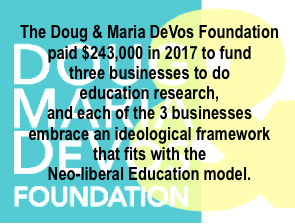 Recently, the group Grand Rapids for Education Justice, submitted a Freedom of Information Act request with the Grand Rapids Public Schools to get information on several issues.
One issue that the GREJ was interested in was funding, specifically funding that comes from either the business community or area foundations. You can see the entire document at this link.
However, there was one example that stood out in this FOIA’d document. The Doug & Maria DeVos Foundation contributed $243,000 to pay for the services of three separate entities that do “research.” The three organization, with the amount they received are: Cambridge Education $80,000, Basis Policy Research $90,000 and Tripod Surveys $72,150. In addition, the remaining $850 could be used by the GRPS at their discretion.
Cambridge Education
According to a 2011 MLive article, “Cambridge is affiliated with Mott MacDonald, an employee-owned management, engineering and development consultancy serving the public and private sector around the world based in the United Kingdom.”
This is not the first time that the DeVos family has paid for Cambridge Education to come to Grand Rapids and influence what happens at the GRPS. In an article from Jack Prince, posted on this site inJune of 2018, Prince writes:
Cambridge was sent to GRPS as a gift from the DeVos’ in April of 2012. As a result of a private paid business led audit of GRPS, Cambridge Education revealed that the district needed to restructure. In August 2012, the audit done by Cambridge Education revealed the district needed to restructure to deliver a better education to students reflecting current student population and to save money. That December the school board approved superintendent Neal’s district restructure known as the transformation plan. It should be noted that the origin of this so called restructure plan was a private for-profit company and not the result of some personal educational philosophy and awareness of superintendent Neal. Somehow this plan became her plan when the name was changed to the transformation plan. Almost immediately the newly named plan garnered the support of local conservative politicians. “State Rep. Lisa Posthumus Lyons R Alto and Sen Dave Hildenbrand R-Lowell Twp. have written letters supporting the Grand Rapids superintendent and school board’s planned major overhaul of the district to improve achievement and finances.”
The FOIA document doesn’t indicate what exactly Cambridge Education was hired to do in 2017, but based on the previous work they did, they played a major role in restructuring the GRPS and creating what the GREJ has identified as a two-tiered school system.
Basis Policy Research
We have a better idea of what Basis Policy Research did with the $90,000 they received from the Doug & Maria DeVos Foundation to provide a service for the Grand Rapids Public Schools. According the Basis Policy Research website, it states:
Adults without a high school diploma are more likely to face limited employment opportunities and a lifetime of poverty. Educators are looking for ways to identify students who are at risk of dropping out and match them with interventions that can get them back on track. Grand Rapids Public Schools recently partnered with Basis to develop a customized, student-level early warning system that uses dropout risk factors to predict the likelihood that a student will fail to graduate: the Opportunity Index.
Our partnership with Grand Rapids Public Schools resulted in the Opportunity Index, which tracks both a student’s progress towards graduating on time as well as their likelihood of being ready for success after high school (often called “college and career readiness”). It focuses on early warning indicators of a student’s progress towards these dual goals using scorecards that pinpoint each student’s progress from kindergarten through high school. Educators and parents are using this tool to identify students for support and to be able to target resources so that more students graduate on time and prepared for success. In an extension of this work, we also partnered with the Doug and Maria DeVos Foundation to facilitate conversations around these scorecards among educators, parents, and students.
When you go to click on the Opportunity Index link, it takes you to the DeVos-funded group Believe 2 Become. However, that link says, WE COULDN’T FIND THAT PAGE.
In addition, Basis Policy Research has three offices around the country and one of them is in Grand Rapids, specifically at 1059 Wealthy SE, Grand Rapids. I have called their Grand Rapids office on several occasions in the past week and the phone just rings, without going to voicemail. What kind of a business doesn’t provide people with an opportunity to leave a message? I also sent them an e-mail more than 2 weeks ago and still have not received a response.
One of the main researchers with Basis Policy Research is David Stuit, who is originally from Grand Rapids. Besides working for Basis Policy Research, Stuit seems to be rather connected to the Charter School industry. Stuit has a page on the website of the National Alliance for Public Charter Schools, an organization which has received millions from the Bill & Melinda Gates Foundation and the Walton Family Foundation, both of which have made it a priority to fund Charter Schools and private schools.
The National Alliance for Public Charter Schools has also spent a great deal of money lobbying Congress on education policy that would benefit the Charter School Industry.
Tripod Surveys
Tripod crafts surveys for students in order to evaluate their teachers. Some of the staff with Tripod used to work for Cambridge Education and it appears they operate from the same ideological framework.
One teacher evaluation site we came across says:
In a study recently released in the esteemed American Educational Research Journal (AERJ), and titled “What Can Student Perception Surveys Tell Us About Teaching? Empirically Testing the Underlying Structure of the Tripod Student Perception Survey,” researchers found that the Tripod’s factor structure did not “hold up.” That is, Tripod’s 7Cs (i.e., seven constructs including: Care, Confer, Captivate, Clarify, Consolidate, Challenge, Classroom Management; see more information about the 7Cs here) and the 36 items that are positioned within each of the 7Cs did not fit the 7C framework as theorized by instrument developer(s).
While this is just a snapshot of the three companies that were paid for by the Doug & Maria DeVos Foundation, it demonstrates that they prefer to use their money to fund entities that are antithetical to public schools and public education. The big question is, why does the Grand Rapids Public Schools agree to utilize the paid for resources from the Doug & Maria DeVos Foundation and what does this mean for the future of the GRPS?
Interview with Levi Rickert: New photo exhibit on Standing Rock being hosted at the Grand Rapids African American Museum and Archives
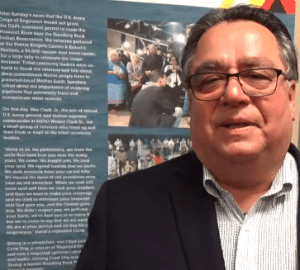 We recently did an interview with Levi Rickert, who is the Publisher/Editor of Native News Online. Like so many indigenous people, Levi went to Standing Rock in the fall of 2016, to be part of the resistance to an oil pipeline that would go through tribal land in North Dakota.
In the interview we talk about what inspired him to put together a photo exhibit, what kinds of things stood out to him while being at Standing Rock, how that resistance is connected to indigenous resistance to pipelines across the country, even Line 5 in Michigan, and why this history is so important to show and talk about.
The exhibit is now up at the Grand Rapids African American Museum and Archives and will be up until December 7.
New Sanctuary Schools Toolkit provides school districts with an opportunity to practice solidarity with immigrant families
 At the beginning of 2019 school year, the Detroit Public Schools formally adopted a school sanctuary policy. The policy essentially means that Immigration & Customs Enforcement (ICE) cannot come into Detroit Public Schools to look for or to apprehend undocumented immigrants who may be parents or employees of the school district.
The formal Detroit Public School Sanctuary states in part:
School personnel must not allow any third party, including, but not limited to, officials from U.S. Immigration and Customs Enforcement (ICE), U.S. Customs Border Protection (CBP), or federal immigration enforcement agencies or similar agencies access to a school site or District facility without a request submitted to the building site administrator and approved by the Office of the Superintendent and General Counsel.
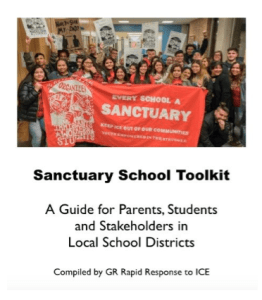
Following this example, the group GR Rapid Response to ICE, has created a toolkit for those wanting to adopt similar policies in school districts in the Greater Grand Rapids area.
The toolkit is designed for parents and other stakeholders in the community who want to take the initiative to get the school district where their children attend or where they live, to adopt a sanctuary school policy to: 1) take concrete action to support immigrant families who live in constant fear of government entities like ICE wanting to do them harm, and 2) to send a message ICE officials and other law enforcement agencies who collaborate with ICE in order to do harm to immigrant families.
The GR Rapid Response to ICE toolkit consists of ideas for parents and other community members, legal information, examples of what other school districts have done, what it means to be a sanctuary school and what else people can do when they encounter ICE agents in their community.
Here is a link to the Spanish version of the toolkit. You can access the toolkit here, but if you have questions for GR Rapid Response to ICE, message them on Facebook at https://www.facebook.com/RapidResponseGR/. Also, please let GR Rapid Response to ICE know if you have begun a campaign in your school district.
Grand Rapids for Education Justice responds to the Grand Rapids School Board with video
Last week, we reported on the Grand Rapids School Board meeting held on Monday,  November 4.
The group, Grand Rapids for Education Justice (GREJ) had presented a series of issues back in October and wanted a response from the board within a month, which was last Monday’s school board meeting.
Several members of GREJ presented at last week’s school board meeting and you can read those comments at this link. However, the Grand Rapids School Board did not provide a response to the issues that GREJ had raised in October, neither in the agenda or in their comments at the end of the school board meeting. Several school board members did have something to say to the GREJ, even though those comments did not address the concerns raised, as you can see at the end of the taped school board meeting for November 4.
In a formal response to the Grand Rapids School Board’s failure to address the concerns brought by GREJ in October and in response to the comments from some school board members, GREJ provided this video response.
Betsy DeVos Watch: A Detroit educator responds to the Secretary of Education’s awful comment about Detroit Public Schools
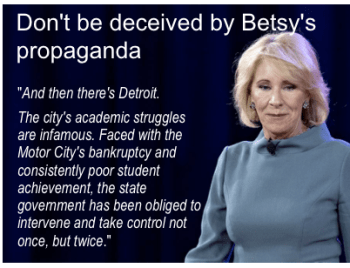 Last week, Secretary of Education, Betsy DeVos, gave a speech on the 2019 National Assessment of Education results.
In that speech, DeVos referenced several school systems across the US. However, her most damning comments were directed at the public schools in Detroit.
What is worth noting is that Betsy DeVos, along with the rest of the DeVos family has contributed millions of dollars to Republican legislators, many of which have been attacking the Detroit Public Schools for decades and in 2016 were calling for the Detroit Public Schools to dissolve.
This is all well documented in a 2016 Michigan Campaign Finance Network article, Big Donors Have Been Big Players In Fight Over Detroit Public Schools Turnaround.
In fact, the organization that Betsy DeVos created in 2001 to push her privatized education agenda, the Great Lakes Education Project (GLEP), was also calling for the Detroit Public Schools to dissolve. You can see from the graphic below that GLEP has also contributed significantly to (mostly) GOP legislators who are supporting what GLEP is calling for.
 DeVos’s rhetoric on this issue is important, so we asked a Detroit educator, Kaitlin Popielarz, to weigh in on this issue. What follows is a clear deconstruction of what Secretary of Education, Betsy DeVos, had to say about Detroit Public Schools in her speech from October 30th.
Betsy DeVos: And then there’s Detroit.
The city’s academic struggles are infamous. Faced with the Motor City’s bankruptcy and consistently poor student achievement, the state government has been obliged to intervene and take control not once, but twice.
Kaitlin: In Detroit, we know that the state-takeover in 1999 and 2008 was due to austerity policies enacted by Governors Engler, Granholm, and Snyder, and backed by DeVos through venture philanthropy, paid-for legislation, and the corporatization of the public good. Detroit Public Schools were successful for decades before forced state intervention. In Detroit, we know that emergency management of Detroit through forced state takeover has only wreaked havoc on the stability of Detroit public schools and communities. DeVos has worked for decades to dismantle Detroit public schools and Detroit’s teachers unions to no avail. Detroit continues to resist through grassroots community mobilization and organization. Significantly, Detroit students continue to excel and achieve within academics, the arts, STEM, athletics, and service. Many young people in Detroit are also involved in grassroots organizations, such as Detroit Area Youth Uniting Michigan (DAYUM), in order to work toward intersectional social justice within education.
Betsy DeVos: Still today, more than 90 percent of Detroit’s community schools’ eighth graders cannot read at grade level.
Kaitlin: In Detroit, we know that NAEP scores, along with other state and nation-wide high stakes standardized test results, are often conflated and misunderstood. Education “reformers” like DeVos utilize the NAEP scores to advocate for harmful education reform efforts that privatize and charterize public education and the public good. In Detroit and across the country, educators have critiqued the use of NAEP scores, in addition to other state and nation-wide high stakes standardized testing practices, which push harmful policies and reforms upon predominantly low-income Students of Color:
https://www.brookings.edu/blog/brown-center-chalkboard/2016/06/13/the-naep-proficiency-myth/
https://morganpolikoff.com/2015/10/06/friends-dont-let-friends-misuse-naep-data/
Betsy DeVos: Things have gotten so bad there that students and families are suing for a right to read.
American students should not have to sue their way to literacy—to learning.
Kaitlin: The right to literacy lawsuit largely names and challenges many of the education “reforms” that DeVos has implemented for decades in Detroit and in Michigan. The right to literacy lawsuit is a direct critique of the education “reforms” that DeVos advocates and implements, which only further exacerbates systemic racial and socioeconomic segregation within public education. For more information on the literacy lawsuit and what it’s actually fighting for, please see these links:
https://sites.google.com/view/detroitequity/resources/right-to-literacy
https://www.detroit-accesstoliteracy.org
These are the kinds of well thought out, reasoned and well sourced responses we need when responding to the propaganda of the Neo-Liberal Education Model that DeVos and others are using on a daily basis.
Now that the elections over in Grand Rapids, maybe we can focus on trying to make structural changes for collective liberation in this community
 It is the day after election results have come in and for Grand Rapids, one could argue that those who voted, voted for progressive candidates. Mayor Bliss was re-elected in a race that included an anti-abortion, christian minister, who practices misogyny and believes that women don’t get to control their own bodies.
In the 2nd ward race, voters chose Milinda Ysasi over Wendy Falb. Ysasi is the first Latina to be elected as a city commissioner in Grand Rapids. Falb had the backing of the GR Police Union to the tune of $10,000.
In the 1st ward race incumbent commissioner Jon O’Connor barely edged Allison Lutz. Lutz ran on a more progressive platform around challenging gentrification, advocating for housing justice and supporting immigrant justice. O’Connor was also backed by the GR Police union ($5,000) and the Realtors PAC MI ($2,000).
Of course, we know that in order to get truly progressive policies, or what I would prefer to call radical policies, there needs to be substantive social movements to push a more radical agenda. It’s great that an anti-abortionist minister didn’t become the mayor of Grand Rapids, but we always run the risk of not pressing those who did win to introduce and push a radical agenda. We cannot be content with just getting progressive candidates, if it doesn’t translate into radical policies, which are really policies that benefit those who outside of the existing power structures in Grand Rapids – communities of color, people who identify as LGBTQ, working class people, immigrants, religious minorities, etc.
You can believe that those who are part of the Grand Rapids Power Structure know the outcome of the recent elections and are poised to push their agenda, which will not benefit the majority of people in this community. For instance, yesterday, the Grand Rapids Chamber of Commerce posted the following message on Facebook:
Congrats to Mayor Rosalynn Bliss, Commissioners Jon O’Connor and Moody, and Commissioner-elect Ysasi for their victories yesterday! We look forward to working with you to support a thriving and prosperous Grand Rapids for all.
Now this sentiment from the Chamber is just a straight up lie. They don’t want prosperity for all, since they have a long history of opposing an increase in minimum wage policies or a real living wage policy. The Chamber of Commerce also has a history of denying climate change, opposing any regulation of the economy and spending millions on lobbying elected officials and buying candidates at all levels of government.
Those who are part of the Grand Rapids Power Structure are not resting after the outcome of the recent election, rather they are already planning on how to strategically use Grand Rapids politicians to support their agenda. This is why we need robust social movements to push radical policies that promote collective liberation. I have been part of numerous social movements over the past four decades and what follows is a proposed agenda that I have learned from over the years from those involved in community organizing and social movement work.
What Do We Want?
Racial Justice
- A massive investment in black communities, with the investment being determined by the black community and not outside interests.
- An educational system that serves the real needs of black, Latino/a, indigenous and all other communities of color.
- Policies that do not punish the immigrant communities, but make them full members of this community at all levels – politically, economically, socially and culturally.
- Reparations for decades of structural racism against the black community, which has resulted in massive profits for White capitalists.
- End mass incarceration in this community, which has disproportionately impacted black and brown communities.
- A recognition that the land where Grand Rapids sits was indigenous and that Grand Rapids is based upon Settler Colonialism.
Public Safety
- The massive budget for the GRPD needs to be significantly reduced and reallocated to neighborhoods to allow them to determine how they want to practice community/public safety.
- End police targeting of black and brown communities, which includes monitoring, patrolling, arrests and detention.
- End all city collaboration with Immigration & Customs Enforcement (ICE)
Economic Justice
- The city should practice participatory budgeting, so that all people who live in the city have a real say in how their tax money will be used. Having the city put forth a budget and then allow the public to weigh in during a small window of time is unacceptable.
- End massive subsidies for development corporations and their development proposals and redirect those funds for people to buy homes or to subsidize rent.
- End the gentrification of Grand Rapids. No development if it results in displacement or pricing people out of a neighborhood.
- A massive housing justice campaign, where there is truly affordable housing for families and individuals, plus the creation of a community land trust.
- Limit the amount of properties that landlords and property management companies control.
- Promote worker run cooperatives and housing cooperatives.
- Make it a goal to end poverty and hunger in Grand Rapids, with a radical redistribution of wealth.
If we believe that everyone has a basic right to a place to live, healthy food, education, health care and to earn a livable wage, then we have to stop saying that we just need to create more opportunities for people who are struggling. This strategy has never worked and it will not work now, especially since those with economic and political power do NOT want everyone to have all their basic needs met. We have to fight and struggle and engage in direct action if we want collective liberation.

