What We Can Learn from Strategic Goals: The Right Place Inc. and Neo-Liberal Capitalism in Grand Rapids
 At the beginning of a new year, it is common for organizations and businesses to set strategic goals for the future, whether that would be the next 6 months, 12 months or 2 years.
You can learn a great deal about any entity, non-profit or business, by looking at their strategic goals. We recently came across the 2020 strategic plan for the Right Place Inc, and thought it would be useful to dissect. The Right Place Inc is one of the primary business-centered entities in the greater Grand Rapids area, along with the GR Chamber of Commerce, even thought they have significantly difference goals.
The Right Place Inc. works with thousands of businesses in West Michigan, offering to connect them to a variety of services, but primarily to assist those businesses with accessing assistance programs. These assistance programs consist of connecting businesses with local and state governments to find ways to reduce investment risk, which is just a fancy way of saying, how to utilize public money and allow businesses to expand their profit margins. One recent example was when the Right Place Inc put together an incentives package for the City of Grand Rapids with the intent of trying to get Amazon to build a major facility in this community. However, most of what was crafted to lure Amazon to Grand Rapids, was not made public, even though roughly a billion dollars in incentives was offered.
It’s also important to look at who makes up the Board of Directors at the Right Place Inc. It is a mix of some of the largest companies in the area, with several colleges/university leaders and local government representatives.
The 2020 Strategic Plan of the Right Place Inc., also provides a window into their short and long-term goals and how this fits into the larger Neo-Liberal Capitalist agenda. You can read the strategic goals here, which is a 5-page document and only 3 pages of content.
The strategic plan of the Right Place Inc includes:
- Business Retention, Expansion, and Attraction
- Economic Inclusion
- Regionalism
- Talent Growth and Attraction
- Strategic Foundations
- Thought Leadership
- Business Intelligence
In addition, the Right Place Inc also lists 4 Strategic growth areas: Advanced Manufacturing, Information Technology, Health Sciences and Food Processing & Agribusiness. Health Sciences is included, mostly because several universities have committed to creating career tracks for the growing medical industrial complex in Grand Rapids, as can been seen on the Medical Mile. Food processing & Agribusiness are included, because Grand Rapids now likes to see itself as a major food hub in the state, despite the fact that a great deal of the labor done in the food industry in the area is done by immigrants (documented & undocumented), with poverty wages.
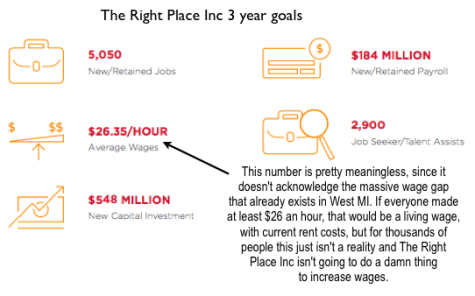 Talent Growth and Attraction is another interesting strategic goal, which is why there are several college/university presidents on the board of the Right Place Inc. So much of local education now caters to the business community’s desire to fill the “talent gap.” This dynamic also includes K-12 education, as is evidenced in a 2017 report by the DeVos-created and funded Believe 2 Become project, which puts an emphasis on developing talent for the West Michigan business community. A more recent example is the GRPS creation of a variety of job training classes that will be hosted at Ottawa Hills High School, such as the Hospitality & Tourism Academy.
It is significant that the Right Place Inc. identifies talent growth as part of their strategic plan. Talent growth is really just another way to use public funding, in this case for education, to train and incentivize students to be directed towards filling employer needs in West Michigan. Essentially, we (the public) pay for the Neo-Liberal Education and the business community will reap the benefits with a trained workforce. This is exactly why the Right Place Inc, the Chamber, Talent 2025 and the West Michigan Policy Forum want to influence the education system, since their members will financially benefit from business-influenced curriculum. It is one of the main components of Neo-Liberal Capitalism, which we should be rebelling against.
Betsy DeVos Watch: Deconstructing Trump and DeVos after the State of the Union address
 On Tuesday night, President Trump gave his State of the Union address. He touched on several topics, including education in the US.
In addition, Secretary of Education Betsy DeVos, released a brief statement in response to what the president had to say. Actually, DeVos had nothing to really add to Trump’s comments, other than to continue using the same Neo-Liberal Education buzzwords and to plug the Education Freedom Scholars.
We offer this brief deconstruction of Trump’s comments and the Press Release sent out by Betsy DeVos from Tuesday, February 4, 2020.
The entire State of the Union address can be found here.

In her Press Release, Betsy DeVos continues to use the political right’s playbook strategies, attacking government with the phrase:
Every student, parent, and teacher should be excited by this bold agenda to free them from a government system that limits their success.
DeVos then points out that, “one in four eighth graders is functionally illiterate.” While this is true, there is no evidence that suggests that Charter Schools or other Neo-Liberal education models are working. In fact, there is plenty of documentation demonstrating how Charter Schools are failing, both in academic terms and in wasting money. See the report Still Asleep at the Wheel: How the Federal Charter Schools Program Results in a Pileup of Fraud and Waste.
In her Press Release, DeVos ends with a push for Congress to pass the Education Freedom Scholarships proposal. The Education Freedom Scholarships would do what the Opportunity Scholarships are already doing, which is to allow people and corporations to donate to a designated scholarship granting organization (SGO) and be reimbursed in the form of a tax credit. With the DeVos plan, states would designate the eligible SGOs, but the federal government would fund the tax credit reimbursement, up to $5 billion total. Once again, public money (in the form of tax credits) would be used to support Charter and Private school systems.
Lastly, it is interesting to note that while both Trump and DeVos are critical of government involvement, they want Congress to pass the Education Freedom Scholarships, which means they want the federal government to be involved in how schools are funded. Apparently they have no problem with government intervention, especially when it promotes the Neo-Liberal Education model.
When undocumented immigrants tell us they live in fear, we really need to hear them
 On Monday night, members of Movimiento Cosecha GR and some allies came to the Wyoming City Commission meeting to get them to adopt a resolution in support of the Driver’s Licenses for All.
More than a dozen members of Cosecha addressed the city commissioners about why being able to obtain a driver’s license was so important to them and to the community. Some people addressed the safety aspects of being able to obtain a driver’s license, while some talked about the economic benefits. However, there was one theme that was present throughout most of those who shared their stories, it was the theme of fear.
Undocumented immigrants live in constant fear, especially of law enforcement officials, whether they are local cops or ICE agents working for the Department of Homeland Security. Those who spoke talked about the fear they have of being pulled over by the police and asking for a driver’s license or other forms of identification. This fear exists when they go to work, when they stop off at the grocery store or when they are picking their children up from school.
This fear that immigrants have is well founded and well documented. During the eight years that the Obama administration occupied the White House, some 3 million immigrants were deported. Under the current administration of Donald Trump, the arrest, detention and deportation of immigrants has escalated, along with the racist rhetoric and policies from border walls, increased restriction on who can immigrate to the US, the addition of more ICE agents and the further expansion of state and private detention facilities across the country.
However, despite more than a dozen emotionally charged testimonies from immigrants, government officials told those same immigrants that they shouldn’t fear the police or elected officials
Towards the end of the public comment period, State Rep. Tommy Brann said that he was not there to support or oppose Driver’s Licenses for All, but that the immigrant community should not be afraid to come and speak to him. Really? What has Rep. Brann done to demonstrate that he is an ally to immigrants? Has he introduced legislation that would support Driver’s Licenses for All? Has he introduced legislation that would support Sanctuary Cities or prevent ICE from terrorizing the immigrant community? The truth is that Rep. Brann has not introduced or voted for legislation that would demonstrate that he is committed to immigrant justice.
Then, at the end of the commission meeting, when commissioners have an opportunity to respond to anything that came up during the public meeting, there were two Wyoming elected officials who told immigrants that they should not fear the Wyoming police. Both of these city officials said this after they had just taken part in a ride along with Wyoming cops. The Wyoming commissioners said that Wyoming police have good hearts and that they see no reason why immigrants should be afraid of them.
This display of white privilege was astounding. Were they not listening to the heartfelt statements from the immigrants who had just spoken? Look, if the Wyoming City Commission wants immigrants to trust them, then they need to take action instead of offering advice. The Wyoming City Commission can start winning the trust of immigrants by passing a resolution to support Driver’s Licenses for All. After they adopt such a resolution, they can adopt a policy of total non-cooperation with ICE and then declare themselves a sanctuary city.
Until these things happen, stop telling immigrants how they should feel. Listen to what immigrants are actually telling you. By ignoring immigrant testimony, the Wyoming officials that told them to not fear cops completely dismiss the lived experience of the immigrants who spoke. Licencias sí, promesas no!

Grand Rapids for Education Justice presents a list of demands to the Grand Rapids Public Schools
Last night, members of Grand Rapids for Education Justice (GREJ), presented a list of demands to the Grand Rapids Public Schools, demands that they had attempted to present last month.

The GREJ had a meeting scheduled for January 6 of 2020, with the President of the School Board and the acting GRPS Superintendent. However, when members of the GREJ requested that they be able to live-stream that meeting, the GRPS said they did not want that conversation recorded. GREJ believes that transparency is a priority and that the public has a right to know what the content of conversations that the GRPS is having.
The GREJ has also been presenting a great deal of data and an analysis of what they refer to as the two-tiered educational system within the GRPS. Over the past several months the GREJ has attended school board meetings and send communication to the GRPS, who has either been dismissive of their concerns or has ignored them.
The three demands the group laid out are:
- An increase in teacher salaries
- An end to the two-tiered system in the GRPS, a system which disproportionate impacts students experiencing poverty and students of color
- An end to all privatization of GRPS services
You can read a more detailed articulation of each of the three demands at this link and watch the video below of the Press Conference held last night outside of the GRPS administration building.
Who has been behind Michigan’s 3rd Grade Reading Retention Policy?
In 2016, the Michigan Legislature passed a law that requires schools to identify learners who are struggling with reading and writing and to provide additional help. The law states that third graders may repeat third grade if they are more than one grade level behind beginning with the 2019-2020 school year.
This law has been controversial ever since it was introduced and during Gov. Whitmer’s State of the State address last Wednesday, she proposed an alternative to the 3rd Grade Reading Law passed in 2016. Her plan is to have the State of Michigan work with foundations across the state to invest in early child literacy and to help families understand the retention mandate.
Background on the 3rd Grade Reading Law and who has been pushing it
Before the 3rd Grade Reading law was introduced with House Bill 4822, there were numerous entities pushing for the this type of policy. At the state level groups like the DeVos-created Great Lakes Education Project and the far right think tank, the Mackinac Center for Public Policy, were zealously in favor of the 3rd grade reading law. On the local level, the West Michigan Policy Forum has been the primary champion.
HB 4822 was introduced in 2015 by then Rep. Amanda Price, who was then replaced by Rep. Jim Lilly. Other major backers of this legislation were Lisa Lyons, Lee Chatfield, Jim Runestad and Daniela Garcia. Most of these politicians have received major funding from the DeVos family, like Lee Chatfield, while others have moved on to the Michigan Senate, and in the case of Daniela Garcia, she is now a staff person at the Department of Education, working for Betsy DeVos.
The vote on HB 4822, was pretty much along partisan lines, with 54 Republicans and 3 Democrats voting for the legislation. After a significant amount of deliberation, then-Gov. Snyder approved the legislation in October of 2016, nearly a year after it was introduced. For a substantial articulation of what this law means, read the analysis provided by the House and Senate Education Committees.
The Michigan Education Association opposed this legislation, mostly on the grounds that it could result in, “large numbers of children being held back from advancing to fourth grade—especially in high-poverty and urban areas where proficiency rates were lower than elsewhere.” Below are provisions in the new reading law.

There are currently 19 states that have adopted the same 3rd grade reading retention policies, which began in 1998, when California adopted a 3rd Grade Reading Retention policy. According to an NPR report late last year, forcing children to repeat a grade is stigmatizing and can damage their self-esteem. Multiple studies have found that flunking a grade makes it much more likely students will fail to graduate from high school. Some parents and educators have organized against mandatory retention and advocate for children to sit out high-stakes exams. A group of parents in Florida unsuccessfully challenged the policy in court.

On the blog Education Dive, writer Naaz Modan writes:
Across the board, retention can increase the likelihood of a student dropping out of school, and many educators and organizations have criticized the growing policies for this reason.
The National Council of Teachers of English says that the laws are “ill-advised” and perpetuate a “cycle of punishment” that disproportionately affects students of color, impoverished children, English language learners and special needs students.
And Kathy N. Headley, the president of the Board of Directors for the International Literacy Association, pointed out that the retention of 3rd graders without providing the support necessary for educators and students is meaningless.
Last week, Bridge Magazine posted a story about Gov. Whitmer’s attempt to challenge the 3rd grade reading law. The first source cited in the Bridge article, was Michael Jandernoa, who is a board member of the West Michigan Policy Forum, one of the groups that lobbied hard to get it pass in Michigan. Jandernoa states:
“The teachers and schools have been totally unable to help these kids who are behind in third grade graduate in high school and go on and get any kind of trade job or [attend] community college, or any consideration of a four-year university.”
Jandernoa and the West Michigan Policy Forum are very clear about their anti-teacher union positions, their advocacy for Charter and private education, along with their general view that students are nothing more than talent to be developed to fill employer needs.
The Grand Rapids Public Schools was one of the first districts in the state to push for this legislation when it was first introduced, according to a recent WZZM 13 story. This begs the question as to why the GRPS was so eager to adopt the 3rd Grade Reading Retention policy, a policy that was primarily promoted by the Great Lakes Education Project, the Mackinac Center for Public Policy and the West Michigan Policy Forum.
Lastly, so much of the issues that are raised with the 3rd Grade Reading retention policy have to do with funding and resources for education. The public schools are grossly underfunded in this state, with large funding disparities with districts that have a high percentage of students of color. In addition to low school funding, there is also the issue of teachers being paid a justice salary and having access to classroom resources. This is not to suggest that the problem is all about money, but we know that funding for schools when compared to funding for prisons demonstrates where our priorities are.
Normalizing White Settler Colonialism at the Super Bowl
 I work in an adult foster care home and a couple of weekends ago, residents were watching the AFC playoff game between Tennessee and Kansas City, a game which was played in Kansas City.
During the game I could hear the hometown fans doing a chant that was essentially an stereotypical chant or song that indigenous people might use. In addition, Kansas City fans were also doing the tomahawk chop, something that the Atlanta Braves baseball team also does.
There were also fans dressed in native regalia, like the person shown here in the right. This use of dress or song and even the tomahawk chop is all rather offensive and more importantly it is racist.
This Sunday, the Kansas City team will be playing in the biggest game in the NFL and the most viewed sports event in the US, the Super Bowl. What this means is that the Kansas City team, known as the Chiefs, and their fans will most certainly continue to use and abuse indigenous dress and spiritual practice, thus further normalizing a White Settler Colonial narrative.
If you watch the game, listen to see if the people doing the game commentary will bother to bring up this issue. It’s not likely to be addressed and it is not likely that there will be much news coverage of the protests that are likely to take place outside the stadium.
Native American groups are opposing the use racist stereotypes and the fact that the Kansas City team actually plays a “war drum” before their games.
This is not a new issue, but it is something that those of us who are not part of First Nations need to seriously examine and not participate in.
In West Michigan, there has been a battle to get rid of the racist use of the name Redskins by the Paw Paw High School. In Grand Rapids, Ottawa Hills High School used to be the Indians, but through organizing, the name was changed to the Bengals.
The bottom line is that we need to listen to and respect the wishes of the Native America community about what names, logos or mascots are offensive and inappropriate.
There are lots of great resources on this topic that have produced by indigenous people. Check out the documentary entitled, More Than A Word.
Read a powerful essay by Ward Churchill, who talks about how Nazi Germany racist images of Jews and how that relates to racist images used by sports teams.
Become educated and find out how white settler colonialism is being played out in your community.
Ottawa County Commission resolution on refugee resettlement is adopted, but it is a far cry from immigrant justice
Yesterday, I sat through a little over 2 hours of comments from people who came to speak to the Ottawa County Commission about their proposed motion to adopt a resolution (see pages 124 – 126) in response to the Trump administration’s Executive Order 13888, regarding refugee resettlement. The commission chambers was packed with no empty seats and at least another 100 people standing during the meeting.

The Republican and Democratic Parties in Ottawa County were encouraging people to come out and speak to this issue, both using social media. I did not do a methodical count, but it is safe to say that more than half, and maybe as much as two-thirds, of those that spoke, were in favor of supporting a resolution to continue to welcome refugees.
Those opposing the increase in refugees coming to Ottawa County were using arguments that were right out of the playbook of groups like the Federation for American Immigration Reform and the Heritage Foundation. Many of those opposing the resolution also made claims that immigrants and refugees don’t pay taxes and are a burden on American society. One person even claimed that the US would be over run by Muslims and we would all be living under Sharia Law.
The racist and White Supremacist claims were repeated by those opposing the resolution in support of refugee resettlement. One additional argument was that “these people” would have to be assimilated into America culture. None of the people making this argument ever made clear what exactly American culture is, but based on their comments it meant white, Christian and patriotic.
For those who supported the resolution, some of them based it on their experience of working with refugees, either within non-profits or because their church had sponsored a refugee family. The overwhelming argument was based on Christian bible passages, like welcoming the stranger. Many people used the famous Matthew 25: 31 – 46 passage, where Jesus is separating the sheep from the goats. Some people read the entire passage, which ends with those who don’t welcoming refugees being sent to hell.
I get that people of faith were using their religion to support a pro-refugee position, but some of it left a bad taste in my mouth. There was no discussion or articulation that US foreign policy was, in many cases, the cause of displacement. US military and economic policies are a major reason why hundreds of thousands of people, especially for people from Latin America, have fled their countries of origin and often come to the US seeking a better life.
In addition, there were too few responses to the racist and classist claims made by those presenting an anti-refugee/anti-immigrant position. Those supporting the resolution were often appealing to the county commissioner’s Christian heritage, instead of making a more robust argument for what was driving displacement globally. Many of those who supported the proposed resolution were also using the argument that refugees are hard workers, that they contribute to the economy and that they do learn English. While it may be true that many immigrants and refugees have a significant impact on the economy or are hard workers, such arguments are problematic. Refugees and immigrants are often fleeing political persecution, have suffered torture, experienced profound levels of poverty and other brutal circumstances. We should be very careful about using arguments that “they work hard” or “contribute to the economy,” since these arguments often perpetuate a Neo-Liberal Capitalist framework.
Lastly, it is worth noting that in the summary of the proposal from the Ottawa County Commission, it states:
Secondly, I reminded the community and Presidential political base that this refers to Adjudicated Refugees that the Trump Administration has admitted into the country and wants us to accept, so we don’t confuse our constituents that this is somehow making Ottawa County a sanctuary county for illegal refugees.
I include this point, because it also speaks to the larger issue about what the Ottawa County Commissioners think and feel about immigration in general. If immigrants or refugees are admitted to the US through channels that they have sanctioned, then the commission seems to be supportive. However, if immigrants are coming into the US without government sanction, meaning those who are undocumented, then the Ottawa County Commissioners will in no way support those who are undocumented.
The Ottawa County Commission did vote unanimously on the resolution to continue refugee resettlement. The vote is certainly a win for those who are committed to immigrant/refugee justice, but based on the comments from everyone who spoke yesterday, there is a great deal of work to be done to move from welcoming refugees who are admitted to the US, to practicing immigrant justice, where immigrants will not be criminalized, regardless of documentation.
Acton Institute writer puts faith in the market to solve the housing crisis, is dismissive of rent control as a solution
 Last week, Acton Institute writer, Dan Hugger, wrote an article headlined, Sen. Bernie Sanders tweets a blueprint for a housing crisis.
The Acton writer acknowledges that there is a housing crisis, but frames the solution around the market, instead of policy or grassroots organizing. Hugger goes on to cite Kevin Erdmann’s book, Shut Out, but omits the critique of gentrification that is in the paragraph right after the one the Acton writer cites.
The Acton writer then goes on to say:
Senator Sanders’ call for national rent control does nothing about this underlying shortage but rather exacerbates it.
The Acton writer is correct to point out that rent control by itself would be inadequate, plus it would take too long in most states to get rent control passed. However, grassroots organizing by tenant unions across the country have demonstrated that it is more effective to pressure landlords/property management companies, than to wait for states to pass rent control policies.
The Acton writer concludes with his own solutions to the housing crisis. He offers a vague comment about having fewer barriers for developers and one concrete suggestions about flexible zoning, citing Oregon and California’s ban on single family zoning. I agree that more flexible zoning would be important, but if the Acton writer looked beyond the tweet from Bernie Sanders, he would actually see there is a pretty robust plan for dealing with the housing crisis.
Here is what Senator Sanders’ campaign is calling for:
- End the housing crisis by investing $2.5 trillion to build nearly 10 million permanently affordable housing units.
- Protect tenants by implementing a national rent control standard, a “just-cause” requirement for evictions, and ensuring the right to counsel in housing disputes.
- Make rent affordable by making Section 8 vouchers available to all eligible families without a waitlist and strengthening the Fair Housing Act.
- Combat gentrification, exclusionary zoning, segregation, and speculation.
- End homelessness and ensure fair housing for all
- Revitalize public housing by investing $70 billion to repair, decarbonize, and build new public housing.
This platform is what housing advocates, like Right to the City and Hones for All national, having been calling for for more than a decade.
The Acton writer should get their facts straight instead of primarily calling for the market to solve all of our problems. The market approach to problem solving is what the Acton Institute always promotes, which is no surprise to those who have read this blog before. In addition, it seems that the Acton Institute was clearly picking on Senator Sanders, considering their contempt for the ideals of socialism and anybody who espouses them, which I suspect was the real motivation for this post, the housing crisis was merely a mechanism to be dismissive of socialist policies in favor of Neo-Liberal market policies.
We need Food Justice, not Food Charity: The urgency of finding real solutions to food insecurity, poverty and structural racism
 Over the years, we have posted numerous articles that challenges a food charity approach to hunger. In those articles we have challenged groups like Feeding America and Kids Food Basket.
Now, when I say we challenged these groups, I mean to challenge the strategies they employ to end hunger. It is not a bad thing for organizations to provide food relief to people who are food insecure. However, food charity is ultimately a false solution that only perpetuates food insecurity, plus it often makes the people who engage in food security work to feel better about themselves, rather than to seriously investigate the root causes of hunger.
Kids Food Basket (KFB) is a prime example of an organization that practices food charity. They provide food to elementary age children through their sack supper program. This program has received tremendous support over the years, so much so that Kids Food Basket has grown so fast, they have had to move numerous times to accommodate that growth.
Last September, KFB opened their new $7.5 million facility on Leonard St. and just last week they announced another expansion plan to provide more sack suppers to children in Ottawa and Allegan counties.
This continued expansion is ultimately an expansion in charity and does nothing to address the root causes of hunger. On the website of Kids Food Basket, under their FAQ section, one question asks:
How is Kids Food Basket addressing the root causes of hunger? Their answer is that they will continue to practice a false solution, by making sack suppers. In fact, they state, “We meet immediate critical needs with our Sack Suppers and we also need organizations that do work like corner store reform, lobbying at the state and national levels for legislation that encourages universal access to food, and in other areas such as housing, transportation, and employment.” What KFB is suggesting only addresses food access, but there is no discussion about how to fight poverty and hunger.
What are the alternatives?
- It would be important for any and all groups who do food triage work to acknowledge that just providing food assistance on a regular basis does not solve the problem. I’m not saying that people shouldn’t practice mutual aid and assist people in a time of crisis. We absolutely should practice mutual aid when we can. However, it is not enough to just provide charity, we must work towards transformative justice.
- Once Kids Food Basket can acknowledge that hunger is a much larger and systemic economic and racial problem, then they can, with other like-minded groups, begin to develop multi-pronged strategies to fight for economic and racial justice.
- They should end partnerships with corporations and families which are part of the local power structure, which supports candidates who pass policies that create more poverty.
- Promoting and participating in a Living Wage campaign at the city/county level. Currently, many groups around the country are calling for a $15 minimum wage. However, a Living Wage would go further, because it would force us to have a much more substantial conversation about economic policy and the larger wealth gap in this community.
- Wealth re-distribution in the form of reparations. Those families, communities and corporations which have exploited workers and communities for decades, should be required to pay back the communities, families and individuals they have exploited. This is especially the case in the African American community, which has been exploited for centuries and where reparations should begin. Kids Food Basket should call for reparations.
- Organizations like Kids Food Basket need to adopt clear racial justice policies that recognize historical racism and how it currently in manifested in West Michigan. How is it that the people who pick most of our food in West Michigan, migrant farmworkers, have a high rate of poverty?
- The Kids Food Basket location on Leonard St. sits on several acres that they are using to grow food. What if part of that land was used to allow people to come to this newly acquired land and grow food together, specifically the families that are benefiting from the sack supper program. KFB could provide people with the skills, transportation and child care so they could chose to be involved in producing some of their own food. This could also be done by supporting more programs in neighborhoods that are experiencing poverty, by assisting those neighborhoods with urban food production, if that is something residents want to do. This would require the use of more urban land specifically for food production.

These are only just a few suggestions, but I believe that many more creative and powerful ideas could surface if we changed the narrative around how to respond to hunger from food charity to food justice. In fact, GVSU is hosting a Food Summit this Friday, and it would be the perfect place for these kinds of conversations could be had about the need to address the root causes of hunger and to practices food sovereignty.
 The local group Talent 2025, is an entity that seeks to influence the education systems in West Michigan and to develop talent (code for students) that will be ready to fill the employment needs on area businesses.
Their most recent blog post is, Teacher Retention and the Future of the Education Workforce. In that blog post, the author recognizes and acknowledges a serious problem in the very first sentence:
Between the years of 2008 and 2016, enrollment in teacher preparation programs within the state of Michigan decreased by 66 percent.
One of the main reasons for the decrease in teacher preparation programs and teacher retention in Michigan and across the country, is low and inadequate salaries. Teacher salaries have been one of the fundamental issues that has led to teacher strikes in the past three years in states like California, Illinois and West Virginia.
Unfortunately, the Talent 2025 blog post does not acknowledge teacher salaries as being a key issue in teacher retention. Instead, the Talent 2025 article focuses on tactics that some school districts in West Michigan are employing to address the shortage of teachers.
When talking about the Grand Rapids Public Schools (GRPS), Talent 2025 writes:
In Kent County, Grand Rapids Public Schools identified a significant shortage of bilingual teachers and a subsequent lack of local candidates sufficient in the language skills they desired. Through research and conversations with other local school districts, GRPS officials learned of an opportunity to hire bilingual teachers from Puerto Rico. With support from the community, designees from GRPS headed to Puerto Rico to identify candidates with the potential to thrive at Grand Rapids Public Schools.
According to an article in School News Network, the GRPS sent four people to Puerto Rico for 5 days in early November with the intent of getting letters of intent from a half a dozen teachers. According to the same article, “Their trip will be partially funded by a $6,000 grant from the Grand Rapids-based Jandernoa Foundation.”
Since the article states that the trip was partly funded by the Jandernoa Foundation, we can probably assume that the rest was paid for by the GRPS, which means public money was used for this trip. The decision to try to recruit teachers in Puerto Rico to come to Grand Rapids and teach in the Grand Rapids Public Schools raises all sorts of questions that we would like to address.
First, it should be noted that the Grand Rapids Public Schools has the lowest teacher salaries in the area, according to data provided by MLive in 4/2019. The MLive article provides a searchable database, which shows the following teacher salaries by school districts:
- West Ottawa $69,518
- Byron Center $69,271
- Forest Hills $69,219
- East GR $68,960
- Cedar Springs $60,910
- Coopersville $59,276
- Allendale $57,302
- Godfrey Lee $56,892
- Grand Rapids $54,844
If the GRPS was committed to teacher retention and want to attract news teachers to come to this community, then they need to increase the teacher salary.
Second, what else is the GRPS doing to retain and attract teachers, particularly bilingual teachers that they so desperately need because of the growing latino/latinx student population? The GRPS should be working groups like the Hispanic Center or the Latino Coalition to begin the process of cultivating greater opportunities for local latinos/latinx people who want to become teachers. The GRPS could provides incentives for people from this community to return to Grand Rapids after obtaining an education degree and commit to teaching within the GRPS.
Third, it is instructive that Puerto Rico is the place that the GRPS went to recruit teachers. It is critical that we understand that not only have teachers been deeply affected by hurricane Maria in 2017, but that the public school system in Puerto Rico has also been under attack. According to Naomi Klein’s book, The Battle for Paradise, “between 2010 and 2017, roughly 340 public schools were shut down; arts and physical education programs were virtually eliminated in many elementary schools; and the board announced plans to slash the University of Puerto Rico’s budget in half.”
In addition, Puerto Rico’s financial struggles began way before hurricane Maria. The island was facing massive Neo-liberal forms austerity measures, which included the defunding of public education. In fact, Julia Keleher, who was appointed in 2016 to be the Secretary of Education, by the now deposed Puerto Rican Governor, Rossello. Keleher, right after the hurricane, created an education reform bill with the assistance of US Secretary of Education, Betsy DeVos. This new education reform package included exactly what DeVos has imposed on the mainland, which is expanding charter schools and school-voucher programs. (See Aftershocks of Disaster: Puerto Rico Before and After the Storm, edited by Bonilla and LeBron.)
Finally, the Jandernoa Foundation (which provided $6,000 for the GRPS trip to Puerto Rico) is the foundation of Michael Jandernoa, one of the people who makes up the Grand Rapids Power Structure. Jandernoa is connected to Talent 2025 and the West Michigan Policy Forum, both of which support and promote policies that seek to undermine public education and to develop students (talent) to fill jobs within the West MI business community. Jandernoa has also contributed significantly to the Student Advancement Foundation and he has contributed to several current and former Grand Rapids Public School Board members. If Jandernoa funded part of the trip, then people should be very suspicious of his influence in this process.

