 Last week Tuesday, MLive reported that the Grand Rapids City’s fiscal committee voted to spend $21,268 to send two GRPD officers to Boston for a 2 week training on “racial reconciliation.”
This decision is based upon one of the recommendations that came out of the 21st Century Policing Solutions from last year.
The two GRPD officers who are going are Captains Geoff Collard and Dave Schnurstein. Captain Collard made headlines earlier this year when he said at a press conference that the Grand Rapids City leaders:
“will dismiss any actions by members of the Grand Rapids Police Department that are in compliance with established laws, policies and recognized best practices in law enforcement and will instead cower to ‘mob rule’ behavior of any organizations that raise vocal opposition.”
In the same written statement, Collard goes as far to suggest that the City of Grand Rapids has been in collusion with Movimiento Cosecha GR:
“On May 1, 2018, during a large protest, leaders of Movimiento Cosecha GR intentionally overran a police position for the second year in a row. Warrants were sought, sworn to, and issued by a judge for the arrests of two individuals. Shortly thereafter, the Acting City Manager and the Mayor became involved and the warrants were squashed. There is no clearer example that our city leadership would rather appease these groups who intentionally violate the law to purposely disrupt businesses and residents in Grand Rapids while endangering the lives of our officers, the general public, and their own protestors. Having known about this obstruction of justice, of which the current City Manager has also been notified, we are only left to believe that support for our personnel while acting with great restraint and being overrun by law breaking individuals does not and will not exist.”
Such a claim is patently absurd, yet the fiscal committee wants to spend over $21,000 to send Collard and another captain to Boston to get training that will somehow build trust between black and brown communities and the GRPD.
A description of the training can be found at the Police Executive Research Forum site, which says of the training:
The policing profession is changing like never before. New technologies and privacy issues, the implications of cybercrime, and the constantly evolving terror threat represent new and difficult challenges for police that did not exist a generation ago. Communities also expect more from their police departments in terms of procedural justice, increased accountability and transparency, appropriate use of force and racial reconciliation. Plus, today’s recruits differ in significant ways from previous generations. Chiefs must find new ways to address these issues and deliver a wider scope of services, often with fewer resources.
Does racial reconciliation training work for police?
Beyond the amount of money the City of Grand Rapids is spending on these two officers, we have to ask ourselves if this kind of training will actually achieve the goal of creating racial reconciliation. In an article in The Atlantic some 18 months ago it states:
But even as the classes spread, it’s not clear whether they actually work. Few specific guidelines exist for what courses should include, how the material should be taught, or how to measure its effects. Indeed, little data exist about their efficacy over the long term. The Obama administration’s Task Force on 21st Century Policing included implicit-bias training on its list of best practices for law enforcement, but without specifics. That ambiguity leaves each agency to decide what the classes should look like—and whether they’re succeeding.
At their root, the trainings spring from one basic proposition: that unconscious biases—including those linked to factors like economic class and gender, but especially racial biases—are the inevitable product of growing up in a society where stereotypes are woven into the fabric of everyday life. Beneath the surface of the conscious mind, biases influence how people frame and interpret those around them—from whether a smile is shy or sarcastic, to whether a hand is reaching for a wallet or a gun.
In his important book, The End of Policing, author Alex Vitale writes:
Diversity and multicultural training is not a new idea, nor is it terrible effective. Most officers have already been through some form of diversity training and tend to describe it as politically motivated, feel-good programming divorced from the realities of street policing. Researchers have found no impact on problems like racial disparities in traffic stops or marijuana arrests: both implicit and explicit bias remain, even after targeted and intensive training. This is not necessarily because officers remain committed to their racial biases, though this can be true, but because institutional pressures remain intact.
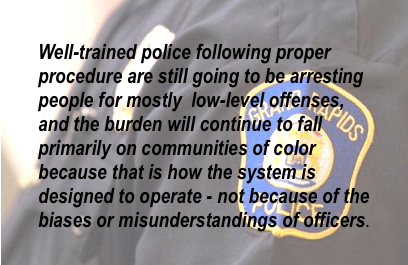
Lastly, Vitale also makes the distinction about what the institutional function of police department are, which is to protect power and business as usual. Vital states, “Well-trained police following proper procedure are still going to be arresting people for mostly low-level offenses, and the burden will continue to fall primarily on communities of color because that is how the system is designed to operate – not because of the biases or misunderstandings of officers.”
Therefore, we should in no way be fooled by or expect that Captain’s Collard and Schnurstein will significantly alter how they interact with black and brown communities or how they will respond to activists and organizers who are exposing police violence.
 Later this week there will be the annual Pride Celebration in Grand Rapids, making it 31 years since the first Pride event. In addition, there are two other events being hosted during the week, also centered around the LGBTQ community.
First, on Wednesday, there will be an event to commemorate the queer and trans identifying Latinx and Black people who were killed at the Pulse 49 Club in Orlando, Florida, three years ago.
Lastly, there is also a Take Back Pride March – End Police Violence action, hosted by Grand Rapids Anti-Fascist Action.
Thirty one years ago, people in the LGBTQ community organized the first Pride event in Grand Rapids. It was held in the old Monroe Amphitheater, now known as Rosa Parks Circle. Someone video taped about 90 minutes of the very first Pride in Grand Rapids, which you can watch here. Members of the Christian community came to harass those gathered for the Pride Celebration, engaging in hate speech and publicly condemning those gathered.
 There were also numerous organizations from around the state who were tabling at the first Pride in GR and several of those groups got up on the stage to speak about their work. The mayor of Grand Rapids, Gerald Helmholdt, did not support or endorse the first Pride Celebration, in fact he spoke rather disparagingly of the “gay community,” something that Jeff Swanson talked about in the interview we did with him for the People’s History of the LGBTQ Community in Grand Rapids documentary.
There were also people who came to the Pride event who wore bags over their heads, for fear of losing their jobs. While there is more room for people to be public about who they are, Grand Rapids and West Michigan still is not a very safe space for those who identify as Lesbian, Gay, Bisexual, Transgender or Queer. This is especially the case for those in the LGBTQ community that are black or latinx, part of the immigrant community or queer youth.
 What follows is an overview of some of the history in Grand Rapids, based upon the lived experience of the LGBTQ community. This history can also teach us about how deeply homophobic, transphobic and heterosexist the Grand Rapids community has been and continues to be since the first Pride in 1988.
AIDS Quilt founder spoke at the 1990 Pride event in Grand Rapids
1991 GRTV show with members of the LGBTQ community.
Anti-Gay businesses in Grand Rapids and the defeat of the first attempt to get an anti-discrimination ordinance in 1991.
1992 video conversation with members of the Network in Grand Rapids.
The Grand Rapids Community Relations Commission, the LGBTQ community and the 1994 anti-discrimination ordinance.
Rich DeVos and the AIDS crisis. https://griid.org/2012/11/27/aids-and-activism-part-ii-reagan-devos-and-the-1980s-crisis/
Dennis Komack was fired from his job at the Grand Rapids Art Museum because of his involvement with Sons & Daughters, a LGBT bookstore/cafe that used to be in Grand Rapids. (see the section on Sons & Daughters in the People’s History of the LGBTQ Community in Grand Rapids.)
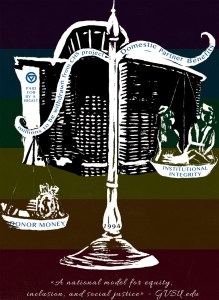 GVSU LGBT Faculty were denied domestic partner benefits in 1995 because Rich DeVos and Peter Cook threatened to withdraw financial support for new Health & Sciences building in Grand Rapids. (also documented in the People’s History of the LGBTQ Community in Grand Rapids.)
What is important for me, as someone who is not part of the LGBTQ community, is that those of us who identify as straight, need to understand, expose and fight the systems of oppression that those in the LGBTQ community face on a daily basis. Attending Pride and changing our FB status to the rainbow flag are cool and all, but one of the most important things we can do as allies is to resist and dismantle the very systems of oppression in this community that translates into queer youth being homeless, that uses state violence against LGBTQ communities of color and perpetuates severe spiritual violence in the CRC land.
 Beginning in 2016, the Kellogg Foundation provided $300,000 to Grand Rapids for its 3 year Racial Equity Initiative.
Two of the goals of this initiative are:
Creating more jobs and employment of residents in Grand Rapids neighborhoods in 17 census tracts that have 48 percent of residents living in poverty that have the highest racial and ethnic diversity.
Create group and individual action steps that will have both immediate and long-term impacts.
While the Kellogg Foundation has provided the funding for this project, Grand Rapids is working with the Government Alliance on Race & Equity.
Last Friday, an article was circulating on social media, that was written by someone who works for the National League of Cities. The article was headlined, In Grand Rapids, Neighborhoods Are the Cornerstone of Racial Equity.
The brief article talks about when Grand Rapids began their Racial Equity Initiative and what it has accomplished so far. The article is rather vague and identifies two ways that Grand Rapids can achieve racial equity. One way Grand Rapids is working to achieve racial equity is through the annual Neighborhood Summits. While I acknowledge that this summit has brought people together to work on specific issues, it has primarily approached social change from a “lets create more opportunities” approach, rather than a “lets address structural racism and dismantle White Supremacy” approach.
The second way that Grand Rapids is addressing racial equity, according to the article, was, Using Accountability and Root Causes to Create More Equitable Economic Development. However, the explanation provided only talked about the need to develop accountability tools, plus there was NO mention of addressing root causes.
In many ways the article was a fluff piece that did not provide an honest assessment of where Grand Rapids was in terms of racial equity or racial justice.
What follows are some areas where racial equity is not being achieved, especially for communities of color in Grand Rapids:
- Black and Brown communities continue to be harassed, intimidated and brutalized by the GRPD and Immigration & Customs Enforcement (ICE) in Grand Rapids. Racial profiling of motorists of color is well documented and the way that policing is done in Grand Rapids targets neighborhoods of color and identifies them as high crime areas.
- The housing market in Grand Rapids benefits the Real Estate industry, developers and property management companies and punishes working class families and communities of color. Gentrification has hit African American and Latinx neighborhoods the hardest, causing displacement and significant increases in the cost of home ownership and rental properties.
- Communities of color continue to experience high levels of food apartheid and food insecurity, with limited access to fresh produce and whole foods.
- The wealth gap in Grand Rapids is the highest in Michigan, yet there is no serious efforts to change this reality when it comes to communities of color, except for the false solutions offered through entrepreneurial projects.
- The Grand Rapids Public Schools, which has a majority of black and latinx students, is grossly underfunded overall, yet it has a two tiered system that favors specialty schools that received a great deal of funding, while some schools lack educational resources and basic needs like heating.
- Neighborhoods where the majority of the residents are from communities of color experience high levels of poverty, have limited green space, have high levels of lead and poorer air quality.
Conversely, there is little acknowledgement of the systemic racism or the structures that support white supremacist values, such as the private sector, the religious community, the criminal justice system, the news media and even the very government that is tasked with implementing the Racial Equity Initiative.
The Kellogg Foundation funding for this 3 year project is slated to end in March of 2020. Who in this community thinks that Grand Rapids is actually making significant strides towards Racial Equity???

Another look at the Grand Rapids Democracy Initiative: History, representation, reformism and radical imagination
 During the past month, there have been several news stories about the local campaign to expand the political ward system in Grand Rapids from 3 to 8 wards. The group behind the campaign is Grand Rapids Democracy Initiative (GRDI).
The mission statement of the group says:
The Grand Rapids Democracy Initiative is a non-partisan effort to ensure that all residents of Grand Rapids have representation and access to democracy through ease of voter registration, and understanding voter rights. We are advocating for a, or multiple ballot proposals to change the Grand Rapids City Charter to include the following:
- 8 city wards with 8 City Commissioners
- Special elections instead of appointments for vacated seats
In early May, MLive ran an article about the campaign, and last Friday, Revue Magazine posted their story. The MLive story is pretty basic, with several of those involved with the effort cited, as well as Tim Gleisner, former head of special collections at the Grand Rapids Public Library. Gleisner was quoted as saying, “The opposition groups felt that city government was better run as a business and more streamlined when commissioners were representing not at a local level but the city as a whole. That was a big concern, they didn’t want local interests to dominate the discussion.”
While Gleisner’s statement isn’t inaccurate, it doesn’t fully reflect why the City Charter was changed from a 12 ward system to a 3 ward system in 1916. The business community was so threatened by the 1911 Furniture Workers Strike, that they didn’t want to leave the future of city politics in the hands of working class people. Here is a summary of what happened from the Grand Rapids People’s History Project:
During the 1911 Furniture Workers Strike and its aftermath, the business community and leading industrialists, began to develop a plan that would significantly alter the way electoral politics was done in Grand Rapids.
The 1911 Furniture Workers Strike revealed several things to wealthy industrialist. First, there was a growing threat of Socialist and Anarchist politics, particularly with the Socialist Mayoral candidate, Edward Kosten, in the 1912 Mayoral race. Out of the 14,772 votes cast in the Mayoral race in 1912, Kosten received a total of 2,315 votes in a three candidate race, which was roughly 1 out of 7 votes.
Second, the wealthy industrialist of Grand Rapids were further committed to the notion that, in the words of Chief Justice John Jay, “the people who own the country ought to govern it.” Not only was this sentiment embraced by the wealthy industrialist in Grand Rapids, it was endorsed by Frank M. Sparks, the political correspondent for the Grand Rapids Herald. Sparks had written a book, The Business of Government Municipal Reform.
In his book, Sparks wrote, “just as ownership in the modern corporation had been divorced from management, so, too, must the individual citizen let professionals guide the direction of municipal life.” Sparks went on to say, “Citizens were like shareholders in the modern municipal corporation. If they wanted more efficient government they must be prepared to surrender direct control of policy to elected commissioners who would serve as a board of directors and in turn hire professional managers.”
Third, the wealthy industrialist were deeply concerned about the current political ward system in Grand Rapids. The majority of working class people had too much influence in the outcome of elections, so a new ward structure was proposed in the 1916 City Charter.
Grand Rapids, at the time, was made up of a twelve ward system, with 2 aldermen elected from each ward and a strong mayor. (see Grand Rapids ward map above) What was proposed in the 1916 City Charter was to have a three ward system with two commissioners from each ward and a weak Mayor, meaning that the Mayor would only have one vote and in a sense be a glorified commissioner. In addition, there would be a City Manager position, which would essentially run the day to day tasks and make recommendations. For many, the City Manager position was the real power behind city hall.
This third factor, in determining the city’s political future, would limit bloc voting, particularly among ethnic communities and religious sectors, and give greater control to electoral outcomes. The voting numbers in the 1916 Grand Rapids City Charter were revealing.
In August of 1916, voters went to the polls to determine the future political structure of Grand Rapids. The new Charter won by a small margin of 7,693 votes in favor to 6,012 votes in opposition. According to Jeffrey Kleiman’s book, Strike: How the Furniture Workers Strike of 1911 Changed Grand Rapids, the wards that voted overwhelmingly in favor of the Charter change were made up of the city’s elite.
The Second, Third and Tenth wards provided enthusiastic support for the proposed changes. Here lived the industrialists, lawyers, and bankers who formed the leadership of the Furniture Manufacturers Association, and the Association of Commerce. These men shared social and business connections through Kent Country Club and the Peninsular Club, and many were members of Fountain Street Baptist Church.
By contrast, those who voted against the City Charter changes in 1916 were made up almost entirely of working class constituents. The wards voting against the changes were the twelfth ward in the southwest part of the city and the entire west side.
Again, according to Kleiman, “After a decade of struggle, the furniture manufacturers and other economic leaders of the new industrial city finally controlled the government.” We would all do well to recognize this history of the voting structure in Grand Rapids and not assume that it has change changed much over the years
Representation for whom?
The Revue Magazine took a different approach to the issue in their article from last Friday.
The article raises several interesting points. First, the issue of racial representation was addressed, both black and latinx representation. There has never been a latinx person elected to the City Commission and more wards could provide an opportunity for that to happen. However, a member of Equity PAC, Denavvia Mojet, challenges GRDI, with these observations:
“As a huge believer in equity, I’ve heard so much skepticism about how this is being framed. It’s almost ignoring the fact that we have three black commissioners now, and the two white people pushing this (VandenBerg and Michael Tuffelmire) are two white people who lost to black people (Commissioners Joe Jones and Senita Lenear).”
A second point worth bringing up has to do with the mission statement from GRDI, which says it is a non-partisan effort. However, the Revue Magazine piece cites Mike Kolehouse as a GRDI organizer and Grand Rapids Political Consultant. The truth is, that Mike Kolehouse is a paid political operative of the Democratic Party, which calls into question how non-partisan this effort is.
Lastly, it is mentioned early on in the Revue Magazine article that the Grand Rapids Chamber of Commerce is not really in favor of restructuring the Grand Rapids City Commission. The Revue article states:
“the Grand Rapids Area Chamber of Commerce is raising “initial concerns” about the potential of more voices at the table stymying the business of the city, specifically about whether the proposal accounts for “big-picture thinking” about Grand Rapids.”
This is exactly the concerns that members of the Capitalist Class had after the 1911 Furniture Workers Strike. The Furniture Barons were completely opposed to having too many working class people have a say in determining the political future of Grand Rapids. The Grand Rapids Chamber of Commerce, which is part of the Grand Rapids Power Structure, also has issues with working class people making decisions that could affect their bottom line.
Reformism or Radical Imagination
This last point about the business class not wanting regular people having too much power to make decisions about what happens in Grand Rapids. The GRDI would do well to have an astute class analysis moving forward. But this also raises issues about racial representation. While I am in principle, supportive of more people of color being in positions of power, the reality is that it doesn’t always translate into meaningful representation.
The Grand Rapids Democracy Initiative ultimately is a reformist approach to a much larger problem of democracy and political power. What this proposal does, as do many proposals is to only slightly adjust how systems of power function, but it will never really challenge systems of power. Why do we limit ourselves to having elections that means we give our power over to those who are elected to be “our representatives?”
Instead of just participating in reformist solutions, why don’t we radically imagine another possibility. For the last several decades, the global movements for justice, coming together under the World Social Forum, has used the phrase, Another World is Possible. Indeed, another world is possible, one that might adopt more direct forms of democracy, forms of governance that are much more participatory, like the models that radical theorist Murray Bookchin wrote about, called Radical Municipalism. There are also lots of other examples historically that we could learn from, like what many indigenous communities practiced, such as the Iroquois Federation or the Spanish Anarchists or what the largest contemporary social movement in the world, Movimento dos Trabalhadores Rurais Sem Terra, The Landless Workers Movement in Brazil.
When one considers that Grand Rapids is faced with institutionalized White Supremacy, gentrification that displaces people on a daily basis, a housing market that serves developers and property management companies, a massive wealth gap (the worst in Michigan) and an urgent climate crisis, it seems that we need to move away from reformist politics and begin to radically imagine another world.
 On Friday, the last of the raised garden beds were delivered for 2019. This was the fourth year that Gardens for Grand Rapids has built and delivered raised garden beds, soil and plants for families experiencing food insecurity. Over the four year period, Gardens for Grand Rapids has provided 135 families with raised garden beds.
However, this year was somewhat different, in a good way. This year, Gardens for Grand Rapids partnered with Steepletown Neighborhood Services, specifically their JobStart program. Steepletown applied for a Neighborhood Match Fund grant and was selected to receive the grant in April. The idea that Steepletown had in mind for the Neighborhood Match Fund was to partner with Gardens for Grand Rapids to not only provide 25 families with a raised garden bed, soil and plants, but to provide an opportunity to the young men in the JobStart program to learn some new skills and maybe develop an interest in gardening.
 JobStart is a program that provides employment and job skills to young men between 18 – 24 years of age. Many of the young men have been in juvenile detention or jail and have struggled to find or maintain employment. JobStart offers several different areas of paid work, plus the young men meet daily with the program supervisor, who acts as a mentor to them.
So what we did this year that was different from pervious years of practicing food justice, was to teach the young men how to build the raised beds, help us fill each garden bed with soil and provide tools and plants for each family. During this whole process we had great conversation with the guys about growing food, seeds, plants, how to harvest, how to can/preserve food and why it is that so many people experience food insecurity.
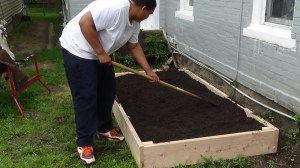 The guys who worked directly with me were genuinely intrigued by the work, the skill building and what other possibilities there might be when it comes to food production. This year also helped to facilitate the practice of food justice outside of a food centered framework. What I mean by that is the fact that this year felt more about offering skill building to the young men in the program, as well as allowing them to imagine the possibilities that food justice can provide to those who have been subject to the prison industrial complex.
In Joshua Sbicca’s book, Food Justice Now: Deepening the Roots of Social Struggle, he talks about the need to incorporate food justice into larger struggles for social change and why we need to have an intersectional approach to these struggles. Sbicca writes:
We call on those in the food movement to recognize the intersections between exploitation of communities via the prison industrial complex and our food system; this recognition is essential to achieve our ultimate liberation. It is critical that we understand that the patterns of domination and exploitation that drive our prison and policing systems are inherently connected with the patterns of domination and exploitation that drive the inequalities within our food system. We who believe in food justice, we who believe in food sovereignty must recognize the need for an abolition of all enslavement and exploitation in order to achieve real justice.
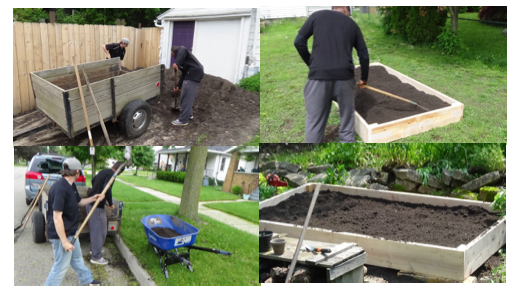
In addition, what made this year’s project so much more exciting, was the fact that this work can provide job opportunities to these young men, increased skill building, a chance to fight against the carceral state and a chance to practice food justice in order to see how these issues overlap and interact with each other.
Lastly, we are in conversation with Steepletown Neighborhood Services about expanding this work and to increase capacity so as to build upon this year’s experiment. We will keep you informed about what else might come from this partnership.
Food Justice Now!
 On Friday, we posted a piece about former US Ambassador to the UN, Nikki Haley, speaking at the Econ Club of Grand Rapids annual dinner. That post focused on the capitalist class in West Michigan, the Econ Club members, and what Haley had to say about Capitalism and Socialism.
However, Haley didn’t just speak at the Econ Club’s annual dinner, she also was the recipient of the Col. Ralph W. Hauenstein Fellowship Award, an award presented by the Hauenstein Center at GVSU.
A number of GVSU faculty members objected to this award being given to Nikki Haley, so much so, that they crafted a letter of dissent, which can be read in its entirety at this link.
The following except from the letter provides the basic objection to the award going to Nikki Haley:
Ambassador Haley’s most prominent national political role to date has been as a loyal member of the Administration of Donald Trump. She supported the Administration during her tenure as U.N. Ambassador, and has continued to do so since stepping down. Yet the current Administration systematically distorts norms of public discourse and conduct, and consistently seeks to undermine public trust in fact-finding and knowledge-generating institutions, including the judiciary, the press, science, and the university. Our objection to the award is that Ambassador Haley’s support for the Administration includes these very efforts. Efforts to undermine standards of public discourse and conduct, and public trust in institutions such as GVSU itself. Awarding her is thus endorsing someone who has been unapologetically complicit in the undermining of the very values that the institution stands for. It is this to which we object.
The entire letter is well articulated and makes a strong case for their collective objection to the former US Ambassador to the United Nations as the recipient of this award from GVSU. I agree with the basic arguments laid out in the letter and am grateful that some faculty members took a public stance against the university’s decision to give the award to Haley.
However, there does seem to be a double standard in this case, especially considering who else has been the recipient of the very same award from the Hauenstein Center. The award has been given out since 2011 and has included the following recipients:
- Gerald R. Ford
- Gen. Brent Scowcroft
- Madeleine Albright
- James Baker
- William Cohen
- Paul O’Neill
- John Beyrle
- Adm. James M Loy
- Tommy Remengesau
- Carla Hills
- Sec. Robert Gates
- Gen. Wesley Clark
There are several former high ranking US military officials who have received the award. For instance, General Brent Scowcroft was the US National Security Advisor to Presidents Ford and George H.W. Bush. This means that during those two administrations, Scowcroft would have endorsed the US decision in 1974 to support the Indonesian invasion and occupation of East Timor, a decision that led to one of the worst genocides in the 20th Century. Under George Bush Sr, Scowcroft would have been complicit in the 1989/90US invasion of Panama, resulting in the deaths of several thousand Panamanian civilians and the 40-day US bombing of Iraq in 1991, which kills thousands of Iraqi civilians and destroyed much of the Iraqi infrastructure, which led to the deaths of tens of thousands more, specifically children.
We could also talk about Robert Gates, who was the Director of the CIA during the George H.W. Bush administration, as well as the US Secretary of Defense during the George W Bush administration and part of the Barack Obama administration (2006 – 2011). Gates was also part of the Central Intelligence agency for decades, which means he was not only aware of the vicious covert activities the CIA was involved in, he had a hand in those activities. For example, while Gates was Deputy Director of the CIA, under the Reagan administration, Gates was involved in the Iran-Contra scandal, a drugs for guns for money scheme that resulted in providing support for the Contra terrorist forces in Central America.
Maybe we could talk about Madeleine Albright, who was the Secretary of State during the Clinton Administration. In addition to her role in the US bombing of Kosovo and Sudan, Albright was a key figure in the Clinton Administration’s decision to impose economic sanctions on Iraq. These sanctions, coupled with the 1991 US destruction of Iraqi infrastructure, led to the deaths of 500,000 Iraqi children. Albright was questioned about this decision on 60 Minutes in 1996, by Leslie Stahl:
Lesley Stahl on U.S. sanctions against Iraq: We have heard that a half million children have died. I mean, that’s more children than died in Hiroshima. And, you know, is the price worth it?
Secretary of State Madeleine Albright: I think this is a very hard choice, but the price–we think the price is worth it
We could go on, but I think the point is clear here. Recipients of past Hauenstein Center awards have served in both Republican and Democratic administration and have engaged in what are considered by international law standards, War Crimes. Now, I am unaware of any faculty at GVSU crafting a public letter of objection against any of the previous award recipients. We have to ask why? Were the war crimes that many of the previous award recipients involved in also not objectionable? Are any of the previous award recipients not deserving of a letter of dissent?
Again, I agree wth the GVSU faculty who objected to Nikki Haley’s award, but doesn’t the bombing of civilians and the deaths of innocent civilians merit the same kind of outrage? Important questions for scholars, students and West Michigan community members alike.
Grand Rapids Capitalist Class invites former UN Ambassador to say that Socialism creates poverty
 Yesterday, the Econ Club of Grand Rapids held their annual dinner, which included the wealthiest people in West Michigan and members of the professional class.
The keynote speaker this year was Nikki Haley, the former US Ambassador to the United Nations. Haley, who served as US Ambassador to the UN for just 1 year (2017 – 2018), was noted for her willingness to use military force against North Korea, her staunch defense of the State of Israel and her role in the Trump Administration’s decision to end aid to countries that were critical of Israel and the US support of Israel.
However, at the Econ Club dinner on Wednesday, Haley addressed the issue of Socialism, which makes complete sense when the event at DeVos Place was packed with those who embrace a Neo-liberal form of Capitalism.
In an MLive article, Haley was quoted as saying:
“Capitalism is the greatest force for ending poverty and lifting up human beings in history. America’s dangerous flirtation with socialism is in colleges, in the media and in Congress. We have an obligation to remind everyone that if you care about global poverty, you should support capitalism.”
According to the MLive article, Haley also talked about US immigration policy and working in the Trump administration. However, her main talking point was to dismiss Socialism and praise Capitalism. Haley said that people need only to look at Venezuela to see how bad Socialism is for people.
Unfortunately, the MLive reporter did not question or verify the claims made by Haley, they simply acted as a stenographer for what the former US Ambassador to the UN had to say. This is not surprising for most journalists, who rarely challenge people in power, especially around the topic of Capitalism or Socialism. I wonder what the former Ambassador to the United Nations would have to say about the fact that Grand Rapids has the largest wealth gap in the State of Michigan or that 1 in 5 children in Michigan live in poverty?
None of this matters in the world of journalism and it certainly doesn’t matter to many in attendance at the Econ Club annual dinner, especially since they are part of a class of people who directly contribute to poverty because of their significant wealth and the poverty-level wages they pay through the businesses they run.
Since leaving her post as US Ambassador to the United Nations, Haley has become a board member for the giant corporation Boeing and she founded a far right think tank called, Stand for America.
DeVos front group AmplifyGR, shifts tactical approach to influence outcomes in southeast part of Grand Rapids
 On May 25, MLive ran an article on a new partnership between Home Repair Services and the DeVos-backed entity AmplifyGR.
This new effort between the two groups, called the Neighborhood Strong program, has been funded through the Doug and Maria DeVos Foundation, the CDV5 Foundation, as well as banks and utilities, according to AmplifyGR director Jon Ippel. It is safe to say that the bulk of the $325,000 provided is coming from the DeVos family, since they have already invested over $10 million on property in that part of Grand Rapids.
The project does provide funding for homeowners in the southeast part of Grand Rapids to make repairs on their homes, which is a positive thing. A few of the homeowners are cited in the MLive article, along with representatives from AmplifyGR and Home Repair Services.
At one point, the MLive story states, “Amplify was initially greeted with suspicion from some neighbors who expressed concerns about gentrification, but it has since been working to build relationships with residents and community groups.”
This statement is instructive and it speaks to the tactical changes that AmplifyGR has taken since it first became public back in the Spring of 2017. AmplifyGR was greeted with more than suspicion in the summer of 2017, when neighbors and other members of the public called the DeVos-created entity out during several public forums.
After AmplifyGR’s the 3rd community forum and continued push back, they decided to cancel any future forums. AmplifyGR then made this statement:
“If going slower is the price of getting this right… of NOT repeating the mistakes of the past… it’s worth it. You’re worth it. Our community is worth it. And our commitment and passion to achieving the above priorities has never been greater.”
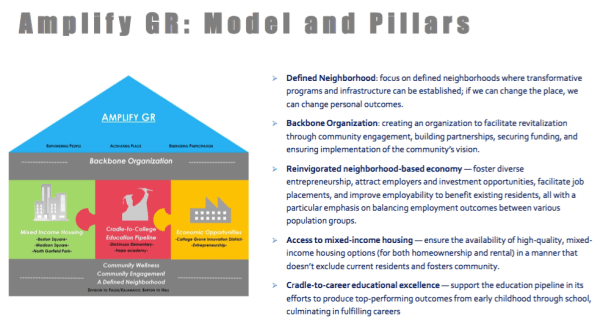
AmplifyGR has shifted their tactical approach to meeting with small groups of people and individuals in the southeast area, thus eliminating community accountability. When organizations like AmplifyGR, which has the back of the wealthiest family in West Michigan, chose to operate with limited transparency, you can be sure that they still are committed to their original agenda, an agenda reflected in the graphic below.
In addition to the Neighborhood Strong program, AmplifyGR has partnered with another DeVos entity, Start Garden, to push an entrepreneurial approach to community development, held turkey give aways, provided personal finance counseling opportunities to residents and other mini grant options.
What AmplifyGR has NOT done is to develop the three dozen properties they invested in with their development partner Rockford Construction. Again, this speaks to the transparency issue, since their is no clear plan on what their longterm agenda is, specifically with the $10 million worth of property that they own. And this is exactly why the community had major concerns about gentrification. When the wealthiest family buys that much land in any neighborhood, they aren’t doing it for altruistic reasons.
None of us should be fooled by the piecemeal services and bandaid approach to neighborhood stabilization projects that AmplifyGR has been engaged in in the past 18 months. People should demand full transparency from AmplifyGR and an articulation of their longterm plans for this part of southeast Grand Rapids where they have engaged in a land grab.
 For the second year in a row, the Senate Armed Services Committee, which Michigan Senator Gary Peters sits on, has voted for an increase in military spending.
According to the independent news agency, The Intercept:
The Senate version of this year’s National Defense Authorization Act would raise military and other defense spending to levels not seen since 2009, when more than 180,000 troops were deployed in Iraq and Afghanistan, according to data from the Stockholm International Peace Research Institute. The Pentagon forecasts that in years to come, its budget requests will keep rising to levels not seen since the World War II.
In some areas, the Senate bill even exceeds what the Trump administration requested. According to a summary document provided by committee staff, the bill authorizes $10 billion for 94 F-35 Fighters — 16 more than the Pentagon asked for.
In a bi-partisan vote of 25 – 2, the Senate Armed Services Committee members voted to approve an increase in US military spending. Some of that spending includes:
• Fully funds the mission of the men and women of USSTRATCOM, beginning with the sustainment modernization of our nuclear forces, including the warheads and supporting the Department of Energy’s nuclear complex.
• Builds on last year’s support for the supplemental systems announced in the president’s Nuclear Posture Review by authorizing funds for the deployment of a low-yield ballistic missile warhead to increase deterrence against Russia.
• Complements the administration’s approach to comprehensive arms control by requiring the Department of Defense to submit a report describing threats beyond the scope of today’s arms control regime, including Russia’s deployed non-strategic weapons, weapons not covered by New START, non-deployed strategic weapons, and China’s nuclear modernization program.
• Fully authorizes critical bilateral U.S.-Israel cooperative missile defense programs.
◦ $69.8 million for several critical weapons programs at the National Nuclear Security Administration – such as the Stockpile Responsiveness Program – in order to buy-down future risk and enhance the resilience of our nuclear complex.
◦ $113 million for the development of the next generation of GPS receivers to ensure the U.S. military continues to have access to resilient position, navigation, and timing capabilities.
• Prohibits any reduction in responsiveness, alert level, or quantity of our ICBM forces.
Michigan Senator Gary Peters voted for this massive US military budget, along with most of his Democratic and Republican colleagues on the Senate Armed Services Committee. However, Senator Peters does not include many of the details of this increased US military budget in his Press Release from last Friday. Instead, Peters chose to present himself as someone who is looking out for US military veterans and Michigan Defense Contractors. As we have reported in the past, Senator Gary Peters, like his predecessor Carl Levin, have always supported massive US military budgets no matter which party sits in the White House. This dynamic demonstrates that the Democratic Party is equally (and has always been) committed to US imperialism as the Republicans are. However, it won’t matter that Democrats like Gary Peters will vote for massive military budgets, while so many Americans live in poverty, because ultimately people will continue to vote for Democrats no matter how much they defend war and militarism at home and abroad.
Memorial Day and Organized Forgetting
There is a need for social movements that invoke stories as a form of public memory, stories that have the potential to unsettle common sense, challenge the commonplace, and move communities to invest in their own sense of civic and collective agency.” Henry Giroux, The Violence of Organized Forgetting: Thinking Beyond America’s Disimagination Machine
 Yesterday, millions of Americans enjoyed a long weekend, spending time with family and friends, and firing up the grill to celebrate Memorial Day. Memorial Day is designated as a day to remember, specifically to remember and honor US soldiers, whom, we are taught, have been and are still fighting for our freedom.
Now, I don’t know how many people actually believe that, but as I was thinking about the significance of Memorial Day, I came to realize that it was not so much a day to remember, but a day to forget.
The late radical historian Howard Zinn would often say that the way most people learn US history is through the lens of the historical winners – those in power, both politically and economically. Zinn would also say that so much of the real history, the history from below, has fallen into the historical memory hole. We have either forgotten much of the history from below or it was never presented to us.
If Memorial Day, is a day for the public to re-member US soldiers and US militarism, then by all means, let’s re-member this collective history.
I wanted to start by quoting the most decorated military officer in US history, General Smedley Butler. After Butler retired from the military, he wrote one of the most important critiques of the US military. Initially given as a speech, Butler then wrote a short booklet entitled, War is a Racket. Here is one brief excerpt from what Butler believed was his real purpose as a US military leader.
I helped make Mexico, especially Tampico, safe for American oil interests in 1914. I helped make Haiti and Cuba a decent place for the National City Bank boys to collect revenues in. I helped in the raping of half a dozen Central American republics for the benefits of Wall Street. The record of racketeering is long. I helped purify Nicaragua for the international banking house of Brown Brothers in 1909-1912 (where have I heard that name before?). I brought light to the Dominican Republic for American sugar interests in 1916. In China I helped to see to it that Standard Oil went its way unmolested.
During those years, I had, as the boys in the back room would say, a swell racket. Looking back on it, I feel that I could have given Al Capone a few hints. The best he could do was to operate his racket in three districts. I operated on three continents.
The United States was founded on two foundational realities. First, the US practiced what indigenous scholar Roxanne Dunbar Ortiz calls Settler Colonialism, which was a practice of indigenous land theft by euro-Americans. The second foundational aspect of the creation and expansion of the US was slavery. The United States would never have become the dominant global power it is today if it had not stolen indigenous land and then created wealth by relying on chattel slavery for the first century of its existence.
Most US history books do not include the critique that the US was founded on settler colonialism and slavery, but this is a fact which is impossible to suppress. In Ward Churchill’s important book, On the Justice of Roosting Chickens: Reflections on the Consequences of US Imperial Arrogance and Criminality, he devotes a large section of the book providing a chronological overview of US militarism between 1776 and 2003. Churchill methodically documents US military actions against First Nations people in North America and US militarism abroad.
In the 1980s, I remember being part of an action at the Federal Building in downtown Grand Rapids. The action was designed to draw attention to US support for the Contra forces who were fighting the Sandinista government in Nicaragua, primarily by engaging in terrorist attacks against civilians. On Memorial Day of 1986, we placed about 100 cross on the Federal Building lawn, each with the name of a Nicaragua civilian who had been killed by Contra soldiers. We wanted to demonstrate that US militarism had a cost and we wanted to NOT forget that innocent people were the victims of US imperialism. We wanted to re-member!

Another person who has documented US military interventions is Professor Zoltan Grossman. Grossman has been documenting this history for years and he has a list beginning with the US Army massacre at Wounded Knee in 1890, through 2014. What Grossman has done is not only to document the history of US militarism, but to provide us with a tool or a mechanism to re-member, to put back together again and to resist what Henry Giroux calls Organized Forgetting.
What follows is what Grossman has documented, which you comes from this link. While this list does not provide many details, it does demonstrate that US militarism and US imperialism has always been an integral part of US history. Millions of people have been murdered during this history, millions more displaced, yet it is history that gets put down the memory hole by politicians and pundits alike. Let us not forget this history and let us all re-member!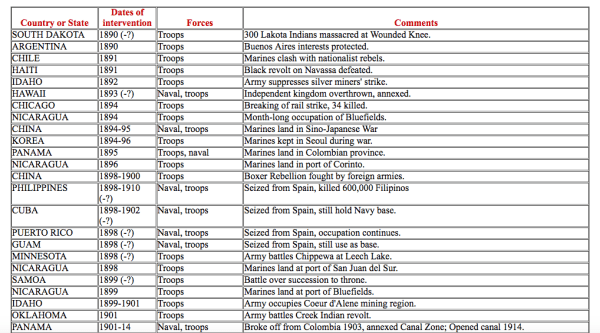





 Grand Rapids Institute for Information Democracy
