Members of the 1% class in West Michigan continue to assert tremendous influence with electoral politics in Michigan.
The Michigan Campaign Finance Network (MCFN) recently posted an article about the top campaign contributors in Michigan for 2019.
This article provides numbers on how state legislators were receiving their funding (individual donor, self-funding or PAC money), along with a breakdown of how much the Republicans and the Democrats raised in 2019, specifically from PAC contributions. In the 2019, the Democrats raised $2.9 million, while the Republicans raised $8.2 million.
In addition, the article provides a list of the top 10 families contributing in 2019, with 5 of the top ten being families from West Michigan. This has been consist for the past 20 years, with the DeVos family always listed as the largest in the past 3 decades. The combined total of the 5 families from West Michigan comes to roughly $1.175 million in campaign contributions for 2019 alone.
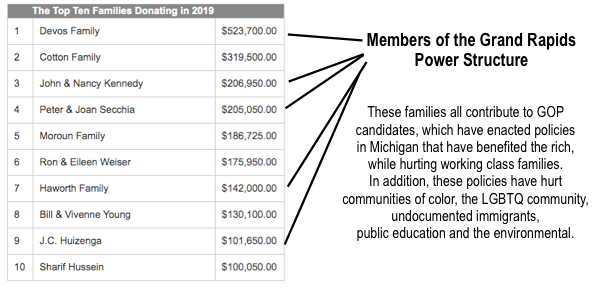
In addition to contributing to the GOP, these West Michigan families sit on the boards of entities like, the Grand Rapids Chamber of Commerce, the West Michigan Policy Forum, the Right Place Inc, the Acton Institute, Talent 2025 and many other organizations which promote policies that benefit their friends in the capitalist class, while devastating black and brown communities, indigenous people, the LGBTQ community, undocumented immigrants, women fighting for reproductive justice, public education and the environment.
As we have documented over and over again, these members of the Grand Rapids Power Structure also use their foundations to then provide some assistance to the very same communities who have been negatively impacted by the policies adopted by state legislators they fund. This demonstrates the absurdity of the non-profit industrial complex in Grand Rapids, since many of the non-profits would not need to exist if these families were not pushing unjust policies, plus it means that these same non-profits will not publicly challenge the root causes of the injustices they claim to be addressing.
It’s all a well oiled machine, which is exactly why these families from West Michigan contribute millions to get policies passed that will primarily benefit their position of power and expand their wealth. This is exactly what West Michigan Nice looks like.
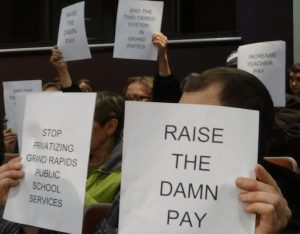
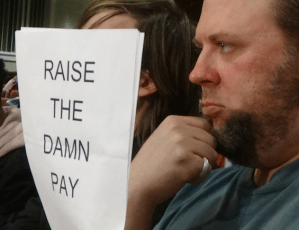 Last night, Grand Rapids for Education Justice (GREJ) brought forth the three demands for the Grand Rapids Public Schools, which were laid out a month ago. The three demands are:
- An increase in teacher salaries
- An end to the two-tiered system in the GRPS, a system which disproportionate impacts students experiencing poverty and students of color
- An end to all privatization of GRPS services
However, since public comment is the last thing on the agenda, people had to wait to address these demands.
The Board meeting began with a recognition of students who were winners in a Martin Luther King Jr. essay contest, sponsored by the law firm of Warner, Norcross & Judd, a law firm that practices business law and is involved in many conservative efforts across the state. Many of the students who participated in the essay contest were recognized and the top three student essays were read by the students who wrote them. The irony of what these students were saying is that it mirrored some of the same aspects of the 3 demands that GREJ had addressed during public comment. In fact, it seemed that these students had laid the ground work for what the GREJ was demanding, especially the demand to end the two-tiered education system within the GRPS.
When it was finally time for public comment, several GREJ members and supporters got up to speak. In fact, GREJ supporters were the only people who spoke during public comment. While GREJ members were speaking, those in the audience held up signs reflecting the three demands.
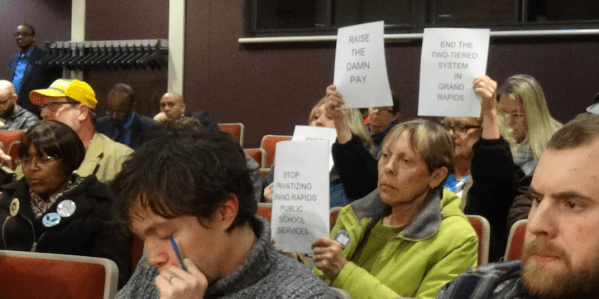
The first person addressed the issue of teacher salary, which the person said was ridiculously low. She also said that the GRPS needs to talk with teachers more directly about what their financial needs really are and what their true value is to this district.
Martha Cooper also addressed teacher salaries, but spent more time talking about the two-tiered system and how it impacts students and parents along racial lines and class lines. She ended her comments by pounding on the table, demonstrating her passion and anger at the lack of equity and justice within the GRPS.
Rich Fink brought up the equity audit that was part of the board of education’s agenda. Rich’s own research pointed out that the scores between the themed schools and the more traditional schools, with theme school students scoring higher. Black and latinx students and those living in poverty have much lower scores, thus emphasizing the inequity of the two-tiered system.
The next person who spoke was asking about the differences between public, charter and themed schools. In addition, she raised issues around privatization, which is one of the demands that GREJ brought forth last night.
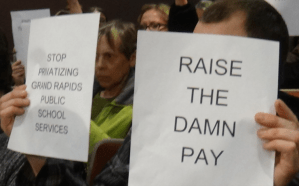 Tony Jacobs then addressed the GREJ demands and said that he felt that the students who read their essays were amazing and he wanted to acknowledge their passion. As a parent of a student within the GRPS, he particularly wanted to address teacher salaries. He told the story of how his daughter sat through an entire year had no gym class, with no teacher and students were forced to sit in the room and not received the physical education they deserved.
Jack Prince addressed the theme of equity, especially since the board of education addressed it numerous times in their agenda. He made the point that teachers need to get better pay, that students deserve equal treatment and should not be subjected to the two-tiered system. Jack really hit hard the issue of privatization. He mentioned that the school district has a long history of privatization, including the buses, custodians and school curriculum. He said that the privatization of public school services was inexcusable and that it contributed significantly to the two-tiered system.
Kyle Lim also addressed the two-tiered system with GRPS. He acknowledged the students essays that were read earlier as well. In fact, while he was listening to them he looked up the racial makeup of the schools these students represented in the essay contest and discovered that these students were primarily from theme schools. He pointed out that all three of the winners were white students and asked why students of color were not afforded the same opportunities as white students. Kyle also addressed the academy schools, the ones that provide training in tourism and other areas, which seem to only lead to low paying job opportunities.
 Ann Collins Swisher, a former teacher within the GRPS, focused primarily on increased teacher salaries, which, she believed, would address the other two demands. She urged the board to fight like hell at the state level to get every dollar they could to pay teachers a better salary and to provide the necessary resources to get the best education possible for every student in the district.
Malik, a GVSU student, shared his story about growing up in a two-tiered education system on the east side of the state and how it limits student opportunities to explore new possibilities that a well grounded education can provide.
At the end of the night, none of the GRPS Board members addressed any of the three demands presented by GREJ. One board member did say, “they were listening,” even though it certainly didn’t seem like that was the case. Lastly, none of the local news agencies were in attendance, thus conveniently not having to report on the growing movement confronting the GRPS.
 GRIID – With the recent statement on AmplifyGR, why did TWAS feel it was important to make such a statement?
TWAS: AmplifyGR recently received preliminary approval for their Phase I plans by the City Planning Commission. Yet at the hearing we heard from so many in the community that had real concerns and that felt that things were going too fast. Our neighbors, our friends hadn’t been able to attend community engagement meetings – either they hadn’t heard about them or they hadn’t been able to attend, or it already felt like it was not for them.
We also feel there’s a huge difference between managed, facilitated “community engagement” as opposed to deep community conversation that arises in an organic way. We noticed a disconnect from what we had heard in 2017. In 2017, even folks at AmplifyGR said they were considering putting the land in trust and letting the community decide the plans. At the very least, as many of us in the community said back then, we wanted signed Community Benefits Agreements (CBAs) that we could hold them to, contracts that would outline things like:
- rent control,
- jobs and businesses going to the community,
- true living wages ($15 an hour isn’t enough in this housing market),
- collective management of some assets – the community growing together.
We haven’t heard anything more about those.
We also noticed there were some respectability politics at play – we heard representatives of churches, non-profits, businesses, and homeowners speak in support of AmplifyGR. These folks are great; they’re important voices in the community. But it’s the folks who are even more marginalized – like some of us who are renting, or are underemployed, or are living with chronic illness, or our existence has been criminalized in some way so either we have a record or a family member who is incarcerated – we didn’t feel like we were hearing enough from those of us.
In fact, some of the homeowners we were talking to were wanting “the criminal element” out of their neighborhood. We felt like if the community was having a deeper and more inclusive community conversation, and really talking to everybody, that would be a different conversation – it would have to be because people experiencing incarceration would be more involved.
So it seemed important to point all that out, while there’s still time in the narrative to make more space for it, before it goes to the City Commission.
GRIID – You mention towards the end of the statement on AmplifyGR that your group is wanting to form a Tenant Union in the Greater Grand Rapids area. Why did you choose to announce a tenant union attached to a response about AmplifyGR?
TWAS: Renters make up a third of the population of Boston Square, and almost half of the population of Grand Rapids as a whole. We realized that in order for us to hear from more of us who don’t have access to property ownership, for whatever reason, we needed to be intentional about making space for our stories, and making space for our organizing.
We believe it’s really important to have a tenants union because our communities deserve a voice for the people, created by the people, and with the best interest of the community in mind.
GRIID – Is the announcement about a tenant union connected to the increased levels of gentrification we are seeing in this community? If so, how do you think a tenant union will act as a counter to some of the effects of gentrification and housing insecurity?
TWAS: Absolutely, yes. One of the most frequent concerns we heard at the City Planning Commission Hearing was about gentrification, and it makes sense. If the plans go through and AmplifyGR sells those renovated spaces, even if they guarantee jobs to the people in the neighborhood, property values and taxes will rise, and so will rents. If the jobs are paying $15 an hour it’s not going to cover increased rents – you can see it coming, that people will get pushed out again.
If we make space for renters to share their stories and to hear each other – how we’ve been pushed out of our neighborhoods by so-called “urban renewal” and rising rents – then we make space to organize for something better. We are setting up a framework that encourages the deep organic conversations that we are longing to hear.
GRIID – What kind of power could a tenant union have that is different than the approaches that all of the other housing rights groups are working on in this community?
TWAS: We can take care of each other so we’re not alone. Because we will be led by renters, for renters, we would do things in a way that reflects our needs.
For instance, the places we can afford to stay now, in neighborhoods that aren’t yet gentrified, are often in bad repair. But if we work together, we have collective power. Then nobody has to go through it alone. If a person needs repairs on their place, a bunch of us can call the landlord, and we can help them report a landlord who is trying to evict them based on their request for repairs (because that happens a lot).
We’re not as interested in talking to the City Commission – lots of people do that already, so we feel like that need is filled. It’s become “business as usual” to have folks like us on the brink of losing our housing again and again, and we want to disrupt that by using our power together.
So our unique focus is on taking care of each other, claiming our power in numbers, and getting results when it comes to property maintenance, keeping our rents down, and anti-eviction measures.
Together We Are Safe will be announcing their first tenant union meeting soon, so check their Facebook page at https://www.facebook.com/TWASforMLK/.
History of US recruitment of Nazi’s and anti-Semitism explored in the TV series Hunters
 I just finished the TV series called Hunters, which features a group of people in the US who hunt down Nazis in the late 1970s.
The show centers around the lived experience of several Jewish characters, most of which survived the Nazi Holocaust. The show goes back and forth between telling the story of Jews in the neath camps and then back to the 1970s in New York City.
I found the story to be well written and the trauma of those who survived the death camps to be presented in a very thoughtful way. However, since I am not Jewish, I think it is important to hear from the Jewish community about how they felt about the series and its depiction of what took place in the Nazi death camps, along with the show’s treatment of several Jewish ceremonies.
What I think is important to address is the fact that this was a show, one of the rare shows in US TV history, to acknowledge, and to some degree, explore the US recruitment of Nazis after WWII, also known as Operation Paperclip.
The relationship between the US power structure and Nazi Germany is rather complex. Most of us are taught that the US took an anti-fascist position during WWII, but that is not the whole story.
After the end of WWI, there were numerous US businesses, law firms and financial institutions that assisted Germany with rebuilding. Many of these businesses invested directly with businesses that would then be an integral part of the Nazi war machine, like IG Farben. This history is explored in Christopher Simpson’s powerful book, The Splendid Blonde Beast: Money, Law, and Genocide in the Twentieth Century.
Even after WWII had begun, many US businesses continued to have deep relationships with Nazi Germany, including the Ford Motor Company, General Motors and IBM. These relationships are explored in two excellent books, Nazi Nexus: America’s Corporate Connection to Hitler’s Holocaust (Edwin Black) and Trading With the Enemy, The Nazi-American Money Plot 1933 – 1949 ( Charles Higham).
This historical context is important and is what leads to Operation Paperclip. The US recruited thousands of Nazis scientists, engineers and policy planners as WWII was coming to a close. These Nazis were legally brought to the US to work with NASA and the US military as US foreign policy began to shift to primarily an anti-Communist position during the Cold War.
There were several high ranking Nazi military personnel that were recruited by the US, like General Reinhard Gehlen, specifically because Gehlen had intimate knowledge of the Soviet military. This history is explored in Mary Ellen Reese’s book, General Reinhard Gehlen: The CIA Connection.
Another important book that explores the US recruitment of Nazis after WWII, is Christopher Simpson’s, Blowback: The First Full Account of America’s Recruitment of Nazis, and Its Disastrous Effect on Our Domestic and Foreign Policy (1988).
The most recent exploration of the US recruitment of Nazis after WWII, can be found in Annie Jacobsen’s book, Operation Paperclip: The Secret Intelligence Program That Brought Nazi Scientists to America (2014). Jacobsen’s book builds on the work of Christopher Simpson, especially since there have been more declassified documents released and a collection of dossiers discovered in government archives at Harvard University.

There is an excellent scene in one of the episodes of Hunters, where US policymakers are having a discussion about Operation Paperclip, with a variety of justifications for why the US needed to recruit Nazis. This dramatic depiction is a fairly accurate as far as the actual reasons that were given for the US recruitment of Nazis.
Lastly, while the show deals with WWII and the 1970s in the US, it is important that we come to terms with the fact that anti-Semitism continues to be part of the US power structure and US dominant culture. This reality is depicted in Hunters, but it is vitally important that all of us look at how anti-Semitism is normalized in our lives and the institutions that we come into contact with on a daily basis.
The Educational Network of Greater Grand Rapids is another front group for the DeVos family’s commitment to a Neo-Liberal Education model
 Has anyone ever heard of a group called the Educational Network of Greater Grand Rapids, as known as EDNET?
The Educational Network of Greater Grand Rapids has only been around since 2017 and states that their purpose is to, “support teachers and administrators in providing excellent and equitable educational experiences for all children in Grand Rapids, Kentwood, and Wyoming.”
The mission statement sounds nice and all, but are the school districts themselves supposed to provide the necessary support to teachers and administrators?
Upon further examination of EDNET, their website states that this project is an initiative of the Doug and Maria DeVos Foundation. Notice that it doesn’t say that EDNET is funded by the Doug & Maria DeVos Foundation, but is an initiative of the Doug & Maria DeVos Foundation.
This certainly made me suspicious when I read who was behind the organization. Upon further investigation I read the following:
We partner with nationally acclaimed organizations to bring new insights, strategies, and resources to urban educators and administrators in public, private, and charter schools here in West Michigan. And we connect schools across districts to facilitate the sharing of transformative thinking and resources.
Ok, so what nationally acclaimed organizations does EDNET partner with? There are three national organizations that EDNET partners with:
- Leading Educators
- West Michigan Leadership Academy
- New Teacher Center
Leading Educators says that they began in 2008 in New Orleans, after Hurricane Katrina. Their website doesn’t talk about what exactly they did during that time period, but numerous writers have documented that the public school system in New Orleans was dismantled and has been replaced primarily by Charter Schools. (See Naomi Klein’s The Shock Doctrine)
Leading Educators works with 8 cities across the country, including Grand Rapids. Here is what they have to say about Grand Rapids:
With the support of the Doug & Maria DeVos Foundation, Leading Educators expanded to Greater Grand Rapids, Michigan, where the first cohort of principals and teacher leaders began training in the summer of 2017. Our approach is the backbone of an ambitious strategy to significantly increase academic achievement among economically-disadvantaged young people who attend the nearly 120 district, charter, and religious schools in the Greater Grand Rapids urban area. This work uses the greatest asset within Grand Rapids’ urban schools—experienced educators—by supporting up to 300 teacher leaders along with their principals and district administrators. This approach will provide approximately 2,400 classroom teachers with self-driven professional development opportunities, ultimately impacting 40,000 students.
In looking at who funds Leading Educators, you guessed it…..The Doug & Maria DeVos Foundation, listed with other Neo-Liberal Education funders such as the Bill & Melinda Gates Foundation and the Chan Zuckerberg Initiative.
The West Michigan Leadership Academy says that it, “works to build the capacity of school and system leaders in West Michigan to envision and enact the structures, systems, and practices necessary to realize equitable outcomes for all students.”
The West Michigan Leadership Academy is actually part of the NYC Leadership Academy, which just has a subsection on their website for the West Michigan Leadership Academy. One of the major funders listed for the NYC Leadership Academy is he Doug & Maria DeVos Foundation.
The third partner listed by the Educational Network of Greater Grand Rapids is the New Teacher Center. The work of the New Teacher Center sounds very similar to the other groups working with EDNET, stating:
NTC is dedicated to improving student learning by accelerating the effectiveness of teachers and school leaders. We build capacity within districts and district partners to drive student learning, teacher effectiveness, and teacher and leadership development. We do this by providing PreK-12 teachers and school leaders with the skills and supports needed to create optimal learning environments that accelerate students’ academic and social emotional success.
The New Teacher Center also does policy work, particularly at the state level. In 2018, they received a $12.8 million grant from the Department of Education, and while the Doug & Maria DeVos Foundation is not listed as one of their funders, some of the same ideologically-driven foundations are major donors.
What the Education Network of Greater Grand Rapids means to this writer is that it exists as an entity that was started by the Doug & Maria DeVos Foundation, partners with other national groups that are either funded by the Doug & Maria DeVos Foundation or other rich people who share the same commitment as DeVos, to the Neo-Liberal Education model. If you or someone you know is involved in the Educational Network of Greater Grand Rapids, you might want to ask them exactly why they are participating in a project for teachers that was started by a family that has consistently been opposed to public education and has provided millions of dollars to candidates who can alter state policies on education, particularly in Michigan.
Acton Institute speaker acts as an apologist for war criminal and agent of global capitalism, John Foster Dulles
 One week ago, the Acton Institute hosted a luncheon lecture entitled, John Foster Dulles: Faith, Freedom, and the Cold War Architect. The presentation was presented by John D. Wilsey, a professor and author of several books and an Affiliate Scholar in Theology and History at the Acton Institute.
Wilsey’s comments were that of a most academics, since the presentation was not that engaging, but also because the professor acted primarily as an apologist for the former Secretary of State, John Foster Dulles. Wilsey made the claim that as Secretary of State, John Foster Dulles was primarily interested in the “containment of Communism.” And why such a statement is true, it does not pain the whole picture of who Dulles was and what role he played in furthering US imperialism.
The Acton Institute presenter acknowledged that John Foster Dulles and his brother Avery Dulles, had some dealings with Germans who were part of the Nazi Party. Wilsey even included a few pictures, but Wilsey said it was ridiculous for historians to suggest that the Dulles brother collaborated in any way with the Nazis.
My own reading of the Dulles brothers would challenge Wilsey’s claims. The Dulles brothers were lawyers and worked for the very influential law firm of Sullivan & Cromwell. In Christopher Simpson’s book, The Splendid Blonde Beast: Money, Law, and Genocide in the Twentieth Century, Simpson asserts that John Foster Dulles played a key role as it relates to Germany just after WWI had ended and during the time of Nazi control. First, while Dulles was acting a a US government representative, Simpson states, “Dulles favored restricting the definition of war crimes to greatest degree possible, then limiting the defeated powers’ obligation to pay reparations to those few cases that had been successfully prosecuted.”
The other major role that John Foster Dulles played, while working for the law firm of Sullivan & Cromwell, was to help broker massive investments in Germany on behalf of major US corporate interests. According to Simpson, these investments totaled over $1 billion in the late 1920s and were key investments in industries that were particularly profitable in the Nazi war machine, like IG Farben.
John Foster Dulles, Allen Dulles, was a main player in the US effort to recruit numerous Nazi high ranking officers to come to the US and assist the US government and the newly created CIA to assist the US during the Cold War.
Because of the relationships that both of the Dulles brothers had developed from the 1920s through the early 1950s, Dwight Eisenhower appointed both of them to his cabinet when he took the office at the beginning of 1953. Allen Dulles became the Director of the Central Intelligence Agency (CIA) and John Foster Dulles became Eisenhower’s Secretary of State. It is during their 8 years as part of the Eisenhower administration that both of the Dulles brothers played an even larger role in expanding US global imperialism.
In 1953, after the government of Iran had nationalized their oil, the US became increasingly concerned with what inside planners (like Dulles) referred to as Arab Nationalism in the Middle East. The US would not tolerate Iran’s nationalizing of their oil, which prompted John Foster Dulles to say, “this is how we get rid of that madman Mossadegh.” Dulles was referring to the CIA orchestrated coup, which removed Mossadegh from power and put the despot Shah in power.
Less than one year later, the Dulles brothers were at it again, this time orchestrating a CIA coup in Guatemala in 1954 on the behest of the United Fruit Company. What made this particularly insidious was the fact that not only did the United Fruit Company use the law firm of Sullivan & Cromwell (where the Dulles brothers used to work), but that the Dulles brothers directly represented the United Fruit Company while working for Sullivan & Cromwell.
The CIA coup in Guatemala was particularly problematic, since it solidified the right wing power structure in that country, which led to genocidal policies against the indigenous population and maintained a massive wealth gap that plagues Guatemala even up to the present day.
John Foster Dulles also played a key role in making sure that the US would not support Ho Chi Minh, despite Minh’s efforts to gain US diplomatic support against the French occupation of Vietnam. Before Dulles died in 1959, he would also influence the US antagonism directed at the Egyptian leader Nassar and the Cuban revolutionary Fidel Castro. (see Stephen Kinzer’s book, The Brothers: John Foster Dulles, Avery Dulles, and Their Secret World War)
Many of us have been conditioned to believe that US policy between WWII and the collapse of the Soviet Union was a nobel endeavor. However, the amount of suffering and oppression that the US caused during those years was unimaginable. John Foster Dulles, along with his brother Allen, would be considered as war criminals for the roles they played the violence of US policy, especially during their time as Secretary of State and Director of the CIA. We should never forget that, even when the Acton Institute presenter claims that John Foster was a man of faith and deep conviction.
Will the new AmplifyGR Director of Economic Opportunities assist residents to create unions or a Community Benefits Agreement?
 Last week, the DeVos-created and DeVos-funded organization AmplifyGR, announced that they hired a new staff person, someone who will, according to Facebook page, “further build a business community that is reflective of the neighborhoods we serve.”
Danielle M. Williams was hired by AmplifyGR to be the new Director of Economic Opportunities. According to the AmplifyGR website:
“With the addition of Danielle to our team, Amplify GR is poised to continue connecting entrepreneurs with the resources needed to build their businesses,” said Jon Ippel, executive director for Amplify GR. “Danielle’s expertise will be an asset in strengthening economic pathways for neighbors, as she has been an integral player in large corporate teams, nonprofit structures and local municipal work. Her experience working in these environments is valuable to our partnerships with businesses and community entrepreneurs.”
Williams started her own consulting agency in 2017, DMWilliams Consulting, LLC. Based on the information from the consulting firm website, the new AmplifyGR employee has most of her experience working with the business community.
The AmplifyGR website also says of the new position that Danielle Williams will have, stating:
As Director of Economic Opportunities, Williams will identify and help activate business ownership and employment opportunities for neighbors. Williams will work with employers to ensure their business practices align with the organization’s employment goals including:
- Employing neighborhood talent
- $15 per hour wage with benefits
- Career advancement opportunities
- Felon-friendly hiring
Each of these four things sound good on paper, but how will they translate into reality? How will this new position be able to leverage what workers will based on the four things listed above?
This new position, along with all of the other AmplifyGR staff job descriptions is very focused on creating businesses and entrepreneurs. This of course is not surprising, since this is exactly what the DeVos family was founded on with the Amway corporation.
The best way to leverage employee power is to form a labor union. Labor unions have 150 years of experience in working to get better wages, benefits and to create workplace democracy. If workers from the neighborhood are hired, what guarantees will they have that the businesses that will be partnering with AmplifyGR will hire ex-felons, provide a minimum $15 an hour wage or employment advancement opportunities? Michigan is an employment at will state. This means that an employer may generally terminate an employment relationship at any time and for any reason, unless a law or agreement provides otherwise. If people were unionized, then they would have more power to fight against termination of employees.
However, it is not likely that a DeVos-created and DeVos-funded entity such as AmplifyGR would help residents of the Boston Square Neighborhood to be part of a union. We can conclude this, since the DeVos family has a long history of opposing labor unions of any kind. In addition to opposing labor unions, the DeVos family was instrumental in passing a Right to Work law in Michigan in 2012, pushing to eliminate public education teacher pensions and working to fight against public sector employee benefits throughout the state. The DeVos family does this by financing candidates which share the same contempt for unions as the DeVos family does and by also crafting anti-union policies through organizations like the West Michigan Policy Forum.
Unions would also be extremely beneficial to those who live in the southeast part of Grand Rapids, where AmplifyGR operates, in terms of housing. A tenant union would be a powerful tool to fight against predatory landlords and property management companies, which are not being challenged anywhere in the city of Grand Rapids.
Some of these ideas were suggested during the 2017 town hall forums that AmplifyGR hosted, along with a whole other host of ideas, like Community Land Trusts and a Community Benefits Agreement (CBE). A Community Benefits Agreement fits in with neighborhood control, which could include the four areas that AmplifyGR says their new staff person would try to implement. In fact, a CBE agreement could include many more demands and it is something that should be pursued for the future viability of the neighborhood. Before any development happens, residents could demand a Community Benefits Agreement before agreeing to what it is that AmplifyGR has proposed to do in the Boston Square Neighborhood.
Based on the 3 community meetings that AmplifyGR held in 2019, centered around their 9-acre development proposal, there are just 2 references to jobs in their 27 page document. Those two references to jobs were, jobs in the neighborhood and “good paying jobs.” Neither of these references expanded to what local jobs or good paying jobs meant, which is exactly what a Community Benefits Agreement could do for those who live in the Boston Square Neighborhood.
The City of Grand Rapids has yet to make a decision on the AmplifyGR proposal and before they do make a decision there will likely be a public hearing on the matter. Pushing for a Community Benefits Agreement is still possible. A community Benefits Agreement could provide the kind of long-term leverage that residents of that neighborhood will need, especially when faced with the deep pockets of the DeVos family.
Mutual Aid as Reparations: How we can all practice justice with the undocumented immigrant community in West Michigan
 While people may not be familiar with the term Mutual Aid, humans have been practicing it for a long time. Anarchist thinker/writer Peter Kropotikin, began to develop a more robust sense of what Mutual Aid is in the later part of the 19th century, producing numerous essays and a book on Mutual Aid.
According to the Big Door Brigade, which has a great Mutual Aid Toolbox, provides this definition:
Mutual aid is a term to describe people giving each other needed material support, trying to resist the control dynamics, hierarchies and system-affirming, oppressive arrangements of charity and social services. Mutual aid projects are a form of political participation in which people take responsibility for caring for one another and changing political conditions, not just through symbolic acts or putting pressure on their representatives in government, but by actually building new social relations that are more survivable.
GR Rapid Response to ICE practices Mutual Aid, specifically with the undocumented immigrant community that experiences ICE violence. This group raises money to provide financial solidarity, offers transportation, legal aid, courtroom solidarity and sanctuary.
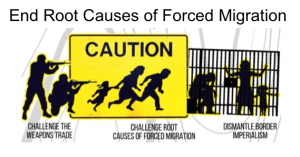
Those who are the recipients of the Mutual Aid that GR Rapid Response to ICE offers are primarily from Mexico and Central America. Some of the people who have fled those countries have been here for several decades and some have recently arrived. Regardless of how long people have been in the US, there is a clear connection to why they have fled their country of origin and US policy.
The United States government has a long history of intervention in Mexico and Central America. If fact, the US took by force roughly a third of Mexico, during the middle of the 19th Century, in what is generally called the US/Mexican War.
Since that time, US policy has impacted Mexico and Central America through direct military intervention, indirect military intervention and economy policies. Lets look at each of these three types of intervention and how they have contributed to the displacement of millions of people directly south of the US.
Direct Military Intervention
The US government has sent US soldiers to Mexico and Central America on a regular basis since the mid-19th Century. Here is a list of those direct military interventions:
- 1984 – Nicaragua: Month-long occupation of US troops in the area of Bluefields.
- 1895 – Panama: Marines land in Colombian province.
- 1896 – Nicaragua: Marines land in port of Corinto.
- 1899 – Nicaragua: Marines land at port of Bluefields.
- 1901 – 1914 – Panama: Broke off from Colombia 1903, annexed Canal Zone; opened canal in 1914.
- 1903 – Honduras: Marines intervene in the revolution.
- 1907 – Nicaragua: Dollar Diplomacy protectorate set up.
- 1907 – Honduras: Marines land during war with Nicaragua.
- 1908 – Panama: Marines intervene in election contest.
- 1910 – Nicaragua: Marines land in Bluefields and Corinto.
- 1911 – Honduras: US interests protected in civil war.
- 1912 – Panama: Marines land during heated election.
- 1912 – Honduras: Marines protect US economic interests.
- 1912 – Nicaragua: 10-year US military occupation, fought guerillas
- 1913 – Mexico: Americans evacuated during revolution.
- 1914 – 1918 – Mexico: Series of interventions against nationalists.
- 1918 – Honduras: Police Duty during unrest after elections.
- 1919 – Honduras: Marines land during election campaign.
- 1920 – Guatemala: 2-week intervention against unionists.
- 1923 – Mexico: US bombs rebellion to defend Calles
- 1924 – Honduras: Marines landed during election strife.
- 1925 – Panama: Marines suppress general strike
- 1932 – El Salvador: Warships sent during Marti revolt.
- 1954 – Guatemala: CIA directs exile invasion after new government nationalized US company lands.
- 1958 – Panama: Flag protest erupts into confrontation.
- 1964 – Panama: US military shoots Panamanians for urging canal’s return.
- 1966 – Guatemala: US Green Berets intervene against rebels.
- 1981 – 1992 – El Salvador: Advisors, overflights aid anti-rebel war, soldiers briefly involved in hostage clash.
- 1981 – 1990 – Nicaragua: CIA directs exile (Contra) invasions, plants harbor mines against revolution.
- 1983 – 89 – Honduras: US military maneuvers leads to base building near borders.
- 1989 – Panama: US sends 27,000 soldiers to arrest Noriega and bombs civilian targets.
Indirect US Military Intervention
Indirect US military interventions has taken on numerous forms in relationship to Mexico and Central America. Some of those forms include US military aid, like when the US provide El Salvador $1 million a day during the entire decade of the 1980s. Other forms of indirect military intervention happens when the US provides training to soldiers or the police force. The School of the Americas Watch has been documenting the number of military personnel from countries in Latin America that have received training at Fort Benning, Georgia. Go to this link to see the list.
Other indirect forms of US military intervention involve weapons sales and US military involvement in the Drug War, which has not done much to reduce the amount of drugs being brought into the US, but it has resulted in the increase of violence, particularly in Mexico. (see Drug War Capitalism, by Dawn Paley)

US Economic Policy’s impact on creating immigrants
US corporations have had their hands in Mexico and Central America for the past 150 years, so US government policy around economics has always been a reality, even if we only think of trade policies like NAFTA and CAFTA.
Once the US ended the bracero program in the 1960s, US companies started setting up factories in the northern part of Mexico, known as Maquiladoras. The claim was always made that these factories would raise the standard of living for Mexicans, but that never really happened. In the 1980s, the IIMF imposed massive austerity measures in Mexico, which radically devalued the peso and opened the door for privatization of public services.
The 1980s financial crisis in Mexico set the stage for the North American Free Trade Agreement, known as NAFTA, a trade agreement that was signed between Canada, Mexico and the US. NAFTA went into effect on January 1st, 1994, which is exactly why the Zapatistas began their rebellion against what the called Neo-liberal global capitalism.
NAFTA has been devastating for most Mexicans, particularly for farmers and small business owners. Cheap US corn subsidies to Mexico has directly contributed to forcing at least 2 million Mexican farmers off their land, because they could not compete with US corn that flooded the market after NAFTA began. NAFTA, along with Plan Merida (a policy signed under George W. Bush, but continued with Obama and Trump), have resulted in massive displacement of Mexicans and in many ways is the root causes of why so many Mexicans are fleeing north to the US. For further documentation see this Fact Sheet.
The Central American Free Trade Agreement (CAFTA) was adopted in 2005-2006 and has had very similar results in those countries as NAFTA had with Mexico. Thus CAFTA has also been an important component in displacing millions, many of which have also fled to the US.
These US trade policies in Mexico and Central America have also been devastating for the environments of those countries and have contributed significantly to Climate Change. Climate Change is now identified as another reason why people are fleeing those countries and coming to the US.
Mutual Aid for immigrants as Reparations
Considering the fact that US military and economic policy are the root causes for the millions of displaced immigrants coming from Mexico and Central America, we ought to consider that providing Mutual Aid to these individuals and families as a form of reparations.
Reparations is fundamentally a recognition that whole groups of people have been affected by policies and therefore are deserving of some form of economic or material compensation for the harm they and their ancestors have endured. Reparations are usually associated with African Americans, who have been demanding reparations for decades as a result of the legal policy of slavery. However, reparations have been paid by the US government to Japanese Americans, specifically to those families that were impacted by the US internment camps during WWII.
Thus, it seems that paying reparations to people from Central America and Mexico seems rather appropriate, especially considering that US military and economic policies have impacted the lives of millions of people from those countries and that the primary reason they have taken the risk to come to the US as undocumented immigrants is precisely because of these US policies. Now, the US government has not and will not anytime soon, own this history and pay reparations to the millions affected. However, we can take action by acknowledging this history and to contributes money, resources and time as both a form of Mutual Aid and Reparations, since the US military and economic policies have been done in our name.
If you are interested in practicing Mutual Aid as Reparations for undocumented immigrants living in West Michigan, then you are encouraged to be part of the work of GR Rapid Response to ICE and the Kent County I-Bond Fund.
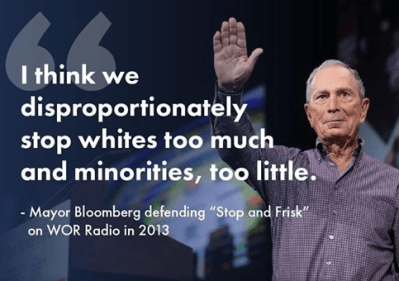 Last weekend, WOOD TV 8 ran a story about Presidential Candidate Michael Bloomberg opening a campaign office in Grand Rapids, on East Fulton.
Kent County Commission and staffer for State Rep. David LaGrand, Phil Skaggs, was the point for the new Bloomberg campaign office in Grand Rapids. In the channel 8 story, Skaggs said:
“There are major things at stake here and another four years of Donald Trump is going to turn America into a place we don’t recognize,” Skaggs said during a speech.
Skaggs says he supports Bloomberg because he has a great track record for getting things done and pragmatic solutions. He also mentioned Bloomberg’s campaign being moderate enough to capture voters who are undecided.
The WOOD TV 8 story goes on to say:
When asked about the criticism Bloomberg has faced for the “stop and frisk” policy he instituted while serving as New York City mayor, Skaggs said every candidate may have issues that people may be concerned about.
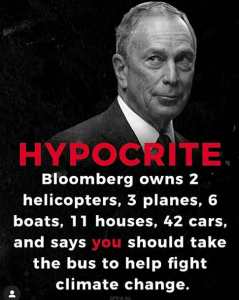
With this line of thinking, lets look at what issues people “may be concerned about,” as it relates to Michael Bloomberg.
- Michael Bloomberg is, by definition, an oligarch. An oligarch is a very rich business leader with a great deal of political influence.
- Bloomberg presided over a police force in New York City, which engaged in a war against black people and other people of color.
- Michael Bloomberg ran a massive Stop & Frisk program, allowing the NYPD to stop, frisk, harass and intimidate mostly black residents, but also other residents of color.
- As Mayor of New York, Bloomberg also ran a massive surveillance program targeting Muslims, as is well documented in the report, Mapping Muslims.
- Michael Bloomberg defended the NYPD amidst accusations that cops used the Stop & Frisk practice to regularly assault black and latinx women.
- Bloomberg has a long history of womanizing and sexism, including dozens of lawsuits brought against him for sex discrimination and sexual harassment.
- Bloomberg has used prison labor to make campaign calls.
- As Mayor of New York, Bloomberg sought to take control of the public schools, shut down numerous “low-performing schools” and promoted Charter Schools.
- Poverty in New York City expanded during the Bloomberg years.
- Gentrification escalated while Bloomberg was Mayor of New York City. Michael Bloomberg says that the financial crisis of 2008 was cause by end red-lining.
 As Mayor of New York City, Michael Bloomberg engaged in repressive tactics against the Occupy Wall Street Movement and removed their camp.
 - Bloomberg has a history of not supporting an increase in the minimum wage.
- Bloomberg has bankrolled numerous GOP candidates over the years, including former Michigan Governor Rick Snyder.
- Bloomberg has used his wealth to buy the silence of non-profit and think tank groups like Emily’s List and the Center for American Progress.
- Michael Bloomberg is spending millions on paid political ads, which is creating a tremendous amount of bias in support of Bloomberg by pundits.
This is just the tip of the iceberg in regards to any serious critique of the billionaire Michael Bloomberg. It is important for people to not be swayed by the ads blitz from Bloomberg, but to do so real investigation of his history.
Wyoming City Commission doesn’t really want diversity and they don’t practice democracy: Movimiento Cosecha GR and the fight for Driver’s Licenses for All
On Monday night, Movimiento Cosecha GR went back to the Wyoming City Commission meeting to continue to press for that commission to pass a resolution in support of Driver’s Licenses for All.
We reported on their first attempt to get a resolution passed by the Wyoming City Commission, which was two weeks ago, on February 3rd. At that meeting, several commissioners made it clear that they were not hearing what the immigrants were sharing during public comment. One after another, members of the immigrant community shared with the commissioners that they live in constant fear of police. Several of the commissioners commented that the Wyoming police were not to be fear and were good public servants.

A similar reaction was made by several commissioners and the Mayor of Wyoming, to those who spoke in favor of Driver’s Licenses for All on at the February 17th meeting. Movimiento Cosecha GR had asked on February 3rd to have Driver’s Licenses for All on the agenda for the February 17th meeting. It was not on the agenda for the February 17 meeting.
When it came time for public comment, the Mayor reiterated that public comment was not meant for dialogue, rather it was for people to make statements about issues they were interested it. However, the Mayor also told those present that the Wyoming City Commission discussed the Driver’s Licenses for All resolution request prior to the February 17 meeting and that they decided that this was not a local matter and that state policy makers should deal with state matters, not the Wyoming City Commission.
So, not only was the issue of Driver’s Licenses for All not on the agenda, the commission made a decision without consulting those who presented the issue on February 3rd. There was no public hearing on this critical issue and in the minds of the Mayor of Wyoming and the City Commission, this matter was taken care of. Without missing a beat, the Mayor of Wyoming then told the who came with Movimiento Cosecha GR that they could still share their thoughts with the commission during public comment. In other words, “you can tell us what you think, but we already made the decision to say no to your request.”
Members of Movimiento Cosecha GR still got up to speak during public, with most of them speaking in Spanish and using a translator. This was important to note for three reasons. First, some people who were in the audience did not understand English, so speaking in Spanish benefitted those who were participating in the democratic process. Second, this issue was important to raise, because the City of Wyoming does not provide translation for those who attend public meetings, even though there are 16,600 Latinos that live in that city, according to recent census data.
The third reason why this issue is important is because the City of Wyoming would only give people who spoke in Spanish 3 minutes to speak, which included the amount of time it took for people to translate. This means that those relying on a translator would only have half as much time as those who spoke English during public comment. How can anyone claim that this is fair and equitable?
Members of Movimiento Cosecha GR continued to present information about the importance of Driver’s Licenses for All and the fear that they experience without having a driver’s license. Many who spoke did not feel that adhering to the 3 minute time limit, since they were relying on translation, was fair, so several of them continued to speak about the need for a resolution from the Wyoming City Commission. The Mayor kept interrupting and trying to cut them off for going over the 3 minute timeline, even going as far as to call members of Movimiento Cosecha GR “rude.”
Another member of Movimiento Cosecha GR pointed out that during the February 3rd Wyoming City Commission meeting, the Mayor had said that he welcomed input from “minority” communities and that having more diverse people participating in civic matters was good for the city. Well, here was Movimiento Cosecha GR participating in civic matters, reflecting the diversity of the community and the Mayor shut them down.
These kinds of meetings are always presented as democracy in action, yet it has been the experience of Movimiento Cosecha GR that these kinds of meetings are really about local government control, where local governments get to decide what is best for people and where anytime people challenge business as usual they are labeled as disruptive. La Lucha Sigue y Sigue!

