Betsy DeVos sends an additional $85 million of public money to private schools in the nation’s capital
 There has been a fair amount of pushback from educators and parents across the country, with the increase of funds being allocated from the Department of Education. At the behest of Secretary of Education Betsy DeVos, millions of taxpayer money has been allocated to private schools.
Several states, including Michigan, have filed lawsuits against the Department of Education for using public money for private education. The NAACP also announced recently that they too would be filing a lawsuit against the Secretary of Education, citing this reason:
“In a moment of crisis — when public school districts are called upon to educate their students in unprecedented circumstances, to protect their students and staff from disease, and to feed families who have been plunged into poverty, all with decimated state and local revenues — it is unconscionable for Defendants to siphon away the CARES Act’s desperately needed funds for the benefit of more affluent private-school students.”
At about the exact same time that the NAACP had filed their lawsuit, it was announced by the Secretary of Education, that an additional $85 million in public money would be going to private schools in Washington, DC. This announcement came on July 22nd, with the headline, Trump Administration Announces $85 Million to Support Disadvantaged Students in Nation’s Capital Attending K-12 Private Schools of Their Choice.
What is even more interesting is that Betsy DeVos’s office announced that the $85 million would not be going directly to private schools, but would be managed by an organization called Serving Our Children. This particular, where the federal government provides public money to private schools in DC, began in 2004 from legislation that was crafted by the Heritage Foundation, plus it was the first time that federal funds were allocated to private schools.
Just two years before this program was instituted in Washington, DC, the husband of Betsy DeVos, Dick DeVos, gave a speech at the Heritage Foundation. In that speech DeVos lays out a strategy for attacking and undermining public education. Here is a video clip of that speech:
This program in DC is called the D.C. Opportunity Scholarship Program (DCOSP), but it is essentially a school voucher program, where public money goes to private schools, which is exactly what Dick and Betsy DeVos had been attempting to implement in Michigan, with an unsuccessful ballot initiative in 2000.
There have been numerous entities that have evaluated the D.C. Opportunity Scholarship Program and most of those evaluations are not favorable. According to an article at the Center for American Progress:
In the spring of 2017, the Institute of Education Sciences (IES), the independent research arm of the Education Department, published a study that found that D.C. students who used a voucher scored 0.12 standard deviations lower in math than students who were not offered a voucher and remained in a public school.35 The evaluation assessed the outcomes of students from the 2012, 2013, and 2014 lotteries. This 0.12 score drop is the equivalent of an average student in the 50th percentile dropping to the 45th percentile after participating in the D.C. voucher program for one year.36 According to the IES study, participating in the D.C. voucher program had no statistically significant effect on reading achievement.37
It is deeply troubling that the Trump administration, through the efforts of Betsy DeVos, have been pushing for an increase in public funding for private education. Many of these private schools are also faith-based, which calls into question the so-called separation between Church & State. What is equally problematic about this trend is that there is not enough opposition from teacher unions or other groups, which should be making this fight for public education a priority.
Most Democrats, including Michigan Senator’s Peters and Stabenow, voted against a reduction in US military spending
“A nation that continues year after year to spend more money on military defense than on programs of social uplift is approaching spiritual death.” Dr. Martin Luther King Jr.
Earlier this week, 139 Democrats in the House voted against an amendment to the US Military Budget, which would have reduced military spending by 10%. Then on Wednesday, the majority of Senate Democrats also voted against the amendment that was introduced by Bernie Sanders.
The amendment would have reduced the US military budget by a mere 10% and redirect that money into jobs, education, health care, and housing in communities in the United States in which the poverty rate is not less than 25 percent.
The Senate vote was 77 against the amendment and 23 in favor. Both Michigan Senators Debbie Stabenow and Gary Peters voted against the amendment, which would have redirected $74 Billion to meet critical needs of the most impoverished communities across the US.
In a recent report by the National Priorities Project, which examines the 2020 US Military Budget, shows a continued increase in US military spending, in the midst of the COVID-19 crisis and widening wealth gap in the US. The study also shows that the US military budget is so large that it is more than the next 10 largest military budgets combined, as can be seen in this graphic.

Therefore, the question should be asked, why are the Democrats voting for an increase in US military spending and against an amendment that would reduced military spending and direct that money to support the poorest communities? Despite public perceptions, the Democratic Party has been equally committed to US imperialism abroad and to the Military Industrial Complex. The Center for Responsive Politics provides data that shows that the US Defense Industry contributes a substantial amount of money to the Democratic Party, only slightly less than to their Republican counterparts.
Then there is the issue of how military weaponry is manufactured, with private weapons companies in virtually every Congressional District across the country, thus making it difficult for most candidates to go against reduced military spending, so as not to alienate the private defense sector.
As for Senators Stabenow and Peters, we have reported (in 2018 and 2019) on their motivations for ongoing support for US military spending.
Voting for increased US military spending and against proposals to reduce such spending signifies that the Democratic Party is not progressive on one of the most important issues of our time, even if the majority of those who identify as Democrats would support a reduction in US military spending.
What is problematic about the recent announcement from Grand Rapids to have mental health workers collaborate with the GRPD?
 On July 20th, the City of Grand Rapids, specifically the City Manager, made an announcement of it’s, “intent to expand mental health partnerships as part of the City’s ongoing efforts to improve public safety outcomes.”
The local news media reported on this announcement, but essentially just re-posted the City’s Media Release, without bothering to ask important questions about what this announcement means.
There was lots of buzz on social media and several non-profits have chimed in on the announcement, singing the City’s praises. Again, no real engagement and no hard questions being asked about what this will all mean.
It is important that we acknowledge that this announcement comes in the midst of a major community push to Defund the GRPD, with Commissioner Lenear stating during the July 21st City Commission meeting that nearly 6,000 community members have engaged the city on the matter of Defunding the GRPD. One could see this as a public relations move or by some as a positive outcome because of all of the public pressure.
City Manager Mark Washington acknowledges in the announcement that the traditional response – sending cops – is not the most effective. Not only is what Washington said an understatement, it ignores the fact that communities have been calling for a social services response model for decades.
So, what is problematic about this recent announcement from the City? First, and this is more of a procedural issue, but why does Chief Payne get to decide whether or not, “an expanded co-response model with a mental health or behavioral health professional could work.” The police are tasked with enforcement, but should not be creating policy or deciding whether or not to implement policy.
Second, the City’s announcement lists a number of types of calls where a mental health professional could be applicable; Disorderly intoxication, Drug overdose, Intoxicated person, Mental health crisis, Suicide crisis, Mental health transport, Disorderly youth/juvenile, Panhandling and Neighborhood dispute. One could argue that most of these types of calls could be handled exclusively by social service or mental health professionals. In fact, in a 2019 study done by Hillard Heintze LLC, as reported by MLive, determined that:
“Across the GRPD, officers are not tasked in alignment with a strategic vision, which results in inefficient use as officers are tasked based on demand inflows, rather than a guided strategic vision that outlines how and when resources are allocated,” the study reads.
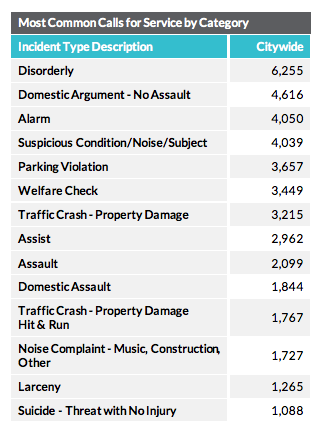 The study done by Hillard Heintze LLC, also determined that 70% of calls to the GRPD are non-emergency calls. You can see here on the right, the breakdown of types of calls that the GRPD responds to. With 70% being non-emergency, wouldn’t it follow that conflicts or complaints could be dealt with, without the need of police officers.
Third, according to Alex Vitale (author of the book, The End of Policing) hundreds of people with mental illness are killed by cops on an annual basis. Police do not have the capacity to make a mental health diagnosis and statistically, when police respond to concerns about someone with mental health issues, too often it results in the person being arrested. According to the National Alliance on Mental Illness (NAMI), 2 million people with mental health issues are jailed every year and that the number two cause of death in jails and prisons is suicide. NAMI estimates that 83% of those incarcerated with mental health issues don’t have access to the treatments they need. Vitale believes that what is happening with police responding to these types of calls, is the criminalization of mental illness. Having police present with mental health professionals only escalates potential harm.
Fourth, having cops present with or partnering with mental health professional ultimately lends greater legitimacy to police departments and their bloated budgets. If the public was encouraged to call 311 instead of 911, police involvement would be reduced and the public would see that most conflicts can be resolved through non-violent means, whether that means that friends, neighbors or community professionals take initiative to provide the support that people need in a crisis or when there is a conflict. This is the exact kind of outcome that the Grand Rapids-based group Together We Are Safe has been advocating for over a year now, by distributing a document entitled, Before Calling the Police, Ask Yourself.
Lastly, if there was more equity in our community, where people had sufficient income, affordable housing, good health care and the ability to enjoy life, then there would be less of a justification for the GRPD. Grand Rapids City officials are always talking about equity, yet thousands of people in this city are suffering from poverty, systemic racism, high rent costs, lack of adequate health care and tremendous stress and pressure to make ends meet.
Having the GRPD partner with mental health professionals is a false solution. Working towards greater equity and dismantling structural violence would not only reduce the need for cops, it would drastically improve the quality of life for people in this community. However, despite the rhetoric, Grand Rapids City officials do little to dismantle structural violence. The City’s resistance to community calls to reduce the funding of the GRPD sends a strong message to residents that the City is committed to maintaining a system of power and inequality.
 In Part I, we provided a framework for how policing functions in the United States and in Grand Rapids, with particular emphasis on the two overarching strategies that police departments use, Negotiated Management and Escalating Force.
In Part II, we want to focus on why police departments, specifically the Grand Rapids Police Department, sees dissident movements/protest movements, as an insurgency. Within the larger US foreign policy framework, insurgent forces are those that are a direct threat to US political and economic dominance. To deal with any insurgent movement around the world, the US has adopted what they refer to as a counterinsurgency strategy.
Counterinsurgency, as practiced by the US, essentially means to separate the general population from the combatants – those who make up the insurgent forces. It is important to note that for counterinsurgency experts, separating the public from insurgent forces is not just a physical separation, but a psychological and ideological separation. This type of separation is critical for us to understand, especially when we are talking about policing around the country and in Grand Rapids.
A couple of important books on this very topic of how police department have adopted a counterinsurgency strategy are, Police” A Field Guide, by David Correia and Tyler Wall, and Life During Wartime: Resisting Counterinsurgency, edited by Kristian Williams, Will Munger and Lara Messersmith-Glavin. In their analysis, the contributors to the second book make it clear that:
The state needs legitimacy to stabilize its rule, and that under conditions of insurgency its legitimacy is slipping. In other words, from the perspective of counterinsurgency, resistance is not simply a matter of the population (or portions of it) refusing to cooperate with the state’s agenda; resistance comes as a consequence of the state failing to meet the needs of the population.
We need to understand that state repression is constant, even if we don’t always recognize it. The inequality and structural violence that exists – systemic racism, gentrification, economic exploitation, mass incarceration, the wealth gap – are a constant in Grand Rapids, whether we resist it or not. In this sense, the Grand Rapids City Commission and the Kent County Commission function as “the state” in this situation and they will do whatever is necessary to maintain order, which is to say they act as a buffer against anyone who threatens structural violence. However, when we decide to resist the structural violence, then the state – specifically the City of Grand Rapids – will utilize more overt forms of repressive to suppress dissent.
Life in Grand Rapids before and after May 30th
Before the recent uprising on May 30th, structural violence, systemic racism, gentrification, mass incarceration and other forms of inequality were prevalent in Grand Rapids. There has been a massive disinvestment in the Black community for decades, a housing market that has made rent costs impossible for thousands of families, a growing wealth gap and police violence that has disproportionately impact Black and latinx communities. The COVID-19 pandemic hits and these disparities are even more apparent, with high rates of infection in Black neighborhoods and higher rates of unemployment and food insecurity in the Black and immigrant communities. The structural violence was already there, but on May 30th these injustices were made visible with thousands of people in the streets of Grand Rapids.

Since the uprising began on May 30th, it is important for us to see how the City of Grand Rapids has responded to the collective anger and frustration was demonstrated on May 30th and how their response has been a form of counterinsurgency.
- The uprising was condemned by the political and business class, particularly the property destruction. This moment is instructive, since there is virtually no acknowledgement of decades of looting by the business class, nor the structural violence that Black and latinx people have been experiencing on a daily basis in this city.
- The Mayor of Grand Rapids calls for a 2 day curfew, making it punishable for residents to be out, especially in downtown Grand Rapids.
- The Michigan National Guard are called in to “assist” the GRPD with “population management,” which is a standard counterinsurgency measure.
- City officials, the GRPD, business interests, the news media and white people go out of their way to determine what are acceptable ways for people to protest or to articulate their grievances. Direct Action and protest are condemned, unless it is peaceful, which means – get a permit, obey the laws, be nice, cooperate with the cops and be respectful of those in authority. Within the first week, it became clear that the systems of power in Grand Rapids wanted to shift the focus from the collective grievances of the Black community and other dissents, to “we know you’re upset, so we’ll take a knee with you to show you we understand.”
- The City of Grand Rapids held a few online community forums on police reform, which is what they do every time the community makes demands. The proposed reforms are largely window dressing, but the focus is on how the City is being responsive, instead of focusing on the collective grievances of the Black community.
- Then the resistance shifted by calling for a Defunding of the GRPD, pointing out the massive amounts of money the cops were getting while so much poverty and inequality exists in the Black community.
- The Grand Rapids Police Officers Association pushes back against Defunding the GRPD, as do White people and members of the Grand Rapids Power Structure.
- The push for Defunding the GRPD increases, with lots of organizations getting behind the campaign, using a variety of tactics to highlight the need for a reduction of funding for the GRPD and a refunding of that money to the Black community.
- The City of Grand Rapids does an end run on the Defunding the GRPD effort, by claiming that City Commissioners don’t have the legal authority to reduce police funding.
- The GRPD quickly shifts their counterinsurgency tactics to demonize those using graffiti to make their demands to Defund the GRPD, even recruiting the local commercial news media to use their resources to hunt down the “perpetrators.”
- In an escalation of psychological warfare, the GRPD then claims that there is no way that the City can afford to defund them, now that there has been an increase in the homicide rate in Grand Rapids. The news media goes along, because its good optics, even though there is no evidence presented to show that more cops or more funding of cops will effectively reduce gun violence or any other kind of community violence.
- Community leadership stand shoulder to shoulder with the GRPD decrying gun violence, all the while ignoring the ongoing White Supremacist practices and structural violence in Grand Rapids.
The narrative of this timeline is a perfect example of counterinsurgency being employed by the City of Grand Rapids and the GRPD, since what began as the collective rage and frustration against White Supremacy and structural violence has now been replaced by City government and the GRPD reassuring the community that they are doing what is necessary to “keep us all safe,” which is counterinsurgency language for pacification.
However, even the best counterinsurgency plans often underestimate the resistance to structural violence and White Supremacy.
The resistance continues!
 Last week, the chairman of the Michigan Freedom Fund and DeVos family political operative, Greg McNeilly, wrote an opinion piece in the Detroit News entitled, This election, know candidates’ stance on defunding police.
The article by McNeilly is less about the issue of Defunding Police and more about where candidates stand on the issue of Defunding the Police in the upcoming August Primary.
McNeilly demonstrates his own lack of understanding on the issue, by making overly simplistic comments, as well as presenting misinformation. McNeilly calls the killing of George Floyd “horrific,” but fails to mention that Floyd was murdered by a cop.
The DeVos family operative goes on to say that the protests have been necessary (although I doubt that he has participated in any of them), and then goes on to say:
“So has the selfless and genuine response of the overwhelming majority of Michigan’s remarkable law enforcement officers.”
McNeilly then gives examples of calls across the state to Defund the Police, using Grand Rapids as one example. However, McNeilly uses the claim made by the Grand Rapids Police Officers Association, when talking about how the proposed cut to the GRPD budget might impact policing in Grand Rapids. McNeilly makes this statement as fact, without noting the source or substantiating the validity of the cop union in Grand Rapids.
McNeilly then makes an even more outlandish claim by saying that “violent criminals have spoken out too,” on the matter of defunding police. The Chairman of the Michigan Freedom Fund makes the claim that violent crime is up across the US, leaving us all to think that the idea of defunding the police is a terrible idea.
McNeilly brings the issue back to where candidates stand on this issue, even though he offers no insight into the matter. While I agree it is important that people know where candidates stand on the issue of defunding the police, McNeilly ignores another important component of this issue, which is candidates who get money from police unions.
We reported on the issue of cop unions and political candidates in late June, with an important link to the data provided by the group No More Cop Money.
On the matter of political candidates and where they stand on defunding of police, lets take a look at candidate races in the Grand Rapids area for state legislature. We looked at candidate websites or candidate Facebook pages.
72nd State House
- Dem. Lily Cheng-Schulting – no position on defunding police
- Rep. Steven Johnson – no position on defunding police
73rd State House
- Dem. Bill Saxton – no position on defunding police
- Rep. John Inhulsen – no position on defunding police
- Rep. Bryan Posthumus – no position on defunding police
- Rep. Robert Regan – no position on defunding police
75th State House
- Dem. David LaGrand – no position on defunding police
- Rep. James McKeiver – no position on defunding police
76th State House
- Dem. Rachel Hood – no position on defunding police
- Rep. Doug Zandstra – opposes defunding police
77th State House
- Dem. Bob Smith – no position on defunding police
- Rep. Tommy Brann – no position on defunding police
86th State House
- Dem. Jeff Merritt – no position on defunding police
- Rep. Thomas A. Albert – no position on defunding police
As you can see from this sample of candidates from the greater Grand Rapids area, only one had a position on defunding police and they were against it. Most candidates are playing it safe and not taking a position, but if they took a public position in support of defunding police, it would signal a first step in their commitment to the demands of the Movement for Black Lives.
 In recent days, more and more people have become aware of federal officers in unmarked vans grabbing people off the streets in Portland, Oregon.
While some may find this practice alarming, it is consistent with the history of state repression in the US. For example, in 1919, federal agents rounded up some 3,000 dissidents, many of whom were anarchists, socialists or members of the radical labor union, the IWW. This action was led by US Attorney General Mitchell Palmer, which is why it is often referred to as the Palmer Raids.
It is vitally important that those of us committed to collective liberation become familiar with this history of state repression. Not only is state repression an integral part of US history, it is important in terms of how we organize against it. An excellent overview of this history of state repression can be found in the book, Beyond Bullets: The Suppression of Dissent in the United States, by Jules Boykoff.
Additionally, we have to fundamentally alter our understanding of policing in the US. The recent Black Lives Matter uprising that is happening in cities all across the US are beginning to wake people up to the realities of US policing. There is so much about policing that we need to unlearn, especially since our perceptions of what law enforcement does is so different from what the documented history can teach us. However, it is understandable that our understanding of policing is so biased,when one considers how the function of policing has been presented to us in K-12 education and how cops are represented in the dominant cultural narratives in the US – TV shows, movies, etc.
How the GRPD deals with dissent
When it comes to how law enforcement deals with public dissent and dissidents, we need to understand that the police rely on two fundamental strategies:
Negotiated Management – also called Command and Control techniques – this is when police attempt to negotiate actions, always with the goal to manage it. This often takes the form of cops asking people to get permits to protest, showing up at a protest to let everyone know that they are there to keep people safe, when in fact they are there to manage or control public dissent.
Escalated Force – this is where the state uses surveillance, infiltration, negative press, pre-emptive arrests, protest zones and the use of less lethal weaponry to suppress public resistance. This is what we have seen in Grand Rapids beginning on May 30th, where they have used weapons agains the public, relied on curfews, brought in the National Guard, sought to control the public narrative in the news media and have created the good protester/bad protester dichotomy.
Until we come to terms with these facts, we will continue to view the police as a necessary good and only seek to reform the GRPD. When we speak the language of copspeak – of police reform – we see the world as police do. Police reform is the science of police legitimation accomplished through the art of euphemism. Police reform speaks in a language carefully calibrated to limit our ability to understand police as anything other than an equitable force and indispensable institution.
Ultimately, we have to see that police and policing, even in West Michigan, function to protect power. Black communities have understood this about the US, since the country was founded. James Baldwin, in his famous 1966 essay on policing, referred to policing as a function of an occupying power. The Black Panther Party for Self Defense used the same language several years after Baldwin wrote his essay, always referring to the police as an occupying force.
However, white communities don’t tend to see the police through the same lens, especially white liberal communities like Grand Rapids. As Alex Vitale, in his groundbreaking book, The End of Policing:
“For liberals, police reform is always a question of taking steps to restore the legitimacy of policing…………They want the police to be better trained, more accountable, and less brutal and racist – laudable goals, but they leave intact the basic institutional functions of the police, which have never really been about public safety and crime control………..The reality is that police exist primarily as a system for managing and even producing inequality by suppressing social movements and highly managing the behaviors of poor and nonwhite people; those on the losing end of economic and political arrangements.”
This notion of policing and what function the GRPD plays within the system of power, is becoming clearer to more and more people. What has become apparent to more people since May 30th is the GRPD’s use of the two strategies noted above, both the Negotiated Management strategy and the Escalated Force strategy. For the past 7 weeks both strategies have been employed by the GRPD, and at times simultaneously.
We have been attempting to document the GRPD’s use of these two strategies, beginning with the article we wrote just after the May 30th protest, entitled, Don’t Let the System Control the Narrative on the Black Lives Matter protest in Grand Rapids.
Since then, we have written numerous articles on the GRPD, in the following order:
A Brief History of how the GRPD responds to protests and dissent
We need a campaign to Defund the GRPD
Is there really any such thing as a Peaceful Protest?
They are going to do what they want: Grand Rapids, the GRPD and the illusion of Democracy
Grand Rapids Police Officers Association releases statement against the calls for Defunding the GRPD
Grand Rapids City officials, deception and Defunding the GRPD
WOODTV8 uses far right sources to demonize anti-racist and anti-fascist movements
Grand Rapids news media acts as a conduit for the GRPD, twice in the same day
The GRPD & Respectability Politics vs Community Control over public safety
Ultimately, what we have been doing at GRIID is to provide an ongoing counter-narrative to what the City of Grand Rapids, the GRPD and the commercial news media have been presenting since May 30th. And we will continue to do so as long as the resistance to state violence continues in this community.
In Part II, we will look at how the GRPD uses counterinsurgency tactics to management and suppress public dissent.
 The current push from the city of Grand Rapids to say that they are working on implementing a series of police reforms is nothing new.
A few years after the 1967 racial uprising in Grand Rapids, several members of the African American community submitted a position paper to the Grand Rapids City Commission. This was in 1970, which was reported in the Grand Rapids Press, saying:
“some of the demands from the black community were that the city should hire a black aide to Police Superintendent Robert Anderson, the withdrawal of the police tactical unit from the inner city until an investigation of alleged police brutality is completed and a request that any time there is a request for a cruiser in the black community, if there are no black policemen available, do not send any.”
The result was that another committee was established to look into the demands. This is a pattern that has been repeated over the decades, when the Black community presents demands and the City’s responses are to set up another committee and maybe adopt some mildly reformist policing practices.
In 2016, there was a protest organized by Black youth, where the Chief of Police was confronted on the issue of police violence against the Black community.
In 2017, a group of Black men came to the Grand Rapids City Commission meeting, demanding that the City call for a state of emergency around policing.
Two months after the group of Black men made demands, the GRPD held “listening sessions” in Grand Rapids to re-build community/police relations.
In late 2017, the GRPD held a Black girl at gunpoint, with additional calls for police accountability.
In September of 2018, after another Black youth was detained, the Chief of Police said they were simply following procedure.
In March of 2019, after more police abuse of Black and latinx residents, the GRPD hosts a press conference to say that people need to “obey the police.”
The most recent calls for police accountability and Defunding the GRPD have been met with the same responses this community has seen for decades. The GRPD comes up with a new list of “reforms” and another committee is established to pacify the public. The new Community Police Advisory Council was announced last week by Chief Payne, which will include the Chief and the following members of the community:
- Tracey Brame – Assistant Dean at WMU – Colley Law School. Brame started the Access to Justice Clinic at WMU-Cooley and teaches courses in Family Law, Race and the Supreme Court, and the Death Penalty.
- Marco Bulnes – Mayan Buzz Cafe, Mayan Industries LLC
- Ja’Von Fields – Newly elected President of the Greater Grand Rapids NAACP Youth Council. His involvement with the NAACP ranges from being President of his local branch, to Juvenile Justice Chair of the MI State Youth & College Divison, and a certified Trainer of the National NAACP Youth & Collge Divison.
- Willie Gholston – Senior Pastor at First Community AME Church in Grand Rapids
- Larry Johnson – former GRPD officer, now the head of Public Safety & Security for the Grand Rapids Public Schools
- Raynard Ross – Associate Dean at GRCC and members of the Board of Education for the Grand Rapids Public Schools.
Now, I have nothing against these six people, but it seems as though Chief Payne chose people based on respectability politics, rather than those who have been directly impacted by police violence or those who have been involved in organizing protests since May 30.
Regardless of how one feels about the new Community Police Advisory Council, such a move not only seeks to minimize public pressure for defunding the GRPD, it also means that City Officials and the GRPD have no real interest in community control over policing.
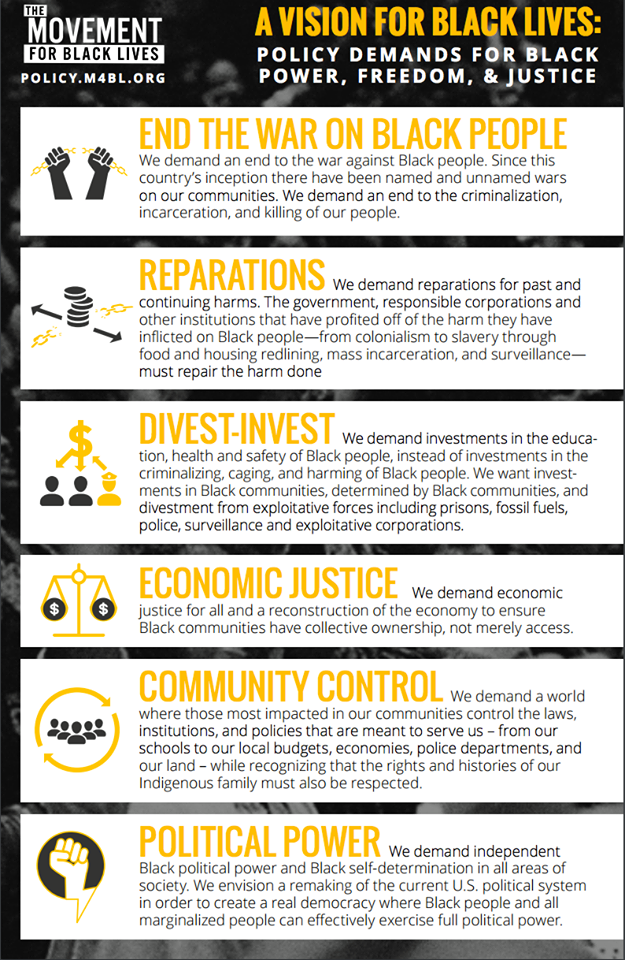
Community Control is one of the main components of the Black Lives Matter vision, which was crafted in 2015. Along with End the War on Black People, Reparation, a Divest/Invest component and Economic Justice, Community Control is central to this vision.
This vision of Community Control states:
Direct democratic community control of local, state, and federal law enforcement agencies, ensuring that communities most harmed by destructive policing have the power to hire and fire officers, determine disciplinary action, control budgets and policies, and subpoena relevant agency information.
Community control over policing is also what many other Black-led groups have been calling for. In a recent article on Black Agenda Report, it cities Chicago organizer Frank Chapman:
“All of the reforms being called for, including abolishing and defunding the police – reforms that directly affect the current existence of the police as outside occupiers of our communities — are embedded in CPAC. CPAC is the way to ensuring these demands are met. CPAC puts the power of reform in the hands of communities through directly elected representatives. That’s community control. With community control, we decide the if, when, and how of policing – up to and including abolition. With community control, we can defund, demilitarize, and regulate the police out of existence. Communities can reimagine a world without police – but not without the power to do so themselves. We’ve heard nothing from our elected leadership about this broad demand to re-conceive public safety, except for the 19 alderpersons who support CPAC.”
If the GRPD is truly committed to protecting and serving the residents of Grand Rapids, then City officials need to let the public, and especially the Black community, have community control over policing in this city. In fact, there is no justifiable reason for not allowing this to happen, especially since the public pays the salaries of the cops.
 There is been a fair amount of attention given to the Paycheck Protection Program (PPP), a program which small businesses with relief loans during the pandemic.
However, like much of the relief money coming from the federal government, funding through the Paycheck Protection Program has benefited banks. According to a recent article on The Intercept:
The Small Business Association, which is running the PPP program, has long been criticized for struggling to process emergency relief quickly during past natural disasters. So when the time came to respond to the coronavirus crisis as fast as possible, the SBA was in no position to do it itself, and Congress mandated that the loans be run through banks instead.
The same article provides two examples of banks that are making millions from the PPP:
New Jersey-based Cross River Bank’s estimated $163 million haul would be more than double its net revenue last year. JPMorgan Chase could make $864 million.
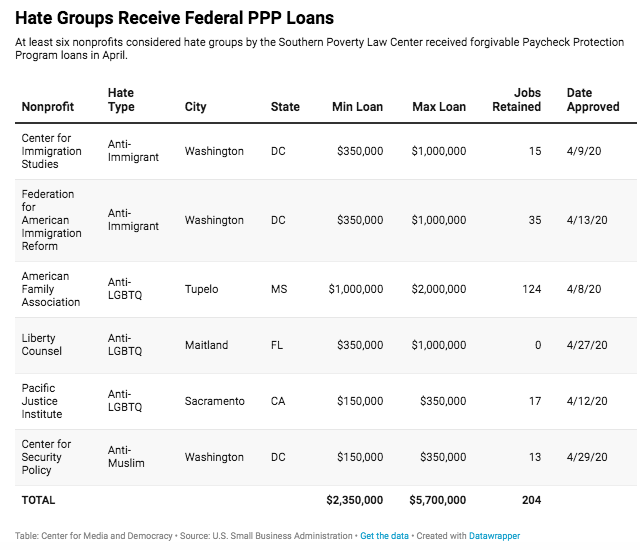
There has also been a fair amount of attention to the fact that the Ayn Rand Institute, the far right think tank, had received PPP funding. However, as the Center for Media & Democracy has pointed out, there are numerous far right groups that have received PPP funding from the federal government, listed below.
MLive, also posted an article about PPP funds going to businesses in Michigan last week, with the headline, 185 Michigan businesses got at least $5 million in federal paycheck protection dollars.
The MLive article also provide a way for people to search which businesses received PPP funding from the federal government. There were 30 businesses in Grand Rapids that received between $5 – 10 million of federal taxpayer money, including businesses such as Rockford Construction, Warner Norcross & Judd, Michigan Turkey Producers and Barfly Ventures LLC.
There were 69 entities receiving between $2 – 5 million, including Aquinas College, Catholic Charities West Michigan, Grand Rapids Christian Schools, Progressive AE, RBC Ministries and Westwood Christian Services.
There were 135 entities in Grand Rapids that received between $1 – 2 million of PPP funding, including Atomic Object, Butterball Farms Inc, General Synod Council of the Reformed Church in America, Mel Trotter Ministries, Northpointe Christian School and Plasan North America.
There were 435 entities that received between $350,000 and $1 million, including All Saints Academy, Calvary Church, Calvin Theological Seminary, Catholic Central High, CWD Real Estate Investment LLC, Fox Motor Group LLC, Holy Spirit Parish, Kuyper College, Seyferth & Associates and Wolverine Gas and Oil Corporation.
Lastly, there were 679 entities that received between $150,000 and $350,000, including Art Prize, Christian Schools International, Ellis Parking, Grand Rapids Downtown Market Inc, Grand Rapids Youth for Christ, Long Road Distillers, MIBIZ Inc, Mike & Johnny Brann’s Steak & Seafood Inc, Pregnancy Resource Center, Start Garden Inc, Tommy Brann’s Steak & Seafood and Words of Hope Inc.
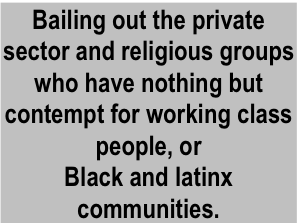
What is instructive about this list is that there are a great deal of religious groups getting bailed out by public tax money, which I find extremely troubling. Where is the separation of Church & State. If these religious groups can get public money, then they need to be paying taxes.
In addition, there are several businesses and business entities that are deeply entrenched in the Grand Rapids Power Structure, such as Rockford Construction, Warner Norcross & Judd, CWD Real Estate Investment LLC, Fox Motor Group LLC, Wolverine Gas and Oil Corporation, Art Prize, Grand Rapids Downtown Market Inc and Start Garden Inc. Lastly, a few of the businesses have also been vocally in support of the GRPD, especially since the Defund the GRPD campaign began, notably the Brann restaurants and Long Road Distillers.
It is instructive that these groups are getting public tax money, especially since they have a history of being anti-union, some are anti-public education and many of them are connected to groups like the West Michigan Policy Forum, which lobbies state lawmakers to pass neo-liberal policies that hurt working class people, the LGBTQ community and disproportionately Black and latinx communities.
 When the CEO of Goya, Robert Unanue, meet with President Trump sang his praises, little did he know there would be backlash for his actions.
An informal boycott is now happening against Goya, with a wave of posts on social media about the company.
What hasn’t received as much attention is the reason why the CEO of Goya was meeting with President Trump in the first place. The Trump White House had announced on July 9th, a new program called the White House Hispanic Prosperity Initiative. Based on the White House statement, released on July 9, the Hispanic Prosperity Initiative will, “improve Hispanic Americans’ access to educational and economic opportunities.”
The White House statement lays out a framework for what the initiative is all about, which lists the following items:
(i) identify and promote educational and workforce development practices that have improved educational, professional, and economic outcomes for Hispanic Americans;
(ii) encourage private-sector initiatives and foster public-private partnerships that improve access to educational and economic opportunities for Hispanic Americans;
(iii) develop a national network of individuals, organizations, and communities, with which to consult and collaborate regarding practices and policies that improve access to educational and economic opportunities for Hispanic Americans;
(iv) monitor the development, implementation, and coordination of Federal Government educational, workforce, and business development programs designed to improve outcomes for Hispanic Americans; and
(v) advise the President, through the Secretary of Education (Secretary), on issues of importance to Hispanic Americans and policies relating to Hispanic Americans’ prosperity.
This description around “school choice” and “public-private partnerships” should raise lots of red flags for anyone who is concerned about how this initiative could negatively impact the latinx community. In many ways, the language used by the White House fits well within their larger Neo-Liberal Capitalist plans, especially for communities of color. Even more alarming, is the fact that this initiative seems to fall under the control of the Department of Education, which means Betsy DeVos.
As Secretary of Education, DeVos also released a statement on July 9, praising the White House Hispanic Prosperity Initiative, stating:
“Hispanic families, like so many families across America, want their children educated in personalized ways that meet their unique needs and their family’s values. We know that a great education is also the launching pad to a great job and long-term prosperity. I applaud President Trump’s strong leadership in support of more educational opportunities and greater prosperity for all Hispanic Americans. At the U.S. Department of Education, we’re working to open up new career pathways including apprenticeships and earn-and-learn opportunities, expanding support for Hispanic Serving Institutions, prioritizing new public charter schools in Opportunity Zones, and fighting for education freedom so Hispanic students—and all students—can find their right fit.”
We should also find this statement from DeVos rather alarming, since it clearly signals another push with this administration to lure communities of color into the privatized educational sphere. This strategy of undermining public education first educes funding for public schools, and then provides a whole menu of incentives for charter and other private educational models to use public money.
In Grand Rapids, we can see how the GRPS continues to deal with reduced budgets, which leaves Black and latinx students with less resources and quality teachers. Faced with these dynamics, latinx parents will look to other education opportunities for their children, which often means looking at Charter Schools or other private educational models.
While some might see the Hispanic Prosperity Initiative as nothing more than a ploy to reach latinx voters for Trump, we should be concerned about how the Hispanic Prosperity Initiative will play out and how it will impact students who are currently in the public education system.
We don’t need no stinking permits to protest: 100 years of dissent and disruption in Grand Rapids
Ever since the Black Lives Matter uprising that began in Grand Rapids on May 30th, Police Chief Payne has been suggesting to those who are protesting that they should get a permit from his office, “so everyone can stay safe.”
Not only do people not need a permit to protest, Chief Payne’s plea for people to obtain a permit drips of irony. The protests that began on May 30th have specifically been directed at police violence against the Black community. Asking those who are protesting to seek permission from the GRPD, to resist police violence, is both confounding and ridiculous.
Now, there are numerous reasons for people to engage in public protest and dissent, but historically, one of the main reasons for protesting has been to disrupt business as usual, to throw a monkey wrench into the gears of conformity, or to strategically force systems of power to meet the demands of those who are protesting.
Social Movements throughout history have rarely sought permission to dissent. Abolitionists did not ask permission to resist slavery. Organized workers, especially in the late 19th century and early 20th century, did not ask permission to demand better working conditions. The Civil Rights Movement didn’t ask permission to engage in a sit-in and freedom riders weren’t asking permission to ride segregated buses.
We have a long history of dissent and disruption in the United States. In fact, the use of dissent and disruption were integral components of social movements, which have been the primary driving force for social change throughout history. People with power, either economic or political power, don’t wake up one day and say, “I think we should give people more rights.” Whatever rights and freedoms we enjoy currently are the direct result of the sacrifices that people in social movements have made to win those freedoms.
We also have a long history of dissent and disruption right here in Grand Rapids. I have been working on the Grand Rapids People’s History Project for 10 years now and I am constantly amazed and inspired by how often people in Grand Rapids have used direct action to make demands and to change lives. What follows is a brief overview of dissent and disruption over the past 100 years in Grand Rapids.
1911 Furniture Workers Strike – 6,000 furniture workers go on strike to demand better wages, better working conditions and the right to have a union. Workers clash with cops in the streets and throw rocks at scab workers brought in from outside the community.
1917 – Socialists in arrested for passing out anti-draft information during WWI.
1937 – Workers go on strike in Grand Rapids, after being inspired by the Flint Wildcat Strike.
1963 – 3,000 people march in Grand Rapids to protest the Birmingham Church bombing.
1965 – Black South High students walk out, in what is called the Mustache Affair. Read the WOODTV8 editorial found on the link, which demonstrates their bias has been around for decades.
1967 Race riot, which was sparked by police harassing Black youth.
1968 – Mayor of Grand Rapids denies Black community a permit to mourn the assassination of Dr. Martin Luther King Jr.
1968 – 1972 anti-Vietnam War organizing in Grand Rapids.
1970 – Student-led Earth Day protests in Grand Rapids.
1986 – Anti-Contra Aid protest in Grand Rapids.
1989 – 100 people shut down Michigan Street protesting US involvement in the murder of 6 priests in El Salvador.
1991 – Gulf War protests in Grand Rapids.
1996 – Anti-Police Brutality Protest in Grand Rapids.
2000 – Anti-Globalization protests in Grand Rapids.
2003 – Anti-Iraq war protest when Bush came to Grand Rapids.
2006 – 10,000 march for immigrant justice in Grand Rapids.
2007 – Protest against Congressman Ehlers’ ongoing support for the US occupation of Iraq.
2016 – Thousands of people protest in the streets of Grand Rapids after the election of Donald Trump.
2017 – Immigrant Justice movement in Grand Rapids begins, with Movimiento Cosecha GR.
May 1st, 2017 march, organized by Movimiento Cosecha GR.
May 1st, 2018 march, organized by Movimiento Cosecha GR.
June 2018 End the ICE Contract protest at the Kent County Commission meeting.
May 1st, 2019 march, organized by Movimiento Cosecha GR.
This is only a sample of the ways in which people in Grand Rapids have protested over the past 100 years and in none of these instances did people ask permission to dissent!

