Why I think Ryan Kelley’s announcement to run for Governor in Michigan can be a benefit to the anti-racism/Black Lives Matter movement
 There has been a fair amount of coverage lately in West Michigan-based news media about one of the co-founders of the American Patriot Council, Ryan Kelley.
Most of the news coverage has centered around his involvement in the January 6 attack on the US Capitol by White Nationalists, particularly whether or not Kelley entered the building or not. Frankly, I’m not as invested in whether or not Kelley entered the US Capitol on January 6, since I think the more important question is the role that he and fellow American Patriot Council play in fostering a political climate for White Nationalists and White Supremacy, something I pointed out in regards to his connection to some of those arrested for attempting to kidnap Governor Whitmer last Fall.
In addition, Ryan Kelley has been in the news because there is an effort to get him removed from the Allendale Township Planning Commission. Those involved in that effort have tried to get him removed because of his defense of the Civil War statue in Allendale, because of his connection to the Whitmer kidnapping plot and now because of his involvement in the January 6 White Nationalist attack at the US Capitol. Getting Ryan Kelley removed from the Planning Commission would be a win, but the more important goal should be to expose and undermine the American Patriot Council and all groups and institutions that promote White Supremacy.
In some ways, I think it is beneficial to the larger anti-racism/Black Lives Matter movement that Ryan Kelley has decided to run for Governor of Michigan. I say this, because it provides the anti-racism/Black Lives Matter movement an opportunity to talk about, challenge and confront White Supremacy in our communities. Having Ryan Kelley run for Governor will not only provide us with an opportunity to expose him and the American Patriot Council, it will expose those who contribute to his campaign. More importantly, Kelley’s decision to run for Governor should force all other candidates to take a much more radical stance on racial justice and if they don’t, the anti-racism/Black Lives Matter movement should pressure them to do so. Look, we can not be content with with saying, “at least the candidate we will vote for, isn’t a White Nationalist” or “at least our candidate didn’t participate in January 6 attack in the US Capitol.” Movement politics should also work towards moving politics towards a more radical and transformative position instead of being content with business as usual.
With Ryan Kelley entering the race for Governor of Michigan, the anti-racism/Black Lives Matter movement should begin articulating what a vision for racial justice could look like in Michigan and then refuse to back any candidate for office, unless they adopt the platform and vision they put forth. The problem with a lesser evil voting mentality is that we fail to recognize the power we have when using the vote as one of the tactics in movement work. We should not be begging candidates to adopt more progressive platforms, candidates should be begging movements for their platforms and voters should be telling candidates that they will not vote for them unless movement platforms are adopted by candidates. Stop giving your power away!
Is rejoining the Paris Accords really cause for celebration? The Climate Justice Movement says otherwise
 Thank you President Biden for making one of your first priorities to rejoin the Paris Accords! This has been an important issue to Mayors across our country as we believe it is critically important for the United States to being a part of leading the world on climate action.
Grand Rapids Mayor Rosalynn Bliss posted these words on her Facebook page recently, words that are worth examining in this post.
On an emotional level, I get why Mayor Bliss, and anyone else for that matter, would celebrate the fact that the Biden Administration is rejoining the Paris Accords. The level of climate denial in the Trump Administration was off the charts, so returning to the Paris Accords seems like a step in the right direction.
However, just undoing some of the Trump era policies is a pretty low bar. More importantly, as many political commentators have pointed out, the status quo that existed before Trump is what led to Trump. This is especially the case when it comes to Climate Change, Climate Justice and the Paris Accords.
The context of the above comment from Mayor Bliss, is rooted in her role with the Climate Mayors statement, which also celebrated a return to the Paris Accords. But what do we know about the Paris Accords and what does the rejoining of these accords by the Biden administration actually mean for Climate Justice.
Patrick Bond, a South African writer and Climate Justice activist, wrote an important assessment of the Paris Accords, just after the Biden Administration had announced it was rejoining. There are many points that Bond makes in his recent article, but one point he makes is worth including here:
My additional concerns are about how during the 2010s, United Nations Framework Convention on Climate Change (UNFCCC) policy was manipulated by Biden’s climate envoy John Kerry (Secretary of State from 2013-17) and other staff from the Obama-era State Department and U.S. Environmental Protection Agency (including former pro-fracking EPA head Gina McCarthy, now Biden’s senior climate advisor). From Copenhagen’s 2009 United Nations Conference of the Parties COP15 to the 2016 Marrakesh COP22 – and especially at Durban COP17 in 2011 and Paris COP21 in 2015 – their corporate neoliberal agenda held sway. This group’s climate-policy imperialism did enormous harm and it’s vital to recall why.
Bond goes on to identify what the major short comings of the Paris Accord are:
The Paris Climate Agreement failed to:
- adopt sufficiently deep and binding global emissions reduction requirements, fairly distributed (in contrast to voluntary 2015 Nationally Determined Contributions that will cause at minimum 3-degree heating by 2100 – with only vague hopes of ratcheting up ‘ambition’), combined with a make-believe 1.5 degree aspirational target which is simply a talk-left distraction, while walk-right pollution continues unabated;
- establish accountability mechanisms including penalties (e.g. ‘border adjustment tax’ climate sanctions);
- apply carbon taxation judiciously and democratically (not regressively and top-down, as imposed in France and Ecuador in 2018-19), and dispense with failed carbon trading and offset gimmicks (implicit in most scam-riddled ‘net zero’ and ‘carbon-neutral’ claims, within the resurgent emissions-trading markets);
- respect historical ‘polluter-pays’ responsibilities for the ‘climate debt’ to cover ‘loss and damage’ and to compensate for poorer countries’ unused carbon space;
- ensure a job-rich Just Transition away from carbon-addicted economies (thus entailing new commitments to localized, labor-intensive production processes that had been eviscerated by neoliberal globalization);
- allow poor countries to adopt climate-friendly technology without Intellectual Property restrictions;
- convincingly incorporate and cut military, maritime and air-transport sectoral emissions (three areas long considered by imperialist powers as illegitimate for regulation); and
- compel fossil fuel owners to cease new exploration (and most current extraction) and simultaneously revalue their ‘unburnable carbon’ as ‘stranded assets’ accordingly (instead of allowing an extremely chaotic global commodity market and unreliable fossil financiers to bear this burden).
Essentially, what Patrick Bond and other Climate Justice proponents argue is that the Paris Accords are largely a market based solution to the Climate Crisis.
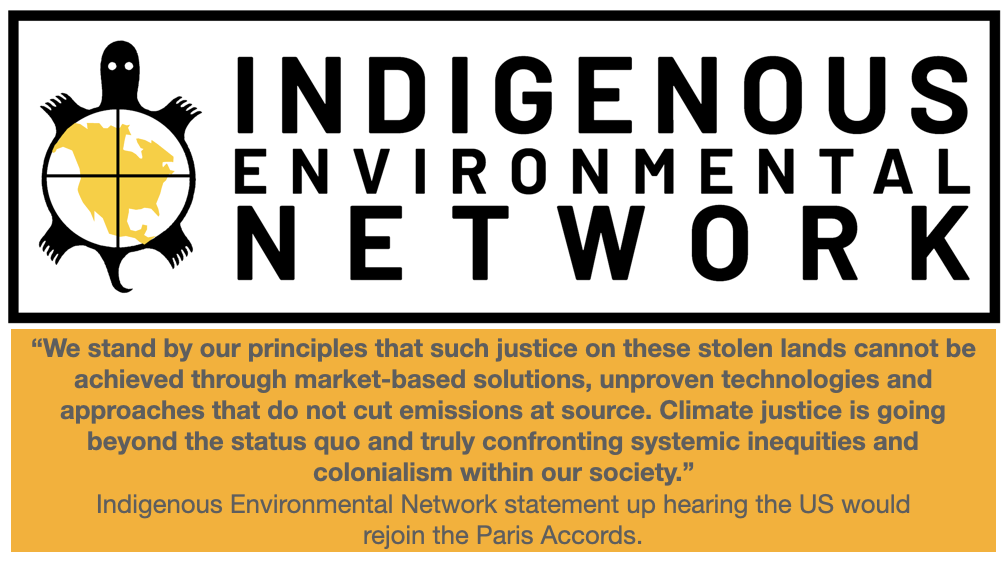
In addition, one thing that is problematic about the Paris Accords is that the agreement was created without consulting frontline communities in the fight for Climate Justice, particularly indigenous community and groups like the Indigenous Environmental Network, which made the following statement about the Biden Administration’s decision to rejoin the Paris Accords:
“We stand by our principles that such justice on these stolen lands cannot be achieved through market-based solutions, unproven technologies and approaches that do not cut emissions at source. Climate justice is going beyond the status quo and truly confronting systemic inequities and colonialism within our society.”
Frontline Climate Justice groups have been making these kinds of statements for several decades and they have consistently been against the Paris Accords because it isn’t a strong enough framework to fight the Climate Crisis. What follows is their assessment of the Paris Accords back in 2015:
The Paris Climate Agreement of December 2015 is a dangerous distraction that threatens all of us. Marked by the heavy influence of the fossil fuel industry, the deal reached at the United Nations Framework Convention on Climate Change (UNFCCC) never mentions the need to curb extractive energy, and sets goals far below those needed to avert a global catastrophe. The agreement signed by 196 countries does acknowledge the global urgency of the climate crisis, and reflects the strength of the climate movement. But the accord that came out of the UNFCC’s 21st Conference of Parties (COP21) ignores the roots of the crisis, and the very people who have the experience and determination to solve it.
Our analysis of the Paris Agreement echoes critiques from social movements around the world, led by those most impacted by both climate disruption and the false promises that governments and corporate interests promote in its wake. In order to effectively develop and support our next organizing steps, we must have a clear and honest understanding of the challenges and conditions we are facing. We have five core concerns with the content of the Paris Agreement:
The Agreement relies on voluntary versus mandatory emission cuts that do not meet targets scientists say are necessary to avoid climate catastrophe.
The Agreement advances pollution trading mechanisms that allow polluters to purchase “offsets” and continue extremely dangerous levels of emissions.
The Agreement relies on dirty energies and false promises including hydraulic fracturing (fracking), nuclear power, agro-fuels, carbon capture and sequestration and other technological proposals that pose serious ecological risks.
The operating text of the Agreement omits any mention of human rights or the rights of Indigenous Peoples and women.
The Agreement weakens or strips the rights of reparations owed to the Global South by the Global North.
Again, we cannot be content with just returning to the business as usual norm. We really need to listen to those on the frontlines of the Climate Justice Movement!
Sponsored Content and Greenwashing: MLive provides a platform for Enbridge to promote themselves as sustainable
On Friday, January 29th, one of the first items that showed up on MLive’s newsfeed was this item from the Enbridge Corporation, shown here below.
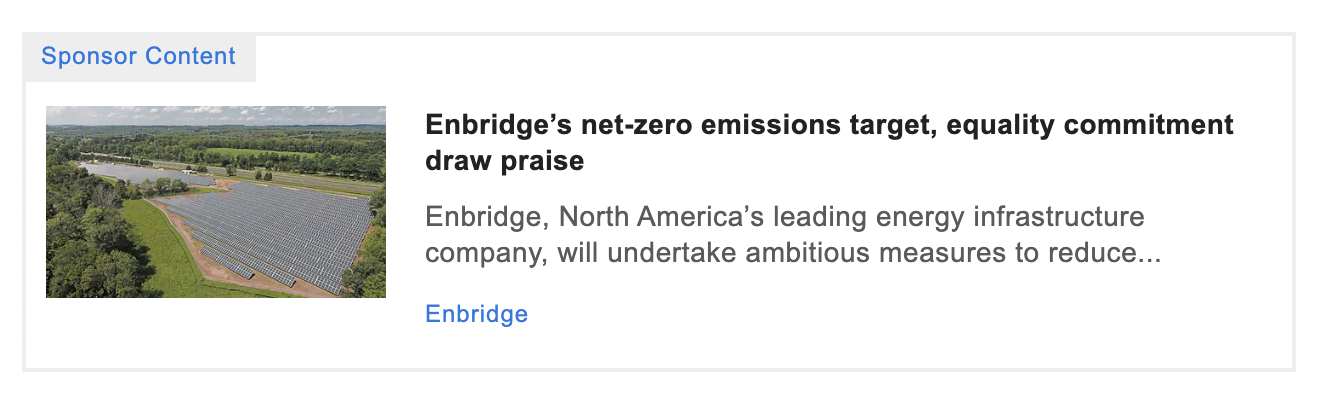
Now this item does say Sponsored Content, yet it is in the normal newsfeed line up. Everything that runs as an advertisement on Live, states that it is an advertisement. In addition, the ads on MLive are stand alone, often to the side and in now way could be confused as part of their regular newsfeed.
It is also instructive that the item from Enbridge is identified as Sponsored Content. Why not just call it an ad, since that is exactly what it is. The so-called Sponsored content from Enbridge is paid for, just like ads are, so why confused readers or blur the lines with the deceptive term sponsored content. All ads are content and all ads are paid for, just like the Enbridge sponsored content that appeared last Friday on MLive.
The Sponsored Content is a Lie
If one were to click on the Sponsored Content that the Enbridge Corporation paid for on MLive, you would go to this link.
The sponsored content from Enbridge is simply a propaganda piece talking about how the company will reduce greenhouse gas emissions in their production process. The paid content by Enbridge also wants you to believe that their involvement in the One Future coalition demonstrates their commitment to sustainability.
While some people might welcome the Enbridge Corporation’s claim to work towards sustainability, their claims should be called out as nothing more than a lie. The Enbridge Corporation’s very existence is to extra and transport fossil fuels, like nature gas and oil. How is it even possible for a company that makes billions off the trafficking of fossil fuels to in any way at all be sustainable? It can’t, but that doesn’t stop the company from engaging in the fraudulent practice of Greenwashing.
 Enbridge is the primary transporter of Alberta Tar Sands oil, which many environmental groups and climate justice groups have identified as the most polluting/greenhouse gas emitting project on the planet.
It’s bad enough that MLive takes money from the Enbridge Corporation, but it is even more insidious to allow them to promote themselves as practicing sustainability. The only way for the Enbridge Corporation to actually practice sustainability, would be to shut down every operation they current are involved in and to undo the harm they have caused for decades, particularly with Indigenous communities all across North America.
White Liberals, Kids Food Basket and the Non-Profit industrial Complex in Grand Rapids
 It has been a few days since the Kids Food Basket legal threat against Black organizers was made public by Defund the GRPD, the Grand Rapids Area Tenant Union, Justice for Black Lives, Movimiento Cosecha GR, GR Rapid Response to ICE and the Grand Rapids Area Mutual Aid Network.
As a matter of transparency, I am involved in many of the groups that posted the legal threat from KFB, groups that are all working to create systemic change and promote collective liberation.
It has been instructive to see the reactions to the criticism of Kids Food Basket and even more instructive to see people continuing to defend Kids Food Basket even after the groups listed above posted the legal threat that was directed at two Black organizers in Grand Rapids. As Breannah R. Alexander Oppenhuizen stated, in her article for Candor Media, the legal threat by Kids Food Basket against two Black organizers was a form of violence.
Also instructive is the fact that I have written five articles over the past decade, each of which have challenged the purpose of Kids Food Basket, which engages in Food Charity, not Food Justice. I have never received a threatening letter from lawyers representing Kids Food Basket.
Now, as someone who tries to be an accomplice with Black, Indigenous and immigrant organizers in Grand Rapids, anytime Whiteness and White Supremacy is called out, it offers those of us who are white an opportunity to think about and reflect upon our own complicity in White Supremacy and structural violence.
When far right groups show up in Grand Rapids and attempt to intimidate people, it is important for those of use who carry lots of privilege to show up and make sure that Black, Indigenous and immigrant organizers do not have to deal with armed, white nationalists. This is one way that white people can concretely practice solidarity with affected communities. However, there are others ways we can show up to challenge White Supremacy, particularly since White Supremacy is so deeply embedded in our society. And just for clarification, when I think of White Supremacy, I use the definition that has been used by long time writer and organizer Elizabeth Martinez:
White Supremacy is an historically based, institutionally perpetuated system of exploitation and oppression of continents, nations, and peoples of color by white peoples and nations of the European continent, for the purpose of maintaining and defending a system of wealth, power, and privilege.
One can see how with this definition, White Supremacy is part of our political system, it is part of capitalism, the legal system, religious institutions, the corporate media and the non-profit sector.
Now, as white people, if we are serious about dismantling White Supremacy, then you can see how there is no shortage of work. In this article though, we are going to examine how White Supremacy is part of the non-profit sector and specifically Kids Food Basket. To have an honest investigation, we are going to use the framework for what non-profits are, based on the fabulous work by the feminist group, INCITE! Over a decade ago, the group INCITE! held a conference on the Non-Profit Industrial Complex and out of the that conference came to book, The Revolution Will Not Be Funded: Beyond the Non-Profit Industrial Complex. In that book, they identify the function of non-profits, which also have a relationship with the government (must apply for a 501-c3 status, given by the State) and the Capitalist Class, which controls the majority of the wealth and also creates foundations as a way to hide some of their wealth from being taxed and to generate their own PR. INCITE! Identifies these 6 functions:
- Monitor and control social justice movements;
- Divert public monies into private hands through foundations;
- Manage and control dissent in order to make the world safe for capitalism;
- Redirect activist energies into career-based modes of organizing instead of mass-based organizing capable of actually transforming society;
- Allow corporations to mask their exploitative and colonial work practices through “philanthropic” work;
- Encourage social movements to model themselves after capitalist structures rather than to challenge them
The issue that Kids Food Basket organizes around is child hunger and poverty. However, instead of addressing the root cause of child hunger and poverty, Kids Food Basket provides food charity. They get businesses to send them volunteers on a regular basis to put together sack lunches, which makes the volunteers feel good about themselves and it’s great PR for the entities sending volunteers.
Then Kids Food Basket relies on donations and grants to “feed children”, which lets individuals get off the hook from taking responsibility for child hunger and more importantly it allows large donors to influence how the money gets used. The DeVos family gives hundreds of thousands annually, which allows them an influential role in determining the work of Kids Food Basket, and since KFB doesn’t challenge the root causes of poverty, wealthy funders like the DeVos family are happy with what KFB does. The DeVos family spends millions during any given election cycle, to buy politicians who will keep the minimum wage low and who will make sure that the tax system benefits the super rich. If issues like these were being addressed by KFB, which are important for addressing the root causes of poverty, then the DeVos funding would likely go away.
Kids Food Basket also has substantial corporate representation on their board, such as Meijer, Amway, Huntington Bank, Williams Group and Rhoades McKee, the law firm which sent the threatening letter to the two black organizers. Having corporate representation on the board is beneficial, since these people represent the interests of the companies they work for, which is to say they will make sure that addressing root causes of poverty are avoided. For example, Meijer, a major food cartel, doesn’t pay most of their store employees a living wage, yet the wealth of Hank & Doug Meijer currently stands at $10.2 Billion, according to Forbes. The Meijer family alone could contribute thousands of dollars to the families of the children who receive KFB food charity and it still wouldn’t make a dent in their wealth.
However, the larger issue is how all the energy, resources, staff and volunteer hours are spent by Kids Food Basket, could be used to come up with real ways to address child hunger and poverty, ways that would address the root causes of that poverty. Remember, White Supremacy is about maintaining and defending a system of wealth, power, and privilege.
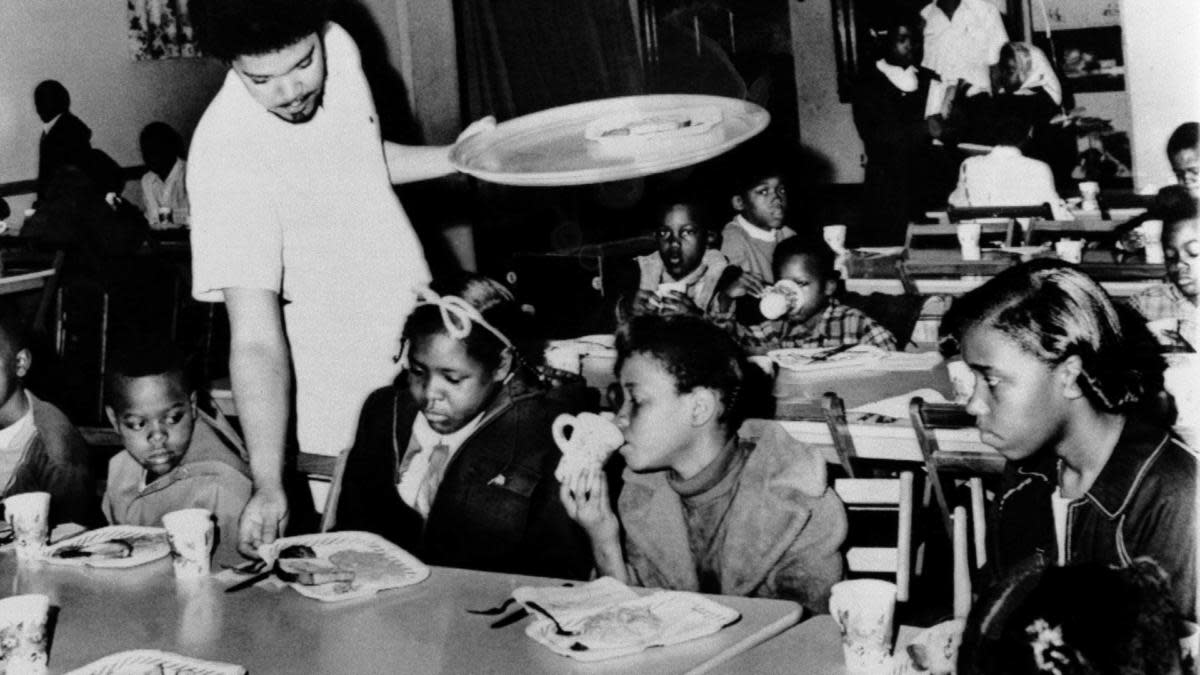
Feeding children can be a powerful strategy for grassroots groups to use if they want to end poverty. The Black Panther Party for Self-Defense had a powerful breakfast program, but this was a program where they directly fed children in their communities, which also included an educational component. More importantly, the Black Panther Party for Self-Defense didn’t just run a breakfast program, they had a 10 Point Program that reflected clear demands in order to achieve the kind of liberation they wanted to see in the world, which included economic justice.
What We Want Now!
- We want freedom. We want power to determine the destiny of our Black Community.
- We want full employment for our people.
- We want an end to the robbery by the capitalists of our black and oppressed communities.
- We want decent housing, fit for shelter of human beings.
- We want education for our people that exposes the true nature of this decadent American society. We want education that teaches us our true history and our role in the present day society.
- We want all Black men to be exempt from military service.
- We want an immediate end to POLICE BRUTALITY and MURDER of Black people.
- We want freedom for all Black men held in federal, state, county and city prisons and jails.
- We want all Black people when brought to trial to be tried in court by a jury of their peer group or people from their Black Communities, as defined by the Constitution of the United States.
- We want land, bread, housing, education, clothing, justice and peace.
This is what it means to work for the root causes of injustice, including child hunger and poverty. For those of us who are White, instead of being so quick to defend Kids Food Basket and how they promote White Supremacy, maybe we need to ask ourselves what are the root causes of hunger and poverty in our community and then work like hell to fight for the necessary changes needed, but only if those most affected want us to join the fight.
Over the next 8 weeks, we will be posting a summary of the class we are facilitating on US Social Movements. These posts will include a summary of the discussion, the questions we presented to frame each social movement that is discussed, a timeline and additional books that are relevant to each movement.
The US Abolitionist Movement, is not only the first significant social movement in US history, it is the foundational movement for all other movements. W. E. B. DuBois referred to the salve revolt as the first “general strike,” and the early labor movement also referred to working for Robber Barons as “wage slavery.” In addition, the some within the early suffrage movement, saw the direct connection between the dismantling of chattel slavery with the liberation of women. Angela Davis, in her monumental work, Women, Race and Class, that the Abolitionist movement laid the foundation for an intersectional analysis of race, gender and class.
For this first week, everyone read chapter 9 from Howard Zinn’s, A People’s History of the United States, which deals specifically with the Abolitionist movement. Zinn doesn’t waste anytime juxtaposing the radical demands of those who were enslaved to the systems of power that were defending slavery. Participants in the class noted some of the more dynamic aspects of the Abolitionist Movements, which had nothing to do with reform, but everything to do with ending the brutal practice of slavery.
In the class we used a timeline of the 19th Century, which had critical points of the Abolitionist movement on the top, along with other important aspects of that century, which were connected to slavery, which were listed on the lower half of the timeline shown here.

In addition, each of the participants were provided with a list of questions to help frame and facilitate a more focused discussion. We will list all 8 of the questions and a brief overview of what was discussed for each question.
- What are the systems of power and oppression that existed during the period of history being discussed, and more importantly, what were the systems of power and oppression that the social movement was confronting, challenging or seeking to dismantle? The most obvious system of oppression was the legal protection of humans owning other humans, or what was referred to then as chattel slavery. This system was a private system, consisting of hundreds of plantation owners who used slave labor. People also identified Capitalism as another system of oppression, since Capitalism drove the demand of cash crops like cotton and tobacco, which were central to the plantation system. Capitalism and slavery was the focus of important book by Edward Baptist, The Half Has Never Been Told: Slavery and the Making of American Capitalism. In addition, people identified the legal system, the political system, religion and the use of slave patrols, which were designed to enforce hunt down slaves who fled the plantations.
- What else was happening in the country or around the world that may have influenced how both the systems of power/oppression and the social movement responded? Here, the class relied on the timeline to see what else was happening in the US and around the world that had a direct impact on the Abolitionist Movement. People identified the Haitian Revolution as being an inspiration for the Abolitionists, which is precisely why the US has been punishing Haiti ever since. We also discussed briefly the thesis of Matthew Karp’s book, This Vast Southern Empire: Slaveholders at the Helm of American Foreign Policy, which investigates members of Congress that supported slavery and how that impacted the relationship between the US and countries that endorsed slavery and those that didn’t. The US wars against Indigenous peoples was also discussed, along with the relationship between Settler Colonialism and Chattel Slavery. Lastly, there was discussion about legislation that benefited the Capitalist Class, such as the Homestead Act, the construction of the Transcontinental Railroad as integral components of Capitalist expansion and how workers were organizing against such dynamics.
- In what way(s) did the social movement organize itself. Centralized, decentralized, autonomous, etc? The Abolitionist Movement was mostly decentralist and autonomous. To this question, most of the conversation centered around the limited means of communication available, but people also talked about the benefits and limitations to not having a well connected movement.
- What were the goal(s), strategies and tactics of the social movement? The main goal was to end Chattel Slavery. Some strategies were education, media, mutual aid, but the primary strategy was Direct Action. Tactics that were used were rebellions, escaping, burning the plantation, finding temporary housing for those who fled, speeches, using force, writing editorials, sharing testimony from those formerly enslaved, organizing and arming people against the plantation system.
- How did the system of power/oppression push back against the demands and gains made by the social movement? The system pushed back by passing the Fugitive Slave Act, by increasing the terror tactics against those who were enslaved, organizing white armed thugs into slave patrols, undermining the provisions of the Reconstruction period, passing the 13th Amendment (which now gave the state power to incarcerate and evolve slavery), and white people organizing themselves into terrorist groups like the KKK.
- Were their intersectional aspects of the struggle the social movement was engaged in? There was always a race, class and gender critique within the aspects of the Abolitionist Movement.
- How did the social movement impact other existing or future social movements? The Abolitionist movement deeply impacted the early labor and suffrage movements, particularly because of people like Frederick Douglass, Sojourner Truth, and the Grimke sisters.
- How was the social movement compromised or co-opted, and by which external forces were they compromised or co-opted? The political system coopted the movement by making promises that were never fulfilled – 40 acres and a mule, or by getting them to believe in the Reconstruction policies, which were then taken away through political deals, particularly the deal knows as the Compromise of 1877, which was an informal agreement between southern Democrats and allies of the Republican Rutherford Hayes to settle the result of the 1876 presidential election, in exchange for withdrawing US troops from the south, thus ending the Reconstruction era.
Additional reading resources:
A People’s History of the Civil War: Struggles for Meaning and Freedom, by avid Williams
The Long Emancipation: The Demise of Slavery in the Unite States, by Ira Berlin
The Half Has Never Been Told: Slavery an the Making of American Capitalism, by Edward Baptist
How Capitalism Underdeveloped Black America, by Manning Marable
Gateway to Freedom: The Hidden History of the Underground Railroad, by Eric Foner
John Brown’s War Against Slavery, by Robert McGlone
Five for Freedom: The African American Soldiers in John Brown’s Army, by Eugene Meyer
Complicity: How the North Promoted, Prolonged, an Profited from Slavery, by Anne Farrow, Joel Lang and Jennifer Frank
This Vast Southern Empire: Slaveholders at the Helm of American Foreign Policy, by Matthew Karp.
And the Spirit Moved Them: The Lost Radical History of America’s First Feminists, by Helen LaKelly Hunt
Women, Race & Class, by Angela Davis
West Michigan Far Right Watch for the week of January 20 -27: American Patriot Council exposed and Acton defends revisionist history
 Welcome to the next installment of West Michigan Far Right Watch, where we keep tabs on the far right in this area and provide a summary of what they are up to and what kind of messages they are promoting in this community. As a matter of clarification, when we say the Far Right, we mean those in the streets who fight to defend White Supremacy, those who promote far right ideology, and those with political and economic power.
We have 2 examples for this installment.
American Patriot Council co-founder, Ryan Kelley, as been in the news lately, since activists have been exposing him for his participation in the January 6 riot at the US Capitol. Local TV stations have reported on this, like WXMI 17, just as we reported on it last week. We also noted in our post from last week that his role in the January 6 riot at the US Capitol is in direct violation of one of the core values of the American Patriot Council, based on what is posted on their website, which states:
- We condemn acts of violence, especially to achieve political gain.
- We do not tolerate lawless behavior or illegal actions.
However, for today’s post we want to draw your attention to the American Patriot Council’s most recent blog post. The blog post is entitled, Biden Wastes No Time Beginning Plan for Economic Ruin. The blog post is short and not well written, but what it demonstrates is that the American Patriot Council is just another White Republican hate group that condemn anything the Democratic Party does. In other words, the American Patriot Council is just another hack partisan entity.
The other issue we want to draw your attention to is a recent post from the Acton Institute for the Study of Religion and Liberty. Last Friday, the main Acton editor, Rev. Ben Johnson, wrote a piece that lamented the now defunct 1776 report, which came out of a conference that former President Donald Trump hosted in September, designed to counteract both the 1619 Project and the work of radical historian Howard Zinn.
The Acton blog post defends the Trump administration’s position on US history, with a point by point argument, which does nothing more than say they agree with the 1776 Report. The report itself is a joke and it’s primary objective, apart from being a form of revisionists history, is the argue that the US was founded on freedom and liberty, not on genocide and slavery, as historians like Zinn, so accurately point out.
At the end of the Acton article, it provides a direct and downloadable link to the 1776 report. This report is painful to read, but it does provide us with more clarity on the ideological framework that so many Americans base their identities in.
Nothing is as it seems: $6.3 million to connect trails along the Grand River, while racial and economic injustice consume this city
On Monday, MLive posted an article entitled, Grand Rapids planning $6.36M trail connector along Grand River.
The article states that the federal, state, city and private money necessary to come up with $6.3 million, will be used to connect a bike and pedestrian trail from Leonard St to Riverside Park. As of now, people have to walk on sidewalks or ride their bikes on Monroe in the designated trail connector area.
Walking or biking along the Grand River is a nice thing, and as someone who lives near Riverside Park, I enjoy riding my bicycle through the park or onto the White Pine Trail that is at the north end of the park.
However, the $6.3 million, in reality, is not just to connect the existing pedestrian trail. The whole push from the City of Grand Rapids and the Grand Rapids Whitewater group, is also about development along the Grand River. I mean, look at the list of funders for Grand Rapids Whitewater. It is the same families that dictate the same pro-business bullshit that dominates this city.

In an August 2020 blog post on Grand Rapids Whitewater, the writers claim that these development projects are all about promoting equity. Hell, they even quote Dr. King. Why it is that people are always quoting Dr. King, but never really understand the radical vision and demands that Dr. King was advocating for until he was assassinated? Anyway, Grand Rapids loves to use that term equity, and why not, since the more you use it the more you can convince people that is what this city is committed to.
However, despite the constant claims of equity, Grand Rapids has the largest wealth gap of any city in Michigan, with Black, latinx and indigenous communities subjected to poverty at alarming rates. Grand Rapids has a significant unhoused population that is increasingly being criminalized and the amount tax breaks that continues to be given to developers and corporations in this community is staggering.
Again, I like riding my bike along the river, but I am more committed to real equity and racial justice than I am to projects that seem trivial in the face of all the injustice that is going on in Grand Rapids and all the suffering that is going, especially in the midst of a pandemic.
It is instructive to observe that when these kinds of projects are evolving, the City of Grand Rapids always seems to be able to find funding to make it happen. In this case, as it states in the MLive article, the trail connector project would use federal, state, city and private donors.
If the City can find money to connect a bike and pedestrian trail, then why can’t they find money to end homelessness, to create truly affordable housing for all, end hunger, end poverty or provide Black residents in the southeast part of town funding to development their own neighborhoods in a way that lets them be in control of that reality?
$6.3 million is a number, but how could that number be used to address some of the glaring racial and economic injustices in this city?
It would provide 437 families rent money for 12 months coverage of $1,200 a month.
It would provide 126 families the ability to each put a down payment of 50,000 on a home.
It would provide 525 families a food budget for one year at $1000 per month.
Now, these number don’t tell everything. If families that are the most marginalized right now, were able to have rent relief or a food budget at those number, it would provide tremendous relief to families who would not have to worry about utilities or health care as much. But of course, this just provides people with some relief, since the greater goal is real racial and economic justice.
If we were allowed employ radical imagination to the serious social inequities we face, we could also find more longterm solutions that would do away with the business as usual approach, the White Savior approach and the reliance on rich philanthropists who also exploit people and buy politicians approach, to how we address systemic and structural racism and poverty in this community. Nothing is as it seems. Yes to bike and pedestrian trails, but not until racial and economic justice is achieved!
 Two weeks ago, we began out first installment of this regular posting, which takes a critical look at Grand Rapids politics and policies, based primarily on the public record, such as committee agendas and minutes.
We continue our look at Grand Rapids politics today, with some observations about the Grand Rapids City Commission’s Committee of the Whole and general City Commission meeting agenda packets for January 26th, which can be found at this link.
Two brief observations having to do with tax breaks for business, at the expense of the public and then a more detailed look at a recent “survey” done in Grand Rapids, having to do with the GRPD.
Back in early December, we reported on the DeVas-created AmplifyGR group, in conjunction with their partner, Rockford Construction, to seek tax breaks for a new business project that will be located at 1601 Madison SE, in Grand Rapids. The business that would occupy 1601 Madison SE was not revealed in early December, but the Director of AmplifyGR was quoted in MLive, saying, ““We’re hoping that by the end of the year we can be a little bit more public with that. So hopefully it’s a matter of weeks and not months.
It has been nearly two months since the AmplifyGR Director made this comment and still there is no mention of the name of the business that will benefit from $2.2 million in tax breaks from this development project for a private company. City officials will likely vote on this matter, despite the fact that AmplifyGR and Rockford Construction cannot be transparent which company will be the beneficiaries of public funding.
Also on the docket today is a proposal to provide both state funds and 12 years of tax breaks to the global self-care company Perrigo, which wants to build a facility at 400 Monroe NW in Grand Rapids. My question is, why does the State and the City need to provide massive tax breaks to a global corporation that had over a billion dollars in sales in their last quarterly report?
The State of Michigan has already committed $2 million to this relocation, and add to that 12 years of tax breaks from the City of Grand Rapids, and we are talking about a good sum of money, money that could benefit families that are struggling financially, with housing, health care and food insecurity.
Lastly, the City of Grand Rapids will likely vote on a 1 year pilot project with the private group known as Governance Sciences Group, Inc to provide FlashVote services for an estimate amount of $14,900. Essentially, what FlashVote is, is an online survey system, designed to solicit public input on issue.
The City of Grand Rapids is particularly interested in getting feedback on the GRPD, and in their Agenda Packet (beginning on page 95), it states it will also support the Police Department strategic plan.
As someone who has been involved in Defund the GRPD, I find this so-called survey suspect. First, on page 99 of the Agenda Packet, the City of Grand Rapids already did a test run in September, soliciting input on the GRPD. It says that 335 people were invited to participate, yet there is no methodology on how people were invited, nor the demographics of people invited.
Second, there are 5 questions for people in this survey, questions that are definitely crafted in such a way that avoids any serious critique of the GRPD, such as:
- Please rate how safe you feel in your neighborhood?
- Which best describes the police presence in your neighborhood?
- Which best describes you interactions with GRPD officers over the past 12 months?
- Which of the following are true for you, if any?
- Any other comments or suggestions to improve public safety and community trust in the Grand Rapids Police Department?
Question number 4 does provide a vague option to allocate resources outside of the GRPD, but it fundamentally avoids the issue of defunding and the reasons behind that campaign. On pages 102 & 103 of the Agenda Packet, there are written responses to Question 5, which are instructive at some level, but misleading since we do not know the demographics of those surveyed, nor how they were chosen. This speaks to a third point about why this survey is highly problematic and fundamentally demonstrates that the city wants to control the narrative about the GRPD, just like they did with the online survey in August, and in general, since the May 30th rebellion and the calls for defunding the GRPD.
We all know that Black and Brown residents have a much different lived experience that White people do when it comes to the police. There is also a socio-economic difference with how the cops deal with members of the Capitalist Class and how they deal with the working class poor. The GRPD has a heavier presence in poor neighborhoods that are disproportionately represented by Blacks and latinx communities, which is by design.
Fourth, as we wrote in early July, despite the City receiving thousands of letters from people calling for a reduction of funding for the GRPD and some City Commission support, the City Attorney and City Manager did an end run saying that the City Commission could not vote on reducing the funding for the GRPD. All of the groups involved in that effort were told that by November of 2020, the City would make a decision on this matter, but what happened is that the issue of defunding the GRPD was completely taken off the table, which leads this writer to conclude that City officials never intended to deal with defunding, not at least until they had more control over the narrative.
Lastly, instead of paying private companies to solicit controlled input, why doesn’t the City of Grand Rapids begin the process of using participatory budgeting, which would allow for all residents in Grand Rapids to have a say in how public tax money is used in this city. This would be a more honest and more intentional way of getting public input, plus it would mean that the City of Grand Rapids would have to give up the power to control how public money gets spent.
Black excellence is a threat to Whiteness and White Supremacy: The Legacy of Hank Aaron
 The world lost one of the best all time baseball players, with the passing of Hank Aaron.
I grew up watching Aaron play in the late 60s and 70s, all the way up to his retirement from baseball. Hank Aaron was so good, that he is the all time leader in RBIs and total bases. Hank Aaron also played in 25 All Star games.
As great a baseball player that Hank Aaron was, he was an amazing human being and ambassador for the game. Aaron was not overly political and he wasn’t flashy, but that didn’t mean anything for a Black athlete who came into the Major Leagues in the 1950s.
Hank Aaron got his start in the Negro Leagues, but in April of 1954, Aaron was signed by the Milwaukee Braves, a team he played for throughout most of his career.
We all know how Jackie Robinson broke the color-barrier, when he was signed by the Brooklyn Dodgers, but sometimes we forget that other Black baseball players and Black athletes faced constant harassment, intimidation, discrimination and threats against their life. The irony is, that the greater the player you were, the more intense the threats were.
According to Dave Zirin’s book, A People’s History of Sports in the United States, the year (1973) before Hank Aaron surpassed Babe Ruth’s all time home run record, Aaron had received 930,000 letters, most of which were filled with vicious insults and death threats. Zirin writes:
Samples of the letters read, “Dear Hank Aaron, How about some sickle cell anemia, Hank?; Dear Nigger, You black animal, I hope you never live long enough to hit more home runs than the great Babe Ruth.” Aaron later wrote, “The Atlanta fans weren’t shy about letting me know what they thought of a $200,000 nigger striking out with men on base.”
Zirin also noted that when Aaron did break Bath Ruth’s home run record on April 8, 1974, against the Los Angeles Dodgers, the Commissioner of Baseball, Bowie Kuhn, didn’t even bother to show up to witness and congratulate Aaron.
Playing baseball takes skill and dedication. As someone who played baseball competitively in men’s summer leagues, I am aware of how important dedication to the game is. Yet, the very fact that Hank Aaron, a Black baseball player was going to pass the home run record of White icon Babe Ruth, was what prompted so many death threats against Hank Aaron. It wasn’t because Aaron was on the front lines of the Black Freedom Struggle or because he endorsed groups like the Black Panther Party for Self-Defense, rather it was because his excellence as a Black athlete threatened the very essence of Whiteness and White Supremacy.
And just to be clear, White Supremacy is not only what dictates the actions of the Proud Boys, the KKK or Trump supporters who stormed the US Capitol, White Supremacy is what the US was founded on, and White Supremacy still dictates so much of US society that we don’t even recognize it.
In a world that runs on White Supremacy, it is paramount that we honor the legacy of Hank Aaron, for what he meant to the game of baseball and how much White hatred/White Supremacy he had to endure. Hank Aaron, Rest in Power!
Enbridge says they won’t comply with Governor’s orders, runs new radio ads attacking Whitmer for not caring about working families
 For more than a week, the powerful Enbridge Corporation has stated publicly that they will not comply with Gov. Whitmer’s order to shut down Line 5, since the announcement from the State of Michigan that the oil giant cannot use the public easement.
On January 12th, Vern Yu, executive vice president and president, liquids pipelines, of Enbridge, sent a 7 page letter to Gov. Whitmer, outlining why the fossil fuel corporation will not comply with the government’s order.
Here is part of what that letter contained:
We have carefully reviewed the Notice of Revocation and Termination of 1953 Easement (“Notice”) that we received on November 13 from Mark Totten, Chief Legal Counsel to the Governor. Our review shows that the State lacks the authority to terminate or revoke the 1953 Easement. Enbridge’s court filings since November 13 make clear why “termination” or “revocation” of the Easement is contrary to federal law. Moreover, as discussed in detail below, the Notice fails to specify an existing violation of Easement terms that would justify termination.
For these reasons, we intend to operate the Dual Lines until the replacement pipeline under the Straits within the Great Lakes Tunnel is placed into service, as per our existing Agreement with the State of Michigan and consistent with PHMSA federal regulatory requirements. Enbridge already has requested that the United States District Court allow us to move to dismiss the civil suit the State filed in an attempt to enforce the November 13 Notice. In responding to the Notice’s claims here, Enbridge preserves all of its legal arguments, including that the federal Pipeline Safety Act preempts Michigan’s attempt to enforce its own safety standards on the Dual Lines or to take any action to close the Dual Lines.
The Enbridge letter, ends with these words of defiance:
For all of the reasons discussed, the November 13 Notice is not a valid exercise of the State’s authority under the Easement. Accordingly, the Easement will not terminate or be deemed “revoked” at the end of the 180-day period, as the Notice seeks. Our dual pipelines in the Straits are safe, fit for service and in full compliance with the federal safety standards that govern them.
We trust you will respond positively to our offer to participate in good-faith discussions to resolve any differences. In the meantime, the Dual Pipelines will continue to operate safely until they are replaced on completion of the Tunnel Project, as per the 2018 Agreements. Enbridge will vigorously defend its rights under the Easement in pending court actions, and fully expects that its legal positions will prevail.
Shortly after it became public that Enbridge would not comply with the State’s order, the Michigan League of Conservation Voters released their own statement, which read in part:
Enbridge’s irresponsible refusal to comply with Gov. Gretchen Whitmer’s decision is a slap in the face to Michigan families who care about our Great Lakes and clean drinking water more than Big Oil profits.
The refusal by Enbridge to comply with the Governor’s orders demonstrates their arrogance, but more importantly it demonstrates the power this corporation has. Would a small business be able to get away with failure to comply with state orders? Would any citizen group or individual? Enbridge’s defiance on this matter also demonstrates that they have very deep pockets to fight any efforts to halt their profit-making ability, through litigation.
Propaganda on the airwaves
For years, Enbridge has been running paid advertising, which for corporations can be written off as a business expense in their tax filings. Enbrdige runs both TV and radio ads throughout the Michigan market, specifically related to Line 5 and their proposed tunnel.
 Now, Enbridge is running new ads that are not only attacking Gov. Whitmer for attempting to shut down Line 5, the ad is actually saying that the State of Michigan doesn’t care about working families.
This new radio ad, which I have heard in the Grand Rapids market, is very misleading and disingenuous. How can Enbridge claim that it cares about working families? Working families are always the hardest hit from the environment disasters that Enbridge has perpetrated all across the US, as can be seen in the 10 year graphic on the right, from the National Wildlife Federation.
In addition, the claim that Enbridge cares about working families is false, because Climate Change disproportionately impacts the poor and working class families around the globe and in Michigan.
However, we cannot rely on the courts or the State of Michigan to shut down Line 5 and to dismantle any and all Enbridge pipelines. We need to support direct action campaigns, like we saw at Standing Rock and like the one that is happening right now against Line 3 in Minnesota. The future of the Great Lakes should not be left up to the judicial process or the greed of corporations like Enbridge. Shut Down Line 5 Now!

