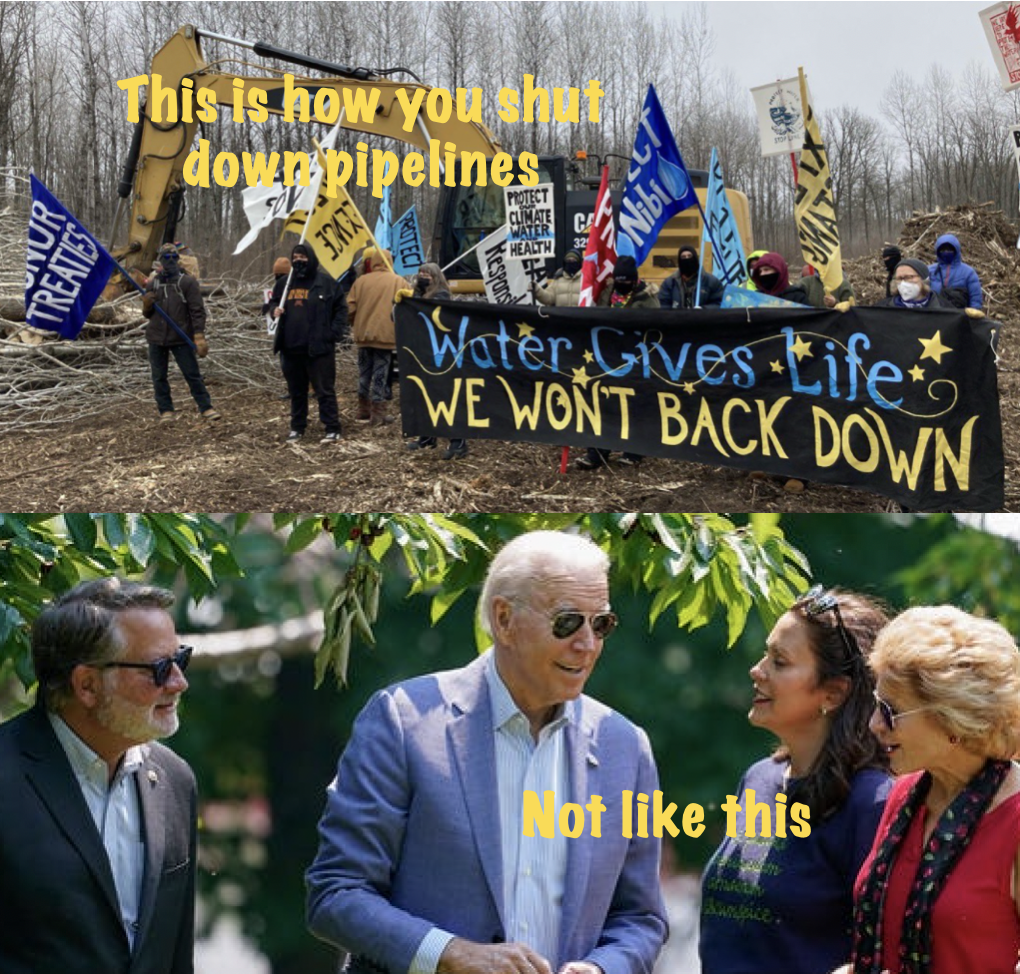
In early May, we reported on indigenous-led actions to shut down the Enbridge Line 5 pipeline, which carries tar sands oil.
At the same time Michigan Governor Gretchen Whitmer had told the Enbridge Corporation that it would be illegal for the company to continue to operate Line 5, after she revoked a 1953 Easement Permit. Since May 12th, the Enbridge Corporation has been illegally operating Line 5, despite the Governor’s position.
Enbridge’s response was to ignore the State of Michigan, continue to appeal this case in court and to announce that they were receiving lots of such for keeping Line 5 open from government bodies, Chambers of Commerce and even unions. https://www.enbridge.com/media-center/news/details?id=123675&lang=en
The Enbridge Corportation has been illegally operating Line 5 since May 12, so what has the State of Michigan done? Did they send State Police officers or the Michigan National Guard to shut down Enbridge offices and the operation of Line 5? Absolutely not.
When President Biden recently visited Traverse City, did Governor Whitmer press him on getting the federal government to enforce the shut down of Line 5? Not that we know of. We do know that the Mayor of Traverse City spoke with Biden about Line 5, but there was not evidence that Biden would take a stand against the Enbridge operated pipeline. https://www.record-eagle.com/news/local_news/biden-visits-king-orchards-with-governor-senators/article_4b5194ee-dc48-11eb-b5c9-03ccb70cc9ed.html
What we do know is this…….the Biden Administration sent a Department of Homeland Security helicopter to disrupt an indigenous-led protest against the Enbridge Line 3 pipeline in early June. https://theintercept.com/2021/06/08/line-3-pipeline-helicopter-dhs-protest/ With that action, Biden signaled his full support for Line 3, which means the administration will most likely not take a stand against Line 5.
In addition, the Enbridge Corporation is continuing to push the Line 5 tunnel, which would be constructed under the Straits of Mackinac. The State of Michigan hosts its own online information about this project, https://www.michigan.gov/line5/ with no indication that they will decline this proposal.
Therefore, we can reasonably conclude that we cannot and should not rely on the State of Michigan or the Biden Administration to shut down Line 5. In fact, what we should be doing is exactly what Indigenous communities are doing, which is to actively resist these tar sands pipelines. We need to learn from the Standing Rock resistance, we need to support and participate in the Line 3 resistance, https://www.stopline3.org/#intro and we need to be doing the same thing in Michigan to shut down Line 5. Relying on the government is a false hope. Direct Action is the solution!
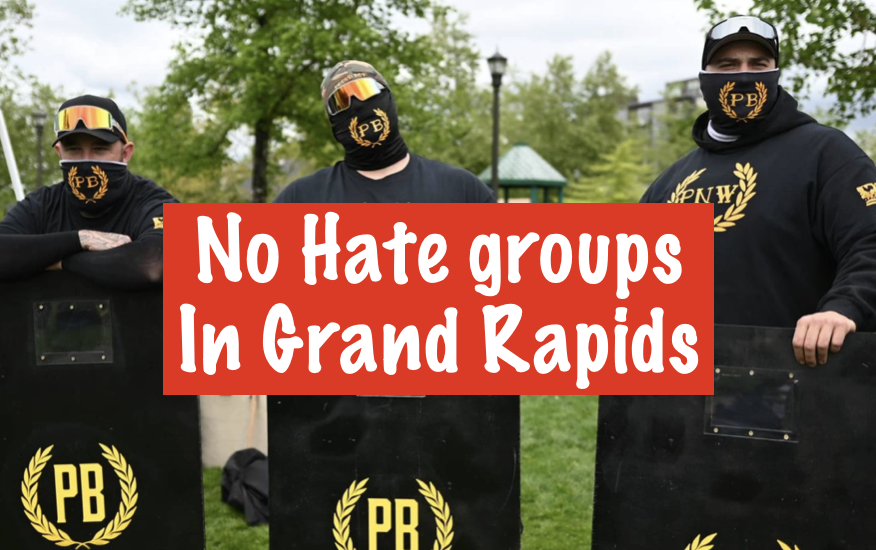
Yesterday, people showed up to do exactly what we needed to do, which was to send a strong message to the Proud Boys that they are never welcome in this community.
About 150 people came to Ah Nab Awen Park in downtown Grand Rapids, from several different groups, to make sure that the Proud Boys rally that was scheduled for noon on Saturday did not happen.
People started arriving around 10am to the park. Around noon there were a few Proud Boys who walked through the park, but after seeing the large numbers of those who came to resist their White Supremacist gathering, they left.
It was a clear victory over hate, thus demonstrating once again, that groups like the Proud Boys, the Klan, neo-Nazis, the militia, etc., should never be tolerated. https://griid.org/2021/07/07/why-we-must-always-confront-hate-groups-when-they-come-to-town/
Around 1:30 a few people spoke to the people who had been in the park for over 3 hours. Joe Cadreau, a Indigenous activist, who talked about the importance of the sacred space that is Ah Nab Awen Park, said it best, “I was not going to allow neo-Nazi fascist and neo-Nazi white supremacists come in and walk across my sacred ancestors. We kicked their ass today.”
The GRPD also had a significant presence during the counter-protest. There were cops stationed on the tops of buildings, in police cruisers, in unmarked cars and about 20 cops in tactical gear riding bikes. The bike cops kept riding around the perimeter of the park and occasionally riding through the park, just to let those of us who were resisting that they were there.
At one point a few cops walked up to some of us and did the usual, “who’s in charge?” Because, in their world, someone has to be in charge. They will never understand the idea of horizontal organizing, where people come together and make decisions collectively. Several people just ended up telling the cops to leave or to fuck off, because they had nothing to say to them and were pissed off at the GRPD for releasing a statement saying that they would “protect” the Proud Boys’ right to free speech.

There were also several local commercial news agencies present, many of which showed up at 10am. The local news media no doubt was hoping for a confrontation, since they love conflict porn, which always gets lots of hits and is great for advertising. The stories that we done were the standard narrative.
WOODTV8 ran a very short story with a headline that read, Dozens of counter protestors gather in GR for rumored Proud Boys rally. https://www.woodtv.com/news/grand-rapids/dozens-of-counter-protestors-gather-in-gr-for-rumored-proud-boys-rally/ The channel 8 reporter interviewed someone who had nothing to do with organizing the resistance and was critical of both the Proud Boys and those who gathered to oppose them.
The MLive article was longer, but also didn’t provide adequate context and follow standard narratives. https://www.mlive.com/news/grand-rapids/2021/07/rumored-proud-boys-rally-fails-to-materialize-in-grand-rapids-as-counterprotesters-gather.html They also included interviews with several people who were not part of the organized resistance, people who had their own agenda and analysis that had nothing to do with why most people were there. In addition, many of the pictures that were included with the MLive article also centered on some of the religious people who came to the counter-protest to impose their values on the rest of us.
The WXMI story was a bit better, since it centered the voices a two of the organizers of the action, but they also gave time to people who were sympathetic to the Proud Boys or made ridiculous comments about the US not being founded on racism. https://www.fox17online.com/news/local-news/grand-rapids/counter-protesters-gather-ahead-of-expected-proud-boys-rally
In addition, WXMI 17 had run a story a few days earlier about the Proud Boys planned rally and the response from Kent County Commissioner Robert Womack, who told people they should just ignore the Proud Boys. This message of non-engagement or ignoring hate groups is absolutely the wrong kind of message to send and it only reinforces this idea that even groups like the Proud Boys have a right to spread their vile whenever they want. https://www.fox17online.com/news/local-news/grand-rapids/county-commissioner-hoping-for-no-violence-as-proud-boys-plan-rally-in-gr
Lastly, some of the news stories used language like, “there was no violence during the counter-protest.” This is a simplistic and naive notion of violence. When the Proud Boys announced they were coming to Grand Rapids, that was a form of violence. The GRPD showing up in large numbers, to do surveillance and to monitor those who came to say that the Proud Boys are not welcomed, that was a form of violence. When the GRPD sends dozens of cops in tactical gear, that is straight up a demonstration of state violence.
However, despite the various news media narratives and the GRPD’s bullshit, it was great to see people come together to defend themselves against White Supremacy and to make it clear that the best way to stand against hate is to show up and confront them!

In our recent post on the KKK rally that was held in Grand Rapids in 1995, it was clear that there were lots of people who resisted their presence.
We have all heard it before, that when groups like the Klan, neo-nazis, the Christian Right, or any other hate group comes to town, that the best response is to ignore them. What this means is that some people want us to ignore those who think that Black people are animals, that immigrants are rapists, that the LGBTQ people are sexual predators, etc. Such council to ignore them, often comes from people who carry tremendous privilege and are not at risk of being harmed by the ideology that these groups bring to any community.
Ignoring hate groups is not an option. We must resist their attempts to spread hate and we must be in solidarity with communities who are at the greatest risk when these hate groups come to town.
What follows are just a few examples of when people in the Grand Rapids area took action to resist hate groups, especially those that came to the area to promote their ideology of White Supremacy, xenophobia, anti-gay and anti-trans, all of which leads to real harm.
In May of 2006, about 40 people gathered in Calder Plaza to rally against undocumented immigrants, calling them “illegal immigrants.” The rally was organized by the Council of Conservative Citizens (CCC), a national hate group, with ties to West Michigan. https://mediamousearchive.wordpress.com/2006/05/07/local-group-con/
Roughly a dozen activists in Grand Rapids showed up to confront the CCC rally, shouting them down and engaging in arguments, which prevented them from doing what they intended to do at the rally.
The GRPD showed up and said that since the group didn’t have a permit, they would have to leave. Maybe half of the anti-immigrant crowd decided to march around downtown Grand Rapids, but they did not expect that the dozen anti-racists activists would follow them the entire time, yelling who they were and what they believed, so that those who were out and about in the downtown area would know what this hate group was all about.
A second example was from October of 2007, when the racist, homophobe and Holocaust denier, Nick Griffin, was scheduled to speak at MSU in East Lansing.
Again, a group from Grand Rapids met up with activists in the Lansing area, to show up and confront Griffin when he got up to speak. As soon as Griffin got up, people began yelling things like racist, homophobe, or pointing out in more detail Griffin’s history of promoting hate in the UK and in the US.
This went on for about 30 minutes, when Griffin decided that it was not productive for him to continue speaking.
As we were leaving, some students followed us out, making threats against us. Those of us who came didn’t back down and when we challenged them, they ran off.
A third example, was when White Supremacists had organized a rally in Kalamazoo in the summer of 2007. Hal Turner, a racist talk show host, was making the claim that African Americans were killing white people in Kalamazoo and that white people should come to Kalamazoo to denounce this.
Anti-racists in the West Michigan area, put out a call for people to come to Kalamazoo and confront the White Supremacist groups that were organized through Hal Turner’s radio show.
In addition to the call the action, there were numerous meetings to plan what to do, involving people from Kalamazoo, Battle Creek, Lansing and Grand Rapids. We even put together a packet of information to hand out to all the hotels in the area, since the White Supremacists were all coming from out of town and out of state. The packets provided people with information on the groups who said they were sending people and with ways to identify groups, particularly through symbols and tattoos. I remember sharing these packets with hotel staff, many of which were grateful that we had let them know that these people might be booking rooms.
Here is an excerpt from the packet, which provides reasons why hate groups should not be tolerated:
Racist groups must be challenged publicly in order to prevent them from gaining a foothold in communities. Many of these groups are able to have success in taking what are in many cases legitimate fears such as concern over economic uncertainty and direct them in racist directions, for example targeting immigrants rather than focusing on neoliberal trade policies. Racists are emboldened in areas where they are allowed to organized unopposed, when they are challenged they often back off entirely or are forced to resort to “underground” tactics such as graffiti or random literature drops. It is not enough to “ignore” organized racists while hoping that they simply go away.
The White Supremacist rally was held in early August of 2007. Here is part of what Media Mouse had posted about what happened that day:
Racist Internet radio show host Hal Turner’s Kalamazoo, Michigan “Rally Against Black Gang Terrorism” on Saturday was overshadowed by protestors, with Turner’s small rally of out-of-town racists and a small group of supporters–numbering around 25–easily outnumbered by the approximately 200 protestors who (un)welcomed them to Kalamazoo. During the rally, Turner and other speakers spoke to each other and a handful of supporters while facing an empty parking lot in 90 degree heat. Reflecting the fact that they have no base in Kalamazoo and were largely ignored by the media, Hal Turner failed to turn out any supporters outside of the racist movement and his calls to “Take Back Kalamazoo” went unanswered as he and his racist friends spoke behind lines of police and multiple layers of fencing.
Protestors began the day meeting at Bronson Park in downtown Kalamazoo at noon. The group waited to gauge the energy of the crowd before deciding to move to the rally site several blocks away at the Kalamazoo Department of Public Safety building on Crosstown Parkway. The protestors held a spirited march on the sidewalk down Burdick Street, loudly chanting, making noise, and handing out flyers exposing the racists behind the rally. The energy was high and the reaction from community members was overwhelmingly positive.
The protestors maintained a presence outside of the security perimeter for the duration of the racists’ rally, attempting to drown out the speeches with noise and chants. The crowd remained energetic throughout, waving signs that read “K-Zoo Not K-K-K-Zoo” and “Racists Go Home” along with banners reading “Hate Speech = Terrorism,” “No Nazis, No KKK, No Racist USA,” and “Racists Here w/Gov’t. Help.” The crowd banged on bucket drums, used air horns, and chanted while making it clear that the racists were not welcome in Kalamazoo.
After the rally concluded, protestors attempted to confront the white supremacists, but the racists were quickly led by police onto Kalamazoo city buses and escorted out of the area. Realizing that they were not going to be able to confront the racists, the protestors staged an unpermited march back to Bronson Park. The march was initially led by chants of “Whose Streets? Our Streets” and “Nazi Crew Out of K-Zoo,” although “Cops and Klan Go Hand in Hand” became a prominent chant when police began to force the march onto the sidewalk by pushing protestors with horses. Police repeatedly told protestors that “your protest is over” and appeared to be looking to make arrests, although none were made during the march despite a tense stand-off when the group of 75 protestors was split in two in front of the Kalamazoo Gazette building at 401 S. Burdick. Following this stand-off, the march continued from the Gazette building to Bronson Park on the sidewalk. Upon arriving at the park, the police arrested two people who went on the amphitheater stage, an area that was for some reason determined to be “off limits” by the police.
This example from 2007 in Kalamazoo, is probably the best organized and most effective anti-racist action I have ever participated in.
The last example took place last year, with community members standing up to the Proud Boys in Kalamazoo. One commentator on social media, who was part of the anti-racist action to confront the Proud Boys stated, “The police SPECIFICALLY PROTECTED the proud boys, CLEARED SPACE for them to leave, and then began ARRESTING Black counter protestor.”
This comment, once again demonstrates that the police will not protect people from racist hate groups, which is exactly why we need to show up to confront these groups and run them out of town.
In fact, the Proud Boys are planning a rally in Grand Rapids, Saturday, July 10th at noon. There is a counter protest scheduled for 10am. If you are in Grand Rapids, show up and say No to Hate Groups and No to Hate Speech!
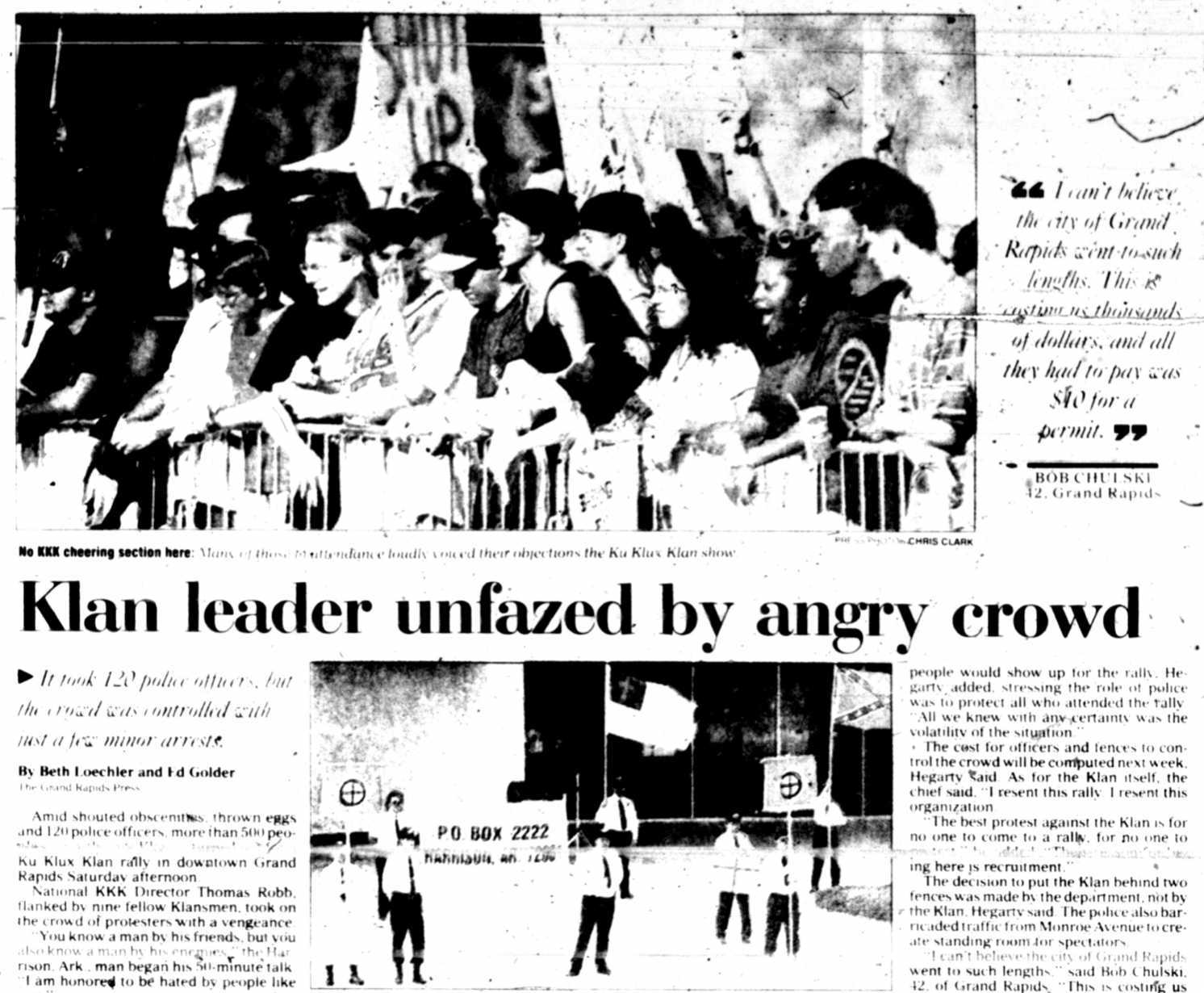
The KKK paid $10 for a permit to hold a rally in Grand Rapids in 1995 and the GRPD protected them
In the past week, we have posted 2 articles about previous KKK gatherings in the Grand Rapids area. The first was in 1925, with at least 6,000 Klan members coming to the Furniture City, and a second gathering, which took place on a farm just south of Grand Rapids, near US 131, in 1970.
In today’s post we want to focus on a Klan rally that took place in late September of 1995. There was coverage in the Grand Rapids Press, both an article about the KKK applying for a permit in Grand Rapids and then one article about the Klan rally on September 30th in front of the Hall of Justice, which was then on Monroe St, right next to the Police Station.
The Press article about the Klan getting a permit is instructive for several reasons. First, the article states that the Klan only needed to pay $10 to get a permit for their rally. Second, it gives significant space to a national Klan spokesperson, who argues that they are coming to Grand Rapids to speak on the North American Free Trade Agreement (NAFTA), the Global Agreement on Tariff’s and Trade (GATT), illegal immigration and White Pride. Third, the Press article also cites the head of the City’s Park’s and Recreation Department, who argues that this is a free speech issue and that their office can’t take sides. Fourth, the Press reporter didn’t bother to get any comments from groups in down that were doing racial justice work at the time, plus the reporter does not question or explore the four themes that the Klan spokesperson was going to address.
The Grand Rapids Press article that came out after the Klan rally on September 30th was also rather telling. The headline read, Klan leader unfazed by angry crowd, with a subheading that said, It took 120 police officers, but the crowd was controlled with just a few minor arrests.
In addition to the awful headline, the Press article was also poorly written. The reporter cited the national Klan spokesperson at length and never questioned or verified any of the claims made by the KKK. The Press reporter also cited then Police Chief William Hegarty who said that the most effective protest would have been for people to not protest the Klan and just stay home. This is a typical liberal response to hate groups, which was ignored by at least 500 people who came to protest the Klan, trying to shout them down, but also hurling eggs and bottles at the less than 10 KKK members who staged the rally.
Over 500 people showed up to tell the Klan to leave
The Press reporter did cite some people who came to the protest, but each was only given a few words to state their point of view.
The article did say that the GRPD had erected portable fencing to separate the Klan and those who came to confront them. The GRPD also had numerous cops standing between the crowd and the Klan members, plus cops posted on roof tops and above Monroe St at the overlook area by City Hall.
I was there that day to protest the Klan, plus Mannie Gentile and I were using equipment from GRTV, to film what was happening.
It is interesting that this Klan rally took place just months after a ballot measure was passed to change the City Charter to reflect that the GRPD should get at least 33% of the City’s budget. The GRPD had 120 officers out that day, which was nearly half of the entire police department. It’s ironic that the GRPD and their supporters fought to get the increased budget allocation so that they could defend the free speech rights of a hate group.
The article does note that there were several people who came to protest the Klan that day, notably independent newspaper publisher Rob LaDew, who jumped the fencing in protest of the Klan. LaDew also was quoted as saying he was not happy with the NAACP chapter that agreed with the strategy to stay home and ignore the Klan rally. I remember talking with Rob LaDew about his arrest and he also felt like it was appropriate that the Klan held their rally in front of the Hall of Justice. LaDew made the point that the Klan members wearing white robes and no different than the judges who wear black robes, especially in terms of the harm they both do that is disproportionately directed at African Americans.
In the end it is important to point out that the Klan rally was an abysmal failure and that the number of people who showed up to say that Hate is Not Welcome in this community won out. Don’t buy into the notion that we should ignore groups like the Klan when they come into our community, show up and resist it!
On July 4th, the local pro-police group, Voice For the Badge (VFB), posted another propaganda image on their Facebook page (shown below), with two flags. The first flag was the USA flag, which accompanied by the tag line, This is Why We Are Free. The second flag is the pro-police flag, which had the tag line, This is Why We Are Safe.

There are several things worth pointing out about the VFB post. First, the image they used is from the Far-Right group Turning Point USA, which not only believes that the US military is a force for good, they believe that cops protect people from Black Lives Matter activists and ANTIFA.
However, when it comes to deconstructing the beliefs that the US Military makes us free and that cops in the US keep us safe, there are lots of fabulous sources to call both beliefs bullshit.
If you haven’t been completely seduced by Hollywood depictions of the US military or bought the ongoing collusion between dominant US news media companies and the US Military, then you know that the US Military has invaded dozens of countries, occupied lots of countries, bombed civilian targets, murdered millions, tortured, repressed and then left politicians in charge to look out for US interests. Zoltan Grossman has been documenting US Military interventions for decades and he has a great list that begins with the 1890 US Military attack at Pine Ridge (killing 300 indigenous people) all the way up to the present. Spend some time looking at that list and then tell me is you really believe that the US Military makes people in the US free.
As for whether or not the police in the US keep us safe, one way to determine if that is true would be to look at statistics of how often cops murder civilians. Check out the data at https://mappingpoliceviolence.org/ and see how many civilians are killed by police each year, along with the disproportionately high number of Black people that are killed by cops.
It’s bad enough that Voice For the Badge pushes it’s pro-cop propaganda, now they want to deny that the US Military is not a brutal, repressive and imperialist force in the world.

We just posted an article about the legacy of the Klan in Grand Rapids in 1925. https://griid.org/2021/06/30/the-legacy-of-the-1925-klan-gathering-in-grand-rapids/ Today, we want to talk about a Klan rally held in Kent County in 1970.
The only archival record we could find about the 1970 Klan rally in Kent County is because a reporter from the Grand Rapids Press attended the rally and wrote a piece in their Wonderland Magazine section of the paper. https://grpeopleshistory.files.wordpress.com/2021/07/kkk-in-kent-county-1970.pdf
The Klan rally took place at a farm in Kent County, a farm that was somewhere along US 131, just south of Grand Rapids. We know this, because the GR Press reporter mentions US 131 several times in the article. In fact, the reporter states that the Klan members parked in the driveway of Bill Post’s farm and walked through his barnyard to get to the location where the rally was being held.
The headline of the article was entitled, The Klan in Kent County, which also featured a photo of a burning cross and a quote from a Christian Pastor who spoke at the Klan rally, saying, “We ask you Lord, to stand behind us in our effort to keep America white.”
Just after the pastor spoke these words, several Klan members dressed in white robes light their torches and then set on fire a large cross they had erected on the farm property. Just as the Klan members were setting the cross on fire, another Klan member in a green robe shouts, “This is a light for all white America.”
The reporter then notes that the cross burned for about an hour before in collapsed on a Saturday night in July of 1970. The reporter goes on to say about the fiery cross, “It falls atop a hill seven miles south of Grand Rapids, and less than 100 yards west of US 131.”
The article also reports that the Grand Dragon of the Michigan unit of the United Klans of America Inc, spoke to the crowd and his names was Robert Miles from Howell, Michigan. The Press reporter notes that he smiles a lot and tells jokes.
On page 4 of the article it notes that there are several armed men patrolling the perimeter of the Klan rally, making sure no “intruders” showed up. According to the Press reporter, there were two main themes in the speech made by the Grand Dragon. First, that white people are a minority, “defending themselves against hostile blacks, Communists, atheists and federal bureaucrats.” The second theme was that history backs up what the Klan teaches.
The Press reporter then states that as the Grand Dragon was finishing with a prayer, he then concluded with these words:
“This cross is but a symbol of our belief that white America will last, that the white race will not be subjugated by the experimenters, that we shall retreat no longer.”
What I find instructive about this article is that the reporter does a good job of reporting on what was said by the Klan spokesperson, but there in no indication that he tried to interview the Grand Dragon. In addition, there is also no reflection on the comments made by the Grand Dragon, no analysis and no contextual information about the realties that Black people were facing in Grand Rapids in 1970, nor does the reporter challenge the claim that white people are the minority, as claimed by the Klan speaker. The truth is that Grand Rapids was still very much made up of mostly white people and that white people controlled the political and economic power in the city.
At the conclusion of the article it states that there were Kent County Sheriff’s deputies and Michigan State police waiting by the cars of the Klan members who were at the rally. The Press reporter writes that the police were writing down the names of the people in attendance, had confiscated “a few rifles and arrested on man for trying to run over a policemen with his car.”

The Legacy of the 1925 Klan Gathering in Grand Rapids
In early July of 1925, KKK delegates from 50 counties throughout Michigan came to Grand Rapids for three days of meetings. This was the largest Klan gathering ever in Grand Rapids, with thousands in attendance.
There was coverage of the Klan gathering in both the Grand Rapids Herald and the Grand Rapids Press. Let’s take a look at what was reported and what was excluded from the local newspaper coverage.
The Grand Rapids Herald published three articles. The headline of the first article read, Klan, Looking for 16,000 here today, erects tent city. The article talks about delegated from 50 counties, “numbering 6,000” on July 3rd, but they were expecting as many as 16,000 by July 4. The first article includes a large list of food and beverages needed for the gathering, along with a brief description of the program that was held, then ending with information about the July 4th parade.
The headline for the second article from the Herald reads, 3,000 Klansmen Parade in Robes Through Streets. The article included the parade route, the order they marched in, floats represented in the parade and a brief description about all the cars that covered nearby hillsides.
There was a short 3rd article that states, “The Herald was also requested to announce that a large quantity of foodstuffs remained unused, and would gladly be given to anyone who could use it……..Neither race nor religious convictions will be considered in distributing this material.”
The two articles from the Grand Rapids Press are shorter, with most of the same information that appeared in the Grand Rapids Herald. The only new information, was the names of the KKK field delegate for Kent County, Maj. Wilbur Ryman and the women’s representative, Mrs. Maggie Elliot.
There were a few instructive comments in the Grand Rapids Herald article, stating that there were “throngs” of people who greeted the Klan parade and that at the parade was led by a “squad of motorcycle police.”
Now the parade began on the westside, at Lincoln Park and moved east on Bridge St. The westside at that time had a very large Catholic population and the parade would have marched past both St. James Church and St. Mary’s. The platform of the KKK was staunchly anti-Catholic, yet there was no evidence that there were detractors who showed up to protest the parade.
The Significance of the Klan Gathering in Grand Rapids
Based on the newspaper coverage, to seems clear that at least 6,000 Klan members gathered for three days in Grand Rapids in 1925. This gathering is significant and says something about the political climate in Grand Rapids at that time. Here are some reasons why we think the Klan gathering in 1925 was significant.
- The Kent County chapter of the KKK was the host of this Klan gathering, signifying that they must have had a large and active membership, which means that there were KKK members in Grand Rapids.
- The City of Grand Rapids not only provided a permit for the parade, they provide a police escort.
- The newspaper coverage completed omits the messages from speakers during the three days. What we do know about the 2nd wave of the KKK, is that they were anti-Catholic, anti-Jewish, anti-immigrant and anti-Black, yet there was no reporting on the Klan platform and no one from the Catholic, Jewish, recent immigrant or Black community was asked to comment on the large gathering of a White Nationalist and White Supremacist organization. (See Craig Fox’s book, Everyday Klansfolk: White Protestant Life and the KKK in 1920s Michigan, for additional background on the Klan.)
- Todd Robinson, in his ground breaking book, A City Within a City: The Black Freedom Struggle in Grand Rapids, MI, states that there was a KKK “club” based at South High, “which was considered one of the most prestigious secondary schools in Grand Rapids.” More importantly, Robinson notes that there was a 1924 Klan parade planned in Grand Rapids, but because of bad weather, the parade was postponed until the following year.
- According to a retrospective piece by GR Press writer Garrett Ellison, where he relies on GVSU history professor Matthew Daley, Ellison writes, “Members began arriving in Grand Rapids in the weeks ahead of July 4 and set up a tent city on the municipal outskirts near the Bridge Street hillside. Daley said mentions of “a symbol” seen atop the hill the night of July 3 suggest Klansmen fired off a cross, possibly with a matching one over Belknap, to announce their presence the next day.” Such a display certainly sent a message to the residents of Grand Rapids.
It is important that we come to terms with this history in Grand Rapids, not only in some intellectual sense, but to grapple with the significance of the large display of White Supremacy. There was no documented opposition, which in many ways is understandable, since there were thousands of KKK members present and likely thousands more who would identify as supporters. Therefore, it could be said that Grand Rapids was the perfect place to hold a Klan gathering/parade, since White Supremacy was normalized in this community.
Lastly, we also need to come to terms with what this legacy means for what is happening right now in Grand Rapids. While there may not be many white rob-wearing KKK members in the area, the White Supremacist values are very much alive in this city. We have government officials in the city and the county that have opposed any reduction of funding for the GRPD, we have GRPD cooperation with ICE, we had a county that until recently had a contract with Immigration and Customs Enforcement, a Sheriff’s Department that still cooperates with ICE, and an ongoing strategy of divestment of funding and gentrification in the Black community. Just because people aren’t wearing white robes doesn’t mean the same White Supremacist values aren’t being practiced in this city.

Senator Peters gets endorsement from police groups for proposed legislation that provides federal dollars to recruit more cops
Last Tuesday, Senator Gary Peters re-introduced legislation called the Strong Communities Act. According to his office’s Press Release:
“It’s critical to build trust between local law enforcement and the communities they serve,” Senator Peters said. “By encouraging community policing, this bipartisan bill would help build stronger relationships between local law enforcement and the neighborhoods they serve. It would also incentivize people to serve in law enforcement in the communities they call home. Community policing can lead to better outcomes and more accountability, which is important as our nation works to reform policing.”
Senator Peters had introduced this legislation last year just days after the country erupted with protests over the police murder of George Floyd. Peters introduced the legislation with U.S. Senator John Cornyn, a Republican from Texas, who used to be the State Attorney General in Texas, where he pushed a pro-police agenda.
This legislation that Senator Peters has re-introduced does two main things. First, it further legitimizes the notion of community policing as a positive way of doing policing. However, as Alex Vitale, author of The End of Policing notes:
The research shows that community policing does not empower communities in meaningful ways. It expands police power, but does nothing to reduce the burden of overpricing on people of color and the poor.
In addition, the co-authors of the book, Life During Wartime: Resisting Counterinsurgency, make the argument that Community Policing is primarily about the ability of local police departments to build relationships with residents for the specific purpose of gathering information and engaging in surveillance…..thus community policing is a form of counterinsurgency, especially in response to an organized populace that is making demands of the state.
The second thing that this legislation from Senator Peters and Senator Cornyn does is offer financial incentives to recruit news cops and then have them live in the neighborhood they serve for at least 4 years. Police reform groups have long advocated that police officers should live in the communities that they serve. The group Communities United Against Police Brutality, has this response to that belief:
“Throughout our research, we have never encountered a shred of evidence that requiring or incentivizing police officers to live in the communities in which they work has any positive effect on the quality of policing,”
It is worth noting that just days before Senator Peters first introduced this legislation in June of 2020, he came out strong against the protests taking place across the US, stating:
“The death of George Floyd was a horrific tragedy and justice must be served. While I understand and respect anyone who wants to demonstrate peacefully to bring attention to this injustice, it is discouraging that what was clearly intended to be a peaceful protest quickly devolved into a riot instigated by extremists with an anarchist ideology.”
This statement from Senator Peters is rather hypocritical, especially considering that Peters sits on the Armed Forces Committee, consistently votes for massive levels of US military spending and praises US militarism abroad, such as airstrikes, drone strikes and other forces of violent tactics that often kill innocent civilians.
The last argument for seeing Senator Peters’ reintroduction of the Strong Communities Act as deeply troubling, is the fact that it has received the endorsement of the largest and oldest police organization in the US, the National Fraternal Order of Police.
The National Fraternal Order of Police has a long history of supporting police departments across the US that have a particularly brutal history, has a leadership that is all white, spends millions on lobbying Congress and endorsed Donald Trump in 2016.
In the end, for those who want to see systemic change around policing, they cannot be seduced by language of community policing and the notion that cops who live in the communities where they work will make a difference. It just doesn’t matter to people who are harassed, arrested, tasered or beaten by cops, that they live in the same neighborhood as the people they are oppressing.

West Michigan Foundation Watch: Richard and Helen DeVos Foundation still funding the Christian Right
In this edition of West Michigan Foundation Watch, we look at the 990 document for the Richard & Helen DeVos Foundation for 2019.
The 2019 990 document is significant, especially since this is the first year after the death of Richard DeVos, who died in 2018. It is significant, in that the numbers are down for the 2019 contributions from the Richard & Helen DeVos Foundation, which could be an indication that the foundation might be phasing out.
The only trustee listed on the 990 document for 2019, is the longtime DeVos family financial advisor, Jerry Tubergen. Tubergen is the CEO of RDV Corporation, and he is the CEO of Ottawa Private Capital LLC.
However, even though the 2019 contributions from the Richard & Helen DeVos Foundation are down from previous years, they still contributed just over $31 million.
The largest contributions, ones that are a million dollars or more are as follows:
Aquinas College $1,000,000
Central Presbyterian Church of New York $1,000,000
George W Bush Foundation $2,000,000
Grand Rapids Community College $1,000,000
Grand Valley State University $2,010,000
Kings College $5,000,000
Michigan State University Office of University Development $2,500,000
Spectrum Health Foundation $3,350,000
West Michigan Horticultural Society $1,035,000
These contributions alone come to just shy of $20 million of the $31 million contributed in 2019. The contributions to local Colleges and Universities has been consistent for decades for the Richard & Helen DeVos Foundation, primarily as a mechanism of influencing school policies, with GVSU as one example. https://griid.org/2018/09/13/gvsu-canonizes-rich-devos-but-some-students-push-back/
The entities to receive a million or more outside of West Michigan are due to the politics of those entities, such as Kings College, a Catholic school with a heavy emphasis on business; Central Presbyterian Church of New York, because of their conservative politics; and the George W Bush Foundation, since the DeVos family helped to elected George W Bush, with massive campaign contributions.
However, there is a longer list of entities that received foundation contributions from the Richard & Helen DeVos Foundation, entities that would fall under the category of Religious Right.
In the anti-Choice category, you have the Right to Life of Michigan Educational Fund receiving $50,000, and the Pregnancy Resource Center receiving the same $50,000 amount.
Then there are Christian groups that engage in White Saviorism, listed here, with the amount of money they received from the Richard & Helen DeVos Foundation:
World Renew $150,000
Partners Worldwide $500,000
Mel Trotter Ministries $50,000
Luis Palau Association $200,000
International Aid Inc. $48,200
Guiding Light Mission $75,000
Music Mission Keiv Inc. $50,000
Evangelism Explosion III International Inc. $165,000
Christian Leaders NPF $150,000
Cardus Inc. $300,000
Back to God Ministries International $50,000
Zuni Christian Mission School $100,000
Rehoboth Christian School Association $350,000
The Richard & Helen DeVos Foundation also funds private schools and organizations which work to undermine public education:
Potters House $525,000
Mackinac Center $100,000
Grand Rapids Initiative for Leaders $20,000
Alliance for Children Everywhere $200,000
There are also non-profits in Grand Rapids that do important work, but taking money from DeVos foundations also buys their silence, thus preventing them from speaking out on the harm that the DeVos family engages in, with their financial interests and their political funding.
Even after both Richard & Helen DeVos pave passed away, their legacy of funding the political and religious right continues.
Within the past week, the Grand Rapids Police Officer’s Association (GRPOA) has made two posts on their Facebook page about defunding the police. The first one stated, “For all the de-funders that follow our page, what is the solution to get this violence under control?” The second comment read, “Still waiting for an answer from the de-funders. How do we stop the violence if properly staffing the police department is not the answer?” In both instances, the GRPOA included a story about gun violence in Grand Rapids.
These posts by the GRPOA are an intellectually sophomoric way of trying to say that those who advocate for defunding the police have no answers to the issue of gun violence or crime being committed in Grand Rapids.
The fact is, the GRPOA is not even interested in what those who are advocating defunding the police have to say. Their question is nothing more than a ruse, meant as a distraction so that we don’t actually have a serious community conversation about how to reduce violence in the city and practice different forms of public safety.
The real question that we should be asking, and a question that should be posed to the GRPOA is, what evidence is there that the GRPD actually prevents violence in Grand Rapids? The reality is that with all of their resources and more than a third of the City’s budget, the GRPD rarely prevents crime. Whether it is gun violence, assaults, theft, etc, the GRPD primarily shows up after the fact with the intent of investigating these so-called crimes.
Two years ago, there was a study done by the group Hillard-Heintze, LLC, to determine what kind of calls the GRPD was getting from the community. The study demonstrated that the majority of calls from the community were not ones that required police, such as disorderly conduct, parking violations, noise complaints, etc. In other words, most of the calls received by dispatch could be handled by someone other than the GRPD.
But back to the GRPOA’s question about gun violence. First, the fact that gun-related violence has been on the rise recently demonstrates that the GRPD does not deter people from engaging in gun violence. Second, the GRPD doesn’t do violence prevention work, they show up after the fact. Third, we need to ask ourselves why there is violence in the community, and once we understand why there is violence in the community, we can address appropriate responses.
There are no simple solutions to community violence and we will not solve the problem overnight. However, if we are really serious about ending violence in our community, then we have to look at the bigger picture and not only talk about root causes of violence, but structural violence as well.
Most news stories having to do with violence are about homicides. This is understandable, since a person being shot is horrible and traumatic. However, if we expand our thinking to address structural violence, then we can see how the GRPD not only does not prevent structural violence from happening, they allow it to persist. People living in poverty is structural violence. People not able to make enough money, because of low wages, is a form of structural violence. Malnutrition is a form of structural violence, as is the for-profit driven health care system and rent/housing costs. White Supremacy is a form of structural violence.
Now, the GRPD does nothing to address these forms of violence. The GRPD doesn’t arrest billionaires who pay no taxes, they don’t arrest corporations for paying shitty wages, they don’t intervene to prevent landlords from evicting people. However, the GRPD will make sure that people who are fighting for a livable wage, Medicare for All, truly affordable housing and healthy food will, especially if they are using direct action tactics, will be harassed, intimidated, monitored and arrested by the GRPD. In other words, the GRPD defends structural violence.
Moving towards a radical community safety model requires two things. First, a divest/invest plan, which has always been part of the Movement for Black Lives agenda. If we defund the police and invest in the communities most affected by policing, it will create greater equity. We wrote about what the budget of the GRPD – $54 million, if invested in the Black community could do. Mind you, the $54 million (based on the 2020 City Budget) is just for one year, so we need to imagine what that kind of monetary investment into communities affected by policing would look like in the short term and the long term.
$54 million a year would lift thousands of families out of poverty. $54 million a year would allow people to purchase homes. $54 million a year would make sure that people didn’t have to chose between heating their homes or feeding their kids. $54 million a year would go along way to provided needed health care to people, as well as educational resources and opportunities to reduce pollution and create sustainable ways of living. Greater equity would actually reduce and potentially eliminate crime and violence, both personal and structural.
The second step needed would then be to look at models of community safety that do not relay of policing. Those of us who have been promoting the Defund the GRPD campaign are not naive and we recognize how hard it will be to not have the GRPD. However, we also believe in radical praxis and radical imagination.
Together We Are Safe already encourages people to not call the GRPD when there is a conflict or a problem in the community. They distribute a two-page document that provides reasons why not to call the GRPD and then provides other valuable resources in the community that would more effectively respond to the conflicts in our community. When the GRPD becomes involved in conflicts, it only increases the possibility that the conflict will escalate.
So what are alternatives to having heavily armed cops in our neighborhoods, which often result in a disproportionately large number of black and brown residents going to jail?
In Zach Morris’s book, We Keep Us Safe: Building Secure, Just and Inclusive Communities, he acknowledges that we live in a failed state. What Morris means by a failed state, is that too many people do not have their basic human needs met – housing, health care, food, transportation, child care, employment/wages. The result is the Prison Industrial Complex, the War on Drugs, Gentrification, a health care system based on profits over human needs, a dysfunctional transportation system and employment that is based on exploitation. One powerful example of how the failed state impacts black people, is this statement from Prison Abolition group Critical Resistance.
While Blacks only represent 13% of drug users, Black drug users represent 38% of those arrested for drug offenses, 55% of those convicted of drug offenses and 74% of those sent to prison.
What We Keep Us Safe advocates, in the face of a failed state, is a care-based strategy for public safety that overturns more than 200 years of fear-based discrimination, othering, and punishment. In addition, the book:
“We Keep Us Safe is a blueprint of how to hold people accountable while still holding them in community. The result reinstates full humanity and agency for everyone who has been dehumanized and traumatized so they can participate fully in life, in society, and in the fabric of our democracy.”
In addition to ideas and examples provided in We Keep Us Safe, there are other very practical ways that people can practice community safety. One of the most important and misunderstood aspects of the Defund the Police movement is that people have not taken the time to actually read what is being proposed. We encourage people to read the Defund the Police Toolkit, which is a powerful document.
Another solid resource is an anti-racist neighborhood watch manual that was developed by people in Portland Oregon. This 31 page manual provides great practical resources and application around community safety, specifically that are anti-racist in application. In some ways, this manual builds on the work of the Black Panther Party for Self Defense, which was essentially about responding to the ongoing police harassment and violence directed at black communities across the country.
A third great resource, which was produced by the Women of Color group, INCITE!, is a 121-page toolkit that focuses on why calling the police is especially problematic for women of color and trans people of color. This toolkit also covers the following areas:
- Gender Policing
- Immigration Enforcement
- Cops in Schools
- Policing Sex Work
- The War on Drugs
- Police Violence and Domestic Violence
- Law Enforcement Violence and Disaster
A second major section of the toolkit, provides great examples of practicing community safety from several organizations. This toolkit is a must read and resource for people who want to practice community safety, plus it is a great resource to help us all radically imagine how life could be without the cops.
Lastly, I think it is worth quoting from the final page of the book, We Keep Us Safe:
“Real safety happens when we bridge the divides and build relationships with each other, overcoming suspicion and distrust. Real safety comes from strategic, smart investment – meaning resources directed towards our stability and well-being. Real safety addresses harms that the current system is failing to tackle, and holds people accountable for those harms while still holding them in community. Real safety results from reinstating full humanity and agency for everyone who has been dehumanized and traumatized, so they can participate fully in society. If we are able to transform our old system and create a culture of caring and healing in its place, we may have an actual shot at creating real democracy for the first time.”