What a strange performative response from faith leaders and the Mayor of Grand Rapids: What solidarity really looks like
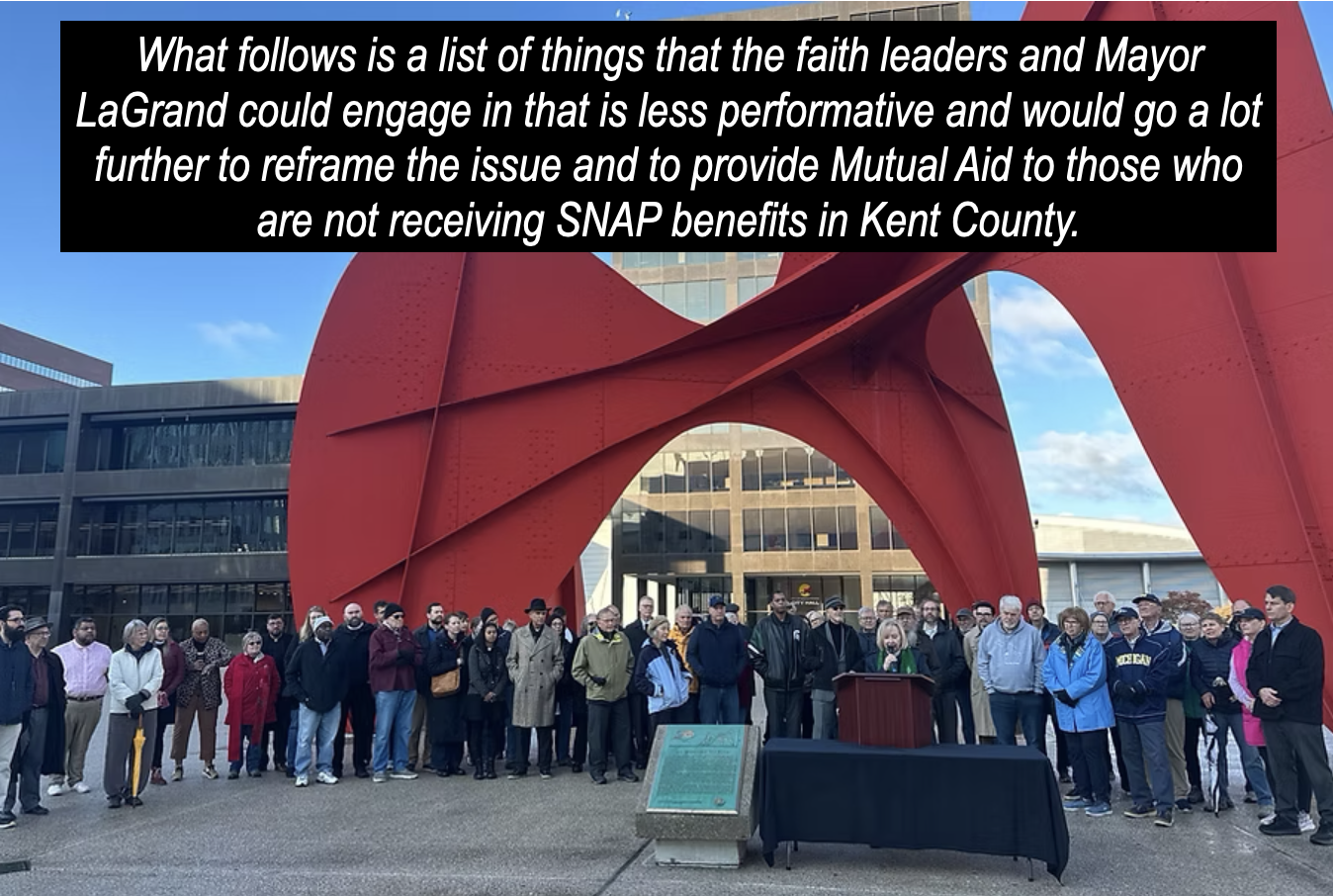
On Monday, several dozen “faith leaders” gathered at Calder Plaza to announce that they would begin a fast until SNAP benefits are restored to people around the country and the 70,000 residents in Kent County that rely on them.
An MLive article provided more details and quoted a few of the people who participated in the event at Calder Plaza, including Grand Rapids Mayor David LaGrand who was quoted as saying, “We cannot allow our neighbors to go hungry because of political gridlock.”
As a former Catholic I understand the role that fasting can play in building empathy and discipline for whatever issue or personal commitments you are seeking to strengthen. During the height of the Central American Solidarity Movement I went without food for 30 days to oppose US Military Aid to the Contras. The organized effort I was a part of in the 1980s engaged in regular actions against Congressman Paul Henry who consistently voted for US Military Aid to the Contras. However, my fast was only one tactic I used, but it did provide me focus to do the other work of direct action.
So, I don’t really think that faith leaders fasting until SNAP benefits are restored is a bad thing, but it is arguably the easiest thing to do and it is the least effective if your goal is to make sure that people who are food insecure don’t go hungry. What follows is a list of things that the faith leaders and Mayor LaGrand could engage in that is less performative and would go a lot further to reframe the issue and to provide Mutual Aid to those who are not receiving SNAP benefits in Kent County.
For faith leaders they should be using their position and their platform every Sunday to encourage people to not only donate food, but offer to transport food for people/families that rely on SNAP benefits.
Faith leaders could also turn the kitchens that more congregations have into a place where food in prepared and offered to people who are food insecure. Community Kitchen is something that congregations should be doing anyway, since it helps build community and connection with people who are being battered by Capitalism.
Faith leaders could also work with local food justice groups to turn much of the green space at GR places of worship that is primarily grass and use it for community gardens that would produce thousands of pounds of food. These same places of worship could offer their kitchen space for how to preserve items grown in these gardens, thus providing people with more skills that would be useful in working towards food justice and food sovereignty in Kent County.
Faith Leaders and Mayor LaGrand could be engaging in popular education and point out some crucial realities about what the government prioritizes over the well being of people who live in Kent County. First, they could put out a challenge to the two wealthiest families in Kent County, the Meijer Family (worth $16.5 billion) and the DeVos Family (worth $5.4 billion, according to Americans for Tax Fairness) and demand that each of these families give up $1 billion to fund not only robust food security programs, but assistance for skyrocketing rent and healthcare costs. This would leave both of these families with $15.5 and $4.4 billion left, which I assume they con continue to live off of.
Second, Mayor LaGrand and the faith leaders who stood on Calder Plaza on Monday could draw a direct link to how the federal government (and not just the Trump Administration) has always prioritized US military spending over the well being of those who live in this county. The US military budget is larger than the next 9 largest country military budgets combined. Having a vastly smaller US military budget would guarantee that there would be funds to make sure the millions of food insecure people living in the US would have enough food, health care, etc. From the 3rd Congressional District alone, taxpayers are paying $1.82 billion to the US military budget on an annual basis, according to the National Priorities Project. Imagine what kind of community care work could be done for people on an annual basis with $1.82 billion?
Third, faith leaders could pressure Grand Rapids City officials and Kent County officials around not providing massive tax breaks or subsidies to local developers for projects like the Amphitheater, the Soccer Stadium or the Three Towers Project (owned by DeVos and Van Andel) and prioritize public funds going to support families who are food insecure and housing insecure. The total amount of public funding that has been redirected by the Grand Rapids City Commission, the Kent County Commission and the State of Michigan is around $1 billion for the following projects: Amphitheater, Soccer Stadium, Three Towers Project and the Lyon Street upgrade project. Again, there it is not a question of funds being available for essential needs like food for families that rely on SNAP Benefits, rather it is a matter of priorities.
Fourth, local faith leaders could work on campaigns to get the City of Grand Rapids and Kent County to adopt Living Wage ordinances, which in this market would likely be about $40 an hour and allow individuals and families to have more economic independence and autonomy.
These are just a few ideas for how we can address short term and long term food insecurity issues, which are ultimately an economic issue where there is such a gap between the haves and have nots in this city and county.
The War Criminal Dick Cheney is dead and people gave him hell when he visited Grand Rapids while he was Vice President
Former US Vice President Dick Cheney is now dead, but as journalist Mehdi Hasan wrote, “He should have died in The Hague.”
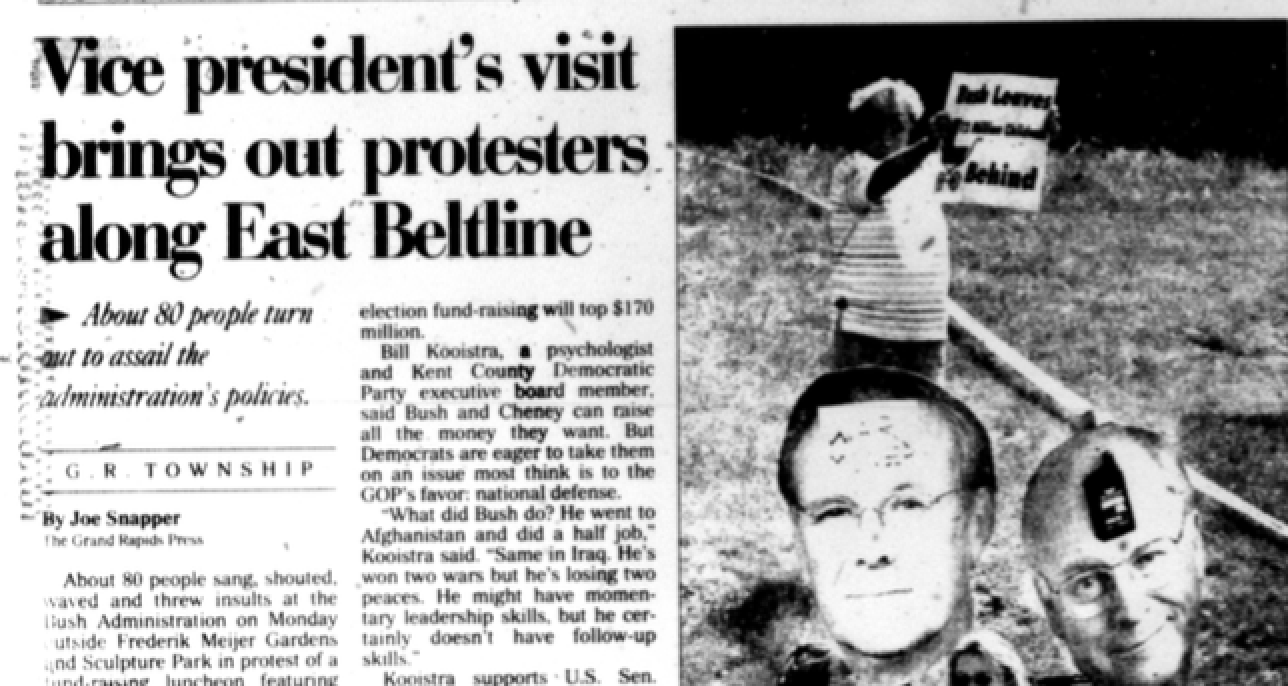
There are already some good indy media posts about the legacy of Dick Cheney, such as this post from Democracy Now earlier today.
Dick Cheney, the former vice president and one of the key architects of the 2003 U.S. invasion of Iraq, died Monday at age 84. Cheney served six terms in Congress as Wyoming’s lone representative before serving as defense secretary under President George H.W. Bush, when he oversaw the first Gulf War and the bloody U.S. invasion of Panama that deposed former U.S. ally Manuel Noriega. From 1995 to 2000, Cheney served as chair and CEO of the oil services company Halliburton, before George W. Bush tapped him as his running mate. As vice president, Cheney was a leading proponent of invading and occupying Iraq, which killed hundreds of thousands of people and destabilized the entire region. Dick Cheney also steadfastly defended warantless mass surveillance programs and the use of torture against detainees of the so-called war on terror.
 For the rest of this post I want to focus on how people organized against Cheney while he was Vice President and one of the main architects of the US invasion/occupation of Iraq beginning in 2003 every time he came to Grand Rapids.
In May of 2003, the group the People’s Alliance for Justice and Change, which did the bulk of the early opposition to the US invasion/occupation of Iraq, organized a protest at a fundraiser in downtown Grand Rapids, where Dick Cheney spoke. The protest was organized under the banner of Occupation is Not Liberation.
In September of 2006, Vice President Dick Cheney again came to West Michigan, this time attending a GOP fundraiser at the home of Peter Secchia in East Grand Rapids. The group ACTIVATE organized an action near Secchia’s home, but were confronted by police and told that they could not protest since the City of East Grand Rapids had a “no picketing ordinance,” which was later contested by the ACLU and the ordinance was done away with.
 In September of 2007, around 75 protestors gathered outside the Gerald R. Ford Museum to tell Vice President Dick Cheney that they support an immediate end to the United States’ occupation of Iraq, as was reported by the Indy Media site Media Mouse.
This protest, organized by the Grand Rapids antiwar group ACTIVATE/SDS, began at Rosa Parks Circle. Shortly after 10:00am, the group–led by a banner reading “US Out of Iraq”–marched to the Gerald R. Ford Museum to attempt to let Cheney know that they support an immediate end to the war. The group was able to get surprisingly close to site of Cheney’s speech–being stopped by police only fifteen feet from the Museum’s front door. Throughout the protest the protestors chanted “Cheney Out of Grand Rapids, US Out of Iraq,” “No Justice, No Peace, US Out of the Middle East,” and “War and Occupation does not bring Liberation.” The protestors made use of whistles and noisemakers to accompany their chanting in an effort to make themselves heard. After being moved from the Museum’s property (essentially twenty-five feet), the protestors continued to chant and wave signs before half of the crowd marched to the intersection of Michigan and Monroe where they waited until Cheney’s motorcade passed them on its way out of town.
For an overview of anti-Iraq occupation organizing that targeted the Bush Administration see part seven in the ten part series on organized opposition of that war/occupation by the Grand Rapids People’s History Project.
Kent County Sheriff refuses to provide information or practice transparency over ICE holds at the County Jail
Just before noon on Monday, several members of GR Rapid Response to ICE gathered in front of the Kent County Sheriff’s office at 701 Ball NE in Grand Rapids. The group was there to do two things, read a statement and to demand answers from Kent County Sheriff Michelle LaJoye-Young.
The statement that was delivered was jointly crafted by Movimiento Cosecha and GR Rapids Response to ICE, which stated:
“GR Rapid Response to ICE got a call on Sunday afternoon about a Guatemalan man who had been picked up by the GRPD on Saturday and taken to the Kent County Jail. The caller was requesting support with paying the bond. A member of the Michigan Solidarity Bail Fund went to the jail to pay it, and when they asked about a timeline for release, they were told that the man would be held for 48 hours to give ICE a chance to decide whether they wanted to take him into custody. The hold keeping this person in jail after the posting of the bond was listed on the online roster as an ICE detainer, DHS form I-247, despite the Sheriff’s claim in 2019 that Kent County would no longer hold people for ICE without judicial warrant. Read that statement here: Kent County Sheriff Statement, 2019 (ACLU of Michigan).
Longtime Immigration Lawyer Richard Kessler sent us a message stating:
Back in 2019 current Sheriff Michelle LaJoye-Young after the racist arrest and imprisonment of U.S citizen marine Jilmar Ramos announced a new policy of the Kent County Sheriff’s which would be to only detain and hold persons for the Immigration Customs Enforcement unless they received a specific judicial warrant from a Court. We have learned , however, that in recent times including today, the Kent County Sheriff’s office has changed their past policy and is now holding people pursuant to simple requests and not requiring Judicial warrants.
For several years, Movimiento Cosecha GR and GR Rapid Response to ICE have received numerous reports from undocumented immigrants whose loved ones were transferred to ICE custody after being released from the Kent County Jail. These reports indicate ongoing cooperation between the Sheriff’s Office and federal immigration enforcement, despite public claims to the contrary.
Families are being separated, Our communities live in fear, ICE presence in Grand Rapids is growing. These are not abstract possibilities. They are lived realities.
Movimiento Cosecha GR and GR Rapid Response to ICE has been leading a campaign to demand that the Kent County passes sanctuary policies ensuring that local law enforcement does not cooperate with ICE or aid in the detention of our beloved community members.
We are here today to demand answers from the Kent County Sheriff’s Office:
- Are undocumented immigrants being held for ICE in violation of the Sheriff’s own stated policy?
- Why are community members still being funneled from local custody into federal immigration detention?
This situation demonstrates clear cooperation with ICE and undermines community trust. It also calls into question whether the Sheriff’s Office is upholding its own commitment to only detain individuals for ICE when presented with a judicial warrant.
We demand transparency.
We demand answers.
We demand justice for undocumented immigrants.”
After reading this statement, the 11 people who had gathered when into the building where the Kent County Sheriff’s office is located. One person asked to speak with Sheriff Michelle LaJoye-Young, saying it was an urgent matter.
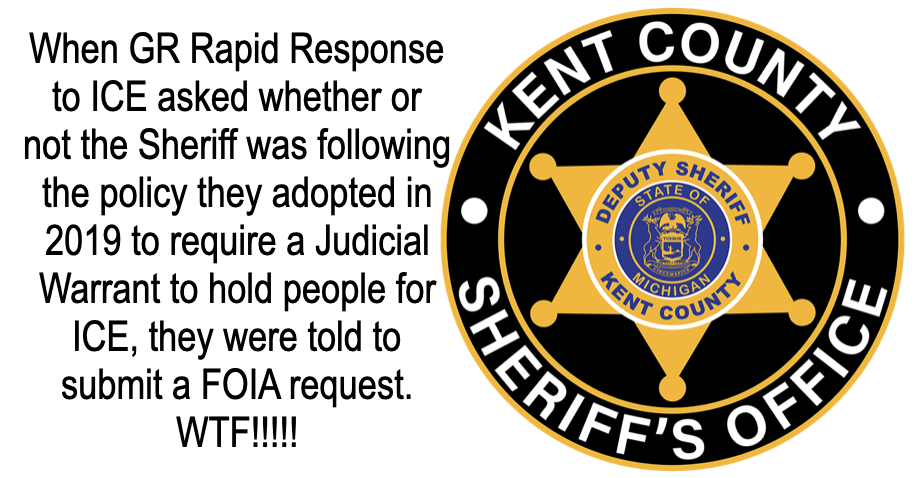
After about 10 minutes someone other than the Sheriff came out, someone who identified himself as a Captain in the Sheriff’s department. He was asked if he could provide the group with information and clarification regarding the 2019 Kent County Sheriff’s decision to require judicial warrants in order for the Kent County Sheriff’s office to hold people in the jail for ICE.
The Captain would not answer the question and instead suggested that we submit a FOIA request to obtain that information. Someone responded by say, “You want us to submit a FOIA, which means you want us to pay money to submit a FOIA request, which will likely take months to get information about whether or not your office requires a judicial warrant to hold people for ICE?”
Several people asked follow up questions, but the representative from the Kent County Sheriff’s Office failed to provide any concrete information, with no commitment to transparency or accountability. You can watch the interaction between members of GR Rapid Response to ICE and someone from the Sheriff’s office.
Of course none of this was surprising, since this is how cops deal with the public, by making them jump through hoops to get information and disregard public concerns over the treatment of immigrants.
Lastly, it is important to note that the Guatemalan man who was arrested by the GRPD on Sunday was taken from the Kent County Jail by ICE just before GR Rapid Response to ICE members showed up to question the Kent County Sheriff.
New video shows how economic and political power functions in Grand Rapids to benefit the those who have deep pockets
A new Grand Rapids Chamber of Commerce video was released last week and focuses on the progress of the CWD Real Estate Investment’s property at 111 Lyon in downtown Grand Rapids.
The video features the GR Chamber’s government affairs liaison Josh Lunger talking with one of the partners of CWD Real Estate Investment Sam Cummings.
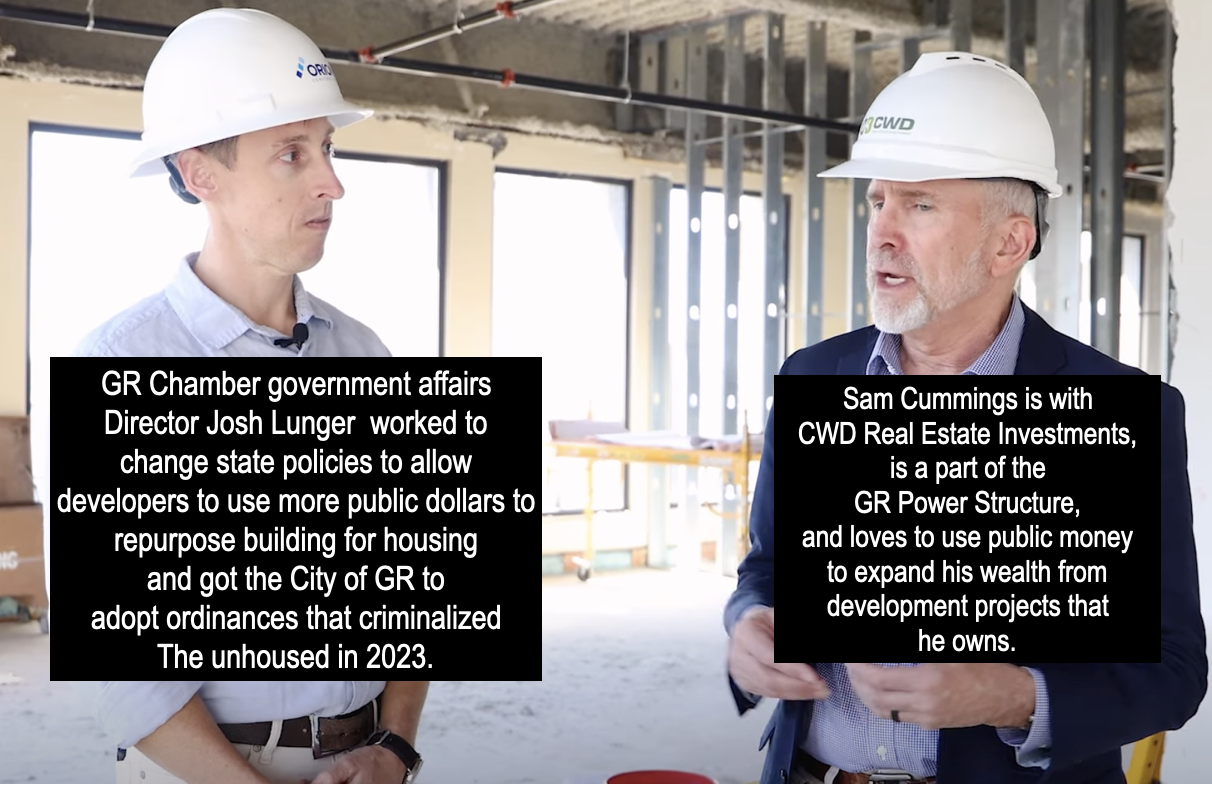
The irony of having Lunger and Cummings featured in this video is that Cummings has been a part of the Grand Rapids Power Structure for decades and Lunger was instrumental in lobbying state legislators to change a law that will allow developers to use public dollars when converting former office space into housing.
In a July article I wrote about how the Chamber and Cummings collaborated to change state law to benefit developers:
At a Grand Rapids Chamber of Commerce event this past Spring, Sam Cummings talked about a state law that was adopted in 2023, which amended the Brownfield Redevelopment Financing Act. This amendment made housing development projects, like the One Eleven Lyon project eligible for brownfield capture. Cummings made these remarks at the Spring conference held by the GR Chamber of Commerce, which contributed to LaGrand’s campaign for Mayor and subsequence campaigns for State Representative, which is nothing more than influence peddling by people like Cummings, who has a long history of using public funds to expand his wealth.
Sam Cummings sent a message to the Grand Rapids City Commission in late 2020, where he berated City officials for not taking $500,000 from Kent County to purchase more technology for the GRPD, known as ShotSpotter. The community, particularly Black and Brown communities organized a campaign to defeat ShotSpotter, but that didn’t prevent Cummings from going off on City officials who, in this case, actually listened to people who don’t have deep pockets like Cummings.
As was mentioned, Josh Lunger helped to lobby state legislators to change a law that will allow developers to use public dollars when converting former office space into housing. As Cummings is giving a tour of the 111 Lyon building to Lunger, where they are talking about billiard tables and pickleball courts, Cummings says the new 140 apartment units will be the coolest place to live in Grand Rapids. What Cummings didn’t say was what these apartments will cost. We all know that these apartments will only be affordable for people who are part of the professional class, people who make well over six-figure salaries, which is the kind of people that the GR Chamber of Commerce and the City of Grand Rapids have been trying to attract in recent decades.
On top of all of that, it is important to note that Josh Lunger was also the main GR Chamber of Commerce person who initiated the discussion around the “problem” of unhoused people in downtown Grand Rapids. In the summer of 2022, Lunger sent a letter to the Grand Rapids City Commission on behalf of the GR Chamber of Commerce about how business owners and some residents of downtown GR were upset about the “homeless, which you can read here.
Josh Lunger then took the next step on behalf of the GR Chamber of Commerce in December of 2022, where he sent another letter that proposed the City of Grand Rapids adopt ordinances that would criminalize the unhoused in downtown Grand Rapids. Lunger and the GR Chamber got over 100 of their friends to endorse the proposal to criminalize the unhoused, which can read here.
In the summer of 2023, the City of Grand Rapids then adopted two ordinances that essentially fulfilled the GR Chamber’s proposal intent, despite their being significant public opposition to the ordinances.
This new video from the GR Chamber of Commerce is another clear example of how political and economic power function in this city and why we have to resist this kind of influence peddling. If we don’t resist, we allow members of the Capitalist Class to dictate the future of Grand Rapids.
Commemorating immigrants that have died while in US Detention Centers during a Day of the Dead vigil in Grand Rapids
On Saturday over 100 people gathered outside the ICE office at 517 Ottawa NW in downtown Grand Rapids to participate in an vigil cosponsored by Movimiento Cosecha, GR Rapid Response to ICE, No Detention Centers in Michigan and the ACLU.

The vigil was part of a national Communities not Cages campaign that was coordinated by the Detention Watch Network. In the Detention Watch Network toolkit for the event it states:
The Day of the Dead National Days of Action is designed to honor lives lost to immigration detention as a part of the Communities Not Cages campaign. Immigration detention is deadly and inherently inhumane — what we’re seeing now is heightened cruelty under the Trump administration. Shockingly, there have been at least 25 deaths in ICE custody since Trump’s inauguration, a record number of deaths within a calendar year since 2006. Take action as we collectively honor, remember, and grieve lives lost in ICE custody.
ICE detention centers have always been cruel spaces of oppression directed at undocumented immigrants since Immigration and Customs Enforcement (ICE) was created in 2003. In “Deadly Failures,” a 2024 report by the ACLU, American Oversight, and Physicians for Human Rights, independent medical experts found that 95 percent of deaths in detention were deemed as being preventable or possibly preventable if ICE had provided clinically appropriate medical care. Additional investigations into deaths in immigration detention include Code Red: The Fatal Consequences of Dangerously Substandard Medical Care in Immigration Detention, Fatal Neglect: How ICE Ignores Deaths in Detention and Systemic Indifference: Dangerous and Substandard Medical Care in US Immigration Detention. These reports have found that ICE medical care has contributed to numerous deaths and that the agency lacks urgency and transparency when reporting deaths in its custody. 
The Day of the Dead vigil outside of the ICE office at 517 Ottawa was facilitated by Rev. Greta Jo Seidohl, who did a great job of creating an atmosphere of grief and mourning, for those that attended the vigil.
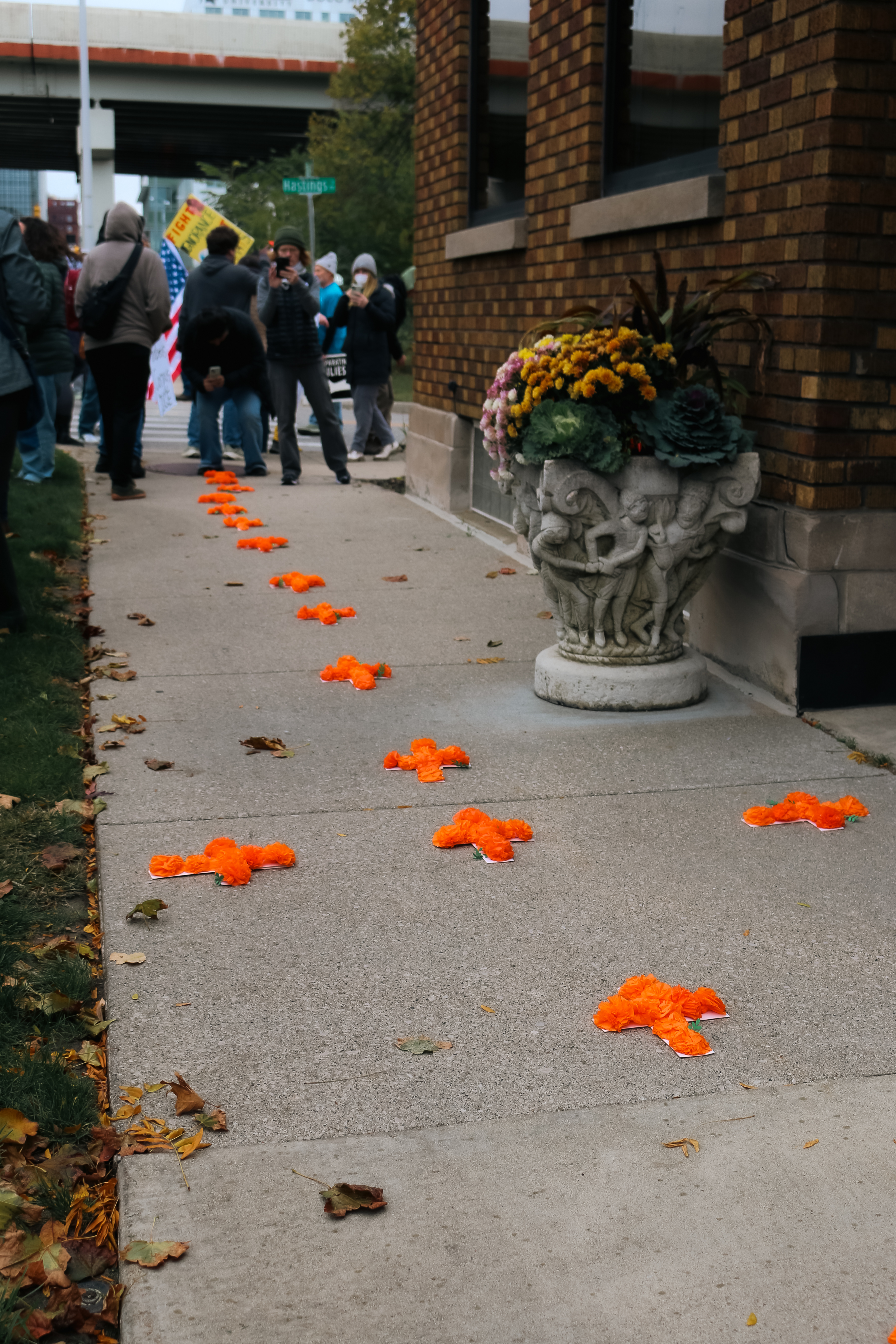
Gema Lowe with Movimiento Cosecha then provided clarity around the importance of Dia de Los Muertos in Mexican culture, which included handmade crosses that Cosecha members made to honor the 25 people who have died in ICE Detention Centers since the beginning of the 2025. Gema also talked about the work that Movimiento Cosecha is involved in, including the boycott campaign that is targeting the businesses that Grand Rapids Mayor David LaGrand owns.
Pastor Ricardo Angarita then addressed the crowd with additional comments about the significance of the Day of the Dead and how it relates to the national campaign to reflect on and remember the 25 immigrants that have died while in ICE Detention Centers throughout the US. Pastor Ricardo then offered up a Christian prayer.
Rev. Nathan Dannison from Fountain Street Church was the next person to address the crowd, specifically to read the names of the 25 immigrants who have died while in ICE Detention Centers in the US since the beginning of the year. Rev. Dannison asked people to say the word Presente! after each name was invoked and the location of the ICE Detention Center they died in. He also asked people to lift up the 25 crosses that Cosecha members had made while everyone said Presente!

Here is the list of those who have died in ICE Detention Centers since the beginning of the year:

After acknowledging those who have died in ICE Detention Centers a representative from No Detention Centers in Michigan played audio from someone who had recently been released from the North Lake ICE Detention Center in Baldwin, Michigan, followed by a second audio recording of someone who is still locked up there. Lauren Ann Coman then read in English what both men had said in Spanish.
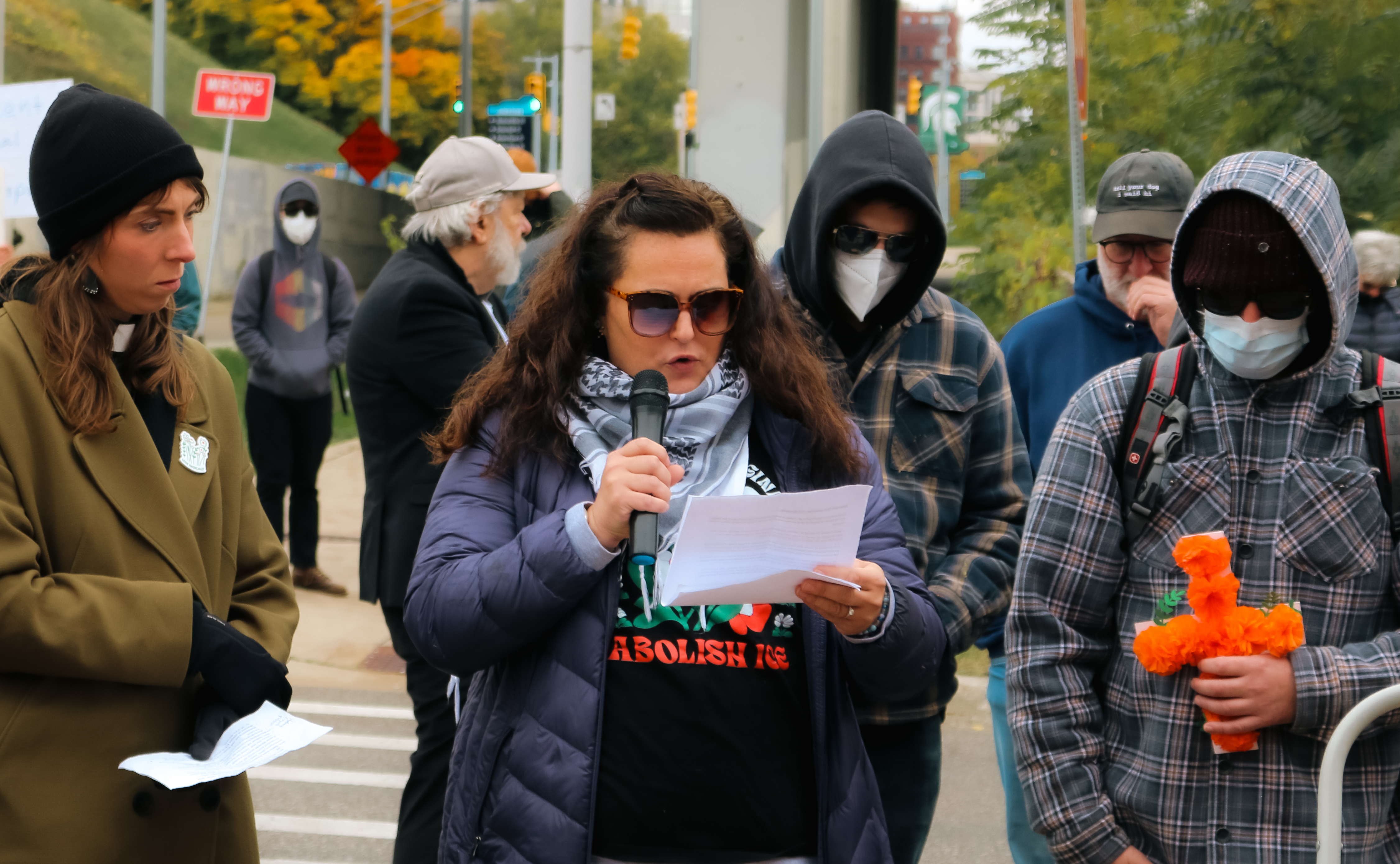
 Lastly, a representative from GR Rapid Response to ICE spoke to offer up ways that people can become actively involved in resisting ICE in the Grand Rapids area. One thing that they emphasized was that they did not want to come back here next year and listen to a new list of immigrants who had died while in an ICE Detention Center, saying, “we need to move from protesting ICE to actively resisting ICE terrorism.”
People who held up the handmade crosses when the names of the immigrants who have died in ICE Detention Centers since the beginning of this year were then asked to place them in front of the ICE Office at 517 Ottawa.
Someone from Movimiento Cosecha videotaped the entire vigil, which you can watch here, with the formal part of the vigil begins at 25 minutes into the video.
Photographs taken by Viviana Rubio
It has been 25 months since the Israeli government began their most recent assault on Gaza and the West Bank. The retaliation for the October 7, 2023 Hamas attack in Israel, has escalated to what the international community has called genocide, therefore, GRIID will be providing weekly links to information and analysis that we think can better inform us of what is happening, along with the role that the US government is playing. All of this information is to provide people with the capacity of what Noam Chomsky refers to as, intellectual self-defense.

Information
Thousands of Unexploded Bombs Dropped by Israel Have Turned Gaza into a Minefield
The Aftermath of a Massive Wave of Israeli Airstrikes that Killed Over 100 Palestinians
The World Confronts the Genocide Washington is Trying to Bury
The Powerful Who Stand with Israel
A Torturous Sanitation Disaster Is Unfolding in Gaza’s Displacement Camps
UN Human Rights Office Warns Israeli Settler Violence in West Bank Is “Surging”
Israel and US Scorn ICJ Ruling Against Starving Civilians as Method of Warfare
WE ASKED PEOPLE IN GAZA WHAT THEY THINK OF THE CEASEFIRE: “JUST A DECLARATION, NOT REALITY”
Analysis & History
HI-TECH HOLOCAUST: HOW MICROSOFT AIDS THE GAZA GENOCIDE
Image used in this post is from https://www.counterpunch.org/2025/10/30/the-powerful-who-stand-with-israel/
I was invited to submit some entires for the Zinn Education Project’s social media popular education platform known as This Day in History
Last week someone with the Zinn Education Project sent me a message asking if I would like to submit some pieces for their online popular education tool known as This Day in History.

I was delighted and honored to be invited to submit some options and the three that I cam up with are: the 1911 Grand Rapids Furniture Workers Strike, November 4, 1985 Calvin students take action on getting the school to divest from South African Apartheid, and June 28, 2018 – Beginning of the End the Contract with ICE Campaign.
I wanted to submit several clear examples over the past century, all of which demonstrate people power. Minutes after I submitted them, all three were approved by the Zinn Education Project and will be included on their social media platforms.
1911 Grand Rapids Furniture Workers Strike
The 1911 strike was founded on longstanding worker grievances. As early as 1909, the workers discovered that the price of the furniture they produced had increased by 10%, and they demanded that their wages be increased. Some of the workers who called for the increase were fired shortly thereafter for being agitators.
The furniture workers strike began in the Spring of 1911, with estimates of between 4,000 – 6,000 workers going on strike, and with thousands more in support of the strikers. Just prior to the beginning of the strike, the Grand Rapids Employers Association sent Francis Campau to deliver a message to the press, in order to influence public opinion, that workers were being treated fairly. Francis Campau was the grandson of the brother of Louie Campau, the so-called founder of Grand Rapids.
Furniture workers, on the other hand, had a very different view of life working in those factories. One important source that reflected the worker’s perspective was a booklet called, History of the Grand Rapids Furniture Strike: With Facts Hitherto Unpublished. This documented was created by Viva Flaherty, a secretary at Fountain Street Church and a known Socialist. Flaherty documented the 1911 strike because she believed that the “people of Grand Rapids are awakened and enlightened and they can be trusted with the whole truth.”
Flaherty makes it clear in her version of the story that the strike was able to endure because of the seven unions that were involved, with membership of over 4,000 workers in thirty-five shops in Grand Rapids. She also documented that the Christian Reformed Church would not grant their members the right to be part of the union, since labor rights and organizing were not “founded on divine right.”
Flaherty documents the kind of wages earned by those in the furniture industry, stating that of the eight thousand furniture workers employed in Grand Rapids, most made less than $2 a day.
The Catholic leader, Bishop Schrembs, came out in support of the strike, stating, “I consider the present labor situation in our city as a most deplorable one from every point of view.” Bishop Schrembs was later banished to the Diocese of Toledo for his solidarity with furniture workers.
The strike ended in August of 1911 and the workers did not win the demands they had hoped. However, they did win lots of public support. During the 1911 Labor Day parade, there were an estimated 10,000 people walking in the parade. The Grand Rapids Furniture Barons, were not happy with worker demands and how much support there was from the city government. In 1916, the Furniture Barons put forward a ballot initiative that changed the City Charter from a 12 ward system to a 3 ward system, in order to consolidate their power. The current ward system we have in Grand Rapids today, is a direct result of those in power punishing workers and their families.
For additional information, see the book, “A People’s History of Grand Rapids”, by Jeff Smith
November 4, 1985 Calvin students take action on getting the school to divest from South African Apartheid
The South African Anti-Apartheid movement was a global movement that took decades to dismantle the legal system of apartheid in South Africa.
In Grand Rapids, there were several anti-Apartheid campaigns that were successful, including the Grand Rapids Public Schools and the City of Grand Rapids. Both of those entities adopted resolutions and put in place practices to divest from companies profiting off of the racist system of Apartheid in South Africa.
A third campaign was led by students from what was then called Calvin College. The students would then recruit Calvin faculty to be part of the campaign, which was eventually successful. What follows is a letter from one of the student organizers to Calvin administrators, a letter that was dated November 4, 1985.
Dear Priorities Committee Member,
The following is a copy of a motion passed unanimously by Student Senate at its October 28 meeting. Part of the request was that the faculty join the Student Senate in making this resolution. This resolution now comes before the Priorities Committee for our discussion regarding its presentation to the entire faculty.
In the summer of 1984, the Synod of the Christian Reformed Church condemned the Biblical defense of apartheid as heresy. The the autumn of 1985 apartheid remains the official policy of the South African government. Under this system of racial segregation, the injustice of minority oppression continues. Therefore, in keeping with the spirit of the Synod’s decision, we the Student Senate of Calvin College, resolve to commit ourselves to take the following action as a manifestation of our strong disapproval of the policy of apartheid and as an expression of our sincerest desire to see the system of apartheid dismantled and replaced by a system that recognizes the equality and oneness of all people before God their Creator: The Student Senate strongly urges Calvin College to divest itself of all holdings in corporations currently doing business in South Africa or transacting business with the government of South Africa.
Student Senate also mandates the Student Senate Executive Committee to draft letters to the companies from which we are recommending the divestment of Calvin College’s holdings expressing Student Senate’s concern regarding involvement in South Africa and explaining the reasons for our action.
Student Senate urges the Faculty to join us in making this resolution.
Very Truly yours,
Craig Knot
Student Body President
For more information on the Grand Rapids anti-Apartheid Movement, especially source material, go to this link and read Chapter 6 of A People’s History of Grand Rapids by Jeff Smith.
June 28, 2018 – Beginning of the End the Contract with ICE Campaign
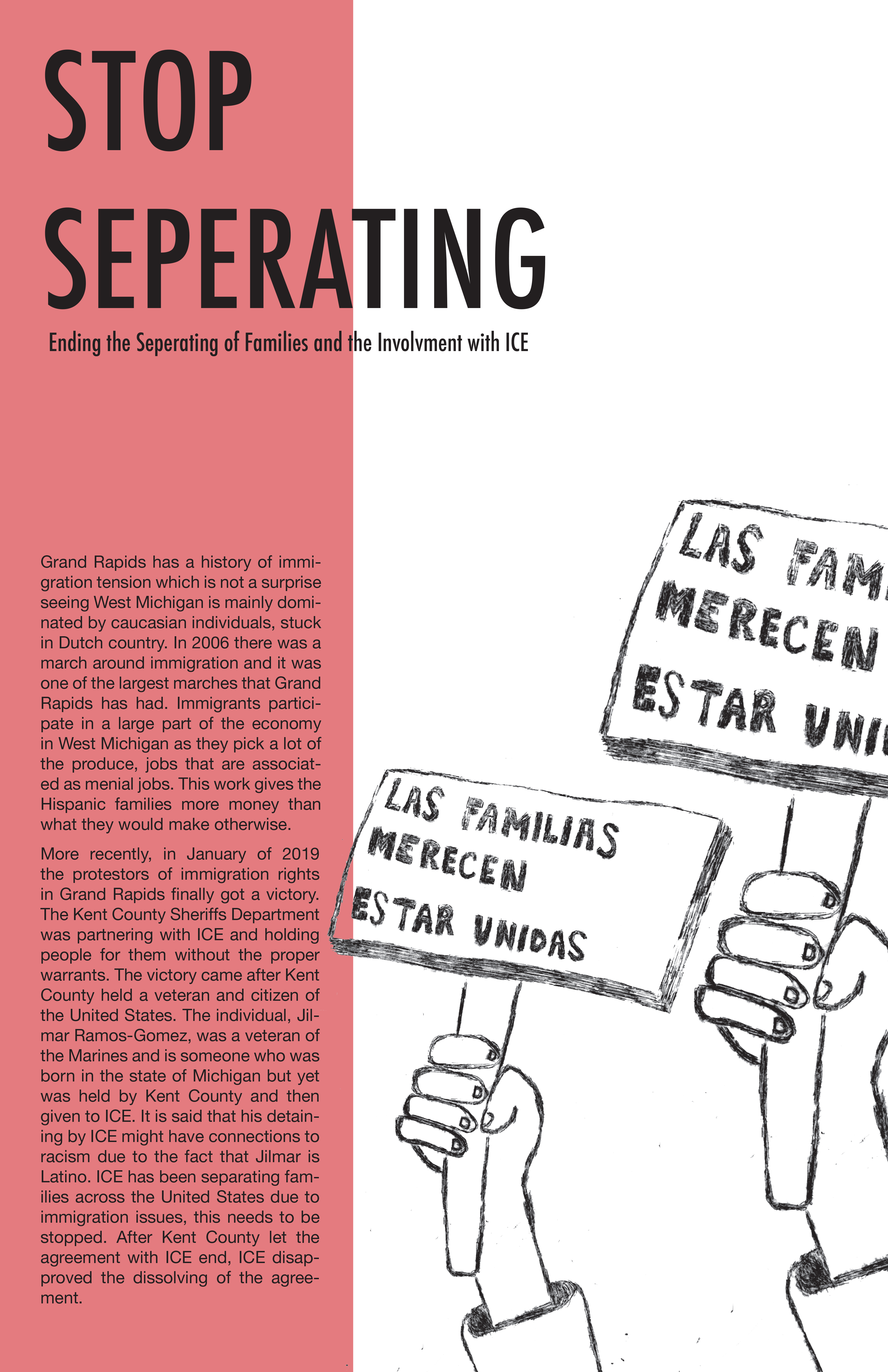 On Thursday, June 28th, 2018, roughly 250 people showed up to the Kent County Commission meeting, a turnout that is rarely seen at such meetings. People with Movimiento Cosecha and GR Rapid Response to ICE had been planning for months to attend the commission meeting and demand that they end the contract between ICE and the Kent County Sheriff’s Department.
Organizers waited until the Public Comment period of the commission meeting and after a few people spoke, a few dozen people occupied the space in the commission chambers, where the Kent County Commissioners sat during the meetings. Some people unfurled a large banner that said, Kent County Separates Families, End the Contract!
Most of the Kent County Commissioners got up and left the meeting, with a just a few of them remaining. The End the Contract campaign organizers asked people to come to the podium and have a People’s Hearing, where dozens of people, primarily those impacted by ICE violence, spoke about the fear they experienced, fear of arrest, fear of detention and fear of deportation. For more than an house the People’s Hearing was conducted, essentially taking over the Kent County Commission meeting.
This was the first action taken in the End the Contract Campaign, which lasted until the following year, when Immigration and Customs Enforcement decided to end their contract with the Kent County Sheriff’s Department, primarily because of all the negative and national press generated from the protests and the abusive actions of ICE and Cops in Grand Rapids.
It should be noted that the Kent County Commission, nor the Sheriff’s Department, called for an end to the ICE contract. In fact, Immigration and Customs Enforcement (ICE), is the entity that ended the contract with Kent County, primarily because of how much media attention the End of Contract campaign was getting. The amount of attention was two fold. First, the 14 month efforts of Movimiento Cosecha GR and GR Rapid Response to ICE engaged in numerous Direct Actions that not only confronted Kent County officials, it engaged the public and generated a tremendous amount of media attention. Second, when an off-duty GRPD Captain contacted ICE about a former US Marine, whom the cop thought was an undocumented immigrant, the national media began to pay attention to the absurdity and immorality of the racist profiling of immigrants. Thus, ICE ended their contract with Kent County in September of 2019.
For additional information, see Chapter 9 from A People’s History of Grand Rapids.
There is deep concern about the threat against people not receiving SNAP benefits in the coming days, and rightfully so. According to a recent KConnect message, “SNAP benefits are a lifeline for nearly 76,000 individuals in Kent County alone, including almost 32,000 children.”

Rep. Hillary Scholten posted on her Facebook page recently these comments related to SNAP:
We’re mere days away from folks losing the benefits they need to put food on their table. I led Michigan Dems in Congress to call on c. Rollins and the U.S. Department of Agriculture to use their contingency fund, which is set aside for scenarios exactly like the one we’re in now. We can’t leave American families to starve.
This is a nice sentiment from Rep. Scholten but sentiments don’t put food on the table for the thousands of families in Kent County that will suffer once SNAP benefits get cut.
It is never a question of lack of money, but a matter of priorities
If Rep. Scholten was really serious about making sure that people who live in her district would not go hungry, there are several things that she could do to demonstrate her commitment to food justice and economic justice simultaneously.
- Rep. Scholten could stop voting for the massive annual US military budgets, which are just shy of $1 Trillion annually. The US military budget is larger than the next 9 largest country military budgets combined. Having a vastly smaller US military budget would guarantee that there would be funds to make sure the millions of food insecure people living in the US would have enough food, health care, etc. From the 3rd Congressional District alone, taxpayers are paying $1.82 billion to the US military budget on an annual basis, according to the National Priorities Project. Imagine what kind of community care work could be done for people on an annual basis with $1.82 billion?
- Rep. Scholten could choose to redirect the millions she raises every 2 years for her re-election efforts and spent that money on food for the people in her district that would lose SNAP benefits. Lets face it, most of the campaign contributions go towards awful and deceptive campaign ads. Rep. raised over $5 million for her 2024 election campaign, according to Open Secrets. In addition, using campaign funds to meet the daily needs of people living in the 3rd Congressional District would likely get her more votes than campaign ads that few people actually pay attention to.
- Rep. Scholten and her fellow Democratic Party colleagues in Congress could engage in a creative act of Civil Disobedience and get arrested in Washington, DC to demonstrate their commitment to the people living in their district demanding that cutting SNAP benefits is unjust. Making statements on social media is performative, but taking direct action stands a greater chance of forcing the Trump Administration to not punish people who are food insecure.
What happens when we take care of each other
I have no illusion that Rep. Scholten or other politicians and governments at any level will actually do the kinds of things I suggested above, which is why I believe that we ultimately shouldn’t rely on government programs like SNAP.
I believe that communities can take care of themselves. Now I am not talking about charity or just doing local food drives. Those types of things might be necessary in the short run, but I am saying is that we need to re-orient our communities to be more interdependent and not rely on the crumbs that governments provide to the people. Governments and politicians have not and do not serve the interests of the majority of the public, so we better come to terms with that fact.
There are groups in Kent County right now that are not waiting for people to go hungry, but are actively engaged in ways to provide some Mutual Aid to those who will lose SNAP benefits. The Grand Rapids Area Mutual Aid Network has been doing this kind of work since March of 2020 just days after the US government finally acknowledged the pandemic. There is also work being done to provide more food equity from the group Unite & Resist, which is included in the graphic here above. And of course people can contribute to local food pantries or get involved in other food emergency efforts, but these are all short term solutions, also hereontheright.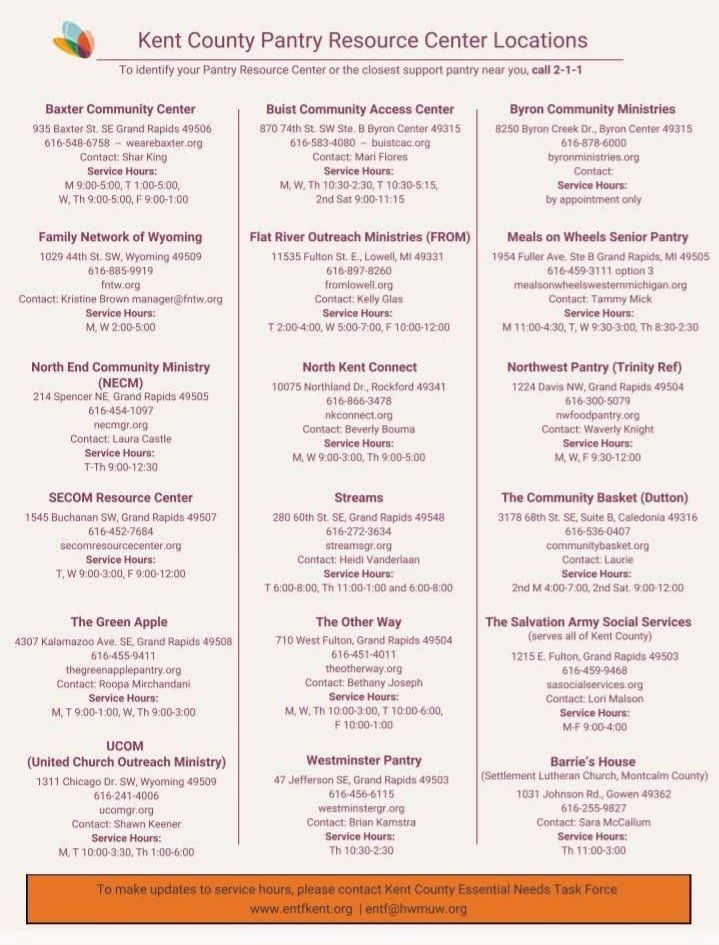
During the height of the COVID pandemic I wrote a series of articles entitled, Why we can’t go back to the way things were in Grand Rapids. Part II in that series was Re-imagining a new food system.
So what might a radically re-imagined food system look like in the Grand Rapids area? Here, we offer 10 ideas about how to move in that direction.
- We do need more people to question the existing food system and learn food growing and food preserving skills. More people growing and preserving food is an important step, but it is only a first step and not the end goal.
- We need large, fully functional farmers markets in a sectors of the Grand Rapids area, which will make it easier for more people to access fresh food that is in their neighborhood.
- We need to guarantee that people have access to land to grow food, particularly to grow food collectively. I support people turning their lawns into spaces of food production, but this is often a privileged response, since many people do not have lawns. Vacant lots, church property, green space that exists at commercial facilities, all need to be made available for people to collectively grow food.
- Right now, a great deal of food that is grown in West Michigan, does not stay in West Michigan. Many of the area farms grow mono-crops, like corn and apples, which are either used for animal feed (in the case of corn) or the food is sent abroad to be used in the creation of highly processed foods. Current, the food system is not bio-regional and this also means that the average food item grown will travel 1,000 miles before it is consumed. This is not sustainable, nor should it be desirable. More farmers would use a CSA model (Community Supported Agriculture), but this requires that thousands more need to join a CSA.
- Food waste is built in to the current food system. Food that goes bad before it gets to consumers is expected and used as a write-off in the current food system. Then there is the amount of food that grocery stores throw away because it has expired and all the food that is thrown away by restaurants and other institutions that prepare thousands of pounds of food every day. So much food ends up in a landfill, food that could be used to meet the nutritional needs of so many people.
- We need to rethink how we access food and move beyond supporting the large grocery chains, moving to other food distribution models. We need more food coops, food buying clubs, more CSAs and more neighborhood-based farmers markets. 75% of the food sold in Grocery store chains is highly processed foods that we don’t need, and if fact, the highly processed foods is what has led to a major health crisis, especially for those experiencing poverty.

- The Slaughterhouse industry has also now being exposed to its brutal and dysfunctional nature. For years we have know that a meat-centric diet in the current food system is a major contributor to climate change. Moving forward we need to come to terms with the fact we need to significantly reduce animal consumption to truly have a just and sustainable food system.
- Right now it is apparent that agricultural workers/migrant workers are “essential workers.” However, agricultural workers/migrant workers have always been essential to the current food system, despite the fact that they are exploited on a massive scale. Food worker demands should be met, which includes a livable wage, safe working conditions, just housing conditions and the elimination of the threat of ICE arrest, detention and deportation, since many workers in the food system are undocumented. Farmworker unions should be a priority.
- Farmworker labor improvements are a good first step, but it would still not do much to challenge the existing food system. We need massive land reform, which includes a longstanding tradition, particularly in the Global South, where those who work the land should own the land.
- We also need to challenge the massive subsidization of the current food system, also known as the Farm Bill. Billions of dollars of taxpayer money is used to support a dysfunctional, exploitative and unjust food system.
- Instead of ending the Farm Bill, maybe we need to radically re-imagine a new Farm Bill that would redistribute the billions going to support the agribusiness sector and redistribute that money to fund all of the other ideas listed above.

These ideas are just the beginning of what a radically re-imagined food system might look like, but it is just that, a beginning. We have to radically re-image our economy, our housing system, transportation, health care, community safety and so much more if we want to begin to practice real solidarity and work towards collective liberation. Politicians won’t save us nor the existing systems that have been designed to maintain power and privilege. Another World is Possible!
What are the Sanctuary policies that Cosecha and GR Rapid Response to ICE are demanding from Grand Rapids and Kent County? Part II
This is the second in a series that will further examine the various sanctuary policies that Movimiento Cosecha and GR Rapid Response to ICE are demanding that the City of Grand Rapids and the Kent County Commission adopt. In Part I last week I looked at the policy that allows officers to provide assistance to federal immigration authorities when there is an emergency that poses an immediate danger to public safety or federal agents.
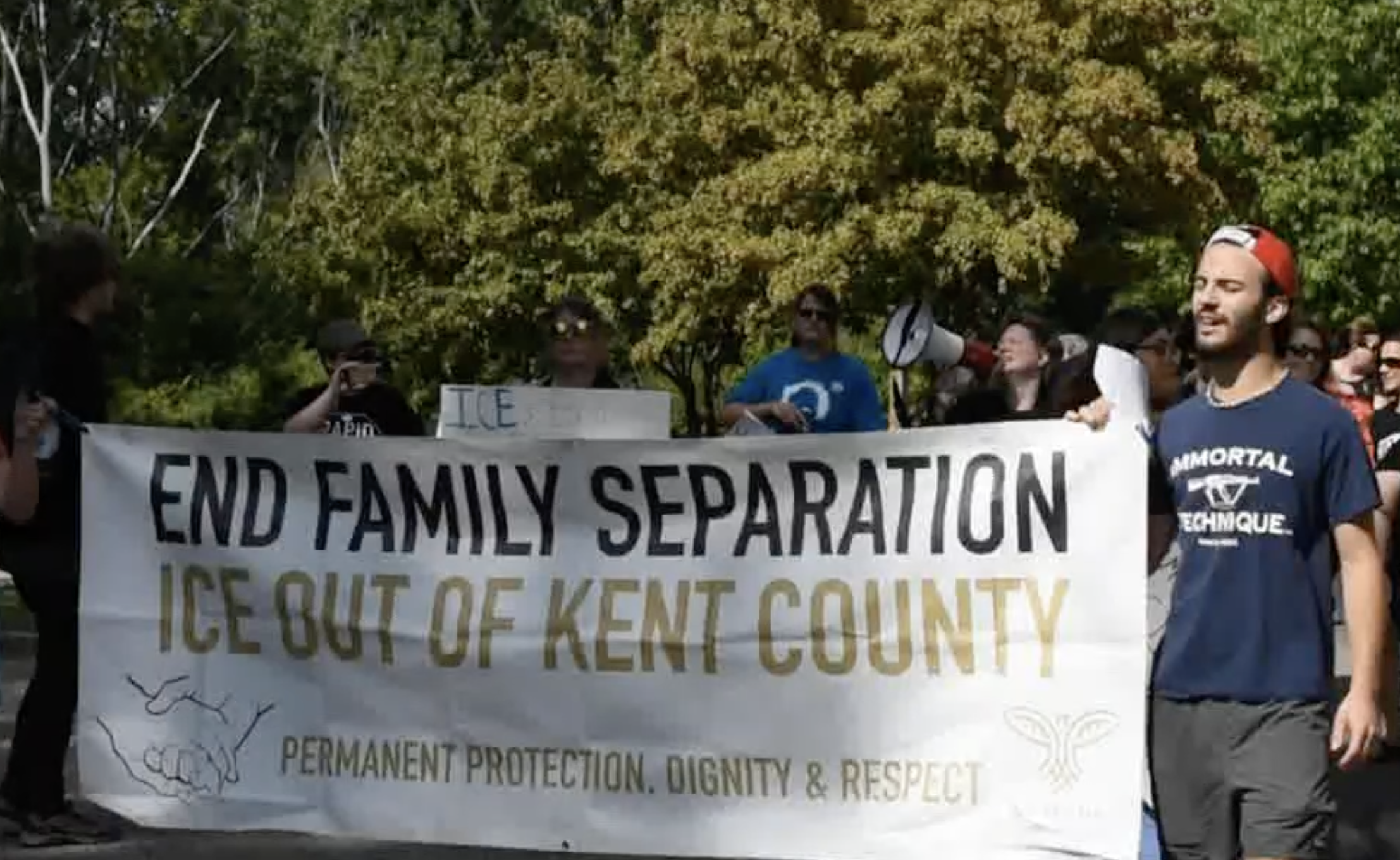
Today I will look at policies that would prevent local governments from entering into a contract with the federal government to hold immigrants in detention. Kent County used to have a contract with ICE that began in 2012, a contract you can read here.
In 2012, then Sheriff Stelma agreed to a contract with Immigration and Customs Enforcement (ICE), a contract that saw an increase in arrests, detentions and deportation during the Obama administration and the subsequent Trump administration. In 2017, Kent County signed an extension of the ICE contract, a contract which provided financial incentives for the Kent County Sheriff’s Department.
Sheriff Stelma signed onto a letter from the National Sheriff’s Association in March of 2018, which is more of an ideological statement about immigration. Part of that letter reads:
Congress must act to pass legislation to secure our borders through enforcing immigration laws, tightening border security, support the replacement and upgrades to current barriers and fencing and construction of barriers along the U.S. and Mexico international boundary as requested by those areas where it is needed, suspending and/or monitoring the issuance of visas to any place where adequate vetting cannot occur, end criminal cooperation and shelter in cities, counties, and states, and have zero tolerance and increased repercussions for criminal aliens. I stand firm with my fellow Sheriffs throughout our nation to have our borders secured first, in full cooperation and support of our promise and mission to uphold and enforce our nation’s laws, and we expect nothing less from Congress.
During the entire time that Kent County had their contract with ICE, they were getting money from ICE to hold immigrants at the Kent County Jail until ICE took them to a detention facility. ICE paid the Kent County Sheriff’s Department per person and per day, so there was a financial incentive for them to cooperate with ICE.
After the Jilmar Ramos Gomez scandal, where a former US Marine was picked up by ICE in Grand Rapids after the GRPD called ICE on him, the Kent County Sheriff’s Department was forced to require ICE to get a judicial warrant in order to hold someone for them. The Trump Administration responded to this by referring to Kent County as a sanctuary county.
Kent County Sheriff LaJoye-Young took issue with ICE calling the County’s policy a “Sanctuary Policy.” IN the MLive article, the Kent County Sheriff is quoted as saying:
“We are not a ‘sanctuary’ department. I have no intention in being a shield for someone to avoid being held responsible for criminal violations to include criminal immigration violations.”
In June of 2018, Movimiento Cosecha and GR Rapid Response to ICE had began a campaign to end that contract and were successful in ending that contract in 2019, which is documented here.
 While the ICE contracted ended in the fall of 2019, the Kent County Sheriff’s Department continued to cooperate with ICE, by notifying ICE that an undocumented immigrant was in the jail and often times holding immigrants at the jail until ICE could take them to a detention facility. This practice of cooperation continues at the present moment between the Kent County Sheriff’s Department and ICE.
Many immigrant families and several immigration lawyers have shared stories with Cosecha and GR Rapid Response to ICE about how an immigrant family member was in the Kent County jail for some minor infraction and were then scheduled to be released. Families would go to pick up their loved ones at the Kent County Jail only to find out that ICE was contacted by the Kent County Sheriff’s Department and ICE took them just after the jail had released.
This is why Cosecha and GR Rapid Response to ICE have a campaign to get the City of Grand Rapids and Kent County to adopt sanctuary policies, because having policies like not cooperating with ICE to hold immigrants in the jail until ICE takes them clearly causes family separation and trauma.
In Part III, I will look at policies that could prevent immigration detention centers from being established in Grand Rapids.
In their Email for October 29, Indivisible GGR sent out information with the following headline: What is ICE? Or What Is It Supposed to Be?
The post begins by providing a very weak and limited commentary of how ICE came to be, using as their only source an NPR story. There is so much good information on the history of ICE, such as the book Abolish ICE: A Passionate Plea for a More Humane Immigration System, by Natascha Elena Uhlman. More importantly, why would IGGR not rely on the two groups doing the most around ICE since 2017 in Grand Rapids, Movimiento Cosecha and GR Rapid Response to ICE? Very troubling.
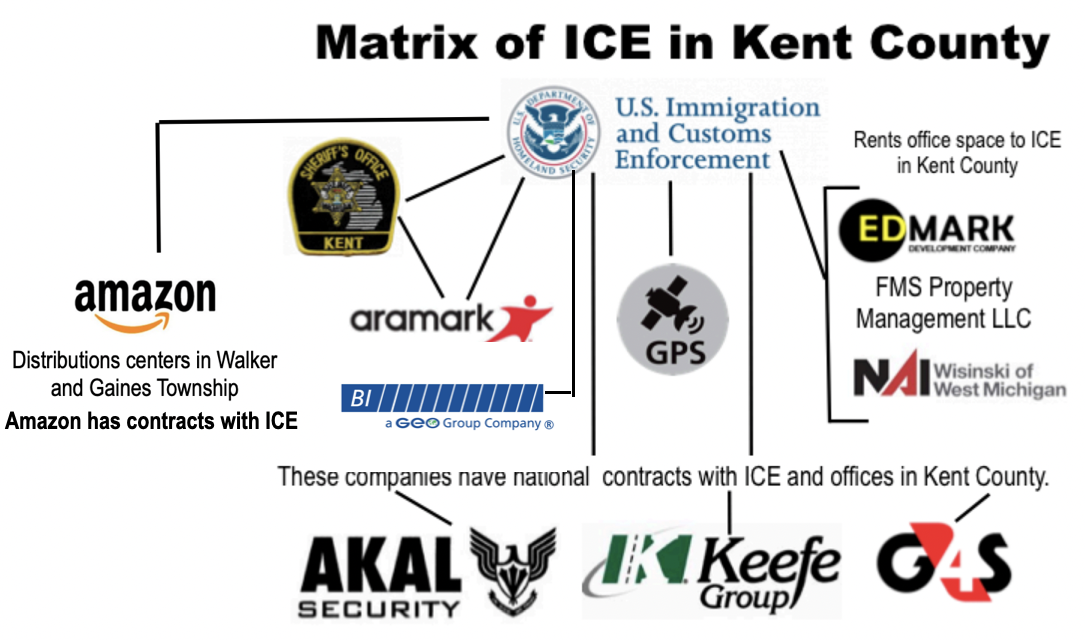
The IGGR post goes on to write:
ICE’s stated purpose is to “protect America through criminal investigations and enforcing immigration laws to preserve national security and public safety.” Unfortunately, the ICE of today is a masked police force acting at the behest of the President and his syncophantic Secretary of Homeland Security, Kristi Noem.
This is not only an inaccurate assessment, but it puts the blame solely on one administration, when in fact since ICE was created during the George W. Bush Administration, every administration has used ICE to terrorize undocumented immigrants. The Obama Administration deported roughly 3.5 million and the Biden Administration deported roughly 4 million. IGGR is showing it’s partisan bias here by wanting to only lay the blame at the feet of Donald Trump and Republicans. In addition, Democrats have been voting for anti-immigrant legislation and voting with Republicans to fund ICE and US Customs and Border Patrol. What ICE has been doing since it was created is a result of bipartisan policies.
Next, the IGGR post has a heading that reads ICE During the First Trump Administration. In this section they use as ICE data as a source without providing any independent or immigrant-led data or analysis. The section then includes what ICE looked like in Kent County during the first Trump Administration and only uses the case of Jilmar Ramos Gomez, a former US Marine who was suffering from PTSD and ended up in ICE detention because a GRPD cop called ICE in a clear case of racial profiling. The Kent County Sheriff’s office then announced that they would require a judicial warrant for ICE to detain anyone who was in the Kent County Jail. The IGGR post states, “This prompted Kent County to change its mode of cooperation with ICE to ensure constitutional protections.” What this section of the post omits are two things. First, the Kent County Sheriff’s department continued to cooperate with ICE when people who were booked into the Kent County Jail were discovered to be undocumented immigrants, plus the Kent County Jail was still profiting from holding undocumented immigrants in the Jail County Jail for ICE, which was based on a 2012 contact that ICE had with Kent County, a contract directly related to Obama era ICE policies. The IGGR post also omits the fact that Movimiento Cosecha and GR Rapid Response to ICE engaged in a 14 month campaign to end the ICE contract with Kent County.
The IGGR post then skips what ICE was doing to arrest, detain and deport immigrants during the Biden Administration and just moved on to the next heading which read, ICE During the Second Trump Administration. In this section they write:
As we’ve seen across the country, ICE has also been apprehending immigrants in Kent County as they arrive for hearings on their immigration status. In other words, those who are trying to work through the system legally are having their rights trampled on. For example, on June 4, ICE apprehended a refugee who had intended to return to El Salvador in a matter of days. The return was delayed because ICE took away the passports that the man needed in order to return. The rest of the family sought sanctuary at Fountain Street Church. The man, after being detained in unsanitary conditions, was ultimately reunited with his family in El Salvador. One may wonder the point of putting a man through all of this when he already intended to return home to El Salvador. As they say, the cruelty is the point.
The incident the IGGR post is referring to happened at the ISAP office, which you can read about in detail here from a first hand account of what happened on June 4. I also wrote an update in the case of the family that was offered sanctuary at Fountain Street Church, which talked about the efforts by Cosecha and GR Rapid Response to ICE to get Senators Slotkin and Peters, along with Rep. Scholten to assist in getting the Salvadoran father of this family released, even though none of these members of Congress did anything to fight for this family.
Lastly, the IGGR post mentions something about the GEO Group owned ICE Detention facility in Baldwin, Michigan, but says nothing about the group that has been organizing around that facility since 2018, No Detention Centers Michigan.
In the final section of the post they offer, “some ways to make your voices heard about the mistreatment of Americans at the hands of ICE.” Unfortunately, IGGR omits the most affective ways to resist ICE violence right here in Grand Rapids, by not encouraging their members to support Movimineto Cosecha and take one of the regularly scheduled trainings from GR Rapid Response to ICE. These two groups are doing actual resistance work against ICE in this city and they have been doing it since 2017. Excluding them from a call to action is not only absurd, it does harm to this movement to resist ICE. Let IGGR know that they need to do better by centering the work of those who are actually resisting ICE. Send them a message please https://www.facebook.com/groups/IndivisibleGR.
 Grand Rapids Institute for Information Democracy