On May 14th, the City of Grand Rapids posted on their Facebook page and their website a story that makes the claim, Grand Rapids named one of the best places in America to start a career.
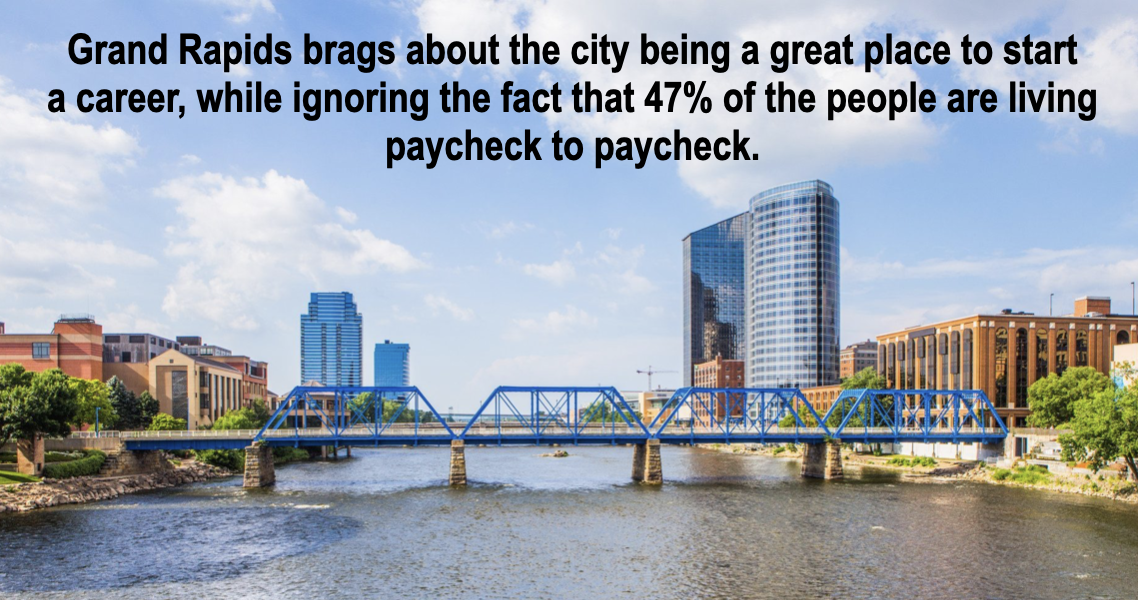
The source of this claim is WalletHub, which is market/finances-driven tool that is utilized by the professional and capitalist classes. Back in 2022 WalletHub made the claim that Michigan was the safest city in Michigan to live in, although their methodology for making such a determination is deeply problematic.
For the claim that Grand Rapids is one of the best places to start a career, WalletHub states:
WalletHub compared the relative market strength and overall livability of more than 180 U.S. cities. We examined each city based on 25 key metrics that range from the availability of entry-level jobs to the average monthly starting salary to housing affordability.
If you are looking at housing affordability, then Grand Rapids is the worst in Michigan. According to the National Low Income Housing Coalition for the average cost of rent for a two bedroom place people need to earn a wage of $26.33 per hour to afford to live in Grand Rapids.
Entry level jobs are also significantly low in Grand Rapids, partly because the minimum wage in Michigan is $13.73 an hour and Grand Rapids is home to the ethos of screw the workers and start your own business, which is what they mean by entrepreneurs. According to a recent ALICE report – ALICE stands for Asset Limited, Income Constrained, Employed – 47% of Grand Rapids households are living paycheck to paycheck. With this kind of economic data, how can WalletHub claim that Grand Rapids one of the best places in America to start a career?
For the past several decades Grand Rapids has been advocating for professionals to move here, which is why there has been such a push to invest so heavily in the downtown. Grand Rapids wants upwardly mobile professionals to locate here, which is also connected to the Grand Action 2.0 projects like the Amphitheater and the Soccer Stadium. If this city has more amenities, it will attract people who are part of the professional class.
In the City’s post about the WalletHub claim, their post includes comments from City Manager Mark Washington and Mayor David LaGrand. LaGrand is quoted as saying:
Grand Rapids continues to grow because our business community keeps creating opportunities for the next generation. With a younger and more diverse talent base than much of the country, our city is in a strong position for long‑term success. I’m grateful to the employers who are investing here and helping young workers build their futures in Grand Rapids.”
This commentary is instructive, since it makes the standard capitalist claim that businesses are the ones providing opportunities to works, when in fact workers are the ones that actually do the labor, which makes profits for the owners. Besides the Class Consciousness 101 observation, the other problem I have with the claim from Mayor LaGrand is that he doesn’t cite any source or data to support such a claim.
Lastly, it is worth noting how the Mayor uses the term “talent base”, which is what the business community refers to as students. A few years ago GVSU developed a program to partner with several major businesses in Grand Rapids to develop a talent pool. In fact, this is exactly what the group Talent First does, which is to see education as developing talent.
A reporter with De Volkskrant, a Dutch newspaper – recently reached out to me after they did an interview with Hank Meijer.
Interviewing Hank Meijer comes as no surprise as he has for decades been involved in Dutch/American Heritage work, like the lecture he gave last year for the West Michigan Dutch American Heritage Celebration.
As the reporter from De Volkskrant was doing some research on Hank Meijer he came across a GRIID article about the Meijer family that was less flattering. Thus, the De Volkskrant reporter reached out to me to ask if he could talk with me and pose some questions. I said, sure. Here is what the reporter wrote in their very next Email:
What is your main objection to Meijer Inc?
Do you consider that making a contribution to the community as a company? Or do they just do it for show?
I spent a day with Hank Meijer. He doesn’t strike me as the typical American billionaire; he writes books and supports many cultural initiatives. How do you see that?
This response and this question from the reporter with De Volkskrant told me a great deal about the reporter, what he thought about Hank Meijer and how he clearly has internalized the values of the Capitalist system.
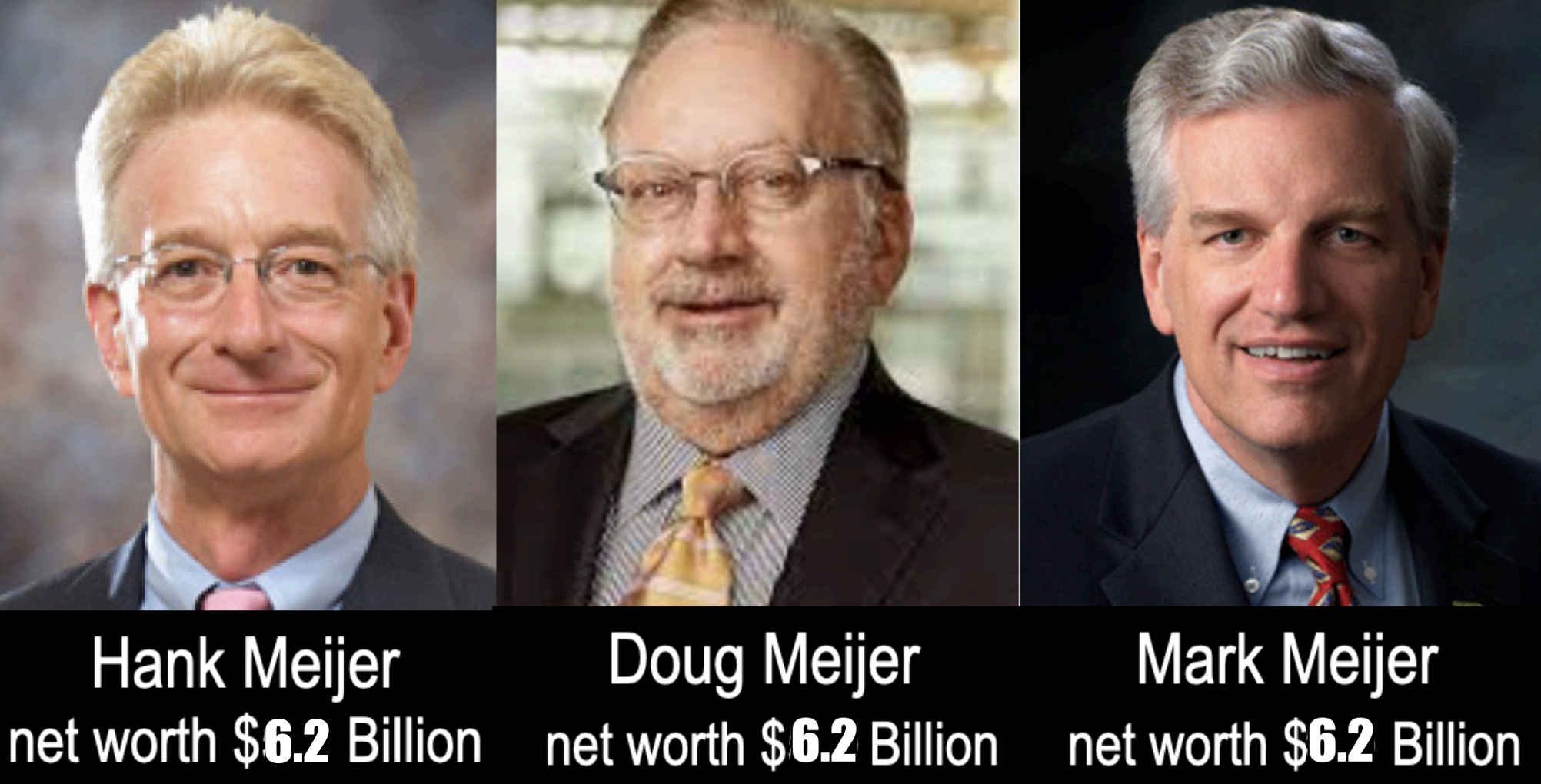
What is your main objection to Meijer Inc? My main objection has to do with the fact that the Meijer brothers, Hank, Doug and Mark are each worth $6.2 billion, making their collective worth $18.6 billion, according to the most recent Forbes Real-Time Billionaires ranking.
The Meijer brother wealth jumped significantly during the pandemic, since they were making a killing off of their chain of retail stores. As I wrote in October of 2021, the Meijer brother’s wealth had grown $6.7 billion from the beginning of the pandemic to October of 2021.
The wealth of the Meijer brothers has continued to expand, which puts them as the wealthiest family in West Michigan, even wealthier than the DeVos family. Now, the Meijer family doesn’t insert themselves has much into politics as the DeVos family, but their wealth has similar outcomes for the rest of us, especially their employees.
Meijer Inc. employees thousands of people to work in their stores and their warehouses. The warehouse workers are unionized, but not the store workers. Store workers do not make a living wage, not even close to the amount that one would have to earn to afford the average cost of rent in the Grand Rapids market, according to the National Low Income Housing Coalition. In order for Meijer store employees to afford the average cost of a 2 bedroom apartment they would have to earn $24.46 an hour. This number increases to $26.33 per hour for those living in Grand Rapids. Most Meijer store employees make way less than that, but they don’t have to.
In another article I wrote about the Meijer brother’s wealth I pointed out that in the first year of the pandemic, the Meijer brother’s increased their wealth by $2.6 billion. $2.6 billion would be enough to pay 26,666 employees earning $40 an hour for 40 hours a week for an entire year. Considering that the Meijer brother’s are currently worth $18.6 billion, it seems reasonable that they could afford to live off of $16 billion, the amount they would still have after paying employees a livable wage.
To the reporter’s other points about Meijer contributions to the community, I have a few responses. First, Meijer funds to run the Meijer Gardens and other charitable functions is money that comes from their foundation. Foundations by the rich are designed to hide some of their wealth so it won’t be taxed, then to distract us from the issue of poverty and inequality. Second, the food drive that Meijer does annually during the annual Meijer sponsored LPGA Golf tournament is both insulting and a PR stunt. Meijer employees are accessing food assistance because the Meijer Corporation doesn’t pay them enough.
The last point that the De Volkskrant reporter makes – “I spent a day with Hank Meijer. He doesn’t strike me as the typical American billionaire; he writes books and supports many cultural initiatives. How do you see that?” First, I would say, read everything above. Second, the fact that this reporter makes such an observation demonstrates that he feels that billionaires can be descent people and they earned their wealth so why all the complaining.
This is a fundamental problem with journalism today, where billionaires are treated as heroes and celebrated for their generosity. Reporters are rarely even asking how the billionaire class made their wealth, which is usually a combination of inheritance or by paying those who actually do the work unlivable wages. This was my response to the reporter.
Last night I facilitated the first part of a two part workshop centered around and Grand Rapids Power Analysis.
For about the past 12 years I have been doing a 10 Part series on the Grand Rapids Power Structure, looking at the families and organizations that have the most political, economic, social and cultural power in Grand Rapids.
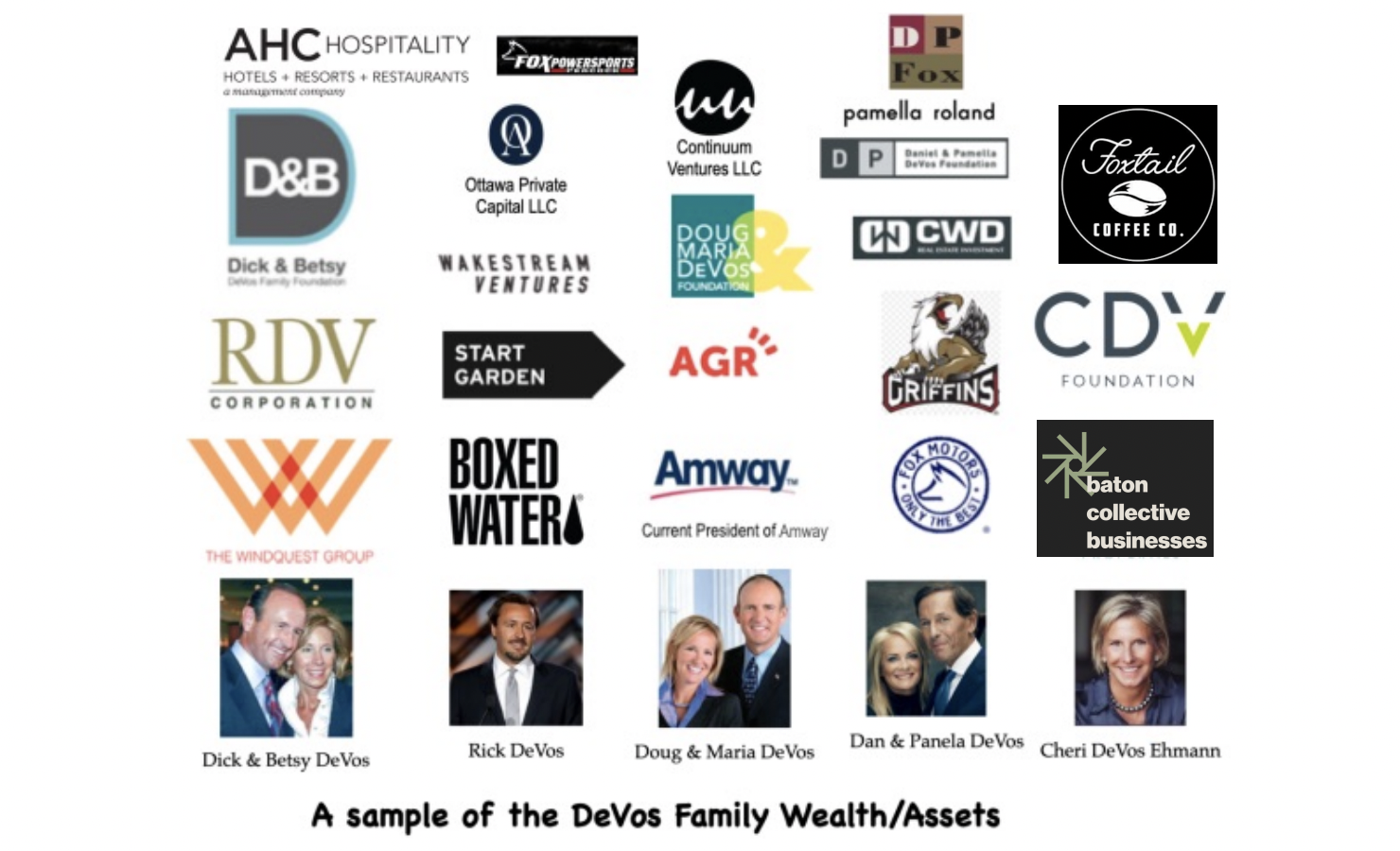
I regularly use the slides from the Grand Rapids Power Analysis, as I regularly write about these families and organizations in order to provide ongoing analysis. For people who have seen these slides previously, I have recently updated some of the data, analysis and even added new slides to better reflect the far reaching power that the families and organizations in this city have, like the one here above. You can access the updated slides here.
In Part II, I will be looking at how we can organize and resist the economic, political, social and cultural power that the Grand Rapids Power Structure has in this city. This will be the first time that I have had the opportunity to talk about how we can engage in collective resistance to the Grand Rapids Power Structure developing strategies and tactics, especially as we seek to fight for social justice and collective liberation in this community. As I said during the presentation last night, you can not ignore the Grand Rapids Power Structure if you truly want to work on creating structural change.
Part II, the how to resist part of this two part workshop, will be on Sunday, May 31st at Fountain Street Church, from 2pm – 3:30pm. This workshop is free and open to anyone.
We now have two days behind us and by all commercial media accounts the opening of the amphitheater was a success. People bought tickets, some paid $60 for parking, and lots of businesses in downtown Grand Rapids were packed with consumers having dinner and drinks.
However, let us not lose sight about what the amphitheater project is and has always been about – expanding the wealth of those who proposed the amphitheater in the first place, the members of Grand Action 2.0.
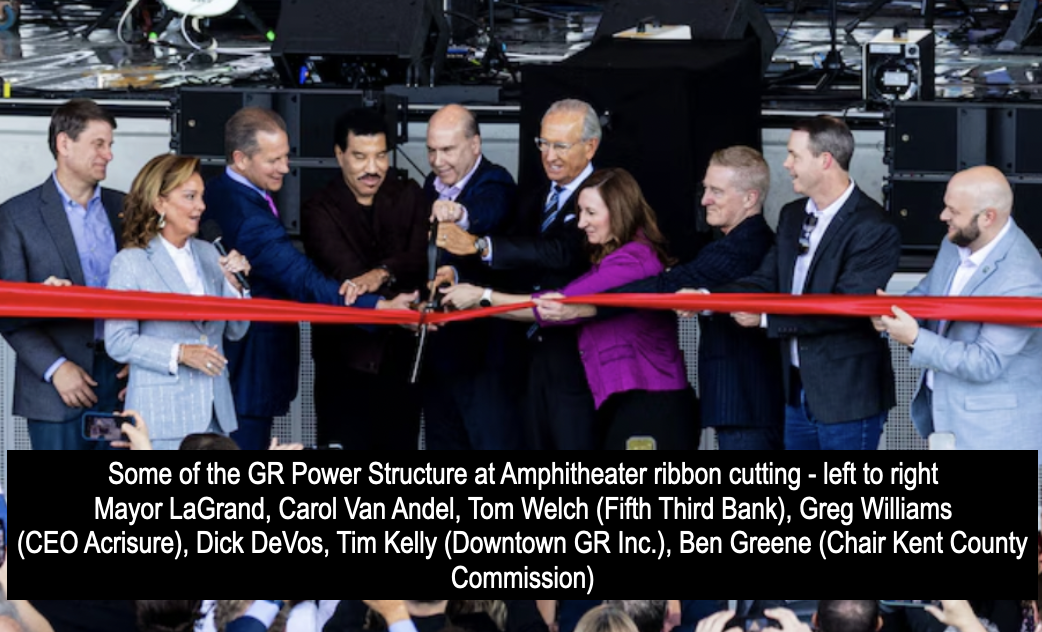
Look at who was invited to be part of the ribbon cutting ceremony pictured here above. These people are part of the Grand Rapids Power Structure, which included two politicians – Mayor LaGrand and Kent County Chair Ben Greene, both claiming to represent the people, when in fact they do the bidding of those with the real power.
We all became aware of the proposed amphitheater in 2020, when the community was in the midst of a pandemic.
The DeVos family purchased the Charlie’s Crab property in order to make room for the amphitheater, which led to the City of Grand Rapids moving some of it’s services to a different location in order to clear out even more riverfront space for the Grand Action 2.0 proposed project. It is always instructive to see how much effort and public dollars are used for such projects while thousands of families in Grand Rapids have no secure housing.
In 2022, we learned that the Convention and Arena Authority would manage the amphitheater and according to City documents, the “Design and financial planning for the amphitheater continues through a partnership of Grand Action 2.0, the DDA/DGRI, the City, the CAA and other stakeholders.”
We have been told from the beginning that this was a private/public partnership, where the public (without it’s consent) provides millions, while the private sector reaps most of the benefits.
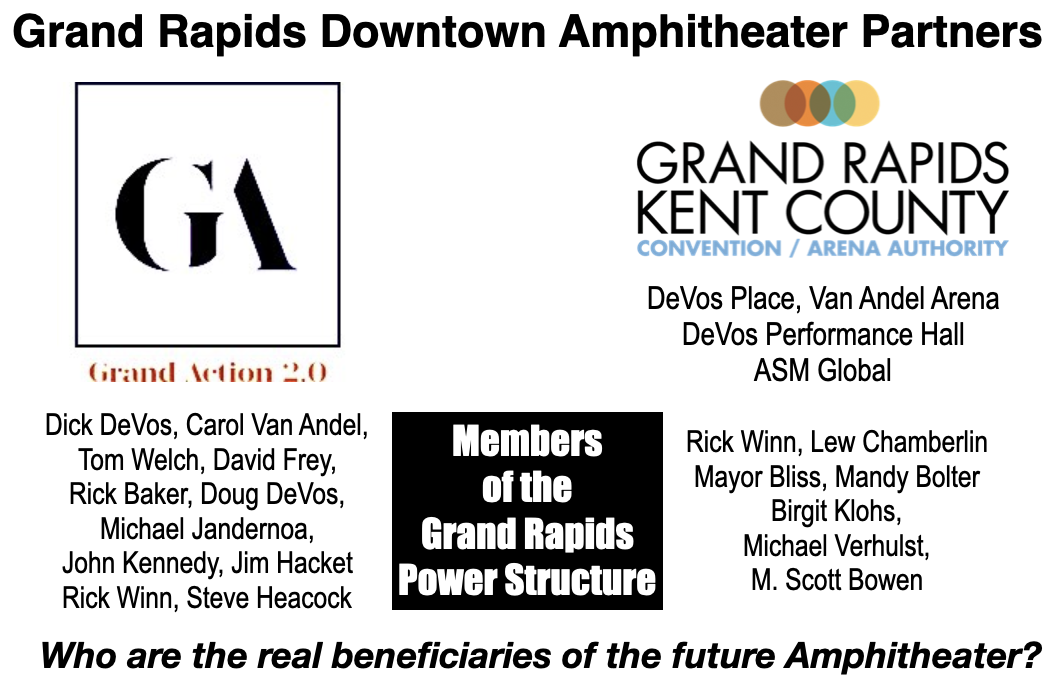
We have a local commercial media sector that has continued to endorse the amphitheater project, with gushing headlines using a news platform to celebrate the dictatorship of capitalism in this city.
In December of 2024, I wrote that the Kent County Commission voted for a 25 year contract with Live Nation for events at the Amphitheater, even though Live Nation is facing a federal lawsuit for having a near monopoly on tickets sales and for jacking up the price for concert goers.
Last September we found out how much public money has been used for the amphitheater project and we learned what the ticket pricing structure would be for amphitheater events.
In March of this year it was revealed that the GRPD is using the amphitheater as another justification for their own bloated budget, since the the Amphitheater and will be paying for at least 24 GRPD cops to work the Amphitheater events, to make sure that tourists and people with money will be protected from unhoused people or political dissidents who might interrupt their plans to have dinner & drinks before attending live concerts with overpriced tickets.
Movimiento Cosecha statement on the Court’s decision to deny Byron Martinez asylum in the US
Yesterday, I wrote about the Press Conference that Movimiento Cosecha hosted on their Free Byron Campaign. After Byron had his asylum hearing with the Judge this morning, they released this statement:
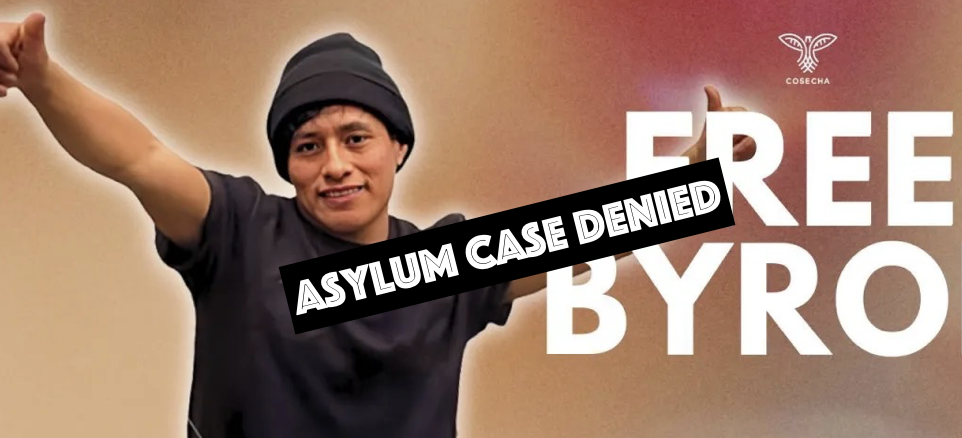
It is with heavy hearts that we share the news that this morning a federal judge denied Byron Martinez asylum in the United States. This decision comes after Byron spent 100 days detained at the GEO Group-owned North Lake detention center in Baldwin, Michigan.
Despite months of organizing and advocacy by Movimiento Cosecha Michigan and our partner organizations through the #FreeByron campaign, we were ultimately unable to secure Byron’s freedom. He now faces deportation back to Ecuador, the country he fled after experiencing violence and threats to his safety. Supporters fear that Byron could face continued danger upon his return.
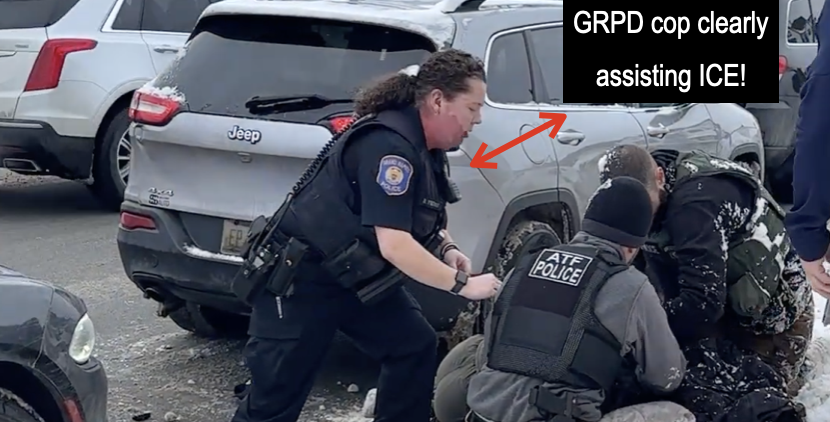
Byron Martinez was unjustly arrested and detained in Grand Rapids in February after ICE agents, assisted by ATF and GRPD officers, stopped him and used force against him despite the fact that he had asylum documentation in his possession. Advocates maintain that had officers allowed Byron the opportunity to present his paperwork, there would have been no legal basis for his detention.
During his detention, Byron endured harsh conditions, emotional trauma, and inadequate medical care. His case became a rallying point for community members, faith leaders, immigrant advocates, and supporters who organized press conferences, vigils, legal support efforts, public pressure campaigns, and community solidarity actions demanding his release and humane treatment.
Byron’s case is one example of the cruel and punitive immigration detention system that continues to impact countless immigrant families across the United States. As an immigrant-led organization, Movimiento Cosecha remains committed to resisting ICE and fighting for dignity, respect, due process, and permanent protection for all undocumented immigrants.
We will continue organizing, advocating, and standing in solidarity with immigrant communities facing detention, deportation, and separation from their loved ones.
Abolish ICE now!
I had a chance to talk with Cosecha organizer Gema Lowe and her reaction to Judge’s decision to deny asylum to Byron.
Many Latin American countries are in a very unsafe situation. In speaking with Byron directly about keeping himself safe and his family safe in Ecuador, he told me his mother’s business was bombed in, which forced his family to relocate. This was the primary reason why he came to the US in the first place. Now he has to face this danger again, with his losing his asylum case. He and his family made the decision for him to come to the US, but in this case he has had no say in what is best for him, the US government has decided and taken away his agency as a human being. This is what injustice looks like.
Free Byron Press Conference held on the 100th day of his detention, with a judicial ruling coming tomorrow morning
Movimiento Cosecha held another Press Conference today as part of their ongoing Free Byron campaign.
May 14th marks 100 days that Byron has been at the Geo Group-owned detention center in Baldwin, Michigan. Byron was arrested on February 3rd in Grand Rapids, where ICE, in collaboration with ATF and GRPD, arrested him on false pretenses, which was the focus of a Press Conference held on February 23rd.
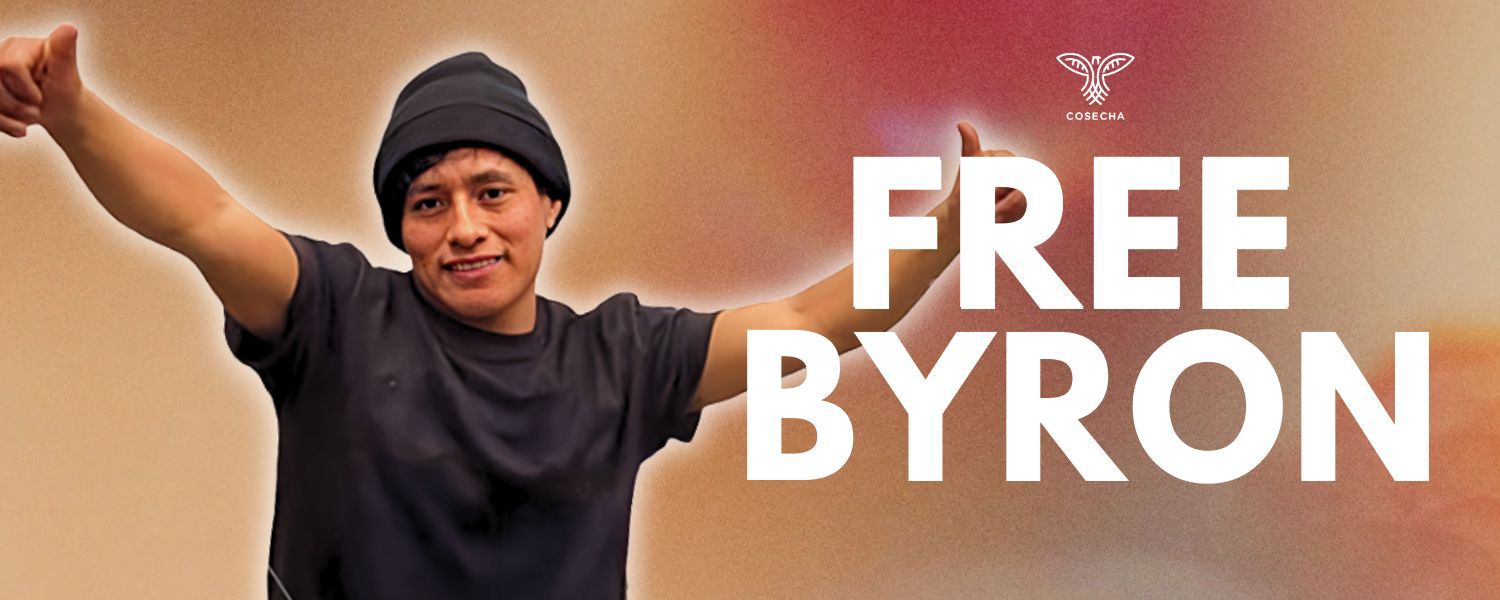
A spokesperson for Movimiento Cosecha stated:
Byron was never given the opportunity to identify himself or present proof of his asylum case. Instead, agents forcefully pulled him from his car and slammed him against it as he desperately pleaded to show his paperwork. Witnesses describe a terrifying scene in which Byron was then thrown onto a snowbank, his face pressed into the freezing snow so hard that he struggled to breathe.
A week into his detention at the GEO group North Lake private detention center, Byron developed a facial infection that went untreated for 9 days until Movimiento Cosecha Michigan and our allies like GR Rapid Response to ICE, community members in Grand Rapids and Kalamazoo ran a campaign and a phone zap demanding the proper medical care since his face became defigure and the infections was getting to the point of live threatening. Finally he received the medication he so desperately needed and this action saved his life.
We would like to highlight that his untreated condition is not isolated and many detainees have similar instances where their lives are in danger because of the precarious conditions. People in North Lake have taken action and went on a hunger strike demanding basic human rights like access to health care, nutritious food and the due process for their civil immigration cases. Movimiento Cosecha stands in solidarity with these efforts and supports those demands that violate basic human rights.
As far as Byron immigration case, he won his Habeas Corpus case in federal court but an immigration judge denied his release on bond under the bogus accusation by ICE that Byron was resisting arrest and therefore he was a violent person but we all saw the video where ICE agents assisted by a federal ATF agent and local GRPD were violent push into a snowbank and he couldn’t breath and we could clearly see who was being violent on the video. Since then Byron has been suffering trauma and nightmares inside North Lake where his mental health has also been taking a toll with anxiety and depression.
Cosecha organizer Gema Lowe then provided a chronological list of accomplishments in the Free Byron Campaign, which included Press Conferences, an Email campaign to ICE officials, a medical care phone zap, legal representation for Byron and a court victory, a vigil, community support letters ongoing visits and other types of community support. To read about all of the efforts in the Free Byron Campaign go here.
The next person to speak was with GR Rapid Response to ICE who made three specifics points about the Byron Martinez case.
- First, that the GRPD was present at his arrest with clear evidence of GRPD collaboration. This is something that they have on video, which you can watch here.
- Second, when Byron was first arrested he was taken to the Kent County jail, and eventually transported to the Northlake Detention Processing Center. The Kent County Jail is also collaborating with ICE, by providing holds for Immigration Customs Enforcement.
- Third, Byron’s has an asylum hearing on Friday morning and if he is denied asylum, then he will be deported. This means that both the City of Grand Rapids and Kent County have played a role in Byron’s case, causing him tremendous harm and demonstrating that local government’s and local cops are complicit in the unjust deportation of immigrants that came here seeking a better life.
The last speaker was Joana from the Southwest Michigan Coalition, who stated:
Tomorrow, May 15, Byron will attend his final asylum hearing. If the judge rules against him, his future will become deeply uncertain. Byron’s case has become highly visible within his community, and the violence he once fled in Ecuador has once again resurfaced through threats directed at his family. Byron knows very well that if he returns to his home country, his life will be in danger. He has been warned that returning could cost him his life.
After enduring the unjust suffering of being detained without an arrest warrant, surviving a life-threatening medical situation inside detention, and being denied timely medical care, Byron continues to carry deep emotional and psychological trauma. The violent arrest left him traumatized, and while detained he has suffered nightmares, anxiety, and depression.
Even now, after more than 100 days in detention, Byron faces an uncertain future. If the judge denies his asylum case, he cannot safely return to Ecuador, yet he also does not know where he will be able to go or what will happen next.
Today, we are asking the community to continue standing in solidarity with Byron, to continue supporting him, and to continue lifting him up with hope and positivity as he prepares for this critical moment in his life. Tomorrow, May 15, after more than 100 days in detention, Byron will finally face the final hearing in his asylum case.
Community members who would like to support Byron and contribute toward his release can donate through:
CashApp: $kbabk888
Venmo: @kbabk888
Any amount is deeply appreciated and urgently needed.
What we learned from Mayor LaGrand’s comments after the most recent City Commission meeting about Cops and ICE
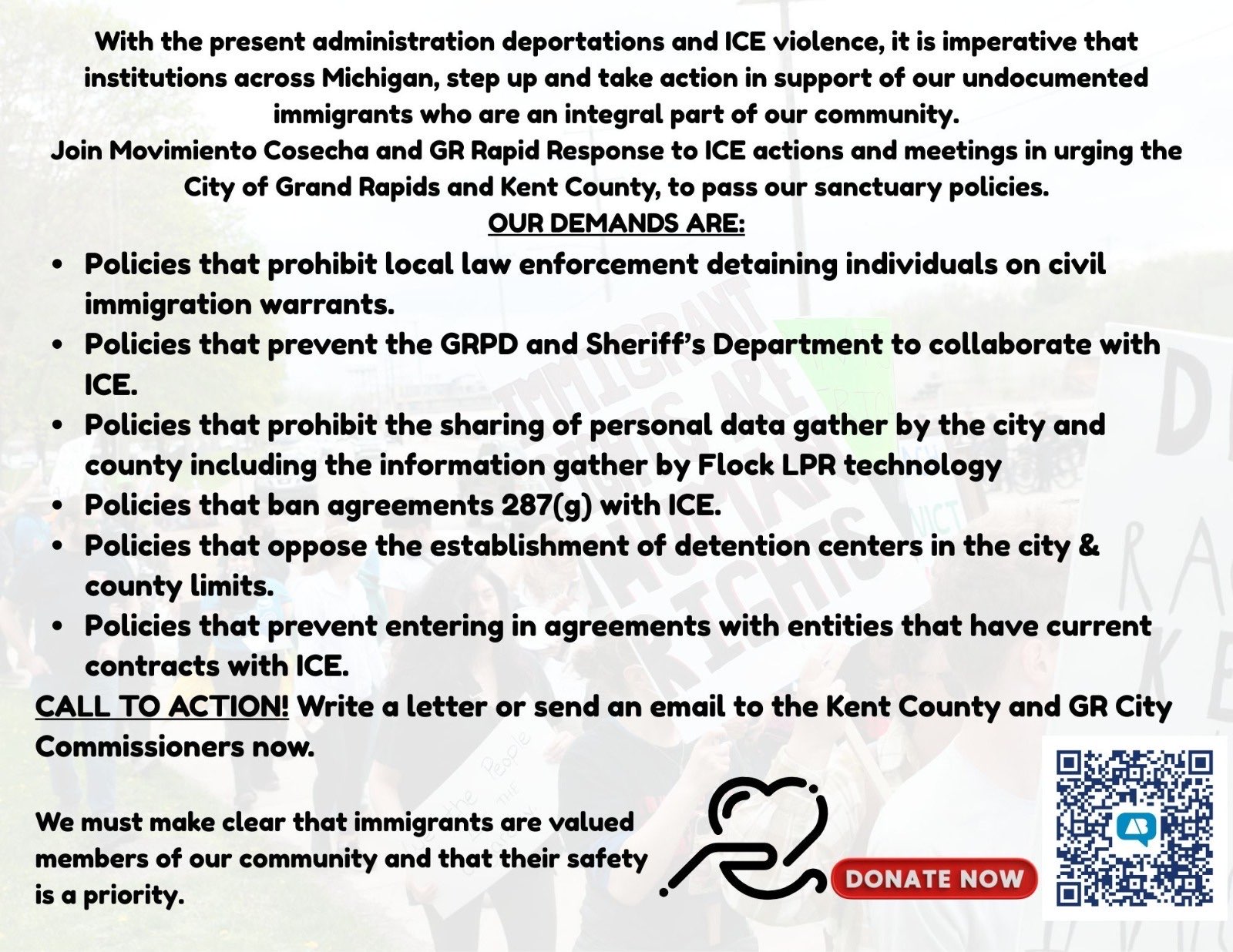
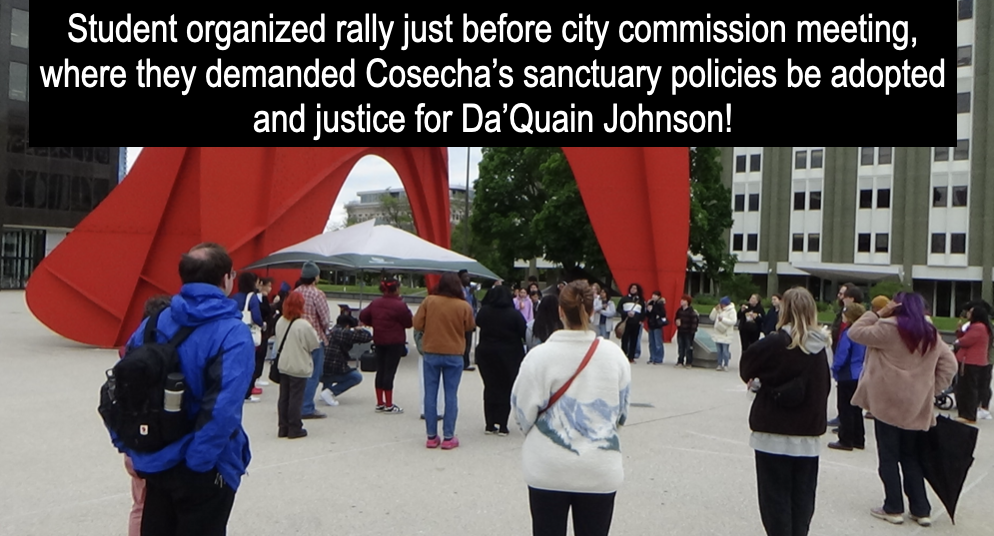
As I noted in my post about the student organized rally and the student comments during the City Commission meeting on Tuesday. much of the focus was on adopting the Cosecha sanctuary policies, demanding justice for Da’Quain Johnson and redirecting some of the $75.4 million proposed funds for the GRPD to meet community needs.
Students comments, along with other community input during the Grand Rapids City Commission was important, even if it seems as if no one was being listened to. Several of the commissioners responded at the end, although most of their comments had nothing to do and completely avoided the point that people were making around ICE, the GRPD and the City budget. However, Mayor LaGrand had plenty of to say, which is what I want to focus on in the rest of this post.
There were two overarching takeaways from what Grand Rapids Mayor David LaGrand had to say in his closing comments, which you can watch here, beginning at 2:38:42 into the video, making his comments about twelve and a half minutes long. The two issues we learned were that Mayor LaGrand believes that 1) the GRPD are essential to public safety and that they don’t act out of malice; and 2) the 6 sanctuary policies that Cosecha has been demanding for over 15 months, Grand Rapids is already doing them.
Before the Mayor talked about what he thinks of the GRPD and law enforcement in general, LaGrand decided to response to someone’s comment about working on police issues for a long time. LaGrand said he has been working in the “law enforcement space for 36 years,” as a lawyer, and as a state representative. LaGrand goes on to say he has worked to end mass incarceration and create a justice system that is not biased around class or race. He then said that he has yet to meet a cop who did their job out of malice.
Interesting, now I don’t recall anyone talking about cops acting out of malice, but I do remember people talking about the structural or systemic nature of policing, which has been designed to protect property, wealth and power. This has been the case since much of policing in the US can be traced back to slave patrols. Please read Kristian Williams book, Our Enemies in Blue: Police and Power in America.
It is not about malice or the “a few bad apples” argument, it is about understand the function of policing. See my 8 part articles based on a GRIID class on the history and function of policing in the US to find more resources and analysis.
The Mayor then says that he knows that the GRPD doesn’t act out of malice because he does ride alongs on a regular basis and that they do their jobs with courage. LaGrand even states at one point that all cops are not perfect, which evades the issue that people brought up on Tuesday night and have been doing for years in response to the GRPD, which has been to critique the systemic repression coming from the GRPD. Mayor LaGrand even went so far as to apologize to the GRPD for the comments made by mostly Black and immigrant community members.
From there he talked about spending years of his life trying to make the justice system better, which was followed by a list of his accomplishments, like the concerns raised by Black and Brown was about him and what he has done. Sweet baby Jesus……
Lastly, he said that living in a world without cops is a real stretch for him when he was talking about working with domestic violence victims, meaning that cops were absolutely necessary in domestic violence situations. The Mayor’s comment on this matter flies in the face of what the group INCITE in their toolkit says – Law Enforcement Violence against Women of Color & Trans People of Color: A Critical Intersection of Gender violence & State Violence
The second major issue that Mayor LaGand responded to was the 6 sanctuary policies that Cosecha has been demanding. LaGrand essentially said that the City of Grand Rapids is already doing them all. This is instructive in that the Mayor has only recently been saying this, even though Cosecha began their campaign in January of 2025. In fact, there has been an evolution or ever changing response from Mayor LaGrand regarding the 6 sanctuary policies which I addressed in an article from this past January.
Mayor LaGrand then proceeds to read each demand and tell people how the city is already doing them. LaGrand states that since he is a lawyer he wants to address each one and then provide his own insights. I am including the six policies here below.
What is instructive about what the Mayor said is regards to most of these sanctuary policies is that the city is already doing them because “it is in the policy” or because the “Chief of Police said so.” This is no real answer since there was no document provided to verify that the GRPD or the City of Grand Rapids was already doing it. People shouldn’t take the word of anyone who is in a position of power, we should demand evidence.
When Mayor LaGrand got to the issue of the GRPD collaborating with ICE, he said they are are already doing it because the Chief of Police said so. This is despite the fact that numerous people have seen first hand accounts of the GRPD cooperating with ICE, even a documented example when Byron Martinez was arrested and a GRPD officer had their hand on Byron while ICE agents are shoving his face into a snow bank. (Pictured at the beginning of this article)

Then there was the 6th policing, which LaGrand found to be confusing and tried to give an example such as Gordon Foods having a contract with ICE to keep their vending machines full. This kind of commentary from the Mayor is unfortunately too common. What #6 is saying is that the City of Grand Rapids should not enter into any contracts with companies that also have contracts with ICE. Now, there are lots of companies that have contracts with ICE, with the largest listed here. However, there are smaller contracts, which I discovered by doing some research, which you can find here. Again, the city should not enter into contracts with companies who have contracts with ICE, a federal agency that is disappearing people for being undocumented.
Lastly, the Mayor suggested that he is willing to have a conversation with the community about this. I would support such a conversation, especially if it was outside of a commission meeting.
“In any case, the hidden hand of of foundations can control the course of social change and deflect anger to targets other than elite power.”
– Joan Roelofs, Foundations and Public Policy
DeVos Family Foundation
GRIID has always begun our Foundation Watch work by looking at the foundations associated with the most powerful family in West Michigan, the DeVos family. So far I have done posts on the Dick and Betsy DeVos Foundation, the Doug and Maria DeVos Foundation and the Dan and Pamela DeVos Foundation and the Cheri DeVos Foundation.
The DeVos Family Foundation gave $9,645,232 in 2024, with only $2,950 left in total assets in that foundation, which suggest that they might be phasing out this foundation.
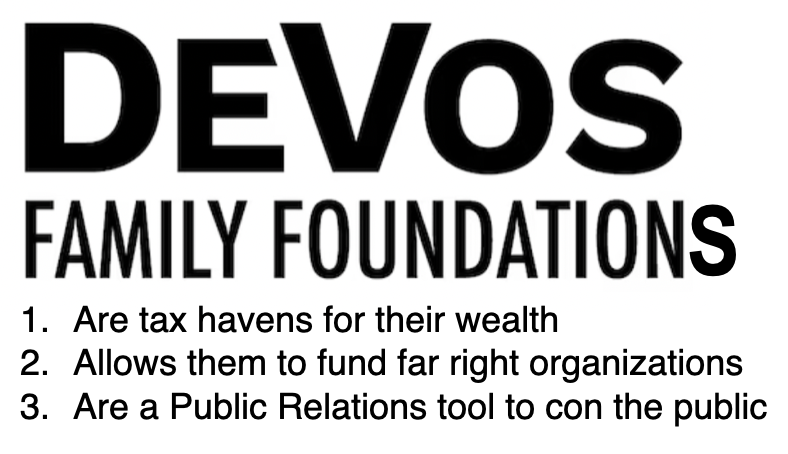
The DeVos Family Foundation made contributions to dozens of entities in 2024, but there are some clear categories of groups they contributed to, such as the Pro-Capitalist groups, Education-centered groups, but mostly entities that were either created by the DeVos family or has a DeVos family member or associate that sits on the Board of Directors.
However, what is different about the DeVos Family Foundation in relation to the other DeVos Foundations is that this foundation is what remains of the Richard and Helen DeVos Foundation.
However, before I get to how they distributed their foundation funds for 2024, I think it is important that the DeVos Family Foundation paid one DeVos-owned entity to manage how their foundation money was used in 2024, along with three independent companies. The DeVos Family Foundation paid RDV Corporation $118,770.00, The Arts Manger $150,000.00, Flywheel CDS LLC $90,000.00, and WOTV $75,600.00.
Religious Groups
- Degage Ministries – $50,000
These religious groups practice varying degrees of conservative politics, which fit into the ideological framework that the DeVos family is committed to.
Pro-Capitalist Groups
- Greater Grand Rapids Chamber Foundation – $102,500
- Philanthropy Roundtable – $300,000
In 1999, Philanthropy Roundtable spun off the Koch-funded DonorsTrust (DT) and Donors Capital Fund (DCF), two “donor-advised funds” that create separate accounts for individual donors, who then recommend disbursements from the accounts to different non-profits.
Education-centered groups
- New York University Stern School of Business – $12,500
- University of Central Florida Foundation – $90,000
DeVos-owned, created or connected groups
- Alliance for Children Everywhere – $150,000 – Amway provides material support and several DeVos Foundations are partners
- Chicago Cubs Charities – $10,000
- Corewell Health Foundation – 21,005,000
- One Starfish Foundation – $60,000 (Board member is the President of DP Fox Ventures)
- Orlando Magic Youth Foundation – $360,000
Of course all these entities that were created by DeVos family members, also promote their ideological religious and capitalist values. On top of that, it also means that DeVos family members are funding their own entities and using their foundation to fund their own pet projects, and arts and culture institutions that cater primarily to members of the Capitalist Class.
Groups receiving Hush $
- CommunityRebuilders – $50,000
- Heart of West Michigan United Way – $60,000
- John Ball Zoo (run by Kent County) – $1,000,000
- Mary Free Bed Rehabilitation Hospital – $5,000,000
- New Image Youth Center – $250,000
- Pine Rest Foundation – $5,000,000
- St. Cecilia Music Center – $20,000
- United Way of Florida – $500,000
These groups all provide some sort of social service – people fleeing domestic violence, those who are housing insecure, people with disabilities, adoption and immigration. There are root causes to all of these issues, but these groups are not likely to address root causes and larger systems of oppression. When the DeVos family foundations make contributions, this will increase the likelihood that systems of oppression will not be addressed by these groups.
Foundations rarely make contributions without strings attached. The DeVos Family Foundation has a long history of funding far right and religious right groups, which GRIID began documenting over a decade ago when I started this project. Lastly, it is worth noting that the DeVos Family Foundation, like all of the DeVos family foundations, compliments the campaign contributions they make to further impact public policy and promote their religious and capitalist ideologies.
Roughly 75 people gathered at Calder Plaza, which included some 30 students, most of which are students in the Grand Rapids Public Schools (GRPS) system.
Students invited people to use sidewalk chalk to express their concerns and their demands. Several students then spoke about the demands they were presenting, as well as speaking about their own lived experiences as Black, Latinx and immigrant students. There was also a student that spoke about the history of student organizing in Grand Rapids, with his comments making it clear that students have always been involved in organizing and an essential part of social movements.
Before going up to attend and speak at the City Commission meeting I was able to interview one of the student organizers, a bright and articulate student named Colette.
At the City Commission there were several opportunities for people to speak, but most people and the students chose to speak during the Public Hearing that was held specifically to the issue of the FY2027 Budget, which I wrote about in a previous post.
One student began by asking people to raise their lands if they feel unsafe around police, with half the room raising their hands. This student then went on to demand that less money go to the GRPD and more funds be invested in public safety models that are not based on fear and force.
Another student talked specifically about an encounter she had while going to school, an encounter with cops. She also said she came to use her voice to speak for her parents and for her immigrant community.
A third student spoke about the need to reduce funding for the GRPD and redirect funding to community needs, like housing, mental health resources, and long term sustainable efforts that truly promotes community safety.
One of the students got up and said that they were dedicating their time to the families who have had loved ones deported.
One theme that emanated from several students was the fact that they were frustrated that the needed to come to the City Commission meeting instead of focusing on their studies, by talking about the horrific realties of harm and danger that is happening in this city, specifically at the hands of cops.
There were also several members of Together West Michigan who have spent the past two years working to get safety on Kalamazoo, safety for street calming, lights and better signage to keep residents safe. Residents in that neighborhood are jaded and feel ignored. At the same time billionaires get a free pass when the city agrees to use millions in taxpayer dollars to support the DeVos/Van Andel Three Towers Project.
Another resident brought up the irony around the issue that of the $2.9 million for Oversight and Public Accountability, $1.7 million of this is for Axon contract including body cameras. How is it accountability when $1.7 million goes to a private corporation? That is nothing more than a corporate handout.
While many of the dozens of people who spoke during the Public Hearing on the FY2027 budget were inspiring with sound arguments, especially the comments from students, I don’t expect that this City Commission will actually hear what people have said. As I wrote yesterday, “holding one public hearing on this matter is a pitiful display of public engagement and what people should be demanding is a full blown participatory budgeting process that would essentially allow for a full year of discussion, debate and development of a budget that would truly meet the public’s needs.”
As always I don’t invest hope or faith in government officials, but in the people who do the hard work, people in the streets, people who organize and resist state carceral violence. La Lucha Sigue!
“In any case, the hidden hand of of foundations can control the course of social change and deflect anger to targets other than elite power.”
– Joan Roelofs, Foundations and Public Policy
Cheri DeVos Foundation
GRIID has always begun our Foundation Watch work by looking at the foundations associated with the most powerful family in West Michigan, the DeVos family. So far I have done posts on the Dick and Betsy DeVos Foundation, the Doug and Maria DeVos Foundation and the Dan and Pamela DeVos Foundation, which are some of the largest in West Michigan. Today I want to focus on the Cheri DeVos Foundation.
Cheri DeVos is the founder and owner of the Baton Collective, which includes Michigan Sports Academies, Discover Ada, Ada Hotel, Ada Village, Otter and Foxtail Coffee. The Cheri DeVos Foundation gave $4,172,500 in 2024, while maintaining $82,141,217 in total assets in that foundation.
The Cheri DeVos Foundation made contributions to dozens of entities in 2024, but there are some clear categories of groups they contributed to, such as the Religious Right, Think Tanks, Education-centered groups, and social service entities, to name a few. Below is a listing of each from these categories, with a dollar amount and a brief analysis.
I also include groups that are DeVos owned or created, along with liberal non-profits. With the liberal non-profits, we believe that funding from foundations like the DeVos family foundations is a form of hush money. When we say hush money, we mean that these entities will not publicly challenge the system of Capitalism, the wealth gap, structural racism and other systems of oppression, which the DeVos family benefits from and perpetuates through their own political funding.
However, before I get to how they distributed their foundation funds for 2024, I think it is important that the Cheri DeVos Foundation paid two DeVos-owned entities to manage how their foundation money was used in 2024, along with another independent company. The Cheri DeVos Foundation paid RDV Corporation $174,338.00 and Ottawa Avenue Private Capital $92,154.00. The independent company was Northern Trust Securities Inc., which received $106,868.00.
Religious Groups
- Bethany Christian Services – $20,000
- Bridge Street Ministries – $22,5000
- Degage Ministries – $80,000
- Partners Worldwide – $30,000
- Roosevelt Park Ministries Inc. – $60,000
- Safe Haven Ministries – $75,000
- Young Life Central Grand Rapids – $40,000
These religious groups practice varying degrees of conservative politics, which fit into the ideological framework that the DeVos family is committed to.
Political Organizations
- Gerald R. Ford Presidential Foundation – $500,000
Education-centered groups
- Ada Christian School Society – $125,000
- Grand Rapids Christian Schools – $50,000
- Grand Rapids Public Schools Foundation – $225,000
- Potters House – $150,000
- Rehoboth Christian School association – $150,000
Most of the education groups that the Cheri DeVos Foundation contributes to are conservative Christian Schools. The Ada Christian School society is where several of the DeVos family members have sent their children. Betsy DeVos has had a special relationship with Potter’s House school, and the Rehoboth Christian School Association is one of those old school missions for Indigenous children. It is important to note that the DeVos family foundations have contributed millions to the Grand Rapids Public Schools Foundation over the last decade or so, with the goal to always influence GRPS practices and policies.
DeVos-owned, created or connected groups
- Chicago Cubs Charities – $10,000
- Corewell Health Foundation – $10,000
- Grand Action Foundation – $1,000,000
- Grand Rapids Initiative for Leaders – $60,000
Of course all these entities that were created by DeVos family members, also promote their ideological religious and capitalist values. On top of that, it also means that DeVos family members are funding their own entities and using their foundation to fund their own pet projects, and arts and culture institutions that cater primarily to members of the Capitalist Class.
Groups receiving Hush $
- AYA Youth Collective – $40,000
- Baxter Community Center – $45,000
- Boys and Girls Clubs of Grand Rapids – $100,000
- Children’s Advocacy Center of Kent County – $30,000
- Community Food Clubs – $60,000
- Exalta Health – $110,000
- Family Promise of Grand Rapids – $45,000
- Grand Rapids Children’s Museum – $40,000
- Grand Rapids Opportunities for Women – $100,000
- Heart of West Michigan United Way – $75,000
- Housing Kent – $200,000
- ICCF Community Homes – $45,000
- Kent County Habitat for Humanity – $100,000
- Kids Food Basket – $75,000
- LINC UP Community Revitalization – $20,000
- Moms Blossom Inc. – $80,000
- Pine Rest Christian Mental Health Services – $1,850,000
These groups all provide some sort of social service – people fleeing domestic violence, those who are housing insecure, people with disabilities, adoption and immigration. There are root causes to all of these issues, but these groups are not likely to address root causes and larger systems of oppression. When the DeVos family foundations make contributions, this will increase the likelihood that systems of oppression will not be addressed by these groups.
Foundations rarely make contributions without strings attached. The Cheri DeVos Foundation has a long history of funding far right and religious right groups, which GRIID began documenting over a decade ago when I started this project. Lastly, it is worth noting that the Cheri DeVos Foundation, like all of the DeVos family foundations, compliments the campaign contributions they make to further impact public policy and promote their religious and capitalist ideologies.

