Big Tech and ICE: Understanding and resisting the Surveillance State in Grand Rapids and beyond
“At this moment, a dangerous convergence of two trends threatens democracy. The first is the Trump administration’s aggressive acceleration of the use of technology and artificial intelligence to rapidly expand immigration enforcement and military force. The second involves an unprecedented amassing of economic and political influence by a small group of tech oligarchs.”
The above comment is from a new report entitled, The Teach Behind ICE: Oligarchs, Immigration Enforcement, and the Threat to Democracy. The report was a collaborative project from Mijente, Just Futures Law and the Surveillance Resistance Lab.

The 86-page report provides excellent information and a robust analysis about the convergence of Big Tech with the Carceral State. In the report’s executive summary it states:
This report examines how DHS has laid the foundation for this authoritarian moment. We reveal how this moment creates an accelerated danger, as a power-hungry tech oligarchy becomes increasingly influential, and identify the major actors, corporations, monies, and mechanisms involved. This report also describes some of the most important strategies available to non-violently resist the entanglement of big tech, immigration enforcement, and militarism. Confronting this threat requires a clearunderstanding of the convergence of agendas and where their power can be disrupted.
The major sections of the report cover the following areas:
- The Architecture of Authoritarianism
- Follow the Money: Revolving Door to Corner Office
- Building the Militarized Police State
- Taxpayer-Funded Surveillance and AI
- Tools of the Surveillance State
- Organized Resistance
In Grand Rapids we have seen how the carceral state collaborates with ICE, with the GRPD assisting ICE in arrests, the Kent County Jail holding immigrants for ICE, and local cops sharing Flock camera information with ICE. These dynamics are a major reason why Movimiento Cosecha and GR Rapid Response to ICE have been pushing the City of Grand Rapids and Kent County to adopt the 6 sanctuary policies they are demanding. This new report can provide those resisting ICE in Kent County with better analysis and additional ways to fight back against ICE and other forms of the Carceral State.
According to the report, since June of 2026, the world’s 10 richest individuals, nine of them based in the United States,81 held a combined wealth of roughly $2.9 trillion —an amount more than the GDPs of all the countries in the world. Nine of the richest 10 are tech oligarchs.
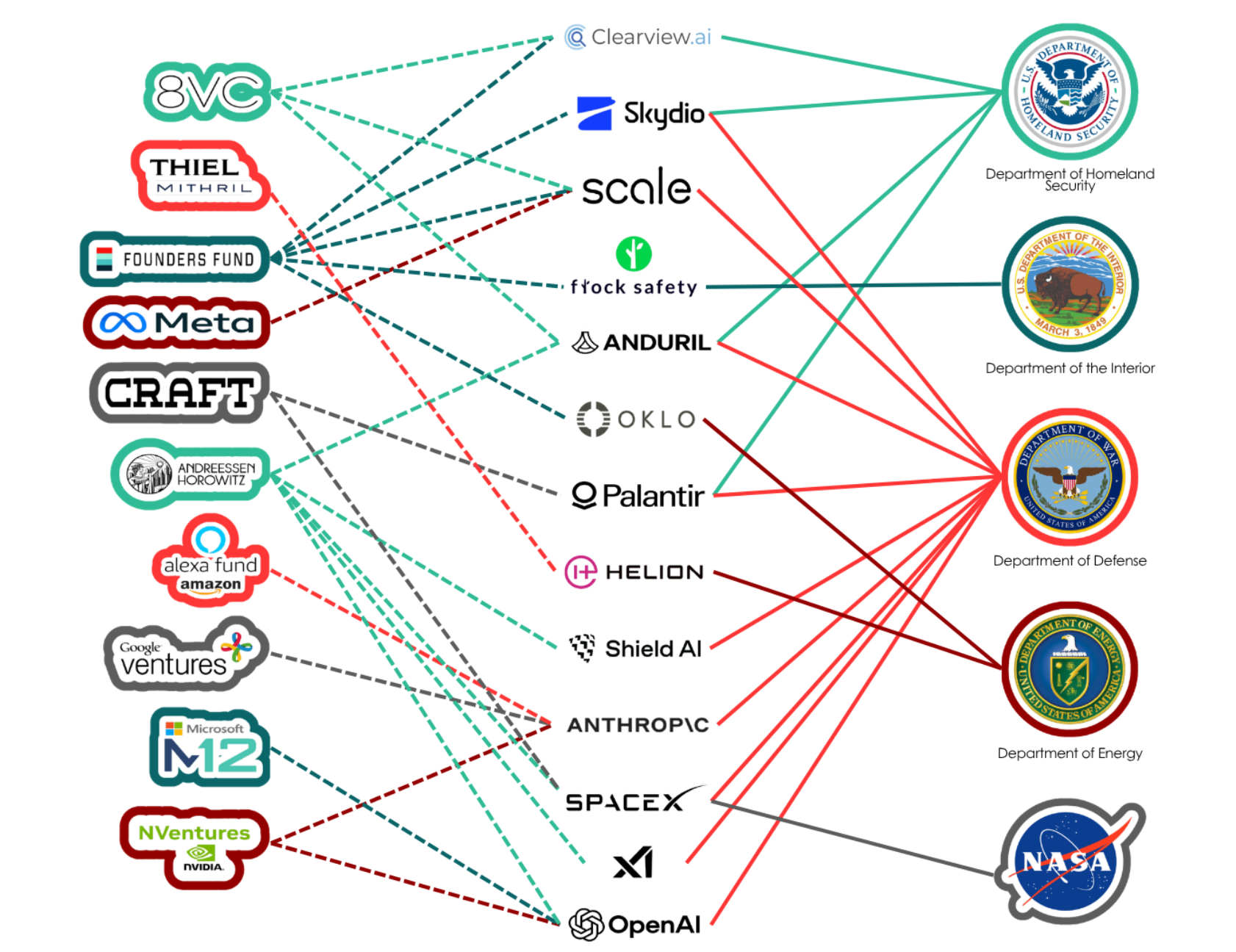
The report provides lots of information on how Big Tech is partnering with the US military to increase its reliance on AI, specifically through companies like Palantir and Anduril. However, most of the Big Tech companies are also expanding their relations with the Carceral State in the US, in Michigan and in Grand Rapids. In addition, this new report makes it clear that Big Tech companies and their owners have become some of the largest campaign contributors to candidates and are also spending tens of millions on lobbying Congress each year.
A second major area in this new report looks at the relationship between Big Tech, ICE, local and state law enforcement agencies. The report notes:
While local police have been found to arrest people for routine traffic violations, for example, in order to turn them over to ICE, 287(g) further empowers police by giving them authority to arrest people for suspected immigration violations. A February 2026 study found participation in 287(g) has grown by 900% under the new Trump administration. This effectively means upwards of 15,800 police officers and sheriff’s deputies nationwide can participate directly in ICE surveillance and arrests. The June 2026 budget reconciliation bill pushed through by the Trump administration—the second such bill to increase DHS funding in less than a year—included $350 million specifically for ICE operations in cities and states that do not participate in 287(g) agreements.
Based on this analysis it is likely that there will be an increase in ICE activity in Grand Rapids and other parts of Kent County, since there are no 287(g) agreements with ICE.
ICE and AI
As the relationship between ICE and Big Tech has deepened, there is a greater reliance on the use of Artificial Intelligence (AI). On this growing relationship the report states:
Inside the federal government, Congress has passed several laws aimed at advancing US leadership in artificial intelligence, including the implementation of AI across federal agencies. Vendors providing ICE and CBP with AI applications include Anthropic, Palantir, Anduril, Microsoft, Dataminr, Clearview AI, and many others. DHS use of AI now covers areas including generative AI, computer vision, natural language processing, machine learning, and agentic AI. These procurement expenses are part of an IT budget at DHS that amounted to more than $10 billion in 2025.226 The White House Fiscal 2027 budget shows DHS will hold the third highest IT investment in the federal government—$11.7 billion, which includes AI. The Department of Defense holds the highest investment in AI, seeking $58.5 billion for “continued American dominance in AI-enabled warfare.
The increased use of AI by the Department of Homeland Security partly correlates to the increase in proposed data centers across the country and right here in West Michigan. All of the amazing public opposition to data centers over the past year in Kent County has been important, but they can now add ICE surveillance to the list of reasons to say no to data centers.
The last section of the report is on resisting ICE and its relationship with Big Tech. The report states:
The surveillance and deportation systems described throughout this report were built through political choices, public investments, and corporate partnerships. They can be challenged in the same way. The technologies that power modern immigration enforcement depend on local government cooperation, private sector participation, taxpayer funding, and public legitimacy.
The report states that local government should be doing the following to resist what DHS/ICE is doing in communities like Grand Rapids:
1) Dismantle data sharing with ICE;
2) End expansion of surveillance technology;
3) Strengthen privacy protection.
These suggested actions certainly fit within the 6 sanctuary policy demands that Cosecha and GR Rapid Response to ICE have been demanding since the beginning of 2025.
The report also suggests exposing and disrupting the companies that have contracts with ICE in every community. GRIID did some research into companies with ICE contracts and posted a story back in early April, which could also provide opportunities with expanding the scope of resistance to ICE. However we engage in organized resistance to ICE, this new report provides important information that could lead to the development of new resistance strategies.
Movements resisting surveillance and immigration enforcement must develop a much deeper understanding of the technologies we are confronting, and the power that circulates through them. The current fusion of state and corporate power driving technologies that foster authoritarianism and exclude and repress everyday people, requires that we challenge oligarchs and the ways that they are fundamentally changing the way our democracy operates.
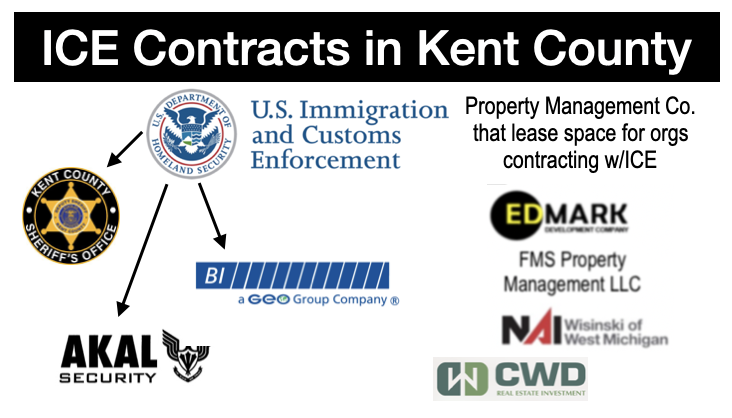
For anyone who is concerned about the relationship between Big Tech and ICE, this report is an important tool. If you want to then get involved in resisting ICE in Kent County you should definitely be part of the important work of Movimiento Cosecha GR and GR Rapid Response to ICE.


Comments are closed.