(This post is in commemoration of the 76th anniversary of the US bombing of Hiroshima, Japan. In addition, today’s post is part of the forthcoming book, A People’s History of Grand Rapids.)

The Anti-Nuclear Movement
The third major US foreign policy movement that was organized in Grand Rapids was the anti-nuclear, or the Nuclear Freeze Movement. This movement also began in the late 1970s, which grew into a full fledged movement in the 1980s all across the US and in Grand Rapids.
Beginning in the late 1970s, many people in the US began to learn about the dangers of nuclear weapons and possibility of nuclear war.
The US and the former Soviet Union were engaged in a nuclear arms race, with both countries increasing their nuclear weapons stockpiles and placing these weapons of mass destruction all across the planet.
A movement to challenge the proliferation of nuclear weapons was born and involved not only seasoned activists, but included physicians, social workers, scientists and teachers. Groups like Physicians for Social Responsibility help push an anti-nuclear agenda that focused on getting the US to sign on to an arms reduction treaty as the beginning stages of a total nuclear disarmament campaign.

In Grand Rapids, a local chapter of Physicians for Social Responsibility, the Institute for Global Education (IGE) and various faith-based groups formed a coalition to educate the community and organize for nuclear disarmament. The group pictured above, were some of the main organizers of the Grand Rapids campaign. This picture was taken in front of the YWCA building on Sheldon SE, where IGE had an office in the early 80s.
The educational campaign focused on hosting forums, creating and distributing literature, screening films like If You Love This Planet and holding regular demonstrations in public spaces in order to engage the community. One tactic was to get communities, organizations or congregations to declare themselves Nuclear Free Zones, as is pictured here. The Nuclear Free Zones were part of the Ground Zero Campaign, to help people understand what would happen to communities hit by a nuclear bomb.
 Another tactic used to draw attention to the harsh realities of a nuclear attack was to hold a Die-In on the First Friday of the month in downtown Grand Rapids. At noon, a siren goes off as a test, but it is the same siren that would be used if an impending disaster would happen, such as a nuclear attack. People involved in the Freeze Campaign would be on the old Monroe Mall downtown and when the siren went off they would scream and fall to the ground. Other members of the Freeze Campaign would hand out flyers to people walking by to let them know what would actually happen if a nuclear bomb fell on Grand Rapids.
Over time, some of these same activists would use the old weather ball (formerly located on top of the Michigan National building) as a way to draw attention to nuclear war and nuclear winter by saying, WEATHER BALL BLACK, NUCLEAR ATTACK.
However, the organizing against nuclear war and nuclear proliferation by people in Grand Rapids involved taking action outside of West MI. Several campaigns involved people confronting nuclear madness where the bombs were deployed and where the bombs were made.
In August of 1982, several people were arrested at the K.I. Sawyer Air Force Base, which was a Strategic Air Command base in the UP. Barb Lester, Matt Goodheart and Lisa Markucki, all from Grand Rapids, were arrested for trespassing at the military base.
In an interview with Barb Lester, she talked about what led her to get involved in the anti-nuclear movement:
“I remember the exact moment I became involved in Nuclear Freeze Campaign. In the spring of 1982 I saw a photo on the front page of the Grand Rapids Press reporting on an antinuclear march that took place in downtown Grand Rapids. Seventeen-year-old Louie Villaire, was carrying a nuclear “bomb” and I thought “finally, someone is doing something about the insanity of the arms race”. The march through downtown was one of the first in a series of events that would draw me into the local discussion about the nuclear arms race that was out of control and endangering the entire planet. Within a week I became involved with the Ground Zero Project, an effort to educate people about the dangers of nuclear weapons.”
 Another person who became involved in the Nuclear Freeze movement was Margi Derks Peterson. Margi, who had been working as a model, first got involved in the movement in 1981. She was deeply involved in Physicians for Social Responsibility and IGE. In an interview I did with with Margi in 2015, when asked about the importance of being involved in such a movement, she stated:
I realized, after many months of working hard on these activities, that the most important thing I could do to change the world was to change myself, and not be afraid to speak out about injustice. The experience of being part of a grass-roots movement gave me hope that “little people” without a lot of money could really accomplish something.
Mark Kane, who was the main coordinator of the Nuclear Freeze Movement in Grand Rapids, said that they brought Dr. Helen Caldicott to town to speak early on in the movement. Dr. Caldicott’s 1981 oscar nominated film, Eight Minutes to Midnight, was used an both an educational and recruiting tool for the anti-nuclear movement, according to Mark Kane. “Then with the election of Ronald Reagan and his decision to escalate the nuclear arms race with the Soviet Union, people were really motivated to become involved in the anti-nuclear movement.”
Mark Kane told me that there was a statewide network on the nuclear freeze campaign, with regional chapters organized by Congressional district. He also said they tried to get a ballot initiative going that would allow the residents of Michigan to vote on a freeze to the US nuclear arms race. The ballot initiative was effective, with 56% of the state voting in favor of the freeze. This victory energized people, especially from Kent County, which had the second highest percentage of people in the state voting for the ballot initiative. This led to busloads of people from West Michigan traveling to New York City for the massive anti-nuclear protest later that same year.
Over 1 million people descended on New York City during a United Nations gathering in 1982. Several people from Grand Rapids participated in that march, with lots of people from the Institute for Global Education attending the march. There were also 2 women from Grand Rapids who were arrested at the massive Nuclear Freeze march in New York, Lori and Beth Smalligan.
Tim & Deb Pieri were part of the contingent that went from Grand Rapids to that march, pictured here.
Despite all of the growing energy around the nuclear freeze movement, there wasn’t any major shift at the federal level to push policies of disarmament or even reduction of nuclear weapons. Reagan won a second term in 1984, which led the anti-nuclear movement to shift tactics and strategies that challenged the larger military industrial complex and the manufacturers of nuclear weapons.
There were campaigns that targeted weapons manufacturers in 1983, such as Williams International in Walled Lake, MI and Lear Siegler, located in the southeastern part of Grand Rapids. Numerous people were involved in both of those campaigns, which attempted to shut down production of nuclear weapons at both of these factories. These campaigns used educational literature, vigils and direct action to stop the manufacturing of weapons of mass destruction.
Grassroots resistance groups engaged in physical occupation of facilities where research and weapons manufacturing took place. Resisters got arrested at Congressional offices when elected officials voted for more funding for weapons of mass destruction. Other people entered US military bases where nuclear weapons were being deployed, particularly Air Force bases, which transported nuclear missiles on B-52 Bombers. And then there were those who began planning direct action, sometimes involving the taking jack-hammers to missile silos peppered through rural US.The later form of direct action activist became known as the Plowshares resisters, named after the Hebrew Prophet Isaiah’s vision. The first of such actions was captured in a docu-drama known as In the King of Prussia, which dealt with activists arrested for entering A GE plant in the town of King of Prussia, Pennsylvania, which made nuclear weapons components.
West Michigan saw its share of activists participate in such actions, both across the state and here in Grand Rapids.
Beginning in the early 1980s, with the Reagan administration aggressively promoting the use of nuclear weapons, activists began doing research on Department of Defense contracts with private companies to make parts for nuclear weapons. This research was critical at the time, since these contracts were with companies who only made one part of the nuclear weapons, thus making it harder to determine how many were involved in nuclear weapons production.
A group of activists came together in Lansing, known as Covenant for Peace, which began a years long campaign against a nuclear weapons manufacturer in Walled Lake, Michigan, Williams International. The campaign began with research and reconnaissance work before engaging in direct action. The first direct action took place in 1983, with people entering the property of Williams International and to prevent workers from entering the building in order to build more nuclear weapons parts. One of those arrested with Matthew Goodheart, who was working for the Institute for Global Education in Grand Rapids in the early 1980s.
Goodheart and others were charged with trespassing in the District Court. However, out of fear that such actions would continue to take place, Williams International worked with the legal system and got a judge in the Circuit Court to adopt an injunction (front page seen here). This injunction would allow the court to demand that anyone who was arrested resisting the weapons manufacturing at Williams International, be required to sign a statement saying they would never take such action again. If those arrested did not sign the court document, they would be given an indefinite sentence, meaning they would stay in jail until they signed the statement or until the judge decided to release them.
 I also participated in civil disobedience at Williams international in late 1984. A group of 13 of us attempted to block the entrance of Williams International, thus preventing workers from entering and manufacturing more cruise missiles. All 13 of us were arrested and found guilty in District Court. However, because there was an injunction that Williams International had obtained in the Circuit Court, we were given an indefinite sentence, not because we had protested, but because we failed to sign a statement saying we would never go back and protest again.
We all refused to sign the statement and I spent 48 days in jail because of my failure to comply with the injunction. I remember Michael Moore, who was editor of the Flint Voice at the time, came to visit and interviewed some of us about the action. After a few weeks in jail, Amnesty International got involved in the case, since we were technically prisoners of conscience. When Amnesty International became involved in our case, Williams International eventually decided that it was too politically costly to keep us in jail and eventually everyone was released.
The campaign against Lear Siegler began in fall of 1983, with students from the Aquinas College Social Action Committee raising awareness about the military contract that the company had to make flight systems for nuclear weapons. In the Spring of 1984, Aquinas students, several of which were seminary students, organized a Good Friday Stations of the Cross action from the campus to the Lear Siegler plant several miles away.
Some 200 people took part in this action, which got a fair amount of news coverage with information about the fact that parts for nuclear weapons were being manufactured right there in the Grand Rapids area. Students who had organized the action were then confronted by the Aquinas College President who told them that this action was “shameless and judgmental.” The students said they were acting on the US Catholic Bishop’s recent pastoral letter, which called nuclear weapons immoral. It was later discovered that the CEO of Lear Siegler was a major financial contributor to Aquinas College.
The Aquinas students who were involved in that effort, then began a weekly leafletting campaign outside of the Lear Siegler manufacturing facility, with leaflets focusing on the dangers of nuclear weapons proliferation and economic conversation. However, the leafletting campaign only lasted for 5 months and then Lear Siegler was bought be a British corporation called Smith Industries.
 A few years later, there was a campaign that began at the Defense Logistics Agency, located on Front St. in Grand Rapids. This office channel all of the US military contracts from the Pentagon to West Michigan companies, which made it an important target for actions.
Between 1987 and 1989, numerous actions were taken at the Front St. office location as an attempt to raise awareness about nuclear weapons contracts in West Michigan and to directly disrupt business as usual at this local cog in the Military Industrial Complex.
Most of the action involved the distribution of information about the Defense Logistics Agency to the rest of the tenants in the building and to people walking or driving by, since the office is located at the westside of the Sixth Street Bridge. On several occasions banners were hung off the Sixth Street Bridge calling attention to the technical work being performed inside in preparation for a nuclear holocaust.
However, most of the actions were in the form of resistance, where activists went inside the building to disrupt the daily workings at the Defense Logistics Agency. On one occasion, activists went inside and began putting flyers on all the desks or handing them to clerical staff about the dangers of nuclear weapons production and the horror of nuclear weapons being used. According to one of those involved in the direct action efforts (who choses to remain anonymous), the clerical staff were rather sympathetic to the message, but those in administrative positions would become immediately confrontational.
 On several occasions activists would not leave the office when asked by office personnel. However, activists refused to leave the building and would stay and continue to make statements about the evils of nuclear weapons. Office staff at the Defense Logistics Agency would then call Federal Building security guards to come over and physically remove those involved in the action. Sometime activists would not cooperate and had to be carried or drug out of the building.
One other major action was when activists planned to enter the building and pour their own blood on military documents they had seen when disrupting activities in the office. However, the day that activists had planned to enter the building to pour blood on military contracts, the building was secured and only those who worked in the building could enter.
Those involved in the action decided to pour the blood on the steps of the building. The demonstration lasted for several hours with activists handing out information to people entering the building. During this process, people were unaware of the blood on the steps of the building and ended up bringing blood into the building on the bottom of their shoes. One activist, Richa, said that this was symbolic of the bloodshed brought about by US Militarism.
In addition to handing out literature, the Reverend George Heartwell performed a sort of exorcism of the building, a tactic that had been used by other activists around the country to dramatize the horror of nuclear weaponry and militarism.
There were two other significant campaigns that focused on disarmament issues, both of which involved activists from Grand Rapids. The first was a campaign to shut down the US military base in Oscoda, Michigan. Wurtsmith Air Force base was was a nuclear-ready US military base, with B-52 bombers flying 24 hours a day, carrying nuclear weapons. Anti-nuclear activists from Saginaw, Lansing, Detroit, Ann Arbor and Grand Rapids participated in actions every year at the Oscodo military base, usually around the anniversary of US bombing of Hiroshima and Nagasaki, Japan during WWII.
Several Grand Rapids anti-nuclear activists had been arrested at Wurtsmith Aid Force base in the 1980s. For first time offenders, activist would receive a ban and bar letter that basically said don’t come back again. For those who were arrested a second time, like Kay and Randy Bond, the sentence was 30 – 90 days.
In 1990, several activists from Grand Rapids were arrested again at Wurtsmith Air Force base, myself included. We were all released, but were told that we would be receiving a letter in the mail within weeks of the action, in order to appear before federal judge for sentencing. I chose to not go to my sentencing and instead I wrote the court a response saying that I would not be coming.

Weeks later I received a second letter, telling me to report on another date in court. Again, I refused to do so and eventually federal agents came to my house to arrest me. Not wanting to just hand myself over, one of my housemates said I wasn’t home and I slipped out of the house, thus avoiding arrest. I then went underground for months, staying at the homes of several different friends before being arrested in the Fall of 1990. I decided to participate in a demonstration against the US military build up just before the Gulf War, which took place in front of the Grand Rapids federal building. Some federal agents spotted me, arrested me and placed me in a holding cell on the 9th floor of the federal building. I was sentence to only community service.
Another example of nuclear resistance that took place in Grand Rapids in 1990-91, know as the Homes Not Bombs Campaign. This campaign was designed to educate the public about the cost of nuclear weapons production and how many homes could be built with the same amount of money. The other part of the campaign was to confront lawmakers who continued to vote in favor of weapons production.
 The Homes Not Bombs Campaign in Grand Rapids lasted for over a year with their education efforts, plus there was a direct action component that lasted 2 weeks in the summer of 1990. Grand Rapids activists built shanties, like the one pictured here, and slept in front of the federal building on Michigan street. During the two weeks of action, activists handed out information on the campaign, had conversation with people who walked past the federal building, held workshops and some activists committed civil disobedience by having a sit in in the offices of former Congressman Paul Henry and former US Senator Carl Levin.
During the 2 week action, activist also built additional shanties during the night, when there was only one security guard inside. Sometimes those involved with this action built the shanty around some of the large exterior columns of the federal building on the Michigan Ave. side of the building. Using power tools, they bolted a wood frame around the columns and then added cardboard, which had messages written on the outside for the public to see.
The next day, federal building security personnel would recruit maintenance people from the building to tear down the shanties, with activists only turning around and building more the next night.
This campaign, and the shanty town action, also involved many people who were radicalized during the so-called US War in the Gulf, which began in January of 1991 and only lasted 45 days. For many new activists, this was the first time they witnessed the human and economic cost of US militarism in what some media scholars refer to as the first 24-hour TV war.
West Michigan Foundation Watch: Dick & Betsy DeVos Foundation – funding the far right and the anti-Public Education movement
 To date, we have looked at the 990 documents for local foundations in 2021 for the Prince Family, the Richard & Helen DeVos Foundation and the Doug & Maria DeVos Foundation. Today, we provide some insight into the Dick & Betsy DeVos Foundation.
The Dick & Betsy DeVos has over $53 million in assets, money that is hidden from taxation, which is one of the primary benefits of having a foundation. As in previous years, the Dick & Betsy DeVos Foundation has contributed to numerous conservative Christian entities, Think Tanks and Policy organizations, organizations that are committed to the privatization of education, higher education, and entities that are run by or founded by other members of the DeVos family.
Conservative Christian groups
Mars Hill Bible Church $380,000
Grand Rapids Initiative for Leaders $20,000
Museum of the Bible $160,000
Partners Worldwide $25,000
Rehoboth Christian School Association $10,000
Willow Creek Association $800,000
Global Leadership Network $710,000
Think Tanks and Policy Organizations – These groups all have a documented history of promoting Capitalism, opposing labor unions, undermining public education, and create policy positions that are often adopted by state and federal lawmakers.
Acton Institute for the Study of Religion and Liberty $170,000
American Enterprise Institute $550,000
Mackinac Center for Public Policy $350,000
Claremont Institute for the Study of Statesmanship and Political Philosophy $40,000
Education groups committed to undermining Public Schools – These groups work to attack public education, teacher unions and/or promote the privatization of education or attempt to insert religion into public schools.
Kids Hope USA $300,000
Potters House $1,200,000
Alliance for School Choice Inc. $1,000,000
Foundation for Individual Rights in Education Inc. $10,000
Grand Rapids Student Advancement Foundation $5,000
Holland Christian Education Society $100,000
Journey Grand Rapids $10,000
Higher Education – Many of these universities or colleges have buildings or business schools named after the DeVos family.
Northwood University $1,000,000
Ferris State University $10,000
Grand Rapids Community College Foundation $50,000
GVSU $175,000
MSU $200,000
University of Maryland College Park Foundation Inc. $750,000
Organizations that were founded by a member of the DeVos family – This is a perfect way for the DeVos family members to channel un-taxed funds to pet projects that one of the family members have started.
ArtPrize $385,000
Orlando Magic Youth Foundation $270,000
Start Garden Foundation $600,000
West Michigan Aviation Academy $173,000
Like most of the other DeVos family foundations, the Dick & Betsy DeVos Foundation contributes to the religious and far right organizations throughout the country and in West Michigan. The only major difference is the sizable amount of funding to organizations that are committed to undermining public eduction, which has been a passion of both Dick & Betsy DeVos for the past 40 years.
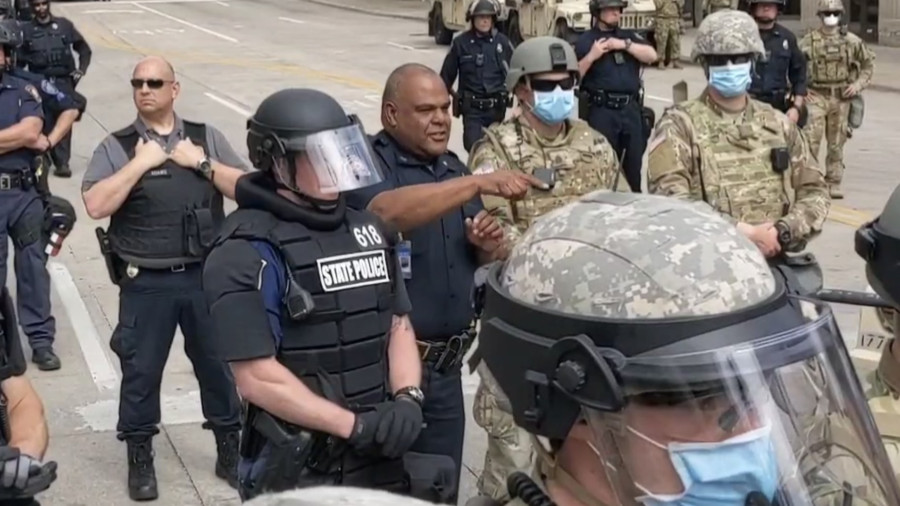
Chief Payne announces his retirement, continues to present a managed narrative about the function of policing in Grand Rapids
Grand Rapids Police Chief Eric Payne has announced that he plans to retire sometime in early 2022, according to a Media Release from the City of Grand Rapids.
 From the Media Release:
According to Payne, those goals included transforming public safety in Grand Rapids by focusing on community relationships, transparency, staffing, and training. City Manager Mark Washington believes Payne has positioned the department, and the City, well heading into the future.
“The last few years have been challenging for law enforcement nationally, and Grand Rapids hasn’t been immune to that, but I can’t imagine a better person to help us navigate this moment than Eric Payne,” Washington said.
“His commitment to the people of this community and his officers has been a guiding force as we worked to reimagine public safety in this City.”
The local news media has pretty much parroted the content of the City’s Media Release on Payne’s retirement and what the GRPD has done since he took over a few years ago. In addition, the local news media has not solicited responses from those who have been critical of policing in Grand Rapids, which also function to keep the managed narrative about the GRPD from City officials.
However, it is important that we do present a contrasting narrative, one that is community based, one that comes from those who have been both impacted by policing in Grand Rapids and have been at the forefront of challenging the GRPD.
Challenging the GRPD narrative
It is instructive to look back at how City Officials and the GRPD have responded since the uprising in Ferguson after the police murder of Michael Brown. The GRPD had a list of reform measures they sought to implement, with the top priority of getting body cameras. This coincided with the GRPD utilizing respectability politics, by getting endorsements from establishment Black voices, instead of paying attention to younger voices who embraced a more abolitionist vision of policing.
There were then repeated examples of GRPD engaging in harm against Black and Brown community members, incidents which received a great deal of public attention, with more push back from the community, particularly in the case of how the GRPD was pulling guns on Black and Brown youth.
After the 2016 election outcome there were also new social movements developing, particularly around immigrant justice, led by Movimiento Cosecha GR. We have seen for years how the GRPD has chosen to police dissident groups in the community, but this took on a whole new dynamic of excessive policing, especially since it was a movement led by immigrants.
This movement engaged in some collaboration with the Black community and involving white allies to challenge the GRPD, particularly around the GRPD surveillance and intimidation tactics used against immigrant organizers.
Then the pandemic happened and the May 30th uprising, which saw even more people challenging how policing was happening across the US and in Grand Rapids. Again, the GRPD and City officials attempted to adopt mild reforms with the hope that it might appease those who were calling for the Defunding of the GRPD. But the Defund the Policing Movement is rooted in an abolitionist vision and will not be appeased with reformist rhetoric or policy changes.
This abolitionist vision is described in the introduction to a new book by David Correia and Tyler Wall, entitled, Violent Order: Essays on the nature of police:
“If we believe policing to be an institution dedicated to promoting safety and security, then we could reasonably assume that improving policing increases safety. If we understand policing as both depending on and generating violence, however, then we understand that the only true way to end the violence of policing is to end policing.”
Just prior to Chief Payne’s retirement announcement, the GRPD published their 2020 Annual Report. In the introduction of the report, Chief Payne states:
This past year we encountered unimaginable obstacles, including a global pandemic, nationwide civil unrest, and extensive reductions to police resources. Despite these difficulties, we have moved the agency forward and developed a stronger community partnership for Grand Rapids. We have implemented an aggressive strategic plan, to restructure, increase transparency, and utilize data more strategically. Our targeted deployments of Operation: Safe Neighborhoods have allowed us to focus on violent offenders, while addressing disparate outcomes.
What is instructive about Payne’s narrative is that it completely omits how the GRPD has intimidated, harassed, targeted, arrested and engaged in an ongoing counter-insurgency strategy to suppress the resistance to policing in Grand Rapids. This is the narrative we must elevate and this is the narrative that defines Chief Payne’s legacy, one of repression and a complete failure to listen to Black and Brown organizers. The call for defunding of the GRPD will continue, regardless of who will be the next Chief of Police.

The Mayor of Grand Rapids is term limited, so why are influential people still giving her campaign money?
 In 2014, when voters decided to term limit Grand Rapids elected officials, those who would win City Commission or Mayoral seats could only serve a maximum of two 4-year terms.
Mayor Bliss was voted in as Mayor in 2016 and 2020, thus she will no longer be able to be the Mayor or Grand Rapids past December 31st of 2024.
According to the most recent campaign finance date (obtained through the Kent County Clerk), Mayor Bliss has $63,963.82 as a balance. It is possible that Bliss might be considering a run for a different elected position, but nothing has been announced to confirm that sort of speculation.
However, in the most recent campaign finance report for January 1st, through July 20th, 2021, Mayor Bliss had received an additional $2,800. Now, this is a small amount, but what is important to point out is who Mayor Bliss received that money from. The most recent campaign finance report show that 15 people contributed, and they all contributed the same amount, $175. Here is a list of those who contributed:
Mike Ellis – Ellis Parking
David Custer – Custer Inc.
Ray Kisor – former Real Estate Broker and Owner of RJK Investments LLC
Carl Erickson – President of Atomic Object
John Truscott – Truscott Rosman, former staff of John Engler
Lawrence Duthler – President of Sun Title
Win Irwin – Irwin Seating
Keith Brophy – CEO of Business Lab
Jim Conner – Manager Triangle Associates Inc.
Ginny Seyferth – President Seyferth PR
John Wheeler – President Orion Construction
Meredith Bronk – President OST
Monica App – Vice President of Properties for Rockford Construction
Rick Baker – CEO of Grand Rapids Chamber of Commerce
Peter Albertini – Realtor for Albertini Properties
All of these people have influence, especially through the companies they are a part of. In addition, many of them sit on the boards of government committees and non-profits in the area, thus further extending their influence, particularly through a pro-Capitalist lens. Lastly, there are several in this group who are also part of the West Michigan Policy Forum (WMPF), which seeks to influence public policy at the state level. Over the years, we have documented the kinds of policies they have worked to put in place, policies that are politically far right and similar to the kinds of policies that the Koch Bothers have been pushing for decades across the country.
The bottom line is that people on this list do not contribute money to politicians without expecting something in return. Whether or not Mayor Bliss decides to run for a higher officer is still undecided, but her history of taking money from wealthy and influential people should be disconcerting to anyone who has a commitment to social justice.
 The most recent campaign finance disclosure date was July 26. We now have some idea of who is funding candidates for upcoming elections, specifically the 2022 race for Governor in Michigan.
This means we now have campaign finance records for Ryan Kelley, the co-founder of the American Patriot Council, who was part of the January 6th attack on the US Capitol, and defender of the Confederate statue in Allendale, Michigan.
There are no glaring revelations when it comes to who has already contributed money to Kelley’s campaign, which to date has raised a meager $34,954. This puts Kelley in fourth place for campaign funds raised by GOP candidates running for Governor in Michigan, well behind Garrett Soldano who has raised $624,827.
The top nine contributors to Kelley’s campaign have contributed $1,000 or more, with the top contributor coming in at $5,000. Those top contributors include:
Steve Zsigray $5,000, Riverside, IL
James Miller $2,500, Gladwin, MI
Michael Kwast $1,500, Belmont, MI
Steve Goeddeke $1,000, Wyoming, MI
David Keim $1,000, Ada, MI
Joseph Moss $1,000, Hudsonville, MI
Jennifer Freed $1,000, Hart, MI
Jamie Fellows-Garno $1,000, Manton, MI
Jeff Grysen $1,000, Allendale, MI
Most of these contributors are business people, with some being fellow realtors (like Kelley) and two chiropractors. Some of them, based on their Facebook profiles, share similar ideological positions as Kelley.
Ryan Kelley the Candidate
Ever since Kelley announced his candidacy for Governor in Michigan, he has tried to distance himself from the American Patriot Council group he formed in 2020. The American Patriot Council website has been dormant since March of this year, with no new content, although numerous posts have been removed in an attempt to distance themselves from the people who have been arrested in the attempted kidnapping of Gov. Whitmer.
If you go to the ryankelley.com site, which is his campaign page, you get what one would expect. There is lots of rhetoric, but little substance. The lack of substance is most glaring when you look at Kelley’s policies page, which reads like a bunch of far right catch phrases, with no clear articulation of anything meaningful.
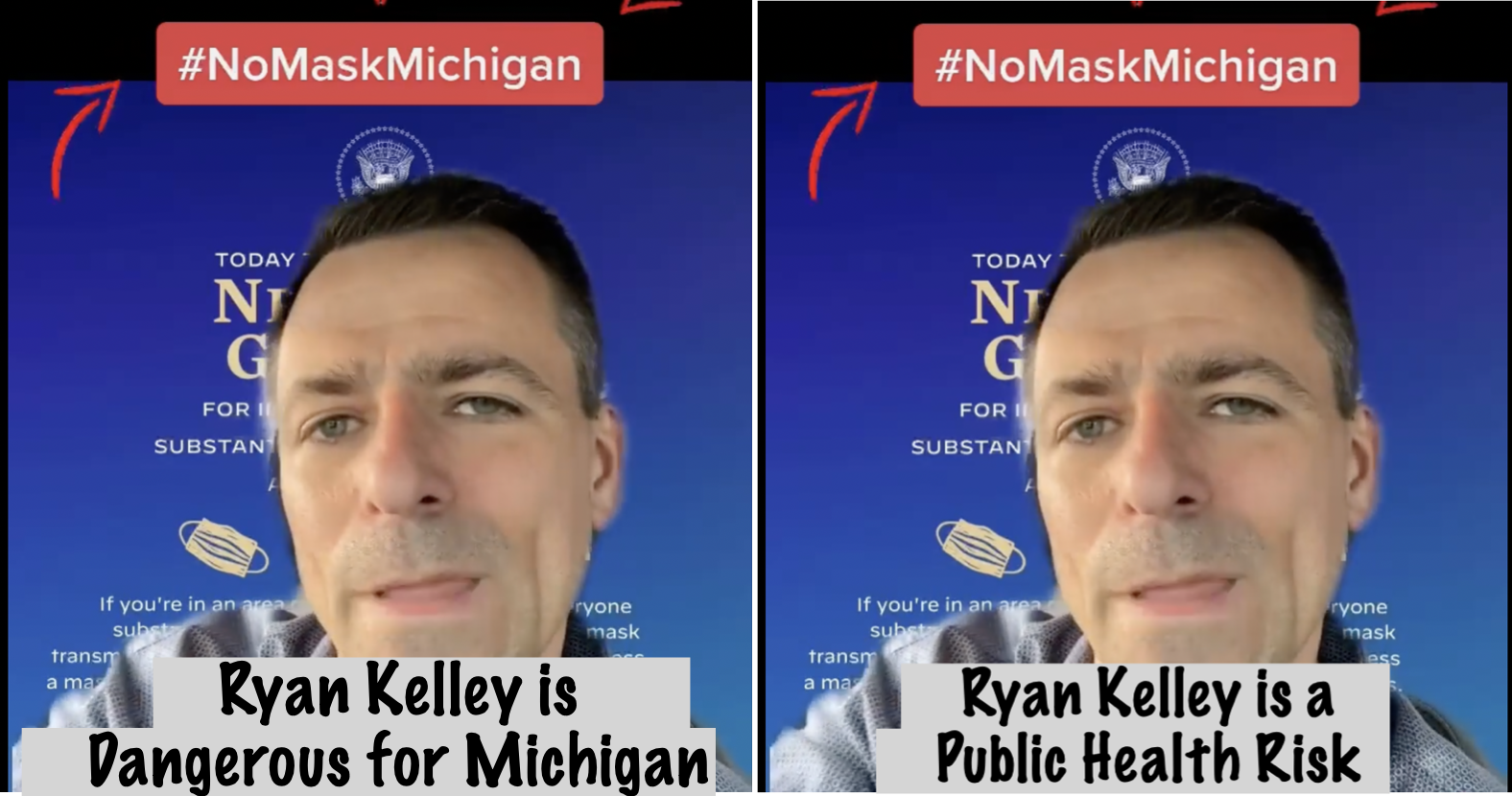
Ryan Kelley’s Facebook page isn’t all that different than his website, although it is more active in terms of content. Within the past week of content, Kelley uses comments from Marjorie Taylor Greene, posts about the contested election results in 2020, comments about his commitment to making Michigan an open carry state and his ongoing belief that COVID 19 was a hoax. His anti-vax and anti-mask positions might be his most dangerous, yet no one in the commercial media is scrutinizing the fact that a GOP candidate for Governor believes that COVID 19 is fake news.
Kelley also makes pronouncements about education, calling for the abolition of Common Core, for parents to get involved in their kids’ school, to teach the US Constitution and to ban any reference to Critical Race Theory or any content that is critical of US history.
Lastly, there is one picture with Ryan Kelley being interviewed by WXMI 17 and Kelley added a quote to the picture from George Orwell, which reads, “The further society drifts from the truth, the more it will hate those who speak it.” Kelley believes he is speaking the truth, yet he has no idea that Orwell would despise Kelley’s politics. Those on the right think that because Orwell wrote 1984, which is a critique of authoritarian government, that somehow their nationalist movement is anti-authoritarian. Orwell signed up to fight against the Fascists during the Spanish Civil War and he would be opposed to the United State’s imperialist policies abroad and its Apartheid style practices at home. Ryan Kelley not only insults the memory of Orwell, he wouldn’t know the truth if it bit him on the ass.
Cops, Clergy and State Violence: The GRPD recruits faith leaders for Clergy on Patrol program
Earlier this week, the Grand Rapids Police Department posted information about a new program they are rolling out called Clergy on Patrol or COP.
According to the GRPD’s post:
The Grand Rapids Police Department is excited to launch a new partnership with area faith leaders, called Clergy on Patrol (COP). The mission is to foster relationships between the police and faith based leaders to build bridges with the community. Clergy members have already started to learn more about GRPD operations and procedures.
During the Grand Rapids Public Safety Committee Meeting on July 27th, Police Chief Payne said that there were already 11 clergy signed up for the GRPD’s
Cops on Patrol program. Payne said he would like to triple that number. Grand Rapids City Commissioner Nathaniel Moody, who is also a pastor, responded by saying, “The clergy that I know, that’s going to participate, they wanna participate. They were excited to hear about it, and they were excited to get the information.”
For those who have been involved in monitoring and resisting US militarism abroad, the language that the GRPD is using to recruit faith leaders is the exact same kind of language that the US Army and CIA were using in manuals to train foreign soldiers in counterinsurgency. This may sound extreme to equate the GRPD’s recruitment of faith leaders to techniques that have been used in counterinsurgency, but to dismiss such a claim would be naive.
The GRPD sees the public, particularly members of the public who are opposing business as usual policies, as insurgents, as people who are a potential threat to order. In the Public Safety Committee meeting mentioned above, Chief Payne stated that he had reached out to the group Justice for Black Lives (JFBL) about getting a permit for their rally/march to City Hall. Chief Payne stated that groups like JFBL need to get permits if they want to do things in a lawful and orderly fashion. In other words, the GRPD wants to be notified, and therefore, have has much control as possible for when there is any demonstration, protest or act of resistance that challenges business as usual.
This is why it is important for us to think about how dangerous it is for faith leaders to be part of the Clergy on Patrol program. We have to come to terms with what the bigger picture is for such programs, which are ultimately about inserting law enforcement – which is state violence – into neighborhoods and through community-based groups. In fact, the more they are inserted into our communities, into our schools, and places of worship, the result would be and increase in surveillance, the expansion of mass incarceration expands and increased justification for state violence.
Now, one major objection to faith leaders working with the GRPD is on moral grounds. The argument usually is framed through a Christian lens and says, “Jesus was all about non-violence, forgiveness and mercy, so collaborating with the police would be contradictory.”
Now I don’t necessarily disagree with such a response, but these are theological and biblical arguments which have been had since St. Augustine developed the Just War Theory. I am much more interested in looking at the distinction between the interpretation of faith teachings and the historical record of how faith communities have acted. In fact, if one were to take a close look at the history of Christianity and its support of State Violence, then one would see that it has not been an aberration, but the norm.
This is just a brief sampling of what we mean when we say that Christian Clergy have been intricately connected to State Violence over the centuries:
- The Crusades
- The Inquisition
- The Witch Trials in Europe and in North America
- Every example of European Colonization involved Christian Clergy and communities
- The Genocide of Indigenous people in the so-called Americas.
- Slavery of African people
- Forced removal of Indigenous children into boarding schools – most of which were run by Christians.
- The rape and murder of Indigenous Children at so-called boarding schools.
- Christian support of and enforcement of Jim Crows laws.
- Christians defending segregation and voter suppression.
- Chaplins in the US Military.
- Chaplins in Police Departments.
- Chaplins in jails and prisons.
- Christians in active support or complicity of US militarism for the past 150 years.
- Christians in active support of complicity of White Supremacy for centuries.
Again, this is a very brief list of the ways in which Christian Clergy have participated in State Violence. However, there are no doubt people who will point out that their church did not participate in Colonialism, White Supremacy, US militarism or other forms of State Violence. My response would be the same response that Dr. King gave to Christian ministers (a message he wrote in a Letter from a Birmingham Jail) who told King that he and the Black Freedom Struggle were demanding too much:
I must make two honest confessions to you, my Christian and Jewish brothers. First, I must confess that over the past few years I have been gravely disappointed with the white moderate. I have almost reached the regrettable conclusion that the Negro’s great stumbling block in his stride toward freedom is not the White Citizen’s Counciler or the Ku Klux Klanner, but the white moderate, who is more devoted to “order” than to justice; who prefers a negative peace which is the absence of tension to a positive peace which is the presence of justice; who constantly says: “I agree with you in the goal you seek, but I cannot agree with your methods of direct action”; who paternalistically believes he can set the timetable for another man’s freedom; who lives by a mythical concept of time and who constantly advises the Negro to wait for a “more convenient season.” Shallow understanding from people of good will is more frustrating than absolute misunderstanding from people of ill will. Lukewarm acceptance is much more bewildering than outright rejection.
For those of you who are part of faith communities, I hope that you will actively resist collaborating with the GRPD. Doing so, would only solidify your complicity in State Violence.

The Grand Rapids Power Structure is backing Mark Huizenga in a big way for the 28th Senate District
The Grand Rapids Power Structure has made it clear that of the three GOP candidates running for the 28th District Senate seat, they are picking Mark Huizenga.
Huizenga is running against Tommy Brann and Kevin Green, all of who have been State Representatives. The two Democratic Party challengers are Keith Courtade and Gidget Groendyk, but neither of them stands a chance to defeat the GOP candidate that has the financial endorsement of every major player in the Greater Grand Rapids area.
Huizenga is the choice of the most powerful people in West Michigan because he has consistently demonstrated his allegiance to the issues that best represent their interests – a pro-business, reduce taxes on the rich, small government, Anti-Choice, anti-Labor Union, and pro-police positions.
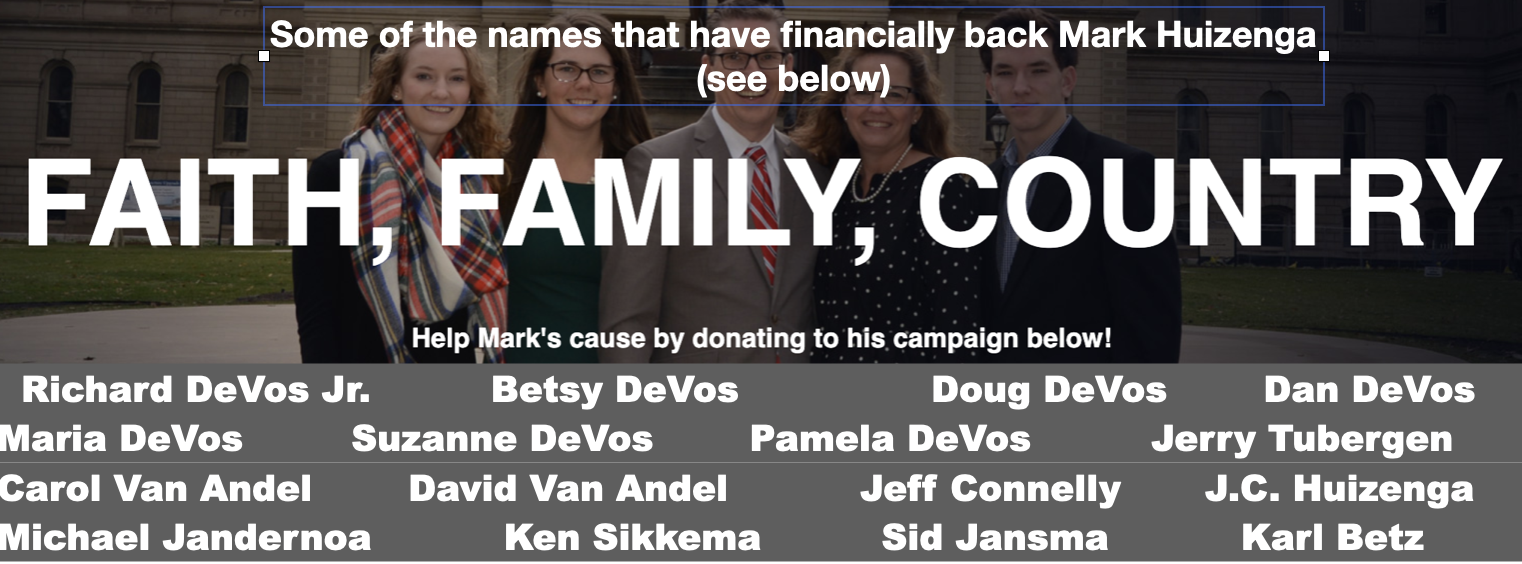
I mean, the first thing you see when you go to Huizenga’s Senate candidacy website are the words, Faith, Family, Country. https://votehuizenga.com/ Of course, there isn’t much information about Huizenga’s platform or his voting record of the years, but these are details that the people just don’t really care about. At least, that is what we are told.
So here is a rundown of the financial backed that Mark Huizenga has received from those with tremendous political and economic power in the Greater Grand Rapids area, based on date from the Secretary of State’s Office.
Betsy DeVos $2,100
Ken Sikkema $2,100
Karl Betz $2,100
Carol Van Andel $2,100
Patricia Betz $2,100
Dan DeVos $2,100
Jeff Connelly $2,100
Maria DeVos $2,100
John Weller $2,100
Timothy Schowalter $2,100
Jim Williams $2,100
Tom Helmstetter $2,100
Sid Jansma Jr. $2,100
Jeffrey Baker $2,100
Suzanne DeVos $2,100
Jerry Tubergen $2,100
S. Helmstetter $2,100
Daniel Hibman $2,100
Bill Morren $2,100
J.C. Huizenga $2,100
Carla Sikkema $2,100
David Van Andel $2,100
Doug DeVos $2,100
Richard DeVos Jr. $2,100
Stephen Ehmann $2,100
Pamela DeVos $2,100
Michael Jandernoa $2,100
Now this list just represents the list of those who contributed the maximum amount for individuals. There are also other people who are part of the local power structure that contributed less than the maximum $2,100, some $1,500 and some $1,000, but you get a pretty clear idea from this list.
Now I am not a betting man and neither are those with deep pockets. The list of people here are strategic in their thinking, no matter how vile or loathsome they might be, they don’t just throw their money around. I would find it hard to believe that on August 4th, there would be a name other than Mark Huizenga as the winner of the August 3rd Primary for the 28th District Senate Seat.
So, how do we counter the political and economic influence that the Grand Rapids Power Structure wields? I don’t believe that it is a matter of matching their funding with better candidates. I believe that we build powerful social movements that can not only challenge the policies implemented by the Capitalist Class and their bought politicians, but more importantly, we build movements that actually create the kind of world we want to live in. We need to build social movements that practice direct democracy, direct action and collective liberation instead of playing the chess game that those in power want us to play.
I’m sure we have all seen the Anti-Defund the Police meme. Hell, maybe some of you have even posted it. It’s the left side of the graphic here below.

This meme is so insidious and started appearing shortly after the Defund the Police Movement began, as a clear response to the police murder of George Floyd. It is critical to deconstruct any form of propaganda and this one is particularly important to deconstruct, especially since the Movement to Defund the Police is at a critical juncture.
There is a lot to unpack with this meme, but I want to point out three major aspects.
First, let’s look at the content of this meme. The whole “let’s transform, reform, rebuild, retrain the police” is simply a dead end. If you have read Alex Vitale’s book, The End of Policing, or any of Kristian Williams books on the history and function of policing in the US, you realize that trying to reform policing simply will not work, not if we are serious about ending state violence.
Moving beyond the slogans at the top of this meme, we then get to the narrative, which makes the case that if police numbers are reduced that criminal will run wild. There is little evidence to support such a claim, and the fact is that people who commit crimes already get away with whatever crime they commit, despite the fact that US police departments are massive, with tremendous weaponry. Moving on the narrative claims that this is damaging the Black Lives Matter cause. Ok, stop right there. The Defund the Police Movement actually comes out of the Movement for Black Lives, in part because of the lived experiences of Black people being brutalized by the cops and because of the decades long push to Abolish various forms of State violence, particularly the Prison Industrial Complex. The meme then continues to say that demanding to defund the police will hurt, “our chances of beating Trump in November.” Why is it that White Liberals always think that Social Movements are subservient to elections?
Second, at the bottom of the meme, it says that the message came from the American Women’s Coalition. The American Women’s Coalition has no other online presence that a Facebook page, which was created by and run by Eve Sharon Hart, someone who is a “life coach” and lives in Laguna Beach, California. The Facebook page for the American Women’s Coalition states, “We are a new group for progressive, liberal and independent women of integrity, intelligence and heart, who are on a journey of both personal growth and political action!” However, no other people or organization are named as part of this coalition, which should raise lots of red flags. Coalitions have multiple groups, yet there is no evidence that the American Women’s Coalition is more than a one person gig.
Third, and most importantly, the Defund the Police Movement is a direct outgrowth of the Movement for Black Lives and other Black organizers that have been using an abolitionist framework to challenge numerous aspects of State violence over the past several decades.
If people would actually read the Defund the Police Toolkit https://griid.org/wp-content/uploads/2020/06/movement-for-black-lives-defund-police-toolkit.pdf, we could easily dispose of these harmful memes created by White Liberals. Here are the opening words of the toolkit:
#DefundPolice is a demand that has gained popularity in response to recent police killings of George Floyd, Breonna Taylor, and Tony McDade. It is rooted in the failure of decades of commissions, investigations, police reforms, and oversight to prevent their deaths.
It is also a response to the fact that, in the face of a pandemic and the most devastating economic crisis of a generation, in which cities, counties, and states are experiencing drastic losses in revenues, many life-saving programs are on the chopping block while officials increase or maintain police budgets.
It is a demand to #DefendBlackLives by shutting off resources to institutions that harm Black people and redirecting them to meeting Black communities’ needs and increasing our collective safety.
#DefundPolice is a demand to cut funding and resources from police departments and other law enforcement and invest in things that actually make our communities safer: quality, affordable, and accessible housing, universal quality health care, including community based mental health services, income support to stay safe during the pandemic, safe living wage employment, education, and youth programming. It is rooted in a larger Invest/Divest framework articulated in the Movement for Black Lives’ Vision for Black Lives.
It is high time that white people stop telling everyone else what they should do, particularly when it comes to how to deal with systems of oppression. White people need to shut up and listen to what Black people are telling them they want. White people also need to educate themselves on the history of the Black Freedom Struggle instead of just re-posting harmful memes that make them feel less threatened.
Acton Institute’s shameful defense of Billionaires
There are lots of critiques and memes these days calling out Jeff Bezos for spending a shit ton of money to go into space. While I generally view such attention as a distraction, it has provided an opportunity to talk about Capitalism and the Billionaire Class.
In many ways, the Billionaire Class are an easy target, but useful as a way of framing the problem of wealth in society. For example, according to a recent Forbes report, in looking at the current wealth of Jeff Bezos, he makes $215,068,493 every day, which translates into $8,961,384 per hour or $149,353 a minute. This means that Bezos makes more money in a minute than millions of Americans will make in a year.
On the flip side, you have organizations, like the Acton Institute for the Study of Religion and Liberty, who have since their founding in 1990, have vehemently defended Capitalism. This is not surprising, considering the fact half of the members of the Acton Board of Directors are millionaires, with one member, Rick DeVos, being part of a Billionaire family.
Then on July 13, the Acton Institute posted an article entitled, Are Billionaires Evil? The article wasn’t about actually answering this question, as much as it was a defense of billionaires, wealth accumulation and Capitalism.
The article was written by Ben Luker, who is a Junior at Calvin University. According to Ben’s Linedin page, he worked as a sales associate for Boyne Country Sports for 6 months in Grand Rapids, plus he worked for 2 years at a concert set up and security group in his hometown of Grand Junction, Colorado. Considering his extensive job experience, it would appear that Ben has no clue as to realities of what it means to be part of the working class, nor the realities of how the Capitalist Class has been hell bent on exploiting workers, since Capitalism began centuries ago.
But hey, there’s nothing like drinking the Capitalist Koolaid and defending Billionaires.
The article by Luker is brief, which begins with a quick dismissal of the criticisms of the Billionaire Class, then shifts to proclamations about how wealth promotes innovation and opportunity. Luker does admit that some of, “the ultra-rich have engaged in shady and immoral business practices.” The Acton writer cites illegal schemes made recently by Amazon, but only because it was outside the law.
What young Ben Luker, the Acton Institute and other defenders of Capitalism will never talk about is the fact that:
- It is completely legal for someone like Jeff Bezos or Hank Meijer to exploit workers in their own companies, paying them wages that require people to seek out various forms of charity just to survive.
- It is completely legal for members of the Capitalist Class to pollute the world with toxins – called externalities – and to extract massive amounts of fossil fuels to make billions in profits, while contributing to Climate Catastrophe.
- It is completely legal for members of the Capitalist Class to buy politicians and to influence public policy that benefits their bottom line, like not raising the minimum wage or creating tax policies that make it so that the wealthiest pay virtually nothing in taxes.
- It is completely legal for members of the Capitalist Class to hide large amounts of their wealthy from being taxed, by creating foundations that are not only another way of practicing social management, it provides them with a fabulous PR opportunity to talk about how much they care about “the community.”
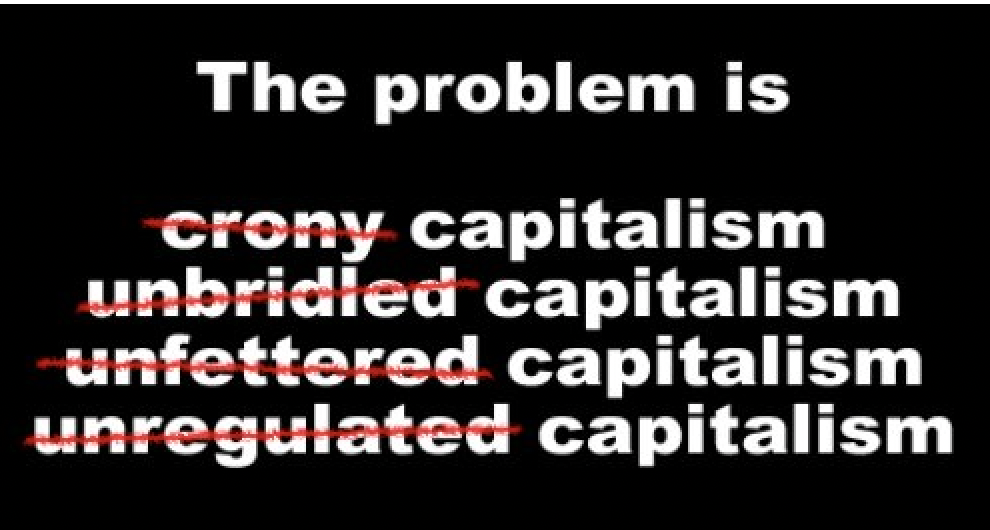
It is completely understandable for people to have nothing but contempt for Jeff Bezos, Hank Meijer, and the rest of the billionaire class. However, it is critical that we don’t let our contempt of the billionaire class cloud our analysis of the economic system that spawned billionaires in the first place. We must make it a priority to dismantle the system of Capitalism and replace it with other economic mechanisms that are not only sustainable, but honor the humanity of everyone on the planet.
A short history of the GRPD Budget
The Grand Rapids Police Department, the Grand Rapids Police Officer’s Association and City officials have all pushed back against a significant call from the community to defund the police department.
In June of 2020, when the coalition of groups that formed to demand that the GRPD be defunded, some City officials were willing to listen to what the community had to say. However, the City Manager and the City Attorney stepped in and prevented a proposal from several City Commissioners to actual reduce the GRPD’s budget.
Since then, there have been two dominant narratives coming from the police. The first narrative is that the GRPD have made reforms, a narrative that is hollow and meant to distract us from seriously investigating the real function of policing in this society.
The second narrative coming from the GRPD has been that gun violence is on the rise, therefore this would be a bad time to defund the GRPD. The reality is that the GRPD rarely ever actually prevents gun violence or other homicides from happening in this city, they just show up after the fact. In other words, the GRPD does NOT prevent violence, they only manage it, particularly violence from below.
Structural violence – the violence of poverty, the violence of low wages and the violence of food insecurity – these forms of violence, which do more harm in our community, are never prevented or even considered by the GRPD. In fact, structural violence, which is violence from above, from those with political and economic power, are protected and defended by the GRPD.
I was recently reading Sidney Harring’s, Policing A Class Society: The Experience of American Cities 1865 – 1915, and came across a brief description of a labor strike in Grand Rapids in May of 1891. I decided to look up how the local newspapers reported on the strike.
Both cable and horse car workers went on strike May 10, 1891, for higher wages and union contracts. The company began hiring scab workers immediately. As the week progressed, workers tried to keep cars from running, first by inducing others not to take their jobs, but later also by blocking the cars.
The Grand Rapids Eagle and the Grand Rapids Democrat newspapers, both reported on the strike. The Grand Rapids Eagle even reprinted the text of a flyer that the striking workers were handing out, which includes information about a labor parade and the role of the local Sheriff’s office. The same was the case during the 1911 Grand Rapids Furniture Workers Strike and any other worker strike that has happened in this city. The police show up to defend the company, to protect scab workers, to defend the Capitalist Class and to defend business as usual.
Policing was created in the US prior to the Civil War with the use of slave patrols, where men were hired to hunt down and bring back those who had fled slavery, especially after the passage of the Fugitive Slave Act in 1850.
Since then, police departments, like the GRPD, have existed to keep social order for those with power, whether that is to suppress strikes or make sure that Black, Latinx, indigenous and other communities of color do not assert their rights.
It is instructive to note that has Black, Indigenous and Latinx people have asserted their rights, particularly since the late 1950s, one can see how police budgets across the US and right here in Grand Rapids have increased. These increases in police budgets have also coincided with an increase in the funding for law enforcement at the federal level.
In her important book, America on Fire: The Untold History of Police Violence and Black rebellion Since the 1960s, Elizabeth Hinton makes a clear correlation between increased federal spending on policing and Black militancy. For instance, after the 1967 riots occurred in cities across the country, Congress passed The Omnibus Crime Control and Safe Streets Act of 1968. This legislation not only increased funding for the police, it provided an upgrade in weaponry.
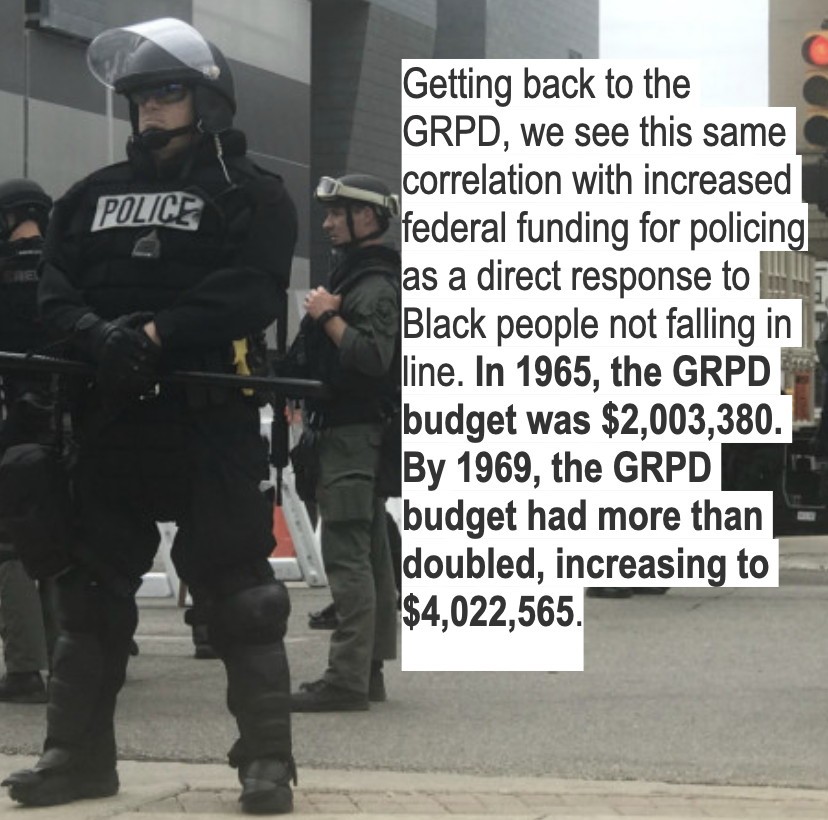
Getting back to the GRPD, we see this same correlation with increased federal funding for policing as a direct response to Black people not falling in line. In 1965, the GRPD budget was $2,003,380. By 1969, the GRPD budget had more than doubled, increasing to $4,022,565.
We can then look to passage of The Violent Crime Control and Law Enforcement Act of 1994, commonly referred to as the 1994 Crime Bill, which also provided massive increases in police funding. In Grand Rapids, the GRPD budget was $23,762,515 in 1994. In 1995, the City Charter was changed to make it so that at least 32% of the City’s budget would be allocated to the GRPD. By 1996, the GRPD budget grew by more than 3 million, totaling $27,865,047.
In 2000, just prior to 9/11, the GRPD’s budget was $39,533,775. After 9/11, the rhetoric at the federal level supporting the police was very high, so naturally the federal government was able to push for more police funding in order to fight against domestic terrorism. This led to the creation of the Department of Homeland Security and the further militarization of the country. By 2003, the GRPD’s budget had grown to $43,207,168.
In 2020, we saw the largest anti-police protests in US history. Cities all across the country were protesting against the continued police killing of Black people. On May 30th, 2020, Grand Rapids saw a similar response.
The Biden administration has already been calling for an increase in police funding, so one would think that funding for police at the local level would increase as well. However, because of the massive call for defunding police departments, we have not seen a significant increase at the local level. In Grand Rapids, the budget for the GRPD did increase, but only by $700,000, bringing the total to $55.81 million for 2022. Any increase for the GRPD budget is still too much, but it is important to acknowledge that for the first time in Grand Rapids, and across the US, there is a defund the police movement that has already had tremendous success in challenging the power of the police and police funding.
 Grand Rapids Institute for Information Democracy
