Radical Imagination and funding priorities during a Climate Crisis
 As the United Nations Climate Change Summit, often referred to as COP26, enters its last week, most climate activists around the world realize that these gatherings of world leaders do not and will not result in any serious plan to reduce our collective dependence on fossil fuels.
Over and over again, the Climate Justice Movement, particularly in the Global South, have made it clear that the most powerful nations on the planet continue to use lofty rhetoric, but fail to embrace policies and practices that will avert further climate disaster.
As many climate activists have pointed out, world leaders are ultimately beholden to the Neo-Liberal Capitalist economy that drives the push towards global climate disaster.
Many climate activists also have been pointing out for years that we often fail to radically imagine a different world, a world outside of Capitalism and dependence on the use of fossil fuels. One clear example is centering around funding priorities.
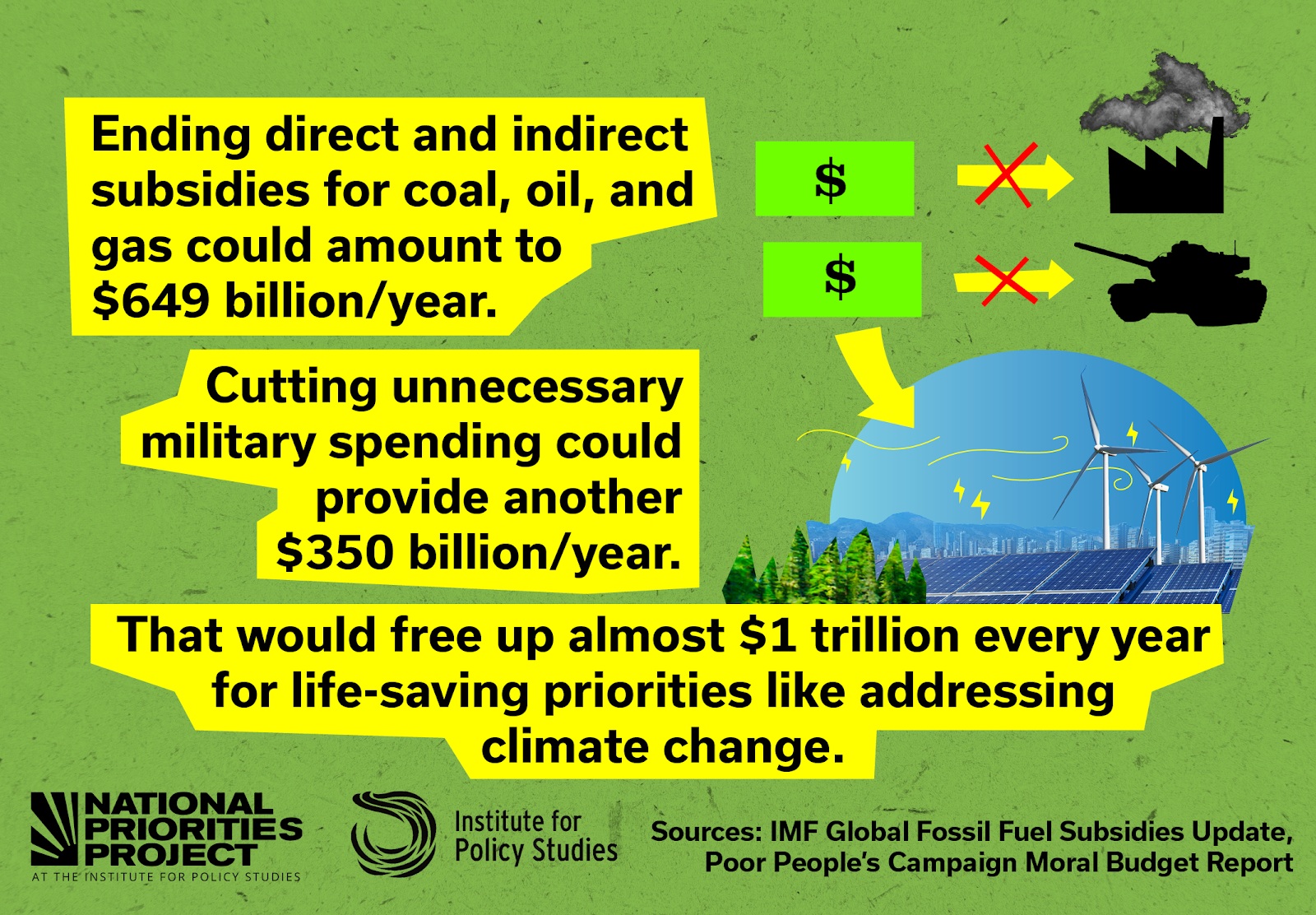
Most of us are probably aware of the fact that the fossil fuel industry receives massive taxpayer subsidies.Global giveaways to oil, gas, and coal companies total more than $444 billion per year. That’s nearly $1 million every minute.
In the US, the Environmental and Energy Study Institute reported that direct subsidies to the fossil fuel industry total $20 billion per year, with 80% going toward oil and gas. This is exactly why the fossil fuel industry spends millions every year to contribute to political candidates and to lobby Congress. OpenSecrets.org reported that the fossil fuel sector had already spent $81.9 million on lobby in the first three quarters of 2021, just prior to COP26.
 Now, if we were to apply some radical imagination in the US, what could we do with the $20 Billion we give to the fossil fuel industry in subsidies? How much could $20 Billion reduce student debt? How many homes could be built for $20 Billion? What could $20 Billion a year buy in terms of sustainable energy? And remember, this happens on an annual basis.
Another are we could exercise out radical imagination would be in looking at how much money the US spends on militarism and war. In a recent report put out by the National Priorities Project and the Institute for Policy Studies, they provide us with some very clear numbers on what the US has spent on militarism since 9/11.
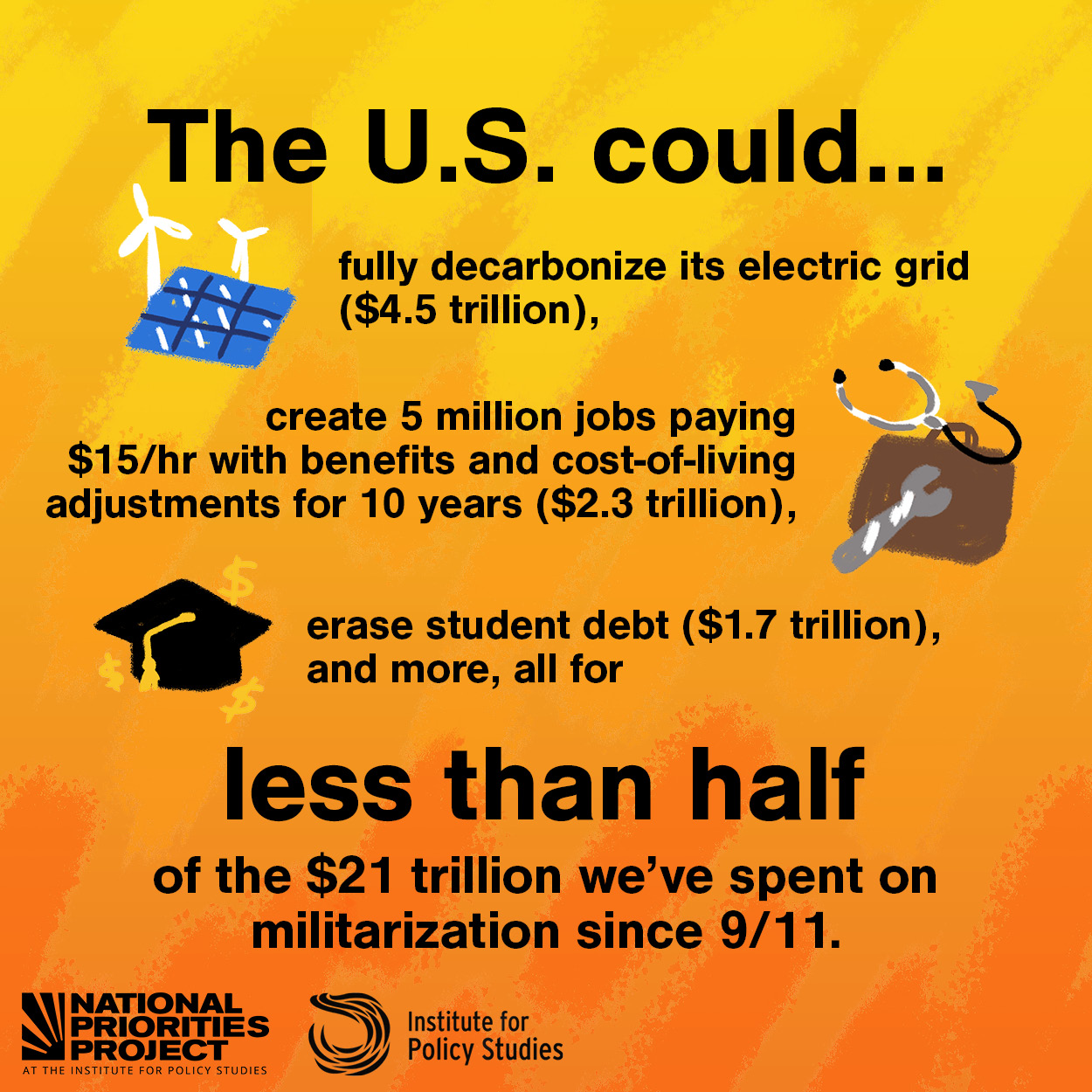
The US has spent $21 Trillion on foreign and domestic militarism. Here are some numbers these groups provide, that practice a radically imagined use of $21 Trillion that would support life-affirming projects.
For far less than it spent on militarization since 9/11, the U.S. could reinvest to meet critical challenges that have been neglected for the last 20 years:
-
- $4.5 trillion could fully decarbonize the U.S. electric grid.
- $2.3 trillion could create 5 million jobs at $15 per hour with benefits and cost-of-living adjustments for 10 years.
- $1.7 trillion could erase student debt.
- $449 billion could continue the extended Child Tax Credit for another 10 years.
- $200 billion could guarantee free preschool for every 3-and-4-year old for 10 years, and raise teacher pay.
- $25 billion could provide COVID vaccines for the populations of low-income countries.
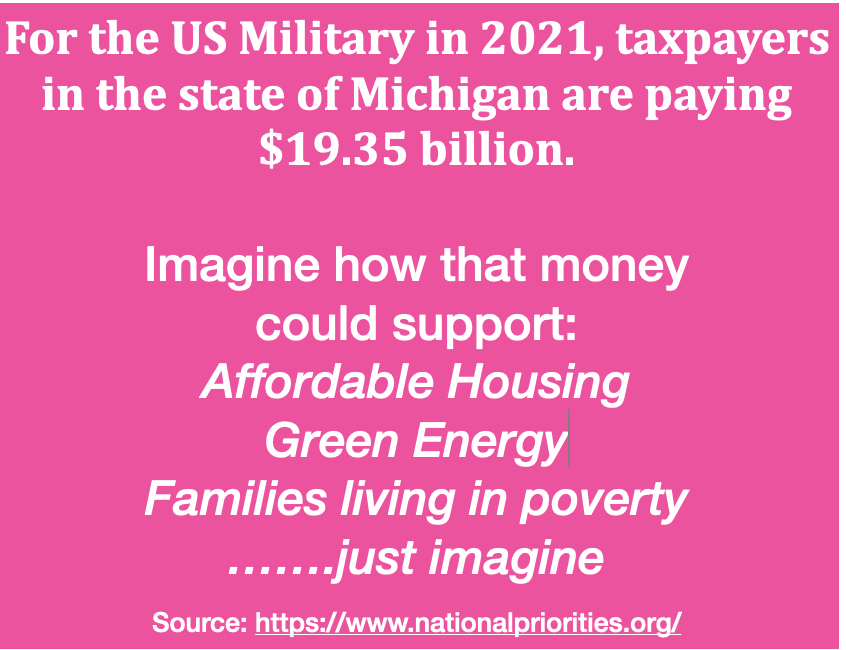
In 2020, Senators Markey and Sanders proposed legislation to cut the $740 Billion US Military Budget by 10%, thus diverting $74 Billion to social programs. The Senate voted against such a proposal by a vote of 77 – 23, with both Michigan Senators voting against reducing the US military budget.
When people ask how can we pay off the student debt in the US, Medicare For All, or any number of project areas that would improve millions of lives of US residents, it is never a question of money, rather it is always a question of priorities.
 This is one of the arguments that the Defund the Police Movement has been making. Since there is no serious evidence that policing prevents crime and violence in the US, what if the money we currently spend on policing was diverted to programs and projects that specifically benefit BIPOC communities.
These are not only the kinds of questions we need to be asking ourselves, but we need to practice radical imagination in our organizing work so that other people can see how they would benefit from these kinds of priority shifts, along with the fact that our planetary future depends on it.
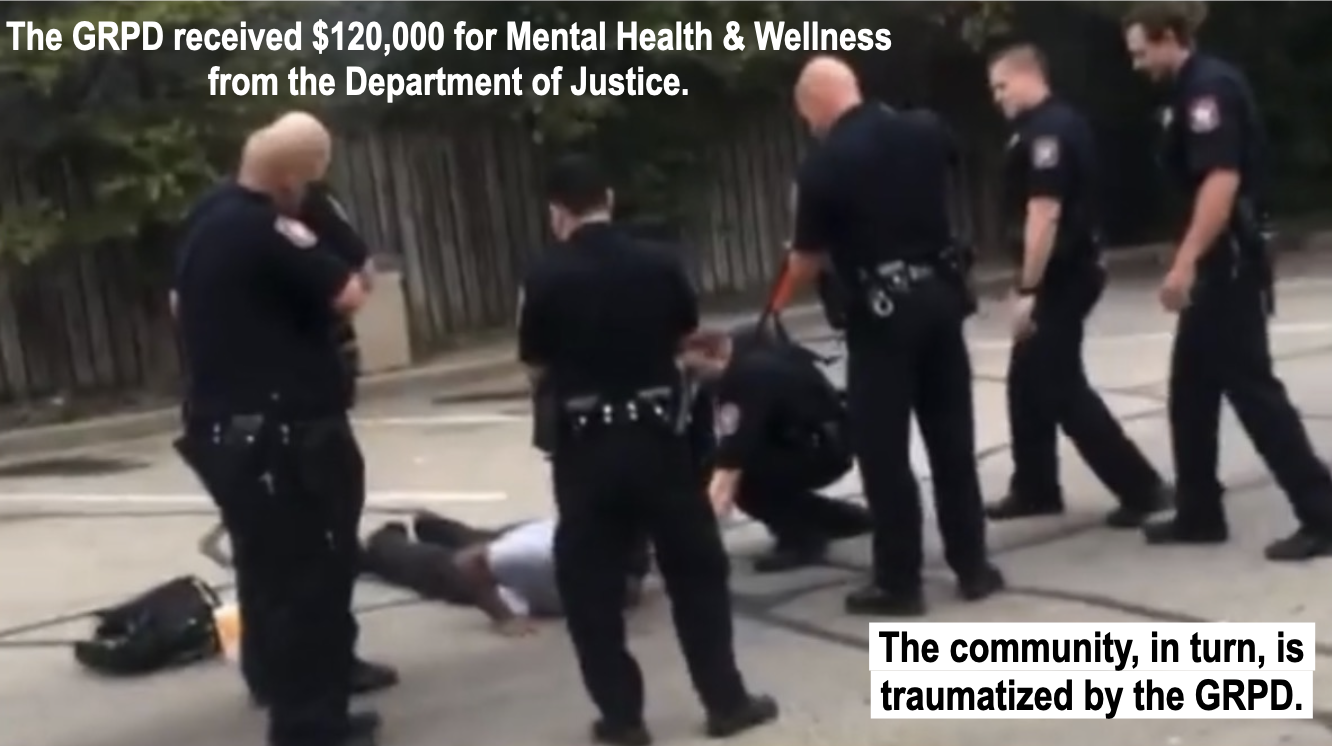 One item on the October 26th City Commission Agenda, from a recommendation through the Fiscal Committee (pages 9 – 10), was a $120,000 grant to be awarded to the GRPD from the US Department of Justice.
The DOJ grant came from their FY 2021 Law Enforcement Mental Health and Wellness Act program. According to the Fiscal Committee’s Agenda packet:
The award in the amount of $120,000, will enable the GRPD to implement a universal in-service mental health wellness training for sworn officers and eligible civilian staff. The project will address risk factors that can damage public trust, with goals to build community trust and transform departmental culture around mental health. The award period for this grant is September 1, 2021 through August 31, 2023, with no match required.
The Fiscal Committee Agenda Packet then has the following additional information in regards to the Law Enforcement Mental Health and Wellness grant money:
GRPD’s strategic plan emphasizes building community trust within the framework of neighborhood-based policing, with one strategy emphasizing officer wellness. This project focuses on mental health wellness because repeated exposure to trauma and occupational stress can pose significant risks to officers’ mental health. Poor mental health can lead to poor judgement and poor performance, which damages public trust. This first major initiative of GRPD’s fledgling wellness program will acquire expert trainers with a background in first responder/military background through competitive bid. The curriculum will focus on resilience, stress management, PTSD, sleep hygiene, and first responder needs and culture. Eight (8) one-day workshops will be arranged to accommodate the patrol schedule, and peer support will promote the training as a positive wellness activity. The Wellness Coordinator will review surveys and other data with the Wellness Committee to track skills utilization and identify needs that may influence the design of the wellness program.
It is problematic that the person who will be doing the mental health and wellness training for the GRPD will be someone “with a background in first responder/military background.” Why do they need people with this kind of background to offer training for those who would potentially be dealing with PTSD?
Equally problematic is the language around how all of this mental health and wellness training is critical for building community trust. The statement above says, “Poor mental health can lead to poor judgement and poor performance, which damages public trust.” While there may be some truth to this dynamic, the fact is that whenever the GRPD engages in cases that have received some media attention and calls for community accountability, the Chief of Police always says that the GRPD officers involved always “acted appropriately.” If the Chief of Police is saying that his officers acted appropriately, then it would be reasonable to say that it has little to do with cops who have poor mental health and are using poor judgement.
Let us look at a recent case where the GRPD acted appropriately, but falsely arrested a Black man, simple because he “fit the description.” On September 3, the GRPD responded to a call about a breaking and entering. Several police officers stopped a Black man who “fit the description,” and then called for backup, simply because the Black man who was falsely accused, did not obey the cops. The Chief of Police defended the action of the officers who arrested the Black man who was falsely accused, saying once again that these officers followed protocol. It should be stated that the Kent County Prosecutors office dropped the charges last week against the Black man who was falsely arrested on September 3rd.
In this case, like so many others, the people who are in need of mental health and wellness support, are the people who are being harassed, intimidated and arrested – often at gunpoint – by the GRPD. Why are there no US Department of Justice funds being made available for the victims of how the GRPD does policing in this community?
In addition, if the GRPD emphasizes the need to build community trust, these kinds of cases, along with so many others, will do nothing more than create even more distrust between the GRPD and the community, particularly Black and Brown communities.
Despite this recent history, the City Commission approved the $120,000 grant from the Department of Justice to help cops who regularly stop Black residents at gun point.
More funding for the GRPD approved
In the City Commission Agenda packet for the November 9th meeting (pages 13 & 14), there are additional items for the GRPD that the commissioners approved for funding. The first item was a new low light camera for $11,599, to be purchased from Crime Point Inc., a company that specializes in surveillance.
A second item for the GRPD that was approved was 2 radar speed trailers for the Mobile GR department from Kustom Signals, Inc. for the total amount of $24,824. Kustom Signals Inc. has their own blog, with content which is always from a pro-cop perspective, such as their post about Riot Police and Crowd Control.
A third and final item that was approved for the GRPD for the purchase, delivery, and installation of exercise equipment for the Police Department from Strengthio Fitness for the amount of $47,838.20.
So it seems that the GRPD, despite their ongoing harassment of activists and their policing practices that disproportionately target Black and Brown neighborhoods, has received lots more taxpayer money to use against the residents of Grand Rapids and to provide even more support for cops, even if those cops traumatize members of the community.
In anticipation of Whitmer veto, Michigan GOP has begun a petition campaign to allow the use of public money for private and religious education
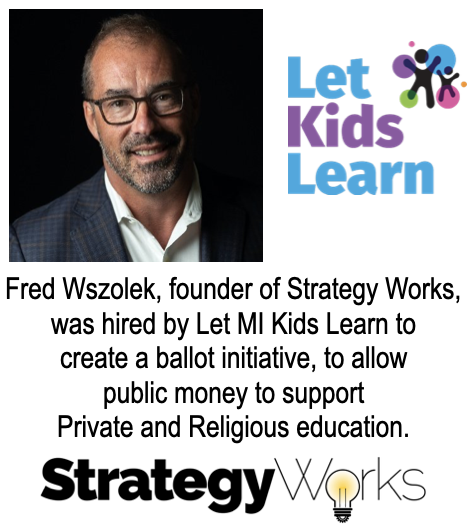 Last week, it was announced that the Let MI Kids Learn ballot committee was forming, in order to begin collecting signatures for a ballot campaign that would essentially support the very legislation that Gov. Whitmer plans to veto.
On October 24, we reported on the Senate and House bills that passed in the Michigan Legislature, bills that will do what Betsy DeVos has been attempting to do since 2000, with her failed school voucher ballot initiative.
In the article from late October, we laid out 4 tactics that the DeVos family has been using to get public money to support private and religious education. Those tactics include – the financial backing of candidates who would embrace such policies, to attacked public teacher unions, to utilize the expertise of far right think tanks in Michigan, and to create their own education-centered non-profit, the Great Lakes Education Project.
“The passage of this legislation was a test for Governor Whitmer: she could stand with families and children, or she could stand with special interests. Sadly, but predictably, Whitmer chose the special interests – as she always has. But Michigan’s constitution gives voters a recourse, and our petition drive will allow voters to expand opportunities for children, even if Whitmer won’t.”
The above comment comes from Rep. Bryan Posthumus, one of the state legislators that the DeVos family has provided thousands of dollars in campaign contributions. The DeVos family, especially through the group the West Michigan Policy Forum, has continually attacked public teacher unions, which is the second tactic they use. The DeVos-led effort around these bills also has the support of the Mackinac Center for Public Policy, which is the 3rd tactic they employ. Lastly, the DeVos-created Great Lakes Education Project (GLEP) has been a major champion of these bills and will likely support the ballot initiative that the Let MI Kids Learn organization is moving forward with.
Let MI Kids Learn needs to collect 340,000 valid signatures from registered voters for both petitions in six months.
Spokesperson for Let MI Kids Learn, Fred Wszolek was quoted in the Detroit News as saying, “This exciting legislation gives new opportunities to learn to children, and new choices to tens of thousands of Michigan parents. But Gov. Whitmer stands in the schoolhouse door with her veto pen, determined to strip families of any choice, and deny children the money they deserve for educational opportunities. We’re just as determined to veto Whitmer’s veto with our petition.”
Wszolek is the co-founder of the Lansing-based organization know as Strategy Works, has worked on numerous GOP candidate broadcast ad campaigns, but specializes in the passage and defeat of ballot proposals.
Fred Wszolek recently headed up a ballot initiative for Unlock Michigan, which is a campaign to prevent the Governor from adopting certain emergency policies, like we saw in 2020, when Gov. Whitmer mandated lockdown orders as a means of minimizing the harm of the COVID virus.
Interestingly enough, the address for the Unlock Michigan campaign – 2145 Commons Parkway, Okemos, MI 48864 – is the same address being used for Let Mi Kids Learn campaign. The 2145 Commons Parkway, Okemos address is also the address for Doster Law Offices, PLLC. Doster Law Officers was founded by Eric Doster, who was longest-serving General Counsel in the history of the Michigan Republican Party, having served in this position from 1992 to 2017.
It would seem that the GOP is well organized for the Let MI Kids Learn campaign. It will be interesting to see how the Democratic Party, the MEA and those who are committed to public education respond to the Let MI Kids Learn campaign.
 I recently received the following E-mail from Senator Peters:
The Great Lakes are more than an economic engine and ecological treasure: they are simply in our DNA as Michiganders. That’s why I was alarmed when the Coast Guard told me that they were unprepared to deal with oil spills that occur in freshwater environments – and that more science and research was needed around the issue. This puts the Great Lakes, and the businesses and communities that depend on them, at risk.
As a result, I set out to create a new Coast Guard National Center of Expertise – to help us learn more about cleaning up oil spills in freshwater. After my bill establishing the Center was signed into law, I secured the funding needed to get the Center up-and-running.
On the Senator Peters’ website, it states that he secured $4.5 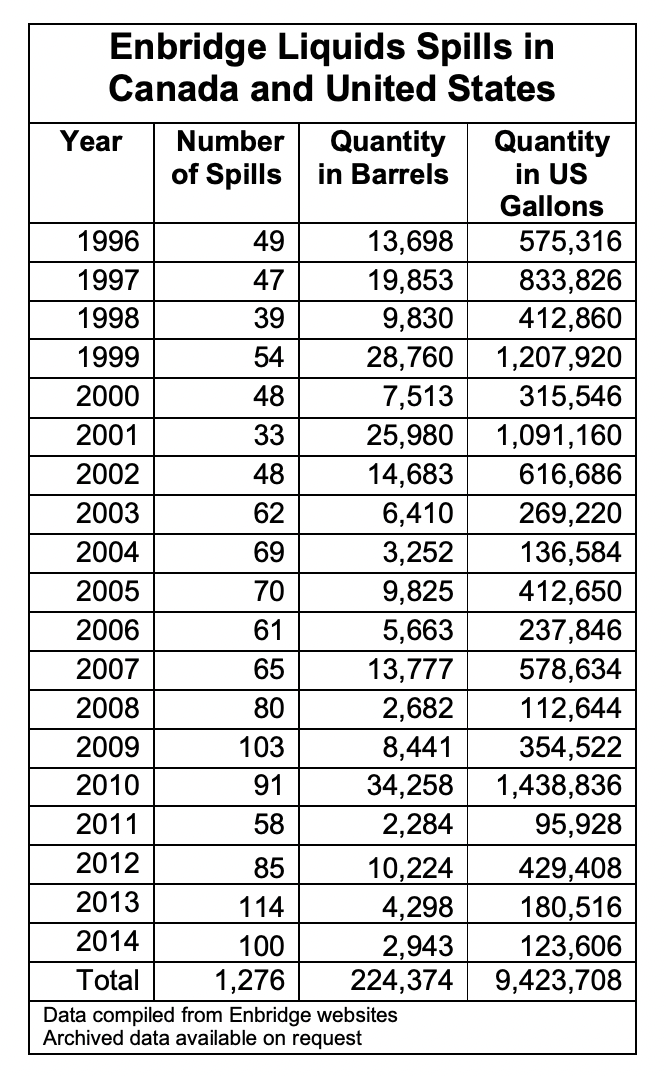 million for this project, which will be a collaboration between a few universities and the US Coast guard. Nothing is his E-mail or his post from October 21st, says anything about the Enbridge Corporation and its history of previous oil spills in the Great Lakes region, particularly the massive Enbridge oil spill in the Kalamazoo River in 2010.
The Detroit News reported on Peters securing $4.5 million for the Coast Guard, plus they cited Peters as saying that the new research center had to “be near critical crude oil pipeline infrastructure.” However, once again, the Enbridge Corporation is not mentioned in the article.
MLive also reported on the new research center and did mention Line 5, but made no mention that it was owned and operated by the Enbridge Corporation. The article does quote a few environmental groups, along with a comment from Whitney Gravelle, chairperson for Bay Mills Indian Community, who stated:
“While I am happy that they’re undertaking the work, I think it also highlights the current dangers that we are in, which is that we don’t have a proper response to oil spills in freshwater here in the Great Lakes, and yet we have a pipeline running through our waters in the Straits of Mackinac.”
What is instructive about the MLive post from October 20, is the fact that it doesn’t mention the action that took place on the same day, where an activist actually shut down Line 5 before being arrested.
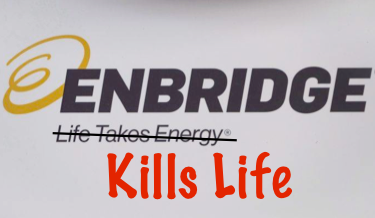 For years there has been an effort to shut down the Enbridge Line 5 pipeline in Michigan, which has wide support throughout the state. If Senator Peters really wanted to do some good, why is he not calling for the complete shutdown of Enbridge’s Line 3 and Line 5, both of which will negatively impact the Great Lakes and further the climate crisis. Securing another military contract will do nothing to reverse course in the fight against Climate Change. We don’t need to be better prepared to respond to Enbridge oil spills in the Great Lakes, we need to prevent them from ever happening again. The only way to do that is to shut down Line 3 and Line 5 immediately.
Which Grand Rapids residents will get to decide how to spend $2 million in the City’s Participatory Budgeting project?
 It has been roughly 5 months since the City of Grand Rapids announced that residents will be able to have a more direct say in how to spend $2 million.
In June, the City of Grand Rapids announced it would begin a participatory budgeting pilot project, using $2 million in funds, money from the federal government’s American Rescue Plan Act.
At that time, we asked the question of whether this process would be a way to practice radical democracy or would it simply be another form of managed democracy. We pointed out that the funding already has some pre-determined parameters for how it could be used, that City Commissioners would appoint 2 representatives from each ward to act as steering committee members, and a short timeline.
In August, we wrote a follow up story about what sort of progress the project members had made. We noted that the City staff who were involved in the project admitted that the initial timeline was grossly in adequate and that in order for there to be a participatory budgeting process it would take time. We also noted that there wasn’t any consensus amongst City Commissioners on what the pilot project would ultimately look like. For instance, during the August Commission discussion, the issue of how to get people to participate came up. It was argued that not only is it critical to have people participate, but to have people who are not normally engaged to participate in the decision making.
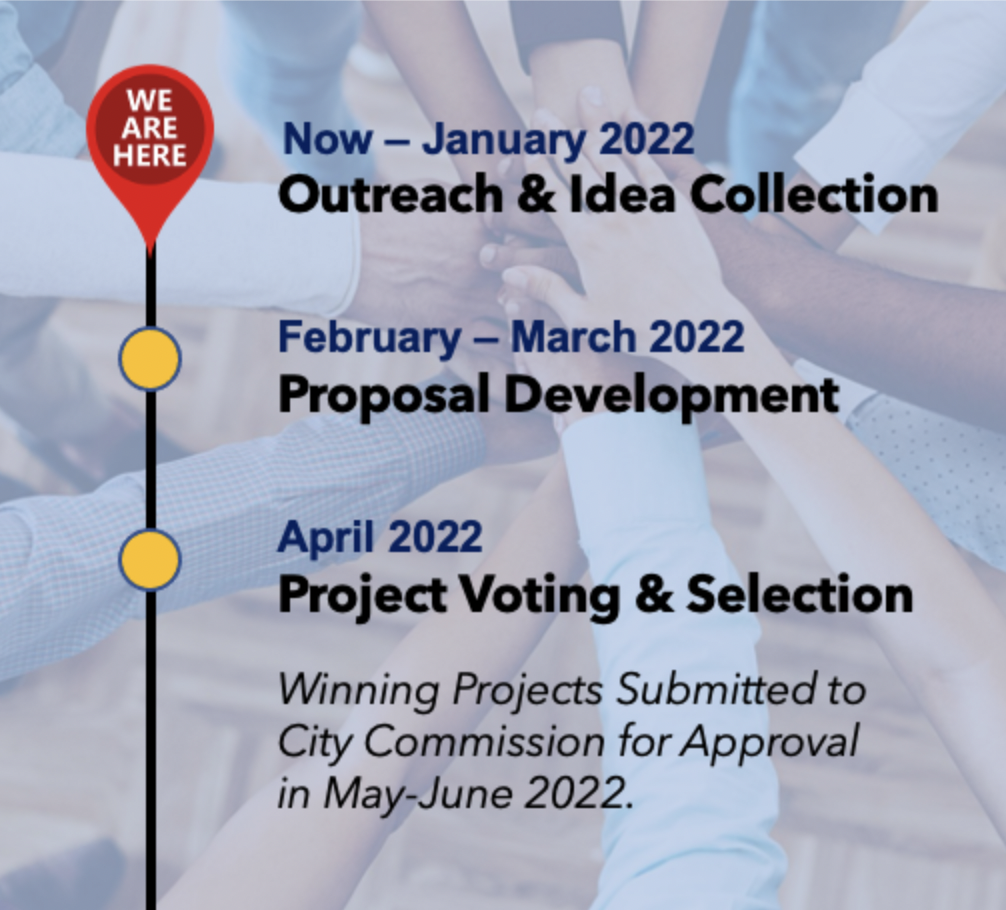
The City now has a more realistic timeline, with public input beginning in January of 2022, project proposals developed in February/March, and project voting in April of 2022.
However, the big issue is still centered around the matter of who is actively being recruited to participate and what plans does the City have to get substantial participation?
The Grand Rapids Business Journal ran a story about the project on November 1st, but there hasn’t been lots of other commercial media coverage, now that the timeline has been firmed up. Plus, the Business Journal generally isn’t read by people who are the most marginalized in the community, people you want input from.
The City of Grand Rapids has online information about the Participatory Budgeting project, along with ways for people to sign up to be involved. The City also has a Facebook page specifically for this project, but the City has not shared their plans for how to actively recruit people to be involved in the decision making process with this money. Will the City of Grand Rapids provide a stipend to people for their participation, particularly for those whose voices are the most marginalized in this city? Will there be transportation provided, child care, food and other incentives that would demonstrate to people how committed the City is to getting as much input as possible? On the City’s Facebook page for this project, they are asking people to share the information, but there is no additional information or plan on how to get people involved.
 On last thing to point out about this project it the fact that the timeline has people voting on the proposed project ideas in April, with submitted proposals going to the City Commission for approval in May/June 2022. This raises two question for me. First, the City of Grand Rapids usually has public hearings around the same time for the City’s Budget. Will the timing of the participatory budgeting process divert attention away from the larger City Budget process for residents and will the City promote public input on the annual budget on top of the participatory budgeting pilot project? The second issue gets to the question of who ultimately decides. It seems that City Commissioners will either approve or reject proposed projects. Why not let the public vote on the proposals for each city ward, instead of giving all the power to commissioners? Again, do we want managed democracy or a more radical democracy?
For more insight into radical municipal politics, we encourage our readers to check out the book, Fearless Cities: A Guide to the Global Municipalist Movement, along with a fairly recent report on how Participatory Budgeting is spreading across the world.
When community activists and organizers demand justice, the response from the City of Grand Rapids is further GRPD repression
 On October 11, the Grand Rapids Area Tenant Union (GRATU) sent a letter to the Mayor of Grand Rapids, all 6 City Commissioners and City Manager Mark Washington.
The letter, which is included in its entirety below, was sent to Grand Rapids City officials because GRATU members were appalled at the ridiculous number of GRPD officers deployed because GRATU was holding a Press Conference with several tenants who live at the Grand View Place apartments.
GRATU Letter
On Wednesday, September 29, members of the Grand Rapids Area Tenant Union (GRATU) were invited by tenants of the Grand View Place apartments located at 936 Front Ave NW here in Grand Rapids.
GRATU had been working with tenants on issues such as safety, sanitation and threats of eviction that the property manager was using against tenants any time they made formal complaints.
GRATU was invited by tenants on September 29th to participate in a Press Conference to talk about the concerns mentioned previously.
Shortly after GRATU members arrived and met tenants outside of the building, they were approached by the property manager and a GRPD officer. GRATU members were asked to leave the property, even though we were there by invitation of the tenants. GRATU members did move to the public sidewalk, where they planned on holding the Press Conference.
Within minutes of being asked to leave the property, GRATU members witnessed 4 additional GRPD cruisers pass by, with one parking across the street next to a building, in order to observe what GRATU and the tenants were doing.
The police officer who had been with the property manager was leaving the property in his cruiser, but before leaving, pulled up and asked what we were doing. GRATU members stated clearly that they were simply holding a Press Conference with the tenants who wanted to share their grievance with the news media.
GRATU members are well aware of the ongoing discussion about GRPD funding and their claims of being short staffed. However, upon seeing 5 different GRPD cruisers show up to a GRATU/tenant press conference we have to ask why were so many police cruisers dispatched to a press conference?
If the GRPD is so short staffed, why would they dispatch 5 police cruisers to a press conference, where tenants were sharing their grievances with Grand View Place apartments to news media?
Several tenants expressed their frustration with having the police show up for something that was not only legal, but for something they had every right to participate in. Tenants from Grand View Place apartments also felt intimidated with such a heavy police presence.
GRATU members are asking for answers as to why so many GRPD cruisers were dispatched to deal with tenants who were involved in a press conference. This incident not only made tenants feel intimidated, it demonstrated that the GRPD acted on whatever message that the property manager of Grand View Place apartments without considering the concerns of some of the tenants.
Not only was the GRATU Press Conference purely an informational event, there was nothing about it that warranted police presence at all. However, as we have documented in recent years, anytime that activist groups hold meetings, press conferences or other informational events, the GRPD has been sending a significant number of cops to harass and intimidate activists. One example, is GRPD officers coming inside a church, where Movimiento Cosecha GR was holding a Press Conference in 2018.
GRATU sent the letter on October 8, some three weeks ago, and has only received one response so far. The one response, which came from Mayor Bliss’s office on October 11, was actually not much of a response. The message was from Mayor’s assistant who wrote, “I have relayed it to her directly and she has asked the City Manager to follow up with the Chief regarding this matter.”
GRATU responded immediately by saying, “We would like feedback, from the Chief and the Mayor on how they could justify sending so many cruisers to an event that was so non-threatening.”
Since the GRATU response of October 11, there has been no response from the Mayor, other City officials, not the Grand Rapids Police Chief.This lack of response has come to be the general response to City officials, when they are confronted by community-based groups that are making demands.
This kind of non-response is similar during City Commission meetings, where they have made it clear that City Commission meetings are not the time to have a dialogue about critical issues in the City of Grand Rapids. Activists are repeatedly told that this is how it has always been done. This means that the regular forum to practice participatory democracy, City Commission meetings, is not the time nor the place for dialogue.
The question then is, when is the time for City officials to really practice participatory democracy? It seems to this writer that the answer is never. Sure, there have been a few commissioners who have said that they are available to meet and discuss issues with people before commission meetings, but those discussions happen behind closed doors. Those discussions are not public and are not recorded or broadcast through the same means that regular City Commission meetings happen. Again, my answer then is that the Grand Rapids City Commission is NOT interested in practicing real democracy, since they provide no forum for this to really take place.
This is one of the reasons why community activists and organizers have been engaging in a variety of tactics and strategies to confront City officials on their failure to meet the demands of the community. Activists and community organizers have confronted the City on issues related to immigration status & ICE, on the unhoused, lack of affordable housing and gentrification, and on the way that the GRPD practices policing in this city. In each of these cases the City has always had a clear response, which has been to send lots of GRPD officers to harass, intimidate, monitor, arrest and abuse those who have no other real options for which to make their demands known to City officials. The sad thing is, that this response from the City of Grand Rapids has nothing to do with democracy, it has to do with power, plain and simple.
Peter Meijer, Campaign Finances and the 2022 Election: Corporate paymasters and GR Power Structure member contributions
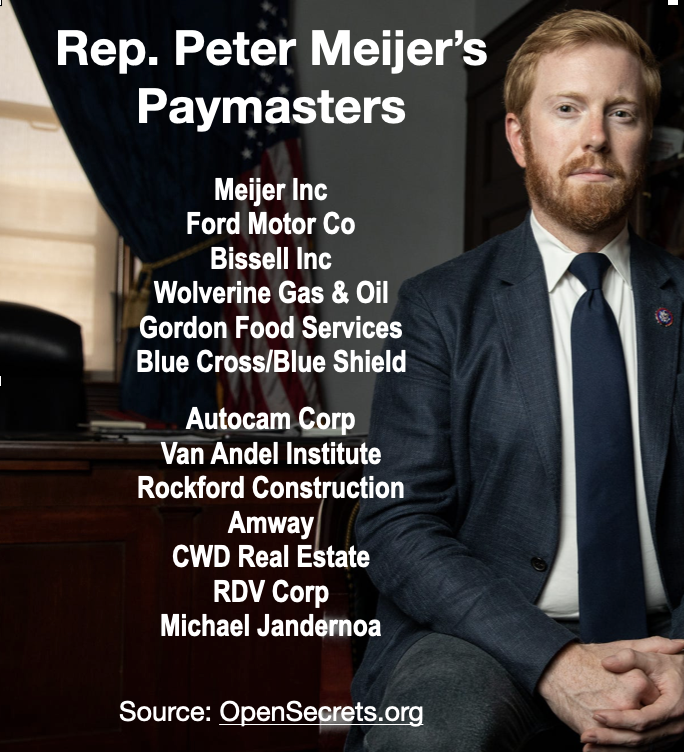 As of last weeks quarterly campaign finance reporting, Rep. Peter Meijer has raised $1,083,457 for the 2022 election cycle.
The Democratic Party has yet to announce a challenger to Meijer, but looking at who has already contributed to his re-election campaign, any challenger will have a difficult task in trying to unseat the son of the wealthiest family in West Michigan.
According to the Center for Responsible Politics, there are three clear campaign contribution categories for Rep. Peter Meijer, corporate contributions, wealthy individuals who are part of the Grand Rapids Power Structure and Political Action Committees (PACs).
Here is a list of some of the major corporate contributions to Peter Meijer’s re-election campaign so far:
- Meijer Inc. – $23,500
- Edward C Levy Co. – $23,200
- Ford Motor Company – $13,700
- Bissell Inc. – $11,600
- Dempsy Ventures – $11,600
- Gordon Food Services. – $11,600
- Wolverine Oil & Gas. – $11,600
- Blue Cross/Blue Shield. – $10,850
- New York Life Insurance. – $10,000
- Gerson Lehman Group – $10,000
Political Action Committees, often referred to as PACs, are some of the most aggressive campaign contributors in recent decades. Here are a few that have contributed to Peter Meijer’s re-election bid:
- Future First Leadership PAC – $10,000
- Eye of the Tiger PAC. – $10,000
- Continuing America’s Strength & Security PAC – $7,500
- Ginger PAC. – $5,800
- Unite American. – $5,200
- Cowboy PAC. – $5,000
- New Pioneer’s PAC. – $5,000
- Making America Prosperous – $5,000
- With Honor PAC – $5,000
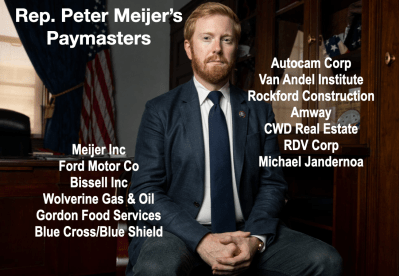
Lastly, there are individuals and entities that make up the Grand Rapids Power Structure, which have also contributed to Peter Meijer’s re-election campaign:
- Autocam Corp/John Kennedy – $11,600
- Van Andel Institute. – $11,600
- Amway. – $5,000
- CWD Real Estate – $4,583
- Rockford Construction. – $3,271
- Michael Jandernoa LLC. – $2,900
- RDV Corp. – $2,900
- Pamela Roland (wife of Dan DeVos). – $2,900

This is just a partial listing of major contributors so far, but we all know that millions more will pour in before the November 2022 election. In the meantime, it is always important that we follow the money and understand what really drives the US system of electoral democracy.
Ryan Kelley’s new political ad is filled with misinformation, unsubstantiated claims, and wrapped in White Supremacist rhetoric
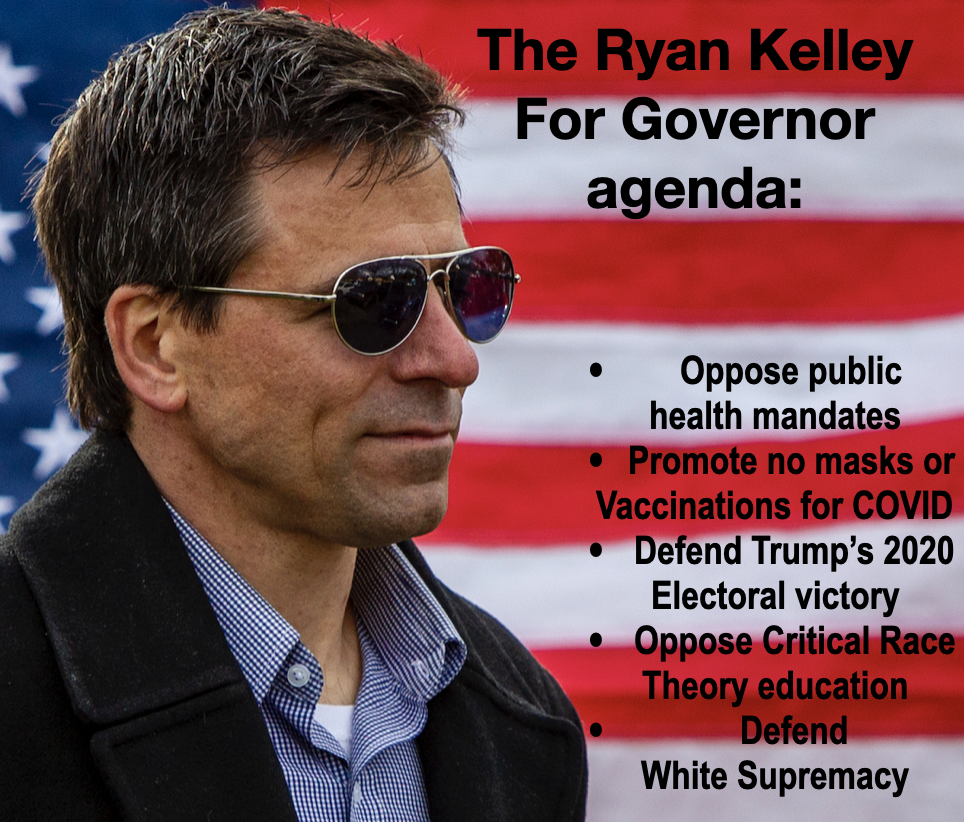 On Friday, Republican Gubernatorial candidate Ryan Kelley, released a new political ad for his campaign to become the next Governor of Michigan.
As we noted last week, the Whitmer campaign has raised a ton of money a full year before the November 2022 election. In the same post, we also noted that the primary Republican Gubernatorial candidate, in terms of fundraising, is James Craig. Craig is getting money from corporate sources, wealthy families and numerous influential people within the GOP.
Ryan Kelley, on the other hand, is not raking in the big money at this point, with only $80,000 raised in his campaign. When comparing his campaign fundraising totals to Craig, Craig has raised about 15 times more money and Craig entered the race months after Kelley.
While campaign contributions are central to elections in the US, it is also important to look at the platforms and messaging coming from candidates. This brings us back to Ryan Kelley’s most recent political ad and why I want to provide a deconstruction of the ad from the co-founder (or as Kelley like to call “a founding father) of the far right group known as the American Patriot Council.
The political ad is 2 minutes and 50 seconds long and is only being shared on social media, especially since he hasn’t raised the necessary funds to run ads on commercial media. I will use a mix of images from Kelley’s ad, along with a narrative for the deconstruction.

Kelley then states that the Michigan Democratic Party has attacked him and tried to discredit him. While there may have been some criticisms from Michigan Democrats, most of the criticism has come from individuals and autonomous movements that exposed Kelley for his roll in organizing the anti-lockdown protests that began in Lansing in April of 2020.

At 40 seconds into the ad, Kelley then claims that during the lockdown, “we didn’t back down.” This of course really means that Kelley and the American Patriot Council invited far right Michiganders to come to Lansing with assault rifles and enter the Lansing State Capitol, while Kelley was texting with Senator Majority Leader Mike Shirkey. In a blog post on the American Patriot Council, which has since been removed, Kelley wrote:
“The irony is that the American Patriot Rally was organized with one thing in mind: to encourage the senate to vote no on extending Whitmer’s emergency declaration, which they did. It was a victory. If Sean had taken the time to be a journalist, he’d have known that we got exactly what we came for.”
Kelley had then invited Sen. Shirley to speak at an American Patriot Council-organized anti-lockdown rally in Grand Rapids in May of 2020, which we reported on. It was always clear that the anti-lockdown protests were organized in conjunction with Republican elected officials, and was being co-ordinated by the Council for National Policy across the country.
At 52 seconds into the ad, Kelley then talks about how people have had enough of politicians who lie just to get elected and then never do anything to benefit the people. While I would agree with Kelley’s comment here, since most politicians don’t do much that benefits most people, he is only using these comments to the lead up beginning at 1:10 in the video. At this point Kelley turns the focus on the “failures” of the Whitmer administration, with Kelley standing right in front of Gov. Whitmer’s home.
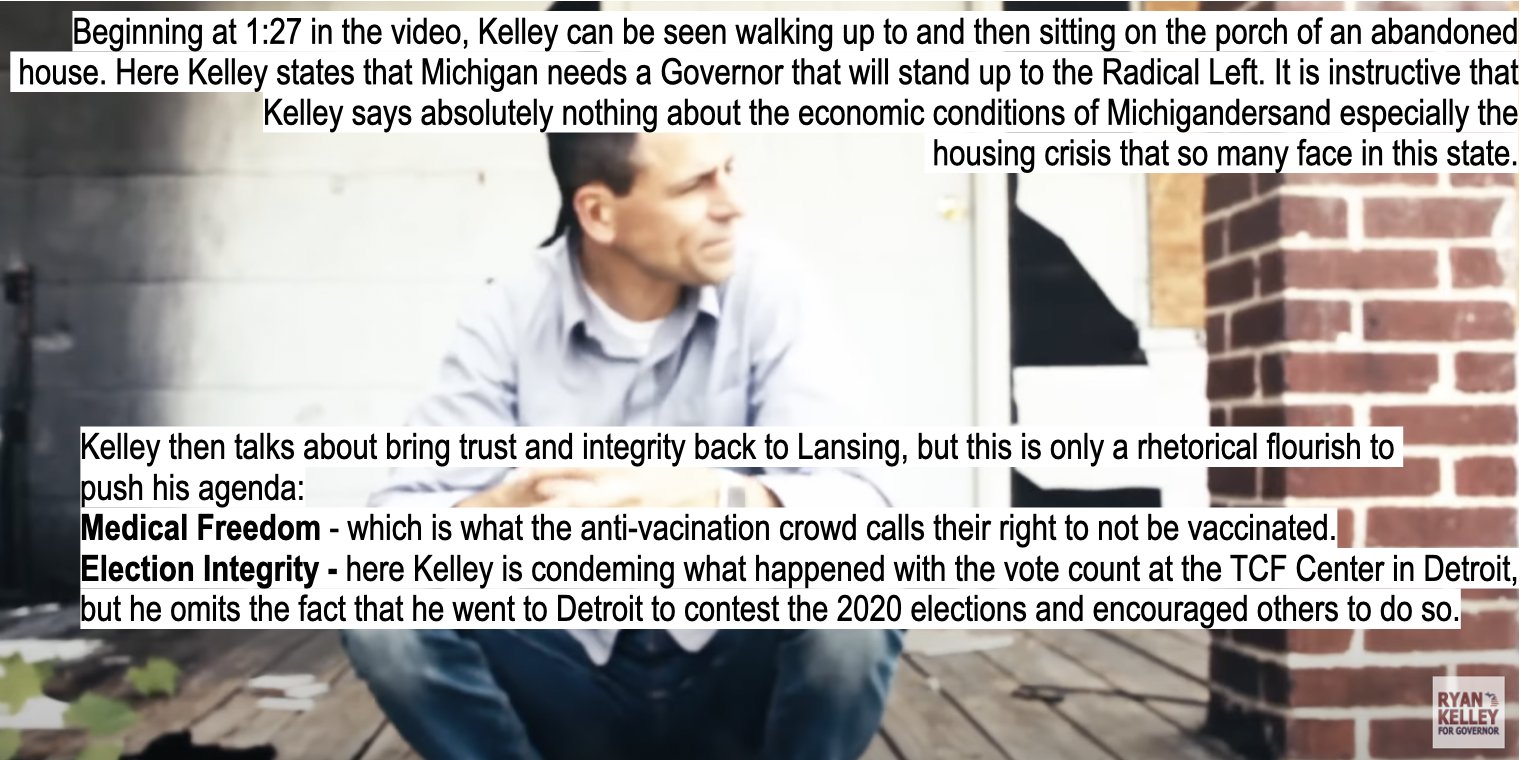
At the 2 minute mark in the video, there is footage of Ryan Kelley with his wife and children, talking about how there are efforts to destroy the nuclear family. This is followed by more rhetoric about integrity and standing up for people’s rights. The political ad ends with Kelley saying that he and other gave people hope, saying all of this while standing in front of the Lansing State Capitol. Kelley is clearly appealing to his base, those who supported his role in the anti-lockdown protests.
Like all political ads, Kelley uses vague rhetoric and appeals to traditional conservative values. However, Kelley also uses lots of misinformation, unsubstantiated claims and a great deal of fear-mongering, all of which have become the norm with political ads. More importantly, Kelley offers no concrete plans for what he would do that would actually benefit the majority of Michigan residents, specifically around economic policy, public health, the environment and housing.
Lastly, it is clear that the only things Kelley can appeal to are the things he has personally been involved in, such as the anti-lockdown protests, the defense of the Confederate statue in Allendale, opposing COVID vaccinations and whining about the 2020 election results. All of these issues, it must be said, are wrapped in the ideology of White Supremacy, which is what Ryan Kelley has demonstrated he is committed to, since he became a public figure in April 2020.
There is a war on BIPOC people in Kalamazoo: An Interview with Monica Washington Padula
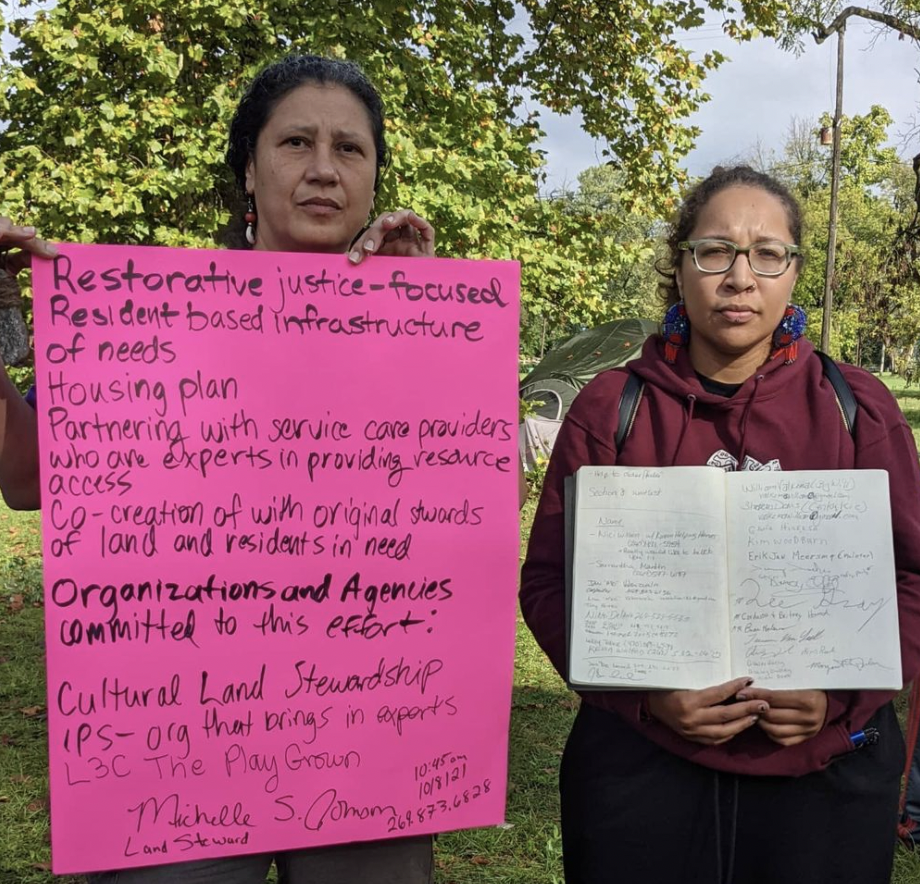 In early October, the City of Kalamazoo sent members of the Kalamazoo Police Department to a houseless encampment to evict those who were staying at the encampment. You can read some context of what took place on October 8th, from this article on the site NowKalamazoo.
The Kalamazoo Police also arrested Monica Washington Padula, an Afro-Indigenous activist who was present on October 8 in a supportive capacity for the unhoused community. Recently, we had the opportunity to hear Monica’s story about what happened that day, which not only provides even more context, but Monica’s narrative gives us a first hand accounting of how the City of Kalamazoo is waging a war against BIPOC people in that community.
We have seen this same dynamic happen in Grand Rapids, with the ongoing harassment, intimidation and arrests of groups like Justice for Black Lives, Defund the GRPD and Movimiento Cosecha GR. In addition, the City of Grand Rapids evicted a housing encampment at Heartside Park last year and has continued to harass other unhoused encampments around the city.
Our interview with Monica is roughly 36 minutes and we encourage people to watch the video, then share it.
We’re Rich and We Do What We Want: A DeVos Family Reader
 In Howard Zinn’s monumental book, A People’s History of the United States, he constantly juxtaposes the amazing things that people did to fight for liberation and the people behind the systems of oppression that social movements were fighting against.
This is exactly why I have spent years monitoring, investigating and critiquing the DeVos Family. They are the most recognizable and powerful manifestation of the systems of power and oppression in West Michigan. Now, I know there are plenty of people who share the belief that without the DeVos Family, Grand Rapids wouldn’t be where it is today. I fully agree with that belief, but for reasons that are the exact opposite of those who hold the most powerful family in West Michigan in high regard.
When Rich DeVos and Jay Van Andel founded the Amway corporation, they did so by embracing some of the most deeply entrenched lies about this country. Rich DeVos has written numerous books that promote his values. In his book Believe, DeVos, in talking about freedom, states, “that call of freedom went forth from a rugged wilderness, and Europe and Asia and Africa sent their sons of adventure to hew out a new society in a land of forests and savages.”
This statement from DeVos is essentially an affirmation in his belief of Manifest Destiny. For those who don’t know, the company that DeVos founded with Jay Van Andel, was originally going to be called The American Way, but was changed to Amway so as to abbreviate their take on Manifest Destiny.
In addition to believing in Manifest Destiny, Rich DeVos is also deeply committed to the values of capitalism, or what he likes to refer to as the free enterprise system. In his book Believe, DeVos states, “The free-enterprise system has outperformed, outproduced any other in the world. It is a gift of God to us, and we should understand it, embrace it, and believe in it.”
The above statement is the perfect encapsulation of what the patriarch of the family, Rich DeVos, believes and is firmly committed to. The DeVos Family is a deeply religious family, regardless of how one defines religious beliefs. The family comes out of the Calvinist tradition and are members of the Christian Reformed Church. However, the DeVos Family, in many ways embraces a form of Christian Reconstruction. Those who practice Christian Reconstruction theology believe that society should be governed by biblical values, rather than secular values. This is exactly why the family has for decades developed relationships and funded organizations that are deeply committed to homophobia, anti-reproductive rights, patriarchy, white supremacy and free market capitalism.
The DeVos Family not only supports these religiously motivated values by their support of certainly organizations, but by their deep commitment to influencing public policy. The family has been one of the largest donors to the Republican Party for several decades now, at the federal, state and local level, as is documented in this collection of articles. In addition to supporting the Republican Party and GOP candidates, they also contribute to organizations that are committed to influencing public policy. In West Michigan, the DeVos Family has been involved in the financing, planning and development of groups like the West Michigan Policy Forum, the Acton Institute and the Right Place Inc. These groups all embrace the capitalist economic system and public policy decisions, which benefits and expands the power of those who make up these groups, including the DeVos Family.
What is ironic about the candidates and public policy that the DeVos Family endorses, is that those same policies end up negatively impacting communities of color, those who identify as LGBTQ, those experiencing poverty and immigrants. The irony is that the DeVos Family foundations end up contributing millions to West Michigan non-profits that provide services to the very same people who are negatively impacted by these neoliberal economic policies.
These are the kinds of themes that are explored in the DeVos Family Reader. In addition, we look at how the local news media has reported on the most powerful family in West Michigan, which has played a role in creating public misinformation. We also look at the strategic function of ArtPrize and what impact it has had on West Michigan. We argue that in many ways, ArtPrize functions has a great PR tool for the DeVos Family and its goals. In fact, such a belief was confirmed early on in the evolution of ArtPrize, when Sam Cummings, co-founder of CWD (of which the DeVos Family is part of) said, “Our long-term goal is really to import capital – intellectual capital, and ultimately real capital. And this (ArtPrize) is certainly an extraordinary tool.”
Lastly, we look at Betsy DeVos’ ascent to the White House as Secretary of Education in the section listed as Betsy DeVos Watch.
As I stated at the beginning of the introduction, I have spent years monitoring, investigating and critiquing the DeVos Family. This is an ongoing project and the DeVos Family Reader will continue to be updated. The contributions to the DeVos Family Reader have come from a variety of sources such as the Grand Rapids People’s History Project, an Indy newspaper from the 90s called The FUNdamentalist, Media Mouse and the Grand Rapids Institute for Information Democracy.
Also, as stated before, I believe that in order to promote collective liberation and social justice for those most marginalized, we have to understand and resist the systems of power and oppression in this community. Looking into the history and practices of the DeVos Family, provides us with a clear example of how systems of power and oppression function in this community. I am deeply indebted to those who have been involved in this struggle and it is my hope that the DeVos Family Reader can be a useful tool in the ongoing struggle for justice.
Over 500 pages on the DeVos family are in our reader, which you can access at our Documents section, then clicking on DeVos Family Reader.
 Grand Rapids Institute for Information Democracy