Invest in Community Care, Not Cops: Kent County Sheriff’s Department wants nearly $3 Million CARES Act funding for themselves
On Wednesday, MLive posted an article about the reduced list of proposals in Kent County that would utilize the American Rescue Plan Act (ARPA) funds that the Kent County Commission will decide upon on December 1st.

In September, GRIID reported on the then 319 proposals that had been submitted to the County, proposals that were hoping to use the $127.6 million in COVID-19 stimulus funding that Kent County received from the American Rescue Plan Act.
One of the proposals that is still in the running comes from the Kent County Sheriff’s Department. Their proposal is asking for $2,837,500 is for a School Safety Radio Network. You can read the proposal in the MLive article, but essentially the Kent County Sheriff’s Department wants to use nearly $3 Million to create a new communication system for schools in the event of future school shootings in Kent County.
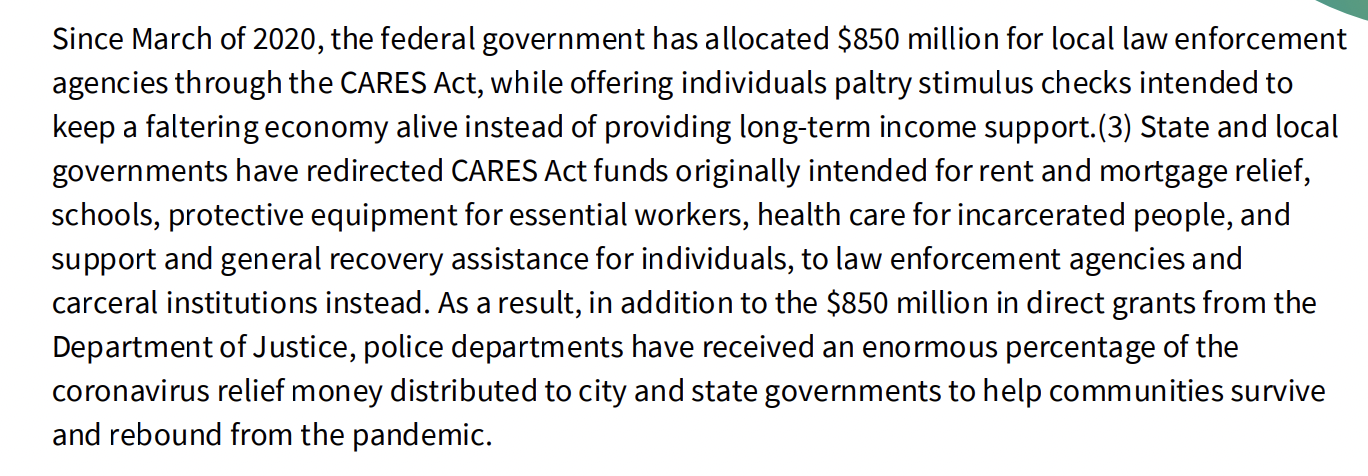
There are several reasons why this proposal should be outright rejected. First, the proposal from the Kent County Sheriff’s Department continues a trend that began in 2020, where local law enforcement agencies have continued to re-direct CARES Act funding away from the public and those who most need it. A May 2021 report from the group Interrupting Criminalization entitled, Divesting from Pandemic Policing and Investing in Just Recovery, provides us with this important analysis:
Second, decades of police militarization since Columbine have not only failed to stop mass shootings, we frequently see police put their own safety above that of the people they are supposed to protect. This was clearly demonstrated in the school shooting earlier this year in Uvalde, Texas. That police fail to keep us safe is nothing new, even in situations of mass shootings. During the 2018 school shooting in Parkland, Florida, the school cop Scot Peterson cowered right outside the building while seventeen people were killed. A study in the Journal of the American Medical Association from just last year found that “armed guards were not associated with significant reduction in rates of injuries” and that “the rate of deaths was 2.83 times greater in schools with an armed guard present.” I am not aware of a case where the police have actually stopped a school shooting from happening in the act.
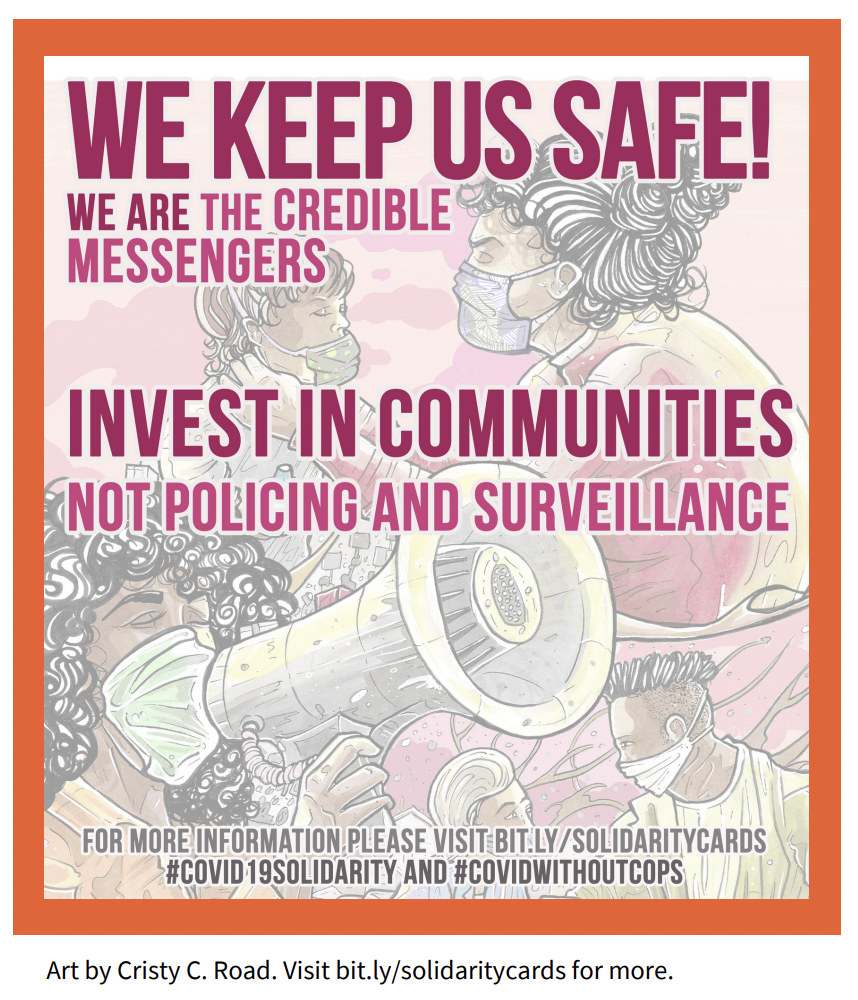 Those of us who have been calling for the defunding of police departments — indeed for police abolition in favor of real, collective public safety practices — have been treated by Democratic and Republican leaders and commentators alike as fanatical. In the face of decades, if not centuries of evidence exposing what the work of policing actually entails — and does not entail — the true ideologues are those committed to policing as a social solution.
Now, the Kent County Sheriff’s Department proposal for a new communication system in every school in Kent County is designed to, “provide area law enforcement with critical, factual, and real-time information they need to respond and end school-related incidents..” As we have been stating throughout this article, there is no evidence that sending cops to schools that are facing an active shooter does little to actually prevent students and teachers from being shot. In fact, funding the proposal from the Kent County Sheriff’s Department further legitimizes that institution and perpetuates the myth that cops actually protect the public.
If you don’t want to see nearly $3 Million of the CARES Act funding go to the Kent County Sheriff’s Department, then you should tell them NO. Go to this link, which provides contact information for all 21 Kent County Commissioners. Tell them NO funding for cops, only community care!
The Future of ArtPrize: Get the Public sector to do the bulk of the work plus funding, while the private sector reaps the rewards
It is fairly well known that Rick DeVos is relinquishing control of ArtPrize and has decide to discontinue the regular art/tourism money making spectacle that happens every fall in downtown Grand Rapids.
Recently, WOOD TV 8 media personalities, conducted an interview with Grand Rapids Mayor Rosalynn Bliss, to discuss the future of ArtPrize and what people can expect for next year. The interview was posted online on November 15th, which you can find here.
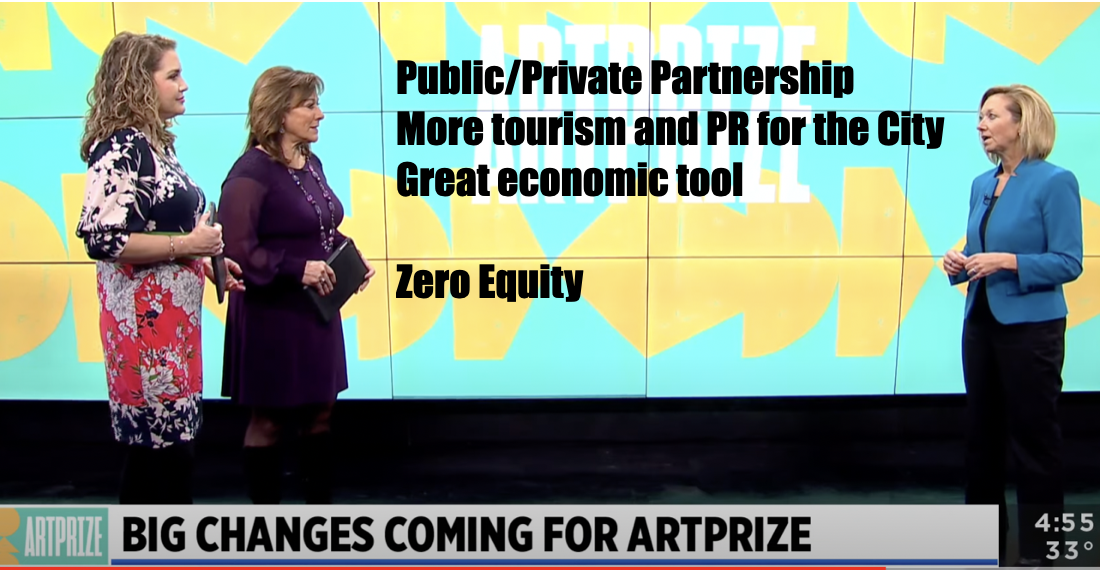
The WOOD TV 8 media personalities first asked Mayor Bliss, “why was it so important for the City of Grand Rapids to keep ArtPrize going?” The response from Bliss was instructive, particularly in terms of what was most valuable to City officials about the annual event.
Here are the things that the Mayor centered on why ArtPrize was so important for Grand Rapids:
- ArtPrize put Grand Rapids on the International map in terms of art.
- ArtPrize is a huge economic driver for Grand Rapids. Small businesses rely on it, it is a mechanism for tourism, and it highlights the city across the globe.
- ArtPrize will continue to be a public/private partnership, which is what Grand Rapids is known for.
- They are getting feedback from the public, the artists, and the venues, which will inform how to move forward.
These four items are a way of gauging the lens in which ArtPrize is seen by those who run the city. First, it is mentioned in point one and again in point number two that the event brings people in from across the country and around the world.
The second point that is mentioned by the Mayor, which is really the driving force behind the value of Artprize, is how much money it brings into the City of Grand Rapids. This was the point that Sam Cummings, a member of the GR Power Structure and partner with CWD Real Estate Investments, had made back in 2010 about the value of ArtPrize. “Our long-term goal is really to import capital – intellectual capital, and ultimately real capital. And this (ArtPrize) is certainly an extraordinary tool.”
In the third point, Mayor Bliss not only stressed the public/private partnership aspect of Grand Rapids, but went as far as to say that this is what Grand Rapids is known for. Lets be clearly, when city leaders talk about public/private partnerships, what they really mean is that the private sectors benefits from making a great deal of money from ArtPrize, while the public sector uses public money, with little or no input from the public and they only public benefit is that Grand Rapids get more recognition and tourism, which ultimately means more money for the private sector.
The fourth, and last point, was the required feedback from the public, artists and the venues involved, which usually means the loudest voices in each of those arenas, but really means that the venues (which are primarily businesses) will have the most influential voice in the process.
At one point, one of the WOOD TV 8 personalities said, “Everyone looks forward to it,” which is to say that no one in their right mind thinks that ArtPrize isn’t the greatest thing since indoor plumbing.
Later in the interview, another WOOD TV 8 personality asks, “with all of the new hotels and hotel expansion, how important is ArtPrize for the area.” The Mayor responds by saying that during COVID so many businesses were asking when ArtPrize was happening again. She also said the event is important in terms of attracting people to the city and drawing national attention. Again, the economic benefit is centered, as is the PR benefits for the city, which usually about money as well.
One last question from a WOOD TV 8 personality asks, “what are the next steps?”Mayor says they are in the process of identifying additional leaders to be on the board of directors, then get dates set, so we can get the word out about ArtPrize 2023. Additional leaders? This usually mean people who are either members of the Grand Rapids Power Structure, those who work for organization run by the GR Power Structure or those who at the very least defend the function of the GR Power Structure.
We do know that as of right now, the three entities that will run the future ArtPrize are, the City of Grand Rapids, Downtown Grand Rapids Inc. and Kendall College.
It is also worth mentioning the things that the Mayor did not mention or did not center in her comments. Artists are only mentioned once in the interview, and that was in reference to getting feedback from those who have participated. The public was only centered once, again as an entity to get feedback from. No where does the Mayor talk about the cultural and social impact of ArtPrize, nor does Mayor Bliss mention equity or if/how such an event can benefit the most marginalized in Grand Rapids or work towards creating racial justice, something the Mayor and City officials claim they are working towards.
In the end, one can expect that the future of ArtPrize will continue to be a benefit primarily for the private sector, to be a tool used for generating tourism and positive PR. The only real difference that I can see with Rick DeVos no longer running ArtPrize, is that he got the City of Grand Rapids to take it over. Ultimately, this means City funds, City resources and City staff time will be spent on an event that will primarily benefit the private sector. It’s sort of like a reverse austerity measure, where instead of privatizing a public service, the private sector gets the public sector to underwriting and promote ArtPrize, yet the private sector is the primary beneficiary of the monied art spectacle.
Is the DeVos family getting involved in another land deal in Grand Rapids, this time in the 2nd Ward?
(Updated version of this story, with new information added on November 23rd from someone who contacted GRIID.)
As readers on this blog will know, anytime the DeVos family gets involved in purchasing property, especially for future housing projects, the public should be very concerned about such projects.
In 2017, when the DeVos/Rockford Construction Company partnership spent millions to buy up several dozen properties in the Third Ward, specifically the Boston Square Neighborhood. All of this happened without resident knowledge. The DeVos/Rockford Construction land grab in the Third Ward was then followed by the Doug & Maria DeVos Foundation’s creation of AmplifyGR, which was charged with implementing DeVos-family values, such as creating entrepreneurs, educational opportunities outside of the Public School system and taking advantage of public money to achieve said goals. You can read all of the GRIID postings on the DeVos/Rockford Construction/AmplifyGR project at this link https://griid.org/tag/amplifygr/.
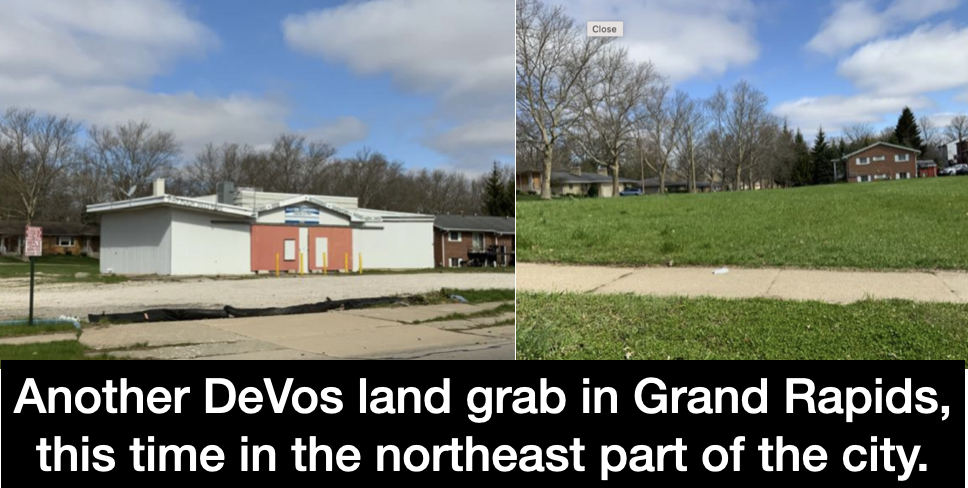
We recently learned of a land purchase by the DeVos family in the Second Ward, just east of the Kent Country Club on Diamond and Country Club Dr. NE. MiBiz posted an article on November 8th, which read in part:
The Michigan Department of Environment, Great Lakes and Energy recently awarded a total of $1.73 million in brownfield grants for three redevelopments on contaminated properties in West Michigan.
The brownfield grants include $1 million for the Boston Square Together project in Grand Rapids, $430,000 for a multi-building apartment project in Grand Rapids’ Creston neighborhood, and $300,000 for a condominium development at 815 Verhoeks St. in Grand Haven.
The state agency awarded the grants to the city of Grand Rapids’ Brownfield Redevelopment Authority and its Economic Development Corp. as well as the Grand Haven Brownfield Redevelopment Authority. The local entities plan to allocate the funds to the three redevelopment projects.
The grants will fund demolition, environmental investigations, disposal of contaminated soil and the installation of barriers and ventilation systems beneath future buildings to prevent potential exposure to residual contamination.
Jacey Shachter, president of Metric Structures LLC and developer of the Country Club Place project in the Creston neighborhood, said the $430,000 in brownfield funding is an important step for the project. The $8 million project would contain two apartment buildings with multiple levels, but a unit count is still undetermined, Shachter said.
“We like to do infill community development,” Shachter told MiBiz. “This is right in the Creston neighborhood, it’s been vacant for a long time and we like a good puzzle to figure out how we can add value and activate some of these infill sites.”
The development would be located on two parcels at 1603 Diamond Ave. NE and 1600 Country Club Drive NE. The plan calls for demolishing a 1,189-square-foot existing building on the site, allowing for the removal of contaminated soils underneath.
Affiliates of RDV Corp., the family office for the DeVos family, purchased both properties for $270,000 in June 2021, according to property records. Artesian Group LLC, registered to Angel Gonzalez, is the former property owner.
“The City of Grand Rapids Economic Development Corporation is grateful to EGLE for their investment in the cleanup efforts of this project,” Jonathan Klooster, executive director of the Grand Rapids Economic Development Corp., said in a statement. “Our partnership continues to make urban infill projects like this financially feasible and helps to incrementally increase housing supply in our community.”
Shachter hopes to break ground on the project in spring of 2023. Grand Rapids-based MEM Designs LLC serves as the project designer.
In looking at who actually purchased the land, which the MiBiz article refers to as, “Affiliates of RDV Corp., the family office for the DeVos family, we were able to find this information from this City of Grand Rapids link https://bsaonline.com/?uid=115. If you put in 1603 Diamond Ave. NE, it says that the owner of the property is 1600 COUNTRY CLUB LLC, which is located at 4940 Cascade Rd SE, Suite 220, Grand Rapids, MI 49546. Guess what entity has an office at 940 Cascade Rd SE, CDV5 Property Management, which is run by Cheri DeVos.
People with wealth and those involved in land grabs, often create LLCs to hide their identity. CDV5 Property Management purchased the property in June of 2021. If you enter 1600 Country Club Drive NE, you get the same information, that it was purchased by 1600 Country Club LLC, which is Cheri DeVos’ property management company. In addition, it is important to note that Jacey Shachter, who is the president of Metric Structures LLC (the developer for the housing project mentioned in the MiBiz article), is the daughter of Steve Ehmann, the husband of Cheri DeVos and co-owner of CDV5 Property Management. As is the case with many DeVos family companies and projects, they often contract with other family members, which keeps the wealth in house.
The 1603 Diamond NE property has an old commercial building on the site, but the land listed as 1600 Country Club Drive NE is a vacant lot.
Lastly, it is important to note that the property currently owned by the DeVos family is a beneficiary of the brownfield development funds, which is public money, for environmental clean up for the land they now own. You can also bet that when this land is developed, it will also likely submit a request to the Michigan State Housing Development Authority for more public funds to develop the property. Now, we don’t know if the DeVos family when end up owning the new housing project, but if they do, they will double dip for public subsidies, while profiting from either the management of the developed property or the sale of it after the development is complete. Isn’t Capitalism wonderful……..at least for the rich.
Doug DeVos had a conversation on his podcast about leadership with Mike Pence, Mike F**king Pence
 On the October 25th episode of Doug DeVos’ podcast Believe, he discussed the topic of what it means to be a leader, with former Vice President, Mike Pence.
For the next 48 minutes, DeVos and Pence talked about what they thought leadership was all about, even though I had a hard time identifying what they hell they were really talking about. I would not recommend listening to the show yourself, but if you have 48 minutes to waste, then by all means. What follows are a few observations that I took away from their conversation.
For the first two and a half minutes Pence talked about the fact that he has been an admirer of Doug and the DeVos family for years. Then, DeVos return the admiration, which quickly turned into a love-fest.
The first thing that Mike Pence said about leadership, was that it was a gift “we get from God.” Pence then went in to talk about his foundation of leadership, which is knowing who one is. For Pence, he is first a Christian, then a Conservative and lastly a Republican.
Pence then said that he aspired to embrace a servant leadership model. DeVos then chimed in saying that leadership is having a sense of humility. Ok, how it it that these two rich, white, deeply privileged people can say shit like this with a straight face. Are they just saying it because this is what those who look up to them want to hear, or do they really believe this crap?.
Doug DeVos then asked Pence, “how do you avoid bad judgment or pitfalls?” Pence responded by saying it all has to do with how you begin your day. Pence said, he began his day with prayer and reading the Bible.
DeVos then asked Pence how he puts principles into action. Pence said he was involved in the group Advancing American Freedom, which is essentially a group of mostly former Trump Administration people, along with other far right Republicans. Their principles and goals are just more of the same.
Finally about two thirds into the conversation, Pence said this about Donald Trump, “Trump was a great leader and great personality.” So much for distancing himself from the former President and now Presidential candidate. It is incredulous that Pence could say this about a man who engaged in so much hateful rhetoric, on top of the loathsome policies that oppressed so many and rewarded so few.
Doug DeVos then asked about the pandemic and leadership from the Trump Administration. The response from Pence had me listening in disbelief. Pence said that Trump did something that was historic, which was to suspend travel from China. The former Vice President then said they need a broad range of counsel on the pandemic, so they listened to experts, like people from the CDC. Pence then went on to say the following about the Trump Administration. “We saved thousands, if not millions of lives in those early days.” I don’t know what is worse, the fact that Pence was literally creating a fictional history of how the Trump administration responded to the pandemic, or the fact that Doug DeVos said nothing to question or challenge this assertion. On the conservative side of the numbers, there was an Associated Press article with the headline, Shameful’: US virus deaths top 400K as Trump leaves office.
The conversation on leadership ended with DeVos and Pence talking about how the US leads the world. DeVos asked the question, “How does American leadership impact the world?” Pence responded by saying that America is the indispensable leader of the world, and that the world looks to America and counts on America for leadership. Again, are they saying this to satisfy their listeners or because they really believe this shit?
At the very end of the conversation, Pence makes a plug for his new book, which is an autobiography, entitled, So Help Me God! All I could think about was, this is the phrase my mother would use when she was anger with us kids. “So help me God, wait til your father gets home.“
In the end, I do believe that what Pence and DeVos were saying throughout the conversation was not just for listeners, they both really believed every word they were saying. This is one of the things about people who embrace religious ideology. Of course they believe what they said, because they think that God talks to them and justifies all the horrible shit they do in the world. I’m rich because God wants me to be. I hate gays because God told me so, Women are murderers if they have an abortion, because….yeah, God.
People like Doug DeVos and Mike Pence live lives that are so insulated from the real world, that they have no idea about the harm they cause, nor the pain and suffering that countless people experience because of their ideological bullshit.
The Un-affordability of housing in Grand Rapids
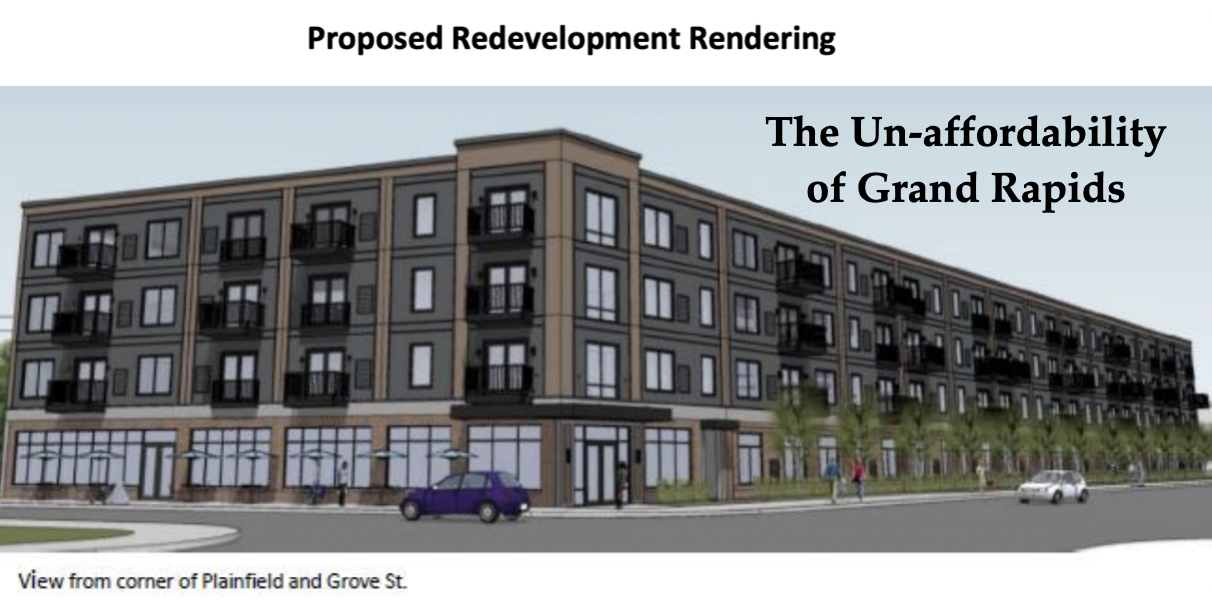
At Tuesday’s Grand Rapids City Commission meeting, one agenda item a resolution approving the establishment of the Lofts on Grove Neighborhood Enterprise Zone (NEZ) for the parcels of property located at 1359 and 1329 Plainfield Avenue NE.
The agenda item can be found in the Agenda Packet for Tuesday, November 15, pages 12 – 17. Part of the text for this resolution reads:
The Developer, which is affiliated with First Companies, owns the Property and proposes to demolish the existing buildings and site improvements to construct a new, mixed-use four-story building containing 3,275 square feet of ground-floor retail space and 110 market-rate residential units. Total investment in the project is estimated at $24.4 million with hard construction costs of approximately $18.6 million. Ten new jobs are expected to be created by the tenant of the commercial space, with wages anticipated to be $15.00 per hour with benefits.
The Developer has also been approved for reimbursement of up to $1,146,476 for brownfield eligible activities including environmental assessment, demolition, lead and asbestos abatement, site preparation, and infrastructure improvements. Reimbursement is expected to occur over a 13-year period, with an additional five years of capture for the Local Brownfield Revolving Fund.
So, the developer will get reimbursed just over $1 Million in this process, which is a lovely perk. Later in the proposal, the cost levels for renting a studio apartment, a 1 bedroom and 2 bedroom apartments, which are shown here below.

Now, the average wage of the 10 new jobs that will be created in this project is $15 an hour, which would be $31,200 a year for 40 hours a week before taxes. Let’s be generous and say that after taxes, someone making $15 an hour would make $28,000 in take home pay. This means that for those who would rent the studio apartments, they would spend half of their income, at $14,100. If one wanted to rent a 1 bedroom apartment, which would cost $17,400 for a year, this would leave them with only $10,000 left for utilities, food, transportation, health care, entertainment, etc., which would mean they would have $833 a month to cover all expenses other than housing.
Grand Rapids, like most cities in the US, continues to perpetuate a housing crisis. Housing is un-affordable because city officials and many housing organizations can’t look past market solutions to this crisis. How can you expect people to live on $15 an hour, which is the average wage of the jobs created in the Lofts on Grove businesses, making is very difficult to afford the cost of rent for the apartments that will be located above where they work?
The National Low Income Housing Coalition provides excellent information on affordability of rent in all states, including Michigan, which you can find here https://nlihc.org/oor/state/mi. The graphic below, provides a good summary of the average cost of rent and what people need to earn per hour to afford most rent. As you can see in the graphic, for those renting in Grand Rapids, you need to earn $20.02 an hour to afford the average rent. There are literally tens of thousands of individuals and families who do not make $20 an hour in Grand Rapids, yet developers keep creating housing that is un-affordable for so many people.

What Kind of Change Do We really want to see in Michigan: Part III
In Part I, we covered Immigration Justice, Health Care for All, Housing Justice and Education Justice. Part II covered a list of demands dealing with Today, we will explore demands centered around the Prison Industrial Complex/Policing, Racial Justice, Environmental Justice and LGBTQ Justice. In today post, which is the last in the series, we will address Economic Justice, Foreign Policy & Michigan, along with Democracy demands, where we discuss the ways in which we need to change how we govern ourselves.
“Since 1984, Republicans have used their control of the Michigan Senate to block things Michigan families need. No more.” Michigan Senate Democrats statement after the 2022 elections
The Democratic Party now has control of the State House, the State Senate and the Governor’s seat, which is the first time this has happened since the early 1980s.
With the Democrats now being in the driver’s seat through at least the end of 2024, this seems like a great time to make the kinds of demands we want, in terms of policy change. The Blue wave has come to Michigan, and since the Democratic Party is the “party of the people”, then this seems like a perfect opportunity to create a list of policy demands that the Dems can pass in Michigan. If we can take seriously the above comment from the Michigan Senate Democrats, then it is crucial to ask what it is that families living in Michigan really need?
It has been my experience over the past 40 years of doing organizing work, along with my read of US history, is that federal, state and local governments don’t generally make the necessary changes that people need. Governments must be pushed and pressured by organized movements of resistance, which is the essential message of Howard Zinn’s monumental book, A People’s History of the United States.
The following list of demands is based on movement politics that I have been involved in or movement politics that I have been following closely for the past 40 years. If you have additional ideas, then by all means send them along or create your own on a different platform, but let’s think creatively, let’s practice radical imagination and lets demand collective liberation. We will cover some of these demands in several postings, plus most of these issues intersect, so we will regularly refer back to other demands.
Economic Justice
For me, the long-term goal would be to dismantle the economic system of Capitalism, but it is not likely that governments will go along with that. It should always be the stated goal, but in the process of getting there, we can make demands. As part of the Poor People’s Campaign that the Southern Christian Leadership Conference and Dr. King were involved in, they had developed an Economic Bill of Rights, which is something we could do today.
A Living Wage/Income for all – It is always hard to determine what a real living wage should be, but given the cost of living – rent, food, transportation, utilities, etc., we should demand that no one earn less than $30 an hour in Michigan, whether you have a job or not. Think of what this will mean to people currently making he minimum wage or just above. Making $30 an hour would triple their current income. Such a guaranteed income should be for life or until we dismantled Capitalism and create a better economic system based on cooperation.
We also need to radically alter the tax policy, to make the wealthiest people pay more taxes, along with businesses/corporations and for everyone else to pay less taxes, so they can keep more of the money they earn.
Michigan need to end the practice of giving subsidies and tax breaks to businesses who want to set up shop in Michigan or move their current location. The same thing goes for developers who always want subsidies or tax breaks or utilize Brownfield Development perks.
Policy makers should remove the Right to Work status for Michigan and do everything to support, encourage and fight with workers wanting to unionize.
We have already address many economic issues in Part I and Part II of this series, but another way we can afford to make sure that a guaranteed income for all is possible, would be to address the amount of money that is leaving Michigan every year to support the US Military Industrial Complex.
Foreign Policy and Michigan
US Foreign Policy impacts Michigan in numerous ways, even if we are not think about the connection. Millions of people are displaced from their countries on an annual basis, often because of US economic and military policies, which means they often end up in Michigan.
Trade policies, like NAFTA and CAFTA have resulted in the loss of thousands of jobs in Michigan, since corporations are always seeking lower wages for workers.
Then there is the issue of US militarism. There are numerous US military installations in the State of Michigan, along with hundreds of corporations that are subsidized by public money through contracts with the Pentagon.
However, the largest issue has to do with the sheer cost of US militarism. The US Military budget is the largest on the planet. In fact, the US Military budget is larger than the next 9 highest country military budgets, combined.
The National Priorities Project monitors US military spending and provides detailed breakdowns for the amount of money leaving each state to pay for US militarism abroad. According to the The National Priorities Project, the cost of the US Military Budget for 2021, which was $740 Billion, taxpayers in the state of Michigan are paying $19.35 billion of that total. Imagine if the people living in Michigan would get to decide on how to use $19.35 Billion for just one year. Many of the other policy demands we have addressed – Medicare for All, cancelling student debt, a guaranteed loving wage for everyone, mass transit, etc, could become a reality if the US Military budget was reduced. It is never a question of there not being enough funding for things like housing, health care, education, etc., but it is a matter of priorities. In the words of Dr. King, “A nation that continues year after year to spend more money on military defense than on programs of social uplift is approaching spiritual death.”
Michigan lawmakers would not only need to meet with federal officials on a regular basis, it would mean that Michigan members of the State government would have to lobby and demand a re-direction of US military funding to fund the basic needs of people living right here.
Democracy Demands
One last aspect of the need for radical, structural change, would be to change how we are governed. As someone who embraces anarchism and anarchist principles, I inherently oppose representative democracy. I believe that each community could have their own autonomous ways of governing, such as adopting models like the Zapatistas or popular/general assemblies for each community. Another model is what the great writer and theorist Murray Bookchin called Libertarian municipalism. For Bookchin, Libertarian Municipalism is:
The immediate goal of a libertarian municipalist agenda is not to exercise sudden and massive control by representatives and their bureaucratic agents over the existing economy; its immediate goal is to reopen a public sphere in flat opposition to statism, one that allows for maximum democracy in the literal sense of the term, and to create in embryonic form the institutions that can give power to a people generally. If this perspective can be initially achieved only by morally empowered assemblies on a limited scale, at least it will be a form of popular power that can, in time, expand locally and grow over wide regions. That its future is unforeseeable does not alter the fact that it development depends upon the growing consciousness of the people, not upon the growing power of the state–and how that consciousness, concretized in high democratic institutions, will develop may be an open issue but it will surely be a political adventure.
It will certainly take time to adopt these forms of popular democracy, so in the means time there are some very easy things we can do to change the existing form of government and elections in Michigan.
- Make Election Day a State Holiday, so people don’t have to go to work or do other things that make it difficult to vote.
- Eliminate Citizen’s United, to reduce the the influence of money from the Capitalist Class, from corporations, Political Action Committees, and Dark Money groups, all of which are run by those in the Capitalist Class.
- Give all political candidates free air time on TV and radio for 30 days prior to an election.
- Eliminate campaign advertising on radio, TV and social media, in part because this is how the bulk of campaign contributions are used, but also because political advertising is inherently vague and deceptive.
- Institute a ranked-Choice voting system, which would provide people the opportunity to more accurately vote their conscience, and still allow people to vote for more than one candidate in a ranked system.
- Once candidates are elected, there could be a government run or independent social media platform that would have a list of current proposed legislation, so that people can easily see what the State government is likely to vote on. There could also be a process called participatory democracy, which is similar to participatory budgeting. With participatory democracy, there would be an opportunity for people to vote directly on proposed legislation, rather than rely on representatives to make decisions for them.
Now, my understanding of these issues, both the policy demands listed in this 3-part series, and the proposals to change the form of governance, would be met with tremendous resistance by both the Republicans and the Democrats. Both parties have a history of resisting more horizontal forms of democracy, even if party members may be open to them.
My read on history also informs me that all of the policy demands listed in the 3-part series are not likely to be adopted unless there is a significant grassroots movement(s) that would force the State Government in Lansing to heed the will of the people. This is exactly why I believe that popular social movements are essential to winning radical and structural changes to society, since it is through social movements that we learn how to create the kind of world we want to live in. El Otro Mundo es Posible!!!!

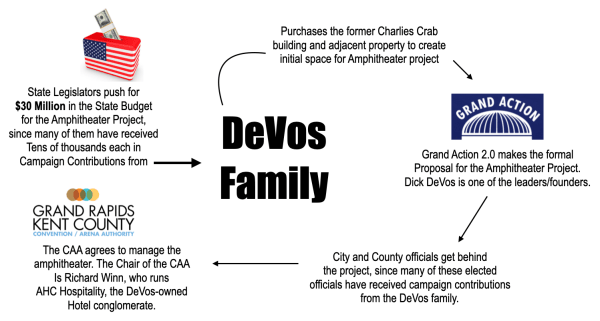
The DeVos/Grand Action 2.0 Amphitheater will officially be run by the Kent County Convention Arena Authority
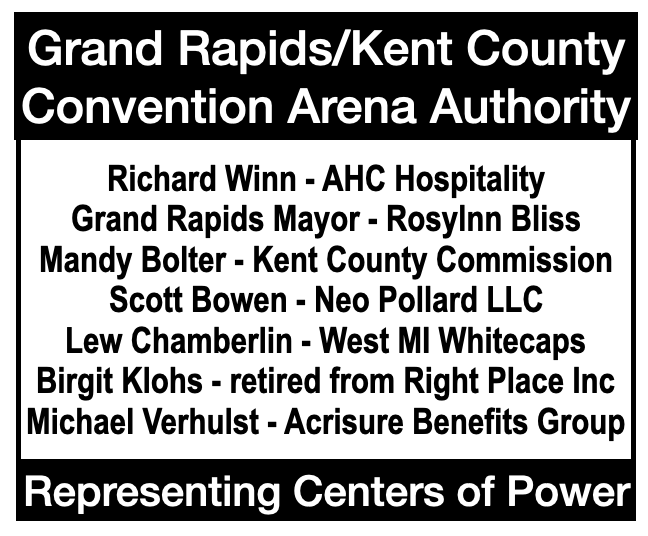 We first heard about the plans for a 14,000 seat outdoor amphitheater back in October of 2020, when Grand Action 2.0 first announced the plans.
We have also written the following articles as this project has unfolded:
How is it that we allow groups like Grand Action 2.0 to get away with the shit they do?
Tuesday morning, during the Grand Rapids City Commission Committee Meeting of the Whole, City Officials approved the mission statement of the Amphitheater, which you can read about in the Committee of the Whole Agenda packet, pages 9 – 11.
Before getting to the mission statement, it is important to look at what real function the Amphitheater will play. On page 9 of the agenda packet, it reads:
“The property that the City will sell to the CAA is part of a larger corridor redevelopment plan, which will include a mix of uses, public access to the riverfront, and other features reflecting the Grand River’s restoration as a key place-making opportunity for the city.
The CAA and City continue to make progress on the steps necessary to complete the purchase, including creation of separate parcels dividing the city-owned property into smaller parcels for sale. Design and financial planning for the amphitheater continues through a partnership of Grand Action 2.0, the DDA/DGRI, the City, the CAA and other stakeholders.”
To be clear, this project has always been about re-developing the Market Avenue corridor, from Fulton St. all the way down to Godfrey SW. There are already plans to turn an old warehouse into high end apartments, with plans to include lots of restaurants and other commercial establishments along that route.
You also can see from the above text that City Officials are using the “place-making” terminology, which was widely adopted by cities across the country after Richard Florida wrote his 2002 book, The Rise of the Creative Class. Since then, Florida’s ideas have received a ton of criticism, mostly with the claim that his ideas helped to usher in a new wave of gentrification throughout North America. Florida even acknowledge this reality, with his 2018 book entitled, The New Urban Crisis: How Our Cities Are Increasing Inequality, Deepening Segregation, and Failing the Middle Class-and What We Can Do About It. Unfortunately, Grand Rapids City Officials have yet to acknowledge that gentrification exists in Beer City USA.
The last thing worth pointing about about the text is the listing of the now normalized Public/Private partnership group involved in the Amphitheater plans, even though there is the mysterious “other stakeholders” listed. Stakeholders is nothing more than code for people and organizations with power that primarily function to maintain economic dominance and political power.
Amphitheater Mission Statement
To encourage economic development within the West Michigan region, create jobs and provide a facility for entertainment, enjoyment and benefit of the residents in an economical manner with a priority of facility fiscal responsibility through the delivery of events that are primarily entertainment related with a secondary emphasis on artistic and community activities and public events.
The mission statement includes all of the usual vagueness of mission statements, like create jobs and benefit all residents. They never clarify if these new jobs will pay a living wage, with benefits nor do they provide any clarity on the cost of admission for a concert or other entertainment-based events.
The mission statement for the Amphitheater is nothing more than the latest project in a continuing effort to transform downtown Grand Rapids into a playground for the privileged and a destination place for tourism. It will primarily provide economic benefits for those who are already economically well off, plus the ongoing development is likely to impact the Grandville Avenue corridor and the Black Hills neighborhood. I’m not someone who gambles, but I would bet on who the real beneficiaries of the Amphitheater project will be in 5 to 10 years.
What Kind of Change Do We really want to see in Michigan: Part II
In Part I, we covered Immigration Justice, Health Care for All, Housing Justice and Education Justice. Today, we will explore demands centered around the Prison Industrial Complex/Policing, Racial Justice, Environmental Justice and LGBTQ Justice.
“Since 1984, Republicans have used their control of the Michigan Senate to block things Michigan families need. No more.” Michigan Senate Democrats statement after the 2022 elections
The Democratic Party now has control of the State House, the State Senate and the Governor’s seat, which is the first time this has happened since the early 1980s.

With the Democrats now being in the driver’s seat through at least the end of 2024, this seems like a great time to make the kinds of demands we want, in terms of policy change. The Blue wave has come to Michigan, and since the Democratic Party is the “party of the people”, then this seems like a perfect opportunity to create a list of policy demands that the Dems can pass in Michigan. If we can take seriously the above comment from the Michigan Senate Democrats, then it is crucial to ask what it is that families living in Michigan really need?
It has been my experience over the past 40 years of doing organizing work, along with my read of US history, is that federal, state and local governments don’t generally make the necessary changes that people need. Governments must be pushed and pressured by organized movements of resistance, which is the essential message of Howard Zinn’s monumental book, A People’s History of the United States.
The following list of demands is based on movement politics that I have been involved in or movement politics that I have been following closely for the past 40 years. If you have additional ideas, then by all means send them along or create your own on a different platform, but let’s think creatively, let’s practice radical imagination and lets demand collective liberation. We will cover some of these demands in several postings, plus most of these issues intersect, so we will regularly refer back to other demands.
Prison Industrial Complex/Policing
The US has the more people in prison than any other country on the planet and Michigan is part of that reality. The State of Michigan also spends a great deal of public funds on operating prisons, just like counties all across the state, which operate jails. We also know that the bulk of people who are in prison, jail, on parole or probation are people who are part of this system, even though their crimes are non-violent. Mass incarceration and the Prison Industrial Complex must be dismantled and we can begin this process by releasing people who are in for non-violent offenses.
Imagine if the prison/jail population were reduced by 75 or 80%. Then imagine of the taxpayer money used to run prisons and jails were all of a sudden put towards supporting families that have endured the harsh impact of the Prison Industrial Complex. We know that communities with the most resources are communities with the least crime. If there was a massive investment in the communities that are currently experiencing poverty, criminal activity would drastically be reduced.
Also, we demand an end to privately run prisons and detention facilities in the State of Michigan. Private prisons and detention facilities should be abolished in Michigan.
It is also no surprise that a disproportionate amount of BIPOC people are in the prisons and jails throughout Michigan. This reality is due to the fact that BIPOC communities have the least resources and because the way policing is currently done, BIPOC community members are more likely to end up being monitored, harassed and arrested by the police.
Like the Prison Industrial Complex, police forces throughout Michigan are not needed, especially if the billions spent on prisons and policing in Michigan were re-directed to community needs. We know from the research done by groups like Interrupting Criminalization, that police do not prevent most crimes or reduce violence. If the billions that are currently being spent on prisons and cops were to be spent in communities, particularly BIPOC communities, then prisons and cops would not be necessary. This is not to say that violence will never occur, but there are lots of other models of violence prevention that do not rely on heavily armed state violence workers, aka, the police.
The State of Michigan should adopted a policy of defunding the prison industrial complex, which also includes defunding the police.
Racial Justice
Some aspects of racial justice can be achieved with the abolition of prisons and policing, mentioned above. For indigenous people, the State of Michigan could honor all previous treaties that were signed, give land back and pay reparations for the harm done to indigenous people and to indigenous children from the so-called boarding schools.
More importantly, State lawmakers should convene listening sessions to ask directly indigenous communities what they want and how there can be racial justice moving forward.
This process of creating racial justice should also be done with the Black community, Latino/a community, the Arab community and the Asian community. Each of these communities should make their own specific demands for racial justice moving forward and that means that lawmakers must listen to their demands and then take appropriate action.
LGBTQ Justice
The State of Michigan must adopt policies that eliminate any forms of discriminations directed towards the LGBTQ community. This process could begin by including the LGBTQ community as part of the Elliot Larsen Act.
In addition, the State of Michigan should adopt policies to allow for same sex partner benefits, allow domestic partners to adopt and to remove any and homophobic and transphobic practices that take place in public and private institutions – legal institutions, educational institutions, civic institutions, etc. Again, the LGBTQ community should make their own demands, which means the State of Michigan should follow the same practice of holding listening sessions and then implement policies based on the demands from the LGBTQ community.
Environmental Justice
Environmental Justice includes Climate Justice, some of which we addressed in a previous post about the Enbridge Line 5. The same could be said about all fossil fuel extraction and consumption in Michigan.
State policymakers should familiarize themselves with the principles of Environmental Justice and use these principles when making policy that make Environmental Justice a reality, especially since these principles are very intersectional.
Mass Transit should be the norm moving forward, which would mean a drastic reduction in automobile use and production. Shifting to electric cars and trucks is not the answer.
Michigan agricultural policy should shift the use of land to food production that would be available for people living in the Great Lakes bio-region, not for export around the world. Shifting food production from mono-crops would also mean less production of food like corn, which is primarily for animal feed and not human consumption. There should be an end to industrial size agribusiness practices and smaller organic farming practices that are more bio-diverse, thus reducing the need for pesticides. Also, most of the people of Michigan are food insecure, so policies must be adopted to promote greater food security, food justice and food sovereignty. For a deeper exploration of the current food system, with is based on exploitation and driven by profits, go to this link.
The current climate crisis is an urgent matter and time is of the essence. Climate Justice and the larger Environmental Justice policies addressed here need to be implemented in the very near future.
In Part III of this series we will address Economic Justice, Foreign Policy & Michigan, along with Democracy demands, where we discuss the ways in which we need to change how we govern ourselves.
What Kind of Change Do We really want to see in Michigan: Part I
“Since 1984, Republicans have used their control of the Michigan Senate to block things Michigan families need. No more.” Michigan Senate Democrats statement after the 2022 elections
The Democratic Party now has control of the State House, the State Senate and the Governor’s seat, which is the first time this has happened since the early 1980s.
With the Democrats now being in the driver’s seat through at least the end of 2024, this seems like a great time to make the kinds of demands we want, in terms of policy change. The Blue wave has come to Michigan, and since the Democratic Party is the “party of the people”, then this seems like a perfect opportunity to create a list of policy demands that the Dems can pass in Michigan. If we can take seriously the above comment from the Michigan Senate Democrats, then it is crucial to ask what it is that families living in Michigan really need?

It has been my experience over the past 40 years of doing organizing work, along with my read of US history, is that federal, state and local governments don’t generally make the necessary changes that people need. Governments must be pushed and pressured by organized movements of resistance, which is the essential message of Howard Zinn’s monumental book, A People’s History of the United States.
The following list of demands is based on movement politics that I have been involved in or movement politics that I have been following closely for the past 40 years. If you have additional ideas, then by all means send them along or create your own on a different platform, but let’s think creatively, let’s practice radical imagination and lets demand collective liberation. We will cover some of these demands in several postings, plus most of these issues intersect, so we will regularly refer back to other demands.
Immigration Justice
One demand, which should be an easy one, is for a Democratic Party controlled State legislature to provide undocumented immigrants the right to obtain a driver’s license. This has been a demand of Movimiento Cosecha and the coalition known as Drive Forward Michigan.
End any and all cooperation between the State of Michigan and Immigration and Customs Enforcement (ICE). In addition, the State of Michigan should adopt a formal sanctuary policy, which would include no law enforcement cooperation with ICE, but also a public declaration to stand with the undocumented community and to provide support for them. Support could be in the form of connecting undocumented immigrants to community resources, but it might also mean providing material and legal support to prevent arrest, detention and deportation.
We know that many immigrants come to the US because their country is experiencing political violence, the effects of Climate catastrophe or the consequences of economic policies that benefit the wealthiest members of their country or foreign countries. US foreign policy is often a culprit in forced migration around the world, therefore we would call upon the State of Michigan to meet with and pressure members of Congress from Michigan to get them to fundamentally alter US foreign policy in the countries where said policy is a root cause of forced migration.
The national immigrant justice movement, Movimiento Cosecha, since it began has been demanding dignity, respect and permanent protection for all 11 million undocumented immigrants in the US. The State of Michigan should also adopt a policy that commits to working towards this goal as well.
Health Care for All
Several Michigan Democrats ran on the claim that they lowered the price of medicines. While this is a step in the right direction, it is woefully inadequate. Michigan legislators need to adopt a Medicare for All policy that is specific to Michigan. Adopting such a policy would guarantee that all people living this state would have access to health care resources and the medications they need.
There are also pharmaceutical companies based in Michigan. Get them to support Medicare for All in Michigan, if not, then those companies should be made into public assets. Health Insurance companies that operate in Michigan, like Priority Health and Blue Cross Blue Care, will also need to get behind Medicare for All, which would essentially make those companies obsolete. The State of Michigan, would then guarantee employment for any and all health insurance employees, if they so chose.
Lastly, all hospitals, clinics and health care facilities should be available for anyone to use at any time, at no cost to those individuals. If health care is a right, then it should be free. On the matter of how Medicare for All will be paid for in Michigan, see the section on US Foreign Policy and Michigan.
Housing Justice
Housing has been a longstanding issue for Michigan families, particularly around affordability. State policy should be rooted in the idea that housing is a right and should not be dictated by the market.
Our demands should include rent control, which would put limits on landlords and property Management Companies from charging whatever they want for rent in Michigan. Second, more state funds should be available for people to buy a home. One way to create a funding source for first time home buyers would be to stop providing tax breaks, tax incentives and brownfield development resources to developers and redirect them to families in Michigan wanting to buy a home.
Third, State policy should put an end to the practice of gentrification. Fourth, Vacant buildings should be rehabbed and retrofitted to provide truly affordable housing for families that need it. Fifth, real estate and rental property owner associations should not be allowed to influence future elections through political action committees. Lastly, it should be State policy to make massive investments into creating new housing complexes, which would take more of the housing market out of the private sector. In addition, the State should promote more housing cooperatives, along with Community Land Trusts, which will not only provide a larger variety of affordable housing options, but prevent future possibilities for gentrification.
Education Justice
The State of Michigan should make sure that all public schools are fully funded, to put an end to the practice of allowing public money to be used by charter schools and other private educational systems.
Public Schools should have greater autonomy to create and implement curriculum that allows for Critical Race Theory, history that centers BIPOC voices and experiences, sex education and education that allows students to be free to be themselves in a safe and healthy environment. No educational resources should be used to promote homophobia or transphobia.
Public Education should not be seen primarily as a space to create talent for the business community, but a place where critical thinking, multiculturalism and skill building for collective liberation are taught.
All Community College, Public Colleges and Public Universities should be free and accessible for anyone who wants to attend.
Religion should not be part of public school education in any capacity.
In Part II, we will explore demands around the following issues: the Prison Industrial Complex/Policing, Racial Justice, Environmental Justice and LGBTQ Justice.
Election Money and Mutual Aid: A Proposal for the Grand Rapids community
 According to Transparency USA, there has been just over $40 Billion spent on the 2022 Elections for the entire country. In Michigan, the total amount of money raised has been $399,945,494.73, but the amount spent is about $15 Million more, coming to a total of $415,768,045.15.
So, $415 Million has been spent by candidates, Political Action Committees and Political Parties, going primarily to media companies and organizations that have consulted candidates, along with organizations that have co-ordinated ballot initiatives. Not surprising that the bulk of money goes to produce those shitty sound-bites videos for TV, audio files for radio and the plethora of mailers. In the month leading up to the election, we received around 200 separate mailers. I looked at everyone of them and all of them had the most basic information, often vague or misleading about the candidates and ballot proposals.
According to the Michigan Voter Information Center, there are roughly 8,214,213 registered voters in Michigan. 5,568,097 Michiganders voted in the 2020 Election, which was the largest turnout ever. Now, just to round it out, if 5.5 million voters showed up Tuesday, that would mean that for every voter there was an average of $82 spent to convince them how to vote.
There was a total of $60 Million spent on Proposal 3 alone, with the group supporting Proposal 3 raising almost three times as much as the group that was opposing Proposal 3. Again, a great deal of money for just one ballot proposal.
In thinking about how much money is raised and spent during political campaigns, with he bulk of the money going to political ads of all kinds (although I seriously doubt that the public benefits from these ads), what would it mean if the same amount of money would be used to support the most vulnerable communities in Michigan? What sort of an impact would $60 Million – the amount spent on Proposal 3 – have if that amount was provided to the people who were having to make a decision about their reproductive health? How could $60 Million be used to provide support or direct Mutual Aid to people considering having an abortion? Now, I don’t think for a second that reproductive choice simply comes down to money, but if there was that kind of money being spent on resources or as direct Mutual Aid for people confronted with making difficult choices about whether or not to have children, my guess is that it would make those decisions less stressful.
Then there is the money raised by candidates. Again, according to Transparency USA, the total amount of money raised by Democratic Party candidates (a total of 307), was $65,091,779. This means that the average amount raised by Democratic Party candidates in Michigan was $212,025. What if those same candidates, whether they won or not, would commit to raising the equivalent amount of money – $212,025 – and provide it as Mutual Aid to the most vulnerable in their communities? What would it be like for trans youth to receive direct Mutual Aid, especially those who are not supported by their families? What would it be like for undocumented immigrants who live in constant fear from ICE and other law enforcement agencies, to be the recipients of direct Mutual Aid funds? How about BIPOC families that are struggling to afford rent or families in general that are food insecure, can’t afford medications they need, can’t afford child care and basic health care needs?
If the candidate you contributed money to ended up losing in the election, then that money is gone. However, even if the candidate you contributed to won their election, there is not real way to know if you will benefit from how they vote or what policy proposals they introduce and get passed. It is very difficult to quantify the monetary or material benefits that elected officials might be able to win for the public from policies that are passed.
However, we can make determinations about the community well being when we look at poverty, food insecurity, health conditions, employment, education opportunities, transportation costs, etc. In Kent County alone there are thousands of families that are struggling to survive when it comes to basic necessities and this has been the case since the county of Kent has existed. The question we should be asking ourselves is, why is there always a large percentage of the population that is struggling to have their basic necessities met, regardless of which political party is in control of local, state and federal governments?
 I’m not asking people to stop contributing to political campaigns, but what I am proposing is that candidates, political parties and people who contribute to them, to provide Mutual Aid to individuals and families directly that are the most vulnerable in every community. Doing so would provide direct relief to thousands in every community, it would bring a greater awareness and understanding of economic disparities in every community and it might even get candidates, elected officials and political systems to have a fundamental shift in how they do policy……..because the way they do policy right now, primarily benefits those who are already highly privileged.
Editors note: Mutual Aid is already being practiced in Grand Rapids in many people and coalitions of groups. Please consider contributing to the Grand Rapids Area Mutual Aid Network (GRAMAN), which has been doing amazing work with all volunteers, providing direct Mutual Aid to families throughout the Grand Rapids area.

