 In Part I of our series looking back at the 20th anniversary of the public resistance to the US invasion/occupation of Iraq in 2003, we focused on early organizing efforts to build an anti-war movement before the US war on Iraq even began. In Part II, we looked at the protest when President’s Bush’s visited Grand Rapids the day after his State of the Union address and the GRPD’s response during that protest. In Part III, we looked at the Women in Black actions, the global protest against the war march that took place in Lansing, along with the People’s Alliance for Justice & Change workshops on civil disobedience that were offered to a growing number of people who wanted to do more than just hold signs.
In today’s post, we will look back at the students organizing that was taking place at a few colleges in Grand Rapids, plus the sit in that took place in the Federal Building to confront Congressman Ehlers on his complicity in the US war against Iraq.
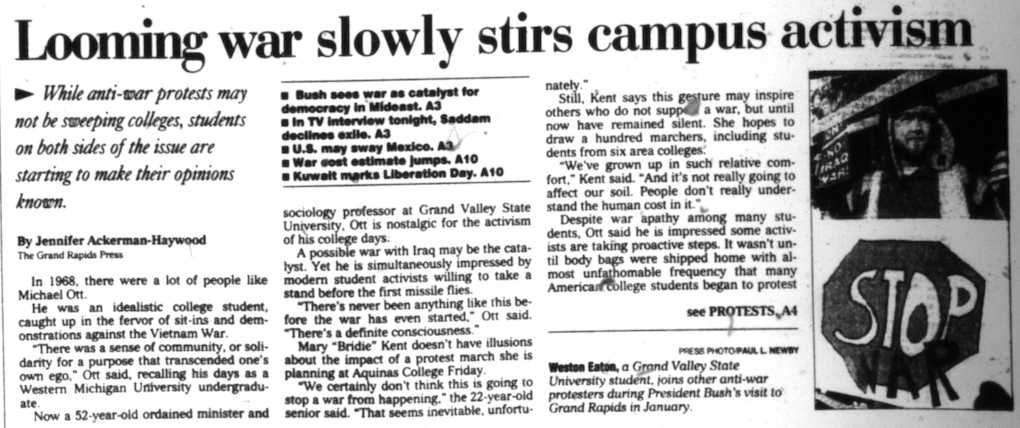
Beginning in the fall of 2002, college students in the greater Grand Rapids area began to be involved with anti-war organizing efforts. Some of those students were part of the People’s Alliance for Justice & Change, but most of them were organizing on their campus. The above article from the Grand Rapids Press attempted to show that college students were becoming active, but the main problem with the article was that they were n’t really talking to students who were actively involved in resisting the US invasion of Iraq.
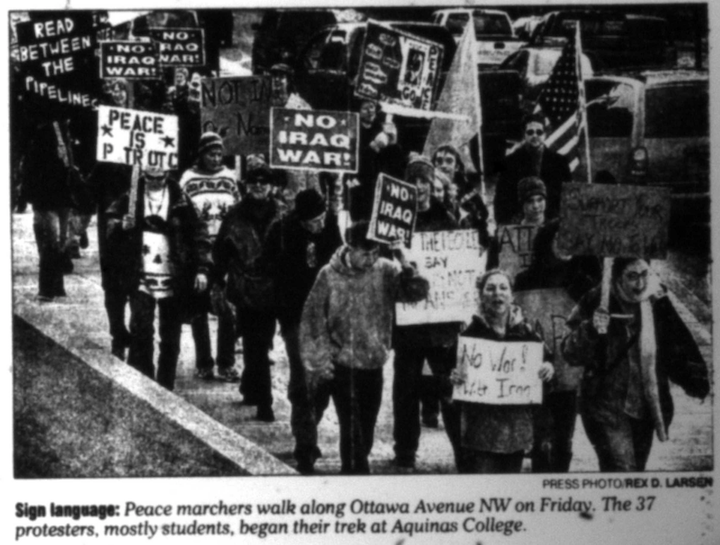 On March 1st, 2003, an estimated 50 people marched from Aquinas College to the federal building in downtown Grand Rapids to protest the looming war with Iraq. (As this picture here on the right shows) Students from GVSU, Calvin College and Aquinas College made up the bulk of those marching. The march numbers were small, mostly because the action began at noon on a Friday and went til about 4pm, which made it difficult for working class people to participate.
However, some students who participated in the march were wanting to do more. The People’s Alliance for Justice & Change organized a civil disobedience training the following week, which then led to an action at the office of Rep. Vern Ehlers.

The GR Press article headline was misleading, since the group didn’t really care if Rep. Ehlers was there or not, they just wanted to make a statement about the impending US invasion of Iraq.
There were a few GVSU students who participated in this action, along with members of the People’s Alliance for Justice & Change. Six people were arrested when they refused to leave the federal building, so the US Federal Marshals called the GRPD.
The group had people there to speak to the news media and to hand out two flyers, one with information about the illegality of the US war/sanctions on Iraq and another handout, which was a poster of a WANTED sign for Rep. Ehlers, which called for his immediate arrest for supporting war crimes.
 A few months later, the People’s Alliance for Justice & Change organized a People’s Trial of Rep. Vern Ehlers. The mock trial was a piece of performance art designed to dramatize the human rights violations and war crimes that the West Michigan Congressman was complicit in, since he consistently voted for ongoing military operations and funding for the US military invasion/occupation of Iraq.
The trial organizers did send a People’s Subpoena to Congressman Ehlers office in Grand Rapids, but he never responded. The trial script was written by John Rich, a script you can read here, along with supporting documents on the war crimes committed by the US military in Iraq, crimes which the Congressman supported.
The trial was also broadcast on the public access TV station, GRTV, as well as being posted on line. The video is 33 minutes long and involved several characters to address specific issues related to the US invasion/occupation of Iraq. Here below is the video of the People’s Trial of Vern Ehlers.
In Part V, we will look at organizing to support the Arab American and Muslim communities in Grand Rapids, along with the final action that took place before the US began bombing Iraq on March 20, 2003.
False solutions and the housing crisis: Why groups like Housing Next in Kent County are a danger to a movement for housing justice
Last week, MLive posted a story with the headline, Grand Rapids, Kent County need 34,699 new housing units by 2027. Can it be done?
The article begins by stating:
The housing gap in Grand Rapids and Kent County has jumped 56%, with an estimated 34,699 new units needed by 2027 to meet projected population growth, a new study released by the group Housing Next shows.
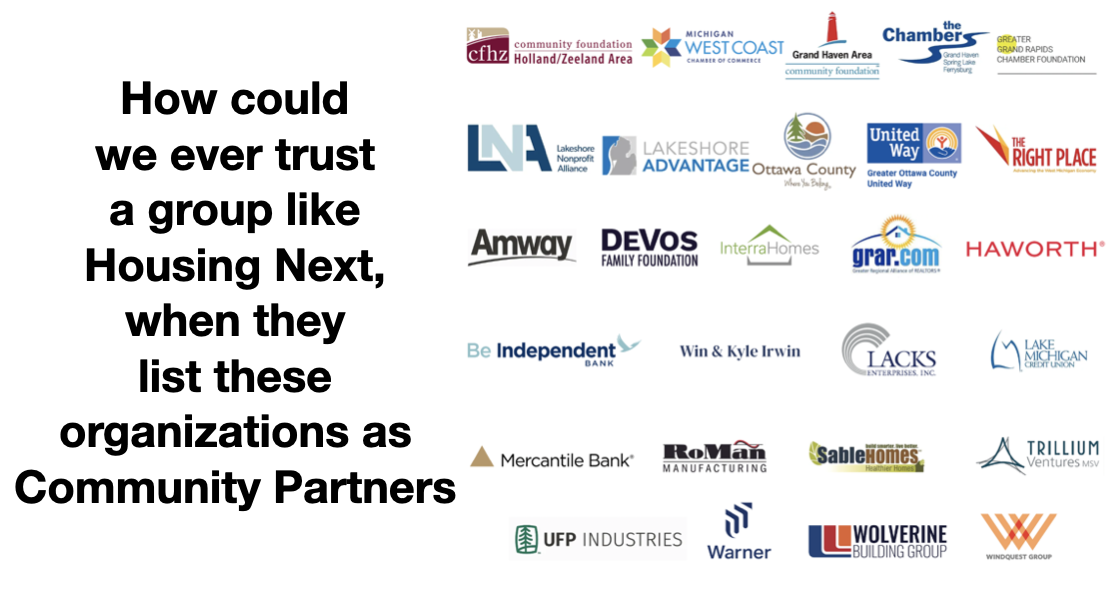
This MLive article is based on a gathering that was hosted by the Grand Rapids Chamber of Commerce, which involved a few government officials, Chamber members, but mostly developers. At that meeting both government officials and developers lauded the importance of growth for Grand Rapids and Kent County, but ignored the realities of the current housing crisis.
Central to this story was the Housing Next study. If people are not aware, Housing Next is an entity that was essentially created by the Chamber of Commerce, primarily as a way to insert themselves into the housing discussion and to influence housing policy.
The “solution” to the current housing crisis, according to Housing Next, involves local government, developers and non-profits. The fact of the matter is, Housing Next offers no real solution to the housing crisis, only the same old model, the market. This is not a solution or maybe more aptly named a false solution. This is because under a market system, housing is nothing more than a commodity that can be bought and solid to make profits. For the Chamber and those sectors of society who believe in the market, housing is not a fundamental human right. Housing within a market economy, particularly home ownership, is for those who can afford it, which leaves out millions of people in the US alone.
If you want to understand who is really behind the Housing Next effort, along with the ideological framework they operate under, just look at the list of “community partners” in the graphic above.
The market-based solution that Housing Next is suggesting doesn’t even make sense within a market context. If those who are committed to a market economy, those who want to see homes being purchased and apartments being rented, then they have to recognize that people need to make enough money in order to purchase a home or pay the rental costs that the market dictates. This would require that individuals and families wouldn’t have to earn enough money to pay a mortgage or cover the monthly cost of rent. According to the National Low Income Housing Coalition, people need to earn $20.02 an hour to afford the average cost of rent in Grand Rapids. Not only are there thousands of people in Grand Rapids which DO NOT make $20 an hour, the community partners that Housing Next listed above has fought for decades against an increase in the minimum wage in Michigan, which is currently $10.10 an hour. So, you see, those who want to use a market-based solution to the current housing crisis, don’t even want to play by the rules of the market, which would pay people wages that would allow them to afford a home mortgage or monthly rental costs.
Last month, GRIID posted an article that critiqued how the City of Grand Rapids was viewing the issue of how to address the rising number of unhoused people in this city. In that article we identified several tactics to address the current housing crisis, including:
- Paying people a livable wage, which right now would be $25 an hour minimum
- Reducing the wealth gap in Kent County, where there are over 600 millionaires, but 25% of the population subjected to poverty.
- Government regulated rent control
- The creation of Tenant Unions
- Stop the influence peddling by Real Estate and Rental Property Associations, especially during election cycles, as we documented in 2022.
- Re-direct part of the massive US Military Budget ($858 Billion for 2023) and use it to provide housing for people, particularly the most marginalized communities.
- Practice Radical Hospitality, particularly in the faith communities. Imagine home many people who are currently housing insecure, could benefit from the resources and hospitality of the faith communities.
- Limit large corporate property management companies or real estate investors from operating in Grand Rapids/Kent County.
- End government subsidies/tax breaks for developers.
- Promote cooperative housing and Community Land Trusts.
There are lots of other possible tactics and strategies that could be developed to address the current housing crisis, but we need a social movement to confront the current market driven housing system and to implement non-market housing solutions. We cannot be fooled by groups like Housing Next, nor can we allow them to continue to dictate the narrative about how to address the current housing crisis.
Our latest update to the DeVos Family Reader: Monitoring the most powerful family in West Michigan
In Howard Zinn’s monumental book, A People’s History of the United States, he constantly juxtaposes the amazing things that people did to fight for liberation and the people behind the systems of oppression that social movements were fighting against.
This is exactly why I have spent years monitoring, investigating and critiquing the DeVos Family. They are the most recognizable and powerful manifestation of the systems of power and oppression in West Michigan. Now, I know there are plenty of people who share the belief that without the DeVos Family, Grand Rapids wouldn’t be where it is today. I fully agree with that belief, but for reasons that are the exact opposite of those who hold the most powerful family in West Michigan in high regard.
 Three times a year we try to update our DeVos Family Reader, a collection of articles that looks at the family’s history, the influence on election & public policy, their foundations, how they are reported on in the news media, ArtPrize and the section entitled Betsy DeVos Watch.
This updated version of the DeVos Family Reader includes information and analysis on a variety of topics, since our last update, which was 4 months ago. There have been a total of 8 new articles included in the DeVos Family Reader, including pieces on the outdoor amphitheater, the proposed soccer stadium, DeVos foundations, their 2022 campaign contributions, Betsy DeVos at GVSU and Doug DeVos podcast.
The DeVos Family Reader is now up to 700 pages of history, analysis and information about the most powerful family in West Michigan.
Will the Democrats reverse Michigan’s Right to Work Law: Low hanging fruit in today’s Class War
In December, we wrote about the campaign to make Michigan a Right to Work state, which took place in 2012. In that article, we noted that there were several West Michigan entities that played a major role in making Right to Work a reality in Michigan. Some of those same groups are now making noise in order to maintain Right to Work for Michigan.
Legislation to dismantle the Right to Work policy in Michigan were introduced on January 12, with House Bill 4004 and Senate Bill 0005.
These bills were both sent to the Committees on Labor, which has held no hearings on the matter, nor made any decisions. The Labor committees in both the Michigan House and Senate are dominated by Democrats, which begs the question, Why have they not acted to dismantle Right to Work?
Groups that pushed for Right to Work in 2012 are now making it a priority to keep Right to Work
The organizations that were involved in pushing Right to Work legislation from 2008 – 2012, such as the West Michigan Policy Forum, the Chamber of Commerce, the Mackinac Center for Public Policy and the Michigan Freedom Fund, have made the issue of maintaining a Right to Work policy a priority in Michigan.
Fir instance, the Michigan Freedom Fund has only had 3 blog posts on their site since the November 2022 elections, with all three devoted to the importance of maintaining a Right to Work policy in Michigan.
The West Michigan Policy Forum has made five separate blog posts about the importance of having a Right to Work law in Michigan, often using propaganda to justify their stance on Right to Work. For instance, their most recent blog post about Right to Work is from February 8th, with the headline, Fact Check: Right-to-work Helps All Americans Prosper. Not surprisingly, the WMPF blog post provides no hard evidence that Right to Work laws benefit everyone.
The Mackinac Center for Public Policy has also made a push to maintain Right to Work in Michigan. In fact, since the November 2022 election, the Mackinac Center has posted 16 separate Right to Work articles on their site. In fact, when you go to the main page of there Mackinac Center, at the top of their webpage the issue of Right to Work is featured. They have even created a stand alone page dedicated to Right to Work, where people can post stories about how wonderful Right to Work has been for them https://protectmiworkers.com/.
One interesting side note about these groups that are zealously defending Right to Work laws in Michigan, is the fact that all of them have a direct connection to the DeVos family and their considerable wealth. The DeVos family fully funded the Michigan Freedom Fund, they have contributed millions to the Mackinac Center for Public Policy and DeVos family members have served on the Board of Directors for both the Mackinac Center and the West Michigan Policy Forum. The fact that the DeVos family has been so involved in the work to create and maintain a Right to Work law in Michigan speaks volumes and may have something to do with why the Democrats have yet to take action on the proposed legislation that would dismantle Right to Work in the state.
One would think that it should be easy for the Democrats to get rid of the Right to Work policy in Michigan, especially since it is very low hanging fruit. Getting rid of Right to Work should be a decisive and swift decision for the Democrats, since the claim to be for workers and have benefitted from the millions that labor unions have contributed to candidates in recent years. In fact, once the Democrats have dismantled Right to Work laws in Michigan, they should make it a priority to raise the minimum wage in Michigan to $25 an hour, which would be more of a livable wage, along with taxing the hell out of the rich to fund housing, education, health care and climate justice work that we can’t wait another decade for.
Unfortunately, the Democratic Party will not push for more substantive policies that would essentially redistribute wealth in this society, especially since the Dems are also deeply committed to the system of Capitalism. This means that in order to win a contemporary class war, we will need to be in the streets, to democratize our workplaces, to engage in strikes, boycotts and numerous other tactics that will demonstrate our collective power. As Frederick Douglass said so eloquently in 1857, “Power concedes nothing without a demand. It never did and it never will. If there is no struggle, there is no progress.”
While DeSantis gets headlines for whitewashing education curriculum, there are groups in West Michigan who are pushing the same anti-Black narrative
Over the past month, Florida Governor Ron DeSantis has been making headlines for numerous far right actions, including his push to undermine education curriculum that provides a more honest view of US history, particularly about the Black experience and the Black Freedom struggle.

There are numerous other high profile reactionaries who have been attacking any and all education-centered material that rightly names that the US was essentially founded on two major atrocities – the genocide of Indigenous people and the mass enslavement of Black people. These attacks have been going on ever since BIPOC communities have been demanding a more honest investigation of US history, particularly at the college level.
During the Trump administration, there was a renewed interest in undermining a more honest look at US history, such as the White House Conference on American History that was organized in September of 2020, which we wrote about. In fact, the Trump Administration endorsed the 1776 Project, which was crafted by educators with the far right Hillsdale College, in Hillsdale, Michigan.
The 1776 Project was a direct response to the work being done by Nikole Hannah-Jones and the work she was doing with the 1619 Project. The 1619 Project began in 2019, and has been the target of numerous high profile far right ideologues, like DeSantis, but also from numerous organizations that are committed to maintaining a white-centered narrative about US history.
Just last month, the 1619 Project had released a 6-part documentary series on the streaming services known as Hulu, which has once again prompted a great deal of criticism from the far right sectors of the country, along with groups right here in West Michigan.
One group that has been openly opposed to the 1619 Project, is the far right think tank, the Acton Institute. The Acton Institute had initially done a podcast in August of 2020, inviting Phillip W. Magness, with the American Institute for Economic Research, who wrote a book entitled, The1619 Project: A Critique. On February 1st, the Acton Institute re-played that interview with Magness, with an updated introduction to the podcast. In that Acton Institute interview, their quests makes the claim that people simply have a hard time “accepting the complicated totality of US history.”
A second example of someone in Grand Rapids that has openly attacked the 1619 Project, was a guest on the Doug DeVos podcast called Believe! DeVos invited Dr. Larry Arnn, the President of Hillsdale College to discuss the 1619 Project. The Hillsdale President does acknowledge slavery, but just in passing. Interestingly enough, Dr. Arnn then spends a great deal of time talking negatively about the 1619 Project, stating:
You know, the New York Times has done that frightful 1619 Project. And they claim that the movement of the founding of America from the colonies forward was in the direction of perpetuating slavery. The President of Hillsdale College then cites Gordon Wood as the leading US Historian, so as to contradict the claims made by the 1619 Project. This theme is not really explored by DeVos or his guest, since both are not interested in a serious exploration of the more honest history that the 1619 Project explores, particularly as it related to the centuries long practice of systemic racism in the US and how it has impacted the Black community in particular.
A third, and final example, comes from the pro-police Facebook group in Grand Rapids, Silent no More. Silent no More is a fairly recent creation, but appears to be some of the same people who host Stand With Schurr, the group that is defending the cop who murdered Patrick Lyoya last April. A few days ago, the group Silent no More posted a link on their FB page from the group legalinsurrection.com, with the headline, “Hulu series based on 1619 Project Pushes ‘False History.’ One of the main objectives of the group legalinserrection.com, is to discredit Critical Race Theory. The fact that the pro-police group Silent no More posted this information only demonstrates that besides defending cops, they defend white-centered history and deny that structural racism has been a fundamental component of the political experiment called the United States. Groups that a police apologists tend to justify policing targeted towards BIPOC people, along with denying structural racism.
While I am disgusted by the likes of Gov. DeSantis and his attacks on Critical Race Theory and the 1619 Project, I am more interested in groups in West Michigan that are doing the same thing. If I want to do more than be aware, then working to oppose these groups in West Michigan seems way more important than simply spouting off against the likes of Gov. DeSantis. We can actively work to expose and confront this kind of misinformation in Grand Rapids, misinformation that is well funded.
Blurring the lines between education and Neo-Liberal Capitalism: GVSU partners with local business to provide a talent pipeline
Last week both MLive and MiBiz reported that GVSU has begun a new program, where they are partnering with 5 Grand Rapids-based companies.
The program is being called the Laker Accelerated Talent Link. The name of the program is consistent with how the Capitalist Class sees educational institutions, where their main function is to create talent for businesses. In fact, the local group Talent First, said that the three main goals of their work, from a 2017 report, was to, 1) develop partnerships between businesses and educators, 2) Evaluate community investments to improve the opportunity ecosystem (make sure school funding was used for workforce development), and 3) Change public policy to create a new education system.
All of this think around talent creation and workforce development is consistent with Neo-Liberal Capitalism.
The President of GVSU, Philomena Mantella, confirmed this relationship between Neo-Liberal Capitalism and education, with the following comments from the MLive article:
We are grateful to these leading employers in the region for taking this initial step with us to equip dynamic and diverse professionals for the workforce.
We are addressing labor-shortage concerns and creating a positive impact on the business community. This program will highlight Grand Valley students’ human-centered skills and deep knowledge of their disciplines, and the companies will benefit from well-prepared employees
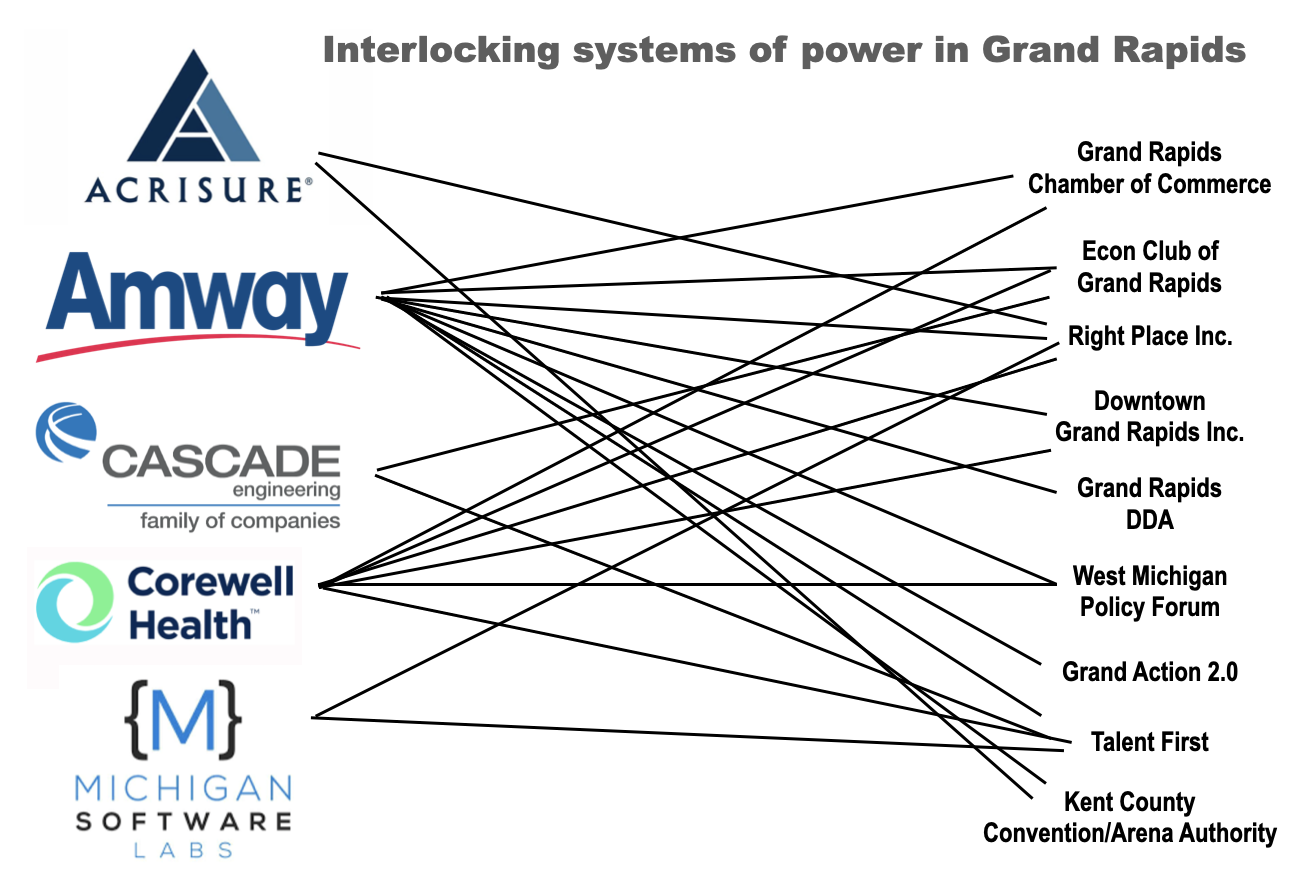
The five companies that are partnering with GVSU are, Acrisure, Amway, Cascade Engineering, Corewell Health and Michigan Software Labs. Now, these aren’t just random companies that will be partnering with GVSU, they are companies that are deeply tied to the Grand Rapids Power Structure, which is essentially an interlocking system of power, as is reflected in the graphic above. For the purposes of this post, we will attach the DeVos name to Amway, since the DeVos family is at the top of the Grand Rapids Power Structure and has dozens of subsidiaries that are represented in the groups that make up the local power structure.
It should also be noted that the President of GVSU, Philomena Mantella, also sits on the boards of Grand Action 2.0, Right Place Inc., Talent 2025, and the Econ Club of Grand Rapids.
Another connection to this project between GVSU and local companies, which is set to begin in August of 2023, is the fact that two of the companies involved, also sit on the GVSU Board of Trustees – Amway and Corewell Health. Lastly, GVSU President Philomena Mantella stated in the MIBiz article, “GVSU plans to scale the program and is actively seeking other corporate partners.”
The audacity of lawyers: Postponing the trial for the cop that murdered Patrick Lyoya
On Friday, it was reported by several local news agencies that the Judge Mark Trusock has granted a delay in the trial of Christopher Schurr. Schurr was the GRPD cop who shot and killed Patrick Lyoya last April.

The lawyers for Schurr asked the court to postpone the trial until October, meaning the trial would not begin until 18 months after Schurr shot Lyoya in the back of the head after a routine traffic stop. We’ll get to the reasons that Schurr’s lawyers used in order to get the trial delayed, but first I think it would be useful to provide a brief timeline from the murder of Patrick Lyoya to the present.
April 4th, 2022 – During a routine traffic stop, GRPD Officer Christopher Schurr shoots and kills Patrick Lyoya. GRPD and City officials hold Press Conference.
April 14, 2022 – GRPD and Grand Rapids City officials released video of the GRPD cop who shot and killed Patrick Lyoya.
April 26, 2022 – Pro-Police groups go on the offensive, support Christopher Schurr and argue that Patrick Lyoya died because he refused to obey a cop.
May 5, 2022 – Local news submits Freedom of Information Act (FOIA) request to get internal GRPD documents related to the Patrick Lyoya shooting.
May 12, 2022 – Mayor Bliss threatens to change City Commission meeting rules to prevent disruptions by the Justice4Patrick Movement.
May 23, 2022 – MLive article on Officer Christopher Schurr normalizes White Supremacy and White Saviorism.
June 10, 2022 – Cop who killed Patrick Lyoya is charged with second degree murder, plus responses from GR City officials.
June 12, 2022 – Lawyers now representing Schurr release a statement attempting to control the public narrative, which reads in part: “We were disappointed to learn that Officer Schurr has been charged with murder by the Kent County Prosecutor. Officer Schurr is a decorated member of law enforcement who has dedicated his career to helping others and protecting the citizens of Grand Rapids. The evidence in this case will show that the death of Patrick Lyoya was not murder but an unfortunate tragedy, resulting from a highly volatile situation. Mr. Lyoya continually refused to obey lawful commands and ultimately disarmed a police officer. Mr. Lyoya gained full control of a police officer’s weapon while resisting arrest, placing Officer Schurr in fear of great bodily harm or death. We are confident that after a jury hears all of the evidence, Officer Schurr will be exonerated.”
June 22, 2022 – Once again the Grand Rapids commercial news media presents a narrative that favors the ex-GRPD cop who killed Patrick Lyoya.
July 27, 2022 – New GRPD “Sanctity of Life” policy announced.
September 25, 2022 – Hearing on the Christopher Schurr case, where Schurr’s lawyers say they now have all of the documents needed for this case.
October 27, 2022 – Another hearing in the Schurr case to finalize the trial date.
October 28, 2022 – Witness testimony and character assassination: Local news coverage of the court hearing of Chris Schurr, the man who shot and killed Patrick Lyoya.
January 12, 2023 – Lawyers representing Schurr submit 45 page brief arguing the charges against Schurr should be dropped.
This brings us to last Friday, where the lawyers representing Christopher Schurr were granted a delay in the trial date, which will now take place in October. There were two reasons submitted by Schurr’s lawyers as to why the trial should be delayed:
- They needed more time to, “mull over more than 30,000 pages of files in the case.”
- Matthew Borgula, one of Schurr’s attorneys, explained to the judge that one of the members of their trial team recently died, and his co-counsel also recently lost an immediate family member.
To the first point, Schurr’s lawyers have had all the documentation they needed since September 25. In addition, as most law firms do, they often utilize or hire additional staff/clerks to sift through documents relevant to cases they are working on. Needing more time for the 30,000 pages seems like a weak argument and borders on petty.
On the second point, I am assuming that these family members weren’t murdered, rather they died under less horrific circumstances. Having the trial delayed by 7 months seems rather excessive. Most of us in this society rarely get much time off to grieve the loss of family members. More importantly, Patrick Lyoya’s family will now have to wait an additional 7 months to see if there will be any justice or possible closure. Is there no consideration for their grief, which is a direct result of the murder of their family member? Losing a family member to murder is a much more traumatic and horrendous death to deal with and will no doubt impact Patrick’s family for the rest of their lives. In using the loss of a family member, the lawyers representing Schurr not only insult the family of Patrick Lyoya, their request is a form of mockery, even taunting, as if to say, “we don’t give a damn about your loss and your grief.”
Some people might say, well it’s only another 7 months til the trial, so just be patient and wait. Such sentiment is a construct of white supremacy, not only because it is insensitive, but because it essentially erases the centuries of harm done to Black people by systems of power and privilege. You might recall what Dr. Martin Luther King Jr. had to say to white people, when they urged him to be patient, to wait for justice. Dr. King responded, while sitting in a jail cell in Birmingham, Alabama, and wrote these words:
We know through painful experience that freedom is never voluntarily given by the oppressor; it must be demanded by the oppressed. Frankly, I have yet to engage in a direct action campaign that was “well timed” in the view of those who have not suffered unduly from the disease of segregation. For years now I have heard the word “Wait!” It rings in the ear of every Negro with piercing familiarity. This “Wait” has almost always meant “Never.” We must come to see, with one of our distinguished jurists, that “justice too long delayed is justice denied.” We have waited for more than 340 years for our constitutional and God given rights. The nations of Asia and Africa are moving with jet like speed toward gaining political independence, but we still creep at horse and buggy pace toward gaining a cup of coffee at a lunch counter. Perhaps it is easy for those who have never felt the stinging darts of segregation to say, “Wait.” But when you have seen vicious mobs lynch your mothers and fathers at will and drown your sisters and brothers at whim; when you have seen hate filled policemen curse, kick and even kill your black brothers and sisters; when you see the vast majority of your twenty million Negro brothers smothering in an airtight cage of poverty in the midst of an affluent society; when you suddenly find your tongue twisted and your speech stammering as you seek to explain to your six year old daughter why she can’t go to the public amusement park that has just been advertised on television, and see tears welling up in her eyes when she is told that Funtown is closed to colored children, and see ominous clouds of inferiority beginning to form in her little mental sky, and see her beginning to distort her personality by developing an unconscious bitterness toward white people; when you have to concoct an answer for a five year old son who is asking: “Daddy, why do white people treat colored people so mean?”; when you take a cross county drive and find it necessary to sleep night after night in the uncomfortable corners of your automobile because no motel will accept you; when you are humiliated day in and day out by nagging signs reading “white” and “colored”; when your first name becomes “nigger,” your middle name becomes “boy” (however old you are) and your last name becomes “John,” and your wife and mother are never given the respected title “Mrs.”; when you are harried by day and haunted by night by the fact that you are a Negro, living constantly at tiptoe stance, never quite knowing what to expect next, and are plagued with inner fears and outer resentments; when you are forever fighting a degenerating sense of “nobodiness”–then you will understand why we find it difficult to wait. There comes a time when the cup of endurance runs over, and men are no longer willing to be plunged into the abyss of despair. I hope, sirs, you can understand our legitimate and unavoidable impatience.
In Part I of our series looking back at the 20th anniversary of the public resistance to the US invasion/occupation of Iraq in 2003, we focused on early organizing efforts to build an anti-war movement before the US war on Iraq even began. In Part II, we looked at the protest when President’s Bush’s visited Grand Rapids the day after his State of the Union address and the GRPD’s response during that protest.
Today, we will look at the Women in Black actions, the global protest against the war march that took place in Lansing, along with the People’s Alliance for Justice & Change workshops on civil disobedience that were offered to a growing number of people who wanted to do more than just hold signs. In addition, we will talk about how the local media responded to Colin Powell’s WMD presentation to the United Nations.

On February 4th, about 100 anti-war activists came to the Grand Rapids City Commission, demanding that the commission adopt a resolution against the US invasion/war against Iraq. Some people from the People’s Alliance for Justice and Change spoke and they were followed by Women in Black protesters. Women in Black was an international movement started by Israeli and Palestinian women who protester the Israeli occupation of Palestine. The movement then grew to oppose war and militarism in general. Only a few members of Women in Black spoke, while most of the members stood in silence wearing all black. It was a powerful image that generated a great deal of discussion and media coverage, like the Grand Rapids Press article above.
The City of Grand Rapids eventually adopted a resolution against the US occupation of Iraq, but not until a year after the war had begun, plus the resolution was much weaker than the version that members of Women in Black and the People’s Alliance for Justice and Change had proposed.
Then on February 15th, the largest global anti-war protests in history took place. There were at least 60 different countries that participated in the anti-war protests, with 225 communities in the United States holding some sort of action. There was a big push for people in Michigan to attend a march Lansing, a march that began at MSU and ended up at the State Capitol. There was an estimated 10,000 people marching against the war, with at least 1,000 from Grand Rapids.
Despite the largest global anti-war protest in history, US President George W. Bush said that he wasn’t changing his mind about invading Iraq. Bush had actually referred to the millions of people in the streets on February 15/16 as a “focus group.” As a response to the Bush Administration’s dismissal of the massive global anti-war protests, the People’s Alliance for Justice and Change decided to escalate tactics and provide some training for people who were willing to participate in Civil Disobedience. In Part IV, we will talk about the acts of Civil Disobedience that took place just before the US invasion began.
 The last item we wanted to address in today’s post was US Secretary of State Colin Powell presentation the United Nations on his findings that “proved Iraq had Weapons of Mass Destruction (WMDs).” This was the so-called smoking gun that the US administration and the US media had been looking for, and while it was not cause enough to invade Iraq, the US government and the US media used it to win public support for the invasion.
What was interesting about this news was that several Grand Rapids-based news agencies had contacted the People’s Alliance for Justice and Change to get their response to the Powell report. However, the local news agencies didn’t just ask for a response, they took the position that local anti-war organizers were wrong and needed to acknowledge their mistake. Members of the People’s Alliance for Justice and Change never accepted the Powell report as fact, but more importantly, they argued that even if Iraq had WMDs, this was not a valid reason for the US to invade Iraq. The US was in possession of more WMDs than any other country in the world and had used them more times than any other country. The local news media wasn’t interested in facts, they only wanted to make local anti-war groups look bad.
Of course, we all know that years later it was proved that Iraq never had WMDs and that Colin Powell himself admitted that he lied during his February 2003 presentation to the United Nations. The local news media never apologized for their complicity in reporting Powell’s report as fact.
In Part IV of our exploration on the 20th anniversary of the US war against Iraq, we will talk about student organizing and Civil Disobedience that was done at the office of Congressman Vern Ehlers the week before the US invasion took place.
Why did Rep. Hillary Scholten vote for the Republican resolution that condemns Socialism?
In one of her first votes as a member of Congress, Rep. Hillary Scholten voted for a Republican resolution named, Denouncing the horrors of socialism.
In fact, Scholten was one of 109 Democrats who voted for the resolution, which means that more Democrats voted for the resolution to condemn socialism than those who voted against it.
Rep. Scholten doesn’t provide us with any reason(s) as to why she voted yes on this resolution, she only refers to it “a non-serious messaging bill from Republicans.”
Granted, the resolution is not a “deliverable”, as Rep. Scholten refers to it, but it is part of a larger ideological battle that should not be minimized.
The resolution is fairly brief and begins with these sentences:
Whereas socialist ideology necessitates a concentration of power that has time and time again collapsed into Communist regimes, totalitarian rule, and brutal dictatorships;
Whereas socialism has repeatedly led to famine and mass murders, and the killing of over 100,000,000 people worldwide;
Whereas many of the greatest crimes in history were committed by socialist ideologues, including Vladimir Lenin, Joseph Stalin, Mao Zedong, Fidel Castro, Pol Pot, Kim Jong Il, Kim Jong Un, Daniel Ortega, Hugo Chavez, and Nicolás Maduro;
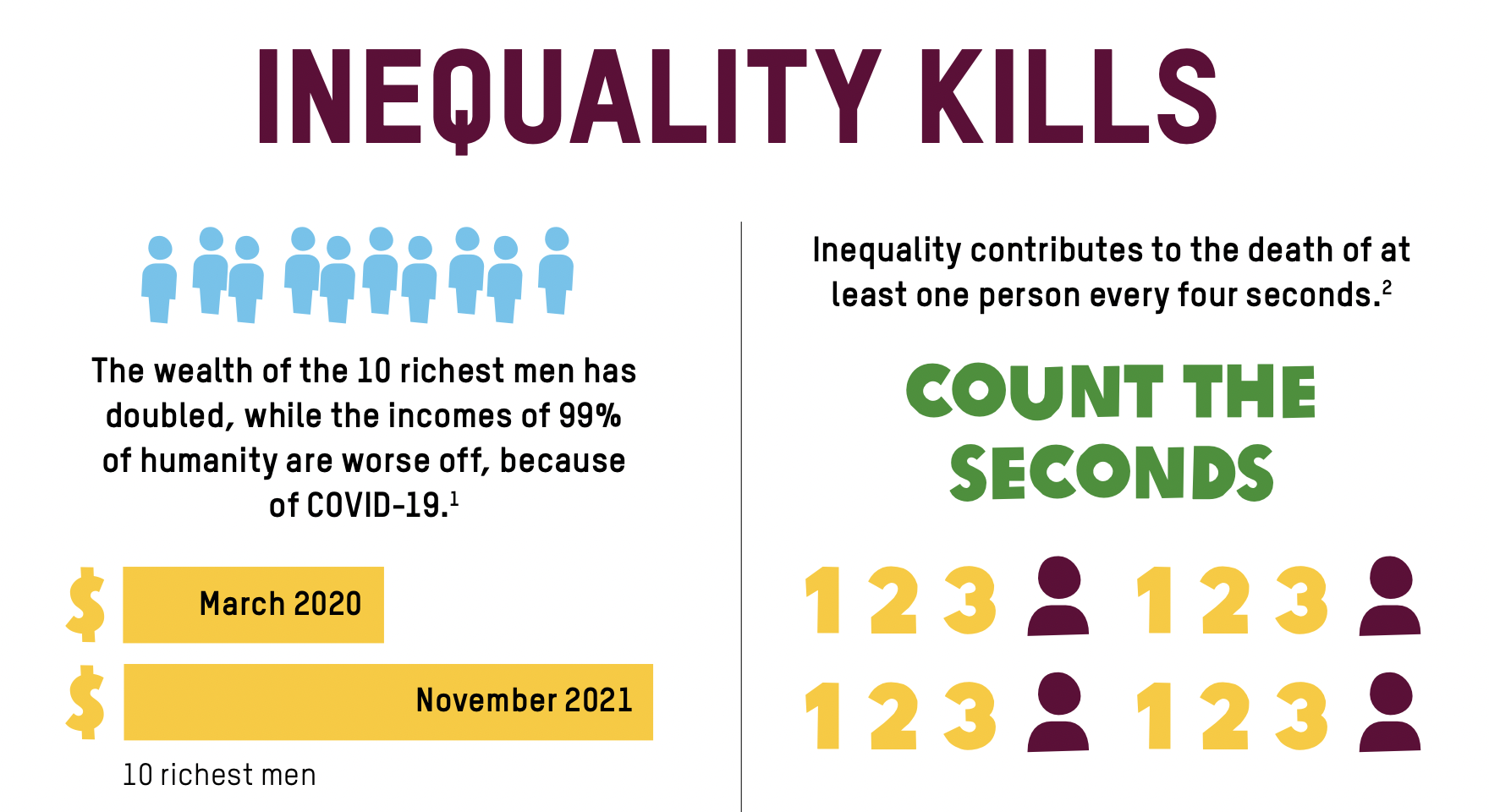
The first sentence makes the claim that socialism necessitates a concentration of wealth. I not really sure how they landed on this statement, but the economic system of Capitalism has clearly led to the concentration of wealth. Here is a brief part of the summary from a 2022 report by Oxfam entitled, Inequality Kills:
A new billionaire has been created every 26 hours since the pandemic began.6 The world’s 10 richest men have doubled their fortunes, while over 160 million people are projected to have been pushed into poverty.7 Meanwhile, an estimated 17 million people have died from COVID-19—a scale of loss not seen since the Second World War.8
These issues are all part of the same, deeper malaise. It is that inequality is tearing our societies apart. It is that violence is rigged into our economic systems. It is that inequality kills.
In the second sentence, which claims that 100 Million people have dies because of socialism. Like most of the Resolution, none of it is sourced to substantiate any of the claims made. Now, I am no apologist for socialism, and millions have suffered under the former Soviet regime, China, North Korea, etc, but we will do well to acknowledge how much suffering has occurred at the hands of Capitalism, particularly in the US.
The US was founded on genocide and slavery, meaning; 1) the killing of at least 1 million Indigenous people in the territory that is now the US, along with taking most of their land; 2) the enslavement of 12.5 million Africans who were sent to the Americas, according to the Trans-Atlantic Slave Trade Database. In terms of number of people who have been killed because of US foreign policy, it is hard to quantify, since it would include out right war the US has been engaged in, US military support for dictatorships and the use of proxy forces, along with sanctions and economic policies that have resulted in millions of deaths. See Ward Churchill’s book, On the Justice of Roosting Chickens: Reflections on the Consequences of U. S. Imperial Arrogance and Criminality.
Later in the text of the Resolution, it quotes Thomas Jefferson, “To take from one, because it is thought that his own industry and that of his fathers has acquired too much, in order to spare to others, who, or whose fathers have not exercised equal industry and skill, is to violate arbitrarily the first principle of association, the guarantee to every one of a free exercise of his industry, and the fruits acquired by it.” The irony here is that Jefferson, while President, owned 10,000 acres of land and at least 185 people he bought who were enslaved. In fact, Jefferson gave he daughter as a wedding present 25 of the people he had enslaved, like they were just another commodity.
Now, I know that this was just a resolution and maybe Rep. Scholten did not want to provide an opportunity for the GOP to attack her, but for me it sets a problematic tone for how she might vote in the future.
Lastly, it is worth quoting from an article by Liza Featherstone, who is a columnist for the Jacobin magazine, entitled, Democratic Leaders Join House Republican Attack on “Socialism”:
The resolution, which took the obligatory shots at Lenin, Castro and Maduro for taking money from rich people, asserts that the U.S. “was founded on the belief in the sanctity of the individual, to which the collectivistic system of socialism in all of its forms is fundamentally and necessarily opposed.” There was quite a lot of unpaid, collectivized forced labor supporting the “sanctity of the individual” founders, as I recall.
During the Grand Rapids Committee of the Whole meeting yesterday, there was a resolution to recognize the annual César E. Chávez Social Justice March as a City-Sponsored Event, beginning on page 2. Part of the Resolution reads:
The City of Grand Rapids has taken the necessary step of recognizing the César E. Chávez Social Justice March by way of a City Proclamation and now recommends endorsement of the César E. Chávez Social Justice March as a City-Sponsored Event to further unite Grand Rapids with a solid “Si Se Puede Spirit”!

For some, having the City of Grand Rapids sponsor the Cesar E. Chavez Social Justice March will be seen as good news. People might say that having local government support of an event that began in 2000, not only lends credibility to the event, it also means that the City of Grand Rapids will embrace and promote the legacy of Cesar E. Chavez and the United Farm Workers. However, having the City of Grand Rapids be a co-sponsor of this event is not only problematic, it will likely mean that the legacy of the farmworker struggle will become further co-opted.
I personally have attended the Cesar E. Chavez march for justice at least 8 – 10 times over the past 20 years. The City of Grand Rapids has always played a major role in the event, provide police escort and granting the event organizers a permit to march in the street.
As you can see in the photo above, which was included in the Committee of the Whole Agenda Packet, that the people holding the banner have had little or no involvement with migrant worker struggles. I particularly find it offensive to see the Grand Rapids Mayor, the City Manager and 1st Ward Commissioner Jon O’Connor holding banner with the image of a man that believed in direct action, which included disruptions of both commerce and government functions, and a movement that is rarely even represented during the annual march.
The march is usually led by an escort of GRPD vehicles, followed by roughly 25-30 JRROTC students marching in military formation. First, it seemed strange to have so much of a hyper-military presence with JrROTC students and GRPD officers on foot and in cars. Chavez was pretty militant about his commitment to non-violence, so their consistent presence seems rather contradictory and will only continue with the new City resolution.
 More importantly, having police presence sends a strong message to people who are undocumented and live in the Grandville Ave area. The ongoing deportations and raids conducted by ICE and other law enforcement officials is a reality that those who are undocumented must face on a daily basis. Having law enforcement officials present at such an event only discourages farmworkers and undocumented migrants from participating, even though they are the ones who have most in common with the legacy of Chavez and and current farmworker struggles.
The annual Cesar E. Chavez march is held during the week, usually late morning. This means that most farmworkers wouldn’t be able to attend, since they would be working. This begs the question about why the voices and lived experiences of migrant workers are not centered at such an event. One year several people from the group Foco Rojo handed out flyers about migrant worker conditions and information about the farmworker movement, in both English and Spanish, only to be told to stop handing out the information by the march organizers. The flyer read:
Migrant workers are some of the most exploited workers in our community. They work long hours, in difficult working conditions, and make very little money. In fact, migrant workers are one of the few jobs where minimum wage laws do not apply.
In 2010, the Michigan Civil Rights Commission published a report, based on testimony from farm workers, that concluded the living and working conditions for farm workers today is as bad, if not worse, than it was 50 years ago.
Migrant farm workers continue to live in poverty and many of them live in fear of harassment and deportation, since many of these workers are undocumented.
To honor the legacy of Cesar Chavez, which is to honor the lives of migrant farm workers, we ask, why are there no campaigns to organize migrant farm workers in West Michigan? We cannot truly honor the legacy of Cesar Chavez by holding symbolic marches while migrant farm workers and their families struggle to survive.
Migrant farm workers are organizing themselves all across the country through organizations such as the United Farm Workers, the Farm Labor Organizing Committee and the Coalition of Immokalee Workers. However, no such efforts to organize migrant farm workers is currently taking place in West Michigan, in spite of the fact that this area has one of the highest concentration of migrant farm workers in the country.
Honoring the legacy of Cesar Chavez should not be a day to make us feel good about ourselves, it should be a day where we commit ourselves to standing in solidarity with migrant farm workers. It should be a day where we hear the voices of migrant farm workers, not from politicians and other so-called leaders.
The United Farm Workers movement that Cesar Chavez was part of, was a movement that was committed to union solidarity, to the use of tactics like boycotts, strikes and other forms of direct action to force agribusiness to respect the dignity of migrant farm workers. This is the kind of movement we need today.
The issue of labor solidarity is an important one, especially since Mayor Bliss refused to support the bus driver’s union demands a few year back. In fact, there were GVSU students, who were part of the student movement known as Students Against Sweatshops, which was working with the bus driver’s union in Grand Rapids. Mayor Bliss approved sending GRPD cops to intimidate and threaten the GVSU students because of their support of the bus driver’s union. Because the Mayor was complicit in not supporting the union and approved the GRPD threats against students, the United Farm Workers sent Mayor Bliss a scathing letter, which read:
On behalf of the more than 10,000 members of the United Farm Workers, I am writing to express our deep disappointment in the breathtaking hypocrisy demonstrated by your administration this past week. On Thursday, March 17, you marched under our banner to commemorate the work of an American icon and our founder, Cesar Chavez. The very next day, on Friday, March 18, you dispatched Grand Rapids Police to the homes of student activists to intimidate them for organizing a January sit in to support transit workers represented by Amalgamated Transit Union (ATU) Local 836.
 You cannot march in the name of Cesar Chavez one day and use police officers to suppress all that he fought for the next. The United Farm Workers stands in solidarity with our ATU brothers and sisters struggling to preserve their retirement security and the United Students Against Sweatshops (USAS) who, in an inspiring acts of selflessness, have embraced their elders fight as their own.
I also write to call you to a higher purpose than implementing an austerity agenda that may win accolades from the comfortable, but will destroy the lives of the constituents who are counting on you the most. We ask that you adopt the spirit of our heroes – Cesar Chavez, Rosa Parks, Martin Luther King Jr. – whose names adorn your city streets and parks by rejecting the tactics who opposed and oppressed them in their lifetimes.
In the end, the Cesar E. Chavez March for Social Justice is primarily performative, since it doesn’t center the ongoing farmworker struggle. Having the City of Grand Rapids as a co-sponsor of the event further cheapens the message and legacy of Cesar Chavez and the ongoing farmworker movement. Chavez and the farmworker movement were all about engaging in tactics that disrupted business as usual, which the City of Grand Rapids clearly opposes. All you have to do is look at how city officials have responded to this demanding justice for Patrick Lyoya and the defunding of the GRPD to see how the city treats those who disrupt business as usual.

