POLICE SHOOTING RANGE UPGRADE AWARDED TO UTAH CONTRACTOR
(This article was written and submitted by Kellan Martin.)
The City of Grand Rapids has awarded a municipal auction contract to Action Target of Provo, Utah for a Grand Rapids Police Department (GRPD) practice range upgrade. The contract was voted on by the City Commission on February 21st, 2023 and officially awarded on March 9th, 2023. The contract awards a total of $167,595 to Action Target for “comprehensive upgrade[s]” to the 20-yard target range currently utilized by the GRPD.
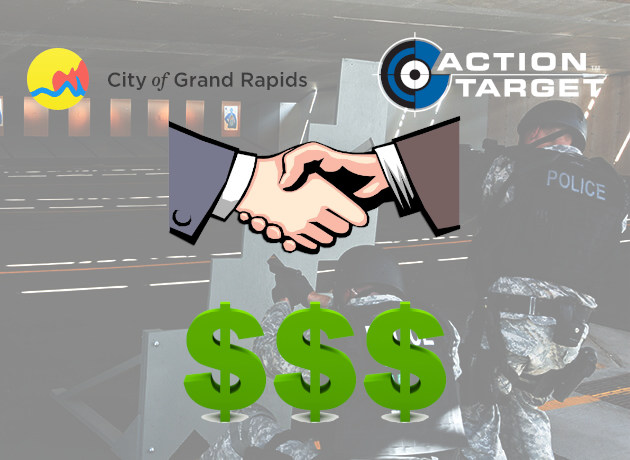
The funds for this project were obtained through the city’s Capital Improvement Fund, a tax-funded account the City of Grand Rapids uses to make payments for maintenance and updates on city-owned assets. Action Target is a large-sized range manufacturer that, between 2000 to 2008, was awarded $42.9 million in US government contracts, and in 2004 built training facilities for the US and other national forces occupying Iraq.
In the wake of the execution of Patrick Lyoya by former GRPD officer Christopher Schurr, the City of Grand Rapids chose Action Target to install a “Fixed Turning Target System” that Tony Wojciakowski, a Buyer in the Purchasing Department of Grand Rapids writes, “…[provides] crucial training when designing courses around high stress, split-second decision making.”
City documents do not answer the question of how this development in GRPD’s shooting range will make officers choose better decisions outside of a scenario where police are in the action of shooting at someone. This further “tacticalization” of police that companies like Action Target exploit is an extension of the general trend of law enforcement militarization in the United States, and is a widely documented issue that presents itself in the form of weapons, gear, policies, and protocols.
Within the last three years, police spending nationwide has increased under federal efforts to hire more officers and to provide them with a higher level of training. What is missing from official statements from the Biden administration especially is any critical thought towards the contradictions formed from this official thought process. Officials do not want to expose the connection that this recent injection of police funding and support came into existence after calls of justice during social unrest following murders of unarmed civilians by the police such as Breonna Taylor, George Floyd, Patrick Lyoya, Tyre Nichols, and many more.
In other words, the current struggle against police brutality was only possible because of government policies acting in the interests of the property owning class that has built the capitalist US system, and institutionalized racism within it. The state violence coming out of these conscious decisions to militarize the police and allow for extrajudicial killings citizens is now being used as a narrative focal point for those in power to introduce the need for more funding and “training” of the police as a solution. But this “solution” is merely an extension of the overall issue of how conditions got to where they were in the first place.
The police reforms currently being put in place by the United States government, in Biden’s words, are “… to fund the police. Fund them with the resources and training they need to protect our communities.” But that begs multiple questions. First, what kind of further protection will a shooting range upgrade bring our communities in Grand Rapids? And second; exactly which community in Grand Rapids needed to be protected from Patrick Lyoya to the point where GRPD officer Christopher Schurr shot Patrick in the back of the head?
Sources:
http://grandrapidscitymi.iqm2.com/Citizens/FileOpen.aspx?Type=1&ID=5180
https://en.wikipedia.org/wiki/Action_Target
https://thecrimereport.org/2022/10/17/police-funding-increased-nationwide-in-2022/
It has been one year since a GRPD cop shot Patrick Lyoya in the back of the head, killing him instantly.
A great deal has transpired over the past 12 months, with a tremendous amount of organizing and resistance to GRPD policing practices, raising Mutual Aid funds for the children of Patrick Lyoya and making demands on the GRPD budget.
However, if one were to look at the coverage of the 1 year anniversary of the GRPD killing of Lyoya, these stories or this information would not be included. What we do get instead are stories that simply recycle information about the legal case against the the ex-cop who killed Lyoya, Christopher Schurr. This was the case with an MLive article, with the headline, The People vs. Christopher Schurr: Where officer’s murder case stands a year after Patrick Lyoya was killed.
Then there was the story that ran on WZZM 13 and WXMI 17. I say story, because both of these two TV stations didn’t produce their own stories, they simply posted the same Associated Press article, an article which is incoherent and all over the place. Here are a few highlights from the AP article:
- A Grand Rapids Pastor who urged people to “do it right” when it came to protests was cited, even though this person has not been involved in the organized resistance with Lyoya was killed.
- The AP story says that Lyoya was from Nigeria, which is wrong. Lyoya’s family were Congolese refugees.
- City officials were cited, a Commissioner, plus City Manager Mark Washington.
- The AP story also looks at other cases of Black people who were killed by cops, which included citations from organizations in other cities.
The article ends with a neighborhood association spokes person and the director of the Interfaith Dialogue Association in Grand Rapids, who believes that “cooler heads prevailed after the murder of Lyoya. The Interfaith Dialogue Association then goes on to say, “There are people who will disagree with me — a group that is extremely vocal and extremely disruptive who will claim Grand Rapids has not taken a step forward,” Stella said. “I understand their passion and frustration, but I see progress.” Unfortunately, such a statement goes unchallenged, as if it were fact.
What was missing from the AP story are the numerous voices of people involved in the ongoing organizing in Grand Rapids around policing issues, such as Defund the GRPD and the Justice4Patrick movement.
Maybe the most egregious story that has appeared in the local news media in the past few days is a story that WOODTV8 ran on Monday, April 3rd.
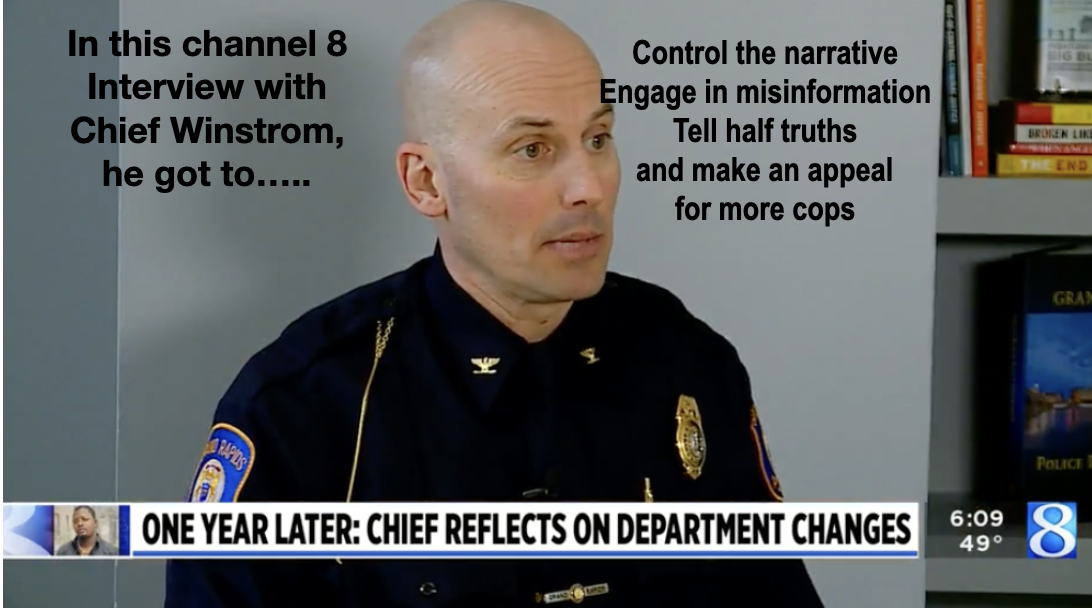
The story was 5 minutes and 26 seconds in length, which for local TV news stories is long. The channel 8 story begins with a brief recounting of the GRPD killing of Lyoya, but it then quickly turns into a 5 minute opportunity for GRPD Police Chief Eric Winstrom to control the narrative.
Winstrom kept saying throughout the interview that this was a devastating tragedy, and was very careful not to call it a murder or a killing. Winstrom then went on to say, “We had eight very large protests here right in front of the police station. Of those eight very large protests, we had zero broken windows. We had zero property damage. We had zero uses of force by police officers. We had zero arrests. That was the police department acknowledging this is a difficult thing for a lot of people. We knew we couldn’t make it any better. We’re going to do everything we can not to make it worse as this process moves out.”
In this statement, Winstrom wants to equate property damage with violence. Wonstrom also uses some slight of hand around the claim that no one was arrested, nor did the GRPD use force against protesters. This maybe true in front of the GRPD headquarters, where in most cases the GRPD didn’t even bother to come out of the building and engage with protesters. What Winstrom failed to mention, was the fact that GRPD cops made arrests of protesters at City Hall, especially during some of the City Commission meetings that took place in the weeks after Patrick Lyoya was killed. In the above statement, Winstrom also seems to be saying that the GRPD did a favor to protesters, because they acknowledged that the death of Lyoya was a difficult thing. Winstrom once again demonstrating his arrogance and contempt for those protesting.
From there on out, the audacity of the WOODTV8 interview with Winstrom only gets worse. The channel 8 reporter asked Winstrom about de-escalation training, which allowed the Police Chief yet another opportunity to control the narrative. From there Wonstrom talked about concerns over funding for the GRPD, but ends by using this platform to call for additional cops.
In the end, WOODTV8 essentially provided Police Chief Winston with 5 minutes of free airtime to not only control the narrative about the GRPD killing of Lyoya, but to engage in misinformation and half-truths, especially since the channel 8 reported failed challenge Winstrom in the most basic way. Can you imagine of someone from Defund the GRPD or the Justice4 Patrick Movement were given 5 minutes to say whatever they wanted? It wouldn’t happen.
On Sunday afternoon, it felt more like a funeral procession than it did a protest. Then I remembered that in many cultures the public display of grief, of anger and rage against an injustice often happens with funerals. I witnessed this kind of creative resistance in Central American and Mexico, especially among the Indigenous people of that region.

There was something cathartic about the whole action. I felt centered and focused on what we were doing, which sometimes doesn’t always happen during protests or marches.
We began in the Boston Square Neighborhood and drove mostly on the side streets, particularly in neighborhoods that had a higher proportion of Black residents.

We honked horns, drove very slow, used the little orange flags that funeral homes often use when they drive from the church to the cemetery.
Messages were painted on vehicle windows, like “Patrick Lyoya should still be alive,” “Justice4Patick”, and the GRPD are murderers.
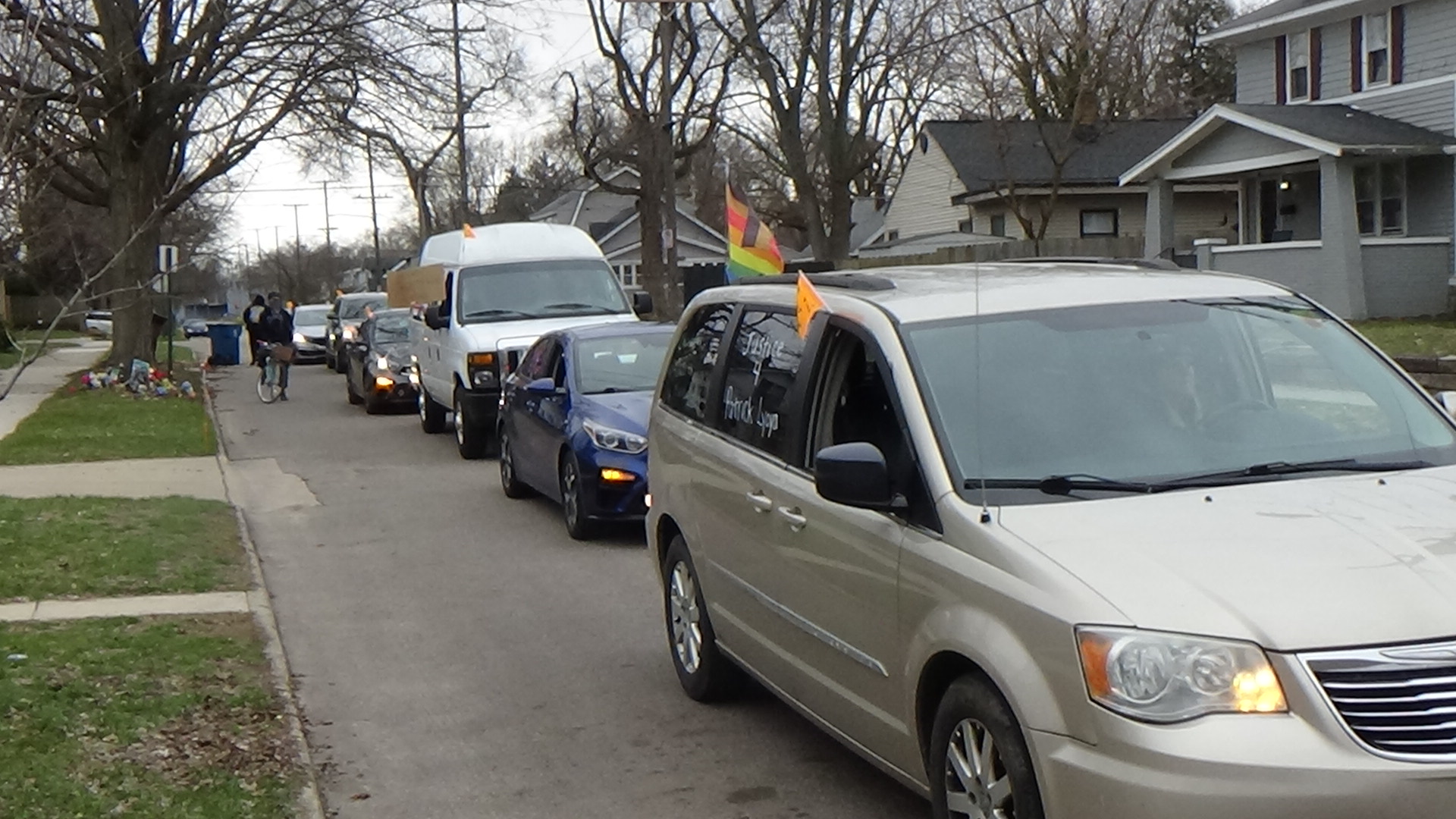
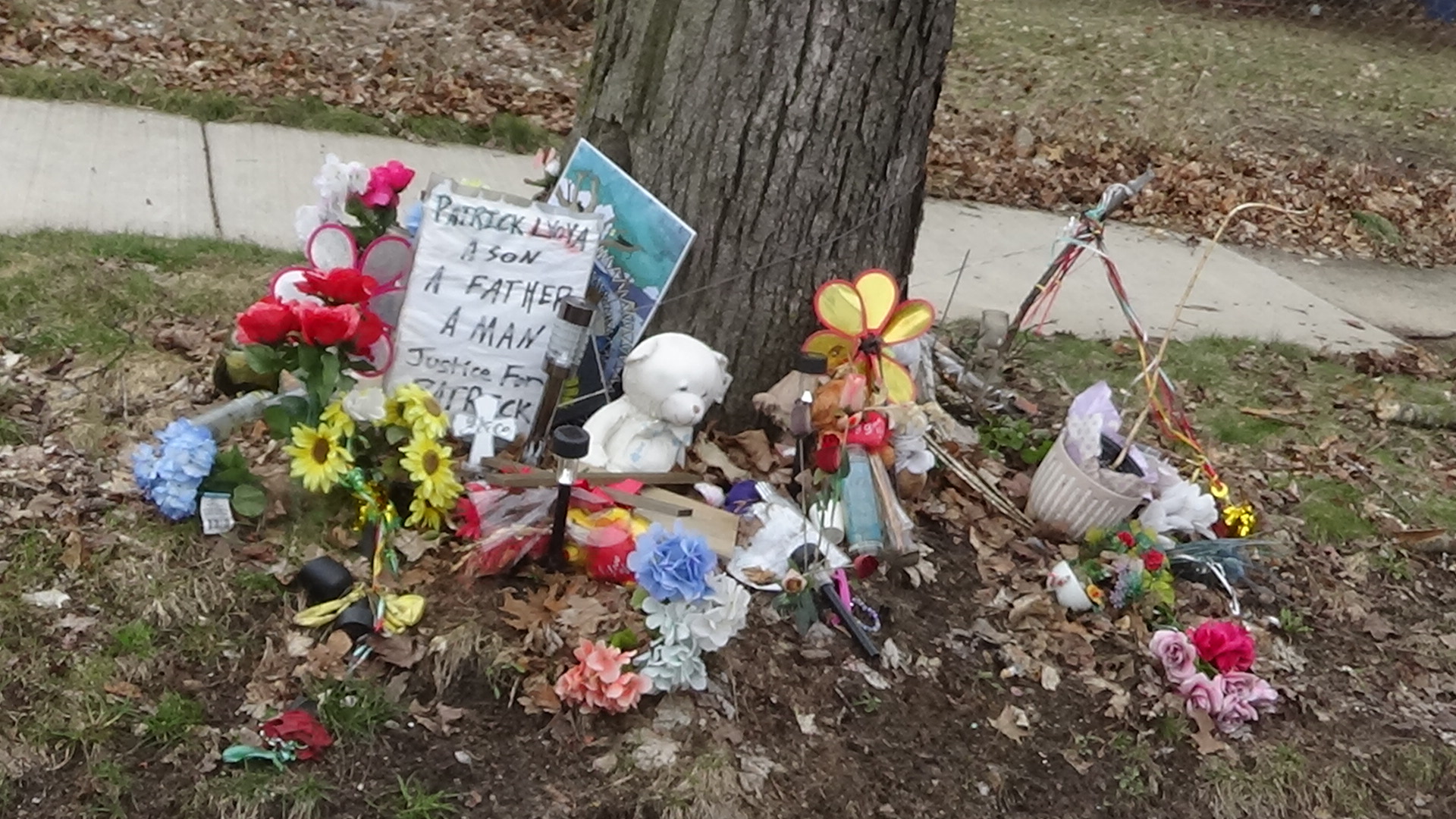
At one point we drove through the neighborhood where Patrick Lyoya was killed, where he was shot in the back of the head by then GRPD cop Christopher Schurr, who sat on top of the Congolese immigrant who was face down on the ground.
You could eve see the small memorial that has existed for nearly a tear, a memorial that rests up against a tree with flowers, candles and pictures.
As we woven through the streets, honking horns and chanting, many of the residents in the southeast side of Grand Rapids came out of their homes, so to take pictures or films what was happening, but there were also lots of residents who cheered us on, who out their fist in the air and who even joined in the chanting.
One of my favorite chants was, “The whole damn system is corrupt!”

The whole caravan action last two hours, even though it felt like it went by a lot faster than that. It probably had to do with all the great energy from those participating.
When we reconvened at the place we started, one organizer said to me that this was a kickoff to numerous events/actions that would be organized in the struggle for justice on behalf of Patrick Lyoya and his family. I had no doubt about the resolve and commitment displayed by these young organizers. It brought me great joy!
This Tuesday is the next action!!!!
By visiting Kids Food Basket in Grand Rapids, Gov. Whitmer perpetuates food insecurity by normalizing the food charity model
The headline from a March 27th MLive article read, Gov. Whitmer prepares meals for West Michigan kids with volunteers to highlight food insecurity.
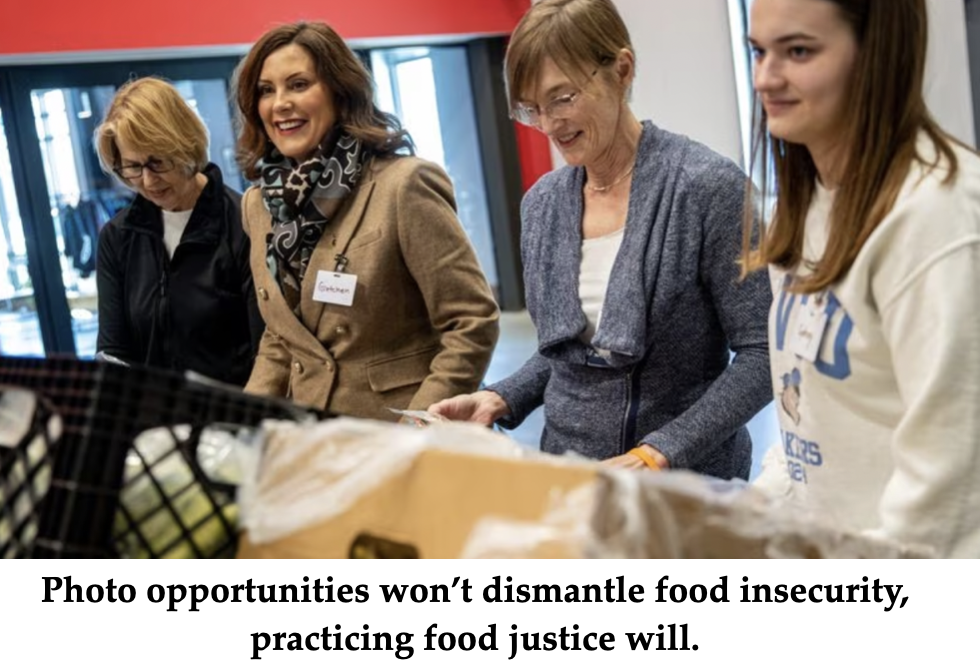
Michigan Governor Gretchen Whitmer engaged in a photo op at the non-profit group, Kids Food Basket last Monday. Whitmer posed for the media while she assisted other volunteers to put together bag lunches that go to numerous schools in the Grand Rapids area.
The MLive article states:
In her proposed $79 billion budget, Whitmer has recommended spending an estimated $160 million from the state’s School Aid Fund so that all Michigan children could get free breakfast and lunch at schools. This would impact 1.4 million children statewide, according to a press release.
Now, I believe that the government, especially the federal and state governments should makes sure that students attending public schools should have access to free meals while they are at school. In fact, providing free meals to Public Schools students should always be part of state and federal budgets.
Having said that, what is problematic about this story is that the MLive reporter doesn’t question the realities of food insecurity in West Michigan. Instead, the MLive story presents information about Kids Food Basket and how many sack lunches they prepared for school age students on a regular basis, along a bit of information about their farm program. At one point in the article, a representative from Kids Food Basket is quoted as saying:
“Many times, parents and families don’t have enough food to get them through the night and into the next day until they get their (school) breakfast and lunch. So, we provide healthy, nourishing meals because no child deserves to go to bed hungry.”
 This is a nice sentiment, but what Kids Food Basket does is to promote a food charity model, not a food justice model. The food charity model provides donations of food to people who are experiencing poverty. A food justice model would first ask the question, “Why are children food insecure, or why are families food insecure,” and then the food justice model would include some sort of action to end food insecurity. Kids Food Basket does not address the root causes of food insecurity, they have instead chosen to continue to expand their operations to provide more sack lunches to students, which might make for good photo opportunities and it might provide business opportunities to donate money or labor, but it also does nothing to address food insecurity. In fact, the food charity model that Kids Food Basket and so many other non-profits embrace, actually perpetuates food insecurity.
If an organization provides food to families, but never addresses the reasons why these families need food assistance on a regular basis, that is simply a perpetuation of food insecurity. In addition, the students who receive sack lunches from Kids Food Basket are also disproportionately Black and Latino students, which means that besides not address the economic disparities that exist in this area, Kids Food Basket also practices a form of White Saviorism.
Whether knowingly or unknowingly, by coming to Kids Food Basket, Michigan Governor Gretchen Whitmer was also complicit in perpetuating food insecurity by endorsing the food charity model, as practiced by Kids Food Basket. Thus, the headline from the MLive article mentioned at the beginning of the blog, Gov. Whitmer prepares meals for West Michigan kids with volunteers to highlight food insecurity, should have read, Gov. Whitmer prepares meals for West Michigan kids with volunteers, thereby perpetuating food insecurity. Then again, journalism practiced by the commercial media doesn’t question injustice, they are too busy being stenographers to power.
Editor’s Note: For more analysis of the food charity model and Kids Food Basket, check out previous GRIID articles on the topic. For more information on what the food justice model is, check out the GRIID Food Justice Workshop slides.
The GRPD unknowingly gave us a tactical gift during their presentation to the Public Safety Committee
As we noted in yesterday’s post, the Grand Rapids Police Department took over the Public Safety Committee meeting on March 28th, in order to present their case on why the GRPD should have funding to purchase and deploy drones in Grand Rapids.
What the GRPD did not know, was that they provided movement organizers with a small gift.

Social movement organizers are always thinking about tactics and strategies that can be developed and use to further movement goals. One larger strategy that movement organizers have utilized for centuries is the idea of disrupting business as usual, whether that is government operations, business operations, or other systems of oppression.
For example, according to a report put out by the Indigenous Environmental Network in 2021, Indigenous-led resistance campaigns against pipelines in the US and Canada have reduced greenhouse gas pollution by at least 25% annually since these campaigns began. By disrupting the construction of oil and gas pipelines, the indigenous resistance not only reduced the amount of greenhouse gases produced, they cost oil and gas companies money. In other words, the profits that oil and gas companies make was disrupted by the various campaigns to resist the extraction and transport of fossil fuels.
Any social movement campaign that seeks to disrupt business as usual will be effective, precisely because it will have a real cost to the systems of power that they are confronting. When workers go on strike, they effectively shut down production, which costs the company they work for. When there is a well organized boycott, it can cost a specific company, a group of companies or even a country that is reliant on the profits generated from production and consumption. The South African Anti-Apartheid Movement was effective because of the divestment campaigns they waged, which impacted the profit-making entities that were being targeted.
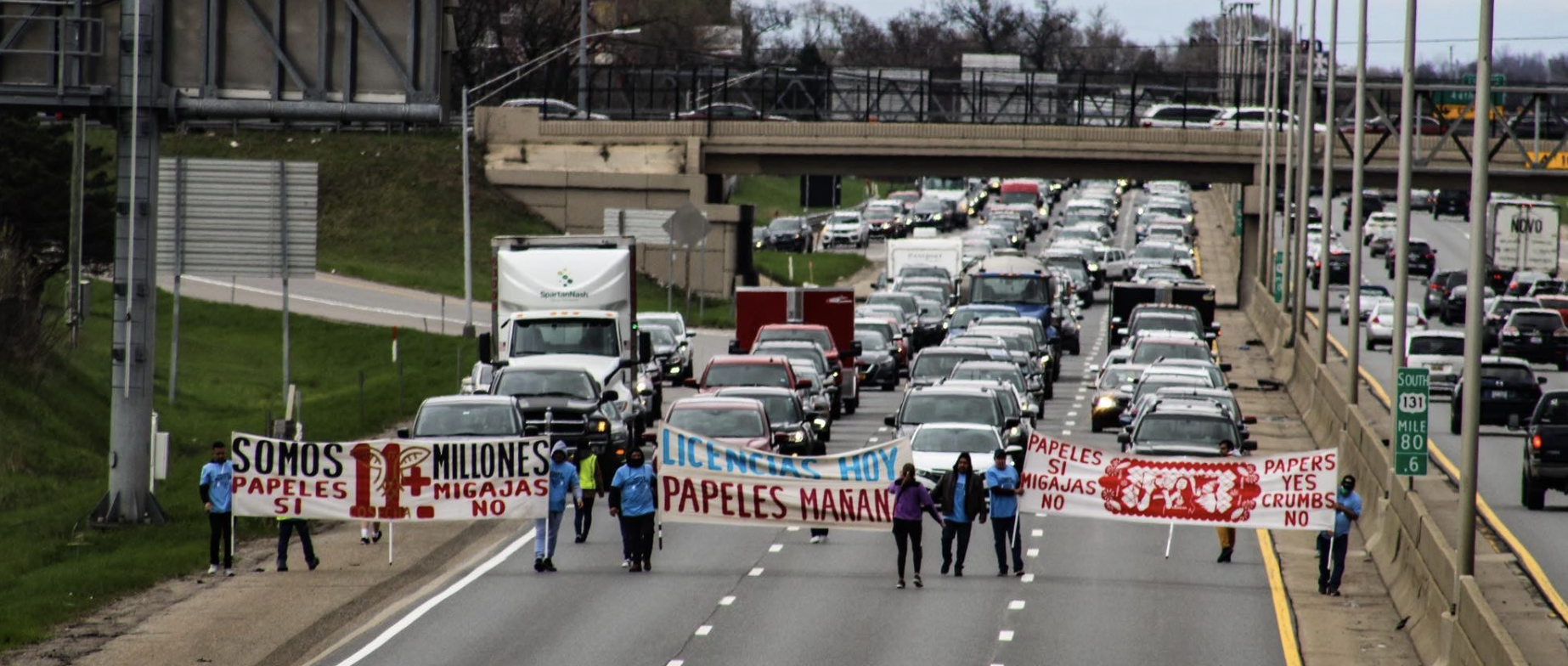
Likewise, when large numbers of people take to the streets and shut down main intersections or highways, they disrupt business as usual, meaning they are disrupting commerce in a very big way. This is why one of the slides that the GRPD presented at Tuesday’s Public Safety Committee meeting was a real gift to social movement organizers. In that slide – shown above – it says, “the NHTSA (National Highway Traffic Safety Administration) estimates that an urban freeway closure to have a $6,800 per minute cost to commerce.” This means that is people shut down an urban freeway for 30 minutes, it could cost the world of commerce $204,000. If a social movement action shut down an urban freeway for an hour, it would cost commerce $408,000.
Such numbers are not only significant, but they underscore exactly why police departments do not want social movements to disrupt business as usual. Therefore, I want to thank the GRPD for providing that bit of information, which could be beneficial for future social movement work in Grand Rapids.
GRPD takes over Public Safety Committee meeting and convinces the members to support drone proposal
(You can watch the GRPD’s presentation on why they should have drones at this link.)
Yesterday, GRIID posted a piece that deconstructed the local news coverage of the GRPD’s proposal on drones presentation that took place during the Grand Rapids Public Safety Committee meeting.
The coverage on MLive and the 3 Grand Rapids-based TV stations was superficial, using the GRPD as the primary source, along with literally copying parts of the GRPD’s presentation they made to the Public Safety Committee. There was no serious inquiry from the commercial news media about what the use of drones by the GRPD would mean and how it could impact the public.
Since I was critical of the local news media’s coverage on the critical issue of the GRPD proposing to purchase and utilize drone technology, I wanted to offer up my own analysis of what took place during the Public Safety Committee meeting and what impact it could have in the larger fight to defund the police and reduced their budget in order to fund more care work in the community.

During the presentation, Chief Winstrom was joined by three additional cops to make a push for the GRPD to obtain and use drones. In his brief comments at the beginning, Winstrom used the faux argument that the “GRPD is short handed.” Winstrom then used the MSU shooting as an additional argument for why drones would “enhance” their work, even though he never made it clear as to how having drones in the case of an active shooter situation it would enhance what the cops do.

The GRPD then began putting up slides for everyone to see, slides which were meant to make their case for why drones are necessary for their work. In this first slide, shown here above, they give reasons why drones are needed, arguing that the drones will “offer an opportunity for a safer community.” However, all four reasons listed, in my opinion, are not about a safer community, rather they are really about efficiency.
There was also information about costs and economic benefits. In one slide it stated, that the “Direct GRPD call-in savings would be $11,880 annually. However, in another slide, seen here below it states that the cost of the number that the number of drones the GRPD wants to purchase would be $100,000, plus annual reoccurring expenses, which were quantified for maintenance, certification and training ($20,000), but not for data storage or FOIA requests. This means that the savings amount ($11,880) in one slide is meaningless, on top of the fact that they don’t know how much it will cost to do data storage or for POIA request.

Equally important is the fact that beside the money they will spend on training people, there is no budget cost listed for paying the salaries of cops who will be using the drones from the time of deployment until they stores the data. For me, the fact that they left out cost for cops using the drones is deceptive, since it could mean tens or hundreds of thousands of dollars for police salary. Having GRPD cops working the drones also adds to Chief Winstrom’s argument that they need a larger police force.
The other slide that is worth looking at (here below) , shows a list of reasons for deploying the drones. The one listed that is worth reflecting on is City Manager Extenuating Circumstances. This means that the City Manager of Grand Rapids has the power to determine if there are other reasons to use drones, for surveillance and information gathering. Chief Winstrom said that Extenuating Circumstances, as an example, might be the 2020 uprising that took place in downtown Grand Rapids. In fact, Winstrom had stated at the previous Public Safety Committee meeting, that when there are protests that are not permitted or where traffic is being blocked or government and business operations are disrupted, those would qualify for Extenuating Circumstances. Extenuating Circumstances are included in the policy that the Grand Rapids NAACP had a hand in writing, which you can find here. Ultimately, when the City Manager decides there are Extenuating Circumstances, the City’s policy on surveillance, which the NAACP helped craft, goes out the window.
However, the reality is that, most of the presentation by the GRPD during the Public Safety Committee meeting focused on using drones to find people who are lost or to find suspects who flee.
Public Safety Committee responses & questions
After the GRPD presentation, there were a few questions from committee members, both government officials and volunteer committee members.
Commissioner Moody was the first person to speak and he began by saying that he was in favor, saying that drones were needed. Commissioner Moody went on to say that for the GRPD to not have drones says a lot about what is “wrong.”
Mayor Bliss, who was filling in for Commissioner O’Connor asked if car theft issues and motorcycles speeding in city, would drones be good for these issues?
Commissioner Ysasi asks if drones would be used for monitoring speeding? She then asks if operating a drone would only be cop position, not civilian. Winstrom responded by saying that a drone cop would be in a squad car.
One of the volunteer members of the Public Safety Committee asks how drones would promote and protect the public. Winstrom says that drones would reduce the time when looking for a live shooter or someone who commits a felony.
Another volunteer member of the Public Safety Committee, Christine Cameron, believes that the GRPD should drones.. “If we don’t have drones, it would tie the hands of the GRPD.” Cameron then wants to make a motion to have a public hearing.
Finally, one Public Safety Committee member asks if drones would be used for criminal intelligence gathering? Winstrom said no.Chief Winstrom then talks about how the OPA will review all the drone footage and make sure it is in line with City policy.
Commissioner Moody then makes a motion to set a public hearing for GRPD drone purchasing and use. There is a unanimous vote to hold a hearing. City Manager Mark Washington said he will bring the question back to the next City Commission meeting on the April 11, with a public hearing potentially being April 25th.
In the end, the members of the Public Committee didn’t really challenge the GRPD on the information, claims and arguments they made for the need to purchase and utilize drones. The unanimous vote wasn’t just a to support holding a public hearing, since many of the committee members had also verbalized their support that the GRPD spend more money on technology that could still be used against the public, and facilitate the likely expansion of the police force.
If you don’t support the GRPD purchasing and utilizing drones, then check out the campaign being organized by Defund the GRPD.
Commercial news coverage of the GRPD proposal to purchase and use drone technology in Grand Rapids
On Tuesday, the Grand Rapids Public Safety Committee met to listen to Grand Rapids Police Chief Eric Winstrom present his latest proposal to purchase and utilize drones for the GRPD. You can watch the Public Safety Committee meeting for March 28th, at this link.

However, if people were not watching the meeting on Tuesday or haven’t looked at the recorded video of the meeting, they might have come across stories in the Grand Rapids commercial news media. MLive and all 3 Grand Rapids-based TV stations – WOODTV8, WZZM13 and WXMI17 – all of which ran stories about the latest proposal by the GRPD to purchase and utilize drone technology. What follows is a deconstruction of that coverage.
Sources cited in the coverage
It’s always important to look at which sources are cited in these kind of stories, since we are not only talking about Grand Rapids government policies, but because the GRPD has come under significant scrutiny in recent years.
The only source cited in the MLive article, was Police Chief Winstrom. WOODTV8 cited Chief Winstrom and the Grand Rapids NAACP President Cle Jackson, but Jackson said he believed that the drones would be used for “public safety.” In the Channel 13 story, the only voice we heard was from Police Chief Eric Winstrom, although the WZZM 13 reporter did say that the group Defund the GRPD already began a campaign to oppose them, though viewers did not heard directly from anyone with Defund the GRPD. Lastly, in the WXMI 17 story, Chief Winstrom is once again the only source cited.
How were the stories on the GRPD proposal for drone use framed?
How news stories are framed is also an important part of how the public navigates the news, especially about critical issues like policing. The MLive article headline reads, Grand Rapids city leaders to decide on moving police drone conversation forward. The headline alone doesn’t tell us much, but it does communicate that there was no public opposition to the GRPD use of drone technology. Beyond the MLive headline, the rest of the article essentially uses the information from the GRPD presentation during the Public Safety Committee meeting, often using word for word bullet points, without any critical assessment or verification of the claims made by the GRPD on drone use.
The channel 8 online post headline reads, Chief says GRPD ‘late to the party’ on drones, which clearly reflects the perspective of the GRPD. In the rest of the story, as was mentioned, the President of the NAACP is cited, but he doesn’t challenge the Chief of Police and believes that the surveillance policy that the NAACP help to write with the City of Grand Rapids will guarantee that drones will not be used in a negative way. More importantly, the channel 8 reporter allows Winstrom to make a statement on camera, without challenging the head of the GRPD’s claim. Winstrom said:
“There’s a lot of common sense in this town. When it comes down to it, and when you really understand what we’re going to be doing with these drones and how that’s going to benefit the people of Grand Rapids, I think the city’s going to come together and say ‘yeah, it’s probably about time we utilize this technology for the benefit of the city.”
WZZM 13 also frames much of their story around what the GRPD presented during the Public Safety Committee meeting, again using the same list of talking points on drone use that the GRPD presented. Channel 13 is the only news source of the four GRIID looked at that provided an oppositional point of view, but they limited the reasons for the opposition by Defund the GRPD to just one talking point, despite the fact that they have numerous talking points to oppose the GRPD’s purchase and use of drones, which you can read on their Facebook page.
With the WXMI 17 online story about the GRPD and drones, their headline reads, Grand Rapids Police Department pitches a plan for drones. This headline is somewhat neutral, but the content of the article essentially parrots the same information and talking points used by the GRPD.
What is missing from the coverage on the GRPD’s proposal to purchase drones?
There is a great deal that is missing from Tuesday’s coverage on the GRPD proposal to purchase and use drones. First, there are not nearly enough oppositional voices/perspectives presented in most of the coverage, especially since no person or organization was actually cited with comments that were oppositional. Second, there are no comments or perspectives shared by the members of the Public Safety Committee, whether they were elected officials or volunteer committee members. If you watch the Public Committee meeting it is clear that there were people who ask questions. Now, for the most part the questions were not oppositional, but there were some questions that at least challenged the GRPD on their drone proposal.
Third, while the GRPD used the argument that everybody uses these drones, the local news coverage did not investigate to see if there was concern about use of drones by police departments around civil rights or privacy issues. There are national organizations that have raised significant issues about police use of drones for several years, specifically the ACLU and the Electronic Frontier Foundation.
All of the news sources GRIID looked at did mention that the next step in the process for the GRPD to purchase and use drones, will be the public hearing that the Grand Rapids City Commission will initiate, along with possible community forums to discuss the issue. However, if the public were relying on the local commercial news media to make an informed decision about the GRPD’s proposal to purchase and use drones, they would be rather disappointed. As we said in the beginning of this post, since the GRPD has come under significant scrutiny in recent years, it is imperative that we seek out information, perspectives and opinions that do not sold rely on what the GRPD is telling the public about drones.
Editor’s Note: Tomorrow GRIID will post our own analysis of the GRPD’s drone proposal at the Public Safety Committee meeting.

On the one year anniversary of the GRPD killing of Patrick Lyoya: GRIID Interview with a member of the Comrades Collective
 GRIID – What are your thoughts about how slowly the legal process has taken in regards to trial of the former GRPD cop who killed Patrick Lyoya?
CC – I expected this to happen. While I was surprised that Kent County Prosecutor Chris Becker decided to file charges, it was after the riots in Grand Rapids in response to the police murders of Breonna Taylor and George Floyd. The City didn’t want that to happen again, especially now that they’re pushing tourism downtown with upcoming developments.
When Becker did decide to file second degree murder charges, the part of me that knew better, anticipated the legal process being slow and steady for Christopher Schurr. He was arrested in Calhoun County, over 60 days after murdering Patrick Lyoya but didn’t spend more than 12 hours in custody. That only happens for people with privilege — he’s a white cop. The legal process doesn’t work like that for people that look like me.
GRIID – The Comrades Collective has 2 events coming up around the anniversary of when Patrick Lyoya was murdered by the GRPD. Can you talk about those 2 events and they fit into a larger strategy of mobilizing public support around Justice4Patrick?
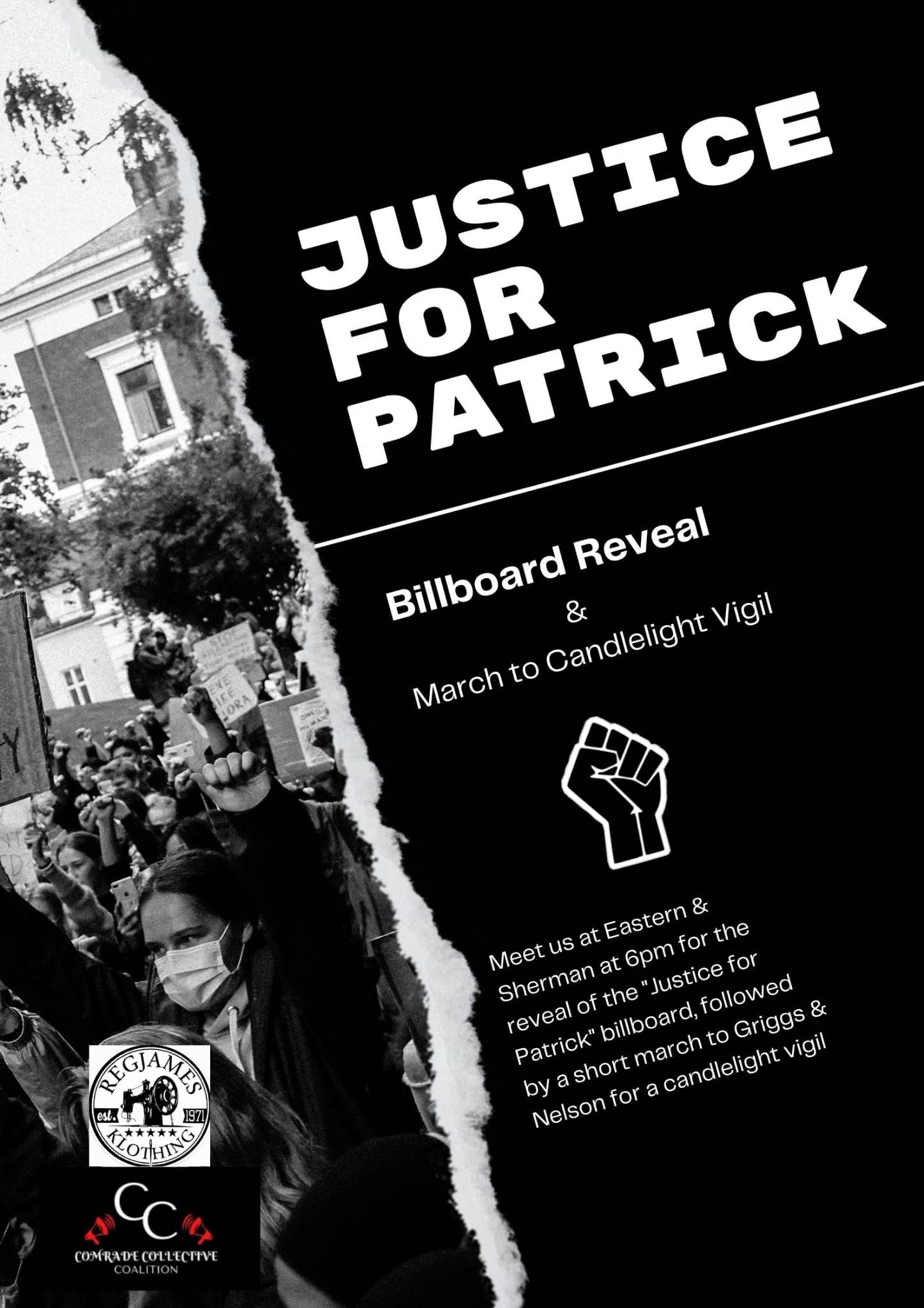
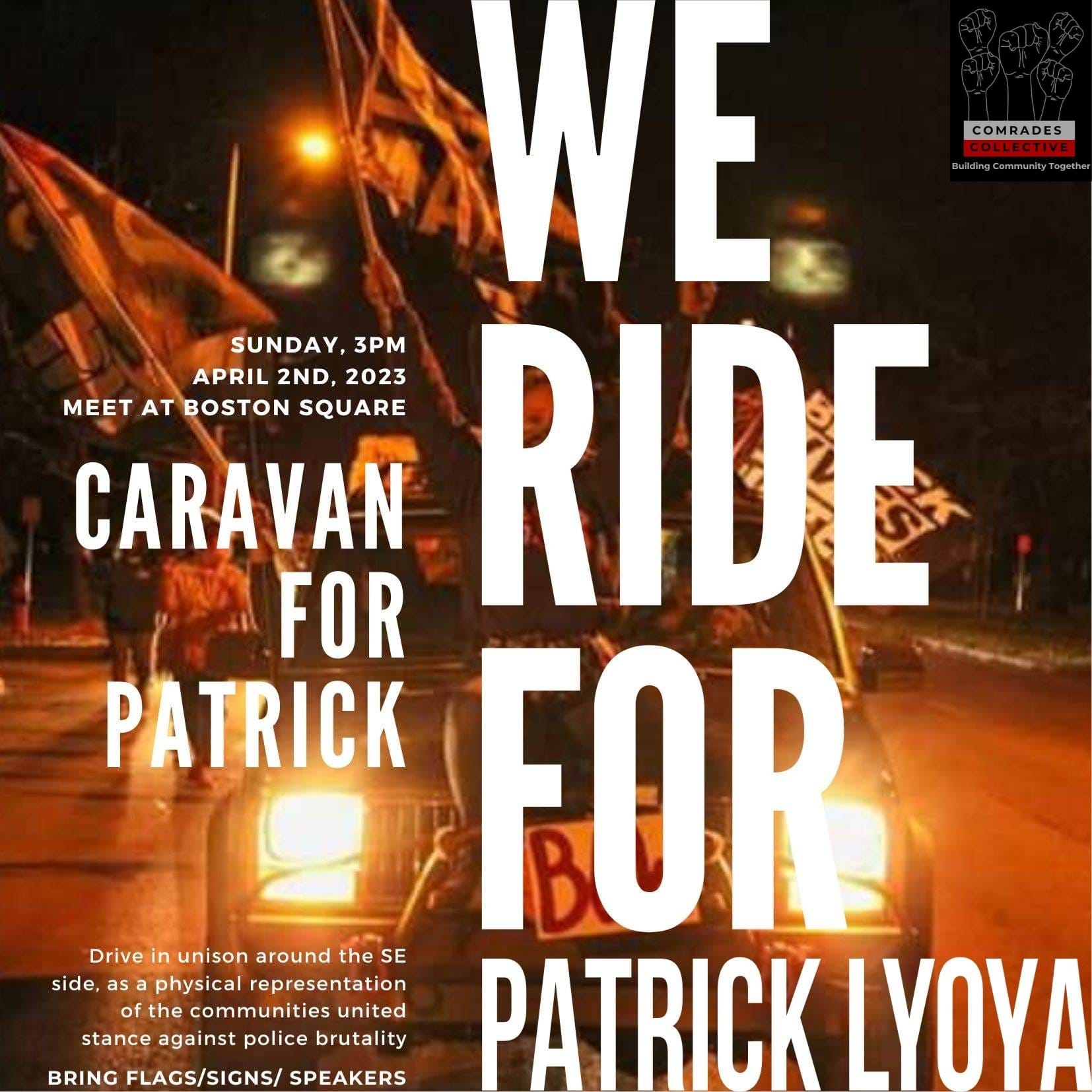
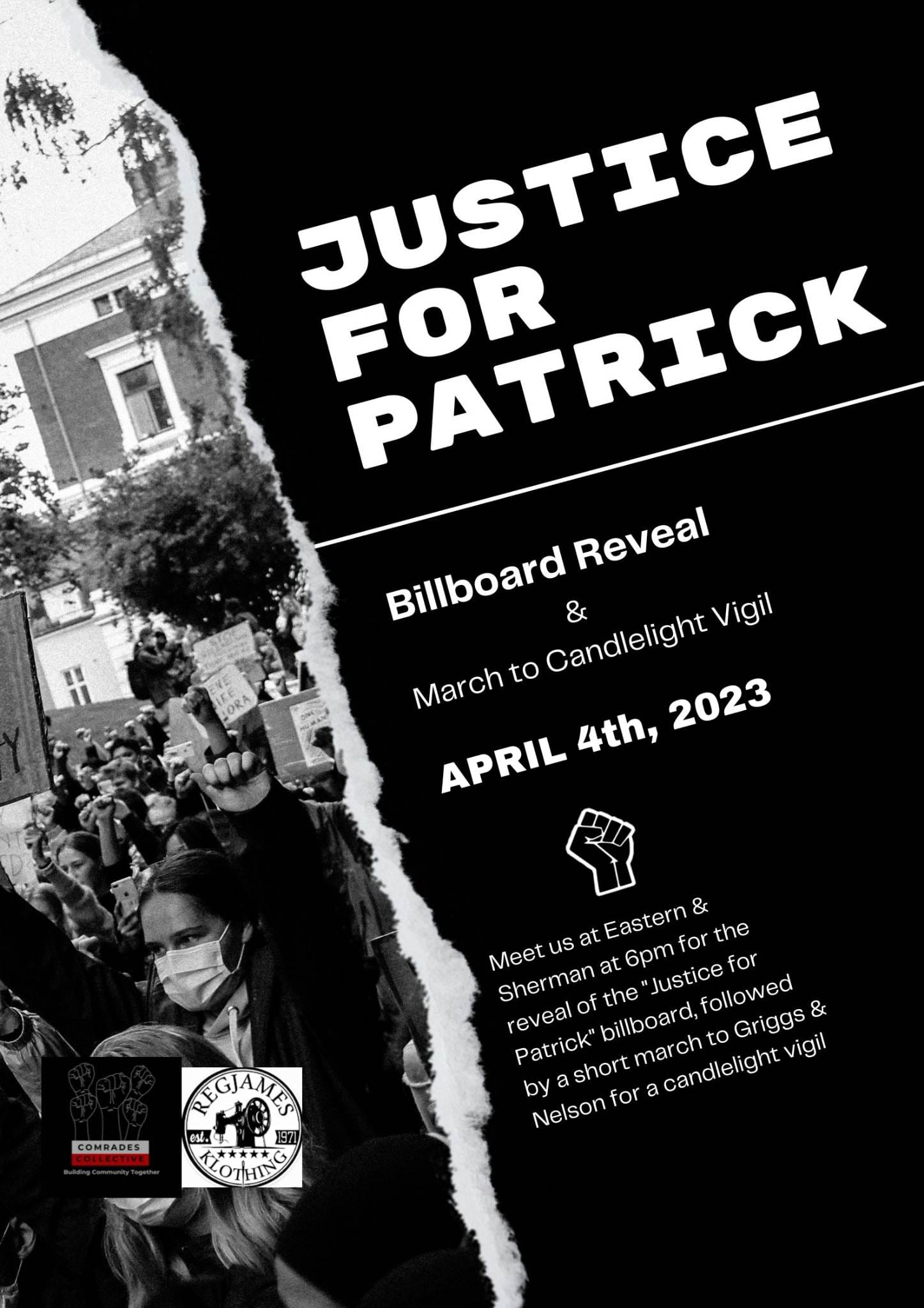
CC – It’s been almost a year since Patrick Lyoya was murdered. The Comrades Collective is planning a caravan through Boston Square and the southeast side on April 2nd to remind and rally our community. The second event is spearheaded by someone else, RegJames. He had a fundraiser for a “Justice for Patrick Lyoya” billboard reveal. We were already planning to do a march and candlelight vigil on April 4th, so it made sense to collaborate and conjoin them. We understand that our community isn’t as comfortable with the potential repercussions of protesting, so we want to mobilize our community in a less intense but still powerful way. We want their support as much as Patrick’s family does, the movement is hard to carry for a few.
GRIID – Do you think that the tactic by the lawyers representing the ex-cop who killed Patrick Lyoya, to delay the trial as long as possible, is designed with the hopes that the movement will diminish? If so, what response do you have?
CC – I don’t think it’s solely Schurr’s defense team, they wouldn’t have been able to accomplish this without Chris Becker’s assistance. He’s brought the most pitiful prosecution I’ve ever seen. I foresaw his efforts being half assed, and it was confirmed when I sat in Judge Ayoub’s court during the preliminary hearing and watched Becker present an MSP witness that made Patrick Lyoya look like a criminal, instead of trying to paint him in a more positive light. Becker was doing the defense team’s work for them. I’m suspicious that they were able to push the trial back to October 24th while Judge Elmore was out because “an issue came up.” The motion was approved by Judge Trusock, he isn’t presiding over the case. Schurr’s defense team cited needing to go over thousands of case files and experiencing deaths on their counsel’s family, which Chris Becker didn’t object to.
While the Prosecutor’s office claims its due process and not wanting to have any missteps, they are all counting on people forgetting and giving up. The City has also targeted activists and organizers that have been consistently showing up, charging them with all kinds of shit to scare them. It’s only making us more vigilant and determined to see it through, so that it isn’t all for nothing. Patrick’s life matters. He could’ve been any one of us or our loved ones.
 GRIID – If the ex-cop is convicted of second degree murder, for many this will be a win. However, for those who see policing in Grand Rapids as a systemic problem, where even abolition of the GRPD is a goal, what would you like to see happen in addition to the conviction of Christopher Schurr?
CC – It’s really hard to imagine a cop being convicted in Grand Rapids, especially after all of the incidents of GRPD brutalizing people over my lifetime. The political climate is grotesquely conservative, considering the money that runs this city and the support that Christopher Schurr has received. That’s all a part of the systemic problem. There would have to be radical policy changes for real accountability, let alone police abolition in Grand Rapids. That’s what I would like to see. If Schurr were to be convicted, I wouldn’t see it as a win because Patrick Lyoya’s life and the lives of so many others impacted by police brutality, have been forever changed.
GRIID – Lastly, how important is it for people to understand the link between policing in Grand Rapids and structural racism?
CC – It’s life or death for people to understand and address the link between policing in Grand Rapids and structural racism. The purpose of the police is to enforce the will of the rich. In Grand Rapids, the structure protects and serves the DeVos and Van Andels, their names are on most of the buildings downtown and around the county. Their money is what pumps through the veins of the city government. However, until we realize how powerful we are together, the program will remain the same.
For more information on the Comrades Collective, you can follow them on Facebook. You can also watch the latest Comrades Collective podcast, which discusses the same issues reflected in the above interview.
Last year during Black History month, I made three posts about books dealing with the Black Freedom Struggle that influenced how I saw the world. Now that we are in Women’s History Month, I want to do the same thing in regards to books by women, particularly feminists that influenced my understanding of the world.
I say feminist writers, as Women’s History month has evolved to the point where it is centered on identity politics, rather than the being rooted in the origins of International Women’s Day.
Two weeks ago, in Part I, I shared the titles of books that I read in the 80s and early 90s that challenged my understanding of myself and the world around me. In Part II, I provide a list of books that are from the late 1990s and early 2000’s. In today’s post – Part III, I am posting feminist books from the last 15 years that have had a tremendous influence on me.
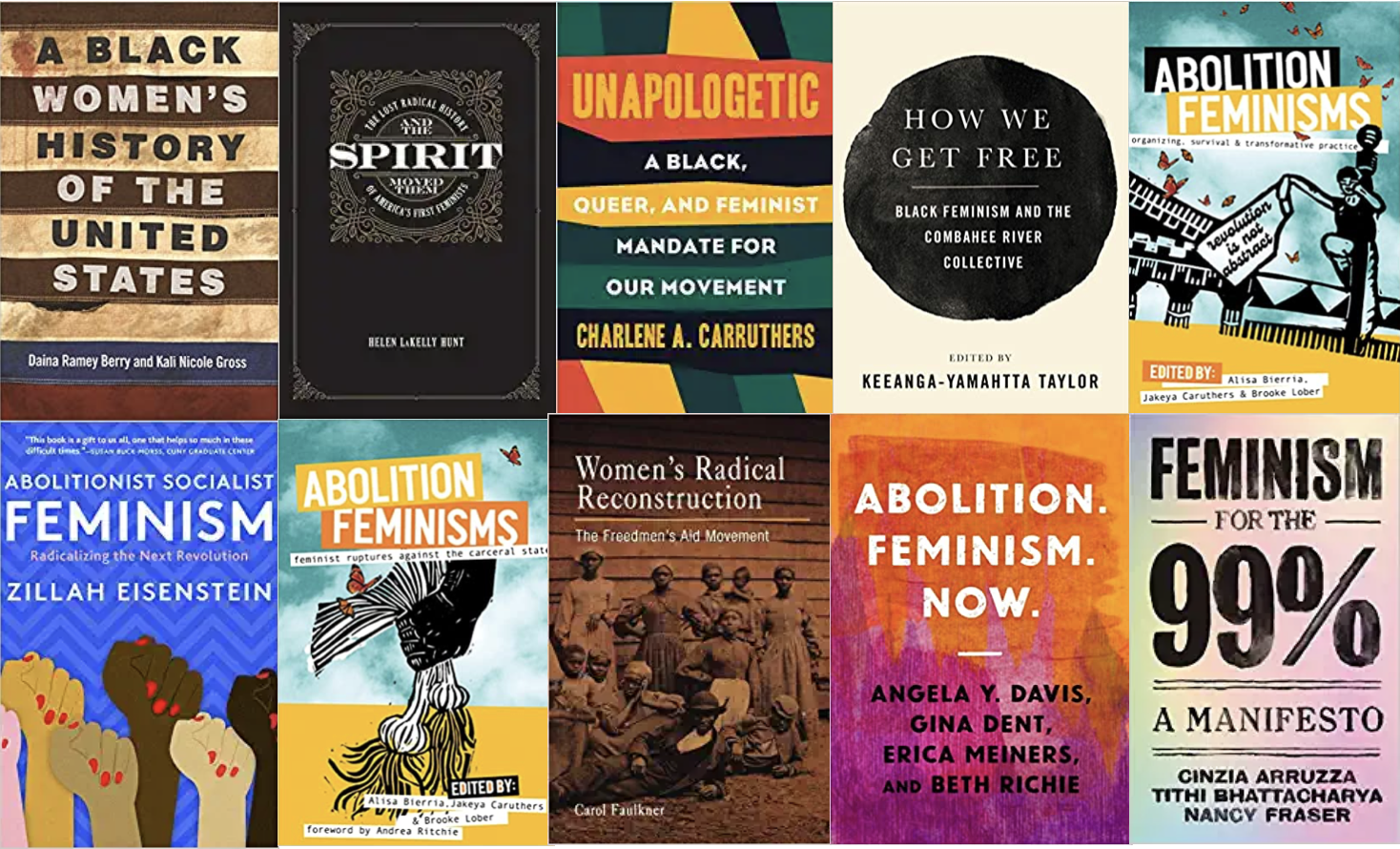
And the Spirit Moved Them: The Lost Radical History of America’s First Feminists, by Helen LaKelly Hunt
Abolition. Feminism. Now, by Angela Y. Davis, Gina Dent, Erica R. Meiners and Beth E. Richie
How We Get Free: Black Feminism and the Combahee River Collective, by Keeanga-Yamahtta Taylor
Abolition Feminisms Vol. 1: Organizing, Survival, and Transformative Practice, by Alisa Bierria, Jakeya Caruthers and Brooke Lober
Abolition Feminisms Vol. 2: Feminist Ruptures against the Carceral State, by Alisa Bierria, Brooke Lober and Jakeya Caruthers
Unapologetic: A Black, Queer, and Feminist Mandate for Radical Movements, by Charlene Carruthers
Abolitionist Socialist Feminism: Radicalizing the Next Revolution, by Zillah Eisenstein
A Black Women’s History of the United States, by Daina Ramey Berry and Kali Nicole Gross
Women’s Radical Reconstruction: The Freedmen’s Aid Movement, by Carol Faulkner
Feminism for the 99%: A Manifesto, by Cinzia Arruzza, Tithi Bhattacharya and Nancy Fraser
In Part I of our series looking back at the 20th anniversary of the public resistance to the US invasion/occupation of Iraq in 2003, we focused on early organizing efforts to build an anti-war movement before the US war on Iraq even began. In Part II, we looked at the protest when President’s Bush’s visited Grand Rapids the day after his State of the Union address and the GRPD’s response during that protest.
In Part III, we looked at the Women in Black actions, the global protest against the war march that took place in Lansing, along with the People’s Alliance for Justice & Change workshops on civil disobedience that were offered to a growing number of people who wanted to do more than just hold signs. Part IV focused on student organizing against the imminent US war against Iraq, along with civil disobedience that was done at Rep. Ehlers office before the war began. In Part V, we looked back on some of the plans that anti-war organizers had put in place once the US invasion/occupation of Iraq began, along with increased GRPD surveillance. Part VI focuses on what actions took place once the US war/occupation of Iraq had begun, along with the increased intensity of GRPD surveillance and repression against anti-war organizers.

In today’s post, we look at local media reporting on the US war in Iraq and how one radio station was overtly promoting the war.
A Pro-US Invasion of Iraq bias
The national media watchdog group, Fairness & Accuracy in Reporting (FAIR) did excellent work monitoring the national news outlets leading up to the March 2003 US invasion of Iraq, with a report entitled, In Iraq Crisis, Networks Are Megaphones for Official Views.
Once the US invasion of Iraq had begun, FAIR followed up with another study of US media coverage, Amplifying Officials, Squelching Dissent, which was consistent with the study that GRIID conducted on local news coverage of the US invasion/occupation of Iraq.
GRIID conducted a six-week study of the Grand Rapids Press and the three TV news stations (WZZM, WXMI and WOODTV8) from a few days before the war began (March 17) through the first full week in May. The GRIID study looked at sources, framing, historical context and home-front coverage. You can view a 38 minute video analysis of their study, Searching for the Smoking Gun: Local Coverage of the War in Iraq.
In addition to the GRIID study of local news coverage of the US Invasion/Occupation of Iraq, some involved in anti-war organizing decided to challenge the local media with their hyper-nationalistic reporting and cheerleading.
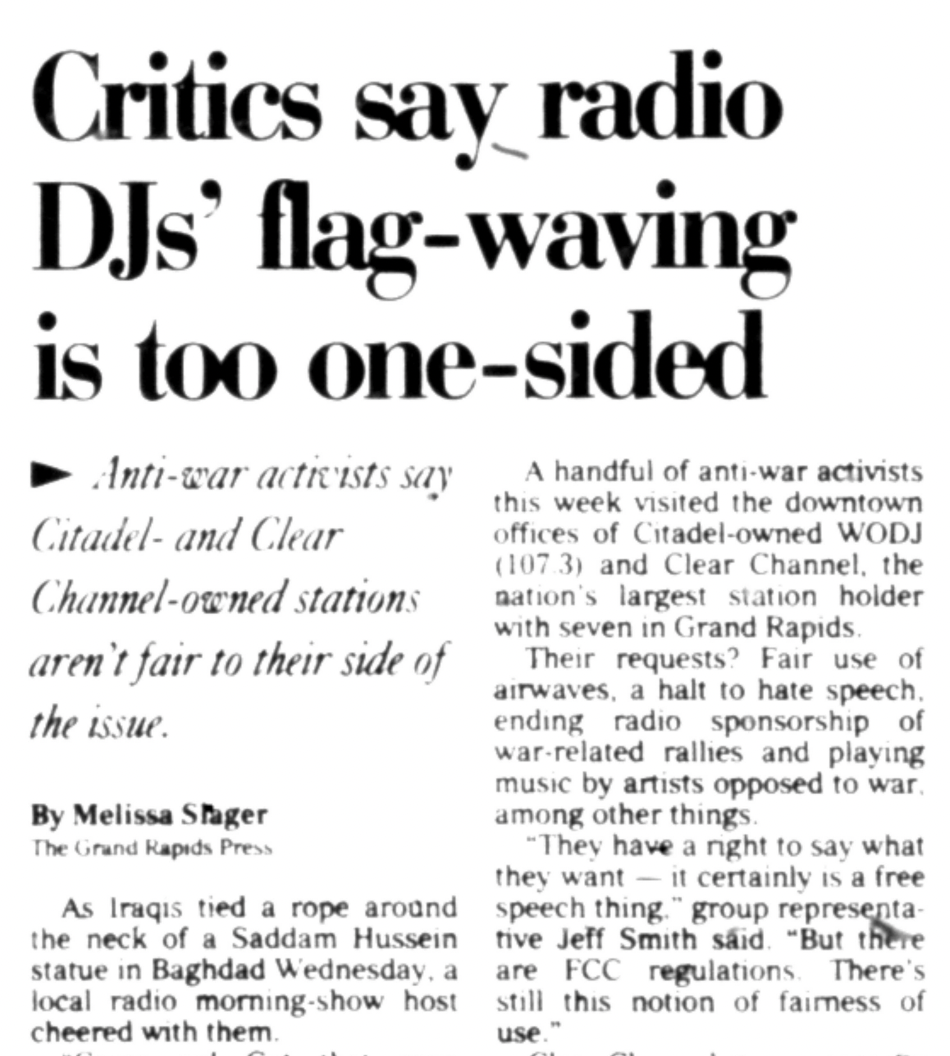 In mid-April, anti-war protestors decided to hold a demonstration outside of the office of Citadel and Clear Channel radio, both of which were not only providing one-sided reporting on the US war against Iraq, but some of their DJs were using their airtime to dismiss and mock those who did not support the war. One DJ in particular, Rich Michaels would mock anti-war demonstrators, saying they were cowards and during the early months of the war would begin his show saying, “Born and raised in America, it’s Michaels in the Morning.”
Check out the Grand Rapids Press coverage of the anti-war protest at Clear Channel and Citadel radio stations at this link, pages 18 – 19.
In our next post, we will look at other anti-war actions that were organized in Grand Rapids month after the war started and what kinds of tactics and strategies that anti-war organizers were using.
 Grand Rapids Institute for Information Democracy