The boycott campaign was organized by the Grand Rapids Area Tenant Union, as a response to the recent adoption of two ordinances by the City Commission, ordinances that will both criminalize the unhoused. Long Road Distillers is co-owned by 1st Ward City Commissioner Jon O’Connor, one of the 5 members of the commission to vote in favor of adopting these ordinances.
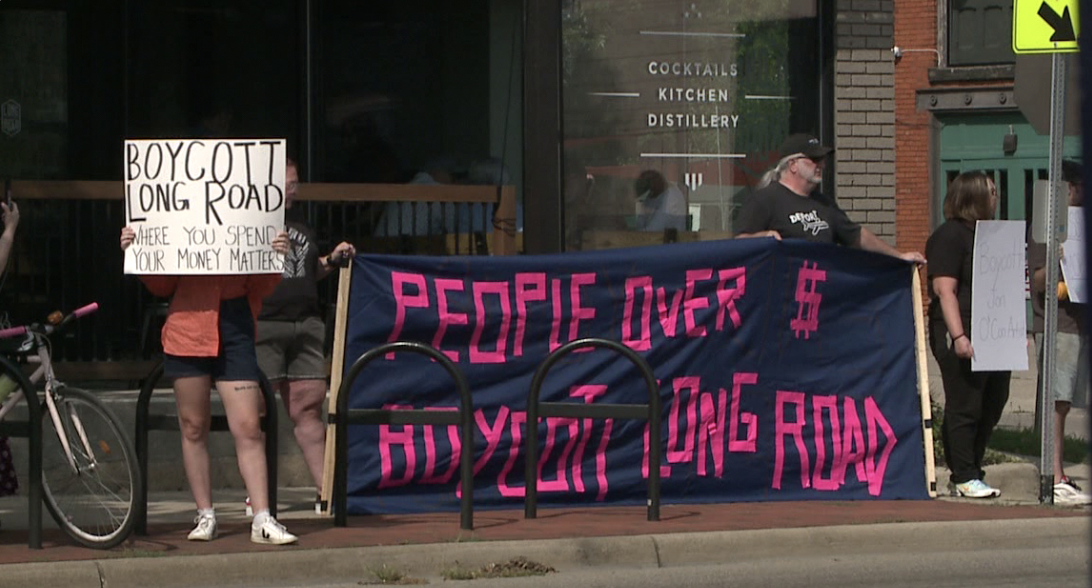
The tenant union had sent out a Media Release, which reads:
The Grand Rapids Tenants Union (GRATU) will be holding a rally at the sidewalk in front of Long Road Distillers at 537 Leonard St NW, Grand Rapids, MI 49504 on Saturday August 19th from 4-6pm. Signs with relevant messages will be at the rally but people are welcome to bring their own.
GRATU is promoting a community boycott of Long Road Distillers because of the backwards decisions made against the public by City Commissioner John O’Connor, one of the owners of Long Road Distillers. His vote for anti-unhoused changes to the City ordinance expresses the wishes of the rich exploiters, and not the majority of people. John O’Connor voted to give the Grand Rapids Police Department a legal shield to intensify state terrorism against those who are deemed as unhoused in the City.
Anyone who wishes to show up against the unjust political system in Grand Rapids is welcome to join. In Beer City, those in power want us to prioritize the consumption of alcohol and events over the basic needs of the people. We must have Grand Rapids be known as a City that innovates in housing justice. A city where safe housing, health care, healthy food, and living wages are human rights, and available for everyone.
We are calling for a Boycott of Long Road Distillers on W. Leonard, Less Traveled on Cherry St. Se and Long Road Distillers in Grand Haven.
There are clear consequences to voting on public policy that marginalizes those with the least power, and since there will be money and social costs to the unhoused because of the ordinance that Commission O’Connor voted for, then we are going to impose a cost on him with this boycott.
The only local news agency to show up was WXMI 17, which ran a story the evening of August 19 during their 10pm newscast, a story which was also posted online, with the following headline, Small protest at Grand Rapids business urges city leaders to change new ordinance.
The Fox 17 story lasted 3:32, which features two sources, someone from the tenant union and City Commissioner Jon O’Connor, who also is one of the owners of Long Road Distillers. However, before the viewers hear from either source, the reporter stated that the “protesters single out one of the Commissioners because he has an influence on businesses.” This is a misleading statement, a statement which really frames the entire news story. The Grand Rapids Area Tenant Union singled out Commissioner O’Connor because he co-owns Long Road Distillers and they wanted to make him feel the economic impact of a boycott against his business because of his vote in favor of the two ordinances that will criminalize the unhoused. This point is made clear in the Media Release, which WXMI 17 received.
There are two points that Commissioner O’Connor made in response to the organized boycott of his bar, I want to address. The first, is when O’Connor says:
“These were gaps that, you know, opportunities to address some gaps in the system based on, you know, behaviors in our community that we didn’t think were acceptable,” O’Connor explained.
This sentiment from O’Connor, is very similar to comments he made during a June Public Safety Committee meeting and reflected in the image here below.
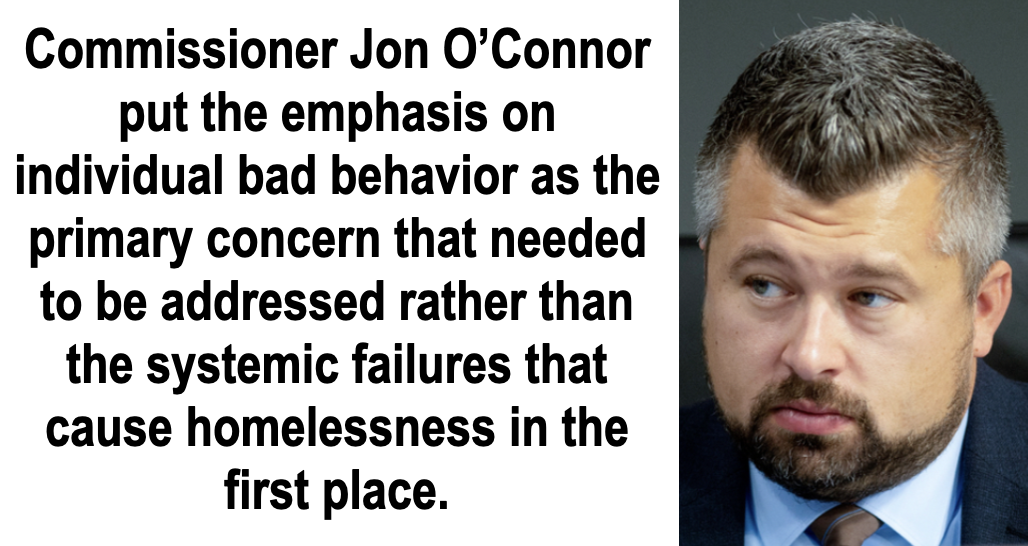
It is important to note that when it comes to the growing number of people who are unhoused and housing insecure, you can’t solve the problem with a few tweaks in the system. The system is the failure, whether we are talking about the ridiculous rise in housing costs, the market-driven realities of the real estate and rental property markets, and the role that these industries play in influencing public policy, all of which we have addressed previously.
The second thing I wanted to point out was O’Connor’s weak claims that there are option for the unhoused, which is how the Fox 17 story concludes, by saying:
O’Connor, on the other hand, offered several options for someone trying to seek shelter in the city of Grand Rapids right now— He says there are beds open and many resources available to help people get back on their feet.”
“We have the Fusion Center, which operates at Crossroads Bible Church every week,” he said. “You have an opportunity, if you are unhoused, to go to one location to get an ID if you need it, to get signed up for your VA benefits or your SSI benefits, to take a shower.”
 Let’s be clear, these are not solutions to the housing crisis in Grand Rapids, they are bandaids to a much larger, systemic problem. The beds that O’Connor is referring to are those that are available at Mel Trotter Ministries and Guiding Light Ministries. What we have been hearing from those who have stayed in these facilities is that they are not safe, they are not healthy and both of them are religious charities that are completely uninterested in challenging the current housing crisis or the root causes of this crisis.
This point is further solidified by O’Connor who references the Crossroads Bible Church and the resources people can access there. While the resources are useful, they do not address the larger, systemic problems of the housing crisis. Therefore, it seems clear to this writer that Commissioner O’Connor either fails to recognize that there are root causes of the current housing crisis, or that he just doesn’t give a shit.
Lastly, it is necessary to point out that the WXMI 17 reported did not challenge the claims of either the tenant union or Commissioner O’Connor. More importantly, the reporter fails to address the whole point of the protest, which was to kick-off the boycott that the tenant union was calling for, specifically a boycott of all the Long Road Distillers locations in West Michigan.
Since late March, when local commercial news sources began reporting on the GRPD’s presentation to the Grand Rapids Public Safety Committee about their plans to purchase drones, the dominant narrative has been that these drones would only be used to improve public safety.
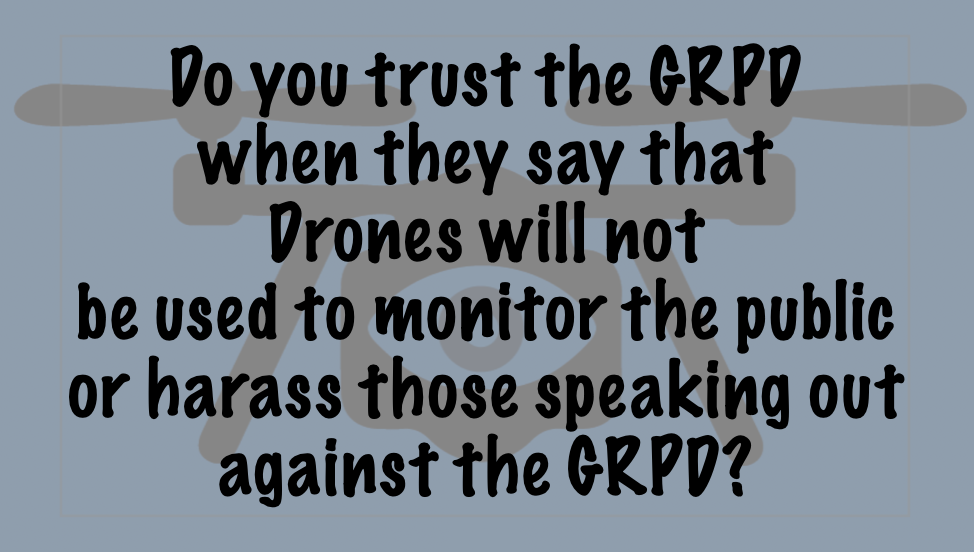
Our response (GRIID) to that same meeting in late March was fundamentally different. One critical point that GRIID raised at that meeting was:
The one listed that is worth reflecting on is City Manager Extenuating Circumstances. This means that the City Manager of Grand Rapids has the power to determine if there are other reasons to use drones, for surveillance and information gathering. Chief Winstrom said that Extenuating Circumstances, as an example, might be the 2020 uprising that took place in downtown Grand Rapids. In fact, Winstrom had stated at the previous Public Safety Committee meeting, that when there are protests that are not permitted or where traffic is being blocked or government and business operations are disrupted, those would qualify for Extenuating Circumstances. Extenuating Circumstances are included in the policy that the Grand Rapids NAACP had a hand in writing, which you can find here. Ultimately, when the City Manager decides there are Extenuating Circumstances, the City’s policy on surveillance, which the NAACP helped craft, goes out the window.
It was also recommended in late March that a Public Hearing be held on the matter of the GRPD wanting to purchase drones. True to form, just days before the Public Hearing was held, the City of Grand Rapids crafted a survey, which was specifically designed to elicit certain public responses to information and questions that the City controlled, while conveniently omitting critical information.
Just days after the City’s survey was sent out to the community, there was a Public Hearing held on the GRPD’s desire to purchase and use drones, which GRIID also reported on. However, before the Public Hearing even began, City officials provide Chief Winstrom yet another opportunity to present the Police Department’s take on what drones would be used for.
However, despite the attempts to once again control the narrative, those who spoke at the Public Hearing were overwhelmingly opposed to the GRPD’s use of drones. There were also several people who brought up the issue of Extenuating Circumstances which was discussed in an April 11 article on MLive, where City Manager Mark Washington said that drones could be used to monitor protests that aren’t permitted and are potentially interfering with roadways. In that same MLive article from April 11, it also stated that drones may be used by the GRPD “in the case of civil unrest and large gatherings where an aerial view is necessary to ensure safety and minimize the number of officers involved on the street,” Chief Winstrom wrote to commissioners in an April 11 memo.” Again, Extenuating Circumstances is the rational that can and will be used in these circumstances.
Since the Public Hearing was held, the GRPD hosted their own meetings in the community, where they made sure to control the narrative, which meant that the issue of extenuating circumstances would not be discussed. For several months the issue of the GRPD’s desire to use drones hasn’t received any attention, but now it appears that it will be voted on at the August 22nd City Commission meeting this Tuesday.
In the Agenda Packet of the Fiscal Committee, which was made public late Friday, we can see that the information presented on the matter of drones is again a controlled narrative. From page 2 -15, of the Fiscal Committee’s Agenda Packet we see this narrative, along with the fact that the same committee, “recommends adoption of the following resolution approving an Agreement with Unmanned Vehicle Technologies for the purchase of small Unmanned Aerial System technology.”

We then read that what most of the Committee of the Whole will be doing Tuesday morning, is listening to a representative of the GRPD (once again) on how drones would be used by the GRPD, with an emphasis on seeking their endorsement. See pages 5 – 17 of the Agenda Packet of the Committee of the Whole.
The Committee of the Whole will likely adopt the recommendation of the Fiscal Committee, which essentially means it’s a done deal. Sure, the formal vote won’t happen until the Tuesday evening City Commission meeting, but it all but a done deal, no matter how many people speak during public comment.
Is this what representative democracy has come to or has it always been like this, where those with economic power and those with electoral power, get to decide on critical matters in this community? Do we once again try to mobilize the grassroots community to oppose the City’s decision to use nearly $100,000 of public money to purchase drones for the GRPD? And do we once again show up and use our voices to oppose the GRPD’s use of drones? As the old labor song goes, which side are you on my people, which side are you on? I’m on the Freedom side!

Camp ARYV takes on Climate Justice with Community Action
Yesterday, about 30 people, mostly youth participating in Camp ARYV, spent about 90 minutes picking up trash in the Madison Square Neighborhood.

Camp ARYV is a week-long camp for teenagers that provides opportunities for participants to learn about social justice and activism. This is the 3rd year that Camp ARYV has been in existence.
The theme for this year’s camp was Climate Justice. So, besides picking up trash on several streets in the Madison Square Neighborhood, some participants held signs, while other led chants, such as – “No Coal, No Oil, Keep it in the Soil.”
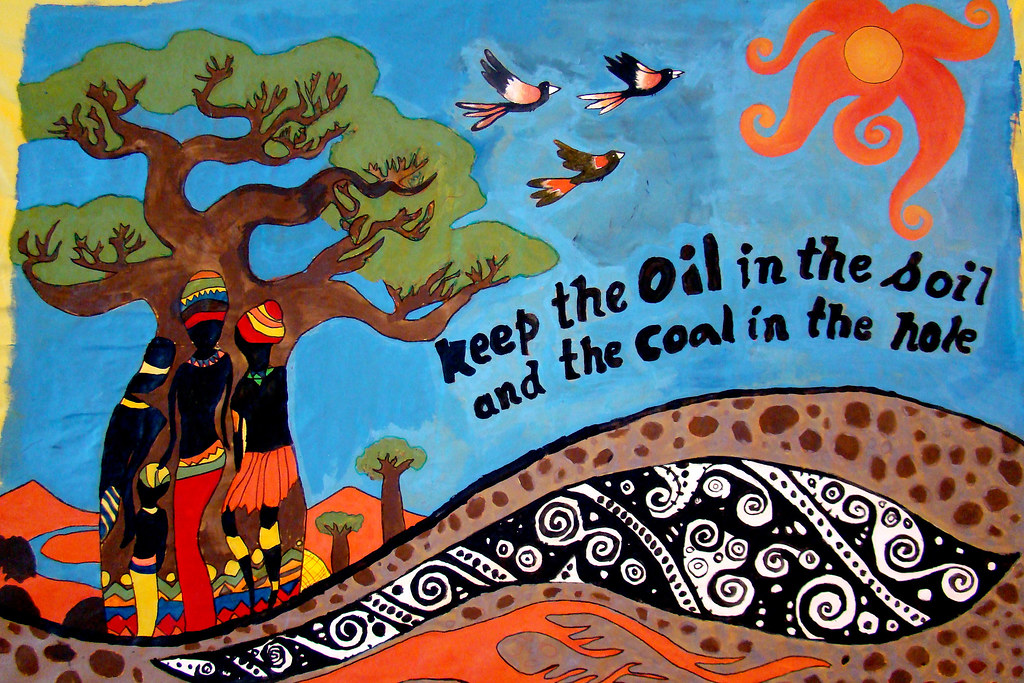
In addition, some of the youth, based on what they had been learning in previous days, used bullhorns to share vital information that was Climate Justice related and specific to the 49507 zip code, which is where their action took place. Some of the bits of information that they shared were:
- The 49507 zip code area has the highest levels of lead in the city
- The 49507 zip code has the least amount of green space in Grand Rapids
- The 49507 zip code area has the fewest community gardens in the city
- The 49507 zip code area residents have the least amount of access to fresh produce in Grand Rapids
- The air quality in Grand Rapids in 2023 is the worst it has been in the past 15 years.
After the Camp ARYV Climate Justice Action, GRIID did a short interview with Marius, who has been part of the summer camp for all three years it has been around.
Two weeks ago, GRIID posted an article about the Protect Grand Rapids campaign, which is essentially centered around getting people to thank the Grand Rapids City Commission for adopting the two ordinances, ordinances which will further criminalize the unhoused.
I believe that the group behind this online campaign is the Grand Rapids Chamber of Commerce, primarily because of how the campaign looks, the language they are using, along with the fact that the Chamber was involved in a similar effort last year, all of which is explained in the post.
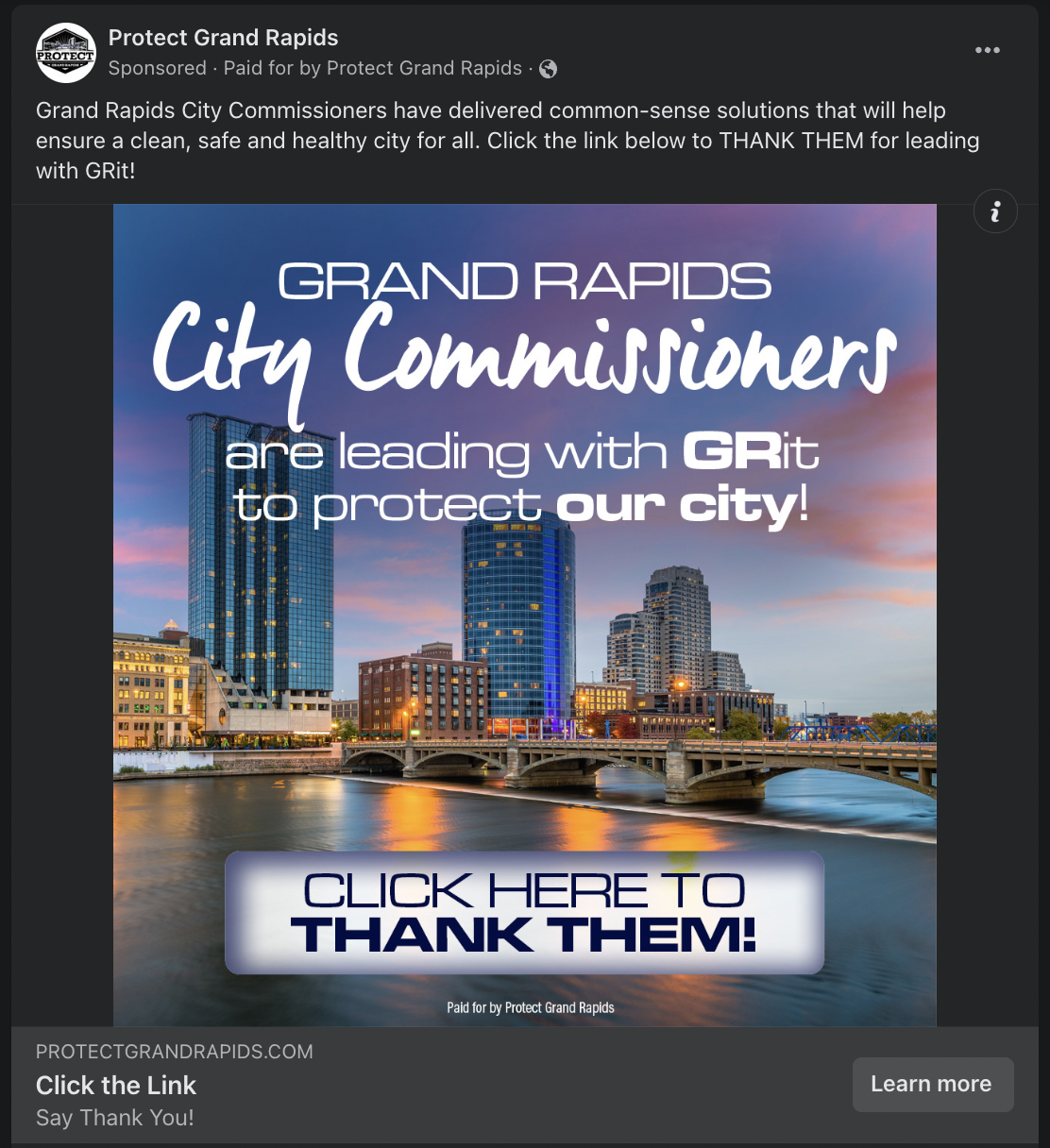 The graphic here on the right, is the image they are using in this online campaign, which is a sponsored campaign, since the Chamber of Commerce and their members have no problem spending money on sponsored Facebook posts.
About a week ago, I wrote the following statement on the sponsored post from Protect Grand Rapids, “The adoption of the ordinances is putting profit first, which is what the GR Chamber of Commerce is all about!”
Since I wrote these comments, several people have responded. What follows is a rundown of the comments and my responses.
Nancy Jo Wilson
Jeff Smith Nonsense. People on the street should be expected to follow the same laws we all have to follow. And communists don’t help out city at all.
Jeff Smith
Nancy Jo Wilson what the city adopted was two separate ordinances, not laws. Get your facts straight. And for the record, politically I embrace the philosophy of Anarchism, not Communism…..so don’t accuse people of something they are not. For instance, I never referred to you as an idiot, but if I had, you might be bothered by that label.
Nancy Jo Wilson
Jeff Smith I have heard you speak many times before and you have always been a communist. And anarchism is what destroyed downtown Grand Rapids. We don’t need either idea in Grand Rapids. Is Soros still paying you each month?
Jeff Smith
Nancy Jo Wilson wow, so much ignorance, where to start?
Nancy Jo Wilson
Jeff Smith Don’t bother. I don’t respect communists. Or Marxists.
Charles Bellgraph
Jeff Smith. So … we don’t have to follow ordinances like we do laws???
That is a new one!
Jeff Smith
Charles Bellgraph not if they cause harm and oppression. Slavery was legal, genocide was legal, Jim Crow Laws were legal, fossil fuels companies denying climate change is legal, the production and deployment of nuclear weapons is legal. Every social movement fought against oppressive laws, so yeah, we will resist this shit too!
Charles Bellgraph
Jeff Smith. Not the point.
You said to Nancy that they were ordinances, not laws.
Are you confused? There are reading comprehension classes you can take!
Also, everyone knows that the climate changes however people don’t cause it.
Plus Liberal Socialist Communist Nazi Racist Democrats are pretty ARROGANT thinking that they know what the ideal temperature of the Earth should be.
Jeff Smith
Charles Bellgraph the point Chuck, is that these ordinances are oppressive and we will resist them and the Chamber’s tactic of buying off local politicians.
Greg Reed
Jeff Smith climate change is a proven hoax perpetrated by the left you have just shown your communist hand.
Jeff Smith
Gregg Reed if you think that Climate Change is a hoax, then you are willfully an idiot.
Eric Michael (this person has since removed their comment, but my responses is still there)
Jeff Smith, you just showed your Communist hand. You are like the same kind of people who spit on my uncle when he came back from Vietnam.
Jeff Smith
Eric Michael the notion that anti-war activists spit on returning GI’s who were in Vietnam is a fabrication. Read “The Spitting Image: Myth, Memory, and the Legacy of Vietnam”. The author is a Vietnam Veteran. I’m more like the GI’s who came back to the US to join the anti-war movement, because the saw the atrocities committed against Vietnamese civilians. See the excellent documentary entitled, Sir No Sir.
To be clear, I don’t usually respond to these types of non-sensical comments. I don’t generally respond because I don’t believe there is any point in trying to have a conversation with people who are either ideologically opposed to what I believe or who are just trolls who get paid to respond to those who challenge systems of power and oppression.
I decided to post this exchange for several reasons. First, because for me, it speaks to the kinds of people that support the GR Chamber of Commerce, or at least what they stand for. Second, since this was a sponsored post from Protect Grand Rapids, my comments the the responses I received would be more widely seen, which if the nature of sponsored posts on Facebook. Lastly, I decided to post this exchange, simply because it shines a light on the ridiculousness of the ideological right, which is a little reminder of how shallow much of the discourse is, particularly in the social media world.
“In any case, the hidden hand of of foundations can control the course of social change and deflect anger to targets other than elite power.”
– Joan Roelofs, Foundations and Public Policy
For the past 10 years, GRIID has been monitoring foundations in West Michigan, particularly the large family foundations that those who are part of the Grand Rapids Power Structure have created. Our monitoring of local foundations has been part of our larger critique of the Non-Profit Industrial complex in Grand Rapids.
GRIID has been providing information and analysis on the various DeVos Family Foundations, using the most recent 990 documents that foundations are legally required to submit. These 990 documents must be submitted within a three-year period, which is why the 990s that we will be examining are from 2020, since most foundations prefer to submit their 990 documents at the last minute, thus minimizing public scrutiny. So far we have posted articles about the Richard and Helen DeVos Foundation, the Dick and Betsy DeVos Foundation, the Doug and Maria DeVos Foundation, the Dan and Pamela DeVos Foundation, the Cheri DeVos Foundation, and the Jerry & Marcia Tubergen Foundation.
The Steve and Amy Van Andel Foundation
GRIID has always done our Foundation Watch work by looking at the foundations associated with the most powerful families in West Michigan, like the DeVos family and the longtime family friends, the Van Andel family. The Steve & Amy Vandel Foundation was founded in 2005, with assets of $111,040,892. The most recent 990 document for their foundation is 2021, where a total of $8,504,096 was spent in contributions.
As we reported last year, the Steve & Amy Van Andel Foundation has contributed heavily to the Religious Right and the Political Right, along with charity-based non-profits in West MI, which we categorize as hush money. When we say hush money, we mean that these entities will not publicly challenge the system of Capitalism, the wealth gap, structural racism and other systems of oppression, which the Van Andel family benefits from and perpetuates through their own political funding.
Below we provide some categories of organizations/entities that have been the beneficiaries of Van Andel Foundation funds, with some analysis. To view the 990 document for the Steve and Amy Van Andel Foundation, go to guidestar.org and you can find the information they are required to make public.
Religious Right/Conservative Christian Groups
- Camp Rogers – $125,000
- St. Thomas the Apostle Church – $37,000
Political Right and Think Tanks
- American Enterprise Institute – $20,000
- Grand Action Foundation – $125,000
- The George W Bush Presidential Library Foundation – $1,000,000
- The Heritage Foundation – $10,000
- Township of Ada – $1,000,000
- Traffic Squad Safety and Community Action Fund – $12,000
The Heritage Foundation is one of the oldest Far Right Think Tanks in the US and is known for essentially crafting the policy agenda for the Reagan Administration. The Grand Action Foundation supports the work of Grand Action 2.0, which has pushed major development projects in downtown Grand Rapids since the mid-1990s, beginning with the Van Andel Arena. These development projects always rely heavily on public subsidies, without public input. The American Enterprise Institute is currently the largest conservative Think Tank in the US and during the George W. Bush administration, AEI was regarded “as the intellectual command post of the neoconservative campaign for regime change in Iraq,”
Education Institutions
- Hillsdale College – $4,200,000
- West MI Aviation Academy – $50,000
The West MI Aviation Academy was founded by Dick DeVos and is a Charter School located at the Gerald R Ford Airport.
Hillsdale College has a long history of practicing and promoting far right values. The former President of Hillsdale College, George Roche, was also on the advisory board of the US affiliate of the World Anti-Communist League, according to Scott and Jon Lee Andersen’s book, Inside the League: The Shocking Expose of How Terrorists, Nazis, and Latin American Death Squads Have Infiltrated the World Anti-Communist League.
Hillsdale College has hosted forums over the years with speakers such as Manuel Ayau, a member of Guatemala’s Amigos del Pais, a group linked to the death squads in Guatemala. Hillsdale also houses the late John Bircher Clarence Manion’s tape collection, with lectures from former Nicaraguan Dictator Anastasio Somoza Hillsdale’s magazine, Imprimis, which provides a forum for anti-minority views.
In another book by Russ Bellant, The Coors Connection: How Coors Family Philanthropy Undermines Democratic Pluralism, the author writes:
“Longtime Hiilsdale President Roche is opposed in general to social engineering plans, among which he includes affirmative action and public education. Roche has attacked the Civil Rights Restoration Act as frightening federal intervention. He calls affirmative action “the putrid backwash of all the tired social engineering schemes and complains that its advocates are so hypersensitive that a school’s unwillingness to set up advanced bongo drum programs is called racist.”
Bellant goes on to say:
“The selection of contributors for Hillsdale’s monthly magazine, Imprimis, also reflects the school’s far right political views. In one issue, Gerda Bikales, a founder and former executive director of the English Only organization, US English, condemned the advocates of cultural diversity and bilingual education. She attacked the skilled language planners and other militant advocates who promote bilingual education, as well as those who aggressively pursue diversity and cultural pluralism.”
Groups receiving Hush Money
- Children’s Healing Center – $50,000
- Hand2Hand – $25,000
- Harbor Springs Festival of the Book – $100,000
- John Ball Zoological Society – $75,000
- Kids Food Basket – $33,333
- Mary Free Bed Rehabilitation Hospital Foundation – $500,000
- Safe Haven Ministries – $10,000
- South End Community Outreach Ministries – $10,000
- Trillium Institute – $500,000
Foundations rarely make contributions without strings attached. The Steve and Amy Van Andel Foundation has a long history of funding far right and religious right groups, which GRIID documented 10 years ago when we started this project. Lastly, it is worth noting that the Steve and Amy Van Andel Foundation compliments the campaign contributions to GOP candidates, which is also pretty substantial, according to OpenSecrets.org.
Last week, we posted an article that provided some analysis of the larger vision of the Grand Rapids Chamber of Commerce.
We noted in that article that the GR Chamber was emphasizing in their vision, three distinct areas – 1) development projects, which they refer to as “amenities”, 2) responding to the housing crisis by pushing a Neo-Liberal Capitalist model, and 3) embracing the GRPD’s role as a defender of property (but let’s be honest, the property of the wealthiest and their underlings), along with pushing for more cops.
Each of these three vision points were discussed last Wednesday, at what the GR Chamber was calling a Grand Rapids Policy Conference. The conference included business leaders, community leaders, and local thought leaders. To attend the conference people needed to pay $250, unless you were a Chamber member, in which case it was a mere $200. GRIID had sent a request to attend as media, but the Grand Rapids Chamber of Commerce didn’t even bother to respond. Apparently, they only want media that embraces Capitalism and won’t challenge their role in the Grand Rapids community.
Therefore, I must rely on the pictures that the Chamber posted on their Facebook page, since I was denied the opportunity to independently report on the Policy Conference, and because none of the local commercial news media reported on it.
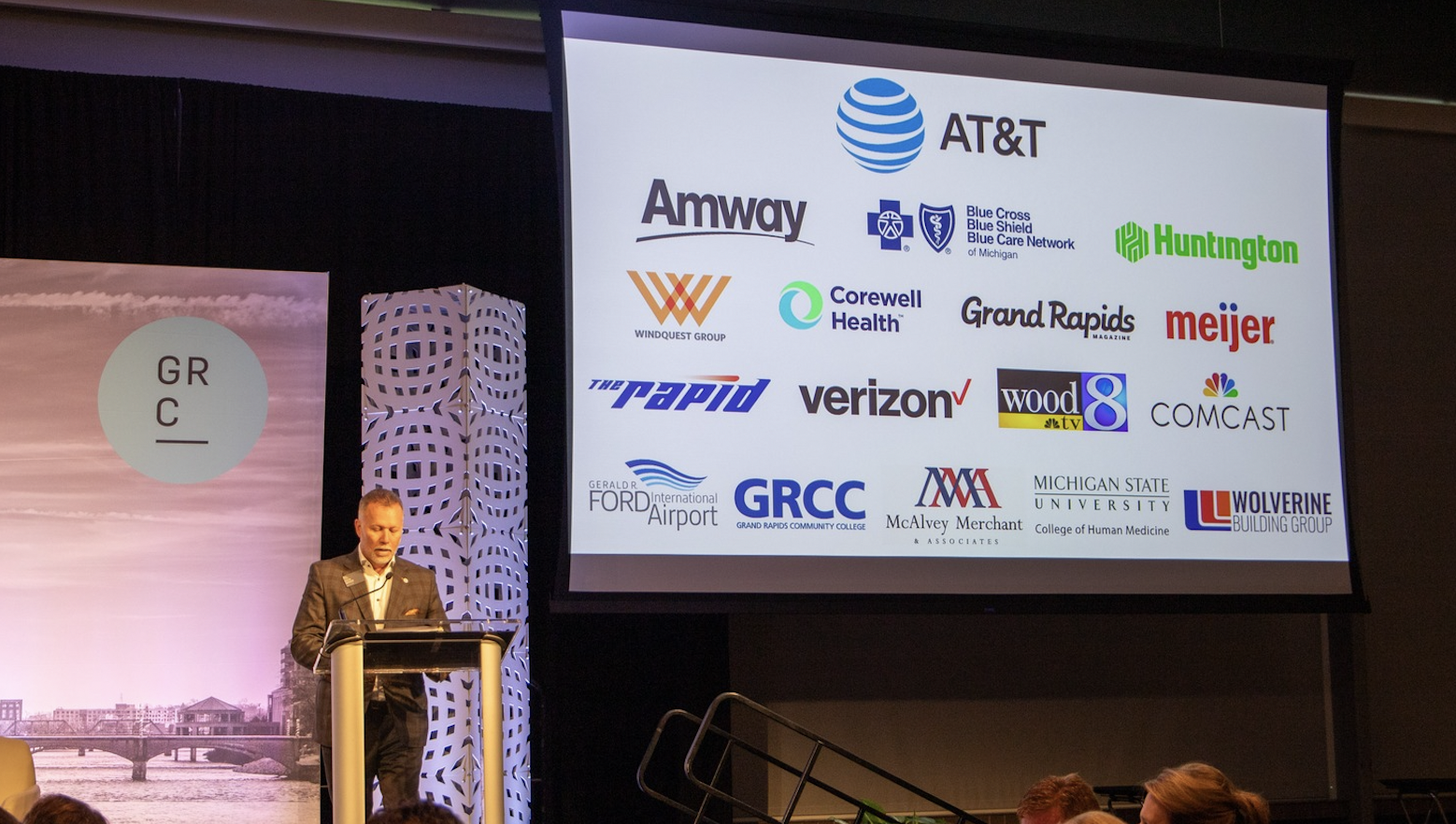
It is said that a picture is worth a thousands words, but I also believe that pictures can tell us a great deal about people and those in power.
 The above image, shows the Grand Rapids Chamber of Commerce’s President Rick Baker addressing those in attendance. In addition, we see on the conference screen, a list of the corporate sponsors of the event, which also include a few media entities, along with other institutional sponsors. As you can see, WOODTV8 was a conference sponsor, yet they failed to report on the conference.
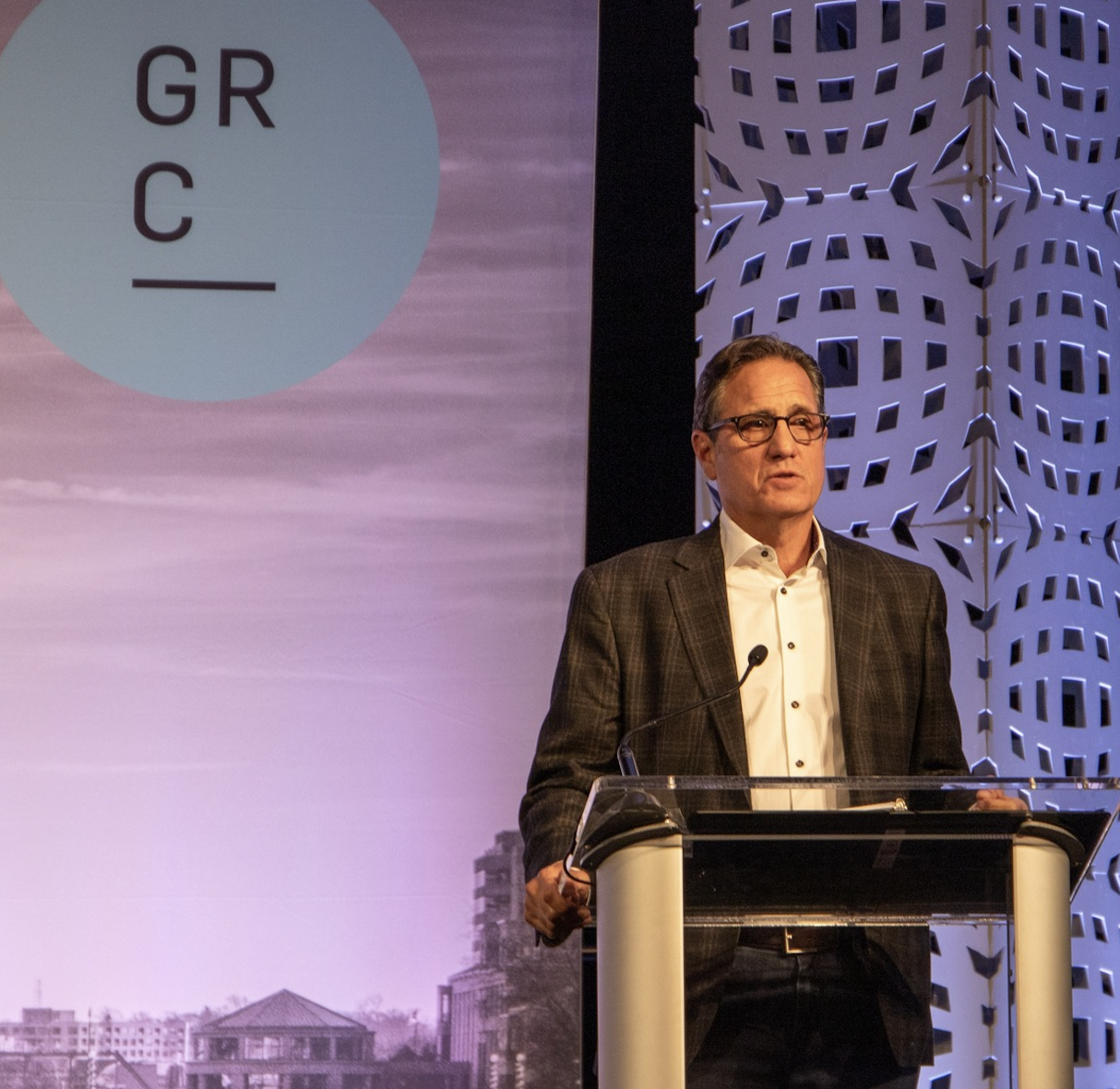
In this second image (here on the right), you can see the CEO of Rockford Construction, Mike VanGessel. VanGessel is part of the Grand Rapids Power Structure, has been a key partner with the DeVos family in gentrifying the near westside and buying millions of dollars of property in the Boston Square Neighborhood, as part of the AmplifyGR project. In addition, VanGessel was a major player in pushing for the two ordinances that the City of Grand Rapids adopted on July 25th, ordinances that have criminalized the unhoused.
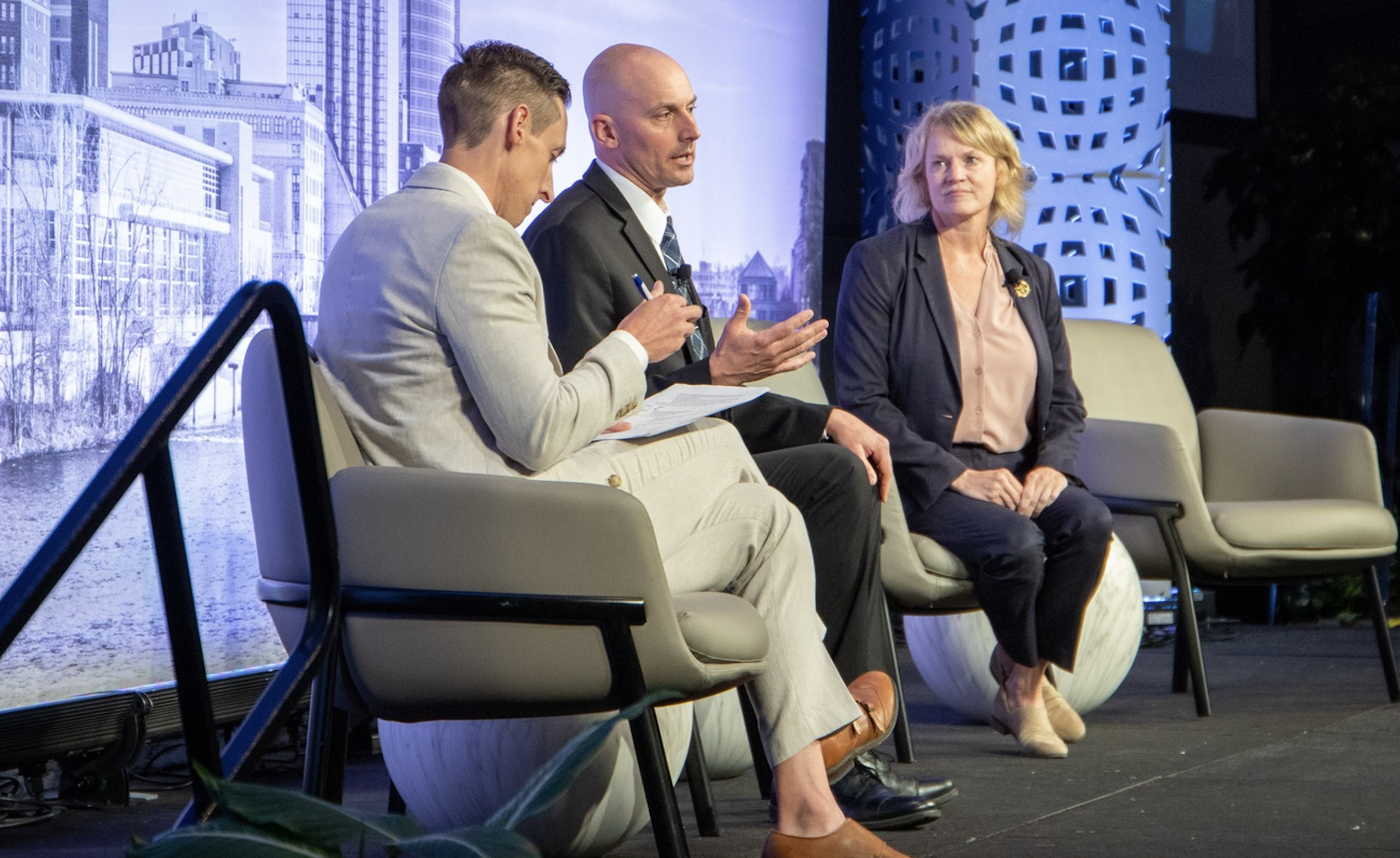
In this next picture above, you can see Josh Lungar, the chamber’s vice president of government affairs, next to the Grand Rapids Police Chief, Eric Winstrom. Winstrom is no doubt speaking about how the GRPD will protect the interests of the downtown business owners, along with thought about those pesky protestors, the ones who have been challenging the local power structure, Grand Rapids and City officials and the GRPD over policing issues, institutionalized racism, and disrupting business as usual.
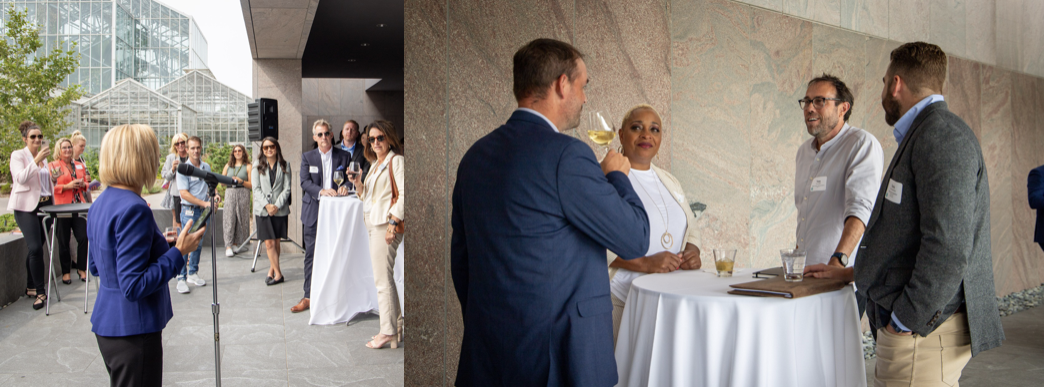
In this next picture, shown above, you can see several area elected officials schmoozing with members of the Grand Rapids Chamber of Commerce. Indeed, as we have reported before, the GR Chamber often make contributions to candidates running for local office, therefore, if candidates or incumbents want to continue to be the beneficiaries of campaign contributions, then attending their events and supporting the Chamber’s vision is critical. Pictured is Mayor Bliss on the left, with City Commissioner Lisa Knight on the right, along with County Commissioner Tony Baker.
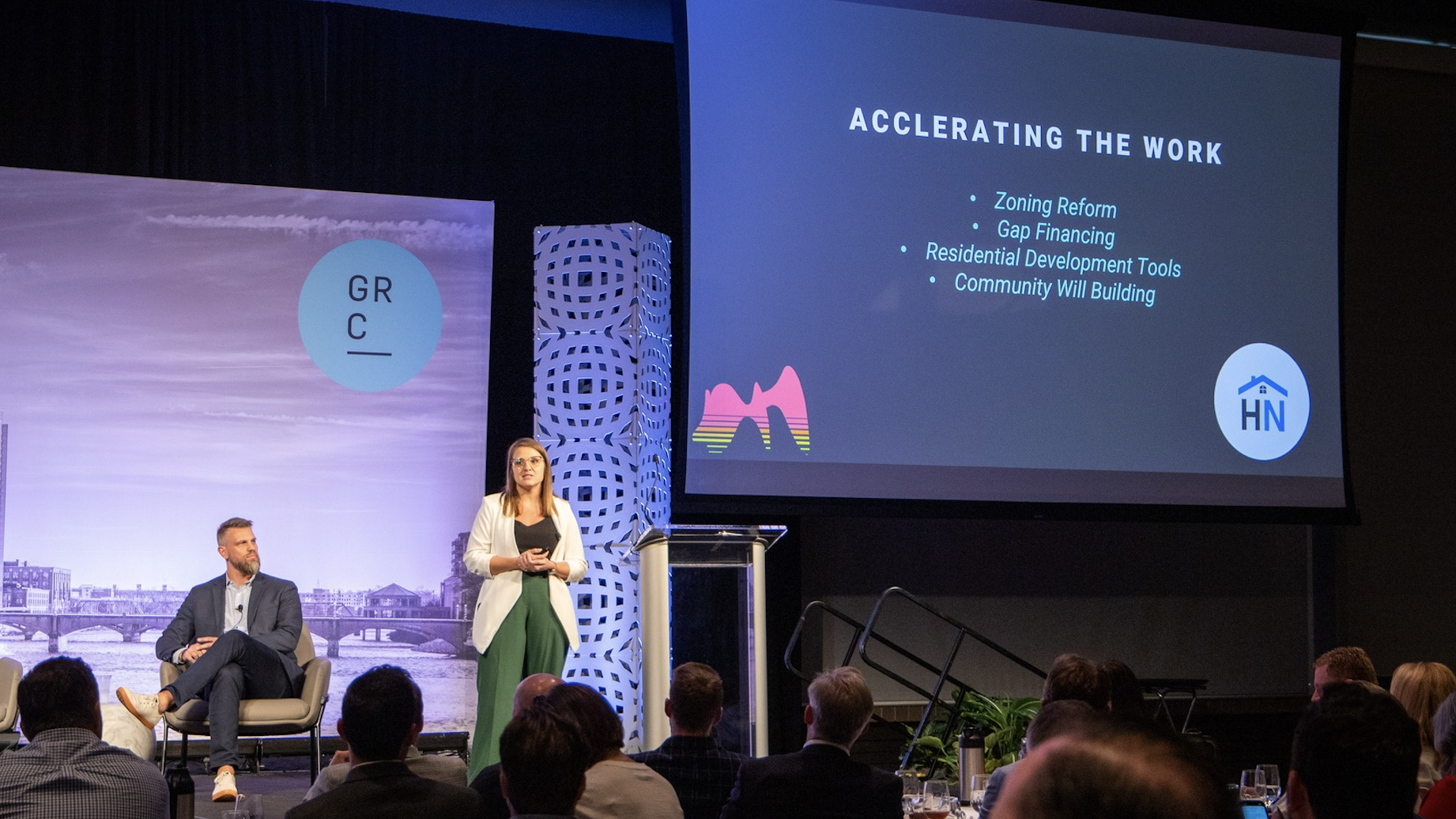
This next picture, we see people with the Grand Rapids Chamber of Commerce created group, Housing Next, speaking during the policy conference. Note the kinds of things that are listed that they want to do. All of those items are a reflection of their commitment to solving the housing crisis through the market. What we don’t see listed are challenging the power of financial institutions that have made the cost of housing so unaffordable, elevating tenants and their fight against exploitation by landlords and property management companies, the issue of how much money the real estate industry and landlord associations contribute to political candidates, or the fact that most companies don’t pay workers livable wages, which is why so many can’t afford to buy a home or pay rent.
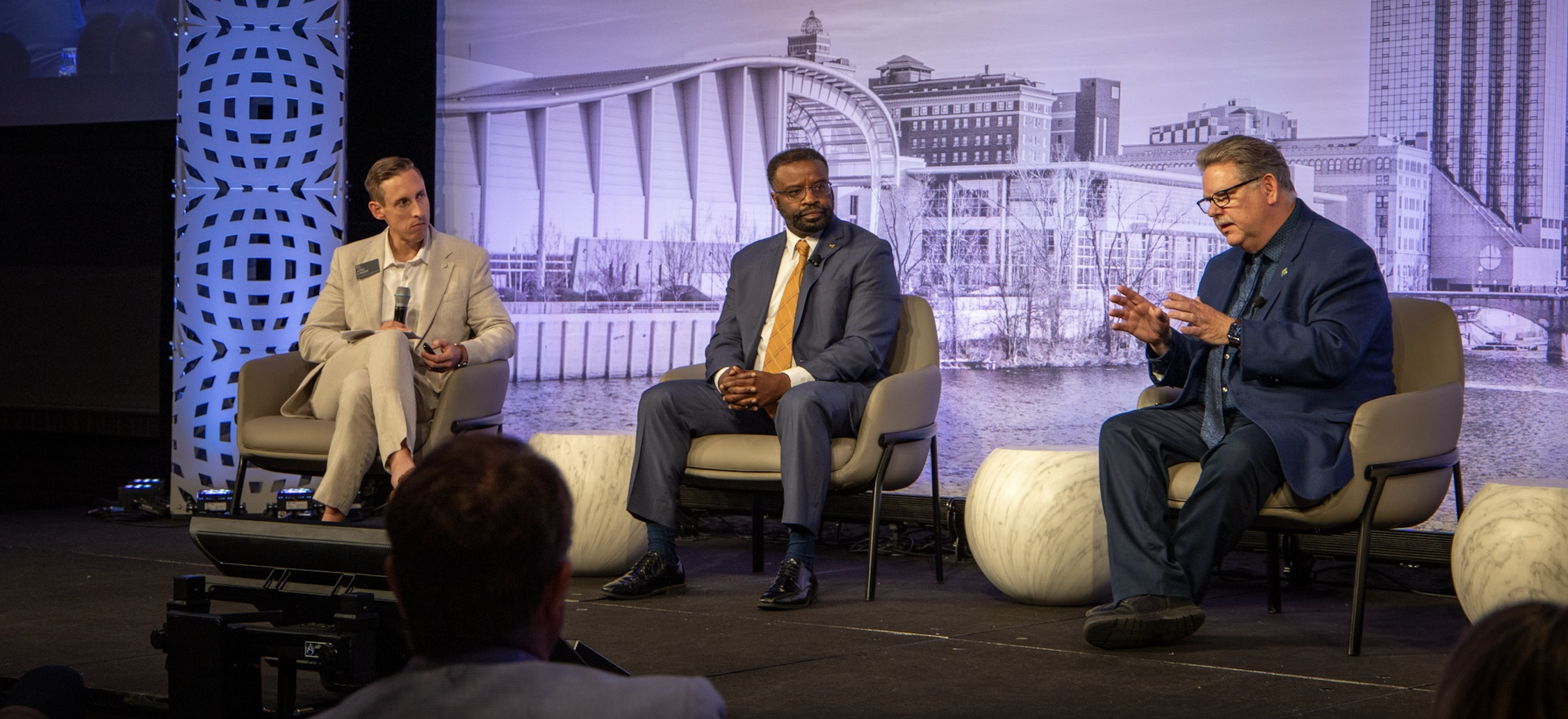
Then there is this photo above, which includes Josh Lunger once again on the left, City Manager Mark Washington in the center, and Al Vandenberg, who is the Administrator for Kent County. What is instructive about this picture is that even though we have elected officials at the City and County level, the Grand Rapids City Manager and the Kent County Administrator are more powerful than those elected in both commissions.
Last, but not least, the picture below is a fun one, with two Chamber staff members standing with Mayor Bliss, City Manager Mark Washington and Lupe Ramos-Montigny. Lupe Ramos-Montigny has been a Democratic Party operative for many years in Kent County. She is also the founder of the Committee to Honor Cesar Chavez, and she campaigned last fall to help get Andrew Robbins elected as a Grand Rapids 1st Ward City Commissioner. Robbins received $10,500 from the GR Chamber of Commerce, $10,500 from the Grand Rapids Police Officers Association and lots of money from several members of the Grand Rapids Power Structure, which you can see at this link. I don’t see how someone who founded the Committee to Honor Cesar Chavez can actually believe that they are honoring the legacy of someone who not only organized migrant workers to fight against corporate agribusinesses, but was deeply committed to non-violent direct action.
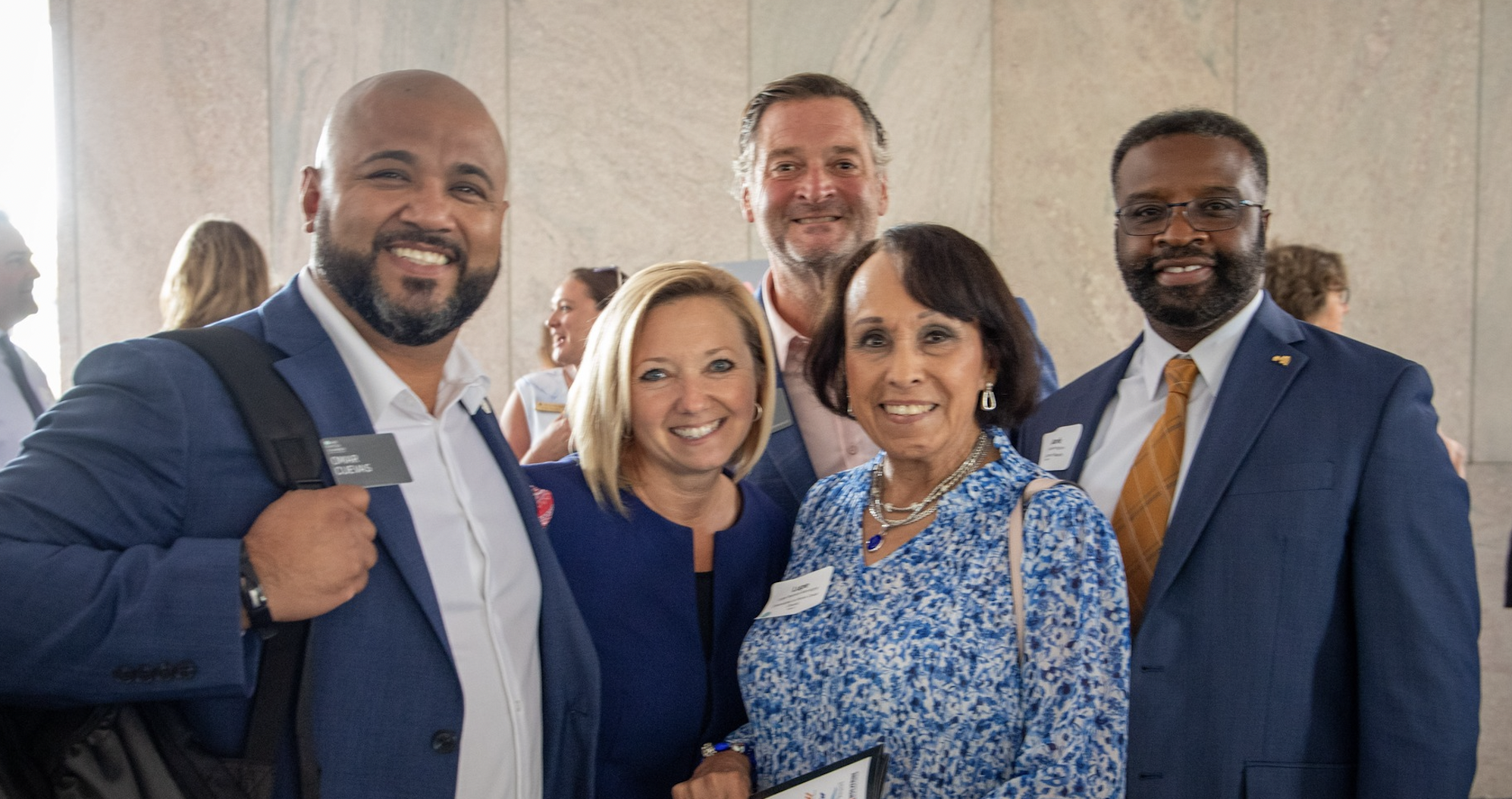
Thus you can see how a picture can be worth a thousand words, or in the case of the Chamber of Commerce and their collaborators, a picture is worth millions of dollars.
On Tuesday, MLive ran the headline, City of Grand Rapids to borrow up to $12M to redevelop downtown riverfront park.
The first sentence of the article stated, “The Grand Rapids City Commission approved a request by city staff to borrow up to $12 million to redevelop Lyon Square, an urban riverfront park located between DeVos Place and Amway Grand Plaza Hotel.”
This is really all readers needed to know.
So, the City of Grand Rapids will be borrowing $12 Million to redevelop the space along the Grand River that just happens to be between DeVos Place and the Amways Grand Plaza. It should be noted that on the northwest corner of Lyon and Monroe, is the Reserve Wine Bar, which Dick and Betsy DeVos own.
Now, we will probably never know, since the local Capitalist Class and the City of Grand Rapids are not big on transparency, but it is instructive that the City will be borrowing $12 Million to “redevelop” this very small riverfront park, which is sandwiched in between two DeVos-owned businesses and the Convention Center, which is named after the DeVos family. Imagine the conversations had been DeVos people and the City of Grand Rapids, regarding the Lyon Square redevelopment idea. It might have gone something like this:
Hey, how about you all foot the bill for the redevelopment of this project, and by you all we mean the public. When Lyon Square is then redeveloped, it will add to our ability to promote this new amenity for people who will be staying in our hotel or visiting our wine bar. I’m sure the general public, maybe even working class people will use it from time to time, but since we utilize private security guards, and we now have the new ordinances adopted that will make it harder for poor people to just hang out and be idle with no real purpose.
In the August 8th Agenda Packet for the Fiscal Committee (pages 51 – 56), it lists what exactly the $12 Million will be used for:
The Additional Bonds will be issued for the purpose of defraying all or a portion of the costs of improvements to Lyon Street, N.W. between Monroe Avenue, N.W. and the Grand River and adjacent properties commonly known as, “Lyon Square,” consisting of (a) demolition and removal of obsolete public fixtures, utilities, facilities, and related infrastructure, (b) construction of new roadways and walkways, an event and performance space, park and recreation facilities, streetscape improvements, tree canopy and landscape improvements, placemaking amenities, mechanical snowmelt system, structural, mechanical, electrical, and plumbing systems, and other public amenities, and (c) all other work, furnishings, fixtures and equipment and site improvements necessary and incidental thereto which are located within the City of Grand Rapids.
$12 Million is a lot of money for such a tiny park
In May of this year, it was noted that, “Roughly $5 million was allocated to the fund (for Affordable Housing) for the next fiscal year, which will boost the grand total to about $11.5 million,” according to an article on MLive. The $11.5 Million has been building up over several years and will be used for Affordable Housing in Grand Rapids, although the details of how that money will be spent haven’t been very clear.
However, the point I want to make is that compared to several years of putting together an $11.5 Million budget for Affordable Housing, the City of Grand Rapids approved $12 Million to redevelop a small downtown park with one simple vote. The $12 Million for Lyon Square will not be used for housing, but for a park space that will primarily benefit tourists and members of the Capitalist Class.
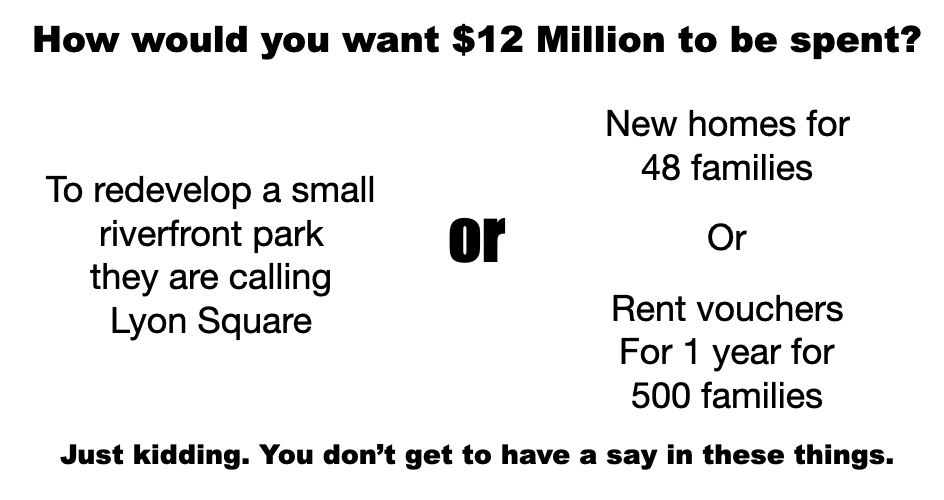
Now imagine for a moment that the DeVos family would foot the bill for the Lyon Square project and the $12 Million that the City will now be borrowing, would instead go directly to affordable housing. Affordable Housing is a relative term, but let’s say that for a new modest home for a family of 4, it would cost $250,000. With $12 Million, the amount they will be spending on redeveloping a small park, that amount of money could cover the cost of building a $250,000 home for 48 families.
Of course, affordable housing could also mean providing rent vouchers to families, who pay $2000 a month for rent. At $2000 a month, that would be $24,000 for a year. So, what would $12 Million look like if it was used as rent vouchers for an entire year for families who are paying $2000 a month? $12 Million could cover the cost of $2000 a month rent for an entire year, for 500 families.
Therefore, either 48 families could have their new homes paid for with the $12 Million that will be spent on Lyon Square or 500 families could have their rent paid for during a 12 month period. If given a chance to vote on this, how do you think most families would vote on the $12 Million?
Of course, we could do this for all of the other development projects for downtown – the Amphitheater, the proposed Soccer Stadium or the proposed Aquarium, all of which will each cost way more than $12 Million. The point I want to end with is this, there is plenty of funding available so that no one in this community would have to be housing insecure, but the priorities of those who own Grand Rapids are designed to increase their wealth, not to create economic equality.
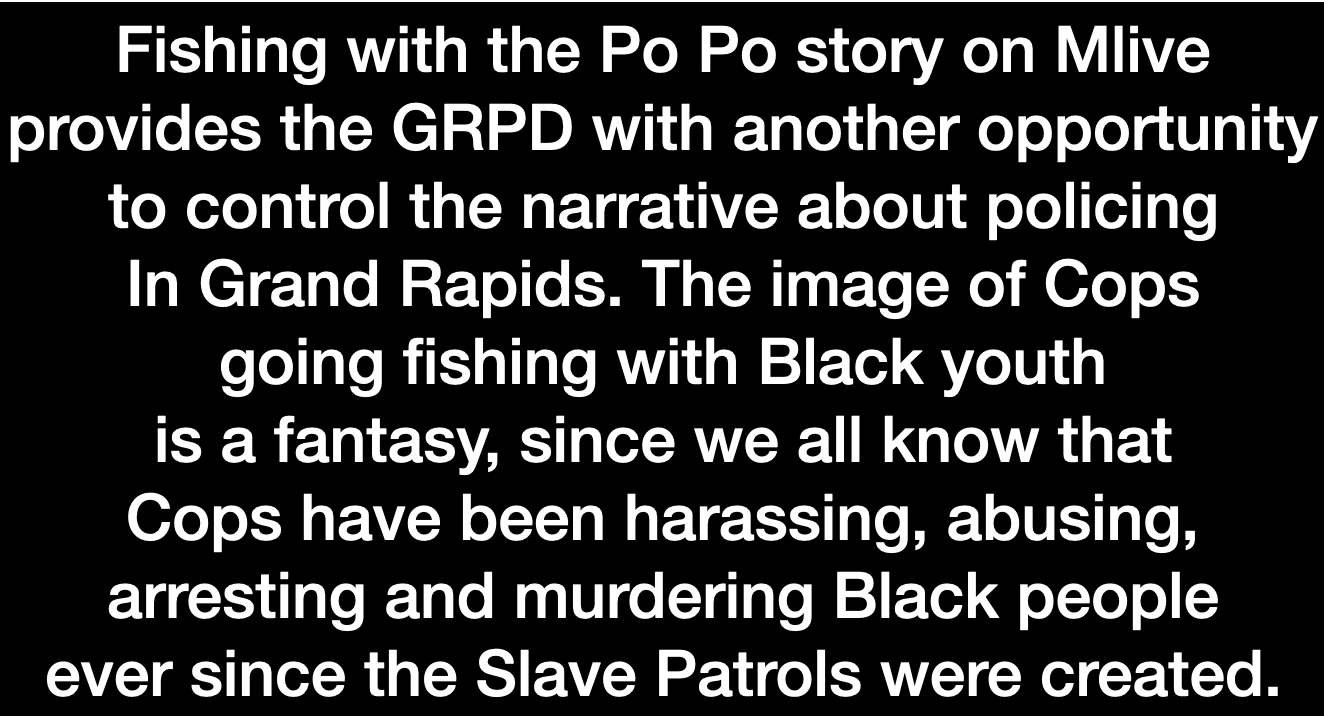
On Saturday, August 5th, MLive posted an article entitled, ‘Fishing with the Po Po’ event lets kids, police bond together outdoors.”
Like many of the stories that the local commercial media does about the GRPD, this story is nothing more than a propaganda piece for the cops, thus it is copaganda.
Now, we don’t know if the MLive article was the result of a Press Release from the GRPD or Uptown Church GR, which was the entity that organized the event, since there are no online Media Releases. However, Uptown Church GR did a promotional piece about the event on Fox 17 in late July.
There are two overall issues that I think are important about the MLive story, one has to do with the lack of context and transparency, and the second point has to do with the commentary from Police Chief Eric Winstrom.
Nowhere in the MLive article do we learn that Uptown Church GR has been part of larger efforts in collaboration with the GRPD and pro-police organizations in Grand Rapids. This is important, since Uptown Church GR has participated in an event that was hosted by the pro-cop group iCI Nation, a so-called Unity Walk, which involved some local pastors and the GRPD walking in a neighborhood on the Southside of Grand Rapids.
In addition, Uptown Church GR hosted a Summer Celebration just 3 weeks ago, with the GRPD invited to participate and to have some of their cops show off in feats of strength. These are just a few examples of how Uptown Church GR has made the decision, in the words of their Pastor, to develop relationships with the GRPD.
The second point I wanted to talk about, has to do with what Police Chief Eric Winstrom had to say to the MLive reporter. Winstrom was quoted as saying:
“We want to let the kids know we’re very much human,” Winstrom said. “We very much care about the kids and we’re not the enemy. We’re not. We care about them here and we care about them when we’re at work, patrolling the area.” Winstrom said it has been hard to make community connections in the past few years after public opinion of police soured following high-profile police shootings of civilians like George Floyd in Minneapolis in May 2020. “Policing is here to stay, at least for the foreseeable future, and police are necessary,” Winstom said. “Having adults in Grand Rapids that still embrace us and say, ‘Hey, we know that the police department is important and we want to support them,’ and making these connections for us is huge.”
These comments from Winstrom are instructive, but it is also worth noting that the MLive reporter does not challenge what Chief Winstrom had to say, instead they just acted as a stenographer without question or without providing any sort of counter-narrative.
We don’t know what order Chief Winstrom said the things that he said, especially since we know how much the news media often constructs story narratives. In Winstrom’s comments he begins and ends with making the point about how important it is to make connections with the public. His comment, “Having adults in Grand Rapids that still embrace us and say, ‘Hey, we know that the police department is important and we want to support them,’ and making these connections for us is huge.” Winstrom is correct in saying that this is huge, because they want to influence how the public sees them and what better opportunity than to go fishing with adults and kids. In this setting, the GRPD can construct their own image, an image which is radically different than cops patrolling in neighborhoods, profiling Black motorists, or pulling guns on Black and Latinx youth, as has been the norm in recent years in Grand Rapids.
The fact that Winstrom himself, acknowledged the high profile police shootings of civilians like George Floyd in May of 2020, is itself an admission that his department is always looking for ways to counter the growing public understanding of the function and practice of policing in the US. The MLive reported could have presented the fact that 1006 civilians have been killed by police in the US over the past 12 months, based on the data collected by Washington Post. The MLive reporter also could have made the point that the Washington Post does, where they say:
Black people account for roughly 14 percent of the U.S. population and are killed by police at more than twice the rate of White Americans. Hispanic Americans are also killed by police at a disproportionate rate.
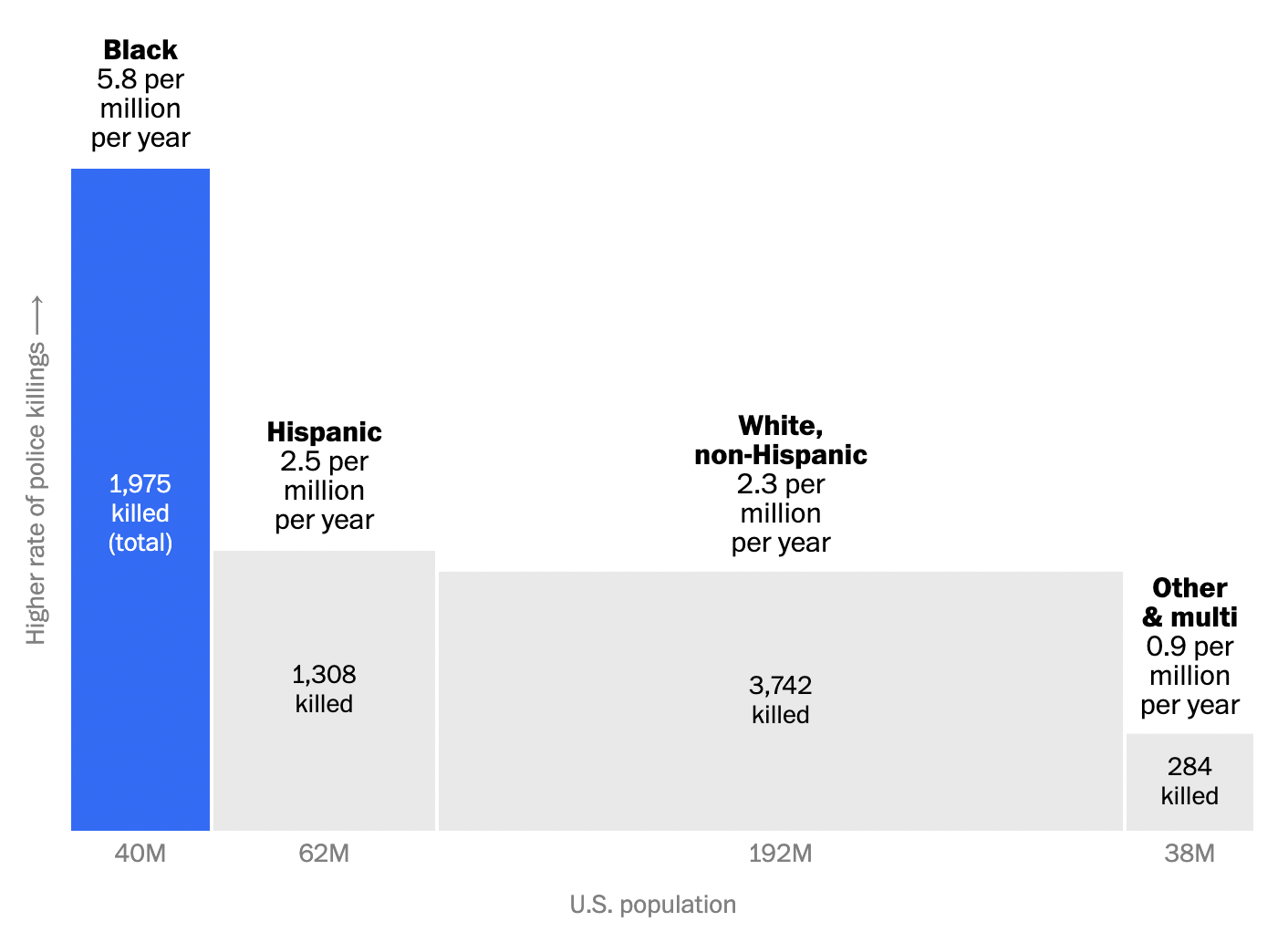
Chief Winstrom and his GRPD officers are not going to address this data or the fact that Black people in general are constantly at risk of intimidation, abuse, arrest, or death when encountering the police in this country. Add to this the lack of accountability or counter narratives about policing as presented by the dominant commercial news media in Grand Rapids, Chief Winstrom can feel confident that the GRPD will continue to to dictate the narrative about their role in this community, a narrative that is sanitized and completely false.
The Grand Rapids Chamber of Commerce has a vision, and it doesn’t include a lot of us
Over the past ten months GRIID has been writing about the Grand Rapids Chamber of Commerce, particularly the role they have played in changing City policy that serves the interests of the business community.
We reported on the Chamber’s decision to inject a great deal of money into electoral politics at the city level, something that has only happened previously on a small scale. The Grand Rapids Chamber of Commerce contributed $10,500 to Drew Robbins running in the 1st Ward and the same amount to Rev. Hoskins, running in the 3rd Ward. Robbins won and Hoskins lost, but this level of funding sets a dangerous precedent for future elections in Grand Rapids, with the goal of buying policies that are favorable to the interests of the Chamber and their members.
Then in December of 2022, the Chamber submitted a proposed ordinance that would essentially criminalize the unhoused. This proposed ordinance was followed by a letter from 120 members of the business community, with several dozen signatories coming from those we identify as part of the Grand Rapids Power Structure.
The City of Grand Rapids did not adopt the Chamber’s proposed ordinance, but they did bide their time and then crafted two separate ordinances that were presented to the public. An overwhelming number of people showed up to a public hearing, with the majority opposing the two ordinances. Unfortunately, City Commissioners then voted on the ordinance proposals at the very next meeting on July 25th, adopting both by a margin of 5 – 2.
However, it is vitally importantly that we understand that the Chamber’s push to get these ordinances passed, is only part of a much larger vision they want to implement in Grand Rapids, a vision that excludes large sectors of the population.
In a July 26th Chamber of Commerce “news” posting, those who run the Grand Rapids Chamber of Commerce made known their vision for Grand Rapids.
The heading of this post reads, What Will Define our Regional Success? The Chamber claims that Grand Rapids has bucked some of the “worrisome trends” in terms of urban development, but then poses the question – Will we continue this way in the future? The Chamber’s answer is instructive:
It’s complicated. There is never a single solution to major disruption and complex issues, but we can learn from other cities have done – or not done. And it will take the business community leading the effort to promote a vibrant and prosperous region in the coming decades. Cities that are succeeding are focused on:
- Investing in amenities that improve quality of life – from signature assets to enhancing greenspace.
- Increasing the availability and attainability of housing for all
- Increasing community safety
The good news is that our region is already engaging in public-private partnerships on all these fronts. Here’s how greater Grand Rapids is breaking the mold.
Before we get to the bullet points listed here, it is important to note that when the Chamber (or any other group) uses the term “public-private partnership”, what they really mean is that a government entity will provide substantial amounts of public money to a project that will primarily benefit the private sector. Therefore, we should really see public-private partnerships as welfare for the rich.
Now, let’s deconstruct the three bullet points that the Grand Rapids Chamber of Commerce is presenting in their “vision.”
First, the Grand Rapids Chamber of Commerce idea of an amenity, are things that will primarily benefit the private sector, places that require a cost to get in, and direct people to use things like hotels, fee-based parking lots, restaurants, bars and other downtown businesses. Therefore, the amenities that the GR Chamber lists are the downtown Amphitheater, the Factory Yards, River Development, and the Aquarium. They go on to say, “creating amenity-rich neighborhoods and corridors will drive a better future.” To be clear, it will drive a better future for those who own and/or profit from the items listed above. Again, since these are public-private partnerships, the private sector, which is often the very rich in this community, has already received millions in public dollars, before they make millions more from the “amenities” they have been pushing.
Think about how all of the above “amenities” will exclude a large sector of the population, especially working class people/families, which are struggling to survive from paycheck to paycheck. These individuals and families will not be able to afford a ticket to a concert at the Amphitheater, plus parking, which often would require child care, etc.
To see all of the “amenities” that the Grand Rapids Chamber of Commerce are pushing, go here.
The second bullet point item is Increasing Housing at all Price Points. What the Chamber means by the second bullet point is that the “market” will provide solutions to our housing needs. This is a false solution, since the market has made most housing option unaffordable for people/families in Grand Rapids. In February of 2023, we wrote:
The “solution” to the current housing crisis, according to Housing Next, involves local government, developers and non-profits. The fact of the matter is, Housing Next offers no real solution to the housing crisis, only the same old model, the market. This is not a solution or maybe more aptly named a false solution. This is because under a market system, housing is nothing more than a commodity that can be bought and sold to make profits. For the Chamber and those sectors of society who believe in the market, housing is not a fundamental human right. Housing within a market economy, particularly home ownership, is for those who can afford it, which leaves out millions of people in the US alone.
 In addition, we need to recognize that Housing Next is an entity that was essentially created by the Chamber of Commerce, primarily as a way to insert themselves into the housing discussion and to influence housing policy. Recently, Housing Next was able to bamboozle the Michigan State Housing Development Authority (MSHDA), to allow them to be the point entity for West Michigan to hold community meetings around housing and to work to re-direct state money to subsidize housing projects for the near future. Also, if you read the Housing at all Price Points section, it states, “Thankfully, we have made significant progress to rise to this challenge, but we still need to accelerate our efforts to create desirable, walkable and amenity-rich housing opportunities.” Notice that the word affordable is nowhere in that statement, plus all of the “resources” they list are market-based or public-private solution.
As a counter to the market-based housing solutions, I have come up with my own list, which is rooted in years of providing radical hospitality to those who were housing insecure and the current work I do with the Grand Rapids Area Tenant Union. These Housing Justice solutions include:
- Paying people a livable wage, which right now would be $25 an hour minimum
- Reducing the wealth gap in Kent County, where there are over 600 millionaires, but 25% of the population is subjected to poverty.
- Government regulated rent control
- The creation of Tenant Unions
- Stop the influence peddling of Real Estate and Rental Property Associations, especially during election cycles, as we documented in 2022.
- Re-direct part of the massive US Military Budget ($858 Billion for 2023) and use it to provide housing for people, particularly the most marginalized communities.
- Practice Radical Hospitality, particularly in the faith communities. Imagine home many people who are currently housing insecure, could benefit from the resources and hospitality of the faith communities.
- Limit large corporate property management companies or real estate investors from operating in Grand Rapids/Kent County.
- End government subsidies/tax breaks for developers.
- Promote cooperative housing and Community Land Trusts.
The third, and last bullet point that the Grand Rapids Chamber of Commerce lists as their vision for this city is “Community Safety,” which really means more cops. In fact, in the section on Community safety, they list 2 points – increasing the number of cops and Clean, Healthy & Safe Public Space. The later point was written before the July 25th City Commission vote to adopt the ordinances to criminalize the unhoused, which is what the GR Chamber means by clean, healthy and safe public spaces.
So you can see that the vision of the Grand Rapids Chamber of Commerce is to create a city that will primarily benefit the wealthy, use public dollars to subsidize projects the private sector will profit from, rely on housing solutions that are market based, and increase the number of police to make sure than any undesirables – the unhoused, working class people, those who do not elevate consumption as a top priority, and dissidents – will not interfere with their plans and their vision.
Lastly, it is worth noting that the Grand Rapids Chamber of Commerce will be discussing this vision – so-called transformational projects, housing and increasing cops and private security guards – at an afternoon conference being held at Frederick Meijer Gardens this Wednesday, August 9th, from 11:30am – 5:30pm. The conference will include business leaders, community leaders, and local thought leaders. Thought leaders? Why do those who have power over others always use such stupid language? Are they suggesting that they are leaders who think or are thoughtful? Please, they only think about what benefits their interests. Oh, and if you want to attend this “Policy Conference”, it will cost you $250 to attend, assuming you aren’t a Chamber member. GRIID sent a request to attend as media, but have yet to receive a response.
Minimal progress has been made in racial equity and justice 60 years after the 1963 March on Washington
The United States is a country that is deeply divided around the issue of racial justice and racial equality. Sixty years ago this month, the Civil Rights Movement organized a massive march in Washington, DC, to demand greater freedoms, housing and jobs, especially for Black Americans.
According to a new study produced by the FPWA – Fulfilling the Promise of Opportunity, found that since the march, racial disparities across housing, education, employment, wages, and voting rights have remained stagnant, or in many cases widened to a staggering degree.
The 58 page report published by FPWA demonstrates that desire the grassroots efforts of the Civil Right Movement, Black Americans are still unable to realize the dreams of the 1963 March on Washington, primarily due to the systemic and structural racism that is built in to virtually all sectors of society. For example, the report states:
Black Americans earn 20% less than their white counterparts, even with identical college degrees. This racial wealth gap has long-term detrimental impacts on families: 1 in 3 Black children live in poverty, compared to less than 1 in 10 white children. For incarceration rates, the disparity is yet more severe: 1 out of 3 Black boys born today can expect to be sentenced to prison in their lifetime, versus 1 out of 17 for their white peers.
On this issue of racial disparities and housing here are a few bullet points from the report:
- The passage of the Fair Housing Act of 1968 was a crowning achievement of the Civil Rights era, but much like the Voting Rights Act it too has been steadily eroded and hollowed out.
60 years later, the gap in homeownership remains relatively unchanged; segregation – while shifting scale from state-level to municipal level — too remains stubbornly flat
Devaluation of Black and Brown communities and diminishment of Black wealth continues unmitigated, costing Black families, fortunate enough to own their own homes, billions of dollars in wealth accumulation.
Abhorrently high levels of homelessness seen in Black and indigenous communities across this country.
Black and Brown communities continue to bear the brunt of environmental degradation, economic disinvestment, and unequal access to healthcare services. These social determinants of health were starkly revealed as Covid-19 ravaged communities of color.
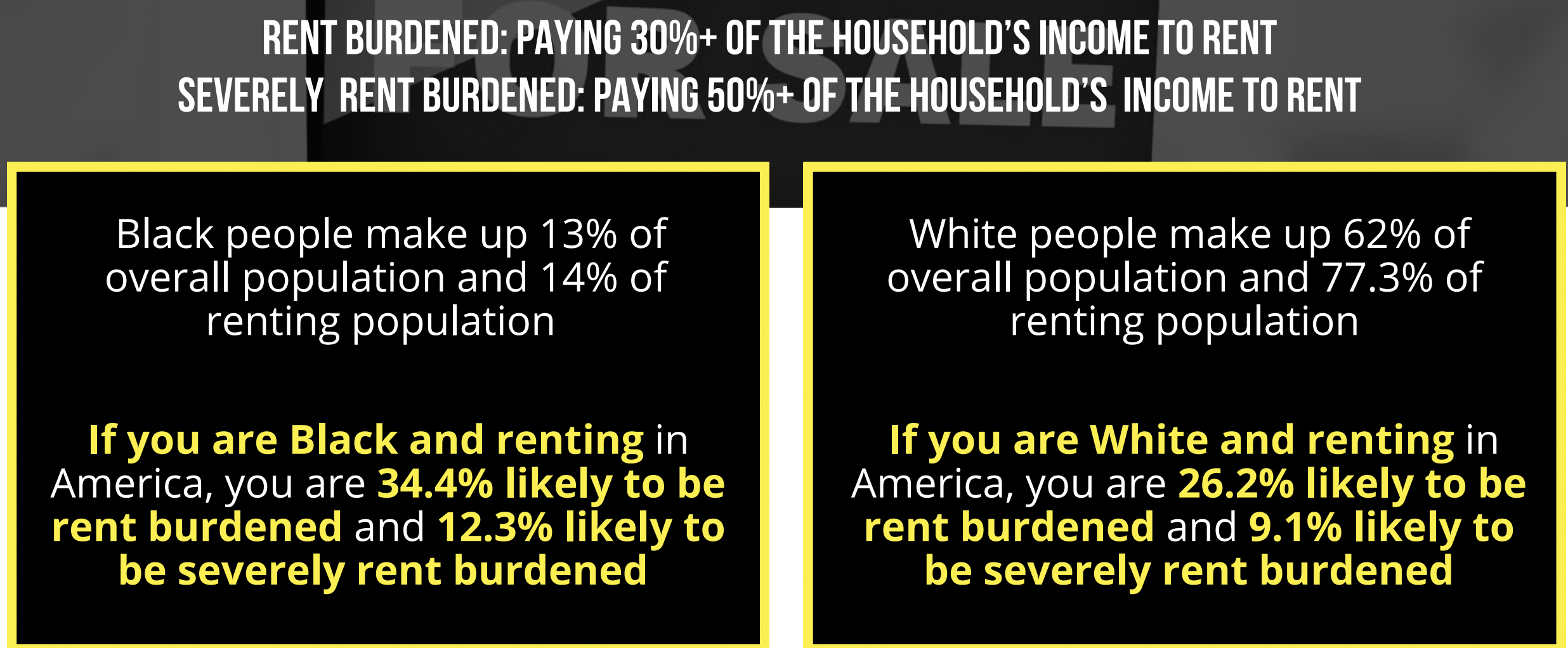
On the disparities with rent, check out this graphic below.
On the matter of economic disparities, specifically on jobs and wages, there too we can see significant differences.
- Black people experience higher unemployment rates AND lower wages across all educational attainment levels and age cohorts than White persons.
On average, Black persons earn 20% less than their White counterpoints.
Due to occupation and wage segregation and wage inequity, Black persons are disproportionately impacted by the suppressed federal minimum wage and outdated federal poverty measure.
Then there is the issue of Police Brutality, which Grand Rapidians are all too familiar with. Check out the data in this graphic.

So, despite all of the handwringing after the Black Lives Matter protests and the 2020 uprisings that took place across the country, the actual data and the socio-economic conditions show that Black people all across the country and in Grand Rapids are not better off than they were in 1963.
In Grand Rapids and Kent County as a whole, the fact is that Black people proportionately experience higher levels of poverty than white people, have higher health risks, have worse infant mortality rates, have a larger percentage of families experiencing food insecurity, plus a higher percentage of incarceration rates. Like the rest of the country, Grand Rapids has deeply systemic and structural racism in both the public and the private sector.
Later this month, GRIID will post an article about people from Grand Rapids who participated in the 1963 March on Washington.
 Grand Rapids Institute for Information Democracy