Bipartisan Resolution in the Michigan House to condemn Hamas is the focus of the DeVos-created group Michigan Freedom Fund’s ridiculous post
On Thursday, the DeVos-created and funded organization, the Michigan Freedom Fund (MFF), posted an article entitled, Michigan House Democrats Join Tlaib in Refusal To Condemn Hamas.
It is important to point out from the get go, that several Michigan House Democrats have co-sponsored the resolution to condemn Hamas, so the headline for the MFF post is misleading.
The MFF post begins by stating:
Michigan House Democrat leadership join the ranks of extremists like US Rep. Rashida Tlaib by refusing to condemn the horrifying Oct. 7 attack on innocent Israeli citizens. State Representative Bill Schuette introduced a Resolution condemning the attacks that claimed over a thousand lives, including 25 Americans, and left thousands more injured. The resolution also calls for the release of all hostages held by Hamas. The resolution was blocked by House Democrat Leadership in defiance of some of their own caucus members who signed on to the resolution.
This is an interesting post for numerous reasons. First, the MFF post in primarily interested in condemning the Michigan Democratic Party leadership, specifically Rep. Joe Tate. Second, the MFF post also mentions Michigan’s Congressional Representative Rashida Tlaib, who has been an outspoken supporter of the Palestinians since she has been a member of Congress. However, Tlaib stated on Wednesday, in a comment quote in Michigan Advance:
“I do not support the targeting and killing of civilians, whether in Israel or Palestine,” Tlaib first told the Advance on Wednesday. “The fact that some have suggested otherwise is offensive and rooted in bigoted assumptions about my faith and ethnicity.”
Therefore, it seems that the MFF post is not honest and not accurate about what they are claiming about Michigan Democrats. It is true that House Majority leader Joe Tate chose to send the resolution to the Government Operations Committee, but that doesn’t mean that the resolution is dead.
Another point worth making has to do with Rep. Bill Schuette, who proposed the resolution condemning Hamas. In a statement he wrote last week, Schuette said,
“There can be no equivocation here. Broad and watered-down statements do not suffice. An atrocity occurred in Israel last weekend. Hamas, a terrorist organization targeted civilians, children and U.S. citizens. Hundreds are dead, hostages remain in captivity. To not speak on this issue is an abdication of our moral responsibility.”
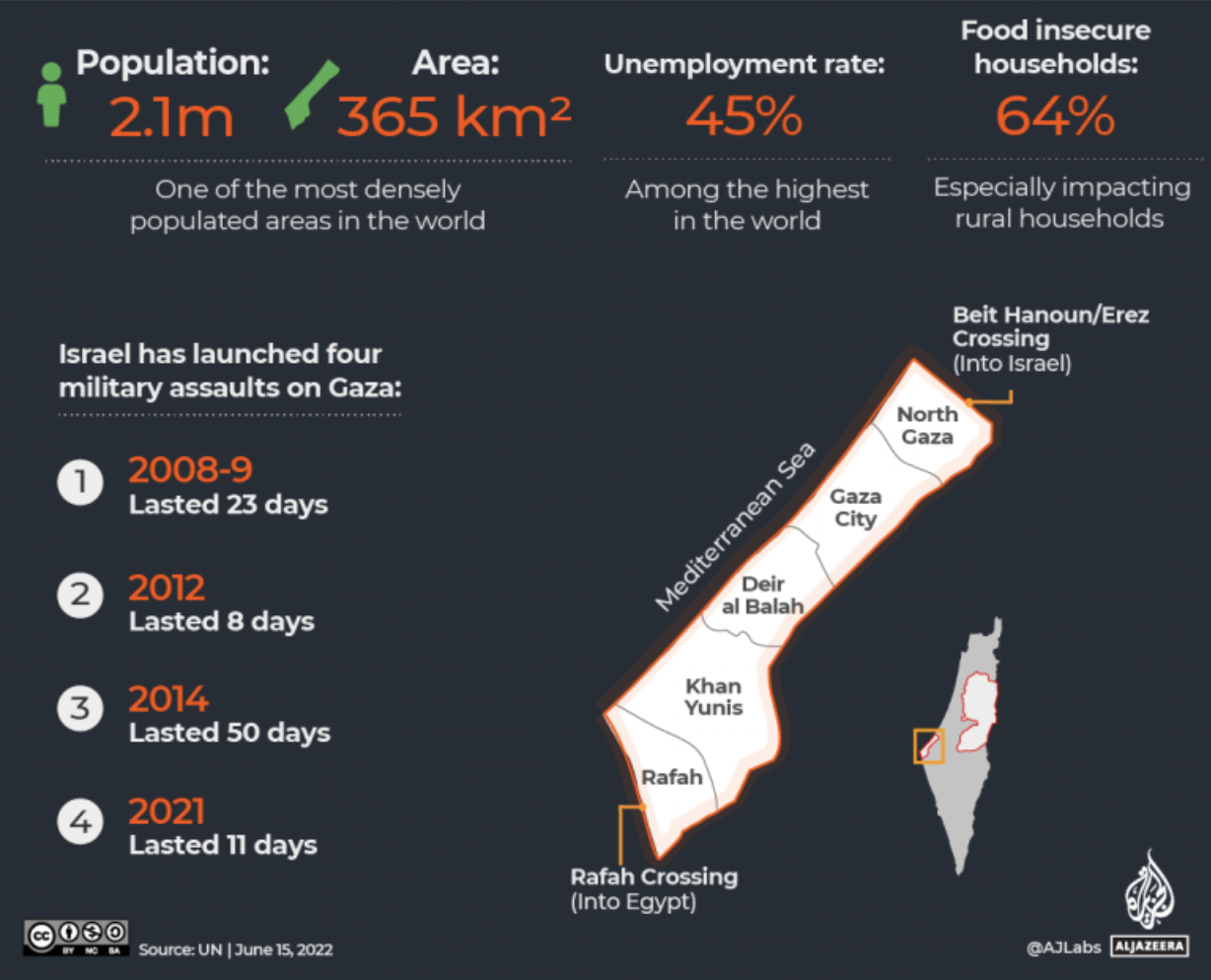
It is always instructive to see such statement made, especially when they invoke the notion of “moral responsibility.” Rep. Shuette, like the Republican Party as well as the majority of the Democratic Party, has never condemned the Israeli terrorist attacks against Palestinians living in Gaza, not in 2008-2009, 2012, 2014 or 2021. These attacks by the Israeli military not only targeted civilians, but destroyed hospitals and other civil society structures, which according to International Law are war crimes.
It’s always about the other side
The Michigan Freedom Fund Communications Director, Mary Drabik, who wrote the post for the MFF on October 11th, that Michigan is home to “over 85,000 Jews and around 2,500 Israelis,” although she doesn’t source those numbers. What Mary Drabik fails to mention is that Michigan is also home to thousands of Arab Americans, including Palestinians.
Having said all of this, the issue of some Democratic politicians not outright condemning Hamas is instructive, especially since the Democratic Party is also unhappy with members of Congress like Rep. Rashida Tlaib and Rep. Cory Bush. In an article in The Intercepted, it notes that Democratic Party members who are closely aligned with largest Pro-Israel lobby group, the American Israel Public Affairs Committee (AIPAC), are the ones going after Tlaib and Bush. You will recall that one of the challengers to Rep. Tlaib, Janice Winfrey, had “secured contributions from United Democracy Project, a super PAC tied to American Israel Public Affairs Committee (AIPAC), the pro-Israel lobbying group.”
This is the dilemma of the Democratic Party, which has consistently supported Israel, both in principle and with billions in military aid. This blind support for Israel is not reflected in the growing number of Americans in recent that support the Palestinian struggle. When the Democrats attack their own for not standing with Israel, it further underscores the hypocrisy of US foreign policy in the Middle East.
From Columbus Day to Indigenous People’s Day: Why white people need to learn about Settler Colonialism in the past and the present
In know that many people celebrated Indigenous People’s Day on Monday, October 9th. This was partly due to the federal government’s previous designation of Columbus Day on the Monday before October 12.
Now that we are doing away with celebrating Columbus, who personifies genocide and settler colonialism in what is now called the Americas, we can embrace and celebrate Indigenous People’s Day.

However, acknowledging Indigenous people for one day is ridiculous, since the harm done to Indigenous people in the Western hemisphere alone is so vast that it is difficult to quantify. Europeans and Euro-Americans have slaughtered millions of Indigenous people since Columbus got lost in 1492, along with the theft of the majority of their lands, the attempted suppression of their languages and culture, forcibly removing Indigenous children from their communities and placing them in so-called boarding schools, and in more recent decades extracting fossil fuels and minerals from their sacred lands to fuel the system of Capitalism.
In an excellent article I read recently, entitled, Dismantling Columbus’s Legacy Requires More Than Changing a Holiday’s Name, the author writes:
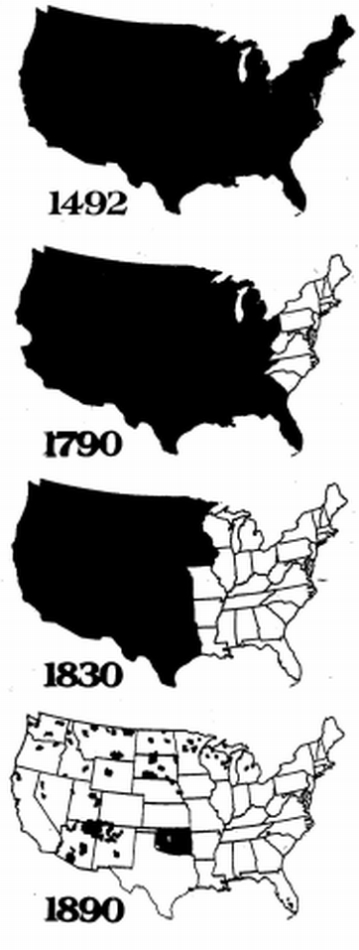 Colonialism is a structure, not an event. Dismantling that structure and creating different relationships with each other requires material actions because abolition and decolonization are not metaphors. When we say we need to end what Columbus stands for, we mean it. But there is a deep resistance in environmental and climate activist circles to embrace even the most basic action that would dismantle the logic of Columbus, which is to support Indigenous refusal of the extraction and desecration of sacred sites, waters and homelands. Instead, there are calls for “consultation” without the right to refuse and prevent development projects. Environmental activists proclaim, “leave fossil fuels in the ground” while also promoting false greenwashing technologies such as electric vehicles that require destroying sacred sites with polluting mining, supporting a new gold rush with the same structures of genocide.
If we are to take these words to heart (which we should), then we need to do a great deal of unlearning and learning at the same time. We have to unlearn what we think we know about the past 500 years of Settler Colonialism, learn the truth about what the US was founded on, and how US policy continues to do tremendous harm to Indigenous people right up until the present. In order to do so, we need to learn directly from Indigenous people themselves, so I am going to include a variety of sources that we all need to look at in order to come to terms with this history in order to move forward and work towards be an accomplice with Indigenous people right now.

The above working definition of Settler Colonialism comes from Indigenous scholar Roxanne Dunbar-Ortiz. Some resources I would suggest on the history of Settler Colonialism are:
The Canary Effect: Kill the Indian, Save the Man. This documentary film was produced in 2006 and provides an excellent introduction to Settler Colonialism and its last impact on Indigenous people. You can watch the film online here.
Books
- The Rediscovery of America: Native Peoples and the Unmaking of US History, by Ned Blackhawk.
- A Little Matter of Genocide: Holocaust Denial in the Americas 1492 to the Present, by Ward Churchill.
- An Indigenous People’s History of the United States, by Roxanne Dunbar-Ortiz
- Unsettling Truths: The Ongoing Dehumanizing Legacy of the Doctrine of Discovery, by Mark Charles and Soong-Chan Rah
- Not “A Nation of Immigrants”: Settler Colonialism, White Supremacy, and A History of Erasure and Exclusion, by Roxanne Dunbar-Ortiz
Last year, the U.S. Department of the Interior (DOI) released its historic Federal Indian Boarding School Initiative Investigative Report, which serves as a formal investigation into federal Indian boarding school policy. The report identified 408 federally-run Indian boarding schools. Also, read War Churchill’s book, Kill the Indian, Save the Man: The genocidal Impact of American Indian Residential Schools.
In the 1970s, the US Federal Government, including the FBI, sought to suppress the American Indian Movement, particularly through the program known as COINTELPRO, which counter-intelligence program to eliminate and destabilize domestic threats to systems of power in the US. Read the book, The Cointelpro Papers: Documents from the FBI’s Secret Wars Against Domestic Dissent, and watch the documentary film entitled, COINTELPRO 101, which you can watch here. Another excellent documentary film on this topic is Incident at Oglala, which centers on the Federal Governments suppression of AIM activists at the Pine Ridge Reservation and the case of Leonard Peltier. You can watch that documentary here.
This brings us to more contemporary matters, such as the massive efforts of fossil fuel companies working with state and federal agencies to extract resources from Indigenous lands and how Indigenous communities are resisting the extraction of resources from Native communities. Here are some excellent books that investigate this topic:
- The Militarization of Indian Country, by Winona LaDuke
- Our History is the Future: Standing Rock versus the Dakota Access Pipeline, and the Long Tradition of Indigenous Resistance, by Nick Estes
- To Be A Water Protector: The Rise of the Wiindigoo Slayers, by Winona LaDuke
- Standing With Standing Rock: Voices From the #NODAPL Movement, edited by Nick Estes and Jaskiran Dhillion
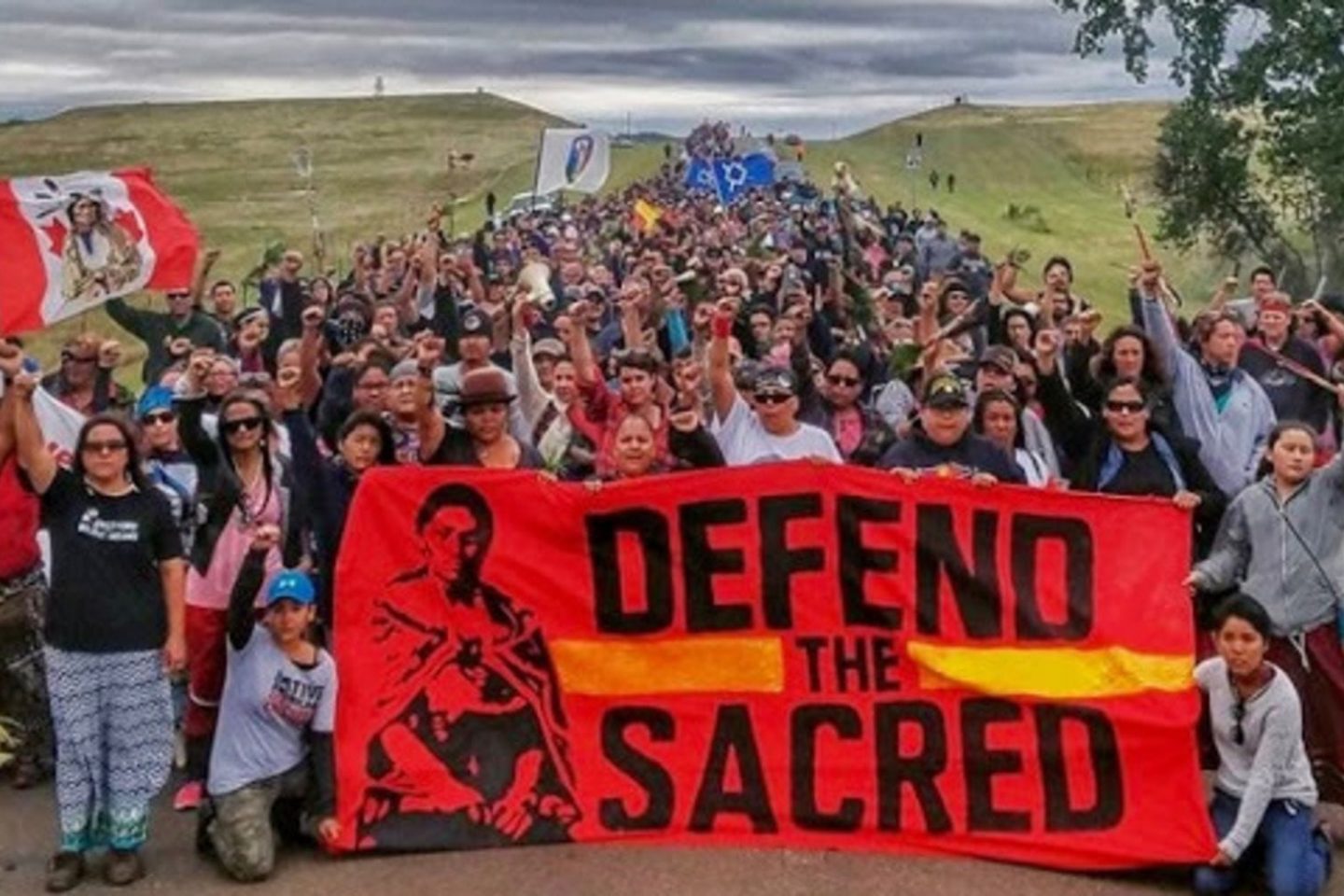
It is worth noting that the resistance to the extraction of resources on Indigenous land is ongoing and that the Indigenous Resistance has been deeply impactful. According to a report put out by the Indigenous Environmental Network in 2021, Indigenous-led resistance campaigns against pipelines in the US and Canada have reduced greenhouse gas pollution by at least 25% annually since these campaigns began.
For more analysis of how Indigenous people are leading the fight for Climate Justice, check out the online resources at the Indigenous Environmental Network, along with the book, The Red Deal: Indigenous Action to Save Our Earth, published by The Red Nation.
Lastly, for white people, if you really want to be part of the contemporary Indigenous struggles, then I would encourage you to read this excellent zine entitled, Accomplices Not Allies: Abolishing the Ally Industrial Complex.
Worthy and unworthy victims: The US, Israelis, and Palestinians
 In Ed Herman and Noam Chomsky’s seminal work, Manufacturing Consent: The Political Economy of the Mass Media, they discuss the function of what they name as worth and unworthy victims.
The main example that Herman and Chomsky provide in their book is a comparison of the amount of news coverage that one Polish Priest who was killed by communists, compared to a hundred religious workers in Latin American in the early 1980s. In looking at the major US news media, they determined that there were more stories about this one Polish Priest, compared to 100 religious workers being killed in Latin America.
Arguably, a similar dynamic is occurring right now with the recent Hamas attack against Israel, which resulted in estimates of up to 900 dead Israelis. Since last week’s attack by Hamas, Israel has retaliated, with the number of Palestinian deaths rising by the hour, especially since the violence being pretreated by the Israeli military has been constant, especially in the Gaza Strip.
Of course, what is not regularly reported on in the US media or uttered by most US politicians is the fact that:
- Israel has been illegally occupying Palestinian lands for decades.
- Israel has been bombing Gaza on and off for decades.
- Israeli Settlements have expanded, despite the fact that the settlement expansion is happening on Palestinian lands and because settlement expansion has been condemned by the United Nations.
- The US has since the mid-1970s provided military aid to Israel, with recent decades averaging $3 Billion annually.
The cumulative number of Palestinians killed by the Israeli military, tortured by Israel and displaced from their lands by Israel is overwhelmingly disproportionate to how many Israelis have been killed, tortured or been displaced from their lands by Palestinians.
However, despite the statistical differences, Israel is seen as a worthy victim, while Palestinians are unworthy. In fact, not only are Palestinian deaths unworthy, they are consistently labeled as terrorists, or as one Israeli military leader recently referred to them as “human animals.”
US government position on Israel/Palestine
US President Joe Biden, in a statement he released on Saturday, stated in the first three sentences:
THE PRESIDENT: Good afternoon. Today, the people of Israel are under attack, orchestrated by a terrorist organization, Hamas.
In this moment of tragedy, I want to say to them and to the world and to terrorists everywhere that the United States stands with Israel. We will not ever fail to have their back.
Four days ago, 3rd Congressional Representative Hillary Scholten posted these words on Facebook:
To our strong ally, Israel–we are with you in the face of these horrific attacks. We pray that you feel our unity surrounding you and your loved ones. We mourn the dead, pray for the wounded and afraid, and rise to meet this challenge together.
Scholten has not issued a similar statement about the Palestinians who have been killed in the past two days.
On Monday, Rep. Scholten wrote:
Hamas terrorism has claimed thousands of innocent lives and continues to devastate and destabilize the region. I’m joining a bipartisan resolution to condemn this terrorist group and reaffirm our nation’s commitment to providing support to our ally, Israel.
The bipartisan resolution that Scholten is referring to can be viewed here. As of this writing, there have been 392 US House members that have already signed on to the resolution, including Rep. Scholten. This is consistent with the 50 year bipartisan US support for Israel. It is also due to the millions of dollars that pro-Israeli PACs have contributed to members of Congress. In fact, if you are an elected official or a candidate and you speak challenge the US narrative about Israel, there will be a campaign to discredit you.
News Media Bias
The national media watchdog group, Fairness & Accuracy in Reporting (FAIR), has been documenting the biased coverage by the larger national news agencies for nearly 40 years. Their documentation has shown a clear bias in favor of Israel, but they have also documented how the national news media has internalized the official US government narrative on Israel. In an August post, they encourage US news consumers to look out for 6 tropes on Israeli/Palestine coverage, with the 4th trope affirming Chomsky and Herman’s analysis, Newsworthy and Unnewsworthy Deaths.
For additional media analysis of how the US News Media reports on Israel/Palestine, see the following documentaries:
Peace, Propaganda & the Promised Land: U.S. Media & the Israeli-Palestinian Conflict https://shop.mediaed.org/peace-propaganda–the-promised-land-p117.aspx
The Occupation of the American Mind: Israel’s Public Relations War in the United States https://shop.mediaed.org/the-occupation-of-the-american-mind-p198.aspx
As a counter to the US Government/Media Narrative, I would encourage people to check out the site Electronic Intifada, which was begun by a Palestinian activist/educator Ali Abunimah. A group that I was involved with in 2002, Brough Abunimah to Grand Rapids to speak. When the Grand Rapids chapter of the Jewish Federation found out that Abumimah would be speaking in Grand Rapids, they applied pressure to Aquinas College, where we were hosting a teach-in and almost got the event cancelled. Here is an excellent example of the kind of analysis that Ali Abunimah brings to this critical issue.
Other recommended resources that challenge the US/Israeli narrative on Israel/Palestine are:
B’Tselem – The Israeli Information Center for Human Rights in the Occupied Territories https://www.btselem.org/
Occupation 101: Voices of the Silenced Majority https://shop.mediaed.org/occupation-101-p120.aspx
The International Boycott, Divestment, Sanction movement, known as the BDS Movement. https://bdsmovement.net/
The Ethnic Cleansing of Palestine, by Ilan Pappe
Internationalism: Decolonizing Native America and Palestine, by Steven Salaita
Dishonest Broker: The US Role in Israel and Palestine, by Naseer H. Aruri
The New Intifada: Resisting Israel’s Apartheid, edited by Roane Carey
The Holocaust Industry: Reflections on the Exploitation of Jewish Suffering, by Norman Finkelstein
Ten Myths About Israel, by Ilan Pappe
The Battle for Justice in Palestine, by Ali Abunimah
BDS: The Global Struggle for Palestinian Rights, by Omar Barghouti
On Palestine, by Noam Chomsky and Ilan Pappe
Challenging the US/Israeli narrative is not popular and it is very risky, since you will often be labeled as anti-Semitic. This tactic is meant to silence or marginalize people. However, if we study history, critically examine this issue and not get stuck in ideological positions, it is my belief that people will embrace the Palestinian struggle.
News coverage of the proposed soccer stadium fails to ask the more important questions that will impact the public in Grand Rapids
On Friday, during the Grand Rapids-Kent County Convention/Arena Authority (CAA) meeting, the proposal to have a soccer stadium in downtown Grand Rapids became more formalized.
A Memorandum of Understanding (MOU) was agreed upon by the Grand Rapids-Kent County Convention/Arena Authority (CAA) and Grand Action 2.0. The MOU states in part:
That the CAA determines to enter a Third Memorandum of Understanding with GA2.0 for the purpose of reaching an agreement regarding the development, funding, construction, ownership, and operation of the Soccer Stadium, and the Chairperson of the Board is authorized and directed to execute said agreement, in a form approved as to substance by the Board Chair, and as to form by CAA legal counsel, contingent upon the CAA’s authority as set forth in the CAA’s Articles of Organization and Operating Agreement, as amended, and as may be amended.
To read the entire MOU between Grand Rapids-Kent County Convention/Arena Authority (CAA) and Grand Action 2.0, you can go here. (pages 33 – 38)
The major news entities that reported on the Friday Grand Rapids-Kent County Convention/Arena Authority were, MLive, WOODTV8 and Crain’s Grand Rapids.
The reporting is what we have come to expect from the local news media, especially when it has to do with major development projects like the outdoor amphitheater, and now the proposed soccer stadium, which is that local news agencies don’t even question what such a project means, who benefits and who will have to pay for it. Most of the local news coverage focuses on superficial details, like where the soccer stadium will be located. However, the Crain’s Grand Rapids article, there is a more honest comment from Doug Small, who is the president and CEO of Experience Grand Rapids. Small states:
“Any professional sport that we have here allows us to continue carrying on the Grand Rapids brand throughout the nation and the world, hopefully. It’s just another opportunity to get our name out there, so I’m excited for that. I think we’ve got a very robust soccer fan base here. It’s nice to see that the fanbase get rewarded with a team of the caliber they are looking to bring in here.”
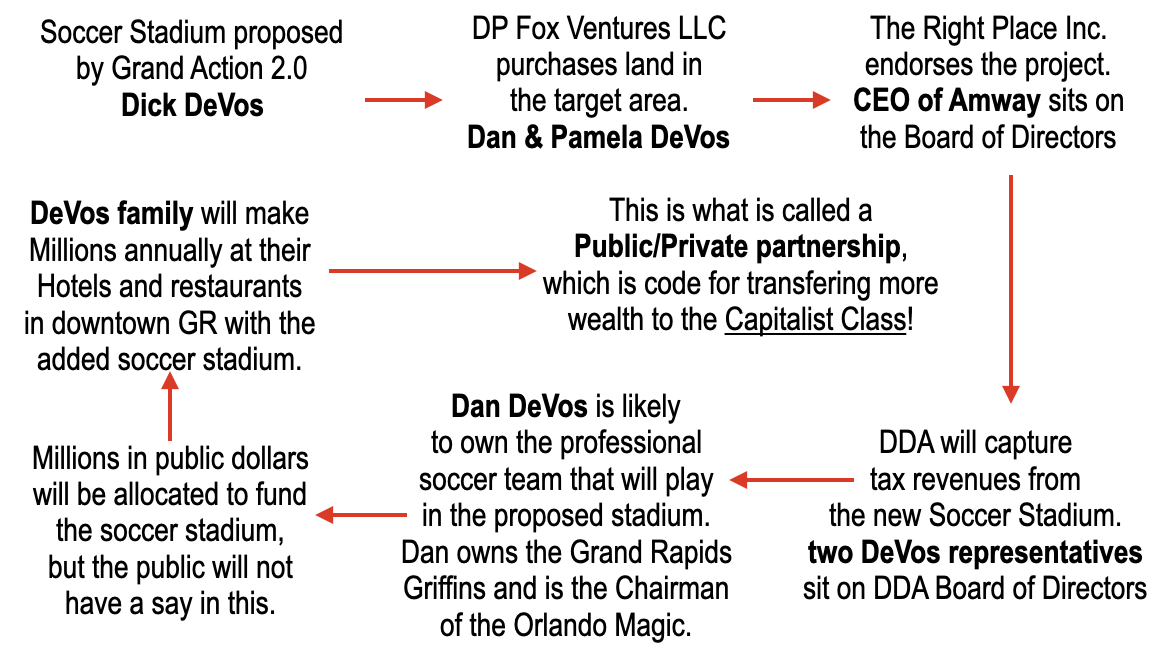
However, the most important part of the Crain’s Grand Rapids article was this sentence, “Developing a soccer stadium has long been discussed by Grand Rapids officials as a way to drive economic development.” The question we need to be asking ourselves is, economic development for whom? In addition, we need to be asking questions like:
- How much public money will be used to support such a project and will the public have any say in the use of public money for a private project?
- Who will own the soccer stadium and the team, once all of this is in place?
- Why can’t the City of Grand Rapids adopt a model of community ownership, which would not only allow for potentially thousands of people to own shares in the stadium/team – which is a model that the Green Bay Packers use – or an ownership model where the City manages the soccer stadium/team, with an oversight board represented by people other than the usual suspects, and profits generated from the operation of the soccer stadium/team be used to support housing costs for families who are housing insecure.
Unfortunately, we cannot rely on City or County officials to raise these kinds of questions or propose alternate models of ownership, or the idea that we don’t even need a soccer stadium and that truly affordable housing or other of the many pressing issues this city faces should be prioritized. Imagine what it would be like to live in a city where housing security, dismantling racism and promoting environmental just were prioritized over such things as the branding of Grand Rapids, promoting tourism and the transfer of public funds to members of the Grand Rapids Power Structure (reflected in the graphic above that GRIID created over a year ago.)
What I presented at the Great Lakes History Conference on A People’s History of Grand Rapids
Since the theme of this year’s conference is Division and Reaction: Democracy in Peril, my paper will present on a People’s History of Grand Rapids.
I would contend that the issue of rule by the people, democracy, has always been in peril in the area that is now called Grand Rapids, and I will support this argument with several examples. But first, I want to share a story about 2 separate incidents that took place within 10 days of each other in late May of 2020 in Grand Rapids.
In the 3rd weekend of May, the American Patriot Council hosted a rally at Rosa Parks circle in downtown Grand Rapids. This is the same group that had one month earlier held a rally at the Lansing State Capitol, with lots of white guys with guns walking in and out of the Capitol building with no resistance from the Capitol security. At their rally in Grand Rapids, where about 200 people showed up, they were openly calling for the arrest of Gov. Whitmer, the Michigan Attorney General and the Secretary of State. Once again, there were numerous white men with guns present, along with the fact that no one was wearing a mask in the middle of a pandemic.The GRPD was keeping their distance throughout the rally, mostly sitting in squad cars around the perimeter of the park. Several of the organizers of the rally were later brought up on charges of for participating in the January 6th insurrection in Washington in 2021. In addition, several of the armed men who were on the stage at the rally in Grand Rapids, were later charged in the attempted plot to kidnap Gov. Whitmer.

One week later, also beginning at Rosa Park Circle, Black organizers had organized a rally and march to call attention to the numerous police killings of Black people across the US, with George Floyd being the most recent. None of the Black organizers or the thousands of people who attended the rally/march had guns. This Black Lives Matter rally/march did not asks for a permit and the police did not have an issue with that, based on their lack of response to the march, which took over the street on Fulton and Division. The march then came to the Grand Rapids Police Station, which had some barricades set up, with around 50 bike cops lined up with riot gear. This march/confrontation was initially non-violent until the GRPD began shooting tear gas and sped canisters at protesters. After that, protesters set fire to several cop cars, smashed widows of government buildings and some businesses in the downtown area. Numerous arrests were made, the Mayor called for a state of Emergency, brought in the Michigan National Guard and imposed a curfew for downtown Grand Rapids.

I shared these two stories from May of 2020 to primarily make a point that when white men with guns who are calling for the arrest and removal of State government officials, the state did virtually nothing to limit their speech or to attack them with tear gas or other crowd dispersing weapons. However, when BIPOC people, without guns, were protesting police murders of Black people, the response from the state was markedly different. There were cops in riot gear, cops preventing the public from entering the police station, plus there were regional police departments, the Kent County Sheriff’s Dept. and even Michigan State Police on hand to suppress those who were confronting state violence. The clear racial bias in how the state responds to public resistance is clear and can only make sense when we recognize that the contrast of these actions are rooted in White Supremacy.
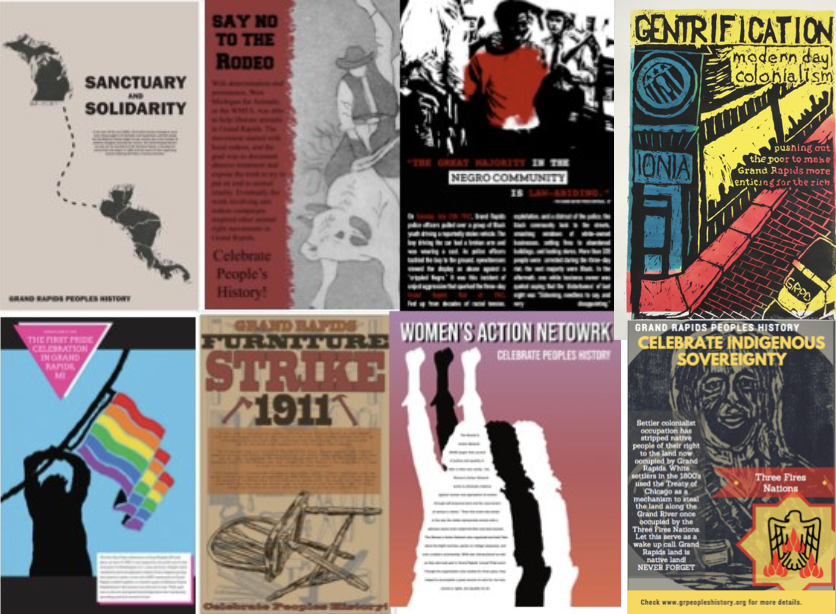
Now, I wanted to share a few other historical examples from Grand Rapids, which challenges the notion that somehow the current political climate is more divided than at any time in the nation’s history. I want to use four examples: 1) looking at how Euro-Americans treated Indigenous people in what is now called Grand Rapid, 2) the Capitalist Class response to the 1911 Furniture Workers Strike and its aftermath, 3) the backdrop to the structural racism that the Black people in Grand Rapids were dealing with, which erupted in the riot of 1967, and 4) how the LGBTQ community fought against homophobia, transphobia and heterosexism in Grand Rapids in the 80s and 90s.
There are numerous other examples I could provide, but these four should be sufficient to make my point that from the very founding of Grand Rapids, there has always been division and reaction, and that the only way for marginalized communities to be able to be part of this city was to fight for a more expansive sense of democracy and to resist the reactions of the dominant society to submit to their worldview.
Indigenous Resistance
 In Z.Z. Lydens’ book, The Story of Grand Rapids, Lydens attempts to portray what happened to the native population as mild compared to other parts of the country. “The history of Grand Rapids does not have a backdrop of conflict with the Indians. There were no tales of raids and scalping and scourging of the settlement with flame.”
The reality is that thousands of Indigenous people lived along the Grand River prior to the European invasion. Most in these native communities experienced displacement by force, religious colonization, the flooding of their communities with alcohol, and displacement through legal maneuvers known as treaties. There were numerous treaties that resulted in the takeover of Native land by settler colonialists throughout what is now called Michigan, but settler colonialists have a long history of violating those treaties.
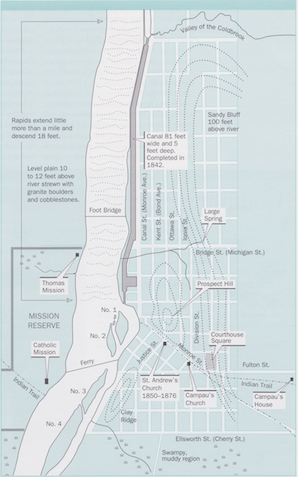 In terms of what this meant for Native people who lived along the Grand River, many of them fled to other areas in the Great Lakes in the first half of the 19th century, hoping for a better chance to survive.
While it is true that the level of violence against Native people in the Grand River area was not as overt as it was for other Indigenous nations, the violence was real and systemic. Lydens’ commentary above is instructive since it purposely works within a limited understanding of violence and ignores how settler colonialism functions.
Settler Colonialism was practiced in what is now Grand Rapids through traders like Louis Campau and Lucious Lyons, alongside Christian missions on both sides of the Grand River, the Baptists on the westside and the Catholic on the Eastside. These mission pitted Native people against each other and the Baptists got one indigenous leader, Chief Noonday, to sign the 1821 Treaty of Chicago, which ultimately paved the way for the displacement of Native people and the takeover of lands by Euro-American Settler Colonialists. The Catholic Church also played a major role in taking Native children from their communities and placing them in boarding schools in three keys places in Michigan, a tactic that falls under the broader category of genocide, as defined by the UN’s Genocide Convention of 1948. I would therefore argue that the major contributing factors in what Euro-Americans did to Native people in the West MI area were rooted in the ideologies of Manifest Destiny, Christian conversion and Capitalist expansion.
Worker resistance to the Furniture Barons
In the Spring of 1911, some 6,000 furniture workers went on strike to demand the right to unionize, the right to better working conditions and better wages. The Grand Rapids furniture barons responded by bringing in scab workers and using local police to suppress the strike.
 The 1911 strike was founded on longstanding worker grievances. As early as 1909, the workers discovered that the price of the furniture they produced had increased by 10%, and they demanded that their wages be increased. Some of the workers who called for the increase were fired shortly thereafter for being agitators.
Just prior to the beginning of the strike, the Grand Rapids Employers Association sent Francis Campau to deliver a message to the press, in order to influence public opinion, that workers were being treated fairly. Francis Campau was the grandson of the brother of Louie Campau, the so-called founder of Grand Rapids.
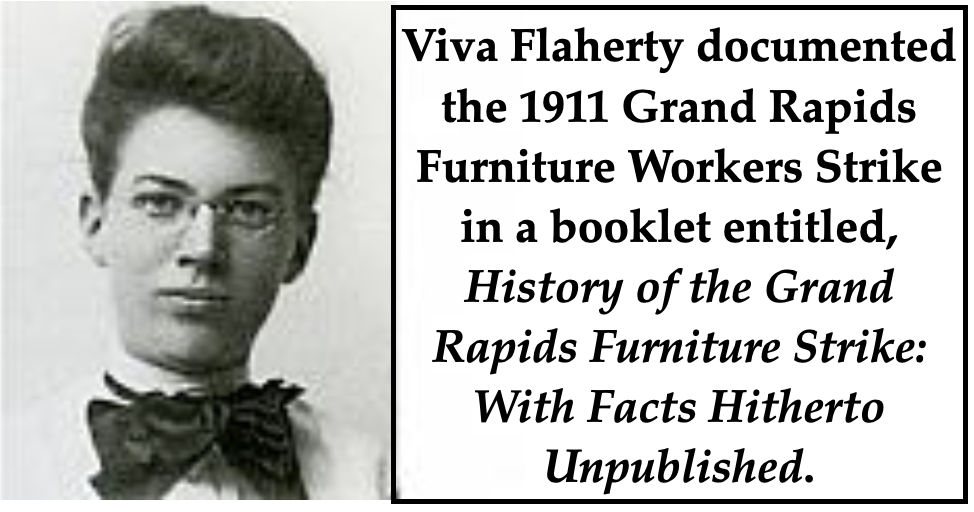
Furniture workers, on the other hand, had a very different view of life working in those factories. One important source that reflected the worker’s perspective was a booklet called, History of the Grand Rapids Furniture Strike: With Facts Hitherto Unpublished.14 This document was created by Viva Flaherty, a secretary at Fountain Street Church and a known Socialist. Flaherty documented the 1911 strike because she believed that the “people of Grand Rapids are awakened and enlightened and they can be trusted with the whole truth.”
Flaherty makes it clear in her version of the story that the strike was able to endure because of the seven unions that were involved, with membership of over 4,000 workers in thirty-five shops in Grand Rapids. She also documented that the Christian Reformed Church would not grant their members the right to be part of the union, since labor rights and organizing were not “founded on divine right.”
Flaherty documents the kind of wages earned by those in the furniture industry, stating that of the eight thousand furniture workers employed in Grand Rapids, most made less than $2 a day.
 The Strike lasted until the early part of August and had the support of several of the city commissioners, and most vocally the Mayor of Grand Rapids. In addition, the Catholic Bishop of Grand Rapids, Bishops Schrembs, was also a vocal supporter, stating: “I consider the present labor situation in our city as a most deplorable one from every point of view. I would welcome and hasten the day when compulsory arbitration will force men dealing with their fellow men to let fairness and justice come to their own through reasonable methods rather than through the cowering of men’s hearts through the cruel pangs of hunger of their wives and children.” Schrembs was later moved to the Diocese of Toledo as a form of punishment for speaking out in support of furniture workers.
Now, the striking furniture workers did not win most of the demands they fought for, but their fight did build a larger culture of resistance and solidarity. This was evident in the 1911 Labor Day parade, with 10,000 people marching in the parade and hundreds more watching from the roadside. At the time, Grand Rapids only had a population of 100,000, thus 10% of the community walked in the Labor Day parade.
However, The 1911 furniture workers strike was perceived by the furniture barons and other members of the local power structure as a serious threat. Those with a great deal to lose at the hands of striking workers took other steps to protect their interests. And they did not forget that Mayor Ellis had denied them permits for a private army. The City of Grand Rapids was made up of 12 political wards in 1911, with many of the wards dominated by certain ethnic groups – Polish, Dutch, German, Italian, etc. Most of the ethnic groups – and many of the wards – supported the furniture workers strike.
In order to hold power, in 1916 the furniture barons and their political cronies decided to change the Grand Rapids City Charter to do two things:
- Gerrymander and reduce the diversity of the political wards, down from a 12-ward system to a 3-ward system, with 2 representatives for each ward. This would give immigrant and ethnic groups, who were also predominantly working class, less say in local government.
- Eliminate a strong mayor and make future mayors into glorified city commissioners with only one vote. The balance of power shifted to the non-elected city manager position.
This has been the political system in Grand Rapids ever since, because the members of the Capitalist Class were so threatened by the working class, thus they changed the political system in their favor.
The Black Freedom Struggle and the 1967 riot in Grand Rapids
For decades the Black community in Grand Rapids was subjected to all forms of discrimination during the Jim Crow era, with legal and institutional racism, Red-lining, road blocks to getting higher paying jobs, limited educational opportunities, along with being completely shut out in the realm of electoral politics.
This began to change with the growing Civil Rights Movement, which saw national speakers, like Malcolm X coming to Grand Rapids in 1962, a substantial contingent of people going to DC to participate in the historic March on Washington in 1963, a solidarity action in Grand Rapids in response to the church bombing in Alabama just weeks later, where 3,000 residents participated in a march, and an increasing amount of community-based organizing to create more Black autonomy.
An increase in Black Consciousness led to students organizing at South High, with demands around more flexible dress codes. These demands led to what was known as the Mustache incident, where Black students protested dress codes that forbade young men from growing mustaches. South High students, working with Grand Valley State College students participated in a walk out.
A WOOD TV8 editorial addressed the issue of the student walk out stating:
Events of yesterday and today in Grand Rapids South High are most disturbing. Last night, there was a demonstration at South High. In it were some Grand Valley State College students, some South High students and a few adults. It was well organized and had to be planned. The demonstration was a shocking act of irresponsibility. It could have triggered a riot that could have resulted in property damage, injuries and even deaths. The most frightening part of the incident is that Grand Valley students who participated were not at all involved in the good grooming dispute at South High. The demonstrators started something that could have tragic consequences, even yet.
In a subsequent WOOD TV8 editorial, the student protestors were referred to as “animals” throughout the editorial.
In May of 1967, Kwame Ture (then known as Stokely Carmichael) was scheduled to speak in Grand Rapids, which led to pushback from several high profiled city officials. Kwame Ture did speak at Fountain Street Church on May 17, 1967 and spoke about the constant presence and violence of white cops in Black neighborhoods and counseled that Black cops should not join the current unions that were under the umbrella of the AFL-CIO, since they practiced racism in their ranks. One final comment was Ture’s response to J. Edgar Hoover, who claimed that he was part of the Revolutionary Action Movement (RAM). Ture responded by calling Hoover “a note taker” who stood by and ineffectually jotted musings while the cops surrounded Black people and beat them.

Ture also met with about 300 members of the Black community at First Community Church AME. People spoke with passion about their dissatisfaction with community conditions, with public education, and with the Campau Housing Project in particular. Ture encouraged high school students from Central, South and Ottawa to get organized and become part of SNCC.
Only seven weeks after Ture’s visit, the head of the Grand Rapids Urban League, Paul I Phillips, warned Mayor Sonneveldt, the City Manager and the Grand Rapids Chief of Police that according to the national Urban League office, Grand Rapids was on a “dangerous list” of cities with racial tensions. Mayor Sonneveldt, the City Manager and the Chief of Police “positively denied that riots were possible in the city.” Less than two weeks after Phillips warned city officials of a potential uprising, people in the Grand Rapids Black community exploded with anger. After some isolated incidents of rock-throwing, police officers had pulled over a car of Black youth, believing the car had been stolen. As in many over-policed Black neighborhoods of urban centers around the nation, this incident was the spark that led to a three-day uprising in July of 1967.
The Michigan National Guard were called in to help suppress the riot and the GRPD created a perimeter around a several block area in the near Southside of Grand Rapids, where they determined who could come in or out of that section of the city.

Dozens of Black people were arrested for a variety of crimes, along with a few white people. However, the white people that were arrested, were arrested for showing up in Black neighborhoods with guns hoping to “put down the rebellion.” In fact, the GRPD had received numerous calls from white residents asking if they needed help with the “Black problem.”
A July 26th editorial in the Grand Rapids Press stated: The lawless behavior of a few Negro citizens has made a mockery of civil rights, and everything that has been done up to this point to improve the Negro’s social and economic standing has been a waste of time, money and effort.
The very next day, the Grand Rapids Press ran a story that centered the reactionary culture’s fear about urban Black communities. The July 27th story was based on calls that a Press writer made to people in bedroom communities near Grand Rapids, communities that were almost exclusively white.
We heard they were coming here on Tuesday. We all had our guns ready if we had to.
– a white woman from Ionia
I think it is terrible. They are destroying their own property – hurting their own cause.
– a white woman from Lowell
It is a terrible thing to say, too, but authorities should open fire on them, do something drastic to wake them up.
– a resident of Saranac
The troops should have orders to stop them anyway necessary.
– a white man from Holland
Fighting homophobia, transphobia and heterosexism in Grand Rapids in the 80s and 90s.
Like the rest of the country, the struggle for equality for the LGBTQ community in Grand Rapids was difficult and it took decades of struggle even to win some of the most basic rights.
For those who resisted heteronormativity, it was dangerous. Being out often led to being ostracized from family, from ones place of worship, or worse, it could mean losing your job or being harassed, bullied or beaten. Meeting in private homes or in a few select bars were the only real options for those who identified as part of the LGBTQ community.
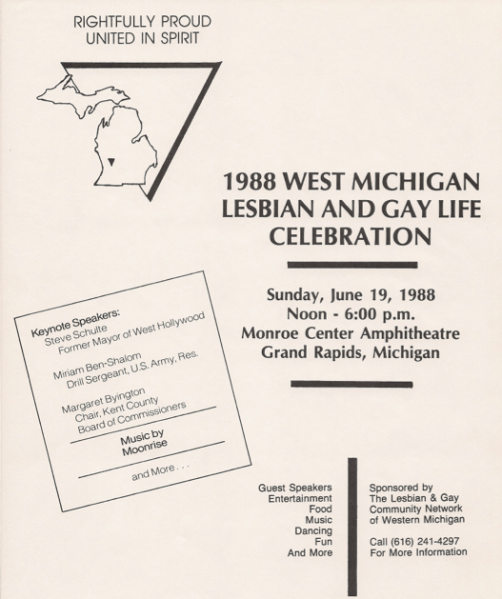 This all began to change in the 1980s, when members of the LGBTQ community began to organize and to fight back against homophobia. Based on dozens of interview we did for a documentary on the LGBTQ community in Grand Rapids, the catalyst for getting organized was in 1988, when people from Grand Rapids went to the march in Washington DC. Motivated by their experience at the march, local members of the LGBTQ community formed the Lesbian and Gay Network, which began working on numerous issues, like organizing a Pride Celebration in Grand Rapids.
The first Pride Celebration was held in June of 1988, although the Mayor of Grand Rapids would not support the event, nor provide a declaration for the event, even though Mayor Helmholt had written proclamation for the following events the same year – Michigan Beverage News Week, Family Sexuality Education Month, Polish Heritage Month, National Roofing Week and Bozo Show Day. Mayor Helmholt did deny another group a proclamation, a neo-Nazi group that was hosting an event in Grand Rapids that same year.
 The Network was also working on the issue of HIV/AIDs, since the disease had already impacted so many members of their community. The national LGBTQ movement had forced the Reagan Administration to create an AIDS Task Force, but many of the members of the Task Force were anti-gay, like Rich DeVos, the co-founder of Amway. Years later, it was reported what DeVos thought about his time on the AIDS Task Force saying:
When HIV first came out, President Reagan formed a commission and I was honored to be on that commission. I listened to 300 witnesses tell us that it was everybody else’s fault but their own. Nothing to do with their conduct, just that the government didn’t fix this disease. At the end of that I put in the document, it was the conclusion document from the commission, that actions have consequences and you are responsible for yours. AIDS is a disease people gain because of their actions. It wasn’t like cancer. We all made the exceptions for how you got it, by accident, that was all solved a long time ago. That’s when they started hanging me in effigy because I wasn’t sympathetic to all their requests for special treatment. Because at that time it was always someone else’s fault. I said, you are responsible for your actions too, you know. Conduct yourself properly, which is a pretty solid Christian principle.
Bruce Roller, a Christian Pastor and a member of the LGBTQ community said that there was tremendous bias towards those with AIDS, and a great deal of ignorance. Roller said that medical staff would not touch AIDS patients, nor bring food into their rooms. Many ambulance companies and funeral homes also refused services to those who had AIDS or who had just died from AIDS.
Beginning in the early 1990s, the LGBTQ community also took on the task of changing the City’s anti-discrimination ordinance, to include sexual orientation to the list of things that people could not be discriminated on. Members of the Network did letter writing campaigns, public educational forums and kept going to the City Commission meetings demanding a change.
In 1992, the first of several public hearing were held on the anti-discrimination ordinance. Lots of people from the LGBTQ community spoke in favor of the ordinance change, but there were also numerous people, mostly claiming to be Christians, who spoke out against the proposed ordinance change, often using religious texts to justify their position. Grand Rapids, and West Michigan as a whole, was deeply opposed to LGBTQ inclusion, but it is also important to note that many of the wealthiest families in the greater Grand Rapids area also funded numerous anti-Gay groups in Michigan and across the US.

Despite the opposition, in 1994, after a two year campaign, The Network was able to get enough votes for the City Commission to adopt a revised version of the anti-discrimination ordinance, which would include protections against discrimination for sexual orientation.
With the examples I have provided, the very notion of democracy has always been in peril and it has always been evolving, especially when some of the most vulnerable communities began to demand equate treatment.
In my research into the history of what is now called Grand Rapids, I believe that democracy has always been limited and in turmoil and that only when social movements have organized to confront systems of power and demand changes, has any real notion of democracy been practiced.
Deconstructing the Grand Rapids Chamber of Commerce reasons for endorsing the GRPS November bond vote
Some three weeks ago, parents, students and community members came out to an event being held by the Grand Rapids Public Schools. It wasn’t a protest per say, since the group was in full support of the November bond vote for the GRPS, but that they wanted to make sure that GRPS Administration and the School Board would prioritize funds for very specifics issues that are based on what the community is demanding. You can read about those demands at this link.
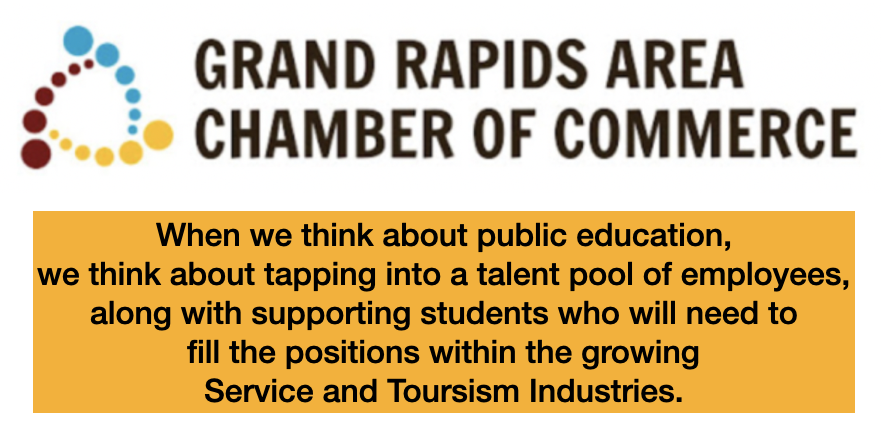
On October 2nd, the Grand Rapids Chamber of Commerce announced that they were endorsing the GRPS bond vote on November 7th. The GR Chamber states in their announcement the following:
GRPS is seeking voter approval of a 20-year, $305 million bond proposal to fund capital, technology and security projects.
- The bond is the same rate as the 2004 & 2015 bonds, 3.85 mills.
- Educational building construction, consolidation improvements, renovations of auditoriums and athletic facilities, technology upgrades, playground improvements, and safety & security improvements will be paid for with the bond.
- GRPS buildings are currently at 51% utilization for student capacity. This proposal will allow GRPS to consolidate educational space and will alleviate an estimated $145 million in deferred maintenance costs.
It is important to note here that what the GR Chamber of Commerce is claiming the money will be used for does not align with what the Urban Core Collective’s Education Justice campaign is calling for.
Equally important are the two talking points that the Grand Rapids Chamber of Commerce provide on the GRPS Bond vote.
- A stable, strong and growing GRPS will retain and attract families, talent and job providers in Grand Rapids. They need 21st infrastructure to make this a reality and the business community urges support.
- Chamber leadership will continue to engage with GRPS on improving outcomes and how school property can best be utilized if no longer needed.
These two talking points are instructive, plus anyone who cares about the future of public education should be rather concerned about what the influential business entity thinks about public education.
The Grand Rapids Chamber of Commerce supports the GRPS bond vote because they want to, “retain and attract families, talent and job providers in Grand Rapids.” Strange, I always thought that public education at the K – 12 level was an opportunity to not only assist students to learn, but to teach critical thinking and further develop in students a curiosity about their community, their country and the world.
What the GR Chamber of Commerce wants to see out of the GRPS is to provide a talent pool for the businesses they represent, plus a steady stream of working class people who can fill positions in the service industry. This fits the two tiered system that the GRPS has, where “more talented” students go to places like City High, while students who are less likely to go to college, can take classes to be part of the Hospitality and Tourism industries.
The second point, where the GR Chamber will, “engage with GRPS on improving outcomes and how school property can best be utilized if no longer needed.” Could this be because GR Chamber members like Rockford Construction are always looking at getting contracts with the GRPS or working with other developers to turn former GRPS facilities into apartments or condos?
Lastly, while I understand that people might think that the Grand Rapids Chamber of Commerce endorsement of the bond vote in November is a good thing, it ignores their stance on other critical issues. Within the past year, the Grand Rapids Chamber of Commerce has initiated and supported the criminalization of the unhoused in Grand Rapids, and has opposed many of the recent legislative efforts in Michigan to move the economy in a more just fashion. This is why we need to see the GR Chamber’s endorsement of the bond vote as nothing more than looking out for their own interests, where students are seen as talent, rather than as critical thinking members of the community.
In any case, the hidden hand of of foundations can control the course of social change and deflect anger to targets other than elite power.”
– Joan Roelofs, Foundations and Public Policy
For the past 10 years, GRIID has been monitoring foundations in West Michigan, particularly the large family foundations that those who are part of the Grand Rapids Power Structure have created. Our monitoring of local foundations has been part of our larger critique of the Non-Profit Industrial complex in Grand Rapids.
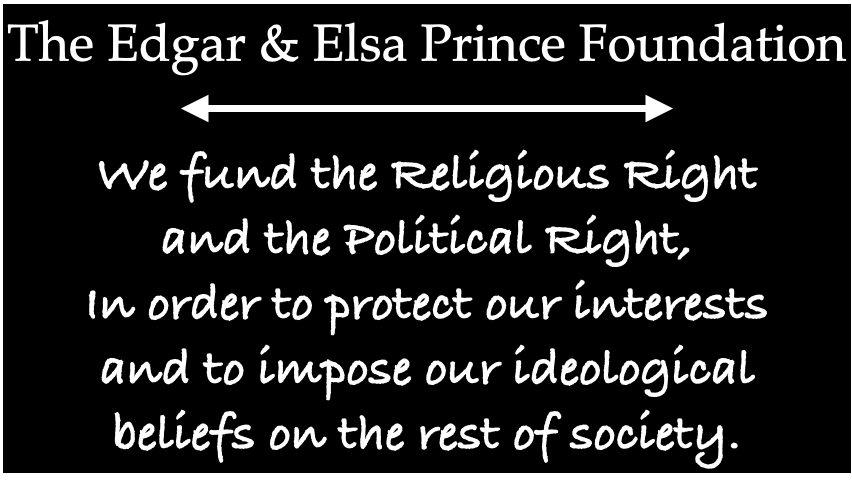
GRIID has been providing information and analysis on the various DeVos Family Foundations, using the most recent 990 documents that foundations are legally required to submit. These 990 documents must be submitted within a three-year period, which is why the 990s that we will be examining are from 2020, since most foundations prefer to submit their 990 documents at the last minute, thus minimizing public scrutiny. So far we have posted articles about the Richard and Helen DeVos Foundation, the Dick and Betsy DeVos Foundation, the Doug and Maria DeVos Foundation, the Dan and Pamela DeVos Foundation, the Cheri DeVos Foundation, the Jerry & Marcia Tubergen Foundation, the Steve and Amy Van Andel Foundation, the David and Carol Van Andel Foundation and the Jandernoa Foundation.
Edgar & Elsa Prince Foundation
Edgar and Elsa Prince are the parents of Erik Prince and Betsy DeVos. Although Edgar has been dead for several years, the foundation that is in his wife and his name, continues the legacy of funding the Religious and Political Right. The Edgar & Elsa Prince Foundation began in 1979, and current has $4,747, 065 in assets. The information that follows is based on the 990 document for 2021, where the foundation distributed $3,102,5000 to the four categories we have been using throughout this series. You can find this information on GuideStar.org just by typing in the Edgar & Elsa Prince Foundation.
Religious Right
- Prison Fellowship Ministries – $125,000
- Our American Values – $30,000
- Gateways to Better Education – $30,000
- Women’s Rights Without Frontiers – $20,000
- Pregnancy Resource Center – $10,000
- Alliance Defending Freedom – $100,000
- Protect Life Michigan – $40,000
- Wycliff Bible Translators – $25,000
- Center for Urban Renewal and Education – $40,000
- Haggai Institute – $300,000
- Focus on the Family – $105,000
The Haggai Institute is a Christian evangelical entity that provides leadership training for people around the world to convert people. The Haggai Institute believes that only Jesus can bring joy to the world, not governments, education or any other spiritual tradition. The Prison Fellowship Ministries was founded by former Nixon Administration staff Charles Colson, who was sentenced to jail for his role in the Watergate scandal. The Prison Fellowship Ministries practices far right Christianity and is part of the State Policy Network, which connects far right groups across the country to promote policy changes at the state level, changes which further the far right agenda. The Alliance for Defending Freedom is a Conservative Christian group of lawyers that defends religious groups around anti-LGBT policies and other religious right issues.
Political Right and Think Tanks
- Acton Institute – $25,000
- Freedom Alliance – $30,000
- Council for National Policy – $15,000
- Mackinac Center for Public Policy – $7,500
- Turning Point USA – $35,000
- Rutherford Institute – $25,000
Freedom Alliance is an entity that was founded by convicted Iran Contra scandal participant Col. Oliver North. American Values is another conservative religious entity, which perpetuates the so-called values of the United States, but are rooted in far right principles. In a recent post they made the following comment: In the aftermath of the Rittenhouse verdict, Marxists and revolutionaries took to the streets, using his exoneration as a match to try to set America ablaze. Make no mistake about it: They are Marxist and they are revolutionary. These radicals want a race war in America. Turning Point USA is a right-wing youth and student group, with a mission to “identify, educate, train, and organize students to promote the principles of freedom, free markets, and limited government.”
Education Institutions
- Holland Christian Schools – $478,000
- Zuni Christian Mission School – $30,000
DeVos-owned, created or connected groups
- Christian Leadership Institute – $25,000
- West Michigan Aviation Academy – $222,500
- Artprize – $40,000
Groups Receiving Hush money
- Wedgewood Christian Youth and Family Services – $15,000
- Family Promise – $30,000
You can clearly see that the Edgar and Elsa Prince Foundation primarily funds the Religious Right and the Political Right, even though sometimes it is difficult to distinguish the two. The Edgar and Elsa Prince Foundation is a perfect way for the family to hide some of their wealth from taxation, but allows them to use it just like direct political contributions, often working in tandem with campaign contributions.
We will not be dismissed or ignored: Day one of the Cosecha Michigan encampment in Lansing
Yesterday, Cosecha Michigan kicked off the first day of a three day encampment at the Lansing State Capitol, in their ongoing commitment to win drivers licenses for the undocumented community in Michigan.
As always, there is a great deal of activity that takes places at the capitol. When we arrived in Lansing there were hundreds of advocates and car crash survivors gathered at the capitol to call for new laws that would help provide care to more than 7,000 crash survivors who lost their benefits after Michigan made changes to its no-fault law in 2019.

Because another rally was taking place, Cosecha held their press conference on the westside of the capitol building. Several members of Cosecha Michigan spoke about their years-long campaign to win drivers licenses. One Cosecha member, Erica, talked about how the Lansing State House and Senate had been controlled by Republicans for the past 40 years, which has meant that the demands from the movement to won drivers licenses were dismissed and ignored. She went on to say that with the Democrats taking control of the State Legislature this year, they continue to see that drivers licenses have not been a priority for lawmakers. She also said that their concerns continue to be ignored and dismissed, which is why they often use the chant, Licenses Yes, Promises No.
The State House was in session yesterday, so the about 20 of the Cosecha Michigan activists went up to the 3rd Floor to engage in a longstanding tactic of disruption, which you can see here in this short video.
One thing that I love about Cosecha actions is that they always explain, in Spanish, what they are doing and where they are during that particular action. During this action they made it clear that this building and these chambers are paid for by their taxes, and that these politicians are always claiming that they work for the people, yet the issues most important to Cosecha are constantly ignored.
The group of activists then went back outside to share some food and talk about the next plan of action for the day. Of course there was lots of community building and laughter, since this group of Cosecha activists have been working together on this issue since 2018.
Rejuvenated by the food and fellowship, Cosecha Michigan activists then went op to the 4th floor to sit in on a Senate Transportation Committee meeting, which began just after 3:30. The meeting had already begun by the time that Cosecha activist had arrived, but there only appeared to be one agenda item, so the meeting did not last long at all. You can watch the video at this link, which shows Cosecha members in the Transportation Committee meeting and as soon as the meeting finished, they began chanting and demanding that the committee hold a public hearing on the proposed legislation, the Drive Safe Bills, which you can learn about at this link.
Once again, a Cosecha activists explained what was happening after the disruption and why winning drivers licenses is so important to the undocumented community. It was stated that having drivers licenses would reduce their fear of being stopped by police and potentially arrested or detained for not having a drivers license. This Cosecha activist then shifted gears to say, “We do the work in Michigan, the hard work like picking the food that everyone eats. Without us the economy in Michigan would collapse and all we are asking is the right to obtain drivers licenses, to be safe and to have the same kind of mobility that other families in Michigan have.” You can watch the Cosecha Michigan activists attending the Transportation Committee meeting and the follow up explanation in the video at this link. https://www.facebook.com/cosechagr/videos/980999182980458
 The Cosecha Michigan activists then went back outside for more food and fellowship, which is really a thing of beauty to see and participate in. I am always amazed and inspired by not only the passion and commitment they display in the fight for justice, but how caring they are with each other and how welcoming they are with people who are new to the movement.
The next task was to then set up the encampment on the east side of the Capitol building area and see if the security people would enforce their policy of not allowing any encampments on the property, even on the surrounding sidewalks, which they claimed were also the property of the State of Michigan and NOT public space. The cops did come out and made it clear that people would have to move, so the Cosecha activists moved across the street to the City building, to the same space they set up their encampment last year, as shown in this picture here on the right.
For the next few days, you can support Movimiento Cosecha Michigan by coming to their encampment, learning about the Drive Safe Bills and taking action to help get those bills passed, you can donate to their work at planton2023.com and you can follow the encampment progress here https://www.facebook.com/cosechamichigan.
An opportunity to promote a living wage campaign in Grand Rapids and other economic justices demands
There is proposed legislation in Lansing right now, legislation that would lift the ban on what is now referred to as the Local Government Labor Regulatory Limitation Act. According to an analysis of Senate Bill 0171:
The Local Government Labor Regulatory Limitation Act, prohibits a local governmental body from regulating the employment relationship between a nonpublic employer and its employees. Among other prohibitions in the Act, a local governmental body may not require an employer to pay an employee a wage higher than the State minimum hourly wage or other fringe benefits, regulate strike activity, or regulate an employer’s hours or scheduling of employees.
If Senate Bill 0171 were to be adopted it would provide greater opportunities for workers and the communities they live in to earn higher wages, have better benefits and allow workers to engage in more militant strikes, moving from symbolic picketing to wildcat strikes.
Of course, there are organizations within the State of Michigan that are opposing this legislation, along with several groups from West Michigan. The Michigan Chamber of Commerce crafted a letter opposing SB 0171, with dozens of organizations signing on to the letter. Among those groups that are from West Michigan, are the Grand Rapids Chamber of Commerce and the West Michigan Policy Forum.
The West Michigan Policy Forum released their own statement on why SB 0171 should be opposed, with the claim that, “ life will get more expensive, and jobs will disappear across our state.”
Similar legislation was proposed in the State House of Representatives back in March. However, the State House version of the proposal hasn’t received the same kind of attention as the Senate version of the bill.

An opportunity to adopt living wage standards
If SB 0171 and HB 4237 were to be adopted, it would merely lift the ban on these critical labor issues. However, the real work would be at the municipal level, which could then make decisions on adopting living wages and other more radical labor demands.
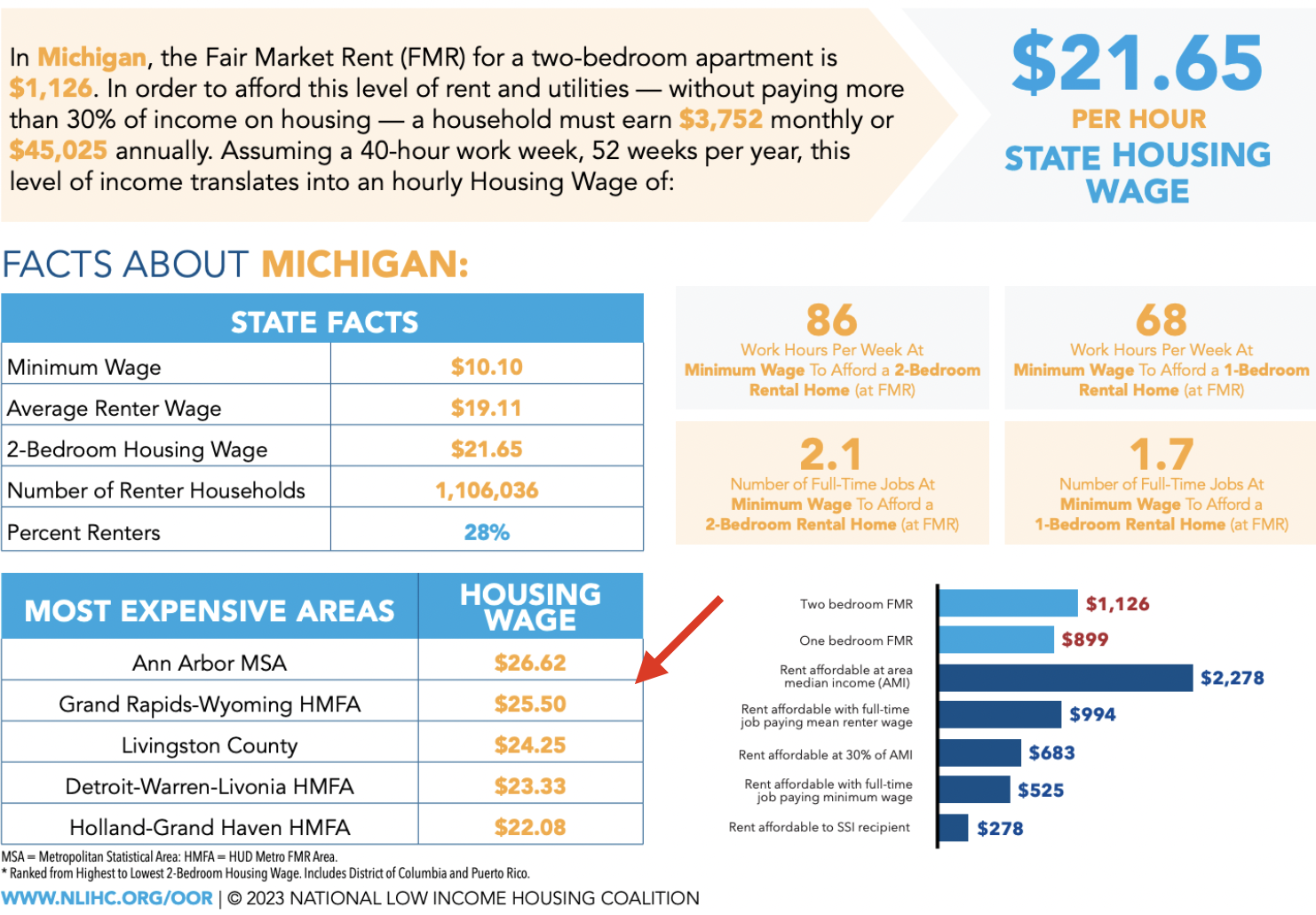
One way to think about this, as it relates to wages in Grand Rapids, is to think about what it costs for people to rent in this city currently. According to the National Low Income Housing Coalition, for the average person in Grand Rapids to afford rent in this city, they would need to earn an hourly wage of $25.50, for 40 hours. Therefore, a minimum wage for Grand Rapids should be $25.50 an hour, but a living wage should probably be $30 – $35 an hour.
If Grand Rapids is organized and people can create an economic justice working group to make this kind of a demand around wages, along with other demands for workers, then the proposed legislation would be a good thing. You can bet that the Grand Rapids Chamber of Commerce and other members of the Capitalist Class will oppose such things, plus they already have a cozy relationship with Grand Rapids City officials, so it will definitely be a fight to win economic justice policies and a living wage campaign in Grand Rapids.
However, it should be noted that throughout history, that battles over wages and other economic justice benefits have come about because of struggles won by labor unions and other economic justice centered groups. In fact, improved wages and benefits have always been won by campaigns organized by working class people. Even if the proposed legislation does not get adopted, workers can get organized in any sector to make demands and win economic justice battles for their families and communities.
Community Coffee Hours with Elected Officials: Creating road blocks for real community engagement
About 10 years ago now, a dozen activists decided to show up at the Rainbow Grill in Grandville to talk with a Conservative State Representative about LGBTQ and Immigration issues.
The Conservative State Representative had been using this spot for years to fulfill his community engagement obligations. However, on one Saturday morning he got more than he bargained for, when 12 activists, sat down with him in a restaurant booth (2 at a time) to confront him on his stance on numerous issues. This State Representative did not stick around to meet with all 12, since he was only there for an hour, so the activists followed him out to his car to continue to share with him their thoughts and feelings about his voting record. 
This lesson taught me that elected officials don’t really like to engage with the community, especially if they don’t get to determine how engagement will happen.I’ve thought about this a great deal more recently, since there have been several instances where Movimiento Cosecha has attempted to talk with State Senator Winnie Brinks, but were told by her staff that she was not available. A similar interaction was had by a continent of housing justice activists who attended the Rent is Too Damn Hight rally in Lansing on September 5th. In this instance, the staffers in Senator Brink’s office had locked the doors and were unwilling to meet with housing justice activists.
I attended a recent Community Owns Safety Coalition meeting in Grand Rapids, where we talked about the Rent is Too Damn High Rally and inability to meet with Senator Brinks that day. We talked about trying to meet with State elected officials when they host coffee hours in Grand Rapids. This tactic was decided upon, since not everyone has the ability to just take off work and go to Lansing during the week to meet with elected officials. The other reason is that there are several proposed state bills that housing justice activists would like to see get passed and meeting with elected officials in Grand Rapids would be more accessible for many people.
Community Coffee Hours
The Community Owns Safety Coalition meeting I mentioned earlier was this past Wednesday, so later that night I wanted to find out which State Representatives and Senators would be hosting their next community coffee hours. I was able to find several upcoming community coffee sessions, but most of them were happening on Friday, September 29th.
Being that these meetings were happening in less than 48 hours, it would make it difficult to mobilize people to attend, with such short notice. In addition, all of the community coffee hours I came across for September 29 were during the day, which also meant that if you work 1st Shift, you would not be able to attend. Another aspect of these opportunities to tell state elected officials what was on your mind is that they generally only lasted for 1 hour, which really limits how much time you have to talk about specific legislation or the issues that you want addressed.
There was one other major road block that one of the housing justice people I know encountered, specifically with a community coffee hour with State Rep. Skaggs and State Senator Brinks. They too were hosting a meeting for 1 hour – from 10:15 – 11:15am, on Friday, September 29th. However, they were not including the location of where the event was being held. Instead, they had this link for people to fill out. One of the housing justice activists I know filled it out on Thursday when they found out about the meeting, but didn’t receive a response until 8 hours after the meeting had already been held.
The housing activists then sent a message to a staff member for State Rep. Skaggs stating,
“You sent the information on the location of the Community Coffee Hour for Rep Skaggs and Sen. Brinks 8 hours after it happened. I submitted the information on Thursday, which would have been ample time to receive information on the location, so I am puzzled as to why you would send this information out after the fact. In addition, why is it that you do not post the information on the location on social media, like Facebook? That is where I found out about the coffee hour. Why make people jump hoops to get information on the location?”
Here is the response the activist received back from Rep. Skagg’s staffer:
“I am sorry that the email did not deliver to you until after the event. I very confused as to how that happened as I sent out all emails regarding the location early this morning at the latest. I understand that is extremely frustrating and unprofessional. If you have concerns or questions for Representative Skaggs, I would be happy to relay them to him or set up a meeting for you to chat. As for withholding the location of the coffee hour, that was not our office’s choice. Because we were hosting with Senate Majority Leader Winnie Brinks, we had to follow her office’s security procedures which required people to register before receiving the location.”
Ok, so why does Senator Brinks have security procedures when it comes to meting people in her district? This makes me suspicious that the housing justice activists not receiving information on the location of the meeting as a mistake, but that they didn’t want them to attend.
The text included with the Facebook event for the meeting with Rep. Skaggs and Senator Brinks states in part – These coffee hours are a great chance for us to hear directly from you about how we can best represent you in the capitol. Really? It seems that if elected officials really want to hear from the public about how best to represent the communities they represent, then they would hold community meetings more frequently, at various times to allow more people to participate, and to stop making people jump through hoops to even find out where they can meet with elected officials. Elected officials are constantly telling us that they work for us, but the limited opportunities to even have a face to face conversation with them in the districts they claim to serve, make it difficult for this writer to believe their commitment to community engagement.
 Grand Rapids Institute for Information Democracy