GRIID 2024 Winter Class – A People’s History of Grand Rapids
 I will be offering a class using my new book, A People’s History of Grand Rapids, beginning on January 22nd.
The class will be on Mondays from 7 – 9m and will be a virtual class, using zoom. The class will be either 8 or 10 weeks, depending on how much time participants want to commit to the class. We will determine how many weeks the class will last during the first class on Monday, January 22nd.
I am suggesting a $25 donation for the class, but this is just a donation, so no one will be turned away if they don’t contribute monetarily.
We will be using my book, A People’s History of Grand Rapids, which if you don’t have you can either purchase through Schuler Books or directly through me. I also have PDF copies of the book, which you can also purchase.
I am limiting the class to 15 participants, and it will be on a first come first serve basis. If you want to sign up for the class, send me a message at sjeff987@gmail.com.
Weekly Palestine Solidarity Information, Analysis, Local Actions and Events: Part I
 It has become clear that the Israeli government will continue their assault on Gaza and the West Bank. The retaliation for the October 7 Hamas attack in Israel, has escalated, therefore, GRIID will be providing weekly links to information and analysis that we think can better inform us of what is happening, along with the role that the US government is playing. We will also provide information on local events and actions that people can get involved in.
Information
Watch: Debunking Israel’s “mass rape” propaganda
Released Palestinians reveal horrors in Israeli prisons
‘Death Zone’: Over 700 Killed in 24 Hours as Israeli Bombing Blitz of Gaza Rages
Press Relayed Israeli Claims of Secret Hospital Base With Insufficient Skepticism
Amid Israel’s Brutality in Gaza, It’s Time to Commit to Anti-Zionism
We blew up Israeli houses on 7 October, says Israeli colonel
Analysis
Krystal Ball interviews author and political scientist Norman Finkelstein on Israel’s war in Gaza.
Two months that shock the world: The first phase of the Gaza War
Local Events and Actions
Rally to Demand a Ceasefire from the Kent County Democrats
Graphic included for this post comes from https://visualizingpalestine.org/.
Rep. Hillary Scholten voted for resolution that conflates Anti-Zionism with Antisemitism
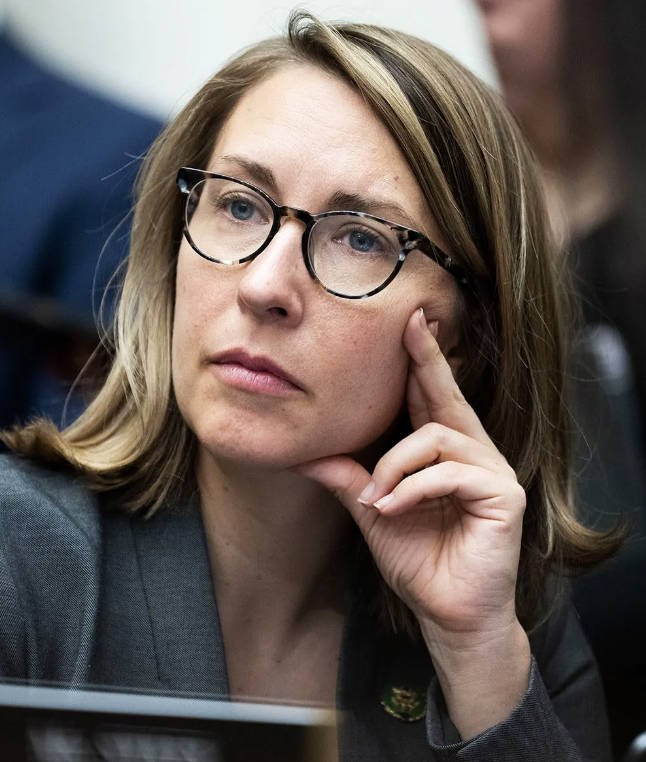 As the US support for Israel’s assault on Gaza continues, the US House of Representatives voted to pass a resolution that equates criticism of Israel with Antisemitism.
According to a recent post on Common Dreams, “The resolution, which embraces the International Holocaust Remembrance Alliance’s controversial working definition of antisemitism, was widely condemned by progressive and Jewish groups this week ahead of the vote.”
House Resolution 894 was introduced by Republican Rep. David Kustoff. The Resolution passed last night with 216 Republicans and 95 Democrats supporting it, with 92 Democrats choosing to vote “present.”
Michigan’s 3rd Congressional Representative, Hillary Scholten, voted yes on the resolution that equates criticism of Israel with Antisemitism. Scholten’s vote is consisted with the fact that she has been a recipient of pro-Israel lobby money, voted in favor of a resolution in July, which claimed that Israel is not an Apartheid state, took an AIPAC sponsored trip to Israel in August, and has supported the Biden Administration’s unconditional support for Israel, including the vicious assault on Gaza and his proposed to send an additional $14.3 billion in US military aid, which we have documented.
I checked Scholten’s website for any comments about her vote, along with her political Facebook page, and in both cases found nothing as of this posting.
New Energy bills signed into law by Gov. Whitmer receives criticism from Environmental Justice Group
 “This package of bills is a vital step toward building a clean energy future here in Michigan that creates jobs and grows our economy,” said Chair of the Michigan Democratic Party Lavora Barnes. “While Republicans sit back and do nothing to address the climate crisis, Democrats are proving they will not leave Michiganders behind. We are thankful to our Democratic leaders who continue to make Michigan an example for the rest of the country when it comes to innovation and industry.”
This celebratory statement has been consistent with much of the coverage on the recent set on energy bills that Michigan State Legislators voted on, and Gov. Whitmer signed into law last week. The Detroit Free Press reported:
“By 2040, 100% of Michigan’s energy is set to come from clean sources under a new law approved by Gov. Gretchen Whitmer on Tuesday. The state now has one of the most ambitious clean energy goals in the U.S., after Whitmer approved heavily debated bills that passed both chambers of the Legislature along party lines.”
However, not everyone was so quick to celebrate the new energy legislation in Michigan. No, I’m not talking about the Republicans, who still think that Climate Change is a hoax. I’m talking about groups like the Union of Concerned Scientists and the Michigan Environmental Justice Coalition.
In a post from last week, the Union of Concerned Scientists (UCS) made it clear that there were several things not included in the energy bills that were just signed into law by Gov. Whitmer:
Specifically, it weakened or completely eliminated environmental justice communities’ key priorities regarding affordability, reliability, and equity. Going forward, Michigan policymakers must incorporate these policies, which will mean standing up to utilities and other corporate interests.
The UCS critique also stated:
Additionally, SB 271 requires utilities to achieve a “clean energy” portfolio of at least 80 percent in 2035 and 100 percent in 2040. However, the bill’s definition of what constitutes clean energy includes nuclear power (which doesn’t emit carbon but isn’t “clean”) and fossil gas power plants that capture and store at least 90 percent of their carbon emissions. The Michigan Public Service Commission (MPSC) will ultimately determine whether such gas plant projects—if proposed—are technically and economically justifiable. Even so, it is concerning that legislators included fossil gas in the definition of clean energy given the risk of continuing our reliance on fossil fuels and the impact of emissions from gas production, transportation, and combustion. Giving the MPSC the final decision on what counts as clean energy may force environmental justice advocates to take up the fight once again to protect their communities.
Notably, SB 271 encourages the growth of energy storage in Michigan by setting a statewide target of 2,500 megawatts of capacity. It also encourages distributed generation, such as rooftop solar, by raising the cap when utilities can deny customers the ability to connect their systems to the grid from 1 to 10 percent of the utility’s average annual load. This is a welcome improvement, but it was a result of compromise and negotiation with utilities—and it does not go far enough. There should be no limit on customers who want to install solar, and they should be better compensated for the value locally owned solar provides to the grid. Regrettably, community solar was left out of SB 271 entirely.
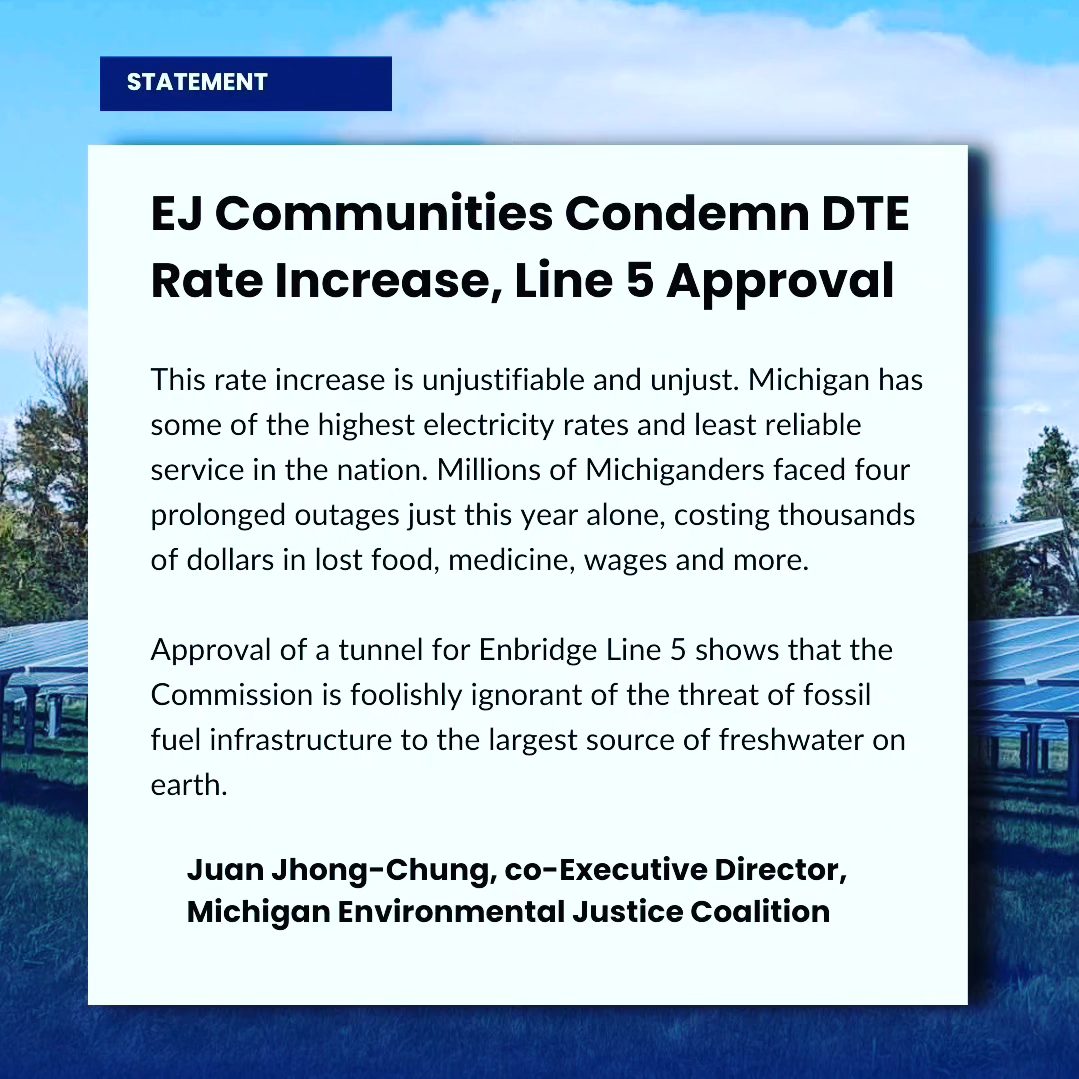
The Michigan Environmental Justice Coalition was equally as critical of the new energy bills signed into law by Gov. Whitmer last week. The coalition released a statement with the heading, EJ Communities Condemn DTE Rate Increase, Line 5 Approval. Their statement reads:
This rate increase is unjustifiable and unjust. Michigan has some of the highest electricity rates and least reliable service in the nation. Millions of Michiganders faced four prolonged outages just this year alone, costing thousands of dollars in lost food, medicine, wages and more.
Approval of a tunnel for Enbridge Line 5 shows that the Commission is foolishly ignorant of the threat of fossil fuel infrastructure to the largest source of freshwater on earth.
The DTE rate increase is particularly infuriating, so much so that the Michigan Environmental Justice Coalition created an Action Alert specifically to condemn DTE, stating in part:
DTE Energy is leaving us in the dark, when we need energy the most. They rely on dirty energy sources that harm our environment, polluting the communities they think can’t fight back while leaving everyone with unreliable and expensive service when we need to heat our homes, cook, and gather with friends.
And, they spend millions of dollars to keep it this way. on political influence to maximize their profit, hiking our rates and leaving us with no other options, paying off some politicians through campaign contributions, secretive “dark money” groups, and an army of lobbyists. All while rigging the rules to influence elections and various laws or regulations, and funding the phony think tanks that fudge data that supports their bottom line.
To sign onto the Coalition’s Action Alert targeting DTE, go to this link.
Last week, the Michigan Public Service Commission voted to approve a permit for the Enbridge Corporation to build an underground tunnel for an oil and gas pipeline that currently sits on bottomlands in the Straits of Mackinac.

There are only three members of the Michigan Public Service Commission and one of them abstained for the vote, thus making it 2 votes in favor of Enbridge. It addition, it should be noted that all three of the commission members were appointed by Gov. Gretchen Whitmer. So, the very Governor who campaigned 5 years ago on the promise that she would shut down Line 5, has not only failed to keep her campaign promise, she appointed the very people who just gave Enbridge a permit to build a pipeline tunnel under the largest body of freshwater on the planet.
Now, the Michigan Public Service Commission, according to the State of Michigan, exists to do the following:
We are committed to developing action-oriented strategies that reinforce the Michigan Public Service Commission as a safe, welcoming work environment and an organization that serves all Michiganders equitably. We address systemic and overt racism, both internally and externally, prevent discrimination, and adjust how we interact with one another as well as our community. We are dedicated to providing the necessary resources and leadership that will support the further development of the Michigan Public Service Commission’s diversity, equity, and inclusion efforts, and we will continue to address institutional or cultural barriers that historically have inhibited or may inhibit progress toward these goals, including both within our organization and in the energy and telecommunications industries we oversee.
If this is indeed the mandate of the commission, then they have failed miserably, especially with their granting a permit to build a pipeline under the Straits of Mackinac.
Nearly four years ago, I wrote: During the election cycle of 2018, then Gubernatorial candidate Gretchen Whitmer and candidate for Attorney General, Dana Nessel, both made the promise that they would shut down the Enbridge oil pipeline that runs through the state and under Lake Michigan, also known as Line 5.
It has been more than five years that Whitmer and Nessel made the promise to shut down the Enbridge owned and operated, Line 5. So why is Line 5 still operating?
We know that Gov. Whitmer tried to use legal means to deal with Line 5, but we all know how limiting that the legal system can be, especially when you have a multi-billion corporation like Enbridge, which had a very large legal team. Regardless, Whitmer and Nessel made a promise to shut down the Enbridge Line 5 and have failed to do so. On top of that, Governor Whitmer appointed the very people who approved the permit for Enbridge to build an underground tunnel for Line 5.
When are we going to stop giving these politicians a free pass and allow them to deceive us into thinking they would actually do the right thing and shut down Line 5? When are we going to take matters into our own hands and shut down Line 5 ourselves? The very existence of Line 5 violates Indigenous treaties and it perpetuates climate injustice.
Development projects vs human needs: Kent County Commissioners vote to put more public dollars into private hands
On Thursday, the Kent County Commission demonstrated their own commitment to giving away public funding for private gain……..more than once. Kent County Commissioners voted on three separate items, all of which revealed their allegiance to Neo-liberal capitalist principles.

Before I get to the three votes from the Kent County Commission, it is worth noting that Josh Lunger, head of government affairs for the Grand Rapids Chamber of Commerce, got up to speak during public comment before the commissioners voted on critical agenda items from Thursday County Commission meeting. Lunger, who was sitting with Grand Rapids Mayor Rosalynn Bliss and chatting with her before he got up to speak, was one of the main protagonists in the City of Grand Rapids decision to adopt ordinances that further criminalized the unhoused.
At 45 minutes and 20 second into the Kent County Commission meeting, Lunger got up to say the following, regarding the items that the County would be voting on 1) giving the Arena Authority governance to operate the outdoor Amphitheater, 2) giving $15 million in public money for the Amphitheater project, and 3) approving a memorandum of understanding relating to the proposed soccer stadium – “These transformational amenities are tools to attract talent and raise the quality of life for all residents.”
Ok, so can somebody explain to me or provide me with concrete evidence that amphitheaters and soccer stadiums attract people? People move to places because of a job, because of family/friend connections, or because of the schools they want to send their kids to. Also, how do amphitheaters and soccer stadiums raise the quality of life for all residents? I mean, does anyone really believe such non-sense? Does Josh Lunger even believe this shit? People have their quality of life raised by making a living wage, by have their basic needs met, by living in communities that prioritize making sure that basic needs are met over development projects that are promoted by the rich, often at the public’s expense.
Voting in favor of transfer public funds to private interests
At 1:40:20 in the video of the Kent County Commission meeting from last Thursday, is where the commissioners begin their discussion on 1) giving the Arena Authority governance to operate the outdoor Amphitheater, 2) giving $15 million in public money for the Amphitheater project, and 3) approving a memorandum of understanding relating to the proposed soccer stadium. Let’s take a look at each of these votes.
Item 1 – The Grand Rapids/Kent County Convention and Arena Authority already oversees the arena and the Convention Center, projects that also involved millions in public funding that have primarily benefited the private sector. The Grand Rapids/Kent County Convention and Arena Authority is made up of a 6 member board. Those 6 board members include ,2 politicians – Mayor Bliss and Kent County Chair Mandy Bolter; Lew Chamberlin, the CEO of the West Michigan Whitecaps; Birgit Klohs, former CEO of the Right Place Inc., Michael Verhulst, with Acrisure Benefits Group (the company that bought the naming rights to the Amphitheater); and David Winn, Chairman of AHC Hospitality, which is owned by the DeVos family. So, we have 4 members of the Capitalist Class and 2 politicians, both of which have a history of defending the interests of the Capitalist Class.
Item 2 – The Kent County Commission voted 16 – 2 in favor of giving $15 million in public money to the Amphitheater project. This brings the total of public money to $114 million out of an estimated $184 price tag for the 12,000 seat outdoor Amphitheater. The majority of the County Commissioners voted to give $15 million in public money because they also believe in the unsubstantiated claim that having places like the Amphitheater will “attract talent.” In contrast, what if the Kent County Commission had voted to provide $15 million in rental assistance to families who can’t afford the high cost of rent. What if the County Commissioners voted to invest $15 million of public money into a more robust transit system or invest in solar panels for Kent County residents. Housing, transportation and energy costs are clearly more urgent that funding an outdoor Amphitheater, yet local governments continue to direct public money to these development projects time and time again.
Item 3 – The last item that the Kent County Commissioners voted unanimously on, was to Support the Memorandum of Understanding Relating to Public Soccer Stadium. You could use the same shitting arguments for the soccer stadium as they have used for the Amphitheater – talent attraction, tourism, and entertainment. Plus, the soccer stadium will also use public money, even though it will be owned privately, probably by Dan DeVos, who already owns multiple sports teams.
Of course all of the local news reported on these decisions by the Kent County Commissioners. However, their reporting was celebratory without any critical inquiry, analysis or discussion about what is prioritized in this community and what isn’t. When the unhoused population grows, since the City and the County both prioritize development projects over basic human needs, they will just keep adopting ordinances to further criminalize and marginalize those who are housing insecure.
On Saturday, there were an estimated 150 people who came out to a protest to show solidarity with Palestinians and to demand an immediate ceasefire in Gaza and the West Bank.

Unlike previous protests in support of Palestine, Saturday was held at Martin Luther King Jr. park, in the southeast part of Grand Rapids. The protest/march was held in that neighborhood, primarily because Rep. Hillary Scholten lives in that neighborhood.
GRIID has been posting articles critical of Rep. Scholten’s unconditional support of Israel, even prior to the October 7 Hamas attack. Most recently, I wrote a critique of Scholten’s statement on the so-called “pause.” Scholten has been the target of a fair amount of activism in the past month, including three of us getting arrested at her Grand Rapids office in the federal building about 4 weeks ago.

The protest/march yesterday began with a short rally, followed by began marching in the streets, specifically in the residential neighborhood around MLK Park. People also dropped off a small handout at the homes of those who lived on the march route. Several people who handed out the flyers, had commented that the feedback was mostly positive, and people came out of their homes to greet those showing solidarity with the Palestinian cause.
The march wove through the neighborhood surround the park and eventually arrived at the home of Rep. Scholten, who lives on Benjamin St., just south of Martin Luther King Jr. Park.

When the march arrived at Scholten’s place, someone put a makeshift yard sign in her front lawn, which demanded an end to US military aid for Israel. Someone else delivered a list of demands that is part of a larger campaign that has been targeting Rep. Scholten, along with Senators Gary Peters and Debbie Stabenow. The campaign targeting these members of Congress is demanding an immediate ceasefire in Gaza, an end to the annual $3.8 billion in US Military Aid, and a no vote on the proposed $14.3 billion the Biden Administration has been calling for over the past month. You can send an electronic message with these demands, which can be found at this link.

After about 15 minutes of chanting outside of Rep. Scholten’s home, those doing crowd safety noted that a few GRPD cruisers had arrived, parking further south on Benjamin St. A few minutes later, people got word that 2 more GRPD cruisers showed up on the north end of the same street, so crowd safety people urged those standing in front of Scholten’s house to move, in order to avoid getting boxed in by the cops.
Just as the protest march was leaving Scholten’s place, an ambulance and a fire truck arrived and pulled up in front of a house that was 2 doors down. There was also a white, unmarked cruiser, which just happened to be the Chief of Police (seen in the picture below), which made those of us doing crowd safety suspicious, since why would Chief Winstrom be out and about on a Saturday.

The march then moved to Alexander street, which is on the south side of MLK Park. All of the marchers were off the street by this time, walking back to the spot where the protest march had begun, when all of a sudden 10 GRPD cruisers showed up, with lights on, and several cops exiting their cars. The march had a car included, which was doing safety from the rear, making sure that no motorists would drive into those marching. This is a standard practices, especially after what happened in Charlottesville in 2017, when a White Supremacist drove into an anti-racists crowd of protesters killing one of the protesters.

The GRPD ended up giving a ticket to the comrade driving the safety car, saying they were blocking traffic, which of course was ridiculous, considering that on a Saturday, in a residential neighborhood, there was essentially no traffic to block. Thus, the GRPD was just looking for any excuse to harass those who were protesting. During this time, lots of people had their phones out, recording the GRPD and chanting, “Police violence is a crime, from Grand Rapids to Palestine,” which was a theme raised at the beginning of the rally by one of the speakers with the Comrade Collective, citing the example of the GRPD’s murder of Patrick Lyoya, a Congolese refugee in April of 2022.

The repressive display from the GRPD was instructive, since it demonstrated to many at the march just how insidious they could be. The Palestine Solidarity march was clearly a non-violent action, with very limited disruption, along with the fact that most of the public we encountered along the way were both supportive and appreciative of what we were doing. The GRPD’s behavior was particularly instructive to those who were newer to protest movement politics, and it also demonstrated how the GRPD reacts to actions that operate outside of the normal downtown marches, which the GRPD has grown accustomed to. The GRPD may also have been alerted to the protest because we stopped in front of Rep. Scholten’s house for some 15 – 20 minutes, further demonstrating their commitment to protecting systems of power, even when those in power who are complicit in war crimes.
The official narrative on Kissinger’s death tells you something about the celebration and normalization of US Imperialism
So, Henry Kissinger is finally dead. This is the kind of sentiment that is being expressed, both in the virtual world and amongst many who live in the Global South, where Kissinger was seen as one of the primary architects of US Imperialism since the Nixon Administration.
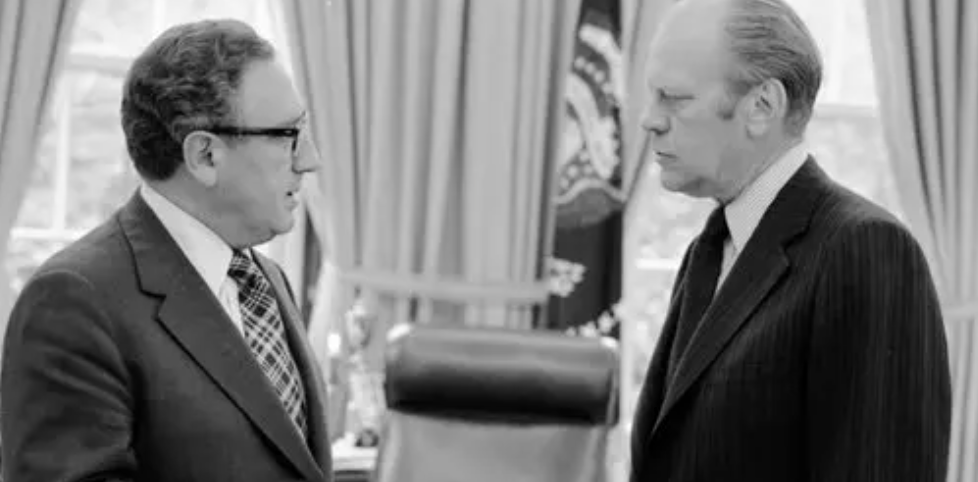
The notion that Kissinger was an integral part of US Imperialism is nowhere to be found within the narrative in commercial news media since he died on November 29th. I did a quick look at the local daily news sources in Grand Rapids and most of them were just re-printing an Associated Press (AP) obituary for the former Secretary of State and National Security Advisor, like the one that MLive re-posted.
I even looked at the Gerald R Ford Museum website to see if they had a tribute to Kissinger, especially since he played such a significant role during the Vice Presidency and Presidency of Ford. There was nothing about the passing of Henry Kissinger.
It’s possible that the local news and the Ford Museum might run something in the coming days to remember Henry Kissinger, but it would no doubt speak of him as a great statesman and scholar. Greg Grandin, who has written a critical account of Kissinger – Kissinger’s Shadow: The Long Reach of America’s Most Controversial Statesman, wrote an excellent article entitled, A People’s Obituary of Henry Kissinger.
Grandin was also interviewed on Democracy Now on Thursday, where he said:
 I mean, we can go into the details, but I do want to say that his death has been as instructive as his life. I mean, if you look at the obituaries and notes of condolences, they just — I mean, they just reveal, I think, a moral bankruptcy of the political establishment, certainly in the transatlantic world, in the larger NATO sphere, just an unwillingness or incapacity to comprehend the crisis that we’re in and Kissinger’s role in that crisis. They’re celebratory. They’re inane. They’re vacuous. They’re really quite remarkable. And if you think of — just think back over the last year, the celebrations, the feting of his 100th anniversary — 100th, you know, birthday, his living to 100 years. I think it’s a cultural marker of just how much — how bankrupt the political class in this country is. So his death is almost as instructive as his life.
I have seen lots of people in my Facebook feed referring to Kissinger as a War Criminal, which I think is accurate, but Grandin also made an excellent point about what is problematic about referring to Kissinger as a War Criminal, stating:
Christopher Hitchens popularized thinking about him as a war criminal, and that has a way of elevating Kissinger, in some ways, as somehow an extraordinary evil. And it’s a fine line, because he did play an outsized role in a staggering number of atrocities and bringing and dealing misery and death across the globe to millions of people. But there’s a lot of war criminals. I mean, you know, this country is stocked with war criminals. There’s no shortage of war criminals.
This is an important point from Grandin, since one could easily argue that since WWII, every US President and every administration has engaged in war crimes, which is to say that they were a proponent of US Imperialism. In a sense, Kissinger has normalized US Imperialism, which always includes war crimes.
Providing a counter-narrative to Official Sources on Kissinger
For those wanting more than the latest meme on Kissinger’s death, let me offer some of the following sources.
I already mentioned Grandin’s book, Kissinger’s Shadow: The Long Reach of America’s Most Controversial Statesman, plus there is the book by Christopher Hitchens, The Trial Of Henry Kissinger. The book by Hitchens, is what inspired the documentary film, The Trial of Henry Kissinger, which focuses on three main US foreign policy examples that Kissinger played a primary role in – Vietnam/Cambodia, Chile and Indonesia’s invasion of East Timor.
Then there are the excellent resources by the National Security Archives, which provides hundreds and hundreds of pages of declassified US Government documents involving Kissinger, which you can find here.
The Intercepted has done some important research and writing on Kissinger as well, with a piece on his legacy from Thursday, HENRY KISSINGER, TOP U.S. DIPLOMAT RESPONSIBLE FOR MILLIONS OF DEATHS, DIES AT 100, and an older post entitled, Blood on His Hands: Survivors of Kissinger’s Secret War in Cambodia Reveal Unreported Mass Killings.
The Jacobin Magazine also has numerous articles from a variety of contributors that were posted on Thursday, which are part of a new book you can order from them entitled, Only the Good Die Young.
Lastly, there is an excellent article from Norman Solomon on CounterPunch, entitled, For Media Elites, War Criminal Henry Kissinger Was a Great Man. In Solomon’s article he quotes the late Anthony Bourdain, who illuminated much about the world’s foods and cultures. As this century got underway, Bourdain wrote:
“Once you’ve been to Cambodia, you’ll never stop wanting to beat Henry Kissinger to death with your bare hands. You will never again be able to open a newspaper and read about that treacherous, prevaricating, murderous scumbag sitting down for a nice chat with Charlie Rose or attending some black-tie affair for a new glossy magazine without choking. Witness what Henry did in Cambodia — the fruits of his genius for statesmanship — and you will never understand why he’s not sitting in the dock at The Hague next to [Slobodan] Milošević.”
It has been a little over 4 months since GRIID last updated the DeVos Family Reader. As always, there has been plenty to report on regarding the most powerful family in West Michigan.

In Howard Zinn’s monumental book, A People’s History of the United States, he constantly juxtaposes the amazing things that people did to fight for liberation and the people behind the systems of oppression that social movements were fighting against.
This is exactly why I have spent years monitoring, investigating and critiquing the DeVos Family. They are the most recognizable and powerful manifestation of the systems of power and oppression in West Michigan. Now, I know there are plenty of people who share the belief that without the DeVos Family, Grand Rapids wouldn’t be where it is today. I fully agree with that belief, but for reasons that are the exact opposite of those who hold the most powerful family in West Michigan in high regard.
 Three times a year we try to update our DeVos Family Reader, a collection of articles that looks at the family’s history, the influence on election & public policy, their foundations, how they are reported on in the news media, ArtPrize and the section entitled Betsy DeVos Watch.
This updated version of the DeVos Family Reader includes information and analysis on a variety of local issues, even some that are not directly focused on the DeVos Family, but there are connections. In September GRIID reported on Rockford Construction getting a contract to build a new park along the river next to the Amway Grand Plaza. Rockford Construction won the contract because of their relationship with the DeVos Family.
Another example of the connections, was an article about the CEO of Acrisure paying for the naming rights for the new outdoor amphitheater, where the CEO said he learned philanthropy from the DeVos and Van Andel families.
There was also an article deconstructing one of Doug DeVos’s podcasts, a critique of a post by the DeVos-created Michigan Freedom Fund, a look at the 200 most influential people in Grand Rapids, a new national report on Philanthropy, and an update on the proposed soccer stadium which involves the DeVos Family.
The DeVos Family Reader is now up to 746 pages of history, analysis and information about the most powerful family in West Michigan.
25 Michigan Legislators send letter to Biden calling for a cease fire, but only 1 is from Kent County
Last Wednesday, 25 members of the Michigan State Legislature signed a letter that was sent to President Biden calling for a cease fire and an “enduring peace.”
The letter begins by saying:
“We write to urge you to do everything in your power as the president of the United States to reach an immediate durable cease-fire. We urge the immediate and unconditional release of all hostages, the adherence of all international laws and aid to ensure that every person living in Israel, Gaza and the West Bank can live with self-determination, dignity and humanity.”
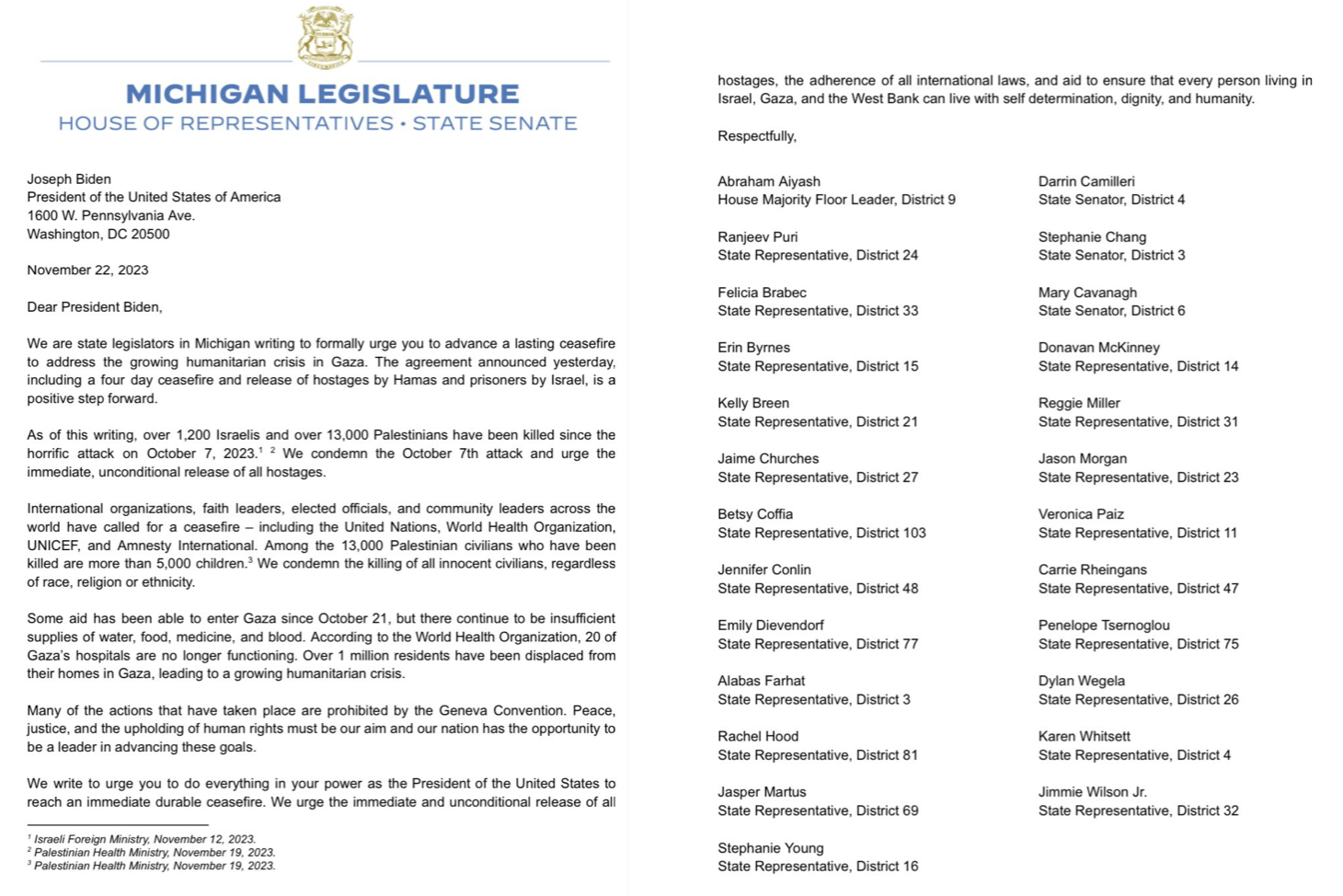
You can read the entire letter at this link, along with seeing which State Legislators signed the letter that was sent to President Biden.
The letter was signed by 25 State Legislators, 22 State Representatives and 3 State Senators. However, the only member of the State Legislature from Kent County to sign onto the letter was Rep. Rachel Hood from the 81st District.
This means that the following members from the State Legislature that represent Kent County did NOT sign the letter.
State Senators
18th District – Thomas A. Albert
20th District – Aric Nesbitt
29th District – Winnie Brinks
30th District – Mark Huizenga
33rd District – Rick Outman
State Representatives
78th District – Gina Johnsen
79th District – Angela Rigas
80th District – Phil Skaggs
82nd District – Kristian Grant
83rd District – John Fitzgerald
84th District – Carol Glanville
89th District – Luke Meerman
90th District – Bryan Posthumus
91st District – Pat Outman
GRIID certainly applaud’s Rep. Hood for signing the letter, but finds it shameful that no one else from this area signed it.
There has been ongoing and significant opposition to the unconditional US support for Israel, the failure of the Biden Administration to call for a cease fire and for the current level of US military Aid to Israel – $3.8 billion, along with the proposal to send an additional $14.3 billion to Israel. Indeed, in Michigan, there have been 3 local governments that have adopted resolutions calling for a cease fire in Gaza – Dearborn, Dearborn Heights and Hamtramck and Detroit. Grand Rapids has also been pressuring City officials to do the same.
It is shameful that more State Legislators did not sign onto this letter, considering the number of Palestinians that have been killed is now over 15,000, with over 6,000 of those deaths being Palestinian children.
Send the elected officials listed above a message, and tell them that it is shameful and cowardly that they did not sign the letter, are not speaking up in favor of a cease fire and standing in solidarity of the Palestinian people who are being brutally assaulted by the Israeli military, using US weapons.
 Grand Rapids Institute for Information Democracy