Always Follow the Money: PHILPAC?
Quite often elected officials start up their own PACs, with the intent of re-directing money to other candidates or the political party that they are connected to. One new Political Action Committee is PHILPAC, which is a PAC created by State Rep. Phil Skaggs. Skaggs is a former Kent County Commissioner and former staffer for David LaGrand, when LaGrand held a state seat. While he was Kent County Commissioner, Skaggs referred to the immigrant led group Movimiento Cosecha’s protests demanding Kent County to end their contract with Immigration and Customs Enforcement (ICE) as Bolshevik cos-play.
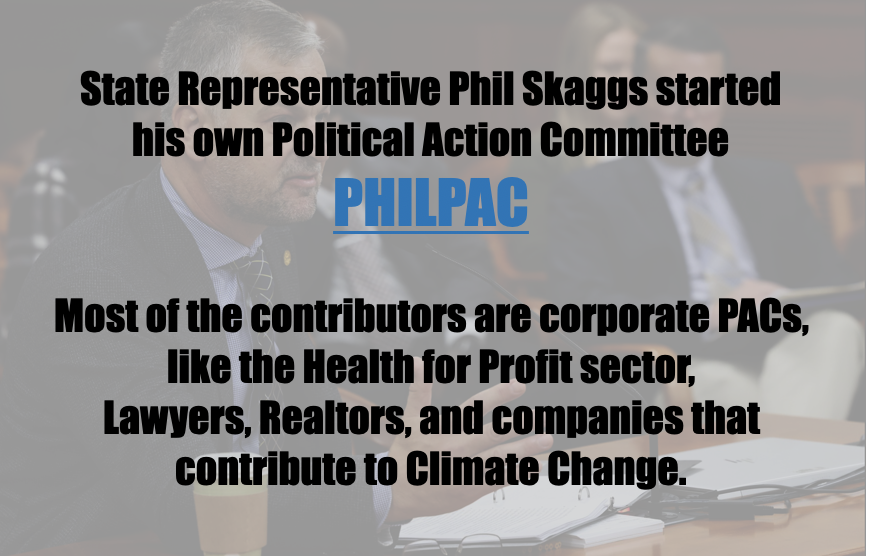
According the most recent state campaign finance records, PHILPAC had raised $23,550.00. As far as contributions to PHILPAC, there were 15 separate contributions in this quarter of campaign finances. Here is a list of those 15 contributors from the largest to the smallest:
- Realtors PAC 1 $1,450
- Delta Dental PAC $1,250
- Health PAC $1,250
- Blue Cross Blue Shield PAC $1,000
- DTE PAC $1,000
- Michigan Association of Recreation Vehicles & Campgrounds PAC $1,000
- Michigan Regional Council of Carpenters PAC $1,000
- Muchmore Harrington Smalley & Associates $750
- Michigan State TROOPERS PAC $500
- Henry Ford Health PAC $500
- Auto Dealers of Michigan PAC $450
- Michigan Association of Counties PAC $300
- Centene Corporation PAC $250
- American Federation of Teachers PAC $200
- Justice PAC $200
As you can see, of the 15 different contributions, 12 of them came from Business/Corporate PACs, two from organized labor (carpenters and teachers) and one from a government PAC. I don’t include the Troopers PAC as labor, since cops are a whole other kind of political animal. Thus, it would seem that the newly formed PHILPAC, by State Representative Phil Skaggs, relies heavily on corporate money, Realtors, the for profit health industry and lawyers. Politicians and candidates who will be taking this money, will no doubt be beholden to the interests of their paymasters.
Always Follow the Money: Grand Rapids Mayoral Candidate David LaGrand
 In July, after the campaign finance deadline, GRIID posted a piece on the campaign finances of Grand Rapids Mayoral candidate David LaGrand, pointing out some of the larger campaign contributors, which included folks who are part of the Grand Rapids Power Structure and other influencers. Today, I want to look at the campaign data from the most recent campaign finance documentation for LaGrand, which you can read here.
- Grand Rapids Fire Fighters Union PAC $2,500
- Steve Pestka – H & H Manegement & Development $1,500
- Thomas Schultz $1,000
- Andrew DeBoer $1,000
- Jon Bylsma – Attorney/Varnum $1,000
- Stephen Rechner $1,000
- Marlin Feyen – Feyen Zylstra $750
- Clay West – 17th Circuit Court Judge $600
- Peter Albertini – Realtor $500
- Fred Clowney – Intermet Systems $500
- Jack Hoffman – attorney with Kuiper Oilebeke $500
- Judy Freeman – Consultant $500
- Robert VanStright $500
- Brandon Dillon – Lobbyist with Winmatt Group $250
- Andy Bos – Eastown Financial Services $250
So far, David LaGrand has raised $31,823.65 for his Grand Rapids Mayoral campaign and has spent $8,708.11 to date. It should also be noted that his campaign manager is Richard Williamson, who has run numerous Democratic Party candidate campaigns in pervious election cycles, which is just another indication that local elections are partisan elections.
Lastly, LaGrand’s campaign website does have a section on priorities, but like most candidate platforms, it is brief and rather vague when it comes to where he stands on critical issues. In addition, it is worth noting that on his campaign Facebook page, there have been several inquiries on his stance about critical issues, which have not received responses.
Sixteen essential books that provide historical context on the US, Israel and Palestine
We are all inundated with information, especially about what is happening right now. It is often difficult to keep up with current events, especially since living in a Capitalist system almost demands that we not be informed, that we just consume.

Since October 7, when Hamas engaged in an assault on Israel, the US news media has acted like the assault merely demonstrated that Hamas is nothing more than a terrorist organization and that Israel has a right to defend itself. There has been very limited historical context provided in the news coverage or with the talking heads in media.
While it is urgent that we continue to get current news, information and analysis, especially from independent sources, we need to do the necessary work of trying to understand the historical context of what is happening, both the history of the relationship between Israelis and Palestinians, and the US relationship to Israel. Here are sixteen books that I have benefited from in terms of my own understanding of Israel, Palestine and the US role, especially since 1948. Of course, one can go back further than 1948, but I would argue that if we begin with the Nakba in 1948, all of this history will help us have a better understanding of what is happening now.
- The Ethnic Cleansing of Palestine, by Ilan Pappe
- Disappearing Palestine: Israel’s Experiments in Human Despair, by Jonathan Cook
- Hundred Years’ War on Palestine: A History of Settler Colonialism and Resistance, 1917 – 2017
- Decolonizing Israel, Liberating Palestine: Zionism, Settler Colonialism, and the Case for One Democratic State, by Jeff Halper
- Israel/Palestine: How to End the War of 1948, by Tanya Reinhart
- Palestinian Refugees: The Right of Return, edited by Naseer Aruri
- The Fateful Triangle: The United States, Israel & The Palestinians, by Noam Chomsky
- Palestine, Palestinians and International Law, by Francis A Boyle
- Architects of Repression: How Israel and its Lobby put Racism, Violence and Injustice at the center of US Middle East Policy, by Walter L. Hixson
- Ten Myths About Israel, by Ilan Pappe
- The Obstruction of Peace: The US, Israel and the Palestinians, by Naseer Aruri
- Popular Resistance: A History of Hope and Empowerment, by Mazin B. Qumsiyeh
- The Road Map to Nowhere: Israel/Palestine since 2003, by Tanya Reinhart
- Dishonest Broker: The US Role in Israel and Palestine, by Naseer Aruri
- The Punishment of Gaza, by Gideon Levy
- Gaza in Crisis: Reflections on Israel’s War Against the Palestinians, by Noam Chomsky & Ilan Pappe
The problem of conflating criticism of Israel’s brutal assault on Gaza with antisemitism in Grand Rapids
“Definitions of antisemitism that treat criticism of Israel or of Zionism as inherently antisemitic are inaccurate and harmful. The majority of Jews are not Israeli, and not all citizens of Israel are Jewish. Israel is a state; Zionism is a political ideology; Judaism and Jewish identity encompass a diversity of religious and secular expressions and a robust, varied set of traditions, cultures, and lived experiences. The misplaced focus of those who demonize Palestinian rights advocacy while ignoring or defending the antisemitism of white supremacists dilutes the understanding of antisemitism and makes it ever more difficult to fight.” From the book, On Antisemitism: Solidarity and the Struggle for Justice.

There are numerous prominent Jewish groups in the US that conflate anti-Zionism with antisemitism. Some of the most prominent groups that conflate anti-Zionism with antisemitism are the Anti-Defamation League, Stand With Us, the Jewish Federation and the American Israeli Public Affairs Committee (AIPAC).
In the most recently monthly newsletter published by the Grand Rapids Chapter of the Jewish Federation, there is an article on page 15, with the headline, Do Not Forget! Anti-Zionism is Antisemitism!
The group Stand With Us, which works primarily on US college campuses, provides students who are pro-Israel with a handbook entitled, The Hasbara Handbook: Promoting Israel on Campus. The word Hasbara is a Hebrew word that essentially means propaganda. In this handbook it states that “it is often better to score points than to engage in actual arguments, and offers an explanation for how, in its own words, “to score points whilst avoiding debate.” One example the handbook provides is to conflate anti-Zionism or criticism of Israel with antisemitism, because this tactic will often silence those who are critics of Israel.
 Think about it, over the past month as Israel has retaliated against the Hamas attack on October 7, the most common response lobbed against those who have taken to the streets to criticize Israel’s brutal assault on Gaza, has been that their protests against Israel are antisemitic. In fact, even the protests that are led by groups like Jewish Voices for Peace or If Not Now (Jewish movement critical of Israel) are often labeled as antisemitic or, at times, they are referred to as “self-hating Jews.”
Being called an antisemitic can be a chilling experience and it often results in self-censorship. It is an understandable reaction, because for people who genuinely want to stand against oppression, we can never tolerate antisemitism in our lives nor in the movements we are apart of. We all have to do the hard work of denouncing antisemitism and holding each other accountable when it surfaces. Having said that, we also must pay close attention to the conflation of criticism of Israel to antisemitism, particularly now.
Here are some useful resources that are worth looking at, which will challenge the notion that criticism of Israel is the same as antisemitism.
“Distorted Definition: Redefining anti-Semitism to silence advocacy for Palestinian rights” – Palestine Legal’s extensive resource on the Israel lobby’s attempts to redefine anti-Jewish bigotry
The Israel Lobby: USA – Watch the film the Israel lobby didn’t want you to see, a four-part undercover investigation by Al Jazeera into Israel’s covert influence campaign in the United States
“Palestine and the anxiety of existence” – Steven Salaita on confronting and dismantling the myths of Zionism
“IHRA definition of anti-Semitism silences solidarity” – Rowan Gaudet’s sharp analysis on the weaponization of anti-Semitism to silence Israel’s critics
Lastly, here is recently created short documentary by the group Electronic Intifada, which deconstructs the notion that anti-Zionism is the same as antisemitism.
Rep. Scholten once again demonstrates her allegiance to Israeli propaganda, with the support of so-called Progressive Democrats
According to a November 7th Press Release, “Rep. Hillary Scholten (MI-03) led dozens of her colleagues in issuing the below statement condemning the use of the anti-Semitic phrase, “from the river to the sea,” affirming Israel’s right to defend itself, and calling for a humanitarian pause to help save innocent life in Gaza.”
What follows is a deconstruction of the statement by Rep. Hillary Scholten.
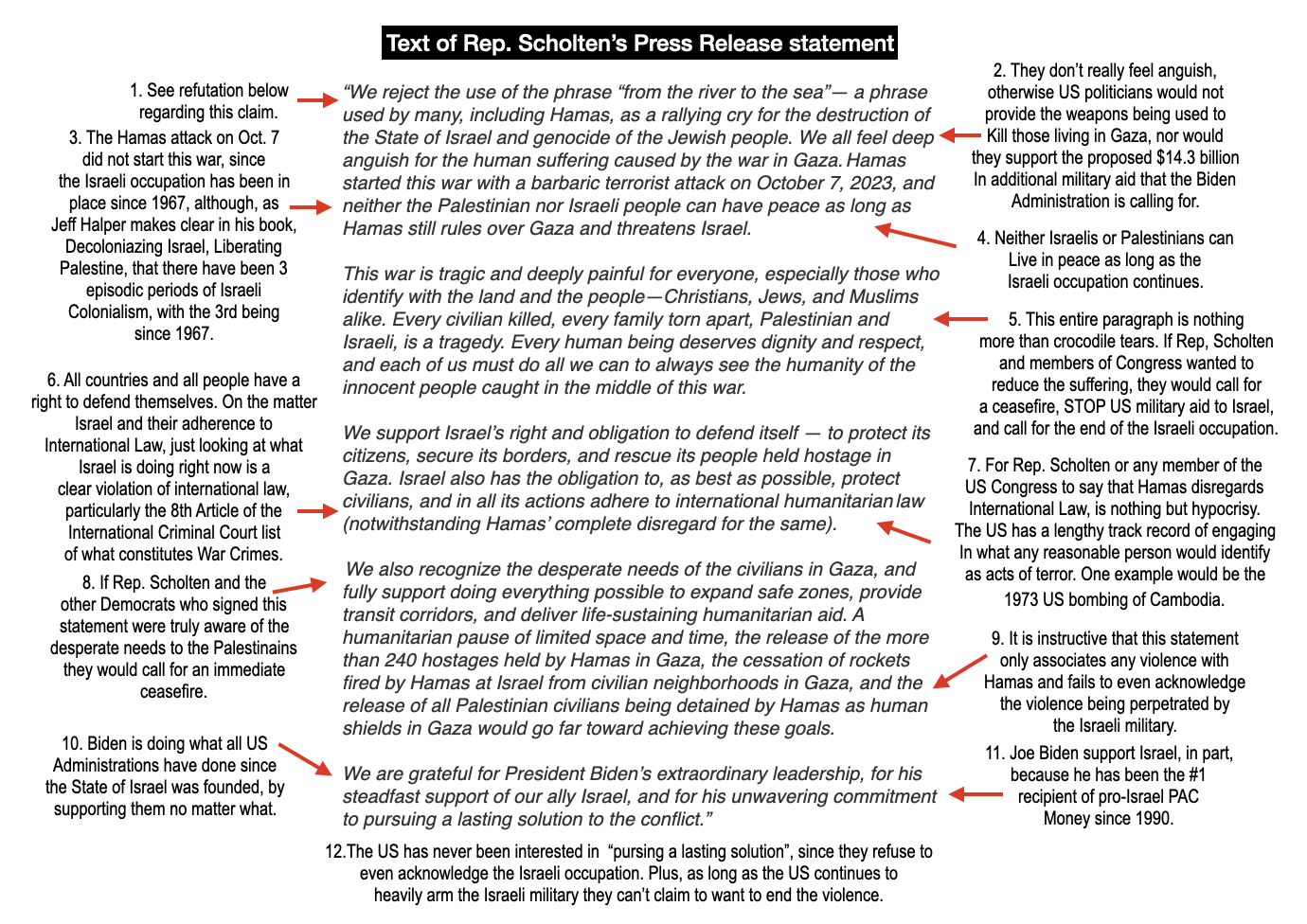
Here some additional sources to the points we made in my deconstruction of Rep. Scholten’s Press Release statement.
1. “From the river to the sea, Palestine will be free” is a call for Israel to extend citizenship and legal and political equality to every single human being residing within its current borders. This is exactly the point that Rep. Tlaib was making in her statement, which got her censured. Here are two articles that do a good job of explaining how the phrase has been used and abused to silence criticism of Israel. https://www.aljazeera.com/news/2023/11/2/from-the-river-to-the-sea-what-does-the-palestinian-slogan-really-mean?fbclid=IwAR0C2rq4Fi9y5DvxI8_tILKxwoLHMZhlwGd3N9D-5lgJch8fmf5LO7xp5f8 https://jacobin.com/2023/11/from-the-river-to-the-sea-palestine-equality-one-state-rashida-tlaib-censure
3. For a more detailed analysis of the history between the Israelis and Palestinians, see Decolonizing Israel, Liberating Palestine: Zionism, Settler Colonialism, and the Case for One Democratic State, by Jeff Halper – especially Part II on the Three Cycles of Zionist Colonial development.
6. For a detailed look at International Law and War Crimes, see https://www.un.org/en/genocideprevention/war-crimes.shtml
7. For a list of US imperialist actions since 1890, see Zoltan Grossman’s resource, which not only provides a chronological list of US interventions since 1890, but identifies when the US engaged in brutalizing civilian populations. https://sites.evergreen.edu/zoltan/wp-content/uploads/sites/358/2019/11/InterventionsList2019.pdf
11. See my article from October 16 on how much money pro-Israel PACs have given candidates and spent on lobbying the US Congress. When it comes to President Joe Biden, who has been a member of Congress since before 1990, the Pro-Israel PACs have contributed $4,228,614 to Biden’s coffers, making him the number 1 recipient of Pro-Israeli PACs since Open Secrets started tracking campaign contributions in 1990.
12. For a detailed analysis of how the US is NOT interested in a peaceful resolution between the Israelis and the Palestinians, see the book, Dishonest Broker: The Role of the United States in Palestine and Israel, by Nasser Aruri.
Always Follow the Money: Both Grand Rapids Chamber of Commerce funded candidates won in Kentwood.
On October 27, I posted an article about which candidates received funding from the Grand Rapids Chamber of Commerce during the most recent campaign finance quarter, ending on October 25th. That GRIID posted noted that there were two candidates running for Kentwood City Commission seats, David Moore II ($1,000) and Maurice Groce ($500), both of whom had received funding from the GR Chamber.

Both Moore and Groce won their election and the largest single local campaign contributor to both of these candidates, was the Grand Rapids Chamber of Commerce. As say local, because there were some larger contributions made to David Moore II from Colorado and Florida, as you can see in the campaign finance data here. In the case of Maurice Groce, the Grand Rapids Chamber of Commerce was the largest contributor, but was matched by the Mayor of Kentwood, Stephen Kepley.
This trend, where the Grand Rapids Chamber of Commerce is making substantial campaign contributions to candidates at the local level is indeed a disturbing trend. The most power business association in West Michigan, which has members in the top tier of the Capitalist Class, will more often than not get want they want on economic and social policies at the local level, just like we saw with the recent ordinances that were adopted by the City of Grand Rapids, ordinances that protected profits over people. When members of the Capitalist Class can use their wealth to determine the outcome of elections, they make a mockery out of even the most basic notion of democracy.
With 6 weeks before the holiday break, The Michigan Legislature has decided to not do another damn thing: When the gavel hit, They didn’t do shit!
It’s official, the Michigan State Legislature will not be doing any work or voting on any new legislative proposals that could provide renters with serious relief. It also means that those who have been working on getting a Drive Safe bill passed, particularly the Immigrant Justice that is led by Movimiento Cosecha. And it means that the Enbridge Line 5 is still operating, putting the Great Lakes at risk, ignoring Tribal Sovereignty and perpetuating the Climate Crisis, despite Gov. Whitmer’s promise to shut it down years ago.

This extended vacation is unacceptable and it comes right after the Michigan State Legislature took off from early July til September the 6th, as we noted in an earlier post on GRIID related to the efforts of Movimiento Cosecha to get driver’s licenses for the undocumented community.
Movimiento Cosecha and the Drive Safe Coalition have been organizing the entire year, and despite the Democrats having control of the State House, the Senate and the Governor’s office, they chose not to make it a priority.
On September 5th, the Rent is Too Damn High Coalition held a sizable rally at the Lansing State Capitol, with very clear and strong demands around tenant rights and housing justice, which GRIID also attended and wrote about.
Since then, the Rent is Too Damn High coalition has made an impact. In a recent Action Alert that the coalition sent out, they provided a list of lessons learned this Fall:
- We have a handful of renters’ rights champions who are ready to sponsor bills and fight for them in the legislature. A bill to enable rent control, and another 8 bills strengthening renters’ rights, have been introduced to the house and are ready for passage.
- Landlords are paying attention to us. The Rental Property Owners Association, the Property Management Association, and other lobbyists have been attending housing committee meetings and testifying against renters’ rights. After our 9/5 demonstration, one of them even said they had “never been more nervous” about being held accountable.
- Democratic House leadership, starting with Speaker Joe Tate, haven’t shown any interest in advancing renters’ rights. Instead they are siding with landlords by leaving important bills to languish in committee.
- Renters aren’t the only constituents being sidelined. House leadership has concluded that doing less of everything will help them get re-elected next year. This is an obviously self-defeating strategy, but it’s the one they’re going with. Don’t take my word for it…read this article published Monday in capitol news service Gongwer: Whether To Upend Status Quo Driving Dem Divide In House.
- The House is likely to adjourn for the year on November 9 — over a month earlier than usual. When they do, they’ll be leaving vulnerable renters and unhoused people without any more rights or relief, as we head into another cold winter. This has definitely come to pass!
- Whatever renters win, we’ll have to fight for. We already knew this, but this fall has confirmed it — The people at the top are not looking out for us. They don’t go to sleep worrying about the rent. They go to sleep comfortable, in homes that they own. It’s up to us to build more power and change the political equation.

The Rent is Too Damn High coalition held another rally on November 8th and also spent hours lobbying member of the State legislature. However, since the Michigan State Legislature has decided to do no more work until next year, the Rent is Too Damn High coalition is now using the phrase – When the gavel hit, They didn’t do shit!
The Rent is Too Damn High coalition is not taking a break and working on pressuring State Legislators in our respective communities, like Rep. Kristian Grant, who sits on the Housing Subcommittee and needs to be held accountable for allowing the unhoused to live through another winter, tenants who facing threats of eviction and need rent control, and thousands of Michigan families that can’t afford housing in the current market-driven housing system!
Representative Grant is hosting a 1 hour coffee and community meeting on Monday, November 13, from 9 – 10am at the Scorpion Hearts Club, which is located at 1035 Wealthy Street SE. Grand Rapids. Why these meetings are held at times when many working people can’t attend, by design. If people can attend, then ask Rep. Grant why none of the demands from the Rent is Too Damn High Coalition have not been met? You also might want to ask her why she has already accepted $500 from the Rental Property Owners Association of Kent County during the current re-election campaign cycle, according to state records. Lastly, we should all demand that she make ending the ban on rent control in Michigan a priority beginning in the New Year.
Rep. Tlaib is not only being censored, pro-Israel groups are running attack ads against her a year before she runs for re-election
 On Tuesday night, the US Housed voted to censure Michigan Representative Rashida Tlaib, the only Palestinian American member of Congress, over her support for Palestine and her criticism of Israeli war crimes in Gaza.
This was also a bi-partisan supported vote, with 22 Democrats voting in favor of censorship. In addition, there have been calls from other so-called progressives in Michigan, like Attorney General Dana Nessel who condemned Rep. Tlaib for pro-Palestinian comments she made on social media.
Rep. Rashida Tlaib responded to her censorship with powerful comments that called out her fellow members of Congress and President Biden in this video.
Unfortunately, this is not the only actions being taken against Rep. Tlaib. In a recent article on Jacobin, there is an article about the group Democratic Majority for Israel (DMFI), which is now running political ads attacking Rep. Tlaib and her stance in US military aid to Israel, the Israeli occupation and the current Israeli assault on Gaza.
In 2022, Rep. Tlaib was challenged by another Democrat during the primaries. The Political Action Committee that was primarily funding her opponent, was the United Democracy Project, which is a pro-Israel group, that spent $26 million in 2022 to support Democrats who were pro-Israel or to defeat Democrats who were critical of Israel.
In 2023, Democratic Majority for Israel is doing the same thing that the United Democracy Project did in 2022, which is to defeat politicians who are critical of Israeli, like Rep. Tlaib. Democratic Majority for Israel created a video to smear Rep. Tlaib, a video that has been airing in Michigan, which is Tlaib’s state. According to Jacobin:
Presumably, the real point of the ad is to build support for some sort of primary challenge in 2024, although so far no one knows who the challenger would be. But DMFI’s attempt at smearing Tlaib is transparently ridiculous — and Democratic voters are increasingly siding with her actual position.
Here is the attack ad.
What the ad is doing is criticizing Rep. Tlaib for standing up for the rights of Palestinians, along with making unsubstantiated claims about Hamas beheading babies.The media watchdog group, Fairness & Accuracy in Reporting in a post from October 20th, a post that challenged the validity of the beheading of babies claim, stated:
It all started with television reporting by journalist Nicole Zedek, who works for the 24-hour Israeli cable news channel i24, now embedded with the Israeli Defense Forces. In one October 10 report, she said, “I’m talking to some of the soldiers, and they say what they’ve witnessed…babies, their heads cut off.” In another report later that day, she says, “About 40 babies at least were taken out on gurneys,” prompting the host to interject: “Nicole, I have to cut in—that’s such a shocking, jarring statement there…. You’re saying 40 babies, dead babies?”
Zedek’s reporting was cobbled together into the viral claim that 40 babies were beheaded, despite that, by her own account, she had not seen the bodies herself, and relied solely on Israeli Defense Forces (IDF) soldiers as her sources. This might not have mattered as much if she were reporting on a less inflammatory subject, or had a more reliable source, but the IDF is known for misleading journalists.
The next day, Zedek told a podcast (Clay Travis and Buck Sexton Show, 10/11/23) that “it’s sickening” that people were scrutinizing her reporting of alleged baby beheadings closely: “We have these soldiers confirming what they’ve seen of the mutilation of these children.”
The claim remains up on i24’s website, as of October 18. Israel’s largest newspaper Ha’aretz (12/2/19) found in a 2019 investigation that i24 had compromised its integrity years earlier by becoming more pro-Netanyahu in order to obtain a broadcast license. It also reputedly has close ties to the Israeli military (Anadolu Ajansi, 10/11/23).
This kind of character assassination is standard in the political world, which is why it is vitally important that we verify claims coming from centers of power or from profit-driven news sources.
It is also disheartening to see the Democrats and Republicans attack one of the most progressive members of Congress, but this is further evidence that neither party will tolerate incumbents or candidates that have a strong connection to community and a deep analysis of systems of power and oppression. As a Michigander, I proudly stand with Rep. Rashida Tlaib!
Yesterday, I was arrested in Rep. Scholten’s office for demanding an immediate ceasefire in Gaza
 Yesterday, myself and two other activists were arrested while demanding that Rep. Scholten immediately reverse her position on unconditional support for Israel, end their assault on Gaza and call for an immediate ceasefire.
Now, we all knew that this would not happen, but we believed it was absolutely necessary to refuse to leave the Congresswoman’s office and engage in an act of civil disobedience. The GRPD was called and we were arrested.
For me, the current Israeli assault on Gaza is very personal. One of my dearest friend’s, Karen Henry, who passed away after years of fighting cancer, was the person who introduced me to the Palestinian freedom struggle. As an Arab-American woman, Karen had spent decades of her life on this issue in Grand Rapids and was an integral part of the Middle East Working Group of IGE. Karen also spent several years as a journalist reporting from the occupied Palestine. If I did not do something significant to demand an end to the horror that is happening right now in Gaza and the West Bank, I would be disrespecting the memory of my dear friend Karen.
I got arrested because engaging in an act of civil disobedience is a mild risk to take, while the US is providing weapons and diplomatic support for Israel to engage in war crimes in Gaza. Yes, war crimes. Bombing hospitals and other places that are part of civil society are war crimes under international law, as is the murder of civilians, especially children. The weapons that are being used by the Israeli military were paid for by my dollars, weapons that are killing thousands of families and injuring countless more. How can I not be outraged by what is being done in my name?
I also got arrested, because as someone who tries to learn from history, I know that the primary strategy for social change is when people engage in direct action. Rep. Hillary Scholten, Senator Peters and Senator Stabenow have all made it clear that they unconditionally support Israel, that they have voted for the $3.8 Billion in military aid that the US provides to Israel on an annual basis, and that they refuse to call for an immediate ceasefire in Gaza. These three politicians have taken this position, because rarely do elected officials get to stay in office if they question the relationship between the US and Israel. In additional, Scholten, Peters and Stabenow have all been the recipients of pro-Israel Political Action Committees funds.
I got arrested yesterday by refusing to leave the federal building in GR, because I believe that we need to engage in direct action, especially when it disrupts business as usual. We know from US history, that every major social movement, from the Abolitionist Movement to the Movement for Black Lives, that disruptive tactics are key to making change. We need to disrupt business as usual, because business as usual is what got us into this mess. It has been business as usual for the US government to give Israel billions in military aid for decades. It has been business as usual for every US administration since Israel was founded to ignore the 700,000 Palestinians who were displaced during the Nakba and the internationally recognized illegal Israeli occupation of Palestinian land. This has been business as usual for the US longer than I have been alive.
I believe in disruptive tactics, because I believe they can inspire people, motivate people and create space for people to be willing to do the same. When Dr. King was arrested for pressuring people in the south to desegregate he wrote these words in response to white Christian pastors who cautioned against civil disobedience:
“I must confess that over the last few years I have been gravely disappointed with the white moderate. I have almost reached the regrettable conclusion that the Negro’s great stumbling block in the stride toward freedom is not the White Citizens Councillor or the Ku Klux Klanner but the white moderate who is more devoted to order than to justice; who prefers a negative peace which is the absence of tension to a positive peace which is the presence of justice; who constantly says, “I agree with you in the goal you seek, but I can’t agree with your methods of direct action”; who paternalistically feels that he can set the timetable for another man’s freedom; who lives by the myth of time; and who constantly advises the Negro to wait until a “more convenient season.” Shallow understanding from people of good will is more frustrating than absolute misunderstanding from people of ill will. Lukewarm acceptance is much more bewildering than outright rejection.”
Below is a statement that we released last night that also explains why we chose to risk arrest in support of the Palestinian people.
Statement in Solidarity with the Palestinians
Those of us who have occupied the Gerald R. Ford Federal Building do so today to demonstrate our solidarity with the Palestinian people, especially those living in Gaza and the West Bank.
The carnage being wrought by the Israeli military is completely unacceptable, with estimates of the dead now surpassing 10,000, including 4,000 Palestinian children.
We are calling on Rep. Hillary Scholten, along with Senators Gary Peters and Debbie Stabenow to demand that President Biden change course from his unconditional support for Israel to an immediate ceasefire! The international community is calling for a ceasefire, as is the United Nations. The assault on Gaza must come to an end.
We know that since the October 7 Hamas assault on Israel, that the US government, along with Rep. Scholten have passed a resolution stating that they stand with Israel. In addition, the Biden administration is calling for an additional $14.3 billion in US military Aid be sent to Israel, which is on top of the $3.8 billion in military aid that the US provides on an annual basis to Israel.
 Rep. Hillary Scholten, Senator Gary Peters and Senator Debbie Stabenow all endorse the additional US military aid to Israel. However, we say not one more dime of US tax dollars should go to support the current genocidal assault on Gaza, and no future US military aid should be to Israel until their occupation of Palestinian land comes to an end. We also demand that the tax money that leaves Grand Rapids to provide military aid to Israel should stay in our community to support the critical needs of people who live here!
The bombs that Israel are dropping on Gaza are being done in our name. The destruction of hospitals is Gaza are being done in our name. The schools and businesses that are being decimated in Gaza, are being done in our name. The Israeli assault that is happening in the West Bank and in the refugee camps are also being done in our name. We say no to all of this! Not in Our Name!
We stand with the Palestinian people, just like the protests that have been happening all across the globe, like the one that took place in Washington DC on Saturday and the hundreds that took place in countries around the world. We Demand an immediate ceasefire! An end to US military Aid to Israel and an End to the Israeli occupation of Palestinian lands.
Lastly, we call on the people of Grand Rapids to rise up and demand an immediate ceasefire. Join a march, take a public stand, pressure your elected officials, be part of the global BDS Movement, get your faith community to demand a ceasefire, and do whatever you can to say emphatically, NOT in OUR NAME!!!!!
Despite the growing calls for a ceasefire, Rep. Scholten remains committed to the brutal Israeli assault on Gaza
It has been a month since Israel began to exact revenge for the October 7 attack by Hamas. During the past four weeks, Rep. Scholten has remained committed to her unconditional support for Israel, which means she supports the bombing of Gaza, the Israeli push to de-populate Gaza of all Palestinians and to allow Israeli settlers to engage in more violence against Palestinians in and around the West Bank.

On October 17, GRIID posted an article entitled, Rep. Scholten endorses Israeli War Crimes in Gaza, because of her silence on the Israeli assault and her endorsement of President Biden’s call for an additional $14.3 billion in US military aid to Israel. On October 24th, I posted another article about how Rep. Scholten was perpetuating misinformation about what Israel was doing against the Palestinians, along with her contradiction to support some humanitarian relief, while simultaneously endorsing the Israeli assault on Gaza, which is the root cause of the need for humanitarian relief.
Then on October 26th, I posted an article, which included AIPAC-produced videos featuring Rep. Scholten, while she was on an AIPAC funded tour of Israel in August.
In Rep. Scholten’s most recent weekly newsletter (November 4), she states the following:
As the Israel-Hamas war raged into its 4th week, the United States is feeling mounting pressure from around the world to pass an international aid package that provides military aid to our democratic ally, Israel, along with humanitarian aid to innocent civilians caught in the path of war. Though Speaker Johnson has already proven capable of putting bipartisan legislation on the floor regarding this war, he chose to prioritize petty partisan politics instead this week with his Israel package. You can read my statement here.
I want to acknowledge again my gratitude for your continued engagement on this challenging and divisive issue. As we continue to work towards peace, and elevate the protection of human life, hearing from you helps guide my actions forward.
Regarding Rep. Scholten’s weekly newsletter comments, she presents only half-truths on what the international community are asking for. Yes, the global community is calling for humanitarian aid, but they are equally emphatic about demanding a ceasefire. Second, while she wants to put them blame on House Speaker Johnson for playing partisan politics, she fails to mention that what she and most of her Democratic colleagues want in their “Israel package,” is an additional $14.3 billion in US military aid. Lastly, it is worth mentioning that no where in her newsletter nor the linked statement Rep. Scholten makes, does she mention Palestinians or the number of dead, which is roughly 9,000 civilians, including 3,600 Palestinian children.
Now, let’s take a look at the linked statement that Rep. Scholten included in her weekly newsletter.
“Just last week, more than 400 bipartisan members of the House came together to condemn Hamas and show our strong support for Israel, underscoring how united this body is in our support for our democratic ally. Instead of putting a bipartisan emergency Israel aid package on the floor, Speaker Johnson, in an unprecedented move, chose to prioritize an extreme Republican policy wish list item.
Not only that, this package fails to include much-needed humanitarian aid for innocent civilians in Israel and Gaza, and has no chance of becoming law. These theatrics are further delaying our ability to provide critical assistance during this time of crisis for our strong ally. This sends a false and dangerous signal that we are not committed to supporting our democratic partners around the world.
Also, of deep concern to me, as someone who prioritizes fiscal responsibility with our taxpayer resources, is that this bill ADDS $12.5B to the deficit. Republicans are showing once again that they need a math lesson–this is not a budget cut, it takes our deficit in the wrong direction.
Speaker Johnson needs to immediately work with Democrats in Congress and the White House on a package that meets this critical moment. The world is watching. We have no time to waste.”
In her statement Rep. Scholten:
- Reminds people of her signing on to the bipartisan resolution affirming the US unconditional support for Israel. This is no surprise, considering how much money Pro-Israel PACs give to federal candidates and how much money they spend on lobbying in recent decades.
- Scholten talks about humanitarian aid, but this is misleading, since the humanitarian aid that the US might provide would be miniscule compared to the additional military aid that the US would provide to Israel, which is currently $14.3 billion.
- Rep. Scholten once again want to blame House Speaker Johnson for creating a deficit, which he would with his proposal. However, wouldn’t it equally be a deficit if the US sends an additional $14.3 billion in military aid to Israel, an amount that Scholten conveniently omits in her statement. The $14.3 billion that the Biden administration wants to send to Israel should be used to provide critical support for families in the US for housing, food and healthcare, not for war crimes, which is reflected in a recent statement by the National Priorities Project.
- Lastly, Rep. Scholten ended her statement by saying, “The world is watching. We have no time to waste.” I agree, the world is watching, and if Rep. Scholten, the majority of the US Congress and the Biden Administration continues to support the Israeli assault on Gaza, the murder of 10,000 Palestinian civilians, of which 3,600 are children, then they will be on the wrong side of history.
 Grand Rapids Institute for Information Democracy