 For people who were part of the Civil Rights and Black Freedom Movement between the 1950s and the 1970s, the murder of organizers was all too frequent.
White Supremacists, which were often part of the law enforcement community, were the ones responsible for the assassination of many of the leaders and organizers within the Civil Rights Movement. They took the lives of people like Medgar Evers, Bobby Hutton, Malcolm X, Fred Hampton and Dr. Martin Luther King Jr.
Today is the 56th Anniversary since they took the life of Dr. King in Memphis Tennessee, while he stood on the balcony of the Lorraine Motel.
Dr. King had been receiving death threats for years and he knew it was just a matter of time before they took his life. People are somewhat familiar with the death threats against Dr. King and other organizers in the South during the Montgomery Bus Boycott and later with the Freedom Rides. However, what is less known, were the threats that Dr. King received in the North, especially after he moved his operation to Chicago. Dr. King often noted that there were larger crowds and more hate-filled verbal assaults on his life in cities in the North than there were in the South.
 When Dr. King was a passenger on a bus or a plan, the departure times were always delayed, because of bomb threats against him, his family and other members of the Southern Christian Leadership Conference. It is hard to quantify the amount of stress that Dr. King had to endure. However, we do know that after Dr. King was assassinated, the medical examiner who preformed the autopsy, reported that he was surprised to see the 39-year old’s heart had the wear and tear of a 60-year old man.
In addition to the white public backlash against Dr. King, the FBI had been monitoring and threatening Dr. Martin Luther King Jr. for several decades. This history of FBI surveillance is well documented in Michael Friedly and David Gallen’s book, Martin Luther King Jr.: The FBI File.
FBI director J. Edgar Hoover, often referred to the Civil Rights leaders as, “that burrhead King” or “the most dangerous Negro in America.” At one point the FBI even sent Dr. King a letter, suggesting that he kill himself, as you can see in this partly redacted letter.
It is no surprise that the FBI saw Dr. King as the “most dangerous man in American,” considering his own evolution. Dr. King was referring less in his speeches about having a Dream, instead he came to the conclusion in his 1967 speech, Which Way It’s Soul Shall Go, to say: I’m sorry to have to say that the vast majority of white Americans are racists, either consciously or unconsciously.
Dr. King realized that demanding an end to racial segregation was not enough. The fiery minister came to see that racial justice was demanded, that the US should pay reparations to black Americans, that economic exploitation was a crime and that the US war in Vietnam was immoral. In fact, Dr. King had come to believe that, “the greatest purveyor of violence in the world today was my own government.”
What Brought Dr. King to Memphis?

One of the strongest criticisms that King had developed in the last few years of his life, was a criticism of poverty, economic exploitation and capitalism. In King’s famous speech, Beyond Vietnam, he provides his own commentary on the story of the Good Samaritan, see here on the right. Restructuring the edifice that produces beggars means we need to change the economic system.
 In addition to King’s increasing critique of capitalism, King was in the midst of working on the last campaign he was organizing, the Poor People’s Campaign. Dr. King and the other organizers of this campaign were planning on using direct action in the nation’s capital, by having a tent city, where poor people from all over the country would be occupying land in Washington, DC to not only draw attention to the issue of poverty, but also to demand the promissory note that King spoke often about, which is just another way of saying reparations.
Considering Dr. King’s increased focus on economic justice and the Poor People’s Campaign, it’s no surprise that he would support the black sanitation workers in Memphis.
Michael Honey’s well research book, Going Down Jericho Road: The Memphis Strike, Martin Luther King’s Last Campaign, provides critical insight into King’s support for the striking sanitation workers. Honey provides detailed background material on the black population in Memphis and how that community was plagued by poverty and white supremacy.
The sanitation workers were paid substandard wages and were not permitted to organize a union. On top of that, the work conditions were horrid, with white supervisors constantly harassing black employees.
On top of the general climate of exploitation, the black sanitation workers were often forced to seek refuge inside the garbage trucks, just to get out of the rain. On February 1st, 1968, while some of the workers were inside the garbage truck, the compactor malfunctioned and killed Echol Cole and Robert Walker, crushing them. On February 11, 700 sanitation workers attended a meeting and decided to go on strike. A week later the NAACP passed a resolution supporting the strike, as did King’s organization, the Southern Christian Leadership Conference (SCLC).
Dr. King arrived on March 18 and that same day gave a speech, where he told the crowd, “You are demonstrating that we can stick together. You are demonstrating that we are all tied in a single garment of destiny, and that if one black person suffers, if one black person is down, we are all down.” At that same speech, King not only endorsed the striking workers, he joined others in supporting a city-wide work stoppage on March 28th.
The March 28th city-wide work stoppage also included 22,000 students who boycotted going to school. These students, along with the sanitation workers and people from all over the city marched to demand justice for the dead workers, for the right to organize a union and for better wages and working conditions.
However, the march was disrupted by violence and a 16 year old was shot and killed by Memphis police. Police also followed marchers to a local church, entered the church, released tear gas inside the sanctuary, and clubbed people as they lay on the floor to get fresh air.
The next day, the Mayor of Memphis, Henry Loeb, a Democrat, called for Marshal Law and had 4,000 National Guard Troops brought in to the city.

In response, striking workers and Dr. King decided to organize another march. Dr. King came back to Memphis on April 3 and delivered what would be his last speech that evening at Bishop Charles Mason Temple.
The next day, while Dr. King, and those with him, were getting ready to go to dinner, he was shot while standing on the balcony of the Lorraine Motel.
Who Killed Dr. King?
For years the US government presented conclusive information that lone gunman James Earl Ray had shot and killed Dr. Martin Luther King Jr. We were always led to believe that this individual racist had taken the life of Dr. King in a fit of rage over what the man had stood for.
 Considering how much Dr. King, and those closest to him, were being monitored by the FBI and local law enforcement, how is it possible for a lone gunman to have shot and killed Dr. King in such a public setting as outside hi motel room? The police were constantly nearby and the motel had been checked by local police for bombs the day before his assassination. Something didn’t seem right.
Along comes William Peppers, a lawyer, who decided to look at this case in greater detail. Peppers interviewed dozens of people who were there in Memphis that day and was able to gain access to lots of documentation and reports on what local law enforcement and the National Guard were doing at the time of Dr. King’s assassination.
After years of research and investigation, William Peppers published a book in 2003 entitled, An Act of State: The Execution of Martin Luther King. In this book, the author provides a detailed analysis, along with evidence that 1) either the government was directly involved in the assassination of Dr. King, or 2) the government turned a blind eye to what had happened on April 4, 1968.
What Pepper’s argues is that at a minimum, the US government had turned a blind eye to the assassination of Dr. King. However, what seems more plausible, is that law enforcement agencies and the National Guard had collaborated to participate in and allow the assassination of Dr. King.
How People Reacted to King’s Death?
There were demonstrations and riots all across the US in the aftermath of Dr. King’s assassination, with dozens of cities reporting that people were taking out their rage on white-owned businesses.

In Washington, DC, Stokely Carmichael and SNCC were going around the city demanding that businesses close for the day out of respect to the black community. However, the crowd of protestors grew larger by the minute and eventually people were smashing windows and taking items from stores. The National Guard was called in to suppress the uprising.
The scenario repeated itself in cities all across the country, in places like New York, Chicago, Baltimore and Detroit. Michigan Governor George Romney had called in the National Guard to stop people from protesting, much like he had done the previous July during the uprising in July of 1967 in both Detroit and Grand Rapids.
How did Grand Rapids Respond to the Death of Dr. King?
On April 5, the Grand Rapids Press put the assassination of Dr. King on the front page.

However, most of the Press coverage framed the reaction to the death of Dr. King in a negative way. The GR Press did interview people from the community to get reactions.
It states, in an article from the Grand Rapids People’s History Project:
Reggie Gatling, referred to as a black power militant, said, “Members of the black community had a meeting last night and decided we would not give out a public statement that would be reflective of feelings. We’re in mourning for Dr. King, but to say anything further would only give comfort, or possibly discomfort, to white racists.”
What is instructive about Grand Rapids, is how the White Power Structure responded. Again, we refer to the Grand Rapids People’s History Project:

It is vitally important that we continue to morn the assassination of Dr. Martin Luther King Jr. In addition, we must not forget this history. We must not forget that Dr. King was in Memphis to be in solidarity with sanitation workers who were striking. We must not forget that Dr. King was working on the Poor People’s Campaign, which was a direct action campaign designed to gain reparations for the black community and poor people in general. And we must not forget that the US government was spying on Dr. King, making threats against him and most likely involved with his assassination.
To honor Dr. King’s Legacy, we should practice the same kind of justice and love in our actions and campaigns today. Anything less would be dishonorable.
Grand Rapids African Diaspora Meets in Historic Event; Calls on Community to Stand Against Western Complacency in DRC Violence
Editor’s note: This post was written by Kellan Martin, who identifies as a Communist journalist.
On Saturday, March 23rd, members of the Michigan Congolese Refugee Community put on a historic event concerning the Democratic Republic of Congo (DRC), the likes of which have not occurred in Grand Rapids for at least thirty years. The event centered around the question, which was also the event’s namesake, “What is Happening in the Democratic Republic of Congo, and Why”? Kawiye Jumale took the role of emcee and guided in-person and virtual attendees through the informative and at times incredibly difficult conversations about issues affecting people on the ground in the DRC.

Mass displacement of families, direct targeting of women with sexual violence as a tactic of war, and wanton destruction of lives were all described as abysmal effects of an international power struggle waged on African soil. Proxy militias aided by Rwanda and Western governments such as the United States were said to be fighting for control over areas in the Kivu region of the DRC that are flush with minerals containing copper and cobalt.
Cobalt can be obtained as a by-product of large scale copper mining. Both elements are used everywhere in the world to produce high-tech products like phones and computers. The U.S. in particular has a great demand for these materials as it reportedly contains one third of the $5 trillion global IT market. The panel pointed out that due to this mad dash for minerals in the Congo, there are negative effects on the spirituality of the country, and there is no help provided for even this aspect.
West Michigan religious leaders and institutions were criticized for not doing enough to try and stop the violence. Israel Siku and Pastor Banza both stated religious entities were choosing not to express their opposition to the violence in the Congo and call for peace. “Churches will go to Ukraine but not to Congo,” said Pastor Banza. He also pointed out racial disparity in U.S. immigration practices. It is commonly known among refugees in America that Ukrainians have a much easier time going through the immigration system and becoming naturalized citizens, while it is notoriously difficult for refugees from the DRC to even be allowed in.
Questions from the audience were taken by panel members near the end of the event. When one attendee asked “What will it take for the US to help the Congo,” responses from the panel centered on the fact that the U.S. benefits from this destabilization. “The world is delighted we are suffering because it [divides Africa and] helps [foreign investment] interests,” said Didas Mbongya, who also provided interpretation services for the event.
The discussion concluded with commitments by the panel to have more events of a similar nature and to improve outreach among the community. The panel feels it is necessary for people’s consciousness to be raised towards the issues in the DRC and all of Africa, and to promote of Pan-African unity so people can see the issues in Africa affect all Africans.
Anti-Immigration hysteria in Kent County: Part II
Within the last week there has been a great deal of hysteria over the murder of Ruby Garcia, a young woman who was murdered by a man who was in a relationship with the victim. The death of Ruby Garcia is a tragedy, but her death has nothing to do with the killer’s immigration status.
In Part I, I looked at how the immigration hysteria has played out in Kent County regarding the issue of whether or not Kent County is a sanctuary for undocumented immigrants. Several Republican members of the Kent County Commission, along with the Kent County Sheriff and a Kent County Administrator made it clear that this county in not a sanctuary for undocumented immigrants. It is true that Kent County is ideologically opposed to undocumented immigrants and that they continue to fully cooperate with ICE in the arrest and detention of those immigrants. Today, I want to address what Michigan members of Congress are saying on this matter, specifically on the matter of the recent death of Ruby Garcia.
Knee jerk reactions from West MI members of Congress
On Friday, March 29th, MLive ran another piece with the headline, Michigan Republicans blast immigration policies after man in U.S. illegally accused of murder.
The article begins with a jingoistic comment from the Chair of the Michigan GOP Pete Hoekstra saying: “West Michigan is not going to accept the open southern border causing murders in our backyard.”
The MLive article continues with details on how the man that killed Ruby Garcia had been deported under President Trump, but then re-entered the country without documentation. The MLive reporter knowingly or unknowingly was setting up their story to provide responses by elected officials to engage in anti-immigrant rhetoric that was never challenged. The MLive piece then says, “Former U.S. Rep. Peter Meijer, R-Grand Rapids, wrote Wednesday on social media that the federal government failed Garcia. “Ruby Garcia was shot and killed, her body dumped on the side of US-131,” wrote Meijer, who is running this fall for an open U.S. Senate seat in Michigan. “The man who confessed to her murder was deported in 2020, and came back into the US illegally.”
The jingoistic trope was allowed to stand and was never challenged by the MLive reporter. During the Obama Administration 3 million undocumented immigrants were deported, while the number of deportations under the Trump Administration decreased, according to the ICE Enforcement and Removal Operations Annual Reports, which you can see in the graphic below.
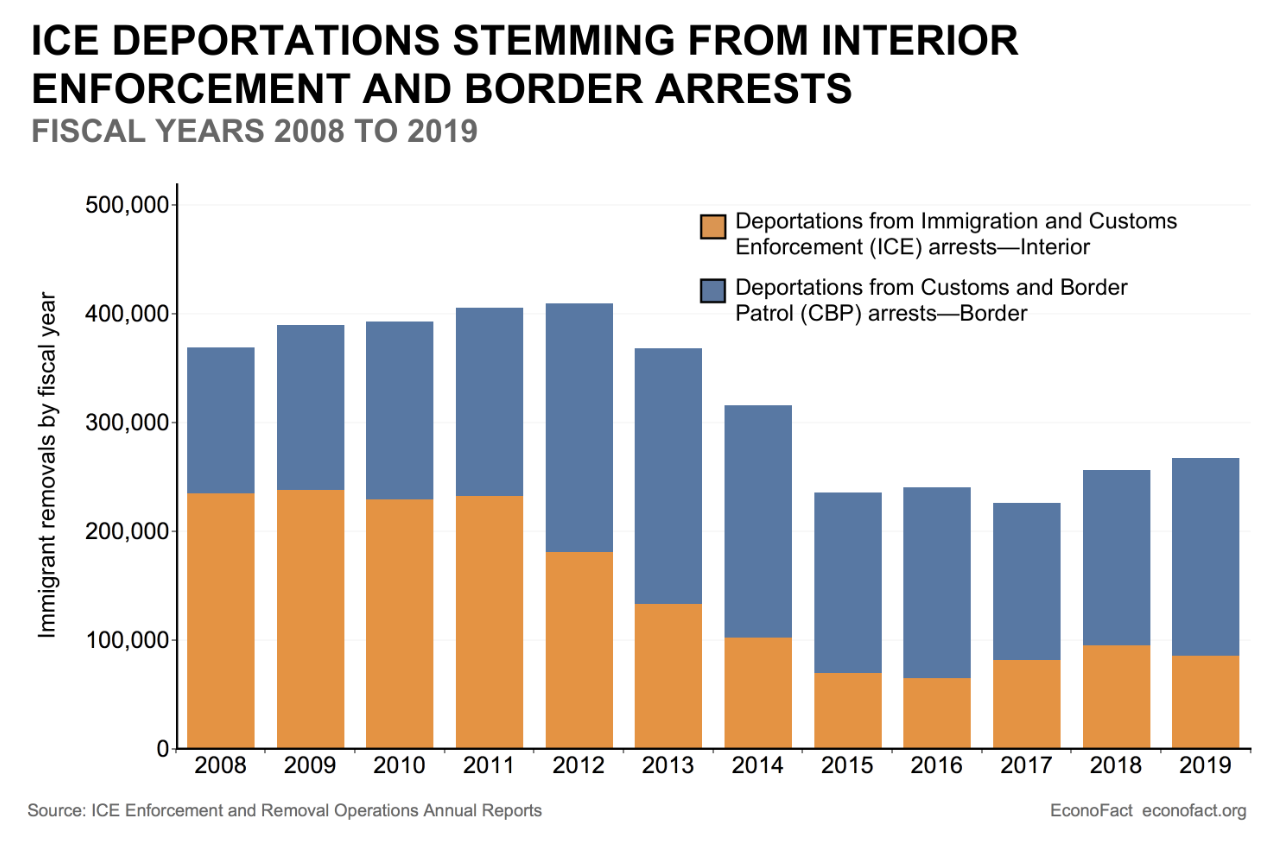
In addition, numerous people who have been deported will often re-enter, primarily out of desperation because it is either too dangerous to remain in their country of origin or the economic conditions are so grave that they would rather risk being arrested, detained and deported again if it means they can earn money to send home to family members. In fact the majority of undocumented immigrants that come to the US work their butts off – often two jobs – doing difficult work that doesn’t pay well, so they can support their families, a point that is well documented in books like Aviva Chomsky’s, “They Take Our Jobs!”: And 20 Other Myths about Immigration.
So, the MLive reporter doesn’t question the claims of the Republicans they cited in the story, instead, they would rather just provide a response from the Democrats, thinking this balances out the reporting. The article then quotes Rep. Hillary Scholten who says:
“My heart breaks for Ruby Garcia and her family as they grapple with this unspeakable tragedy,” Scholten said. “The individual who committed this heinous crime should be prosecuted to the fullest extent of the law. I’m continuing to push for bipartisan immigration reform that both secures our border and makes sure that individuals who come to our country are fully vetted to keep our communities safe.”
The bipartisan immigration legislation that Rep. Scholten is referring to is the Dignity Act, which GRIID has previously critiqued. The Dignity has some positive elements to it, but it also has an emphasis on enforcement, which Scholten spoke to. She said, “Crossings have increased, but so has enforcement. Border agents do have adequate technology resources, which means more enforcement.” Rep. Scholten discussed the need to enforce the existing US immigration laws, but failed to bring up the issue of why so many people are fleeing Mexico and Central American, to come to the US.
Scholten also talked about having bipartisan support for the Dignity Act, specifically with Rep; Salas from Florida. However, the Dignity Act is not Comprehensive Immigration Reform, nor does it address more structural elements of root causes of immigration, such as the US role in supporting military and trade policies in Latin America that have destabilized most of the region, along with the fact that more and more people are being displaced and forced to flee their homelands because of Climate Change. (See Todd Miller’s excellent book, Storming the Wall: Climate Change, Migration and Homeland Security.)
The MLive reporter then gives space to Rep. Huizenga, who states: “President Biden can act right now using the same executive action to improve border security that he used to open the border.” Again, this comment is not verified, even though it is completely not factual. The reality is that the primary difference between the Trump Administration’s immigration policy and the Biden Administration’s is rhetorical. In a post from last year, I methodically documented that the Biden Administration was detaining immigrant children and holding them in awful conditions, increasing funding for US Border Patrol, continuing to build the wall that Trump set out to build, along with many other policies that have been similar. Even during President Biden’s 2024 State of the Union address he referred to undocumented people as illegals, which is the same rhetoric coming out of the Trump camp.
Still no independent perspectives
The rest of the MLive article then continues to support the GOP claims by discussing at length one other case where an immigrant who had been deported came back to the US again and murdered someone in Georgia, along with more details on the Ruby Garcia murder. As I said earlier, there is no real correlation between undocumented immigrants and homicides in the US. Hell, even the libertarian think tank, the Cato Institute, which was founded by the Koch brothers, recently posted a study entitled, Illegal Immigrants Have a Low Homicide Conviction Rate: Setting the Record Straight on Illegal Immigrant Crime.
This is exactly why we need to have journalism that not only verifies the claims of those with political and economic power, we need journalism that investigates critical issues like US immigration policy.
Unfortunately, the MLive article does neither of what I am suggesting, instead they finished the article by including comments from a GOP candidate who is running against Rep. Scholten in the 2024 Election. GOP candidate Michael Markey, Jr stated:
“Inaction by Joe Biden and Hillary Scholten have left another innocent American dead at the hands of an illegal immigrant,” Markey wrote Monday on social media. “Washington is failing the American people and it’s time to disrupt the status quo. Under Joe Biden, every state is a border state.”
Once again, the MLive reporter doesn’t question or verify the rhetorical claims by the GOP candidate, thus leaving the public in the dark about what the actual record is of the Biden Administration or previous US administrations on the matter of immigration policy. Equally important is the fact that rarely does mainstream commercial media ever talk about the root causes of immigrants entering through the US/Mexican border. Those root causes have been because of the longstanding US commitment to support military dictatorships in Latin America, which has cause people to flee their own countries, US initiated trade policies like NAFTA and CAFTA, which has increase poverty in Mexico and Central America, and the serious issue of Climate Change, which has displaced thousands of people, making them climate refugees. These root causes and the history of US policy are addressed in a GRIID popular education document, which is based on an 8 week course on the history of US immigration policy that I offer.
Anti-Immigration hysteria in Kent County: Part I
 Within the last week there has been a great deal of hysteria over the murder of Ruby Garcia, a young woman who was murdered by a man who was in a relationship with the victim. The death of Ruby Garcia is a tragedy, but her death has nothing to do with the killer’s immigration status.
Presidential candidate Donald Trump was in Grand Rapids on Friday and he certainly used the opportunity to demonize immigrants and refer to them as predators. This anti-immigrant sentiment and jingoistic ideology that undocumented immigrants are destroying the US is not only patently absurd, it is simply not true. Numerous elected officials have weighed in on this issue, including members of Congress that represent West Michigan, the chair of the Michigan Republican Party and several Republican members of the Kent County Commission. There are essentially two separate immigration-themed issues at hand, both the death of Ruby Garcia and the recent designation of Kent County as a “sanctuary county” by a national anti-immigration organization. We’ll deal with the later in today’s post.
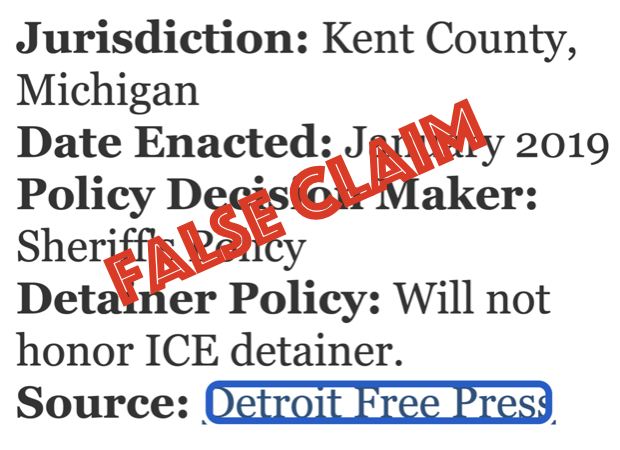
On Thursday, MLive ran a story with the headline, Kent County leaders deny ‘sanctuary’ claims after Mexican citizen charged with murder. This story is centered around the fact that the Center for Immigration Studies, a far right immigration think tank, gave Kent County a designation as a sanctuary county. The Center for Immigration Studies created a sanctuary cities map, which includes Kent County, with the following information shown here on the upper right, when you click on the yellow square over Kent County on the map. There is no blog post on the site that gives this designation to Kent County, so I’m not sure why the Republican members of the Kent County Commission responded to the claim.
However, the Republican members of the Kent County Commission did respond to the designation of by a sanctuary county with the following comments in the MLive article:
“As individual county commissioners, we want to set the record straight. Kent County is not a sanctuary county,” the Republican county commissioners wrote. “As the elected representatives for our respective districts, we will never support any policy that encourages illegal immigrants to make their home here.”
As someone who has directly been involved in making the area a sanctuary for undocumented immigrants since 1986, when my community house was a sanctuary for undocumented immigrants, and as someone who has been working with Movimiento Cosecha, an undocumented immigrant-led movement, the GOP members of the Kent County Commission are telling the truth. The truth being, that the GOP commissioners have actively opposed any welcoming policies for undocumented immigrants since Cosecha began working on a campaign to end the County’s contract with Immigration and Customs Enforcement (ICE) in 2018.
When Movimiento Cosecha and GR Rapid Response to ICE began organizing a campaign to end the ICE contract with the Kent County Sheriff’s Department, in June of 2018, they discovered immediately that the Kent County Commissioners were not interested in ending the contract. And to be clear, both the Republican and Democrats on the County Commission refused to end the ICE contract. In fact, the ICE contract with the Kent County Sheriff’s Department was ended by ICE in 2019, primarily because of all the negative attention that the campaign generated. All of this history can be read in a GRIID post from 2021, after some Democrats wanted to claim (falsely) that they ended the contract.
The MLive article did, however, provide some insight into the ongoing relationship between ICE and the Kent County Sheriff’s office, who also publicly refuted the designation of Kent County as a sanctuary city. The MLive article provides some background on the County’s policy of holding undocumented immigrants at the Kent County Jail until ICE decided what to do with them. When the Kent County Sheriff decided to end the policy to no longer honor federal immigration holds without an arrest warrant signed by a judge. This when the Center for Immigration Studies gave the county the sanctuary designation, but Kent County, as the Sheriff acknowledged, never ended their cooperation with ICE, and still hasn’t to this day. You can read the letter from the GOP Kent County Commissioners and the letter from the Kent County Sheriff’s office, both of which were included on a post by WOODTV8. What is instructive about the Kent County Sheriff’s letter, is the fact that they provided the number of people they turned over to ICE in 2023 (26) and the number they have turned over to ICE since the beginning of 2024 (10).
The irony of this story is that the far right think tank, the Center for Immigration Studies, essentially embraces the same ideological framework that the Kent County Republicans embrace, which doesn’t tolerate undocumented immigrants living in this area.
In Part II, GRIID will discuss the response to the immigration hysteria coming from members of Congress that represent West Michigan.
Michigan Congressman Tim Walberg says that the US should deal with Gaza like “we did with Hiroshima and Nagasaki”
Last week, during a town hall meeting with Congressman Tim Walberg, a Republican who represents the 5th District, he was asked about humanitarian aid to Gaza. Walberg’s response was harsh and revealed that he has any lack of understanding of US foreign policy.

“Yeah. Um — It’s Joe Biden’s the reason: We need to get humanitarian aid into Gaza. I don’t think we should, I — I don’t think any of our aid that goes to Israel to support our greatest ally, arguably maybe in the world, to defeat Hamas and Iran and Russia and probably North Korea’s in there, and China too, with them in helping — helping — uh — uh, Hamas. Um, we shouldn’t be spending a dime on humanitarian aid. It — it should be like Nagasaki and Hiroshima. Get it over quick.”
It is worth noting that in the 2022 Election, the single largest donor to his re-election campaign was the American Israel Public Affairs Committee (AIPAC), which contributed $25,000 to Walberg. Other notable contributors, specifically the DeVos family, in the 2022 Election were:
- RDV Copr. – $23,200
- Windquest Group – $11,600
- Amway/Alticor – $7,000
- Amway Corp. – $5,800
- Dp Fox Ventures – $5,800
- Pamella Roland (wife of Doug DeVos) – $5,800
- Jerry & Marcia Tubergen Foundation (Jerry Tubergen is the CEO of RDV Corp.) – $4,750
This means that the DeVos family and their associates, collectively contributed $39,500 to a man who thinks that the current Israeli campaign of genocide that is happening in Gaza is not enough. Walberg believes, with AIPAC and DeVos funding, that the US should deal with Gaza the same way the US dealt with Hiroshima and Nagasaki…….drop a nuclear bomb.
Not only do these words from Rep. Walberg reflect a deep disregard for human life, it demonstrates that he doesn’t care about the likely consequences of sending a nuclear weapon to annihilate Gaza. Such an action on the part of the US would likely result in nuclear war with other nuclear powers.
To watch/listen to a video of Rep. Walberg’s comments, go the this link.
Deconstructing Memes: Just because US Presidents aren’t indicted doesn’t mean they didn’t commit crimes
 A meme can be an excellent way to communicate powerful messages with few words and sometimes images. At the same time, a meme can oversimplify or distort historical facts. GRIID will now regularly deconstruct memes, in part because memes continue to increase in number on social media, but also because they often engage in misinformation.
The meme I want to look at today includes a photo of former US Presidents George H.W. Bush, Barack Obama, George W. Bush, Bill Clinton and Jimmy Carter. The tag line for the meme states, “Five Presidents, 31 Years, Not a Single Indictment.” Clearly, the meme is meant to communicate the idea that these 5 US Presidents were never indicted for crimes, but former President Donald Trump has been.
It is true that the 5 US Presidents in the meme were never indicted, but that doesn’t mean that they didn’t commit crimes or engage in morally repugnant behavior. What is criminal in the US can be misleading. For instance, if a US President decides to launch a nuclear strike it would be legal. If a US President provides weapons to a dictatorship or a country that is committing war crimes or genocide, that will also bring no indictments. Subjecting huge numbers of US residents to poverty is legal, as is mass incarceration, providing large subsidies to fossil fuel companies while the planet is warming is legal, and abusing undocumented immigrants and locking them in detention is legal. Just because something is legal doesn’t mean it is right.
Now, in case anyone thinks I am defending Trump, let me be clear that I consider Donald Trump to be a despicable human being and someone who engaged in policy decisions that did tremendous harm to countless people. Having said that, it is worth looking back at some of the policy decisions of the 5 US Presidents in the meme that would either be criminal under international law or caused tremendous harm to countless people. Mind you the following are just a few samples. I will do the run down in chronological order.
Jimmy Carter
- Supported the Somozan dictatorship in Nicaragua until the Sandinistas revolution in 1979
- Maintained the blockage on Cuba, which caused tremendous economic hardship
- Supported the illegal CIA activities in Angola
- Supported the brutal regime of the Shah of Iran
- Salvadoran Archbishop Oscar Romero sent a letter to Carter demanding that he not send more weapons to El Salvador, but humanitarian aid instead. Just weeks after Romero sent that letter he was shot dead by Salvadoran soldiers who has received training at the US Army School of the Americas.
- Carter did little to respond to the beginnings of the counter-offensive against the gains of the Civil Rights and Labor movements.
George H.W. Bush
- Was complicit in the Iran/Contra Affair
- The Bush Administration continued the Reagan Administration commitment to providing $1 Million a day to El Salvador for their bloody counter-insurgency campaign that killed some 80,000 Salvadorans between 1980 and 1990.
- Invaded Panama in 1989 and used new bombs that were dropped on civilians
- Invaded Iraq under false pretenses in 1991, killed Iraqi combatants and civilians in large numbers. The US military also targeted key parts of the Iraqi infrastructure, followed by imposing brutal sanctions on Iraq.
- Bush I negotiated and signed the North American Free Trade Agreement (NAFTA), which would have devastating effects on workers and the environment.
- The Bush Administration was complicit in the financial crimes of the Savings & Loans scandal.
- Police brutality was caught on tape in the 1991 Rodney King case, which led to riots. The Bush Administration’s response to to increase funding for the police.
Bill Clinton
- Clinton maintaining the sanction on Iraq throughout the rest of the 90s, resulting in at least 500,000 Iraqi children dying. When asked about this, Clinton’s Secretary of State Madeleine Albright said of the 500,000 child deaths in Iraq, “We think it was worth it.”
- The US Military committed war crimes during the Kosovo war.
- Clinton gave orders for a missile strike in Sudan, blowing up a pharmaceutical plant, which denied thousands access to vital medicines.
- US military bases expanded in Colombia under the claim of fighting the War on Drugs, but it never resulted in a reduction of drug trafficking
- Clinton expanded World Bank and IMF austerity measures, which was resisted at the 1999 Battle in Seattle.
- Clinton ended welfare as we know it with the Personal Responsibility and Work Opportunity Reconciliation Act of 1996.
- Clinton signed the Crime Bill, which gave the police more power, more money and led to an explosion in the Prison Industrial Complex and mass incarceration.
George W. Bush
- 9/11 gave the US military a green light to start an invasion and occupation of Afghanistan in 2001, which lead to a 20 year occupation and thousands of Afghani and US soldier deaths.
- In March of 2003, the US invaded and occupied Iraq, leading to over 1 million Iraqi deaths on the bogus claim that Iraq had WMDs.
- The US military was involved in the ouster of Haitian President Aristide in 2004/2005 which further destabilized Haiti.
- Under Bush the US Congress adopted the Patriot Act, which criminalized public dissent, saw the interrogation and imprisonment of thousands of Arab Americans and Muslims in the US, along with increased high tech surveillance of US residents.
- Institutionalized racism was on display when President Bush failed to act quickly and provide adequate resources to people, especially Black people after hurricane Katrina. In addition, the Bush administration used this natural disaster to further privatize public resources and public schools.
- The beginning of the economic crash of 2008-2009 began under Bush because of continued deregulation of the financial sector.
Barack Obama
- The US used cruise missile in Yemen.
- The US bombed Libya, removing Qaddafi and killed civilians.
- The Obama Administration engaged in a massive drone assassination campaign against supposed terrorists, which also resulted in a large number of civilian deaths.
- The Obama Administration was complicit in the military coup in Honduras.
- The number of police killings of Black people increased dramatically during the Obama years, which led to the birth fo the Movement for Black Lives.
- The wealth gap in the US grew substantially, which led to the Occupy Wall Street movement during the Obama years.
- The Obama Administration chose to bail out Wall Street instead of bailing out main street, especially those that were conned in the housing finance scandal, which disproportionately impact Black and Brown families.
- The Obama Administration deported 3 million undocumented immigrants.
Lastly, all 5 of these US presidents provided $3 billion a year in military aid to Israel, along with diplomatic support for the illegal Israeli occupation of Palestine.
Sources used:
US Military Interventions from Wounded Knee to Yemen https://sites.evergreen.edu/zoltan/interventions/
National Security Archive https://nsarchive.gwu.edu/
Killing Hope: U.S. Military and CIA Interventions Since World War II https://williamblum.org/books/killing-hope/
School of the Americans Watch https://soaw.org/home
In the Name of Democracy: American War Crimes in Iraq and Beyond, by Jeremy Brecher
Obama drone assassination policy https://theintercept.com/drone-papers/the-assassination-complex/
https://www.citizen.org/article/naftas-20-year-legacy-and-the-fate-of-the-trans-pacific-partnership/
https://jacobin.com/2016/08/welfare-reform-clinton-twentieth-anniversary-poverty/
Once again the Biden Administration gets bipartisan support for a massive US Military Budget
 Last weekend President Biden signed off on the FY2025 spending bill, which totaled $1.2 Trillion dollars.
Michigan Senator Gary Peters released a Media Statement on March 25th about all the money he secured for Michigan in the FY2025 spending bill. What is instructive about the statement from Sen. Peters is the fact that not only is military funding listed first, but there are more military relating funding items than any of the other categories – education, environment, economy, health care, child care or government efficiency.
The statement from Senator Peters’ office with the emphasis on military funding for Michigan is a microcosm of the $1.2 Trillion FY2025 budget. According to the National Priorities Project, 69% of the FY2025 budget will fund the military, Homeland Security and Veterans Affairs, while a meager 31% goes to fund everything else. Just remember what Dr. Martin Luther King Jr had to say about the US budget priorities in his famous Beyond Vietnam speech, “A nation that continues year after year to spend more money on military defense than on programs of social uplift is approaching spiritual death.”
The total US military spending in the FY2025 budget can be broken down to:
- $850 billion for the Pentagon
- $34 billion for nuclear weapons
- $11.6 billion in international military aid (so far)
- $62 billion in non-emergency funding for the Department of Homeland Security, including $9.3 billion for Immigration and Customs Enforcement (ICE) and $17 billion for Customs and Border Protection (CBP)
- $113 billion for Veterans’ Affairs Medical Programs.
The 31% that is left over is being divided up between education, environmental, public assistance, medicaid/medicare, transportation and all the other non-lethal programs. What this means is that militarism is prioritized over things like funding public education, the massive housing crisis in the US, the climate crisis, the health care crisis and other social issues that the majority of Americans are facing.
Both Senators Gary Peters and Debbie Stabenow voted to use the majority of US taxpayers money for militarism then on social programs, as did Rep. Hillary Scholten and the majority of the Michigan members of Congress. Remember, it is never a question of there not being enough money to fund social housing, climate justice, immigration justice or public education, it all comes down to a matter of priorities. Hillary Scholten, Debbie Stabenow and Gary Peters all chose militarism as their first priority over everything else.
On Tuesday, both MLive and Crain’s Grand Rapids posted stories about the additional development projects associated with the downtown Amphitheater and the Soccer Stadium.

Grand Action 2.0, the development entity that is run by and serves the interests of the Grand Rapids Power Structure, will be pitching their new development projects at the Brownfield Redevelopment Authority meeting on Wednesday, March 27. I want to look at the Agenda Packet for that meeting, but first I want to look at how both MLive and Crain’s Grand Rapids reported on the Grand Action 2.0 announcement.
The MLive article is headlined, High-rise towers would bring 735 apartments to amphitheater, soccer stadium sites. The article begins by stating:
Two residential and commercial towers, containing 735 apartments, retail and parking, would be built next to Acrisure Amphitheater and the proposed Grand Rapids soccer stadium under plans being crafted by Grand Action 2.0 and the Downtown Development Authority.
The only people sited in the MLive piece is someone from the City of Grand Rapids and the head of Downtown Grand Rapids Inc. The article is upbeat in terms of the prospects of both apartment complexes and how they can continue to promote “economic development.” However, the article never talks to residents in the area about the impact it may have during the construction time and the having 735 new apartments in that area.
The Crain’s Grand Rapids story’s headline is, Skyline-changing mixed-use projects envisioned with Grand Rapids amphitheater, soccer stadium. Their article is shorter than the MLive piece, partly because no one is cited in the article. The Crain’s piece is also framed as positive news, with no concerns reflected in the story.
MLive kept referring to a new city memo about these new development projects, but they never source where the memo can be found. I suspect that the “memo” the article refers to is simply part of the Brownfield Redevelopment Authority meeting for March 27, linked here, beginning on page 47.
Grand Action 2.0 submitted information about these new development projects to the Brownfield Redevelopment Authority, simply because they are hoping to benefit from the Transformational Brownfield Program, which will increase the amount of tax that can be recaptured and reimbursed to developers. Remember, the developers are connected to the Grand Rapids Power Structure and will benefit financially from the tax reimbursements.
Then there is the issue of what the cost of these 735 apartments will be. The Brownfield Redevelopment Authority Agenda Packet does mention that a certain percentage of the apartments will be set aside as more “affordable”, even though Grand Action 2.0 never really defines affordable, nor does it list what these proposed apartments will actually cost. It is important to remember that the term affordable is purposely vague and it is dictated by those who are part of the Capitalist Class, not the masses of people who make up the working class.
It is important to note that this is the first time that people who live in Grand Rapids, specifically people who live near the Soccer Stadium – the near westside residents, and the people who live just south of the Amphitheater – those in the Grandville Avenue corridor and the Black Hills neighborhood – are just now hearing about these new development projects.
Those with economic and political power will always inform people only after they have spent months, even years developing a plan before they go public. This means the public only gets to give input at certain city meetings, which are ultimately irrelevant, since those with economic and political power have already met with and discussed their plans with Grand Rapids City officials. This process is called the Capitalist Class two step, where they don’t inform the public, but they use public money for privately owned projects, thus increasing their wealth and conning us into believing they do this so we have more entertainment options. In ancient Rome they simply called this, Bread and Circuses.
Medicare Advantage Exposed
Editor’s Note: This article was written by Jack Prince, a retired teacher who lives in Grand Rapids.
Medicare Advantage is neither Medicare or an advantage! It is not a social program but rather a private insurance plan making billions of dollars for private insurers. Medicare Advantage (MA) is a scam covered and disguised by a deceptive moniker devised and perpetuated by conservative corporate cohorts with George W. Bush. Bush knew he had to hide his maneuver to privatize Medicare so he used the same trusted name Medicare coined in 1965 for socialized care with the added descriptor Advantage for private insurance! That sleight of hand was sufficient in convincing millions that Medicare Advantage is just medicare improved! When in actuality it is private insurance with the bill paid by medicare in an incredible fashion unknown by most Americans. Once a person is enrolled in an Advantage plan it’s difficult to undo and if they remain for over a year they are not able to return to regular Medicare with a Medigap plan at all.
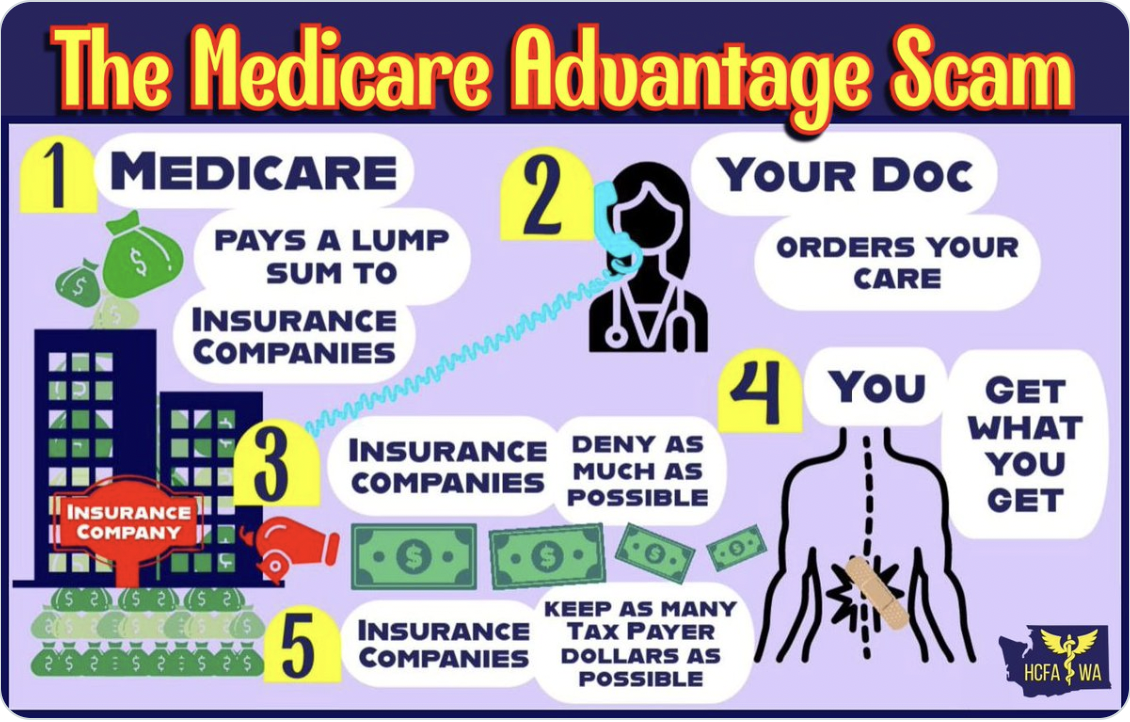
Once trapped here are some of the disadvantages to MA:
1.Unlike Medicare doctors must get approval from the insurer before being able to treat their MA patients.
2. The private plan many times has inadequate networks of doctors, hospitals and essential facilities. This stands in severe contrast to actual Medicare where nearly all doctors and hospitals are available to patients without referral
3. When a patient knowingly or accidently sees a doctor or or goes to a hospital out of network they will pay thousands of extra dollars out of their pockets.
4.Even worse the private plans have networks that typically only cover the patient ‘s home area meaning doctors and hospitals including centers of excellence outside of the patient’s home area are out of network.
5.People enrolled in MA are not allowed to buy supplemental coverage to reduce out of pocket expenses, unlike original Medicare enrollees. That can mean additional payments as much as 7000 to 8000 dollars per year.
6. MA consistently has been known to refuse claims payments for a plethora of reasons. 7. The excessive cost to taxpayers because of the overpayments by the government to a private program that costs 6 -7% more to operate than traditional Medicare. (Stop the Medicare Advantage Scam before Medicare is dead Medium 8/5/22 Taxpayers Cost)
Then President George W. Bush with willing congressional Republicans and fellow neoliberal Democrats created the MA racket in 2003.Since that time it’s estimated that over a trillion dollars of taxpayer money has landed needlessly in the pockets of private insurers that could have replenished the actual Medicare fund and ensured its longevity. “Just the overcharges happening now with MA are costing Americans over 140 billion a year which is more than the entire budget for the original Medicare Part B and D program. These ripoffs that no one seems to have an interest in stopping are draining the Medicare trust fund while trapping gullible seniors exposed to 24/7 MA television ads into the private program where they are often denied life-saving care! It must be remembered that real Medicare pays the claim the minute they’re presented. MA however has a person in a corporate cubicle somewhere who delineates what charges get paid. MA gets paid a calculated amount of money each year in a lump sum of tax money before any medical service is even rendered to the people enrolled in MA. Payments to MA plans boosted Medicare Spending by 7 Billion in 2019 alone and have increased measurably since then! The federal government spent 321 dollars more on each person on MA in2019 than they would have if they had been on Traditional Medicare! MA spending is expected to rise to 664 billion per year by 2029 doubling what it is presently! Imagine the federal government giving a private grocery store millions of dollars the first of January for a specific group of people to be doled out throughout the year and the private grocery can keep any money left over at the end of the year! To emulate this analogy with MA the grocery executives would send out so called concerned workers to question the hunger and eating needs of the designated group then inflate their findings to request more money from the government! Next they would reduce the quality of food for their own profit while reducing their outlets of distribution to limit consumer accessibility! Lastly they would simply refuse to give food insisting it’s not really necessary recommending gym membership and fasting. With the profits realized with such a scam the grocery would use some of their money to advertise for increased membership to the specific group using bodybuilders and famous athletes to espouse their lies! They would saturate the media i.e the Television with their great offer non stop 24/7 for months all the while knowing that the less you would eat the more they would make! I personally experienced an MA visitor for a health check in my home who then exaggerated negatively my health evaluation to increase the government’s pre-payment to MA. It is crucial to realize MAs real concern is for the profit and wellbeing of their shareholders and CEOs while Actual Medicare does not seek a financial profit for anyone!
These tactics and more are elucidated in the doctors group Physicians for a National Health Program (PNHP) which has recently published a shocking report on the extent of the MA ripoffs which greatly impacts individual customers and Medicare itself!
Hospitals and Doctors Refuse to honor Medicare Advantage
If you consider treatment when on MA they will consistently second guess your decision and try anything to intimidate you into paying out of pocket! They are infamous for urging people considering hip or knee replacement to only get therapy or exercise more to escape surgery. Many times they will simply refuse payment after a procedure to see if you will file a complaint against them. As a result hospitals and Dr. groups across America are beginning to refuse to take Medicare Advantage Patients. (Hospitals are dropping Medicare Advantage plans left and right, Beckers Hospital Review 12/14/23). Scripps Health based in California had cared for over 30,000 people in MA and recently notified their members that Scripps will no longer offer medical services to them unless they pay out of pocket or go back to real Medicare. Scripps made their decision because 75 million worth of services their physicians had recommended to their patients were turned down by MA! BTW Scripps provided the care and were stuck with the bill!
Likewise the Mayo Clinic has warned its customers in Arizona and Florida that they won’t be accepting Medicare Advantage anymore! ( Mayo Clinic warns it won’t Take Most Medicare Advantage Plans (Medpage Today- 10/20/2022).
Complicit Politicians
One plausible reason this National insurance fiasco is allowed to continue unchallenged is because of the amount of Politicians on the take from lucrative private insurance and systemically allowing them to shear the middle class. The Pew research center conducted a comprehensive research poll and unequivocally discovered that 70% of Americans felt the US economic system unfairly favors the economically powerful! Gandhi stated that the measure of a society is how it treats its weakest members. Many are realizing the American economic reality is just the antithesis of Gandhi’s vision. Ironically the American Public while voicing their sense of economic injustice miss corporate malfeasance and its collusion with the political parties. They have not remotely grasped the immense Elephant in the room theft by Medicare Advantage or how it works! It is pertinent to realize that over one third of congressional members hold significant health-care related financial assets while two thirds of congress members cashed Pharma campaign checks in 2020. (State news .com 6/9/21)
Advertisement Deception
A clear explanation of the exploitation can be traced directly to expensive hired Media deceptive and manipulative advertising for the misnamed MA! If you have been anywhere near a television or read newspapers and magazines you can recall a non-stop bombardment of the last few months of health insurance ads which were devised for the most part to transition Medicare members to MA. “Paid corporate marketing skews heavily toward the indoctrination of MA, which is more than twice as profitable for private insurers than any other type of coverage they offer. Incredibly 9 out of 10 TV ads that ran last fall explicitly focused on MA. (Kaiser Family Foundation 10/16/23). Reminiscent of gambling ads most of those ads featured celebrity spokespeople touting the plans supposed benefits”! ( Forbes 2/21/24).
Personal experience
As a retired educator for 30 years of service my health insurance during my career was always crucial to me especially with five children! I carefully monitored my coverage and at retirement in 2014 when I was 65 I enrolled in original Medicare and fully expected to remain there for life. By accident in 2024 in a phone conversation with the Michigan ORS I discovered that I was taken from Medicare in 2016 and placed in MA along with every state worker without any notification. I have since talked to other friends who worked at ATandT, unionized carpenters, and other private workers who experienced the same transition without any warning! The ORS, MEA, MARSP nor Democratic party were unable to explain to me why no notification was given to the state workers in this state! I met Senator Gary Peters at an Alma College football tailgate party last fall. We had friendly conversation as we are both Alma Alumni but when asked about the forced placement of retirees here in Michigan and nationwide into MA his expression changed pleading no knowledge of the situation. I asked what he thought of the privatization of any social program including Social Security, the Post Office, Public Schools or more specifically Medicare and did he recognize the conservative age long penchant to do just that. He also claimed to be unaware of the Democratic Mayor from NewYork Bill de Blasio who attempted to also switch hundreds of public workers to MA but got caught admitting he was just trying to save the city money!
New York City the Perfect Prototype
There is a stark contrast between the thousands of public workers in NewYork with those in Michigan as they experienced the same switch to MA! Amazingly the NewYorkers stormed city hall in protest, sued the city and won a ban by a New York Supreme justice to stop MA! The lack of protest here in Michigan or even cognizance to the issue is telltale and can be traced to a constipation of information not emanating from the Unions and the Democratic party which were traditional expected sources of help to workers. It is a historical fact that in July of 2023 hundreds of retired New York city workers physically stormed city hall and challenged the plan to change their health plan to MA! That secretive plan would have impacted over 250,000 municipal workers. “ A stunning move by the city with political help and corporate coaxing to change the health benefits of hundreds of thousands of retired workers has prompted them to claim they are being forced to accept an inferior and costly plan called Medicare Advantage that could bankrupt them in their golden years. ( New York CBS New York) In addition, thousands of angry emails flooded Mayor Bill de Blasio’s office such as the following: “ I am angry, I feel it is a betrayal, 30 year city worker William Shenton said! Shenton pointed out the real catalyst for the switch maintaining it was a nexus with the Mayor and city unions to save millions for both. Shenton’s wife Susan suffers from a chronic lung disease and discovered that MA would only pay for a fraction of his wife’s needed medicine. ( Irate retires inundate CBS2 with emails 10/14/21). Rose, a retired teacher’s email stated: I can no longer get the needed cancer treatment from my doctors quickly because the new MA program is requiring pre-authorization which delays my treatment by a week, if I can get it at all! It was a backroom deal in a smoky room fumed NY retiree Loraine Motola ( CBS NY).
An actual ban to Medicare Advantage
The organized protest in NY resulted in a Manhattan Supreme Court judge permanently banning the MA as a substitute insurance for NY city retirees. ( Judge permanently Bans NY City from executing Retire MA plan MMIT Network 8/17 /23). In his decision the judge Lyle Frank ordered the city “ permanently from requiring any City retirees, and their dependents from being removed from their current health plans, and from being required to enroll in any MA plan”.
Imagine an organized protest of that magnitude from NY happening here in Michigan. Would that not be an appropriate action for the MEA? Remember however that the Neoliberals in NY were able to push their privatized health initiative with the full agreement and support of the Municipal Labor Committee which consists of 102 public sector unions in NY and voted for the Medicare switch in March of 2021! The democratic party and sister unions evidently lose little sleep over any privatization!
Is Anybody Fighting?
Unfortunately there are few political leaders fighting against MA! Bravely there are a few and their actions are under-reported and obfuscated but their stance is nonetheless correct and
should be supported and espoused! A dozen U.S. senators and 3 witnesses sharply criticized MA marketing schemes and lack of coverage during a finance committee hearing in October of 23. Recently Senators Markey, Warren, and Brown joined in urging HHS and CMS to protect Seniors, and hold insurance companies accountable for abuse in MA! Senator Mark Pocan may be the most aggressive advocate for Medicare continuance as he has challenged the legality of private Insurance companies selling a private plan pretending its Medicare. Such advocacy against Medicare’s enemies is scarce and the clock is close to midnight especially when reviewing the recently released conservative Project 2025. While conservatives have always been opposed to most social programs, they have stated unequivocally in Project 2025 their intentions to make MA the default enrollment option for all 65 year old retirees! Simply put, all seniors at 65 would automatically be placed into MA. No one doubts the Trump administration would enact the components of Project 2025 if re-elected!
Anti-Social Program History
G.W. Bush was just another run -of- the- mill right wing ideologue in a line of conservative anti social program politicians dating back to 1933 when the Social Security attacks began. However he had a specific crusade his entire political career which he boasted about endlessly. His forte was to end Social Security and Medicare! When Bush left office he claimed his greatest regret was not to have privatized Social Security! He knew he had privatized Medicare with no regrets.
Ronald Regan, another member of the conservative litany changed his party affiliation from Democrat to Republican because of his repulsion for SS and Medicare. Republican Mike Lee vowed at a campaign rally in 2010 that he would phase out SS and Medicare and ranted he would pull them up by the roots and get rid of them. Today we have an undesirable union and bipartisan proclivity from both parties to favor wealthy corporate interests called neoliberalism. Regan ran on a Mantra of privatization and deregulation and today we see the battle lines with all remaining public institutions and social programs to supplant public with private! To fool us Bush signed an act which contained the MA scheme on December 8 2003 cleverly titled The Medicare Improvement and Modernization Act. Equally revealing he pretended to be concerned with the well-being of SS while telling his base he would end it! An example of his real Social Security appreciation manifested when he withdrew 1.37 trillion from SS to pay for his tax cuts for the rich and never repaid it!
Stand and Fight
Medicare was initiated on July 30 1965 and for 59 years has protected the health and welfare of millions of Americans. It has been estimated that just between 1999 and 2013, 300,000 American lives were saved by its existence. Life expectancy also increased by 5 years from its inception to 2018! One of the greatest social aspects of the program is that it was created for people over 65 regardless of income and medical history! The humane aspect of Medicare is its designated care for the elderly at their vulnerable age restoring personal health and dignity. It is difficult to comprehend how anyone could try to end a plan intended for the elderly and disabled offering help to those unable to afford the high cost of private coverage. We must stand against their damaging efforts to ensure the continuance of Medicare for our children and all Americans!
Image used in this article is from Health Care For All-Washington
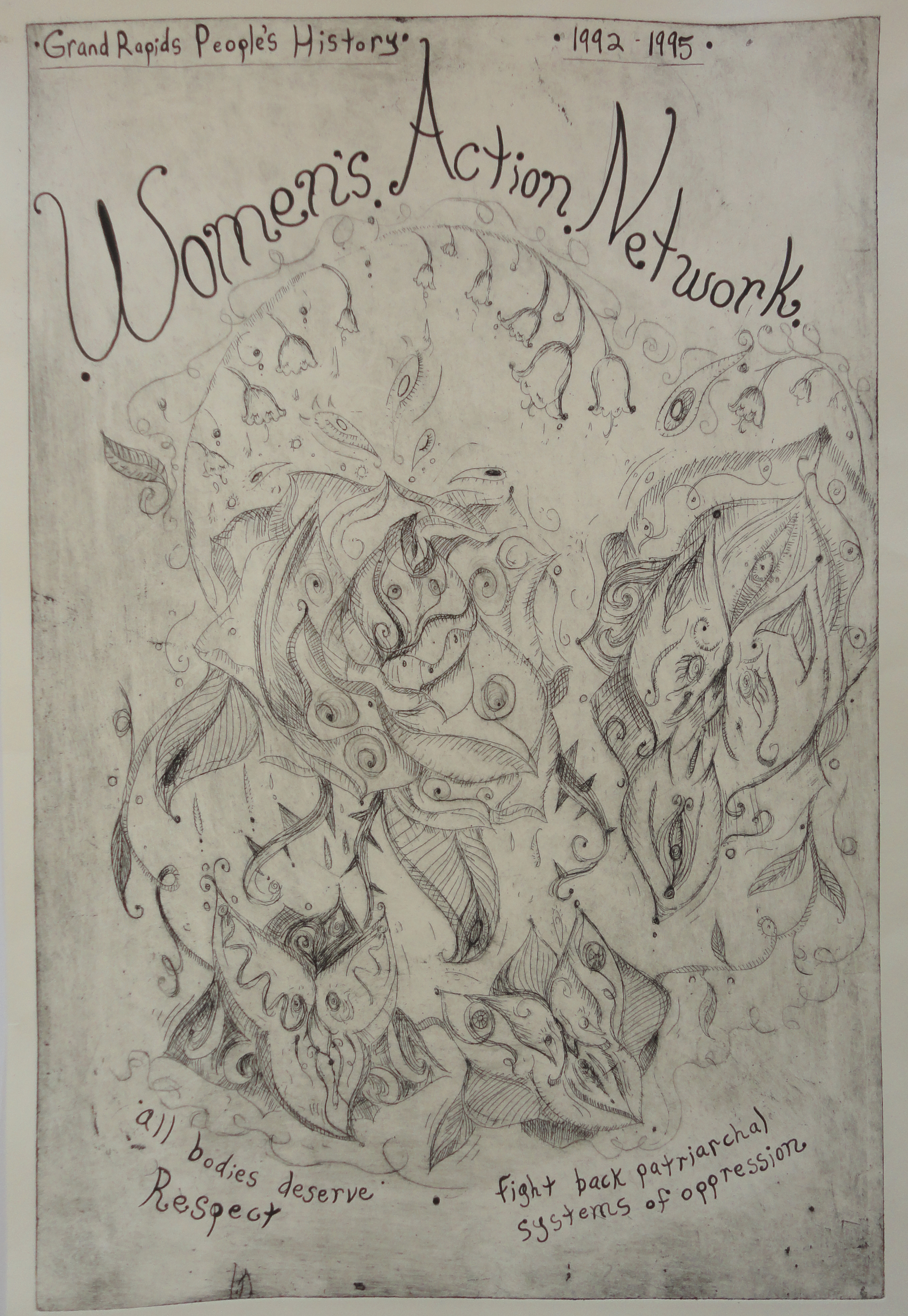 It’s Women’s History month and one good way to celebrate it is to look back at the incredible work that women’s movements have done in Grand Rapids. This is a three part series, focusing on the women’s suffrage movement, the movement for reproductive justice, and the fight against sexual assault and objectification of women. This 3 part series is taken from my book, A People’s History of Grand Rapids.
Womyn’s Action Network
In recent years there has been a rallying cry to fight “The War on Women,” in reference to national and state efforts to diminish legal protection for women around reproductive rights and rape. The organizing has mostly been inside the electoral framework of fighting legislation and supporting or opposing political candidates. While electoral politics is one strategic approach to fighting for the rights of women and non-men, it is certainly not the only one.
In the early 1990’s, four Grand Rapids women – Karen Henry, Sister Jackie Hudson, Marge Kuipers and Sue Ablao – created the Womyn’s Action Network (WAN). (Note: the spelling of “womyn” with a “y,” was one common in feminist circles at the time, to avoid the sexism in the standard spelling, which contains the word “man.” Though the founders of WAN were trans-inclusive, as time has progressed, that spelling of “womyn” is now often used by anti-trans and often white feminists who deny that trans women are women and/or who feel that including trans women invalidates the fight against patriarchy.)
From the organizational brochure: “The Womyn’s Action Network works to eliminate violence against women and oppression of women through self-empowerment and the resurrection of womyn’s voices.” WAN came together in 1992 and began their feminist work with an event that satirized media representation of women.
The First Annual Media Bash was an awards ceremony featuring both misogynistic and empowering images of women in print and broadcast, all in order to grant the Dick and Jane Awards, based on the patriarchal 1950s schoolbooks for early readers.
- The Dick awards were given out to the ads that were “the most degrading, demeaning and disgusting,”
- The Jane awards were given to “those ads that portray us in the most positive and affirming ways.”
Marge Kuipers had this to say about the Media Bash:
Especially memorable was WAN’s “Dick & Jane Awards” which took place at the temporary UICA building on Monroe Avenue. The room was packed with an enthusiastic assembly of women (along with a few men) who hooted, hollered, and hissed at the images that were projected on the screen of the advertising industry’s exploitation of women. The ‘Dick Award’ was presented to the ad the audience considered to be the worst of the worst.
Karen Henry, one of the group’s founders and an Arab-American woman, understood the importance of critically looking at representation in the media. The Media Bash was a creative way to reframe gender representation, which often normalized the sexualized objectification of women and girls.
 In addition to the Media Bash, WAN organized or participated in Take Back the Night marches, challenged sexist local radio billboards (some from 94.5 WKLQ Radio), spoke on campuses, facilitated forums, and created a Women Now Forever Scholarship. The scholarship was for women attending or wanting to attend college and gave preference to women of color as well as lesbian and bisexual women.
WAN was deeply committed to confronting sexual assault. In the early 1990’s, they co-sponsored a talk by the feminist author Kay Leigh Hagan, who had just published a book entitled, Fugitive Information: Essays from a Feminist Hothead. During Hagan’s talk, she addressed how the Take Back the Night Movement was originally created in the 1970s by those who had experienced sexual assault and rape. In the early years of the Take Back the Night marches, they were designed to be public and to raise a ruckus. Often these early marches would go through parts of the community where sexual assault was committed, or in the neighborhoods of known perpetrators. Hagan made the point that as the event became national and international, these marches had become less radical, turning into candlelight vigils rather than a public denunciation of violence against women.17 (In many cities, Take Back the Night now includes all survivors of sexual assault, including trans individuals and men.)
In addition to the Take Back the Night actions, WAN sponsored the Clothesline Project locally. The Clothesline Project was both an art installation and a mechanism for sexual assault survivors to tell their story by painting on a t-shirt, with images or words. These shirts would be displayed on a clothesline to provide an opportunity to inform the public and to allow friends, family and community members the chance to honored the lived-experience of those who have been sexually assaulted. The Clothesline Project was displayed at art spaces, like 10 Weston, run by Nancy Lautenbach.
The Womyn’s Action Network was based on an inclusive and cross-issue framework. WAN members participated in:
- the annual Pride event in Grand Rapids,
- World AIDS Day,
- anti-war activities,
- community-wide anti-violence campaigns.
The organization was committed to looking at issues through a holistic race/class/gender lens, which included, according to their literature:
- challenging corporate-defined beauty,
- fighting femicide, rape, battering and harassment,
- addressing health issues like breast cancer, menopause, and menstruation.
Though WAN survived for only three years, from 1992 – 1995, they accomplished an amazing amount of work in that brief time and inspired many in Grand Rapids to find and define their voices to fight back against patriarchal systems of oppression.
 Grand Rapids Institute for Information Democracy