GRPD once again demonstrates their commitment to assisting ICE and those profiting from ICE abductions in Grand Rapids
On Tuesday, around midday, GR Rapid Response to ICE showed up to the 517 Ottawa ICE office. This was because they received a call about ICE abductions and the 517 Ottawa office is where ICE takes people to process while they are locked up in a holding cell ICE has on site.

Movimiento Cosecha was also on site and filmed part of what happened. Here is the video link. The first thing you see in the video is a white van pulling out of the ICE office garage and the white van is a GEO Group-owned vehicle to transport immigrants picked up by ICE to the North Lake Processing Center in Baldwin, Michigan, which is owned and operated by the GEO Group.
People who have been trained through GR Rapid Response to ICE stood in front of the GEO Group van, since they were transporting someone ICE had abducted. You can GRPD cops on the scene about 1 minute into the video, which means ICE likely contacted the GRPD to assist them, in this case to prevent people from blocking the GEO Group van.
This is just the latest example of how the GRPD has been consistently cooperating with ICE and in this case the GEO Group, which profits from the detention of immigrants that ICE abducts from our community.
The fact that the GRPD assisted ICE/GEO Group by preventing people from trying to stop immigrant family separation completely contradicts what Mayor LaGrand and the GRPD Chief of Police have been saying since January of 2025 when Movimiento Cosecha began their campaign to get the City of Grand Rapids to adopt six sanctuary policies. In fact, from where I sit, this recent GRPD collaboration with ICE/GEO Group signifies to me that Mayor LaGrand and the GRPD Chief have been lying to Cosecha, GR Rapid Response to ICE and the community at large.
At about 1:40 into the video you can see the number of ICE agents present while they stood inside the 517 Ottawa ICE office garage to watch the GRPD assist the GEO Group van make a get away. The harsh reality is that this is happening on a regular basis in Grand Rapids. The sad thing about this is that people would rather spend their energy campaigning for politicians than actively resist ICE from abducting immigrants in this city.
Follow the Money: Campaign Contributions from members of the Grand Rapid Power Structure during the 2026 Election cycle
If you read the GRIID blog on a regular basis you know that I write about the Grand Rapids Power Structure on a fairly regular basis. Hell, I even do a GR Power Analysis workshop that organizations can have me do.
My GR Power Analysis workshop covers numerous aspects of the Grand Rapids Power Structure, which includes looking at their wealth/assets, their involvement with organizations that have similar ideological interests, how they use their foundation funds, how they tend to embrace deeply conservative religious beliefs, their interest in shaping social and economic realities, how they infiltrate and use non-profits, and how they use their wealth to influence elections. For this post I want to focus on how the members of the Grand Rapids Power Structure use their wealth to influence elections.

I am limiting the scope to just Michigan in terms of how the GR Power Structure uses their wealth to influence elections. Using data from https://www.transparencyusa.org/mi/contributors, which includes data on the 2026 election cycle through 3/31/2026, here are the names and the dollar amounts that members of the Grand Rapids Power Structure have contributed so far.
- Daniel DeVos – $2,962,075
- Pamella DeVos – $2,508,325
- JC Huizenga – $748,300
- John Kennedy III – $421,275
- Maria and Doug DeVos – $287,500
- Suzanne Cheryl DeVos – $287,500
- Michael Jandernoa – $271,075
- Daniel Hibma – $264,850
- Richard Haworth – $255,950
- Hendrik Meijer – $250,000
- Matthew Haworth – $249,950
- Nancy Kennedy – $203,825
- Richard M DeVos Sr. – $173,875
- Ethel Haworth – $157,400
- Mark Meijer – $144,000
- Betsy DeVos – $125,000
- Jennifer Haworth – $106,075
- Sidney Jansma III – $88,825
The 18 listings here are not only members of the Grand Rapids Power Structure, but they are all in the top 100 largest contributors in the 2026 election cycle in Michigan. Their contributions collectively are roughly $8.5 million as of 3/31/2026. $8.5 million is a huge amount of influence, which is just one of the ways they use their money to protect and expand their wealth.
Follow the Money: Campaign Contributions and Endorsements from the Grand Rapids Chamber of Commerce
The Grand Rapids Chamber of Commerce has a long history of endorsing and providing campaign contributions to candidates in the greater Grand Rapids area.
Endorsements from the Grand Rapids Chamber of Commerce have also involved non-partisan political races, such as Grand Rapids Mayor and Grand Rapids City Commission Candidates. For example, in 2022 the Grand Rapids Chamber of Commerce gave 1st Ward Candidate Andrew Robbins $10,500.

In the 2024 Election here is a list of candidates that received campaign contributions from the Grand Rapids Chamber of Commerce. All of the candidates listed here won their election, except for Dean Pacific and Tommy Brann.
- Dean Pacific: 1st Ward Grand Rapids City Commission – $7075.00
- Tommy Brann: 83rd District State Representative – $2500.00
- Richard Williamson: GRPS Board of Education – $1000.00
- David LaGrand: Mayor of Grand Rapids – $1000.00
- Aric Nesbitt: 20th District State Senate – $1,000.00
- Arick Davis: GRPS Board of Education – $1000.00
- House Republican Campaign Committee – $1000.00
- Posthumus Majority Fund – $500.00
- Carol Glanville: 84th State Representative – $250.00
- Dan Burrill: 8th District Kent County Commission – $250.00
In a recent GR Chamber online post they listed candidates whom they are endorsing for the 2026 Election:
MICHIGAN HOUSE OF REPRESENTATIVES:
- District 44: Steve Frisbie (R)
- District 81: Stephen Wooden (D)
- District 83: John Fitzgerald (D)
- District 84: Drew Robbins (R)
- District 85: Bradley Slagh (R)
- District 86: Nancy DeBoer (R)
- District 87: Will Snyder (D)
- District 88: Greg VanWoerkom (R)
- District 90: Lynn Afendoulis (R)
- District 91: Pat Outman (R)
- District 101: Jaxon Deur (R)
- District 102: Curt VanderWall (R)
MICHIGAN STATE SENATE
- District 18: Thomas Albert (R)
- District 20: Chris Moraitis (R)
- District 30: Mark Huizenga (R)
- District 32: Kim Cole (R)
- District 33: Gina Johnsen (R) & Katie DeBoer (R)
U.S. HOUSE OF REPRESENTATIVES
- District 2: John Moolenaar (R)
- District 4: Bill Huizenga (R)
Now, most of the candidates listed here are Republican candidates. However, there are three Democrats that are being endorsed by the Grand Rapids Chamber of Commerce, which begs the question – Why would Democrats take money from a PAC that specifically works to expand the wealth of the Capitalist Class?
Now, as with all political contributions there is never one simple answer. One reason why the GR Chamber of Commerce might chose to give to Democrats is because the district they are running for almost always is won by a Democrat, so why not give money to gain greater access to a political candidate. Others might say it is mostly about access, since candidates that are elected will more likely give individuals or entities more time to talk than they would regular folk.
However, there is a third reason, which is that most elected Democrats also have a deep commitment to the economic system of capitalism and defending business interests. All one has to do is look at how Democratic politicians have collaborated and cooperated with business interests, especially since the Democrats have fully embraced Neo-Liberal economic policies, most definitely since the Clinton Administration.
Lastly, I believe it is important for people to push back on any candidate, but especially Democrats that take money from the likes of the Grand Rapids Chamber of Commerce. More and more groups across the US are saying that they will not endorse or vote for candidates that take money from PACs that are specifically designed to expand the wealth of the Capitalist Class.
In Part I the focus was on how the Grand Rapids Power Structure provided roughly $100,000 in campaign finances to Kent County Sheriff Michelle LaJoye-Young. The Sheriff wasn’t even being challenged in her bid to win re-election in 2024, but those with the most political and economic power in Kent County want to make sure that the Kent County Sheriff would protect their interests, which includes the Kent County Sheriff’s Office cooperation with ICE, specifically by engaging in ICE detainers at the Kent County Jail.
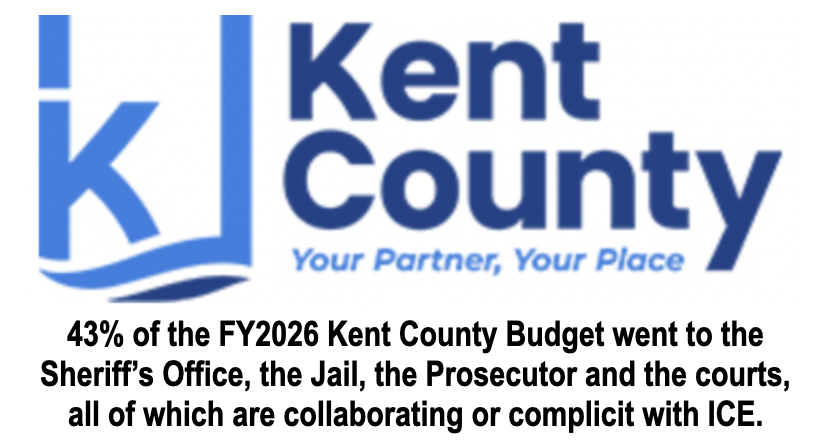
In today’s post I want to focus on Kent County Commissioners that are receiving campaign contributions from the Grand Rapids Power Structure.
The decisions regarding cooperation with ICE in Kent County not only comes from the Sheriff’s Office, but other Kent County officials, like the Kent County Commission.
The GR Power Structure and Kent County Commissioners
Like the Kent County Sheriff, many of the Kent County Commissioners have been bought and paid for by members of the Grand Rapids Power Structure. What follows is a list of Kent County Commissioners that have received campaign funds from members of the Grand Rapids Power Structure during the 2024 election.
Kent County Board Chair Ben Greene
- Doug DeVos – $1,225
- Dick DeVos – $1,225
- Daniel DeVos – $1,225
Commissioner Elizabeth Morse
- Maintain Our Majority (Charlie Secchia) – $4,000
- Friends of West Michigan Business PAC ( GR Chamber of Commerce) – $500
Commissioner Jennifer Merchant
- Grand Rapids Chamber PAC $500
Commissioner Dave Hildenbrand
- Dan DeVos $1225
- Doug DeVos $1225
- Richard DeVos $1225
- Grand Rapids Chamber PAC $500
Commissioner Stan Stek
- Grand Rapids Chamber PAC $7000
- Betsy DeVos $1225
- Daniel DeVos $1225
- Doug DeVos $1225
- Maria DeVos $1225
Commissioner Stan Ponstein
- Maintain Our Majority PAC (Charlie Secchia) – $5000
- TGIF Victory Fund (Dan Hibma) – $2,500
- Kent County Republican Committee – $1000
Commissioner Dan Burrill
- TGIF Victory Fund (Dan Hibma) – $12,250
- The Friends of West Michigan Business PAC – $7000
- Mark Bissell -$1225
- Betsy DeVos – $1225
Commissioner Robin Halsted
- Maintain Our Majority (Charlie Secchia) – $10,000
- John/Nancy Kennedy – $2450
- Grand Rapids Chamber PAC – $2000
- Mark/Mary Bissell – $1225
- Betsy DeVos – $1225
Commissioner Lindsey Thiel
- TGIF Victory Fund – $12,250
- Maintain Our Majority PAC (Charlie Secchia) – $10,000
- Sidney Jansma Jr – $2450
- Grand Rapids Chamber PAC- $1500
- Mark Bissell – $1225
In exchange for the thousands of campaign contributions to the above Kent County Commissioners the Grand Rapids Power Structure expects the Kent County Commission to vote in their interests. For example, in 2024, the Kent County Commission voted nearly unanimous to put the Hotel Tax on the August Primary Ballot, which would provide even more funding for the Amphitheater and other entertainment venues. The GR Power Structure spent nearly half a million dollars to convince voters to adopt this ballot initiative.
Then there is the matter of funding the Kent County Sheriff’s Office, the Kent County Jail, the Kent County Prosecutor’s Office and the Kent County Courts. Last year, the Kent County Commission voted 16 – 4 in favor of the FY2026 budget, which was $668 million. 43% of the county’s budget – just over $300 million – goes towards Kent County Sheriff’s Office, the Kent County Jail, the Kent County Prosecutor’s Office and the Kent County Courts. Abolitionists like Angela Davis have been referring to this system as the Prison Industrial Complex.
What is instructive is that all 9 of the Democratic members of the Kent County Commission voted for the $668 million FY2026 Annual Budget, while 7 Republican members of the County Commission also voted for the budget. Four Republican Kent County members voted no, but not because too much money was allocated towards the Prison Industrial Complex in Kent County. The four dissenting Republican members (Merchant, DeBoer, Burrill, and Bujak) voted no because they think the Kent County government is too big and their constituents are over taxed.
Despite some GOP member opposition, the majority of the Kent County Commissioners voted for the massive amount of funds that go towards the Prison Industrial Complex in Kent County – the Sheriff’s Department, the jail, the court system and the prosecuting attorney’s office. Voting for the Prison Industrial Complex in Kent County means they voted for the arrest and jailing of a disproportionate number of BIPOC residents and residents who live in poverty.
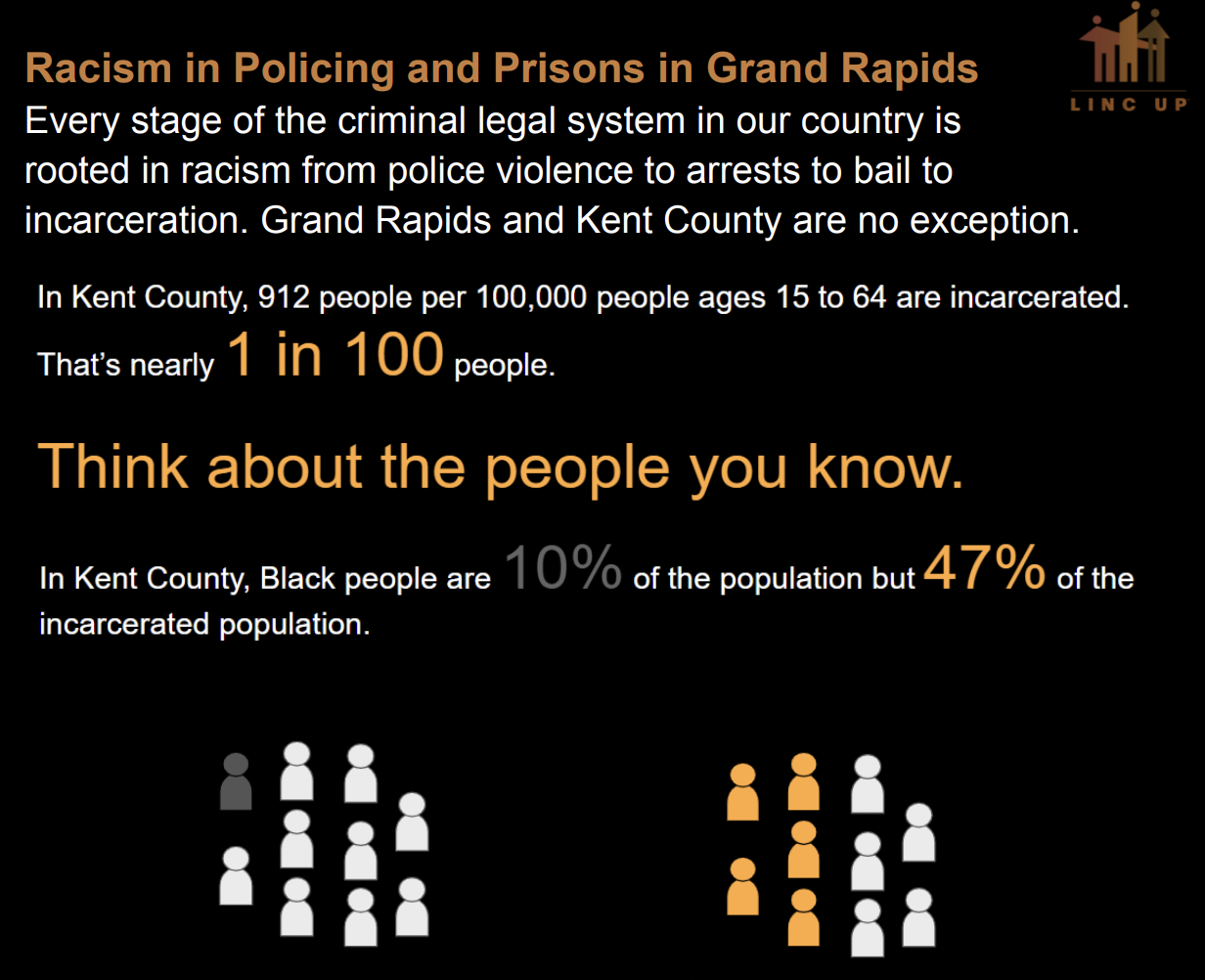
This also clearly demonstrates how the Kent County Commission annual approval of the county’s budget supports ICE, since the Sheriff’s Office, the Kent County Jail, the Prosecutor’s Office and the Kent County Courts all have a hand in cooperating with ICE and at the very least are complicit with ICE violence by doing and saying nothing to end immigrant family separation in Kent County. This is what the Grand Rapids Power Structure is paying for when they contribute campaign dollars to Kent County elected officials.
For the candidates who are on the August 4 Primary ballot, the public will have one week to access campaign finance information, especially since the local commercial news media tends to not report on campaign financing, especially for many of the local races, which GRIID noted in our Media Monitoring report during the last election cycle in 2024.

There are three candidates running for the open seat for the 1st Ward on the Grand Rapids City Commission. Those three candidates are as listed on the Kent County Clerk’s August 4th Primary Ballot:
- Jordoun Eatman
- Lindsey Perez-Plescher
- Steve Tibbe
What I will list is the amount each candidate has raised, what they have spent so far and the top donors.
Jordoun Eatman
According to campaign finance data from the Kent County Clerk’s office, Jordoun Eatman raised $8,475.55 and has spent a total of $3,599.84.
https://campaignfinance.us/docs.kent.mi/25111.PDF
https://campaignfinance.us/docs.kent.mi/25736.pdf
Top donors:
- Brandy McCallum-Martin (Director Experience GR) – $1,300
- Floria Bates – $1,225
- Craig Thompson (Global Human Resources Business Partner at Amway) – $1,225
- Mercedes Barragan – $1,200
- Tasha Blackmon – $500
- Katherine Hoffman (ED Garfield Park Neighborhood Association) – $400
- Charlie Dubose – $350
- Senita Lenear – $250
- Joe Jones – $250
- Stephanie Brown – $250
- Shaquanda Gordon – $250
- Lakessa Davis – $200
- Michelle Singleton – $200
Lindsey Perez-Plescher
According to campaign finance data from the Kent County Clerk’s office, Lindsey Perez-Plescher has raised $13,330 and has spent a total of $5,434.65.
https://campaignfinance.us/docs.kent.mi/25113.PDF
Top donors:
- Michigan Regional Council of Carpenters PAC – $5,000
- Kent County Democratic Party – $3,250
- Tami Vandenberg – $1,000
- West Michigan Plumbers, Fitters and Services Trades Local – $500
- Brittany Plescher – $500
- Steve Pestka – $300
- Carmen Vacaguzman (Tech Executive at Amway) – $300
- Lucas Gilles – $300
- Kurt Reppart – $200
- George Heartwell – $200
Steve Tibbe
According to campaign finance data from the Kent County Clerk’s office, Steve Tibbe raised $5,960.47 and has spent a total of $1,783.93.
https://campaignfinance.us/docs.kent.mi/25115.PDF
https://campaignfinance.us/docs.kent.mi/25717.PDF
Top donors:
- The Greater Regional Alliance of Realtors (GRAR) – $2,500
- Tim Maclam – $1,000
- Steve Tibbe – $1,000
- Claire Razmus – $333.72
- Bing Goei – $250
- Marcus Ringnalda – $206
- Paul Soltziak – $150
- Mark Murray – $100
- Dean Pacific – $100
- Andy DeVries – $100
Now, campaign finances alone should not decide how one will vote, people should consider what candidate platforms are, how embedded they are in communities – particularly affected communities, and voting records if they are incumbents. Each of the three First Ward candidates have questionable contributors: Eatman has the ED of Experience GR, a top executive at Amway and the ED of a neighborhood association; Perez-Plescher has a PAC, the local Democratic Party (even though this is a non-partisan position), and an executive from Amway; and Tibbe has realtor organization in a city facing a housing crisis (realtor groups are about making money not making sure everyone has a safe place to live), a member of the GR Power Structure (Mark Murray) and a former First Ward candidate that was connected to a dark money group that attacked his opponent in 2024 (Dean Pacific).
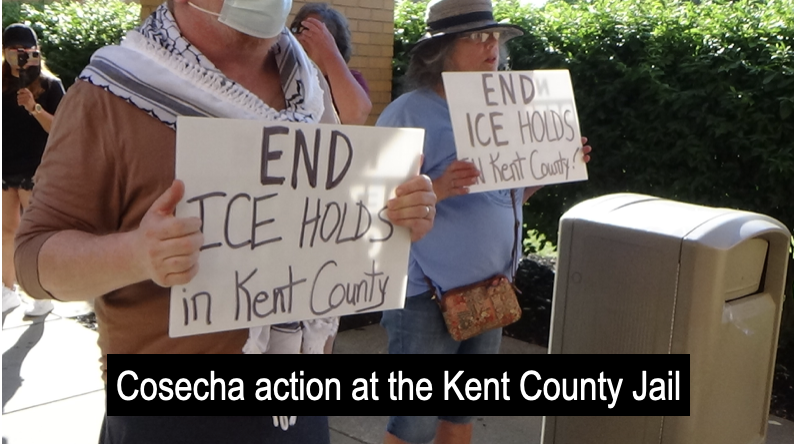
Next Friday four of us who engaged in civil disobedience at the Kent County Sheriff’s Office last January will have a jury trial for that action.
We engaged in that action to draw attention to the Sheriff’s Office complicity with ICE by doing ICE holds, often referred to as ICE detainers. Those who participated in civil disobedience also were drawing attention to Movimiento Cosecha’s six sanctuary policy demands that the immigrant-led group began in February of 2025.
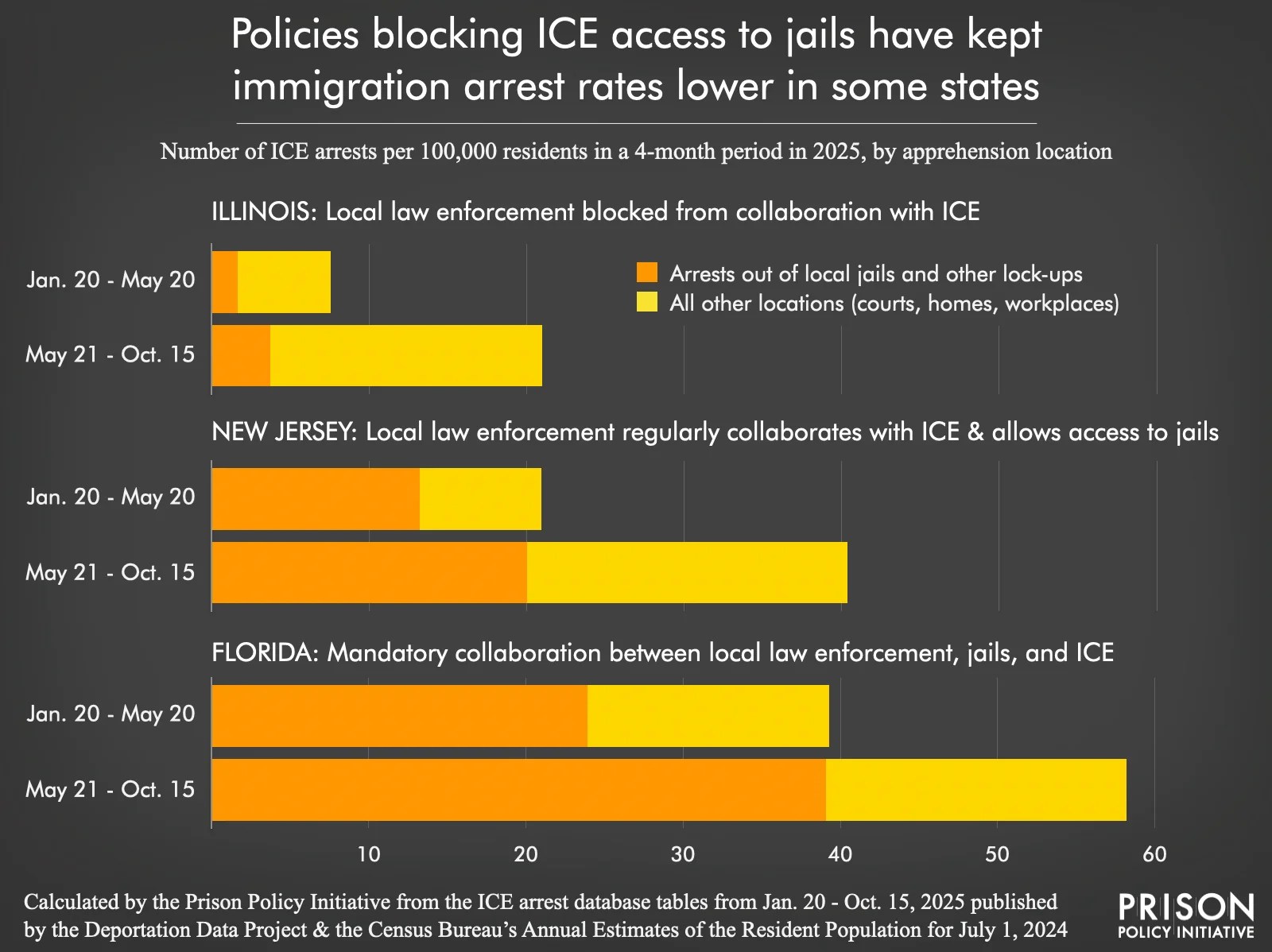
According to a report from the Prison Policy Initiative county jails play a critical role in the Trump Administration’s mass deportation plan:
Local jails and police departments are key to the Trump administration’s mass deportation agenda because they facilitate ICE arrests of people who are already in police custody. In the first year of Trump’s second term, the administration has intensified the criminalization of asylum seekers and immigrants, pushed immigrant detention to all-time highs, and indiscriminately raided city after city.
In counties and states that have no ICE detainer policies, the number of ICE arrests at jails is lower, as is reflected in this infographic from the Prison Policy Initiative.
The Grand Rapids Power Structure and ICE in Kent County
The decisions regarding cooperation with ICE in Kent County comes from the Sheriff’s Office and other Kent County officials. In Part I of this series I want to look at the relationship between the Grand Rapids Power Structure and elected positions in Kent County that are only every four years.
Kent County Sheriff Michelle LaJoye-Young had raised a total of $131,531.39 in the 2024 election. She ran unopposed. Her top contributors were a who’s who of the Grand Rapids Power Structure:
- TGIF Victory Fund – $10,000
- Cheri DeVos – $8,325
- Steve Ehmann – $8,325
- Doug DeVos – $8,325
- Maria DeVos – $8,325
- Dick DeVos – $8,325
- Betsy DeVos – $8,325
- Daniel DeVos – $8,325
- Pamela DeVos – $8,325
- Joan Secchia – $4,000
- David Van Andel – $2,500
- Carol Van Andel – $2,500
- Charlie Secchia – $2,000
- John Kennedy – $2,000
- Jim Williams – $2,000
- Mike Ellis – $1,000
- Mark Murray – $1,000
- Tom Bylenga – $1,000
- Mark Bissell – $1,000
In the 2020 election Kent County Sheriff Michelle LaJoye-Young was also backed by a lot of the same members of the GR Power Structure, such as:
- Dan Hibma – $2000
- Maria DeVos – $2000
- Cheri DeVos – $2000
- Steve Ehmann – $2000
- Pamela DeVos – $2000
- Dan DeVos – $2000
- Richard DeVos – $2000
Although the amounts were less from this group in 2020, they were still the largest contributors to the Kent County Sheriff. The reasons why they contributed is hard to determine as these wealthy individuals don’t practice transparency, but I believe that they have backed Kent County Sheriff Michelle LaJoye-Young the past two election cycles because she has demonstrated a commitment to protecting order and the status quo, which is primarily beneficial to the wealthiest members of the Grand Rapids Power Structure.
More importantly Kent County Sheriff Michelle LaJoye-Young has also cooperated with ICE since she became Sheriff in late 2018 after Larry Stelma took an early retirement. The Grand Rapids Power Structure is aware of this dynamic and supports it, since it creates a climate of fear in Kent County, and fear motivates people to not rock the boat or question the most powerful families in Kent County. Thus the Grand Rapids Power Structure has been rewarding Michelle LaJoye-Young for her commitment to protecting their interests.
For several years now GRIID has been looking at the housing issue in Grand Rapids, Kent County and in Michigan. I have been arguing that the market-based policies for housing, even so-called affordable housing are false solutions.
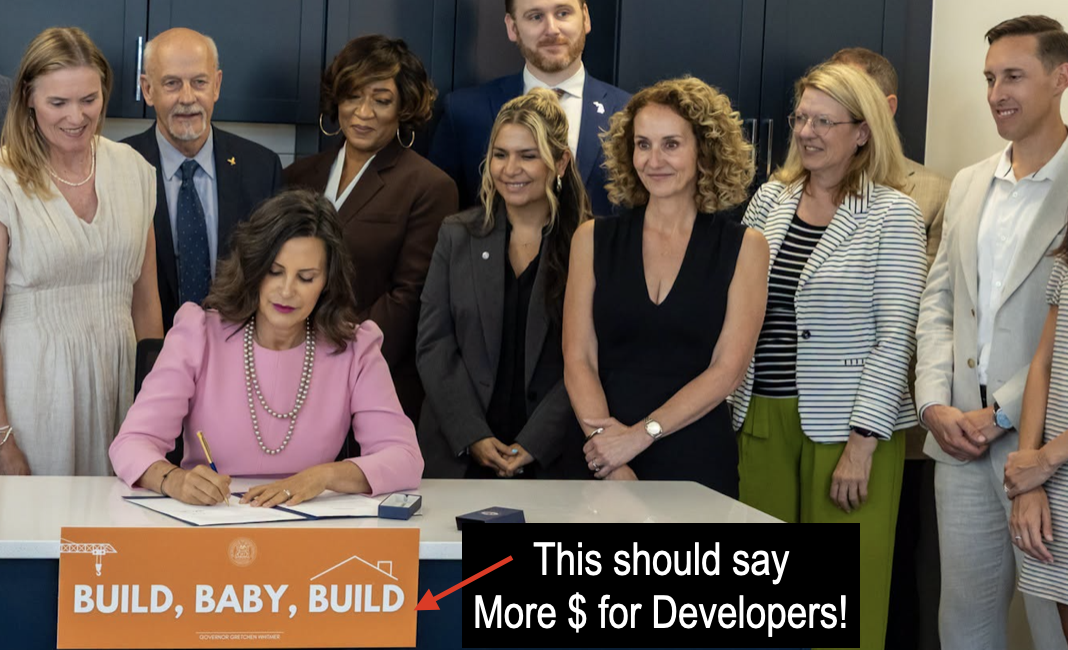
On Wednesday, Michigan State Senator Winnie Brinks posted the following statement on her Facebook page:
Since day one, Michigan Senate Democrats have been tackling the housing crisis head-on — investing record state funding in affordable housing projects, expanding the brownfield redevelopment program, and now creating the Michigan Housing Opportunity Credit and banning large corporate investors from buying up single family homes. Together, our efforts will bring more homes, more opportunity, and more stability to Michigan families for generations to come.
I want to take issue with Senator Brinks on this statement, but first I want to say something about the picture above, which was included in her Facebook post from Wednesday, July 22nd. Gov. Whitmer is signing the transformational brownfield plan program that provides tax incentives for developers. This program did provide $1.6 billion for developers, but that amount has been doubled to $3.2 billion. Signing this bill will green light the DeVos/Van Andel Three Towers project, which will provide $565 million in public subsidies for the billionaire families.
Also included in the picture – on the far right – is Josh Lunger, the governmental affairs staff for the Grand Rapids Chamber of Commerce. Lunger was behind the push to criminalize the unhoused in Grand Rapids and plays a major role in pushing pro-Chamber of Commerce policies at the state level.
As for the claims made by Senator Brinks, we should not be fooled by the wording, such as affordable housing, banning large corporate investors from buying up single family home, and more stability to Michigan families for generations to come. None of these things are true. First, the state investment for affordable hosing is for developers, not for working class families who can’t afford housing in Michigan. Second, the Governor signing the transformational brownfield plan program benefits large projects like the DeVos/Van Andel Three Towers project, not families who are housing insecure.
Third, on the matter of banning large corporate investors from buying up single family home, this simply isn’t true. House Bill 6074 defines a large institutional investor as an investment fund, corporation, general or limited partnership, limited liability company, joint venture, association or other for-profit entity that directly or indirectly has investment control of more than 100 single-family homes in the state and manages or has a net value of $375 million or more. So, a large investor, corporation or LLC could continue to own up to 100 single family homes. However, if the large investor, corporation or LLC would add new housing stock, substantially rehabilitate an existing home or is part of a program to create a pathway to ownership for a renter, then the cap on controlling 100 single family homes doesn’t apply. The House version of this bill passed with a vote of 102-3 in favor. Thus the language Senator Brinks uses is misleading.

Fourth, when Sen. Brinks says that Michigan Democrats have been tackling the housing crisis head-on, this is also a false statement. When Michigan Democrats had the trifecta of Governor, State Senate and State House, they failed to adopt numerous hosing policies that would benefit working class families, policies that the statewide coalition known as the Rent is Too Damn High were pushing in 2024. See list of bills above. It is also worth noting that this list does not include Rent Control, which tenants have been fighting to win for years.
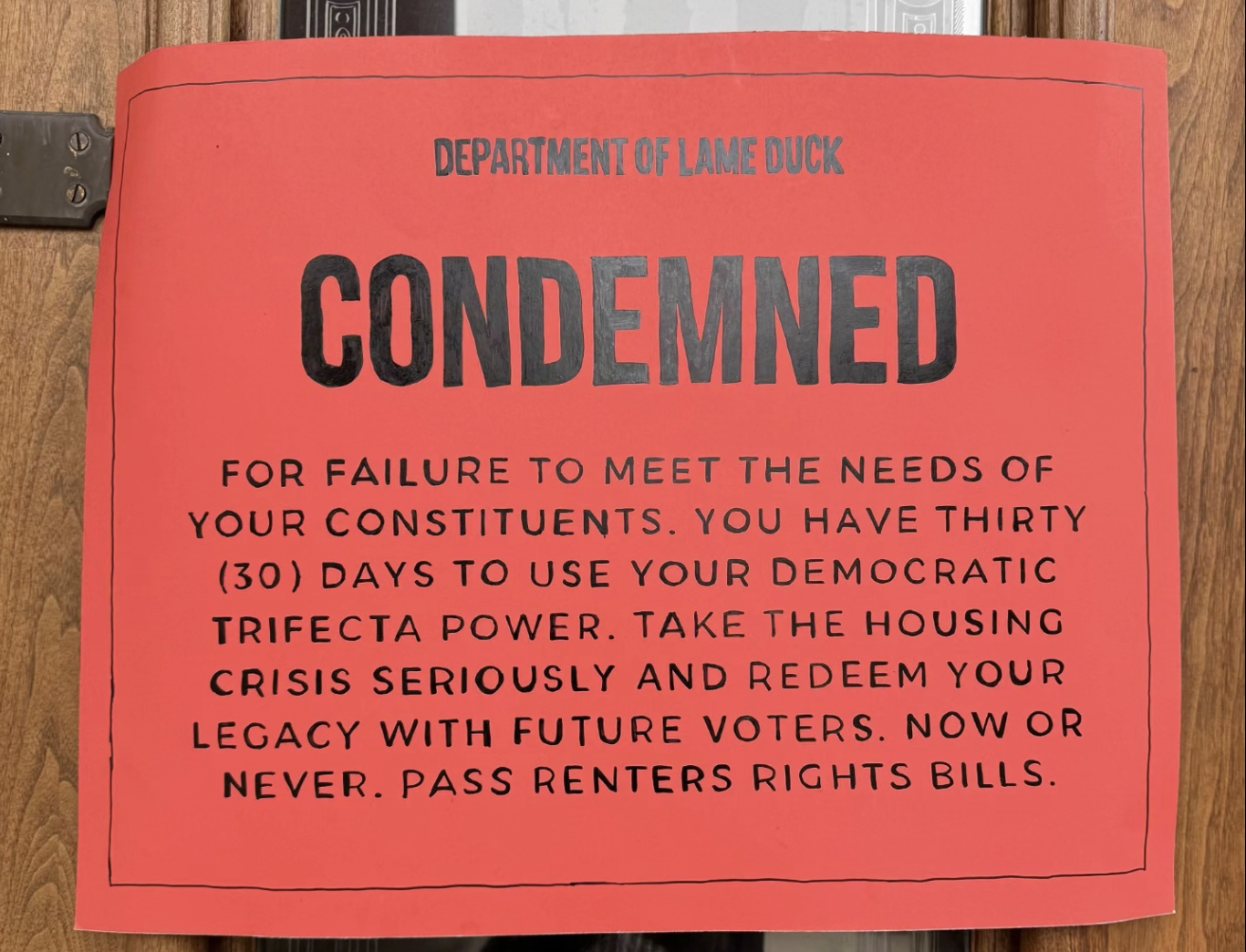
The Grand Rapids AreaTenant Union presented the list of renter rights bill to Senator Brinks at her home in November of 2024, yet as the Senate Majority leader she failed to get most of these bills passed.
Lastly, it is worth noting that Michigan Democrats have failed to make the minimum wage $25, which would give people a chance to afford the cost of rent in Michigan. The current minimum wage in Michigan is a paltry $13.73 per hour. Michigan Democrats do not fight for working families in Michigan.
 Monday, July 20th was the deadline for when political candidates could accept funds for their campaigns.
The statements that candidates have to submit regarding campaign finances is due by 5pm on Monday, July 27. Every day after July 27 candidates will be fined for not filing their campaign finance reports.
This means that for the candidates who are on the August 4 Primary ballot, the public will have one week to access this information, especially since the local commercial news media tends to not report on campaign financing, especially for many of the local races, which GRIID noted in our Media Monitoring report during the last election cycle in 2024.
Campaign financing is a critical component during elections, since you can determine which wealthy individuals, powerful PACs and corporations are contributing to candidates, especially at the local level.
GRIID has been monitoring campaign finance data for years and I am always amazed at how much money goes to local candidates from groups like the Grand Rapids Chamber of Commerce, the Grand Rapids Police Officers Association PAC, the Michigan Realtors PAC and members of the Grand Rapids Power Structure, like the DeVos family.
GRIID will be posting campaign finance data for the candidates that appear on the August 4 Primary Election starting this coming weekend.
In addition, if you want to learn how to track campaign finance data please attend the UCC Power Fund workshop Follow the Money: Exploring Candidate’s Campaign Funding on Tuesday, July 28th from 6 – 7:30pm at 413 Hall St. SE, Suite #1 in Grand Rapids. UCC is asking people to RSVP for this event.
Yesterday, I, and several other volunteers with GR Rapid Response to ICE, were accompanying two different people that requested we go with them to their appointments at the ISAP office. ISAP stands for Intensive Supervision Appearance Program.
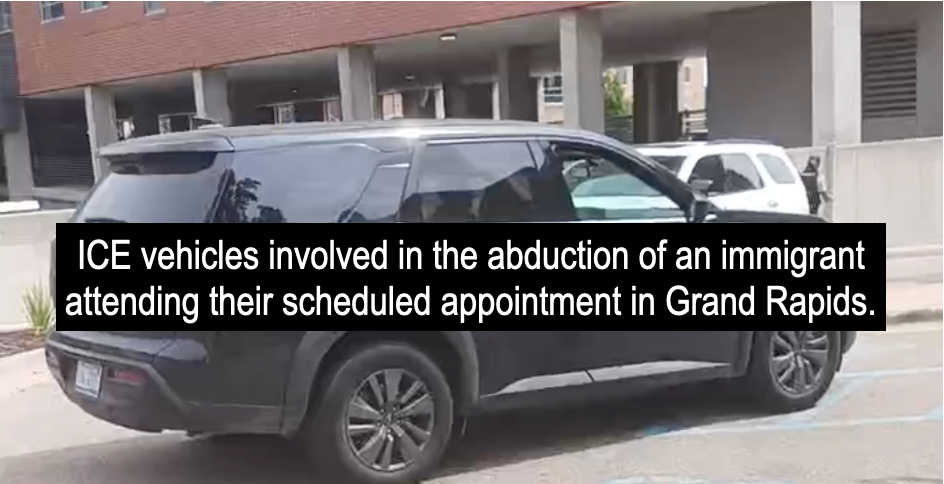
At about 11:45am we noticed a vehicle on the narrow road right behind the ISAP office, a vehicle that was facing west. I pointed out to another GR Rapid Response to ICE volunteer, when the card started moving slowly and I said, “It looks like the cars has tinted windows.” Two seconds later ICE came through one of the exit only doors with someone they had just arrested, with their hands zip tied behind their back. I moved towards the ICE vehicle when all of a sudden another ICE vehicle came from behind me, made a sharp right turn, almost hitting me.
Being cut off from a clear view of the other car I could not get pictures, but another volunteer was able to video tape both cars and get their license plate numbers. This all happened in less than 30 seconds, since ICE likes to – in their own words – snatch and grab people.
On June 4th, of last year, the public awareness around the existence of the ISAP office in Grand Rapids has increased, since ICE agents arrested and detained immigrants who were coming to their scheduled appointments at 545 Michigan St.
Since then, GR Rapid Response to ICE has been providing accompaniment to people who have appointments at that office, along with those who go to the ICE office at 517 Ottawa NW, just north of the 196 overpass. Today was the fist time that ICE took someone from the ISAP office since GR Rapid Response to ICE began providing accompaniment to immigrants during scheduled appointments.
What is instructive about the ISAP office in Grand Rapids, is that it is run by BI Incorporated, which is a subsidiary of the GEO Group. The GEO Group is one of the largest private prison entities in the world, which also runs prisons that are specifically ICE Detention Centers.
In addition, BI Incorporated also sells location tracking devices, such as ankle bracelets or wrist bracelets that people have to wear, so that ICE or other cops can monitor their whereabouts.

Think about it this way. The people who come to appointments at the ISAP office in Grand Rapids, are in the ICE system. They have to access the BI SmartLINK app, which allows “for real-time communication between officers and clients,” according to the BI Incorporated page. If they have a wrist or ankle bracelet, that is also provided by BI Incorporated. When they come to an appointment at the ISAP office in Grand Rapids, that is owned by BI Incorporated. Lastly, if they are detained by ICE agents while coming to their appointments, which is what happened on June 4, they will be sent to detention, which will soon mean that they will be sent to the GEO Group ICE detention facility in Baldwin, Michigan.
This is what Capitalists call a perfect loop, since every step in the process is owned and operated by the same company, the GEO Group. Not surprising, in 2024, the GEO Group contributed $3,718,518 to political candidates and they spent $1,380,000 lobbying Congress to adopt laws that would make them even more money. To top it off, all of these contract that the GEO Group has, along with their subsidiary BI Incorporated, are government contracts through ICE. This means that taxpayers foot the bill for the hellish systems used to track, monitor, manage, arrest and detain immigrants.
Last December The Intercepted reported that BI Incorporated has a new contract with ICE to use bounty hunters to track down immigrants for ICE. The article states:
Records show ICE has already paid BI $1.6 million, with the potential for the contract to grow to as much as $121 million by the time it concludes in 2027.
After ICE kidnapped an immigrant who had come to their appointment at the ISAP office, volunteers with GR Rapid Response to ICE stayed to make sure that other people coming to their appointments got in and out safely. If you know people who have appointments at either to 517 Ottawa NW ICE Office or the 545 Michigan ISAP Office let them know that volunteers with GR Rapid Response to ICE can accompany them during those appointments. To schedule accompaniments call the GR Rapid Response to ICE hotline: 616-238-0081.

Tensions and conflicts in movement work: How we move forward in the goal of shutting down the North Lake Detention Center
(Editor’s note: Before writing this post I sought out lots of input from those involved in shutting down the North Lake Processing Center, especially people who have been involved with No Detention Centers in Michigan since 2019.)
“Solidarity is not a humanitarian gesture, it is a political intervention rooted in a material understanding of power. In the context of ICE raids, deportations, and carceral violence, to show up is not to perform rescue, but to participate in collective resistance. This is why we say we are not protesting ICE, rather we are resisting ICE.” Movimiento Cosecha organizer Carlos Castaneda
Engaging in movement work is never easy and it often results in tensions and conflicts with people and organizations. However, I am of the belief that tensions and conflicts aren’t inherently negative. They give us the opportunity to learn from our mistakes and clarify what our movement is all about.
There has recently been increasing tension between various groups and individuals, some of which is directed at No Detention Centers in Michigan (NDCM). Before I get to the tension and conflict, I want to provide some history of the movement work that NDMC has been engaged in, along with providing St. Paul Principles to give my critique a principled framework for what is happening.
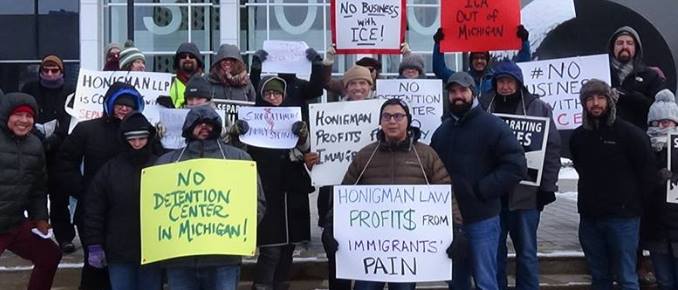
NDCM origins
No Detention Centers in Michigan started in 2019 as a statewide effort to address the issue of ICE detention centers in Michigan. At that time there were no formal ICE detention centers in Michigan, except for a few county jails which had contracts with ICE to either hold immigrants for a few days until they could be moved or longer stints, since ICE compensated county jails to act as de facto detention centers.
Members of the statewide coalition that became NDCM discovered that there were some proposed ICE detention centers, like the proposal to convert one of the former Ionia State Prison facilities into a detention center.
I wrote about the original proposal back in October of 2018, followed by a post about the company that was behind the proposed Ionia location, when they presented their proposal before the Ionia City Council in January of 2019.
 As a response to the Ionia ICE detention proposals NDCM hosted their first public meeting in February of 2019. It is important to note that from the very beginning, NDCM was working directly with the national coalition Detention Watch Network, which was coordinating all efforts nationally to resist and shut down ICE detention centers.
Just months after pandemic hit the world, the same company that was attempting to convert one of the Ionia state prison facilities into an ICE detention center. Immigration Centers of America (ICA) was proposing to construct a new building near the Ionia State Prison. NDCM organized to oppose that ICE proposal, which I wrote about after listening to an Ionia City Council meeting. The NDCM effort paid off and that proposal from Immigration Centers of America (ICA) was defeated.
Because jails, prisons, and detention centers were essentially incubators for the COVID-19 virus to spread, there were growing concerns over people who were incarcerated. Additionally, there was a growing demand around the country to release all prisoners, since it was understood that the disregard for prison conditions was another form of state carceral violence to subject people who were incarcerated to the COVID virus.
In solidarity with prisoners, No Detention Centers in Michigan released a statement written by prisoners at the North Lake Correctional Facility. Here is part of that statement:
On Sunday, April 5th, approximately ten people incarcerated at the North Lake Correctional Facility in Baldwin, Michigan launched a hunger strike in response to unsafe conditions and the mistreatment they have experienced inside the Special Housing Unit, or SHU. Their concerns include inadequate food and lack of access to medical attention. North Lake is a private immigrant-only prison operated by the GEO Group through a contract with the Federal Bureau of Prisons.
From 2020 through 2024, No Detention Centers in Michigan was engaged in significant prisoner solidarity work, building relationships with those incarcerated and learning valuable lessons about how to show up for people being detained.
I share this history because it is important to understand that NDCM has been doing meaningful solidarity work against the Prison Industrial Complex since 2019, and the coalition’s member organizations and individuals have been showing up for the impacted communities for even longer. It is in this context that some of the aforementioned tensions and conflicts began in 2025.
With the second Trump Administration taking power in 2025 and calling for mass deportation, there was naturally deep concern for how to organize and resist ICE arrests, detention, and deportation. By the time the GEO Group began steps to reopen their vacant building in Baldwin as a detention center in 2025, people were ready to protest. Naturally, NDCM began to host meetings, build solidarity, and plan a coordinated campaign with coalition members. However, several people did not want to wait for consensus before protesting, disregarding the years of organizing that NDCM had engaged in around fighting detention centers and NDCM’s years of collaboration with Detention Watch Network.
St. Paul Principles
The St. Paul Principles were developed by those who participated in the effort to shut down the Republican National Convention in Minneapolis/St. Paul in 2008. The principles are:
- Our solidarity will be based on respect for a diversity of tactics and the plans of other groups.
- The actions and tactics used will be organized to maintain a separation of time or space.
- Any debates or criticisms will stay internal to the movement, avoiding any public or media denunciations of fellow activists and events.
- We oppose any state repression of dissent, including surveillance, infiltration, disruption and violence. We agree not to assist law enforcement actions against activists and others.
These principles were developed primarily because there were groups that did not support the more direct action approach of preventing the convention from happening. I was a participant in those actions, and I remember how people who decided to get permits to protest and people that wanted to engage only in performative actions condemned people who fought in the streets with a wide range of tactics to stop the GOP convention from happening.
Current tensions and conflicts regarding the GEO Group owned ICE detention facility in Baldwin, Mi
NDCM held a protest at North Lake in July of 2025, but it was not without controversy. The main issue was that some people objected to protesters blocking cars from entering or exiting the main gate. Despite such tactics being used in movement work for centuries, some thought it was too aggressive, and even erroneously labeled it as “violent.” Violence is something that is done to living creatures, such as the violence that GEO Group guards and other staff at the North Lake Processing Center are inflicting upon our neighbors.

The other issue that day was that there was someone who was designated as crowd safety (not the police liaison) who spoke with the cops. When this person was confronted about this behavior, they said they knew these cops and had known them for years, so it was no big deal. This person was an older white woman who violated a fundamental tenet of movement work: only police liaisons talk to cops, but only to potentially get information and never to give information.
Shortly after the July 4 protest, NDCM and Detention Watch Network sent out a joint Press Release to underscore the urgency of shutting down ICE detention centers across the country. Part of the Press Release stated:
Communities Not Cages is amplifying local community organizing to end ICE detention while illuminating the dangers of the Trump administration’s multi-layered detention expansion plan. Campaign organizers underscore that the gravity of this moment cannot be understated, particularly after the passage of the MAGA megabill that will supercharge Trump’s cruel mass detention and deportation agenda, making ICE the largest law enforcement agency in the country. Shockingly, ICE’s budget now exceeds many militaries around the world.
Subsequent NDCM protests have been held at the North Lake Concentration Camp, alongside other protests from a variety of groups. However, some of the other groups decided to distance themselves from what NDCM was doing, since they believed that the tactics being used to both demonstrate solidarity with people in detention and disrupt business as usual at the ICE detention center were too “aggressive.” What was even worse was that some of these groups were saying that, when protests are aggressive, the GEO Group would not allow visitation during that time or cancel visits for an entire day. These groups were blaming NDCM for the repressive tactics being used by the GEO Group. To the degree that systems of oppression use these types of counter measures means that they see the growing resistance as a threat, but the GEO Group imposed these repressive tactics against people in detention because that is what systems of repression do. It is also important to understand that this GEO Group tactic of cancelling visitation is not legal by international standards—it constitutes collective punishment, a violation of the Geneva Convention.
The tension and conflicts with the North Lake Concentration Camp have increased in recent months, specifically with work being done by Bonnie Demos and Cliff Demos. The group of people they are working with have been fundraising to put money into the commissaries of people in detention and organizing visits to people in detention. This is all well and good. A question that many of us have asked is, do these participants attend any sort of anti-oppression and anti-racism training before doing visits to make sure that they are not engaging in white saviorism? How people show up in these situations is critical, so good intentions are not enough. We must listen to affected people/communities and do what they want us to do, not what we think is best. The language barrier can exacerbate this dynamic, as many or most of the visitors in this group reportedly have little Spanish, or fluency in other first languages of people in detention.
Additionally, doing visits and putting funds into the commissaries without working towards the abolition of ICE detention centers makes such actions charity rather than Mutual Aid. Mutual Aid work that is done within movements is always part of the larger goal of ending state carceral violence and abolishing detention centers. (See Dean Spade’s important book, Mutual Aid: Building Solidarity During This Crisis (and the Next).
NDCM, as well as many other groups and individuals in Michigan (for example, Movimiento Cosecha, Detroit People’s Assembly/Asamblea Popular, and Raíces Migrantes), also coordinate commissary deposits, visit people in prison at North Lake, and assist people upon release. Bonnie and Cliff Demos’ group is not the first or only group to engage in this critically important material and moral support for people in detention. The question is, does a group engage in these activities from a position of solidarity and mutual aid with a solid political critique of oppression, or do they do so out of white saviorism and charity?
In a recent talk given by Cliff and Bonnie Demos to a group of white people with Indivisible Central Michigan (linked below), they criticize people who are aggressive or rude towards the GEO Group guards. Cliff Demos says the guards are just trying to feed their families. While people employed at the North Lake Concentration Camp are making money to support themselves, they are also working in a brutal system that is designed to punish immigrants and disregard their basic human rights, all so the GEO Group can expand their profits. The same argument was made about Germans working at Nazi Concentration Camps – that they were just doing their job. Make no mistake about it, the guards working at North Lake are not only complicit in the oppression of people in detention, but they also directly participate in it based upon the conditions and treatment that people in detention have reported receiving at the hands of the guards.
Another false claim made by Cliff Demos in this video is that there never was a hunger strike that took place in the North Lake Concentration Camp. This harmful claim is in fact the same thing that the GEO Group and DHS/ICE have said. NDCM has been communicating directly with numerous people in detention in North Lake over the past year and has built a relationship based in solidarity. Many people in detention have shared about the conditions in detention and began a hunger strike in April, even before the Delaney Hall hunger strike in New Jersey. NDCM supported by quickly organizing another solidarity demonstration. In fact, the group Michigan Multi-Faith Clergy Rapid Response supported the hunger strike and were inviting people to fast as a way of being in solidarity with people in detention and their demands during the hunger strike. For anyone to claim that the hunger strike did not occur is to do harm to the people in detention who organized it and all people in detention who are being subjected to these inhumane conditions.
In that same video, Cliff Demos demonizes people from Grand Rapids who were protesting at the North Lake Concentration Camp because they “were covering their faces just like ICE does.” ICE covers their faces because they don’t want to be held accountable and they don’t want to reveal their identity so they can continue to brutalize immigrants without any consequences, legal or otherwise. Grassroots autonomous groups cover their faces to make it harder for the state to ID them, because the state will come after them, with the full force of state carceral violence, for resisting ICE.
Do Cliff and Bonnie Demos not know what happened to the Prairieland defendants for organizing against ICE, where people are receiving decades long sentences for a noise demonstration, or for distributing or transporting zines? People can’t afford to be this naive and reckless in their comments about tactics simply because they don’t agree with those tactics. It does real harm and has consequences when people say that protesters “act like ICE” or are too “aggressive.” Indeed, this kind of harm is akin to cooperation with the state. When people with a whole lot of privilege dedicate themselves to tearing existing solidarity groups down without taking the time to unlearn their own biases, they end up inadvertently siding with the systems of oppression. It’s also important to mention that these same privileged people usually don’t know the history of movements fighting for collective liberation. If they took the time to listen and to learn, they’d discover that militant tactics were always used in collective liberation movements.
Bonnie and Cliff Demos also have falsely claimed that a comrade who was at a recent protest against the North Lake Concentration Camp and was hit by a car driven by one of the guards was being violent. Again, these kinds of claims are harmful, and they do damage to individuals as well as to the movement as a whole.
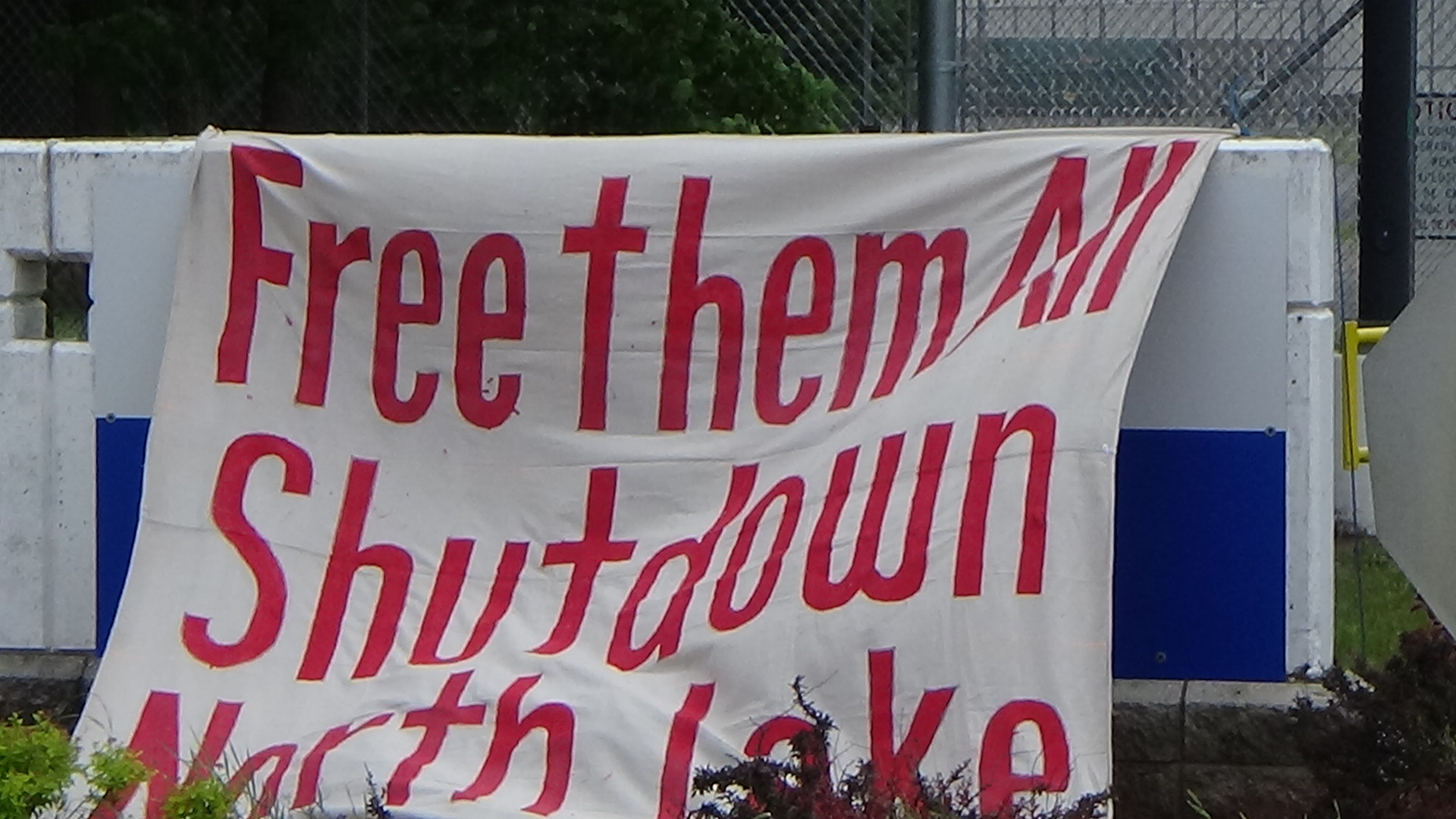
Moving Forward
I believe it is beneficial to include as many people as possible when doing movement work. There are a growing number of people who oppose what ICE does, many of whom support the abolition of ICE.
There are also more and more people who want to shut down ICE detention centers, especially with increased awareness of the conditions and the increased number of people that have died while in detention.
Movement work can involve all kinds of people who want to shut down the North Lake Concentration Camp. We don’t all have to do the same thing. We need people to write letters with people in detention, put money in their commissaries, and visit them if they request visits from non-family members. We need people to do more popular education work around the GEO Group and the North Lake Concentration Camp, especially with workshops, presentations and lots of online resources that are necessary to mobilize people.
However, we also need people who are willing to do the resistance work and to engage in direct action that can disrupt the GEO Group’s ability to profit from human suffering. We need to maintain a diversity of tactics so we can get closer to the goal of shutting down the ICE detention center in Baldwin, Michigan.
What we don’t need is people who criticize and demonize those who don’t make nice with systems of power and oppression, in this case the GEO Group. Even if you don’t agree with the tactics, you never publicly condemn them unless they are doing active harm to the movement and disregarding input from the affected communities as Bonnie and Cliff Demos are.
What we do need is for people with privilege, which includes me, to follow the lead of affected communities and do what they are asking of us. Those of us with privilege do not know what is best for those who are people in detention, unless we engage with them and their loved ones and communities directly. We need to cultivate a deep sense of solidarity if we want to shut down the North Lake Concentration Camp and we need to show up in ways that centers those most affected.

