New ICE commercials airing in Michigan are based on a false narrative about what ICE does
There is a series of new ICE commercials running in several states over the past few weeks. The ads are currently running in Michigan, North Carolina, and Georgia. These ICE commercials eve ran during last Sunday’s Super Bowl game. You can watch two of the ICE commercials here.
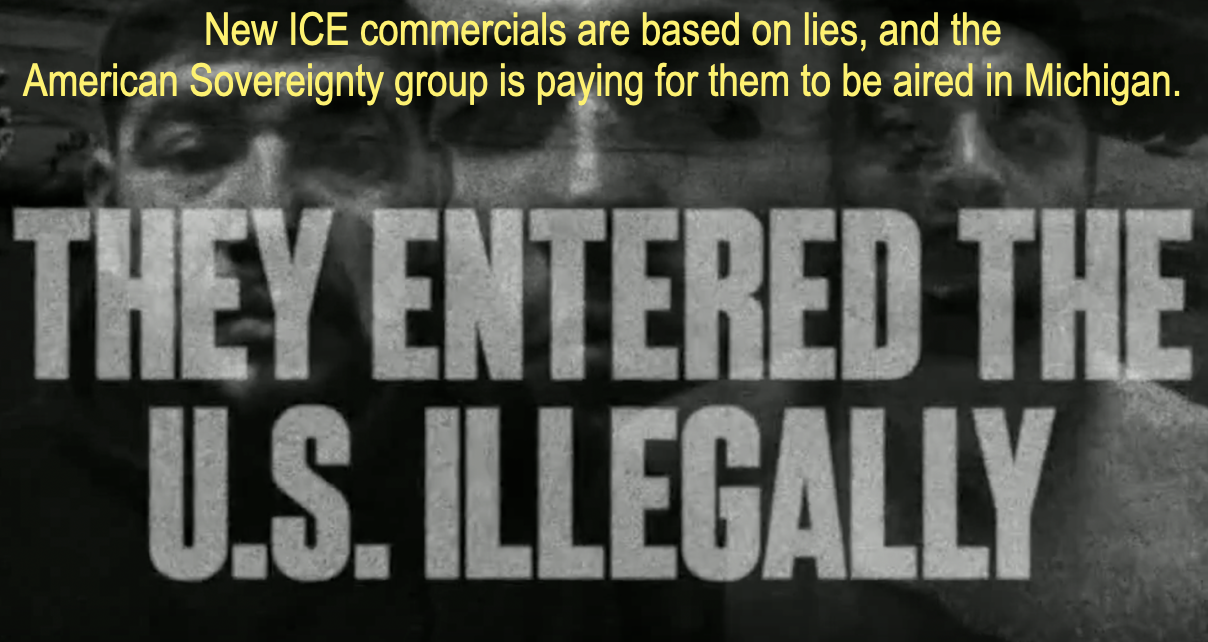
Here is the narrative from one of the ads:
Immigration and Customs Enforcement have removed thousands of criminal, illegal aliens from the US. They entered the United State illegally and committed crime against our mothers, children, and friends. Every day Immigration and Customs Enforcement take them off our streets. Every removal makes us safer and America stronger. This is what ICE does. This is Immigration and Customs Enforcement.
There is a great deal with these ICE commercials that are deeply problematic, however, the main issue is that that these commercials are presenting lies.
The first lie is that immigrants entered the US illegally. Undocumented immigrants who entered the US without papers did nothing illegal. Being in the US without papers is a civil infraction, but not a crime.
The second lie is that ICE is “removing” immigrants who commit violent crimes. There is no definitive consensus on how many undocumented immigrants have committed violent crimes, like the kind that are listed in the ICE commercial – murder, child predator, drug trafficker, kidnapping, child pornography, rape and child molestation. David Bier, the director of immigration studies at the Cato Institute, (which has been funded by the Koch brothers, so not exactly a leftist think tank) analyzed nonpublic data from ICE leaked to Cato, and he found that among those with criminal convictions detained by ICE, 8% were convicted of violent or property crimes (about 5% were violent criminal convictions). “And that includes very minor assaults. I mean, not like rape and murder,” Bier said in a radio interview with KPFA on Jan. 22. “These are someone had an altercation at a bar or things like that, not serious violent criminals who committed murder and rape.” Thus, only 5 percent had a violent criminal conviction.
The third lie is that ICE arrests are making “us safer and America stronger.” The reality is that when ICE arrests people they are causing harm directly to immigrant families, both economic hardship since the majority of those taken were the primary income earners, along with the trauma that families experience when someone is taken. This harm doesn’t make people and communities safer, instead it harms us as well. ICE is arresting people who are our neighbors, co-workers, friends, ad people we attend religious services with.
Lastly, it is important to note that the entity paying for these ICE commercials is America Sovereignty. American Sovereignty lists some of its priorities as border security, protecting taxpayers and public safety, according to its website. The website doesn’t provide further details about who the group comprises, where its funding comes from, nor in what ways it works toward its mission.
According to a recent Mother Jones article:
American Sovereignty has a bare-bones website created in January, where you can sign up for a mailing list and read its privacy policy. But, otherwise, basically nothing is known.
We couldn’t find any publicly available corporate registration documents, and we got no response today when we reached out to the email address on the website to ask about the background of the group. It’s been the same for other news outlets: After American Sovereignty put up a pro-ICE billboard in San Francisco in the run-up to the Super Bowl, multiple journalists reached out to the group but didn’t get a response.
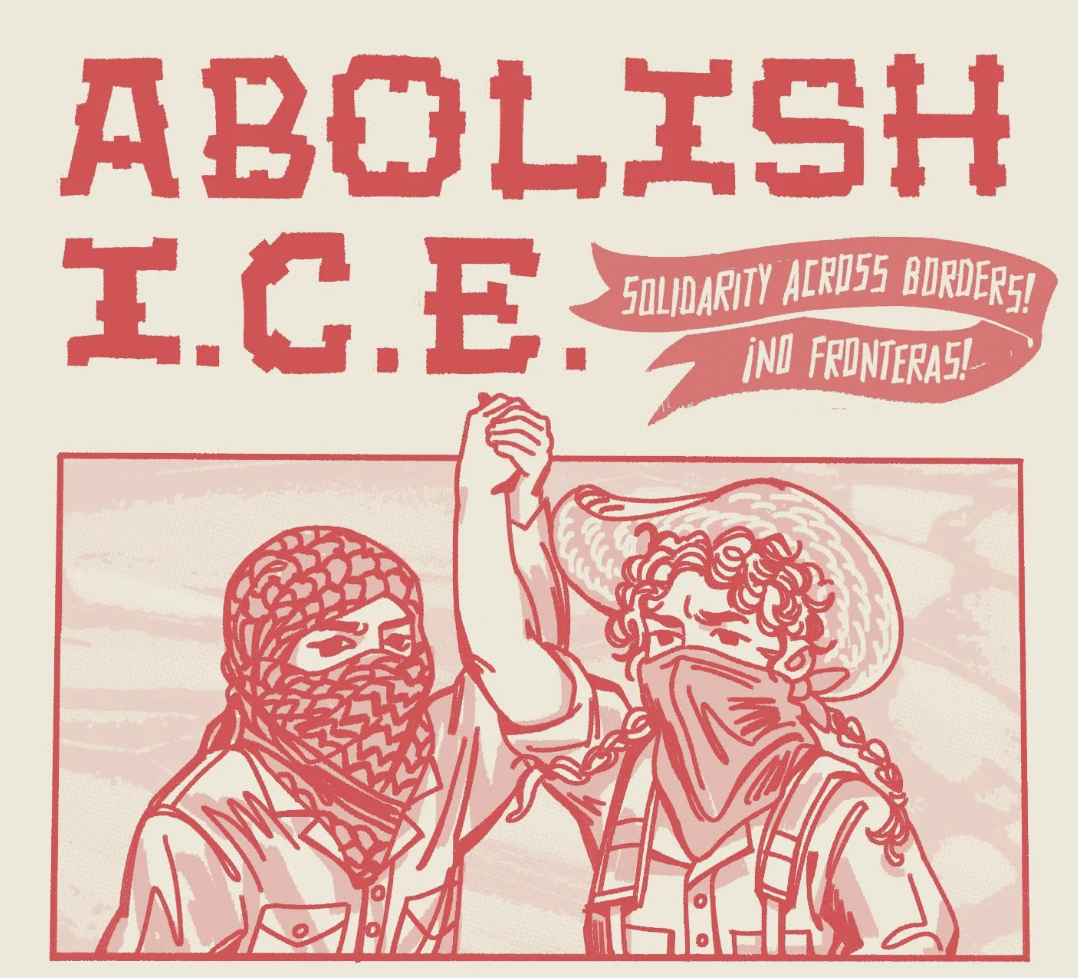
Regardless of the fact that we know very little about who is behind these pro-ICE commercials, we do know that they are based on lies and they are seeking to change public opinion about Immigration and Customs Enforcement. ICE was created in 2003, yet the most recent polling shows at least half the country not only opposes ICE, but wants the federal agency to be abolished. Abolishing ICE is exactly was Movimiento Cosecha and GR Rapid Response to ICE are demanding.
The local news media has once again done a disservice to the people of Grand Rapids. Since it was announced that Chief Winstrom might be headed to Florida, the news media has not only fawned over Winstrom, they have provided him with a platform to create his own narrative about the last 4 years as the top cop.
An excellent example of how Winstrom got to create his own narrative is the 11 minutes and 32 second piece from WZZM 13. One instructive comment from Winstrom had to do with his complaint that there is an “anti-cop” sentiment in Grand Rapids. Winstrom gave two examples, which included the difficulty of getting drones for the GRPD and then the docu-series (Winstrom’s description), which he got complaints about because it “showed the police department in a positive light.”
While I am happy to see Winstrom leave, he will be replaced by another cop who will continue to do what cops to, which is to protect power and privilege. The City of Grand Rapids will conducted another “search” and even provide some public forums, but make no mistake, there is no democracy when it comes to the next Chief of Police, just like there wasn’t the last time 4 years ago.
What I intend to do in this post is to provide a more honest assessment of policing in Grand Rapids under Winstrom or at least a more community-based assessment on what has happened while Winstrom was in charge of the GRPD.
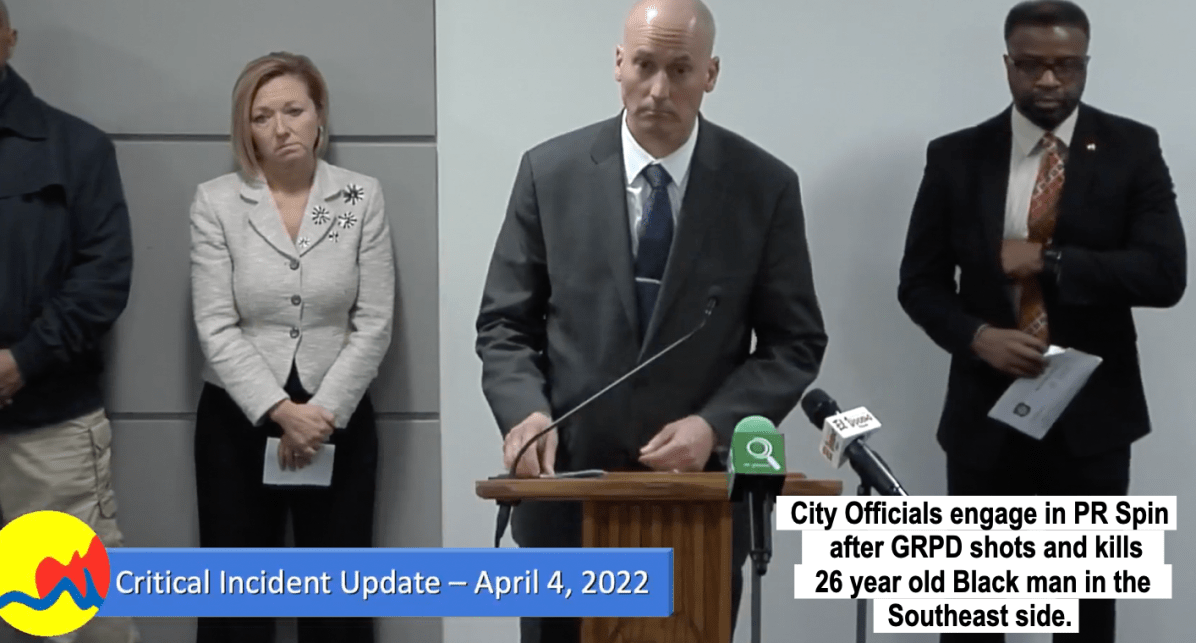
Right after Winstrom arrived in 2022 a GRPD cop killed Patrick Lyoya
The City of Grand Rapids and the GRPD attempted to control the narrative about what happened to Patrick Lyoya, often wanting to blame Lyoya for not “cooperating with the cop who shot him in the back of the head. From the first Press Conference the City had, to the release of the body cam footage , to the City’s attempt to silence those demanding Justice for Patrick, over the past 3 years and 9 months the City officials and the Chief Winstrom have not been willing to take responsibility for Patrick Lyoya’s death.
There have also been several FOIA requests related to the GRPD murder of Patrick Lyoya and how the GRPD has responded to those organizing to demand justice for Patrick Lyoya. In both cases, there were large sections of the FOIA documents redacted.
For a more detailed overview of the government, media and community responses to the GRPD killing of Patrick Lyoya, go here.
In June of 2022, Chief Winstrom held another Press Conference about an “officer involved shooting,” where Winstrom talked about what he referred to as the “Ferguson Effect.” In response, this is part of what I wrote:
At 7:10 into the video, another reporter asked whether this shooting might have been retaliation for the Christopher Schurr (now an ex-cop) shot and killed Patrick Lyoya. Winstrom responded by saying, that was his concern, and then he goes on to use the phrase, the “Ferguson Effect.” Winstrom then refers to the Michael Brown incident – he was also shot and killed by a cop in Ferguson, Missouri – and claims that there is a correlation between police killings of Black people and an increase in violent crime. Winstrom says this happened after the police murder of George Floyd, with “record levels of violent crime.” Winstrom then says this was his concern after the April 4 police shooting of Patrick Lyoya – again referred to as the “April 4th incident.” Throughout all of this commentary by Chief Winstrom, he offers no evidence that there is a clear correlation between police murdering Black people and an increase in violent crime.
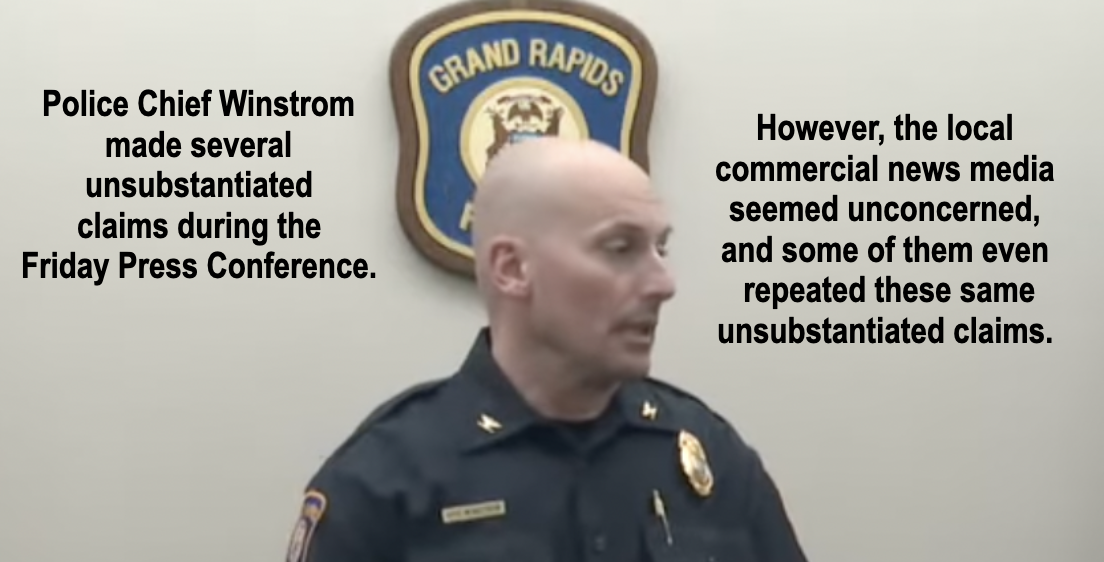
The phrase “Ferguson Effect”, was coined by Heather MacDonald, which Chief Wonstrom named during the Press Conference. What Winstrom didn’t mention is the fact that Heather MacDonald is a senior fellow at the right-wing Manhattan Institute. The use of the phrase, the “Ferguson Effect” was looked at in an article by the media watchdog group, Fairness in Accuracy & Reporting in June of 2015. The article states:
The point of the “Ferguson effect,” though, is not to be accurate. It is instead to distract us from the growing evidence about the magnitude and extent of police use of lethal violence in the United States—as powerfully documented just this week by the Guardian and the Washington Post—and to besmirch the #BlackLivesMatter movement.
It’s a strategy that Republican presidential candidate Barry Goldwater inaugurated in his campaign in 1964, almost single-handedly turning crime into a political weapon against the civil rights movement.
In December of 2022, the Grand Rapids Chamber of Commerce sent a letter, followed by over 100 signatures of some of the most powerful property owners in Grand Rapids to get the city to adopt an ordinance that would criminalize the unhoused. Chief Winstrom consistently supported that effort.
In February 2023, the GRPD released their new Strategic Plan, which was the first under Chief Winstrom. Here is a GRIID assessment of that Strategic Plan.
In April of 2023, there was a public hearing about the GRPD’s request for funding to purchase drones. There was overwhelming opposition to this proposal and the GRPD intimidated people during that hearing. However, despite significant public opposition to the GRPD using drones for surveillance and to track activist activity, City officials approved additional public dollars for the drones.
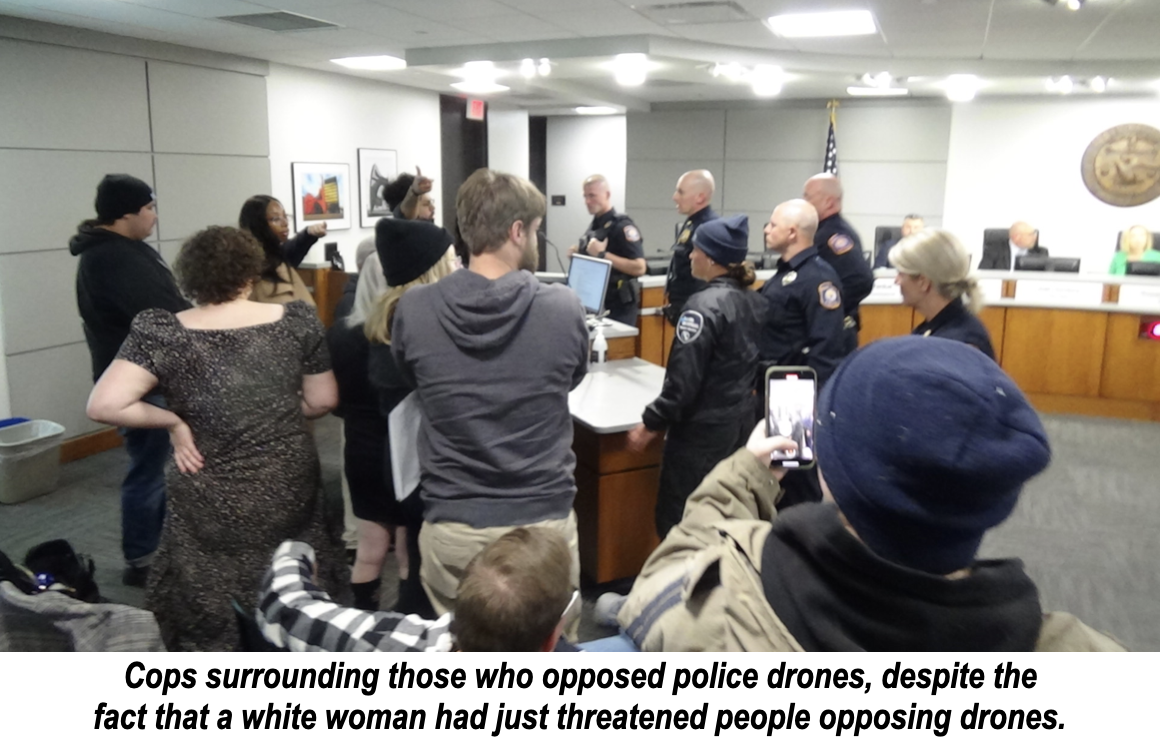
Just one week after the public hearing on drones for the GRPD, Chief Winstrom made callous remarks about activists, claiming they didn’t care about their neighbors. One month later Winstrom once again was dismissing activist saying that their goal was merely to get on TV. As I note in the article Winstrom’s claims are completely false.
In July of 2023, the Grand Rapids Area Tenant Union began a campaign that generated thousands of electronic messages to city hall, along with urging people to attend a public hearing to oppose a city ordinance that would criminalize the unhoused. Chief Winstrom and his department were more than happy to enforce this ordinance, despite overwhelming opposition.
In November of that year, the GRPD requested an additional $200,000 to hire more staff to respond to FOIA requests, which were primarily because people and organization were scrutinizing GRPD practices.
In December, people organized a march to and action at the home of Rep. Scholten because of her unconditional support for Israel’s genocidal assault on Gaza. Chief Winstom deployed 10 police cruisers and showed up himself, which resulted in arresting someone who was driving behind the march to prevent any harm to those marching.
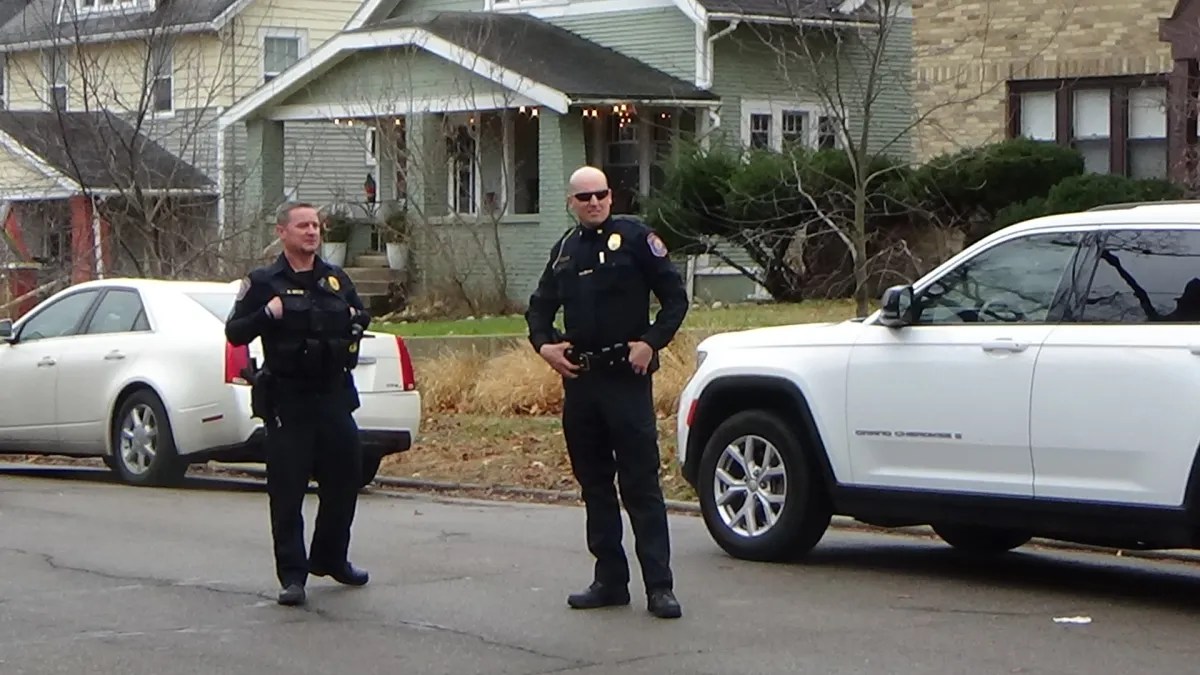
In March of 2024 I wrote an article headlined, GRPD Chief Winstrom exploits the memory of Breonna Taylor, while his department continues to harass, monitor and repress activists challenging policing in Grand Rapids. In that article I wrote:
The arrogance of cops and of white people, like Chief Winstrom, to take up space at an event about a Black woman murdered by cops is disgusting. Such an event should be an opportunity to center the voices of those who have been most affected by police murders. White people, especially cops, should not only keep their mouths shut during such events, they should not attend an event that commemorates a victim of police violence.
In April of 2024, the Comrades Collective held a non-violent march on the second anniversary of the GRPD killing of Patrick Lyoya. Lyoya’s parents joined that march only to witness the GRPD harassment of activists, along with an arrest of one organizer at the event. However, the harassment and targeting of activists didn’t end that day. Two BIPOC organizers were charged by the GRPD weeks later. GRIID interviewed both Jose and later Ky about the blatant targeting of BIPOC activists by the GRPD.
I then followed up these interviews with a post entitled, The criminalization of dissent in Grand Rapids. Four days later Chief Winstrom outright lied to an MLive reporter about the GRPD’s constant harassment and suppression of any dissent or disruption to business as usual in Grand Rapids.
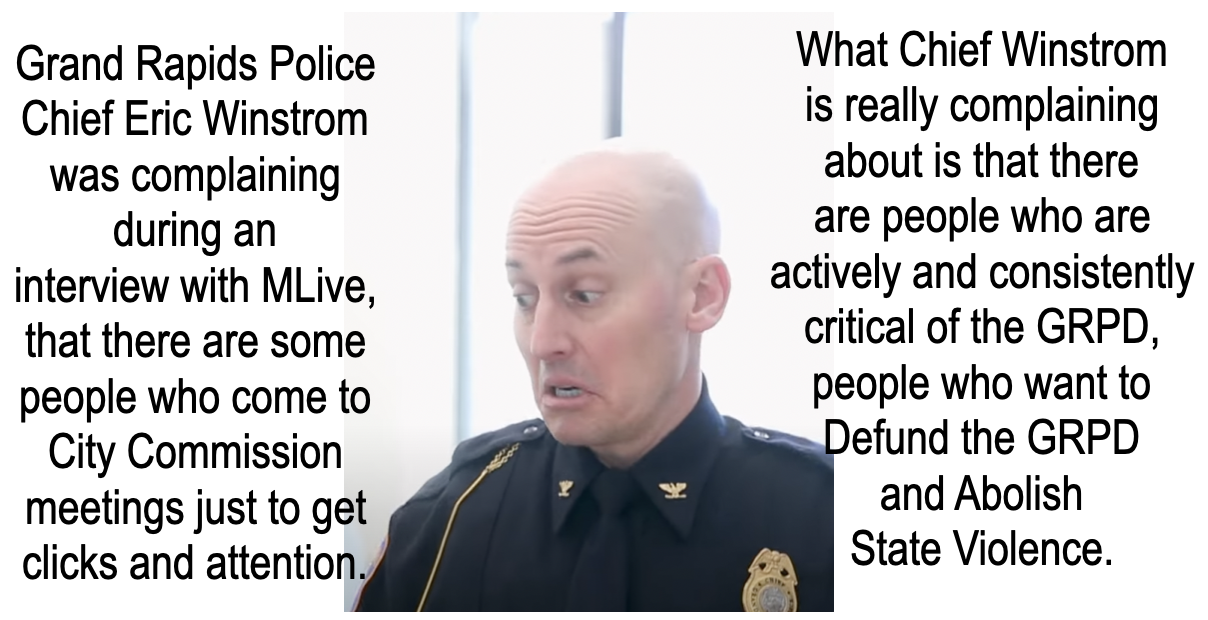
In September of 2024, GRIID posted a story on FOIA documents regarding the GRPD suppression of activists responding to the GRPD killing of Patrick Lyoya. The FOIA request took 16 months to obtain, plus the GRPD redacted a great deal of those documents.
In November the Grand Rapids Chamber of Commerce invite Chief Winstrom to speak on the theme of leadership lessons. This invite demonstrated exactly who Chief Winstrom and the GRPD primarily serve.
Later in November the GRPD shot and killed an African America man near Trinity Health Hospital, a man who was unarmed and struggled with mental health issues. The Kent County Prosecutor found no wrong doing on the part of the GRPD officers who shot an unarmed Black man.
Two weeks later a Black youth’s body was found after he had been reported as missing. Chief Winstrom created a narrative about what happened, but family members were not buying it.
In January of 2025, immigrant justice activists pressured the Grand Rapids City Commission to adopt concrete sanctuary policies that would prevent the GRPD and City staff from collaborating with ICE. Chief Winstrom claimed that his department wouldn’t, but that is not what the City’s Foreign National policy states.
In April, I posted a story about the pro-cop media bias in the lead up to the Christopher Schurr trial, I pointed out that some of that bias was determined by Chief Winstrom’s control of the public narrative. Then in May, Cosecha held their annual May Day march, but even before the march began the GRPD threatened to arrest people if they stepped into the street during their non-violent action.
In mid-May, Chief Winstrom went public by stating that had the GRPD not been understaffed, Patrick Lyoya would not have been killed.
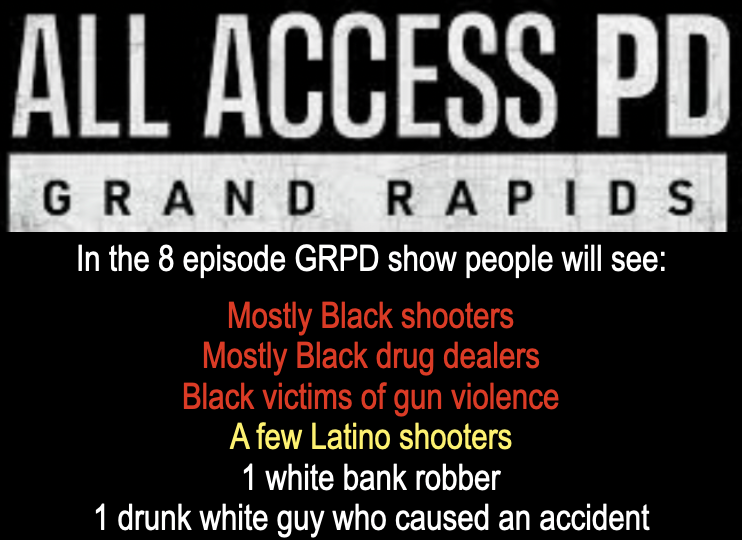
In late May of 2025, the Grand Rapids City Commission approved their 2026 fiscal budget, which included fully funding the GRPD. Just days later I completed an 8-part analysis of the GRPD TV show that was on HBO MAX, a show that Chief Winstron said was an honest depiction of his department. At the end of my post about the TV series, I stated:
Lastly, it should be stated that the All Access PD: Grand Rapids TV series is ultimately about controlling the narrative about policing. Ever since the 2020 uprising in Grand Rapids, there has been an all out war to control the narrative about the GRPD, because more than anything those in power do not want to succumb to the will of popular social movements, and they will not allow any conversation about defunding/abolishing the Grand Rapids Police Department. Grand Rapids is in a narrative war about the GRPD, and this was ultimately why Grand Rapids politicians and members of the Capitalist class have endorsed it.
In June, members of Cosecha and GR Rapid Response to ICE showed up to prevent additional ICE arrests at the ISAP office on Michigan Street in Grand Rapids. The GRPD came to harass and threaten activists attempting to keep immigrants safe. Two days later GRIID posted an article which demonstrated that the GRPD was sharing information with ICE, with the use of Flock cameras.
In mid-June, two Boston Square community organizers came upon the GRPD holding young Black men, so the organizers began filming what was happening. Eventually, the two community organizers began asking questions while they were filming and then the GRPD took one of them down with force. Both community organizers were arrested and Chief Winstrom justified his department’s arrests with claims that the two organizers “inserted themselves” into a situation they shouldn’t have. Community organizers shared a much different narrative about how the GRPD responded in this situation.
In late July, immigrant justice organizers spoke for 2 hours on why the City of Grand Rapids should not collaborate with ICE. The organizers dramatized this reality with street theater, then disrupted the City Commission meeting, only to have Mayor LaGrand threaten activists with arrest by the GRPD.
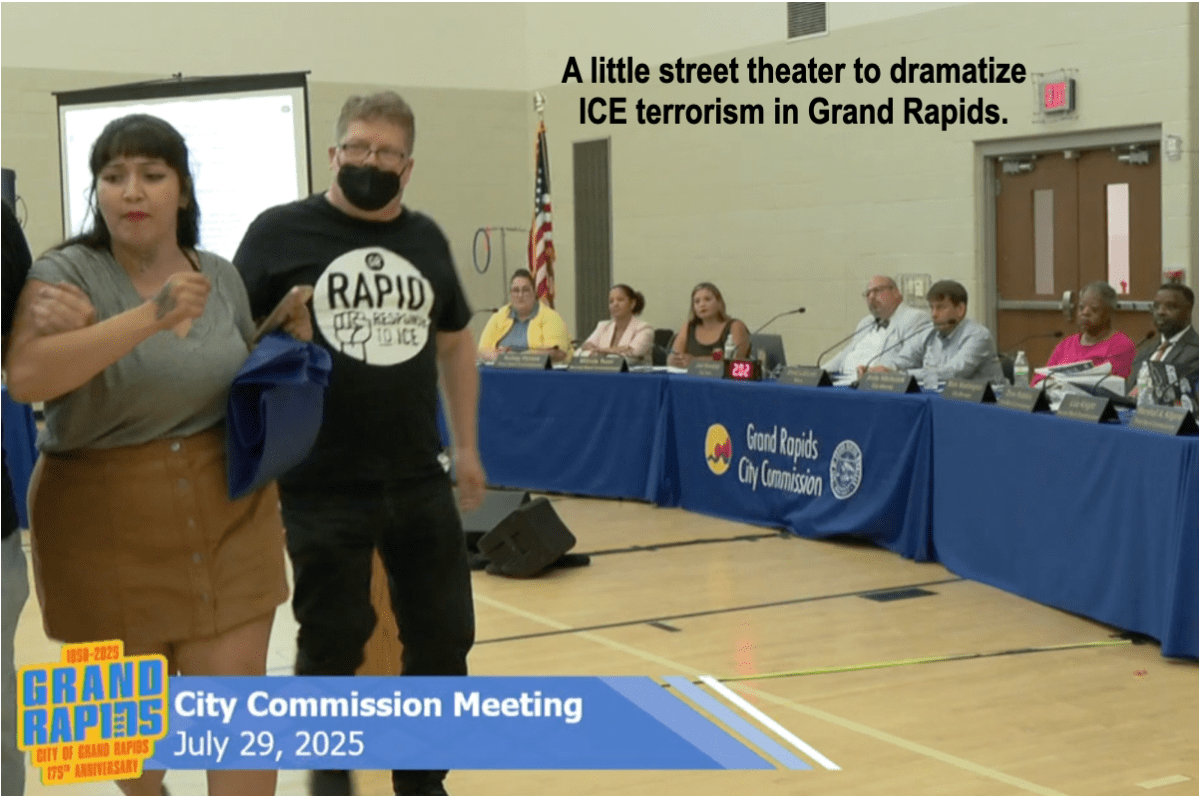
Throughout the rest of 2025 and in the beginning of 2026, organizers with Movimiento Cosecha and GR Rapid Response to ICE documented several instances where the GRPD was clearly cooperating with ICE in their efforts to arrest and detain undocumented immigrants, thus separating immigrant families.
This documented account of Chief Winstrom’s time in Grand Rapids is a clear counter narrative to what he and the local news media would have us believe. Winstrom, who came from Chicago, was the consummate PR man, who continued the GRPD tradition of over-policing in Black and Brown neighborhoods, protecting system of power in Grand Rapids and criminalizing dissent.
Recently, I posted an article that was critical of the GR A250 group, which was created to celebrate the 250th anniversary of the founding of the US and the 175th anniversary of the founding of Grand Rapids.
I have also noted in a previous post that the steering committee for the GR A250 group is dominated by members of the GR Power Structure. Additionally, what this group posts on their Facebook page is primarily history from the perspective of those with economic or political power, which was the subject of my last post regarding GR A250.
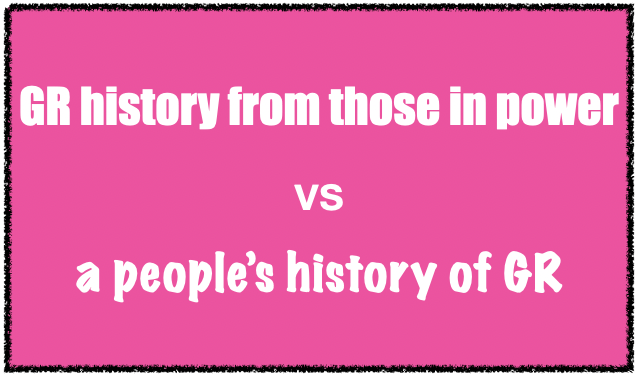
The GR A250 once again made a post that is reflective of people with power, in this case specifically economic power. The post included the following commentary, along with an picture of the old Lear facility.
Before innovation reached cruising altitude, it lifted off in Grand Rapids.
Long before his name became synonymous with business jets, Bill Lear built and scaled much of his early success right here in Grand Rapids through Lear Service. From pioneering radio technology to advancing aircraft systems, Lear’s work helped push American innovation forward by proving that world-changing ideas didn’t just come from the coasts, but from communities like ours.
Grand Rapids wasn’t a witness to innovation. It helped launch it.
Once again, the emphasis is on business people, without ever mentioning those who actually made Lear’s wealth, the workers. More importantly, the Lear company, which later became Lear Siegler, didn’t just make jets, they also has contracts with the Department of Defense to make weapons, including nuclear weapons.
An anti-nuclear campaign against Lear Siegler began in fall of 1983, with students from the Aquinas College Social Action Committee raising awareness about the military contract that the company had to make flight systems for nuclear weapons In the Spring of 1984, Aquinas students, several of which were seminary students, organized a Good Friday Stations of the Cross action from the campus to the Lear Siegler plant several miles away.
Some 200 people took part in this action, which got a fair amount of news cover-age with information about the fact that parts for nuclear weapons were being manufactured right there in the Grand Rapids area. Students who had organized the action were then confronted by the Aquinas College President who told them that this action was “shameless and judgmental.” The students said they were acting on the US Catholic Bishop’s recent pastoral letter, which called nuclear weapons immoral. It was later discovered that the CEO of Lear Siegler was a major financial contributor to Aquinas College.
The Aquinas students who were involved in that effort, then began a weekly leaf-letting campaign outside of the Lear Siegler manufacturing facility, with leaflets focusing on the dangers of nuclear weapons proliferation and economic conversation. However, the leafletting campaign only lasted for five months and then Lear Siegler was bought by a British corporation called Smith Industries.
I completely get why those who run the GR A250 project want to highlight business achievements, since many of them are business owners. But this is exactly why I will continue to provide analysis and counter narratives around Grand Rapids history, specifically a people’s history.
GRIID Class on US Foreign Policy since WWII – Week #4
In week #1 I provided some foundational documents and a framework for how to look at no what country the US is engaged in. I also used the framework document to assess the history of Iraq, particularly the US relationship with that country.
For week #2 we focused on US government efforts, primarily through the CIA to undermine the elections in Italy 1947-48, and to orchestrate coups in Iran in 1953 and Guatemala in 1954.
For week #3 we continued to used William Blum’s book, Killing Hope: US Military and CIA Interventions since WWII. The three countries we focused on were the Congo, Indonesia, and Chile during the 1960s. This week we discussed how the US undermined Angola, Libya and Nicaragua in the 1970s and 80s.
Angola 1975 – 1980s
Version 1.0.0
Blum begins this chapter by writing:
It is spring 1975. Saigon has just fallen. The last of the Americans are fleeing for their lives. Fallout from Watergate hangs heavy in the air in the United States. The Pike Committee of the House of Representatives is investigating CIA foreign covert activities. On the Senate side, the Church Committee is doing the same. And the Rockefeller Commission has set about investigating the Agency’s domestic activities. The morning papers bring fresh revelations about CIA and FBI misdeeds.
This is an important context for what the CIA was doing in Angola, specifically around their relationships with various factions fighting for independence from Portugal. Ultimately, the US sided with UNITA, which was led by Jonas Savimbi. Savimbi was willing at one point to negotiate with other Angolan factions, but Kissinger personally promised UNITA continued support if they maintained their resistance, knowing full well that there was no more support to give. Savimibi eventually became a powerful rogue player, receiving weapons from the US and killing many of his fellow Angolans.
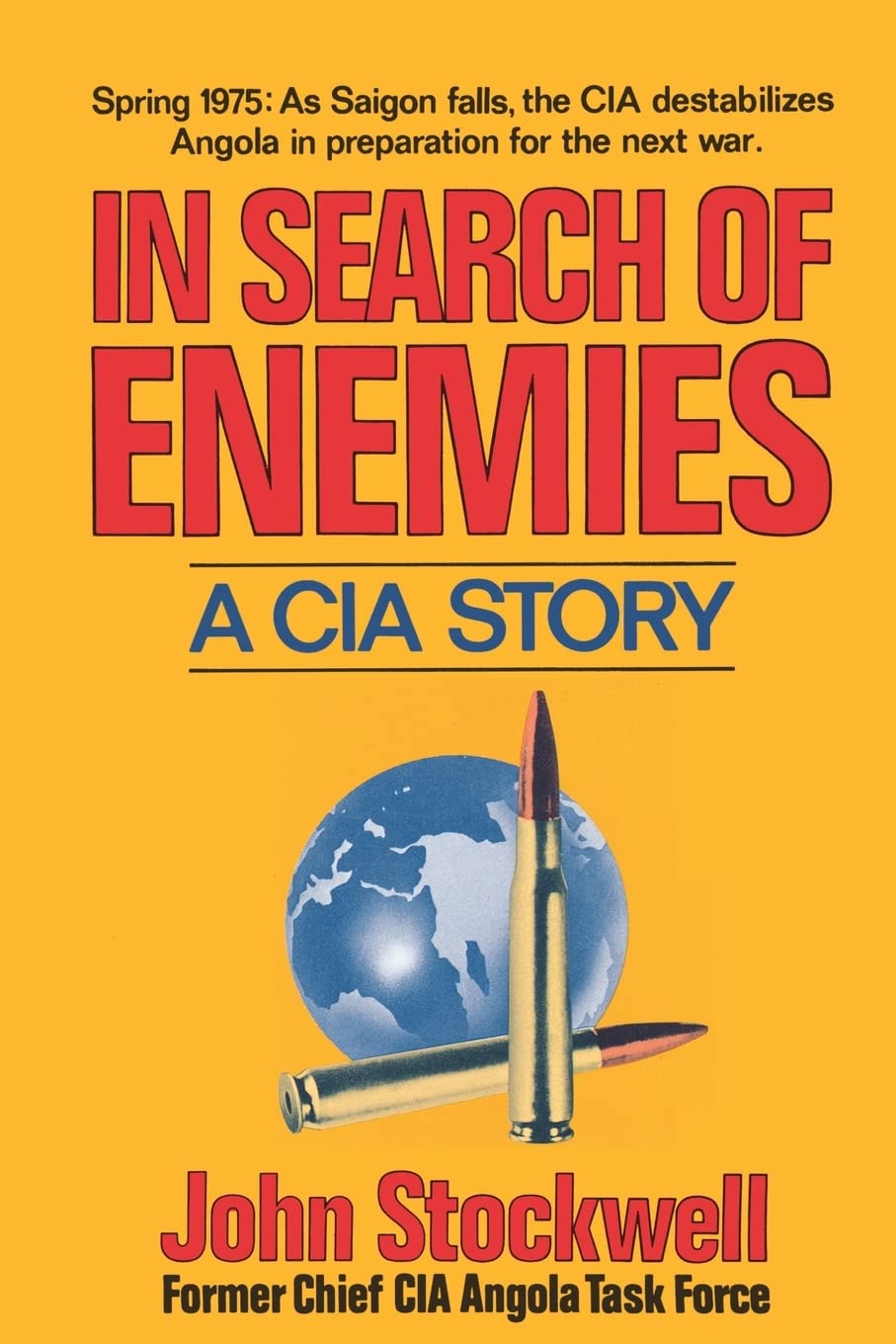
Interestingly, Cuba got involved with supporting other factions, as they had done in various African nations, which you can read about in Piero Gleijeses excellent book, Conflicting Missions: Havana, Washington, and Africa, 1959-1976. A second important book is, In Search of Enemies: A CIA Story, by John Stockwell, who was the CIA station chief for Angola who left the agencies in the early 1980s and published this book to expose the CIA and it’s role in the larger US imperialist plan.
Libya 1981 – 1989
We began our discussion of Libya by talking about the fact that they were a colony of Italy for several decade until 1943. Because Italy was losing WWII, they could no longer maintain control of Libya, which led to their eventual independence.
This section from Blum’s book focused more on Libya during the Reagan years, since Libya became a major target of the US. The US consistently referred to Libya under Qaddafi as a terrorist state, even though most of the claims by the Reagan administration were false, and in some cases the terrorist acts were being committed by groups that the US was supporting at the time.
The US major media outlets perpetuated the misinformation about Libya, which worked to get US public opinion to support any actions against Libya by the Reagan Administration.
Years later during the Arab Spring, Qaddafi became even more marginalized as a leader and the US initiated a bombing campaign (with NATO support), which killed thousands of Libyans and eventually Qaddafi himself. This bombing campaign happened under the Obama Administration, which you can read about in more detail here.
Nicaragua 1979 – 1990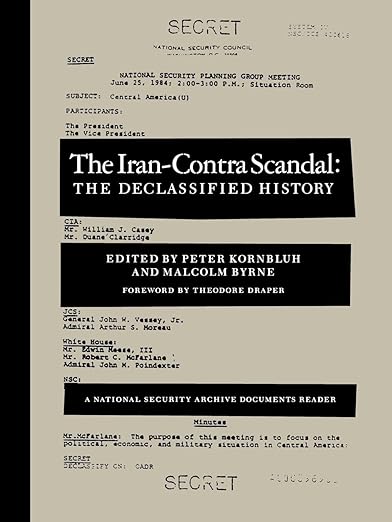
In the third example from week #4, we discussed the US and Nicaragua. The US military had intervened in Nicaragua more than a dozen times in the early part of the 20th Century, until they finally installed a US-friendly dictatorship run by the Somozan family.
The Sandinistas began a rebellion after a 1975 earthquake that devastated the Central American country, but despite all the international aid, the Somoza family kept the majority of those funds and took it with them when they fled to Miami during the 1979 revolution.
The international human rights/food aid organization OxFam said of the US efforts to undermine the Sandinista government was because, “Nicaragua was becoming a threat of a good example.”
The US began arming and training former national guardsmen from the Somoza dictatorship (known as the Contras) primarily in Honduras, where they engaged in a terrorist counter-insurgency war for the better part of a 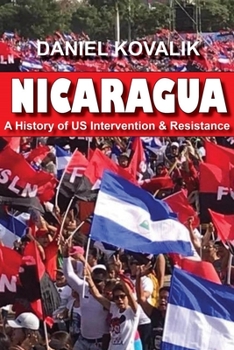 decade. Even after the US Congress made it illegal to fund the Contras, the US government began finding ways to fund them weapons negotiations with Iran and making money from trafficking in Cocaine. This led to the Iran/Contra scandal, which was one of the few times that CIA activity came under scrutiny during prime time national TV coverage. See the book, The Iran-Contra Scandal: The Declassified History, published through the National Security Archives.
The US also imposed sanctions against the Nicaraguan government, along with mining the main harbor of that country, which was deemed illegal by the UN. The US eventually got Nicaragua to cry uncle in 1990, by threatening to continue funding the Contras unless the opposition party won in the elections that year. An excellent book on this history is Nicaragua: A History of Us Intervention & Resistance, by Dan Kovalik.
Griffins hockey team President who made a racist and homophobic statement works for the DeVos/Van Andel families
Recently, Tim Gortsema, the President of the Griffins hockey team here in Grand Rapids, posted comments that were both homophobic and racist. I want to deconstruct his statement and then talk about how this kind of hateful rhetoric is ultimately the fault of the ownership of the team, which just happens to be
Gortsema stated:
What I won’t be watching will be this year’s Super Bowl Halftime Show featuring Puerto Rican artist Bad Bunny. Specifically, I do not believe he models proper behavior for our youth, and I take issue with his crossdressing and sexually explicit lyrics (even if most of his songs are in Spanish). Overall, I just think the NFL missed the mark with this year’s halftime show. In a nation that is already divided, the selection of Bad Bunny reinforces and widens this current divide. I’m not saying that the halftime performer needs to be MAGA or Pro-Trump. Instead, I would have liked the performer to at least be Pro-America. Despite our Nation’s flaws, I still believe that we are privileged to live in the greatest country on the planet.
Ok, so what kind of behavior does Tim Gortsema want people to model? Seems like he wants white, straight performers who also think that the US is the greatest country on the planet. Bad Bunny is a fabulous model for youth and his choice(s) of clothing provides people who are subjected to a deeply homophobic culture, some additional emotional and social space to be who they want to be in the world.
When Tim Gortsema says the halftime performer doesn’t need to be “MAGA or Pro-Trump” he is most definitely projecting that that is precisely the kind of performer he thinks should be part of the Super Bowl Halftime Show. Lastly, when Gortsema says, “Despite our Nation’s flaws, I still believe that we are privileged to live in the greatest country on the planet, “ he is clearly gaslighting the public with these comments. The US is deeply divided because there are lots of people who want to maintain a white supremacist system and there are those who don’t. Also, Puerto Rico is part of the US, because the US occupied Puerto Rico in 1898 and made it a colony. If this is Gortsema’s notion of the greatest country on the planet, one which practices global imperialism, then Gortsems needs to bone up on his understanding of history.
The DeVos and Van Andel hire people who embrace their values
Ok, so let’s be clear about who Tim Gortsema is and who he works for. According to the Grand Rapids Griffins Team page:
Gortsema is a member of the Griffins’ original 1995 staff and began his career with DP Fox Sports & Entertainment as director of finance and administration before being named vice president in 1997. In February 2007 he was promoted to senior vice president of business operations, becoming just the second person to direct the Griffins’ front office, and he was named president of the franchise in June 2015.
The Griffin’s hockey team is owned by Dan DeVos and David Van Andel. These two families hired Gortsema and knew the kind of person he is, since they have known him at least since 1995 when he join their staff. Doug DeVos and David Van Andel knew that Tim Gortsema embraces an anti-gay, pro-America, white dominant society, specifically because that is what the DeVos and Van Andel families have embraced for decades.
For people who regularly read this blog know that I regularly write about the Grand Rapids Power Structure, where the DeVos and Van Andel families play a major role. These two families have contributed to the Republican Party and more recently to the campaigns for Donald Trump. These two families control a great deal of the land and assets in downtown Grand Rapids, like Hotels, bars, and parking spaces. The DeVos and Van Andel families are behind the Three Towers project, which is being subsidized with $561 million in public dollars. These two families paid for the naming rights to the soccer stadium and they own the professional soccer team that will play there.
In addition, the DeVos and Van Andel families use their foundations to fund anti-gay and anti-union groups, along with funding projects that promote their pro-Capitalism and Pro-Christian beliefs. None of what Tim Gortsema said should be seen as a surprise, since his beliefs and values are the very same beliefs and values of the DeVos and Van Andel families.
Now, we know that Gortsems made a weak apology since he posted the above comments, but that was only because of the backlash on social media. However, the biggest fear that the DeVos and Van Andel families have is that their wealth would be threatened by people not wanting to spend their money at DeVos and Van Andel establishments, like Grand Rapids Griffins hockey games. I invite you to call or write Tim Gortsema and tell him that we will not tolerate such hateful comments and boycott businesses owned by the DeVos and Van Andel families.
Email: tgortsema@griffinshockey.com Phone: (616) 774-4585 ext. 3014
For more details on the DeVos family see my DeVos Family Reader.
GRPS students from the Museum School engage in a walkout to protest ICE terrorism in Grand Rapids
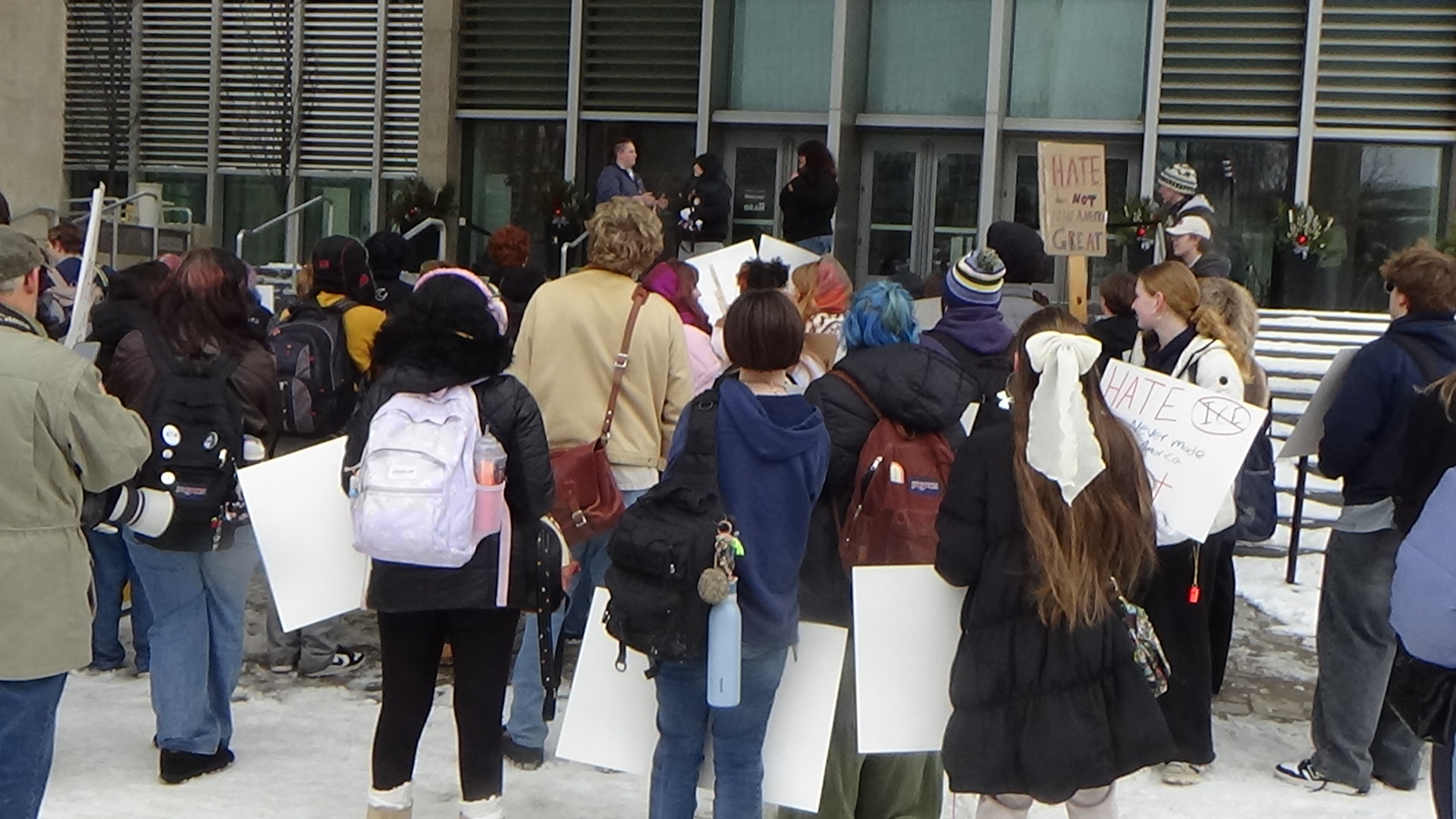
Around 100 students from the Grand Rapids Public School’s Museum High School organized a walkout on Wednesday at 2pm to join the growing number of people in Grand Rapids and across the country to oppose to terrorist tactics of ICE.
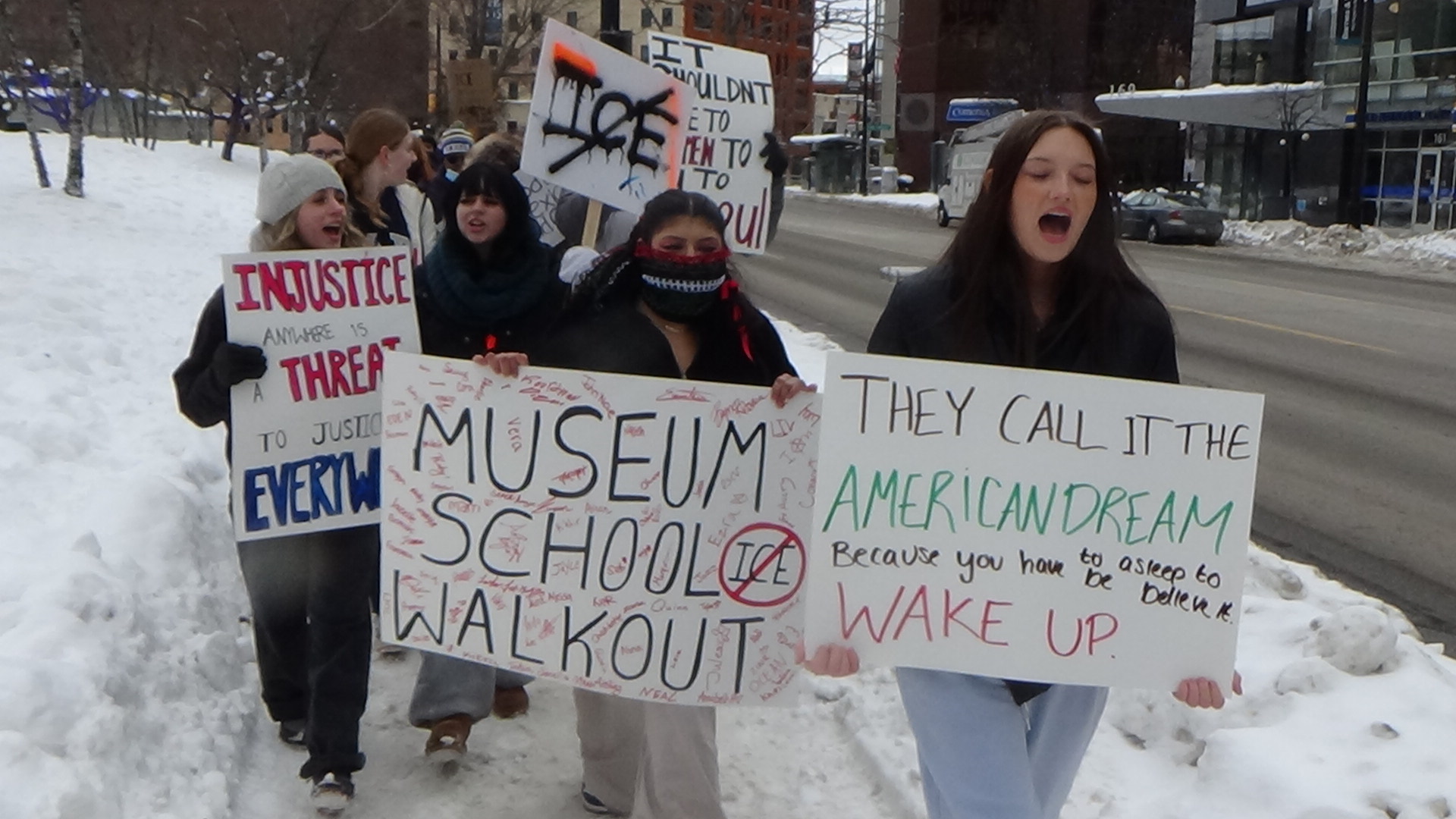
A student group in Lowell organized a walkout earlier this week, along with high school and college students that have been doing this over the past 12 months, after the Trump Administration announced that he was engage in mass deportations and then increased the budget for ICE to roughly $75 billion.
Student walkouts are part of a longstanding tradition of protest and resistance around the world and in the US, like the 22,000 Mexican America students across seven schools in East L.A did in 1968 as part of the larger civil rights struggle that Chicano organizers were part of. This student-led walkout was so impactful and so famous that it was made into a movie called Walkout.
The GRPS student walkout was supported by people who provided crowd safety, to make sure they were not harassed during their march, which took them to Rosa Parks Circle.
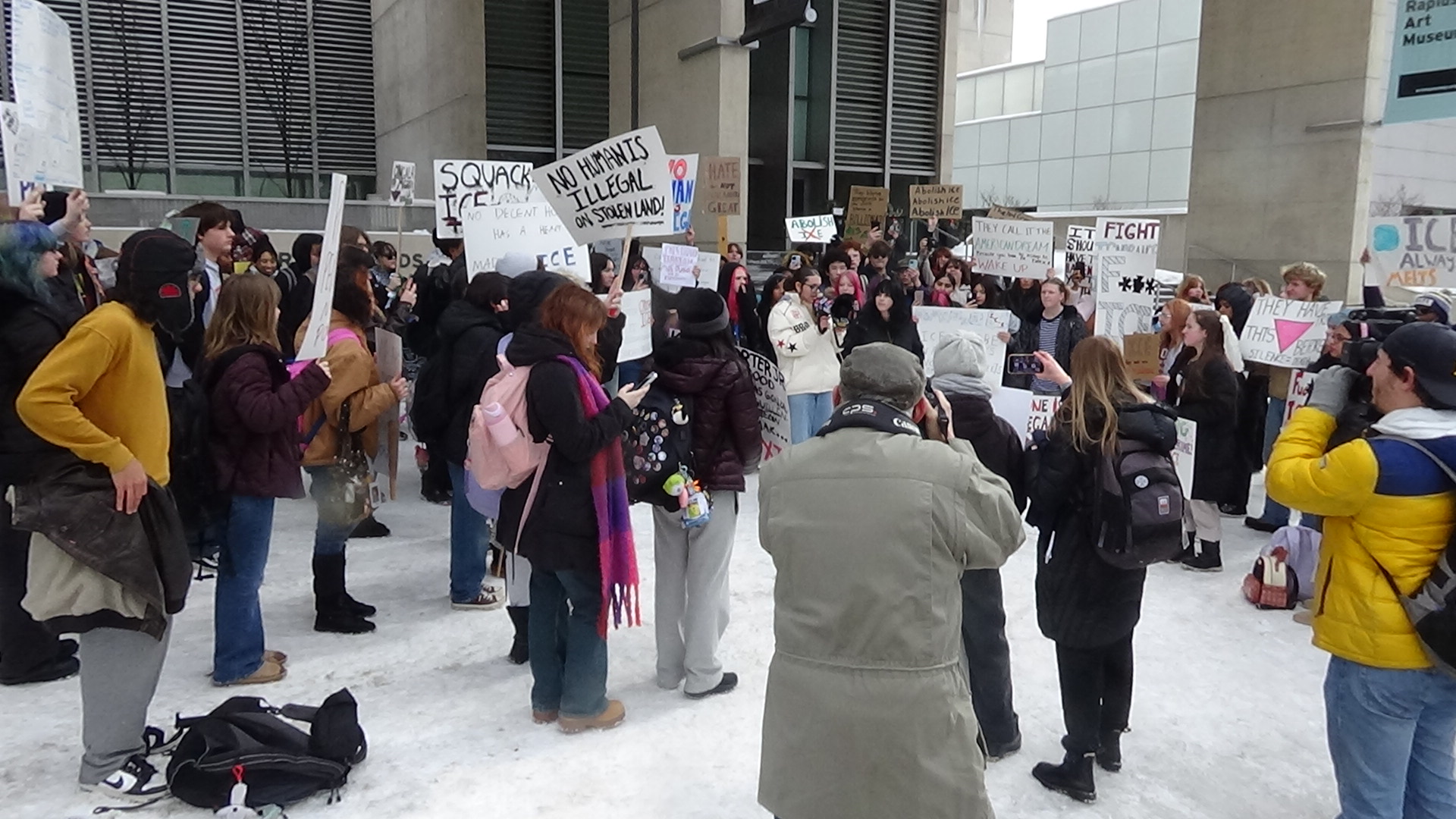
Throughout the march students engaged in numerous chants, but the most power was reflected in their demand to ABOLISH ICE!. This message is consistent with what a growing numerous of immigrant justice groups around the country have been demanding, along with local groups such as Movimiento Cosecha and GR Rapid Response to ICE.
When the GRPS students arrived at Rosa Parks Circle, several of them read statements that denounced how ICE has been terrorizing immigrant families and communities, along with calling for the abolition of ICE.
One student who had brought his guitar also sang a song which spoke to the aspirations of young people wanting to live in a world without fear from government agencies like ICE.
The students then marched back to their school on Jefferson and State Street, just a few blocks from Rosa Parks Circle. It was inspiring for me to witness this action and to be invited to take part. Student groups have always been part of nation movements for justice and this movement for immigrant justice and the abolition of ICE.
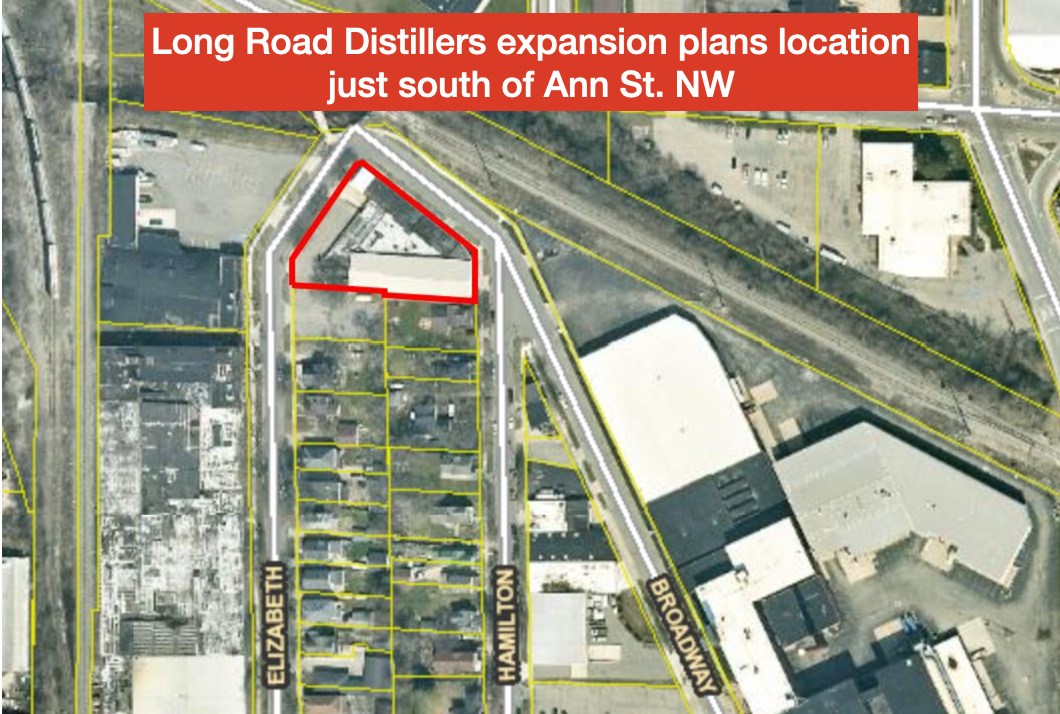
Last Thursday, Crain’s Grand Rapids Business posted an article entitled, Long Road bets on canned cocktails with production facility expansion.

The article discusses the production expansion plan, along with details about the company’s desire to produce more ready to drink cocktail beverages. The primary source for the Crain’s article was co-owner and former GR City Commissioner Jon O’Conner.
Having O’Connor be the spokesperson makes sense, since the other co-owner is Grand Rapids Mayor David LaGrand.
The production expansion plans were also part of the January 27th Grand Rapids City Commission meeting, which means that Mayor LaGrand had to remove himself from the discussion, since his being a co-owner would have been a conflict of interest.
Unfortunately, the Crain’s Grand Rapids Business article doesn’t mention that Mayor LaGrand is a co-owner of Long Road Distillers or that it was an agenda item at the Grand Rapids City Commission. Not only was the Long Road Distillers expansion on the City Commission’s agenda, there will be a public hearing on Tuesday, February 10th at 2pm to hear public input on the company’s expansion plans and whether or not the city should be providing the company with a tax abatement.
Additionally, the Crain’s Grand Rapids Business article never mentions that there has been an organized boycott of Long Road Distillers locations and products since last October, when members of Movimiento Cosecha and GR Rapid Response to ICE began the campaign with a protest in front of their Leonard St. location.
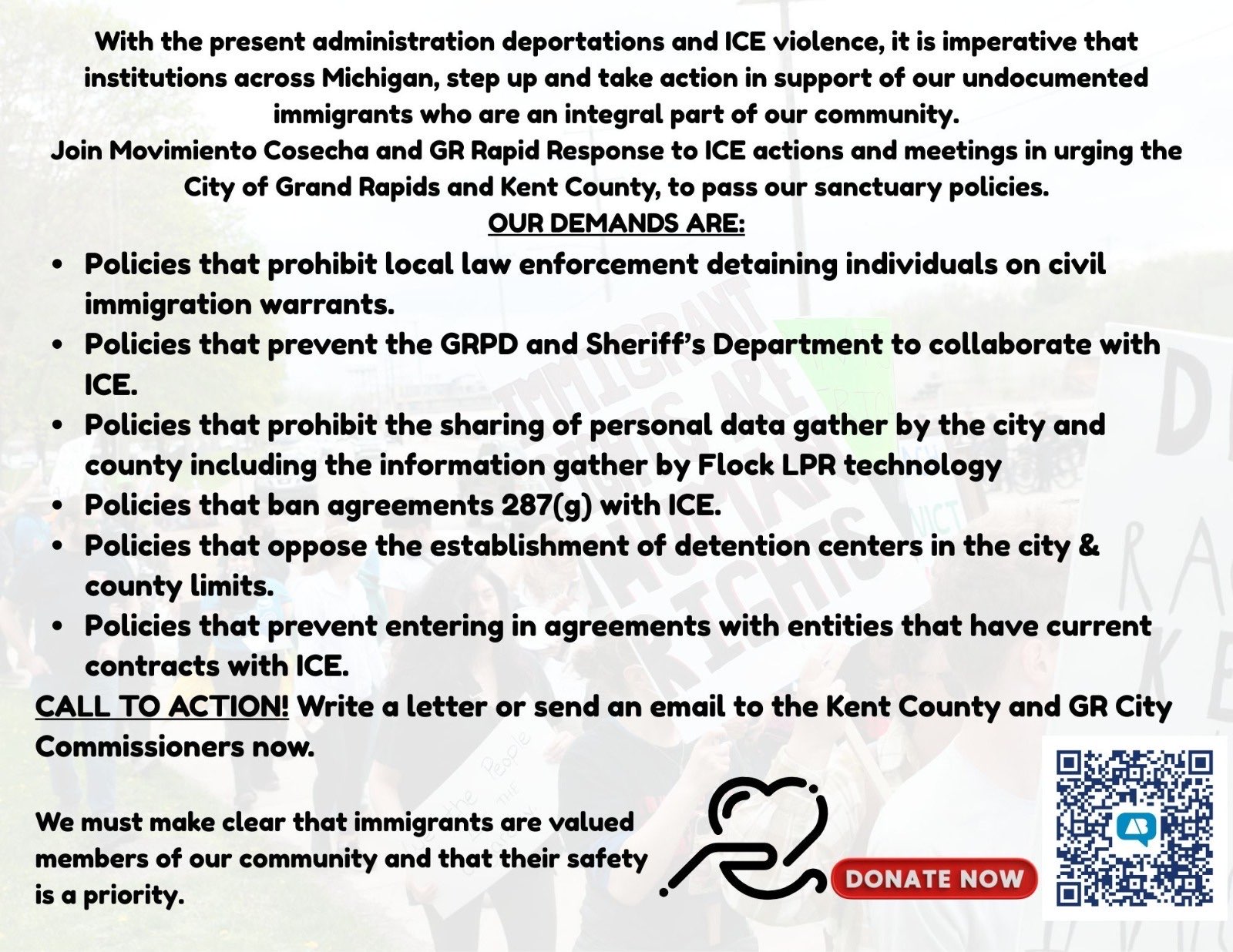
Movimiento Cosecha and GR Rapid Response to ICE initiated the boycott to pressure Mayor LaGrand to adopt 6 sanctuary policies that would guarantee that the City of Grand Rapids and the GRPD would not collaborate with Immigration and Customs Enforcement (ICE) in their efforts to arrest, detain and deport immigrants.
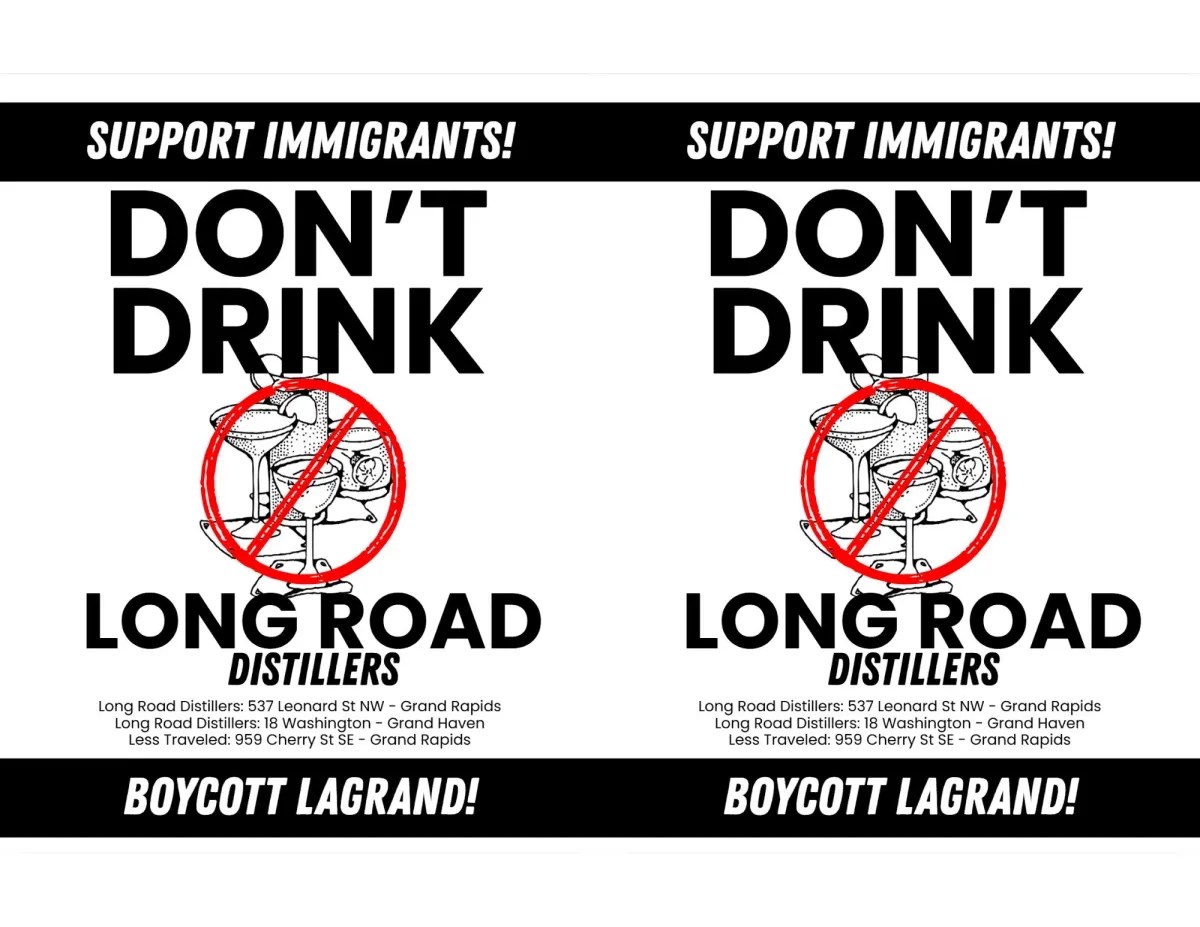
It is instructive that the Crain’s Grand Rapids Business article fails to inform its readers that their is an upcoming public hearing on the expansion plans of Long Road Distillers along with the fact that there is an active boycott of the company as a tactic to pressure Mayor LaGrand to adopt the 6 sanctuary policies that Movimiento Cosecha and GR Rapid Response to ICE began 4 months ago.
This is a clear case where Crain’s Grand Rapids Business only seems interested in promoting business interests at the expense of community demands and community safety.
In November there will be more elections and with that comes the same dynamics we have seen repeatedly in terms of where we should place our focus and energy.
The mid-terms are upon us and many people and organizations are placing a great deal of hope in those elections. Not only are groups wanting to center the upcoming elections they want us to participate with the usual mantra of anybody but the Republicans. Ironically, this blind devotion to voting for the lesser of evils is exactly how we got here in the first place.
Ask yourself if the Democratic Party has demonstrated any real and substantive resistance to the Trump Administration over the past twelve months? I don’t mean speeches or statements, rather how have Democrats voted and more importantly, how much are they following the lead of those doing the actual organized resistance across the county? The Democratic Party in the past 12 months has not engaged in real resistance, and more often than not they have tried to either undermine organized resistance through proxy groups and they have gone out of their way to defend systems of power and oppression, like ICE.
Undermining organized resistance
The Democratic Party has undermined movement work in recent decades, often using the language of on the ground movements, but always with the goal of not doing what movements are demanding. Remember of the Occupy Wall Street movement, which was challenging the Capitalist Class and calling for radical economic change that would not only benefit families, but address the climate crisis. Remember, the Occupy movement happened during the Obama Administration, which bailout out banks and forced autoworkers into taking concessions during contract negotiations.
Then there was the Movement for Black Lives, which was a direct response to brutal killings of Black people by cops. Again, the Obama Administration did little to address this matter, often chastising those in the streets and practicing respectability politics. This same national movement erupted in 2020 with the largest protests in US history after the police murder of George Floyd, with calls to defund and abolish the police. Again, Democrats tried to change the narrative and make it so cops had more diversity training, using body cams or they needed even more funding, like what happened under the Biden Administration.
In the past twelve months under the Trump Administration we have seen economic attacks against working class people, continued support for the Israel genocide and direct US military intervention in places like Venezuela. Again, the Democratic Party has responded by simply offering more oversight or mild reforms to capitalism and they continue to vote to provide nearly roughly $1 trillion to fund US militarism.
A large percentage of the public is calling for ICE to be abolished and yet the Democratic Party wants to make it about ICE agents wearing masks, calling for body cams additional oversight. What the Democratic Party is not calling for is the abolition of ICE.
Undermining organized resistance through proxy groups
The other main strategy of the Democrats is to use proxy groups to undermine the incredible organized resistance happening across the country. Some of those proxy groups are MoveOn (which was created during the Bush Admin.), 50501 or Indivisible.
In a recent weekly Email, the GR Indivisible group wrote the following:
Protests, rallies, calling our elected representatives, letter and postcard writing, supporting affected communities and mutual aid efforts, helping with food insecurity, and showing up for our neighbors are all incredibly important actions that we should continue to do. But if we do not turn Congress around in the 2026 midterm elections by getting progressive candidates elected, our society will continue to break down, increasing hardship for people not just in the U.S. but also around the globe.
Ok, so this is an instructive statement from Indivisible. What I take from this statement is that before the Trump Administration most people in the US were doing pretty good. This kind of thinking is so problematic, because 1) it fails to acknowledge how millions of people in the US have been suffering for a very long time regardless of who sits in the White House, and 2) it demonstrates that Democrats and Democratic Party front groups like Indivisible are in denial of the tremendous suffering and injustice that happens under Democratic administrations.
Here is a question, why wasn’t Indivisible organizing during the Biden Administration. Why weren’t they making similar statements during the Biden Administration? Here is a very short list of what happened during the Biden Administration that were also rather heinous:
- There were more deportations in the last four years than there were during the first Trump Administration.
- The Biden Administration approved more fossil fuel extractions on US soil than the Trump Administration did.
- The wealth gap has expanded during the Biden Administration, especially amongst the Billionaire Class.
- The Biden Administration increased US military funding every year for the past 4 years.
- The Biden Administration increased funding for policing, even in the era of Black Lives Matter.
- The Biden Administration was completely and utterly complicit in the war crimes and genocidal policies of Israel, refusing to end weapons sales to Israel, being complicit in allowing Israel to block humanitarian aid to Gaza and always voting against most of the rest of the world when the United Nations condemned what Israel was doing.
- The Biden Administration was not only silent, but did not actively oppose the repression of the US campus Pro-Palestine movement.
- Rent increases went up during the Biden Administration, which did very little to address the current US housing crisis.
- The Biden Administration did not raise the federal minimum wage, they did not eliminate Citizens United, the did not release the Epstein files, and they didn’t codify Roe v Wade.
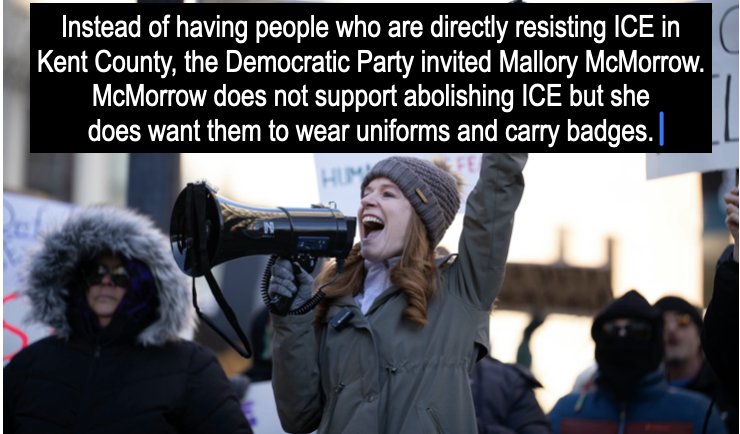 Last Saturday, the Kent Dems held an anti-ICE rally in Grand Rapids, but the Kent County Dems do not support the sanctuary policies that Movimiento Cosecha has been demanding over the past 12 months and none of the local Democratic politicians support Cosecha’s demands either. More importantly, they did not center affected communities during their anti-ICE rally or even bother to have Cosecha speak.
Instead, the Kent Dems invited the Senate candidate Mallory McMorrow to speak. McMorrow has NO history of demanding that ICE be abolished and her stance on ICE and immigration includes the following:
- Support legislation to require all ICE officers to wear uniforms and clear identification to prevent fear and distrust with plain-clothes officers conducting raids in communities
- Focus our immigration enforcement dollars on keeping violent criminals off of our streets, not bullying legal immigrants who came here for a better life
- Secure the border with more agents, better technology like sensors and scanners, and modernized ports of entry to stop trafficking and bring order to entry
This is the same weak reformist proposals that will do nothing to effectively stop ICE from arresting, detaining and deporting immigrants.
Now, I’m not telling people to not vote or how to vote, but what I am saying is that never in the history of the US has the federal government ever done anything good on their own. To the degree that there has been any fundamental changes at the federal level it has always been because of organized resistance and organized movements throughout history.
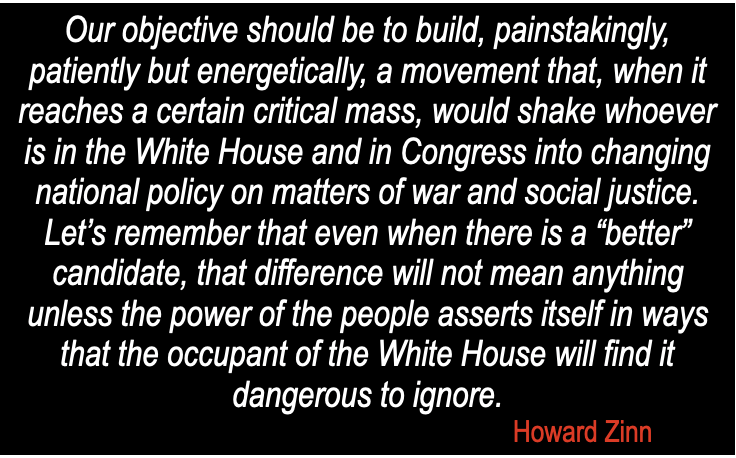
The radical historian Howard Zinn once said:
But before and after those two minutes it takes to vote, our time, our energy, as concerned citizens, should be spent in educating, agitating and organizing in the workplace, in the neighborhood, in the schools.
Our objective should be to build, painstakingly, patiently but energetically, a movement that, when it reaches a certain critical mass, would shake whoever is in the White House and in Congress into changing national policy on matters of war and social justice.
Let’s remember that even when there is a “better” candidate, that difference will not mean anything unless the power of the people asserts itself in ways that the occupant of the White House will find it dangerous to ignore.
On Friday, the US Senate voted 71 – 29 for a spending package to keep the government open, which included funding for the Department of Homeland Security and by extension ICE.
According to an article on Truthout:
The deal represents a major concession from Democrats — by allowing spending for most of the government to be approved, they give up a large bargaining chip to ensure their demands, however milquetoast, are taken seriously.
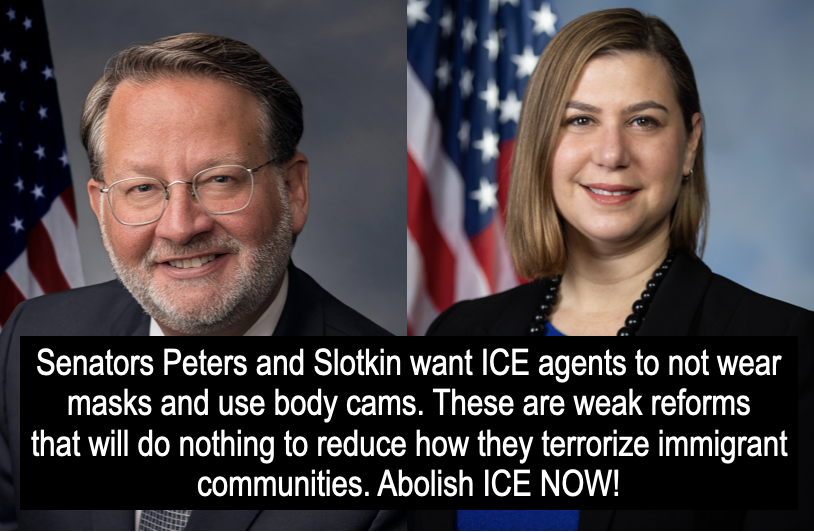
Michigan Senator Gary Peters voted for the seriously compromised bill and released a statement which included these comments:
“While we continue to negotiate DHS reforms like requiring body cameras and clear identification of federal law enforcement, I’m glad that we were able to pass funding for the remaining government agencies with bipartisan support.”
Senator Slotkin voted no on the bill that included funding for ICE, which was fairly meaningless, since 22 of her fellow Senate Democrats voted for ICE funding. In addition, Senator Slotkin wrote on her Facebook page:
“My sincere hope is the White House and my Republican colleagues in Congress hear the chorus from the American people, and use the next two weeks to put the appropriate limits on ICE. The model should be our state and local police officers, who adhere to a set of standards every day while protecting our communities.”
First, Slotkin left out Democrats in this statement, since the overwhelming message from the American people has been to Abolish ICE, not make it a kinder, gentler systems of state carceral violence. Second, for Slotkin to suggest that ICE should model themselves after state and local police means she not only is not interested in abolishing ICE, the Michigan Senator is denying two major factors about state and local police – that they use massive amounts of public tax dollars, which do not actually keep the public safe, plus cops across the country killed 1,314 people in the US in 2025, which has been the average number since 2020.
The votes from Senators Slotkin and Peters are representative of the majority of Democratic Party members in Congress, which is to keep voting to fund ICE, but with some mild reforms like no masks and body cams. The fact of the matter is that even without masks and wearing body cams, ICE will still be arresting, detaining and deporting undocumented immigrants.
This is why I believe that the Democrats are equally complicit in the state carceral violence that ICE inflicts on affected communities, since they only want to make some mild reforms around the edges, while funding the separation of immigrant families and perpetuating trauma and pain on affected communities.
GRIID Class on US Foreign Policy since WWII – Week #3
In week #1 I provided some foundational documents and a framework for how to look at no what country the US is engaged in. I also used the framework document to assess the history of Iraq, particularly the US relationship with that country.
For week #2 we focused on US government efforts, primarily through the CIA to undermine the elections in Italy 1947-48, and to orchestrate coups in Iran in 1953 and Guatemala in 1954.
For week #3 we continued to used William Blum’s book, Killing Hope: US Military and CIA Interventions since WWII. The three countries we focused on were the Congo, Indonesia, and Chile during the 1960s.
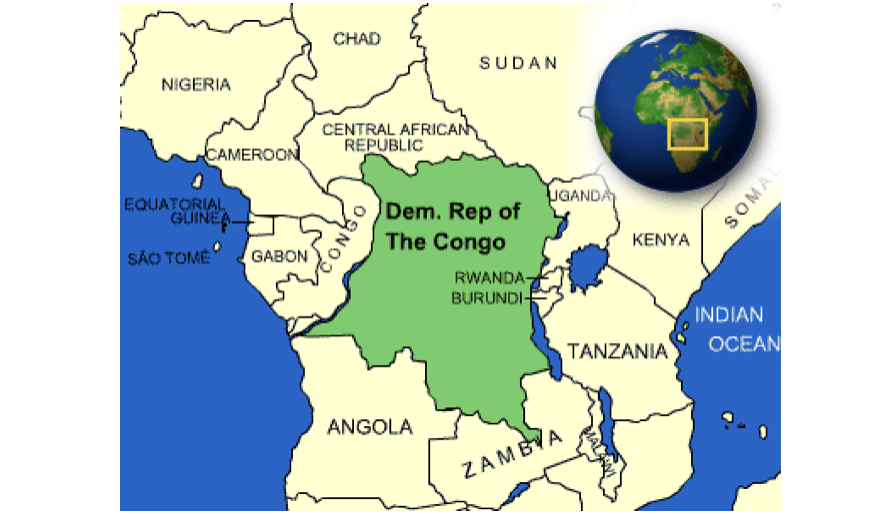
The Congo
The Congo had been colonized by Belgium for decades, primarily under the rule of King Leopold who was responsible for an estimated 10-15 million Congolese that were killed.
Eventually the Congo wanted to get out from under the boot of Belgium and began working for independence in 1960. The US always pays attention to countries that are seeking to be independent of colonialism and when they discovered that one of the leaders of the independence movement, Patrice Lumumba, was not only a charismatic speaker, but a sharp organizer.
According to Blum’s book (chapter 26) the CIA got involved and began looking for Congolese leaders who would be more sympathetic to long-term US interests, specifically mining interests. There is no consensus who who actually killed Lumumba, but it is clear that the CIA played a significant role in his death.
Once Lumumba was dealt with the US and Belgium collaborated to control economic and political dynamics in the Congo until they found the perfect leader who would be submissive to US longer interests, Mobutu. Mobutu had been recruited by the CIA as early as the 1950s, and in 1965 Mobutu seize power in the Congo with the assistance of the CIA. Mobutu was a dictator and plundered the national wealth for his own benefit. He was eventually forced out in 1990, thus ending 25 years of rule.
Today, the Congo still is one of the poorest countries in the world and continues to have its natural resources plundered by multinational corporations, which is well documented in the book, Cobalt Red: How the Blood of the Congo Powers Our Lives, by Siddharth Kara.
Indonesia 1965
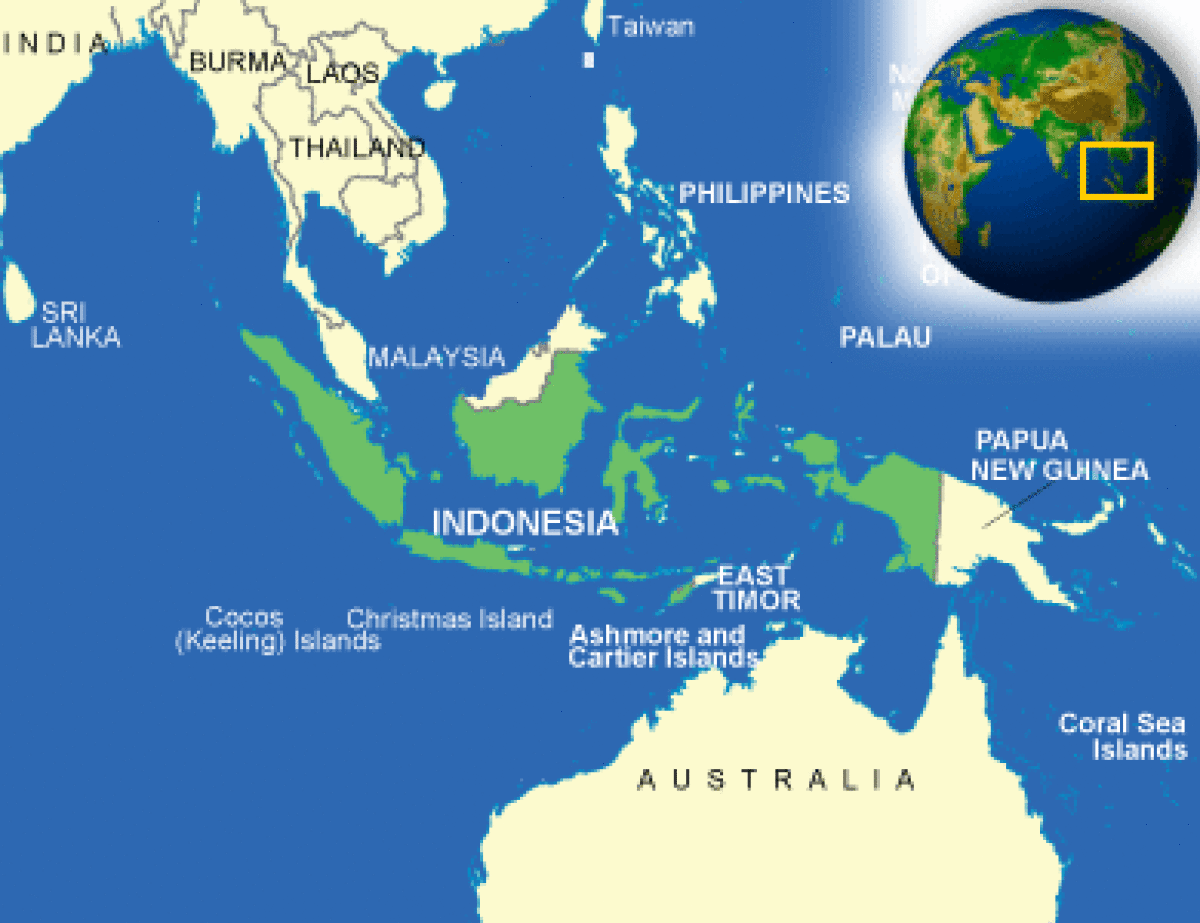
In October of 1965, there was a coup (involving the CIA) with the goal of ousting President Sukarno. According to Blum’s book the coup/purge resulted in 50,000 deaths:
Twenty-five years later, American diplomats disclosed that they had systematically compiled comprehensive lists of “communist” operatives, from top echelons down to village cadres, and turned over as many as 5,000 names to the Indonesian army, which hunted those persons down and killed them. The Americans would then check off the names of those who had been killed or captured. Robert Martens, a former member of the US Embassy’s political section in Jakarta, stated in 1990: “It really was a big help to the army. They probably killed a lot of people, and I probably have a lot of blood on my hands, but that’s not all bad. There’s a time when you have to strike hard at a decisive moment.”
In many ways this was a purge of anyone who was identified as a communist. Blum goes on to write:
The desire of the US government to be rid of Sukarno—a leader of the nonaligned and anti-imperialist movements of the Third World, and a protector of the PKI—did not diminish with the failure of the Agency-backed military uprising in 1958. Amongst the various reports of the early 1960s indicating a continuing interest in this end, a CIA memorandum of June 1962 is strikingly to the point. The author of the memo, whose name is deleted, was reporting on the impressions he had received from conversations with “Western diplomats” concerning a recent meeting between President Kennedy and British Prime Minister Macmillan. The two leaders agreed, said the memo, to attempt to isolate Sukarno in Asia and Africa. Further, “They agreed to liquidate President Sukarno, depending upon the situation and available opportunities. (It is not clear to me [the CIA officer] whether murder or overthrow is intended by the word liquidate.)”
This purging of communists put General Suharto in power, who was a longtime ally of the US. In 1975 Indonesia invaded the former Portuguese colony of East Timor, which lies at the eastern end of the Indonesian archipelago and which had proclaimed its independence after Portugal relinquished control. It was the beginning of a massacre that continues into the 1990s. By 1989, Amnesty International estimated that Indonesian troops, with the aim of forcibly annexing East Timor, had killed 200,000 people out of a population of between 600,000 and 700,000.29 The level of atrocity has often been on a par with that carried out against the PKI in Indonesia itself.
Suharto was able to do this after meeting with US President Gerald R. Ford and Henry Kissinger, who gave Suharto the green light to invade East Timor and cause one of the worst atrocities of the 20th century. See the declassified US documents collected by the National Security Archives. Also see the documentary, The Trials of Henry Kissinger, which documents the role the US played in the Indonesian invasion of East Timor.
Chile 1964 – 1973
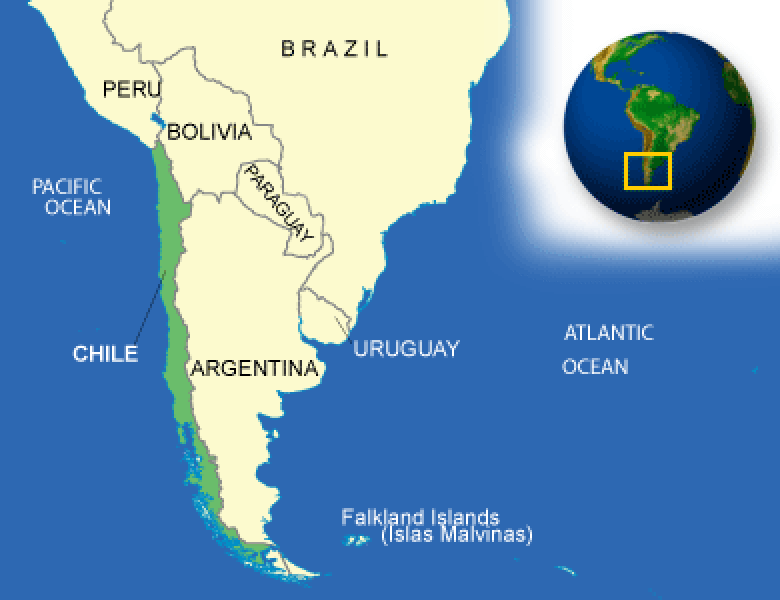
The US will not tolerate socialism in any country, especially in the Americas. This is why the US State Department, the CIA and the Johnson and Nixon Administrations worked tirelessly to overthrow the democratically elected government in Chile, with President Allende.
According to Blum’s book:
The CIA is an ongoing organization. Its covert activities are ongoing, each day, in each country. Between the 1964 and 1970 presidential elections many of the programs designed to foster an anti-leftist mentality indifferent sections of the population continued; much of the propaganda and electioneering mechanisms remained in place to support candidates of the 1965 and 1969 congressional elections; in the latter election, financial support was given to a splinter socialist party in order to attract votes away from Allende’s Socialist Party; this reportedly deprived the party of a minimum of seven congressional seats.
The CIA also began supporting some labor unions, which were connected to US labor unions and also collaborated with US efforts to squash socialism. See Jeff Schuhrke’s book, Blue-Collar Empire: The Untold Story of US Labor’s Global Anticommunist Crusade.
US multinational corporations also got involved, since the Allende government wanted to use Chilean resources for Chile. Companies like ITT and Kennecott Copper, which provided logistical support to US agencies seeking to overthrown the Chilean government.
Again, Blum writes:
In September the military prevailed. “It is clear,” said the Senate investigating committee, “the CIA received intelligence reports on the coup planning of the group which carried out the successful September 11 coup throughout the months of July, August, and September 1.973.”
The American role on that fateful day was one of substance and shadow. The coup began in the Pacific coast port of Valparaiso with the dispatch of Chilean naval troops to Santiago, while US Navy ships were present offshore, ostensibly to participate in joint maneuvers with the Chilean Navy. The American ships stayed outside of Chilean waters, but remained on the alert. A US WB-575 plane—an airborne communications control system—piloted by US Air Force officers, cruised in the Chilean sky. At the same time, 32 American observation and fighter planes were landing at the US air base in Mendoza, Argentina, not far from the Chilean border.
The CIA coup led to the rise of Augusto Pinochet, who ruled Chile with an iron fist, eliminated public dissent and adopted economic policies that were favorable to Chilean elites and foreign investors. Pinochet invited US economists to Chile to restructure the economy.
Milton Freidman was the prominent US economist and intellectual architect behind the neoliberal restructuring of Chile following the 1973 CIA-backed coup against Salvador Allende. Friedman advised the “Chicago Boys”—Chilean economists trained at the University of Chicago—who implemented radical free-market reforms, including privatization, deregulation, and austerity under dictator Augusto Pinochet.
For more details on the CIA coup, see the National Security Archives documents here and part of the documentary, The Trials of Henry Kissinger.
 Grand Rapids Institute for Information Democracy