Yesterday, MLive posted a story with the following headline, Catholic counselors sue over Michigan’s ban on conversion therapy.
The article states that the Catholic counselors have hired Becket Law (formerly known as Becket Fund for Religious Liberty), which claims, “the law banning conversion therapy – a widely discredited practice of trying to change an LGBTQ person’s sexual orientation or gender identity – violates a right to free speech and free exercise of religion.”

According to Mlive, Becket Law is based in DC is dedicated to “defending the freedom of religion.” The only other information that MLive provides readers on Becket Law is the following:
Becket has successfully argued several religious liberty cases before the U.S. Supreme Court including one over Philadelphia refusing a contract because Catholic Social Services rejected same-sex couples as foster parents. The group also won a case over Hobby Lobby not offering its employees birth control.
Most of the rest of the MLive article focuses on the background of the State of Michigan’s ban on conversation therapy, which happened in 2023.
So what didn’t the MLive article tell us about Becket Law?
- Becket Law has ties to the far right groups known as the State Policy Network.
- Roger Severino, who was chief operations officer and legal counsel for Becket, was appointed by Donald Trump to head the department’s Office of Civil Rights in 2018.
- Becket Law has ties to the Koch Family Foundation.
- Becket Law defends families against school system that providing reading material or curriculum that informs about LGBTQ issues and particularly anything that promotes being trans.
- Becket Law defends Jewish students at the university level because they claim that the Pro-Palestine movement on US campuses is antisemitic.
- Becket Law fights cases where groups are seeking to remove certain statues or memorials that center war. Becket Law believes that many of these memorials are also religious in nature.
- The Southern Poverty Law Center says – “Though it was originally nonpartisan and took on a variety of “religious liberty” cases, under the current leadership of President William Mumma it has become more conservative and is seen as the intellectual leader of right-wing religious liberty campaigns. In 2012, it won the landmark Hosanna-Tabor Evangelical Lutheran Church and School vs. EEOC, a ruling that allows religious organizations to hire and fire clergy without regard to employment discrimination law.”
- Becket Law also works with Catholic and other Right to Life groups defending their religious grounds to NOT support abortion or any kind of reproductive freedom.
I found out all of this information about Becket Law within one hour, but apparently the journalist with MLive didn’t think it was necessary to provide more background of the group that is trying to undermine Michigan’s ban on conversion therapy.
Sources used:
https://www.sourcewatch.org/index.php?title=Becket
https://www.splcenter.org/20160211/religious-liberty-and-anti-lgbt-right#becket-fund
MLive coverage of the Grand Rapids 3rd Ward Candidates gives the public vague answers to vague questions
Last week, I posted a critique of the MLive coverage for the Grand Rapids City Commission 1st Ward candidates, and today I will do the same regarding the six 3rd Ward Candidates.
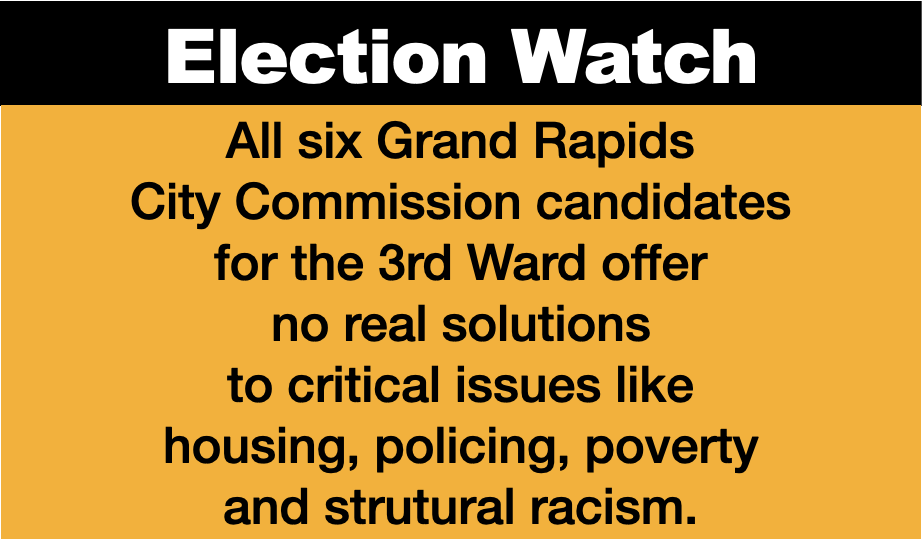
The MLive story on the six 3rd Ward candidates follows the same format, a brief introduction of each of the candidates and then responses to the same 4 questions that was asked of the 1st Ward candidates. Those four questions are:
- What in your experience makes you the most qualified candidate for this position?
- What are your goals should you be elected and how will you work to accomplish them with currently limited resources?
- What are the most important challenges facing our community, and how do you propose to address them?
- What will you do to support a vibrant economy in our community?
As I stated previously, these are not compelling questions, nor do they address some of the most pressing issues in the city and specifically in the 3rd Ward. According to the MLive article, one of the six candidates, Al Willis, did not respond to the candidate questionnaire.
In the post I did about the 1st Ward Candidates I wrote an overview of responses bases on each of the question asked. Today I want to focus on the responses from each candidate in the order they are listed in the MLive article.
Joyce Priscilla Gipson – Regarding what goals she has, Gipson wants to end Proposal 3, since she is against abortion, plus she has questions about making the “new stadium or aquarium” priorities, when children’s lives are “in the balance.” Regarding the challenges facing the Grand Rapids community, Gipson said that she would monitor sex education and then give those students that meet the requirements should each get $2000. First, Gipson doesn’t seem to be aware that as a City Commissioner they have little say in state policy (Proposal 3) or GRPS policy (sex education). Gipson offers no concrete solutions on how to address pressing issues facing Grand Rapids and doesn’t even respond to the question about the economy.
Bing Goei – He says he wants to reduce poverty, but offers no concrete solutions on how to do that. Goei acknowledges a disinvestment in the 3rd Ward, but also doesn’t offer what real investment would look like, except to say he would prioritize “strengthening and growing the existing small businesses economy in the Third Ward and the City by prioritizing Black Owned and Hispanic Owned businesses” How exactly will that reduce poverty in the 3rd Ward. Prioritizing Black and Latino/a business might benefit the families of those businesses, but it would unlikely benefit others unless those businesses plan on paying a living wage with good benefits. On the most important challenges the city faces Goei thinks the city should “retain diverse, International talent.” On building a vibrant economy, and Goei suggests supporting small businesses.
Reggie Howard – He wants to keep widows in their homes, get services to Veterans, go gun storage, help people become home owners and help people open more businesses. Howard says all of this without any concrete plans. Regarding most pressing issues in the city, he says gun control and building trust between Commissioners, the GRPD and the community. Again, no concrete solutions. On the matter of a vibrant economy Howard does say people should be paid “good wages”, but wages are only good if they meet the needs of those earning the wages.
Marshall Kilgore – This candidate says they are a human rights advocate and that he wants inclusive policies for the BIPOC and LGBTQ+ communities. This sounds like a positive things, but there are no concrete solutions offer that would benefit BIPOC and LGBTQ+ communities. In response to the questions about goals Kilgore says increase the 3rd Ward Equity Fund, support solar initiatives and make affordable housing a priority. However, Kilgore offers little in concrete solutions and only talks about getting state and federal funds for housing. Responding to challenges faced in the 3rd Ward, Kilgore simply restates the need for expanded investment and more affordable housing options. On the matter of creating a vibrant economy Kilgore again talks about investment and fair wages, both of which come with no actual numbers. Why is it that candidates can’t say a living wage or wages no lower than $25 an hour?
John Krajewski – This candidates wants more commercial districts and more staffing for the GRFD and the GRPD. If MLive wanted to do journalism instead of simply providing candidates with an open forum to say whatever they want without their comments being questioned, then MLive would have told readers that Krajewski wants to add more cops because he received $12,500 from the Grand Rapids Police Officer’s Association PAC in campaign contributions. Regarding the biggest challenges facing the city, Krajewski says housing, with no solutions, then talks more on policing and building community trust. On the matter of creating a vibrant economy Krajewski says more safety for businesses to thrive in and more business districts. Again, no real solutions are offered and he says nothing about working class people or poverty in the 3rd Ward.
The Grand Rapids 3rd Ward is already the most policed area in the city. The 3rd Ward has the highest percentage of African Americans living in that ward, which also translates into the fact that there are more Black people in the Kent County jail than any other group of people, because the GRPD targets the Black community. None of the 3rd War candidates really talk about racism, specifically structural racism. If MLive would chose to ask more probing questions and follow up questions to the candidate responses, the public would be better served regarding where the candidates stand on critical issues. Instead, the public is left with vague questions and relatively vague answers from the candidates. Commentators often wonder why there is low voter turnout or the lack of enthusiasm for candidates, but rarely do they talk about the low quality of candidates themselves.
Do politicians really believe that violence has no place in America: A short history of violence in so-called America
After Saturday’s shooting during a Trump rally, numerous politicians responded by saying that violence was unacceptable.
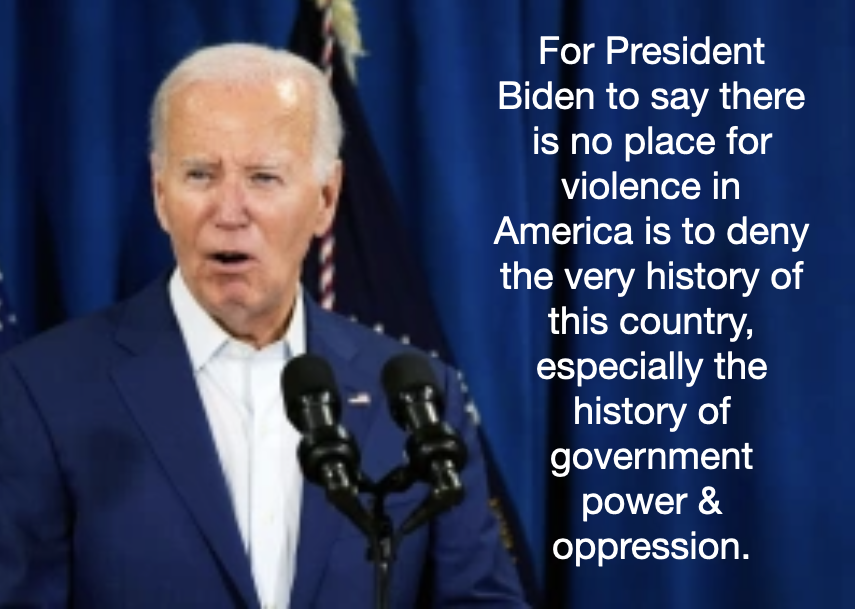
When President Biden heard about the shooting, he said, “There’s no place in America for this kind of violence.” Michigan Governor Gretchen Whitmer responded to the news of the shooting by saying, “There is no place for political violence in this country, period.”
My initial reaction to these comments from Biden and Whitmer is simply that what they are saying is bullshit! I say this for two reasons. First, Biden and Whitmer, along with lots of white liberals were hoping that Trump would have been killed, they just don’t want to admit that they feel this way. Believe me, I understand that sentiment. I was thinking that before I even sat down to write this piece I was reflecting on the plot to assassinate German Chancellor Adolf Hitler, a plot that included the great theologian Dietrich Bonhoeffer. I would encourage people to watch the Martin Doblmeier 2003 produced documentary, Bonhoeffer.
Second, the notion that there is no place for violence in America is to ignore the very core of what this country was founded on and what it continues to practice……..violence. Now, it is not a question of whether or not Whitmer or Biden are unaware of the history of violence in the US, it is more about the fact that they can’t acknowledge this historical fact or even admit it. For most politicians it would be political suicide. However, imagine for a second if there were political leaders who would say things like, the US was founded on structural violence, both with the genocide of Native Nations and the enslavement of Africans. Of course that will not happen, since both Republicans and Democrats don’t want to admit that the US was founded on genocide, the theft of Indigenous land and the enslavement of people from Africa.
Genocide and slavery were the two foundational aspects of the founding of the US, but they are not the only forms of violence that are at the core of US history. What follows is an overview of the systemic or structural violence that is woven into the very fabric of this country, along with sources to support these claims.
- Genocide of Native Nations – see An Indigenous Peoples’ History of the United States, Roxanne Dunbar-Ortiz.
- Chattel Slavery – see The Half Has Never Been Told: Slavery and the Making of American Capitalism, Edward E Baptist.
- Only white men who owned land could vote for nearly the first 75 years of this country – see Toward an American Revolution: Exposing the Constitution and Other Illusions, by Jerry Fresia.
- The racist, xenophobic, white nationalist history of US immigration policy – see American Intolerance: Our Dark History of Demonizing Immigrants, by Robert Bartholomew & Anja Reumschussel and The End of the Myth: From the Frontier to the Border Wall in the Mind of America, by Greg Grandin.
- The violent history of forcibly removing Indigenous children from their communities and placing them into so-called boarding schools – see Kill the Indian, Save the Man, by Ward Churchill.
- The history of US wars, whether they have been for the expansion of what is now the 50 states to the countless wars and other forms of imperialism around the globe – see Stephen Kinzer’s book, Overthrow: America’s Century of Regime Change from Hawaii to Iraq, William Blum’s book, Killing Hope: US Military and CIA Interventions since World War II, and the excellent online source from Zoltan Grossman FROM WOUNDED KNEE TO YEMEN
- The violent history of US worker suppression by the Capitalist Class – one great example is found in David Correia’s book, Earth on Fire: The Great Anthracite Coal Strike of 1902 and the Birth of the Police, plus the 10 volumes of the History of the Labor Movement in the United States, by Philip Foner.
- The violent history of patriarchy and misogyny in the US – see Phyllis Chesler’s book, Patriarchy: Notes of an Expert Witness.
- The suppression of political dissent in the US – see Jules Boykoff’s book, Beyond Bullets: The Suppression of Dissent in the United States.
- See the three volume history of the US by Mumia Abu-Jamal and Stephen Vittoria, Murder Incorporated: Empire, Genocide and Manifest Destiny
- Mass Incarceration in the US – see Michelle Alexander’s book, The New Jim Crow: Mass Incarceration in the Age of Colorblindness and Naomi Murakawa’s book, The First Civil Right: How Liberals Built Prison America.
- The US Drug War – see Clarence Lusane’s book, Pipe Dream Blues: Racism and the War on Drugs, plus the global side of the US drug war, which is documented well in Alfred McCoy’s book, The Politics of Heroin: CiA Complicity in the Global Drug Trade
- Police murder of civilians in the US – see the online source https://mappingpoliceviolence.org/
- The long history of violence against nature and eco-systems in the US, the climate crisis and environmental racism.
- We also need to add all of the systemic violence perpetrated against people with disabilities, queer & the LGBTQ community, all BIPOC people, class violence against working class people, immigrants and religious people who are not Christians.
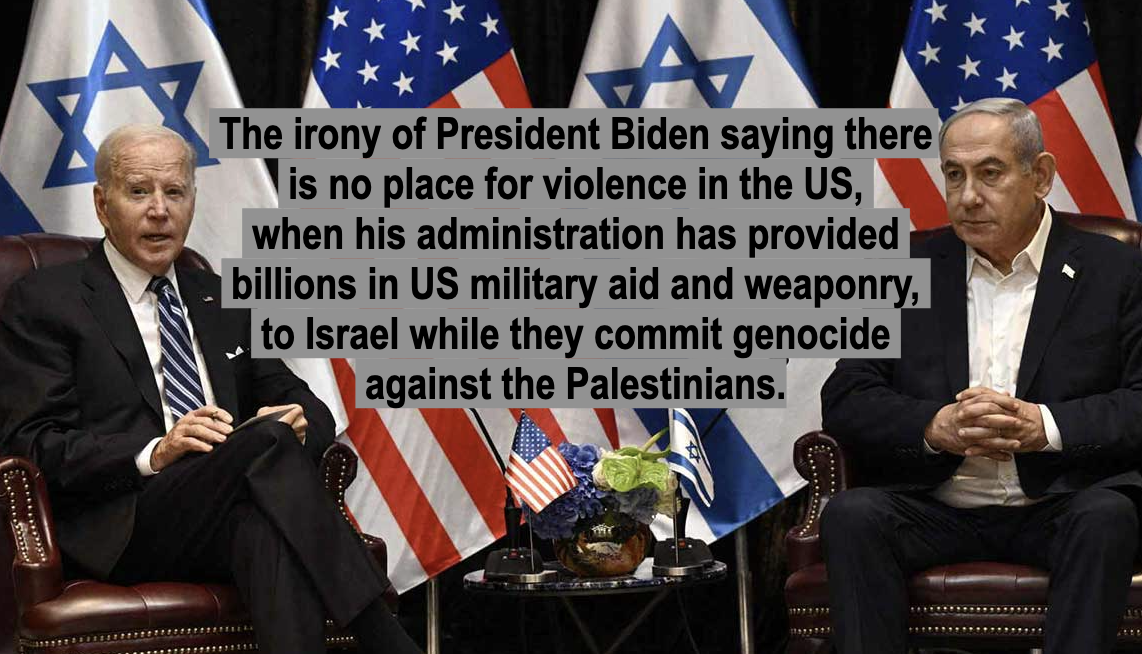
This is just a short list of the violence that has been part of the US since it was founded and is woven into every aspect of society. To the degree that we have any civil liberties, civil rights or human rights, has been because regular, everyday people organized, fought, resisted and often died to win any sense of justice. The US political system never gave us anything, it was never a gift. So for President Biden to say there is no place for violence in America is to deny the very history of this country, especially the history of systems of political and economic power & oppression.
Palestine Solidarity Information, Analysis, Local Actions and Events for the week of July 14th
It has been 9 months since the Israeli government began their most recent assault on Gaza and the West Bank. The retaliation for the October 7 Hamas attack in Israel, has escalated to what the international community has called genocide, therefore, GRIID will be providing weekly links to information and analysis that we think can better inform us of what is happening, along with the role that the US government is playing. We will also provide information on local events and actions that people can get involved in. All of this information is to provide people with the capacity of what Noam Chomsky refers to as, intellectual self-defense.

Information
‘Horrific Massacre’: Israel Bombs Gaza School Used as Refugee Camp, Killing Dozens
Despite Gaza War Crimes Accusations, Biden Sends Israel More 500-Pound Bombs
Israeli Newspaper Confirms IDF Employed ‘Hannibal Directive’ on October 7
Israeli Campaign against Gaza may have Killed 186,000 or More — 8% of Population: The Lancet
THE COMPANIES MAKING IT EASY TO BUY IN A WEST BANK SETTLEMENT
Gaza facing “most dangerous days” of the genocide
Their Goal Is Total Ethnic Cleansing: Mustafa Barghouti on Israel’s Expulsion Order for Gaza City
Analysis & History
We Must Understand Israel as a Settler-Colonial State
Israeli Historian: This Is Exactly What Genocide Looks Like
Local Events and Actions
Sign this Action Alert demanding that the City of Grand Rapids Divest from companies profiting from the Israeli Occupation, Israeli Apartheid and the Israeli genocide.
Power to Palestine: Weekly Rally in Grand Rapids
Wednesday, July 17, 12pm – 1pm, Monument Park
Graphic used in this post is from https://visualizingpalestine.org/visual/citi-banking-on-genocide/
There is a tremendous amount of social media chatter about Project 2025, a project that was hatched by the longtime conservative groups know as the Heritage Foundation.
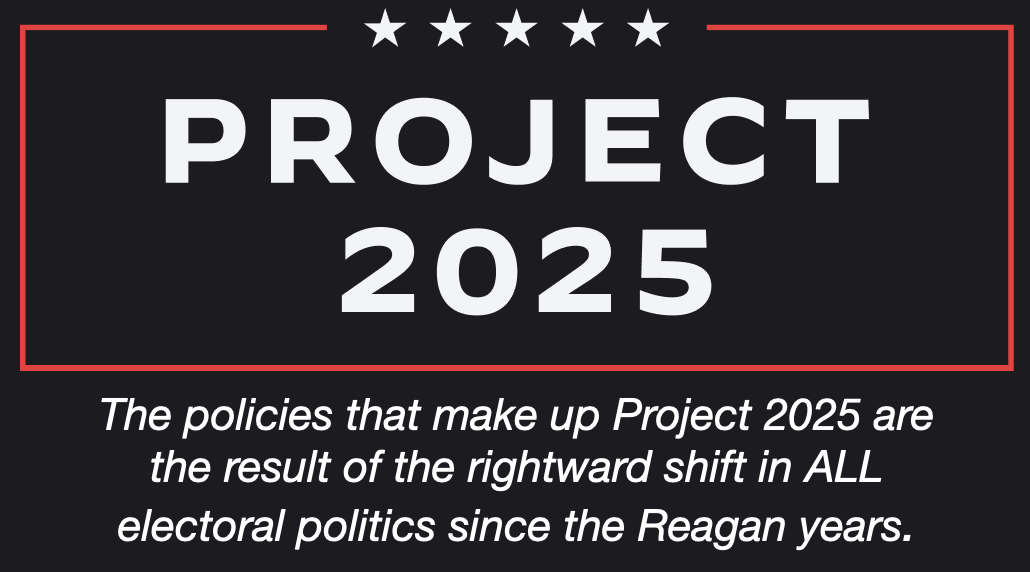
Most of the social media posts about Project 2025 uses the all too often fear tactic, painting a picture that democracy will end. Granted, a great deal of what Project 2025 is advocating would be horrible, but we need to look at Project 2025 through a historical lens.
The Heritage Foundation was founded in 1973, with a large injection of funding coming from beer magnate Joseph Coors. Coors and other Capitalists who embraced far right thinking were getting better organized in the 1970s, which included the Rich DeVos and Jay Van Andel. (See Russ Bellant’s book, The Coors Connection: How Coors Family Philanthropy Undermines Democratic Pluralism.)
In 1980, when Ronald Reagan was seeking to defeat sitting President Jimmy Carter, the Heritage Foundation had crafted a similar platform for Reagan, known as the Mandate for Leadership. The 1980 version of the Mandate for Leadership was 1,100 pages long and “was described by United Press International back then as “a blueprint for grabbing the government by its frayed New Deal lapels and shaking out 48 years of liberal policy.”
The Reagan Administration not only pushed national politics to the right, it forced the Democrats to do the same. Under the leadership of the Democratic Leadership Council (DLC), the Democrats also began to abandon traditional New Deal policies and embrace Reagan era policies, such as the Clinton Administration adopting the end of welfare known as The Personal Responsibility and Work Opportunity Reconciliation Act. Around the same time, The Clinton Administration adopted the Crime Bill, which was crafted by then Senator Joe Biden, known as the Violent Crime Control and Law Enforcement Act of 1994, along with the 1996 Telecommunications Act, which ended Federal Communications Commissions regulations and resulted in media consolidation so complete that only six corporations control most of what we watch and hear. The point being that all politics shifted to the right with the Reagan Administration and that brings us to the present with what is referred to as Project 2025. These policies that were adopted under Clinton were part of the Reagan era Mandate for Change policies that the Heritage Foundation wanted to see implemented.
The Trump Administration utilized the Mandate for Leadership platform crafted by the Heritage Foundation during his Administration, which is what Project 2025 is also known as. Therefore, it is important that we understand that Project 2025 is the natural outcome of a policy platform that has shifted to the right for the past 40 plus years, just as all electoral politics has shifted to the right. As Black Agenda Report editor Margaret Kimberley has said, “Project 2025 is just the latest in a series of conservative think pieces which outlines how republicans should wield presidential power. The outrage surrounding it ignores democrats’ collusion with republican policies when they are in office and is a cynical effort to scare especially Black voters into continuing support for the Biden/Harris ticket.”
The DeVos connection to the Heritage Foundation and the Project 2025 Advisory Board
Another major omission in the fear-driven cries for people to look at Project 2025 is the lack of any conversation about the long standing relationship between the DeVos family and the Heritage Foundation. One would think that this would draw the ire of liberals and Democrats, but I have yet to see any discussion about the relationships between the Heritage Foundation and the most powerful family in West Michigan, the DeVos family.
The Richard and Helen DeVos Foundation were major contributors to the Heritage Foundation for decades, providing millions to the far right think tank. When Rich DeVos died in 2018, the Heritage Foundation wrote a tribute to the the far right/Christian Right billionaire.
However, Rich DeVos was not the only contributor to the Heritage Foundation, since many of his sons would also provide money and ideological support for the think tank. In 2002, Dick DeVos gave a speech to the conservative think tank, the Heritage Foundation. In that speech DeVos lays out a strategy for attacking and undermining public education. Here is a video of that speech:
Ten years later Dick DeVos was being interviewed by the Heritage Foundation after Michigan became a Right to Work state, where the Mackinac Center for Public Policy led the charge, with substantial funding from the DeVos family. Here is that interview:
Then there is the issue of the more than 100 Advisory Board organizations listed as supporting Project 2025, which you can find here. What is instructive about this list are the dozens of groups that the DeVos family has had a direct connection to, whether it has been funding, sitting on their board of directors, policy work or collaborating with them. Here are just a few examples of the direct connection of the DeVos family to the organizations that endorse Project 2025
Alliance Defending Freedom – Funding, policy work and collaboration
American Center for Law and Justice – Funding
American Family Association – Policy Work
American Legislative Exchange Council – Policy Work and collaboration
Center for Immigration Studies – Policy Work
Claremont Institute – Funding
Coalition for a Prosperous America – Policy Work
Eagle Forum – Policy Work and collaboration
Family Policy Alliance – Policy Work
Family Research Council – Funding, Policy Work and Board of Directors
The Heartland Institute – Funding and Policy Work
Hillsdale College – Policy Work and collaboration
Independent Women’s Forum – Policy Work and collaboration
Dr. James Dobson Family Institute – Policy Work and collaboration
Mackinac Center for Public Policy – Board of Directors, Funding, Policy Work and collaboration
Texas Public Policy Foundation – Policy Work
Turning Point USA – Policy Work and collaboration
Young Americans Foundation – Funding, Policy Work and collaboration
In this moment in history it is vitally important that we take a long view of the Heritage Foundation and Project 2025. The proliferation of memes and other sound bite reactions to Project 2025 does do anything other than to promote fear-based reactions. If we are to defeat such policy platforms, then we need to develop movements and structures that promote collective liberation and the dismantling of systems of power and oppression. Simply voting Blue won’t do that, since all electoral politics has shifted to the right.
Yesterday, MLive posted a story about the four candidates running for a seat in the 1st Ward, a seat that will be vacated by John O’Conner at the end of 2024.
The article provides some introductory information about each of the four candidates, with links to their campaign websites. However, the bulk of the article includes candidate responses to 4 questions that were compiled by the League of Women Voters. The four questions are:
- What in your experience makes you the most qualified candidate for this position?
- What are your goals should you be elected and how will you work to accomplish them with currently limited resources?
- What are the most important challenges facing our community, and how do you propose to address them?
- What will you do to support a vibrant economy in our community?
In many ways, these question are the typical types of questions that are asked by groups like the League of Women Voters, often vague or so broad that it doesn’t often address the most pressing issues that communities are dealing with. I will respond to each question and discuss some of the responses, along with what was not said and why all of these candidates are promoting variations of business as usual.
Question #1 – Asking people why they are the most qualified was already answer to some degree when MLive provided a summary of each candidate’s resume. None of their answers are compelling, in that they all say things like “listening to the community,” being a long-time or life-long resident of the 1st Ward and being “a voice for the people.” These are all vaguely meaningless, since none of them have every been elected previously.
Question #2 – Again, the answers are broad, without any real qualifiers, except for a few examples. People can say they want safe neighborhoods and more housing, but no one is really offering any new ideas or ideas that are outside of the mainstream. For instance, when it comes to housing the candidates say they want more affordable housing, but only within the current housing market framework. No one was talking about ending massive subsidies to developers or the so-called transformational project and use those millions for affordable housing. In addition, none of the candidates talked about the need for rent control of a renters bill of rights to deal with the outrages cost of rent in this city. Dean Pacific said he wants more cops for the GRPD, but the MLive article fails to inform readers and potential voters that Pacific had already received $12,500 from the Grand Rapids Police Officer’s Association PAC in April.
Question #3 – Responses to this question varied, but they all still stuck to acceptable responses that don’t really challenge or change how to address major issues in Grand Rapids, like housing, economic disparities and policing issues. One candidate said more community policing, which is just code for more of the same and doesn’t address the root causes of issues, like more resources going to the community. Again, the responses to housing are the standard market-based solutions, such as “additional housing units at all price points.” This is a false solution that not only avoids talking about the massive wealth gap in this city, plus there is no acknowledgement of social housing, which is one of the many demands coming from the statewide coalition known as The Rent is Too Damn High.
Question #4 – Here the responses are frustratingly framed within the Capitalist system, such as the city needs more entrepreneurs, find money for start up businesses, or expand neighborhood business districts. Again, this is business as usual thinking that will not address the massive wealth gap that exists in Grand Rapids. Not one candidate talked about paying people a living wage, which would be like $35 as hour. The National Low Income Housing Coalition says that Grand Rapidians need to make $25.50 an hour in order to afford the average rent costs in this city. All the candidate talks about job creation, but never mention wages or the increased cost of living. Lastly, no candidate addresses the so called Public/Private partnerships in this city which really means the private sector gets richer, but uses public money for their pet projects.
After reading the responses from candidates I was not only frustrated but disappointed that none of them engaged in radical imagination, nor did they center the thousands of families who are struggling to just survive, especially in a city that elevates business people and rarely acknowledges the working class people who do all the work. I still believe in the social movement phrase that came out of the Global South that another world is possible, but it won’t happen through electoral politics, especially with candidates that don’t have the courage to challenge systems of power and oppression.
Understanding the GR Power Structure – Part III: Families and people who have tremendous influence in Grand Rapids
In Part I of this series I began an updated version of a Grand Rapids Power Analysis, which lays out the ground work for what the Grand Rapids Power Structure looks like and what it means for this community.
When I use the phrase, the Grand Rapids Power Structure and who has power, it is important to note that I mean power over. A local power analysis is designed to investigate who has power over – who oppresses, exploits and engages in policy that benefits them to the exclusion of everyone else – the majority of people living in Grand Rapids.
In Part II of this series on the Grand Rapids Power Structure, I looked at the DeVos family, which I argue is the most powerful family in this city, in terms of economics, politics, social and cultural dynamics.
In Part III of the series I want to look at some other families and individuals that also wield tremendous power in this city, economically, politically and socially.
As with my first series on the GR Power Structure, which was done in 2018, several people of influence have died. Besides Rich DeVos, Peter Secchia also died in recent years, so the families and people I include in the 2024 version of the Grand Rapids Power Structure will be somewhat different.
The families that have tremendous influence in Grand Rapids besides the DeVos family, would certainly be the Meijer and the Van Andel families. Hank, Doug and Mark Meijer are each worth $5.5 billion, which makes their collective worth $16.5 billion. Not far behind are Steven and David Van Andel, in terms of wealth and influence.
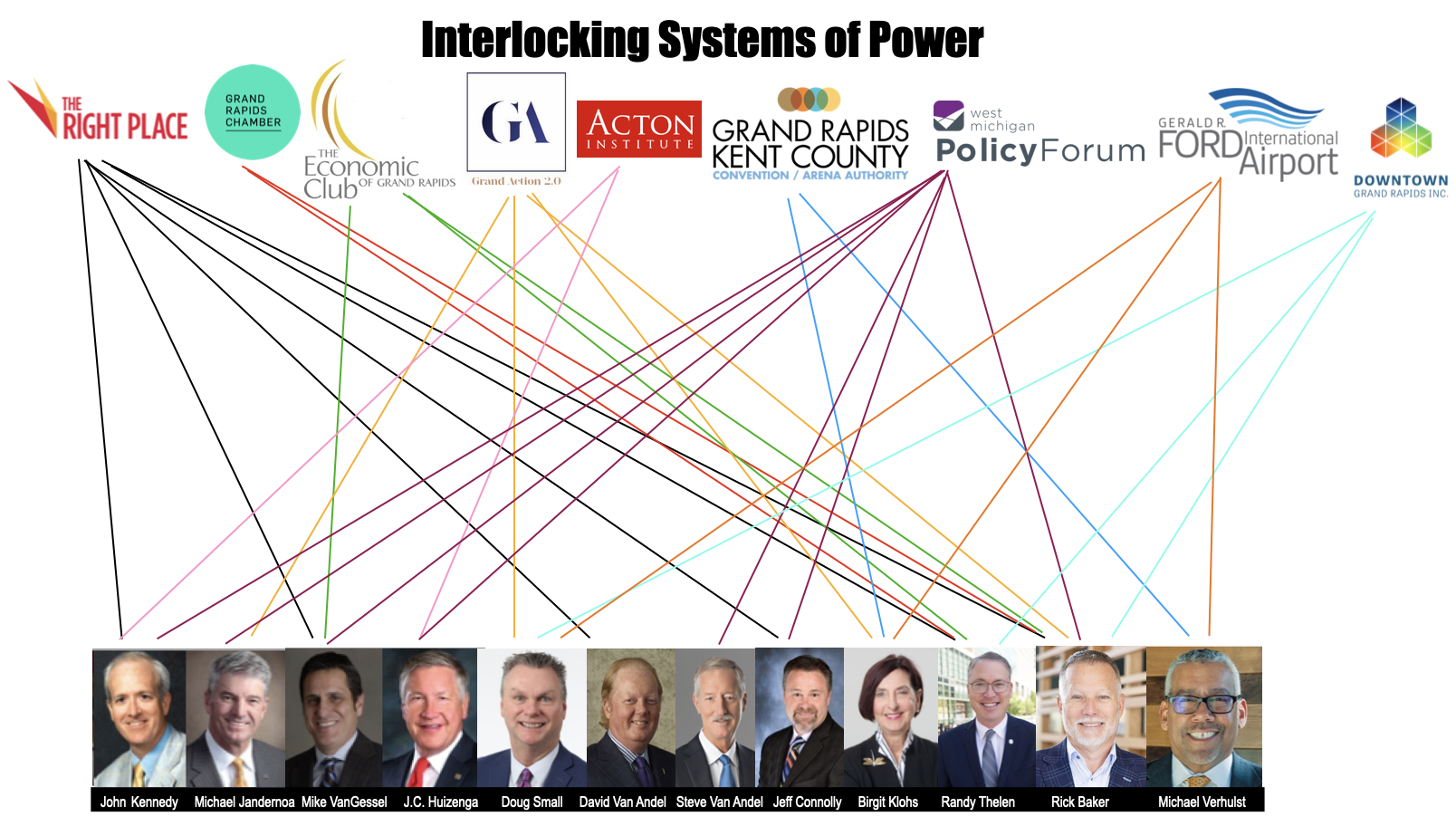
Other people who have significant influence in Grand Rapids, both in terms of their economic and political influence are Michael Jandernoa (42 North Partners) , John Kennedy (CEO of Autocam), Mike VanGessel (CEO of Rockford Construction), J.C. Huizenga (CEO of National Heritage Academies), Jeff Connolly (Blue Cross Blue Shield of MI), Doug Small (President & CEO of Experience Grand Rapids), Michael Verhulst (Verhulst Ventures and Pure Architects), Birgit Klohs (New Community Transformation Fund), Randy Thelen (President of The Right Place Inc.) and Rick Baker (CEO of Grand Rapids Chamber of Commerce). This is not an exhaustive list, but as you will see in the graphic above these people are also tied into numerous institutions in Grand Rapids, providing them with tremendous access and influence.
Interlocking Systems of Power
Besides the wealth that many of the people I have named have, they also have significant influence because of position they hold with an organization or the businesses that they own or their role as a leader in those businesses.
In the graphic above, you can see some of these people and their involvement with organizations that also have tremendous influence in Grand Rapids, a topic I will explore in Part IV. These members of the Grand Rapids Power Structure are part of an interlocking system of power, with organizations that provide them with access and influence over the Grand Rapids economy, politics, plus social and cultural dynamics.
In addition to their involvement with these interlocking systems of power, most of the members of the Grand Rapids Power Structure also influence local and state politics with their deep pockets in the form of campaign contributions. Just from 2022, look at these previous GRIID posts and you can see which members of the local power structure were buying political influence.
Grand Rapids 2022 First Ward GR City Commission
Grand Rapids 2022 Third Ward GR City Commission
Grand Rapids 2022 Second Ward GR City Commission
Kent County 2022 Commission races
One last area of influence for some of the members of the Grand Rapids Power Structure has to do with the fact that they use their foundations to both influence outcomes and silence potential critics from the social services sector. Here are some of the foundations that members of the Grand Rapids Power Structure own and operate.
The David and Carol Van Andel Foundation
The Steve and Amy Van Andel Foundation
While these members of the Grand Rapids Power Structure don’t have the kind of influence that the DeVos family does, they still use their money and their positions to influence political, economic, social and cultural outcomes in Grand Rapids that not only helps them to maintain power, but to prevent organized movements from challenging their power. In Part IV, I will look at the organizations that the members of the Grand Rapids Power Structure have a role in, specifically the Board of Directors, with a focus on what these organizations do.
One aspect of the work that I have been doing with the Urban Core Collective (UCC) is monitoring the local commercial news media. The areas of focus for the news monitoring has been to look at the coverage around the issues areas that UCC is working on – the Grand Rapids Public Schools, Public Safety, Climate Justice and their new Democracy Initiative.
Here is the data for the four news agencies I have been monitoring since January 1st through July 6th:
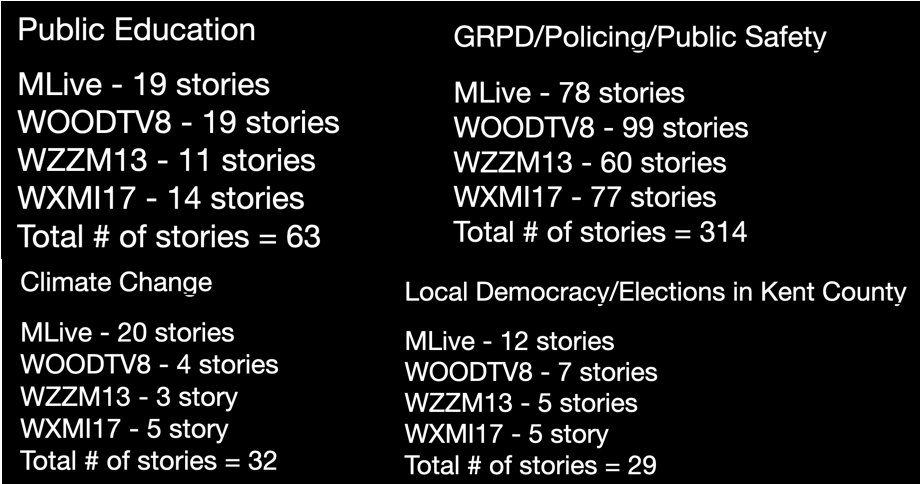
As you can see from the data, policing/public safety dominates local news coverage over areas of public education, climate justice and local democracy. There are several reasons why crime coverage is far more likely than the other three areas.
- It is easier to produce crime coverage, since it is already a packaged story, driven by images and narrative. Flashing police lights and police tape make make for stories that are easy to fill in the blanks.
- The local news media relies almost exclusively on the GRPD or the local judicial system as sources of information on crime and public safety.
- The local news media rarely asks probing questions or investigates the claims from the police or the courts, especially since they have internalized the belief that the police and the courts actually serve the public interest.
- It is also worth pointing out that in all of the 313 policing/public safety stories over the past 6 months, there have only been 8 stories about community-based groups doing crime prevention work. Lastly, of all these 313 stories that center mostly crime, there were only 10 stories about the GRPD actually preventing crime, which means in most of the stories the GRPD showed up after a crime had been committed. This should tell us something about the real function of the GRPD.
Beyond the data it is also important to look at the kinds of stories done and the narratives they are using in the local commercial news media. In the coverage of Climate Justice (32 stories total) in only one of those stories was phrase climate change used. There was one story where the phrase “climate related phenomenon” was used and the term “global warming” was used only once. This means in the bulk of the climate coverage – which centered mostly on the mild winter and the increased heat in May and June – there was rarely any direct correlation between the weather and climate change.
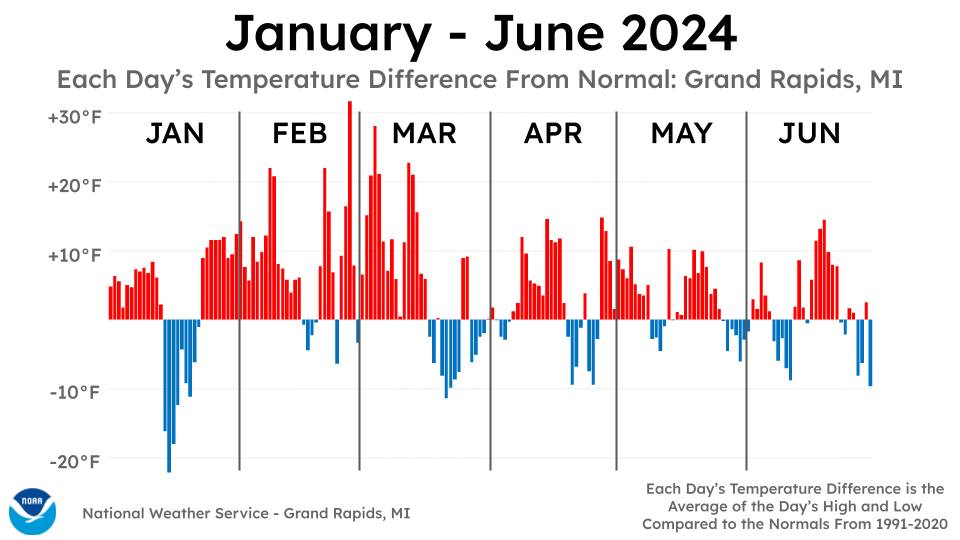
On the matter of local elections and local democracy, the coverage was even less than on Climate Change. For as much as the public talks about the importance of participating in local elections, the news media doesn’t seem to embrace this reality. For the upcoming August 6th Primary Ballot there are numerous political races that should be getting attention, such as the Mayoral race in Grand Rapids and the 1st and 3rd Ward races in Grand Rapids. There have only been a few stories about the Grand Rapids Mayoral race, such as a few stories about campaign financing and a few about candidates speaking with some sectors of the community. What we have not seen in the local news is any coverage about the platforms of the Grand Rapids Mayoral candidates, which is ultimately the most relevant information.
There have been no stories about candidates running for the 1st and 3rd Wards in Grand Rapids so far, which is deeply problematic, especially since in both races there will be two new city commissioners, since the standing commissioners are term limited.
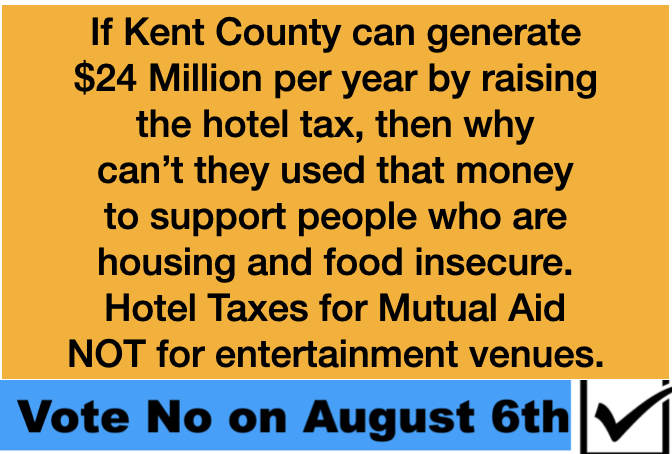
Lastly, the only other local election coverage has been about ballot initiatives and most of those stories have been about the hotel tax proposal. Unfortunately, with the increased hotel tax stories the public has only heard from those who support the proposal. Not surprising, many of the people endorsing the increased hotel tax proposal, which will be used to fund the Amphitheater, the Soccer Stadium and the Aquarium, are also the same people who will be the primary economic beneficiaries of these development projects.
On the matter of local news reporting on the Grand Rapids Public Schools, while there are more stories on this topic than on Climate or local elections, much of the coverage is still not useful for the public’s understanding of GRPS policy decisions.
The GRPS coverage was a mix of stories about school snow days, school closings and stories that were about a specific program or project that involved in the GRPS. There were very few stories about GRPS policy decisions and even less about community organizing efforts to improve the Grand Rapids Public School system.
The decision of local news agencies to focus more on feel good stories as opposed to centering GRPS policy and budget decisions doesn’t promote community engagement. If we want people to be informed and involved in the Grand Rapids Public Schools the local commercial news media needs to spend more time on investigating and reporting on how school policies impact outcomes for students.
Since the late 1980’s I have been involved in monitoring and documenting how the local news media has been reporting on issues that are critical to the community. After 35 years I can attest to the fact that the local news media mostly fails the public in reporting on matters that are of vital importance to this community. If we want to see more people engaged in community issues, then we also need to demand that the local news media needs to report on critical community issues and actually serve the public interest instead of merely entertaining us.
Within the past 2 weeks I have received two different mailers endorsing the is usually referred to as the Hotel Tax ballot initiative that will appear on the August 6th Primary Ballot.
One of the mailers came from the committee that is responsible for promoting the Hotel Tax ballot initiative, the Destination Kent Committee. According to their website, the Destination Kent Committee was formed earlier this year with the following members:
Grand Rapids Mayor Rosalynn Bliss – voted for ordinances in 2023 to criminalize the unhoused, has consistently voted for massive subsidies and tax breaks for developers, has opposed community calls to reduce funding for the GRPD, has been a recipient of the Grand Rapids Police Officers Association PAC and the Grand Rapids Chamber of Commerce PAC, known as Friends of West Michigan Business.
Kara Wood of Grand Action 2.0 – used to work on economic development for the City of Grand Rapids and started at Grand Action 2.0 in 2022. Grand Action was created by the DeVos family and other members of the GR Power Structure to get the city and county to use public funds to finance projects like the Van Andel Arena, the Convention Center, the Downtown Market and now the Amphitheater, the Soccer Stadium and the proposed Aquarium.
Joshua Lunger from the Grand Rapids Chamber – is the VP of Government Affairs for the Chamber, which means he is a paid lobbyist who spends his time getting local and state politicians to adopt policies that benefit business interests. Lunger was the architect of the push to criminalize the unhoused in downtown Grand Rapids, which the City adopted in 2023.
John Helmholdt of SeyferthPR – has previously worked as director of communications for the Grand Rapids Public Schools, along with working for Republican State Senator Glenn Steil Sr. Helmholdt also endorsed the ordinance adopted last year in Grand Rapids that criminalizes the unhoused.
Bill Jackson of McAlvey Merchant & Associates – Bill was the first Director of the West Michigan Policy Forum, which has worked to eliminate the Michigan Business Tax, made Michigan a Right to Work State from 2012 – 2022, has worked to keep Michigan’s minimum wage low and has worked to undermine public sector unions. McAlvey Merchant & Associates is also a Michigan lobbyist group.
Bob Herr as treasurer – Bob Herr also sits on the Board of Directors of the Economic Club of Grand Rapids and is the Chairman of the Downtown Improvement District.
The other mailer, which was the standard glossy political mailer, but was an 8.5 by 11 inch mailer, came from the Grand Rapids Kent County Convention Arena Authority (CAA). It is no surprise that the CAA sent out their own mailer in favor of the 3% increase in the hotel tax, especially when you consider who sits on their board and the fact that the CAA had previously benefited from the use of public funds for the venues that they manage, which will include the Amphitheater once it is completed.
Dissecting Talking Points
The Destination Kent Committee has been using several primary talking points to try to convince the public to vote for the 3% hotel tax increase on August 6th. Here are a few of those talking points:
- The venues that will be the beneficiaries of the 3% hotel tax increase will have an economic impact that will generate $1 billion in economic impact and create 1,200 plus jobs. While $1 billion might be spent because of these new venues, that almost always means that the bulk of those profits will go to those who already have deep pockets. When people come to the Amphitheater, the Soccer Stadium or the Aquarium, they will have to pay for parking, which will mean more revenue for Ellis Parking or the City of Grand Rapids, neither of which really benefits the general public. Most of the hotels that people will stay at in the downtown area are owned by the DeVos family and the restaurants and bars that people will go to will benefit those businesses, but will not translate into increased wages for those who wait tables, wash dishes, tend bar, janitorial crews, etc.
- The 1,200 plus jobs that are cited is an estimate at best or is more likely way off. Then there is the fact that most of these jobs will not pay a living wage with good benefits. These jobs might also be part-time or temporary. Using the job creation argument is an old Capitalist Class mantra, but more often then not it means lower wage jobs and temp jobs.
- Another talking point is that the 3% hotel tax increase is a modest increase. For many people it is a modest increase, but for thousands that are housing insecure, staying in a hotel for a day, a week or a month could be costly. There are lots of people who stay in hotels/motels for the weekly rate, since they don’t have more permanent housing. The 3% hotel tax would be a burden on those who have limited housing options and stay in motels for a week at a time or more.
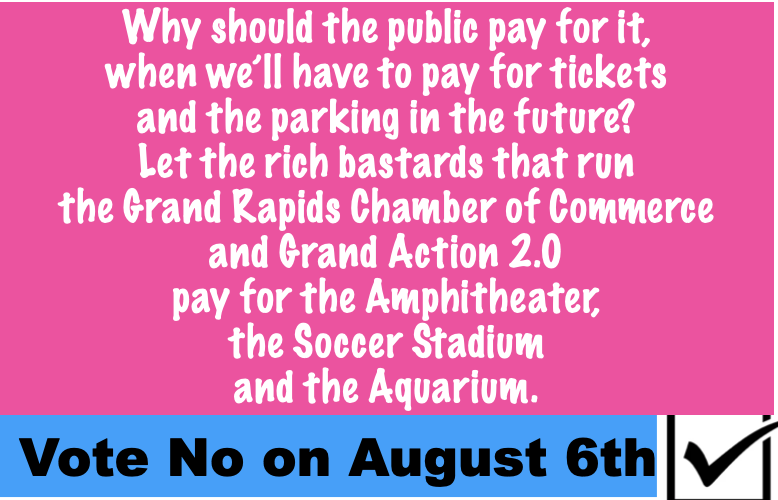
- One last talking point is that the increased hotel tax would be for “community owned assets.” This is just an outright lie. The community will not own the Amphitheater, the Soccer Stadium or the Aquarium, just like they don’t currently own the Convention Center the Van Andel Arena or the Downtown Market. These are privately owned and privately managed venues, which generate a shit ton of money for those who already control a great deal of the economy in Kent County.
As I have stated previously, why don’t the people and the organizations who are pushing for the increased hotel tax pay for the Amphitheater, the Soccer Stadium and the Aquarium themselves. Not only can they afford it, they will be reaping the benefits every time people purchase tickets at these venues and primarily spend their money in and near the downtown area.
More importantly, according to the Destination Kent Committee, 1 year after the increased hotel tax would generate $24 million dollars. Imagine if $24 million were put to providing social housing for families, rental assistance for tenants, addressing food insecurity, improved health care and more environmental justice outcomes for the people who already live in this city and are struggling to survive. When are we going to put the lives of Kent County residents ahead of the tourists who visit this community?
Palestine Solidarity Information, Analysis, Local Actions and Events for the week of July 7th
It has been 9 months since the Israeli government began their most recent assault on Gaza and the West Bank. The retaliation for the October 7 Hamas attack in Israel, has escalated to what the international community has called genocide, therefore, GRIID will be providing weekly links to information and analysis that we think can better inform us of what is happening, along with the role that the US government is playing. We will also provide information on local events and actions that people can get involved in. All of this information is to provide people with the capacity of what Noam Chomsky refers to as, intellectual self-defense.

Information
‘A Full-Fledged War Crime’: Israel Condemned Over New Human Shield Footage
Israel Has Forcibly Displaced 1.9 Million Palestinians in Gaza
US Troops are Quitting the Military Over Gaza
‘The Land Theft Continues’: Israel Announces Biggest West Bank Seizure in Over 30 Years
FREE SPEECH UNDER FIRE: HOW ISRAEL’S TECH GUARD IS KILLING FREE SPEECH ONLINE
As Israel Refuses to End Genocide in Gaza, Threat of War With Hezbollah Looms
‘Complicit in the Genocide’: First Muslim Biden Appointee Resigns Over Gaza
“This Must End”: Israel Orders New Mass Evacuation, Continuing Attacks on Gaza Health System
Analysis & History
UNDERSTANDING ISRAEL’S “SYSTEM OF DOMINATION”
Local Events and Actions
Sign this Action Alert demanding that the City of Grand Rapids Divest from companies profiting from the Israeli Occupation, Israeli Apartheid and the Israeli genocide.
Power to Palestine: Weekly Rally in Grand Rapids
Wednesday, July 10, 6pm – 7pm, Monument Park
Palestine Solidarity Grand Rapids is hosting an insightful rally led by veterans supporting an end to the genocide in Palestine on Sunday, July 14 at 5 pm at Veterans Memorial Park (101 Fulton, next door to Monument Park) in Grand Rapids, MI
Graphic used in this post is from https://visualizingpalestine.org/visual/citi-banking-on-genocide/
 Grand Rapids Institute for Information Democracy