Light Metals’ workers locked out since Nov. 1
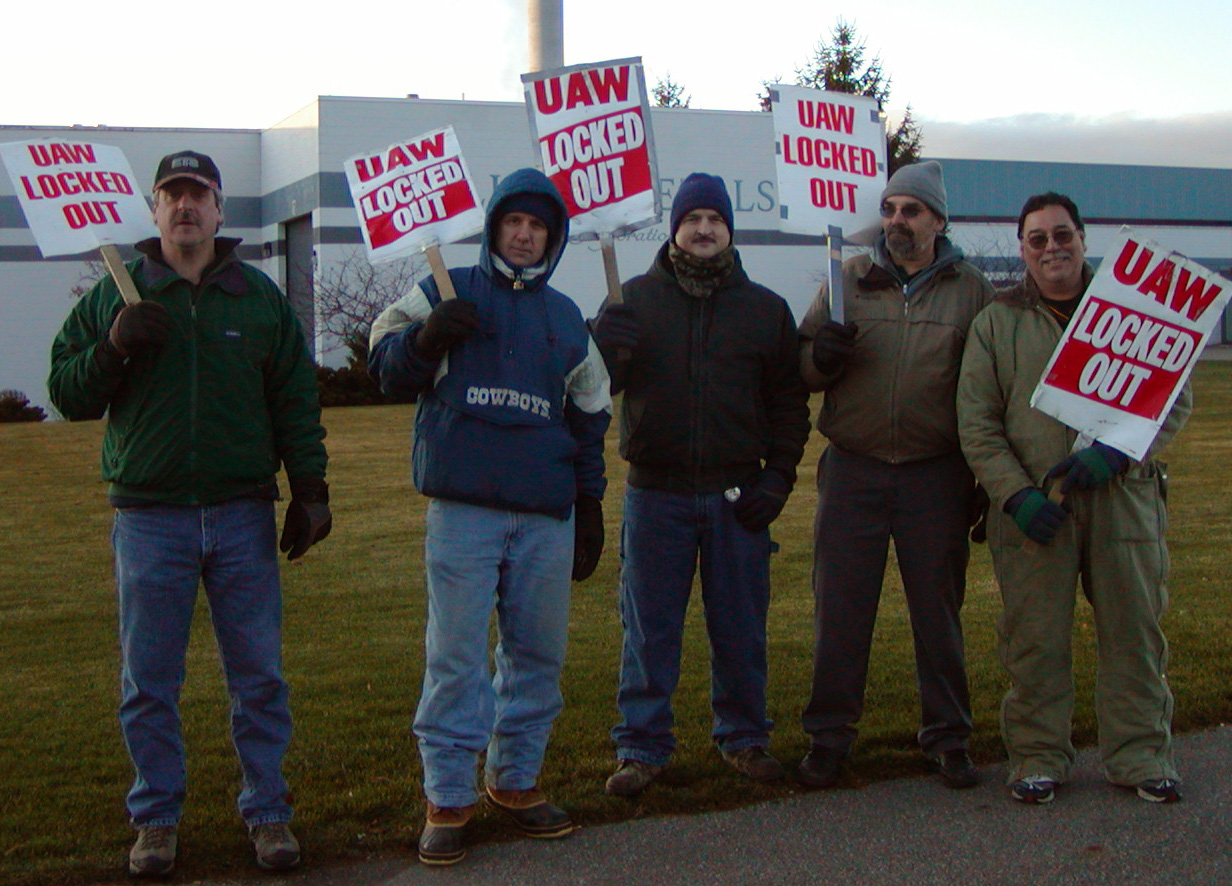 Driving by Light Metals Corp., 2740 Prairie St. SW in Wyoming, passersby may assume that the workforce picketing out front is on strike. They are not. These 70 men and women, UAW Local 19 members who average 20 years employment with Light Metals, were locked out more than a month ago (Nov. 1) when the contract negotiated in 2004 expired. They desperately want to get back to work.
“The company refuses to let the workers in,” explained Chuck Dietrich, chief union steward and Light Metals employee for nearly 40 years. “They gave us specifications (for a new contract) and we met or exceeded their demands. We took the pay cuts, the decrease in insurance coverage and holidays. Any place there could be savings, we negotiated. They just told us that we ‘didn’t understand.'”
Meanwhile, “scabs,” inexperienced, non-union workers no doubt earning far less than a fair wage, are crossing picket lines and keeping the manufacturer’s machines humming. Some of the locked-out workers noted that prior to Nov. 1, they were required to work ten hours a day, six days a week, raising speculation about whether Light Metals’ management was stockpiling product in anticipation of the lock-out. 
While previous cuts in pay and benefits were already making for a slim holiday season, the lock-out, if it continues, will most likely result in many of the workers losing their homes. “We just want to get our jobs back,” Dietrich says. “We can do it better than any scab — or the management. We hope they don’t run the company into the ground.”
In Nov. of 2004, Light Metals locked out their UAW workers until a court decision brought union workers back to work. This year’s lockout is patrolled by approximately 20 DK security guards in white vans, who make sure that the workers on the picket line don’t stray past the “No Trespassing” signs stuck in the well groomed lawn out front.
When a guard was asked to comment on his role, he gruffly replied that he was not allowed to talk about it. One worker shared that a security van driver who was a bit too eager to block a driveway accidentally clipped him with the vehicle’s side mirror. “If they have an economic crisis here, the way to solve it is with the union, not with thugs,” Dietrich says.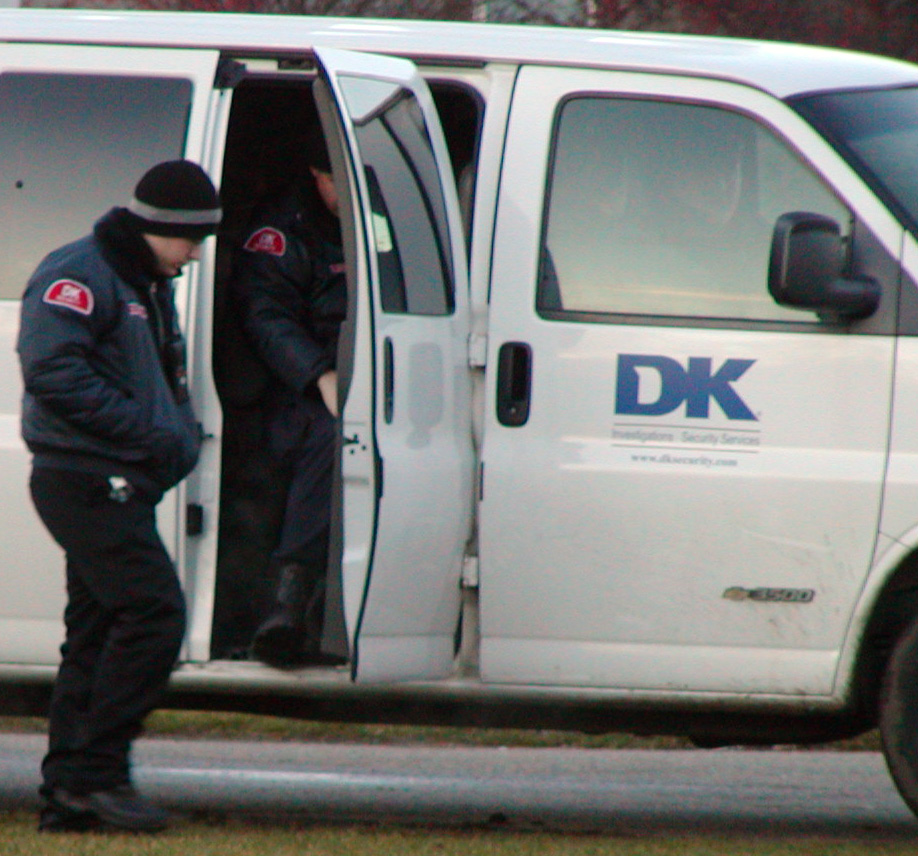
When asked about anti-union sentiments commonly spouted in corporate media, Dietrich correctly asserted that without unions, average Americans would not have 40-hour work weeks, overtime pay and other workplace rights that are taken for granted. Unions taking direct action also fought for and won the workplace safety regulations, child labor laws and decent wages most US workers earn today. “Unions have provided things people in this country would never have gotten any other way,” Dietrich says. “These are what happens in a union economy.”
Calls to Light Metals made two days in a row asking for their comments on the lock-out were met with the response that “Jim,” no last name known, “would not be in until tomorrow.”
The group of picketers gathered on Tuesday morning agreed that NAFTA was the cause of high unemployment and a poorly performing US economy, but question whether current economic conditions are at the root of the Light Metals lockout. “The management are greedy assholes taking advantage of a poor economy,” said a picketer who wished to remain anonymous. “We can’t keep working for less and less and less. We’ve been giving up more and more up for the last 12 years, before the economy went bad.”
Light Metal’s union workers can’t seem to get an answer, either. So, for now, they spend the workday on the picket line, locked out in the cold, hoping to get their jobs back. While Dietrich takes a glove off to shake my hand, he says, “We have every intent to negotiate, but not capitulate.”
If you would like to stand in solidarity with the locked-out workers at Light Metals Corp., drive by and honk your horn or make a donation to the West Michigan Food Bank People in Need fund account 02999. They ask that you do not drop off cash to them at the picket site.
Dissecting Obama’s Afghan Escalation Speech
There has already been a great deal written about President Barack Obama’s speech at the West Point Military Academy on Tuesday night. Most of what has been written in the mainstream media has been to either summarize the President’s comments or to provide reaction from pundits, politicians or military personnel and their families.

What we have yet to see from much of the journalism community is a clear analysis of the President’s speech, with particular emphasis on verifying the major claims made by Obama. We will try to address some of those major points here.
“For the first time in its history, the North Atlantic Treaty Organization invoked Article 5 — the commitment that says an attack on one member nation is an attack on all. And the United Nations Security Council endorsed the use of all necessary steps to respond to the 9/11 attacks. America, our allies and the world were acting as one to destroy al Qaeda’s terrorist network, and to protect our common security.”
Paul Street, academic and author, responded to this claim by the President by saying, “the UNSC did no such thing since the attack met none of the UN’s criteria for legitimate self-defense. The United States ‘ attack on Afghanistan met none of the standard international moral and legal criteria for justifiable self-defense and occurred without reasonable consultation with the United Nations Security Council.
As the prominent U.S. legal scholar Marjorie Cohn noted in July of 2008, “The invasion of Afghanistan was as illegal as the invasion of Iraq.” The U.N. Charter requires member states to settle international disputes by peaceful means. Nations are permitted to use military force only in self-defense or when authorized by the Security Council. After 9/11, the Council passed two resolutions, neither of which authorized the use of military force in Afghanistan.”
“Only after the Taliban refused to turn over Osama bin Laden did we send our troops into Afghanistan.”
Here again Paul Street responds by saying, “This was completely false. In the actual history that occurred, the U.S. refused to respond to the Taliban government’s offer to turn bin-Laden over to a foreign government for a trial once elementary evidence pointing to his guilt was presented. The U.S. deliberately made sure that bin Laden would not be turned over through legal and diplomatic channels because (quite frankly) the Bush administration wanted war and did not wish to follow the UN Charter’s requirement that nations pursue “all means short of force before taking military action”
“Today, after extraordinary costs, we are bringing the Iraq war to a responsible end. We will remove our combat brigades from Iraq by the end of next summer, and all of our troops by the end of 2011. That we are doing so is a testament to the character of our men and women in uniform. Thanks to their courage, grit and perseverance, we have given Iraqis a chance to shape their future, and we are successfully leaving Iraq to its people.”
Wow, bringing the war in Iraq to an end……this couldn’t be farther from the truth. As Gareth Porter and other writers have pointed out US forces will continue to remain in Iraq after 2011. Porter states that between 30-50,000 US troops will remain, as will several permanent US military bases. The only thing that will change is these troops will no longer be labeled Combat Troops, they will be called “Brigades Enhanced for Stability Operations” (BESO).
In response to the idea that the US is “successfully leaving Iraq to its people,” independent journalist Nir Rosen had a clear response on Democracy Now yesterday. “The civil war indeed is over, but you have an incredibly corrupt government, weak, oppressive and this so-called success in Iraq which we’re using as a model for Afghanistan, success that included the deaths of hundreds of thousands of Iraqis, the displacement of millions of Iraqis, the devastation of a country, the spread throughout the region of sectarianism and instability – so Iraq should hardly be a model for anything and certainly not for population security for peace and stability because Iraq is still a much more dangerous place than Afghanistan is. But again, the surge in Iraq followed the civil war in Iraq.”
“The 30,000 additional troops that I am announcing tonight will deploy in the first part of 2010 — the fastest pace possible — so that they can target the insurgency and secure key population centers. They will increase our ability to train competent Afghan security forces, and to partner with them so that more Afghans can get into the fight. And they will help create the conditions for the United States to transfer responsibility to the Afghans.”
So, even though the President admitted during his speech that Al Qaida has fewer numbers than in 2001 and all in the border region (a point which can be disputed), he states here that the US troops will be used to “secure key population centers.” Anyone who has seriously looked at Afghanistan knows that the country is mostly rural and that is where the Taliban are located, so securing population centers doesn’t seem to be an effective strategy.
Then there is the issue of training Afghan security forces, a point that Michigan Senator Carl Levin has emphasized. Here is what Nir Rosen had to say about the Afghan Security Forces. “Nobody familiar with the Afghan security forces really expects this to happen. Having spent time with them—I don’t even know if it is a good thing. I mean, the McChrystal report or assessment identified the Afghan police as one of the main problems in the country, so you’re going to double them? Basically the Afghan police are the recruiters for the Taliban. They oppress the population. They are mostly on drugs. They are incompetent. Some of them are very brave and they are being killed in large numbers, but your going to double this corrupt and oppressive force? That is truly not going to win you any support among the local population. The Afghan army, meanwhile, which we have spent billions on, was a failure. We saw in the Helmand operation in July, they just decided not to show up. I was in Helmand and the Americans and Brits were surprised and complaining the Afghan army didn’t feel like taking part. They perceive themselves more as a force designed for external threats, not for internal purposes. So that’s a complete waste. And they also just don’t have the ability. They are also dominated by Tajiks and Uzbeks and they are fighting Pashtuns. You are going to see this force break down along ethnic lines. We see the increase or return of ethnic based militias throughout the country.”
“The people of Afghanistan have endured violence for decades. They have been confronted with occupation — by the Soviet Union, and then by foreign al Qaeda fighters who used Afghan land for their own purposes. So tonight, I want the Afghan people to understand — America seeks an end to this era of war and suffering. We have no interest in occupying your country.”
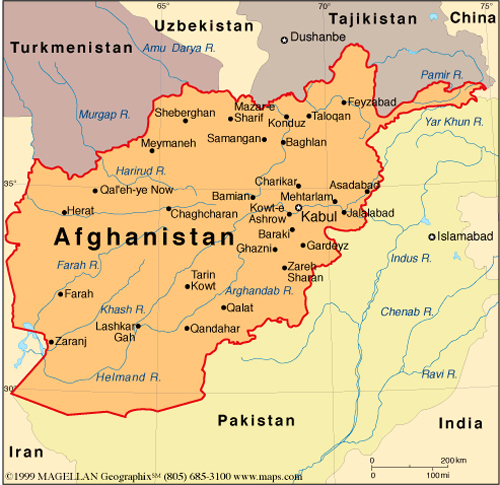
It is true that the people of Afghanistan have endured violence for decades, but the President fails to acknowledge what role the US has played in perpetuating that violence. Foreign policy scholar Bill Blum has pointed out that the US funded and trained the Afghan Mujahadeen forces in the 1980s to fight the Soviet occupation. However, once the Soviet Army left Afghanistan those that made up the Mujahadeen began fighting each other and attacking the Afghan civilian population. Many of the US funded and trained forces of the 1980s are now the very same warlords within the Karzai government.
Moreover, how can the President say the US has no interest in occupying Afghanistan? What would you call the past eight years other than an occupation? If there is no intention of occupying the country, why build permanent US military bases and the new 1,100 person prison facility at Bargram?
“But more than any other nation, the United States of America has underwritten global security for over six decades — a time that, for all its problems, has seen walls come down, markets open, billions lifted from poverty, unparalleled scientific progress, and advancing frontiers of human liberty. For unlike the great powers of old, we have not sought world domination. Our union was founded in resistance to oppression. We do not seek to occupy other nations. We will not claim another nation’s resources.”
This statement is propaganda at its finest. The US has militarily intervened in more countries in the last six decades than any other nation. According to Professor Zoltan Grossman, the US has militarily intervened over 100 times around the world since the end of WWII.
And when the President says, “we will not claim another nation’s resources,” does he really think that the American public is that stupid? The CIA-led coup in Iran in 1953 was for oil and in 1954 in Guatemala it was to protect the right of United Fruit to extract that country’s resources. These are just two examples of the long list of times when the US claimed another nation’s resources.
Like many US President’s before him, Barack Obama wants to try to convince the American people that the US only send its troops to foreign lands with the noblest intentions. We must do our best to not simply accept this premise without serious scrutiny.
(There were many other aspects of the speech that could be critiqued. For additional analysis we encourage people to read an excellent article by Phyllis Bennis and a short interview with Anand Gopal who has been reporting on Afghanistan for years.)
Today, the Grand Rapids Press ran a significantly edited version of an AP story about Blackwater founder Erik Prince. The Press version of the article said, “Prince will relinquish involvement in the company’s day-to-day operations and give up some of his ownership rights.”

The article then goes on to say, “Prince felt he was “constantly being thrown under the bus” after serving the country for years.” The Press version of the story doesn’t mention Blackwater’s involvement in the shooting deaths of several Iraqis in 2007, instead the article reads, “Prince’s company did years of work for the government but has been dogged by a series of federal investigations into its work.”
The original Associated Press (AP) article was a bit more substantive in that it mentions the 2007 Blackwater shootings in Baghdad and the dollar amount of the company’s contracts in Iraq. However, the AP article was still quote favorable to Prince and didn’t bother to mention details of the company’s current foreign contracts.
One country that Blackwater is currently operating in is Pakistan, which would seem to be very topical considering the US escalation of its occupation in Afghanistan and the US funding of Pakistan’s army to fight the Taliban. Investigative journalist Jeremy Scahill, author of the book Blackwater: The Rise of the World’s Most Powerful Mercenary Army, recently published a story on the role that Blackwater is playing in a covert operation in Pakistan. This important information is apparently not as relevant as Erik Prince’s feelings.
Two Grand Rapids activists occupy Senator Levin’s Office
At 4p.m. EST today, two Grand Rapids activists occupied U.S. Senator Carl Levin’s Grand Rapids office. They released the following statement:
Why We Occupied Senator Levin’s Office
Today, we occupied Senator Carl Levin’s office in Grand Rapids as a protest against the current administration’s decision to escalate the US war in Afghanistan. We do this not simply because we are against war, but because this decision by the Obama administration is unjust.
The US is not in Afghanistan to bring Democracy – Since 1979, the US has supported anti-democratic forces such as the Mujahadeen, the Northern Alliance, the Taliban and a variety of individual warlords. The US has also supported the current regime of Karzai, knowing full well that his administration has been corrupt from the beginning.

The US is not in Afghanistan to protect the rights of Women – The groups of armed men that the US has supported for decades, like the Mujahadeen, are some of the most misogynist groups in that country. Even under the current government of Karzai, a law was passed that essentially legalized the rape of women. Afghan Women’s groups like RAWA and the Afghan Women’s Mission have made it very clear that if those of us in the US want to support women in Afghanistan then we should work for an end to the US military occupation of their country.
The US is not in Afghanistan to Prevent Terrorism – Many credible members of the US intelligence community have stated in recent years that there is no link between the Taliban and Al Qaida. The Taliban did not attack the US on September 11, 2001. The Taliban are a nationalist group that wants the US out of their country. In fact, we would say that the US occupation of Afghanistan only gives rise to potential acts of terror and feeds a growing anti-American sentiment.
What the US is doing in Afghanistan has more to do with long-term strategic interests. We believe that the US recognizes that Afghanistan is a bridge between the Middle East and Central Asia, that it borders Iran, Pakistan, China and other important countries. We believe that the US sees Afghanistan as playing an important role in the control of future resources in that region, both because it will likely be a major trans-shipment point to move oil and gas in the region, but also because it can act as a US outpost to prevent China, India and Russia from gaining access to the region’s resources.
The US is currently expanding military bases it has had there since 2001, as well as constructing new bases in strategic locations throughout Afghanistan, which implies that the US, like in Iraq, has no plans to leave that country for a long time to come. The US recently built a 1,100 person prison facility at Bagram Air Base, which is another indication that the US has no timely withdraw plans.
We are occupying Senator Levin’s office today because this war is now primarily at the feet of the Democratic Party. The Democrats control the White House and the Congress and is therefore the major force behind this escalating war in Afghanistan. Senator Levin may have tactical disagreements with how the war is being prosecuted (he has supported more training for an Afghan Army), but he supports the fundamental premise of the White House that the US occupation of Afghanistan is in the National Security interest of the US.
We know that our occupation of Senator Levin’s office will not stop the escalating US war in Afghanistan, but we cannot be silent. Senator Levin needs to know that he cannot support President Obama’s prosecution of this brutal war in our name.
We also act today in order to send a message to those who call themselves progressives. We strongly encourage all progressives to ask themselves if they really believe the lies about Afghanistan and to stop supporting this escalating war. We ask them to stop being silent and to take action that leads toward an end of the US occupation in Afghanistan.
We ask people of good will to think about the escalating cost of this war, which as of today, has cost over $232 billion dollars for the country and $122 million from the residents of Grand Rapids. Considering the current economic struggles that people face in this community, how can we support a war that costs so much?
We ask people to think about the relationship between the US military industrial complex and global warming (see the book Green Zone: The Environmental Costs of Militarism). The US military is one of the single largest polluters on the planet and exists primarily for the purpose of stealing other countries fossil fuels. (see the film Blood & Oil, by Michael Klare).
We ask people to think about whether or not they want their family members or their friends who might be deployed to Afghanistan to participate in the killing of innocent Afghani civilians or to come home traumatized, wounded or dead. There is a growing movement of US troops who oppose the US wars in Iraq and Afghanistan and we need to hear their voices.
We ask people to talk about this war, to educate themselves and to take action – write letters, sign petitions, yes, but more importantly engage in direct action! Take to the streets, prevent young men and women from entering the US military, confront the corporations that are profiting from this war, don’t pay your taxes, don’t vote for people who support war, organize a march, organize a sit in, shut down a military recruiting center . . . do something!
End the US Occupation of Afghanistan Now!
Bring the Troops Home!
Pay Reparations to Afghanistan for the Damage We Have Done to Their Country!
Media Bites – Miller Lite and Relationships
This week’s Media Bites takes a look at some recent Miller Lite ads that pit men and their beer against their girlfriends. Both spots are meant to target “guys” with lowbrow humor, but should we just accept these messages as harmless fun?
The Story of Cap & Trade
We just wanted to share with our readers this video that creatively explains what is wrong with the Cap & Trade policies that Big Business/Big Polluters, the Obama administration and even some environmental groups endorse.
The video is produced by The Story of Stuff Project & Free Range Studios, in partnership with Climate Justice Now! and the Durban Group for Climate Justice, two leading international networks of climate justice advocates. Below we have embedded the trailer for this short film. To see the entire video, go to http://www.storyofstuff.org/capandtrade/.
From Seattle to Detroit: 10 Lessons for Movement Building on the 10th Anniversary of the WTO Shutdown
(For the 10th Anniversary of the anti-WTO action in Seattle, we thought this article does a great job of taking the lessons from that historic action and offering up ideas for future movement building. This piece is by Stephanie Guilloud and first appeared in the newsletter of Project South.)
For five days in 1999, 80,000 people from Seattle and from all over the country stopped the World Trade Organization from meeting. Despite extreme police and state violence, students, organizers, workers, and community members participated in a public uprising using direct actions, marches, rallies, and mass convergences. Longshoremen shut down every port on the West Coast. Global actions of solidarity happened from India to Italy. Trade ministers, heads of state, and corporate hosts were forced to abandon their agenda and declare the Millenium Ministerial a complete failure. We said we would shut it down, and we did.
“The fact is that the Social Forum and Peoples Movement Assembly process actually started in Seattle. The Social Forum took off from the experience of the ‘Battle of Seattle’ when the Brazilian organizing committee formed in 2000 and held the first World Social Forum in 2001. Ten years later, we come back to where this started. What has been accomplished in the last 10 years? How have our social movements developed to build the power towards real social systemic change in the US? How do we map the new forces and what is the power of the social movement assembly?”
– Ruben Solis, Southwest Workers Union,
participant in the Seattle shutdown, and one of the founders of the Grassroots Global Justice Alliance
As one of the founders and leaders of the Direct Action Network and a resident of Olympia, Washington, I offer personal and political reflections on the WTO shutdown as a major turning point in my life as an organizer and in our lives working to build movements in the US. As an organizer with the US Social Forum process and a co-lead to develop the People’s Movement Assembly, I carry these lessons with me on a daily basis. I offer these stories with humility and a sense of responsibility. When I refer to “we” in this brief article, I refer to my community of young people in their early twenties, living in Seattle, Olympia, Portland, and the Bay Area, who, with many others, mobilized, organized, and implemented the direct action strategies we had planned for months.
1) Know your history: Seattle was a turning point
Seattle was a historic turning point in our movements for racial, economic and gender justice for a few reasons. On a global scale, the demonstrations and effective shutdown of the World Trade Organization’s ministerial was historic because of our position and location in the US. Seattle did not mark the beginning of a movement, it marked the beginning of a significant connection between the US and the rest of the world. Global movements had and have been challenging and confronting financial institutions and their systemic effects for decades. The demonstrations – the five days of direct action, the massive and violent state response, and the subsequent alliances – accomplished a few major shifts in historic directions. The demonstrations exposed to the US public the tangible affects of globalization on regular people’s lives. The effectiveness of the actions and stalling of the meetings allowed for delegates from the global South to challenge the policies and procedures of the WTO. And for the first time in history, the decision-making rounds of a global financial institution collapsed.
Seattle also opened a door on a new era for movement in the US. The strengths and weaknesses of our organizing efforts served as a spark for new work, new alliances, new conversations, and a new generational drive. It opened the possibility for a generation of people to understand action, movement, and strategy as effective. It also offered an opportunity to see the strengths of innovation and mass organizing, as well as the weaknesses of underdeveloped leadership and lack of connection to long-term transformative practices.
2) Claim your victories and evaluate your mistakes.
How we organize to win is still a critical question today. Winning is different in any moment given the political context as well as the will and abilities of the people involved. We made a widespread call to Shut Down the WTO without total confidence that we could or would achieve that goal. The call was a way to declare a politic beyond reforming the WTO and towards complete transformation of the economic and social systems in motion. On the first day, we succeeded at exactly what we had said we would do. Shutting down a major financial institution with tens of thousands of people and well-coordinated non-violent action was a victory.
Claiming victory is essential to tactical decisions on the ground as well as understanding the political significance after the fact. After the success of the first day, we re-convened the Spokescouncil easily. We had planned for the possibility of mass numbers being in jail, but I am proud that we saw and rose to the opportunity of victory and understood it as an ongoing process. The next few days demanded different sets of tactics to incorporate the constant influx of new people who had not necessarily gone through the preparations that led up to the November 30th action.
That’s a taste of movement building – How do you move consistently through multiple reactions from the state and opposing forces while constantly mobilizing and expanding your base? How do you shift and re-adjust when met with the possibility of victory? And significantly (because it was lacking on a mass scale following the demonstrations) how do you expand the momentum of victory with strategic, intentional plans to continue what you started? And finally, how do you evaluate the mis-steps and mistakes after such a significant and widespread experience? How do you receive and understand criticism as well as accolade without losing momentum or integrity?
3) Make your enemy known: Mass demonstrations are not spontaneous
Globalization and neoliberalism were not common terms or centers of public debate. The WTO was relatively unknown at the time. Its meetings were secret, the levers of decision making and the connections between nation-states and corporate leaders were blurry and deliberately non-transparent. We believed everyone had a stake in refusing to let them meet quietly, especially in our town. We knew that any major action would not be spontaneous – it would need massive buy-in and involvement from many sectors of the community.
There had been a successful campaign to pass an ordinance banning the MAI (Mulitlateral Agreement on Investment) in Olympia, and we knew there was a hook into our community on the issues of corporate control and local power. We studied the mechanisms of the WTO in order to describe it and educate about its relationship to our work, our food, our health, our governance, and our economies. I facilitated countless popular education-style workshops in classes, at unions, in prisons, and in the community. A team of us produced the broadsheet that went out that summer to over 25,000 people engaged in environmental, labor, peace, and social justice work. The articles exposed the WTO as an illegitimate and undemocratic institution, and we called for a Shut Down on November 30, 1999.
One of the most significant accomplishments of our organizing was that people knew the enemy – they knew the details, the characteristics, the impact, and the context of the WTO. We worked to make that happen. We studied and applied tactics and strategies from the Spanish Civil War and the anti-nuclear movement. We invented new tactics and strategies based on our knowledge of the terrain. It was a planned, locally-led massive demonstration with global consequence.
4) They came out of the bars: Infrastructure and preparation allows for spontaneous action
On the first day of the demonstrations, there were a few different kinds of folks on the street. There were the organized labor marchers, prepared and routed. There were the Direct Action Network folks who had been preparing for months, organized into affinity groups and clusters with clear, coordinated instructions to hold particular intersections in various formations. And there were folks in Seattle who walked off their shifts and linked elbows in front of glass doors and irate WTO delegates. On the third day of the demonstrations, after two days of cloudy tear gas on Capitol Hill and rubber bullets flying, the confused media reports, and a lot of traumatized people who were either arrested or hurt – the people living in Seattle were the irate ones. We had more people who wanted to get involved, and they hadn’t gone through the trainings.
My affinity group was tasked on the second night of the protests with leading a march the next day on King County Jail where about 600 of our folks were being held and doing jail solidarity. We moved thousands of people from Pike Place Market with the plan to split the march and surround the jail. We were still successfully operating with tactics of surprise. There had been no police or city negotiations for any days past the first. No routes, no advance warning. (And remember that ten years ago there were no cell phones, no tweets and texts, and very little email.) We did it again – Surrounded the jail with 2000 people, made our demands, and got the lawyers in. But the real victory was the mass of people who was not prepared, was not experienced with actions, direct or otherwise, and who completely trusted our leadership and moved collectively.
In order for that trust to emerge, we created a culture. We prepared as best we could, and a culture emerged spontaneously in the moment as well. The way we used call and response was like poetry. We had to make the words meaningful and precise. And it worked – at that time and in that place. The experience, sometimes frustrating and frightening, still moves me to believe in people’s power and creativity.
5) Surprise only works once: Evolve our tactics and strategies
We cannot afford to dismiss the significance and influence of different tactics, strategies, and convergences in different historical moments. We also cannot rely on old models of organizing, simply because they have worked in the past. Mass demonstrations and protest rallies cannot be our default response to all injustice. Two major lessons surface. Surprising the cops in Seattle put us at an advantage at every turn. By the nature of our movements being extremely out-militarized, we are not in a position to repeat the same strategies with the same success. We will have to be smarter, one (or more) steps ahead of the turn, and completely in command of whatever local terrain we occupy.
Another major lesson from post-Seattle demonstrations was that convergence at the expense of local organizing is not effective. The local leadership and knowledge made the demonstrations in Seattle effective. We learn similar lessons in the US Social Forum process. The Forum would be in danger of becoming a big conference if power building in multiple locations (including local, regional, national, and global relationships) is not inherent to the organizing and operational process. What has been powerful in my experience in working in the South and organizing the US Social Forum, a convergence process led by people of color in community-based organizations from multiple sectors, is that we understand that strategic convergence is still extremely necessary and valuable. That the model was developed and refined in the global South through the World Social Forum is critical to its relevance and success. The convergence in Seattle ten years ago was important, but we’re not always coming together to target an oppressive institution or body. We are also coming together to increase the breadth and width of community-led power bases. New tactics and strategies will rise from that convergence.
6) It’s not about a leader. It is about leadership.
There are two major things you learn about inside of an affinity group: 1) Play your position and 2) trust everyone else to play theirs. There is no other option. If you’re locked down to 50 other people, you cannot also get water for everyone or communicate your coordinates. There are distinct and necessary roles. The group process of building trust and skills together over time allows for everyone to play their roles to the utmost efficiency. We were spokespeople, facilitators, planners, logisticians, tacticians, jail support, communication points, and when the time came to make hard decisions about how to move within and through the police violence, while still maintaining our effectiveness in blocking our coordinates, we made them by consensus. With 200 people. You can’t ever tell me, consensus doesn’t work or it takes too long – you’re just not doing it right.
We built that same model to scale for the Spokescouncil, and as with many of the lessons from this moment, there is a lot to learn and expand from being able to convene hundreds of people that represent thousands and make tactical decisions. These models are not about a single leader nor the absence of leaders. Leadership is critical to the functionality and direction of these spaces. The collective nature of leadership is not easy, we are not trained to work like that, and we must be intentional and deliberate about our principles as we practice them at higher and higher stakes. Leadership in this case looked like incredibly well-developed plans and structures by multiple people in different positions, while at the same time allowing everyone on the streets to claim and feel true victory in their bodies. What can we learn and share, about this model, and what needs to be further developed?
7) Strategy, please: Action-hopping is not movement building
Most of the demonstrations that followed the Seattle demonstrations over the next two years in the US (specifically the actions around the IMF, World Bank, and political party conventions) did not have the intention, timeline, or local mobilization and support that would allow for 10,000 people to do direct action while having the support and solidarity of upwards of 60-70,000 people in the labor and progressive movements. Though there were different levels of success and effectiveness in different convergences over the next few years, we played to many of our weaknesses rather than move from our strengths and unique positions.
There were opportunities to build with broader, more grounded global movements who felt connected to what we did in Seattle. Part of what’s necessary to do this work effectively is knowing the landscape – literally and politically. In order to organize for global justice in our communities, we need to understand that the forms and functions of international financial institutions and groups change and shift to meet new economic conditions. The exclusive club of primarily colonial powers, the G8 just became the G20. How are we shifting and changing to meet new conditions? How are we building in our communities in ways that are rooted to the local conditions and responding to broad systemic realities?
8) Leadership development, thank you.
Where there were intergenerational relationships there was strength. Where we relied on only ourselves as isolated young people, we stumbled. The impediments were age-old internal and external barriers to serious, strategic organizing. Most of us were young (I was 22) and having participated at the helm of the protests, we held this depth of experience but struggled with what all new leadership struggles with – clear political direction, strategy development, and organizing skills. The generational turning point here cannot be dismissed. I was hired and trained by a seasoned organizer and strategist, and he challenged me, supported me, and connected what was happening to a broader, historical context. That daily training I received laid the foundations for me to develop my skills as an organizer for long-term work. Others in my community also had relationships with key mentors and advisors, but there was not a movement infrastructure for that leadership to enter, learn, and build on the momentum after the demonstrations. I am still wildly cognizant of that immense and specific need on a large scale, and I strive to carve out space and time to give and receive what I can to people who are battling on the frontlines of our communities.
9) Guilt slowed us down: Solidarity is action
Elizabeth Martinez’s article “Where was the Color in Seattle?” sparked debate following the demonstrations about race, leadership, and global justice. Though there were great points to discuss, the debate it sparked is not as relevant as the larger context of how white supremacy and racism manifests in our social movements. The Seattle demonstrations did not represent “white movements” but it did reflect many dynamics – old and painful dynamics around leadership, race, culture, and styles, as well as some new dynamics about the nature of massive convergences from a local base with national reach. The debate and challenge around the roles of white people in leadership was happening within the organizing bodies. We challenged racism where we saw it, we attempted to advance our communities’ understanding and skill through trainings and workshops, and ultimately the affinity group I was working with in Olympia made a decision to resign from the Direct Action Network if we did not examine our broader positions as a leadership body and our roles within that context.
One outcome of the dialogue at that time was a culture embedded in identity rather than experience. This culture had already begun plaguing this new generation but has since ballooned. The critique for critique’s sake nature of anti-oppression work showed a lack of development as well as real misunderstandings of history and race in the US. Instead of emerging from this historical moment to build deeper connections to local and global struggles, young white activists questioned their right to act. Confronting white supremacy is not an existential activity. The lesson here for our US movements is about understanding how to challenge the dynamics of privilege and oppression while also building large, wide, and deep movements that are led by and rooted in the experiences of people who know injustice and exploitation – currently and historically.
10) Know your vision: Learn lessons in order to move forward.
The lessons of that time are with me in my everyday organizing work. I moved back South (I’m from Houston and live in Atlanta now) in 2003 to work with Project South and practice movement building in Southern grassroots communities. After Seattle, I knew I needed more development around strategy, history, and developing long-term organized formations to build instead of react. Project South was one of the primary anchors for the first-ever US Social Forum in 2007, and for me the Forum was a continuation of the momentum we built in Seattle. In an exciting shift and in less than ten years after the demonstrations, the Forum represented more vision, more leadership from frontline communities, and more strategic connection to global struggles.
From that process and within the context of global dialogues about coordinated actions, we are building the People’s Movement Assembly as an organizing process to prepare for the Forum, to make decisions at the Forum, and to advance new directions after the Forum. We are pulling on all these lessons from 10 years ago to facilitate Movement Assemblies – mass convergence, collective decision-making, political clarity, shared leadership, and trust that we will move forward together. What will we build over the next ten years in order to shift, evolve, and grow our movements to win?
Stephanie Guilloud graduated from The Evergreen State College in Olympia, Washington in 1999. She was hired that week by history professor and organizer Dan Leahy to organize a conference called Trade, Labor, and the Environment: Analyzing the World Trade Organization. She co-founded the Direct Action Network with other organizers from California, Oregon, and Washington. Her affinity group was made up of queer and trans folks from Olympia and called itself the Small Town Sleazy Cowboys (and Lady) Puppet Rodeo Association. They built a cluster of over 200 people to shut down multiple intersections on the first day, led the action for over 2000 people to shut down King County Jail on the third day, and continued mobilizing actions until the end of the fifth day. Stephanie edited and produced ‘Voices from the WTO,’ an anthology of first-hand accounts from the demonstrations and is a contributor to The Battle of the Story of the Battle of Seattle, a short anthology released for the tenth anniversary looking at how that watershed event has been misrepresented and reproducing the original 1999 Shut Down broadsheet.
Blind Spot Documentary in Conjunction with Climate Summit

GVSU students and the Bloom Collective will be hosting 2 screenings this week of the documentary Blind Spot: Peak Oil and the Coming Global Crisis.
The documentary screenings are in conjunction with the upcoming International Climate Summit in Copenhagen, Denmark, which takes place from December 7 – 18. After the documentary there will be discussion and resources available for people to check out.
Times and locations:
– Wed Dec 2 @ 6pm on Pew Campus in Downtown Grand Rapids 204A DeVos building
– Thurs Dec 3 @ 6pm on the Allendale Campus 154 Lake Superior Hall
Both screenings are free and open to the public.
Anti-War Rally Planned Before Obama Addresses the Nation

This Tuesday, December 1, there is an Anti-War Rally planned outside the Grand Rapids Federal building to protest President Barack Obama’s decision to send more US troops to Afghanistan.
The White House has announced that the President will address the nation this Tuesday at 8pm from the West Point Military Academy. News reports are saying that Obama plans to send between 32 – 35,000 additional US soldiers to fight the war in Afghanistan.
People are encouraged to bring signs and noise-makers to the rally.
Anti-War Rally
Tuesday, December 1
4:30 – 5:30pm
Grand Rapids Federal building
Corner of Michigan & Ottawa
Questioning War Claims: The GR Press, Afghanistan & Obama
Yesterday, the Grand Rapids Press published another Associated Press article about President Barack Obama’s upcoming announcement to send more US troops to Afghanistan.
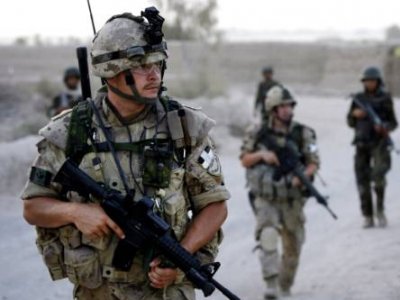
The article states up front that the President will announce on Tuesday to a national audience his intention to increase US troop numbers in Afghanistan by as many as 35,000, according to military officials who spoke with the AP reporter on condition of anonymity.
The article then says, “Polls show support for the war has dropped significantly since Obama took office, with a majority now saying both that they oppose the war and that it is not worth fighting.” The AP story does not source any recent data to support such a claim. There have been recent polls that shows less public support for the war in Afghanistan, such as an August 20 Washington Post poll or September 15 poll from CNN. However, a recent (Nov. 12) Gallup poll shows the country to be quite divided on sending more troops to Afghanistan.
Much of the rest of the article is devoted to how Democrats and Republicans will respond. The AP story makes the claim that, “Congressional Democrats, including House Speaker Nancy Pelosi, D-Calif., have been blunt in saying Congress has little stomach for a large troop increase and flagging confidence in the U.S.-backed Afghan government the war effort is meant to support.” While Pelosi and others may have made these comments, the real test of support is whether or not these Democratic leaders have voted in favor of financial support for the war in Afghanistan or for the troop increases last Spring. Also not mentioned was the concrete opposition by Rep. Barbara Lee whose bill calls for cutting off funds for the troop escalation and Rep. Jim McGovern’s resolution calling for the administration to offer an exit strategy.
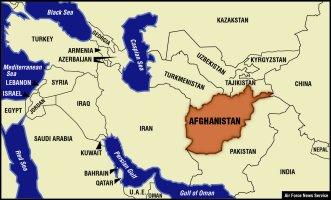
The AP article concludes with two points that are also not verified. The first is a comment from White House Press Secretary Gibbs who says, “We are not going to be there another eight or nine years.” There is no follow-up, nor any context for such a statement. The AP reporter could have asked, “if the US has no plans to be there for a long time, why are they building permanent military bases in Afghanistan?” The reporter also could have asked about the number of private US military contractors in Afghanistan or the recent construction of a 1,000-plus prison the US has built there.
The other unverified statement was from the AP reporter, which claimed, “Incompetence and corruption have aided a rise in the Taliban’s strength.” While it is true that there has been significant corruption in the Karzai regime, the article fails to mention that the US has until the recent election fraud backed the corrupt Afghani leader. The closing comment also fails to acknowledge that in addition to corruption giving aid to the Taliban’s strength so has the US/NATO occupation, which according to some sources is the number one reason for Afghans joining the Taliban.
Unfortunately for Press readers, this article, like much of what we have documented, gives both a limited and slanted view of US policy in Afghanistan.

