3rd Congressional debate gets limited coverage
On Monday, the Grand Rapids Chamber of Commerce and Davenport University held a forum for candidates running in the 3rd Congressional District race. Six of the seven candidates vying for the seat that will be vacated by Vern Ehlers participated in the debate held at Davenport’s campus on Kraft near the Southbelt.
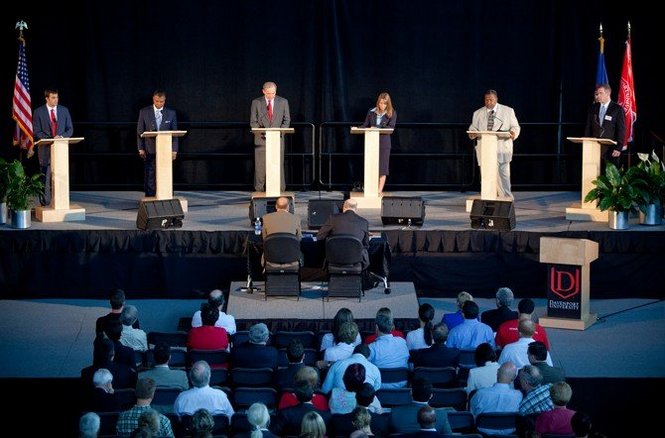
The only news agency to cover the debate was the Grand Rapids Press. Press editor Jeff Cranson was the moderator for the debate, a fact the Press article omitted. The debate was scheduled to last for two hours.
The Press coverage of the debate was very limited, offering only a single comment from each of the candidates. The article did start out stating, “the five Republicans hewed to the right, criticizing health care reforms, corporate bailouts and taxes in general while trying to avoid being labeled a “politician.” However, there were no details as to why these candidates took those positions, nor what policies they would put forth if elected.
The reporter mentioned the lone Democrat (Paul Mayhue) at the debate near the end of the article stating he, “defended the Obama Administration’s health care legislation and its bailouts of the auto industry.” Candidates used words like taxes and free trade and the only question asked from the moderator included in the article was about Asian carp. It’s hard to imagine that there wasn’t something more substantive asks of candidates during the two-hour debate.
The Press reporter could have at least looked at the comments candidates made and compare them to what they have posted on their websites. As of this writing Justin Amash has more platform information than any other candidate, although 75-words or less on issues like education, health care and the economy is not very impressive. Amash’s issues page states that he believes in the “free market,” protecting private property, a private health care system, lowering taxes, gun rights and a strong military.
Bill Hardiman has limited information about where he stands on issues and only addresses government spending, national defense, limiting government and putting less restrictions on business.
Former Kent County Commissioner Steve Heacock only has information about his stance on health care and Louise Johnson’s issue page is blank. Bob Overbeek has a 10-point plan, which consists on just bullet points. Overbeek is the only candidate who mentions the US wars in Afghanistan and Iraq, as well as immigration and Cap & Trade legislation. The Democratic candidate Paul Mayhue has limited information on education, health care, jobs and seniors.

Congress just sold you out to Comcast and AT&T. Seventy-four House Democrats and 37 Senate Republicans just signed their names to industry letters telling the FCC to halt efforts to protect Internet users and prevent phone and cable companies from blocking Internet traffic.
Almost every one of these elected officials has accepted massive contributions from the phone and cable lobby. In exchange, they are handing control of the Internet to companies that can’t be trusted to protect the public interest.
Speak out against this unethical behavior. Sign this letter to demand that Congress and the FCC stand with the people they represent and support an open and affordable Internet for everyone.
Journalism or an ad from the Visitor’s Bureau?

It was announced a few weeks ago that Grand Rapids was awarded a Green City status by the US Chamber of Commerce and the Siemens Corporation. We critiqued that announcement in a pervious posting and now the Grand Rapids Press is continuing to promote the idea that this city is sustainable without providing much evidence to support that claim.
The front page of yesterday’s Press has the headline “Greentown, USA?” The lead story was only about 50 words long and stated that this new identity was due to the recent Chamber award and a 2007 United Nations University designation, which called Grand Rapids a “Regional Center for Enterprise in sustainable development.
No explanation of this designation is provided in the Press article, just 6 pictures with captions that somehow demonstrate the city’s commitment to sustainability. The pictures are of the local recycling program, rooftop planting, electricity from methane, LEED certified buildings, a new citywide sewage/storm-water run-off system and a new Meijer store on 28th street and Kalamazoo.
The obvious first question is, how does Meijer’s new store construction demonstrate sustainability? While Meijer may have their origins in West Michigan, the company is a regional food distributor that sells mostly non-organic and processed food stuff. How anyone could defend that Meijer stores promote sustainability is almost laughable.
However, the larger problem is that the Press in the case is not practicing journalism. They monopoly daily paper is merely presenting information from sources of power – the City of Grand Rapids, the United Nations University and the US Chamber of Commerce – without questioning or verifying the claims made in this so-called article.
The Press should have followed the intent of the headline (Greentown, USA?) and actually questioned the idea that Grand Rapids is actually promoting sustainability. Without any questioning the story might as well be an ad from the Grand Rapids Convention and Visitor’s Bureau.
Obama’s Border Plan Looks Similar to Bush’s
(This article is re-posted from Common Dreams.)

President Barack Obama’s plan to send as many as 1,200 National Guard troops to the US-Mexico border appears to be a scaled-down version of the border security approach championed by his predecessor.
The 6,000 troops who were sent by President George W. Bush to the border from June 2006 to July 2008 were generally credited within law enforcement circles as having helped improve border security, but restrictions placed on the soldiers were denounced by advocates for tougher enforcement who are now leveling similar objections at Obama’s plan.
Some law enforcement officials along the border said they worry that Obama will repeat Bush’s mistake by limiting the troops to support roles, such as conducting surveillance and installing lighting, rather than letting them make arrests and confront smugglers. They also believe the scale of the force – one-fifth of the size of the one sent by Bush – is too small to make a difference along the length of the 2,000-mile border.
Cochise County Sheriff Larry Dever, whose jurisdiction includes about 80 miles of the Arizona-Mexico border, said 1,200 soldiers might make a difference in a smaller portion of the border. “But if you spread it across the border, it’s like spitting into the wind,” Dever said.
Under the Obama plan, the troops will work on intelligence, surveillance and reconnaissance support, analysis and training, and support efforts to block drug trafficking. They will temporarily supplement border patrol agents until Customs and Border Protection can recruit and train additional officers and agents to serve on the border. Obama also will request $500 million for border protection and law enforcement activities.
Arizona Attorney General Terry Goddard, a Democrat who has prosecuted rings of drug and immigrant smugglers, said the planned deployment was a good first step, but believes that the president’s plan should evolve to include more troops and more authority for the soldiers.
“I’ll take what we can get,” Goddard said. “Again, I don’t think this is the final response.”
The Mexican government issued a statement saying it hoped the troops would be used to fight drug cartels and not enforce immigration laws. Mexico has traditionally objected to the use of the military to control illegal immigration.
When Bush sent the National Guard to the border, the troops performed support duties that tie up immigration agents, who then had more time to arrest illegal immigrants.
The troops under the Bush deployment didn’t perform significant law enforcement duties. They installed vehicle barriers, operated remote cameras, repaired vehicles, worked as radio dispatchers and performed other duties. Troops who manned mobile observation towers had used binoculars to search for and report border breaches.
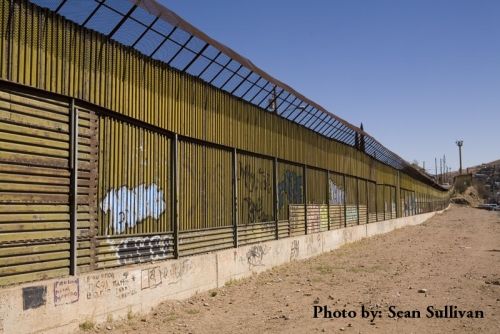
The effect of the troops was felt by the smugglers and would-be border-crossers during 2006 in Palomas, Mexico, a smuggling hub south of the village of Columbus, N.M., where a buildup of border agents, surveillance cameras, vehicle barriers and troops were credited with reducing smuggling traffic.
Vendors in Palomas reported a significant drop in the number of backpacks they sold to border-crossers for carrying their food, water and clothing in during their walk into the United States. “There are not many people because of the soldiers that were put on the border,” vendor Elisco Hernandez Gonzalez told The Associated Press two months after the Guard was sent to the border.
Republican state Sen. Russell Pearce of Arizona, the author of the state’s new immigration law, said he fears Obama will repeat Bush’s mistake in not giving the troops the power to confront violent smugglers and other armed criminals along the border.
Pearce was disturbed by an incident in 2007 where National Guard troops backed off and called in federal agents as gunmen approached their post near the Arizona-Mexico border.
While supporters of the decision said the Guard members did as they were supposed to, Pearce questioned the point of having troops on the border if they can’t confront such dangers. “It was a welcome-wagon role last time,” Pearce said. “They weren’t allowed to do anything.”
T.J. Bonner, president of the National Border Patrol Council, a union representing 17,000 agents, said he doesn’t see the broad outlines of the Obama plan as a solution to border violence.
“People shouldn’t be surprised if the violence continues,” Bonner said. “They shouldn’t expect that the announcement of up to 1,200 National Guard members will send a shock wave of fear in the cartels and that they will start playing nice.”
Pinal County Sheriff Paul Babeu, a major in the Arizona Army National Guard who served as a commander in Yuma, Ariz., during the 2006 deployment, said Obama’s plan is welcome news that will help confront border security weaknesses, but it doesn’t go far enough.
Babeu, who wasn’t speaking on behalf of the National Guard, said the visible presence of armed soldiers is an effective deterrent for illegal immigration. “They’re not given law enforcement authority, but the fact that they’re there, keeping watch, 24/7, has proven to be the most effective solution for border security,” Babeu said.
US soldier deaths in Afghanistan now over 1,000

With the recent escalation of the US occupation of Afghanistan by President Barack Obama and the military campaigns in Marjah and Kandahar it was expected the US casualty rates would increase.
According to the website icasualties.org, the number of US troop deaths in at 1,083, while the total number of NATO soldier deaths is at 1,784.
Yesterday it was reported that the US will now shift to more special forces operations in Kandahar, with an emphasis on raids to undermine the power of the Taliban. This decision is not likely to reduce the number of US troops, which will be killed in action. In fact, the number of US soldier deaths has been on the rise since Obama took office.
Watch the most recent Rethink Afghanistan video, which invites people to take action in response to the increased US troop death count.
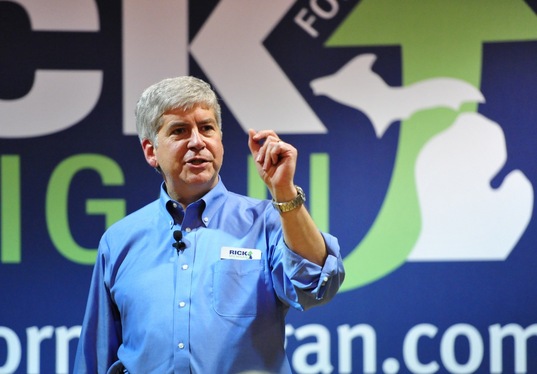
Republican gubernatorial candidate Rick Snyder came to Grand Rapids on Monday as part of his Reinvent Michigan tour. Under a sweltering sun about 200 people gathered at Rosa Parks for the town hall meeting at noon. Some of the people were lured there by the smell of free hot dogs, given in exchange for wearing a Snyder campaign sticker. Others came due to their involvement in the Republican Party, including big time donor Peter Secchia and Bill Cooper, who is running for the 2nd Congressional District seat currently held by Republican gubernatorial candidate Pete Hoekstra.
Snyder began the meeting by outlining his reasons for running for governor, saying Michigan is in an economic disaster and Lansing is broken and overwhelmed by career politicians. Snyder often touts himself as being a nerdy businessman who is outside of the political world of Lansing.
In some respects that’s true. He doesn’t have much experience in Lansing, being an entrepreneur who has made millions by running Gateway Computers in the 90s and starting up Ardesta, a micro and nanotechnology firm.
But Snyder does have enough experience to use the popular Republican line, saying, “It’s time for bureaucracy to go.” He went on to say bureaucracy is a hundred year old system that should be replaced with a customer service government that is more transparent and regulates less. To continue his business rhetoric he said, “If Lansing was a business, we would have fired them a long time ago.”
Yet being a self-described nerd, Snyder sure doesn’t talk like it. At the town hall meeting his rhetoric often lacked substance, a common problem with political speak. Snyder didn’t offer much in the way of concrete plans of how to implement what he calls “Michigan 3.0“, or Michigan’s next era.
Snyder talked about the need to create more jobs but didn’t say much about how. Rather Snyder just said, “The government’s role is not to supply jobs but to create the environment for jobs.” It seems he hopes to create this environment by ridding Michigan of its current business tax and replacing it with a 6% flat corporate tax. But this isn’t certain if it would lead to more jobs or save the state money, and Snyder’s plan would reduce the state’s spending on public worker’s wages and benefits.
When asked about how to fix Michigan’s crumbling education system, Snyder said what needs to happen is a change in dialogue, making it more about the teachers and students rather than funding. Yet not much can be done to keep teachers in the state and schools open for students without money.
Many of these students later attend colleges in Michigan, though keeping them here after college is another issue. When asked about this by a young college student, Snyder replied that Michigan needs to build up a mentor network and to create a better quality of place where young people want to flock to. But Michigan needs to create a lot more than that if it wants to keep its young people, namely diversified jobs.
Near the end of the meeting, Snyder labeled himself a Republican but said also that he doesn’t mention party anywhere in his political literature because he wants people to vote for him because of what he stands for. But what he stands for is the same old Republican ideas of limiting government, letting free markets reign, and cutting taxes.
Rick Snyder is running against fellow Republicans Attorney General Mike Cox, state Sen. Tom George, U.S. Rep. Pete Hoekstra and Oakland County Sheriff Mike Bouchard in an August 3rd primary.
Media Bites: Miller Lite and masculinity
In this week’s Media Bites we take a look at a new Miller Lite ad campaign where the beer company challenges men to be more “masculine.” In both commercials that we look at the men who don’t drink their brand of beer are demeaned for looking too feminine. The Miller Brewing Co. is clearly using stereotypes about masculinity in order to target men with their messages.
GRPS Board only hears criticism on proposed budget
Last night the Grand Rapids School Board held a public hearing on the proposed budget for the upcoming school year. A much smaller crowd was in attendance compared to recent weeks, with an estimated 75 people in attendance.

Everyone who spoke during public comment was critical of the proposed budget, despite the recent announcement from Lansing that some funding would now be coming to the struggling school district.
The first person to address the school board was a PTA president from North Park School. His recommendations on the proposed budget were to not cut funding for art & music as well as an emphasis on pre-school education funding. In addition, he mentioned that their school/PTA is hosting a forum on education and education funding with state legislators this Thursday, which will be a great opportunity for people to pressure state officials on education funding issues.
Some of those who spoke addressed the school board to discuss the importance of revenue in addition to the budget. Paul Haan urged the school board members to be more creativity in generating revenue, beyond state funded enrollment numbers. He asks what else is being done and advocates that GRPS needs to have a more aggressive plan to find revenue. He also advocated for restoration pre-school education funding, funding for arts & music, and trimming administrative costs.
Several speakers were also critical of the HUB model and how it fits into the proposed budget. One teacher said she supports theme schools, because they provide some choices for students and parents. She believes that the proposed budget threatens the existence of these themed schools and their diverse practices, which she says provide great learning opportunities for students.
A music teacher from CA Frost School said she was opposed to cuts in music and art. She believes that students need a strong foundation of music and art in order to develop better learning skills. She also shared a story about how one student improved on his grades in order to stay in her music class.
Some of the students with the GRPS Student Union spoke next. Luis Lara stated that the current educational system is not working and the proposed “blended model” will only continue that trend. He reminds the school board that they work for the students and parents and should seek out their counsel and not just rely on the school superintendent.
Another student, Dan Morrow, read a quote from a fellow student about the importance of having art as a means expressing herself. Morrow also expressed his opposition to proposed cuts to music and art. He ended his comments by saying that the budget should be decided by people who grew up in this district and not by suits who make $150,000, referring to Superintendent Taylor.
Several other parents addressed the school board as well and one said that the budget is less about dollars and more about priorities. This parent felt that having effective, highly qualified teachers in the district should drive the budget.
The last person to speak was a teacher in the GRPS system and said he doesn’t feel good about his job. He feels that all he does as a teacher is to try to reduce failure. He also said the school district has been changing and that education is fraught with trends, but what “we need to do is see what works for our students. We need parental involvement and trained teachers.” He pleads with the board to show some leadership to serve these children.
After the event we spoke with a member of the local chapter of the ACLU who said that they have been in communication with students and parents who told them that they have been harassed and intimidated for speaking out against the school board and school administration. If anything more on this surfaces we will report on that aspect of this issue in the future.
“We did NOT capitulate”
Locked out since Nov. 1, 2009, the UAW Local 19 workers of Light Metals Corp., 2740 Prairie St. SW in Wyoming, ratified a contract on Friday, May 21.
“Although it is a far cry from a great contract, it is a contract that was negotiated and we are all returning to work next Wednesday. (It’s a) five-and-a-half year contract expiring on Oct. 31, 2015,” reported Chuck Dietrich, chief union steward and Light Metals employee for nearly 40 years. “Oh yes, all members who want to will be returning to work and all replacement workers (scabs) will be looking for new employment.”
The locked-out workers stood steadfast on the picket line, through rain and shine, ice and snow, harassment by company security guards and the Wyoming police, who during the coldest days of winter made the workers extinguish a warming fire safely built in a portable metal fire-pit.
In November 2004, Light Metals locked out their UAW workers, who were working under contract, until a court decision brought union workers back to work. When that contract expired last November (2009), they locked them out again. Even though the Local had agreed to a new contract’s demands for cuts in pay, benefits and holidays in November, Light Metals refused to let them work.
The 70 men and women who were locked out averaged 20 years employment with Light Metals. They maintained their daily picket line simply because they wanted their jobs back. While the financial hardship of being locked out for nearly six months has taken its toll, they are happy to be back to work.
“I am proud of our membership,” Dietrich said. “We did NOT capitulate. We DID negotiate.”

There is now an organized effort to confront former Bush advisor Karl Rove, when is in Grand Rapids this week. Rove will be signing books at the Meijer at Knapps corner on Thursday, May 27 between 4 – 7pm. A group calling for a Citizens arrest of Karl Rove is inviting people to come to Meijers during the book signing.
 Grand Rapids Institute for Information Democracy