A Critique of the Obama Administration so far

(This interview is re-posted from News Click.)
It’s going to be almost two years that Barack Obama was sworn in as President of the United States. During his presidential campaign he promised change. But may be the person who runs the best campaign does not necessarily turn out to be the best president. Prof. Vijay Prashad does detailed analysis of Obama Administration and his declined popularity.
Vijay Prashad is George and Martha Kellner Chair in South Asian History and Professor of International Studies at Trinity College in Hartford, Connecticut, USA. He is the author of eleven books, most recently The Darker Nations: A People’s History of the Third World (2007).
State Department Details Blackwater Violations of US Laws
(This article from McClatchy Newspapers is re-posted from Common Dreams.)
The company formerly known as Blackwater violated U.S. export control laws nearly 300 times, ranging from attempts to do business in Sudan while that country was under U.S. sanctions to training an Afghan border patrol official who was a native of Iran, the State Department said Monday.
 Erik Prince of Xe, formerly Blackwater. Prince recently moved to the United Arab Emirates, and has put Xe Services up for sale.(Chuck Kennedy / MCT)
The alleged violations were spelled out in documents released Monday by the State Department as part of a $42 million settlement with Blackwater that will allow the company, now known as Xe Services LLC, to continue receiving U.S. government contracts.
The agreement appears to spell the end of a three-and-a-half-year, multi-agency federal probe into Xe Services’ unauthorized exports of defense technologies and services. While elements of the case were presented to a federal grand jury, the company and its currently serving officers have avoided criminal prosecution.
The State Department said Monday that Xe Services’ alleged violations, while widespread, “did not involve sensitive technologies or cause a known harm to national security.” Additionally, it said, they took place while Xe “was providing services in support of U.S. government programs and military operations abroad.”
Under the agreement with the U.S. government, the Moyock, N.C., company was levied a $42 million fine, but Xe is allowed to use $12 million of that to strengthen the company’s export control compliance programs. Xe won’t be barred from further U.S. government contracts, and a government policy of denying most of the firm’s export control applications, in place since December 2008, will be lifted.
Mark Corallo, a spokesman for Blackwater founder Erik Prince, didn’t immediately return a phone call seeking comment. Prince recently moved to the United Arab Emirates, and has put Xe Services up for sale.
McClatchy first reported in June that Xe Services and the U.S. government were negotiating a multimillion-dollar fine to settle allegations that it violated laws regulating the export of defense equipment and know-how overseas. The article detailed Blackwater’s extensive efforts to secure business in southern Sudan at a time when the country was under U.S. sanctions for its sponsorship of terrorism.
A 41-page State Department document released Monday provides some new details about Blackwater’s Sudan plans and provides a peek into the secretive company’s training of foreign military personnel around the globe.
For example, an October 2006 Blackwater proposal to the south Sudanese government called for the company to provide military training to individuals who held citizenship in both Sudan and neighboring Uganda, but “would be deemed Ugandans for training purposes.” Blackwater obtained Ugandan passports for the prospective trainees from the south Sudanese government.
At the time, Sudan was under U.S. sanctions, but Uganda wasn’t.
Most of the 288 violations of export control laws cited in the document involve Blackwater providing unauthorized military or security training to foreign nationals or failing to vet adequately the backgrounds of those it was training. The concern is that U.S. enemies could benefit inadvertently from such training.
Persons trained by Blackwater under a U.S. government contract to train the Afghan Border Police included “one (who) was born in Pakistan and the other in Iran, a proscribed country,” the document says.
Blackwater provided military training to security forces in almost every corner of the globe, often without proper authorization from the U.S. government, the documents show. Countries that received those services included Azerbaijan, Canada, Japan, Jordan, Kuwait, Niger, the Philippines and Taiwan.
Blackwater also violated firearms regulations on numerous occasions, the documents allege. In one case, it diverted weapons intended for use in supporting U.S. military operations in Iraq to the company’s private contracts in that country.
The company “did not fully cooperate” during the first 18 months of the State Department investigation, which began in February 2007, and made several false statements to the government that it later revised, the documents said.
ON THE WEB
The State Department agreement with Xe Services
MORE FROM MCCLATCHY
Feds won’t charge Blackwater in Sudan sanctions case
Media Bites – Adidas
In this week’s Media Bites, we take a look at a hip, new commercial from the athletic shoe and apparel company Adidas. The ad presents their product in a retro diner setting, where shoes are served like food. While it may seem cool to wear Adidas, the commercial omits the conditions that workers who make the shoes are forced to work in.
2010 Fall GRIID Classes
This fall we are offering two new classes that our readers would no doubt find are about topics that we write about on a regular basis. The classes are Radical Sustainability and Confronting Racism and White Privilege.

In the Radical Sustainability class we will investigate the growing popularity of sustainability or what would more accurately be called Green Capitalism. What does it mean to be Green? Can we purchase our way out of environmental destruction? What is Greenwashing?
We will not use a book for this class, rather a collection of articles, web pages and videos to have greater understanding of the idea of sustainability. We will also collectively create a vision or set of proposals for what a truly sustainable Grand Rapids might look like. This class will be on Mondays from 7 – 9pm, staring October 4.

The second class is designed to get participants to confront the issue of White racism & White privilege. As a primary text, we will use the book by Tim Wise, Between Barack and a Hard Place: Racism and White Denial in the Age of Obama. In addition, we will look at how White Racism impacts other communities of color and issues such as immigration.
Included in this class will be a look at the racial dynamics that exist in the Greater Grand Rapids area and what is or isn’t being done to promote racial justice. This class will be on Wednesday’s from 7 – 9pm, starting October 6.
Both classes are for 6 weeks and the cost is $20. We will be hosting the classes in the Steepletown Center at 671 Davis NW in Grand Rapids. For more information or to sign up please contact Mike Saunders at outobol@gmail.com or Jeff Smith jsmith@griid.org.
If you want to promote the classes you can forward this link and print or post the flyers for both classes.
What We Are Reading
Below is a list of books that we have read in recent weeks. The comments are not a review of the books, instead sort of an endorsement of ideas and investigations that can provide solid analysis and even inspiration in the struggle for change. All these books are available at The Bloom Collective, so check them out and stimulate your mind.

The Possessive Investment in Whiteness: How White People Profit From Identity Politics, by George Lipsitz – The book by University of California Professor George Lipsitz is an excellent investigation into how White Privilege and White Supremacy is manifested in the contemporary United States. Lipsitz looks at how White Privilege and White Supremacy has evolved since the Civil Rights era into a much more subtle and sophisticated form of institutional racism. An important book for anyone committed to racial justice.

Sparking A Worldwide Energy Revolution: Social Struggles in the Transition to a Post-Petrol World, edited by Koyla Abramsky – For anyone who is concerned about the future of the planet and who is tired of the limited critique of Peak Oil, this collection of essays will both inform and inspire. The 50 essays contained within this book are presented from an anti-capitalist perspective. The contributors look at energy workers, oil production, natural gas, nuclear and bio-fuels. In addition, there are numerous examples of communal approaches to energy production and use, as well as indigenous and grassroots efforts to fight the global energy cartels.

For All The People: Uncovering the Hidden History of Cooperation, Cooperative Movements, and Communalism in America, by John Curl – In many ways this book is like a people’s history of economic cooperatives. The author excavates a rich history and shows that one thing that many unions embraced in the later part of the 19th century and early part of the 20th century were cooperatives that both competed with companies and demonstrated a model that could counter capitalism. Seeking to reclaim history that has remained largely ignored by most historians, this dramatic and stirring account examines each of the definitive American cooperative movements for social change – farmer, union, consumer, and communalist – that have all but been erased from collective memory.

Between Barack and A Hard Place: Racism and White Denial in the Age of Obama, by Tim Wise – Written within weeks of the 2008 Electoral victory of Barack Obama, this short book by one of the best anti-racist thinkers in America cautions us to not believe that just because a Black man occupies the White House that racism no longer exits. Wise looks at both the attitudes that White people who voted for Obama have, as well as the a more sophisticated for of White Supremacy that the author refers to as Racism 2.0.
The Press and Economic Lessons
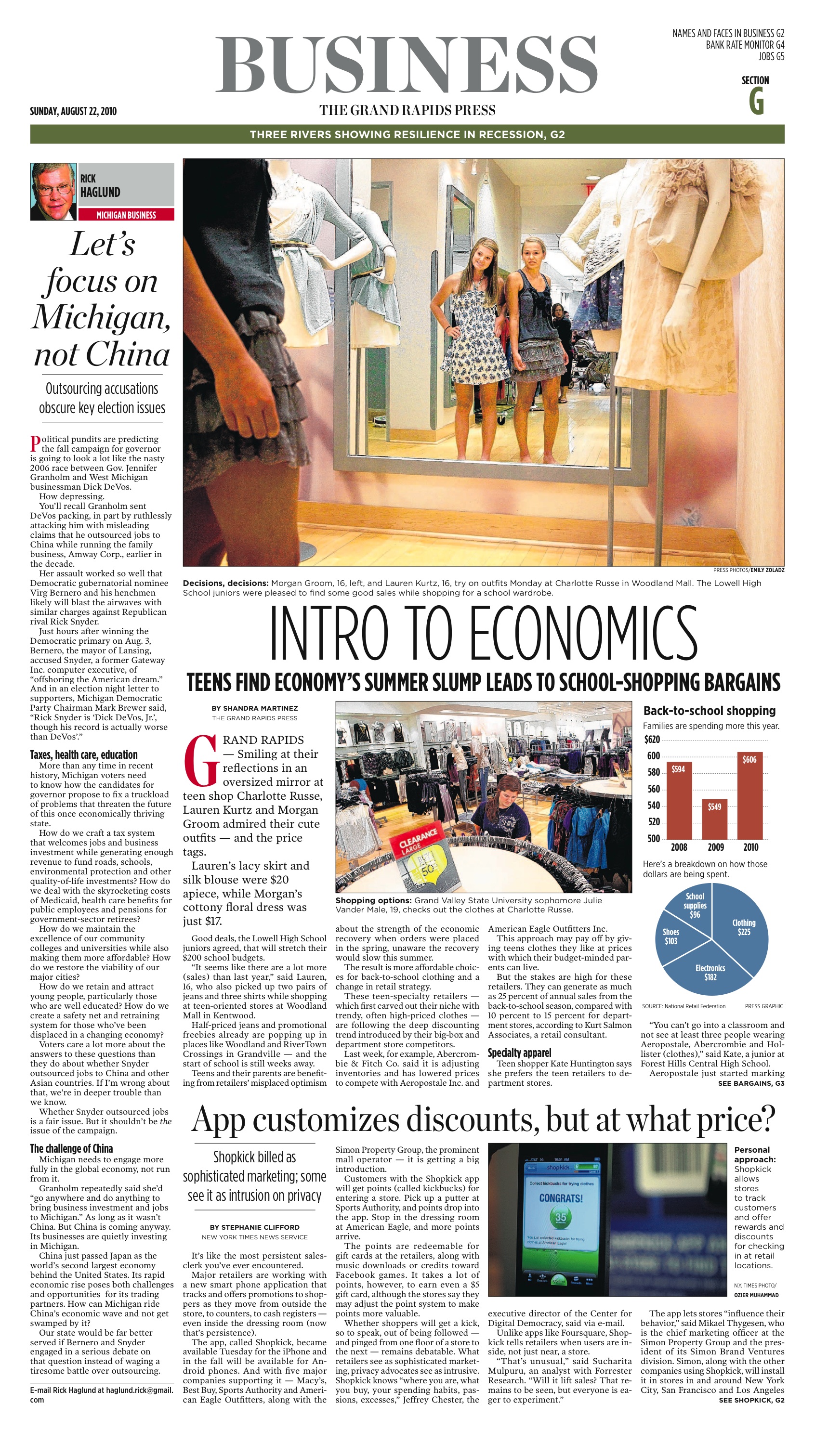
Yesterday, the Grand Rapids Press ran as a feature story in the Business section an article entitled, “Intro to Economics.” The basic premise of the article was that since retailers were too optimistic about teen clothing sales they over ordered in the Spring, so now the prices have drooped, which is supposedly good for consumers.
The article speaks to a few teens and a few parents, some which were happy that they were able to “only” spend $500 on their kids for back to school clothing. Besides the consumer input the article also sourced a retail analyst who doesn’t really add anything to the story.
Much of the story was actually a promotional piece for several national clothing retailers like Abercrombie & Fitch and Aeropostale. The Press reporter even tells readers which area malls have these teen clothing deals and what the prices are for some of the items. This is common practice with the Press as we have noted before and in another recent story on back to school shopping.
The print version of the story is accompanied by 4 pictures, all of shoppers in front of stores or teens trying on clothing. These images add to the basic economic message of the Press story, which tries to frame the article as pro-consumer. However, the pictures and the article seriously omit important economic elements of the clothing industry.
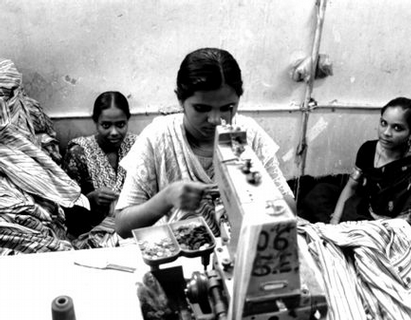
First, there is no mention of where most of the clothing sold in chains stores is made. Knowing that the bulk of clothing that Americans buy is made outside of the country’s borders would be a useful bit of information in communicating the economics of the retail industry.
Second, readers are not made aware of the realities that garment works around the world, many of whom are teenagers themselves. According to the National Labor Committee (NLC), young women in Bangladesh make as little as 11 cents an hour at beginning wages making jeans. The NLC reports that women make an estimated 2 cents for every pair of jeans they sew.
Many of these young women in Bangladesh are now organizing to get a more just wage, a campaign that was recently endorsed by both US and British unions. Adding this kind of information would surely qualify as an Intro to Economics, and would probably resonate with teenagers and their parents who might be interested in more than the price tag.
Anti-War Activist Arrested at the home of Erik Prince
(This is a Media Release is re-posted from the anti-war group CODEPINK.)
CODEPINK cofounder Medea Benjamin and other DC area activists were detained at the home of Blackwater Founder Erik Prince. The group dropped by to deliver a letter urging Prince not to flee the US to extradition-free UAE.
His move, though couched by his PR team as a much needed break from the US would in fact eliminate the possibilities that he could be held accountable for the crimes perpetrated by Blackwater while under his control. Benjamin was invited into the Prince home, she then proceeded to explain to Prince’s wife why she was delivering the letter; Mrs. Prince then pushed Benjamin out the door and told her to “leave the house immediately”.
Police soon arrived, entered the house to speak with the Prince family. While statements were being taken by other eyewitnesses, Benjamin was quickly hand-cuffed and arrested.
In light of the combat troop withdrawal from Iraq this week and the ongoing build up of private security forces by the State Department in Iraq, CODEPINK wanted to deliver the message to Prince that his fleeing to a country that does not have extradition treaty with the US was highly suspect given the violent and illegal history of his former company.
“The combat troops are being withdrawn from Iraq, yet 75,000 contractors remain and Clinton wants to bring in another 6-7,000 more arms-for-hire. The Iraqi people kicked Blackwater out of their country and they are still making a killing off of US taxpayers. The fact that Prince is allowed to cut ties and skip town is criminal,” says Jodie Evans, CODEPINK Cofounder.
Blackwater and Prince have been the subject of ongoing investigations and litigations surrounding illegal and violent tactics used against the Iraqi people. On Jan 30, 2009, The U.S. State Department told Blackwater Worldwide that it will not renew its contract in Iraq, though Secretary of State Clinton has awarded the company (now known as Xe) several lucrative contracts in Afghanistan.
OKT Hosts Free August Garden Tours
OKT 2010 Garden Tours
- Tues. 8/24 SECA Walking Tour
SECA, 1409 Madison SE- Thurs. 8/26 ECA Walking Tour
Barefoot Victory Garden, 1350 Wealthy SE- Sat. 8/28 4th St. Garden Oasis Walking Tour
4th St. at Stocking and Pettibone NW

As part of its Food Diversity Project, Our Kitchen Table hosts its 3rd Annual Garden Tours. All are invited to view food gardens, discuss food issues and connect with gardeners. Each tour concludes with delicious samples of grilled garden foods at the last stop. OKT will also provide water to fill water bottles.
“The purpose of the OKT Food Garden Tours is to illustrate that many folks in our urban neighborhoods are engaged in growing healthy foods and eating healthy foods,” said Lisa Oliver-King of OKT. “OKT seeks to support these folks and make it easier for other urban neighbors to access the know-how and resources needed to eat healthy, whole foods—and growing your own vegetables is one way to do that.”

OKT hosting a gardening seminar at the Barefoot Victory Garden last spring.
Each one- to two-mile walking tour stops at eight to ten diverse gardens. Tours will begin at 5:30 p.m. with a gathering time and set off from 6 – 7:30 p.m. A small communal garden meal of fresh garden foods will take place from 7:30 – 8:30 p.m
Neighbors with food gardens in any of the above neighborhoods are encouraged to join as a tour stop. Tours will be canceled and rescheduled if weather is inclement (rain or heat alert).
During each tour, OKT invites folks partipating to:
· Join OKT’s Food Buying Club. No cost for membership.
· Join OKT’s Free Seed Saving Bank.
· Bring used household batteries and CFL light bulbs for recycling.
· Exchange mercury thermometer for a free digital thermometer
· Sign up and receive free recycle bins
For information, contact Lisa O-K lisask1@aol.com or 616-719-9779
Grand Rapids “Urban Market” Part 3
Last month the Grand Rapids Press ran a short article announcing that the entity behind the proposed downtown “urban market” (Grand Action), has now hired an architect.
The architect, Hugh Boyd, is a New Jersey-based architect who will partner with local architects Design Plus and engineers from Fishbeck, Thompson, Carr & Huber. The article mentioned that the project will be completed in 2012 or 2013 and cost an estimated $27 million.
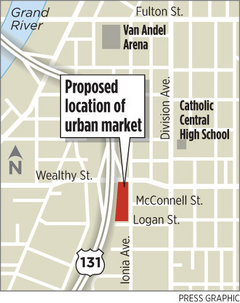
The Press article also mentions that the Downtown Development Authority (DDA) has already agreed to give Grand Action $100,000 towards development plans and it is believed that the DDA will also donate the land where the development project will go along Ionia by the Wealthy St. ramp to US 131.
Since the DDA uses public money, some people have been calling for more transparency with this project. As a result of some public concerns the consultants did interview people who addressed concerns.
GRIID spoke with a few people who were interviewed more recently and they expressed concerns that both the consultant (Ted Spitzer) and the Grand Action representative (John Canepa) were dismissive of the issued they raised. Some of those issues had to do with how accessible the food at this new urban market would be for people of low income, particularly residents in Heartside, the Southeast part of the city and the Grandville Avenue corridor.
Spitzer said that this project is not about local food and will only have an estimated 40 food vendors. Those involved in the project also made it clear that this was primarily about “economic development” and what they called “agro-tourism.” The folks at Grand Action see the “urban market” as a way to bring more suburbanites into downtown Grand Rapids, which is why the project is more about trendy bars and restaurants.
Long-term Development Consequences
One could certainly argue that this $27 million-plus “development” project will greatly alter the make up of the neighborhoods that surround the proposed site. The “urban market” project will no doubt increase the likelihood of further capital investment into the area, which will be a benefit to some and a negative impact on others.
First, there is the issue of parking and increased traffic. Anyone who spends anytime near the intersection of Wealthy & Division or trying to get on or off US 131 at Wealthy knows that this is already a congested area. Adding a project, which is design to bring people from the surrounding communities to the downtown area, will further exacerbate the need for more parking and traffic congestion. For those who live and work in this area that will only add to more frustration, stress and other health issues related to air pollution and traffic congestion.

Second, these kinds of development projects always seem to displace marginalized populations. There is already some concern from Heartside residents and service providers about how this new development and the clientele it will serve will impact those of low income who live in the Heartside area.
In addition, this project and the economic ripple effect it will have will no doubt impact the long-term future of the residential area just east of Division and south of Wealthy. This is a neighborhood that currently has a tremendous amount of recently vacant land with residents of moderate and low-income levels. Will the “urban market” project potentially force people out of the area because of property tax increases, land purchases, potential re-zoning and class pressures.
A good example of how all this can impact low-income and marginal communities from 15 years ago was when the arena was proposed in Grand Rapids (also a Grand Action project.) The land that the arena now sits on used to be a City parking lot and since the parking spaces would be swallowed up by the arena, they needed to find other land to fill those spaces.
At the same time the land where the new YMCA sits and surrounding parking was once a neighborhood of some 80 houses. This was a primarily working class neighborhood with some of the residents receiving government assistance. All these houses were then bought by local real estate developer Jack Buchanan (of the Hangar42 fame) with the intent of rehabbing the houses for more upscale housing and office space.
Buchanan and his associate at the time then decided that the project wouldn’t work and they then offered the City the opportunity to buy the land for a City parking lot. It is difficult to say whether or not this was the intent of Buchanan all along, since there isn’t much in the public record. But what is clear is that at the time that there was still housing there I had the opportunity to interview numerous residents about the plans to bulldoze the neighborhood.
Many residents said that landlords were “purposely allowing properties to decline” and refused to do even basic repairs. For their troubles residents who signed an agreement to leave were given a 20-inch TV in order to pacify people who might otherwise complain. Again, it is not critical to the point I am making in terms of whether or not the displacement of these people was part of the development plan all along, but it clearly is an example of how development projects can have that affect.
Third, there are always consequences of development projects in terms of class conflicts and this project has the potential to add to that conflict. As someone who has lived near the Heartside district for 25 years I can tell you that there are many people I know who are economically struggling who have had to deal with the consequences of development project.
You can bet that with the “urban market” going in that there will be an increase of police presence in the area. People who current live under the Wealthy St, highway ramp will no doubt be removed from that area. Heartside residents who utilize the park space on Ionia will also likely be confronted by law enforcement due to increased consumers coming to the area. Indeed, one of the person interviewed by the project consultant said that the Grand Action folks “there’s going to be surveillance on the premise that the GRPD can monitor.” The person interviewed was also told, “they don’t own it, referring to those who are homeless who hang out in the Heartside Park where they want to do family fun activities.”
Lastly, there is the issue of ongoing transparency and public accountability, especially since there is already public money being used in this project. It is difficult to get information about the full project at this point, but there is information from the August 11 DDA meeting (pages 14-15) regarding who will run the “urban market.”
The plan is to set up a Michigan limited liability company named Grand Rapids Urban Market Holdings, LLC. This non-profit entity will be under the direction of a 9 member Board of Directors, which will serve at least a 3-year term. It is in this memorandum that the DDA states that it will turn over this property for the “urban market,” which underscores another area where public funds may have been involved. Having said that to date there has been limited transparency of this project and it will not likely become more transparent unless the public holds them accountable.

