Interview with Jose Guadalupe Jimenez Jr on his new film to be screened at the Wealthy Theater on January 15
GRIID – You have been involved with Movimiento Cosecha GR during the first Trump Administration. What made you decide to be involved in the immigrant justice movement?
Jose – I am the son of two immigrant parents from Moyahua, Zacatecas, Mexico. I feel a deep sense of pride in being their son, as they moved here to better their lives. It would be dishonorable not to fight for immigrant rights because it could very well be my parents who need that support.
I moved to Grand Rapids in 2017, about a little more than a year into 45’s presidency. I felt that my skills in filmmaking could help people who look like me, talk like me, and have similar experiences to mine.
The biggest catalyst that made me want to take action against injustice was watching the footage of the Standing Rock conflict over the Dakota Access Pipeline. Seeing blatant white supremacy in action, treating Native Americans with such dismissal and disrespect, physically hurt me. One of my biggest regrets is not jumping on a plane to help in some way.
I believe that no one can be illegal on stolen land.
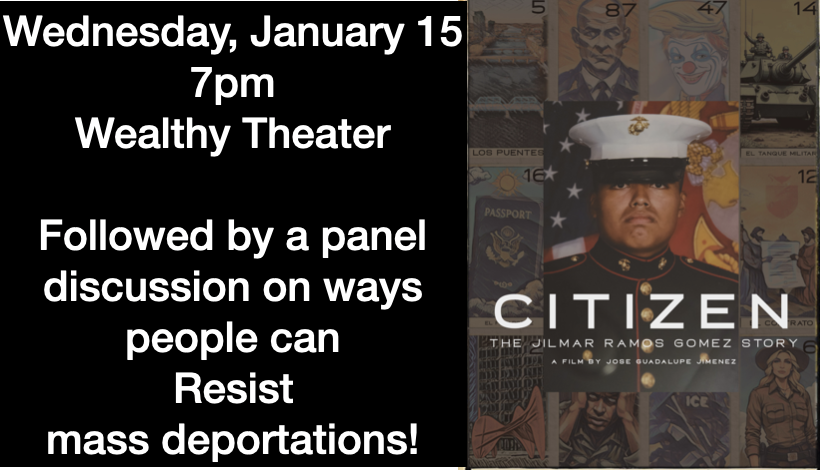
GRIID – You were involved Movimiento Cosecha GR when they began the End the Contract Campaign and when the Jilmar Ramos Gomez was sent to an ICE detention facility. For you, what about Jilmar’s case most impacted you, and why did you decide to make a film about what happened to him?
Jose – I really saw myself in Jilmar’s situation. I’ve been detained at the border multiple times before. I was filming a documentary series following famous Latino Athletes, and one of them was Mexican futbol star who played for the professional team in Tijuana. I would drive from Los Angeles to TJ by myself. For three weekends straight, border patrol sent me to secondary inspection each time. They’d search my car from head to toe, making me feel like a criminal. I thought to myself, “Do they not keep records of who crosses the border?”
Finally, I asked the agent inspecting my car, “Is this always going to happen when I cross the border?” He revealed that there was another Jose Guadalupe Jimenez, and apparently, he had quite the rap sheet. I asked if I looked like the guy, and he said no. Apparently, the other Jose is 4’11” and 150 pounds, while I’m 5’11” and 230 pounds.
A few months later, my wife and I were invited to a wedding in Buffalo, New York. We thought it would be a great opportunity to visit Toronto and see Niagara Falls. We flew to Toronto and rented a car to drive to Buffalo for the wedding. When we arrived at the US border, the agent saw my passport, and bing—a mini version of me popped up on his computer. He immediately ordered me to turn off the car, step out, and told my wife to stay put.
This was a rental car, so I was low-key scared someone might have left something in the trunk. Then, four border patrol agents with assault rifles arrived and escorted me into the building in front of a line of cars. I tried to joke around with the officers, but they were all business. They escorted me to a separate glass door and told me to wait until they could verify my identity.
Thirty minutes in, without any contact with my wife or the officers, I went up to the desk where an agent sat. I explained that this always happens when I cross the border and mentioned what the agent in Tijuana had told me about the other guy’s record. I asked if there was anything I could do to expedite the process. The agent replied, “You should change your name.” At the moment, I didn’t think much of it, but later, I felt angry. Why should I change my name? I love my name; it’s my dad’s name. I bet they let John Smith or Daryl Johnson in without any problems.
I’m not trying to equate what happened to me to what happened to Jilmar Ramos-Gomez, but it did sting. What happened to Jilmar was egregious, horrible, a shame, embarrassing, and insulting. If you google FUBAR, what they did to Jilmar should be a top search result.
It felt like this was exactly what Movimiento Cosecha said would happen. It was the evidence we kept presenting to the county commissioners.
I couldn’t stop thinking about how they treated him despite having his passport in his pocket, his Real ID, and being a veteran. It made me think, “How much more do you want from us?” It really drove home the point that it was never about being legal or “illegal” or having the right documents. It just proved to me that it was always a racial issue.
I felt like I had to tell his story or else no one else would.
GRIID – During a Cosecha community meeting, you said that it would be difficult to impact federal policy, but that people can influence and change things at the local level. Can you say a little bit more about what you mean?
Jose – What I was trying to convey is that sometimes we fall into 47’s mental game and fear tactics, which can make people feel powerless to make a difference. 47 will continue to be a racist today, tomorrow, and forever and I can’t change that. Changing policy on a national level is extremely difficult. However, after witnessing what Cosecha did here in Grand Rapids—showing up to county and city commission meetings month after month—and after what happened to Jilmar, proving what the community has been saying for months, it became easier, and dare I say, necessary for the sheriff to change the department’s policy detainers from ICE. I don’t think we would have seen that change so quickly without the pressure. I feel given the history of local law officials and politicians, I feel they would have tried to make it seem that Jilmar’s near deportation was an extraordinary occurrence. This then gave ICE no choice but to not renew its contract with Kent County. I realized that if every city did what Cosecha did, we could achieve real positive change.
I didn’t mean to ignore 47 completely, but I feel if we focus locally, we can effect change nationally.
GRIID – You are screening your film in January 15th at the Wealthy Theater here in Grand Rapids. After the film there will be a panel discussion about how to deal with the incoming Trump Administration’s threat of mass deportations. Do you see your film as a catalyst to move people to get involved in resisting deportations?
Jose – I hope so. At the very least, I feel the film will wake people up to the fact that the chess pieces for mass deportation are already set. I don’t think it will involve people being put on trains and rounded up like cattle or knocking on doors to see if people are speaking Spanish, as they did in the 1930s with the Mexican Repatriation Act and the 1950s with Operation Wetback. Not saying that isn’t a possibility, but I think the administration will try to really take advantage of local law enforcement to do their dirty work for them. There are plenty racial sheriffs and politicians are itching to deport not only Undocumented folks but anyone that might look or sound like us. We already know that they are going to increase participation in the 287(g) program, which deputizes sheriff’s departments to enforce immigration law. We are going to see detainers continue to racially profile Latinos like they did with Jilmar. It’s up to us to ask our local officials—in our case, the GRPD Chief, the new Mayor, the City Manager, and the city and county Commissioners, and our neighbors—”Are you going to treat us with dignity and respect, or are you going to be complicit and let them deport us?”
GRIID – Are you planning any future public screenings and how can organizations best contact you if they want to show your film in the future?
Jose – Nothing concrete yet. I think it’s really important that people see the film. I am open to screening it around Michigan, and hope organizations reach out to screen the film. I would send an email to at hola@josegjimenez.com if people are interested.
I also plan on submitting to film festivals to increase the reach of the film and make sure other cities across the country know Jilmar’s Story, know the community’s story.
GRIID end of the year in Review: Part III – Monitoring the Grand Rapids Power Structure
In Part I of the GRIID Year in Review, I wrote about the media watchdog work I do and how the local news reported on critical issues in Grand Rapids for 2024. Part II of the GRIID Year in Review focused on monitoring the Far Right in West Michigan. Today, I want to provide an overview of GRIID’s monitoring of the Grand Rapids Power Structure.
I have been writing about the Grand Rapids Power Structure for the past couple of decades. I write about this structure because I believe it is important that we understand what they do and what that means for the rest of us. I also believe that if we are ever to achieve any lasting sense of collective liberation, then the Grand Rapids Power Structure must be dismantled.
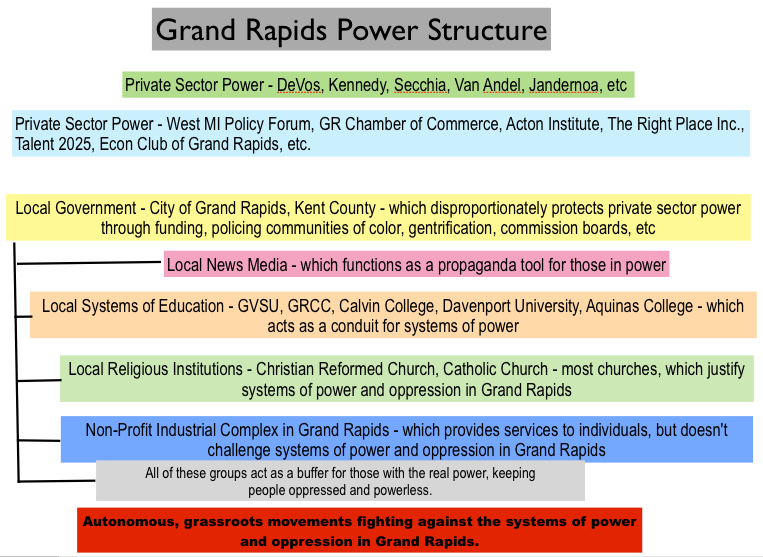
The Grand Rapids Power Structure was extremely active in 2024, which is why I decided to update my 2018 ten part series, since the local power structure is always evolving. You can read the 2024 ten part series by going to this link, which is Part X, but has all of the other 9 parts linked in that article.
The Grand Rapids Power Structure played a significant role in the 2024 Elections, specifically local and state elections. In October, after the quarterly campaign finances were made public, I wrote about whom the Grand Rapids Chamber of Commerce was funding, which candidates took money from the Real Estate industry, the GR Mayoral race, the Grand Rapids City Commission races, how DeVos money dominated Kent County candidates, and how DeVos and other members of the GR Power Structure were buying state races. I also wrote about how members of the Grand Rapids Power Structure spent nearly half a million dollars to pass a ballot initiative to increase the hotel taxes as a way to fund downtown development projects.
Another way that the GR Power Structure leverages their wealth is in development project, where they get the State and local governments to use massive amounts of public money that will ultimately expand the wealth of those in the GR Power Structure. In February, I wrote about how so-called community engagement functions as part of the GR Power Structure’s strategy regarding the soccer stadium. Later in February, I wrote about how the Downtown Development Authority (DDA) was using public taxes to fund the Amphitheater.
In March, I wrote about how the Meijer family expanded their wealth in 2024, from $15 billion to $16.5 billion. Later in March, I wrote about how Grand Action 2.0 was proposing apartment complexes that would be adjacent to the Amphitheater and the soccer stadium, but that the hundreds of millions in public money should be used for such projects.
In April, the City of Grand Rapids decided to prioritize more public money for developers and the GRPD, which I wrote about. In late May, I then wrote about how the Grand Rapids City Commission unanimously voted to give $318 million towards the Grand Action 2.0 apartment complexes for the Amphitheater and the Soccer Stadium.
In August, I wrote about a recently created group called Thrive and Prosper, which is essentially a front group for members of the Grand Rapids Power Structure. As I do every year, I posted numerous articles about the Foundations of several members of the Grand Rapids Power Structure beginning in mid-August, which you can access here.
Beginning in late September, I wrote several posts about a massive development project involving the DeVos and Van Andel families. This massive downtown development project, it was later revealed, had been in the works for several years, but the public only found out about it in September of 2024. This project was also requesting $544 million in tax incentives. In October, the Grand Rapids DDA approved this project and later that month, and the Grand Rapids Brownfield Redevelopment Authority unanimously approved the $544 million subsidy. In November, there was a public hearing on the DeVos/Van Andel development project, where developers and City officials talked down to those who spoke against the project. The City then approved the massive tax incentives for the DeVos/Van Andel project, despite significant public opposition.
A few other noteworthy posts I did on the Grand Rapids Power Structure, were about the DeVos/Van Andel announcement that they would own the professional soccer team that would be playing at the soon to be built stadium, the Kent County Commission decision to approve a 25 year contract with Live Nation for the Amphitheater bookings, and the newly created website that members of the Grand Rapids Power Structure collaborated on to both celebrate and sell the economic benefits to the new downtown development projects.
In Part IV of the GRIID end of the year in Review, I will talk about the social movements and groups that organized against systems of power and oppression in Grand Rapids.
Palestine Solidarity Information, Analysis, Local Actions and Events for the week of January 5th
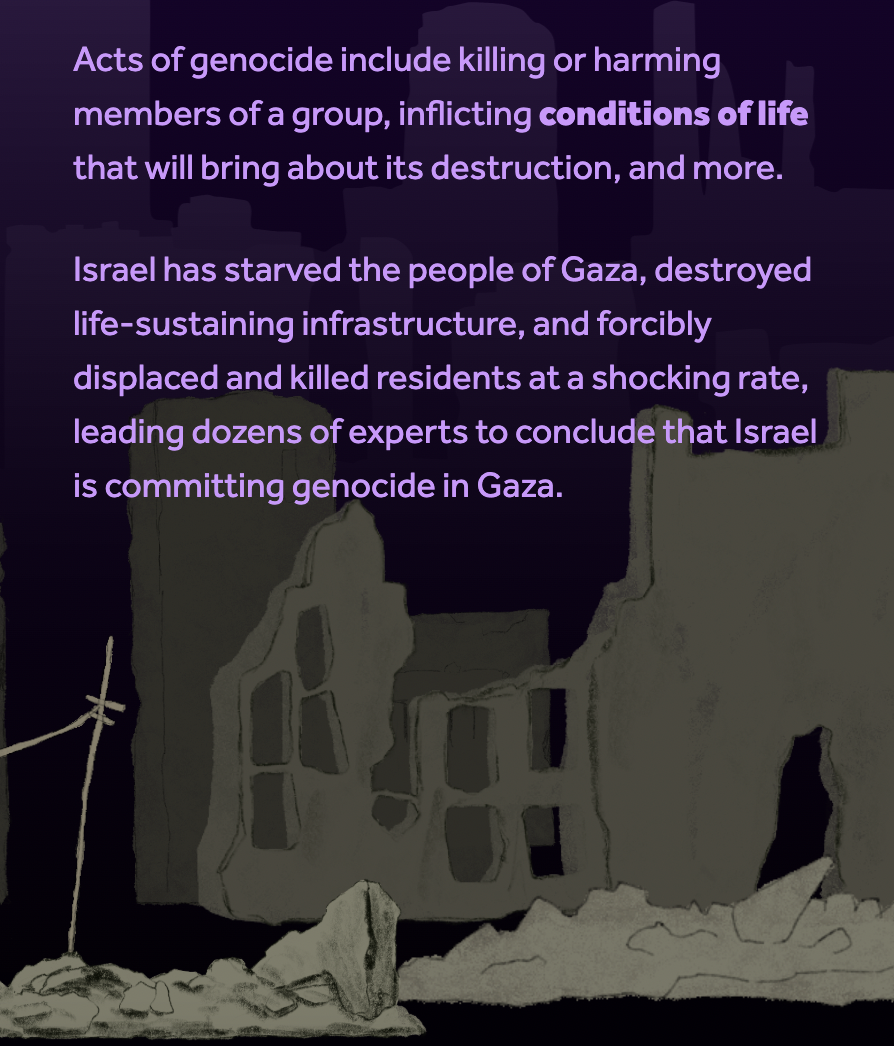
It has been almost 15 months since the Israeli government began their most recent assault on Gaza and the West Bank. The retaliation for the October 7, 2023 Hamas attack in Israel, has escalated to what the international community has called genocide, therefore, GRIID will be providing weekly links to information and analysis that we think can better inform us of what is happening, along with the role that the US government is playing. We will also provide information on local events and actions that people can get involved in. All of this information is to provide people with the capacity of what Noam Chomsky refers to as, intellectual self-defense.
Information
Israel Carried Out 1,400 Strikes in Gaza Last Month — Over 45 a Day on Average
Gaza: Doctors Warn Thousands of Palestinians Could Die This Winter from Cold, Hunger, Disease
UN Report Condemns Israel’s ‘Appalling Destruction’ of Gaza Hospitals
SUITCASES OF QATARI CASH: UNPACKING ISRAEL’S ROLE IN ‘FUNDING HAMAS’
Israeli Strikes on Gaza Kill Over 20—Including Children—on First Day of New Year
Latest Israeli Attack on Gaza ‘Safe Zone’ Kills Several Children
Manufacturing Consent 101: The New York Times and “What [NOT] to Know” About the Genocide in Gaza
Analysis & History
2024 Will Be Remembered as the Year Israel’s Global Legitimacy Fully Unraveled
Image used in this post is from the https://visualizingpalestine.org/.
GRIID end of the year in Review: Part II – Monitoring the Far Right in West Michigan
 In Part I of the GRIID Year in Review, I wrote about the media watchdog work I do and how the local news reported on critical issues in Grand Rapids for 2024. Today, I want to look at my reporting on the Far Right in West Michigan.
I monitor the Far Right in West Michigan because not only do they spread misinformation and promote hate, they also engage in actual harm. The kind of harm the far right practices disproportionately impacts trans people, immigrants, BIPOC communities and people who are subjected to poverty. Monitoring the Far Right in West Michigan can help us to identify the organizations engaged in harm, which can lead to exposure and resistance.
In February of 2024, I wrote a Part I and Part II story about how Kent County candidates were embracing some of the same ideological commitments as the group Ottawa Impact.
In a March 12 post, I looked at how the Acton Institute trashed Aaron Bushnell for his decision to self-immolate as a protest against US complicity in the Israeli genocide against the Palestinians, the GR Chamber’s claim about immigrants and a Doug DeVos podcast interview with former GRPS Superintendent Teresa Weatherall Neal.
In late. March, I wrote another 2 part story about how politicians used anti-immigrant hysteria after an undocumented immigrant killed his girlfriend in Kent County. The hysteria was brought about because a far right anti-immigrant group claimed that Kent County was a sanctuary county.
The Acton Institute was once again the subject of another GRIID article in April, after one of the Acton writers made anti-Black comments and then equated anti-Zionism with anti-semitism. In late April, I also wrote a piece about the far right group in the Forest Hills area known as Forest Hills for JUST Education.
In May, I wrote about the far right pro-cop group, Voice for the Badge, and Acton Institute podcasters calling for students that are protesting against the Israeli genocide should be expelled. Then in late May, I wrote about the GR Chamber of Commerce, the Acton Institute and the Betsy DeVos created group, the Great Lakes Education Project.
On June 18th, GRIID posted an article about a Press Conference held by the far right, anti-trans coalition that was touring with their message of hate. The group Our Bodies, Our Sports held a Press Conference in front of the Ford Museum and included Betsy DeVos as one of the speakers.
After a tremendous amount of social media content about Project 2025, I wrote a piece in July that made it clear that many of the national groups that had signed off on the project have been funded by the DeVos family.
In August, the Acton Institute was once again the target of a GRIID article, especially since they made the claim that no one, even the unhoused, have a right to housing.
In September, Voice for the Badge reposted a meme from the group NumbersUSA. According to SourceWatch, NumbersUSA is an anti-immigrant organization that was tied to the larger anti-immigrant network that was created by now deceased Michigan physician John Tanton.
In October, I discovered that there were several conservative churches that were participating in Faith & Blue weekend. Some local churches actively participated in a national campaign that was created in response to the massive public protests again the George Floyd murder in 2020.
Lastly, in November, I wrote about how the Acton Institute’s revisionist claims about the First Thanksgiving, along with how the GR Chamber of Commerce was lobbying Michigan legislators to adopt bills that would benefit their members and other people in the Capitalist Class.
Some of the Far Right stories that I wrote in 2024, could easily be categorized as being part of the Grand Rapids Power Structure, but there is a great deal of overlap between the far right and the GR Power Structure. Part III in this series will focus on the Grand Rapids Power Structure.
I posted 53 different stories that critiqued the local daily commercial news media in 2024. The four news agencies I monitor regularly are MLive, WOODTV8, WZZM 13 and WXMI 17.
Some of those 53 posts were one-off pieces that looked at things like the Tesla mining project in Michigan’s Upper Peninsula, where the MLive article failed to provide adequate contextual information or explore the ecological and social implications of the mine.
Other one-off examples would be how WXMI 17 reported on the 50th anniversary of when Gerald R. Ford became President, how WZZM 13 failed to address how many people are struggling with the cost of rent in Kent County, how WOODTV8 only talked to the GR Chamber of Commerce on recent court decisions regarding minimum wages, or the example of how MLive failed to question the State of Michigan giving a $100 million tax exemption to the Chevron Corporation.
However, the bulk of the critique that GRIID provided on local news reporting centered primarily on the themes of the 2024 election, the GRPD and how the local news primarily acted as stenographers to the Grand Rapids Power Structure.
Local Election Coverage for 2024
ArtPrize vs Local Election coverage in the Grand Rapids media market
Local News Coverage on the GRPD for 2024
In an upcoming GRIID report, I documented that in the 673 crime related stories in the 4 local daily commercial media outlets, the GRPD were the primary source in 628 of those stories.
Here are some examples of how relying on the GRPD protects the GRPD from greater public scrutiny.
GRPD Chief Winstrom just lied to a reporter from MLive
GRPD Chief Winstrom engages in a little Copaganda and the local news media never questions it
Corporate Crime vs Street Crime: How Grand Rapids news distorts and racializes crime
Local News acts as stenographers to GR Power Structure
The amount of local news coverage regarding how the Grand Rapids Power Structure functions in this city, once again demonstrates how local news primarily acts as stenographers to those with power. There are too many to list here, so let me just highlight some of the more egregious examples.
Power Dynamics, community engagement and the Grand Action Soccer Stadium proposal
MLive’s Amphitheater coverage is a disgusting display of Neo-Liberal Journalism
Billionaire families announce new development project in GR, wants $544 million in public funding
Stenographers to power: When an Amway Press Release is used as “news”
What the DeVos/Van Andel ownership of the soccer team means for Grand Rapids
In Part II of the GRIID Year in Review, I will look at my reporting on the Far Right in West Michigan.
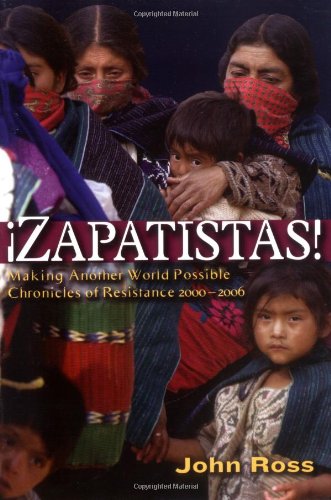
Doing accompaniment work with the Zapatistas in Mexico led me to do accompaniment work in Grand Rapids
It is now 31 years since the Zapatistas revealed themselves to the world in the southern state of Mexico, known as Chiapas.
The Ejercito Zapatista de Liberacion Nacional (EZLN) chose January 1st, 1994, since that was the day that the North American Free Trade Agreement (NAFTA) began in Canada, US and Mexico. The Zapatistas condemned this trade agreement, even going so far as to call it a death sentence for campesinos and indigenous people.

I had been through Chiapas numerous times before the uprising in 1994. After the uprising in Chiapas, I did travel through in 1994 on my way to be an election observer in El Salvador, then again in 1995, where I was doing accompaniment work in Guatemala with several human rights groups, along with documenting election violations in the Quiche region of Guatemala.
Version 1.0.0
The first time I did accompaniment work in Chiapas, specifically in the Zapatista communities, was in 1997, in the community of La Realidad. La Realidad is located in the Lacandon forest area, so it took about 4 hours to get there. I had to catch a ride in a cattle truck at 2am, so as to avoid Mexican government authorities, since traveling to Zapatista communities was prohibited at that time.
I was in La Realidid for for several weeks doing accompaniment work, where we mostly documented the daily activity of the Mexican military, which drove through La Realidad every day in order to intimidate them. Those of us would also monitor helicopter activity by the Mexican military, which used US supplied Huey helicopters. The same day that I left La Realidad, paramilitary forces in Mexico murdered 45 campesinos in Acteal, Chiapas, which was less than 30 miles from La Realidid.
I went to Chiapas a second time to do accompaniment work, but this time a whole group of people from Grand Rapids came. I was working at the Institute for Global Education at the time and was teaching a class on the history of US/Mexican relations. Several members of the class decided to make the trip to Chiapas with me.

This trip, which was in 1998, led us to the Zapatista community of Oventic. Again, we were in this community during the annual New Year’s even celebration, to commemorate the EZLN uprising.
My 3rd, and last time doing accompaniment work in Chiapas, was in late 2000, through the first days of 2021. During that short stint of accompaniment, several communities from the area marched to a Mexican military base and occupied the base until they left. Check out the video clip of this action, along with one of the Comandantes reading a statement during the New Years Eve celebration.
I am forever grateful for the opportunity to learn from the Zapatistas and to be able to leverage my privilege by doing accompaniment work in Chiapas. I continue to practice accompaniment work here in Grand Rapids, whether it is with Indigenous people, Black community organizers or the undocumented immigrant movement known as Movimiento Cosecha GR. La Lucha Sigue!!!!
The two lives of Jimmy Carter: Service to humanity and servitude to US Imperialism
The passing of Jimmy Carter on Sunday has been instructive, both in terms of the public reaction and the narratives that have been crafted to accompany his death.
On one hand we have the Jimmy Carter to supported the work of Habitat for Humanity, not just financially, but by wielding a hammer on numerous occasions. Then there is the Jimmy Cater who started The Carter Center, which promoted conflict resolution, provided election observers and promoted human rights.

There was also the Jimmy Carter who wrote the 2006 book, Palestine: Peace Not Apartheid. Not only did this book name the unjust policy of Israel – Apartheid – it provided a substantive critique of US policy in the Middle East.
This narrative, the Jimmy Carter that embraced humanity and practiced being in service to others should be celebrated and cherished. However, the post-White House Jimmy Carter should in no way be confused with the Jimmy Carter presidency.
As President, Jimmy Carter continued and maintained much of the Cold War policies that his predecessors did, such as:
- Maintaining the US Embargo on Cuba, along with regular efforts to either assassinate Fidel Castro or disrupt Cuban life. See Clara Nieto’s book, Masters of War: Latin America and US Aggression.
- The Carter Administration increased US military aid to Indonesia, which continued its military occupation of East Timor, thus bringing the death toll to an estimated 200,000 by the end of 1979. See Norman Solomon’s book, War Made Easy: How Presidents and Pundits Keep Spinning Us to Death.
- Carter continued supporting the Angolan military dictator Jonas Savimbi, with US weapons and CIA support. See William Blum’s book, Killing Hope: US Military and CIA Interventions since WWII.
- President Carter also supported the brutal Shah of Iran and his death squads forces, known as SAVAK. The Carter Administration then botched an effort to rescue US citizens after the Iranian revolution of 1979, which also involved US troops. See William Blum’s book, Killing Hope: US Military and CIA Interventions since WWII.
- In 1979, there was a revolution in Nicaragua, an uprising begun by the Sandinistas. The uprising brought about the end of the Somoza dictatorship, which the US had supported for decades. The Carter Administration supported the Nicaragua military right through 1979, and laid the ground work for the former Nicaragua soldiers, which eventually became the terrorist group known as the Contras. See Nathan Robinson’s book, The Myth of American Idealism: How US Foreign Policy Endangers the World.
- After the Soviet invasion and occupation of Afghanistan in 1979, the Carter Administration, under the leadership of his national security advisor, Zbigniew Brzezinski, gave military aid to the Afghani opposition forces to, in the words of Brzezinski – The day that the Soviets officially crossed the border, I wrote to President Carter. “We now have the opportunity of giving the USSR its Vietnam War. Indeed, for almost 10 years, Moscow had to carry on a war unsupportable by the government, a conflict that brought about the demoralization and finally the breakup of the Soviet Empire. Brzezinski failed to mention that the Afghani’s they were providing over $1 billion in military aid were the Mujahideen, Islamic fundamentalists that included Osama bin Laden, then later morphed into the Taliban.
- In the last few years of the Carter Administration, he continued providing military aid, training and weapons to the Guatemalan military dictatorship and the Salvadoran military dictatorship. In February of 1980, Salvadoran Archbishop Oscar Romero sent Carter a letter demanding that the US government stop sending weapons to El Salvador, but they would welcome humanitarian aid. In Noam Chomsky and Ed Herman’s book, Manufacturing Consent: The Political Economy of the Mass Media, the co-authors write: “The Carter Administration had been so disturbed by Romero’s opposition to its policies that it had secretly lobbied the pope to curb the archbishop.” Romero was assassinated one month later while saying mass in San Salvador. The assassins were trained at the US Army School of the Americans, located at Fort Benning in Georgia.
- The Carter Administration maintained massive US military aid to Israel, despite the ongoing Israeli occupation and apartheid policies against the Palestinians.
- The Carter Administration also defended and financed the hundreds of US military bases around the world, along with a massive annual US military budget. President Carter also maintain nuclear weapons superiority during his presidency, even introducing a new group of nuclear weapons.
A great deal more could be said about how President Carter perpetuated US Imperialism abroad, which always translated into lack of funds for adequate housing, health care, education and other basic necessities that all people living in the US should benefit from.
For more critical analysis of Jimmy Carter’s presidency, see the following articles:
https://jacobin.com/series/jimmy-carter-obituary
https://www.counterpunch.org/2024/12/30/jimmy-carter-the-false-savoir/
https://znetwork.org/znetarticle/jimmy-carter-worsened-the-american-malaise-he-decried/
On Friday, MLive posted an article with the headline, Grand Rapids’ first female mayor leaves after 9 years marked by ‘remarkable’ growth.
The article primarily celebrates the outgoing mayor, whom the journalist credits with bringing tremendous growth to Grand Rapids. In addition to celebrating Mayor Bliss, the MLive article only cites three sources, City Manager Mark Washington, Josh Lunger from the Grand Rapids Chamber of Commerce, and Kent County Commissioner Robert Womack. Not surprising, each of these sources praised Bliss, which means there is no critical assessment of what has happened during the two term tenure of the outgoing Mayor.
There was some reflection in the MLive piece, which stated:
Bliss’ tenure as head of the city hasn’t been without its challenges. In 2020, Grand Rapids made national headlines due to social justice riots that destroyed businesses downtown. Police relations hit an all-time low in 2022 after the killing of a Black man by a Grand Rapids cop. Meanwhile, the city continues to struggle with homelessness and housing affordability.
Despite these issues, there is no investigation nor sources that could have challenged the narrative that the City of Grand Rapids has seen “remarkable’ growth.” Don’t get me wrong, I agree that there has been a great deal of growth in Grand Rapids, especially growth that has been beneficial to the business class. What the MLive writer fails to question is……for whom has the City’s growth been remarkable for?
In July, GRIID posted an article talking about the economy and how many people are living paycheck to paycheck. I cited data from ALICE, which stands for Asset Limited, Income Constrained, Employed. According to an ALICE report for 2023, 41% of Michigan households live paycheck to paycheck, but that number goes up to 47% for Grand Rapids households. This means that nearly half of the households in Grand Rapids are living paycheck to paycheck! This doesn’t sound like remarkable growth to me.
Since MLive, and the local news in general, won’t provide the public with a more honest assessment of Mayor’ legacy, I will provide some concrete examples of how Mayor Bliss has failed to embrace justice, has supported repression, and enabled remarkable growth of the wealth gap in Grand Rapids.
- In early February of 2016, some members of the group Healing Children of Conflict met with Mayor Bliss to see if she would endorse a City effort to divest from companies profiting from the Israeli occupation and Israeli Apartheid. The campaign began in October of 2015. Mayor Bliss refused to support such an effort.
- In March of 2016, GVSU students, who were supporting the bus union campaign for a new contract, were being targeted by the GRPD and Mayor Bliss supported this.
- In late March of 2016, the United Farm Workers sent a letter to Mayor Bliss condemning her participation in the annual Cesar Chavez march, but not supporting bus union workers and allowing the cops to harass GVSU students.
- In April of 2017, GRPD officers pulled guns on several Black youth because they “fit a description.”
- On May 1st, 2017, Movimiento Cosecha held a march on May Day, with clear demands from political leaders. Mayor Bliss did not participate but the GRPD showed up to threaten and harass the 2,000 who marched.
- In May of 2017, 100 Black men came to a Grand Rapids City Commission meeting calling for a state of emergency regarding systemic racism in Grand Rapids. No action was taken by the City.
- In October of 2017, Movimiento Cosecha took part in a solidarity action with the bus driver’s union to demand a new and fair contract during a City Commission meeting. They were ignored by Bliss and the City Commissioners.
- In December of 2017, an 11 year old Black girl was handcuffed and detained by the GRPD.
- In May of 2018, Movimiento Cosecha once again had a large march from Roosevelt Park to downtown Grand Rapids. Again, Mayor Bliss did not participate and the GRPD had a massive show of force that again tried to dictate the direction of the march route.
- In late 2018, a GRPD cop who was off duty, saw a story on TV about a man – Jilmar Romos Gomez, who was suffering PTSD and started a fire at Spectrum Health. The GRPD cop called ICE and said that this man was an undocumented immigrant, when he fact he was a former Marine. Under Mayor Bliss’s leadership Captain VanderKooi was never held accountable for this incident over a two year period.
- In February of 2019, immigrant justice activists disrupted the Grand Rapids City Commission meeting, because Mayor Bliss would not allow the same amount of time to community members that the Chief of Police was given to defend Captain VanderKooi.
- In March of 2019, a coalition of groups held a press conference with a list of demands around the GRPD and the lack of accountability regarding their actions against Black and Latinx communities.
- May 2019 march by Cosecha, was once again not attended by Mayor Bliss, plus the GRPD were now threatening people if they marched in the streets.
- GRIID obtained FOIA documents regarding the GRPD’s monitoring, spying, harassment and intimidation leading up to the 2019 May Day march.
- In May of 2020, Grand Rapids also had a George Floyd protest that erupted with thousands of people in the streets and the response from the GRPD was repressive. Mayor Bliss called for a State of Emergency, brought in the Michigan National Guard and instituted a curfew for downtown Grand Rapids. There was an effort to Defund the GRPD in late June/early July, which the Mayor derailed and numerous other repressive tactics used by the GRPD to target activists. You can check out our visual timeline of all this.
- In July of 2020, Defund the GRPD protested in front of the home of Mayor Bliss. (Pictured here below) She was not there, as she primarilY stays with her partner in Caledonia, which was verified by several of her neighbors who came out to talk with those protesting.
- In November of 2020, the community organized a campaign to defeat the GRPD from obtaining Shot Spotter technology. Mayor Bliss voted for it.
- In late December of 2020, Mayor Bliss gave the GRPD the green light to evict unhoused people who set up an encampment at Heartside Park.
- In April of 2021, the City of Grand Rapids sent out a Press Release saying that anyone protesting the outcome of the Derek Chauvin trial would be arrested.
- In May, the group Defund the GRPD was organizing to pressure the City of Grand Rapids to not only reduce funding for the GRPD, but to allow more public input on how public money would be used in the City Budget for 2022. In early May, the City held a one hour virtual town hall meeting on the 2022 Budget, which was an insult to those who have been organizing around how public money would be used. Defund the GRPD had posted their own demands on what they wanted to see happen with the funds, as well as the process for determining the 2022 City Budget. Defund the GRPD also organized people to call in during the City Commission meeting later in May, right before they voted on the 2022 Budget.
- Throughout much of 2021, the group Justice for Black Lives were targeted for demanding Police accountability in Grand Rapids.
- In November, at a protest following a not guilty verdict for Kyle Rittenhouse, several JFBL activists were arrested again, after the protest had finished. Once again, JFBL held a press conference to respond to the arrests and to counter the claims made by the GRPD.
- On April 4, 2022, the GRPD shot and killed Patrick Lyoya in the back of the head, execution style. Mayor Bliss has done nothing to further justice for the family of Patrick Lyoya, but has repeatedly allowed the GRPD to target activists who are demanding justice.
- In late December 2022, the Chamber of Commerce wanted to impose ordinances that would essentially criminalize the unhoused. During the last Grand Rapids City Commission meeting for 2022, Mayo Bliss and the other commissioners refused to denounce the Chamber’s proposal.
- Throughout 2023, Mayor Bliss fully supported the GRPD’s desire to purchase and use drones, plus she fully endorsed the Grand Rapids ordinances that has criminalized the unhoused in this city.
- After the brutal Israeli assault in Gaza, GR residents tried to get the City of Grand Rapids to pass a resolution demanding a ceasefire in Gaza and to call on members of Congress from Michigan to not use federal tax money that does to Israel but to use those funds to benefit our community. Mayor Bliss and the other commissioners said calling for a resolution is not what they do.
- Since last year, the GRPD has targeting more dissident groups and calling un-permitted marches illegal. When the Comrades Collective joined Palestine Solidarity Grand Rapids for a march that began at MLK Park, then went to Rep. Scholten’s home, the GRPD showed up in big numbers and ticketed the safety car driver. Safety cars have been used in recent years during marches as a means of protecting those marching from motorists that want to ram into people who are in the streets, just like what happened in Charlottesville in 2017.
- In April of 2024, during a march for Patrick Lyoya, which took places 2 days after the second anniversary of his murder on April 6th, the GRPD arrested the safety car person and then impounded their car. Patrick Lyoya’s parents were present during the march and were shocked at how people were treated by the GRPD.
- A few weeks after the GRPD shut down a non-violent march on the 2nd anniversary of Patrick Lyoya’s death, two BIPOC activists then received calls from the GRPD to turn themselves in, since one was being charged with a misdemeanor and the other a misdemeanor and a felony.
- During the Primary Election of 2024, Mayor Bliss was part of the group that was pushing for the Hotel Tax increase in Kent County, which would direct more money to projects like the Amphitheater and Soccer Stadium. Bliss helped to raise nearly half a million dollars for the Destination Kent Committee, the group that was behind the Hotel Tax increase ballot initiative.
- Over the past few years, Mayor Bliss has also voted for the use of over $1 billion of public money to finance development projects that will expand the wealth of those who are already filthy rich. Here are four projects Mayor Bliss has signed off on: At least $100 million in public money for the Amphitheater; $318 Million for the 2 apartment buildings that will be next to the Amphitheater and the Soccer Stadium; $100 million for Soccer Stadium; and $565 million in tax incentives/subsidies for the DeVos/Van Andel 3 towers project on Fulton and Market.
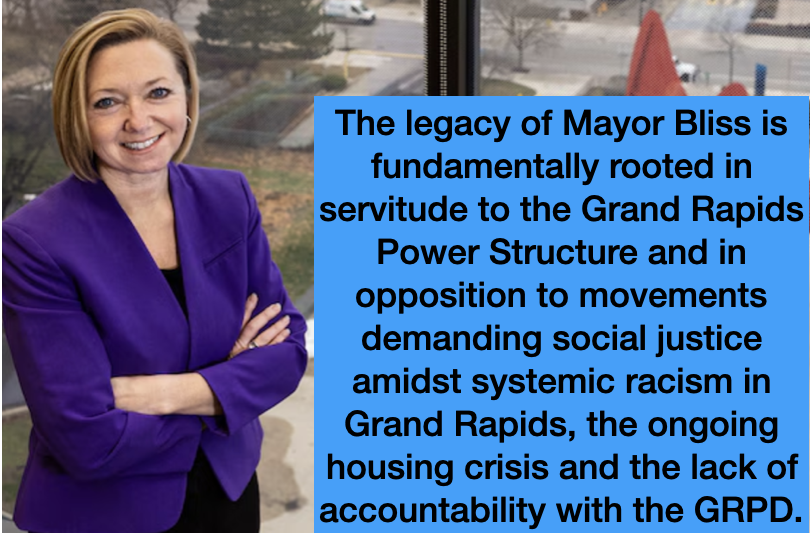
This is just a partial list of the ways in which Mayor Bliss has opposed efforts to promote justice, especially efforts that were led by BIPOC organizers. The legacy of Mayor Bliss is fundamentally rooted in servitude to the Grand Rapids Power Structure and in opposition to movements demanding social justice amidst systemic racism in Grand Rapids, the ongoing housing crisis and the lack of accountability with the GRPD.
Palestine Solidarity Information, Analysis, Local Actions and Events for the week of December 29th
It has been more than 14 months since the Israeli government began their most recent assault on Gaza and the West Bank. The retaliation for the October 7 Hamas attack in Israel, has escalated to what the international community has called genocide, therefore, GRIID will be providing weekly links to information and analysis that we think can better inform us of what is happening, along with the role that the US government is playing. We will also provide information on local events and actions that people can get involved in. All of this information is to provide people with the capacity of what Noam Chomsky refers to as, intellectual self-defense.

Information
The World Owes Palestine This Much – Please Stop Censoring Palestinian Voices
Three Declarations of Genocide and the U.S. Responses
Palestinians Endure Another Christmas of Genocide and Displacement
As Palestinians Starve and Freeze, Israeli Troops Unwind at Gaza ‘Beachfront Resort’
Israeli Raid Puts Last Hospital in Besieged Northern Gaza Out of Service
Analysis & History
How research at MIT abets Israel’s genocide in Gaza
A Palestinian year in review: Genocide, resistance and unanswered questions
The BDS Movement calls for a Boycott Chevron weekend of Action January 31-February 2
Images used in this post is from the Boycott Chevron Campaign. https://drive.google.com/drive/folders/1SkZIN6DcU-GTLw03aQrfJpe01CWgHIMY?usp=drive_link
On December 19th, Bridge Michigan posted an article with the headline, Michigan House kills hundreds of bills.
The article provided a pretty good summary of all of the proposed bills that never got voted on, in part because state lawmakers either didn’t show up to vote on them or because of partisan bickering.

Screenshot
However, the list of bills that Bridge Michigan cited were primarily mild reformist bills that only tweaked issues that need a more robust response to unjust and oppressive realities. For example, one bill that did pass in the Lame Duck period was legislation that would protect Michigan consumers from price gouging during emergencies. Sure, this is a good thing, but it doesn’t address larger issues of corporate regulation or the fact that most Michiganders don’t make a Living Wage.
What didn’t happen with a Democratic Party trifecta in Michigan
In the 2022 elections, Michigan Democrats won a majority in both the State House and State Senate. Since the Democrats already had control of the Governor’s office, this gave them what is often referred to as a trifecta in party politics.
There was a great deal of excitement when the Democratic trifecta happened two years ago, and along with that excitement came many promises and expectations about what would happen. I wrote a three part piece in November of 2022, entitled, What Kind of Change Do We really want to see in Michigan: Part I, Part II and Part III.
In each of those articles I addressed more structural changes that were needed, changes that could transform lives and get us closer to the kind of world – or at least state – we wanted to live in. What follows is a summary of those three articles and how the Democratic trifecta failed us in so many ways.
Driver’s Licenses for undocumented immigrants – So many Democratic Party lawmakers, including Gov. Whitmer, had promised the immigrant community that they would pass the Drive SAFE bills, which would once again allow undocumented immigrants the ability to obtain a driver’s license. Not only would driver’s licenses improving the quality of life for undocumented immigrants, it would reduce the possibility of ICE detaining or deporting family members. Movimiento Cosecha has been working on this issue for the past 7 years and in the end, the Democrats failed them by not even having a quorum last week to vote on the bills.
Increasing the minimum wage to a Living Wage – The minimum wage in Michigan is a joke, at $10.33 an hour. According to the National Low Income Housing Coalition, people in Michigan need to make roughly $25 an hour in order to afford the average cost of rent in the state. However, $25 an hour doesn’t cover other expenses like food, transportation, health care, etc. Sure, it was nice to see the Dems repeal the Right to Work law in early 2023, but that should only have been the first step in the fight to improve the economic conditions of working class families and individuals.

Housing Justice – There is a housing crisis all over the US and in Michigan. The cost of housing is out of reach for more than half the population and the cost of rent is ridiculously too high. The Democratic Party did not deliver on most of the bills that the Rent is Too Damn High coalition presented over the past 15 months. Plus the issue of banning the current Michigan law, which doesn’t allow for rent control was never even really considered.
Environmental Justice – Gov. Whitmer made it a promise when she took office in 2018 to shut down the Enbridge oil pipeline, known as Line 5. With the Democrats in control of the State Legislature, they could have made that a priority, but didn’t. In fact, Enbridge is still moving forward with plans to build a tunnel under Lake Michigan for Line 5. In addition, there are new mining projects in the UP, projects that would not only contaminate the water and the soil, these projects are in violation of Indigenous Rights and Indigenous sovereignty.
Transportation Justice – Michigan Democrats decided to take the easy way out and push for electric cars, when they could have given the the billions of taxpayer subsidies that went to EV production and the auto industry, and instead us that money to develop mass transit systems. Electric cars are an improvement over fossil fuel cars, but they don’t address other longterm and structural issues, like parking, traffic congestion and land use.
The Prison Industrial Complex – Policing and mass incarceration have been issues that are front and center, especially for BIPOC communities in recent years. Michigan’s Democrats have not fundamentally altered funding for police departments, in fact they have increased funding. In addition, the Prison Industrial Complex – policing, the courts and the jail/prison infrastructure – has not been addressed, despite the fact that violent crime has been on the decline for several years.
Education Justice – Funding for public education is still deeply inadequate in Michigan. Parents, students and education advocates across the state are left angry and dismayed as Michigan legislators fast-tracked tax breaks for corporations rather than prioritize our families and schools. Critical bills, including teaching accurate and inclusive history, continuing to aid debt relief in Detroit, updating outdated sex education, paid family leave, a supplemental for Bridgeman schools, and closing tax loopholes among many other important issues for Michigan families were derailed by the Governor, Speaker Tate, Senate Leader Brinks and Representative Karen Whitsett.
While these are only some of the issues that the Democratic Party failed us on, we need to think hard about how we can create mass movements that will get us what we want and want we need. We also need to address the fact that when Democrats have a majority in local, state and federal government systems, it doesn’t translate into structural changes that are necessary to improve the lives of communities across Michigan. Another World is indeed possible, but only if we don’t rely on political parties. We have to create the world we want from the ground up.

 Grand Rapids Institute for Information Democracy