Hip-Hop and Forbes: Parallels of Image and Inequality
(This commentary by Jared A. Ball is re-posted from Black Agenda Report)
 “The Blackness on top only masks the deepening levels of Blackness at the bottom.”
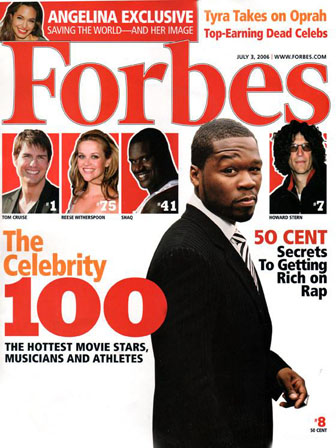
The newly released Forbes list of Top 25 money earners in music and the newly released report from the National Urban League of Black inequality in the United States should be paired and used by even the most ardent lovers of hip-hop as proof of one very powerful lesson: The Blackness on top only masks the deepening levels of Blackness at the bottom. Hip-hop, the broader entertainment industry, and the presidency of Barack Obama all, as much as anything else in this country, splendidly demonstrate the point: Heavily promoted Blackness masks Black suffering while enriching a mostly White, male elite.
The Forbes list shows the problem in microcosm. The success of a few rappers hasn’t helped the rest of the hip-hop community any more than the election of the first Black president has helped Black people. And in neither case do the rewards of a select few compare to that which they create for their respective betters. In fact, in each case the respective betters are all mostly housed on Wall Street where each do better than their more highly promoted and meticulously selected blacker representatives. So, for instance, and according to Forbes, the highest earning rap group, the Black Eyed Peas, earned roughly $61 million over the last 12 months. But this is not even half what the top earning band made over that same last year; U2 pulled in about $195 million. And neither amount amounts to much compared to the revenues generated by the owner of the label that owns both of these groups. Vivendi, the parent company of Universal Music Group, was well over $40 billion in 2010.
As it is below, so it is above. In the macrocosm, according to a recent National Urban League study, the standard of living gap between White and Black Americans has actually worsened during the time of the Blackest face in the highest place, the Obama presidency. So just as the highest earning Black musicians bring in less than has about half of their richest counterparts, Black America’s standard of living is only about 70% that of Whites and dropping. And even when the highest earning rap group is often referred to as “multi-racial” and “multi-ethnic,” and even though it’s fronted by a White woman they still can’t close these divides! Even when the president is Black and fronted by White corporations Black inequality persists, and gets worse!

And for real? As big as hip-hop is globally none of the other 5 Black faces on that Forbes list are strictly hip-hop. Jay-Z and P. Diddy make more of their money through other ventures, Beyonce, Usher and Rihanna are pop singing, sometime actors. Hip-hop isn’t even on the list. It’s as broke as the communities that produced it. But just as it would take the accumulated sum of all those other 5 Black faces on that Forbes list to reach the top White group, the Urban League report shows that the accumulated sum of a Black president leaves Black people still having less than half the access to health care as Whites but still twice the unemployment. And all those top Black musicians still leaves the bulk in hip-hop needing equal pay and health care themselves, just ask the Grassroots Artist Movement (G.A.ME) who have been trying to organize around that for years.
But the real point is that in the end, as Jim Hightower pointed out recently, the biggest thieves walk off with it all with no questions asked, like the hedge fund manager who made $2.4 million an hour last year, or all those major corporations who pay no taxes while we are forced to watch schools close and teachers blamed. It is always a good exercise to compare popularly touted individual success stories with the conditions of the communities they’ve escaped.
We are constantly told that the reason Michigan is in such a dire financial state is because we don’t have a “business-friendly” environment.
This has been the mantra of the last four Governors of Michigan and it was reflected in the policy decisions to further deregulate the state culminating in the elimination of the Michigan Business Tax this year under Governor Rick Snyder.
The claim by Snyder, individual business owners, the Chamber of Commerce and groups like the West Michigan Policy Forum is that limited or no business tax will attract new companies thus creating new jobs that will have a trickle down effect in generating local and state revenues.
Not only has this notion been factually dismissed by authors such as Greg LaRoy in his well documented book The Great American Job Scam: Corporate Tax Dodging and the Myth of Job Creation, the very idea that eliminating business taxes will make it impossible for states to be fiscally responsible. A new report by the Boston-based group United for a Fair Economy can help shed some light on this reality.

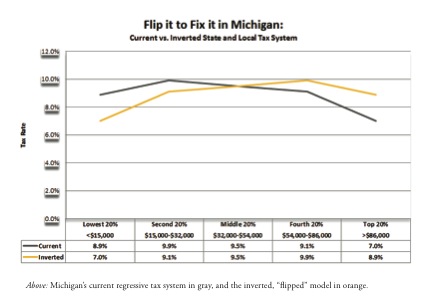
According to the report Flip It to Fix It: An Immediate, Fair Solution to State Budget Shortfalls, “At the core of the budget crisis facing states are regressive state tax structures (comprised of the major state and local taxes) that are unfair, unsound, and unsustainable by design.”
The researchers at United for Fair Economy state that of the current state tax structure was inverted, which would mean that business pay more of the share of taxes that states could eliminate their deficit. The report goes on to state, “The inversion exercise takes a state’s current distribution of state and local taxes by income quintile (lowest 20 percent, second 20 percent, middle 20 percent, fourth 20 percent, top 20 percent) and flips it at the 50th percentile mark, thereby making a regressive structure progressive.
This resulting progressive tax structure has major benefits to states.
- It raises significant revenue. If every state inverted its tax structure, states would raise a combined $490 billion, wiping out deficits with cash to spare to invest in economy-enhancing activities.
- It is unmatched in its economic efficiency, which encourages steady and strong economic activity and widespread prosperity over time.
- It provides commonsense equity, with wealthy families contributing a greater share of their income in taxes than low- and middle-income families.
The report also provides a state by state breakdown of the current and inverted tax structure to show how states could eliminate their budget deficits – as is reflected in this graph.
Inverting the current tax structure is not being proposed by even most progressive organizations and since the current administration and legislative body seems bent on turning more of the public sector over to the private sector that such a policy will not even be considered in the near future.
Advertisers to blame for childhood obesity in US according to American Academy of Pediatrics
According to a new statement by the American Academy of Pediatrics (AAP) the amount of time kids spend watching media and the targeted junk food ads as contributed significantly to childhood obesity in the US.

MLive posted a story today announcing the new statement by the AAP, which provides a pretty good summary of the findings and ends with a list of actions steps the association is calling for:
• A ban on junk-food advertising during TV shows geared for children.
• A ban on interactive ads and games for children and teens through cell phones, digital TV and other media.
• Federal funding for research into the effects of media use on children.
• More ads and video games promoting healthy food choices.
The action suggestions are a welcomed contribution to the fight against childhood obesity and they are important for a greater understanding on what role media has in the lives of children.
It would have been useful if the MLive writer had talked to the local TV stations to get a response to this new study from the AAP, especially since they all air lots of ads for unhealthy junk foods during children’s TV programs. We contacted channel’s 8, 13 and 17 on this issue, but have not received a response from any of the stations.
In addition, the MLive story does not provide other resources available for parents, teachers and community members concerned about this issue. There is an excellent study on how food and beverage marketers target children from the Center for Digital Democracy and a great toolkit for advocates from the Berkley Media Studies Group. For educators there are great resources to teach media literacy about junk food ads, particularly the lessons plans you can access from the Media Awareness Network.
Lastly, it would have been useful for those with MLive to talk with area pediatrics in West Michigan in order to put a local spin on the issue or the group Stop Targeting Our Kids (STOK) who have been confronting issues around media and children for the past 2 years.
Texas Gov. Rick Perry’s National Day of Divisiveness
(This article is re-posted from PRWatch.)
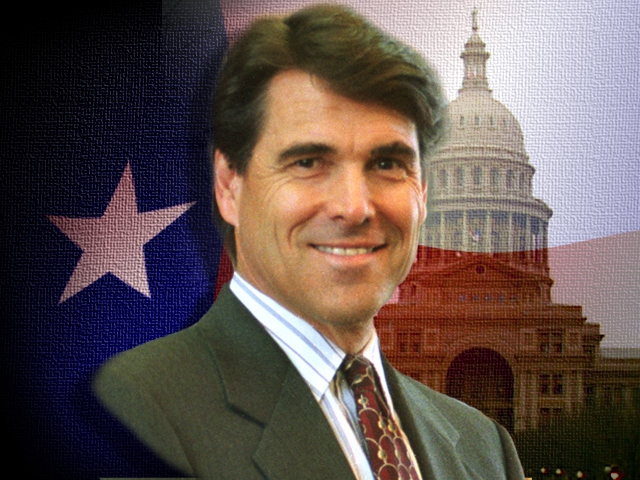
Texas Governor Rick Perry plans to host a “National Day of Prayer and Fasting” on Saturday, August 6 at Reliant Stadium in Houston, Texas, in an event is billed as a “non-denominational, apolitical Christian prayer meeting.” Despite the “apolitical” label, the event has some political undertones, particularly since Perry has been flirting with a run for the Republican presidential nomination and currently serves as chair of the Republican Governors Association. Perry has invited the other 49 U.S. state governors to the event. The portrayal of the event as a “nondenominational” ceremony is a misnomer, too, since the event will be exclusively Christian, and no other belief systems will be represented.
Controversial Host
Controversy surrounding Perry’s Day of Prayer is growing quickly. The event is hosted and funded — including the rental of Houston’s huge stadium — by the Tupelo, Mississippi-based American Family Association (AFA), which the Southern Poverty Law Center (SPLC) labels as an anti-gay hate group. A June 11 editorial in the Houston Chronicle opposing Perry’s Day of Prayer said “There could hardly be a more divisive, unforgiving group than the American Family Association,” to host the event.

The AFA makes no attempt to hide its disdain towards gays and other members of society it considers inferior. In 2010, Bryan Fischer, AFA’s Director of Issue Analysis for Government and Public Policy, said, “Homosexuality gave us Adolph Hitler, and homosexuals in the military gave us the Brown Shirts, the Nazi war machine and six million dead Jews.” Fischer has also openly attacked native Americans. In a February, 2011 blog post (pdf), Fischer wrote that native Americans are morally and culturally inferior because of their refusal to accept Christianity. He wrote, “In all the discussions about the European settlement of the New World, one feature has been conspicuously absent: the role that the superstition, savagery and sexual immorality of native Americans played in making them morally disqualified from sovereign control of American soil.” Moreover, Fischer blamed high rates of poverty and alcoholism among native Americans on their refusal to accept Christianity, writing, ” …Many of the tribal reservations today remain mired in poverty and alcoholism because many native Americans continue to cling to the darkness of indigenous superstition instead of coming into the light of Christianity and assimilating into Christian culture.”
AFA’s president, Tim Wildmon, dismisses SPLC’s labeling of AFA as a hate group, saying AFA’s stand on homosexuality represents the beliefs of “a lot of people who have traditional values.” He adds that the purpose of the Day of Prayer is to pray for an end to the “debasement of our culture.” Translation: to pray for an end to America’s increasing acceptance of homosexuality.
Questionable Endorsers
The Rev. John Hagee, pastor of the Cornerstone Church in San Antonio, Texas, is listed as an event endorser. He is the guy who said in a 2006 interview that Hurricane Katrina was God’s retribution against New Orelans for planning a gay pride parade. Like Harold Camping, the elderly radio pastor who gained fame in May, 2011 through his absurd failed global apocalypse PR campaign, Hagee preaches about the Rapture and the second coming of Jesus Christ. Hagee predicted on television that the world will end within 20 years. Hagee openly endorsed John McCain for the Republican presidential nomination in 2008. Another event endorser, David Barton, is a religious activist in Texas, and also a political consultant to the RNC, who says the United States is a “Christian nation” and calls the separation of church and state “a myth.”
In appearances across the U.S., Barton has assured pastors that they are permitted to use their pulpit to endorse political candidates, even though doing so violates IRS rules. Perry’s Day of Prayer is causing concern among progressive Houston-area clergy, so much so that they wrote a letter criticizing the event for breaching the wall of separation between church and state, for excluding non-Christians, and for the event’s partnership with AFA. In their letter, Houston Clergy Council members wrote, “We ask that Rick Perry leave the ministry to us and refocus his energy on the work of governing our state.” They point out that Perry’s event is inappropriate, particularly given the religious diversity of the Houston area.
The “Day of Prayer” event is drawing considerable national attention to Perry, coincidentally just as he considers a run for the Republican presidential nomination. Despite this, and the obvious ties between some event backers and the Republican party, Perry denies that the event is politically motivated. Whatever Rick Perry says, though, if he does declare he is running for president, he can credit this controversial event with boosting his name recognition throughout the country.
The Holland City Council Vote and Talent Retention
Last week’s Holland City Council no vote on an anti-discrimination ordinance has continued to have ripple effects from all sides of this debate.
On Saturday is was reported that a member of Holland’s Human Relations Commission resigned in protest because of the decision by the City Council to vote no on the anti-discrimination ordinance. Other people upset by the vote have begun a boycott of Holland businesses and on the other side of the fence a group has said they will finance efforts to unseat 3 of the 4 city council members who voted for the ordinance.
There have also been a series of articles in the Grand Rapids Press concerning how the Holland City Council vote will impact the local business climate. Last Thursday there was an article that included comments from some area business who think the vote doesn’t promote a welcoming environment. A representative from a consulting firm was quoted as saying, “I’m concerned about Holland’s ability to keep and attain talent because, in the future, there will be a talent war.”
MLive also posted an additional article on Thursday about the issue of attracting “talent” to communities like Holland, which also included a plug for a forum held at the Amway headquarters on Friday morning, where the Mayor’s of Holland, Muskegon and Grand Rapids would be debating the importance of attracting a creative class to West Michigan.
The Press then published a story on Friday about that same forum on retaining talent that was hosted by the Grand Rapids Chamber of Commerce and is a project of the various West Michigan chambers. The article mostly summarizes what each of the area mayors had to say about how you attract and retain talent in one’s community. There was some disagreement on how to attract and retain talent, but there were no voices questioning the very idea of talent retention or even a serious look at what that means.
Many people are aware of the idea of talent retention and the creative class through the work of Richard Florida, author and speaker who works for the Martin Prosperity Institute. The Martin Prosperity Institute, which appeals to hip, young professionals, is nothing more than a slick representation of contemporary neo-liberal capitalism. In other words, how can we help you to become prosperous on the backs of others. Florida and his colleagues at the Martin Prosperity Institute talk about the creative class and culture, but they casually ignore any serious conversation about the fact that their formula will exclude a huge sector of society…….namely working class people.
You see all this discussion about how to retain talent is predicated on the lack of interest in retaining working class people. The thousands of people who live in poverty in Grand Rapids alone are not be courted, recruited and are not the subject of talent retention. They are merely used for their labor to do tasks that apparently do not require talent or creativity, like pick the food we eat, scrub the floors, change the linen, pick up the trash, take care of the elderly and tend to the lawns of West Michigan.

The very idea of a creative class is in itself misleading. If we are going to apply the term class to people in this society, then we only have 2 classes – the ownership/capitalist class and the working class. Sure there is some diversity within the working class in terms of income levels, but ultimately those who do not have economic and political power are part of the working class.
The Holland City Council Vote and Talent Retention
This brings us back to the Holland City Council vote. I am all in favor of such a vote passing in Holland. Having said that, I also think it is important to raise serious questions about the benefit and intent of such an ordinance.
It is important to have an ordinance that would provide some legal recourse for people who are discriminated against. Grand Rapids passed an anti-discrimination ordinance in the mid-90s but people in the LGBT community still face serious discrimination in this community.
In Mayor Heartwell’s comments at the talent retention forum on Friday he admitted that such an ordinance is more symbolic than anything else. However, what he said has less to do with protecting and respecting people’s rights than the role such an ordinance plays in promoting business interest. Heartwell said the ordinance was more about marketing. “What cities can do to attract talent has more to do with place-making. If you create a vibrant area where people want to be, then I think (recruitment) happens.”
So a question that could be asked is, “should cities attract members of the LGBT community because it makes good business sense?” If this is the case then what are we really gaining? Another way to ask the question is, “what about working class members of the LGBT community that are not part of the creative class, will they be welcomed and recruited?”
It is important to recognize at this point that the ideas of Richard Florida are not really new ideas, they are old ideas that are simply repackaged. As a result of the social movements of the 1960s and 70s many businesses realized that if they just started to include women and racial minorities on their boards that this would gain them some points within those circles.

Coca Cola was one of the first businesses to attract more African Americans to leadership positions, in part as a response to the Civil Rights struggle, but more because they are based in one of the largest Black cities in the US (Atlanta) and because they wanted to attract more African American consumers. Coca Cola has been fairly successful in being a more inclusive company in terms of who sits on the board of directors and who has been the CEO in recent decades. However, Coca Cola is a company that makes tremendous profit from selling a product that is fundamentally unhealthy for human consumption, exploits workers worldwide, is complicit in serious human rights violations and destroys ecosystems.
The question is, is the ultimate goal of passing an anti-discrimination ordinance about justice or is it about promoting and enhancing business interests? It seems clear from the news coverage and the interests of groups working to retain talent in West Michigan that their interest has more to do with the profit motive than with justice and it is a question that deserves serious discussion.
Both Vicki Eaklor in her book Queer America: A People’s GLBT History of the United States and Michael Bronski’s A Queer History of the United States document the tension that has always existed within the LGBT community around whether or not their struggle was merely to be accepted/included in a heterosexist society or to struggle for greater liberation, both sexual and social liberation.
Are we to be content that companies like Herman Miller offer same sex partner benefits or do we question the necessity and sustainability of a company that manufacturers and markets office chairs that range from $500 to $5,000? These are the kind of questions and conversations that are vital to the future of social justice and they are the kinds of questions cannot be lost amidst the simplistic talent retention chatter currently underway.
Mexico’s Hidden War
(This story is re-posted from Fault Lines/Al Jazeera.)
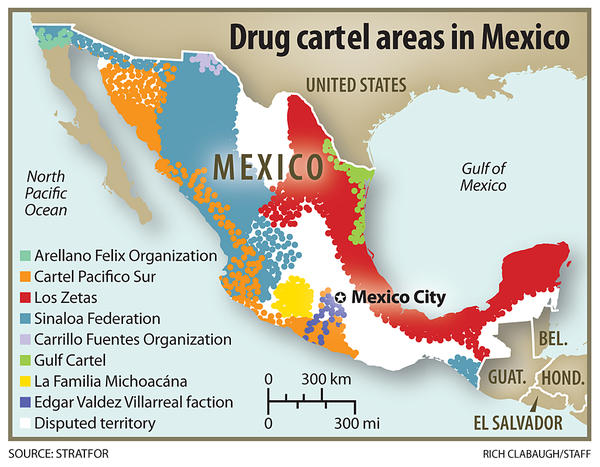
The spectacular violence of Mexico’s drug war grabs international attention. Some 40,000 people have been killed since 2006, when President Felipe Calderon deployed Mexican military and security forces in the so-called war against the cartels — often in gruesome and sadistic ways.
But behind the headlines, under cover of impunity, a low- intensity war is being waged.
In the second episode of a two-part series, Josh Rushing and the Fault Lines team travel to the state of Guerrero to investigate claims that Mexican security forces are using the drug war as a pretext to repress indigenous and campesino communities. In one of Mexico’s poorest and top drug-producing states, where struggling farmers are surrounded by the narco-economy, we ask about the cost of taking the struggle against dispossession into your own hands.

Last night US President Barack Obama addressed the nation on the matter of US involvement in Afghanistan. While the President said there would be some US troop removal he also arrogantly defending the US occupation of Afghanistan and gave no indication that the US has any plans to leave that country for years to come.
First, the timetable for US troop withdrawal Obama presented is misleading. Some defenders of the administration will no doubt argue that the President is keeping his word from his December 2009 speech where he announced that the US would begin withdrawing troops by July of 2011.
According to the online source Think Progress, “the United States would still have far more troops in Afghanistan than it did when Obama came into office and more than at any point during former president George W. Bush’s administration:

This means that the troop reduction would not put us much closer to actually ending the war by the end of 2012. Rather this would simply scale back the second surge of 30,000 troops that President Obama announced in December 2009. It would also maintain the first surge of 17,000 troops Obama ordered upon entering office. This comes at a time when a record number of Americans want to end the war in Afghanistan and the costs of which are putting the United States deeper into debt.”
US Foreign Policy analyst Phyllis Bennis also points out in an article that the number of US troops that the Obama administration plans to withdraw also doesn’t take into account the 50,000 NATO troops still present and the 100,000 Pentagon paid contractors.
Bennis went on to say that this limited troop reduction is not a real strategy since it does not address any long-term policy issues. There was no mention of the US military base construction, which is another indication the US has no long-term plans of leaving Afghanistan. Historian Gareth Porter who was interviewed on Democracy Now this morning echoed this notion that the US has no intention of leaving Afghanistan. Porter stated:
I think the second storyline is equally important, and that is that Obama likened the—what he called the “responsible” withdrawal from Afghanistan to what has been done in Iraq. And of course, that reminds us that what the President did in Iraq was to promise to withdraw combat troops, combat brigades, while in fact leaving them there well beyond the date that they were supposed to be withdrawn. So, I think we can look forward to, you know, beyond 2012, having combat troops continue to carry out the war, while the President is talking about withdrawing them. I think we’re in for a repeat of the Iraq experience there.

Another point about Obama’s speech is that he left out not only what the Afghani people think, he left out the fact that civilian casualties have been on the rise in Afghanistan with the so-called surge and that as we mentioned last week Afghanistan has become an extremely dangerous place for women.
In addition, much of the commercial news media coverage so far has accepted the claim from the Obama administration that the surge has worked. According to a report from the Afghanistan Analysis Network the Taliban have actually gained ground in several parts of the country, even in non-Pasthun areas, a reality that contradicts the claims of the White House.
This lack of questioning by the US media is reflected in the way they have framed the issue since the President’s speech last night. For example, the story this morning on MLive tries to present multiple views on the Obama’s announcement about troop withdrawal. However, the article does not question the claims of the administration by the way they have framed the story and they present no perspectives that challenge to overall policy of the past 10 years.
The Grand Rapids Press reporter has some pro-war and anti-war voices, but their comments are purely limited to the issues of US troop numbers in Afghanistan. The Press also spoke with political science professors from Calvin College and GVSU, but both of these “experts” fundamentally accept the US government’s rationale for being in Afghanistan in the first place. This type of reporting not only is misleading, it contributes to a general lack of understanding for the American public who have been forced to pay roughly half a trillion dollars to fund the nearly 10-year US occupation of Afghanistan.
New Media We Recommend
Below is a list of new materials that we have read/watched in recent weeks. The comments are not a “review” of the material, instead sort of an endorsement of ideas and investigations that can provide solid analysis and even inspiration in the struggle for change. All these items are available at The Bloom Collective, so check them out and stimulate your mind.
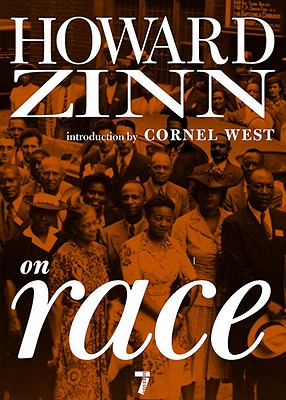
Howard Zinn on Race – This new collection of previously published essays and interviews is a marvelous tribute to a man deeply committed to racial justice in America. The essays are arraigned chronologically and span 5 decades of reflections from Howard Zinn on topics such as civil rights, sit-ins, marches, freedom riders, immigration and the university’s role in perpetuating racism. Zinn writes with clarity and not as an observer, but as someone who fully participated in the struggle for racial justice his whole life. The book ends with an interview with Zinn that took place during the 2008 presidential election where Zinn is highly critical of candidate Obama and calls on the need for new popular movements like the civil rights and black power movements of the 1960s and 1970s.

Deep Green Resistance, by Aric McBay, Lierre Keith and Derrick Jensen – For anyone who is not only concerned about the human caused destruction of ecosystems and species extinction Deep Green Resistance is must reading. This book not provides urgent analysis on the state of the planet it provides an important tactical and strategic framework for how we can engage in resistance to what the authors refer to as industrial civilization. This book does not advocate reform of the system, the benefits of green capitalism or the saving qualities of technology. Deep Green Resistance advocates for the dismantling of industrial civilization and the sharing of skills that will contribute to future autonomous communities that can lead the way to truly sustainable living. Deep Green Resistance is a dangerous book for dangerous times.

Homophobia: A Weapon of Sexism, by Suzanne Pharr – After hearing Suzanne Pharr speak in Grand Rapids earlier this year I was inspired to read here work. Homophobia is an excellent contribution to intersectional analysis and dialogue. What Pharr demonstrates in her book is how homophobia impacts women differently than men and that men often use homophobia as a weapon of male domination. Pharr’s book not only provides important analysis, she includes the stories and experience of numerous lesbian women who have been victimized by the sexist nature of homophobia in American society. However, what makes this book such an important resource is the concluding section on how this analysis can provide those doing anti-oppression work needed skills to organize in the fight against homophobia.
END-CIV: Resist or Die (DVD) – Filmmaker Franklin Lopez has done a marvelous job in this documentary of taking some of the fundamental premises in Derrick Jensen’s book Endgame and making them come alive through visuals. This documentary not only provides us with sharp analysis of the current state of the planet it provides compelling imagery and examples of how people are actively resisting around the world. This is an excellent tool for anyone serious about stopping ecological destruction.
Lawsuit seeks injunction on Emergency Manager law
(This article by Eartha Jane Melzer is re-posted from Michigan Messenger. Some of the sources used in this article were interview today on Democracy Now!)
In a lawsuit filed Wednesday in Ingham County court, citizens from across the state are asking that Michigan’s Emergency Manager law be declared unconstitutional.
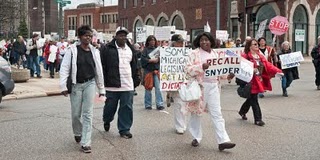
The Local Government and School District Fiscal Accountability Act allows the governor to appoint Emergency Managers to take over local units of government, fire elected officials, sell off or privatize community assets and even dissolve whole cities.
The measure was rushed through the Republican-controlled legislature this spring as a move to protect against widespread municipal bankruptcies, with some of its supporters referring to it as “financial martial law.”
But in legal arguments filed in court this morning a group of 25 plaintiffs say the right of citizens to elect their local officials is guaranteed in the state Constitution and financial stress is not a legitimate ground for scrapping the democratic process.
“This is an infringement on basic democracy,” said plaintiffs attorney John Philo of the Sugar Law Center for Economic and Social Justice. “It really is an experiment in a new form of government — one person rule.”
The complaint alleges that the law “violates the rights of local voters by attempting to delegate law-making power and the power to adopt local acts to unelected emergency mangers, by suspending the rights of local electors to establish charters and to elect local officials, and by imposing substantial new costs and expenses upon local municipalities without providing new revenue,” the group argues.
The law is so extreme, the plaintiffs say, that it “establishes a new form of local government, previously unknown within the United States or the State of Michigan, where the people within local municipalities may be governed by an unelected official who establishes local law by decree.”
“Because it is such a radical change in how you govern a city it is untested waters legally,“ Philo said, “but if the Constitution is to have any meaning we think the law should be struck.”
“A financial emergency has never been found to be equivalent to invasion of a foreign government where you can make martial law and suspend the Constitution,” he added.
Philo said that according to the law’s criteria for state intervention 75 percent of Michigan communities could be subject to Emergency Managers.
Unfunded mandate
According to the law local communities are required to pay the salary, benefits and expenses of the appointed Emergency Manager and all costs of any employees or contractors hired by the Emergency Manager as well as legal costs and insurance.
These expenses have been substantial. In Benton Harbor Emergency Manger Joe Harris is paid $11,000 per month. Former Detroit Public Schools Emergency Financial Manager Robert Bobb made $425,000 during his final year on the job. The plaintiffs argue that requiring communities to pay these costs violates the 1978 Headlee amendment which requires the state to reimburse local governments for any new state mandated programs.
Plaintiff Emma Kinnard of Benton Harbor lost her elected officials when Emergency Manager Joe Harris used his new powers to strip the Benton Harbor City Commission of all decision making power in April.
Kinnard said that while she didn’t always agree with Benton Harbor’s local officials she was able to stay informed about city business and participate in city politics, but now there is no mechanism for public participation or oversight of local government, she said.
“This is not democracy this is dictatorship,” she said. “They talk about other communist countries … this is following the same things they were doing. How can this be democracy when there is no accountability … just one person in power?”
“Benton Harbor is a test center,” she said, “If it goes through in Benton Harbor they are going to start doing this all over the state.”
The suit names as defendants Gov. Rick Snyder and state Treasurer Andy Dillon.
There is also a federal suit challenging the Emergency Manager law, filed in April by Detroit’s city pension systems. That suit challenges the authority of Emergency Managers to change city charters and remove trustees from office.
Rep. John Conyers (D-Detroit) and others have argued that the Emergency Manager law violates Michigan and U.S. Constitutional prohibitions against laws that break contracts. Earlier this month the law was used by Pontiac’s Emergency Manager to void the city’s contract with its police dispatchers. A lawsuit over that action is also expected.
Press conferences are scheduled for several cities around the state — Lansing, Benton Harbor, Flint, Detroit and Monroe — to announce the lawsuit today. The plaintiffs have also launched a website.
Here’s the full legal complaint:
Climate Meetings Have Become Conferences of Polluters
(This article by Patrick Bond is re-posted from CounterPunch.)
Judging by what transpired at last week’s global climate negotiations in the former West German capital, Bonn, it appears certain that in just over five months time, the South African port city of Durban will host a conference of procrastinators, the ‘COP 17’ (Conference of Parties), dooming the earth to the frying pan. Further inaction on climate change will leave our city’s name as infamous for elite incompetence and political betrayal as is Oslo’s in the Middle East.
It appears certain that Pretoria’s alliance with Washington, Beijing, New Delhi and Brasilia, witnessed in the shameful 2009 Copenhagen Accord, will be extended to other saboteurs of the Kyoto Protocol, especially from Ottawa, Tokyo and Moscow, along with Brussels and London carbon traders.
What everyone now predicts is a conference of paralysis. Not only will the Kyoto Protocol be allowed to expire at the end of its first commitment period (2012). Far worse, Durban will primarily be a conference of profiteers, as carbon trading – the privatization of the air, giving rich states and companies the property-right to pollute – is cemented as the foundation of the next decade’s global climate malgovernance.
Indeed, a telling diplomatic move in Bonn was when Pretoria negotiators, weighed down by team members from maxi-polluters Eskom, Sasol and the National Business Initiative, tried to break African solidarity against European Union plans for opening up new carbon markets (in exchange for Europe emitting much more GreenHouse Gas pollution) – instead of doing the honorable thing by paying the EU’s vast climate debt to Africa straight up.
A local alignment is now approaching in which on the one hand Pretoria’s Bantustan-type politicians and officials will legitimize ‘climate apartheid’ once the COP17 begins at the Durban International Convention Centre, at the same time they support every homegrown, climate-destroying action in sight:
* building two of the world’s four largest coal-fired power plants for $20 billion each at Kusile and Medupi
* digging a vast new $14 billion port in South Durban, announced last week
* constructing a new $12 billion heavy-oil refinery in Port Elizabeth; and
* offering shale-gas fracking exploration rights to South African, Norwegian and US firms in the fragile Drakensburg mountain range
To top it off, the promised $100 billion/year Green Climate Fund, far larger than any other financing source ever assembled, is co-chaired by another Northern-pliant Pretoria politician, national planning minister Trevor Manuel, a man who takes his responsibilities so lackadaisically that he offered no visible objection to these eco-catastrophic investments.

Indeed as finance minister, Manuel repeatedly gave SA’s state power corporation Eskom the green light to continue supplying the world’s cheapest electricity to BHP Billiton and the Anglo American Corporation while raising poor people’s power prices to unaffordable heights so as to pay for the expensive plants.
Manuel apparently thought so highly of the Green Climate Fund (GCF) that in late April he preferred to stay home in Cape Town, unsuccessfully seeking votes for the ruling party (it lost to the conservative opposition in mid-May municipal elections), instead of going to the Mexico City conference where in absentia Manuel was given GCF design co-leadership. In all the talk of his joining the EU-rigged race for International Monetary Fund managing director, which Manuel quit on the last day, June 10, not a word was uttered about climate or his GCF co-chair responsibilities.
The GCF may do far more harm than good, especially if Manuel’s team authorizes the financing of ‘false solutions’ such as biotech, Genetically Modified trees and plants, timber plantations, nuclear energy, carbon capture and storage, or seeding the air with the coolant SO2 and the sea with iron filings to create algae blooms. He has already pronounced that the GCF should raise up to half its funds through carbon trading.
But Manuel will fail not only because of periodic carbon market collapses but because, as Third World Network director Meena Raman complained last week, “Only a few [6] days of negotiations have been set aside for the GCF Technical Committee between now and Durban, while there are many complex issues to resolve… [How can they] execute the difficult and important task in such a short period of time?” At the May 30 GCF workshop in Bonn, only co-chair Kjetil Lund of Norway attended parts of the session, but Manuel and the third co-chair, Mexico’s Ernesto Cordero Arroyo, were no-shows.
This typifies the disrespect that state and business elites show for climate negotiations. Because Pretoria can’t be trusted to lead the world in December, says Michele Maynard of the Pan African Climate Justice Alliance, “African civil society is calling on the South African Government to have an open, democratic and accountable process. That means saying when, where and who they are meeting and how they will let the people actually impacted by climate change have their say.”
Maynard continued, “This is all the more urgent as we hear that New Zealand and the US are driving the introduction of ‘soil carbon’ markets into the negotiations. These markets are false solutions that will only fuel the land-grab in Africa and seriously undermine the ability of poor Africans to feed themselves.”
The Kyoto Protocol will be the first casualty of Durban, everyone predicts. The North wants a voluntary ‘political commitment’ sometimes called ‘pledge and review’ to replace the binding emissions reductions requirements made in 1997 in Kyoto.
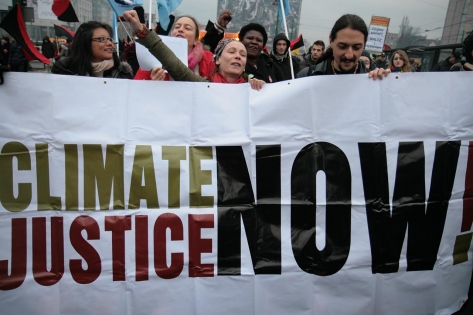
To be sure, the civil society movement Climate Justice Now! is disgusted by Kyoto’s
* low targets (just 5 percent decrease in emissions since 1990);
* ease of exit (especially by the world’s worst tar-sands polluter, Canada);
* lack of sanctions against big polluters for not participating (the US and Australia) or for missing even weak targets (nearly everyone);
* failure to penalize corporate beneficiaries of vast coal operations in sites like South Africa; and
* reliance on carbon markets to make emissions cuts more palatable to big capital, thanks to the sleazy deal done by Al Gore in 1997 in exchange for official US support (but the Senate vote against Kyoto was 95-0!).
Still, a binding global deal is ultimately needed, and replacing Kyoto with a voluntary ‘Durban Package’ would be disastrous given the US, EU and Japanese track-record on underfunding, cheating and bribery. Thanks to last December’s release of US State Department cables by Julian Assange and Bradley Manning (presumably, as he remains uncharged in Leavenworth prison in Kansas), it is undeniable that Clinton underlings Todd Stern and Jonathan Pershing are bullies who should be banned from all future negotiations. The EU’s Connie Hedegaard happily joined them to plot defunding the GCF in February 2010, according to WikiLeaks.
To meet scientific requirements for planet-saving emissions cuts requires a binding UN effort like that made in 1987 in Montreal to ban CFCs, the chemical that was widening the deadly ozone hole. But given the rise of neoliberalism (1990s), neoconservatism (2000s) and their subsequent fusion as the dominant ideologies within the United Nations, a repeat of the Montreal Protocol is not possible anytime soon.
So at the last two climate COPs, in Copenhagen (2009) and Cancún (2010), Pretoria lined up squarely with the worst environmental wreckers. The result, according to Bolivia’s Ambassador to the United Nations, Pablo Sólon, at a Bonn press conference, are “commitments of emissions reductions that leads us to a scenario of [a temperature increase of] 4 degrees Celsius. And that is absolutely unacceptable. We need to come out of South Africa with commitments of emissions reductions that will put us in a scenario of between 1 to 1.5 degrees Celsius in order to preserve our planet and life as we know it.”
Concluded Sólon, one of the few negotiators brave enough to speak truth to power inside UN’s dead space, “South Africa is the place to fight against the new apartheid against Mother Earth and its vital systems.”
Local activists will join this fight knowing their politicians and officials are terribly destructive. One reason Durban will be regarded in future as the city that amplified climate apartheid, is the elites’ hunger to codify and even celebrate market-based environmental governance, including the Reducing Emissions from Deforestation and forest Degradation (REDD) programme.
According to Sólon, “There is a proposal in the Cancún agreement that focuses everything on … guidelines in the capacity of forests to capture CO2. We must not focus on how to prepare forests for a market mechanism, we must fight deforestation now.”
REDD’s most dogmatic advocate has been the World Bank, which is also the trustee for the Green Climate Fund, leading to civil society demands for its repulsion. “The World Bank is part of the climate problem, not the climate solution,” Sebastian Valdomir of Friends of the Earth International said at Bonn. “Its appalling social and environmental track record should immediately disqualify it from playing any role whatsoever in designing the Green Climate Fund, and in climate finance more generally.”
Case in point: the Bank’s $3.75 billion loan to Eskom last year, mainly to fund the Medupi plant in spite of well-known conflicts of interest (African National Congress investments in Hitachi boiler construction) and worsening inability to pay for electricity by poor South Africans, who continue ‘service delivery protests’ at amongst the highest rate in the world.
Rather than expect the dubious bankers to tackle our greatest challenge, Sólon proposed an international financial transactions tax to fund climate aid. The North’s existing commitments, such as the supposed $30 billion in fast track funding pledged by Hillary Clinton at Copenhagen through 2012, is proving to be just as reliable as the G8’s Gleneagles Summit 2005 financing pledges to Africa.
Conferences of promisers are a dime a dozen, as they say in the US, and conferences of empty pledges, such as Clinton’s, as unveiled at Bonn by her own colleagues on June 7 (“there will not be $100 billion a year in the GCF”), have one main purpose: to deflect the world’s justified anger at how Northern pollution threatens us all.
There is another deflection trick we can expect in Durban, just as at the Johannesburg World Summit on Sustainable Development in 2002, when Third World Network’s Martin Khor condemned the host chair (Thabo Mbeki) for importing the exclusionary methodology of the World Trade Organisation’s ‘Green Rooms’. Venezuela’s negotiators in Bonn last week criticized Pretoria’s “proliferation of innovative ideas” that were hashed out beyond closed doors.
Against top-down disasters like these, can activists change the balance of forces? Last Friday as Bonn was drawing to a desultory close, the Durban-born leader of Greenpeace International, Kumi Naidoo, showed exactly the spirit required, while attempting delivery of a 50,000-strong petition to an offshore drilling rig run by Cairn Energy near Greenland.
As Naidoo approached the rig, the Leif Eriksson (named after a Scandinavian Viking, a tribe renowned for looting, pillaging and raping), he was hit by near-freezing water cannon blasts and then arrested ‘indefinitely’ for violating a court injunction.
Said Naidoo, “Arctic oil drilling is one of the defining environmental battles of our age. I’m an African but I care deeply about what’s happening up here. The rapidly melting cap of Arctic sea ice is a grave warning to all of us, so it’s nothing short of madness that companies like Cairn see it as a chance to drill for fossil fuels that got us into this climate change mess in the first place. We have to draw a line and say no more.” The same line will have to be drawn against the Durban Conference of Polluters, and it appears Saturday, December 3 will be a global day of action when in Durban and your hometown, the strongest possible stance will be needed to finally address the mess.

