As the Trump Administration attempts to dismantle various US programs, is threatening to target organizations and movements that have been resisting for years, and wants to adopt policies that will primarily benefit the Capitalist Class, we need to be care about just reacting and think more strategic.
Before I talk about what kind of resistance and strategies we could be engaging in, it is absolutely necessary to talk about what does not work and what we can not rely on, especially if we are serious about resistance work and collective liberation.
When the Democrats go to a fight they show up with a switch-blade, the Republican show up with a howitzer
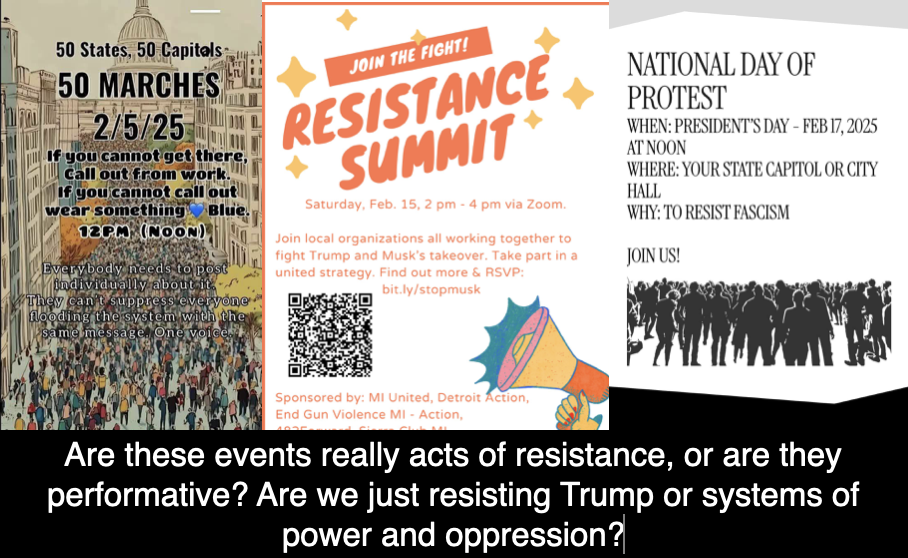
If your first reaction is to center the strategy of electoral politics, then I believe we will continue to make the same mistakes. If you believe that the Democratic Party will save us, then you will be disappointed. Just look at how weak and shallow the Democratic Party has been since the inauguration. The majority of Trump’s nominees have been approved, which means too many Democrats voted for those nominees. Democrats have also voted with Republicans to support Legislation that will do harm, especially to vulnerable communities and communities that are being targeted. (See the Laken Riley Act vote)
More importantly, the Democratic Party doesn’t seem to learn from their failures. They elected Ken Martin as the new DNC chair and in his first speech after winning that position, Martin said that there are “good billionaires.” Such sentiment is both naive and shows that the DNC doesn’t have the kind of class consciousness that will challenge nor dismantle the system of Capitalism. There is no such thing as a good billionaire.
The Democrats simply want to blame 3rd Party voters or those that chose to not vote, rather than to actually listen to its base and develop a platform that moves us to collective liberation. Just look at what happened during the Biden Administration:
- There were more deportations in the last four years than there were during the first Trump Administration.
- The Biden Administration approved more fossil fuel extractions on US soil than the Trump Administration did.
- The wealth gap has expanded during the Biden Administration, especially amongst the Billionaire Class.
- The Biden Administration increased US military funding every year for the past 4 years.
- The Biden Administration increased funding for policing, even in the era of Black Lives Matter.
- The Biden Administration was completely and utterly complicit in the war crimes and genocidal policies of Israel, refusing to end weapons sales to Israel, being complicit in allowing Israel to block humanitarian aid to Gaza and always voting against most of the rest of the world when the United Nations condemned what Israel was doing.
- The Biden Administration was not only silent, but did not actively oppose the repression of the US campus Pro-Palestine movement.
- Rent increases went up during the Biden Administration, which did very little to address the current US housing crisis.
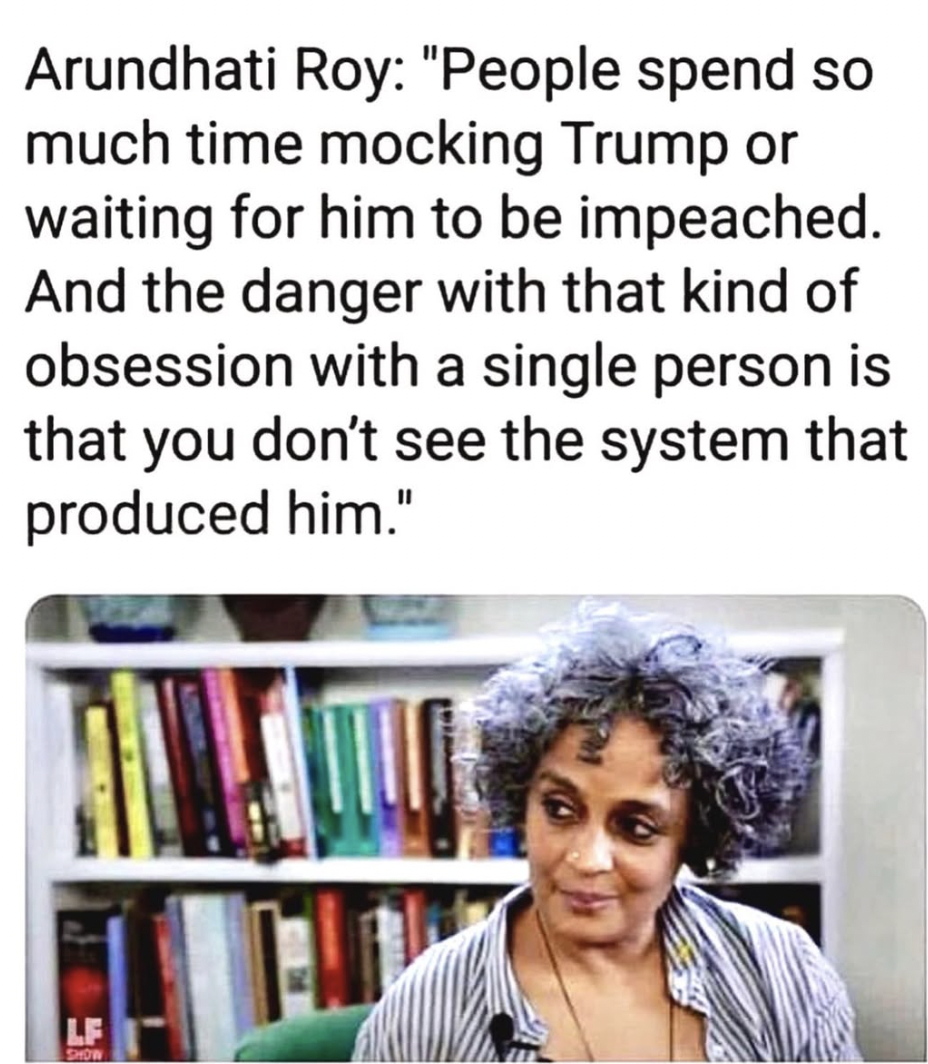 This list could be longer, but you get they point. Still, people are falling for the let’s get behind the electoral plans of the Democrats and the banality of the Democrats calling what they are doing as resistance. I call BULLSHIT. The 50 States, 50 Capitals protest that happened last week, even though the memes for this event did not provide a source for who was behind it, should have been a red flag for what was happening. I tracked down who was behind it, which there were three main groups, the 50501Movement, Political Revolution and Protest for Human Rights. All three of these groups are primarily pushing the electoral politics as a strategy, plus to advocate for business as usual approaches to systemic change.
Then there are events like the one that happened in Michigan for February 15, where they are inviting people to “join the Resistance.” Look at the list of orgs that were part of this virtual summit, all of which are 501-C3 groups that have historically collaborated with the Democratic Party and wouldn’t know the first thing about what real resistance looks like.
Thinking strategically to practice resistance, engage in movement building and fighting for Collective Liberation
When people went to the 50 States, 50 Capitals protest, what was the goal, and what were the strategies and tactics that were used. As far as I can tell, people were protesting a broad range of Trump’s Executive Orders, but to what end? There is nothing wrong with voicing opposition to the Executive Orders, but standing in front of the capital in Lansing makes no sense. Why not have people show up at federal buildings or the offices and homes of members of the US House or US Senate? However, even that isn’t sufficient.
Here are are some suggestions about moving forward, especially if we are about more than opposing the Trump Administration.
First, this is not just about Trump and Musk! Sure, these people are awful and despicable human beings, but we have to focus on systems of power and systems of oppression if we are ever going to fundamentally change things. The list of things that happened during the Biden Administration that I mentioned earlier, were also awful shit, causing tremendous harm, but where was the outcry and the sense of urgency then? Why just now? I think part of it is that white people are starting to worry about certain dynamics, but for BIPOC people, immigrants, working class poor, queer & trans people, and people with disabilities, this been an ongoing shit show of harm. As Noam Chomsky points out in this video interview (from 2003), every US President since WWII could be tried for War Crimes. The horror that the US practices domestically and internationally has been a constant.
Second, we can’t just be reactive to what is happening, we have to think about what we really want. We can’t just want to get rid of Trump and Musk, we have to start thinking about, practicing radical imagination, then strategize and organize around what we really want, not just what we are against.
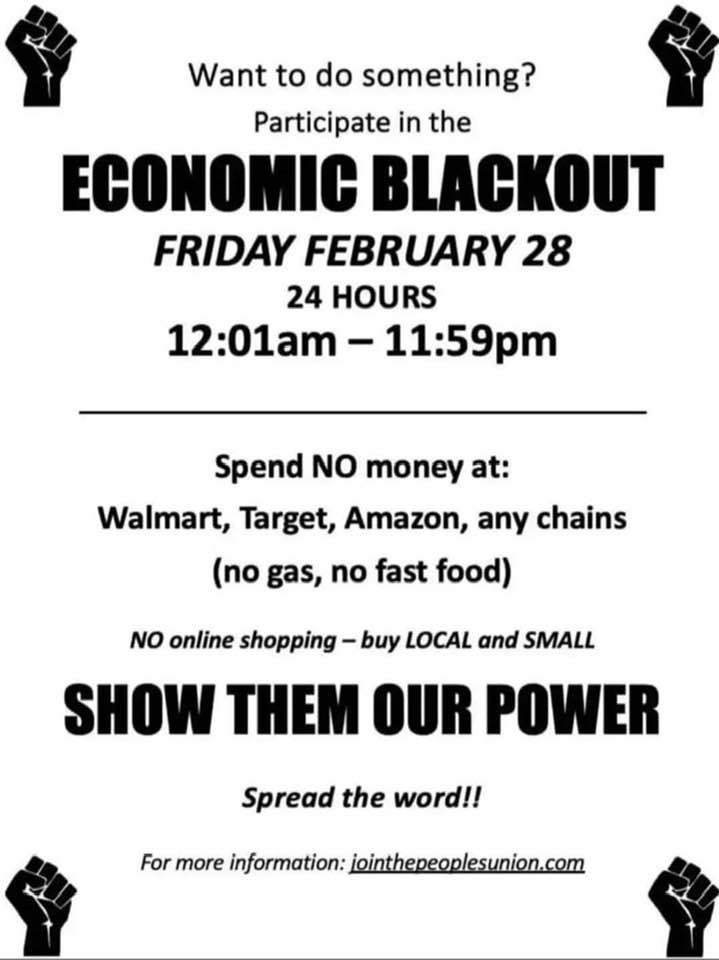 Third, we should think more critically about the memes and information being shared on social media. There have been memes that are used calling for protest, without knowing who is behind them or any serious investigation of who is behind them. For example, there is an Economic Blackout being called for February 28. The website calling for this used to be the people’s union, but they founder of this group changed it to this, https://theonecalledjai.com/. Yes, John Schwartz says he started this movement, a businessman who likes to meditate. Movements aren’t created by those with privilege, they come out of the collective lived experienced of people who have been oppressed. Now, I’m not saying that boycotts or economic strikes is a bad thing, but we should be looking to movements that have been doing boots on the ground work for decades or longer, to see what they are advocating and then support that.
Fourth, we need to learn from the history of social movements, along with paying attention to the current movements for radical social change and collective liberation, not people who are just pissed off about Trump. For example, in Grand Rapids, the immigrant-led group Movimiento Cosecha GR, which began in 2017, is part of the national movement that is immigrant led and began during the Obama years after that administration deported millions of their family members. Beginning in 2017, Movimiento Cosecha GR saw lots of allies join the fight, but just as soon as Biden was elected, people abandoned that movement. Why? The Biden Administration continued many of the same anti-immigrant policies that existed under Trump, but without the rhetoric. The first action that Movimiento Cosecha GR took after the 2020 Election, was to hang a banner near City Hall in GR, a banner that said, “Democrats deport us too.”

Fifth, we need to acknowledge that no significant economic, political or social change has ever happened in the US because of politicians. Social change has always happened when organized social movements force politicians to adopt policies. The end of chattel slavery was because of the decades of Black-led resistance; plantation revolts, the Underground Railroad, creating networks of solidarity and self-care; which also included white allies who provided financial support, used media and created safe houses for those fleeing slavery. Labor conditions for workers did not change because of bosses, but because of strikes, work stoppages, and the creation of labor unions. Jim Crow era policies did not change because of politicians, but because of the BlackFreedom Struggle/Civil Rights Movement that forced America to adopt political and economic policies that Black people demanded.
I was recently talking about this the other day with Movimiento Cosecha organizers, since the last time a sitting president adopted a sweeping immigration policy that was beneficial to undocumented immigrants, was 1986, during the Reagan Administration, the Immigration Reform and Control Act of 1986. This immigration policy provided amnesty for approximately 2.7 million immigrants that were in the US as undocumented. The reasons why this happened is because there was a robust Central American Solidarity Movement. There were roughly 400 Sanctuaries across the US for Central Americans fleeing US-sponsored and funded counter-insurgency wars, there a Sister Cities Movement, there were thousands of people from the US going to do either solidarity work in Central America or fact finding missions that helped to change the public conversation about what was happening in Central America. There was the national Pledge of Resistance, where people pledged to do Civil Disobedience, there was Veterans for Peace, Pastors for Peace and there was the blow back from the Iran Contra scandal. All of these things made it possible for the Immigration Reform and Control Act of 1986 to be adopted.
Sixth, those of us who have lots of privilege need to make sure that the voices of those who are most marginalized are now centered and amplified. I was having a conversation with someone from Indivisible Greater Grand Rapids the other day and they were saying to me that they would like to see younger people and people of color join their movement. I responded by saying that this has always been the problem of white-led movements. White people need to stop thinking this way and start learning from BIPOC communities, immigrants, queer & trans people, people with disabilities, and the working class poor. We need to find out what kind of support these communities and movements want from us, if anything, and then leverage our privilege to benefit their struggles and their demands.
Seventh, when we develop strategies, we need to start using tactics that do not perpetuate business as usual. For everyone who thinks that going to visit with politicians and telling them what you think is going to actually change anything, then you haven’t been paying attention. People should be occupying the offices of politicians, disrupting commission meetings and engaging in creative demonstrations at the homes of those who claim to be public servants. More importantly, we need to once again learn from previous social movements and utilize tactics that threaten systems of power and oppression. We need to disrupt business as usual, we need to make sure that the grinding machine of Capitalism comes to a halt.

Lastly, it is fairly common for people to compare what the Trump Administration is doing to what the Nazi Party did in Germany. If you believe this – there are some similarities – then maybe we all need to start acting like the Germans who resisted the Nazi Party. In other words, we need to think more about getting out of our comfort zones and start taking risks. No meaningful social change ever cam about without people taking risks. If you truly believe we are experiencing a coup and living under a dictator, then we need to take risks. Engaging in symbolic protests will not get us very far, not if we want real change. It’s time for us to stop be reactive and starting fight for what we want. Another World is Possible!
For the 3rd time in the past 5 weeks, Rep. Scholten voted with Republicans on legislation that punishes the immigrant community. In early January, I reported that Scholten had voted for the Laken Riley Act, stating:
“3rd Congressional Rep. Hillary Scholten was one of 48 Democrats that voted with Republicans to pass this legislation, which once again demonstrates how Democrats also embrace more draconian policies regarding immigrants, especially undocumented immigrants.”
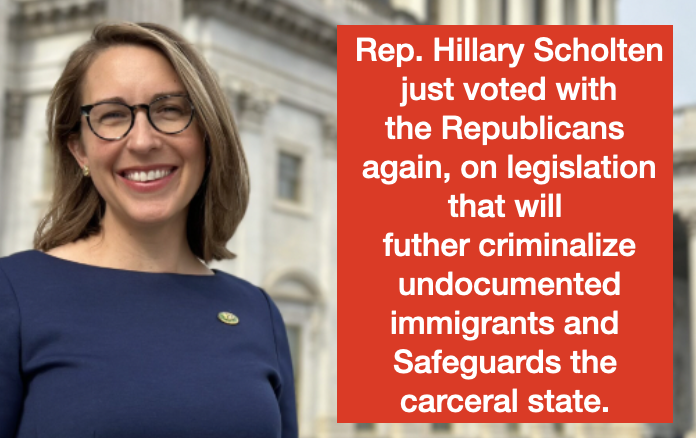
In late January, I reported that Rep. Scholten had voted for the Preventing Violence Against Women by Illegal Aliens Act, H.R. 30. Republicans were claiming that the Preventing Violence Against Women by Illegal Aliens Act would protect women and children. Republican Rep. Nancy Mace from South Carolina argued that the legislation was necessary to protect women and children from a “hoard” of undocumented immigrants sexually abusing “American” women and girls.
In response to H.R. 30, at least 200 organizations that fight against domestic violence have condemned the legislation and are saying that the Preventing Violence Against Women by Illegal Aliens Act will make it easier to deport survivors who get caught up in the criminal legal and child welfare systems as a result of the abuse they suffered.
Last Thursday, Rep. Hillary Scholten voted again with Republicans to pass H.R.35 – Agent Raul Gonzalez Officer Safety Act. Scholten was one of 50 Democrats who voted for this piece of legislation, which states:
A person commits an offense under this section by operating a motor vehicle within 100 miles of the United States border while intentionally fleeing from – ‘’(1) a pursuing U.S. Border Patrol agent acting pursuant to lawful authority; or ‘‘(2) any pursuing Federal, State, or local law enforcement officer who is actively assisting, or under the command of, U.S. Border Patrol.
The penalties for violating this law are:
any person who commits an offense described in subsection (a) shall be—‘‘(A) imprisoned for a term of not more than 2 years; ‘‘(B) fined under this title; or ‘‘(C) subject to the penalties described in subparagraphs (A) and (B) ‘‘(2) SERIOUS BODILY INJURY.—If serious bodily injury results from the commission of an offense described in subsection (a), the person committing such offense shall be—‘‘(A) imprisoned for a term of not less than 5 years and not more than 20 years; ‘‘(B) fined under this title; or ‘‘(C) subject to the penalties described in subparagraphs (A) and (B). ‘‘(3) DEATH.—If the death of any person results from the commission of an offense described in subsection (a), the person committing such offense shall be— ‘‘(A) imprisoned for a term of not less than 10 years and up to life; ‘‘(B) fined under this title; or ‘‘(C) subject to the penalties described in subparagraphs (A) and (B).’’.
To put this is plain language, those who flee from Border Patrol Agents or other cops assisting them will get up to 2 years in jail and a lot more if any of the Border Patrol Agents or cops are injured or killed pursuing them.
The fact is that people coming into the US, crossing the Mexico/US border, are fleeing either political repression, political violence, debilitating poverty or the climate crisis. It is a reasonable response for people fleeing these circumstances to not want to be arrested, detained and deported back to what they fled in the first place.
This bill not only punishes people from other countries who cross into the US from Mexico, it ignores the context of why people are fleeing their country of origin and it elevates the carceral state, which expects everyone to follow the rule of law, even if those laws are unjust and target certain populations.
For as much as Rep. Scholten likes to remind us that she was an immigration lawyer, she continues to vote for policies that further criminalizes undocumented immigrants, and policies that the Republicans introduced. It would appear the Rep. Scholten is more interested in getting re-elected in the 3rd Congressional District, rather than using her vote to fight for immigrant justice.
GRIID Class on the Prison Industrial Complex in Kent County – Week #2
In our last class we talked about several different items related to the Prison Industrial Complex in Grand Rapids. The first item was a news story that I had sent everyone from last year, a story featuring Kent County Prosecutor Chris Becker talking about why the GRPD were not being charged for anything in the shooting of a Black man they thought was armed.

Participants talked about how awful this news story was, since it not only didn’t provide adequate context for the mental health issues of the man that was killed by the GRPS, the reporter never questions or challenges what the County Prosecutor had to say. Here is a GRIID deconstruction of that story, which I wrote just before the holiday break.
The second thing we discussed in week #2 was some research that was done for the non-profit Linc Up, research that has some instructive data on race, class and other aspects of the Prison Industrial Complex in Kent County. The slide above is just one of the examples from this research, which you can access here.
However, most of our time in week #2, was spent discussing a two-part documentary entitled, Re-Visions of Abolition, which you can watch here. Some of the themes address in this documentary were:
- What is the Prison Industrial Complex (PIC)
- Gender Violence and the PIC
- Mothers and how the PIC destroys communities
- The War on Drugs
- The Culture of the Carceral State

- Capitalism and the PIC
- Abolition: Past, Present & Futures
- Abolition Not Reform
- Critical Resistance
- The L.E.A.D. Project
- The Future of Abolition

The documentary generated a great deal of conversation, with important observations and input from the participants. There was great conversation around the the War on Drugs, Capitalism and the PIC and Abolition Not reform. Next week we will begin to read from the new book Beyond Courts, which was written by Interrupting Criminalization, Community Justice Exchange, and Critical Resistance. This book takes a critical look at how the court system in the US really functions, through an abolitionist lens.
A timeline of GRPS stance on the threat of mass deportation, plus a powerful response from Denver Public Schools to Immigration Customs and Enforcement (ICE)
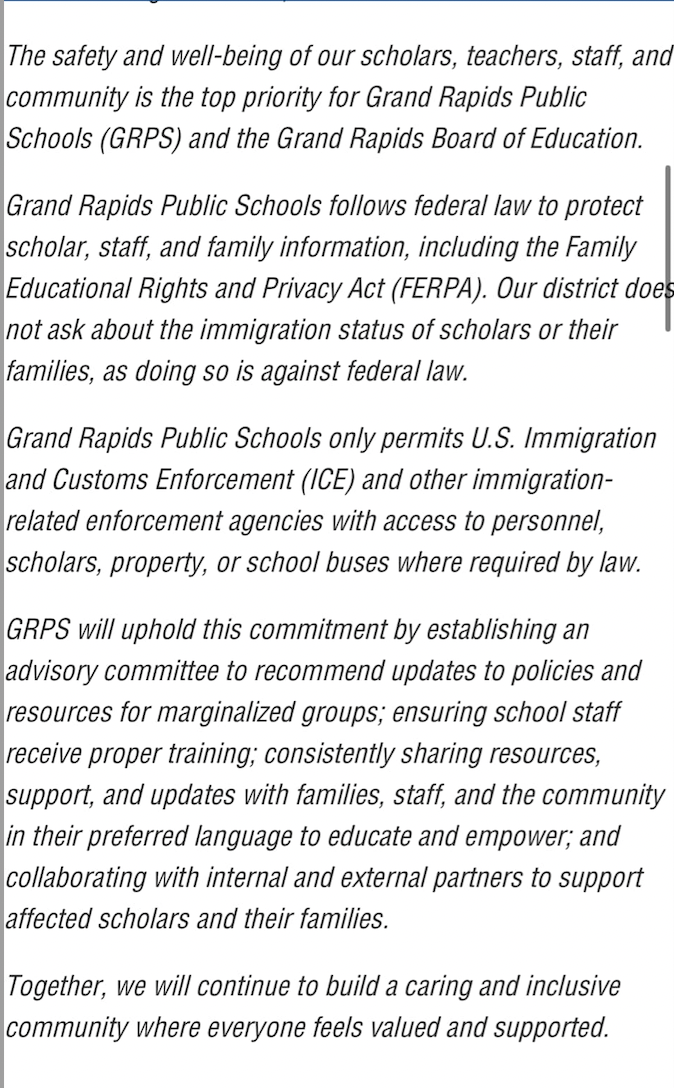
The Grand Rapids Public Schools has pretty much stuck to their initial response when it comes with policies regarding Immigration and Customs Enforcement (ICE) coming to schools within the District. Here is a link to what they send to faculty and parents regarding ICE.
The problem with this response is simply that it is a one-way street. What would it have looked like if the GRPS held a meeting, or meetings, in the community, particularly with communities that are high risk for arrest, detention and deportation? Holding listening session with the affected communities would have been a much better response, as opposed to the GRPS Administration thinking that they know what is best for immigrant communities who are facing the threat of mass deportation.
Around the same time that the GRPS sent out their own policy position on ICE, GR Rapid Response to ICE had created an Action Alert for people to sign, an Action Alert that had some demands and reasons for those demands, which you can read here.
I then wrote about the GRPS Board meeting that was held on January 13th, which had students, parents and community members calling for the District to adopt a Sanctuary policy. There was overwhelming support from the public.
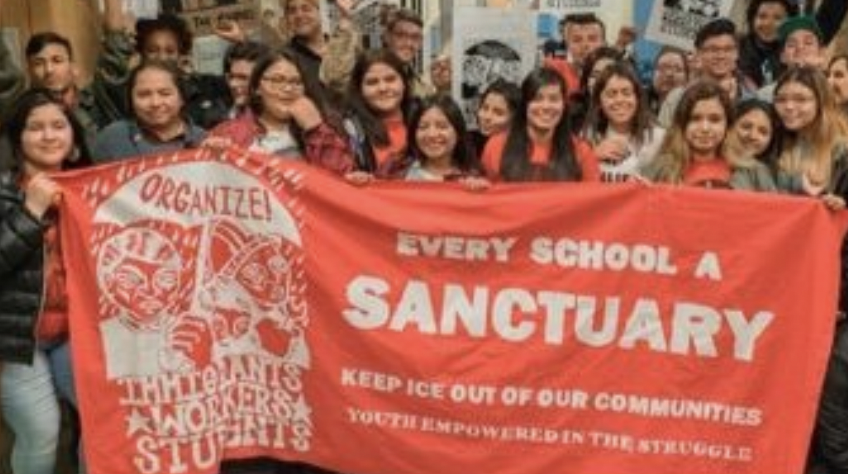
 GRIID has also been sharing toolkits on Sanctuary for Schools, in both English and Spanish, which are modeled after what schools in Detroit were doing.
On January 27th, at the Grand Rapids School Board, there was additional discussion about a Sanctuary policy and some School Board members questioned why the Action Alerts that were being sent to School Board members were being suppressed, which I also wrote about.
GR Rapid Response to ICE sent a letter to the GRPS regarding the censured Action Alert messages the following week. GRPS School Board President Kim Davis responded in an Email, which you can read from the GR Rapid Response to ICE Facebook page here.
Last Monday, February 10th, the GRPS adopted the following resolution, which is posted here on the right. The GRPS School Board member who pushed for the GRPS to take a more robust stance on the threat of mass deportations, Jose Rodriguez, was the only GRPS School Board member to vote no on this resolution.
A Lake of Radical Imagination
As I stated earlier, GRPS making decisions without listening to input from communities at risk of mass deportation, normalizes a power dynamic that is one way, where the GRPS knows better on matters of immigration policy and the threat of mass deportation.
However, not all schools are adopting superficial policies regarding how to deal with Immigration and Customs Enforcement (ICE). Just last week, the Denver Public Schools (DPS), “sued the Trump administration in federal court, alleging “irreparable harm” from the repeal of a policy that put schools, churches and other sensitive locations off-limits for raids.”
According to the Colorado Newsline, the DPS put out this statement:
“For decades, DPS, its students, and their families have relied on this Protected Areas Policy to provide education and services for their students,” says the district’s lawsuit, filed in the U.S. District Court of Colorado against the Department of Homeland Security.
The DPS went on to say, ““DPS has been forced to divert resources from its educational mission to prepare for immigration arrests on DPS school grounds,” says the lawsuit. “DPS has therefore spent significant time and resources implementing policies ensuring student safety and training staff and faculty to effectively respond to encounters with individuals claiming to be conducting immigration enforcement activities on school grounds.”
Lastly, according to the Colorado Newsline, “The district’s lawsuit seeks a temporary restraining order barring DHS from “implementing, enforcing, or acting pursuant to” the new policy on protected areas. In a statement Wednesday, DPS Superintendent Alex Marrero said that the district was acting to ensure that schools can remain a safe place for all students and their families, regardless of their immigration status.”
Imagine if the Grand Rapids Public Schools had taken a similar stance as the Denver Public Schools. Imagine how the communities impacted by the threat of mass deportation would feel in Grand Rapids, if GRPS had taken this action. It seems clear that the Denver Public Schools are listening to affected communities on these urgent matters, instead of adopting tepid resolutions.
MLive doesn’t cite the groups behind the local Sanctuary campaigns and creates a paywall for their poll on whether Grand Rapids should be a Sanctuary City
On Friday, MLive posted a story with the headline, Tell us: Should Grand Rapids become a sanctuary city?
The article wasn’t just asking a simple question about whether or not Grand Rapids should be a Sanctuary City or not. In fact, the article talked about the campaign to get Grand Rapids to be a Sanctuary City, the campaign to get Kent County to be a Sanctuary County, and the recent Michigan House Resolution that would threaten state funds being withheld from cities that took a Sanctuary position. There is also mention that the Trump Administration would also be targeting Sanctuary cities by withholding federal funding.
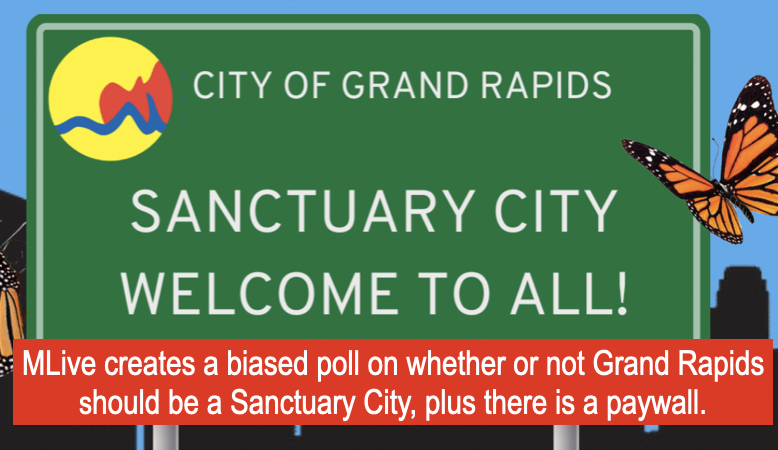
The MLive article also uses quotes from Grand Rapids Mayor David LaGrand, where he says that GR becoming a Sanctuary City would give immigrants a “false hope.” Interestingly enough, the groups that have been behind these campaigns, Movimiento Cosecha GR and GR Rapid Response to ICE, are not cited in the story, despite the fact that they are the two groups that have engage the City, the County and the Grand Rapids Public Schools with adopting Sanctuary policies.
The MLive article also omits some of the details of what a Sanctuary status would mean, especially regarding the role of the GRPD. Here is part of what is in the Action Alert that Movimiento Cosecha GR and GR Rapid Response to ICE has sent out.
“In declaring itself a Sanctuary City, Grand Rapids would implement and execute the following:
– policies restricting the ability of state and local police to make arrests for federal immigration violations, or to detain individuals on civil immigration warrants;
– policies restricting the police or other city workers from asking about immigration status;
– policies prohibiting “287(g)” agreements through which ICE deputizes local law enforcement officers to enforce federal immigration law;
– policies that prevent local governments from entering into a contract with the federal government to hold immigrants in detention;
– policies preventing immigration detention centers in Grand Rapids.”
Lastly, in response to Mayor LaGrand’s claim of giving immigrants a sense of false hope, Movimiento Cosecha GR, which is an immigrant-led organization, has said repeatedly, “that to have Grand Rapids City officials declare themselves a Sanctuary, which would adopt the above list of policies, it also sends a clear message to immigrants in this City that they are valued, the City officials stand with them. This means a great deal to those affected by the mass deportation Executive order, knowing that City officials are publicly condemning the threat of mass deportation. This is what Solidarity looks like.”
A dishonest poll
The polling question that is asked by MLive is this – Should Grand Rapids become a sanctuary city? Why or why not?
Here are my responses to this polling question, especially within the context of this article.
First, the information in the article is biased in favor of government officials and completely omits the voices of the affected community, plus it omits the voices of the organizations that began these campaigns.
Second, there is unsubstantiated claims made in the article, especially regarding the claim that Kent County, “received hundreds of letters of support and opposition to the idea.” There is no verification to this claim, because unlike the City of Grand Rapids, Kent County does not include the letters of the name of people who are for or against Sanctuary status in their Agenda packets, which I recently wrote about.
Third, the MLive article, which includes the poll, is a subscriber only article, so only those who have paid the monthly or annual subscription can participate in the poll. This means that there is greater chance of people with higher incomes to participate in the poll that working class people, like immigrants who are struggling to make a living.
If MLive really wanted to get a sense of what people think, then they might consider the old fashion journalistic choice to go out into the community and ask people what they think about cities and counties adopting Sanctuary policies. Instead, MLive created a paywall, which essentially eliminates feedback from a large percentage of the local population, specifically those most affected by the threat of mass deportation.
Palestine Solidarity Information, Analysis, Local Actions and Events for the week of February 16th
It has been more than 16 months since the Israeli government began their most recent assault on Gaza and the West Bank. The retaliation for the October 7, 2023 Hamas attack in Israel, has escalated to what the international community has called genocide, therefore, GRIID will be providing weekly links to information and analysis that we think can better inform us of what is happening, along with the role that the US government is playing. We will also provide information on local events and actions that people can get involved in. All of this information is to provide people with the capacity of what Noam Chomsky refers to as, intellectual self-defense.

Information
Media Silent Over Israel’s Use Of The ‘Hannibal Directive’ on 7 October 2023
Netanyahu Is Preparing to Sabotage the Gaza Ceasefire…Again
The Great March of Hope: Gaza’s Defiance Against Erasure
The Real Reason Israel is Banning UNRWA, and What It Means for Millions of Palestinian Refugees
Hamas Halts Hostage Release, Citing Deadly Israeli Cease-Fire Violations
From Gaza to the West Bank: Israel’s Unyielding War Machine
Explosive Remnants in Gaza Cause Dozens of Casualties
Nearly 400 Rabbis, Jewish Leaders Say ‘No’ to Trump Push for Ethnic Cleansing of Gaza
Analysis & History
Watch: Finding Refaat’s grave, rebuilding Gaza for Palestinians
Image used in this post is from https://visualizingpalestine.org/visual/anti-palestinian-racism-in-the-media/
On Thursday, MLive posted an article entitled, Grand Rapids, Kent County ICE policies facing scrutiny after funding cut threat.
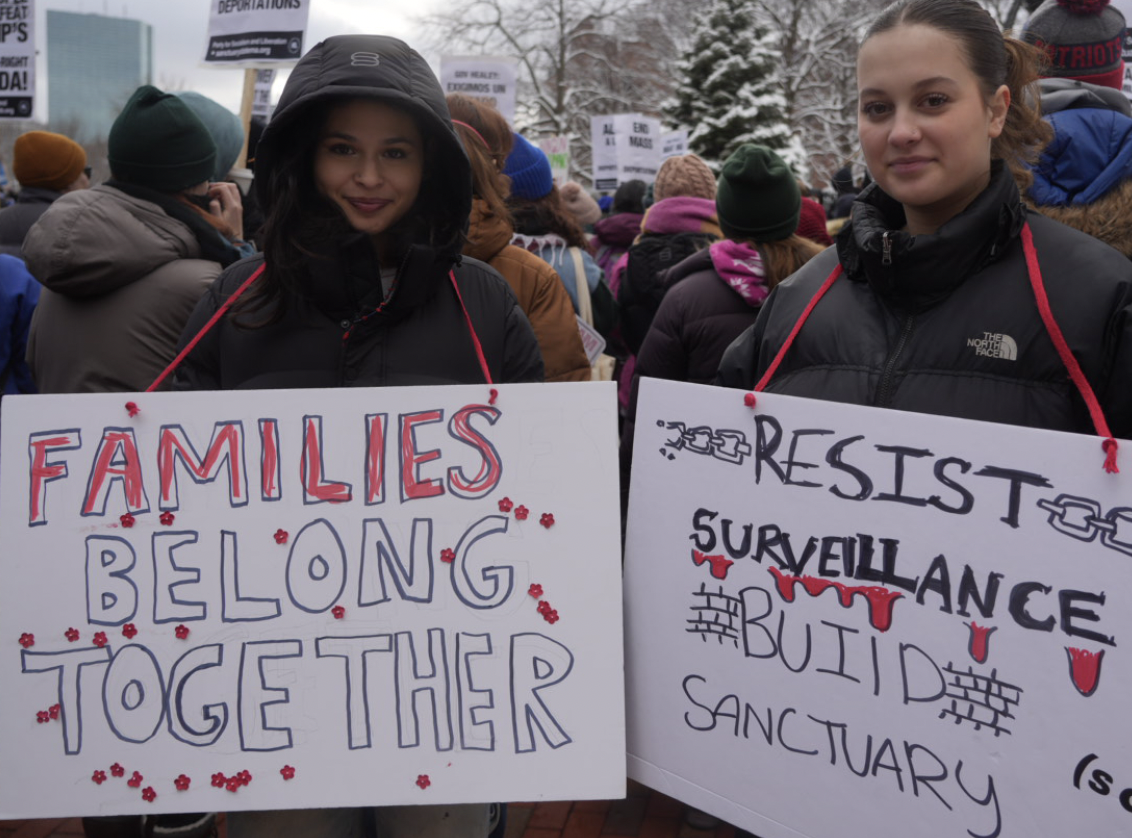
The premise of the article centers around the fact that Michigan Republican legislators proposed a resolution, which has now been adopted, that will threaten state funding if cities, counties and other public institutions – like universities – adopt any sort of Sanctuary policy. The resolution states in part:
An appropriations bill or conference report shall not be brought for a vote if it contains a legislatively directed spending item for which the intended recipient is a municipality or a university, including any official, department, or board of a municipality or university, that actively maintains any rule, policy, ordinance, or resolution that would subvert immigration enforcement in any way or that refuses to comply with federal immigration enforcement measures.
The MLive article cites four different sources in this article – Grand Rapids City Manager Mark Washington, GRPD Chief Eric Winstrom, Sgt. Scott Dietrich with the Kent County Sheriff’s Department and Sheriff Michelle LaJoye-Young. All four of these local officials really, really want us to know that they are cooperating ICE, and in no way want to be seen as “subverting immigration enforcement.”
The only non-governmental source cited in the article is the Center for Immigration Studies, which not only provides false information to MLive, they are actually an anti-immigration group, that “the Southern Poverty Law Center (SPLC), has “been part of a broad-based and well-planned effort to attack immigration in all forms,” according to Source Watch.
What we don’t see in the MLive article are comments from Movimiento Cosecha and GR Rapid Response to ICE, the two groups that have been pushing the City of Grand Rapids and Kent County to adopt Sanctuary policies. How is it that MLive can omit the very entities that are demanding that City and County officials take action to defend immigrants against the federal government’s threat of mass deportation?
It is instructive to note that whenever Movimiento Cosecha or GR Rapid Response to ICE are cited in local news stories, the local news agencies always include comments from government officials in order to show “balance” in those news stories. However, when government officials are cited, the local news doesn’t come to these community-based entities and get responses from them about what the government is or isn’t doing that impacts the affected communities.
It’s all about the money and the threat of it being taken away
The threat of withholding funding by the Federal or State governments for local communities that are taking a stand against unjust policies has been happening for decades. Movimiento Cosecha and GR Rapid Response to ICE have been told by plenty of white liberals during meetings they have held over the past few months, things like, “if we declared ourselves a Sanctuary City, it’s like putting a target on our back” or “the funds that would be withheld will disproportionately impact resources for vulnerable communities.”
First, let us be very clear that when the Federal or State government threatens to withhold funding, it is primarily a way to get people to fall in line and not threatened business as usual. When people, communities and movements are pushing for greater equity, for protection of the most vulnerable, or challenging unjust laws and policies, they do so to push what Dr. King said just days before he was assassinated, “We shall overcome because the arc of the moral universe is long but it bends toward justice.”
Second, people who are part of affected communities, those that are BIPOC, queer and and immigrants, already have a target on their backs from government policies and practices. People with courage and a commitment to justice and collective liberation don’t shy away from systems of power and oppression, they stand up and fight. People who make the claim that we should be quiet and not call for Sanctuary policies are primarily people who carry a great deal of privilege and are unlikely to have any target on their backs.
The goal of any social movement or movements of collective liberation should be to challenge, question, confront and dismantle systems of power and oppression. Of course this work isn’t easy or without risk. In fact, we should get used to taking risks, because that is what is what fighting for justice looks like.
Reflections on the campaign to get Kent County to become a Sanctuary for the undocumented community after today’s Kent County Commission meeting
This morning I arrived early to the Kent County Commission meeting, which began at 8:30am. These meetings are completely unaccessible for most working people, plus they don’t provide translation and you can’t get your parking pass validated.
When I entered the Kent County Building, there was a table set up in a lobby area, where County staff were asking if people were there for the Commission meeting. I had never seen this before, where they were asking people to filled out cards if they wanted to give public comment.

In addition, to the table, there were 5 or 6 officers from the Sheriff’s Department that were fully armed as if they were expecting a riot. Some were standing by the elevators to take people up. I asked what they were doing and they said they were “just keeping people safe.” I don’t feel safe around cops and immigrants and BIPOC communities really don’t feel safe around cops. I said that I didn’t need a cop to ride up with me and the cop said it was what his boss told them to do, so I took their stairs instead.
When I go to the 3rd floor, where Commission meetings are held, there were another 6 – 8 cops there, standing on either side of the entrance to the commission chambers. This really felt like a police state.
Since the issue of Kent County being a Sanctuary was not on the agenda, we had to wait to speak on the matter towards the end of the meeting. I want to spend the rest of this article making some comments about what happened, what was said and what wasn’t said. If you want to watch the entire proceedings, go to this link and where the Kent County Commission Chair begins the conversation around Sanctuary, starts at 59 minutes in to the video.
The Chairman of the Kent County Commission and several other commissioners used the excuse that they already had a policy, which in reality was a deference policy. I say deference, since the commissioners did not want to even consider what being a Sanctuary County would mean, so it is just easier to say immigration in a federal issue. Of course immigration policy is a federal issue, but immigrants, many of them undocumented immigrants, live in Kent County and live in daily fear of the threat of arrest, detention and deportation. This is exactly why Movimiento Cosecha and GR Rapid Response to ICE want county officials to adopt policies that limit the harm done to those who are extremely vulnerable right now and live in the county these politicians represent.
There were more people who spoke during public comment who supported Kent County being a Sanctuary, then there were those who opposed it. Those who spoke in favor of Kent County adopting a Sanctuary policy spoke about the importance of questioning unjust laws, about the direct harm mass deportation would affect, and how undocumented immigrants contribute with the work they do, the products they buy, the taxes they paid, etc. Those who spoke against Kent County being a Sanctuary, acknowledged that they too come from immigrant families, but their families came “legally.” Those who spoke against Kent County being a Sanctuary also often referred to immigrants as “illegal” or as “illegal Aliens.”
Those who spoke in opposition clearly demonstrated that they don’t know people who are undocumented, nor do they have relationships with them. Most of their comments were part of the highly scripted talking points of politicians, think tanks and news media, that have demonized immigrants by calling them “illegal” or worse, rapists, murderers and drug traffickers.
Also, some of the people who spoke against Kent County being a Sanctuary were likely invited by some of the more anti-immigrant commissioners, such as Wally Bujak, which I wrote about on Tuesday. These people were all older white folks, who live in parts of Kent County that were outside of Grand Rapids.
There was a former State Representative who spoke, who also said they were the current President of the Kent GOP. Her comments were a little less harsh in that she didn’t use “illegal aliens”, but she did talk about immigrants coming into the US the “right way” and that Kent County Republicans did not endorse the county being a Sanctuary. It was interest to see that the Kent County Democrats were not represented there to provide a counter-argument.
After the public comment period ended, the Commission Chair made more comments about why they would not be addressing the Sanctuary issue. Commissioner Bujak and Commissioner Greene also made claims that there were more people who had communicated via electronic mail or through petitions that were against the county being a Sanctuary, than those who supported it, but there was no way to verify that. Unlike the City of Grand Rapids, the Kent County government does not provide agenda packets before commission meetings. Grand Rapids City agenda packets not only include individual communications, they provide the language of petitions and a list of people’s name that signed on. Kent County does neither of those things, so the public has no way of verifying the claims of Commissioners Greene and Bujak.
There were two Democratic Commissioners that spoke with more reason. Commissioner Womack talked about the importance of human rights and Commissioner Morales implored her fellow commissioners to look at this issue with more grace, especially considering that 12-13 million undocumented immigrants are facing possible deportation.
Members of Movimiento Cosecha invited me to do a brief summary of what happened during the Kent County Commission meeting in a video with Gema Lowe and myself speaking in Spanish, which you can view here.
Just before we ended our conversation, one of the Cosecha members was commenting on a claim made by one of the County Commissioners, that “illegal immigrants don’t pay taxes.” Her response to this claim was, “I work hard and have always paid taxes, which means I contribute to the salaries of these politicians who make unfounded claims about people they know nothing about.” A better conclusion to this article, I could not come up with!
3204 people are already on record demanding that the City of Grand Rapids become a Sanctuary City compared to 16 people who oppose standing up for immigrants
It has been a little more than 2 weeks since there were more than 100 people who spoke during public comment at the Grand Rapids City Commission meeting to demand that the City of Grand Rapids declare itself a Sanctuary City and not allow the GRPD to cooperate with ICE.
This effort also included an Action Alert that was begun 3 weeks ago, which you can still sign and share.
There have been two Grand Rapids City Commission meetings since January 28th and in both cases, the Agenda packets for those meetings included a list of names that signed the Action Alert. Based on the two City Agenda packets, there have been a total of 3204 people to have signed on the demand that the City become a Sanctuary and commit to not allowing the GRPD to cooperate with ICE. I created a document with the 3204 names that support Grand Rapids being a Sanctuary City, which you can find here.
As I noted in my article after the January 28th GR City Commission meeting, specifically addressing a point by Commissioner Belchak, who said, “there were probably as many people who would oppose GR being a Sanctuary City, they just didn’t show up.” I wrote, Now, there is no way she could know this, but the fundamental difference is that what was on display last night was a demonstration of organized people getting behind a specific cause.
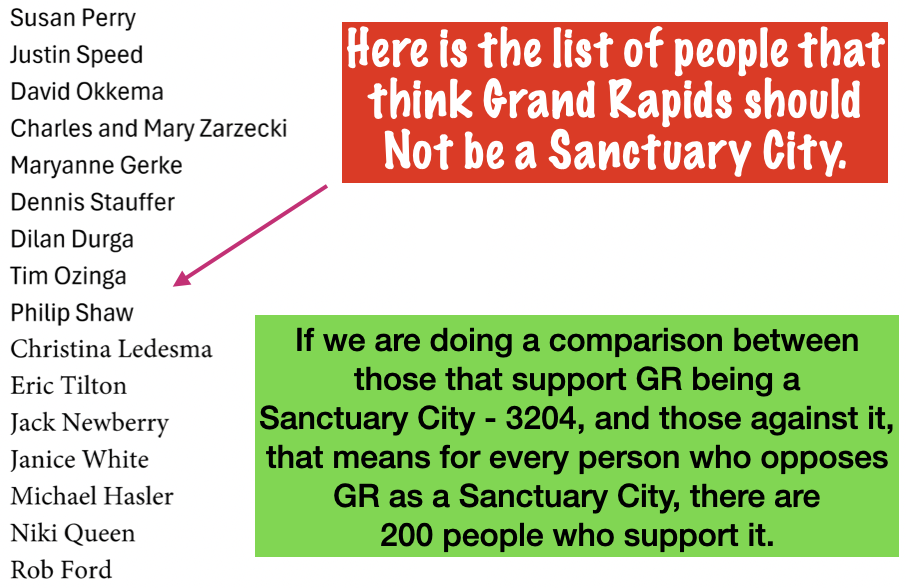
Well, now we know how many people who oppose Grand Rapids becoming a Sanctuary City, since it was part of the Agenda Packet for the February 11th City Commission meeting. There were 16 people who signed onto the statement included here below.
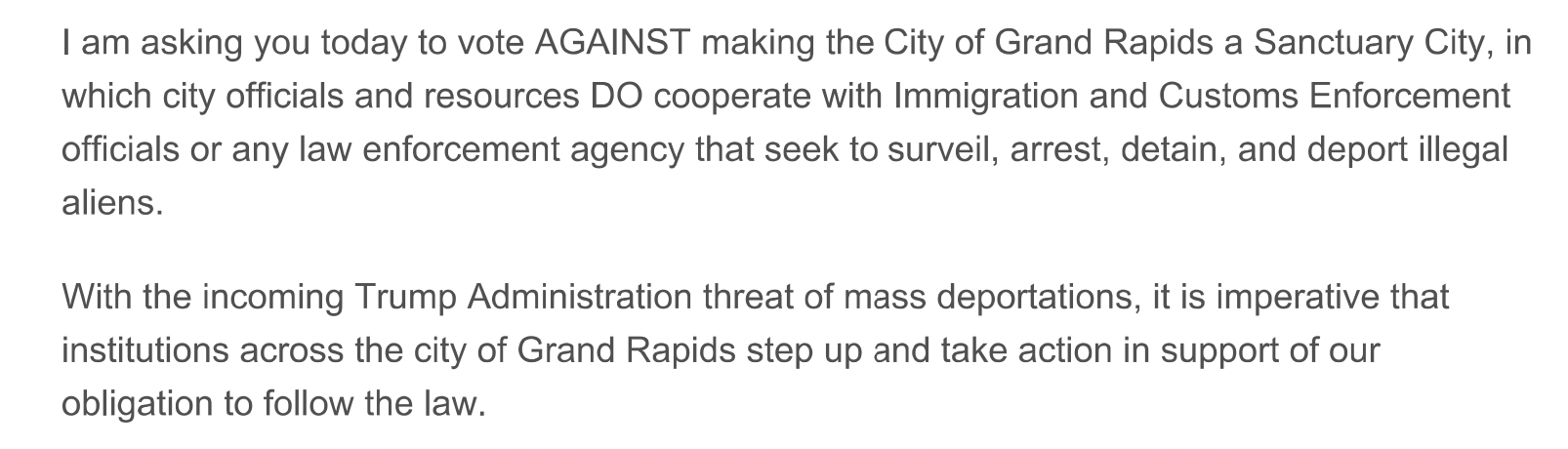
You can see for yourself what a weak and simplistic statement this is, which not only refers to immigrants as “aliens”, it centers the rule of law. The 16 people who signed on to this statement would probably have said the same thing when chattel slavery was legal, when Jim Crow laws were legal, when women couldn’t vote, when LGBTQ+ people could not marry, etc. Just because something is a law, doesn’t make it right. In Germany, the Nazi Holocaust was legal, plus the US military dropping atomic bombs on Hiroshima and Nagasaki, vaporizing several hundred thousand, was legal.
In the graphic near the top of this article, you can see the list of names that signed the letter opposing Grand Rapids becoming a Sanctuary. It’s a 200-1 ratio of those in favor of GR being a Sanctuary City. The numbers don’t lie.
Meet the Kent County Commissioner who opposes sanctuary for immigrants, is a pro-gun, anti-trans, anti-CRT, anti-DEI and anti-abortion
This Thursday, GR Rapid Response to ICE and Movimiento Cosecha will be attending the Kent County Commission meeting to demand that the County declare itself and Sanctuary and commit to not allowing the Sheriff’s Department to cooperate with ICE if they attempt to arrest, detain or deport undocumented immigrants.

The same two groups also began an Action Alert a week ago Monday, so that people could send messages to the County Commissioners, demanding that they declare themselves and Sanctuary and commit to having the Sheriff’s Department not cooperate with ICE. You can sign this Action Alert here.
The only Kent County Commissioner that GR Rapid Response to ICE and those that have sent the Action Alert have heard from is 21st District Commissioner Wally Bujak. Here is the message from Commissioner Bujak:
The question regarding whether Kent County is a “sanctuary county” has come up repeatedly. Kent County is not, and has never been, a sanctuary county.
It is also important to remember that immigration law and policy are determined at the federal level by courts and elected officials who have the authority to create and enforce such policies. Local governments, including Kent County and the Board, do not have the legal authority to create or implement immigration policies.
For years, the Board has adhered to Standing Rule 3.10(C), which prohibits considering or approving non-binding resolutions. This includes symbolic declarations, such as sanctuary status. Instead, the Board has chosen to focus on actionable issues within its jurisdiction, leaving immigration policy to those with the authority to make and enforce such decisions.
Seems pretty clear that Commissioner Bujak didn’t really read the Action Alert, choosing instead to deflect any responsibility from the County to the feds. The GR Rapid Response to ICE Action Alert clearly lays out the two demands, that the County of Kent:
- Declares itself a sanctuary to undocumented immigrants, and;
- Commits to preventing the Kent County Sheriff’s Office, Deputy Services, and Jail from cooperating with Immigration and Customs Enforcement officials and any law enforcement agency that seek to surveil, arrest, detain and deport undocumented immigrants.
In addition, if Kent County has a commitment to leave immigration policy up to the federal government, then why did Kent County have a contract with ICE from 2012 through 2019 – as I noted in a post from last week.
Commissioner Bujak can dance around this issue all he wants, but as of this posting, there are over 4,000 letters sent to Kent County officials, even before we show up to make these demands on Thursday morning during the Kent County Commission meeting.
It is also worth noting that Wally Bujak has only been a Kent County Commissioner for two years. He was re-elected last November, in a race for the 21st District in Kent County, where Bujak ran uncontested.
Even more noteworthy, is the fact that Wally Bujak ran as part of a group of Republicans in Kent County that called themselves the Kent Contact Coalition Candidates, which is model after the Ottawa Impact group in Ottawa County. They all signed a contract to uphold the following principles:
- Defending the 2nd Amendment and adopting a Constitutional Carry resolution.
- Anti-Public Education, Anti-Trans and Anti-CRT.
- Removing Kent County from the Government Alliance on Race and Equity, the Michigan Public Health Institute membership, and end the promotion of Planned Parenthood.
Commissioner Bujak not only opposes Kent County from being a Sanctuary County, he is committed to a pro-gun, anti-trans, anti-Critical Race Theory, anti-DEI and anti-abortion politician.

 Grand Rapids Institute for Information Democracy