Yesterday, Senator Carl Levin issued a brief statement on the killing of Osama bin Laden.
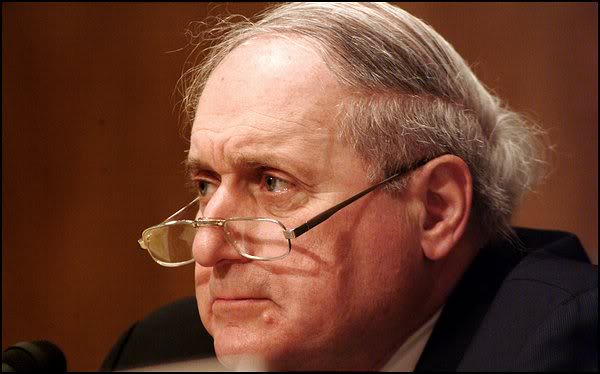
“The people of the world can feel relief and satisfaction that a monster has been brought to justice. Justice has a long memory and a long arm.
“I stand in awe and appreciation of the men and women of our military and our intelligence community, who have once again demonstrated their amazing courage and competence. Their heroism is a stark contrast to bin Laden, who while sending his underlings to die or huddle in mountain caves has been living in the comfort of a villa in Pakistan. Surely this will help puncture the myth of Osama bin Laden.
“This is a great victory in the fight against terrorism. But it is not the final victory.
“These events also bring back to us the pain of the terrible loss we suffered on Sept. 11, 2001, and of the sacrifices of the brave men and women who have been lost or wounded in the years since. It is their heroism, and not bin Laden’s hatred, that endures.”
The statement is revealing on many levels. First, Levin makes the claim that the “people of the world” feel relief that bin Laden is dead, even though the Senator never provides any evidence that the people of the world indeed feel this way. Some heads of state have made comments to that effect and some people in the US are rejoicing over the decision of the Obama administration to assassinate bin Laden, but there is hardly a sense that the people of the world feel relief.
In fact, many people around the world have reason to have a continued sense of fear, since the death of bin Laden will not end US military campaigns around the world. The people of Afghanistan, Pakistan, Iraq, Libya, Palestine, Egypt, Yemen and many other countries will not feel relief. The US military operations or US supported military repression in those countries will not end and will not even decrease in intensity because of the death of bin Laden, a point that Jeremy Scahill made yesterday in regards to Afghanistan & Pakistan while speaking on Democracy Now.
Secondly, Levin goes out of his way to make heroes out of the US military personnel who were involved in the operation that ended bin Laden’s life. Levin says that the men and women have demonstrated “amazing courage.” Interesting, so the most sophisticated army in the world, with the most deadly weaponry in the world demonstrates courage because they assassinated Osama bin Laden. How is this courageous? These men were just following orders.

Levin also said that the US military demonstrated amazing competence. If indeed, the US military did finally kill bin Laden, it took them almost 2 decades to do so, since bin Laden was on the hit list beginning with the Clinton administration. In fact, there are those who have worked in the US intelligence community who think that the US has had plenty of chances to kill or arrest bin Laden and have failed to do so over the past 20 years, a claim made by former intelligence officer Michael Scheuer in his book Imperial Hubris.
Thirdly, Levin states that the death of bin Laden is a victory in the “fight against terrorism,” but then says it is not the “final victory.” Again, Levin provides no evidence that the assassination of bin Laden is a victory in the US campaign against so-called terrorism. Indeed, the assassination of bin Laden will likely have no impact on actions of groups like al Qaeda or the Taliban insurgents in Afghanistan.
Fourth, Senator Levin uses the opportunity of the announcement of bin Laden’s death to talk about the terrorist attack against the US on 9/11/2001. This has been the case of much of the US media, where pundits make the point that those who lost family members in those attacks can now feel like justice has been served. What is problematic with such a position is that is assumes that bin Laden was responsible for 9/11. There is no hard evidence that bin Laden gave the orders for 9/11 and if he is indeed dead we will never know since there will be no trial to determine such a conclusion.
Lastly, the statement by Levin and the current news blitz omits the history relationship between Osama bin Laden and the US. Bin Laden has been presented only as an enemy of the US, but news agencies, President Obama and Senator Levin omit the fact that in the 1980s bin Laden was part of the Mujahideen insurgent forces fighting against the Soviet occupation of Afghanistan. Bin Laden, like many other Muslim extremists, was the recipient of US funding, weapons and training throughout the 1980s in that anti-Soviet campaign, a point that Bill Blum has documented well.
The US funding of bin Laden during the 1980s was also supported by Senator Levin and the majority of Congress who approved roughly $6 billion in weapons and other military aid to the Mujahideen. However, providing historical context is usually not of interest for the commercial media in the US, which means that Senator Levin will rarely be questioned on his foreign policy positions.
(This article is re-posted from OpenSecrets.)
During federal elections, contributions to moneyed political party organizations such as the Democratic National Committee or National Republican Senatorial Campaign Committee receive considerable attention. Less scrutinized are governors associations, which in recent years have attracted significantly more special interest cash than ever before.

Unlike political committees or candidates for federal office, the Democratic Governors Association and Republican Governors Association both may receive unlimited amounts of money in their bids to support gubernatorial candidates across the nation, including money directly from corporate and union treasuries. And raise cash they did.
During the 2010 election cycle, the RGA raised a total of $117.1 million. Interest groups, corporations and unions accounted for $73.1 million of these contributions to the RGA. And of this sum, $60.3 million (or 82.5 percent) came from businesses, lawyers and lobbyists.
According to a Center for Responsive Politics analysis of the top 50 donors to the RGA, 39 are corporate entities, and together, they gave $19 million to support the organization.
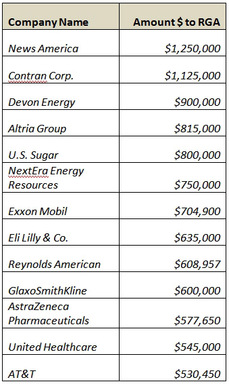
Topping the list of corporate contributors to the RGA is News America, at $1.25 million. News America is a subsidiary of News Corp., a company founded by media magnate Rupert Murdoch. News Corp. is the third largest media conglomerate in the world, and it owns Fox News Channel, the Wall Street Journal and the New York Post, among other publications.
Contran Corp. is a close second, having made $1.125 million in contributions to the RGA during the 2010 election cycle. Contran is a holding company that owns subsidiaries that specializes in chemical, metal, computer and waste management systems. In 2010 alone, the company also spent $340,000 to lobby the federal government.
The DGA, meanwhile, received $46.7 million of its overall $55.3 million in receipts during the 2010 election cycle from corporations, unions or special interest groups, and $32.7 million of that — or about 70 percent — came from corporations, lobbyists and lawyers.
Of the DGA’s top 50 donors, 32 are corporations from the health, energy or and telecommunications sectors.
Pfizer gave $590,770, and this represented the single largest corporate contribution to the DGA. Pfizer is a global pharmaceutical company that produces drugs such as Advil, Celebrex and Lipitor. During 2010, the drug company spent more than $13 million lobbying Congress on public health and tax issues.
Second on the DGA’s list is FirstEnergy Corp., which gave $550,000. FirstEnergy is an Ohio-based electric company and is a member of the Forbes 500 list. The company hired 15 lobbyists to influence lawmakers in Washington on energy, environmental and other issues last year.
Among major corporate contributors to the DGA and RGA:

A number of corporations ultimately hedged their bets in gubernatorial races by giving generously to both the DGA and RGA.
When comparing the top 50 donor lists for both associations, 15 companies sent money to both organizations, according to the Center’s research.
For instance, the U.S. subsidiary of AstraZeneca Pharmaceuticals contributed $577,000 to the RGA while also giving $520,000 to the DGA. AstraZenceca is a London-based pharmaceutical company that specializes in drugs that combats cardiovascular, respiratory and gastrointestinal diseases.
Similarly, the Correction Corporation of America gave $306,000 to RGA and $265,000 to DGA. Correction Corporation of America designs, constructs, remodels and manages prisons and jails. The organization also operates inmate transportation services through its subsidiary company, TransCor America.
Another company that donated to both associations is Wal-Mart. During this past election cycle, the massive retailer contributed $469,000 to the RGA and $411,000 to the DGA.
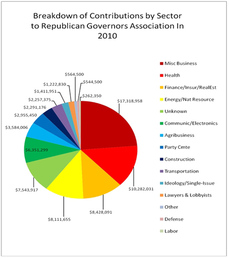
Click on the charts below to see how business and special interest sectors have contributed money to the DGA and RGA during the 2010 election cycle (click charts to enlarge):

Although corporations have made sizable donations to both governors associations, individuals have also made six- and seven-figure donations, particularly to the RGA.
In all, eight people gave at least $500,000 to the RGA during the 2010 election cycle, including Perry Homes chief Bob Perry ($8 million), Elliott Management hedge fund honcho Paul Singer ($2.38 million) and Koch Industries co-owner David Koch ($1 million).
Perry is also notable for his financial support of the Swift Boat Veterans for Truth organization that criticized Democrat John Kerry during his 2004 presidential bid and American Crossroads, a conservative group established last year in part by former George W. Bush strategist Karl Rove, as OpenSecrets Blog previously reported.
Eleven people donated six-figure sums to the DGA during the 2010 election cycle, including Newsweb Corp. Chairman Fred Eychaner ($450,000), lawyer J. Steve Mostyn ($400,000) and BLS Investments Chairman Bernard L. Schwartz ($350,000).
Six-figure contributions by Eychaner were also notably used by a political committee operated by EMILY’s List called Women Vote! to fund radio ads during the special election in Massachusetts in January 2010, as OpenSecrets Blog first reported in March 2010. Women Vote! was one of the first so-called “super PACs” to operate during the 2010 election cycle.
During the 2010 election cycle, the GOP won a net of six gubernatorial seats in the 38 contested state and territorial governorships.
The 2012 election cycle will feature only 13 gubernatorial races. But corporations, labor unions and ideological groups will likely invest their resources into these contests given their competitive nature and deep partisan divides across the nation.
On Saturday, while attending the May Day celebration in Grand Rapids, we had a chance to speak with Benton Harbor activist/organizer Rev. Pinkney.
He talked about what the newly imposed Emergency Financial Manager means for the people of Benton Harbor and what is being done to respond to what he called a “theft of democracy.”
Rev. Pinkney also informed us that there is a demonstration in Benton Harbor this coming Saturday, May 7. Michigan Governor Rick Snyder was invited by the city of St. Joseph to be the Grand Marshall of Grand Floral Parade, which is the biggest yearly event in St. Joseph & Benton Harbor.
People are invited to come and protest the parade this coming Saturday, May 7. People will meet at 11am in front of the Benton Harbor Public Library 200 Wall Street, then march to where the parade is being held.
For more information on the protest or the struggle in Benton Harbor go to http://bhbanco.blogspot.com/.
Grand Rapids Celebrates May Day 2011

Yesterday, hundreds of people from the community came out to celebrate in the 2nd annual May Day event organized by the Grand Rapids Chapter of the IWW.
While the day started out windy and cool, the sun finally broke through and it was a beautiful day for a celebration. Some 15 bands played throughout the day, including folks music, hip hop, Latin rock, punk, blues, rap and Indie music. The IWW also had a DJ there throughout the day spinning tunes between bands keeping the energy high.
These mix of music genres was reflected in the turnout with a racial diverse audience of people, some of which came from the immediate neighborhood surrounding Martin Luther King Park.
In addition, members of Stop Targeting Our Kids (STOK) provided some activities for children such as face painting and other artistic expression projects. The Really, Really Free Market was also open for several hours allowing people to exchange goods without having to spend any money. There was also free food provided by a new chapter of Food Not Bombs and garden plants from Our Kitchen Table. The new worker-run restaurant BarterTown also brought food for people to sample and to see how a worker-run restaurant differs from a management run business.
There were also several organizations there with information and resources. The Sprout Anarchist Collective had a table with zines and other resources, along with the IWW and the Bloom Collective.
Between bands groups had an opportunity to let people know about the grassroots and anti-capitalist work being done in Grand Rapids. There was also some poetry read, a speech by Rev. Pinckney from Benton Harbor and the IWW kept reminding people about the history of May Day and their call for a general strike. GRIID had a chance to speak with IWW member Cole Dorsey about some of these issues.
Barack Obama Seeks Big Bucks
(This article is re-posted from OpenSecrets.)
President Barack Obama returned Wednesday night to a land where campaign cash has flowed for him like milk and honey: New York City.

When Obama ran for president in 2008, of every $20 he raised, $1 came from someone in New York City, according to research by the Center for Responsive Politics.
Donors living in the NYC metro area contributed more than $42 million to Obama’s massive war chest during the 2008 election cycle, according to the Center’s research — more than any other metropolitan area.
And six of the 10 most prolific zip codes that backed Obama represent parts of New York City: 10024, 10023, 10021, 10025, 10128 and 10011.
As he battles for re-election, Obama is hoping to keep his New York City supporters energized and motivated to again open their pocketbooks for him.
On Wednesday night, Obama’s fund-raising tour in the Big Apple consisted of three events: one at the Fifth Avenue home of former Goldman Sachs chief executive officer and former New Jersey Democratic Sen. Jon Corzine, one at the prestigious Waldorf Astoria hotel and one at the Town Hall theater in Manhattan, which also featured music by the Roots. The three events reportedly raised more than $2 million, split between Obama’s nascent re-election campaign and the Democratic National Committee.
At the events, Obama lauded his successful elevation of two new women onto the U.S. Supreme Court — Sonia Sotomayor and Elena Kagan. “We put a couple more women on the Supreme Court — Lord knows we need them,” Obama said to applause.
During his 2008 presidential run, Obama also needed votes and financial support from women.
Female donors accounted for more than $145 million in itemized contributions, that is donations above the $200 threshold for itemized disclosure with the Federal Election Commission.
Male donors, meanwhile, gave Obama about $199 million in donations exceeding $200. That translates to about a 57-42 split between male and female donors.
Obama’s Republican challenger, John McCain, meanwhile, got about 72 of his itemized donations from men and only about 28 percent of his money from women, according to the Center’s research.
Senator Stabenow and the Future of Agribusiness Subsidies

Last week, Senator Debbie Stabenow was in Grand Rapids meeting with representatives from the agribusiness sector, according to MiBiz.
The business journal quotes the Senator as saying, “From farming and ranching to marketing and manufacturing, Michigan’s agriculture industry touches virtually every community, supporting one in four Michigan jobs and bringing more than $70 billion to the state annually.”
While it is true that agribusiness brings $70 billion to the state of Michigan, much of that profit goes into the hands of the agribusiness sector and does not provide a significant benefit to most Michigan families. In fact, Michigan taxpayers subsidize the agribusiness sector to the tune of millions each year. According to the Environmental Working Group, agribusiness subsidies have totaled $4.11 billion from 1995 – 2009.
The amount of these annual subsidies is exactly why the general manager for Country Fresh was so delighted to have a visit from Senator Stabenow. Country Fresh has also been the recipient of huge taxpayer subsidies and according to the Environmental Working Group the dairy sector (which Country Fresh is part of) received $208,146,457 from 1995 – 2009.

One of the main reasons that the agricultural sector receives such high taxpayer subsidies is because they lobby Congress to provide them with these huge cash payments. According to the Center for Responsible Politics, the Agribusiness sector has spent over $500 million dollars in the last 20 years in order to receive hundreds of billions of dollars in federal subsidies over the same period of time. Dean Foods, the parent company of Country Fresh, has contributed $665,200 alone in the past year to members of Congress.
The other reason that Country Fresh management was happy by Senator Stabenow’s visit is because she is the chairwoman of the U.S. Senate Committee on Agriculture, Nutrition and Forestry. Country Fresh invited Stabenow to one of their food processing plants in order to continue a relationship with the Senator, especially now that she is the chair of the Agriculture committee.
Senator Stabenow will be chairing the first of several hearings in Michigan on the 2012 Farm Bill, which will determine the amount of future taxpayer subsidies to agribusiness. This hearing is set for Tuesday, May 31st, from 9AM til Noon in the Kellogg Center at Michigan State University in East Lansing.
Country Fresh will no doubt have it’s own representatives at such a hearing and inviting Senator Stabenow to Grand Rapids just weeks before the hearing no doubt will be beneficial for them in terms of future subsidies.
(This article by Nick Turse is re-posted from TomDispatch.)

In recent weeks, Yemeni protesters calling for an immediate end to the 32-year reign of U.S.-backed President Ali Abdullah Saleh have been met with increasing violence at the hands of state security forces. A recent pledge by Saleh to step down, one of many that haven’t met demonstrators’ demands, has yet to halt the protests or violence by the troops backing his regime. During a demonstration earlier this month in the city of Taiz, protesters marching down a central street were confronted by security forces and Saleh supporters, while government helicopters flew overhead. “The thugs and the security forces fired on us with live gunfire,” Mahmud al-Shaobi, one of the protesters told the New York Times. “Many people were shot.”
In the days since, more demonstrators have been attacked by government forces — with the death toll now estimated to exceed 130. Witnesses have also been reporting the increased use of military helicopters in the crackdown. Some of those aircraft may be recent additions to Saleh’s arsenal, provided courtesy of the Obama administration as part of an $83-million military aviation aid package.
Since the beginning of 2011, under a program run by the U.S. Department of Defense, the United States has overseen the delivery of several new Bell UH-1Hs, or “Huey II” helicopters, current models of the iconic Huey that served as America’s primary gunship and troop transport during the Vietnam War. Although these helicopters are only the latest additions to a sizeable arsenal that the Pentagon has provided to Yemen in recent years, they call attention to how U.S. weapons and assistance support regimes actively suppressing democratic uprisings across the Middle East.
How to Arm a Dictator
Last December, 26-year-old Tunisian fruit-seller Mohammed Bouazizi set himself on fire in front of a local municipal office, touching off popular protests that continue to sweep across the Middle East and North Africa. By the end of January 2011, the country’s U.S.-backed dictator Zine El Abidine Ben Ali had fled and demonstrations, which would eventually also topple corrupt autocrat and long-time U.S. ally Hosni Mubarak, had broken out in Egypt. In Yemen, as is the case elsewhere in the region, anger at government corruption, rampant poverty (40% of all Yemenis live on less than $2 a day), high unemployment (also running at 40%), and decades of harsh rule by an authoritarian strongman brought tens of thousands into the streets.

In January, as freedom struggles were spreading across the region, President Barack Obama publicly avowed support for “certain core values that we believe in as Americans[,] that we believe are universal: freedom of speech, freedom of expression, people being able to use social networking or any other mechanisms to communicate with each other and express their concerns.” Just days earlier, however, his government had transferred military equipment to the security forces of Yemen’s so-called president for life.
Under the terms of a $27 million contract between the Pentagon and Bell Helicopter, Yemen received four Huey IIs. Prior to this, 12 Yemeni Air Force pilots and 20 maintenance personnel were trained to fly and service the aircraft at Bell’s flight instruction facility in Alliance, Texas. “The swift execution of the Yemen Huey II program demonstrates that the military departments — in this case the U.S. Army — can quickly deliver defense articles and services to U.S. partners with the cooperation of U.S. industry,” said Brandon Denecke of the Defense Security Cooperation Agency, the branch of the Pentagon that coordinates sales and transfers of military equipment to allies.
The recent helicopter deal is just the latest example of Pentagon support for the forces of the Yemeni dictator through its so-called “1206 program,” a Congressionally-authorized arrangement that “allows the executive branch to rapidly provide foreign partners with military equipment and training…” Named for section 1206 of the 2006 National Defense Authorization Act, the program allows the Pentagon to enhance the capabilities of foreign military forces for “counterterrorism and stability operations.”
Since 2006, more than $1.3 billion worth of equipment has been allocated under the 1206 program and Yemen has been the largest recipient worldwide, benefitting from about one-fifth of the funding or approximately $253 million through 2010. This assistance, according to a recent report by the Congressional Research Service, has provided Yemeni security forces with light airplanes, helicopters, small arms, ammunition, light tactical vehicles, trucks, radios, surveillance cameras, computers, body armor, patrol boats, and helicopter parts, among other materiel.
Since 2000, the Pentagon has also transferred weapons and equipment directly from U.S. stockpiles to Yemen’s security forces. These items include armored personnel carriers, M-60 machine guns, 2.5-ton military trucks, radios, and motorboats, according to an analysis of Defense Department documents by TomDispatch. The Defense Security Cooperation Agency did not respond to repeated requests for further information.
All told, over the past five years, the U.S. has provided more than $300 million in aid to Yemen’s security forces, with the dollars escalating precipitously under the Obama administration. In 2008, under President George W. Bush, Yemen received $17.2 million in baseline military assistance (which does not include counterterrorism or humanitarian funding). In 2010, that number had risen to $72.3 million while, overall, Yemen received $155.3 million in U.S. aid that year, including a “$34.5 million special operations force counterterrorism enhancement package.” These funds have provided Yemen’s security forces with helicopters, Humvees, weapons, ammunition, radio systems, and night-vision goggles.
Additionally, U.S. special operations troops (along with British and Saudi military personnel) have been supporting, advising, and conducting training missions with some of Yemen’s elite forces — including the Republican Guard, Special Operations Forces, and the National Security Bureau — which are commanded and staffed by Saleh’s sons and other close relatives.
As his part of the bargain, Saleh allowed the U.S. to launch missile strikes against suspected al-Qaeda camps in Yemen while instructing his government to take credit for the attacks (for fear that if their American origins were made clear, there might be an anti-American backlash in Yemen and the larger Arab world), according to classified State Department documents released last year by the whistleblower group Wikileaks. “We’ll continue saying the bombs are ours, not yours,” Saleh told then-CENTCOM commander General David Petraeus following strikes in December 2009.
The Yemeni government also came up with a cover story for, and even excused, the deaths of civilians in those strikes. Rashad al-Alimi, a deputy prime minister, claimed that the Yemeni citizens killed in an attack were “acting in collusion with the terrorists and benefiting financially” when, in reality, they were likely Bedouin families involved in little more than peddling food.
Not So Tough Talk
As Yemen’s security forces have escalated their violence against demonstrators this spring, the Obama administration has offered mixed signals regarding Saleh, but has yet to issue an outright condemnation of the dictator, no less sever ties with a leader seen as crucial to the fight against al-Qaeda. “We have had a good working relationship with President Saleh. He’s been an important ally in the counterterrorism arena,” said U.S. Secretary of Defense Robert Gates on March 23rd. “But clearly, there’s a lot of unhappiness inside Yemen. And I think we will basically just continue to watch the situation. We haven’t done any post-Saleh planning, if you will.”
On April 5th, White House Press Secretary Jay Carney came out more forcefully. “The United States strongly condemns the use of violence by Yemeni government forces against demonstrators in Sanaa, Taiz, and Hodeida in the past several days,” he said. “The Yemeni people have a right to demonstrate peacefully, and we remind President Ali Abdullah Saleh of his responsibility to ensure the safety and security of Yemenis who are exercising their universal right to engage in political expression. “
That same day, however, Pentagon spokesman Geoff Morrell was more equivocal, justifying enduring U.S. support for Yemen’s strongman as a “prudent course of action,” while including the protestors as the equals of the security forces in his condemnation of the use of force: “The protests, the demonstrations need to be nonviolent. Obviously, the government needs to respond to them in a nonviolent manner. So we are — we condemn the violence all around.”
Morrell also sought to distance the Pentagon’s aid for the country’s security forces from the violence being meted out in Yemen’s streets. He told reporters, “To suggest that the aid to Yemen has somehow been used against protesters I think is a leap of faith for which there is no evidence to support.” Recent reports, however, suggest that Yemen’s elite U.S.-trained counterterrorism troops have now been deployed in the capital, Sanaa, to deal with the massive ongoing protests.
Late last year, the Pentagon floated a new proposal to pump up to $1.2 billion more into Yemen’s security forces over the next five years. However, with protesters in the streets week after week in vast numbers and significant elements of the military defecting from the regime, the Obama administration failed to write Saleh a check and began quietly urging him, through back-channel communications, to hand over power — assumedly to a successor likely to favor U.S. interests.
Finally, on April 23rd, after Saleh seemingly agreed to an arrangement brokered by Arab mediators that would grant immunity from prosecution to his family and him, and eventually shift power to his deputy for an interim period, the Obama administration threw its support behind the plan. A spokesman characterized it as “responsive to the aspirations of the Yemeni people.” Not only have many opposition protesters rejected the deal, while Saleh’s troops continue to attack them, but the dictator has slowly backed away from it as well.
And yet, despite weeks of violence that have left hundreds dead or wounded, President Obama has yet to publicly and unequivocally call for Saleh to step down as he did, albeit belatedly, with former Egyptian president Hosni Mubarak and, more recently, Libyan leader Muammar Gaddafi.
Sending a Message
Earlier this month, Tawakul Karman, a Yemeni human rights activist and antigovernment protest leader, told the New York Times of her anger at Obama for his failure to issue such a call. ”We feel that we have been betrayed,” she said. Hamza Alkamaly, another prominent youth leader, echoed the same sentiments: ”We students lost our trust in the United States.”
After watching two allied autocrats fall in Tunisia and Egypt, the United States has focused on its periodic enemy, Col. Muammar el-Qaddafi, in Libya and has done little of substance to advocate for, let alone facilitate, demands for democracy and social change by protesters in allied states that are more integral to its military plans in the region, including Yemen, Bahrain, Iraq, Jordan, and Saudi Arabia. Instead, Washington has continued to support repressive governments to which it has provided training, weapons, and other military equipment that has already been used or could be used to suppress grassroots democratic movements.
In the case of Bahrain, the U.S. has provided millions of rounds of live ammunition, helicopters, and tanks. For Saudi Arabia, it was a weapons deal worth tens of billions of dollars that will have Saudi pilots training in the U.S. In Iraq, the U.S. is aiding the very units of the security forces implicated in crackdowns on the free press. And these are only a few examples of recent U.S. efforts in the Middle East.
A survey of Yemeni adults conducted in January and February by the U.S.-based polling firm Glevum Associates found exceptional hostility to the United States. Ninety-nine percent of those surveyed viewed the U.S. government’s relations with the Islamic world unfavorably, 82% considered U.S. military influence in the world “somewhat bad” or “bad,” 66% believed that the U.S. hardly ever or never took into account the interests of countries like Yemen, and just 4% “somewhat” or “strongly approved” of President Saleh’s cooperation with the United States.
The numbers could hardly get more dismal, but anger and resentment can deepen and become even more entrenched. When protesters look to the skies over Sanaa in the days and weeks ahead, they may notice new American-made, U.S. taxpayer-financed helicopters hovering above them. Unless the Hueys are seen ferrying the dictator away in a scene reminiscent of Saigon in 1975, Yemenis — more than two-thirds under the age of 24 — are likely to remember for a very long time which side the United States took in their freedom struggle.
Circus Protest Planned for this Friday in Grand Rapids

A group of local animal rights activists have organized a protest against the Circus when it is in town this weekend.
Too often we think of that the animals used in a circus are treated well and willingly do whatever “tricks” they do for the audience. According to PETA, “For animals in circuses, there is no such thing as “positive reinforcement”—only varying degrees of punishment and deprivation. To force them to perform these meaningless and physically uncomfortable tricks, trainers use whips, tight collars, muzzles, electric prods, bullhooks, and other painful tools of the trade.”
Those who have organized the Grand Rapids protest also make a statement about how animals are treated in the circus.
“Help us stop the cruelty. These animals have horrible lives and are trained with whips and chains. They live in small trailers and do not even have room to turn around. They submit to this cruelty because they are completely broken down.”
Anyone who opposes the animal cruelty in circuses is invited to come with signs and send a message to those who paid to see animals mistreated.
Friday, April 29
4 – 7:00 PM
DeltaPlex Arena & Conference Center
2500 Turner Ave NW
Grand Rapids, MI 49544
Jesse Jackson calls for uprising in Benton Harbor
(This article from Eartha Jane Melzer is re-posted from The Michigan Messenger.)
Residents of Benton Harbor should not lose their democratic rights or their city parks just because the city is poor, Rev. Jesse Jackson said yesterday, and he called for people to speak out against Michigan’s Emergency Manager law.

In an op-ed to the Chicago Sun Times Jackson wrote:
Benton Harbor’s finances are a mess. How could they not be in a town stripped of jobs and hope? So, the state has stripped its residents of their democracy. In what is accurately termed “fiscal martial law,” the state has named a czar to run the city. That appointee, Joseph Harris, has issued an order essentially stripping the elected city council of all powers. No money can be spent, no taxes raised or lowered, no bonds issued, no regulations changed without his approval. Benton Harbor’s residents now live in a dictatorship imposed by a Republican governor famous for his belief that the poor should be punished and the rich rewarded.
This appointed dictator claims breathtaking powers. He can sell public assets, dismiss pension boards and take control of public pension funds and revoke labor contracts. What triggers this takeover? The law is remarkably vague. The governor may act if a payroll is missed, if there are complaints of late bill payment, if pensions are underfunded, if there is a significant budget deficit, a term that goes undefined.
This takeover is a recipe for the worst abuses of oppression, cronyism and corruption. And here, too, Benton Harbor is the example. One of the few citizen treasures in Benton Harbor is the Jean Klock Park, a half-mile of sandy dunes on the edge of Lake Michigan. It was bequeathed to the children of Benton Harbor by the Klock family in 1917 in memory of their daughter.
But developers backed by Whirlpool now want to appropriate a large portion of the park to turn it into a Harbor Shores golf resort with a 350-room hotel, two marinas, a 60,000-foot indoor water park (for members only), and a fancy golf course open to all who can afford a $5,000 entry fee and be approved by the club. The town’s citizens have resisted this development, which is under litigation.
But the new czar’s first act was to take over the Brownfield Redevelopment Authority, most likely as a way to proceed with the development and sidestep the lawsuits. Why be suspicious? Because the law that the new czar is operating under was introduced by Republican state Rep. Al Pscholka, former staff aide to U.S. Rep. Fred Upton, an heir to the Whirlpool fortune.
They’ve shut down the jobs, and taken over the schools. Now they want to shut down the democracy and turn the public parks into a rich man’s playground. But in Benton Harbor, as in Selma and Montgomery, they forget even the poorest people have a sense of dignity. Dr. King wrote, “the ultimate tragedy is not the oppression and cruelty by the bad people but the silence over that by the good people.” In Benton Harbor, it is time for the good people to make themselves heard.
People from throughout the region are expected to converge on Benton Harbor today for a noon march and rally in response to the suspension of local government.
This Date in Resistance History: The Trial of Emile Henry
On this day in 1894, Emile Henry was brought to court on charges of murder and insurrection. Henry, born in 1872 in Spain, was the son of a Communard who had been exiled after the collapse of the Paris Commune.

As an adult, Henry traveled to France and studied the history of social justice and the oppression of workers. He had arrived at a point where class warfare was reaching a fever pitch. The gap between the rich and the poor was widening, just as it is today. The wealthy flocked to the grand cafés to be seen and to mingle; to the wedding-cake Parisian opera house for entertainment; and to restaurants for meals of eight courses. Meanwhile, the poor were suffering and invisible. They had no representation in parliament; they were underpaid or living in poverty; and many died young from diseases which spread in the Parisian slums. Child labor was widespread (and is still, amazingly, a serious problem in France today).
As he witnessed this social injustice, Emile Henry’s views became increasingly radical. On hearing of a strike of mine workers in Carmaux, he traveled there to stand in solidarity with the miners. What he found there appalled him.
The mining company was notorious for union-busting, and on August 15 of 1892, the workers took over the offices of the mine and declared themselves on strike. Supposed union sympathizers had arrived on the scene, offering to set up a strike fund and appeal for contributions. The miners allowed these men to collect funds for their ongoing fight against the owners of the mine. But the workers saw only a fraction of the money collected in their names, while the organizers advised the miners to resist peacefully.

Meanwhile, Henry saw clearly that the miners had lost the initiative to attack the financial underpinnings of the mining operation. They could have destroyed already-mined coal, sabotaged machines, and created other damage that would have given them the leverage to negotiate. Instead, the miners held out passively for two months while the company simply sold its reserves of coal. Finally broken, their families starving, the workers returned to their jobs.
The mining company, owned by the wealthy capitalist Baron Reille, continued its punitive work practices, while having suffered no financial loss from the thwarted attempt of the miners to improve their condition.
Enraged, Henry, whose father had also been a miner, decided to bomb the mining company’s offices. The bomb was discovered before it detonated, and inept police officers brought the bomb back to the police station without defusing it first. It exploded, killing several officers.
Henry returned to Paris directly after his bombing attempt, and discovered that a fellow anarchist had bombed the Palais-Bourbon (the French parliament of the time). In the wake of this action, students and other radicals were being indiscriminately rounded up for arrest, often without charges. “Nobody was concerned about what happened to the wives and children of these comrades while they remained in jail,” Henry wrote. Meanwhile, he observed the wealthy enjoying their luxurious “café society” lifestyle, supported by their oppression of workers and the suppression of unions in France.
The Café Terminus was, at the time, the leading café of the elite. Located on the ground floor of a luxurious hotel, the café featured gilded chairs, marble-topped tables, mirrored and gilded walls, and its own orchestra. A meal there cost the equivalent of several days’ wages for a worker. It was located near the Paris Opera House, and so was busy during the day and also before and after opera performances.

Henry packed a metal lunchbox, the type that the miners had carried into the mine shafts, with dynamite and a tube of zinc filled with buckshot. He entered the café, drank two beers, and then threw the activated bomb toward the orchestra stage. It flew up in the air, exploding on contact with one of the café’s huge crystal chandeliers. The force of the explosion shattered the marble tables, punched a crater into the floor, and shattered the mirrored walls.
Later, Henry never attempted to defend himself. He did not declare himself to be innocent. He accepted responsibility for the bombing, which killed one patron of the café and injured twenty. In an explanation of his actions, he wrote in part:
But why, you ask, attack those peaceful café guests, who sat listening to music and who, no doubt, were neither judges nor deputies nor bureaucrats? Why? It is very simple. The bourgeoisie did not distinguish among the anarchists….Those good bourgeois who hold no office but who reap their dividends and live idly on the profits of the workers’ toil, they also must take their share in the reprisals.
Both at his trial and in his written statement, Emile Henry maintained that nobody who enjoyed a luxurious life at the expense of inadequate pay, inhuman working hours, and unsafe working conditions was “innocent.” He stated:
We will not spare the women and children of the bourgeois, for the women and children of those we love have not been spared. Must we not count among the innocent victims those children who die slowly of anaemia in the slums because bread is scarce in their houses; those women who grow pale in your workshops, working to earn forty sous a day and fortunate when poverty does not force them into prostitution; those old men whom you have made production machines all their lives and whom you cast on to the waste heap or into the workhouse when their strength has worn away? At least have the courage of your crimes, gentlemen of the bourgeoisie, and grant that our reprisals are completely legitimate.
Emile Henry was executed by guillotine on May 24, 1894. He was 21 years old. In his short life, Henry chose the most extreme of political actions, with which many might disagree. Even so, it is striking to look at the social justice/economic situation to which he responded and see so many parallels to worker struggles today.
 Grand Rapids Institute for Information Democracy