 Editor’s note: I have been working with Fountain Street Church and looking at a substantial amount of archival materials they have. Today’s post is only possible because Fountain Street Church has provided me access to their archives and they want this information to be public and available to the community. I will be hosting the archival material on the Grand Rapids People’s History Project site, but also posting here on GRIID. This is the second in a series of postings from the archival material at Fountain Street Church.
Earlier this year I posted a transcript of a lecture from Kwame Ture, known as Stokely Carmichael when he spoke at Fountain Street Church in May of 1967, which you can read here.
Today, I want to post an audio file of a lecture that civil rights activist James Meredith gave in March of 1967 at Fountain Street Church.
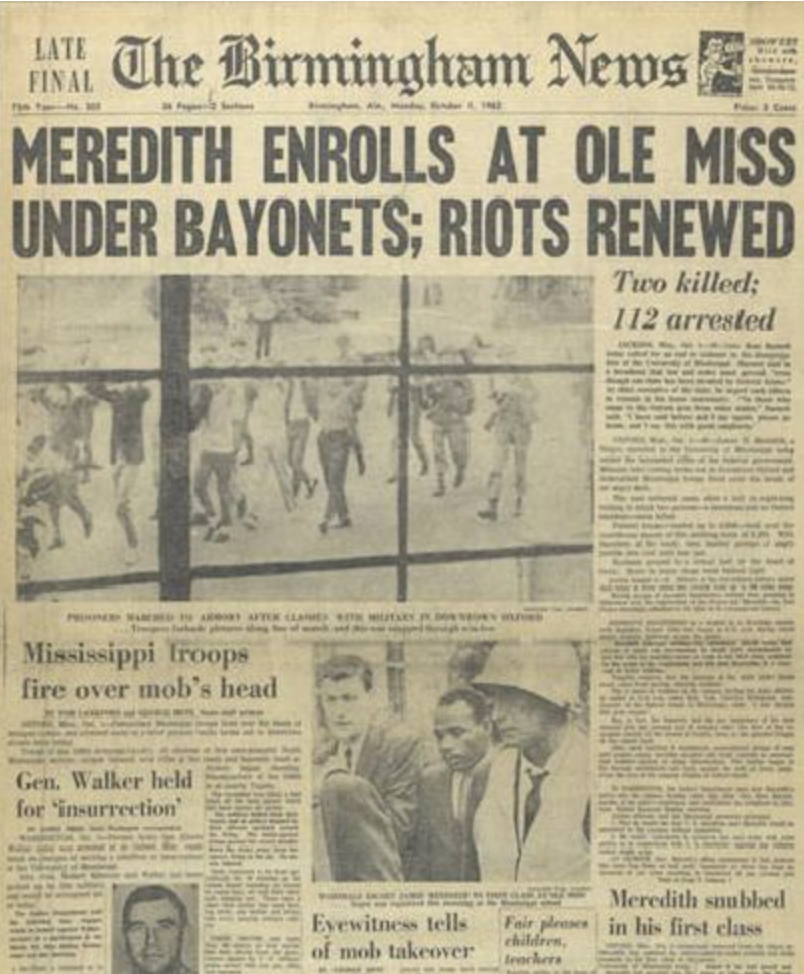
James Meredith was known for being the first Black student to be admitted into the racially segregated University of Mississippi in 1962. Meredith decided to enroll in U Miss to pressure the Kennedy Administration into actually supporting desegregation policies in the South. A riot broke out in September of 1962, since the the University of Mississippi, white students and white alumni were opposed to desegregating the school.
In 1966, Meredith planned a solo 220-mile walk, which he called a March Against Fear. Meredith wanted to highlight continuing racism in the South and encourage voter registration after passage of the Voting Rights Act of 1965. On the second day of the march Meredith was shot at by white gunmen, and suffered several wounds. After recovering from the gunshot wounds Meredith started the march again and was joined by some 15,000 along the way.
Here is the 56 minutes talk by James Meredith on March 8th, 1967.
Image used is in this post is from https://www.digitalhistory.uh.edu/disp_textbook.cfm?smtID=8&psid=4186&filepath=http://www.digitalhistory.uh.edu/primarysources_upload/images/Meredith_Enrolls_at_Ole_Miss_LG.jpg
An interesting response to my recent post about the DeVos-owned bourbon label: Liberals acting as apologists for the DeVos family
In early August, I posted an article entitled, DeVos family always looking to expand their wealth, this time with high end bourbon and whiskey.
The article looked at the West Michigan-based CraftCo. and its JOSEPH MAGNUS, FOX & ODEN, and COPPERCRAFT brands of bourbon and whiskey that Dick and Betsy DeVos recently purchased, but it primarily talked about the DeVos family’s expansion of investments and companies that will allow them to grow them their wealth. I also talked about how they use their wealth in the political arena to buy candidates and policies that benefit their interests, which are the interests of the Capitalist Class.
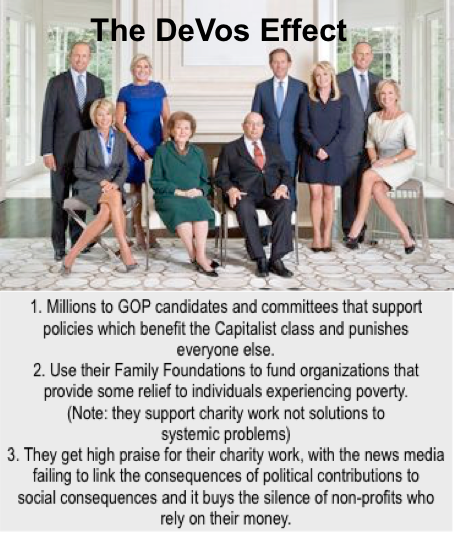
Here is one response I saw to that article, a response that I found very instructive:
“Good, while you are at it don’t go to DeVos Hall, GR public museum, the symphony, the opera, the ballet, or any of dozens of institutions they have funded for fifty years. Boycotts do nothing. I’m a dyed in the wool democrat but I appreciate everything the DeVos family has done for the city and I am not naive enough to believe boycotting their commercial enterprises will do one thing to stop their political contributions. Which they have the same right to do as do we. Develop community and quit vilifying.”
I think some deconstruction of this response is in order.
First, when the person says that people should boycott the institutions that the DeVos family has funded for 50 years, that is a statement that I do not disagree with. This is why billionaires get away with so much, since there are never enough organized campaigns to challenge their economic and political power.
Second, saying that boycotts do nothing is just historically wrong. The Montgomery Bus Boycott was very effective in the early years of the Civil Rights Movement. Then there was the South African Anti-Apartheid campaign that began in 1959, which included boycotting as a tactic, along with divestment and sanctions. The South African Anti-Apartheid campaign was also successful, even though it took longer than the Montgomery Bus Boycott to get the results that South Africans wanted. Boycotts are an effective tactic against systems of power and oppression, but the most effective boycotts are those that are initiated by people that are most impacted, like the boycotts that the Palestinians are calling for right now.
Third, the person who made the response said that they are, “a dyed in the wool democrat.” To me this makes sense, since there are too many people who identify as Democrats that limit their political understanding to voting and not on larger strategies and tactics that will actually make way more change than voting does.
Fourth, this Democrat then says that they “appreciate everything the DeVos family has done for the city.” And what would that be exactly? In every instance where they have purchased property in downtown Grand Rapids, especially the places that have their names on it, the public has contributed more in any of those endeavors than the DeVos family has. This means that the public, primarily through tax dollars, have done a great deal for the city, despite the fact that the public has had virtually no say in how that money is spent. The person who made this statement fails to understand that the DeVos family, like all billionaires are strategic. The DeVos family gave money to the arena, the downtown market, the Civic Theater, to the Amphitheater, the Soccer Stadium, just to name a few. Why? Because they will be one of the very entities that will profit from such ventures, since it means that people will stay at the hotels they own and eat in their restaurants. This is why the DeVos family has their people strategically placed on boards that make decisions about the downtown, because it mostly benefits their interests, not that of the majority of the people who live in Grand Rapids.
Fifth, this person again fails to understand how pressuring billionaires, both economically and politically, can be effective as strategies and tactics. This person also says that the DeVos family has the right to make political contributions, just like we do. Holy fucking shit! Does this person not understand that they give a crap load more money to political candidates, because they are billionaires? Does this person think that the DeVos family campaign contributions to 5 Kent County positions in the 2024 election, contributions that were $330,000 – the bulk of these Kent County candidates – is equal to what the rest of us can do?
The DeVos family is not just making political contributions to candidates, they are buying access and they are influencing public policy in ways that most of us never could. I have been tracking this shit for decades, which you can read in my 800 page document called, We’re Rich and We Do What We Want: A DeVos Family Reader. Chapter 3 is the chapter that looks at campaign financing.
Lastly, this person says develop community and stop vilifying. This is just plain ignorant. Does this person think that billionaires become billionaires purely on hard work. Fuck no! Billionaires become billionaires because they exploit people and resources, along with using a political and economic system that is designed to benefit a small percentage of the population. Sure, the DeVos family has foundations, but if you look at that stuff closely, most of their foundation contributions also go to institutions that promote and benefit from power and oppression. Besides, billionaires create foundations primarily as a way to hide some of their wealth so it will not be taxed.
Statements like the one that prompted this article make it clear there are too many people who are willing to give billionaires a free pass. Not only that, but there are people who are unknowingly doing the bidding of billionaires, like the DeVos family, by defending them and acting as apologists for their desire to dominate the economic, political, social and cultural dynamics of Grand Rapids. I for one will continue to vilify the DeVos family as long as I draw breathe.
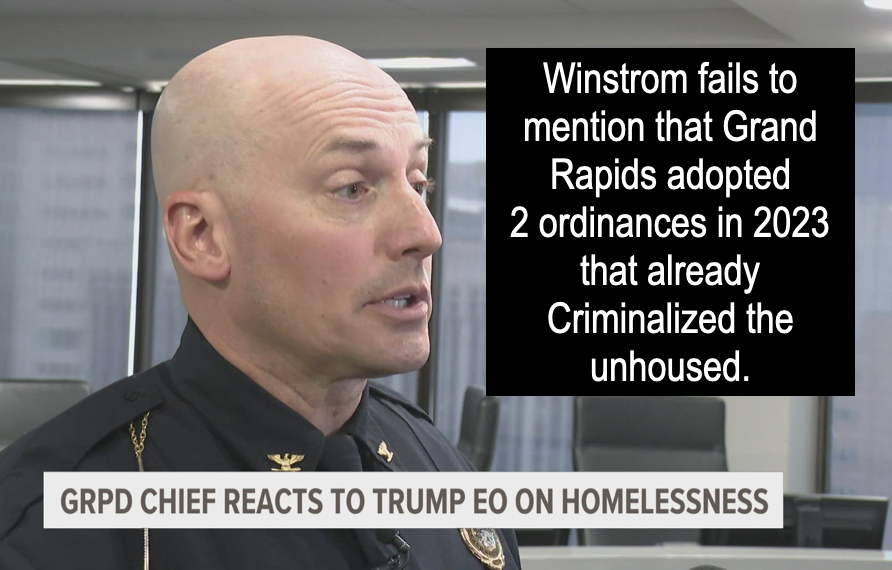
In late July, after President Trump issued an Executive Order that would further criminalize the unhoused, WZZM 13 ran a story about how Grand Rapids, and specifically GRPD Chief Winstrom, was responding to that Executive Order.
Winstrom said that the GRPD has removed 4 cops from the Homeless Outreach Team (HOT), stating: “We had to remove those officers just simply to respond to 911 calls, because we saw the time people were calling 911, it was taking 15 minutes for officers to respond.”
Not having GRPD cops interact with unhoused people is a good thing, since we know that cops aren’t trained to provide community care and they generally respond with force in those interactions.
Winstrom then goes on to say:
“I think there’s some grant information in there involved, like the federal government was going to look to give grants to different municipalities looking at that, but I think we’re doing a pretty good job here in the City of Grand Rapids, supporting our unhoused community, and I don’t see it having a big impact.”
Chief Winstrom might be referring to the 100 campaign that Grand Rapids has been involved in, but that is somewhat of a show piece response in Grand Rapids, one that was primarily motivated by removing unhoused people from downtown Grand Rapids in order to minimize their interactions with people who are spending money in downtown GR, especially when it comes to tourism.
More importantly is the fact that the WZZM 13 reporter completely ignores the Grand Rapids ordinances that were adopted two years ago that already criminalized the unhoused in Grand Rapids. Those ordinances were promoted by the Grand Rapids Chamber of Commerce and the downtown business community that sought to rid downtown of unhoused people by criminalizing them.
WZZM 13 fails the public miserably on the issue of the unhoused in Grand Rapids. First, they do not provide proper context by excluding any information about the Grand Rapids City ordinances that already have criminalized the unhoused. Second, the channel 13 reporter only provides Chief Winstrom’s voice to the exclusion of those who are unhoused and those who are advocates of the unhoused. Essentially, Grand Rapids adopted policies to criminalize the unhoused 2 years prior to the recent Executive Order from President Trump.
It has been 22 months since the Israeli government began their most recent assault on Gaza and the West Bank. The retaliation for the October 7, 2023 Hamas attack in Israel, has escalated to what the international community has called genocide, therefore, GRIID will be providing weekly links to information and analysis that we think can better inform us of what is happening, along with the role that the US government is playing. All of this information is to provide people with the capacity of what Noam Chomsky refers to as, intellectual self-defense.

Information
The Accursed Fate of Palestinians in Israeli Prisons
Hundreds of Former Israeli Spies Are Working in Big Tech, Database Shows
The Christian Zionist View of Foreign Policy Is Holy War
Gaza Exposes the Bankruptcy of Western Liberalism
Senior Israeli Commanders Openly Contradict Netanyahu Claim On Gaza Destruction
Airdrops kill starving people with rotten food
‘Blatant and Premeditated Attack on Press Freedom’: Israel Assassinates Five Gaza Journalists
ISRAEL’S BIGGEST US DONOR NOW OWNS CBS
The New York Times Continues to Give Netanyahu the Benefit of the Doubt
Analysis & History
Trump’s Gaza Famine w/ Akbar Shahid Ahmed
Senior Hamas Official to Trump: We Are Ready to Make a Fair Deal
Free Speech and Gaza: Norman Finkelstein in Conversation with Cornel West and Nadine Strossen
Image used in this post is from Code Pink https://www.codepink.org/armsembargonow.
GRIID is taking a break til next week sometime
 Just taking a short break for a little rest and relaxation. However, I will be back sometime next week to continue doing the media watchdog work, monitoring systems of power in Grand Rapids and documenting movement organizing in West Michigan.
Too often movement work, particularly of BIPOC organizers gets ignored, overlooked and misrepresented, so there is always a need to document what is happening from the ground up.
Chinga La Migra!
Far right Trump cheerleader Charlie Kirk, who spoke in Grand Rapids in 2020, is also endorsing US military occupation of cities across the US
MAGA influencer Charlie Kirk celebrated President Donald Trump’s “Liberation Day” takeover of the nation’s capital by calling for the Trump administration to unleash a “full military occupation” of other large American cities “once we liberate” Washington, D.C.
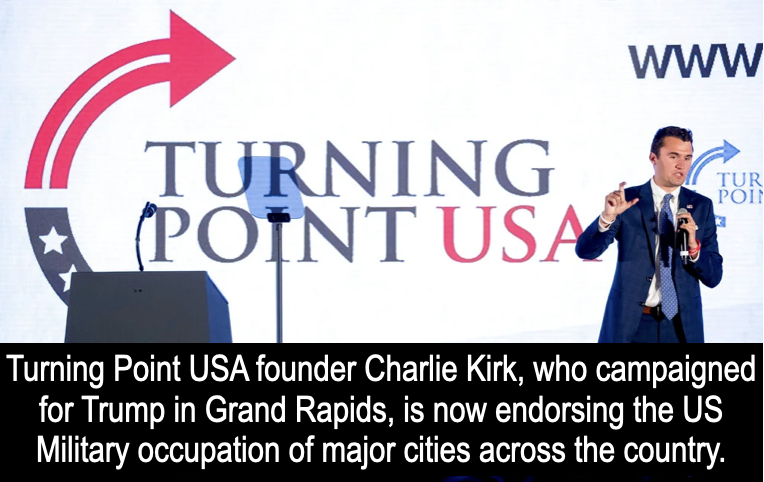
During his podcast on Monday, Kirk – one of the president’s most loyal media acolytes and founder of the MAGA youth organization Turning Point USA – urged Trump to send more American military forces into other cities in short order, claiming it would create favorable press coverage, according to an article on The Independent.
Kirk was saying that “we have a big teenage problem of crime in our country,” and suggested that teenagers get long prison sentences for auto theft. Kirk, who in many ways is a younger version of Donald Trump, who engages in all sorts of outlandish rhetoric, but has a populist following of primarily white youth.
People might remember that Charlie Kirk was in Grand Rapids in 2020 stumping for Trump at a rally in Rosa Parks Circle hosted by Students for Trump.
Kirk founded Turning Point USA in 2012, according to SourceWatch. Turning Point USA makes the following claim on their website:
Since its founding, Turning Point USA has embarked on a mission to build the most organized, active, and powerful conservative grassroots activist network on high school and college campuses across the country. With a presence on over 2,000 campuses, Turning Point USA is the largest and fastest-growing youth organization in America.
According to SourceWatch.org, Turning Point USA has ties to the Koch Brothers, the fossil fuel industry and the Trump family.
However, the most overt aspect of Turning Point USA and its founder, Charlie Kirk, is their use of racist propaganda and its relationship to White Supremacists groups across the country.
The Southern Poverty Law Center, in one article, documents several examples of Turning Point USA leaders making racist comments:
TPUSA’s flirtation with racists and racism is well documented. In a December 2017 expose in The New Yorker, reporter Jane Mayer was provided screenshots of a text message from TPUSA’s (now former) national field director, Crystal Clanton, that read, “i hate black people. Like f— them all… I hate blacks. End of story.”
Kirk himself has been criticized for his anti-immigrant and anti-Muslim tweets, and he habitually tweets out racist dog-whistles with statements like, “It would take 40 years worth of blacks killed by cops to equal the number of black [sic] killed by other blacks in one year.”
In an article for Newsweek, TPUSA founder Charlie Kirk rails against Black Lives Matter and their unfounded use of rioting in response to the police murder of George Floyd.
In another public talk, Kirk said that there is no such thing as systemic racism in police departments. In fact, Kirk says, “cops are more likely to be shot by Black people,” as stated in this video.
In this brief exchange, Kirk talks about why he likes Immigration and Customs Enforcement and in yet another video Kirk defends building the Wall along the the US/Mexican border. In both instances Kirk uses false information.
It is worth noting that when Kirk was in Grand Rapids in 2020, there were, according to the Turning Point USA Chapter Map, TPUSA chapters at Forest Hills Eastern High School, Forest Hills Northern High School, GVSU, Hope College and West Ottawa High School, all predominantly white schools.
On Saturday, MLive posted an article entitled, 23 Michigan counties lean on a little-known immigration fund. It’s getting more money.
The irony is that one of the reasons the funding for this “little-known immigration fund” is because the commercial news media has not reported on it. While this MLive article is welcomed, they don’t explore the significance of what is known as Operation Stonegarden.

According to Homeland Security’s Grants Office, “Operation Stonegarden (OPSG) supports enhanced cooperation and coordination among Customs and Border Protection (CBP)/United States Border Patrol (USBP), and federal, state, local, tribal, and territorial law enforcement agencies to strengthen border security.”
The MLive article provides some information on how Operation Stonegarden funds are being used by counties in Michigan that either border or are near the US/Canadian border. However, the MLive reporter limits their article to only talking to local law enforcement entities, particularly in the Upper Peninsula. In other words, MLive doesn’t bother to speak with immigrants about this so-called border security funding program, nor do they talk to groups like Movimiento Cosecha. GR Rapid Response to ICE, No Detention Centers Michigan, the Michigan Immigrant Rights Center and any number of organizations that are doing immigrant justice work in Michigan. The only perspective in the article is from law enforcement and their perspective is that they are delighted with the extra funding on immigration related matters.
The MLive article does provide a link to the Operation Stonegarden program of the Department of Homeland Security, but they don’t spend much time on looking at what one might find at this link https://www.homelandsecuritygrants.info/Grant-Details/gid/21875.
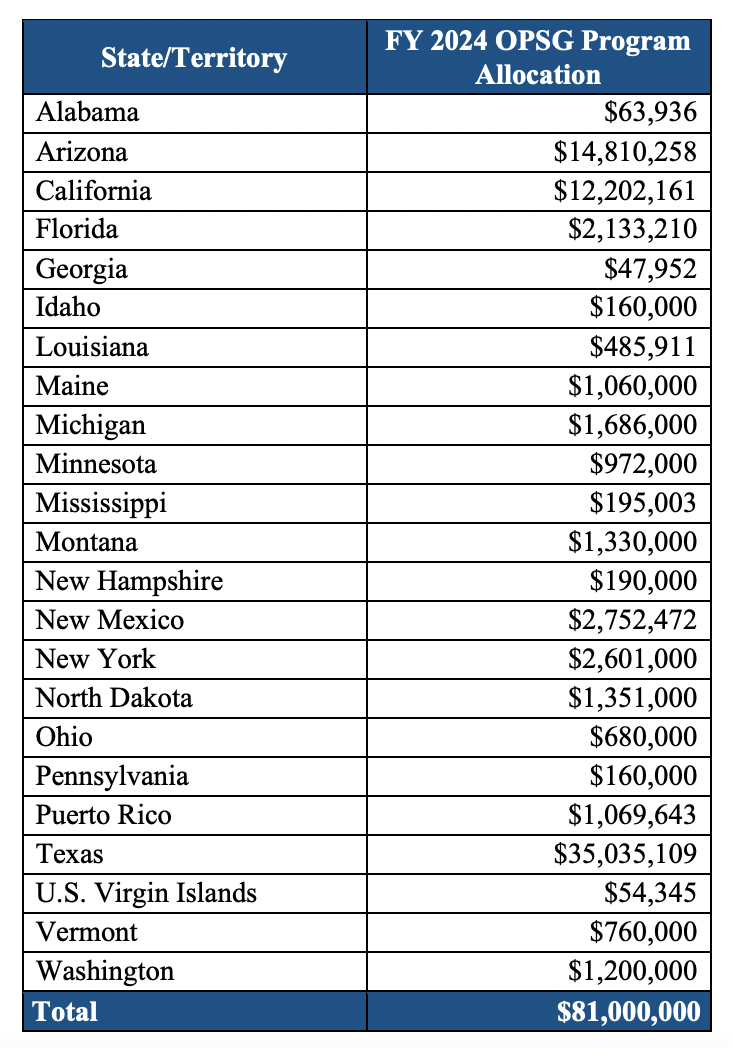 At this link you will find a report from FY 2024 regarding the funding for Operation Stonegarden (OPSG). “OPSG provides $81 million to enhance cooperation and coordination among state, local, tribal, territorial, and federal law enforcement agencies in a joint mission to secure the United States’ borders along routes of ingress from international borders, to include travel corridors in states bordering Mexico and Canada, as well as states and territories with international water borders.” (See Table 3 here on the right.) Based on the table, Michigan received the 7th largest amount of funding through the Operation Stonegarden program, a total of $1,686,000.
In 2023, the amount that Michigan received was $1,886,500.
In 2022, the amount that Michigan received was $1,902,500.
Keep in mind that the funding for these three years was during the Biden Administration. We cannot forget that the Biden Administration deported some 4 million people and that funding for Immigration and Border Security was at an all-time high. However, with the passing of the Big Beautiful Bill, the Trump Administration will expand border security, funding for ICE and private detention facilities with an additional $170 billion.
Commies of Grand Rapids wants to be edgy, but in reality they just promote White Supremacy and love to blame the unhoused
Just because some people attack the government, doesn’t mean they are revolutionary or edgy in their thinking. This is true of the new Facebook page called Commies of Grand Rapids.
They claim to be non-profit news company, one that is associated with Capital Media Labs, but neither of these claims are true. Some people might think this is merely a spoof page, especially because of the name of the page, but the ideas and images they present are harmful and normalize ideologies like White Supremacy.
Commies of Grand Rapids started posting on July 31st and already have several dozen posts. The content is short, weak and primarily relies on using information or images from other content creators. Their positions are nothing more than opinions, since they do not provide any sources to support their claims.
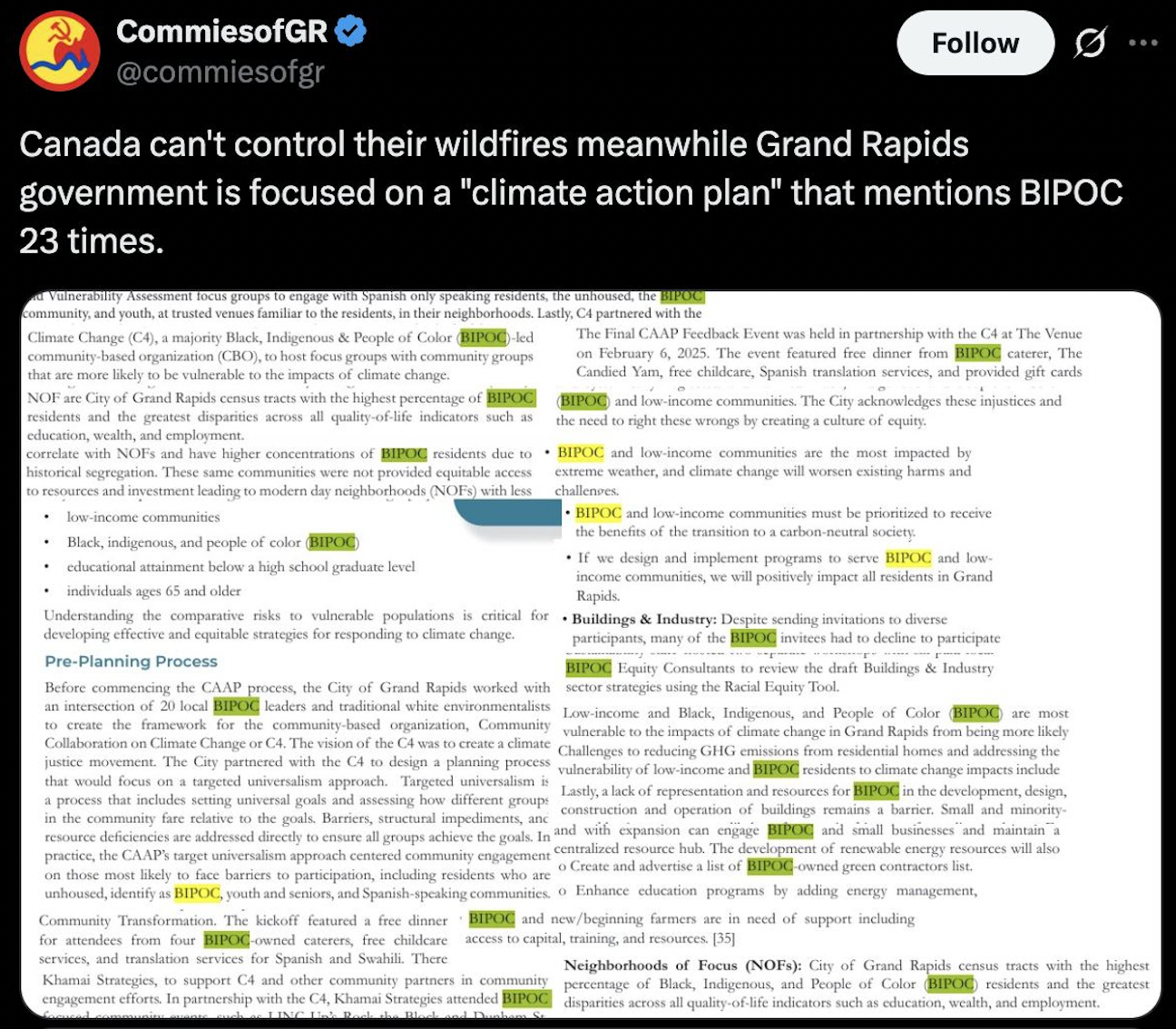
Now, I don’t believe for a second that Commies of Grand Rapids is a new entity, rather it is the project of those who embrace White Supremacist values and have nothing but contempt for the unhoused. Here are some examples.
Just a fews days ago, Commies of Grand Rapids posted the above image, where they point out that in the document the term BIPOC was used 23 times. No one is doubting that the Canadian wildfires are creating a problem for people in Grand Rapids, but the document they are making fun of is about what the City of Grand Rapids can do to practice a more sustainable Climate policy. It just so happens that the reason why BIPOC is used frequently in this document is due to the fact that BIPOC organizers pushed for language in this Climate plan that would recognize that BIPOC communities are disproportionately impacted by Climate Change. Pointing out the number of times BIPOC is used is the same mentality that led to All Lives Matter as a response to Black Lives Matter.

Other examples are the use of images of Black men with commentary about how these Black men are going to get their charges expunged. Commies of Grand Rapids never uses images of white people with negative commentary, only Black people.
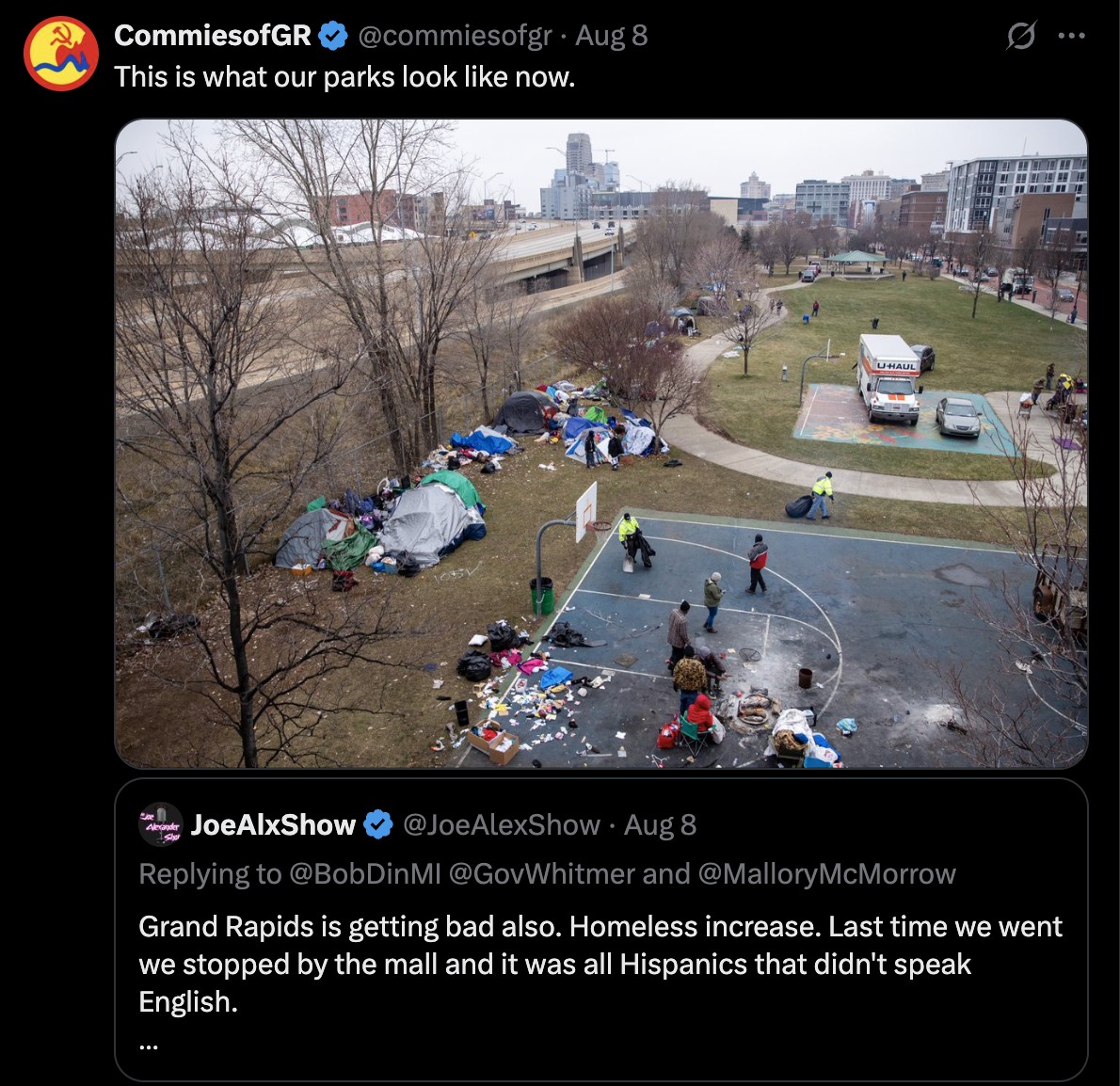
Then there are some posts that shit on the unhoused. In one image they make the claim, “This is our parks look like now,” referring to the Heartside Park in downtown Grand Rapids. The images is from several years ago, shortly after the beginning of the pandemic in 2020. The folks at Commies of Grand Rapids failed to note that shelters during COVID were a breeding ground of disease and that in December of 2020, the GRPD forcibly evicted unhoused people from Heartside Park and threw away most of their belongings.
In another anti-unhoused image they try to make the link between fentanyl use in Grand Rapids, the unhoused and “river equity”, which is a dig on the rhetoric that the City of Grand Rapids has been using about the development along the Grand River. The image on the left is the from the same unhoused encampment at Heartside in 2020, just a different angle.

What Commies of Grand Rapids doesn’t talk about
One way you can tell whether or not something or someone is a fake populist, is by their rhetoric. Commies of Grand Rapids takes pot shots at local government and the things they are bad at, which apparently leads to people being unhoused, the drug problem, BIPOC people as the problem or the fact that they are trying to develop Climate plans that are stupid because they don’t address Canadian wildfires.
Another way to tell that Commies of Grand Rapids is not interested in a real or structural change is by what they don’t talk about. The Grand Rapids Power Structure, the DeVos family, Grand Action 2.0, the GR Chamber of Commerce, the Right Place Inc., are never discussed by those who use the hammer and sickle symbol. There are no critiques of the use of public funds for the Amphitheater, the Soccer Stadium, the City’s ordinance that criminalized the unhoused, the GRPD murder of Patrick Lyoya, the GRPD assaulting and arresting Black community organizers or how the GRPD treats grassroots organizers in general. Commies of Grand Rapids also don’t talk about the cost of housing and the cost of rent, nor the millions in subsidies that have been provided to apartment and condo projects, like the DeVos/Van Andel 3 Towers project, which are unaffordable for the majority of the population.
In the end, Commies of Grand Rapids is just the rantings of another fake populist(s), with commentary that normalizes White Supremacy and blames the unhoused for whatever they see fit.
Arrogant and Ignorant: When white Christians think they are doing the Lord’s work in Grand Rapids
On Saturday, I was volunteering with GR Rapid Response to ICE to provide some crowd safety at the Glimpse of Africa festival at the Calder Plaza. The organizer’s of this event asked GR Rapid Response to ICE to have a presence in case Immigration and Customs Enforcement showed up to intimidate and apprehend members of the African diaspora community, African refugees.

While doing crowd safety, I noticed early on that a group of about 15 young white people, likely high school or college age, had walked passed me several times. Eventually, the group planted themselves in front of the main entrance to the Calder Plaza and then put up their large anti-abortion signs, all of which read…..”Human Rights begins in the womb.”
I thought to myself, how arrogant and ignorant it was for these young white Christians to stand at the entrance of a festival that was specifically for members of the African diaspora to celebrate their culture, their heritage and to let people in West Michigan know that they too make up part of the West Michigan community.
These young white Christians could have been part of Protect Life Michigan or Grand Rapids Right to Life, but ultimately that doesn’t really matter, since they seemed utterly clueless about the lived experiences of those who had organized the Glimpse of Africa festival, those who had information booths, vendors and those who came to support them.
Why would these young white Christian anti-abortionists make it a point to hand out their propaganda to people who were already marginalized in the White Supremacist West MI Nice culture and people who are feeling increased anxiety because of the Trump Administration’s anti-immigrant policies?
Ultimately, these young white Christians are practicing and perpetuating a form of White Supremacy. Those young white Christians clearly are oblivious to what White Supremacy is. If they took the time to learn what White Supremacy is and then examine their own beliefs and behaviors, they would never be standing near the entrance of a festival organized by people who are part of the African diaspora.
In addition, if these young white Christians were interrogating themselves around White Supremacy, they might begin to think about why people from Africa are now living in West Michigan and how US foreign policy contributes to that dynamic. A quick look at recent research and analysis tells us some of the following important points about US Foreign Policy and Africa:
From the Quincy Institute – “Technically, the United States is not at war in Africa. But the practice and terminology of the US-led War on Terror has changed, making the US military’s involvement more difficult to trace. In the past 15 years, the US government has quietly expanded its military footprint across the African continent, engaging in “special operations” with African troops in the name of security. Since the 2007 establishment of the Africa Command (AFRICOM), the defense department’s regional combatant command for Africa, the US has adopted a military-first approach to securing its interests on the continent. This has had disastrous effects.”
From a recent article in The Guardian – “A decision by the US government to incinerate more than $9.7m (£7.3m) of contraceptives is projected to result in 174,000 unintended pregnancies and 56,000 unsafe abortions in five African countries.”
An article from the long time Africa analysis Nick Turse – “A new Pentagon report offers the grimmest assessment yet of the results of the last 10 years of U.S. military efforts on the continent. It corroborates years of reporting on catastrophes that U.S. Africa Command has long attempted to ignore or cover up.”
Lastly, I am not simply pointing out my disgust at these young white Christians and their White Supremacist practices, I believe that as white people we need to constantly interrogate our own perpetuation of White Supremacy and refute the notion that if I am a Liberal, a Progressive or a Democrat that I am not internalizing and perpetuating White Supremacy in one form or another.
It has been 22 months since the Israeli government began their most recent assault on Gaza and the West Bank. The retaliation for the October 7, 2023 Hamas attack in Israel, has escalated to what the international community has called genocide, therefore, GRIID will be providing weekly links to information and analysis that we think can better inform us of what is happening, along with the role that the US government is playing. All of this information is to provide people with the capacity of what Noam Chomsky refers to as, intellectual self-defense.

Information
Israel abducted starving children at Gaza “aid” sites, then tortured them.
Israel Bans Palestinians From Gaza Sea, Cutting Off Yet Another Food Source
Gaza’s Starvation, Israeli Lies and the Tail that Wags the Dog
HUNGER IN GAZA CAN’T BE EXPLAINED AWAY BY PREEXISTING CONDITIONS
Jewish-Led Protest Outside Trump Hotel Demands End to US Support for Gaza Genocide
Trump Admin to Withhold Disaster Aid from Any State or City That Boycotts Israeli Products
NYT Suppressed Genocide Discussion When It Could Have Made a Difference
“Out, Damned Spot!” The Actively Complicit Try to Launder a Genocide
Analysis & History
New report from Israeli Human Rights Group B’Tselem – Our Genocide
Rashid Khalidi on Genocide Complicity, From Columbia to the White House
Israel’s Gaza War Is One of History’s Worst Crimes Ever
“Tightening the Chokehold”: Amjad Iraqi on Israel’s Plans to “Empty Out” Gaza and Annex West Bank
Image used in this post is from Doctors Without Borders.


