A pro-data center panel was featured at the GR Chamber of Commerce annual Policy Conference last week
Last month I wrote a piece about how the Grand Rapids Chamber of Commerce has publicly endorsed Data Centers. I cited a recent report from Data Center Watch there has been $64 billion of data center projects that have been blocked because communities have become organized.
However, despite massive public opposition, the Grand Rapids Chamber of Commerce is in favor of data centers. The Chamber’s Vice President of Government Affairs, Christine Simon wrote an article entitled, BUILDING NEXGEN INFRASTRUCTURE: DATA CENTERS IN WEST MICHIGAN, which was posted on February 6th.

At the GR Chamber’s annual Policy Conference, they had a panel discussion that not only features a representative of Microsoft, the entire panel was pro-Data Center. Crain’s Grand Rapids Business wrote about this panel discussion in an article entitled, Microsoft faces the public as it pursues two Grand Rapids-area data center projects.
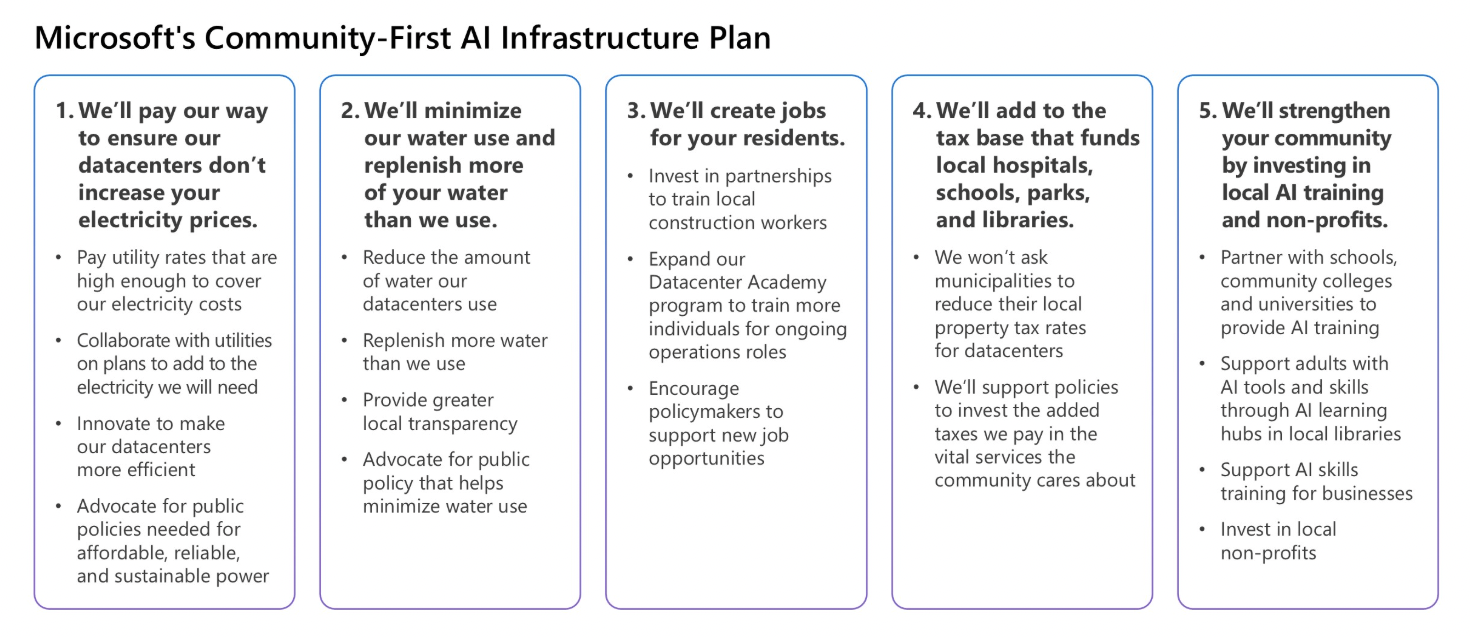
The Crain’s article provides numerous comments from the panelists, especially Microsoft’s senior director of government affairs and infrastructure, Jonathan Noble. Noble made some claims about being responsive to public concerns, but he also laid out their strategy for increasing the number of data centers around the world. This strategy is called, Microsoft’s Community-First AI Infrastructure Plan. Despite the flowering pro-public rhetoric from Microsoft they have never in their corporation’s history been pro-community. Microsoft’s goal is to maximize profits and to answer to their board of directors and their shareholders, which is not the same as the public.
Another pro-data center member of the GR Chamber’s panel said:
“If Michigan wants to remain relevant in this space, we as an industry really need to embrace it, and we’ve taken the right steps to get there, We’re just starting to build this state up for this industry and what we really don’t want to see is kind of taking another step backwards. I would like us to continue to see the positive policies that were set forth for this industry a couple of years ago continue so that we can bring in great businesses like Microsoft to the state and really help build up the communities that we’re in.”
Wow, so this person thinks that Microsoft will be good for our communities and that we all need to embrace data centers.
The Crain’s article goes on to say:
Don Shoemaker, co-founder of Franklin Partners and part owner of the Lowell Township site, said Microsoft is under contract to purchase the property. Franklin Partners, an Oak Brook, Ill.-based commercial real estate firm, specializes in the sale and redevelopment of large industrial sites.
“We’ve gotten pretty much into the data center world,” Shoemaker said. “The demand isn’t slowing down. It’s about where you can get zoned with the community that wants us and get power. It’s all about getting the community support behind it, really.”
So, it’s all about getting community support. What Shoemaker did not say was that getting the public to support data centers means that companies like Microsoft want to con the public into believing that data centers will be good for the community regardless of all the evidence to the contrary. As I mentioned earlier, if data centers are so wonderful why have communities rejected data center projects to the tune of $64 billion that the public said no to?
On Tuesday, the Grand Rapids Chamber of Commerce provided a summary of their Policy Conference, which included a link to the slides from the Microsoft representative. The slides are primarily about Microsoft’s Community-First AI Infrastructure Plan, all to convince the public – or in the case of the GR Chamber Policy Conference attendees – that they really care about the public and that data centers are really about serving communities. Here is one slide that provided their definition of what a data center is:
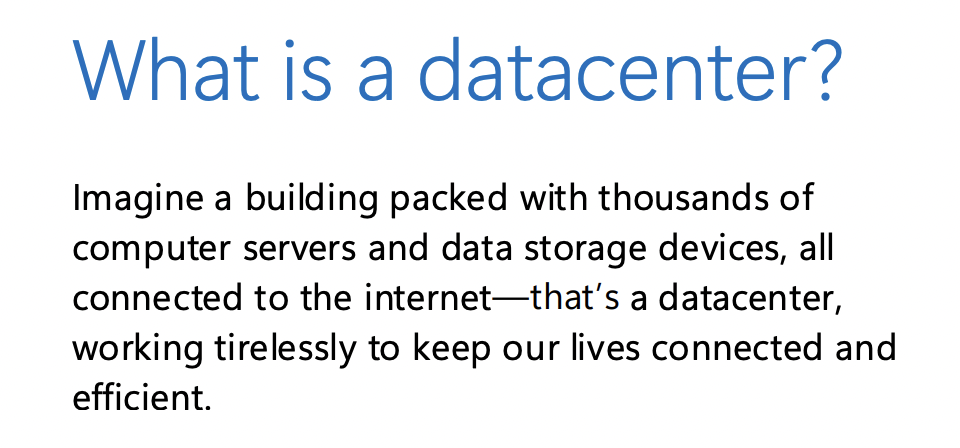
Are we really supposed to believe that data centers are all about keeping our lives connected and efficient? Microsoft, and by extension the GR Chamber of Commerce, must really think that the public is so gullible that we would believe this shit. We never need data centers to keep our lives connected, since human beings have connected with each other for as long as humanity has existed, long before data centers ever existed. All the more reason to oppose data centers when corporations like Microsoft want to shovel more of their propaganda in our communities.
On Sunday, I posted a story about the action that Movimiento Cosecha and GR Rapid Response to ICE organized at the home of the Chair of the Kent County Commission Ben Greene.
I would encourage you all to read my account, which you can read here, since I was a participant in that action. In fact, it is essential that people read this account first or watch the video that Movimiento Cosecha posted that includes the entire action, which you can find here.
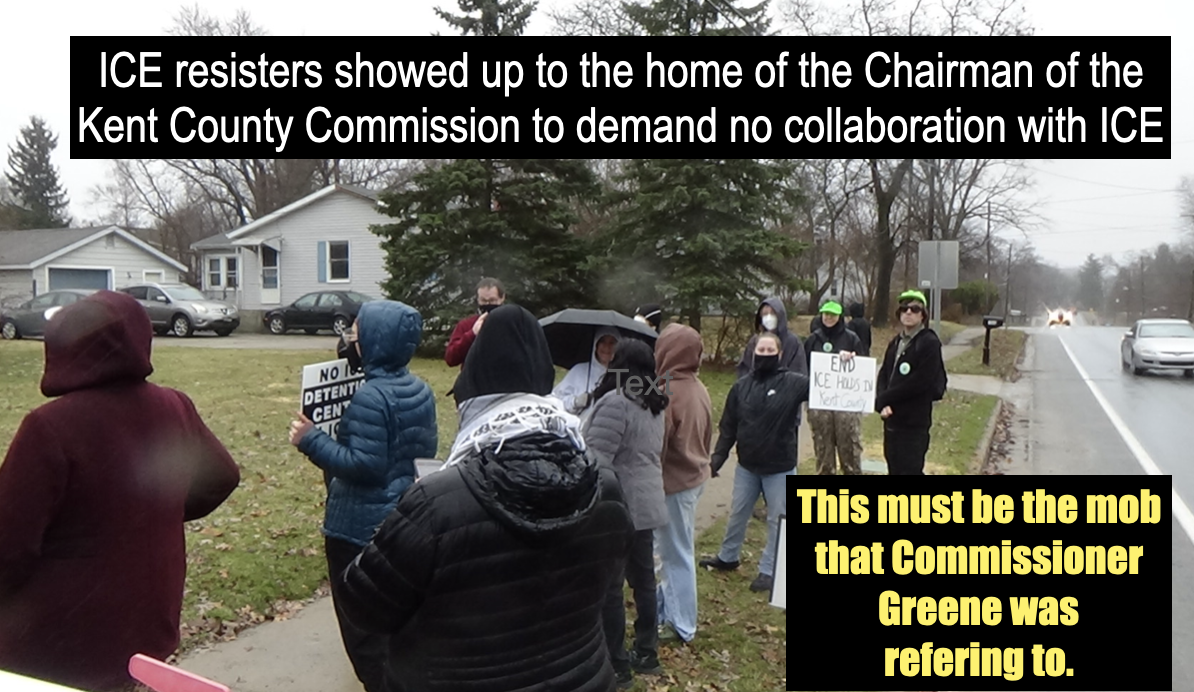
On his Facebook page, Kent County Commissioner Ben Greene posted the statement here below, along with this sentence – On Saturday, radical immigration protesters came to my home.
It’s always convenient for politicians to demonize and exaggerate what community members do. In fact, it is intentional to engage in misinformation and refer to community members a “radical immigration protesters”, which plays well with Greene’s base of support and his major funders, including Dan, Doug and Dick DeVos, which contributed $1,225.00 each to his 2024 election.
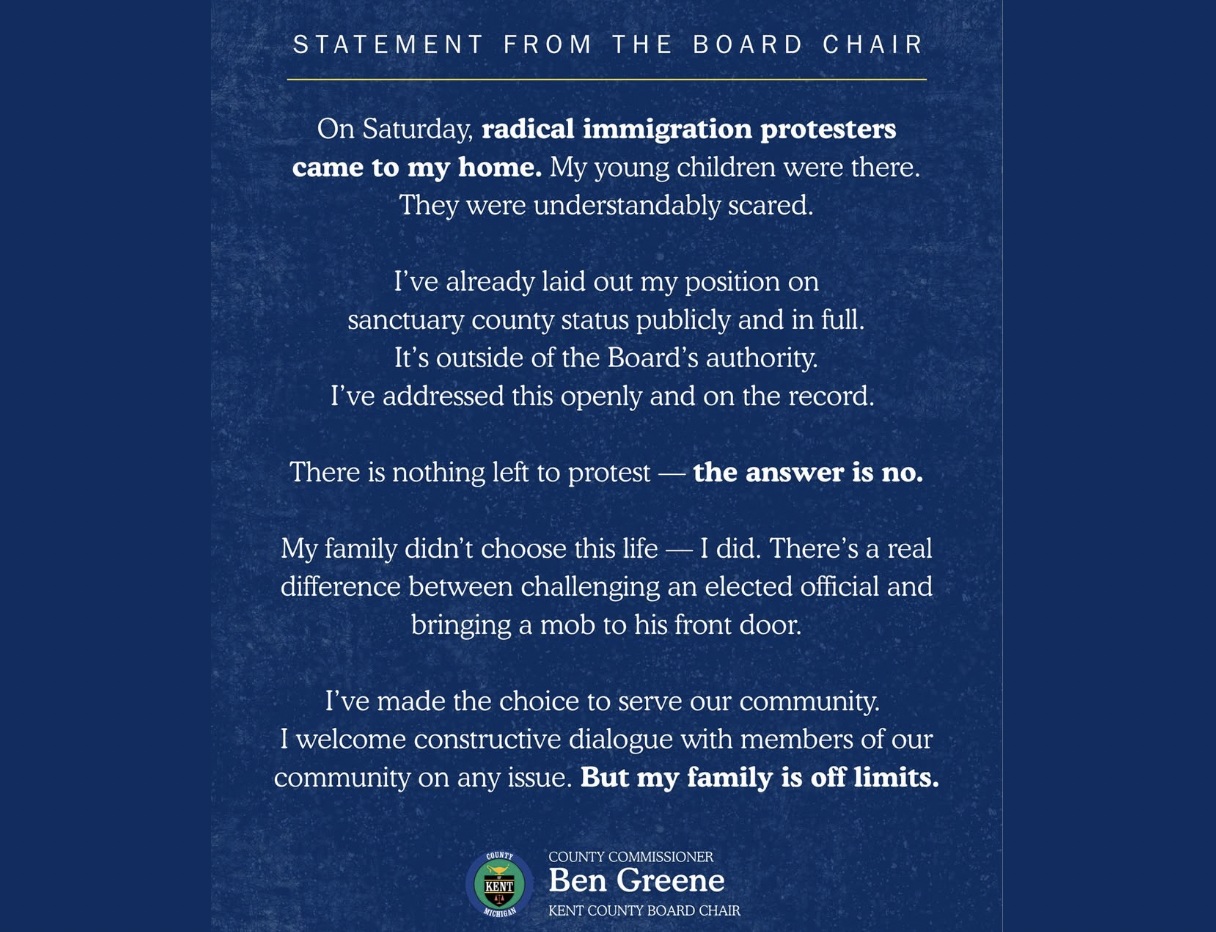
Here are a few responses I have to the lies and misrepresentation of the action that took place at his home on Saturday.
First, when Greene says that his young children were there, we knew that since they looked out the window while we were there and waved at us. Several of the people who were there waved back. In addition, there were two dogs in the house, both of which also came to the window at the front of the house. Both dogs just stood there and looked at us, but never barked.
Second, Commissioner Greene claims that he has already laid out his position on sanctuary county status and that it is outside of the commission’s authority. This statement is rife with misinformation. Cosecha and GR Rapid Response to ICE has never asked the county to become a sanctuary. These two groups have been demanding sanctuary policies, which are in effect public safety policies that would prevent the county from cooperating or collaborating with ICE in any way. All six of these demands are completely with the commission’s authority, since local governments throughout the US have adopted some form of a sanctuary policy.
Third, Commissioner Greene then says, “There is nothing left to protest – the answer is no.” This is instructive in that he is either oblivious to the fact that virtually every civil right in the US was because people organized and pushed politicians to adopt their demands. It is never “over” unless the people determine otherwise.
Fourth, Greene engages in more deceitful language by claiming that a “mob came to his front door.” A standard definition of the word mob is – a large crowd of people, especially one that is disorderly and intent on causing trouble or violence. Only three people came to his door, which would numerically not qualify as a mob. Only one person knocked on the door and handed him a piece of paper and spoke to him is a respectful tone. As for the other people who were standing on the sidewalk, they were chanting thinks like, No Hate, No Fear, Immigrants are welcome here! Not exactly mob-like discourse, rather discourse they centered the demands that Cosecha and GR Rapid Response to ICE have been asking of Commissioner Greene over the past 14 months.
Lastly, Commissioner Greene tries to make the point that his family is off limits. The action on Saturday was non-violent, was non-threatening and was lawful. Instead of chastising those that took part Commissioner Greene could have used the opportunity to educate his children on what democracy actually looks like and how ICE operates. Greene could have told his children that ICE is violent and forcibly removes people from their homes, thus separating families, by sending immigrants to detention facilities and possibly deportation. Commissioner Greene could have been honest with his children by saying that those who came to their house were attempting to get him to adopt policies that would reduce family separation and family trauma.
Instead, the Chair of the Kent County Commission made the decision to put out a statement that is not only untrue, but it is misleading and communicates to the community that he is unwilling to adopt policies that would reduce the harm that ICE is inflicting in Kent County on immigrant communities.
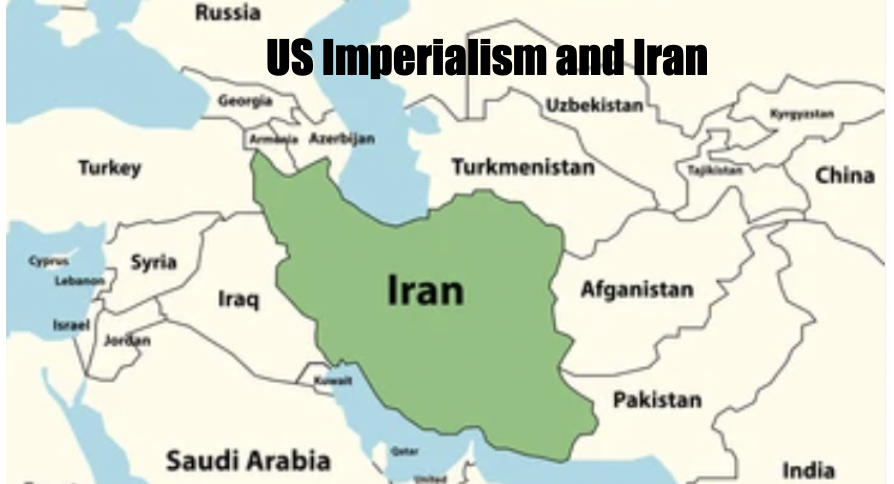
The US assault on Iran is blatant Imperialism and it is what the US has been doing with Iran since the CIA coup of 1953
We are 1 week into the US assault on Iran as of this writing. I just finished an 8 week class on the history of US foreign policy since WWII. In that class I created a framework to analyze US foreign policy, which you can find here.
Before I use this foreign policy analysis framework for what the US is doing to Iran I want to speak briefly about what the Democratic Party and specifically Rep. Scholten’s position is on the current US assault on Iran.
In her weekly Email messages Rep. Scholten said this on Monday, March 2nd:
At the time of this writing, six United States service members have lost their lives in this operation. We must be clear-eyed about what is happening here–Iran is the leading state sponsor of terrorism in the ENTIRE world. It’s beyond time that the United States held them to account.
Now, it is true that Rep. Scholten did recently vote to not give the Trump Administration War Powers but this has done nothing to prevent the US military from continuing to bomb and murder Iranian civilians. The more important vote coming up will be whether or not the Democrats oppose the Trump Administration’s request for $50 billion supplemental military funding bill to further punish Iran.
1. A Brief History of the US and Iran is a history of US Imperialism
The Iranian people and the Iranian government as early as 1951 wanted to nationalize the oil that was being pumped from the earth on Iranian land. Such an action was a major no no, since the oil interests (both British and US) were not in favor of allowing Iranians to benefit from domestic oil production.
The British initiated an economic blockade on Iran once they announced that Iranian oil was for Iranians. However, the Iranian government under the leadership of the democratically elected government of Mohammad Mosaddegh was able to weather the economic blockade and continued to use oil production to benefit Iranian society. US strategists working with the CIA began developing a plan to oust the Mosaddegh government and put in his place the Shah, who would dismantle the law that said Iranian oil for Iranians.
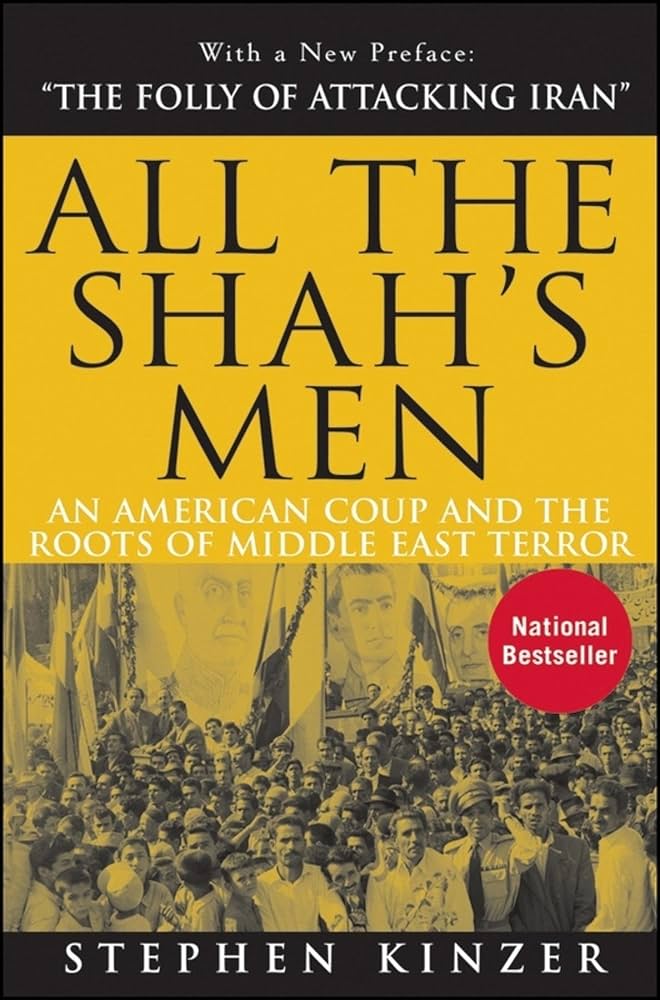 In the summer of 1953, the CIA initiated a coup and then installed The Shah of Iran who became an important ally of the US in the Middle East until 1979. During the Shah’s reign he suppressed dissent, was very anti-Islam and created his own secret police known as SAVAK. According to Blum:
“The notorious Iranian secret police, SAVAK, created under the guidance of the CIA and Israel, spread its tentacles all over the world to punish Iranian dissidents. According to a former CIA analyst on Iran, SAVAK was instructed in torture techniques by the Agency. Amnesty International summed up the situation in 1976 by noting that Iran had the “highest rate of death penalties in the world, no valid system of civilian courts and a history of torture which is beyond belief. No country in the world has a worse record in human rights than Iran.”
The brutality of the Shah of Iran is what eventually led to the Iranian revolution in 1979, which was led by Islamic clerics who had nothing but contempt for the US, primarily because of the decades long US support of the Shah.
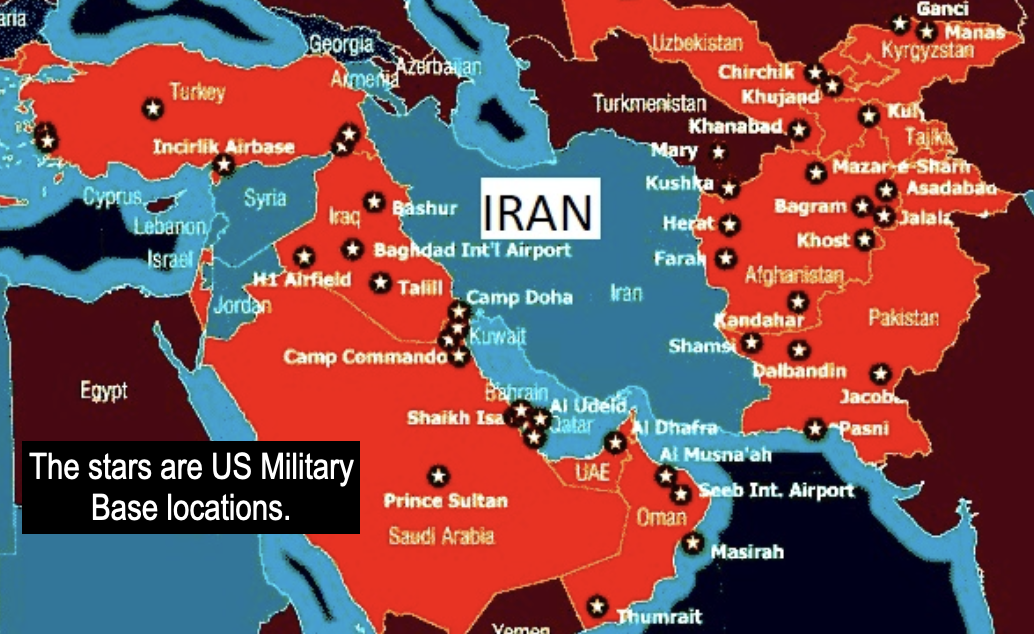
In an attempt to destabilize Iran the US was providing weapons to Iraq throughout the 1980s to go to war against Iran, resulting in 1 million dead. When the US attacked Iraq in 1991 with the so-called Gulf War, it provided the US another opportunity to monitor Iran. In 2003 the US invaded Iraq and began to establish military bases which was one of the goals, in order to have more permanent military presence that was closer to Iran. (reflected in the map above) Every US administration since 1979 has treated Iran as a terrorist state, even though Iran has not invaded another sovereign nation.
For more insights into the history of US/Iranian relations check out the US government declassified documents put together by the National Security Archives.
2. Geopolitics in the US assault on Iran
The map above should tell you all you need to know about the geopolitics of the US and Iran. The US has militarily occupied Afghanistan and Iraq, has provided billions of military aid to Israel, Pakistan, Iraq, Egypt and Saudi Arabia. The US military has also assaulted Turkey, Lebanon and Jordan. The US has imposed the most brutal economic sanctions in history on Iraq from 1991 – 2003. The Middle East is a major hub of oil production and narcotics trafficking. Lastly, because of the proximity of Russia and China to this region, the US has always included this dynamic into what the short-term and long-term policies have always been.
3. US Economic interests regarding Iran and the region
I already addressed this in the geopolitics section, but the role of oil is a major factor and has been since Iran nationalized its oil in the early 1950s. There is also the economic function of US militarism and the military industrial complex, which I address in point 6 below.
4. US Military role in Iran
You can see from the map above how many US military bases are in that part of the world, essentially surrounding Iran. For a detailed account the role that US military bases play in US foreign police see David Vine’s excellent book, Base Nation: How U.S. Military Bases Abroad Harm America and the World. US military presence in proximity to Iran has been a reality for decades, thus allowing the US to engage in assaults whenever they want, gather intelligence and and provide support to US allies in the region, specifically Israel, which is currently a partner in the current US assault on Iran.
5. Human Rights/Human Cost in the US assault on Iran
According to one source, “The death toll in Iran has reached at least 1,332, according to the Iranian Red Crescent Society. Children account for about 30% of those killed in the U.S. and Israeli attacks, government spokeswoman Fatemeh Mohajerani. Dropsite News goes on to say, “The U.S.-Israeli attacks have damaged 3,643 civilian sites, including 3,090 homes, according to the head of the Iranian Red Crescent Society, Pir Hossein Kolivand. In addition, 528 commercial and service centers, 14 medical or pharmaceutical facilities and nine Red Crescent facilities, have also been damaged.”
6. US Military Industrial Complex and the US assault on Iran
The US military use of weapons like Patriot missiles and Tomahawk missiles, along with all of the other weaponry and US military vehicles, drones, telecom resources, etc. is a massive benefit to US military contractors. This is exactly why US military companies spend millions to fund candidates, along with spending millions on lobbyists to make sure that their profits continue to increase. The profit motive is particularly important when the US used the weapons that we all as taxpayers pay for.
7. US University role in weapons research
Universities across the US have played a vital role in supporting US militarism for decades. Numerous US universities engage in Research and Development (R&D) of weapons systems, whether it is through the federal government sponsorship of schools or corporations that contribute money to departments in exchange for R&D. Check out this link for concrete examples of Federally Funded Research and Development Centers and University Affiliated Research Centers.
 8. US Media Coverage and Public Opinion regarding the US assault on Iran
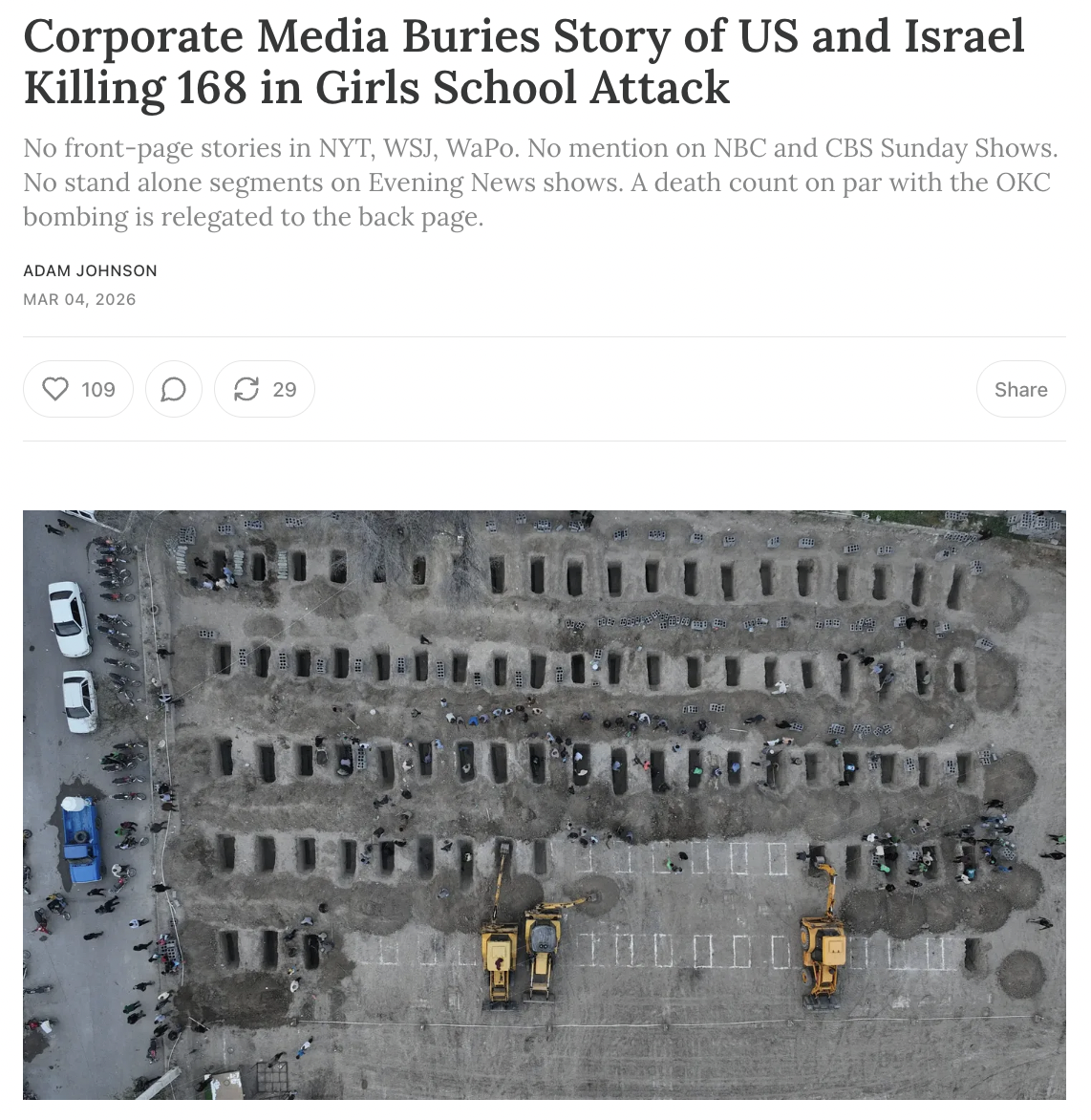
If you looked at how the major commercial news media outlets have reported on the US assault on Iran over the past week and then think about the first seven of the US foreign policy analysis framework I have included, it would be safe to say that the news media has miserably failed the public when it comes to providing robust analysis and coverage.
There is an excellent interview on the media watchdog site Fairness & Accuracy in Reporting with Gregory Shupak who provides solid analysis of US media coverage. In addition, there is an important article entitled, Corporate Media Buries Story of US and Israel Killing 168 in Girls School Attack, which demonstrates how the large US media outlets have minimized or ignored the US killing of 168 people.
9. US Domestic response to the US assault on Iran
There have been protests and marches over the past week throughout the US, but no significant actions that have targeted policy makers, weapons manufacturers or any other sector of society that ultimately benefits from US Imperialism abroad. This may change in the coming weeks and months, especially of the US military continue to assault Iran and cause more death and destruction. It is also important to think about the importance of developing robust strategies and tactics moving forward, since marches and traditional protest with sign holding will not effecting disrupt the US military assault on Iran or anywhere else in the world.
On Saturday, in the early afternoon, about 20 people went to the home of the Chair of the Kent County Commission – Ben Greene – to push demands that he and his fellow commissioners adopt the 6 sanctuary policies that Movimiento Cosecha and GR Rapid Response to ICE have been demanding over the past 14 months.
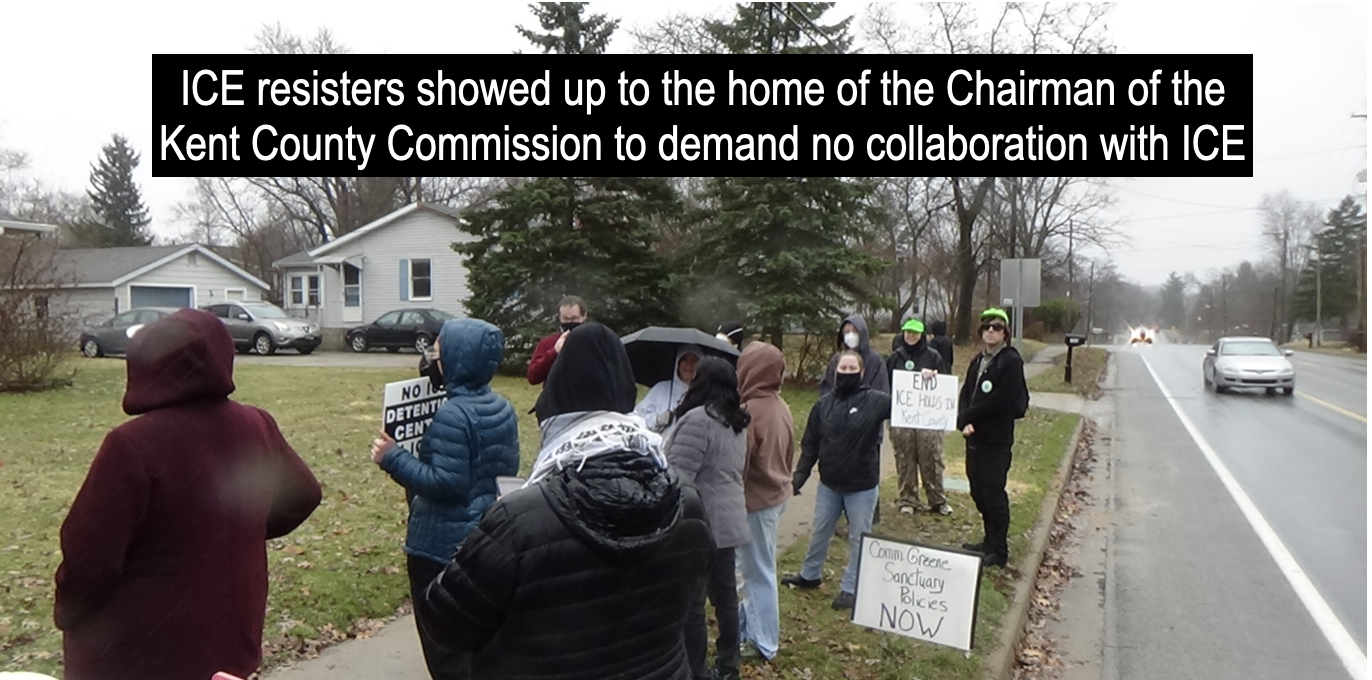
Those who participated in the action had handheld sign, noisemakers, and a few homemade yard signs that were left behind to send a message to Commissioner Greene, to neighbors and motorists passing by his house.
Earlier on in the action two people went up to the front door to deliver a letter to Commissioner Greene, which had a place for him to sign and commit to adopting the 6 sanctuary policies and get his fellow commissioners to do the same, which you can see here.
After several knocks on the door Commissioner Greene did come out and asked what was happening. Someone who was delivering the letter and attempting to get the Commissioner to sign said, “we are providing you an opportunity to publicly support the campaign from Cosecha and GR Rapid Response to ICE to agree to adopt the 6 sanctuary policies the community has asked you to adopt.” Greene took the letter and then said, “Thanks for this. Let me look it over and get back to you.”
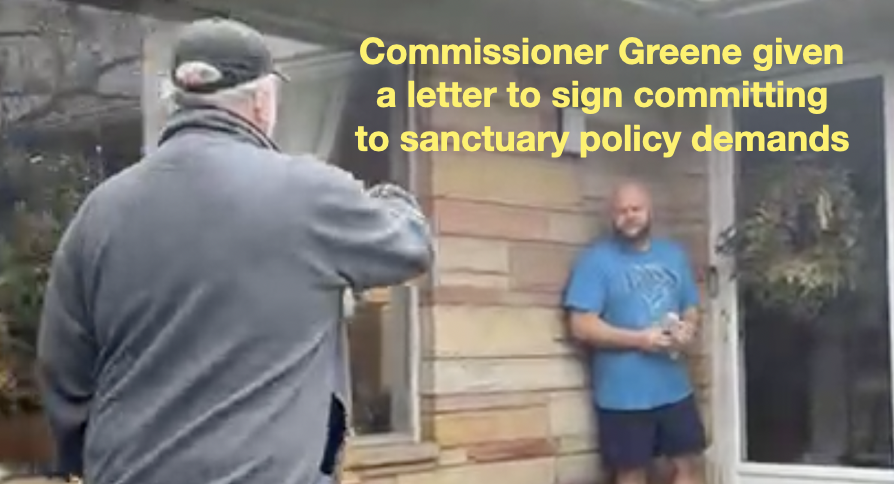
For the next twenty minutes people continued to hold signs, participate in a series of chants and continue to send a message to Commissioner Greene that he needs to be a real leader and agree to adopt these policies that would prevent Kent County from cooperating or collaborating with ICE in any way.
Those six sanctuary policies are: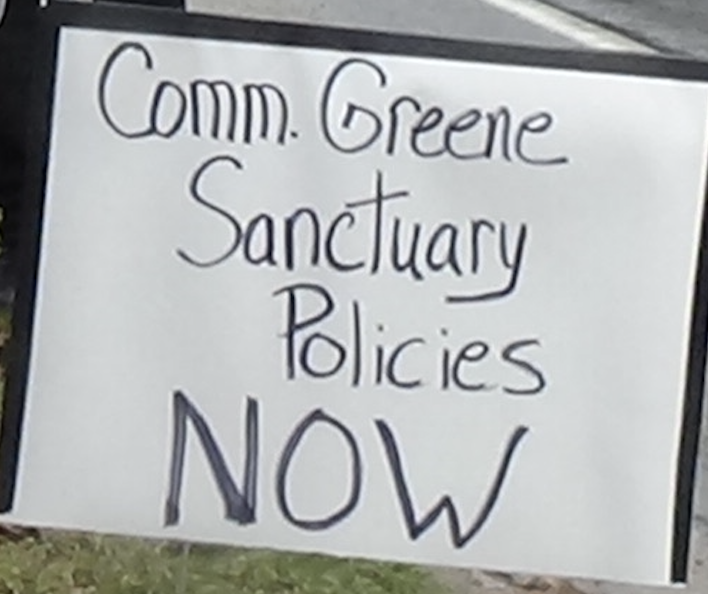
- Policies restricting the ability of state and local police to make arrests for federal immigration violations, or to detain individuals on civil immigration warrants.
- Policies restricting the police or other county workers from asking about immigration status.
- Policies prohibiting “287(g)” agreements through which ICE deputizes local law enforcement officers to enforce federal immigration law.
- Policies that prevent local governments from entering into a contract with the federal government to hold immigrants in detention.
- Policies preventing immigration detention centers from being established in Kent County, which would include the use of the Kent County Jail as a detention facility for ICE.
- A policy that will not allow the Kent County Sheriff’s Department to share Flock camera images or any other information gathered by county staff with ICE or any other law enforcement agency seeking to arrest, detain and deport immigrants.
This action will be followed by having people attend the Kent County Commission meeting this Thursday, March 12 at 8:30am and continue to demand that they adopt these policies that would contribute to limiting the horrors that ICE is in inflicting in Kent County.
Movimiento Cosecha also taped the entire action, which you can find here.
Yesterday I had my settlement conference in court for my January 5th arrest for demanding that Kent County end ICE holds
I previously reported that Movimiento Cosecha and GR Rapid Response to ICE held protests at the Kent County Sheriff’s office to confront the Sheriff about why they were holding immigrants for ICE at the jail. The group of five have been involved in the two previous protests and were working with Movimiento Cosecha to do an escalated action at the Kent County Sheriff’s office, where we were arrested on January 5th.

Since then all five of us plead not guilty and at yesterday’s settlement conference I once again plead not guilty and I am demanding a jury trial. I actually didn’t even have to go before a judge, since the court contact my lawyer just prior to my arrival, since my lawyer affirmed my not guilty plea and communicated to the judge that I wanted a jury trial.
My lawyer did inform me that the judge might offer one more settlement hearing, especially since I was only charged with trespassing, in the hopes that I might change my plea. Even if that doesn’t happen it is likely that a jury trial would not happen for months since the case log for my judge is backed up.
I am in no hurry since we are still working to end ICE holds at the Kent County Jail and the campaign that Movimiento Cosecha and GR Rapid Response to ICE continues to pressure both Kent County and the City of Grand Rapids to adopt the six sanctuary policies they have been demanding since January of 2025.
The six sanctuary policies are:
- Policies restricting the ability of state and local police to make arrests for federal immigration violations, or to detain individuals on civil immigration warrants.
- Policies restricting the police or other county workers from asking about immigration status.
- Policies prohibiting “287(g)” agreements through which ICE deputizes local law enforcement officers to enforce federal immigration law.
- Policies that prevent local governments from entering into a contract with the federal government to hold immigrants in detention.
- Policies preventing immigration detention centers from being established in Kent County, which would include the use of the Kent County Jail as a detention facility for ICE.
- A policy that will not allow the Kent County Sheriff’s Department to share Flock camera images or any other information gathered by county staff with ICE or any other law enforcement agency seeking to arrest, detain and deport immigrants.
Immigrants continue to be held at the Kent County Jail for ICE, where they will be then taken to the GEO Group-own detention center located in Baldwin, Michigan. Movimiento Cosecha continues to hear from immigrant families who have recently had a family member at the Kent County Jail, that ICE holds are being implemented even after people are posting bond for them to be released.

When Movimiento Cosecha and GR Rapid Response briefly spoke with Kent County Sheriff, Michelle LaJoye-Young last November, she refused to answer whether or not the jail was engaging in ICE holds.
According to the American Immigration Council:
- With the funding provided by the One Big Beautiful Bill Act, ICE has enough funding to operate upwards of 135,000 detention beds through the end of FY 2029.
- These changes in arrest practices have led to a 2,450% increase in the number of people with no criminal record being held in ICE detention on any given day.
The lives of thousands of immigrants are at stake, since ICE detention facility conditions are horrendous, on top of the fact that families are now economically suffering, along with the trauma that has been inflicted on immigrant families. This Is why I plead not guilty and why I want a jury trial.
The workshop began with a brief summary of the previous three sessions that took place in the Fall of 2025. I wrote about the one in September and November of last year. These workshops were initiated by Professor Kang who has been conducting interviews with people who were students or staff at the Grand Rapids Public Schools since the 1960s, interviews you can find here.
What follows is information that was presented at the beginning of the workshop, all of which provided participants with context before the conversation began. To see all the slides, go here.
The Introduction of School Choice in Michigan, known as Public Act 362 (1993), created Michigan’s charter school law. Then there was Proposal A (1994), asSchool funding law, which provided the financial mechanism to operate charter schools. Under this system, funding follows the student and since parents were now starting to send their kinds to non-public schools and non-neighborhood schools, school districts began to see their budgets reduce.
Next was presented a quote from the Mackinac Center for Public Policy.
“When the Michigan legislature enacted Public Act 362 of 1993, the law which sets up the guidelines for new “public school academies” or “charter schools”- it sent a powerful message to both the education establishment and parents desperate for new options. No longer would public schools be shielded from competition, insulated from accountability, and immunized against the choices of their customers.”
The Mackinac Center for Public Policy is the oldest right wing think tank in Michigan, which has received millions in funding over the decades from the DeVos family. The Mackinac Center crafts policies and influences state politicians to adopt them. This organization is also part of the larger far right policy group called the State Policy Network.
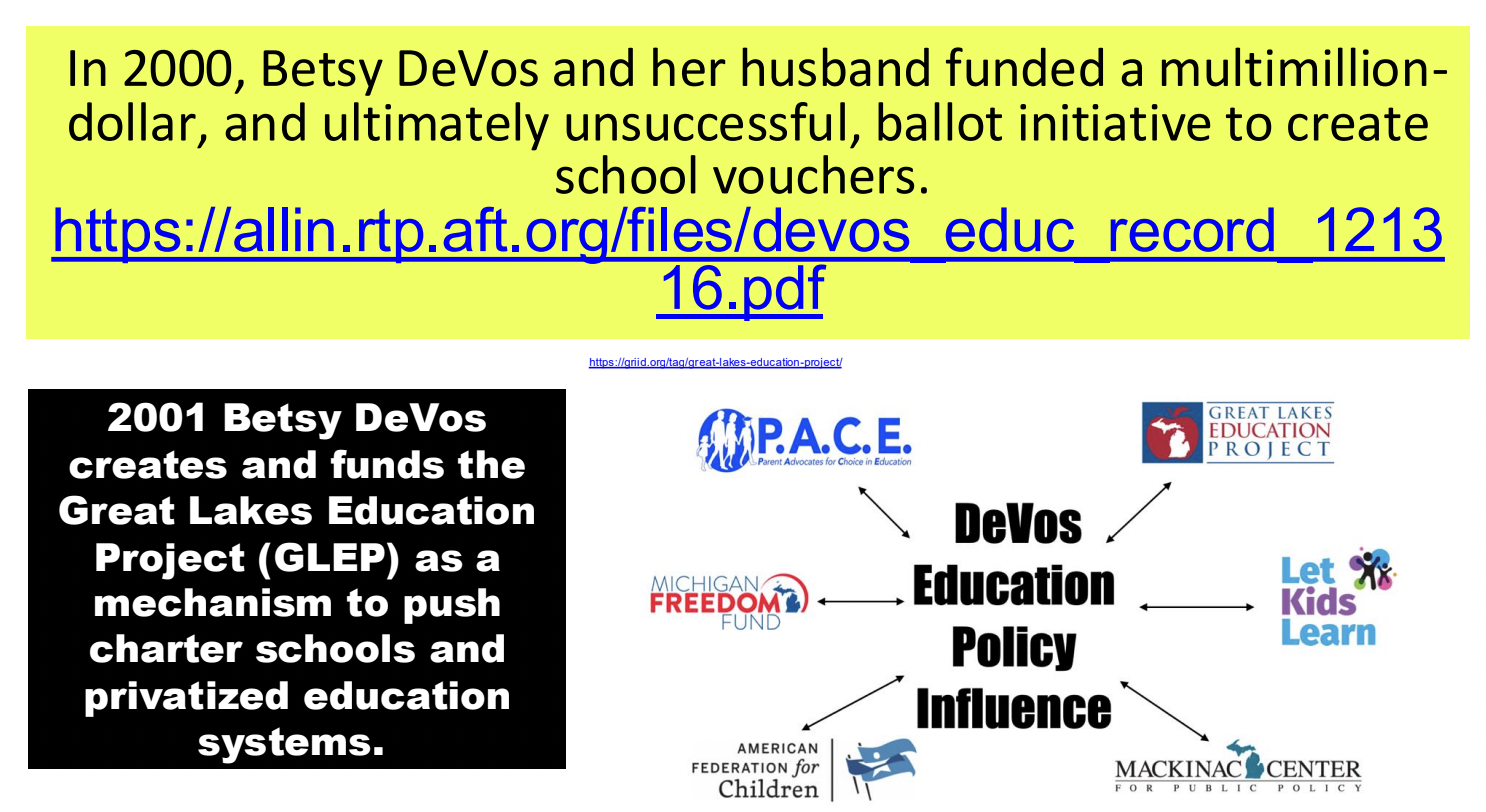
In 2000, Betsy DeVos and her husband funded a multimillion-dollar, and ultimately unsuccessful, ballot initiative to create school vouchers. DeVos had been pushing charter schools and the privatization of public education nationally, and thought she could get a voucher system passed in Michigan. It was roundly defeated. In response to this defeat, in 2001 Betsy DeVos created and funded the Great Lakes Education Project (GLEP) as a mechanism to push charter schools and to privatized education systems.
Here is a video of Dick DeVos speaking at the Heritage Foundation in 2002 about the importance of undermining public education. Pay attention to the language and the strategies he references in this brief clip.
All of this context is what led the Grand Rapids Public Schools to have to deal with less funds, to begin closing schools and restructuring the school system in Grand Rapids, which began under GRPS Superintendent Bert Bleke.
At this point the discussion began and many people shared their own experiences and observations about how the Charter School, reduced budgets and how GRPS restructuring impacted their life or the lives of their children.
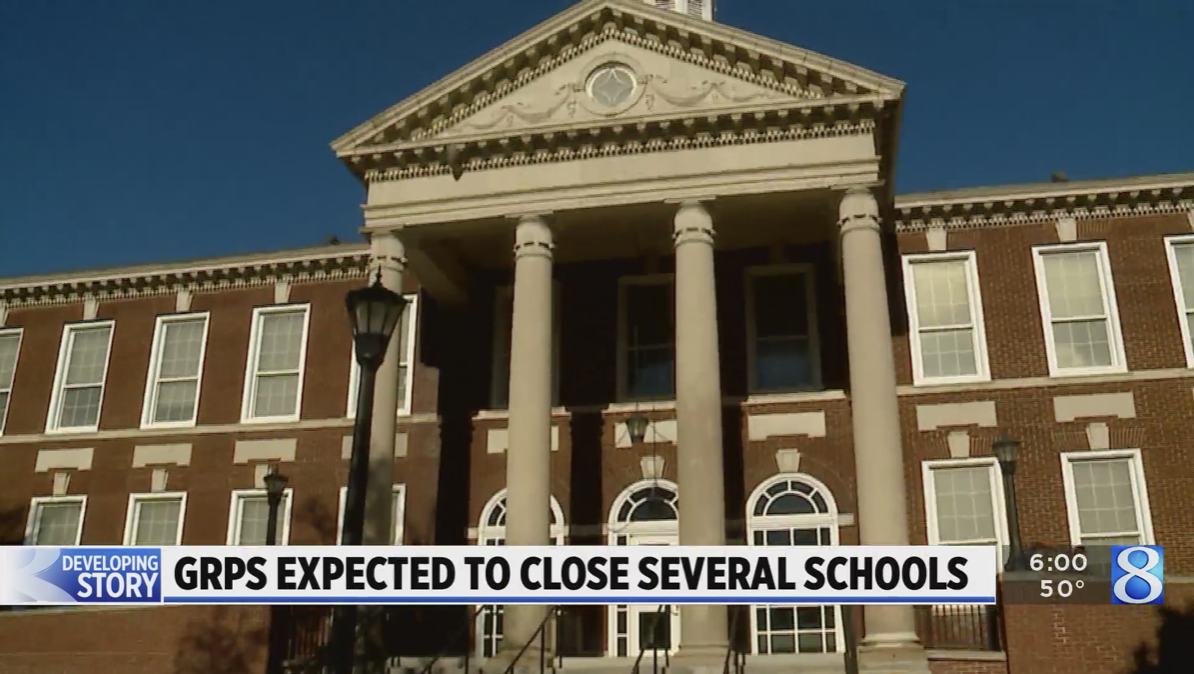
The GRPS had created several alternative schools or specialized schools, which made sense in some ways, but the restructuring has perpetuated racial and class segregation within GRPS schools. One example that was raised was the closing of the Native American School program at Lexington School.
Someone also raised the issue of white flight beginning in the 1960s and its longterm consequences. Another person noted that white families began moving back to Grand Rapids in the 1990s, resulting in some neighborhoods being gentrified and white parents pushing for more options within the GRPS, especially at the Middle & High School level.
One person talked about the pushback from parents who had their children at Hall Street School, which was later changed to Cesar Chavez School. This pushback came primarily from Latine/Latinx parents.
Several people who teach within the GRPS system talked about how principals that have turned schools around were then moved to another school, often against what they wanted. People talked about how frustrating it was to lose this kind of good leadership and how these principals have developed a healthy culture within the schools they were leading.
Towards the end every participant shared their own K-12 experience, even of they did not go to a Grand Rapids Public Schools. It was interesting to hear everyone’s education experience, which allowed people to compare and contrast how the Grand Rapids Public Schools dealt with critical issues compared to school districts around the state or around the country.
Another false solution is being proposed on ending homelessness by a Grand Rapids Chamber of Commerce initiative
Both MLive and Crain’s Grand Rapids Business posted articles about an announcement from the people who started the house 100 individuals in 100 days campaign in 2024.
The Crain’s story headline is claiming this is a GR Chamber of Commerce campaign, even though they are working directly with the Grand Rapids Area Coalition to End Homelessness and local service providers. In the first paragraph of the Crain’s article it says, the targeted goal is to end homelessness downtown this year. Of course this is the goal, as the GR Chamber of Commerce and the business interests in downtown Grand Rapids believe that their ability to make profits is being threatened by unhoused people tend to be downtown during the day. Remember, the GR Chamber of Commerce proposed an ordinance in 2022 to criminalize the unhoused, which the City of Grand Rapids adopted in 2023.
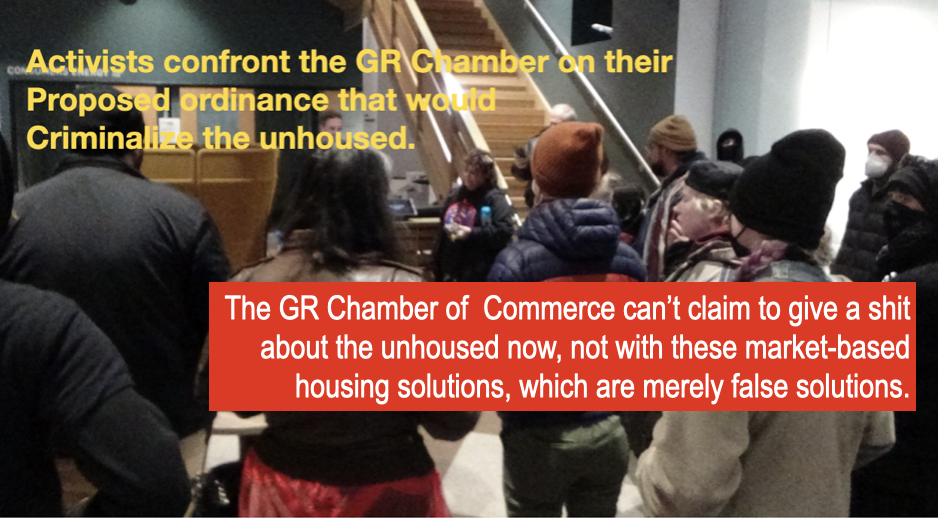
In fact, the government affairs staff member at the GR Chamber of Commerce, Josh Lunger, was calling for an increase in GRPD cops, since unhoused people were a threat to the safety and commerce of the people and businesses in downtown Grand Rapids.
This new initiative is called the Downtown Pathways Project. The Crain’s article then states:
Downtown Pathways partners hope to create a smart homeless response system, build a safe and welcoming downtown, connect stakeholders with clear roles and provide transparency throughout the process, said Ryan Kilpatrick, founder and CEO of Flywheel Community Development.
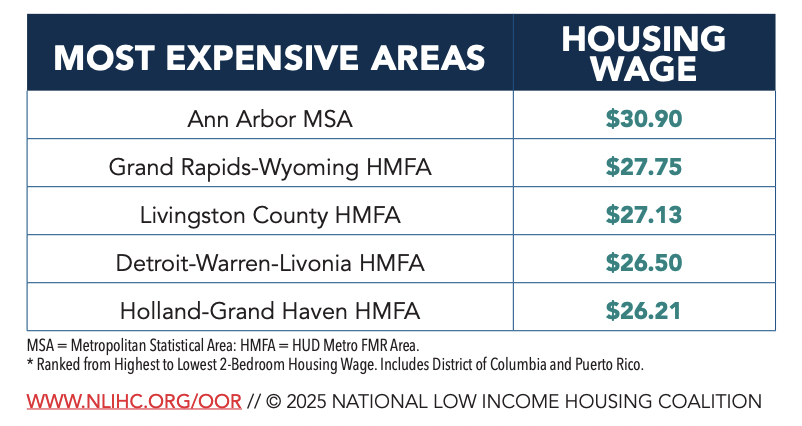
The only action I could find from this new initiative is to secure $100,000 in funding to conduct a fair market rent study. I’m not sure what another study will find, but it seems that someone will be getting paid to conduct the study. I’m also not sure why we need another study about the cost of rent in this city, since the National Low Income Housing Coalition has already provided us with the average cost of rent per zip code in Grand Rapids. For example, in the 49503 area people would have to make $27.88 an hour to afford the average cost of rent in that zip code.
Ryan Kilpatrick, the founder and CEO of Flywheel Community Development Services, is quoted in the MLive article, stating:
“What’s happening right now in Grand Rapids is the payment standard for rent from a federal housing voucher is lower than what rent actually costs. So what we need to be able to do is communicate with HUD that there’s a difference between what they’re willing to pay and what rent actually costs.”
It is important to note that Kilpatrick also works for Housing Next, which is a GR Chamber of Commerce create housing entity that push market based solutions to housing, plus he works for the DeVos Family Foundation and their Facing Home Initiative.
Regarding the point that Kilpatrick makes about HUD, to be clear he is suggesting that HUD needs to increase the amount of funding for housing vouchers. While this might seem like a compassionate response, the best thing that this new initiative could do would be to advocate that people living in Grand Rapids earn a living wage. If the average cost of rent would require that people make $27.88 an hour, then a living wage would be closer to $40 an hour.
The Downtown Pathways Project partners would not endorse paying people a living wage, despite the fact that this would be the most effective strategy within a market based housing system. Paying people wages that will allow them to afford the cost of housing would be a real solution, not a false one, like what this group is offering.
Having the Grand Rapids Chamber of Commerce partner with the Coalition to End Homelessness will always result in false solutions. The GR Chamber of Commerce, like all Chambers of Commerce has over the past century opposed an increase in the minimum wage, has opposed organized labor efforts to defend the interests of workers, has fought to privatize government services and always puts business interests above public interests. The Crain’s Grand Rapids Business article nor the post from MLive even bother to address whether or not the Downtown Pathways Project is working towards the most effective strategies.
On Monday night the East Grand Rapids (EGR) City Commission voted to not adopt a proposed resolution that would not permit the East Grand Rapids Police Department and other city departments to cooperative with Immigration and Customs Enforcement.
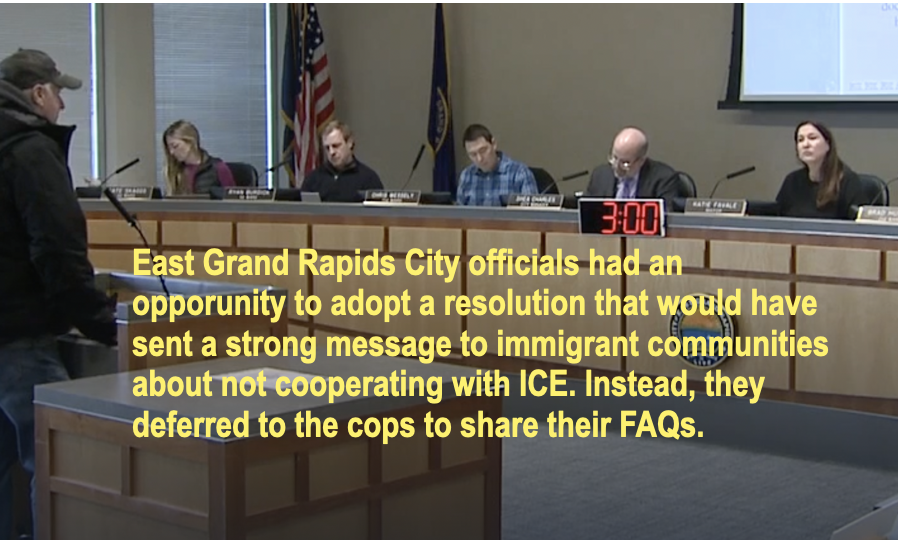
The resolution, which had been proposed at a previous EGR meeting and reads as follows:
1. The documented and enforced policies and procedures of the Department of Public Safety shall specifically
a. Include “immigration status” as a named protected class in its Fair and Impartial Policing Policy; and
b. Prohibit officers and representatives from contributing resources or participating in federal immigration enforcement activities including, but not limited to:
i. Riding along with federal immigration and customs enforcement officers;
ii. Conducting joint investigations with federal immigration and customs
enforcement officers; or
iii. Sharing investigative information with federal immigration and customs enforcement officers.
2. The City shall not use, nor provide for use, any public land, facilities or other resources for the establishment of a federal immigration and customs enforcement detention center.
3. The City shall not enter into any 287(g) agreement with federal immigration and customs enforcement agencies.
AND BE IT FURTHER RESOLVED THAT:
We call on the Kent County Sheriff to immediately cease compliance with any and all detainers issued by federal immigration and customs enforcement agencies and refrain from holding any person in detention at the request of federal immigration and customs enforcement agencies for the purpose of investigating immigration status or securing their presence for immigration enforcement actions.
Before the public was allowed to comment on the resolution, the EGR Police Chief gave a brief presentation about what the department already does. The Chief of Police published FAQ on ICE/immigration related matters, which you can find here, along with the March 2nd agenda, the resolution, the FAQs and other EGR Public Safety-related procedures.
The EGR Chief of Police expressed that he didn’t think the resolution was necessary, since his department already doesn’t cooperate with ICE.
Public comment period was then opened and of the 21 people who spoke on the proposed resolution, 19 were in favor and only 2 were opposed, which is a ratio that has been similar in Grand Rapids. The comments that supported the resolution were based on demonstrating compassion for immigrants, the cruelty that ICE has been inflicting around the country, the realities of what people have heard coming out of the GEO Group-owned ICE Detention Center in Baldwin, people’s faith which calls on them to welcome the stranger and to simply not want to see the horror that ICE has inflicted in communities like Minneapolis recently.
The elected officials and the City Manager then spoke about the resolution. Some commissioners asked specific questions of the Police Chief, while others addressed questions to the City Attorney.
The Police Chief said that the only way our cops would cooperate would be if ICE has a signed judicial warrant. This is a response that is often given, as if having a judicial warrant makes what ICE is doing any less repressive and unjust. The City Attorney stated that the resolution would not have the same weight as an ordinance, stating he was not sure what the resolution would actually do.
At one point, in response to a commissioner’s question the Police Chief said his reading of the proposed resolution would limit some things that his department would do. He followed up those comments by saying that his department would cooperate with ICE in order to keep the peace. This is similar to the City of Grand Rapids and their Foreign National’s Policy, which states:
The policy allows officers to provide assistance to federal immigration authorities when there is an emergency that poses an immediate danger to public safety or federal agents.
There were two EGR Commissioners that spoke out emphatically against the proposed resolution, arguing that they would not support the resolution as they did not want to tie the hands of the EGR police and did not want to make East Grand Rapids a target of ICE. This is also a common retort from people who are not being targeted by ICE. What Movimineto Cosecha says is that they are constantly being threatened by ICE and have been since ICE was created in 2003. Making a public statement in solidarity with undocumented immigrants is a statement of solidarity.
In the end the East Grand Rapids City Commission did not vote on the proposed resolution, but it did decide to post the FAQs that were created by the Police Department, which is not a statement of solidarity with members of the affected communities, undocumented immigrants.
The only news coverage was from WXMI 17, which acknowledged that the majority of those who spoke during public comment were in favor of the resolution. However, the only public comment that viewers heard in the story was from a person who opposed the resolution. In addition, most of the voices heard in the Fox 17 news story were the Police Chief and the City Attorney, both of whom were not in favor of the resolution.
The local news media continue to demonstrate their bias with all the coverage they have given to the former GRPD Police Chief Eric Winstrom. Hell, they provided an unquestioning platform for Winstrom to say whatever he wanted and there was no indication that any of the reporters challenged Winstrom’s claims.
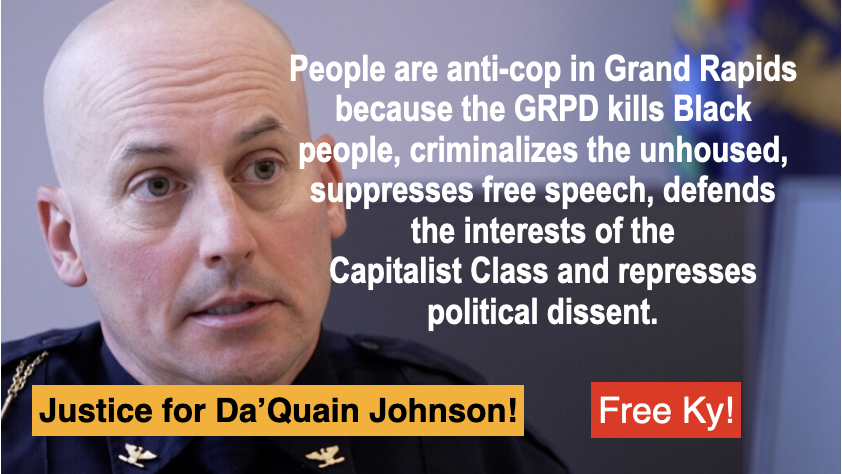
Probably the most egregious claim that Winstrom made was that he left because of the anti-cop sentiment in Grand Rapids. Since this was the main talking point from Winstrom, one would think that any competent journalist would then go and speak with individuals and organizations that have questioned the GRPD, challenged the GRPD, protested against the GRPD and even organized to defend the GRPD. The local media has chosen to not talk to people involved in any of these efforts.
It is instructive to note that this same news media also provided Winstrom an earlier platform where he could talk about what the last 4 years have looked like to him in Grand Rapids. To counter Winstrom’s narrative I methodically looked at stories during his 4 years in Grand Rapids and wrote an article entitled, Killing and assaulting Black people, protecting power and criminalizing dissent: A grassroots account of what Chief Winstrom actually did over the past four years
In that article I talked about how the GRPD under Winstrom’s leadership killed Patrick Lyoya and how the local news has reported on it. I also wrote about how the local news reported on these issues in the just prior to the Schurr trial in an article entitled, Local news coverage leading up to Schurr’s trial has been influenced by his lawyers, experts, a failure to provide community voices and a pro-GRPD bias.
I talked about how the GRPD has been criminalizing dissent in Grand Rapids, particularly when it comes to BIPOC organizers that have been demanding Justice for Patrick in an article entitled, The criminalization of dissent in Grand Rapids.
I talked about how the GRPD has been doing the bidding of the Grand Rapids Chamber of Commerce and other downtown business owners, by enforcing the City’s ordinances that essentially criminalized the unhoused.
I have shown how the GRPD has tried to intimidate those acting in solidarity with immigrants being targeted by ICE in a a recent article, and how Cosecha and GR Rapid Response to ICE have documented lots of evidence that the GRPD is collaborating with ICE.
I wrote two articles recently, both of which show how the GRPD are loved by those with wealth in this city and how the GRPD functions to protect the economic interests of the Capitalist Class.
I also wrote about how under Winstrom’s watch the GRPD killed another Black man in an article entitled, The GRPD killed another Black community member: Those in power have a script, but we don’t have to follow it.
If former GRPD Chief Winstrom wants to complain about an anti-cop sentiment then he and the local news need to come to terms with the fact that the GRPD ultimately protects systems of power – both political and economic – that they try to limit or silence free speech, that they criminalize dissent and that they disproportionately police in Black and Brown neighborhoods to manage those populations, using force whenever they want to.
End Note:
In the past two years I have done methodical documentation of MLive and the three GR-based TV stations – WOODTV8, WZZM13 and WXMI 17 on a number of issues. However, the vast majority of stories has to deal with public safety matters. In the 2024 study (linked below) of all these 673 stories that centered around crime, there were only 11 stories about the GRPD actually preventing crime, which means in most of the stories the GRPD showed up after a crime had been committed. This should tell us something about the real function of the GRPD.
2024 Local News Monitoring Project
Out of the 433 stories in the first six months of 2025 that were about the GRPD, the courts or public safety matters, only once was there a story where the GRPD prevented a crime or violence.
Cops and Capitalism go hand in hand: GRPD says they will need more cops when the Amphitheater opens
Last week WOODTV8 posted a story with the headline, GRPD: Each amphitheater event will require entire shift of officers.
The WOODTV8 story quoted a GRPD cop who stated:
“It is going to put a strain on our staffing. It will take at least 24 cops initially. That is a significant number of officers. That’s an entire patrol shift. We are dedicated and committed to doing that, but it will be really difficult to do 50 times in six months.”
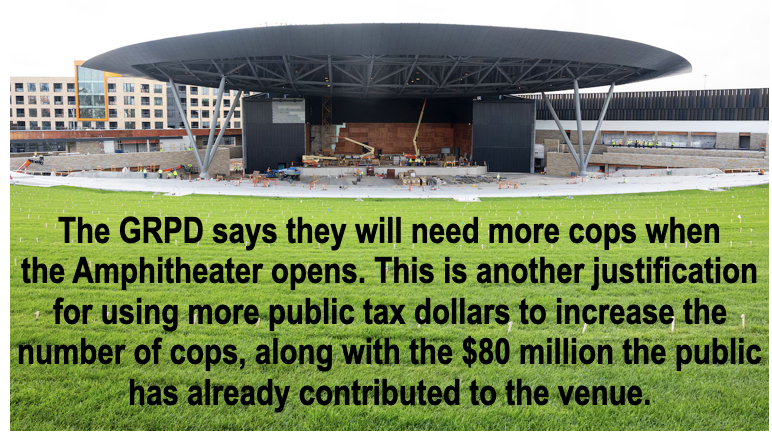
This is not a new sentiment on the part of the GRPD. In October of 2024, WOODTV8 also interviewed a GRPD Captain who was quoted as saying:
“We want to expand our numbers in the next couple years quite a bit. So I would say in the next couple of years — without speaking for the city commission, they’d have to approve it — but we would like to be in that 330 or 340 range. There’s a lot going on downtown with the amphitheater coming in, the soccer stadium. There’s excitement with the river transformation. There is a lot of great restaurants and nightlife down here.”
This is just one more justification for the GRPD and the City of Grand Rapids to increase the number of cops.
At last Tuesday’s Public Safety Committee meeting, which you can watch here, there was a GRPD officer saying that the department is talking about dedicating 20 or more cops per event at the Amphitheater. At 20:45 into the video Mayor LaGrand – with a smile on his face – talking about public safety and special events saying, “in plain English that means what are we going to do about the Amphitheater and the Soccer Stadium.”
Someone from the city then talks about parking issues, but at about 32:50 into the video, where a GRPD officer is talking about crosswalks, he then says “it’s going to take at least 24 officers to police those intersections.” The cop was specifically referring to just the Amphitheater events and the need to have at least 24 cops for so-called safety.
In the fall of 2025, I reported that the Amphitheater had already used $80 million in public funding for that Grand Action 2.0-led project. Thus, the public – without public consent – has been fleeced $80 million for the Amphitheater and will be paying for at least 24 GRPD cops to work the Amphitheater events, to make sure that tourists and people with money will be protected from unhoused people or political dissidents who might interrupt their plans to have dinner & drinks before attending live concerts with overpriced tickets.
This is the natural outcomes within the system of Capitalism, where the public pays a large portion of the bill, while private business reap the rewards and get protect by the cops so their profits aren’t interrupted. As Brian Bean says in his important book, Their End is Our Beginning: Cops, Capitalism and Abolition:
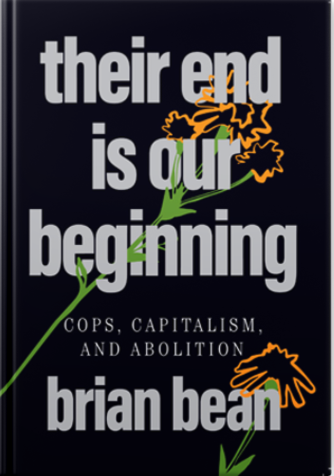 “Cops patrol, maintain, recreate, enforce, and repress resistance to a racist capitalist system. Thus, the abolition of the police requires a breaking with capitalism. Abolitionist politics have always been a contested field, with anticapitalist politics a prominent, if not dominant, tendency. Angela Davis, one of the more prominent abolitionist figures, explains, “Ultimately we are going to have to dismantle this system and move in a socialist direction.” Mariame Kaba states, “We’re not going to abolish the police, if we don’t abolish capitalism by the way! It ain’t going to happen.”
Cops and Capitalism go hand in hand. The Capitalist Class creates laws that allows them to expand their wealth, then uses cops to protect their assets and their ability to expand their profits at the expense of others. In Grand Rapids the Capitalist Class is made up of the DeVos, Meijer and Van Andel families, who will ultimately reap the benefits of the ongoing push to add add more cops to the GR Police Department, which also means that BIPOC communities will be at an even greater risk of being brutalized by the GRPD.
 Grand Rapids Institute for Information Democracy