Iraq War Veteran arrests Carl Levin during Occupy Congress Action
On day 1 of the Occupy Congress actions several people went to Michigan Senator Carl Levin’s office to make a citizens arrest of the Chairman of the Senator Armed Services Committee.
This video features people doing street theater in Carl Levin’s office, where they dramatize an arrest of Senator Levin for his role in crafting the National Defense Authorization Act.
Pay close attention to what Iraq war veteran Shamar Thomas says when confronted by Levin’s staff and the Capitol City police.
The New Jim Crow author addresses GVSU audience
This morning, author Michelle Alexander gave her second talk in two days at GVSU. The topic of her lecture was the subject of her powerful book The New Jim Crow: Mass Incarceration in an Age of Colorblindness.
Alexander addressed a capacity crowd in the Cook-DeWitt auditorium in Allendale. She began by saying that she was tempted to speak about all the accomplishments of Dr. King, but said that she believed that King would rather have us focus on how we have failed to accomplish the goals of the freedom struggle. In addition, she said we must fulfill King’s call to move from Civil Rights work to Human Rights work.
Alexander said that one way in which we have collectively failed is our focus on court battles to protect affirmative action and other so-called gains made during the 60s and 70s. In the meantime, a very sophisticated effort was solidified to criminalize and demonize African Americans through the War on Drugs.
The speaker says that all of this is even happening under the Presidency of Barack Obama. We see a Black man and a Black woman in the highest status in this country, but we don’t see the images of African Americans who are just blocks away from the White House, where the Black community has become second class citizens.
Alexander admitted to the audience that there was a time when she shied away from making comparisons to the current Prison Industrial Complex and chattel slavery. However, after years of research and numerous personal experiences she could no longer not see the link, which eventually led to her writing The New Jim Crow.
The author spoke about how it is impossible and unethical to not look at our criminal justice system through a racialized lens. Alexander then dived into the thesis of her book, which is to say that there are more African Americans in the criminal justice system than there were slaves during the peak of chattel slavery in the US.
Alexander said that an increasing amount of Black men have been charged with felons, which results in most states of their collective loss of voting rights. She went on to then say that this intense criminalization of African Americans and other communities of color has made the US a country with the largest prison population in the world. She also emphasized that this has happened at a time when crime statistics do not show any significant increase in crime being committed.
What Alexander said is the main cause of the mass incarceration is the so-called War on Drugs. In fact, she said that there are more people in the criminal justice system for drug offenses than any other category of crime. Thus, Alexander says that this policy is a way of criminalizing communities of color, despite the fact that more White people use drugs than all other communities combined.
Alexander says that people still believe that there is a tendency to want to have heavy police presence in urban poor communities of color where drug trafficking was prevalent. However, Alexander points of that this is a myth and that the real reason for the heavy focus of law enforcement in communities of color is politically motivated to support the institutionalize economic policies of law enforcement agencies across the country.
The author notes that a policy of Stop and Frisk has led to massive incarceration rates. Alexander notes that this only happens in neighborhoods of poor urban communities of color and almost never in White, upscale neighbors. Even though we know that White people and White youth are more likely to have illegal drugs on their person or in their vehicles, which Alexander says is another indication of the racialized element of the War on Drugs.
The result of getting charged with possession of drugs in a Stop and Frisk action means that you will be labeled a felon. This is a label you will carry all your life and will mean that you will have a difficult time finding work, housing and in most states you will denied social services such as food stamps.
What are folks supposed to do? It seems like the system is designed to send folks back to prison, which is exactly what it does. Alexander says that bout 70% of those in the criminal justice system will go back to prison after they get out. This reality also has the effect of collective shaming of people of color.
So where do we go from here? Alexander says that those of us in the civil rights community have to come to terms with the fact that this massive human rights abuse that has taken place in recent decades has happened on our watch. Alexander says that nothing short of a major massive social movement is necessary for there to be any fundamental change.
The work of this movement will not be easy because it would mean the closure of prisons in poor rural White communities who are now dependent on prisons for economic stability. It would mean that people who have invested and own stock in the private prison system, which is an extremely profitable business.
Alexander said we need to radically alter the focus of the war on drugs to prevention and treatment instead of punitive incarceration. She also said that we need a massive shift of funding from the criminal justice system to public education, housing and community development.
The author then said that this work seems rather daunting, but it is no different than the efforts to abolish slavery or the dismantling of the old Jim Crow system. In order to do this work we need a renewal in the belief that movements for social change can be born again.
It is our task to end not just mass incarceration, but any form of a cast system in which we are faced. Alexander stated we need to create a modern Underground Railroad movement, particularly for those getting out of prison where people can be welcomed, nurtured and supported. The author mentioned a Take Action link on her website that offers to resources and ideas for local community organizing around this issue and that there are no groups on some campuses in the US called Students Against Mass Incarceration.
Other resources we would encourage people to investigate is the movement to abolish prisons and all the great zines on prisons and police at the online zine library.
Sherry Wolf to speak on Occupy Wall Street next Monday at GVSU
Author and activist Sherry Wolf will be in Grand Rapids next week speaking on the campus of GVSU.
Wolf who is the author of the book Sexuality and Socialism: History, Politics and the Theory of LGBT Liberation, will be speaking on a topic she has been writing about a great deal lately……..the Occupy Wall Street Movement.
Wolf, who is a member of the International Socialist Organization (ISO) has been participating in the Occupy Wall Street Movement in New York City where she lives and has visited numerous other Occupy sites across the country. GRIID plans on interviewing here on Monday before she gives her lecture.
Occupy Wall Street: Lessons from the Front Lines – Lecture by Sherry Wolf
Monday, January 23
7:00PM
Grand River Room – Kirkhof Center
GVSU Allendale Campus
This event is free and open to the public.
Equality Rally in Lansing today challenges Michigan lawmakers who ended domestic partner benefits
About 150 people gathered today in front of the State Capitol building on downtown Lansing to protest the recent decision by State Legislators and Michigan Governor Rick Snyder to end domestic partner benefits for public employees.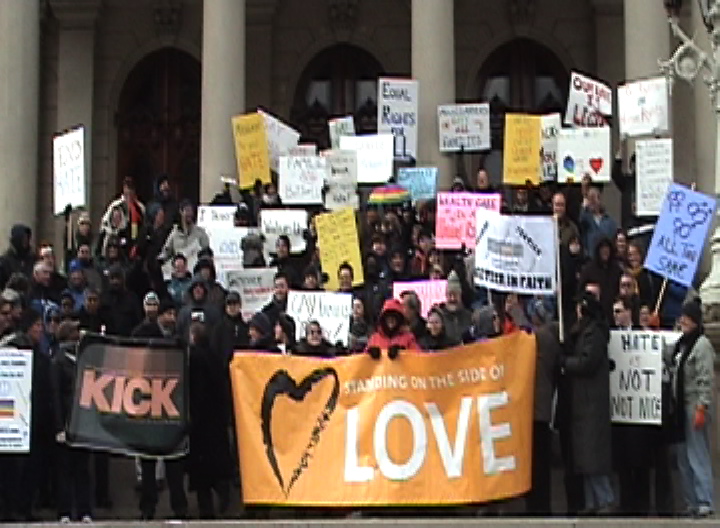
The rally featured speakers from across the state including Ann Arbor, Saginaw and Kalamazoo. West Michigan was represented by people from the GVSU LGBT Resource Center, The Network, West Michigan Pride and Until Love is Equal. Much of the commentary focused on how the LGBT community is outraged that the state would target their community with such a draconian policy.
Some speakers noted that Michigan is a state where anyone who identifies as LGBT or is perceived to be LGBT can be fired from their job, can not legally get married and are the subject of constant harassment and bullying. Add on to that the couples whom now do not have health care benefits because of this new legislation that took effect on January 1st.

Several of the speakers targeted the Republican legislators, which overwhelmingly endorsed the legislation. People also talked about voting out those of push the anti-domestic partner benefits legislation and encouraged people to sign a petition that was circulating in the crowd. It is worth noting that this legislation was first introduced by West Michigan Representative Dave Agema.
Early on in the rally, Rep. Agema passed those protesting, which caused many of those outside to boo him as he crossed the Capitol building walkway. After the rally a handful of those from West Michigan visited Agema’s office to confront him personally. Unfortunately, Agema was not in, but some people left messages with his staff.
TV trucks were parked outside the Capitol building the whole time the protest was taking place in preparation for tonight’s State of the State address from Snyder. Not surprisingly, none of the TV stations bothered to interview or film today’s rally.
The following video includes excellent comments from Dave Garcia with the Detroit-based LGBT group Affirmations and a brief interview with ACLU lawyer Jay Kaplan, who spoke about the legal and real world consequences of this new state policy.
Calvin January Series: Joel Salatin, Polyface Farm

Pigs express their pigness at Polyface Farm
Author and fulltime alternative farmer in Virginia’s Shenandoah Valley, Joel Salatin began his talk with an analogy that likened our relationship to food to a relationship with a dance partner. In eras past, our relationship with this dinner dance partner was much more intimate. People spent a majority of their time dancing with their food—planting it, tending it, harvesting it, preserving it, cooking it and eating it at the table with friends and family.
Now we spend very little time with our dinner dance partner. Most of us don’t even sit down to a meal—instead we graze. “We have pulled away from this dinner dance partner. Others have stepped in very gladly to fill in this relationship deviation: Kraft, Monsanto, Taco Bell … the list goes on and on,” Salatin said. “As we have deviated from this historical intimacy, other entities with dubious agendas have stepped in, corporations which take a fundamentally mechanical view towards food. Food is a biological thing, not a mechanical thing.”
Salatin said that we need to make our kitchens the heart of our homes again. He encouraged audience members to learn to can and cook from scratch–and to be compassionate with themselves. After all, a baby learning to walk falls down a lot at first. “Well, have you heard if it’s worth doing it’s worth doing right? We don’t do anything right at first … If it’s worth doing it’s worth doing poorly first.”
Salatin challenged Tuesday’s January Series audience to think small—microscopically small. He pointed out that two handfuls of fertile soil have more live organisms than there are people living on the earth. He noted that modern science sees agriculture as a mechanical endeavor rather than a relationship with life. Its disregard for the organisms living in soil has grown into a disregard for farm animals, as evidenced in CAFOs, and, ultimately, a disregard for human beings, as borne out by violence in our culture that especially impacts people perceived as “the other,” e.g. immigrants.
“The notion of life as a mechanical thing has led us to some really strange paradigms. Like soil is inert. Look in an electromicroscope. (You’ll see) all kinds of microorganisms living . . . a community of amazing beings . . . Everything that we are and we see is dependent on that invisible world.”
Instead of following the lead of the living, natural world, modern agriculture is looking for “Star Trek fantasy” answers to the increasingly complex problems that science-based agriculture has created. Salatin made reference to the US-Duh (USDA), as it continues to support corporations like Monsanto which are endangering all life on the planet in the name of profits.
“There are reasons why things are the way they are,” Salatin said. “When we view life as an inanimate structure, the culture takes that same kind of tyrannical view towards its own citizens and other cultures . . . we have gotten so mechanistic that we have left an ethical moral parameter.”
A working model
 Salatin’s Polyface Farm successfully flies in the face of modern agricultural science and its destructive “best” practices. One example, over the winter, cows contently amble into a shed to feed—and poop. As the manure piles up, corn is mixed into it and the feed bins are raised. As spring arrives, the pigs are allowed into the shed. As they happily root for corn, they aerate the manure, “fluffing it up” and aerating it, creating a fertile compost for the fields.
Salatin asked, “How do we create a habitat for the pig that allows the talents and gifts that God gave that creature? Put a moral ethic around it. Then we can innovate within the protective confines of humility. In CAFOs, there is no place for the expression of the gifts and talents of the pigs. They get bored, cannibalize each other. We are a culture that cannibalizes as a direct result of a food system that cannibalizes.”
At Polyface Farm, the free range chickens follow the cows, like birds follow herbivores in the wild. The cows here are herbivores. Cows at CAFOs are fed meat, often diseased meat. These types of practices not only subjugate livestock animals to lives of pain and misery, they also breed new diseases, for example, mad cow disease.
Salatin noted that if scientists wanted to create disease, cancer and sickness, the best way to do it would be to establish farms that specialized in only one species so pathogens wouldn’t have to adapt to variety. Then, crowd them up real tight so it’s easy for the pathogens to get from one animal to another. Next they would put the animals in a building with no fresh air or sunshine, as both can slow the growth of pathogens. The scientists would make sure the animals get no exercise, as that might boost their immune systems. They would further suppress the animals’ immune systems by injecting them with antibiotics and hormones. Last of all, they would feed the animals junk. This “experiment” describes today’s CAFO, describes modern, science based agriculture and describes our food system.
“We want a farm that builds soil, builds immune systems, builds nutrient density. Ultimately, as a farmer, I am in the land redemption business . . . (We need to) step in as loving land stewards, caretakers, as an expression of God’s grace, abundance and redemptive capacity. .. God is beautiful and we are supposed to extend his beauty into creation. I’ll bet he’s interested in the pigness of a pig. (We should) all commit ourselves to embracing our dinner dance partner and building a world that’s better than the one we inherited.”
How To Waste Your Vote In 2012
This article by Bruce Dixon is re-posted from Black Agenda Report.
It’s true enough. Your vote really is your voice, and in the modern era, every government on earth claims to rule with the consent of the people. This bestows upon the vote a unique kind of legal and symbolic power. The gap, however, between this legal, this symbolic power of the vote and any real ability to change things for the better is a vast one. The authorities rightly fear the people’s voice, and so have contrived law and custom to ensure that we are seldom heard and almost never heeded.
They would never dream of allowing us to vote on the price of gas, food, housing, credit or college tuition. But they don’t mind at all letting us choose between corporate-funded Republicans and corporate-funded Democrats. The powers that rule our economy, our media and our politics won’t let us vote on whether to bring the troops home from 140 countries and the seven seas, or whether to continue spending more on weapons of death and destruction than the other 95% of humanity combined. But they will let us choose between an ignorant, crazy or racist Republican who promises to give banksters, polluters and corporate criminals a free pass, and a sane, smart, level-headed free market liberal Democrat who does exactly the same thing, no matter what he promised.
The authorities won’t let us vote on whether the broadcast spectrum should be privatized, whether we should have the right to start and join unions, whether to create millions of good-paying green jobs. They won’t allow voters to decide whether corporations deserve more rights than flesh and blood people, or whether the president should be able to kidnap, torture, imprison and murder people without trials or even charges. But they will let us choose between a white guy and a black guy. As long as it’s their white guy, and their black one as well.
This imposition of false and meaningless choices is how, in these United States, our voices are suppressed, our votes wasted and made irrelevant, with the black vote rendered most irrelevant of all.
The gaps between black and white employment and household wealth are greater, and expanding faster than at any time in the last six decades. But the black vote will go to a man who doesn’t believe black unemployment or dispossession or even black mass incarceration merit any special attention. Though black voters are historically more opposed to foreign wars and military intervention, their votes this time are pledged to a president who made a war speech while receiving a peace prize, who invaded Arab and African countries with drones and special forces, and who heartily endorses Israeli apartheid.
This is how the game is played. This is how the legal and symbolic authority of millions of our wasted votes is hijacked every election cycle, making possible wars we do not endorse, ratifying policies we never wanted, and pretending to believe promises we know, or should know will never be kept. This is what Eugene Debs referred to a century ago, when he declared he would rather cast a meaningful vote for what he did want, and not get it, than a fake and hollow one for what he didn’t want, and get that.
And so, a hundred years later, the game is still the game. If we want our votes to have any meaning, it’s time to reject the fake choices between the two corporate parties. It’s time to wise up, to grow up and like adults, to take a view longer than dessert, or the next two or three elections.
OKT hosts activist Bryant Terry in community dialogue
Bryant Terry, eco-chef, activist and author
Community Dialogue with OKT
2 to 4 p.m. Sat. Jan. 21
Sherman Street Church
1000 Sherman St. SE
Grand Rapids
Eco-chef, food justice activist and author, Bryant Terry will meet with Our Kitchen Table and community members for dialogue from 2 to 4 p.m. Saturday Jan. 21 at Sherman Street Church, 1000 Sherman St. SE in Grand Rapids. If you’d like to be better prepared for the dialogue, Terry has recommended reading Body and Soul: The Black Panther Party and the Fight against Medical Discrimination by Alondra Nelson.
Terry’s stop in Grand Rapids kicks off the release of his new cookbook, The Inspired Vegan. He is here principally to participate in Calvin College’s Wake-up Weekend, which includes a Friday evening lecture, “Cooking as Inspiration for Liberation” and a Saturday morning brunch and panel discussion featuring OKT’s executive director, Lisa Oliver King. Hosted by Brick Road Pizza, 1017 Wealthy Street SE. The free panel discussion takes place at 10 a.m. with brunch following at a cost of $12 per person.
Terry’s other books are Grub and Vegan Soul Kitchen. He has appeared on the Sundance Channel’s original TV series “Big Ideas for a Small Planet,” the BET series “My Two Cents” and on PBS’ “Nourish: Food + Community” and “The Endless Feast.”
Enjoy this brief clip of Terry talking about food discrimination:
Local TV stations making money from Oil Industry ads, again

As is always the case during a major election cycle, local broadcasters will reap the benefits of those seeking to influence elections and legislation.
As we have noted in pervious election cycles, local broadcasters, particularly TV stations will make millions from money paid to buy airtime from political parties, political action committees (PACs) and from individual corporations and associations.
Recently, the American Petroleum Institute has been buying airtime in West Michigan with a commercial advocating that the Obama administration approve the Keystone Pipeline Project.
The ad, like all political ads, over simplifies what is at stake. The American Petroleum Institute uses language that tries to make it sound like the Obama administration must approve this project in order to be true to his claims to getting the US economy back on track. The ad focuses mostly on how the Keystone Project would create jobs and provide a safe energy source for the US.
The American Petroleum Institute ad, however, is full of misinformation. First, the bulk of the oil from the Alberta Tar Sands Project will mostly be for export and not for domestic use as the ad claims. Second, the project is considered one of the worst environmental disasters in recent years. According to Tar Sands Watch the project is using an excessively large amount of water resources from Canada and it is now the number one emitter of greenhouse gases in the country. Third, the project is opposed by Aboriginal groups, since the pipeline will threaten the sovereignty of native lands.
These facts and others are not included in the American Petroleum Institute ad and local TV stations are not challenging or questioning their claims.
In addition, the local TV broadcasters are not reporting on the fact that one of the main players in the Keystone Pipeline Project is Enbridge, as you can see from this map below. So not only are local broadcasters making money from this ad they are not investigating the link between a company with a major oil spill in West Michigan and one of the worst ecologically disastrous projects in recent decades.

West Michigan TV viewers are also not likely to hear local TV stories about the political influence of the American Petroleum Institute. According to the Center for Responsive Politics, the American Petroleum Institute has spent millions annually lobbying Congress.
Lastly, this new ad campaign from the American Petroleum Institute is right on the heels of another ad campaign they rolled out late last year called the Vote 4 Energy campaign, where viewers were led to believe that people off the street were saying positive things about the oil industry. We know that the ad was scripted and not the spontaneous reflections of average Americans because a Greenpeace activist was able to get in on the production of the commercial and tape how lines were being fed to people. The ad campaign was also exposed by the group Polluter Watch, which did its own spoof ad we encourage you to watch here.
Is the US Military Addicted to War Porn?
This article by Matthis Chiroux is re-posted from Common Dreams.
The recent images in the media of uniformed U.S. Marines urinating on dead bodies in Afghanistan rightfully invokes nearly universal condemnation. Besides respect for the dead being somewhat of a universal human value at this point, it is a supreme law of war for every single nation on the planet.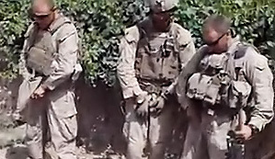
These images should prompt a lot of questions here in America, about our military, our wars, our culture and our role in global affairs. To some, mostly the weavers and backers of war policy, it seems again that ‘a few bad apples’ have acted on their own within the military, and will be brought to justice in accordance with domestic military law.
To others, such as myself and the majority of veterans I associate with, the barbarity of these images is synonymous with our experiences within a military at war. No crime our brothers and sisters commit really surprises us anymore, but confirms to us our nation’s brutal history, of which for a time we became a part, and offers us a reminder that nothing’s really changed.
But while our military’s mission of ‘engage and destroy’ remains essentially the same in Afghanistan as it has been in every other conflict, the modes of documentation have changed, as now nearly every troop carries his own camera into combat. From this fact flows a cinematic phenomenon that troops and veterans recognize as ‘war porn.’
War porn means different things to different people, similar to the ‘adult material’ from which it draws its name. Generally, in military and veteran circles, war porn is recognized as any image or video produced in a combat zone depicting death, violence, gore, brutality, depravity, lewd behavior or any other shocking act that would be perceived unacceptable or even criminal if committed on American soil.
War porn, like pornography, is traded mostly in secret. It is consumed mostly in private, and those who possess it may often feel hesitant to share it with anyone outside of the military or veteran communities. However, during the past decade, the American people and the world have witnessed several stark examples of war porn leaking to the surface. Perhaps the most famous incident to date are the images of bound and naked prisoners being abused in Abu Ghraib Prison, in Iraq, that leaked in 2004.
However, not every piece of war porn that bubbles to the surface ever generates public outcry on the level of the Abu Ghraib photos or the latest disgusting iteration. Several websites have risen to prominence during the War on Terror, solely for the purpose of trafficking war porn. Gotwarporn.com claims that it is “countering the cyber-jihad one video at a time,” by uploading examples of, “the devastating force we bring to bear on our enemies.” Videos can be browsed according to the type of weapon used, the type of violence committed and the location where the violence occurred. Gotwarporn.com regularly displays user-uploaded video, referring to most of their content as having been “leaked.”
But gotwarporn.com is not the first website to help soldiers traffic their war porn. Nowthatsfuckedup.com, which now directs to the Polk County, Flor., Sheriff’s Office, was removed from the web in 2006, after its proprietor, Chris Wilson, was charged with misdemeanor obscenity. The site, which began as an amateur pornographic hub where users could share images of their partners for a fee, became a central depository for war porn after Wilson began allowing site users from the U.S. Military to forgo the membership fee in exchange for posting an image proving they served overseas. According to a Nation magazine article from 2004, the uploaded photos began as “benign images of troops leaning against their tanks, but graphic combat images also began to appear.”
These images, while horrifying to most, serve a purpose for the soldier, and further, have broader public appeal in the U.S. More than simply being in-demand for their shock value, images like these, “constitute a field report on the production and reproduction of U.S. global dominance,” according to Prof. Mary Ann Tetreault of Trinity University in her 2006 piece entitled, “The Sexual Politics of Abu Gharib.”
“The Abu Ghraib images and documents describe violations of the captives’ bodily integrity, masculine self-image, and religious rules about cleanliness,” writes Tetreault. “Photos show naked victims arranged in piles, smeared with filth, and forced to simulate sexual acts. Their manhood is disparaged in many ways. Indeed, they are feminized—unmanned—by the gaze of their captors who strip them, scrutinize and manipulate their bodies, taunt them, and create pornography out of their humiliation by taking pictures of them.”
To me, the images of the Marines urinating on dead Taliban fighters share a similar cultural significance with the images from Abu Ghraib. Again, we see depicted not just random degenerate acts carried out purely for shock value, but instead, we see an image structured in a very specific way; one that acts as a metaphor for U.S. domination. The image is of not just a physically defeated enemy, but of an enemy that has also been stripped of his dignity, customs and masculinity.
Regardless of the face that soldiers are trained to show the world, these types of dominance narratives are highly in-demand in military communities, especially after a decade of relative combat-defeat in which few, if any, of the U.S.’s larger goals for occupation have been accomplished. Historically, defeated or nearly defeated armies have been guilty of some of the most serious atrocities. Indeed, combat journalists throughout history have reported retreating troops to be some of the most dangerous individuals on the battle-field.
It has been my experience within and without the military that soldiers covet nothing greater than power over others. Be it expressed internally through the military rank structure, or externally through the destruction of an enemy, family or coercion of a sexual partner, soldiers generally believe themselves superior human beings to someone, and the affirmation of this desire can take on many brutal forms. Further, when the superiority of a soldier is questioned by a force outside the chain of command, brawls tend to erupt, barracks rumbles ensue and bitter rivalries take shape. What this generates is a ‘wild west’ atmosphere on and around many bases in the world. What this translates to for local communities is violence in nearly every form.
Statistically speaking, military communities are among the more violent U.S. communities, with military bases reporting significantly higher rates of incidents such as rape, domestic assault and suicide. U.S. military bases, both in the U.S. and abroad, have reputations for drunkenness, prostitution and general ‘vice,’ as if each installation were its own little ‘Vegas,’ promising the men within riches of whiskey, wealth, women and weapons.
Not surprisingly, addiction in the military is also something that runs rampant world-wide. But while we’re all used to hearing about the alcoholism and the drugs, pornography addiction is reaping increasingly devastating havoc on military families, according to a recent Army Times story. In the story, Navy Lt. Michael Howard, a licensed therapist and military chaplain who councils soldiers for sex addiction, suggests that as many as twenty percent of our troops are addicted to online porn. “That would be a conservative estimate,” he says, while others in the story corroborate his statements.
But war porn is something in a category of its own. Soldiers don’t just download it, they are the primary manufacturers, and its existence doesn’t just destroy American families. War porn, by definition, documents the destruction of someone else’s family. Furthermore, if it can be argued that pornography normalizes violence against women, it certainly cannot be disputed that war porn normalizes violence against everyone!
We’ve only started as a society to be exposed to the bottomless archives of war porn that exist on hard-drives throughout the country. While particularly blood-thirsty participants in prior wars were forced to either keep simple snapshots or body parts of the people they killed to use as war trophies, troops of today have very different options. While an actual finger or an ear, which still are taken as war trophies, may not make it back across the boarder, a JPEG or an MOV file can be effortlessly concealed; even sent back ahead of the group with the simple click of a mouse.
While I have never heard an official estimate of how much war porn may exist from the occupations of Iraq and Afghanistan, I have spoken to fellow soldiers and veterans around the country and have been exposed to many individual collections. Given what I’ve seen myself, and knowing how many soldiers today carry cameras into combat, I’d estimate that there are many hundreds of thousands of terabytes of data in existence that could be classified as war porn.
While it is true that soldiers have gotten a lot more shrewd about who they’ll share their war porn with, certainly as the result of various related scandals, I do not believe this has led many of them to destroy their individual collections. If anything, the war porn has simply been archived, and may be released at a later time. Many soldiers and veterans are yet to realize the true weight and consequence of what they carry with them. Hopefully, as their consciouses continue to recover, some of the more courageous ones may feel compelled to share publicly what they possess.
But even for those who will never share publicly, the evidence of their acts will continue to exist. It’s the nature of digital information to stick around and be inconveniently discovered later on. It’s only a matter of time until the flood gates open. Perhaps, as I said, it will be the veterans themselves who feel so moved by conscious. More likely, it will be hacked free by information anarchists or recovered by tech-savy garbage pickers in electronics landfills and recycling plants somewhere south of the equator. When that begins happening on a regular basis, we’re going to have a lot to account for as Americans, after having blindly supported our troops through two bloody and unjust military occupations.
Yes America, our military is addicted to war porn, and this fact may ultimately usurp any legacy of honor or glory the military may cling to. No longer can the world be duped by the government-controlled facade of the U.S. soldier as a liberating force for good. Our image is that of an armed, drunken fiend in a public square with his pants down pissing into the wind. Sure, we may be an affront to those around us, but we’re only really soiling ourselves.
Matthis Chiroux is a former Army sergeant, an Iraq War Resister and an Afghanistan veteran. In 2008, he refused deployment orders to Iraq in the U.S. Congress, calling the war illegal and immoral. Eventually, he obtained endorsement for his position from 13 Democratic House Members who penned a letter to then President George W. Bush expressing support for Iraq War Resisters. Matthis has organized extensively within the veterans peace movement since, organizing a variety of direct actions and campaigns in military communities around the country.
MLK event speaker on Hip Hop Activism in the Age of Obama

GVSU hosted the first of several events today for Martin Luther King Jr. week on campus, with a public lecture by author/activist Bakari Kitwana. Kitwana has written several books on the politics of Hip Hop, with his most recent book entitled Hip Hop Activism in the Obama Era.
The speaker began by talking about the connection between MLK, the Civil Rights movement and young people today. He also stated that he wanted to demystify the work of activism.
One thing he pointed out was to say that MLK day should be seen as a celebration of all the participants of the Civil Rights Movement and not just King the individual. This led Bakari to identify three Civil Rights activists, such as Diane Nash, a co-founder of SNCC and a participant in the Freedom Rides.
Another woman he mentioned was Dr. BerniceJohnson Reagon, who was a founding member of the musical group Sweet Honey in the Rock. Bakari spoke about how important music was and what role it played in the movement. He said that Bernice told him about her own involvement in the movement and how at times they were very afraid to take a public stand against injustice.
The third woman that Bakari identified was Carlotta Walls LaNier, one of the Little Rock Nine. At a lecture in which Bakari was at, where Carlotta was also present, people were talking about the mergence of Hip Hop and politics. Carlotta said to Bakari, “what are you waiting for?” Barkari told that story to illustrate the point that each generation needs to step up and make change.
Bakari then shifted to talking about the legacy and the message of Dr. King. He identified three main points that he felt is relevant to take from the Civil Rights movement and what it means for today.
The speaker emphasized how this movement is always moving and is made up of many. He cites Vincent Hardings book There is a River: The Black Struggle for Freedom in America, which makes the point that each generation of African Americans gave birth to leaders and organizations that determined what direction the struggle would go.
Bakari then shifted to discussing how morality was viewed by the likes of King and Malcolm. Too often morality is limited to just being against something like pre-marital sex. It ends up just being a position. However, for King morality has more to do with what action we take to intervene in major issues of the day such as war. Kitwana then applies King’s notion of morality to the current US wars in Iraq and Afghanistan. Bakari particularly points out both the human and monetary costs of these wars and even provides data from the National Priorities Project.
Another issue that King spoke and acted on was the wealth divide in the US and how a disproportionately large percentage of people living in poverty. The gap between the rich and the poor has tripled in the last three decades, according to Kitwana, with an estimated 40 million Americans living in poverty.
King, of course, also addressed the intersection of race and class, according to the speaker. He tells the story of King talking to poor Whites while being in jail in Birmingham and that those poor Whites have the same reasons to march against injustices as Blacks do.
Kitwana then shifted his talk to the youth of today and the history of the Hip Hop movement. Much of the original Hip Hop artists came out of the growing economic divide that resulted in the 1980s with a large shift of US manufacturing jobs to overseas markets.
Hip Hop emerged as a response to this kind of economic disparity in the US and particularly how it impacted the Black community. With Hip Hop you have people in the Black community articulating a vision for struggle across the country. This vision led to the formation of Hip Hop organizations and coalitions, with an emphasis on voter registration with youth. This organizing began in 2004, with the campaign in support of John Kerry and continued to the campaign of Barack Obama in 2008.
Unfortunately, the energy and activism amongst youth that led to the election of Obama, drastically declined after the election. People have not honestly come to terms with the failure to continue political work and organizing, but he also notes that young people in particular are less likely to put faith in the political process since it has not done what people worked so hard for.
Bakari said that now young people are organizing in different ways and mentions the role that youth have played in the Occupy Wall Street movement. However, the message has to be more than just protest, it needs a political savvy that energizes people to fight for what they need to today!
Kitwana did not address in detail the role of Hip Hop in politics today, but during the Q&A he did respond to a question about the importance of having a cultural shift from the corporate music industry produced Hip Hop and the grassroots Hip Hop.
Bakari said that there are more and more Hip Hop artists who are not only operating independently of the commercial music industry, they are also involved in local grassroots politics across the country. He noted how groups like Industry ears are not only exposing the racist and classist elements of the dominant commercial culture, they are organizing around media justice at the local level and in terms of policy.
Having read Kitwana’s books I will say he is a better writer than speaker. However, his message today was valuable and he did not cheapen the memory of King with clichés and a blind call to support Barack Obama without a critical eye.
 Grand Rapids Institute for Information Democracy