Starting in May, GRIID will be offering a 5-week class on the topic of Food Justice. This class is in conjunction with the current Food Justice project that the group Our Kitchen Table (OKT) is involved in.

The 5-week class will explore how we came to have a food system, which is based on an agri-business model that sees food primarily as a commodity and not as a source of healthy nutrition.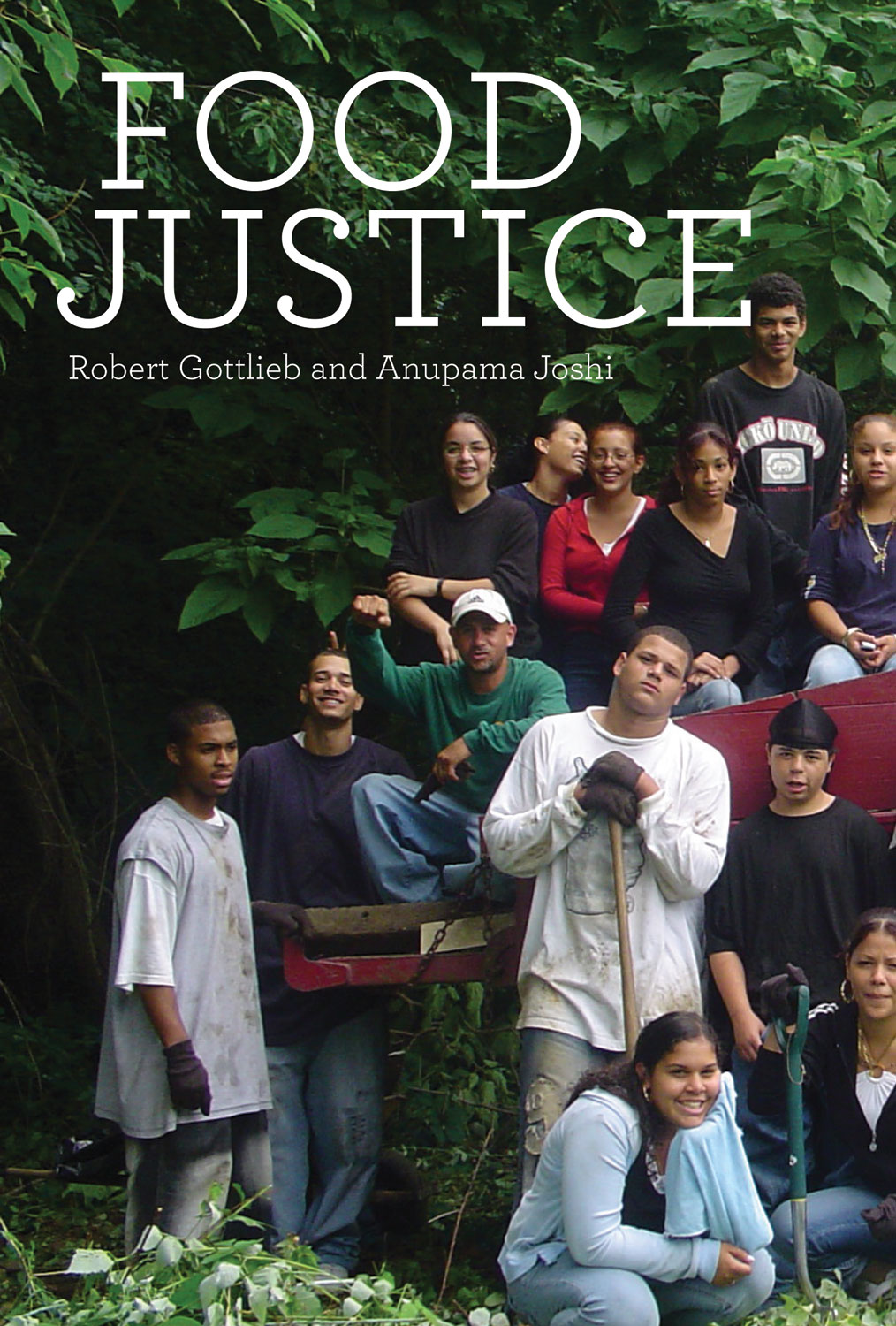
We will explore the US food system over the past 100 years and look at issues like food deserts, food justice and food sovereignty. The class will collectively read the book Food Justice, by Robert Gottlieb and Anupama Joshi.
In addition, the class participants will use the analysis from the readings to discuss ways to create a more just food system in West Michigan.
The 5-week class will be held on Tuesdays from 6 – 8PM in the lower level of the Steepletown building located at 671 Davis, NW, in Grand Rapids. The class will begin on Tuesday, May 8.
Anyone interested in signing up for the class can contact me at jsmith@griid.org. There is no cost to this class, but you need to bring your own copy of the book, Food Justice, by Robert Gottlieb and Anupama Joshi.
Next week, the Grand Rapids branch of the IWW and the Bloom Collective will be hosting a screening of a recently produced film entitled Just Do It: A Tale of Modern Day Outlaws.
JUST DO IT! Lifts the lid on climate activism and the daring troublemakers who have crossed the line to become modern day outlaws. Documented over a year, Emily James’ film follows these activists as they blockade factories, attack coal power stations and glue themselves to the trading floors of international banks despite the very real threat of arrest.
The film demonstrates the power of collective and direct action over petitioning and other reformist approaches to environmental protection and climate justice.
IWW Monthly Film
Just Do It!
Thursday, April 19
7:00 PM
IATSE Labor Hall
931 Bridge St. NW, Grand Rapids
This film is free and open to the public. A discussion will follow the film.
13 Ways the Government Tracks You
This article by Bill Quigley is reposted from CounterPunch.
Privacy is eroding fast as technology offers governments increasing ways to track and spy on citizens. The Washington Post reported there are 3,984 federal, state and local organizations working on domestic counterterrorism. Most collect information on people in the US. Here are thirteen examples of how some of the biggest government agencies and programs track people.

One. The National Security Agency (NSA) collects hundreds of millions of emails, texts and phone calls every day and has the ability to collect and sift through billions more. WIRED just reported NSA is building an immense new data center which will intercept, analyze and store even more electronic communications from satellites and cables across the nation and the world. Though NSA is not supposed to focus on US citizens, it does.
Two. The Federal Bureau of Investigation (FBI) National Security Branch Analysis Center (NSAC) has more than 1.5 billion government and private sector records about US citizens collected from commercial databases, government information, and criminal probes.
Three. The American Civil Liberties Union and the New York Times recently reported that cellphones of private individuals in the US are being tracked without warrants by state and local law enforcement all across the country. With more than 300 million cellphones in the US connected to more than 200,000 cell phone towers, cellphone tracking software can pinpoint the location of a phone and document the places the cellphone user visits over the course of a day, week, month or longer.
Four. More than 62 million people in the US have their fingerprints on file with the FBI, state and local governments. This system, called the Integrated Automated Fingerprint Identification System (IAFIS), shares information with 43 states and 5 federal agencies. This system conducts more than 168,000 checks each day.
Five. Over 126 million people have their fingerprints, photographs and biographical information accessible on the US Department of Homeland Security Automated Biometric Identification System (IDENT). This system conducts about 250,000 biometric transactions each day. The goal of this system is to provide information for national security, law enforcement, immigration, intelligence and other Homeland Security Functions.
Six. More than 110 million people have their visas and more than 90 million have their photographs entered into the US Department of State Consular Consolidated Database (CCD). This system grows by adding about 35,000 people a day. This system serves as a gateway to the Department of State Facial Recognition system, IDENT and IAFSIS.
Seven. DNA profiles on more than 10 million people are available in the FBI coordinated Combined DNA index System (CODIS) National DNA Index.
Eight. Information on more than 2 million people is kept in the Intelligence Community Security Clearance Repository, commonly known as Scattered Castles. Most of the people in this database are employees of the Department of Defense (DOD) and other intelligence agencies.
Nine. The DOD also has an automated biometric identification system (ABIS) to support military operations overseas. This database incorporates fingerprint, palm print, face and iris matching on 6 million people and is adding 20,000 more people each day.
Ten. Information on over 740,000 people is included in the Terrorist Identities Datamart Environment (TIDE) of the National Counterterrorism Center. TIDE is the US government central repository of information on international terrorist identities. The government says that less than 2 percent of the people on file are US citizens or legal permanent residents. They were just given permission to keep their non-terrorism information on US citizens for a period of five years, up from 180 days.
Eleven. Tens of thousands of people are subjects of facial recognition software. The FBI has been working with North Carolina Department of Motor Vehicles and other state and local law enforcement on facial recognition software in a project called “Face Mask.” For example, the FBI has provided thousands of photos and names to the North Carolina DMV which runs those against their photos of North Carolina drivers. The Maricopa Arizona County Sheriff’s Office alone records 9,000 biometric mug shots a month.
Twelve. The FBI operates the Nationwide Suspicious Activity Reporting Initiative (SAR) that collects and analyzes observations or reports of suspicious activities by local law enforcement. With over 160,000 suspicious activity files, SAR stores the profiles of tens of thousands of Americans and legal residents who are not accused of any crime but who are alleged to have acted suspiciously.
Thirteen. The FBI admits it has about 3,000 GPS tracking devices on cars of unsuspecting people in the US right now, even after the US Supreme Court decision authorizing these only after a warrant for probable cause has been issued.
The Future
The technology for tracking and identifying people is exploding as is the government appetite for it.
Soon, police everywhere will be equipped with handheld devices to collect fingerprint, face, iris and even DNA information on the spot and have it instantly sent to national databases for comparison and storage.
Bloomberg News reports the newest surveillance products “can also secretly activate laptop webcams or microphones on mobile devices,” change the contents of written emails mid-transmission, and use voice recognition to scan phone networks.
The advanced technology of the war on terrorism, combined with deferential courts and legislators, have endangered both the right to privacy and the right of people to be free from government snooping and tracking. Only the people can stop this.
The “humility” of Rick DeVos
Earlier today, the Hauenstein Center of GVSU hosted the last of their Wheelhouse Talks, which took place and the Salvation Army Kroc Center in Grand Rapids.
The guest speaker today was Rick DeVos, founder of ArtPrize and other “entrepreneurial” endeavors. DeVos, who read from a script, talked less than 15 minutes before he opened it up for questions.
DeVos began his talk by saying that “leadership” was a loaded word for him. He said he has a hard time with being considered a leader and that he tries to take a humble approach when asked to come speak about the issue of leadership. DeVos even said he prefers being in a quiet room reading a book and not around a lot of people.
DeVos played the humility card quite a bit in fact, but as someone who is born into wealth and has taken advantage of the privileges of using that wealth to start other business ventures, it just seemed like false humility.
DeVos said the main things he wanted to communicate about how he has been successful were three things: having good ideas, clear goals and courage. In fact, the talk he gave earlier today was quite similar to his comments in a recent article in the Fast Company Magazine.
The son of Dick & Betsy DeVos said that we in Michigan plan too much and don’t allow for creativity and that this is a hold over from the manufacturing days. DeVos said he had no proof that people would be interested in ArtPrize, 5×5 or water in a box, but people did. True, there has been interest in those things, but people also like American Idol and Tim Tebow. Just because people like something doesn’t necessarily mean it is a benefit to the community.
DeVos then talked about courage and bravery, which for him is in part coming to terms with the fact that you will fail at times. Again, this seems like such a strange notion from someone who got $2 million from his parents to start ArtPrize. When most people fail in the real world, they don’t have rich parents to back them up.
The third generation DeVos then talked about how there are trolls in the world that will criticize you. Some of those “trolls” are other business people who want to bring you down instead of supporting you and the other type of trolls are those who are “Internet loons with conspiracy theories.” DeVos didn’t identify any of the loons, but dismissing critics as loons who promote conspiracy theories is just a convenient way to dismiss anyone who honestly wants to challenge those who have power.
As someone who has written a great deal about ArtPrize from a critical point of view, I don’t see such criticism as conspiratorial, but an understanding of how power functions. When we posted a piece last November that looked at the second year financials of ArtPrize, where the was clearly monetary benefits being shared by a small sector of local businesses, that isn’t a conspiracy, it is business as usual.
As I already mentioned the talk was brief, so DeVos allowed plenty of time for Q&A. Most of the comments from those in the audience of about 200 were affirming of ArtPrize and the questions ranged from “will you write a book,” to “how did ArtPrize get started” and “what does it take to be an effective team builder.”
One woman did cite an author about how God is calling us to a place of purpose. She asked DeVos where God was calling him, particularly around issues like poverty and justice. Not surprising, those topics were avoided and DeVos instead said he was interested in creating systems where people could invest in each other and themselves.
Some would argue that such investment does address poverty, but the history of struggle for justice, from the 19th century labor movements to the current global uprisings against private economic power, would suggest that justice is about equity, human rights and the redistribution of wealth and power.
Punishment and Profits: Immigration Detention
Editor’s note: This video is re-posted from Al Jazeera and contains information about the GEO Group, the company that runs a major private prison in Michigan.
Immigration is a key issue in the US presidential election, with the Republican candidates trying to demonstrate their tough stance on undocumented immigrants.
But under the Obama administration, the detention and deportation of immigrants has reached an all-time high.
Every day, the US government detains more than 33,000 non-citizens at the cost of $5.5mn a day. That is a lot of money for the powerful private prison industry, which spends millions of dollars on lobbying and now operates nearly half of the country’s immigration detention centres.
Fault Lines travels to Texas and Florida to investigate the business of immigrant detention in the US and to find out how a handful of companies have managed to shape US immigration laws.
It has been over a year now, but the retail giant Walmart is once again trying to get cities across the country to fight for $1 million dollars they want to donate to “fight hunger.”
Like the last time, local news agencies bought into the claim that Walmart wants to fight hunger and encouraged people to like the Fight Hunger GR facebook page. Local hunger relief agencies like Kids Food Basket and Feeding America West Michigan Food Bank are also promoting the Walmart campaign, since their agencies would be beneficiaries of the money if Grand Rapids won.
The Feeding America West Michigan Food Bank even posted a story on the citizen journalism site, the Rapidian. The article is nothing more than a pitch for the Walmart campaign that carries the simple message, “like our page and Grand Rapids can fight hunger.”
If anyone is serious about fighting hunger they will look at the reasons why people are going hungry. Once we explore the root causes we can see that not only do local charities that provide food assistance not fight hunger, in some ways they perpetuate social inequities by re-directing people’s energy and good will to keeping their organizations in operation.
The root cause of hunger in the US is not because there isn’t enough food, it is about having daily access to nutritious food. The main reason people do not have daily access to nutritious food is because millions live in poverty in the US. According to the official pull yourself up by your bootstraps narrative would say people live in poverty because they haven’t worked hard enough. This narrative is complete absurdity and should be apparently so since the 2008 economic bailout, where the financial industry was give billions of taxpayer’s money to keep them going even after they engaged is corrupt and fraudulent practices. Apparently, banks and other financial institutions don’t need to pull themselves up by the bootstraps, they just need a system that will bail them out.
Stealing a lot from the poor and giving a little back
The whole notion that Wal-Mart wants to fight hunger in America would make any reasonable person burst out in laughter. Thinking that the largest company in the world wants to actually fight hunger in America tells us something about how well propaganda works in this country. Here are several reasons why Wal-Mart is not committed to fighting hunger in the US.
1. Wal-Mart is the wealthiest company in the world with over $14 billion in profits last year alone. The company makes that kind of an annual profit because it has destroyed many local businesses and pays its workers poverty level wages. In 2008, Wal-Mart CEO H. Lee Scott Jr. made a $29,682,000 salary, which according to United for a Fair Economy is 1,314 times more than the salary of an average full-time Wal-Mart worker.
2.If Wal-Mart paid its workers a livable wage they could seriously reduce the number of people needing food assistance in the United States. Wal-Mart also constantly violates worker pay agreements and is currently facing about 80 individual lawsuits from workers and 4 class action lawsuits for worker violations.
3.Wal-Mart gets millions in tax breaks every year from communities across the country when they broker deals to build new stores. In addition, Wal-Mart use state and federal tax loopholes to pay less in taxes and get all kinds of subsidies. For example, Wal-Mart has been taking advantage of a tax loophole that the federal government closed years ago, paying rent to itself then deducting it from state taxes in about twenty-five states. Data from filings with the Securities and Exchange Commission show that on average Wal-Mart has paid only about half the statutory state rates over the past decade.” (2008 Wal-Mart Watch Report)
4.Wal-Mart is a company, like any other company, that is committed to maximizing their profits. You cannot simultaneously end hunger and make a profit. Besides not paying workers in the US a livable wage, Wal-Mart profits off the misery of millions globally by selling products made in sweatshop conditions. Thus, Wal-Mart is also contributing to hunger around the world by benefiting off a neoliberal global economic system.
5.Wal-Mart’s board of directors is made up of a group of economic elites who are also committed to maximizing profits and maintaining inter-corporate relations, which allows them to be a united front against government and public scrutiny. Look at who sits on Wal-Mart’s Board of Directors and ask yourself if these people are committed to fighting hunger.
There are many more reasons to discredit the claim that Wal-Mart wants to fight hunger in America, but we think you get the point. Wal-Mart recognizes they are despised by millions of people throughout the country, so this new campaign is really a PR effort to paint themselves as a “responsible” corporation.
This tactic of “funding community projects” is not a new one employed by corporations. Robber Barons like Carnegie and Rockefeller did the same thing 100 years ago as a means to prevent working class rebellion against their obscene wealth in the face of widespread poverty.
Currently, companies like Chase Bank, Pepsi and Wal-Mart are also trying to con the public into thinking they care about our communities by offering funds for local projects. We need to see these efforts for what they are, elaborate public relations ploys to divert our attention from how they continue to amass incredible amounts of wealth while more and more people fall into poverty.
Editor’s note: Baseball season is less than a week old and already there is a major controversy brewing in Florida over comments made by Miami Marlin’s manager Ozzie Guillen.
We are re-posting an article by left sportswriter Dave Zirin and would encourage people to read his blog and books if you have any doubts about the intersectionality of sports and politics.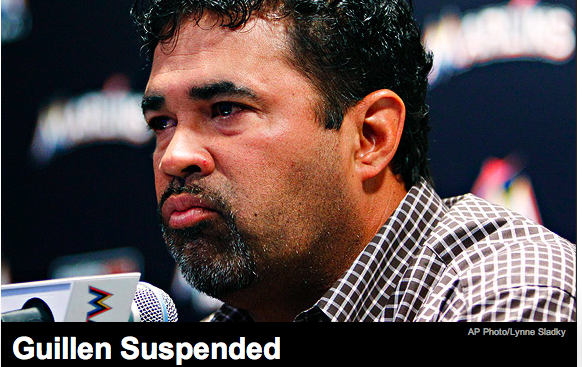
Short of a hurricane or an armed tax-payer revolt, this had to have been Miami Marlins owner Jeffrey Loria’s worst nightmare. Loria was opening a new state of the art, tax-funded stadium in Little Havana that will cost the city two billion dollars over the next 40 years. He also paid out several hundred million dollars in salary for free agents, making his new ballplayers the nation’s wealthiest public employees. This was the last, best, chance to sell baseball in South Florida. Loria desperately needed a hot start for his team and some sugary sweet media coverage for his new ballpark. Then his new manager Ozzie Guillen decided to share his views about Cuba and Fidel Castro. Guillen tends to talk without a filter and in an interview with Time Magazine, he revealed that he happens to not believe that Castro is Satan incarnate. Saying that he “loved” Castro, Guillen explained, “I respect Fidel Castro. You know why? A lot of people have wanted to kill Fidel Castro for the last 60 years, but that son of a b—- is still here.”
Casual kind words for Castro in South Florida is akin to looking at a leaky bottle of kerosene and thinking it could use a match. Now, we haven’t seen outrage like this in South Florida since butterfly ballots and hanging chads.
The Miami Marlins immediately released a condemnation of Guillen but that couldn’t stop a volcanic political explosion. Miami-Dade Mayor Carlos Gimenez called on the organization “to take decisive steps” against Guillen in the name of “freedom loving people.” Miami-Dade County Commission Chairman Joe Martinez demanded Guillen’s resignation. Cuban-American State Senator and Hispanic caucus chair Rene Garcia – in record time! – sent an open letter published in the Miami Herald calling Guillen’s comments “appalling” and said he was “looking forward to further actions taken against him for his deplorable comments.” Garcia also stuck Loria in the ribs by including, “What I also consider disturbing is the fact that the Miami Marlins received tax dollars from this community, including Cuban-American exiles, to fund the construction of the new stadium.” Suffice it to say, many a sports commentator also want Guillen fired or suspended. In their frothy anger, they have a common demand with the Cuban hardline exile group Vigilia Mambisa. An organization that has never shied from street violence and intimidation, Vigilia Mambisa has called for protests in front of the stadium until the Miami Marlins manager is fired.
As for Guillen, he has crumbled under the weight of all this, saying that he is now flying back to Florida to apologize in person to every animal, vegetable, and mineral he might have offended. “I want them to know I’m against everything [in Cuba] 100 percent-I repeat it again-the way [Castro has been] treating people for the last 60 years.”
Let’s leave aside the rather glaring irony that the politicians, sports commentators, and Cuban exiles want to show their love of freedom by taking Guillen’s job for the crime of exercising free speech. The fact is that when looking for political consistency and clarity, Ozzie Guillen is not the best place to start. The Venezuela-born Guillen’s comments on Castro are not very different from what he has always said about Venezuelan President Hugo Chavez. He has made comments very favorable about Chavez and very negative. He said, “Viva Chavez” after his Chicago White Sox won the 2005 World Series. He has also been one of Chavez’s most high profile critics.
Trying to make sense of Guillen based on public utterances is a fool’s errand. As someone who knows people that talk to Guillen when the cameras are off, I will try to explain his actual politics on Venezuela and Cuba. Guillen is big on a collective Latin American pride and will not abide anti-immigrant and anti-Latino words or deeds. He has a great deal of respect for the way Castro and Chavez stand up to the United States. He opposes efforts by the US to impose their will on these countries and wishes the rest of Latin America would show similar mettle. It’s not a question of the relative good or bad of Cuba’s internal politics. It’s a question of independence. He’s also as gung ho for the United States as any manager in baseball, going as far as to fine players for not showing proper respect for the National Anthem, a practice I criticized in 2005. I know that people love portraying Ozzie Guillen as an out-there, crazy kind of guy, and that’s in part because he is an out-there crazy kind of guy. But what’s crazier? Guillen’s views on Cuba or the fact that an aging coterie of people who mourn for the strong hand of Fulgencio Batista control the political debate in South Florida?
But this issue is bigger than Guillen and it’s bigger than Cuban exiles who dream of returning to a smoldering “free Havana”, with Castro’s head on a pike. It’s bigger than the petty hypocrisies of those who stand for freedom by denying it for others. It’s now about whether the ire produced by Guillen’s words will be directed against Loria, his grab of public funds, and the entire Miami baseball operation. If that happens, this issue won’t die, but the Marlins might.
Graffiti, Art and war crimes
This morning MLive posted a story about some new graffiti on the wall of the S-curve in Grand Rapids near the Gerald Ford Museum.
The article is interesting on many levels. The MLive reporter begins by asking the readers if this is graffiti or art, which in some ways is a legitimate question. The problem, however, is that this would not be a question that an MLive reporter asked if the painted images on the side of highway walls were an anti-war or anti-gentrification message.
Not content to end the charade there, the MLive reporter then talks to an employee of the Ford Museum to get his take on the “unsanctioned art.” The Museum spokesperson tries to remain neutral, but in no way does he condemn the graffiti. Imagine if there was a US Out of Afghanistan slogan spray painted at the same location. Do you think that anyone from the Ford Museum would remain neutral if asked about that?
The MLive article continues with the reporter citing the Grand Rapids City policy on graffiti and then followed up with commentary from a Kendall College professor who also considers the stencil of Ford to be art.
There are two issues here to consider on the art v. graffiti issue. First, as we have already pointed out there are clearly double standards about how MLive would report on graffiti that could be considered art, particularly if it affirms the dominant narratives………in this case celebrating Grand Rapids’ own Gerald Ford.
Second, for those who want to condemn graffiti no matter what the message is, you automatically demonize those who often do not have the means to communicate with a mass audience…….ie, those that use graffiti to make a statement. Much of the graffiti created in this community isn’t unlike the kind one would find in most urban centers, which is graffiti that is overtly political in nature (anti-war, anti-capitalist) or the graffiti of those who are economically and socially marginalized……..those we often lump into the “gang” category.
This second point underscores clear class differences, since it reflects how we think about negative social behavior. If a young person of color tags a building with a message we are all supposed to condemn it and say it is criminal behavior. However, if Bank of America puts up a billboard ad in the city, that is generally considered legal free speech. However, who does more harm to people, a street gang or a bank that engaged in massive fraud and then got bailout out by taxpayers who had no say in the matter?
War Crimes and Criminals
One last point worth making about the contradictory nature of the MLive story has to do with Ford himself. The MLive reporter cites the quote that accompanies the graffiti and then provides a hyperlink to the context of this statement. However, a serious look at the historical record would show that while Ford was President and Vice President, he presided over the torture and murder of thousands of people in countries like Vietnam and Indonesia. We produced a short video that gives an overview of Ford’s foreign policy, but an additionally good source is 895 Days that Changed the World: The Presidency of Gerald R. Ford, by Graeme S. Mount.
Again, the contradictions are quite apparent. It’s not ok to have anti-war graffiti, but it’s ok to have graffiti of a war criminal.
Occupy Grand Rapids announces first Spring Action for 2012

The local group, known as Occupy Grand Rapids, has just announced that they will be hosting their first rally this Spring.
As part of the kickoff event, Occupy GR is also hosting a Really, Really Free Market this Saturday on the corner of Fulton and Division at Monument Park.
According to the Media Release, there will also be a number of workshops and “open mic” opportunities. The schedule for the day is as follows:
2:00p-2:30p – “Tabling: how-to & why it’s important.”
2:30p-3:00p – “Occupy Our Homes: Eviction Resistance & Housing Defense”
3:00p-3:30p – Your Rights/Direct Action at work (IWW)
3:30p-4:00p – Consensus and the GA: It’s not a protest it’s a process!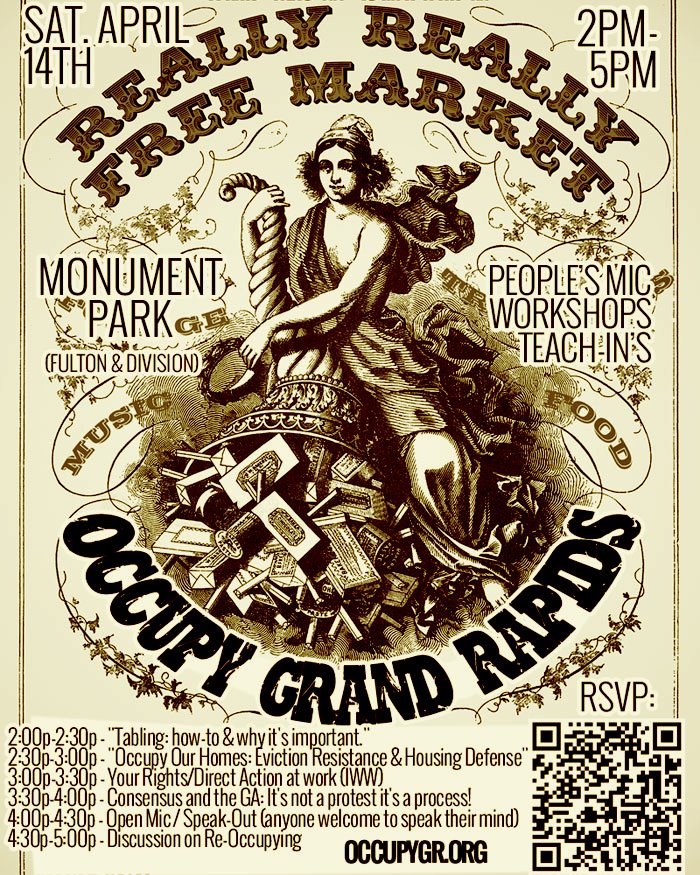
4:00p-4:30p – Open Mic / Speak-Out (anyone welcome to speak their mind)
4:30p-5:00p – Discussion on Re-Occupying
Occupy Grand Rapids
Saturday, April 14
From 2:00PM til 5:00PM
Corner of Fulton & Division in downtown Grand Rapids
For more information, check out their Facebook event page.
Why Campaigning for Democrats Cripples Unions
This article by Shamus Cooke is re-posted from CounterPunch.
As labor leaders across the U.S. shift resources away from defending workers and into Obama’s re-election campaign, millions of organized and non-organized workers remain unemployed and hopeless. Contrary to the “optimistic” government jobs numbers, the jobs crisis grinds onward. Some labor leaders will argue that getting Obama elected is the first step towards addressing the jobs crisis, but they know better.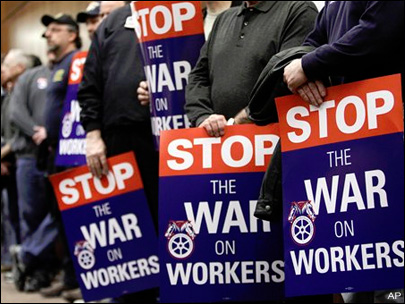
The recent so-called JOBS Act that passed with strong Democrat and Republican support will create zero jobs — the law’s intent is to lower regulations for banks and corporations, in an attempt to boost their profits. The JOBS wording was used for popularity’s sake, requiring heavy doses of deceit.
A similar-minded jobs project was put forth by Obama earlier in the year, when he appointed “experts” to his Council on Jobs and Competitiveness. But the Council was front loaded with CEO’s and bankers, with only two labor reps, who allowed themselves to be used to obscure the real intent of the project. Richard Trumka, President of the labor federation AFL-CIO, was one of the token labor leaders on the council, who only later partially redeemed himself by denouncing the Council’s job-creating recommendations (predictably, one of the key “job creating” ideas was to lower corporate tax rates).
Millions of union and non-union workers have seen their lives worsen under Obama while he promotes the above stunts that are intended to serve the wealthy and fool everybody else.
These millions of workers will now be subjugated to pro-Obama door knockers and phone callers from labor unions who will ignore the above facts while trying to put a pro-worker face on the pro-corporate president. Workers will not be so easily fooled, their paychecks — or lack thereof — speak stronger truths than can any pro-Obama campaigner.
The key irony is that the more forward-looking labor unions have already realized that they need the support of non-unionized workers if their movement is to survive. To this extent both union federations — AFL-CIO and Change to Win — have put tremendous resources towards community outreach and organizing. But such efforts can be wasted when unions pursue policies that working people not only disagree with, but denounce.
Non-unionized workers will only actively support labor unions when they are inspired to do so; if the non-union community trusts labor to fight for their interests, they will fight alongside unions in the streets. However, when unions have to skew the facts to encourage votes for Obama, they lose crucial trust with the broader community.
Trust was also lost when working people witnessed many unions publicly supporting Obama’s health care plan, which forces millions of non-union workers to buy shoddy corporate health insurance they cannot afford. Labor’s kid glove handling of Obama’s anti-public education policy is also high on the list of examples where unions weakened their community status by attaching themselves to the Democrats’ pro-corporate polices.
Shockingly, the largest teachers’ union, National Education Association, has endorsed Obama’s campaign even though the NEA President, Dennis Van Roekel, summarized teachers’ experience with the Obama Administration by saying, “Today our members face the most anti-educator, anti-union, anti-student environment I have ever experienced” — an environment directly encouraged by Obama’s deceitfully named “Race to the Top” education program.
Obama has yet to promise unions or working people anything in the upcoming election. Whoever wins the Presidency will immediately continue serving the corporations with varying degrees of public enthusiasm — the only real difference between the two parties.
Labor leaders are not stupid. They recognize these facts, but have absolutely no idea what to do about it. So they do what they’ve done for decades; align themselves with the Democrats in the hopes that they will be rewarded for their servitude. But the crumbs of gratitude stopped trickling down years ago, and what little remains on the workers plate is now being targeted by both Democratic and Republican politicians who insist on ever more concessions.
The Democrats’ policies signify a clean break from labor unions, an alliance that was always at the indirect expense of the rest of the working class. As long as unions were treated fairly, many labor leaders turned a blind eye to policies that affected non-union workers, creating a suicidal distance between the organized and non-organized.
Now it’s labor unions that are on the menu; Democratic governors on a state by state basis have wrenched major concessions from public sector unions, substantially weakening them and reducing their numbers. This, combined with mass unemployment and Race to the Top, amounts to a concerted anti-union agenda.
Labor leaders solution to this crisis is to raise money and volunteers…to elect Democrats.
Labor’s real power will thus remain unused. The inherent power of unions lies in their numbers, organization, and ability to collectively assert themselves in the workplace and streets. This is how labor became strong; the mass strikes and street demonstrations that built the labor movement created an organizational power that neither Democrats nor Republicans dared touch. President Eisenhower and Nixon, for example, refused to confront unions for fear of the repercussions. Unions were not given this power by compassionate Democrats in past generations; power was forcibly taken from the Democrats.
This truth is kept concealed from the current generation of union members, many of whom are miseducated into believing that their power is limited to electing Democrats. No other belief is as dangerous for the labor movement, which would immediately benefit from de-funding the Democrats and using the money to educate and organize their members to fight in the workplaces and streets for the many pro-worker demands, like a massive federal jobs program, that will otherwise remain “off the table” in Congress.
 Grand Rapids Institute for Information Democracy