A Watered-Down Education
This article about is re-posted from Food & Water Watch. For more information on marketing to children in schools or corporate created curriculum check out the film Captive Audience: How Advertising Invades the Classroom.
Joe Camel. Ronald McDonald. Tony the Tiger. Spuds McKenzie. Kid-friendly advertising tricks by corporations seeking to lure young consumers clutter the annals of marketing history.
While some of these efforts are more insidious than others, they share a common trait. In each case, advertisers were trying to hook new consumers early to cultivate a sense of brand loyalty to be exploited for years to come. With the advent of programs ostensibly designed to teach kids about water issues, bottled water companies are getting in on the action. Their tactics flow through an institution that few kids can escape — the classroom.
The best example of this is Project WET. This non-profit organization claims to educate children and parents about the importance of preserving global water resources. According to its website, “sustainable water management is crucial to secure social and economic stability, as well as a healthy environment.”
That’s certainly true. But Nestlé Waters North America, the organization’s main sponsor, is the last entity that should be empowered to educate the public about responsible water use. When you consider the bottled water behemoth ‘s track record of hogging global water supplies and profiting from them, Project WET’s supposed mission is a slap in the face to any community that has had its water muscled away by Nestlé.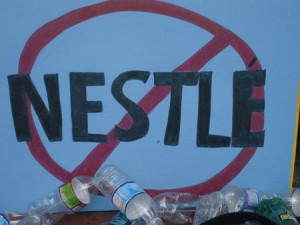
By its own admission, Nestlé expends 2.37 gallons of water for every gallon of bottled water it produces. The company used approximately 4 billion gallons of water in 2007. That same year, it reduced the amount of water it used by 1.3 percent, but that was more than cancelled out as it increased the volume of bottled water it produced by 10 percent. Meanwhile, Nestlé buys community water for as little as $ .000081 per gallon, and sells it back to consumers for at least 127,000 times as much.
Pumping all that water comes at a steep price to consumers and the planet. U.S. bottled water consumption used energy equivalent to 32 to 54 million barrels of oil in 2007, enough to fuel approximately 1.5 million cars over the course of a year. Moreover, 77 percent of all empty plastic water bottles consumed in the United States end up in landfills.
And yet, Nestlé has the audacity to anoint itself a leader in water education.
With over 1.1 billion people in the world lacking access to clean water and sanitation, it’s more important than ever that children learn the connection between the choices they make as consumers and their greater impact on the world. But Nestlé’s brand of water education only greenwashes the company’s own hand in profiting from an increasingly scarce resource to which all humans have a right, while cultivating a new generation of consumers.
Luckily, the Nestlé-funded Project WET isn’t the only water education program in town. We at Food & Water Watch have developed an innovative initiative to teach students that the simple choice of choosing a water fountain over a bottle of water can make a real difference in preserving our shared water resources. The Take Back the Tap Curriculum uses English, science, math, and social studies to help students draw the connection between the stuff that comes out of their taps at home and that which their peers across the globe sometimes have to walk miles to procure.
As Americans, it’s easy to take drinking water for granted, but this basic resource is central to a complex web of political and environmental issues. We should teach our kids the importance of protecting it. We can’t abdicate that responsibility to corporations with a vested interest in building demand for bottled water.
Legislation would remove protections against domestic violence & sex crimes for immigrant women
This Action Alert is from the National Council of La Raza.
Congress has a long-standing history of reauthorizing the Violence Against Women Act (VAWA), a law that protects victims of abuse. Congress is debating the reauthorization of VAWA once again; it has already been passed by the Senate. The bill that has been introduced in the U.S. House of Representatives by Representatives Eric Cantor (R–VA) and Sandy Adams (R–FL) would roll back years of protections and bipartisan commitment to protect vulnerable immigrant victims of domestic violence, stalking, sex crimes, and human trafficking.
The Cantor-Adams bill (H.R. 4970) would effectively prevent immigrant victims from applying for protection from their abusers. It radically changes the current application process for immigrant women and puts steep new hurdles to eligibility in the path of immigrant survivors seeking protection under VAWA.
Since its inception, VAWA has protected immigrant victims of domestic violence by permitting them to obtain legal status on their own when their U.S. citizen and lawful permanent resident spouses, as part of the abuse, refused to petition for them. H.R. 4970 would roll back these protections by removing critical confidentiality provisions and requiring notification of the abuser as part of the VAWA self-petition process.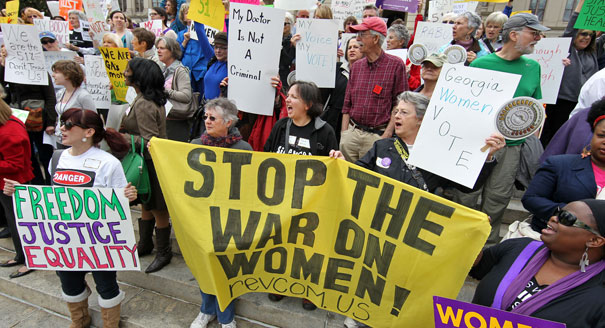
In what world would victims come forward if they knew their abusers would be notified?
As if this weren’t bad enough, H.R. 4970 also leaves out provisions to increase the safety of LGBT victims that were included in the VAWA reauthorization bill that recently passed in the Senate with bipartisan support.
Media Get Bored With Occupy—and Inequality
This article is re-posted from Fairness & Accuracy in Reporting.
Occupy Wall Street is rightly credited with helping to shift the economic debate in America from a fixation on deficits to issues of income inequality, corporate greed and the centralization of wealth among the richest 1 percent. The movement has chalked up other victories as well, from altering New York Gov. Andrew Cuomo’s tax plan (New York Times, 12/5/11) to re-energizing activists and unions, but bringing some discussion of class into the mainstream dialogue has been one of its crowning achievements.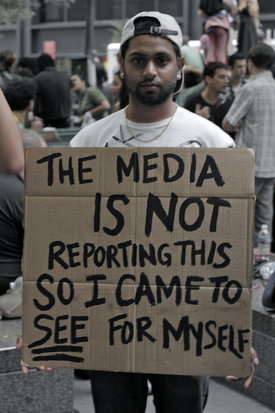
As Occupy slowed down for the winter, though, would corporate media continue to talk about our increasingly stratified society without a vibrant protest movement forcing their hand? The answer, unsurprisingly, is no.
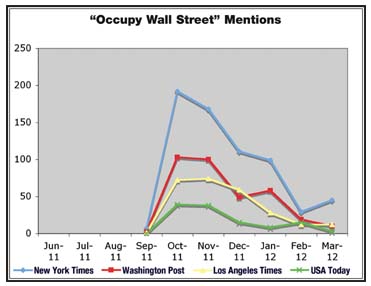
As mentions of “Occupy Wall Street” or “Occupy movement” waned in early 2012, so too have mentions of “income inequality” and, to an even greater extent, “corporate greed.” The trend is true for four leading papers (New York Times, Washington Post, USA Today, L.A. Times), news programs on the major networks (ABC, CBS, NBC), cable (MSNBC, CNN, Fox News) and NPR, according to searches of the Nexis news media database. Google Trends data also indicates that from January to March, the phrases “income inequality” and “corporate greed” declined in volume of both news stories and searches.
From June 2011 through March 2012, mentions of the phrase “income inequality” in the four papers first increased dramatically, then decreased slightly more slowly. The number of mentions per month ranged from 8 to 15 between June and September. Then in October, when OWS coverage peaked, “income inequality” mentions increased nearly fourfold to 44, and reached 52 mentions in November. January had a total of 64 mentions, though 13 of those stories focused on President Barack Obama’s State of the Union address.
By March, there were only 16 mentions of “income inequality,” half from the New York Times—which also far outpaced the other papers in coverage of OWS that month, at 45 mentions to the L.A. Times’ 12, the Post’s 10 and USA Today’s three, due in part to the scores arrested in New York City on the movement’s six-month anniversary on March 17.
Network broadcasts followed the same pattern, albeit with significantly lower numbers. From June to September, there was only one mention of income inequality (ABC, 8/10/11). Mentions across ABC, CBS and NBC jumped to seven in October and held fairly steady through January, but returned to zero by February.

Similarly, “income inequality” was barely mentioned on CNN, MSNBC and Fox News in the early months of the study. October saw a dramatic increase on MSNBC and CNN, with 10 and 14 mentions, respectively, while Fox News stayed low at only five mentions. The numbers peaked at 54 total in January—again, partially due to the SOTU—but by March, “income inequality” was mentioned only six times across all three cable news channels, four times on CNN and once each on MSNBC and Fox.
NPR followed the same pattern, with a peak of 18 mentions in October and only one mention each in February and March.
The spike and subsequent drop-off for “corporate greed” was even more pronounced. After only five total mentions in the four leading papers from June through September, the numbers skyrocketed to 62 mentions in October—again, at the peak of Occupy coverage. The following month, however, “corporate greed” only showed up 19 times. By January, it had completely disappeared from the pages of USA Today and the L.A. Times and made only a meager showing at the New York Times (four mentions) and Washington Post (one).
The broadcast network coverage again mirrored the print coverage. From June to September, “corporate greed” appeared only once. In October, mentions shot up to 35, but as in the newspapers, the drop-off was severe: 11 mentions in November and only one across February and March (ABC, 3/14/12).
NPR and cable data tell the same story. Prior to OWS, “corporate greed” virtually never came up. Then, in October, NPR used the phrase 23 times and CNN used it a remarkable 78 times. The return to business as usual was quick, though, with three mentions on NPR in November, one in December, and none after that. By March, “corporate greed” was mentioned only one time on CNN, and not at all on MSNBC or Fox (where the October peaks were only 11 and five mentions, respectively). While it is certainly true that prior to Occupy, there was virtually no discussion of class issues in the mainstream media (Extra!, 8/09), it’s clear that as Occupy faded from coverage, the media turned away from the persistent issues the movement is trying to highlight.
That’s not to say that there have been no important, lasting rhetorical shifts. Occupy’s most prominent slogan—“We are the 99 Percent”—and the other side of the equation, “the 1 Percent,” have created new ways of talking about centralized wealth in America. Even as media focus turned away from Occupy, the phrase “the 1 Percent” continues to appear in news stories worldwide. Whether it’s used to describe recent lottery winners (Washington Post, 3/31/12), consumers of expensive new gadgets (PC Mag, 3/26/12) or beneficiaries of Paul Ryan’s recently released budget (Chicago Tribune, 3/26/12), the phrase seems to have staying power: From January to March, 109 articles in the four papers mentioned “the 1 Percent” and “wealth.”
The danger, of course, is that “the 1 Percent” simply becomes a buzzword and ceases to have any connection to the way American capitalism produces and reproduces economic and social inequality.
What these data show is that “changing the conversation” isn’t a one-time thing. Corporate media and their owners have every incentive to ignore not only protest movements, but also the underlying causes of those protest movements. Hurricane Katrina showed that even the most powerful and dramatic events exposing the inequalities and poverty in this country have had only very short-term impact on media coverage of those issues (Extra!, 7–8/06). Occupy Wall Street reminded the country of the deep economic divisions running through our society, but it appears the only way to keep the issue in the media discussion is to keep OWS—or some other form of large-scale protest—in the news.

Join Occupy Grand Rapids and friends for a discussion on anarchy, Occupy, and the Oakland Commune. Hosted by Aragorn!, editor of the new book Occupy Everything: Anarchists in the Occupy Movement, this discussion will look at the flexibility, energy, and experience that anarchists brought to The Occupy Movement as it moved beyond lower Manhattan onto the docks and streets of Oakland, the town square of Philadelphia, and abandoned buildings around the country.
“The anarchists’ way of operating was changing our very idea of what politics could be in the first place. This was exhilarating. Some occupiers told me they wanted to take it home with them, to organize assemblies in their own communities. It’s no accident, therefore, that when occupations spread around the country, the horizontal assemblies spread too.” – From Nathan Schneider in The Nation
Occupy Everything: Anarchy, Occupy, & the Oakland Commune
Thursday, May 10
7pm – 9pm
The DAAC
115 South Division, Grand Rapids
Chomsky on Latin American Social Movements
This video is re-posted from ZNet.
Prolific author and political commentator Noam Chomsky talks about the historical significance of current social movements in Latin America. Chomsky draws attention to the particular importance of growing Latin American autonomy from the US.
In this excerpt from a larger conversation, Chomsky talks about the model of Bolivian democracy, the new Latin American economic alliance, the growing recognition of indigenous rights and what this could mean for the rest of the hemisphere.
Obama’s Expansion of Af-Pak War
This interview with Tariq Ali is re-posted from Democracy Now.
Amid ongoing U.S.-Pakistani tensions and fears of a military coup in Pakistan, we are joined by British-Pakistani political commentator, historian, activist, filmmaker and novelist Tariq Ali. Ali discusses Pakistan’s internal turmoil, as well as Pakistani attitudes toward U.S. foreign policy, the GOP presidential contest, and the prospect of a military strike against Iran.
“Pakistanis are basically suffering because Obama, arrogantly, escalated the war in Afghanistan and Pakistan and thought he could get away with it. That has now blown up in his face,” Ali says.
Protests planned next week for the Auction of State Lands for Oil & Gas leasing in Michigan
Much of the following information comes from Mary Ann Lesert.
At a May 1st meeting in Barry County a DEQ geologist proclaimed there is no environmental risks with fracking for natural gas in Michigan. Plenty of people are disagreeing with that assessment.
To demonstrate their disagreement there are organized efforts to stop the sale of public lands, one step necessary for fracking to take place across the state. People with the group Ban Fracking Michigan and other local grassroots efforts are calling for the following actions to take place around the state:
- On May 8 the MI DNR will auction mineral rights for oil & gas leasing to 109,000 acres of state (public) land – including nearly all of the Yankee Springs Recreation Area (23,400 acres in Barry County) and portions of the Lake Orion Recreation Area in Oakland County. Land in 23 Counties is being offered.
- May 7: Occupy the MI DNR Call-In Day – May 7 through May 8 Event Link
- May 7: Kalamazoo – Mineral Rights Protest March – 4:00pm Event Link
- May 8: Lansing – Auction Protest & Rally for “Let’s Ban Fracking” MI Ballot Initiative. Location: Constitution Hall, 525 West Allegan, Lansing, MI
Time: Gather at 7:30am or after – Bring Ban Fracking / Save Public Land signs. Auction: Bidders Register at 8:00 am / Auction Begins at 9:00am
Parking: Garages at the building (Allegan and Pine) & Allegan and Capitol.

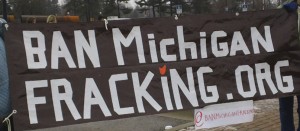
“Let’s Ban Fracking” Petitions for a Ballot Initiative to Ban Fracking in Michigan will be on site May 8th. Make sure you sign the just-launched petition.
MI DNR Bid Documents – Map and Parking Directions
MI DNR Auction Page – Check out the County Maps of Land Being Auctioned
Our Purpose: To let the DNR know that inviting oil & gas development on public land is not what we expect of a department that is supposed to protect and conserve.
New Media We Recommend
Below is a list of new materials that we have read/watched in recent weeks. The comments are not a “review” of the material, instead sort of an endorsement of ideas and investigations that can provide solid analysis and even inspiration in the struggle for change. All these items are available at The Bloom Collective, so check them out and stimulate your mind.
Appetite for Profit: How the Food Industry Undermines Our Health and How to Fight Back, by Michele Simon – Wonderfully researched, Appetite for Profit is an excellent expose of what is wrong with the food system we have in the US. Written by a public health attorney, the book systematically dissects the food system, food corporations, fast food, processed foods, food labeling, government policy and how junk food is marketed to children. Simon makes a strong case that the problem doesn’t so much stem from individual food choices as the food system that is more concerned about profit than the health and well being of the populace.

Weaponizing Anthropology: Social Science in Service of the Militarized State, by David Price – Weaponizing Anthropology is a brilliant analyses of not only how the social sciences are increasingly becoming an integral part of the warfare state but also how knowledge and culture are subject to new modes of militarization, organized in multiple new ways for the production of state violence. Price makes the argument that more and more that the military industrial complex is utilizing social sciences, often through universities, to deepen the ways in which the US imperial project can manipulate and control populations. A disturbing book that shatters any naïve and simplistic understanding of how the US military functions.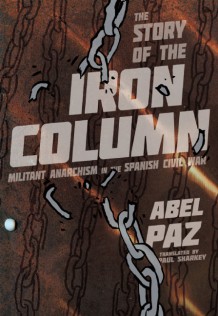
The Story of the Iron Column: Militant Anarchism in the Spanish Civil War, by Abel Paz – A first hand account of how anarchist organizing worked in revolutionary Spain during the late 1930s. Abel Paz, a teenager during the Spanish Civil War, gives us a rich account of the highly organized and militant campaigns by Spanish anarchists that controlled much of the country before Franco’s army suppressed their experiment in self-governance. The book is translated from Spanish and is at times a bit choppy, but the content and the story telling are incredible. Highly recommended.
Living Downstream (DVD) – Based on the acclaimed book by ecologist and cancer survivor Sandra Steingraber, Ph.D., Living Downstream is an eloquent and cinematic documentary film. This poetic film follows Sandra during one pivotal year as she travels across North America, working to break the silence about cancer and its environmental links. Sandra is not the only one who is on a journey—the chemicals against which she is fighting are also on the move. The film follows these invisible toxins as they migrate to some of the most beautiful places in North America. These chemicals enter our bodies and how, once inside, scientists believe they may be working to cause cancer. Steingraber calls on all of us to be carcinogen abolitionists, where instead of just treating cancer, we abolish it.
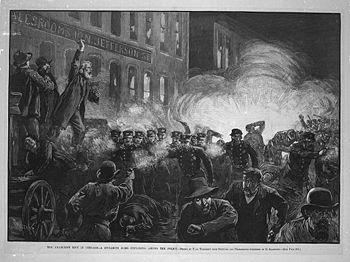
On this day in 1886, a labor rally was held at Haymarket Square in Chicago by workers as part of a campaign to win the 8-hour workday.
Chicago capitalist had been particularly brutal in their treatment of workers in the manufacturing and slaughterhouse sectors, but there was also a lively labor movement that was led by the International Working People’s Association (IWPA).
The rally was also a response to police brutality against workers who were on strike at the McCormick Harvesting Machine Company. The police not only beat several striking workers and their supporters, they fired into the crowd at one point wounding several and killing four.
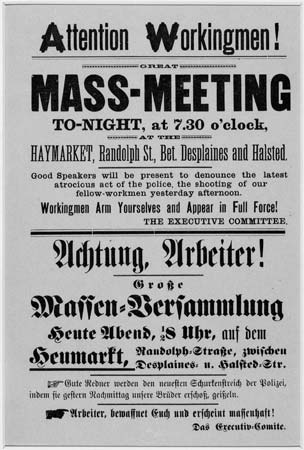
The police brutality incensed members of the IWPA, in particular Albert Parsons and August Spies. Upon hearing the news of the police brutality against striking workers on May 3rd, Spies created a printer circular in both English and German, which read:
Revenge! Workingmen, to Arms!!……You have for years endured the most abject humiliation……you have worked yourself to death……your Children you have sacrificed to the factory lord – in short, you have been miserable and obedient slaves all these years. Why? To satisfy the insatiable greed, to fill the coffers of your lazy thieving master? When you ask them now to lessen your burdens, he sends his bloodhounds out to shoot you, kill you!……..To arms we call you, to arms!!!
About 3,000 workers showed up on May 4 to protest the police brutality called for by the capitalist class and to demand an 8-hour workday. After several speeches and a call to action, many workers then retreated to their homes. A small crowd now remained and nearly 200 police officers arrived and demanded that the workers disperse. A bomb then exploded near the police wounded dozens, which resulted in the police then firing into the crowd of workers killing several and wounding 200.
With no evidence at all of who was responsible the Chicago police arrested eight anarchist leaders connected to the IWPA, including Spies and Parsons. The local press was calling for a speedy trial that would result in executions. According to radical historian Howard Zinn, the real crime of the anarchists was their ideas and their literature. In fact, only one of the eight arrested was even present at Haymarket Square (Fielden) and he was speaking on the platform when the bomb exploded.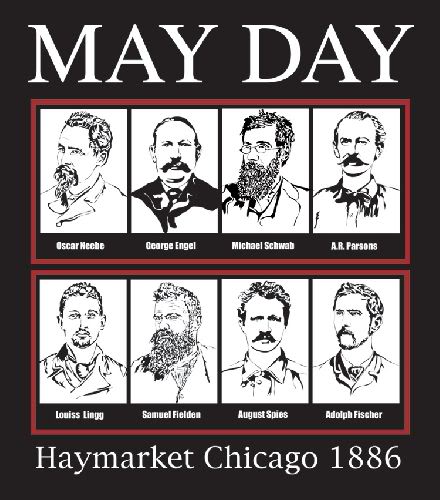
The trial was short and within days the 8 men were founded guilty of murder and sentenced to death. The execution, however, did not take place until the next year and by that time one of those arrested had killed himself in jail. Four of the men were eventually executed and the other three were pardoned.
According to Zinn, it was eventually discovered that the police had paid someone to infiltrate the anarchists who were part of the IWPA and act as an agent provacateur, who admitted to throwing the bomb. This action gave the police and the capitalists a pretext to not only arrest the Haymarket Martyrs, but it led to increased police harassment, the arrest of hundreds and the dismantling of the revolutionary labor leadership in Chicago.
The reaction to the initial arrests on May 4 was far reaching, with workers in London organizing solidarity protests and workers all across the US becoming radicalized. Hundreds of thousands of workers went on strike in 1886, in what Zinn documented as 1,400 separate strikes.
More importantly, workers around the US and around the world began to commemorate the Haymarket Uprising on May 1st, which is why most of the world celebrates May 1st as its worker holiday.
It’s ironic that this history has been suppressed in the US and most people end up celebrating Labor Day in early September, a holiday that marks the end of the summer and tourism more than it does the celebration of labor struggles in the US.
We commemorate this day in resistance history not only to draw attention to the sacrifices and courage of people gone before us, but to follow their example to organize for dignity, freedom and liberation!
This article is re-posted from iwatchnews.org.
South of the border, war is raging with guns mostly supplied by merchants in the United States.
The Government of Mexico has estimated that almost 50,000 people have been killed since 2006, a toll that has made its top officials irate about the persistent flow of weapons south. Some law enforcement officials in the U.S. government share the Mexicans’ concern, but their attempts to stanch the flow by obtaining better intelligence about it have badly singed their fingers.
The notorious “Fast and Furious” operation by the Bureau of Alcohol, Tobacco and Firearms — one in a string of attempts over a nearly decade-long period to tag and closely monitor the movement of individual arms — blew up when two of the weapons being tracked were used to kill a U.S. border patrol agent in 2010.
Republicans in Congress seized on the issue, holding multiple hearings last year. Acting ATF Director Kenneth Melson was reassigned. The Phoenix U.S. attorney who oversaw the operation also resigned, and Republicans called for the resignation of Attorney General Eric Holder. And President Obama has been largely hands off on the gun issue, treating it as the political third rail that is best to be ignored, or at least carefully walked around.
Into this politically-charged environment, the Bureau of Alcohol, Tobacco, Firearms and Explosives (ATF) released a first-of-its-kind report on Thursday that nonetheless attempts to assess the proportional distribution — if not the scope — of the arms flowing to drug cartel operatives.
It confirmed that a majority of the weapons being used by the Mexican drug cartels to kill police, criminals and civilians alike have come from inside the United States. Precisely, of the 99,691 weapons traced from Mexico between 2007 and 2011, 68,161 were manufactured or imported from the U.S. — over 68 percent. Because the data only reflect arms that are captured by Mexican law enforcement agencies, they depict only a subset of all those that flow south.
The data also showed the U.S. arms’ contribution is becoming more malignant: Criminals using U.S. weapons have been moving from handguns to rifles with detachable magazines, weapons with far greater destructive ability in conflicts with government forces. The percentage of traced guns that were rifles went from 28.2 percent in 2007 to 43.3 percent in 2011, while the percentages for pistols, revolvers and shotguns declined.
The flow of U.S. weapons to foreign countries isn’t constrained just to Mexico. Over the five years studied in the report, over 99 percent of the weapons seized for tracing in Canada, for example, were of U.S. origin. Of the five countries studied in the Caribbean for 2011 alone, the largest percentage of weapons with a U.S. origin came from The Bahamas (94 percent), followed by the Dominican Republic (81.3 percent), Jamaica (80.8 percent), Barbados (60 percent) and Trinidad and Tobago (43.3 percent); the majority of weapons seized for tracing were handguns.
But Mexico remains the more volatile situation. After all, there aren’t civilians being gunned down in the streets of Vancouver. Some of the most powerful weapons to show up in Mexico were first imported in a stripped-down condition into the United States, and then modified by domestic gun dealers before being transported across the border.
The data has been seized upon by advocates of stricter gun controls in the United States. In a press release, Sen. Diane Feinstein (D-CA) said the new data “makes it very clear that we need to increase our efforts to starve the supply of American weapons that arm Mexico’s brutal drug trafficking organizations.” ATF was required to release the gun recovery data due to a provision authored by Feinstein as part of last year’s Commerce, Justice and Science Appropriations bill.
The reports form the most comprehensive long-term data available for guns that have been traced through ATF’s National Tracing Center. A report done in 2009 by the Government Accountability Office found that 87 percent of firearms seized by Mexican authorities and traced over the previous five years were from the United States — a higher figure that suggests U.S. law enforcement efforts to root out trafficking may now be having a modest impact.
The National Rifle Association’s Institute for Legislative Action, a group funded partly by gun manufacturers, did not have an immediate comment.
 Grand Rapids Institute for Information Democracy