This article is re-posted from Corpwatch.org. Editors note: GRIID has reported significantly on Enbridge over the past two years, both because of their role in the Alberta Tar Sands Project, but also because of the 2010 Kalamazoo River oil disaster.
War has been declared on Enbridge, a Canadian oil company, by a chief from the Nadleh Whut’en in British Columbia. Chief Martin Louie was attending the company annual general meeting in Toronto where he spoke out Wednesday against the environmental impact of the company’s tar sands operations.

“How far are they willing to go to kill off the human beings of this country? Enbridge and the government are going to go on fighting us,” said Louie. “The war is on.”
Some 700 miles directly south of the Enbridge meeting, on the very same day, Bob Kincaid of Coal River Mountain Watch leveled similar charges against Brian Moynihan, the CEO of Bank of America at their annual general meeting in Charlotte North Carolina, for the impact of mountaintop removal mining.
“You are part of the poisoning of Appalachia and so is every one of your directors and so is every one of your shareholders,” Kincaid said. “You are part of the destruction of an entire region of the country.”
These two new and unconventional fossil fuel sources –tar sands and mountain top coal together with shale rock – have been dubbed “extreme energy” sources by Professor Michael Klare of Hampshire College, to signify the extraordinary and expensive technology needed to extract energy from them. The rush to exploit these source – from rural North Dakota (see “North Dakota Shale Boom Displaces Tribal Residents”) to the deserts of South Africa (see “Fracking South Africa”) that has sparked angry protests because of the devastating environmental consequences.
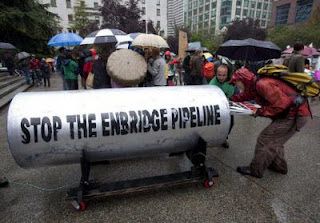
This week the battle against extreme energy was taken to the company annual meetings by environmental and social justice groups. The Nadleh Whut’en were part of the Yinka-Dene Alliance which is protesting Enbridge’s $5.5-billion project that would pipe crude from tar sands in Alberta over 1,100 kilometres to the West coast where the fuel is to be loaded on supertankers to take to Asia.
The protestors brought with them a declaration that read in part:
“We are the Indigenous nations of the Fraser River Watershed. We are many nations, bound together by these waters. Enbridge wants to build pipelines to pump massive amounts of tar sands crude oil through the Fraser’s headwaters. An oil spill in our lands and rivers would destroy our fish, poison our water, and devastate our peoples, our livelihoods, and our futures. Enbridge has many pipeline oil spills every year, including this year’s large spill into Michigan’s Kalamazoo river. We refuse to be next.”
The company claims it is doing a good job. “We wouldn’t be proposing this project if we didn’t have utmost confidence that we could both construct and operate the project with utmost safety and environmental protection,” Enbridge spokesman Todd Nogier told CBC TV.
Brian Moynihan responded the same way to the activists in North Carolina who told him that Bank of America was poisoning Appalachia. “Sir, our environmental team will take a look at it. We look at it all the time,” he told the shareholders who booed him.
Coal River Mountain Watch activists disagreed. “A human health crisis is exploding in Appalachia and Bank of America lights the fuse every day,” said Bob Kincaid, noting that as much as five million pounds of explosives are used every day in Appalachia to extract coal. Kincaid estimated that the practice caused 4,000 deaths a year in West Virginia: “That’s a newborn who never knows a clear breath, a 4-year-old who never gets to be a 5-year-old, a mother who never gets to be a grandmother.”
At the same annual general meeting on Wednesday, Bank of America also saw a number of protestors speak out against the company’s mortgage practices. For example Sister Barbara Busch, a Catholic social justice worker who runs a Cincinnati-based homeowner advocacy group called Working In Neighborhoods, told Moynihan that his bank was the hardest to deal with (41 percent of her customers have their loans managed by Bank of America) “(W)we have no one to talk to. They do not call us back,’ she said of the loan officers. “I understand, Mr. Moynihan, that you really believe that you’ve done something, but … you’ve got to do something about your mortgage servicing.”
The North Carolina protests were coordinated by the Unity Alliance which brought together groups like Grassroots Global Justice Alliance, Jobs with Justice, the National Day Laborers Organizing Network, the National Domestic Workers Alliance, the Pushback Network, and the Right to the City Alliance.
Although the Bank of America protests are now over, the activists plans to be back – for the Democratic National Convention slated to take place in the city this coming September.
‘Lucy’ Obama and his ‘Charlie Brown’ progressives
This article by Conor Friedersdorf is re-posted from The Atlantic.
Over and over, the president tricks interest groups into thinking he’s an ally, only to yank away the thing they desire.

Check out Chuck Todd, NBC’s chief White House correspondent, openly speculating that President Obama is going to embrace same-sex marriage because he needs money from gay people. “Gay money in this election has replaced Wall Street money,” he reported. NBC’s David Gregory agreed. For some reason, neither man seemed to think this theory reflects poorly on the president.
Then the conventional wisdom shifted. Observers were basing their guesses on the fact that HUD Secretary Shaun Donovan and Vice President Joe Biden had both made statements in support of same-sex marriage. The same-sex-marriage supporters who praised these developments were as quickly dismayed when the White House walked back Biden’s statements, insisting that like Obama, Biden’s views on the subject were still “evolving,” a euphemism that seems to mean they’ll favor either marriage equality for gays or discrimination against them depending on their moment-to-moment judgments about what’s best for them politically.
Sounds like Mitt Romney’s position!
Observing all this, Romney 2012 booster Jennifer Rubin aptly noted, “This is becoming the proverbial Lucy and the football. One wonders how often pro-gay-marriage activists, like poor Charlie Brown, are going to fall for this stuff.” But Lucy just had one Charlie Brown. Obama has a whole roster of would-be kickers, and a habit of teeing up the ball only to callously pull it away.
Don’t progressives see this?
Obama tricked the cannabis community into thinking his Justice Department would go easy on medical marijuana in states where it is legal, broke his promise, then misled voters about his options.
Obama tricked anti-war voters into thinking that he wouldn’t order American troops into battle unless there was an imminent threat to America or a declaration of war from Congress, then went to war in Libya, violating the War Powers Resolution, even though neither condition was met.
Obama tricked transparency advocates into thinking he’d celebrate whistleblowers and set new standards in open government. He has prosecuted whistleblowers as aggressively as any president in history, and presided over a dramatic escalation in what the federal government does in secret.
Obama tricked executive-power critics into thinking he would roll back the excesses of the Bush Administration. He has transformed those excesses into matters of bipartisan consensus, and gone farther in some respects, as when an American citizen was killed extra-judicially on his order.
Obama tricked immigration-reform advocates into thinking he was a fellow traveler, then upset them with Secure Communities, record-breaking deportation levels, and a failure to improve immigration detention.
Obama tricked Iraq War opponents into thinking that he would exit the country by the withdrawal date that George W. Bush negotiated. The Iraqi government wouldn’t let him keep troops in the country beyond that date, although he tried to break his promise. Now the Obama Administration pays a small army of private-security contractors to protect America’s presence in that country.
Obama tricked critics of indefinite detention into thinking that he abhorred the practice, only to sign a bill that institutionalized it.
Obama tricked critics of signing statements into thinking he wouldn’t issue them. But he’s done so on many occasions
Obama tricked critics of the state-secrets privilege into thinking he’d reverse Bush-era uses of the tactic. Instead he’s continued it.
This isn’t an exhaustive list, but these examples are sufficient to draw a conclusion: Progressives shouldn’t trust what Obama says, or what they think he believes. They should judge his actions. It’s the only way to distinguish between promises he aims to keep and things he’s said to mislead small constituencies into thinking he’ll do more for them than is justified by reality.

Next Thursday, the Kent County Health Department, Strong Beginnings and Healthy Kent 2020 will host a Health Equity forum.
The Thursday morning event will feature speakers from Ingham County’s Health Equity and Social Justice Department, Kent County data, a new video exploring issues like class, race and other health determinants.
The forum will also include a block of time for small group discussion focused on how to address these larger structural injustices to overcome health inequity throughout the county.
The forum is free and open to the public. Please register by calling 632-7100.
Health Equity Forum
Thursday, May 17
9:00AM – Noon
Kent ISD Conference Center
1633 E. Beltline Ave. NE, Grand Rapids
Monsanto’s Deep Roots In Washington
This article is re-posted from OpenSecrets.org.
It’s planting season, which brings to mind one of the most ubiquitous names in agribusiness: Monsanto. 
Love it or hate it — and there are plenty of people on either side — the company controls much of the agricultural market, and also sells products for the suburban yard such as the weed-killer Roundup. Roundup is the core of Monsanto’s agricultural breakthrough: The company produces genetically modified seeds that are resistant to the herbicide, making it easy for farmers to spray whole fields of soy or corn and kill only the weeds. Food production made easy.
On the flip side, environmentalists and organic food fans maintain there are too many unknowns and potential dangers involved with genetic modification. Monsanto, which last year had revenues of $11.8 billion, has become their bogeyman.
But such efforts as grassroots petitions and proposed legislation to require at least the labeling of genetically modified food have thus far withered on the vine next to Monsanto’s deeply rooted Washington presence, which has proved resistant to most lines of attack.
According to OpenSecrets.org data, in the first three months of this year, Monsanto spent $1.4 million lobbying Washington — and spent about $6.3 million total last year, more than any other agribusiness firm except the tobacco company Altria.
Monsanto’s interests in Washington are diverse. It lobbied bills ranging from the American Research and Competitiveness Act of 2011, which would extend tax credits for companies doing research, to several bills that would change the way the Department of Homeland Security handles security at chemical facilities — chemicals being a big part of Monsanto’s product portfolio.
And just as important as Monsanto’s legislative agenda for 2011 and 2012 is its regulatory one: the company’s lobbying reports list the departments and agencies it visited to talk to federal bureaucrats and appointees as they wrote rules to implement and enforce Congress’ handiwork. That explains why Monsanto reports having lobbied the U.S. Department of Agriculture, the Food and Drug Administration, the Environmental Protection Agency and many other executive branch offices. 
The FDA currently is the target of a petition signed by more than 1 million people, according to a sponsor known as Just Label It, asking the agency to require that genetically engineered food be labeled as such. The petition, sponsored by a coalition of environmental and food groups, is an attempt by activists to make an end-run around Monsanto’s Washington operation — a necessity because their lobbying dollars pale in comparison to the cash spent by Monsanto and others in the industry. For instance, one of the coalition members, the Environmental Working Group, has spent just $82,000 on lobbying this year — or about 5 percent of Monsanto’s total.
“The power of Monsanto, whether in the halls of Washington, or in farm country, should not be ignored,” said Environmental Working Group spokesman Alex Formuzis. “Monsanto comes armed with some of the deepest pockets and a bench of influential lobbyists, which makes the coalition’s efforts over GMO labeling on behalf of consumers a very tough fight indeed.”
Another upcoming matter of great interest to Monsanto: the new farm bill, an omnibus piece of legislation that sets the nation’s agricultural policy and deals with nearly every aspect of the country’s farming and food industries. The current bill expires in 2013; when it went through Congress, Monsanto filed more lobbying reports on it than any other organization. The process of piecing together a new proposal is already well under way.
The company’s access to members of Congress who are likely to be key in shaping the final legislation may be eased by the contributions of its very active PAC, the Monsanto Citizenship Fund. Already this cycle it has spent $383,000. The biggest recipient of that money so far is Rep. Frank D. Lucas (R-Okla.) who has received $20,000 from Monsanto’s PAC — $10,000 for his campaign committee and $10,000 for his leadership PAC. Lucas happens to be the chairman of the House Agriculture Committee — no farm-related legislation is passed without his say-so.
Monsanto has hedged its investment with the agriculture committee, though — it also gave $13,500 to Rep. Collin Peterson (D-Minn.), the top-ranking Democrat on the committee. So far this election cycle, Monsanto’s PAC has given $77,500 to 17 members of the House agriculture committee, or their leadership PACs.
McDonald’s Greenwashing Campaign in Michigan
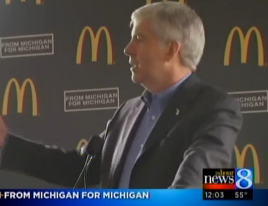
Yesterday, news media outlets all covered Michigan Governor Snyder’s visit to Conklin, Michigan as part of a press conference promoting McDonald’s contribution to the state’s economy.
The news coverage for the most part just presented the claims of Snyder and McDonald’s, with little investigation into the claim that the fast food giant’s decision to buy more Michigan produce for McDonald’s as a benefit to the local economy. While, much of the commentary focused on the local aspect of this effort, it tended to ignore the contradictions.
Snyder used the opportunity to promote the idea that Michigan sells products all around the world and he sees what McDonalds as doing is giving the state a profile for more exports. If Michigan does export more of the produce grown here, then it undermines other states and communities own ability to create locally based economies, despite this being one of the main themes of the press conference.
Even Michigan Senator Debbie Stabenow bought into the McDonald’s campaign. Stabenow posted a message on her website that read in part, “It is great that McDonald’s is buying Michigan-grown fruits, eggs, and milk-supporting Michigan farmers who are producing quality products. With its ‘From Michigan For Michigan’ campaign, McDonald’s is continuing its commitment to Michigan and our agricultural industry. When we grow things and make things in Michigan, we create jobs in Michigan.”
The general consensus from so many sectors is interesting in that it demonstrates both a lack of historical knowledge about what the fast food giant has done and how effect greenwashing is in this era of green capitalism.
If people are not familiar with the history of McDonald’s they might want to read Eric Schlosser’s books Fast Food Nation and Chew on This. Another great resource is the film McLibel, which deals with the longest legal case in British history, where the McDonald’s corporation goes after 2 activists for handing out leaflets to people about what is wrong with the fast food company. The major arguments are: 1) McDonald’s engages in deceptive advertising that targets children, 2) treats their workers poorly, 3) contributes to environmental destruction on a mass scale, 4) promotes cruelty to animals and 5) promotes poor nutrition.

McDonald’s Farm to Front Counter campaign is a classic example of greenwashing in that it is both tapping into a growing interest in people to eat “local” food and a public relations response to the scrutiny put on the fast food/junk food industries for their role in the epidemic of childhood obesity.
Local Responses
As we mentioned earlier in the article, most of the reporting on the McDonald’s Michigan campaign did not provide news consumers with many critical voices. The MLive story from yesterday did include a critical response to the McDonald’s greenwash campaign, with a comment from the Boston-based group Corporate Accountability International, which just produced a report entitled, Slowing Down Fast Food.
We talked with two local food justice organizations about their take on the announcement of the new McDonald’s campaign.
Lisa Oliver King with the Grand Rapids group Our Kitchen Table responded by saying, “We see it as green-washing and a destructive affront on the local food system. Regardless of the fact that these foods will be supplied by local agriculture, they will still be fried and have tons of salt added. The cooking approach has not changed. So, good food is going to waste. We can’t be deceived simply because they are buying from local farmers.”
We also spoke with Cynthia Price, with the group the Greater Grand Rapids Food Systems Council, which produced a Local Food Guide for West Michigan. Price said, “We’ll never move to a sustainable food, or economic, system as long as we rely on corporations like McDonalds to rehash locally grown ingredients and spit them out again as national, or even international, commodities. Only by relearning local food self-reliance will we be able to develop a just and balanced human-scale food system, and, for that matter, establish a stable base for a truly viable economy that values people and place and not just profits.”
Next Thursday, the Grand Rapids chapter of the IWW and the Bloom Collective will be hosting a screening of part one from the two-part biopic film on Ernest “Che” Guevara. 
Part one of the Steven Soderbergh deals with the Cuban revolution and the role that Che played in making that come about. The film is based in part on Guevara’s diaries and other writings, as well as other archival sources that deal with the Cuban Revolution, its aftermath and the US government’s response to the revolution.
Soderbergh’s film does an excellent job of depicting what the Cuban revolutionaries did in order to overthrow the Bautista regime and the antagonistic relationship that developed between the US and Cuba after July of 1959. The film also does a good job of humanizing Guevara without romanticizing the legacy of one of the most famous Latin American revolutionaries of the 20th Century.
Che: Part I
Thursday, May 17
7:00PM
IATSE Labor Hall
931 Bridge St. NW, Grand Rapids
This film is free and open to the public. A discussion will follow the screening.
Drones in US Flight Paths
This article by David Swanson is re-posted from CounterPunch.
On March 9th the Federal Aviation Administration requested comments from the public on drone test sites. On May 8th, lengthy comments were submitted by Not 1 More Acre! and Purgatoire, Apishapa & Comanche Grassland Trust. The FAA asked all the wrong questions, but still got a lot of the right answers. When the drone accidents start, and you’re told “Nobody could have known,” refer them here: PDF.
I would have asked “Should weaponized drones be permitted to exist on earth?” and “How can surveillance drones possibly comply with the Fourth Amendment?” The FAA asked:
“The Congressional language asks the FAA to consult with and leverage the resources of the Department of Defense and NASA in this effort. Since many public operators already have access to test ranges and control the management and use of those ranges, should the management of these new test ranges be held by local governments or should private entity [sic] schedule and manage the airspace?”
Not 1 More Acre! replied:
“Neither. Although the pilot UAS [Unmanned Aircraft System] program is a Congressional mandate, and the timelines are accelerated, the complexities and potential dangers of integration of UAS into civilian airspace must not be delegated to local governments or private organizations in the name of expediency, entrepreneurship, or profit. . . . The wording of Question A suggests that the FAA is contemplating abdicating its inherent authority to manage the NAS [National Airspace System] by ceding broad discretion over UAS flight operations. . . .
“. . . The primary driver of the move to integration has clearly been contractors funded by the DOD, working in concert with the secretive Joint Special Forces Operation Command, the Department of Homeland Security, and the CIA, among others. . . . Private defense [sic] contractors increasingly woo local law enforcement agencies and other community groups with grants to help fund the purchase of new UAS. The FAA should not allow any other federal agency to usurp its authority over the NAS or circumvent the pre-decisional public disclosure requirements of NEPA [National Environmental Policy Act] including agencies like the CIA, NASA, and JSOC which are not transparent or accountable to the public.”
Of course, there’s a catch. Even the accountable agency has, naturally, ceased to be accountable:
“However, the FAA has never conducted any NEPA review related to UAS. The agency has never prepared an Environmental Impact Statement or Environmental Assessment to disclose the potential impacts of UAS to the public and agency officials, despite issuing hundreds of Certificates of Waiver and Authorization to some 60 public agencies.”
Have you heard about the 51st State for Armed Robotic Drones?
The 63 drone sites in the U.S.?
The 30,000 drones planned for U.S. skies?
The habit drones have of crashing even on their own?
While initially cheaper than manned planes, unmanned drones of the sort used now tend to require many more personnel: 168 people to keep a Predator drone in the air for 24 hours, plus 19 analysts to process the videos created by a drone. Drones and their related technologies are increasing in price rapidly. And to make matters worse, they tend to crash. They even “go rogue,” lose contact with their “pilots” and fly off on their own. The U.S. Navy has a drone that self-destructs if you accidentally touch the space bar on the computer keyboard. Drones also tend to supply so-called enemies with information, including the endless hours of video they record, and to infect U.S. military computers with viruses. But these are the sorts of SNAFUs that come with any project lacking oversight, accountability, or cost controls. The companies with the biggest drone contracts did not invest in developing the best technologies but in paying off the most Congress members.
What could go wrong?
Public Citizen is organizing a campaign to both educate and resist a new trade policy that would benefit the global 1%.
Trans-Pacific Partnership (TPP)
It is the dream of the 1%. With 600 U.S. corporations as officials advisors, this stealthy international agreement has been negotiated behind closed doors over the past two years – with talks heading to Dallas in May.
What would TPP mean for the 99%?
Millions more American jobs off-shored. Backdoor deregulation for financial firms to wreck the economy again. Floods of unsafe food and products. Higher medicine prices. A ban on Buy America policies needed to create green jobs and rebuild our economy. Foreign corporations empowered to attack our environmental and health policies in foreign tribunals.
Closed-door talks are on-going between the U.S. and Australia, Brunei, Chile, New Zealand, Peru, Singapore, Malaysia and Vietnam; with countries like Japan and China potentially joining later. The 600 corporate advisors have access to the draft text of this deal that could change all of our lives. The public, Members of Congress, journalists, and civil society are excluded.
The Trans-Pacific Partnership would give: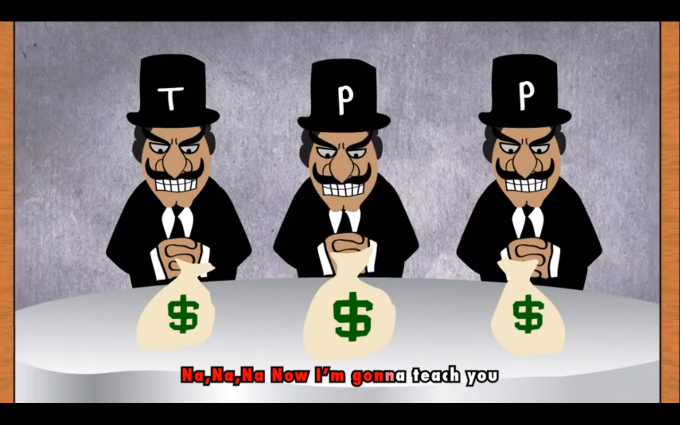
Corporations Grab Taxpayer $$ Attacking U.S. Laws in Foreign Tribunals
Read how foreign corporations would be empowered to attack U.S. health, land use, environmental, and other laws before tribunals of three corporate lawyers operating under World Bank or UN rules to demand taxpayer compensation for policies they think undermine their expected future profits. (Already $350 million has been paid to corporations under NAFTA’s version of this crazy system.)
Bye Bye American Jobs & Buy America
Special investor protections take away the risk of offshoring jobs to low-wage countries and in fact incentivize offshoring by providing special benefits for companies that leave. Plus, TPP would impose limits on how our elected officials can use tax dollars – banning Buy America or Buy Local preferences when government buy goods and services.

TPP would require us to import food that does not meet U.S. safety standards. It would limit food labeling.
Son of SOPA: Curtailing Internet Freedom
Thought SOPA was bad? Read how TPP would require internet service providers to “police” user-activity and treat individual violators as large-scale for-profit violators. Plus, TPP would stifle innovation.
Financial Deregulation: Banksters’ Delight
TPP would rollback reregulation of Wall Street. It would prohibit bans on risky financial services and undermine “too big to fail” regulations.
More Expansive Medicines, Threats to Public Health
Disgustingly, U.S. negotiators at TPP are pushing the agenda of Big PhaRMA – longer monopoly control on drugs for the big firms and higher prices for us. These proposals would mean millions in developing countries are cut off from life-saving medicines and higher prices for those of us in rich countries.
For right now Public Citizen is calling on people to sign a petition, but clearly if this trade agreement moves forward it will need to be resisted with more than electronic opposition.
Lastly, Public Citizen has put together a catchy little video to illustrate what is so dangerous about TPP.

An estimated 80 people traveled to Lansing today to take part in a demonstration against the public auctioning of land for the purpose of fracking for natural gas.
The public auction of land was facilitated by the Michigan Department of Natural Resources (DNR), at Constitutional Hall, a building just west of the State Capital. Most of those who came for the protest stayed outside with signs, information tables and a petition campaign that would ban fracking from taking place anywhere within the State of Michigan.
Other people who made the trip to Lansing went into the building to either act as observers of the public auction to disrupt the proceedings. This writer went inside for the first 90 minutes to document what was happening.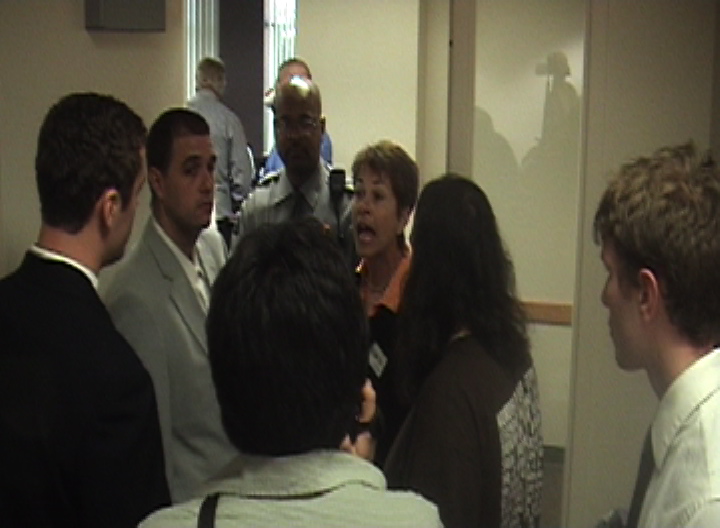
People who were there to bid on public land had to register with the DNR before entering the room being used for the public auction. Before the auction even state representatives from the DNR were asking people to leave the room if they had not registered, even if they were news media.
There were ongoing tensions between the DNR & building security and people who felt that since the auction was of public land and being facilitated by a government entity (DNR), they should have every right to be present to observe the proceedings. People who had entered the room without registering were individually confronted and asked to leave.
However, even after those who were asked to leave had registered, many of them were not allowed to enter because of room capacity, which is the reason that the DNR gave. There was back and forth discussion about public transparency and how unacceptable it was for the public to not be able to observe the proceedings.
After 30 minutes of verbal confrontation, city and state police arrived to intimidate people and remove a few that were not compliant.
At 9:00AM the public land auction began by individual parcels from counties across the state in alphabetical order. After an hour of auctioning this writer left the room go back outside to see what protesters were doing.
Once outside I was told that at about 9:00AM several people entered the lobby and began chanting in the hopes that the noise would disrupt the public land auction. At 10:00AM the protesters outside moved away from the main entrance and found a spot on the north side of the building where the auction was taking place.
Once the crowd moved to a different location, they began making noise by chanting and banging on drums in order to disrupt what was going on inside. Here is some video footage of that action.
The protest lasted about 45 minutes just outside of the room where the DNR land auction was taking place, when eventually the police showed up in large numbers and demanded that the protesters move back up to the sidewalk area. Once people moved back up to the street, it became apparent that the police were there to arrest people if the disruption continued, with nearly 20 officers, 8 cars and police dogs on the scene.
By 10:30AM we began getting reports from people inside that several people began to disrupt the public land auction. We found out that some people made statements and others bid on land and then never paid the cost. We also heard that some people were actually buying public land as a way to prevent those parcels from being subjected to the drilling necessary for natural gas fracking.
We had the opportunity to interview two people who participated in some form of disruption inside.
A Watered-Down Education
This article about is re-posted from Food & Water Watch. For more information on marketing to children in schools or corporate created curriculum check out the film Captive Audience: How Advertising Invades the Classroom.
Joe Camel. Ronald McDonald. Tony the Tiger. Spuds McKenzie. Kid-friendly advertising tricks by corporations seeking to lure young consumers clutter the annals of marketing history.
While some of these efforts are more insidious than others, they share a common trait. In each case, advertisers were trying to hook new consumers early to cultivate a sense of brand loyalty to be exploited for years to come. With the advent of programs ostensibly designed to teach kids about water issues, bottled water companies are getting in on the action. Their tactics flow through an institution that few kids can escape — the classroom.
The best example of this is Project WET. This non-profit organization claims to educate children and parents about the importance of preserving global water resources. According to its website, “sustainable water management is crucial to secure social and economic stability, as well as a healthy environment.”
That’s certainly true. But Nestlé Waters North America, the organization’s main sponsor, is the last entity that should be empowered to educate the public about responsible water use. When you consider the bottled water behemoth ‘s track record of hogging global water supplies and profiting from them, Project WET’s supposed mission is a slap in the face to any community that has had its water muscled away by Nestlé.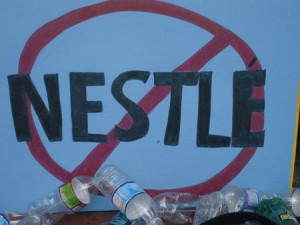
By its own admission, Nestlé expends 2.37 gallons of water for every gallon of bottled water it produces. The company used approximately 4 billion gallons of water in 2007. That same year, it reduced the amount of water it used by 1.3 percent, but that was more than cancelled out as it increased the volume of bottled water it produced by 10 percent. Meanwhile, Nestlé buys community water for as little as $ .000081 per gallon, and sells it back to consumers for at least 127,000 times as much.
Pumping all that water comes at a steep price to consumers and the planet. U.S. bottled water consumption used energy equivalent to 32 to 54 million barrels of oil in 2007, enough to fuel approximately 1.5 million cars over the course of a year. Moreover, 77 percent of all empty plastic water bottles consumed in the United States end up in landfills.
And yet, Nestlé has the audacity to anoint itself a leader in water education.
With over 1.1 billion people in the world lacking access to clean water and sanitation, it’s more important than ever that children learn the connection between the choices they make as consumers and their greater impact on the world. But Nestlé’s brand of water education only greenwashes the company’s own hand in profiting from an increasingly scarce resource to which all humans have a right, while cultivating a new generation of consumers.
Luckily, the Nestlé-funded Project WET isn’t the only water education program in town. We at Food & Water Watch have developed an innovative initiative to teach students that the simple choice of choosing a water fountain over a bottle of water can make a real difference in preserving our shared water resources. The Take Back the Tap Curriculum uses English, science, math, and social studies to help students draw the connection between the stuff that comes out of their taps at home and that which their peers across the globe sometimes have to walk miles to procure.
As Americans, it’s easy to take drinking water for granted, but this basic resource is central to a complex web of political and environmental issues. We should teach our kids the importance of protecting it. We can’t abdicate that responsibility to corporations with a vested interest in building demand for bottled water.
 Grand Rapids Institute for Information Democracy