 Come to Garfield Park next Saturday between 10 a.m. and 3 p.m. to celebrate the beginning of farmers’ market season right here on the southeast side! Market master, Yvonne Woodard of Our Kitchen Table (OKT) has vendors lined up for this small but satisfying market. These vendors will be selling chemical free produce that has been locally grown. It will be a small start as several of our regular vendors do not have produce ready yet.
The South East Area Farmers’ Market Gerald R Ford Middle School market will commence after school gets out, Friday June 15 from 2 to 7 p.m.
Both market locations participate in the following food programs: WIC Project FRESH, Market FRESH, and the Kent County WIC Pilot Project. Patrons are welcome to make their purchases with cash, checks, debit cards and EBT cards.
OKT manages the Southeast Area Farmer’s Market from a justice approach, not an urban ag approach. While it is hoped that participating vendors get a fair price for their produce, the goal is to build an alternative food system that provides healthy, fresh, chemical-free fruits and vegetables to Grand Rapids neighborhoods that are denied access to good foods by the current industrial food complex.
Those using EBT cards can get twice as much for their money with Double Up Food Bucks. For every dollar spent, $2 worth of produce can be purchased, up to $40 worth of food for $20 spent on an EBT card. That’s twice as much healthy nutrition for the dollar!
Obama Re-Defines “Militant” and the Media Eats It Up
This article by Glen Greenwald is re-posted from Salon.com.
To avoid counting civilian deaths, Obama re-defined “militant” to mean “all military-age males in a strike zone”
Virtually every time the U.S. fires a missile from a drone and ends the lives of Muslims, American media outlets dutifully trumpet in headlines that the dead were ”militants” – even though those media outlets literally do not have the slightest idea of who was actually killed. They simply cite always-unnamed “officials” claiming that the dead were “militants.” It’s the most obvious and inexcusable form of rank propaganda: media outlets continuously propagating a vital claim without having the slightest idea if it’s true.
This practice continues even though key Obama officials have been caught lying, a term used advisedly, about how many civilians they’re killing. I’ve written and said many times before that in American media discourse, the definition of “militant” is any human being whose life is extinguished when an American missile or bomb detonates (that term was even used when Anwar Awlaki’s 16-year-old American son, Abdulrahman, was killed by a U.S. drone in Yemen two weeks after a drone killed his father, even though nobody claims the teenager was anything but completely innocent: “Another U.S. Drone Strike Kills Militants in Yemen”).
This morning, the New York Times has a very lengthy and detailed article about President Obama’s counter-Terrorism policies based on interviews with “three dozen of his current and former advisers.” I’m writing separately about the numerous revelations contained in that article, but want specifically to highlight this one vital passage about how the Obama administration determines who is a “militant.” The article explains that Obama’s rhetorical emphasis on avoiding civilian deaths “did not significantly change” the drone program, because Obama himself simply expanded the definition of a “militant” to ensure that it includes virtually everyone killed by his drone strikes. Just read this remarkable passage:
Mr. Obama embraced a disputed method for counting civilian casualties that did little to box him in. It in effect counts all military-age males in a strike zone as combatants, according to several administration officials, unless there is explicit intelligence posthumously proving them innocent.
Counterterrorism officials insist this approach is one of simple logic: people in an area of known terrorist activity, or found with a top Qaeda operative, are probably up to no good. “Al Qaeda is an insular, paranoid organization — innocent neighbors don’t hitchhike rides in the back of trucks headed for the border with guns and bombs,” said one official, who requested anonymity to speak about what is still a classified program.
This counting method may partly explain the official claims of extraordinarily low collateral deaths. In a speech last year Mr. Brennan, Mr. Obama’s trusted adviser, said that not a single noncombatant had been killed in a year of strikes. And in a recent interview, a senior administration official said that the number of civilians killed in drone strikes in Pakistan under Mr. Obama was in the “single digits” — and that independent counts of scores or hundreds of civilian deaths unwittingly draw on false propaganda claims by militants.
But in interviews, three former senior intelligence officials expressed disbelief that the number could be so low. The C.I.A. accounting has so troubled some administration officials outside the agency that they have brought their concerns to the White House. One called it “guilt by association” that has led to “deceptive” estimates of civilian casualties.
“It bothers me when they say there were seven guys, so they must all be militants,” the official said. “They count the corpses and they’re not really sure who they are.”
For the moment, leave the ethical issues to the side that arise from viewing “all military-age males in a strike zone as combatants”; that’s nothing less than sociopathic, a term I use advisedly, but I discuss that in the separate, longer piece I’ve written. For now, consider what this means for American media outlets. Any of them which use the term “militants” to describe those killed by U.S. strikes are knowingly disseminating a false and misleading term of propaganda. By “militant,” the Obama administration literally means nothing more than: any military-age male whom we kill, even when we know nothing else about them. They have no idea whether the person killed is really a militant: if they’re male and of a certain age they just call them one in order to whitewash their behavior and propagandize the citizenry (unless conclusive evidence somehow later emerges proving their innocence).
What kind of self-respecting media outlet would be party to this practice? Here’s the New York Times documenting that this is what the term “militant” means when used by government officials. Any media outlet that continues using it while knowing this is explicitly choosing to be an instrument for state propaganda — not that that’s anything new, but this makes this clearer than it’s ever been.
Read the full article and updates at Salon.com, here. Also, have a look at Greenwald’s subsequent post on the NYT’s ‘Kill List’ piece here.
Signs of Insanity

Next Thursday, June 7, the Bloom Collective will be hosting a screening of a powerful new documentary entitled, Living Downstream.
Based on the acclaimed book by ecologist and cancer survivor Sandra Steingraber, Ph.D., Living Downstream is an eloquent and cinematic documentary film. This poetic film follows Sandra during one pivotal year as she travels across North America, working to break the silence about cancer and its environmental links. Sandra is not the only one who is on a journey—the chemicals against which she is fighting are also on the move.
The film follows these invisible toxins as they migrate to some of the most beautiful places in North America. These chemicals enter our bodies and how, once inside, scientists believe they may be working to cause cancer. Steingraber calls on all of us to be carcinogen abolitionists, where instead of just treating cancer, we abolish it.
After the film there will be a discussion. This film is open to the public. For more information, go to the Facebook event page. $3 suggested donation – light refreshments will be provided.
Living Downstream
Thursday, June 7
7:00PM
The Bloom Collective
671 Davis NW, Grand Rapids
Lower level of the Steepletown Center
The Economic Club of Grand Rapids is hosting its annual dinner tonight and consistent with many former guest speakers, they invite a known war criminal.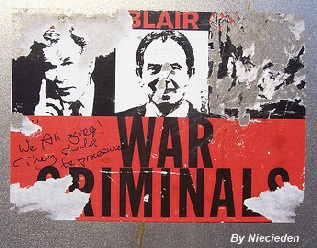
Former British Prime Minister Tony Blair will address the Econ Club audience tonight in downtown Grand Rapids, where he is expected to talk about current events in the Middle East and religious tolerance.
At least this is what the Executive Director of the Econ Club, Lorna Schultz, stated on Mlive. “He definitely has a lot to say that can help all of us learn about what is happening outside of the United States and how it affects us here.”
Schultz also believes that since Tony Blair’s new Foundation, the Tony Blair Faith Foundation, teaches religious tolerance, it will, “dovetails nicely with area leaders “Year of Interfaith Understanding.”
However, for anyone who refuses to ignore history it is hard to forget what Tony Blair did in conjunction with the Bush administration to promote a military invasion of Iraq.
The Iraq war, which started in 2003, has caused the deaths of between 100,000 and one million people, depending on whose estimate you believe. Two men were ultimately responsible for the decision to start it: George W Bush and Tony Blair.
Bush and Blair claim that they were provoked into starting the war by the imminent threat Iraq presented to world peace. They further maintain that the war was legal. A series of leaked documents shows not only that these contentions are untrue, but that Bush and Blair knew they were untrue.
The Downing Street memo, a record of a meeting in July 2002, reveals that Sir Richard Dearlove, director of the UK’s foreign intelligence service MI6, told Blair that in Washington “Military action was now seen as inevitable. Bush wanted to remove Saddam, through military action, justified by the conjunction of terrorism and WMD. But the intelligence and facts were being fixed around the policy.”
The foreign secretary (Jack Straw) then told Mr Blair that “the case was thin. Saddam was not threatening his neighbours, and his WMD capability was less than that of Libya, North Korea or Iran.” He suggested that “we should work up a plan” to produce “legal justification for the use of force.” The Attorney-General told the prime minister that there were only “three possible legal bases” for launching a war: “self-defence, humanitarian intervention, or UNSC [Security Council] authorisation. The first and second could not be the base in this case.” Bush and Blair failed to obtain Security Council authorisation.
In other words the memo reveals that Blair knew that the decision to attack Iraq had already been made; that it preceded the justification, which was being retrofitted to an act of aggression; that the only legal reasons for an attack didn’t apply, and that the war couldn’t be launched without UN authorisation.
The legal status of Bush’s decision had already been explained to Mr Blair. In March 2002, as another leaked memo shows, Jack Straw had reminded him of the conditions required to launch a legal war: “i) There must be an armed attack upon a State or such an attack must be imminent; ii) The use of force must be necessary and other means to reverse/avert the attack must be unavailable; iii) The acts in self-defence must be proportionate and strictly confined to the object of stopping the attack.”
Straw explained that the development or possession of weapons of mass destruction “does not in itself amount to an armed attack; what would be needed would be clear evidence of an imminent attack.”
A third memo, from the Cabinet Office, explained that, “there is no greater threat now than in recent years that Saddam will use WMD … A legal justification for invasion would be needed. Subject to Law Officers’ advice, none currently exists.”
Anti-war activist David Swanson created an entire project based on the lies of the Blair government known as After Downing Street – Now called http://warisacrime.org/. Swanson and his team of contributors continues to provide new information on the war crimes in Iraq committed by the Bush and Blair regimes, with the most recent dealing with the British trial of Media owner Rupert Murdoch, which ironically is connected to the role that Murdoch’s media outlets played in justifying the US/UK invasion of Iraq in 2003.
Graffiti is a crime, bombing people is not
Blair is only the most recent war criminal to come to Grand Rapids. In the past the Econ Club has invited George W. Bush, Condi Rice, Colin Powell, Bill Clinton, Madeleine Albright, Gen. Norman Schwarzkopf and Margaret Thatcher.
There have been protests against many of these former Econ Club annual dinner speakers, but never any investigation by the local “law enforcement” agencies into their war crimes.
Within the past 18 months there has been an intense campaign to arrest people involved in graffiti and brick throwing in Grand Rapids. The GRPD claims they now have the suspects under custody and anticipate they will spend time in jail for “property destruction.”
Tony Blair lied to the British people and they provided military support for the invasion and occupation of Iraq, which led to the deaths of more than 1 million Iraq civilians and he will get a police escort to the Convention Center tonight. It is a strange world indeed.
Occupy the PGA confronts injustice in Benton Harbor

Yesterday, over 100 activists from Benton Harbor, other communities in Michigan and around the world participated in a demonstration against the exploitation and theft of land and resources from the people of Benton Harbor.
The action yesterday was the last day of a 5-day campaign to draw attention to the systemic violence being perpetrated by the Whirlpool Corporation and the City of St. Joseph against the disproportionately Black community in Benton Harbor.
The Professional Golf Association (PGA) was hosting a golf tournament for several days on land that had been stolen from the local community to construct a golf course near Lake Michigan.
As people gathered in a parking lot across from City Hall the police presence became noticeable, with some of the cops filming the crowd. Throughout the day there were cops from Benton Harbor, St. Joseph, the Sheriff’s Department and Michigan State police.
Once the crowd of over 100 gathered in the parking lot, Rev. Pinkney (BANCO) gave a few words about what the Occupy the PGA was all about. He also named those responsible for the theft of land and the exploitation of Benton Harbor.
After Rev. Pinkney spoke, people then moved to the steps of City Hall, where organizers told the crowd how the funeral procession was going to proceed. Before the funeral procession began a local musician led the crowd in a song and was followed by a supporter who read a poem about the systemic violence caused by Whirlpool.
The funeral procession began at City Hall in Benton Harbor and made its way west on Main Street. On this stretch on road there were numerous buildings boarded up and other visual messages about the poverty and exploitation that the people of Benton  Harbor have endured for years.
Once the funeral procession got off of Main Street, it made its way along the golf course route, where at every spot that there was a gap between trees or shrubs, police on foot or in cruisers had a presence in order to prevent people from disrupting the golf tournament by running on the golf course.
The funeral procession also passed a large parking area where tour buses were shuttling golf fans, which bought tickets for the PGA tournament.
Once the funeral procession arrived in St. Joseph it became painfully clear the economic chasm between the residents of Benton Harbor and St. Joseph. The homes in St. Joseph were larger, fancier, with landscaped lawns and people out walking their dogs. Nowhere along this part of the route were African Americans among the residents, only those who marched. The clear evidence of racism and classism was not lost on those that walked in the funeral procession as we passed the Whirlpool Corporation in St. Joseph.
The funeral procession ended at what was left of a public park. This was the park that was significantly downsized so that the land could be used for the golf course. As Lake Michigan welcomed the participants one could not help but notice that there was orange fencing right up against the road that led to the park. The PGA wanted to make sure that even here there would be signs and visual messages letting people know that they were not welcomed. The police tape here said “Ticket Holders Only, NO Trespassing!”

Despite the constant harassment from police, the participants maintained good spirits as they shared food, conversation and relaxed under a pavilion in the park. Organizers stated that they would keep up the pressure on Whirlpool and invited those from out of town to maintain their solidarity and by helping to get the word out about the systemic violence being done in southwest Michigan.
This article by Bruce A. Dixon is re-posted from Black Agenda Report.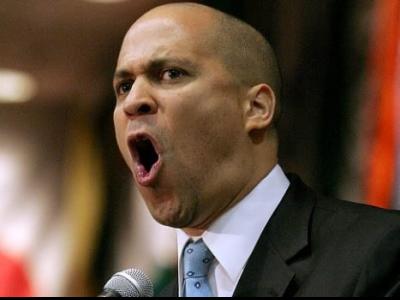
On the first weekend in May, Newark mayor Corey Booker appeared alongside Fox News host Juan Williams and ultra-conservative Republican governors Chris Christie of New Jersey and Bobby Jindal of Louisiana to sing the praises of charters and school privatization, and the evils of organized teacher and parent power at the annual conference of the Alliance for School Choice.. It’s not a big step for Corey Booker, it’s the place he’s been all along, since his first late 1990s gig as a founding board member of the Bradley Foundation’s Black Alliance for Educational Options. What’s new is that in 2012 black Democrats with national profiles like Booker can appear in public spouting pro-corporate right wing dogma alongside such creatures, and hardly anyone notices. What has happened to Democratic party politics, to black politics?
To hear mainstream pundits like Andra Gillespie tell it, black politics and the black politician have been re-invented. The poster boys for this new generation of elected black Democrats are people like Newark’s Corey Booker, former DC mayor Adrian Fenty, and of course, President Barack Obama. Re-invention, the story goes, is a good thing because the re-inventors are “technocrats,” whatever that means, with access to funding, elite connections and crossover appeal that their predecessors lacked, all of which enabled them to get things done which previous generations of black politicians could not or would not.
Some other voices, however, say that the narrative of “re-invention” hides and conceals more than it explains or reveals. “What’s happened to black politics,” says Glen Ford, a veteran New Jersey journalist and co-founder of Black Agenda Report “isn’t re-invention. It’s hijacking. It’s colonization.”
In a groundbreaking 2002 article “Fruit of the Poisoned Tree”, and again at a recent speech at New York City’s All Souls Unitarian Church, Ford outlines the early career of Corey Booker, and Booker’s relation to the constellation of right wing forces orchestrated by the ultraconservative Bradley Foundation, which spent tens of millions of dollars in the 1990s creating astroturf movements for vouchers, school choice, and ultimately for charter schools, at the same that Bradley funded the Heritage Foundation, the American Enterprise Institute and platoons of racist and corporate ideologues like Charles Murray, Robert Bork, Jeanne Kirkpatrick and Antonin Scalia.
Turning the axis of black politics rightward over the last decade was, Ford says, the project of a decade and an immense achievement for the right. For the last third of the 20th century the most left-leaning segment of the North American polity was black America — not Cambridge MA or Ann Arbor MI or San Francisco or even New York City — the rock and foundation of the US left was in New Orleans, Detroit, Newark, St. Louis, Washington DC and other black dominated cities. Funding black Republicans and cranky black academics did little to undermine that rock. The right had to incubate and raise its own crop of corporate-oriented black Democrats to turn that trick. Corey Booker was an early asset.
In Ford’s 2002 article and in the recent speech, he explains how, on the eve of his first run for mayor, Booker was granted a coming-out party at the right wing Manhattan Institute, a signal for the entire conservative universe that he was one of their own. Conservative deep pockets who never took interest in a Newark election in their lives wrote bags of checks. Every single corporate-media outlet in the tri-state area endorsed Corey Booker over his opponent. Thanks to his powerful conservative allies, newbie Booker greatly outspent the most powerful black politician in the state, losing only narrowly in his first mayoral run.
The second time Booker ran for mayor, feds timed their investigations and indictments of Mayor Sharpe James so that he was forced to resign only 3 weeks before the election, too late for another anti-Booker candidate to put together a coherent campaign. Booker also benefited from publicity that could not have been bought with tens of millions of dollars, a feature-length award winning documentary film that portrayed his opponent as a crook, which he was, and Booker as a kind of urban saint.
As one might expect from a product of the Bradley Foundation in office, Booker has faithfully pursued a right wing agenda devoted to dismantling public education, and turning over government assets such as Newark’s water system to favored private contractors. Interestingly, Booker’s full scale pursuit of privatization of his city’s garbage collection, watershed, parks and recreation and other services and assets are little known and rarely mentioned by media outside his home town. The recent Salon article on the “re-invention” of black politics manages to ignore the actual policy practices of the new black “elite displacers” – an empty description meant to apply to new black elite politicians replacing old ones — as well. Privatization and the cutting of government workforces are massively unpopular propositions among the people Booker and the rest of the black political class supposedly represent. Telling this part of the story would be a little too much information. If we had it we might actually begin to understand what the “technocratic leadership,” if there really is any such thing, which Booker and his colleagues bring to the table actually is.
We might not know much about Booker’s aggressive attempts at privatization, the time he rushed into a burning building has been breathlessly covered everywhere. The mayor of Newark some would have us believe, wears a cape. Corporate media seem to work very hard to make our elections are about feelings of safety, pride, fear or security, about images of youth and “technocratic” competence, whatever that is.
The right has decisively invaded the politics of black America, and owns the Democratic party outright. Barack Obama is effectively a center-right president, pursuing wars, prosecuting whistleblowers, shielding banksters, and using cruise missiles to dispatch suspected terrorists with an impunity the Bush-Cheney gang never enjoyed With black Democrats routinely shilling for imperial wars, austerity, school closings, privatizations, bailouts and kindly treatment for their campaign contributors, there are no outlets in the two parties for the real needs and desires of much of black America. The two party system has become people-proof and democracy-proof.
The new black politicians still do call liberally on the images of struggles past. Kasim Reed, for instance, the black mayor of Atlanta in his campaign lit called himself a “civil rights lawyer”. He forgot to mention he was a defendants’s civil rights lawyer, defending corporations that violate the civil rights of actual persons. The new black politicans drape themselves in kente cloth every now and then, and they remember King’s birthday and Black History Month. They come together to celebrate and congratulate each other frequently, at occasions like the Congressional Black Caucus’s annual legislative conference. But their politics, black politics haven’t been re-invented. They’ve been compromised. Hijacked. Colonized.
Black politics isn’t about addressing black unemployment, which is at levels not seen in seventy years. It’s not about the catastrophic fall in black family wealth that has resulted from the foreclosure epidemic, also disproportionately concentrated in black neighborhoods. Black politics isn’t about addressing the issue of black mass incarceration which has shredded our families and futures. Black politics isn’t about stopping the wave of foreign wars which King a generation ago called a demonic suction tube drawing resources away from programs for human needs. There is no room for any of these concerns in today’s black politics. All that’s left is re-electing the black president, protecting him and the first lady from insults and shoring up the careers of black mayors and congressmen. All that, and getting paid.
Black politics is over, at least until the day when enough of us walk out of the Democratic party to build something new, something that does not yet exist.
This articleby Nadra Kareem Nittle originally appeared in the Maynard Media Center on Structural Inequity.
Social wedge issues such as abortion, birth control and sex education in public schools have taken center stage and sometimes dominated the political debate this year, but progressive experts on reproductive rights are concerned that women of color are rarely represented in the mainstream media’s coverage.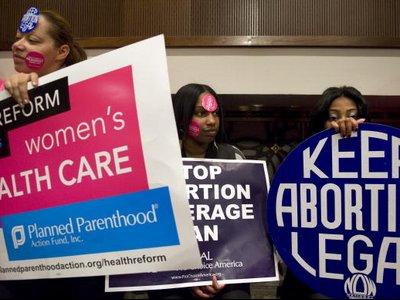
If elected president, presumptive Republican candidate Mitt Romney has vowed to defund Planned Parenthood, a move that the state of Texas is attempting. Moreover, Tennessee has passed legislation to severely limit what educators can teach in sex education classes, and states such as Arizona, Mississippi and Virginia have passed legislation that significantly restricts abortion access.
Conservative attacks on reproductive rights repeatedly make headlines. But women of color and low-income women who disproportionately depend on the services of Planned Parenthood and face challenges accessing reproductive care have not figured prominently in mainstream news coverage of the reproductive rights debate.
Experts on the topic say that because underprivileged women have the most to lose as lawmakers curb such rights, the media should focus on them in the discussion.
“Women who are poor and also women of color have disproportionately high rates of unwanted pregnancy,” says Heather Boonstra, a senior public policy associate of the Guttmacher Institute, a Washington, D.C., organization that advocates for sexual and reproductive health and rights.
“Some of that has to do with the basics in terms of obtaining health care and the kinds of social conditions in the women’s lives that make it hard for them to use contraception and use it consistently,” she says. “Poorer women — their lives have a lot of disruptions. Using and obtaining contraception, let alone affording it and getting it on a routine basis is harder.”
According to the institute, black women are three times as likely as white women to have an unplanned pregnancy, and Hispanic women are two times as likely. Among poor women, Hispanics have the highest rate of unplanned pregnancy. In addition, financial pressures related to the sluggish economy are likely leading more poor women to terminate pregnancies. The institute found that the number of abortion recipients who were poor jumped from 27 percent in 2000 to 42 percent in 2008, the first full year of the economic downturn.
Media outlets tend to ignore these findings and the financial pressures driving them, and simply report on abortion rates and laws without factoring in race and class. Including more women of color and their advocates in mainstream media stories would produce more comprehensive articles.
For instance, Boonstra says a primary reason that poor women have high rates of unintended pregnancies is because they lack access to long-acting forms of contraception, a privilege afforded women with higher incomes and private insurance.
Dependence exclusively on birth control methods that must be used daily or for every sexual encounter, such as pills and condoms, leads to a higher unplanned pregnancy rate among disadvantaged women. Yet pundits and reporters typically don’t mention the impact that current legislation to curb access to birth control, abortion and sex education will have on underprivileged women.
“I think that more African-American women need a turn at the mic to talk about how these issues are impacting the community,” says Janette Robinson-Flint, executive director of Black Women for Wellness, a Los Angeles organization that advocates for health needs of black women. “Major media outlets have a tendency not to have African-American women in anchor or decision-making positions.”
In 2010, the media extensively covered a suggestion by conservative groups, such as the Issues4Life Foundation, that abortion providers were influencing black women to terminate their pregnancies. In major cities, right-wing groups have erected billboards on which they contend that the high number of abortions black women have is tantamount to genocide.
Robinson-Flint says she was dismayed that the media focused on the controversial billboards without delving deeply into factors that lead black women to have abortions at five times the rate that white women do.
“They didn’t talk about the social justice issues,” she says of the flawed reporting. “They didn’t talk about poverty, unemployment, infant mortality, maternal mortality, any of the contributing factors.” She adds that in Los Angeles, for example, hospital closures have resulted in too few medical providers to meet the black community’s needs, contributing to lack of family planning.
Some states have no providers who perform abortions, and legislation pending in Mississippi would result in closure of the sole facility there. Such laws pose the greatest disadvantage to poor, underprivileged women, according to Boonstra, because they already struggle to cover the basic cost of an abortion. Fifty-seven percent of women pay for the procedure out of pocket, the Guttmacher Institute reports.
The institute’s overview of state abortion laws as of May 1 is available here.
Removing local abortion providers means that poor women also must pay for travel to a state that provides abortions and likely miss work or pay for child care if they are among the 61 percent of women who have abortions and are mothers. These costs may increase if women seek abortions in states that require them to endure a waiting period before terminating their pregnancies. Women in this predicament will likely have to miss more days of work and pay for extended stays in hotels, Boonstra says.
The abortion debate isn’t the only sexual health issue making headlines. Legislation to limit the type of sexual education taught in schools has also received major mainstream media coverage. Often omitted from this coverage is that youths of color deprived of sexual education classes may be especially vulnerable.
Black teens, for example, are twice as likely as whites or Latinos to develop a sexually transmitted infection, the Centers for Disease Control and Prevention reported in 2008. That figure was consistent even when factoring in income levels and numbers of sexual partners, an indication that these teens are not taught how to practice safer sex.
After a decline in teen pregnancy from 1990 to 2005, the rates rose in 2006 for all racial groups, particularly minorities. The Hispanic teen pregnancy rate rose by 126.6 percent that year, followed by blacks at 126.3 percent and whites at 44 percent.
“There’s plenty of research that shows abstinence-oriented sex education leads to more teen pregnancy and not less,” says Dominique DiPrima, host of Front Page, a Los Angeles radio show. DiPrima focuses largely on issues of concern to communities of color and women. She recently launched the Black Media Alliance, a coalition of African-Americans in media and broadcasting, to encourage the mainstream media to represent people of color more often as reporters, sources and decision makers.
“There needs to be more [discussion] in the media where women are talking with women and not in a defensive posture,” DiPrima says. “A lot of times, you see panels where there are no women. Not to say men should be excluded, but there [need] to be more places where women can have frank dialogue.”
DiPrima says the media rely too often on professional pundits rather than people of color, who are most likely to be affected.
The Black Media Alliance has had discussions with media outlets such as Clear Channel about racism and misogyny on air. DiPrima says she hopes that communities of color learn more about attacks on reproductive rights before pending legislation becomes law and it’s too late to act.
“I believe people are waking up and realizing that Republicans have gone so Neanderthal with their attacks on women,” she says. “They’re uniting women. I think it’s going to wake people up, and the end result may just be the opposite of what they’re planning for the country.”
Post-Auction Blues as a Ballot Initiative Debuts
This article is written by Maryann Lesert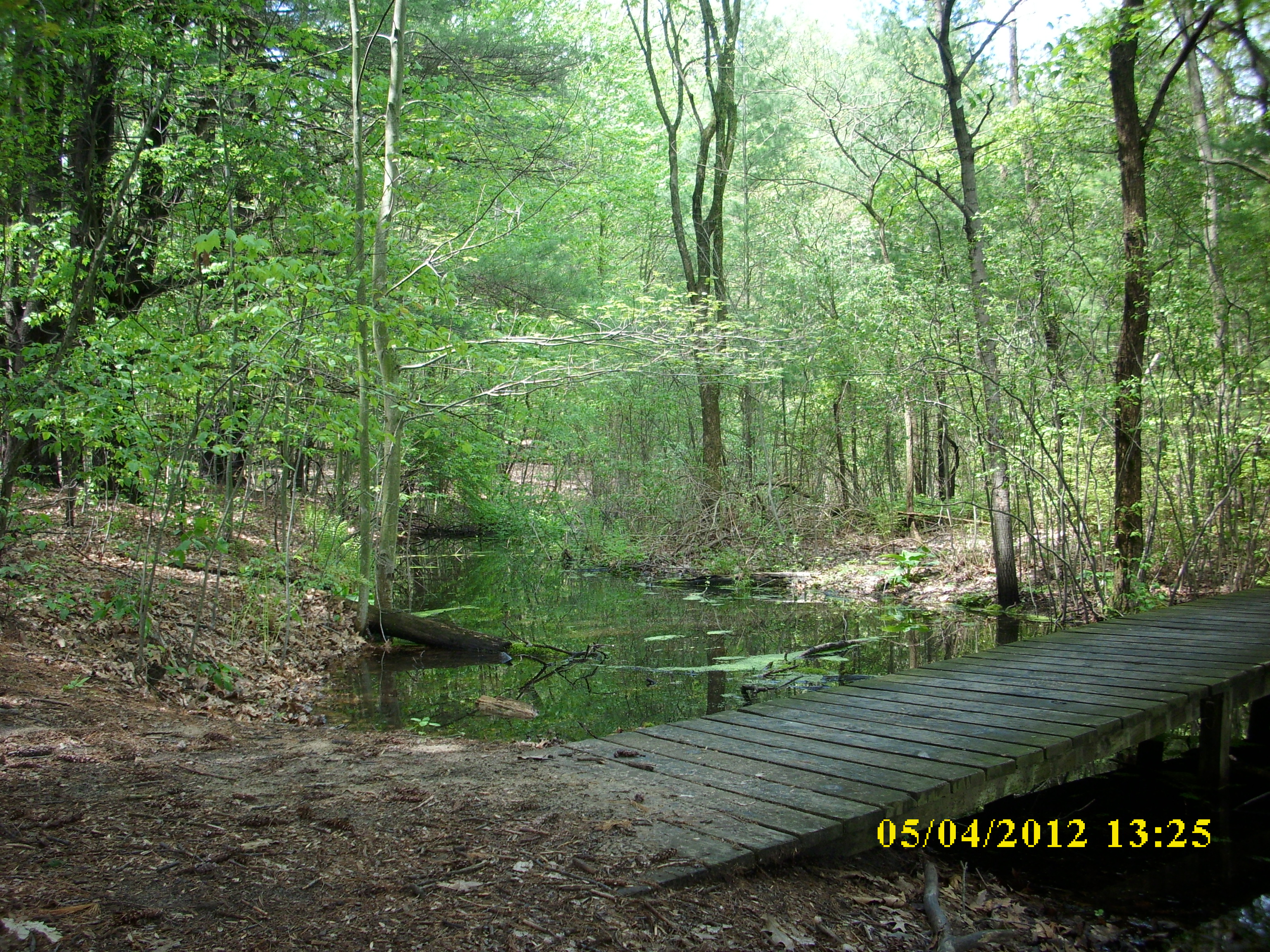
Protestors, Disruptors, Petitioners unite as the Michigan Natural Gas Subcommittee recommends that the State lease all of our remaining public land – 5.3 million unleased acres – to drastically increase oil and gas extraction. And fracking, as one protestor’s sign attests, “is Good Bye Pure Michigan.”
On May 8, the Michigan Department of Natural Resources (MDNR) offered over 108,000 acres of state land in 23 counties to bidders interested in purchasing 5-year mineral rights leases for oil and gas drilling, including 23,400 acres in Barry County with nearly the entire Yankee Springs Recreation Area (just east of Gun Lake) up for bid.
Grand Rapids, Ann Arbor, Muskegon, and Kalamazoo residents attended and took part in the protest alongside people from Barry and Oakland counties there to voice their disapproval of the DNR’s offering of well-known recreation areas. Some drummed and chanted as bidders walked into the building to register. Others entered the auction room and stood up during the bidding process to make statements about the wrongness of auctioning off public land, the dangers of injecting known toxins into land, water, and ecosystems, and fracking’s excessive use of water. 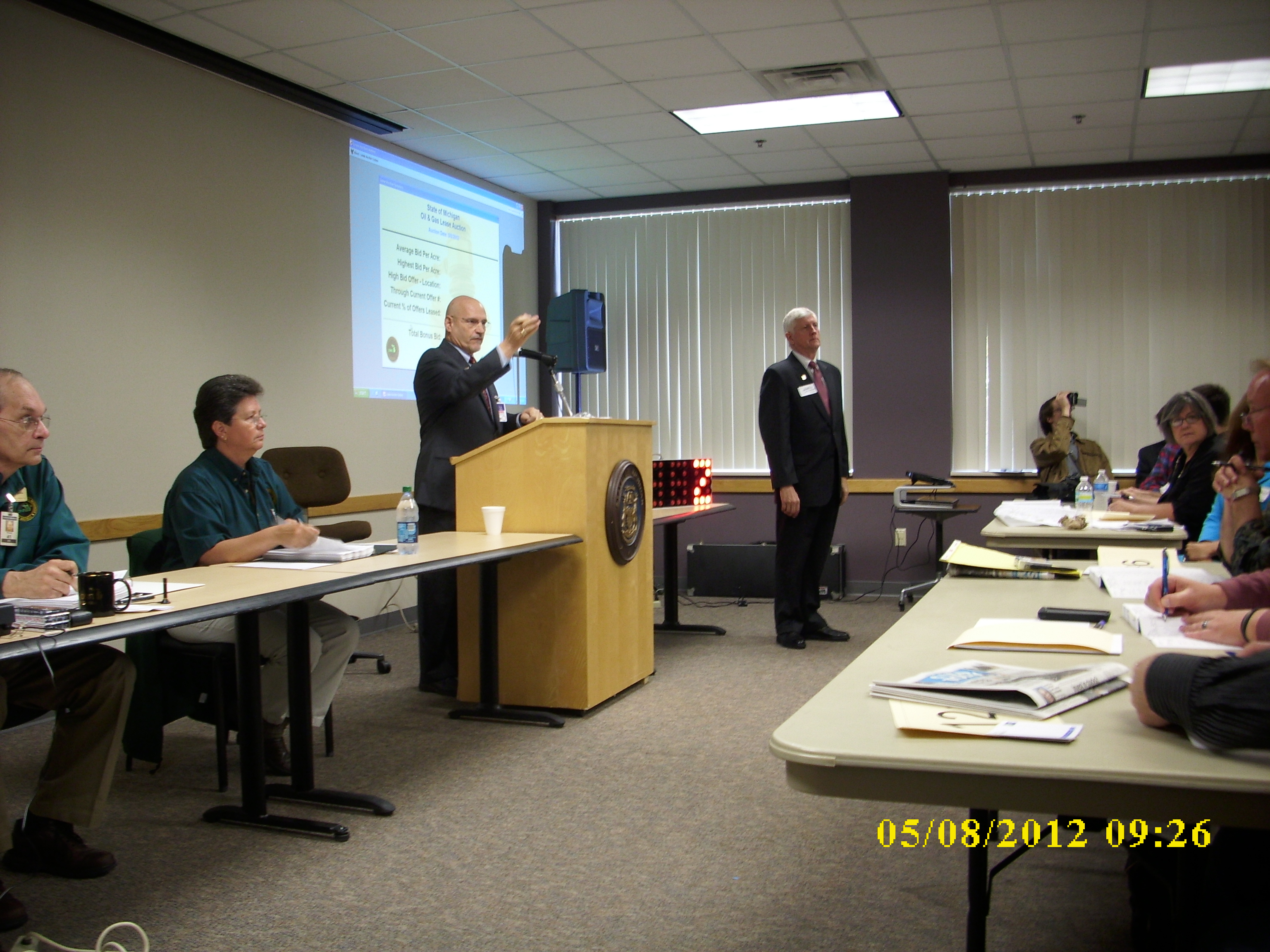
Though state auctions of mineral rights have occurred for decades, Mary Uptigrove of the DNR Mineral Management Division, when asked if the twice-yearly auctions usually drew much public attention, said she had never seen anything like the May 8 protest. “No, nothing like this, and I’ve been here for nine years.” Auctioneer Bob Howe of Sheridan Realty & Auction Co. agreed, noting that two years ago the MDNR had the largest auction ever in terms of money taken in, with a record $178 million for less acreage than the current May 2012 auction, which earned $3.5 million. The difference? Two years ago there was a frenzy of speculation, and our state legislators have obviously been hard at work, paving the way for the “natural gas renaissance [that] is upon us.”
The auctioneer progressed through the first few ‘A’ counties: Alpena, Antrim, and Arenac, rather quickly after some tense moments when over half of us who took seats around the perimeter of the room – 3-4 writers and videographers and about 20-30 members of the public – were forced to vacate our seats. Twenty-five minutes before the auction began, DNR staff claimed there was no room for anyone but registered bidders. I held up my press pass, explaining that I had called to verify that press would be allowed to attend this “open” meeting, but was again told to leave the room due to the 60-person capacity.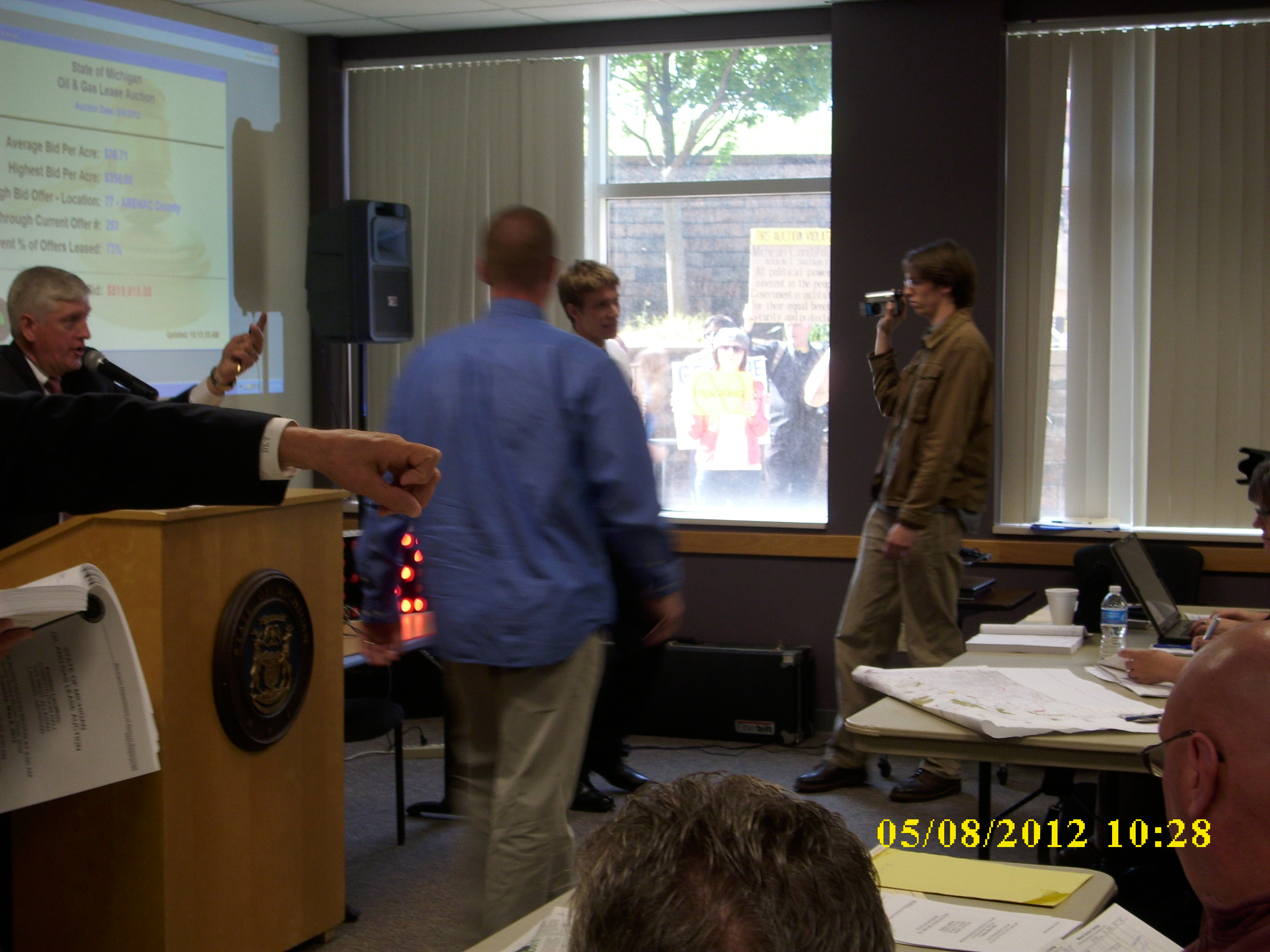
Many of us registered as bidders and re-entered the room. Others gathered outside the auction room’s open door (presumably to maintain the meeting’s “open” status) making noise. “But this is wrong,” one woman’s voice projected over the opening bids. “This is supposed to be a public meeting and they’re auctioning off public land. Isn’t there anything we can do to stop this?”
When Barry County came up to bid, protestors who had been in the building’s lobby moved into the walled courtyard outside the lower-level auction room, pounding on makeshift drums, chanting anti-fracking chants, and banging on the windows as the auctioneer prattled on and bidders continued to bid, though alertness levels definitely rose.
Amid continuous chanting and glimpses of protestors and their colorful signs through the windows (before one of the auctioneers pulled the blinds closed), a young man in a suit was the first to stand up. 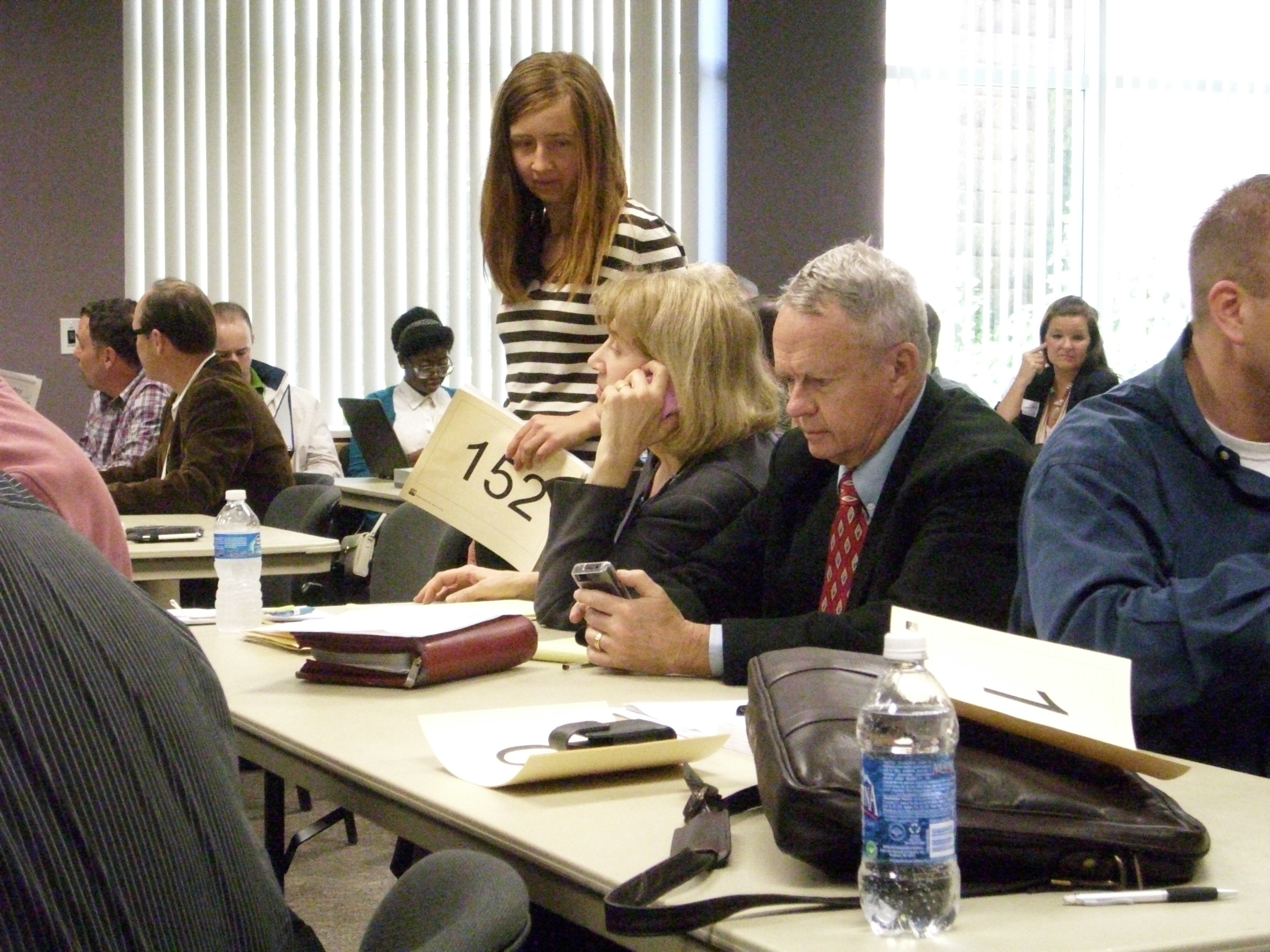
Walking to the windows and pulling back the blinds, he said, “What are they doing out there?” calling attention to the protestors. “Wait,” he said as the one uniformed DNR officer in the room at that point pulled him away. “What are they doing?” As he was escorted out in front of the bidders’ tables, he called out, “What are you doing selling off Yankee Springs?”
A few moments later, a second young man in a dress shirt and tie strode in front of the auctioneer to say, “We don’t believe in the myth of safe fracking. Fracking will poison the water.”
More security came in stages as more protestors entered the room, forced to register as bidders in order to be admitted. The auctioneer’s auction-calling and the “Ho!” and “Here!” bid acknowledgments from his assistants were accompanied by a steady stream of noise from the protestors outside, who were eventually observed but not interfered with by several Lansing police officers.
Debra Grodan Olson, a Michigan lawyer with strong ties to the Circle Pines Center in Delton registered as a bidder, hoping to save several 40-acre parcels up for bid near Circle Pines, an educational recreation and retreat center focused on peace, social justice, and environmental stewardship. In a late-night letter to Governor Snyder, Olson expressed “concern for the values – ecological, wildlife, water, riparian, property, and community – at stake and threatened by the leasing of mineral rights for state lands, wetlands, creeks, streams, and lakes” all treasured, she noted, “far beyond any return the state might expect from selling lease rights to these lands.” Her auction-day goal, knowing she was unable to save all of Yankee Springs, was to prevent the land and lakes near Circle Pines from being drilled under.
As the parcels within Yankee Springs Recreation Area went up for bid, it was clear that Olson’s presence made a difference. Bidder #124 (bidders were identified by numbered cards) routinely opened the bidding at $30 per acre – above the $12 minimum – and it was clear that he was willing to go up to $375 and $380 per acre whenever Olson or occasionally others cross bid. In the end, he made an all-out sweep across Yankee Springs as more protestors rose.
One young man jumped up on an auction table, calling out as two DNR Officers approached him. “This theft of public land is a short term fix for the companies that created our energy crisis. The extraction process poisons our water and air. You will not succeed.”
Only one protestor was arrested for disrupting the auction, though his repeated verbal comment: “We’ve got every right to be here,” came in direct response to a bidder from the opposite side of the room who, conversing back and forth with the auctioneer, chuckled through a complaint: “If you keep these guys out of the room, we’ll be fine.”
The tension and excitement of Olson’s cross bidding came to an end as she packed up to leave, and the last few parcels went quietly unopposed at the $12 per acre minimum. All but one or two of two hundred eleven 40-to-160-to-200-acre parcels of Barry County’s public land went to two bidders – Rich Patterson of Meridian Land & Energy and Amos Fowler of Pteradon Energy – most of them for $12 to $30 to $60 per acre.
One of the last protestors to stand up for Barry County, a young woman, walked up the center aisle clapping her hands together in broad strokes as she chanted, “How about that Hal Fitch. How about that Hal Fitch.” I understood and appreciated her reference to MDEQ’s Director of Oil, Gas, and Minerals and her nod to the Department’s lack of protection of public land. But as we left Barry County and the drums subsided and the stand-up disruptions ceased, I gave in to grief.
One of the most beautiful places in the world – to me, anyway, after three years of hiking Yankee Springs’ trails – had fallen to the F-bomb of all F-bombs: Fracking. For three winters I had dedicated my Sundays to watching the snow fall over Deep Lake or drifting silently in the silver-green air of the Pine Grove. I had ushered in each spring with the Long Lake boardwalk where mounds of new soil bulge above the water and sprout with ferns and ivy and tiny new flowers.
No matter how much we cared or researched or hoped to stop public lands from oil and gas development, Yankee Springs and the equally treasured Lake Orion rec area in Oakland county were “won” by the oil and gas industry – along with land just as important to locals in 21 other counties. It was tempting to believe that none of it – the shouting and the art and the bidders who tried to save the land – did any good. But of course it did.
One hundred people witnessed, made statements, and were escorted out by armed conservation officers. A few of us stayed to the bitter end, watching previously passed-on parcels go up for bid at $6 per acre instead of the first-round minimum of $12 (Talk about grief!).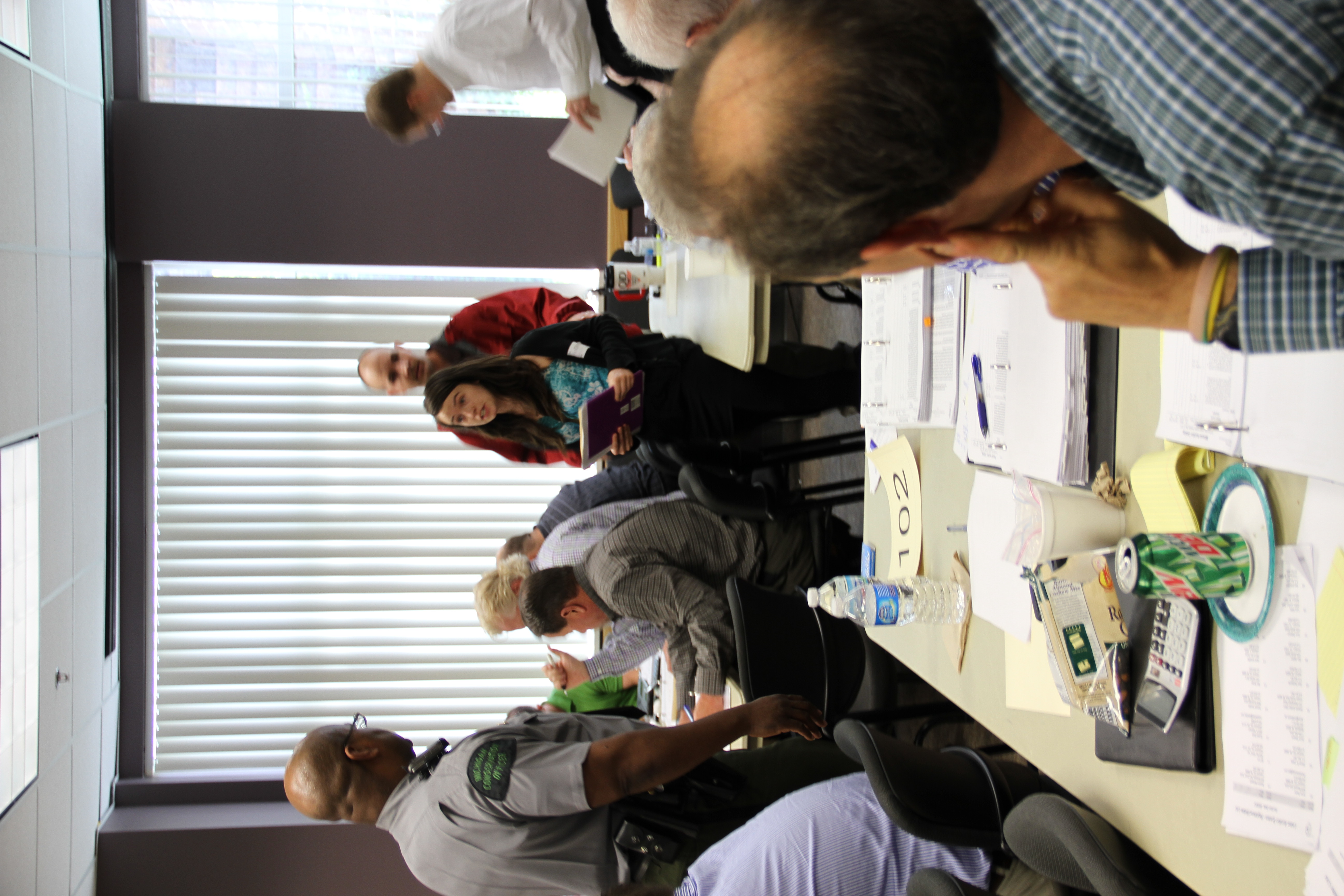
There was a resurgence that kept us going when Oakland County’s recreation areas came up to bid. The drumming and chanting returned and more protestors rose at key moments. One dark haired young woman stood and said in a quietly penetrating voice: “This is my homeland. You are poisoning the water for our children and grandchildren. For your own children and grand children.” And as she willingly turned toward the door with her officer escort, she said, “Ban fracking now,” and it hung in the air.
Still, our outrage at the future damage to landscapes and ecosystems that comes with the distributed industrialization of fracking did not stop the industrializers from winning. So what next?
We form a people’s movement to ban fracking. We bypass Michigan legislators and the Big Greens – environmental organizations such as The National Resources Defense Council and the Sierra Club and the Clean Water Action Council –groups that support frack reform bills which rely on what New York environmental activist and writer Robert Jereski terms “Regulationism: an undue faith in the promise of regulating a noxious processes that distracts from the need to stop it.”
In Michigan, reform bills call for a moratorium, but only within two specific geological layers, the Utica and Collinwood shale layers; they call for a fracking panel to study the safety of hydraulic fracturing with industry funding and participation (green washing and junk science, anyone?). And in the greatest hypocrisy of regulationism, newly introduced House Bill 5565, touted as the bill that will finally require frackers to disclose the chemicals used in the fracking process (the industry has been exempt from regulation and disclosure of “trade secret” chemicals since 2005), HB 5565 actually devotes 2/3rds of its language to detailing the process the industry will use to continue to keep chemicals secret. (Section 61535 sets up conditions for withholding chemical identities.) What’s worse: the bill requires healthcare providers to sign a confidentiality statement, a “gag” order, before receiving chemical data needed to treat their patients (Section 61537).
And House Bill 5565 is touted as stronger regulation? Thanks, but no thanks. Who needs more regulation when it is clear that regulating the gas and oil industry, and fracking in particular, means more secrecy and exemption. “Safe fracking” is a myth which subjects us, reform bill after reform bill, to what Jereski (regulationism) refers to as “the tyranny of low expectation.”
About that Bypass: Let’s Ban Fracking – A Ballot Initiative to Ban Fracking in Michigan
At the protest on May 8, petitioners introduced the public to a new state-wide ballot initiative to ban horizontal hydraulic fracturing in Michigan. A ballot initiative drafted by the most grass roots of grass roots efforts, a committee of people from around the state who were galvanized by the Michigan DNR’s auction of entire recreation areas and by the Michigan Natural Gas Subcommittee’s recommendation that the State employ all sorts of unconventional oil and gas extraction methods on all remaining public land.
Germany, France, and Bulgaria did it, and so did Vermont, when that state’s legislators passed a ban on fracking on May 4. Now the Committee to Ban Fracking in Michigan (http://letsbanfracking.org) is hoping that Michigan will be the first to offer the people the chance to decide whether or not we will allow fracking and its industrializing force to spread across the Great Lakes State.
As the Committee’s Press Release states, “petitioners are required to submit 322,609 valid signatures from Michigan voters by July 9 to the Bureau of Elections in order to place the proposed amendment on the ballot in November.”
The petition reads: “A proposal to amend the Constitution by adding a new Section 28 to Article I to read as follows:
To insure the health, safety, and general welfare of the people, no person, corporation, or other entity shall use horizontal hydraulic fracturing in the State. ‘Horizontal hydraulic fracturing’ is defined as the technique of expanding or creating rock fractures leading from directional wellbores, by injecting substances including but not limited to water, fluids, chemicals, and proppants, under pressure, into or under the rock, for purposes of exploration, drilling, completion, or production of oil or natural gas. No person, corporation, or other entity shall accept, dispose of, store, or process, anywhere in the State, any flowback, residual fluids, or drill cuttings used or produced in horizontal hydraulic fracturing.”
To Sign or Circulate the Petition:
To find a location where you can sign the petition (it must be signed in person) or to contact a city, county, or area coordinator, go to the Let’s Ban Fracking website. Click on “Volunteer” to view a list of area coordinators. See “Events” for a list of signing events.
Note: This is not an online petition. Public pressure petitions gather signatures online, often linked to emails from environmental organizations that use strong words such as “Fracking must stop!” Online petitions serve only one purpose. They are sent to legislators to put pressure on them to respond with legislation. Here in Michigan, where legislators have recommended that all 5.3 million acres of our remaining public land be “used” for oil and gas extraction, public pressure will fall on frack-hungry ears.
Author Bio:
Maryann Lesert is an author and Associate Professor of English at Grand Rapids Community College, researching fracking for an environmental writing project. She belongs to Ban Michigan Fracking (www.banmichiganfracking.org), an educational organization working toward local and statewide bans on hydraulic fracturing.
Hyperlinked Sources:
The U.S. House Energy & Commerce Committee Report, April 2011, “Chemicals Used In Hydraulic Fracturing.” PDF. 14 pgs. See List of 29 Known Carcinogens, Safe Drinking Water Act Contaminants, and Hazardous Air Pollutants, pg. 10.
The Michigan House of Representatives Natural Gas Subcommitee Report on Energy and Job Creation, April 2012. PDF. 26 pages. See; Conclusion & Recommendations, pgs. 20-22.
http://gophouse.com/Publications/80/NaturalGasReport2012.pdf
House Bill No. 5565, Introduced by Reps. Brown, Bledsoe, Lipton, Bauer, Tlaib and Byrum, April 24, 2012. A bill to amend 1994 PA 451, entitled “Natural resources and environmental protection act,”(MCL 324.101 to 324.90106) by adding sections 61506d, 61531, 61532, 61533, 61534, 61535, 61536, and 61537.
http://www.legislature.mi.gov/documents/2011-2012/billintroduced/House/pdf/2012-HIB-5565.pdf
Website for the Committee to Ban Fracking in Michigan.
Educational Website for Ban Michigan Fracking.
Battle over fracking in Ohio coming in June

Next month activists in Ohio will be mobilizing at their state capitol to pass legislation to ban fracking. There are activist from Michigan who will be participating out of solidarity, since they know that Michigan is also a battle-ground on the issue of fracking.
Don’t Frack Ohio is a mass mobilization to stop fracking in Ohio. On June 17th we’ll take over the statehouse in Columbus to hold a people’s assembly to pass the legislation that Ohioans need to protect against the fracking industry.
From June 14th to 16th we’ll be meeting in Columbus to build a stronger anti-fracking movement in Ohio with trainings, strategy sessions and meetups led by local organizers and 350.org trainers.
Go to this link to sign up for the upcoming June action to ban fracking in Ohio.
 Grand Rapids Institute for Information Democracy